

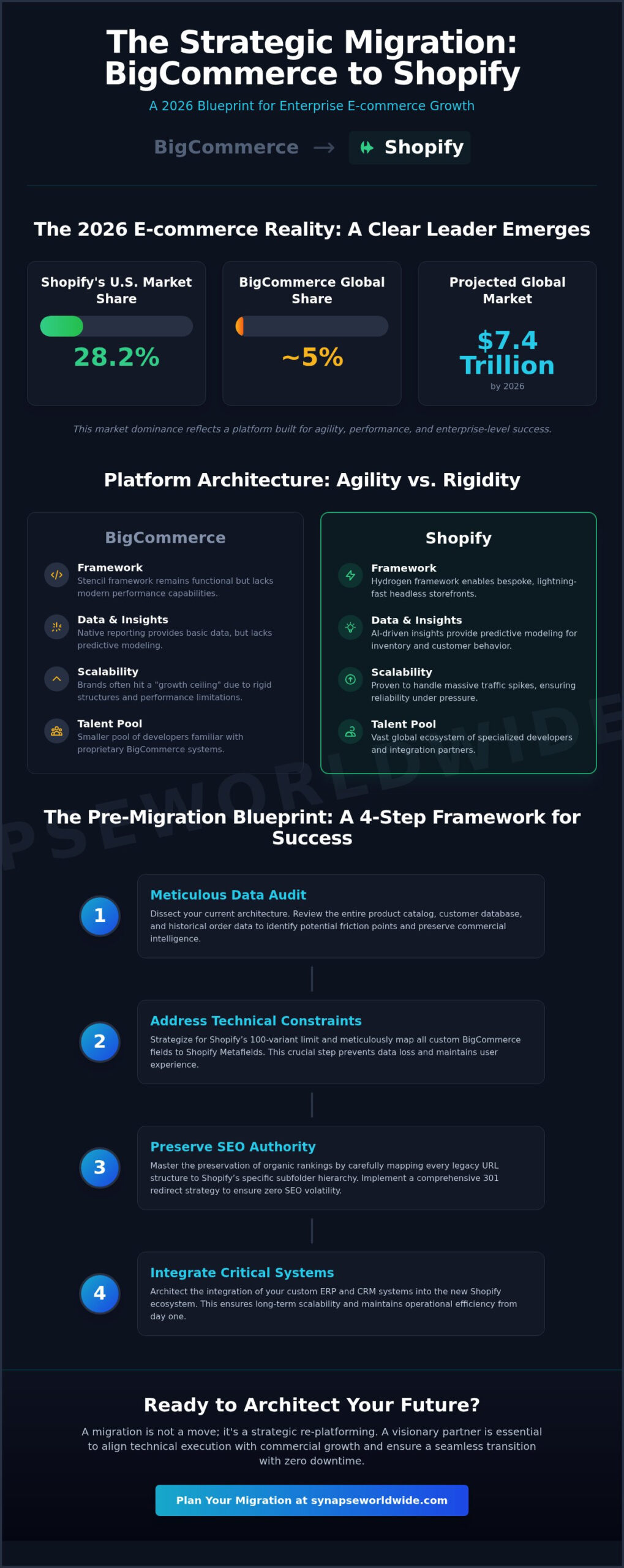
A migration is not a move; it’s a strategic re-platforming that requires a visionary architect to align technical data with commercial growth. With Shopify now commanding 28.2% of the U.S. e-commerce market, the decision to execute a BigCommerce to Shopify migration is often the catalyst for a brand’s next decade of success. However, the fear of losing ten years of order history or mismanaging 301 redirects keeps many high-growth merchants tethered to legacy systems even when scalability is at stake.
You’ve likely spent years refining your current ecosystem, and the anxiety surrounding complex ERP integrations or potential SEO volatility is entirely valid. This article provides a sophisticated framework to master these complexities, designed to preserve your hard-earned authority while accelerating revenue through improved site speed and conversion rates. We’ll preview a strategic architecture for a seamless transition with zero downtime, ensuring your digital presence is built to scale within the $7.4 trillion global e-commerce market of 2026.
Key Takeaways
- Understand why mid-market leaders are shifting to Shopify Plus in 2026 for greater agility and how to evaluate the total cost of ownership beyond base subscription fees.
- Learn to navigate technical hurdles like Shopify’s variant limits while conducting a meticulous data audit of your historical order entities and customer profiles.
- Master the preservation of organic rankings during a bigcommerce to shopify migration by mapping legacy URL structures to Shopify’s specific subfolder hierarchy.
- Discover the architectural shift from BigCommerce themes to high-performance Shopify frameworks to ensure your storefront is optimized for 2026 speed and conversion standards.
- Identify the critical steps to integrate custom ERP and CRM systems into your new ecosystem to ensure long-term scalability and operational efficiency.
Strategic Evaluation: Why Enterprise Brands are Moving to Shopify in 2026
The global e-commerce market is projected to reach $7.4 trillion in 2026, and the architectural choices you make today will determine your share of that growth. While BigCommerce has long positioned itself as an “open-SaaS” alternative, the reality of the 2026 landscape shows a significant shift. Shopify now commands 27.6% of the global market share, while BigCommerce holds approximately 5%. This isn’t merely a popularity contest; it’s a reflection of which platform provides the agility required for mid-market and enterprise success. A bigcommerce to shopify migration has become the standard move for brands that have outgrown the rigid structures of their current environment.
Enterprise leaders often encounter a “growth ceiling” when their platform can’t keep pace with rapid expansion. BigCommerce’s native features, while robust, often lack the modular flexibility of Shopify’s ecosystem. When you analyze the Total Cost of Ownership (TCO), the conversation shifts from simple subscription fees to the cost of innovation. Shopify’s move toward headless commerce through the Hydrogen framework has redefined performance. While BigCommerce’s Stencil framework remains functional, Hydrogen allows for bespoke, lightning-fast storefronts that significantly outperform traditional architectures. You can see how these technical philosophies differ in any neutral Comparison of shopping cart software, where Shopify’s focus on developer experience and front-end speed consistently ranks higher for modern retail needs.
Comparing Platform Agility and Innovation
In 2026, data is the most valuable asset in your stack. Shopify’s AI-driven insights now provide predictive modeling for inventory and customer behavior that outclasses BigCommerce’s native reporting. For Australian exporters, the global-first checkout experience is a non-negotiable requirement. Shopify’s ability to handle massive traffic spikes during flash sales without performance degradation ensures that your brand remains reliable under pressure. This level of stability is why a bigcommerce to shopify migration is seen as a risk-mitigation strategy for high-volume merchants.
The Ecosystem Advantage
The depth of the Shopify App Store provides a level of customization that the BigCommerce Marketplace struggles to match. This ecosystem extends beyond software to human capital. In Australia, the availability of specialized Shopify developers far outweighs those familiar with BigCommerce’s proprietary systems. This talent pool makes it easier to execute a sophisticated digital marketing strategy that integrates seamlessly with your backend. By moving to Shopify, you aren’t just changing your store’s engine; you’re connecting your business to a global infrastructure designed for high-performance commerce and long-term ROI.
The Pre-Migration Blueprint: Auditing Data and Technical Constraints
Success in a bigcommerce to shopify migration isn’t found in the execution phase; it’s won during the audit. Before a single product moves, you must dissect your current data architecture to identify potential friction points. This involves a comprehensive review of your product catalog, customer database, and decade-long order history. One of the most significant technical constraints is Shopify’s 100-variant limit per product. While BigCommerce allows for more expansive variant structures, Shopify requires a more disciplined approach. You’ll need to decide whether to restructure your product taxonomies or implement a third-party solution to bypass this limit without compromising the user experience.
Mapping custom fields and metadata is equally critical. BigCommerce’s flexible data fields must be meticulously translated into Shopify Metafields to ensure no commercial intelligence is lost. As noted in the U.S. Small Business Administration guide to selling online, choosing the right hosted platform requires understanding how these technical nuances align with your specific business model. For Australian enterprises, this audit must also account for local nuances like GST configurations and regional shipping API integrations that may differ between platforms. If you’re unsure how your current integrations will behave, consulting with an expert in e-commerce development can prevent costly mid-migration surprises.
Data Sanitization and Mapping
Migrating every piece of legacy code is a recipe for technical debt. We focus on cleaning “ghost” data, which includes orphaned scripts and redundant tags that serve no purpose in your new environment. Standardizing your product taxonomies now will improve Shopify’s collection logic later, making your site more intuitive for customers. This phase also ensures your customer data remains compliant with the Australian Privacy Act, protecting your brand’s reputation and legal standing during the transition.
Technical Infrastructure Review
Your migration will inevitably impact existing custom software development projects. We evaluate API rate limits to ensure high-volume data transfers don’t throttle your operations or desync your ERP and CRM systems. A common hurdle is the “Customer Password” issue. Because Shopify cannot import encrypted passwords from BigCommerce, you’ll need a strategic re-engagement campaign to invite customers to activate their new accounts. This is an opportunity to refresh your relationship with your database rather than a technical setback.
Executing the Data Transfer: Ensuring Integrity and SEO Continuity
Execution is the moment of truth in a bigcommerce to shopify migration. While automated “wizards” promise a one-hour transition, these tools often overlook the nuanced architectural requirements of an enterprise-level store. A sophisticated move requires a phased approach, beginning with a robust sandbox environment. Testing your data in a staging area allows you to validate product relationships and customer records before the live production push. This disciplined methodology prevents the technical debt that usually follows a rushed, automated import.
Maintaining your organic search equity is the most critical commercial priority during this phase. BigCommerce typically uses a .html suffix for URLs, whereas Shopify employs a rigid subfolder structure for products and collections. As highlighted in the Forbes Advisor comparison of Shopify and BigCommerce, the technical transition requires more than just moving files; it requires a deep understanding of how each platform handles search visibility. You must execute a precise 301 redirect strategy to map every legacy URL to its new Shopify equivalent. Failing to do so results in immediate 404 errors and a catastrophic loss of ranking power that can take months to recover.
The SEO Migration Framework
Your URL map must be comprehensive. We transition your legacy structure into Shopify’s handle-based system while preserving essential metadata and Alt-text. The long-term success of seo for small business and enterprise brands alike depends on this meticulous data preservation. Once the DNS propagation window opens, we conduct real-time monitoring of indexing status. Immediate post-launch crawl audits allow us to identify and fix broken internal links before search engines devalue your pages. For Australian merchants, this also includes verifying that GST-inclusive pricing and local courier API keys are correctly mapped to avoid checkout friction on day one.
Data Migration Execution
We utilize the BigCommerce API to extract high-fidelity product data, ensuring that complex attributes and custom fields remain intact. Migrating historical order data is not just about record-keeping; it’s essential for accurate Lifetime Value (LTV) reporting in your new Shopify dashboard. During the final switch, we perform a delta sync of inventory levels. This ensures that your stock counts are accurate to the second, preventing overselling during the high-traffic window when your new site goes live. This level of precision is what separates a visionary architectural rebuild from a standard data dump.
Beyond the Move: Rebuilding Your Digital Infrastructure for Performance
A bigcommerce to shopify migration provides the ideal moment to shed technical debt and modernize your digital storefront. A common misconception among enterprise leaders is that an existing theme can simply be “ported” from one platform to another. This is technically impossible. BigCommerce utilizes the Stencil framework, while Shopify relies on Liquid or the React-based Hydrogen framework. This incompatibility is actually a strategic advantage, allowing you to rebuild your storefront for superior speed, accessibility, and conversion without the constraints of legacy code.
For enterprise-grade performance in 2026, the choice between Liquid and Hydrogen is pivotal. Liquid remains a robust, highly efficient templating system for most merchants. However, for those seeking a true competitive edge, Shopify’s Hydrogen framework provides a headless architecture that delivers near-instant load times and total creative freedom. This architectural shift is complemented by Shopify Markets, which simplifies international expansion. Unlike the fragmented multi-storefront approach often required in legacy setups, Shopify Markets allows you to manage multi-currency and localized experiences from a single, centralized backend.
UI/UX Transformation
Modular content management is now the industry standard. Shopify’s Online Store 2.0 features allow your marketing team to manage complex layouts and sections without constant developer intervention. In 2026, a mobile-first design isn’t a suggestion; it’s a mandatory requirement for both search visibility and user retention. We focus on designing for high-intent mobile users, implementing AI-driven product recommendations and personalized search features that anticipate customer needs. This transformation ensures your new storefront isn’t just a copy of the old one, but a high-performance sales engine.
Backend Automation and Connectivity
Operational efficiency is the final pillar of your new digital infrastructure. We utilize Shopify Flow to automate repetitive administrative tasks, ranging from inventory alerts to sophisticated customer tagging. This automation extends to your supply chain, ensuring seamless data flow between the storefront and Australian logistics providers. When off-the-shelf apps cannot solve unique business logic, we build custom middleware to bridge the gap. This level of connectivity ensures your CRM and ERP solutions are fully synchronized with your storefront, providing a single source of truth for your commercial data.
Ready to architect a scalable future for your brand? Explore our custom e-commerce development solutions to ensure your migration delivers maximum ROI.
Scaling Your New Ecosystem: Why a Strategic Partner is Essential
Re-platforming is only the beginning of your brand’s next chapter. While many merchants view a bigcommerce to shopify migration as a one-time technical chore, treating it as such often leads to missed commercial opportunities. The market is flooded with “cheap” automated migration apps that promise a quick fix. These tools frequently ignore complex data relationships and nuanced SEO requirements, leading to expensive technical debt that your team will spend months untangling. A strategic partner like Synapse Worldwide acts as a visionary architect, ensuring your technical infrastructure aligns with your high-level commercial objectives from the very first day.
At Synapse Worldwide, we don’t just move data; we build for long-term ROI. This involves a deep commitment to post-migration stability and performance. Once your new storefront is live, the focus shifts toward continuous optimization and rigorous security maintenance. By treating the platform as a living ecosystem, you can leverage Shopify’s robust features for aggressive ecommerce growth. This proactive stance ensures your business remains agile enough to pivot as market conditions evolve.
Long-Term Strategic Partnership
A successful transition moves your business from simple implementation to true innovation. We manage your technical roadmap, ensuring that new features and integrations are deployed strategically rather than reactively. Our approach at Synapse Worldwide includes quarterly performance audits to ensure your Shopify store remains a high-performance growth engine. You also gain access to specialized Australian technical expertise. This local perspective is invaluable for complex troubleshooting and ensuring your store remains compliant with regional regulations and consumer expectations. We bridge the gap between technical execution and business strategy, positioning you as a leader in your vertical.
Maximising your ROI
Your new platform is a powerful tool, but its value is maximized when integrated with a broader commercial strategy. We align your new storefront with sophisticated ppc management services to drive high-intent traffic immediately after launch. By using data-driven insights from the Shopify dashboard, Synapse Worldwide helps you refine your product offerings and marketing spend based on actual customer behavior. This holistic view ensures that your bigcommerce to shopify migration isn’t just a change of scenery, but a fundamental upgrade to your business’s earning potential.
Ready to transform your e-commerce presence? Consult with our architects at Synapse Worldwide today to build a digital future that scales with your ambition.
Architecting Your Future in Digital Commerce
Transitioning your digital storefront is more than a technical update; it’s a foundational shift toward sustained profitability. By prioritizing a meticulous data audit and a robust SEO preservation strategy, you ensure that your brand’s historical authority remains intact while gaining the agility of the Shopify ecosystem. We’ve explored how a strategic bigcommerce to shopify migration allows you to rebuild your theme for 2026 performance standards and integrate complex backend systems that drive operational efficiency.
Success in this high-stakes environment requires a partner who understands the intricate balance between technical detail and commercial vision. With over 20 years of enterprise experience, Synapse Worldwide specializes in complex custom ERP and CRM integrations, ensuring your new architecture is as functional as it is fast. We provide a fixed-price project guarantee to offer the certainty your business demands during this transformation.
The global market waits for those ready to lead. Partner with Synapse Worldwide for a Seamless Shopify Migration and let’s build a digital presence that doesn’t just keep up, but sets the pace for your industry. Your next level of growth starts with a single, strategic decision today.
Frequently Asked Questions
Can I migrate my BigCommerce theme directly to Shopify?
No, you cannot migrate a BigCommerce theme directly because the platforms use entirely different coding languages. BigCommerce stores are built on the Stencil framework, while Shopify utilizes Liquid or the React-based Hydrogen framework. This transition requires a complete rebuild of your storefront, which provides a strategic opportunity to optimize your UI/UX for 2026 conversion standards and mobile-first performance.
Will my search engine rankings drop after moving from BigCommerce to Shopify?
Your search engine rankings won’t drop if you execute a precise SEO preservation strategy. The primary risk during a bigcommerce to shopify migration is the loss of URL equity due to different subfolder structures. By meticulously mapping 301 redirects and preserving all metadata, you can maintain your organic search authority. We monitor indexing status in real-time during the DNS propagation window to catch and fix any crawl errors immediately.
How long does a professional BigCommerce to Shopify migration typically take?
A professional migration typically takes between 4 to 16 weeks depending on the complexity of your data and integrations. A simple store with a small catalog might be ready in a month, while enterprise-level migrations involving custom ERP or CRM integrations can span several months. This timeline includes the audit, sandbox testing, theme development, and the final production push to ensure zero downtime.
Can I migrate my customer passwords to the new Shopify store?
No, customer passwords cannot be migrated because they’re encrypted for security on both platforms. Shopify cannot read the encryption used by BigCommerce. To resolve this, we implement a strategic re-activation campaign where customers are invited to set a new password on your new store. This is a perfect opportunity to re-engage your database with a “welcome to our new home” incentive.
What happens to my blog posts and content pages during migration?
Blog posts and static content pages are fully migratable to Shopify to ensure your content marketing history remains intact. We extract the HTML content, images, and metadata from your BigCommerce blog and map them to Shopify’s blogging engine. This process ensures that your internal linking structure and long-form content continue to support your SEO goals without manual re-entry.
How do I handle BigCommerce products that have more than 100 variants?
You must either restructure your product architecture or utilize a specialized app to bypass Shopify’s 100-variant limit. While BigCommerce is more flexible with variants, Shopify requires a more disciplined data model. We often solve this by splitting complex products into separate listings linked via swatches or by implementing custom middleware that manages extended variant options without degrading site speed.
Is it possible to migrate my historical order data for tax and reporting purposes?
Yes, migrating historical order data is possible and highly recommended for accurate tax compliance and customer lifetime value (LTV) reporting. We use the BigCommerce API to extract high-fidelity order records, including line items, customer details, and discount applications. This ensures your Shopify backend serves as a single source of truth for your entire commercial history.
Do I need to pause my sales during the migration process?
You don’t need to pause your sales during the bigcommerce to shopify migration process. We build and test your new Shopify store in a sandbox environment while your BigCommerce store remains live and functional. A final “delta sync” is performed just before the DNS switch to capture any orders or customer updates that occurred during the build phase. This ensures a seamless transition with zero downtime for your customers.

