
Tag Archives: seo


BigCommerce to Shopify Migration: The 2026 Strategic Architecture for Scalable Growth

BigCommerce to Shopify Migration: The 2026 Strategic Architecture for Scalable Growth

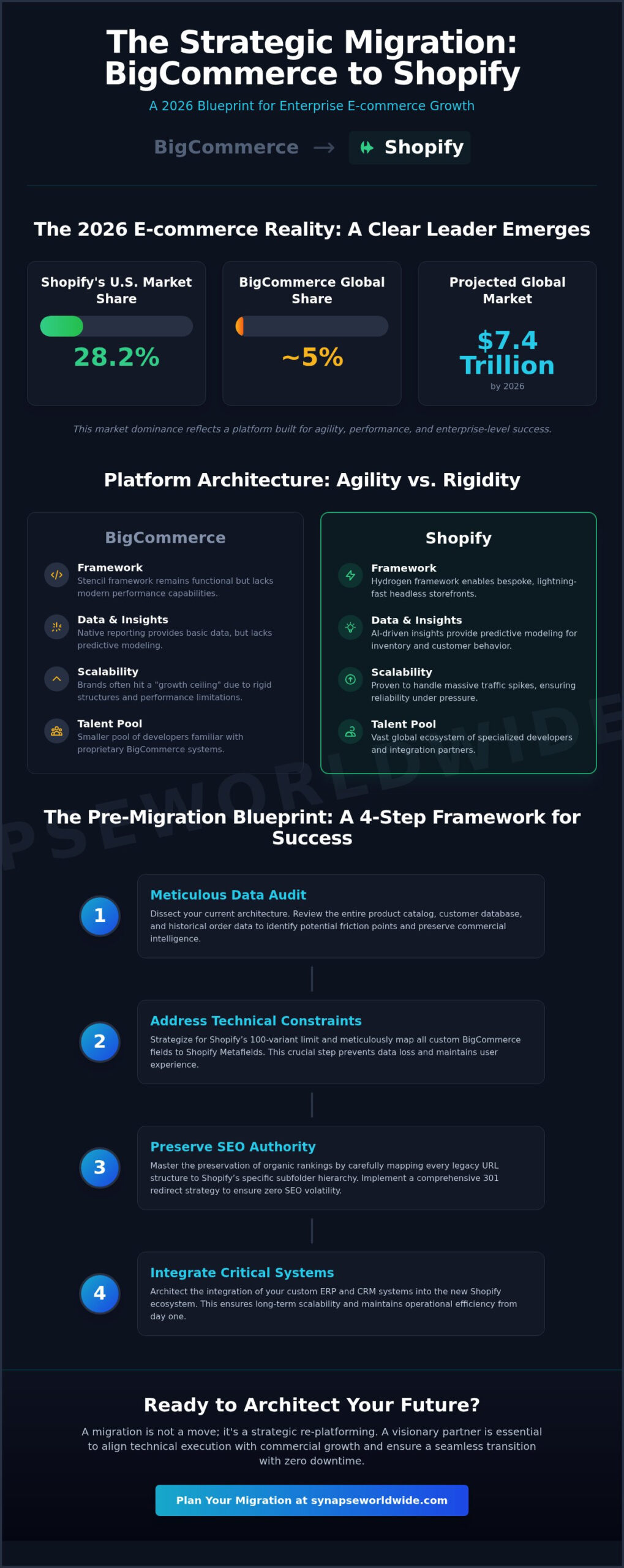
A migration is not a move; it’s a strategic re-platforming that requires a visionary architect to align technical data with commercial growth. With Shopify now commanding 28.2% of the U.S. e-commerce market, the decision to execute a BigCommerce to Shopify migration is often the catalyst for a brand’s next decade of success. However, the fear of losing ten years of order history or mismanaging 301 redirects keeps many high-growth merchants tethered to legacy systems even when scalability is at stake.

You’ve likely spent years refining your current ecosystem, and the anxiety surrounding complex ERP integrations or potential SEO volatility is entirely valid. This article provides a sophisticated framework to master these complexities, designed to preserve your hard-earned authority while accelerating revenue through improved site speed and conversion rates. We’ll preview a strategic architecture for a seamless transition with zero downtime, ensuring your digital presence is built to scale within the $7.4 trillion global e-commerce market of 2026.

Key Takeaways

  • Understand why mid-market leaders are shifting to Shopify Plus in 2026 for greater agility and how to evaluate the total cost of ownership beyond base subscription fees.
  • Learn to navigate technical hurdles like Shopify’s variant limits while conducting a meticulous data audit of your historical order entities and customer profiles.
  • Master the preservation of organic rankings during a bigcommerce to shopify migration by mapping legacy URL structures to Shopify’s specific subfolder hierarchy.
  • Discover the architectural shift from BigCommerce themes to high-performance Shopify frameworks to ensure your storefront is optimized for 2026 speed and conversion standards.
  • Identify the critical steps to integrate custom ERP and CRM systems into your new ecosystem to ensure long-term scalability and operational efficiency.

Strategic Evaluation: Why Enterprise Brands are Moving to Shopify in 2026

The global e-commerce market is projected to reach $7.4 trillion in 2026, and the architectural choices you make today will determine your share of that growth. While BigCommerce has long positioned itself as an “open-SaaS” alternative, the reality of the 2026 landscape shows a significant shift. Shopify now commands 27.6% of the global market share, while BigCommerce holds approximately 5%. This isn’t merely a popularity contest; it’s a reflection of which platform provides the agility required for mid-market and enterprise success. A bigcommerce to shopify migration has become the standard move for brands that have outgrown the rigid structures of their current environment.

Enterprise leaders often encounter a “growth ceiling” when their platform can’t keep pace with rapid expansion. BigCommerce’s native features, while robust, often lack the modular flexibility of Shopify’s ecosystem. When you analyze the Total Cost of Ownership (TCO), the conversation shifts from simple subscription fees to the cost of innovation. Shopify’s move toward headless commerce through the Hydrogen framework has redefined performance. While BigCommerce’s Stencil framework remains functional, Hydrogen allows for bespoke, lightning-fast storefronts that significantly outperform traditional architectures. You can see how these technical philosophies differ in any neutral Comparison of shopping cart software, where Shopify’s focus on developer experience and front-end speed consistently ranks higher for modern retail needs.

Comparing Platform Agility and Innovation

In 2026, data is the most valuable asset in your stack. Shopify’s AI-driven insights now provide predictive modeling for inventory and customer behavior that outclasses BigCommerce’s native reporting. For Australian exporters, the global-first checkout experience is a non-negotiable requirement. Shopify’s ability to handle massive traffic spikes during flash sales without performance degradation ensures that your brand remains reliable under pressure. This level of stability is why a bigcommerce to shopify migration is seen as a risk-mitigation strategy for high-volume merchants.

The Ecosystem Advantage

The depth of the Shopify App Store provides a level of customization that the BigCommerce Marketplace struggles to match. This ecosystem extends beyond software to human capital. In Australia, the availability of specialized Shopify developers far outweighs those familiar with BigCommerce’s proprietary systems. This talent pool makes it easier to execute a sophisticated digital marketing strategy that integrates seamlessly with your backend. By moving to Shopify, you aren’t just changing your store’s engine; you’re connecting your business to a global infrastructure designed for high-performance commerce and long-term ROI.

The Pre-Migration Blueprint: Auditing Data and Technical Constraints

Success in a bigcommerce to shopify migration isn’t found in the execution phase; it’s won during the audit. Before a single product moves, you must dissect your current data architecture to identify potential friction points. This involves a comprehensive review of your product catalog, customer database, and decade-long order history. One of the most significant technical constraints is Shopify’s 100-variant limit per product. While BigCommerce allows for more expansive variant structures, Shopify requires a more disciplined approach. You’ll need to decide whether to restructure your product taxonomies or implement a third-party solution to bypass this limit without compromising the user experience.

Mapping custom fields and metadata is equally critical. BigCommerce’s flexible data fields must be meticulously translated into Shopify Metafields to ensure no commercial intelligence is lost. As noted in the U.S. Small Business Administration guide to selling online, choosing the right hosted platform requires understanding how these technical nuances align with your specific business model. For Australian enterprises, this audit must also account for local nuances like GST configurations and regional shipping API integrations that may differ between platforms. If you’re unsure how your current integrations will behave, consulting with an expert in e-commerce development can prevent costly mid-migration surprises.

Data Sanitization and Mapping

Migrating every piece of legacy code is a recipe for technical debt. We focus on cleaning “ghost” data, which includes orphaned scripts and redundant tags that serve no purpose in your new environment. Standardizing your product taxonomies now will improve Shopify’s collection logic later, making your site more intuitive for customers. This phase also ensures your customer data remains compliant with the Australian Privacy Act, protecting your brand’s reputation and legal standing during the transition.

Technical Infrastructure Review

Your migration will inevitably impact existing custom software development projects. We evaluate API rate limits to ensure high-volume data transfers don’t throttle your operations or desync your ERP and CRM systems. A common hurdle is the “Customer Password” issue. Because Shopify cannot import encrypted passwords from BigCommerce, you’ll need a strategic re-engagement campaign to invite customers to activate their new accounts. This is an opportunity to refresh your relationship with your database rather than a technical setback.
BigCommerce to Shopify Migration: The 2026 Strategic Architecture for Scalable Growth

Executing the Data Transfer: Ensuring Integrity and SEO Continuity

Execution is the moment of truth in a bigcommerce to shopify migration. While automated “wizards” promise a one-hour transition, these tools often overlook the nuanced architectural requirements of an enterprise-level store. A sophisticated move requires a phased approach, beginning with a robust sandbox environment. Testing your data in a staging area allows you to validate product relationships and customer records before the live production push. This disciplined methodology prevents the technical debt that usually follows a rushed, automated import.

Maintaining your organic search equity is the most critical commercial priority during this phase. BigCommerce typically uses a .html suffix for URLs, whereas Shopify employs a rigid subfolder structure for products and collections. As highlighted in the Forbes Advisor comparison of Shopify and BigCommerce, the technical transition requires more than just moving files; it requires a deep understanding of how each platform handles search visibility. You must execute a precise 301 redirect strategy to map every legacy URL to its new Shopify equivalent. Failing to do so results in immediate 404 errors and a catastrophic loss of ranking power that can take months to recover.

The SEO Migration Framework

Your URL map must be comprehensive. We transition your legacy structure into Shopify’s handle-based system while preserving essential metadata and Alt-text. The long-term success of seo for small business and enterprise brands alike depends on this meticulous data preservation. Once the DNS propagation window opens, we conduct real-time monitoring of indexing status. Immediate post-launch crawl audits allow us to identify and fix broken internal links before search engines devalue your pages. For Australian merchants, this also includes verifying that GST-inclusive pricing and local courier API keys are correctly mapped to avoid checkout friction on day one.

Data Migration Execution

We utilize the BigCommerce API to extract high-fidelity product data, ensuring that complex attributes and custom fields remain intact. Migrating historical order data is not just about record-keeping; it’s essential for accurate Lifetime Value (LTV) reporting in your new Shopify dashboard. During the final switch, we perform a delta sync of inventory levels. This ensures that your stock counts are accurate to the second, preventing overselling during the high-traffic window when your new site goes live. This level of precision is what separates a visionary architectural rebuild from a standard data dump.

Beyond the Move: Rebuilding Your Digital Infrastructure for Performance

A bigcommerce to shopify migration provides the ideal moment to shed technical debt and modernize your digital storefront. A common misconception among enterprise leaders is that an existing theme can simply be “ported” from one platform to another. This is technically impossible. BigCommerce utilizes the Stencil framework, while Shopify relies on Liquid or the React-based Hydrogen framework. This incompatibility is actually a strategic advantage, allowing you to rebuild your storefront for superior speed, accessibility, and conversion without the constraints of legacy code.

For enterprise-grade performance in 2026, the choice between Liquid and Hydrogen is pivotal. Liquid remains a robust, highly efficient templating system for most merchants. However, for those seeking a true competitive edge, Shopify’s Hydrogen framework provides a headless architecture that delivers near-instant load times and total creative freedom. This architectural shift is complemented by Shopify Markets, which simplifies international expansion. Unlike the fragmented multi-storefront approach often required in legacy setups, Shopify Markets allows you to manage multi-currency and localized experiences from a single, centralized backend.

UI/UX Transformation

Modular content management is now the industry standard. Shopify’s Online Store 2.0 features allow your marketing team to manage complex layouts and sections without constant developer intervention. In 2026, a mobile-first design isn’t a suggestion; it’s a mandatory requirement for both search visibility and user retention. We focus on designing for high-intent mobile users, implementing AI-driven product recommendations and personalized search features that anticipate customer needs. This transformation ensures your new storefront isn’t just a copy of the old one, but a high-performance sales engine.

Backend Automation and Connectivity

Operational efficiency is the final pillar of your new digital infrastructure. We utilize Shopify Flow to automate repetitive administrative tasks, ranging from inventory alerts to sophisticated customer tagging. This automation extends to your supply chain, ensuring seamless data flow between the storefront and Australian logistics providers. When off-the-shelf apps cannot solve unique business logic, we build custom middleware to bridge the gap. This level of connectivity ensures your CRM and ERP solutions are fully synchronized with your storefront, providing a single source of truth for your commercial data.

Ready to architect a scalable future for your brand? Explore our custom e-commerce development solutions to ensure your migration delivers maximum ROI.

Scaling Your New Ecosystem: Why a Strategic Partner is Essential

Re-platforming is only the beginning of your brand’s next chapter. While many merchants view a bigcommerce to shopify migration as a one-time technical chore, treating it as such often leads to missed commercial opportunities. The market is flooded with “cheap” automated migration apps that promise a quick fix. These tools frequently ignore complex data relationships and nuanced SEO requirements, leading to expensive technical debt that your team will spend months untangling. A strategic partner like Synapse Worldwide acts as a visionary architect, ensuring your technical infrastructure aligns with your high-level commercial objectives from the very first day.

At Synapse Worldwide, we don’t just move data; we build for long-term ROI. This involves a deep commitment to post-migration stability and performance. Once your new storefront is live, the focus shifts toward continuous optimization and rigorous security maintenance. By treating the platform as a living ecosystem, you can leverage Shopify’s robust features for aggressive ecommerce growth. This proactive stance ensures your business remains agile enough to pivot as market conditions evolve.

Long-Term Strategic Partnership

A successful transition moves your business from simple implementation to true innovation. We manage your technical roadmap, ensuring that new features and integrations are deployed strategically rather than reactively. Our approach at Synapse Worldwide includes quarterly performance audits to ensure your Shopify store remains a high-performance growth engine. You also gain access to specialized Australian technical expertise. This local perspective is invaluable for complex troubleshooting and ensuring your store remains compliant with regional regulations and consumer expectations. We bridge the gap between technical execution and business strategy, positioning you as a leader in your vertical.

Maximising your ROI

Your new platform is a powerful tool, but its value is maximized when integrated with a broader commercial strategy. We align your new storefront with sophisticated ppc management services to drive high-intent traffic immediately after launch. By using data-driven insights from the Shopify dashboard, Synapse Worldwide helps you refine your product offerings and marketing spend based on actual customer behavior. This holistic view ensures that your bigcommerce to shopify migration isn’t just a change of scenery, but a fundamental upgrade to your business’s earning potential.

Ready to transform your e-commerce presence? Consult with our architects at Synapse Worldwide today to build a digital future that scales with your ambition.

Architecting Your Future in Digital Commerce

Transitioning your digital storefront is more than a technical update; it’s a foundational shift toward sustained profitability. By prioritizing a meticulous data audit and a robust SEO preservation strategy, you ensure that your brand’s historical authority remains intact while gaining the agility of the Shopify ecosystem. We’ve explored how a strategic bigcommerce to shopify migration allows you to rebuild your theme for 2026 performance standards and integrate complex backend systems that drive operational efficiency.

Success in this high-stakes environment requires a partner who understands the intricate balance between technical detail and commercial vision. With over 20 years of enterprise experience, Synapse Worldwide specializes in complex custom ERP and CRM integrations, ensuring your new architecture is as functional as it is fast. We provide a fixed-price project guarantee to offer the certainty your business demands during this transformation.

The global market waits for those ready to lead. Partner with Synapse Worldwide for a Seamless Shopify Migration and let’s build a digital presence that doesn’t just keep up, but sets the pace for your industry. Your next level of growth starts with a single, strategic decision today.

Frequently Asked Questions

Can I migrate my BigCommerce theme directly to Shopify?

No, you cannot migrate a BigCommerce theme directly because the platforms use entirely different coding languages. BigCommerce stores are built on the Stencil framework, while Shopify utilizes Liquid or the React-based Hydrogen framework. This transition requires a complete rebuild of your storefront, which provides a strategic opportunity to optimize your UI/UX for 2026 conversion standards and mobile-first performance.

Will my search engine rankings drop after moving from BigCommerce to Shopify?

Your search engine rankings won’t drop if you execute a precise SEO preservation strategy. The primary risk during a bigcommerce to shopify migration is the loss of URL equity due to different subfolder structures. By meticulously mapping 301 redirects and preserving all metadata, you can maintain your organic search authority. We monitor indexing status in real-time during the DNS propagation window to catch and fix any crawl errors immediately.

How long does a professional BigCommerce to Shopify migration typically take?

A professional migration typically takes between 4 to 16 weeks depending on the complexity of your data and integrations. A simple store with a small catalog might be ready in a month, while enterprise-level migrations involving custom ERP or CRM integrations can span several months. This timeline includes the audit, sandbox testing, theme development, and the final production push to ensure zero downtime.

Can I migrate my customer passwords to the new Shopify store?

No, customer passwords cannot be migrated because they’re encrypted for security on both platforms. Shopify cannot read the encryption used by BigCommerce. To resolve this, we implement a strategic re-activation campaign where customers are invited to set a new password on your new store. This is a perfect opportunity to re-engage your database with a “welcome to our new home” incentive.

What happens to my blog posts and content pages during migration?

Blog posts and static content pages are fully migratable to Shopify to ensure your content marketing history remains intact. We extract the HTML content, images, and metadata from your BigCommerce blog and map them to Shopify’s blogging engine. This process ensures that your internal linking structure and long-form content continue to support your SEO goals without manual re-entry.

How do I handle BigCommerce products that have more than 100 variants?

You must either restructure your product architecture or utilize a specialized app to bypass Shopify’s 100-variant limit. While BigCommerce is more flexible with variants, Shopify requires a more disciplined data model. We often solve this by splitting complex products into separate listings linked via swatches or by implementing custom middleware that manages extended variant options without degrading site speed.

Is it possible to migrate my historical order data for tax and reporting purposes?

Yes, migrating historical order data is possible and highly recommended for accurate tax compliance and customer lifetime value (LTV) reporting. We use the BigCommerce API to extract high-fidelity order records, including line items, customer details, and discount applications. This ensures your Shopify backend serves as a single source of truth for your entire commercial history.

Do I need to pause my sales during the migration process?

You don’t need to pause your sales during the bigcommerce to shopify migration process. We build and test your new Shopify store in a sandbox environment while your BigCommerce store remains live and functional. A final “delta sync” is performed just before the DNS switch to capture any orders or customer updates that occurred during the build phase. This ensures a seamless transition with zero downtime for your customers.

 

Integrated Digital Marketing Strategy: The 2026 Framework for Scalable Growth

Integrated Digital Marketing Strategy: The 2026 Framework for Scalable Growth

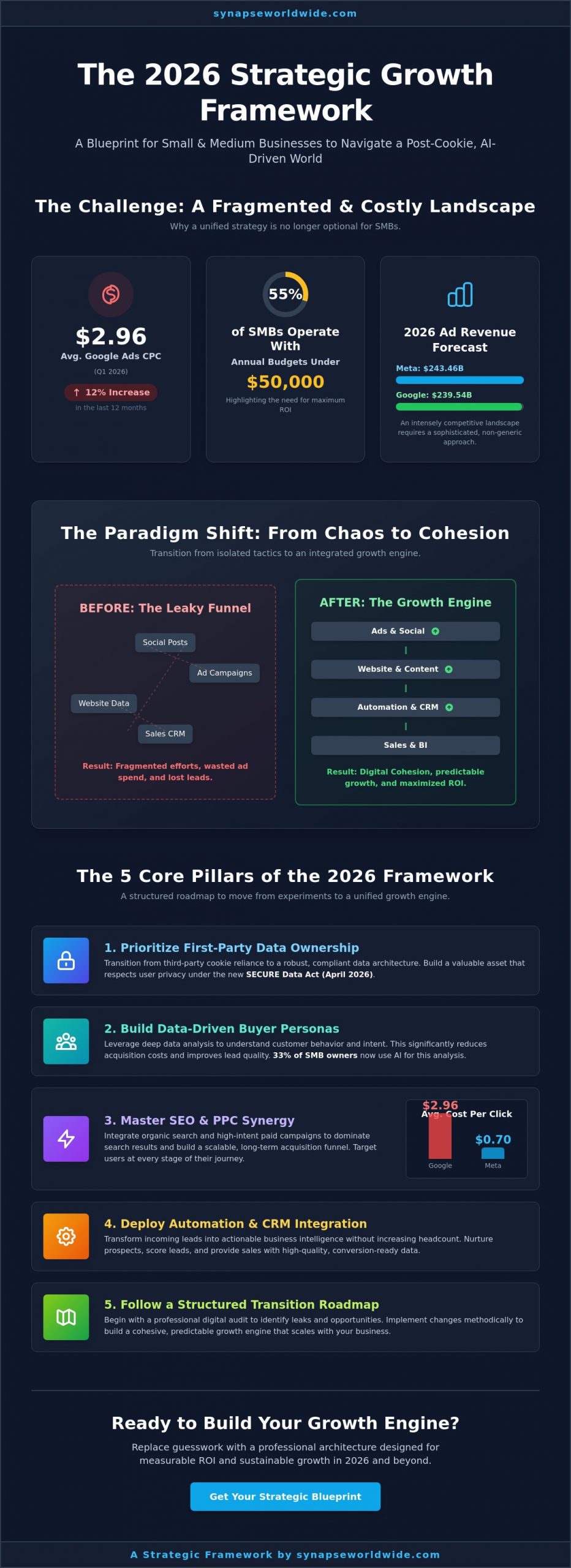
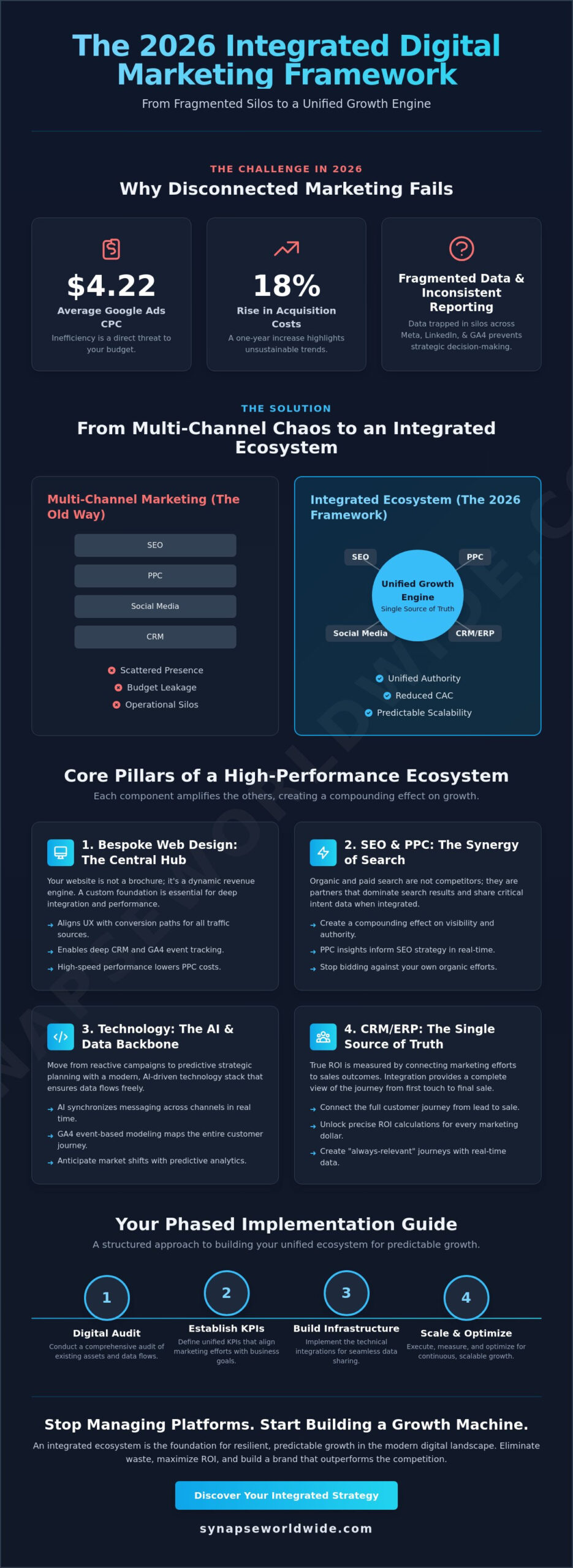
With the average Google Ads cost-per-click hitting $4.22 in 2026, your marketing budget is likely under more strain than ever before. It’s frustrating to watch acquisition costs rise by 18% in a single year while your data remains trapped in disconnected silos. You’re likely tired of the friction caused by inconsistent reporting across Meta and LinkedIn, which makes it nearly impossible to execute a high-performance integrated digital marketing strategy. This fragmentation doesn’t just waste money; it prevents your business from reaching its full potential and reaching the next level of success.

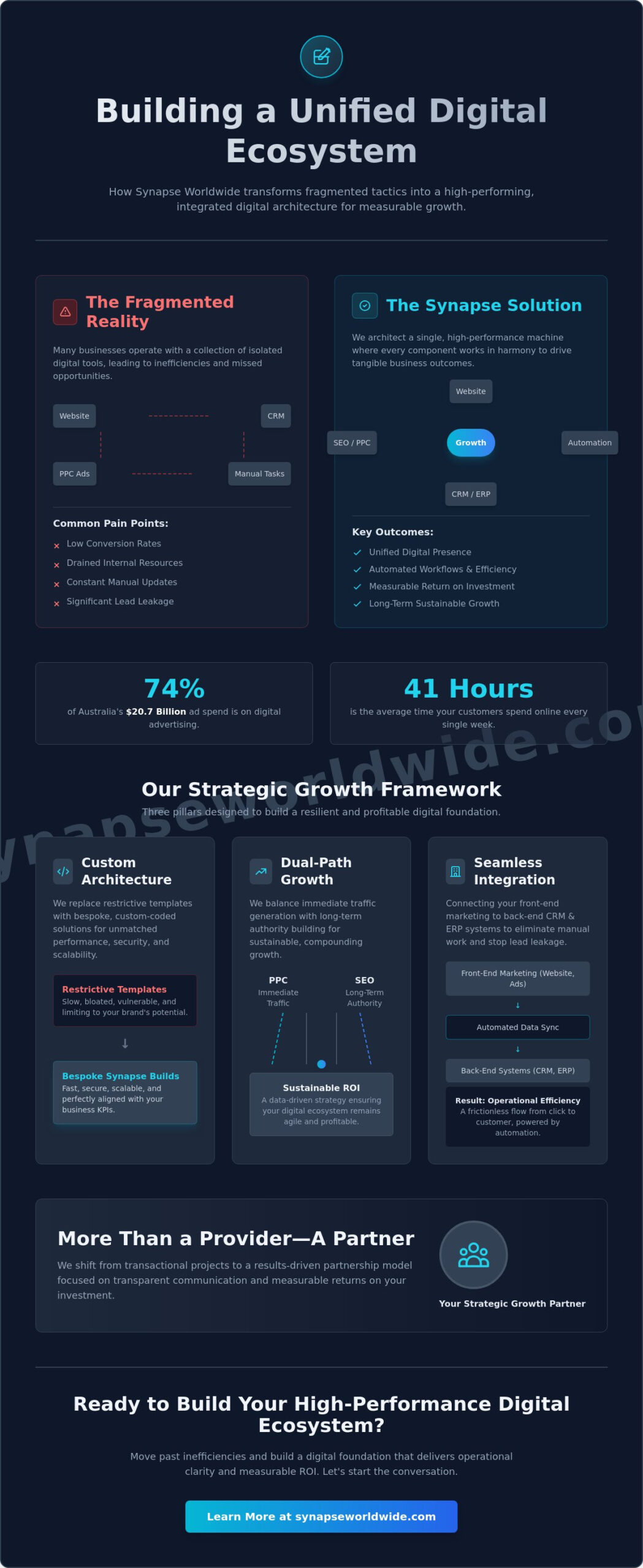
We believe your digital presence should function as a unified ecosystem rather than a collection of competing experiments. This guide introduces the 2026 framework for scalable growth designed to eliminate waste and maximize every dollar spent. You’ll discover how to align your SEO, PPC management, and CRM integration into a single engine that respects the latest CCPA privacy mandates. We’ll walk through the technical architecture needed to automate your operations, streamline your data via GA4, and turn fragmented touchpoints into a predictable path for business transformation. It’s time to stop managing individual platforms and start building a cohesive growth machine.

Key Takeaways

  • Transition from fragmented multi-channel tactics to a unified digital ecosystem that eliminates operational silos and prevents budget leakage.
  • Discover the architectural blueprint for an integrated digital marketing strategy that synchronizes SEO, PPC, and social media into a single growth engine.
  • Understand how CRM and ERP integrations provide a single source of truth for your ROI by connecting the entire customer journey from lead to sale.
  • Follow a phased implementation guide to conduct a comprehensive digital audit and establish the unified KPIs necessary for predictable scalability.
  • Learn why bespoke web design and customized technical solutions are essential for building a resilient brand that outperforms standardized competitors.

The Strategic Evolution of Integrated Digital Marketing in 2026

By 2026, the definition of digital success has shifted from mere visibility to total architectural cohesion. In a market where the average Google Ads cost-per-click has climbed to $4.22, an 18% increase from just a year ago, inefficiency is no longer just a nuisance; it’s a threat to your scalability. Fragmentation acts as a silent drain on your resources. When your SEO efforts don’t communicate with your PPC management, you’re essentially bidding against yourself or missing critical intent signals. A robust integrated digital marketing strategy ensures that every touchpoint reinforces the next, turning your website from a static digital brochure into a dynamic revenue engine. This evolution demands a shift toward “always-relevant” journeys where personalization is driven by real-time data rather than historical assumptions.

Integrated vs. Multi-Channel: The Critical Distinction

Market leadership in this decade isn’t earned by simply being present on every platform. While multi-channel marketing spreads your message wide, it often lacks the connective tissue required for high-level conversion. True integration is rooted in the principles of integrated marketing communications, where a consistent brand voice acts as the anchor across disparate platforms. This synergy directly impacts your bottom line by reducing customer acquisition costs (CAC). When your social media marketing and search strategies work in tandem, you create a compounding effect that drives efficiency and streamlines the path to purchase. It’s about moving from a scattered presence to a unified authority that commands attention.

The 2026 Digital Landscape: AI and Predictive Integration

The modern landscape relies on AI to do more than just generate content; it synchronizes messaging across SEO and paid search in real time. We’ve moved beyond reactive campaigns that look at last month’s performance. Today’s high-performance frameworks use predictive strategic planning to anticipate market shifts before they happen. This requires a seamless flow of data between your CRM integration and automated marketing funnels. By leveraging GA4’s event-based modeling, businesses can now interpret the entire customer journey with precision. This transition from reactive to predictive is the hallmark of a sophisticated integrated digital marketing strategy, allowing you to act on data intelligence before your competitors even recognize the trend. Establishing this real-time data flow is the first step toward building a resilient, self-optimizing growth engine.

Core Pillars of a High-Performance Integrated Ecosystem

A high-performance ecosystem isn’t a collection of disparate tools. It’s a synchronized engine where every component amplifies the others. To achieve scalable growth, your integrated digital marketing strategy must be anchored by four core pillars: bespoke web design, strategic SEO, high-performance PPC, and cohesive content marketing. When these elements operate in isolation, they create friction that slows your momentum. When they’re unified, they create a compounding effect that drives your business toward its next level of success. This structural integrity is what separates market leaders from those who are simply “online.”

Web Design as a Strategic Growth Engine

Your website is the central hub of your digital world. Off-the-shelf templates often struggle to handle the complex requirements of a modern growth strategy, such as deep CRM integration or advanced event tracking in GA4. Investing in custom web design for small business ensures your technical foundation is built specifically to support your unique marketing goals. A well-architected site aligns user experience with conversion paths, ensuring that traffic from your social media marketing or search campaigns doesn’t hit a dead end. High-speed, mobile-optimized pages aren’t just for users; they provide the technical performance required to maintain high quality scores for your paid media landing pages, which effectively lowers your overall acquisition costs.

The Synergy of SEO and Paid Search

In 2026, the most successful brands don’t choose between organic and paid visibility. They use them together to dominate the search engine results pages. By analyzing data from your paid search campaigns, you can identify high-converting keywords in real-time and feed those insights directly into your seo for small business strategy. This data sharing allows you to focus your organic efforts on terms that are proven to drive revenue rather than just empty traffic. This dual-threat approach ensures that your brand captures attention regardless of whether a user clicks an ad or an organic listing. It’s a sophisticated way to optimize ad spend while building long-term authority in your niche.

Content marketing serves as the narrative thread that connects these pillars. It isn’t just about writing articles; it’s about creating a consistent message that resonates from the first social media interaction to the final sale. When your messaging is unified, the customer journey feels seamless and intuitive, which builds the trust necessary for high-value conversions. If you’re looking to build a more resilient digital presence, you might consider how bespoke digital solutions can bridge the gaps in your current framework. Building this level of connectivity requires precision, but the return on investment is undeniable for businesses aiming for serious transformation.

Integrated Digital Marketing Strategy: The 2026 Framework for Scalable Growth

Eliminating Silos: Why Technical Infrastructure is the Backbone

Many businesses mistakenly treat integration as a creative or messaging challenge. In reality, it’s a technical one. Without a robust data layer, your integrated digital marketing strategy is essentially a series of educated guesses. We see growth stall most often when marketing teams can’t see what happens after a lead enters the pipeline. Infrastructure is the connective tissue that allows data to flow from a social media click to a final sale, providing the clarity needed to scale with confidence. Moving away from disconnected spreadsheets toward a unified dashboard isn’t just about organization; it’s about gaining a competitive edge through real-time intelligence.

Data centralization creates a single source of truth for your entire organization. ERP solutions play a critical role here, especially for national enterprises looking to streamline lead-to-sale workflows. By automating the feedback loop between sales data and marketing spend, you can identify exactly which channels produce the highest lifetime value customers. This level of visibility allows you to cut waste instantly and reallocate budget to high-performing segments. It’s a shift from reactive reporting to proactive optimization that ensures your digital presence is always working at peak efficiency.

CRM and Marketing Automation Integration

Connecting your website directly to your lead management systems eliminates the manual entry lag that often kills high-value conversions. It’s not enough to just capture a name; you need to personalize the user experience based on specific CRM data touchpoints. Custom API bridges and system bridges allow your marketing automation to respond to a prospect’s behavior in real time. When your systems talk to each other, the customer journey feels fluid and intentional. This technical harmony reduces friction for the user while providing your team with the granular data needed for sophisticated attribution modeling.

Scalable E-commerce Architecture

For brands selling online, the technical requirements are even more demanding. Sophisticated ecommerce website development requires a deep integration mindset from the start. You must connect inventory management directly with your real-time advertising feeds to ensure you aren’t wasting budget promoting out-of-stock items. Building for future growth means choosing a scalable digital infrastructure that can handle traffic surges without compromising performance. It’s about creating a resilient, interconnected foundation that supports your long-term vision for business transformation and reaches the next level of profitability.

Building Your Framework: A Step-by-Step Implementation Guide

Moving from a conceptual vision to a functional reality requires a disciplined, multi-phase approach. Building a high-performance integrated digital marketing strategy isn’t a weekend project; it’s a structural overhaul of how your business interacts with the digital world. The transition begins by stripping away assumptions and looking at raw data. Success in 2026 depends on your ability to execute these five phases with precision:

  • Phase 1: Conduct a Comprehensive Digital Audit to identify where your budget is leaking.
  • Phase 2: Define Unified KPIs that prioritize revenue over vanity metrics.
  • Phase 3: Execute Technical Synchronization between your website, CRM, and GA4 analytics.
  • Phase 4: Launch Content and Campaign Orchestration to ensure a singular brand voice.
  • Phase 5: Commit to Continuous Optimization to protect your ROI as market conditions shift.

This phased approach ensures that your growth is built on a stable foundation. By addressing technical debt and data silos early, you prevent the friction that typically slows down national enterprises. Each phase builds upon the last, creating a compounding effect that accelerates your transformation.

The Audit: Identifying Fragmented Touchpoints

A successful framework starts with a cold, hard look at your current assets. You can’t fix what you haven’t measured. We look for budget leaks where channels are competing rather than collaborating. For instance, if your social media marketing is driving traffic to pages with high bounce rates, it’s often a sign of a technical health failure or a messaging mismatch. Mapping your current customer journey against a desired state reveals the gaps in your funnel. This phase ensures your foundation is solid before you layer on additional spend. It’s about finding the “single source of truth” that has likely been missing from your previous reports.

Measurement: Tracking What Truly Matters

Vanity metrics like “likes” or “impressions” don’t pay the bills. In an era where Google Ads costs have risen significantly, every click must be accountable. You need revenue-based attribution that shows exactly how an initial search query eventually becomes a closed deal in your CRM. Implementing cross-channel tracking provides a 360-degree view of your ROI. Utilizing professional ppc management services allows for rapid data gathering during this phase, providing the insights needed to refine your long-term strategy. This data-first mindset ensures that every decision is backed by evidence rather than intuition. Ready to eliminate the silos holding your business back? Book a strategic consultation to begin your comprehensive digital audit and start your journey toward scalable growth.

Scaling with a Visionary Strategic Partner

While the framework for an integrated digital marketing strategy is clear, the difference between a plan on paper and a high-performance growth engine lies in the execution. Most businesses fail not because they lack ambition, but because they lack a visionary architect to manage the technical intricacies of their digital ecosystem. Partnering with a strategic consultant ensures that your SEO, PPC management, and CRM integration aren’t just line items in a budget, but interconnected components of a larger business transformation. This high-level oversight is what allows national enterprises to move beyond tactical experiments and toward predictable, scalable growth.

Future-proofing your business requires more than just staying current with trends; it requires building a resilient infrastructure that can withstand the next wave of digital disruption. As ad costs continue to rise and privacy mandates like the CCPA become more complex, having a partner who understands the underlying data layer is your greatest insurance policy. It’s about moving from a state of reactive maintenance to one of proactive, results-oriented leadership. This level of technical depth ensures your brand remains relevant and profitable regardless of how the landscape shifts.

Why a Custom Solution Beats a Standardised Package

Standardized marketing packages are designed for the average business, yet market leadership is rarely achieved by being average. Off-the-shelf solutions often create technical debt that limits your ability to pivot when search algorithms or consumer behaviors shift. Customization is the key to ROI because it allows your digital presence to mirror your unique operational strengths. Whether it’s bespoke e-commerce development or custom ERP solutions, these individualized architectures create a proprietary advantage that competitors can’t simply buy or copy. A long-term partnership focused on bespoke development ensures your infrastructure evolves alongside your ambitious business goals.

Taking the Next Step Toward Digital Integration

The transition from fragmented tactics to a unified strategy begins with expert technical consulting. You need a partner who can see the big picture while managing the intricate details of your automated marketing funnels. This planning phase is critical for identifying the technical bridges required to connect your social media marketing efforts with your sales data. By aligning your digital assets under a single strategic vision, you eliminate waste and create a clear path for expansion. It’s time to stop chasing individual metrics and start building a unified authority that commands the market. To begin your transformation, consult with our strategic architects today and discover how a truly custom solution can redefine your growth trajectory.

Architecting Your Digital Future

The transition from fragmented digital tactics to a unified ecosystem isn’t just a trend; it’s a strategic necessity for any business aiming to scale in 2026. By eliminating the silos between your SEO, PPC management, and web development, you create a resilient engine that turns rising ad costs into a competitive advantage. A successful integrated digital marketing strategy relies on a robust technical backbone where CRM and ERP data flow seamlessly to inform every strategic decision. This level of connectivity ensures that your marketing spend is always aligned with actual revenue growth rather than vanity metrics.

Since 2005, we’ve established a proven track record of driving national growth through bespoke web architecture and high-value system integrations. Our team specializes in custom software solutions that provide the authoritative expertise needed to navigate complex digital landscapes with confidence. You don’t have to settle for standardized packages that limit your transformation potential. Take the first step toward reaching the next level of business success and Partner with Synapse Worldwide for a Custom Strategic Framework. Your digital presence is ready for its next evolution, and the results you’ve been chasing are finally within reach.

Frequently Asked Questions

What is an integrated digital marketing strategy?

An integrated strategy is a unified framework that synchronizes all digital channels into a single growth engine. Instead of treating SEO, PPC, and social media marketing as isolated projects, this approach ensures they share data and messaging. This alignment eliminates budget waste and creates a consistent experience for the customer across every touchpoint, ensuring your brand voice remains authoritative and reliable.

How does integration differ from multi-channel marketing?

Multi-channel marketing simply means being present on various platforms, whereas integration focuses on how those platforms communicate. In a multi-channel setup, your PPC and SEO teams might operate in silos. An integrated digital marketing strategy connects these efforts through a shared technical architecture, allowing insights from one channel to optimize the performance of another and reducing your overall acquisition costs.

Why is CRM integration important for my marketing strategy?

CRM integration is vital because it bridges the gap between lead generation and actual revenue. By connecting your website directly to your sales data, you can track the entire customer journey with precision. This visibility allows you to identify which specific campaigns drive the highest lifetime value, shifting your focus from vanity metrics to tangible business outcomes and long-term transformation.

How long does it take to see results from an integrated approach?

Initial efficiency gains often appear within the first 90 days as budget leaks are identified and closed. While PPC management can drive immediate traffic, the full compounding effect of a unified ecosystem typically matures over six to twelve months. This timeline allows for deep data collection and the gradual build-up of organic authority through strategic SEO and consistent social media engagement.

What are the core components of a successful 2026 digital strategy?

The core pillars include bespoke web design, centralized technical infrastructure, and synchronized campaign orchestration. Success in 2026 requires a focus on data intelligence and privacy-first practices. A high-performance strategy must also include CRM and ERP solutions to ensure that lead-to-sale workflows are fully automated, providing a single source of truth for your business growth.

Do I need to overhaul my entire website to implement an integrated strategy?

An entire overhaul isn’t always mandatory, but your technical foundation must support deep data integration. If your current site cannot handle advanced GA4 tracking or custom API bridges, a strategic upgrade may be necessary. We prioritize the technical health of your digital assets to ensure they can function as a reliable hub for your growth engine and support your ambitious business goals.

How do I measure the ROI of an integrated marketing campaign?

ROI is measured through cross-channel attribution models that track how different touchpoints contribute to a single conversion. By moving away from last-click attribution, you gain a 360-degree view of your marketing spend. We focus on revenue-based KPIs that connect your digital activity directly to the bottom-line growth seen in your ERP systems, ensuring every dollar is accountable.

What role does AI play in digital marketing integration in 2026?

AI serves as the connective tissue that synchronizes messaging and predicts customer behavior in real time. In 2026, AI is used to optimize ad targeting and personalize content based on complex data patterns. It allows your integrated digital marketing strategy to remain agile, automatically adjusting to market shifts and predictive trends before they impact your performance or scalability.


SEO Myths 2026: Debunking Outdated Strategies in the Age of AI Search

SEO Myths 2026: Debunking Outdated Strategies in the Age of AI Search

Did you know that a top-ranking organic position now yields a 58% lower click-through rate than it did just eight months ago? Many business leaders are experiencing a sharp decline in organic traffic despite maintaining a high content output. It’s a common frustration to watch your visibility shrink while legacy providers rely on 2022 tactics that no longer move the needle. Many of the “best practices” still being sold today are actually seo myths 2026 that are actively sabotaging your growth and wasting your digital budget.

We understand the confusion surrounding AI Overviews and the March 2026 Core Update. You need a strategy that prioritizes business outcomes over vanity metrics. This article identifies the legacy tactics you must abandon and introduces the high-performance strategies that drive measurable revenue in the current search environment. We’ll provide a clear roadmap for visibility, validate the metrics that truly impact your ROI, and help you regain strategic confidence in your digital investment through a sophisticated, data-driven approach.

Key Takeaways

  • Understand how search has evolved into a hybrid of traditional indexing and generative AI citations that require a new approach to brand authority.
  • Learn why “Information Gain” is the new standard for content, replacing the outdated focus on sheer volume and repetitive AI-generated text.
  • Discover how to dismantle the seo myths 2026 that are currently draining your marketing budget and stalling your organic growth.
  • Master the technical requirements of Core Web Vitals 4.0 to ensure your site remains the stable, high-performance foundation your brand needs.
  • Transition from reactive tactics to a proactive architecture that aligns your digital presence with the way AI engines actually discover and cite information.

The Evolution of Search: Why 2026 SEO Myths are More Dangerous Than Ever

Search has fundamentally transformed into a sophisticated hybrid system. It no longer relies solely on traditional indexing; instead, it prioritizes generative AI citations and verified domain authority. The March 2026 Core Update solidified this shift by rewarding “information gain” and penalizing sites that merely recycle existing web data. If you’re still following “best practices” from 2024, you’re likely triggering quality penalties that suppress your visibility. Relying on outdated seo myths 2026 can lead to a total decoupling of your content from the results page, making your brand invisible to your target audience.

The primary ranking factor has shifted from keyword density to Information Gain. This means your content must provide unique data, fresh perspectives, or proprietary insights that don’t already exist in the AI’s training set. We recognize the frustration of seeing organic traffic decline despite your team’s hard work. Data from May 2026 shows that AI Overviews have caused a 58% reduction in click-through rates for top-ranking results. This isn’t a failure of effort. It’s a failure of legacy strategy. To succeed, you must architect content that an AI engine views as essential for its own accuracy.

From Keywords to Concepts: The End of String Matching

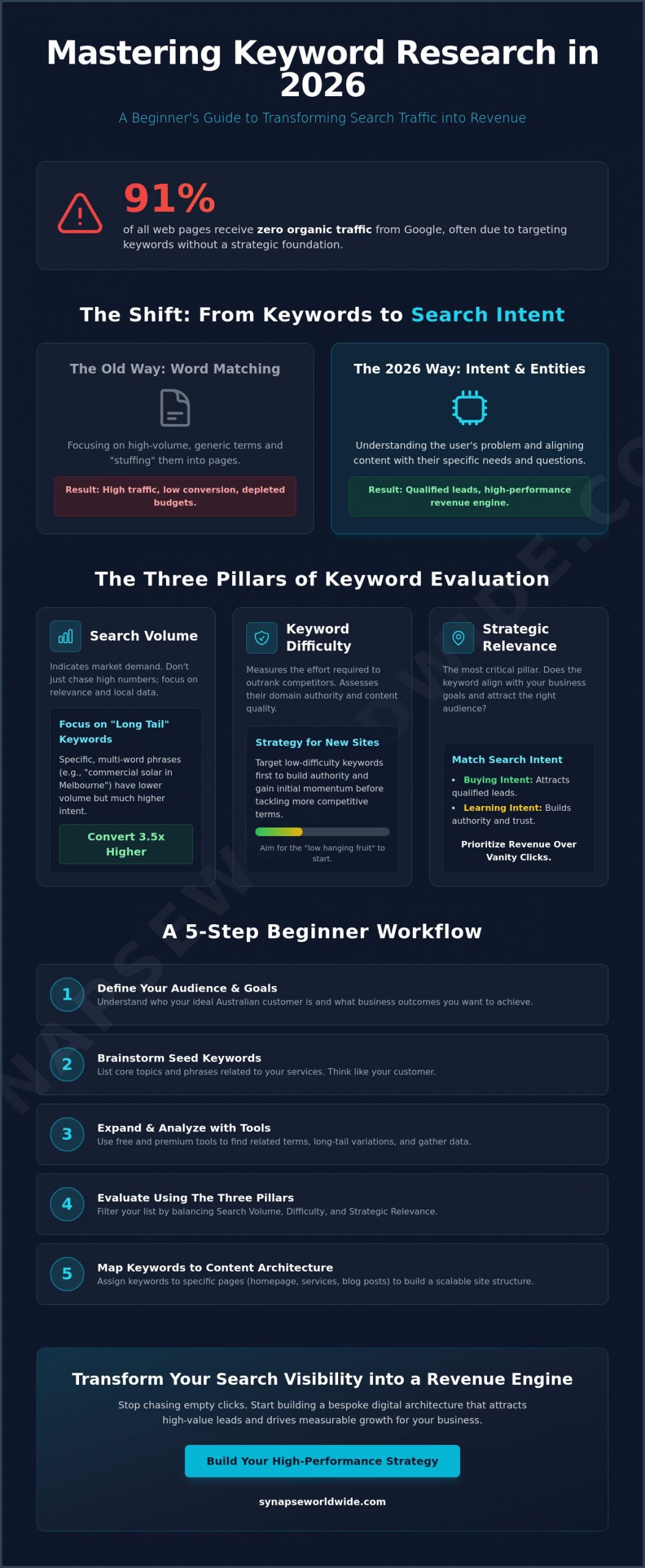
Modern Large Language Models have moved beyond simple string matching. They understand the underlying intent and the conceptual relationships between topics. Success now requires a transition from traditional keyword lists to a robust “Topic Architecture.” This approach ensures your domain is viewed as a coherent authority on a subject. For those establishing a new presence, our guide on keyword research for beginners provides the strategic foundation needed to build this architecture. At its core, Search engine optimization (SEO) is now about proving to an algorithm that your brand owns a specific concept through deep, expert-led content rather than just matching phrases.

The Rise of Zero-Click Search and AI Overviews

Zero-click searches are the new reality. AI Overviews now appear for 95% of comparison-based queries and 86% of question-based queries. While this reduces traffic for general informational searches, it creates a massive opportunity for commercial intent. Being cited as a source within an AI Overview is the new “Position Zero.” It provides the validation and trust necessary to drive high-value clicks from users who are ready to engage. If your current agency is still obsessing over total traffic numbers without accounting for these shifts, they’re likely chasing seo myths 2026 that won’t lead to revenue. You must pivot your focus to becoming the definitive source that AI engines are forced to cite to remain accurate and helpful.

Myth #1: AI Search Engines Have Made Organic SEO Obsolete

The proclamation that SEO is dead has become a predictable industry tradition, yet it remains one of the most pervasive seo myths 2026. While the layout of the search engine results page has changed, the underlying need for high-quality, indexed information has never been greater. In 2026, AI engines don’t replace the web. They rely on it. Without a constant stream of fresh, expert-led data from independent websites, Large Language Models (LLMs) quickly become outdated and unreliable. High-intent buyers still demand the depth and security that only an authoritative, long-form website can provide.

Search engine layouts now feature prominent AI Overviews, but these summaries are not the end of the journey for commercial users. While a user might accept a quick AI answer for a basic informational query, they won’t rely on a summary when choosing an enterprise ERP solution or a custom web design partner. They want to see the portfolio, read the case studies, and verify the expertise. This is where strategic Search Engine Optimization bridges the gap between initial curiosity and a final transaction. In this environment, your visibility is tied to how effectively you can prove your credibility to both human readers and algorithmic crawlers.

The Symbiosis of AI and SEO

Modern search utilizes Retrieval-Augmented Generation (RAG) to ensure accuracy. This means the search engine’s AI retrieves specific data from your website to augment its generated response. Your site serves as the external knowledge base for the AI. To facilitate this, your technical foundation must be flawless. Adhering to a comprehensive on-page seo checklist ensures that AI crawlers can parse your information without friction. If the AI can’t read your site, it won’t cite your site. This relationship creates a new form of interdependence where the search engine needs your data as much as you need its traffic.

Optimizing for Visibility in Generative Answers

Visibility in 2026 requires a shift toward structured data and explicit relationship mapping. By using Schema.org markup, you provide the context that AI needs to understand your claims as facts. This shift requires a deep understanding of the new rules for keyword optimization, where the focus moves from single phrases to complex, question-based clusters. Generative Engine Optimization (GEO) represents the 2026 evolution of SEO, focusing on optimizing content to be the primary citation source for AI-generated responses. Brands that embrace this architecture gain a significant competitive advantage over those still chasing legacy seo myths 2026.

SEO Myths 2026: Debunking Outdated Strategies in the Age of AI Search

Myth #2: Scaling Content Volume with AI is the Key to Dominance

The “Content Arms Race” has reached a tipping point where sheer volume is no longer a competitive advantage. In fact, flooding your domain with thousands of AI-generated pages often leads to a site-wide suppression of organic traffic. Search algorithms have evolved to detect “synthetic echo chambers” where content merely paraphrases existing web data. This is one of the most dangerous seo myths 2026 because it encourages businesses to invest in quantity over substance, ultimately triggering search quality penalties that are difficult to recover from. High-performance brands recognize that a single, deeply researched asset is worth more than a hundred generic AI-generated posts.

Google’s 2026 “Helpful Content” evolution prioritizes what is known as “Information Gain.” This metric evaluates whether a piece of content adds genuinely new knowledge to the digital ecosystem. If your article provides the same information as the top ten results, it offers zero value to a user or an AI engine. Understanding how AI is changing search reveals that search engines now function as answer engines that reward unique perspectives and proprietary data. Sounding like everyone else is a ranking death sentence in an era where AI can replicate generic voices in seconds.

The Information Gain Score: The New Gold Standard

Re-hashing existing articles results in “Hidden” or de-indexed content because it fails the uniqueness test. To maintain visibility, you must inject proprietary data, first-party case studies, and expert opinions into every asset you publish. This level of depth is central to a high-performance content marketing seo strategy. By focusing on data that doesn’t exist in a Large Language Model’s training set, you ensure your brand remains an essential citation source for generative search results. We help our clients move beyond the noise by architecting content that serves as the definitive authority in their niche.

EEAT in 2026: Experience, Expertise, Authoritativeness, and Trust

The “Experience” component of the EEAT framework is the only element AI cannot fake. It represents first-hand, lived experience that provides a human touch to technical information. You can prove this human authorship by integrating video embeds of your team, detailed author bios, and real-world testing results directly into your content architecture. Search engines increasingly look for signals of “physical world” interaction. Trust is built when users see that your insights come from practical execution rather than just algorithmic synthesis. This commitment to authenticity is what separates market leaders from those still chasing outdated seo myths 2026.

The phrase “Content is King” has become one of the most misleading seo myths 2026. While high-quality information is essential, it cannot perform on a foundation that is structurally unsound. A slow, broken, or poorly architected site will never rank, regardless of how insightful the writing is. In 2026, Google’s Core Web Vitals 4.0 have shifted the focus toward Interaction to Next Paint (INP) and visual stability. These metrics aren’t just technical checkboxes. They are direct indicators of user satisfaction and conversion potential. If your site stutters or delays, users leave, and your search visibility vanishes with them.

Site architecture also dictates how an AI engine perceives your brand as an “Entity.” A logical, streamlined structure allows crawlers to map the relationships between your services and your expertise. This clarity is vital for being cited in generative answers. If your digital infrastructure is cluttered, you’re effectively hiding your value from the very algorithms designed to find it. Success in the current landscape requires a visionary approach where technical precision and creative content work in total alignment.

Infrastructure as SEO: Speed, Security, and UX

Your website’s infrastructure is a primary driver of organic growth. Custom digital solutions consistently outperform rigid, template-based sites because they are built for performance rather than convenience. High bounce rates on slow pages negatively impact your “Trust Score,” a critical internal metric search engines use to gauge reliability. To ensure your technical efforts translate into revenue, it’s vital to monitor the right seo kpis for small business. This strategic oversight allows you to identify bottlenecks before they impact your bottom line. Investing in Custom Web Design ensures your brand sits on a high-performance foundation that is optimized for both humans and AI.

The Death of the Low-Quality Backlink

The era of mass-produced guest posts and link farms is over. AI-driven spam filters now identify and ignore approximately 90% of traditional “guest post” style links. In 2026, the focus has shifted from link quantity to Niche Authority and Digital PR. A single mention from a respected publication within your specific ecosystem carries more weight than a thousand irrelevant backlinks. The strongest signal of authority today is branded search volume. When users actively type your name into a search bar, it tells engines that you are a trusted entity. This organic brand recognition is the ultimate validation of your digital presence and the most effective way to dismantle the seo myths 2026 that prioritize vanity metrics over real-world influence.

Transitioning from debunking seo myths 2026 to implementing a proactive growth framework requires a fundamental shift in perspective. You cannot simply patch a few technical errors and expect a transformation in your organic performance. True search visibility in the age of AI is built on a foundation of custom digital infrastructure integrated with high-level strategy. We call this the “Visionary Architect” approach. It treats content, infrastructure, and strategy as a single, cohesive unit rather than a collection of isolated tasks. To achieve a genuine return on investment, your search efforts must be connected to your CRM Integration and ERP Solutions. This connectivity allows you to track a lead from their initial search query directly through to the final transaction in your sales pipeline.

The days of the “one-off” SEO fix are over. Search engines now prioritize stability and consistent authority over short-term hacks. A long-term partnership with a strategic consultant ensures that your digital presence evolves alongside the algorithms. By aligning your search strategy with your broader business goals, you move away from vanity metrics and toward measurable revenue growth. This holistic view is what separates market leaders from those who are still struggling with declining traffic and outdated tactics.

The Synapse Strategic Framework

Our strategic framework combines Custom Web Design with a deep search architecture designed specifically for the current landscape. We don’t just focus on driving traffic; we identify the “Conversion Leaks” that often cause high-quality visitors to drop off before they reach your sales team. Through rigorous technical consulting, we ensure that your site structure supports a seamless user journey. This comprehensive methodology is detailed in our SEO for Small Business Pillar, which serves as the ultimate roadmap for brands looking to establish a dominant digital footprint.

Future-Proofing Your Digital Investment

Digital success is a continuous process of refinement and adaptation. A stable growth model typically begins with a fixed-price development phase to build a high-performance foundation, followed by a monthly retainer for ongoing strategic optimization. This structure ensures your brand remains resilient against the inevitable algorithm shifts of 2026. Regular maintenance and technical updates are essential to prevent technical debt from eroding your rankings. When you’re ready to move beyond the noise of seo myths 2026 and invest in a strategy that prioritizes your bottom line, partner with Synapse Worldwide for a results-oriented SEO strategy that delivers long-term business transformation.

Mastering the New Era of Digital Authority

The landscape of search has fundamentally shifted toward a hybrid model where brand authority and technical precision are non-negotiable. Success no longer comes from chasing volume or recycling generic data. Instead, it requires architecting unique “Information Gain” and maintaining a flawless digital infrastructure that AI engines can trust and cite. Moving beyond the noise of seo myths 2026 allows you to focus on the high-performance strategies that actually drive revenue and long-term business transformation.

Since 2005, we’ve guided businesses through over two decades of digital evolution. Our expertise in custom high-performance web infrastructure and results-oriented strategic consulting provides the stability your brand needs for national growth. We don’t just provide services; we build long-term partnerships that turn your digital presence into a measurable asset. Your next level of business success is within reach. With the right roadmap and a disciplined execution partner, your brand can thrive in the age of AI search.

Architect your 2026 growth strategy with Synapse Worldwide

Frequently Asked Questions

Is keyword research still necessary in 2026?

Keyword research remains essential but has transitioned into mapping conceptual clusters and topic architecture. You aren’t just targeting phrases; you’re architecting authority over specific subject areas. Modern Large Language Models look for topical coherence rather than simple string matching. This ensures your brand is recognized as an expert entity by both users and AI crawlers.

How does AI search affect my website traffic?

AI search fundamentally changes traffic patterns by answering simple questions directly on the results page. This leads to fewer clicks for top of funnel informational queries. However, it places a premium on high intent commercial traffic. Being a cited source in an AI Overview provides the validation necessary to capture users who are ready to invest.

Can I use AI to write all my SEO content?

Using AI for all your content is one of the most dangerous seo myths 2026. Search engines now prioritize “Information Gain,” which requires unique data and first hand experience that AI cannot replicate. If your content merely recycles existing training data, it won’t provide the value needed to rank or be cited by generative engines.

Are backlinks still important for ranking in 2026?

Backlinks are still vital, but the focus has shifted entirely to niche authority and digital PR. High quality links from within your specific ecosystem serve as proof of trustworthiness. AI driven filters now ignore mass produced guest posts. Branded search volume has become an equally powerful signal of your site’s authority.

What is the most important SEO metric to track now?

The most important metric to track is conversion driven ROI rather than vanity traffic numbers. You should monitor how many leads or sales originate from organic search and your citation frequency in AI Overviews. These numbers reflect the actual business impact of your digital strategy and help you avoid common seo myths 2026 regarding success.

How often should I update my SEO strategy?

Your strategy requires continuous refinement to remain effective. While your core business goals might stay the same, the technical implementation must adapt to monthly algorithm shifts and quarterly performance reviews. This proactive approach ensures your infrastructure remains resilient and your content stays ahead of the competition.

Does website speed affect my AI search visibility?

Website speed is a critical factor for AI search visibility. Core Web Vitals 4.0, specifically Interaction to Next Paint (INP), measures how quickly your site responds to user actions. AI engines prefer to cite and rank sites with stable, high performance infrastructure because they offer a superior user experience.

Is SEO a one-time project or an ongoing service?

SEO is an ongoing service, not a one time project. Maintaining search visibility requires a long term partnership to manage technical debt, update content for accuracy, and respond to new competitive threats. A results oriented strategy involves continuous optimization to ensure your digital investment provides a consistent return.


Mobile Responsive Web Design: The Strategic Guide for Business Growth in 2026

Mobile Responsive Web Design: The Strategic Guide for Business Growth in 2026

As of July 1, 2026, Google will entirely remove websites from its index if they lack a functional mobile version. This isn’t a mere ranking penalty; it’s a total exclusion from the digital marketplace. You likely recognize the urgency as mobile devices now command 52.8% of all global web traffic. It’s exhausting to watch high bounce rates climb while your competitors capture the smartphone audience you’ve worked hard to build. You need a digital foundation rooted in mobile responsive web design that commands respect on every screen size without getting lost in technical jargon.

Implementing a sophisticated mobile responsive web design transforms your digital infrastructure into a high-performance engine for user engagement and conversion. This guide provides the strategic roadmap to align your site with the CSS Snapshot 2026 standards and Google’s strict indexing requirements. We’ll explore how to optimize Core Web Vitals, ensure content parity, and reduce mobile cart abandonment rates that currently peak at 85.65% for many industries. You’ll gain the clarity needed to turn your website into a reliable asset for long-term business growth and reach the next level of digital success.

Key Takeaways

  • Adopt the “one site, every device” philosophy to streamline your digital presence. It’s the most efficient way to ensure a consistent brand experience across all platforms.
  • Discover how mobile responsive web design directly influences your SEO visibility and keeps bounce rates low.
  • Identify the critical differences between responsive, adaptive, and mobile-friendly layouts to avoid costly development mistakes.
  • Learn to use fluid grids and flexible images to maintain high-performance load speeds on any connection.
  • Implement a mobile-first strategy by auditing your performance and refining your content hierarchy for maximum conversion.

What is Mobile Responsive Web Design?

At its core, mobile responsive web design is an architectural approach where a single digital infrastructure adapts its layout, content, and functionality to any screen size. This “One Site, Every Device” philosophy eliminates the need for redundant subdomains or separate mobile applications. It ensures your brand maintains a singular, authoritative presence across the web. In 2026, this strategy is no longer optional. Google’s recent policy shift mandates that as of July 1, 2026, any website lacking a functional mobile version will be entirely excluded from search results. This makes responsiveness the primary gatekeeper for your business’s online visibility.

Modern standards defined by the CSS Snapshot 2026 require more than just making elements “fit” on a screen. High-performance design now integrates the viewport meta tag to instruct browsers on how to scale content correctly. This technical directive allows your site to render accurately across the diverse resolutions of 2026, from foldable devices to high-definition desktop monitors. By prioritizing this foundational layer, you protect your search rankings and provide a stable platform for growth.

The Evolution from Desktop-First to Mobile-First

The digital landscape has moved far beyond the era of “m.” sites. These separate mobile versions often failed because they lacked content parity and created fragmented user experiences. Australian businesses that once viewed mobile as a secondary concern now face a reality where 52.8% of global traffic originates from handheld devices. Users in 2026 demand desktop-level functionality on their smartphones. They expect fast load times and full access to every feature, making a unified Responsive Web Design (RWD) strategy essential for retaining high-value leads.

Core Characteristics of Responsive Architecture

Implementing a professional mobile responsive web design involves three pillars that ensure your digital presence is both flexible and resilient. These components work together to provide a seamless experience regardless of the hardware used by your visitors.

  • Fluidity: Content must act like water, flowing naturally into different container sizes without breaking the layout or requiring horizontal scrolling.
  • Intelligent Reflow: This involves more than just shrinking images. It requires a strategic reordering of elements so that the most critical business information remains at the top of the visual hierarchy on smaller screens.
  • Touch-Ready Interfaces: Mouse cursors are precise, but thumbs are not. Modern architecture prioritizes larger tap targets and intuitive gestures to accommodate the tactile nature of mobile browsing.

The Strategic Business Value of Responsive Design

Investing in mobile responsive web design is a high-level strategic decision that directly impacts your bottom line. It’s not merely a technical requirement; it’s a commitment to your digital infrastructure’s performance and reliability. By ensuring your site functions flawlessly across all devices, you eliminate the friction that causes potential clients to abandon their journey. A cohesive mobile experience builds immediate brand trust, positioning your business as a sophisticated and capable partner in an increasingly competitive global market. Using a single URL for all marketing campaigns also streamlines your tracking and management, ensuring your custom web design for small business delivers a consistent message regardless of how it’s accessed.

SEO and the Mobile-First Indexing Era

Google’s evaluation of your digital presence is now entirely dependent on your mobile version. Since mobile-first indexing is the absolute standard in 2026, Google treats your smartphone-optimized site as the primary version for ranking and indexing. This shift means that poor mobile performance will degrade your visibility even for desktop searches. To maintain a competitive edge, your site must excel in Core Web Vitals, specifically targeting metrics like Interaction to Next Paint (INP) and Largest Contentful Paint (LCP). A robust mobile responsive web design provides the stable foundation necessary for a successful SEO architecture. By Implementing a Mobile-First Strategy, you ensure that search engines can crawl and index your content with maximum efficiency.

Conversion Rate Optimization (CRO) on Mobile

There is a significant performance gap between mobile and desktop conversion rates that businesses must bridge. Statistics from April 2026 show mobile conversion rates averaging around 1.82%, compared to 3.14% on desktop. This discrepancy is often due to checkout friction and poor layout hierarchy. High mobile cart abandonment rates, which reached 85.65% in early 2026, are frequently the result of non-responsive elements that frustrate users. Responsive architecture solves this by prioritizing essential content and simplifying the path to purchase. When elements stack and reorder intelligently, you guide the user toward a conversion with minimal effort. This results-oriented approach transforms your website from a static brochure into a proactive lead-generation tool. If you’re looking to capture this lost revenue, our team can help you build a high-performance Custom Web Design solution tailored to your growth objectives.

Mobile Responsive Web Design: The Strategic Guide for Business Growth in 2026

Key Components: Fluid Grids, Flexible Images, and Media Queries

Building a resilient mobile responsive web design requires a shift from rigid, fixed-pixel layouts to a fluid architectural framework. In the past, designers built for a standard 1920×1080 desktop resolution. Today, your site must accommodate a fragmented landscape of devices, including the 11.28% of mobile users on 1080×2400 displays. Fluid grids achieve this by using proportional percentages rather than fixed units. This ensures that every element on the page scales harmoniously, preventing the awkward horizontal scrolling that drives users away. It’s about creating a container that adjusts to the user’s environment rather than forcing the user to adapt to your design.

Media queries act as the strategic brain of your website. These instructions, defined by the CSS Snapshot 2026, detect the user’s device capabilities and apply specific styling rules accordingly. By setting precise breakpoints, you create a seamless transition between a large desktop monitor and a handheld smartphone. This technical precision ensures that your brand’s digital presence remains professional and functional, regardless of the hardware your client chooses to use. It’s a disciplined approach that guarantees your content is always presented in its most readable and accessible format.

Modern Layout Tools: Flexbox and CSS Grid

The arrival of advanced CSS modules has revolutionized how we structure digital content. Flexbox is the ideal tool for one-dimensional layouts, such as navigation bars and centered call-to-action buttons. For more complex, two-dimensional page architectures, CSS Grid provides the discipline needed to manage intricate layouts without sacrificing speed. These tools are essential for meeting website UX best practices, as they allow for content to be reordered based on priority. On a smartphone, your most important lead-generation elements should always be the first things a user sees.

Optimising Media for Performance

Flexible images are a non-negotiable component of high-performance mobile responsive web design. Using the “srcset” attribute allows your site to serve the most appropriate image size for the user’s specific screen. This prevents mobile users from wasting data on high-resolution assets meant for 5K monitors. Performance is a critical design element; fast load times are essential for retention. Large video backgrounds, while visually striking on desktop, often cause friction on mobile. Implementing static “mobile-fallback” images ensures that your site remains fast and accessible for the 52.8% of global traffic originating from handheld devices. This disciplined approach to media management directly supports your conversion goals and reduces the high cart abandonment rates often seen on slower mobile connections. For a deeper understanding of how to achieve optimal load speeds, our website performance optimization guide provides the technical workflows needed to transform slow digital assets into high-performance revenue engines.

Responsive vs. Adaptive vs. Mobile-Friendly

Distinguishing between mobile-friendly, adaptive, and responsive frameworks is a critical step in defining your digital strategy. While these terms are often used interchangeably, they represent different levels of technical sophistication and business utility. A “mobile-friendly” site is the bare minimum requirement. It ensures your content doesn’t break on a smartphone, but it often lacks the intuitive touch-targets and optimized hierarchy needed for a high-performance experience. Adaptive design offers a more tailored approach by serving pre-set layouts for specific devices. However, this method is increasingly difficult to sustain as screen resolutions continue to fragment, requiring constant updates to accommodate every new hardware release.

The 2026 gold standard is mobile responsive web design. This fluid architecture uses a single codebase to serve every user, regardless of their device’s dimensions. By choosing a responsive model, you avoid the pitfalls of “mobile-only” subdomains, such as the outdated m.sites. These separate versions fragment your search engine authority and create a disjointed user journey. A unified responsive site consolidates your SEO power into a single URL, ensuring that every backlink and social share strengthens your primary domain’s ranking potential.

Which Framework is Right for Your Business?

Selecting the right framework requires a balanced evaluation of initial development investment versus long-term maintenance costs. While a single-codebase responsive approach may require a more disciplined initial build, it significantly reduces the total cost of ownership. You won’t need to pay for multiple design iterations or manage separate content databases. If your current site feels rigid or fails to render correctly on the 11.28% of devices using 1080×2400 viewports, you should review these website redesign signals. Identifying these issues early allows you to transition to a more resilient infrastructure before your conversion rates suffer.

The Maintenance Advantage

A primary benefit of mobile responsive web design is the “update once, deploy everywhere” efficiency. This ensures absolute consistency in your branding across all customer touchpoints, from desktop monitors to the latest foldable phones. This level of professional completeness is essential for building long-term trust with your audience. Furthermore, a responsive site is inherently future-proofed. As new technologies like smart glasses or multi-screen devices gain market share, a fluid layout will adapt to these new environments without requiring a complete overhaul. This strategic foresight protects your investment and ensures your digital presence remains authoritative as the hardware landscape evolves. Secure your competitive advantage with a Custom Web Design that scales with your business growth.

Implementing a Mobile-First Strategy for 2026

Executing a successful mobile-first strategy requires a disciplined shift from passive observation to active optimization. You must begin by auditing your current performance through Google Search Console. This platform provides direct insight into how Google’s 100% mobile-first indexing policy interprets your digital infrastructure. In 2026, failing to address these reports isn’t just a technical oversight; it’s a direct threat to your organic visibility. Your goal is to align your site with the latest Core Web Vitals, specifically targeting Interaction to Next Paint (INP) to ensure your mobile responsive web design feels instantaneous and reliable. Achieving these benchmarks requires the kind of deep architectural changes outlined in a comprehensive website performance optimization strategy that addresses technical debt at its root.

Content hierarchy is the next pillar of your strategy. On a smartphone, you don’t have the luxury of expansive screen real estate. You must decide what stays and what goes. This involves prioritizing your primary call-to-action and essential business information so they appear within the first two scrolls. A high-performance engine for user engagement doesn’t overwhelm the visitor. It guides them. By stripping away non-essential desktop elements, you reduce friction and lower the 80.02% average mobile cart abandonment rate seen in mid-2026.

The Design Audit: Is Your Site Truly Responsive?

A professional audit goes beyond browser simulators. While simulators are helpful for initial checks, they can’t replicate the tactile experience of a handheld device. You need to test on real hardware to ensure the user journey is flawless.

  • Step 1: Check for horizontal scrolling. This is a fundamental failure of fluid grids that immediately breaks user trust. Content must fit within the vertical flow of the device.
  • Step 2: Test for “fat-finger” accessibility. Buttons and links must be large enough to tap without misclicking. Small, cramped tap targets are a leading cause of mobile bounce rates.
  • Step 3: Evaluate typography legibility. Ensure your text is readable on a 360x800px viewport without requiring the user to zoom. If your font is too small, your message is lost.

Partnering for Custom Digital Infrastructure

Off-the-shelf templates frequently fail to meet complex business requirements. They are often bloated with unnecessary code that slows down your Largest Contentful Paint (LCP) and limits your ability to scale. Building a high-performance engine requires a tailored approach. Reviewing custom web design examples can help you visualize how a bespoke architecture supports specific growth objectives. A custom build ensures that your mobile responsive web design isn’t just a skin, but a deeply integrated component of your CRM and ERP solutions. Your digital presence is too important to leave to chance. Consult with Synapse Worldwide today for a professional responsive audit and take the first step toward reaching the next level of business success.

Secure Your Competitive Advantage Through Digital Transformation

Transitioning to a high-performance digital presence requires more than just technical adjustments. It demands a visionary approach to mobile responsive web design that prioritizes user experience across every potential touchpoint. By consolidating your search authority into a single, fluid codebase and optimizing for the latest Core Web Vitals, you protect your business from the risks of search exclusion and high abandonment rates. This strategic shift ensures your digital infrastructure remains resilient as user behaviors and hardware technologies continue to evolve.

Since 2005, Synapse Worldwide has operated as a trusted strategic partner for national corporate and government entities. With over 20 years of digital expertise, we specialize in complex custom ERP and CRM integrations that ensure your mobile experience is both seamless and powerful. Transform your digital infrastructure with a custom responsive design from Synapse Worldwide and take the first step toward your brand’s next level of transformation. Your digital future is in expert hands, and it’s time to build a website that works as hard as you do.

Frequently Asked Questions

What is the difference between mobile-friendly and mobile responsive?

Mobile-friendly design is a static approach where a website simply shrinks to fit a smaller screen, often resulting in tiny text and difficult navigation. In contrast, mobile responsive web design uses a fluid architecture that reorders and scales elements intelligently based on the device’s viewport. This ensures that your digital presence remains professional and functional, providing an optimized experience rather than just a scaled-down version of your desktop site.

Will a responsive design improve my Google rankings in 2026?

Yes, it is the single most important factor for search visibility following Google’s July 1, 2026, deadline. As of this date, websites without a functional mobile version are entirely excluded from Google’s index. Because Google uses mobile-first indexing for 100% of websites, a responsive framework is essential for maintaining your search engine rankings and ensuring your business remains discoverable to the 52.8% of global traffic originating from mobile devices.

Do I need a separate app if my website is mobile responsive?

For most businesses, a sophisticated responsive website eliminates the need for a costly separate mobile app. A single-codebase approach provides the same high-level functionality and connectivity without the fragmented maintenance requirements of an app. This streamlined strategy allows you to focus your marketing resources on one authoritative URL, ensuring a consistent brand experience and higher return on investment across all customer touchpoints.

How much does it cost to make an existing website responsive?

The investment required to transition an existing site depends on your current technical debt and the complexity of your required integrations. Factors such as custom CRM or ERP solutions and the volume of content will influence the scope of the project. Rather than a standard fee, professional architects provide tailored solutions based on a strategic audit of your digital infrastructure to ensure the final product meets your specific business growth objectives.

Can responsive design affect my website loading speed?

A well-engineered responsive site significantly improves loading speeds by serving optimized assets through modern CSS standards. By implementing “srcset” for images and prioritizing critical content, you can achieve better scores in Core Web Vitals like Largest Contentful Paint (LCP). Performance is a core design element; fast load times are critical for reducing the high mobile cart abandonment rates that reached 85.65% in early 2026.

Is responsive design necessary for B2B companies?

Mobile responsiveness is vital for B2B growth as decision-makers increasingly conduct initial research and vendor evaluations on handheld devices. A rigid, non-responsive site signals a lack of technical sophistication and can alienate high-value leads before they even contact your team. Professional B2B interactions require a stable, high-performance digital foundation that reflects your brand’s reliability and commitment to a seamless user experience on any device.

How do I test if my website is mobile responsive?

The most effective way to test your site is through a combination of Google Search Console reports and real-device testing. While browser simulators provide a quick overview, they don’t capture the tactile reality of navigating a site on a smartphone. You should check for common failures such as horizontal scrolling, small tap targets, and illegible typography. A professional audit will identify these friction points and provide a roadmap for reaching the next level of digital performance.


Synapse Worldwide Services: A Strategic Guide to Bespoke Digital Solutions

Synapse Worldwide Services: A Strategic Guide to Bespoke Digital Solutions

Did you know that digital advertising now accounts for 74% of the $20.7 billion total ad spend in Australia? This massive investment reflects a reality where your customers spend an average of 41 hours every week online. Yet, many organizations still struggle with a fragmented digital presence and manual processes that drain internal resources. Synapse worldwide services bridge this gap by transforming isolated tactics into a unified, high-performing digital architecture. We believe a website is only as strong as the integrated ecosystem supporting it.

You probably recognize the frustration of seeing low conversion rates despite a consistent marketing budget. It’s common to feel overwhelmed by the need for constant manual updates across disconnected platforms. This guide promises to show you how to move past these inefficiencies to build a digital ecosystem that drives measurable ROI and operational clarity. We’ll explore how integrating custom web design, CRM solutions, and precision SEO creates a seamless, automated path toward sustainable business growth and long-term success.

Key Takeaways

  • Replace restrictive templates with bespoke, custom-coded architectures designed to optimize every stage of the user journey.
  • Learn how synapse worldwide services unify your digital presence by seamlessly connecting front-end marketing to back-end CRM and ERP systems.
  • Adopt a dual-path growth strategy that balances immediate traffic from PPC with the sustainable, long-term authority of technical SEO.
  • Automate manual workflows and eliminate lead leakage through strategic business process integrations that prioritize operational efficiency.
  • Shift from transactional projects to a results-driven partnership model focused on transparent communication and measurable investment returns.

Defining the Synapse Worldwide Service Ecosystem

Many businesses treat digital growth as a series of isolated experiments. They buy a website here, run an ad campaign there, and hope the pieces eventually fit together. Synapse worldwide services operate on a fundamentally different premise. We view your digital presence as a living ecosystem where web design, SEO, and backend automation function as a single, high-performance machine. This holistic approach ensures that every dollar invested in digital marketing translates into a tangible business outcome rather than just a vanity metric.

Our philosophy centers on strategic architecture. We’ve moved beyond the era of generic, off-the-shelf templates that restrict your brand’s potential and compromise security. Instead, we prioritize custom-coded solutions. This bespoke methodology allows us to turn clicks into customers by removing the technical friction that often plagues standardized platforms. While our roots are firmly planted in the Australian market, we maintain international standards of delivery. This ensures our clients can compete effectively on a global stage while benefiting from local expertise.

Custom Digital Architecture

A website shouldn’t just look good; it has to perform under pressure. Custom builds offer a level of security and scalability that templates simply can’t match. By writing clean, purposeful code, we eliminate the bloat that slows down site speed and creates unnecessary vulnerabilities. In 2026, the stakes for web design and branding alignment are higher than ever. Your technical infrastructure must reflect your brand’s maturity, providing a stable foundation that adapts as your user behaviors shift. We tailor every technical solution to your specific KPIs, ensuring the architecture supports your unique operational flow.

Strategic Growth Framework

Success isn’t accidental. It’s the result of aligning digital assets with clear, long-term business objectives. Synapse worldwide services utilize data-driven insights to move beyond guesswork. This is particularly vital when formulating a digital marketing strategy for SMBs, where resources must be allocated with precision. We don’t just act as a service provider; we step in as a strategic growth partner. This means we’re constantly analyzing performance data to refine your trajectory. This ensures your digital ecosystem remains agile and profitable in an increasingly competitive landscape.

High-Performance Web and Ecommerce Development

A website shouldn’t just exist as a digital brochure. In an era where Australians spend an average of 41 hours per week online, your digital presence must function as a high-performance engine for conversion. Synapse worldwide services focus on engineering web applications that solve specific operational challenges while providing a frictionless user journey. We don’t just build sites; we architect environments where UI/UX design directly influences your bottom line. By integrating secure payment gateways and real-time inventory management, we ensure your technical infrastructure is robust enough to handle the complexities of modern trade.

Efficiency at this level requires more than just a pretty interface. Business process automation is the invisible force that powers our most successful builds. When your website automatically syncs with your internal systems, you eliminate the manual errors that stall growth. This mobile-first, automation-heavy approach ensures that whether a customer finds you through a search engine or a social media ad, their experience is fast, secure, and intuitive.

Bespoke Web Design

Templates often act as a ceiling for growing brands, limiting both aesthetic expression and technical capability. We move beyond these constraints to create unique brand identities that are search engine ready from day one. Our focus remains on the critical pillars of site speed, accessibility, and clean code architecture. Bespoke web design is the strategic process of building a unique, high-performance digital foundation that reflects a brand’s specific identity while outperforming standardized competitors in speed, security, and search engine visibility. This level of customization ensures your site can scale as your business evolves.

Scalable Ecommerce Solutions

Modern online stores must manage high volume and complex product catalogues without sacrificing performance. Our ecommerce development includes sophisticated features like multi-currency support, custom checkout flows, and direct ERP syncing. We’re looking ahead to the 2026 landscape, where headless commerce options allow for even greater flexibility in how you present your products across different devices. If you’re ready to transform your online store into a scalable asset, you can explore our custom development solutions to see how we bridge the gap between complex backend operations and elegant frontend experiences. This ensures that as your traffic grows, your infrastructure remains stable and profitable.

Synapse Worldwide Services: A Strategic Guide to Bespoke Digital Solutions

Sustainable Growth through SEO and PPC Management

Traffic is the lifeblood of any digital architecture. While the previous sections detailed how we build high-performance platforms, synapse worldwide services ensure those platforms are visible to the right audience at the exact moment of intent. We employ a dual-path approach to growth. This strategy balances the immediate visibility of paid campaigns with the enduring authority of organic search. Understanding the strategic nuance between SEO and PPC Management allows us to allocate your budget with clinical precision. We ensure you don’t overspend on temporary clicks while ignoring the long-term equity found in organic rankings.

The Australian digital market is highly competitive. With digital advertising accounting for 74% of the total $20.7 billion ad spend in the country, standing out requires more than just participation. It requires a sophisticated understanding of how search engines and social platforms interact to drive brand discovery. We monitor algorithm shifts continuously, adjusting your strategy to maintain a competitive edge as the digital environment matures.

Organic Search Visibility (SEO)

Search engines are undergoing a fundamental transformation. With the rise of AI overviews and zero-click searches in 2026, appearing at the top of a list is no longer sufficient. Your brand must be the authoritative source that AI tools cite. Our SEO framework addresses this by focusing on technical excellence and content relevance. We build industry leadership by creating high-quality assets that satisfy both complex human intent and evolving algorithmic requirements. This future-proofing ensures your visibility remains stable even as search platforms shift their primary delivery models.

Targeted Paid Search (PPC)

Paid search offers a different, immediate advantage. It provides instant access to high-intent users who are ready to convert. Our PPC management moves beyond vanity metrics like impressions to focus strictly on ROI and lead generation. We integrate these efforts with a sophisticated b2b social media marketing strategy to capture prospects at every stage of the sales funnel. Through rigorous A/B testing and landing page optimization, we refine every touchpoint to maximize conversion. This ensures that every dollar spent on Google Ads or social platforms is a calculated investment in your company’s measurable growth.

Business Process Automation: CRM and ERP Integration

A sophisticated digital presence creates demand, but operational efficiency determines whether you can fulfill it profitably. Many Australian businesses suffer from a “leaky bucket” syndrome. This happens when high-quality leads generated by SEO or PPC are lost due to disconnected internal systems. Synapse worldwide services resolve this friction by bridging the gap between front-end marketing and back-end operations. By implementing custom CRM and ERP integrations, we ensure that every customer interaction is captured, tracked, and utilized to drive business intelligence. This connectivity transforms your website from a simple lead generator into a fully integrated business tool.

Operational silos are the enemy of scalability. When your sales data doesn’t talk to your inventory management, or your marketing team can’t see customer lifetime value, you’re making decisions in the dark. ERP solutions centralize these functions, providing a unified view of finance, sales, and logistics. This integration significantly reduces the time spent on cross-referencing spreadsheets and manual reporting. The result is a sharper, more agile organization that responds to market changes with confidence. By removing these technical barriers, you create a foundation for sustainable, long-term growth.

Streamlining Operations

Manual data entry is a significant bottleneck that introduces human error and slows down growth. We eliminate these hurdles through seamless API connections that allow different software platforms to communicate in real-time. While generic third-party plugins might offer a quick fix, they often lack the security and specific tailoring required for complex business models. Our custom automation workflows are built to match your exact operational needs. This ensures your customer follow-up sequences are as unique as your brand. By utilizing synapse worldwide services for automation, you ensure that your technical debt remains low while your productivity stays high.

Data-Driven Decision Making

Integrated data provides a single source of truth for your entire organization. We create unified dashboards that offer real-time tracking of business performance. These tools allow you to see exactly which marketing channels are driving the highest lifetime value. This integrated approach makes it possible to forecast growth with accuracy and identify operational bottlenecks before they become critical issues. We also prioritize data security and privacy compliance, ensuring that your customer information is protected across every system in your ecosystem. This level of oversight turns raw data into a strategic asset.

If your current systems feel disconnected, you can consult with our integration experts to build a more efficient, automated future for your business.

The Partnership Model: Implementation and ROI

The transition from a visionary strategy to a live digital ecosystem requires more than technical skill. It demands a disciplined partnership. At the core of synapse worldwide services is a structured implementation process that moves seamlessly from project discovery to final deployment. We don’t believe in “set and forget” solutions. Instead, we act as a proactive project management partner, ensuring that every milestone is met with transparency and precision. This approach eliminates the ambiguity that often stalls complex digital transformations, providing you with a clear roadmap toward your objectives.

We measure our success through the lens of your revenue growth. While technical metrics like site speed and search rankings are vital indicators, the ultimate validation of our work is the impact on your bottom line. This commitment to ROI is why we prioritize evidence-based strategies over speculative tactics. We maintain a long-term perspective, offering the technical maintenance and support necessary to ensure your systems remain secure and high-performing as your business scales. This ensures that your initial investment continues to yield returns long after the initial launch phase is complete.

Fixed-Price vs. Retainer Models

Financial predictability is essential for Australian enterprises managing complex budgets. We offer two primary engagement structures to suit different business needs. Fixed-price models are ideal for defined project development, such as a custom web build or a specific ecommerce integration. This model provides a clear scope and a set fee, allowing for precise capital allocation. Conversely, monthly retainers are the most effective choice for ongoing digital marketing, social media management, and SEO. Retainers allow for the continuous optimization and agility required to stay ahead of market shifts and algorithm updates. Choosing the right model depends on whether you’re building a new asset or accelerating the growth of an existing one.

Support and Maintenance Subscriptions

A digital ecosystem is only as valuable as its reliability. Annual web hosting and maintenance subscriptions are a necessity, not an option, for businesses that prioritize security and user trust. These subscriptions cover the essential “invisible work” of keeping software updated, patches applied, and servers optimized. We also provide ad-hoc technical consulting to help you navigate new challenges as your operational needs evolve. Proactive maintenance is the most effective way to prevent the costly downtime that results from neglected system updates or security vulnerabilities. By investing in consistent support, you ensure your digital architecture remains a stable foundation for your daily operations.

Architecting Your Digital Future

Digital success in 2026 isn’t built on isolated tactics. It’s the result of a cohesive, high-performance architecture that prioritizes conversion and operational efficiency. By integrating custom web development with automated CRM and ERP systems, you eliminate the manual friction that stalls growth. Synapse worldwide services provide the strategic depth needed to transform your digital presence into a scalable business asset.

With over 20 years of expertise and more than 11,500 successfully managed deliverables, we specialize in the complex e-business solutions that drive measurable ROI. Since 2005, we’ve helped Australian enterprises move beyond generic templates to embrace bespoke digital ecosystems. It’s time to stop managing disconnected platforms and start leading a unified growth engine.

If you’re ready to reach the next level of operational maturity, you can book a discovery meeting to discuss your custom project today. Let’s build a digital foundation that supports your most ambitious business goals.

Frequently Asked Questions

What industries do Synapse Worldwide services cater to?

We provide strategic solutions for a diverse range of sectors, with a particular focus on B2B enterprises, complex ecommerce operations, and service-based businesses. Our expertise is most effective for organizations that require high-level data integration and custom digital workflows. Whether you’re in manufacturing, professional services, or retail, we tailor our technical architecture to meet your specific industry challenges and growth objectives.

How does Synapse Worldwide handle custom CRM and ERP integrations?

Our process begins with a deep-dive discovery phase to map your existing operational workflows and identify data silos. We then develop custom API connections that bridge the gap between your front-end marketing platforms and back-end management systems. This ensures that lead data, inventory levels, and financial records sync in real-time. This eliminates the need for manual data entry and provides a single source of truth for your business intelligence.

What is the difference between your fixed-price and hourly consulting fees?

Fixed-price models are typically utilized for projects with a clearly defined scope and set deliverables, such as a custom web design or a new ecommerce build. This provides budget certainty for your capital investment. Hourly consulting or monthly retainers are better suited for ongoing synapse worldwide services like SEO and PPC management. These models allow for the strategic flexibility needed to respond to changing market data and algorithm updates.

Do you provide ongoing support after a website or application launch?

Yes, we offer comprehensive support and maintenance subscriptions designed to protect your digital investment. These plans include essential security patches, server optimization, and technical consulting to help your systems evolve alongside your business. We believe in building long-term partnerships. Our team remains available to ensure your platform stays fast, secure, and aligned with the latest web standards long after the initial deployment.

How long does a typical custom web development project take?

Timelines for bespoke projects vary depending on the technical complexity, but most custom builds are completed within 8 to 16 weeks. This duration accounts for the entire lifecycle, including strategic planning, UI/UX design, custom coding, and rigorous quality assurance testing. We provide a detailed project roadmap during the discovery phase so you can coordinate the launch with your broader marketing and operational schedules.

Can you help with digital marketing if my website was built by another agency?

We frequently take over the management of existing digital assets to drive better performance and ROI. Synapse worldwide services include a comprehensive technical audit of your current site to ensure it can support advanced SEO and PPC strategies. If the underlying foundation is stable, we focus on optimizing your conversion paths and expanding your search visibility. If technical debt is hindering your growth, we’ll provide a clear plan to resolve those issues first.

What makes Synapse Worldwide different from other Australian digital agencies?

Our differentiator is the depth of our technical architecture and our 20-year history of managing complex e-business projects. Unlike agencies that rely on restrictive templates, we build custom-coded solutions that offer superior security and scalability. We act as both high-level strategic consultants and practical execution partners. This dual role ensures that your digital strategy is visionary yet grounded in technical reality.

How do you ensure the security of custom-built applications?

Security is a foundational element of our development process. We utilize clean coding practices and avoid the bloated third-party plugins that often create vulnerabilities in standardized platforms. Every application undergoes thorough testing and utilizes encrypted data transfers to protect sensitive information. By building bespoke systems, we significantly reduce your attack surface and ensure your data remains under your direct control.


Website UX Best Practices: A Strategic Guide to High-Converting Digital Architecture in 2026

Website UX Best Practices: A Strategic Guide to High-Converting Digital Architecture in 2026

Following the March 2026 Google core update, nearly 80% of URLs in the top three search positions experienced ranking changes because Core Web Vitals became a site-wide signal. If your platform feels sluggish or inconsistent across devices, you aren’t just losing visitors; you’re likely dropping two to four positions in search rankings as Google now prioritizes Interaction to Next Paint (INP) thresholds of 150 milliseconds or less. Implementing modern website ux best practices is no longer a secondary design preference. It’s a fundamental requirement for maintaining a visible, scalable, and high-performance business asset.

You likely recognize that a sophisticated interface means nothing if your bounce rates remain high and conversion numbers stagnate despite steady traffic. It’s frustrating to invest in growth only to watch users abandon their journey because the architecture feels disjointed. This guide provides the strategic roadmap you need to master research-backed UX principles that drive measurable ROI and long-term transformation. We’ll explore how to integrate WCAG 2.2 accessibility standards, optimize for stable browser versions like Chrome 148, and build a bespoke digital presence that feels intuitive to every visitor.

Key Takeaways

  • Understand the 1:100 ROI potential of a strategic digital infrastructure by treating user experience as a core growth engine for your business.
  • Shift your focus from rigid click-counts to building a strong information scent that guides visitors through intuitive navigation and strategic content scanning.
  • Master website ux best practices by maintaining consistent interaction design and providing immediate system feedback to prevent user errors and frustration.
  • Ensure your technical architecture achieves full mobile-first parity and meets the latest performance benchmarks across all modern browser versions.
  • Use data-driven tools like heatmaps and session recordings to identify rage clicks and turn friction points into opportunities for scalable optimization.

The Strategic Foundation: Why Website UX is Your 2026 Growth Engine

User experience isn’t just a design layer. It’s the totality of a visitor’s interaction with your brand’s digital infrastructure. Professional User experience design involves much more than aesthetics; it maps the psychological journey of a customer through your entire digital ecosystem. When your site functions as a cohesive unit, you move beyond mere visibility and start driving real growth through meaningful engagement.

The financial impact of these architectural decisions is profound. Research consistently highlights a 1:100 ROI ratio, where every dollar spent on UX returns $100 in business value. This happens because high-quality design eliminates the friction that causes visitors to abandon their carts or contact forms. While many competitors settle for “Standard UX” using cookie-cutter templates, market leaders prioritize bespoke strategic architecture. Templates are rigid and often bloated with unnecessary code, whereas a tailored approach ensures every element serves a specific conversion goal.

Mastering website ux best practices creates what we call “Frictionless Conversion.” This is the primary goal of professional design. You want to remove every cognitive hurdle, ensuring that the path from the landing page to the “Thank You” screen is seamless. When users don’t have to think about how to use your site, they can focus entirely on the value of your offer. This clarity transforms a standard website into a high-performance business asset.

The Psychology of the Modern User

Modern users rely on a concept called “Information Scent.” Within seconds of landing on a page, they scan for visual and textual cues that indicate they’ll find what they need. If the scent is weak or confusing, they’ll leave immediately. Attention spans in 2026 are shorter than ever, so your site must deliver immediate value. Utilizing custom web design for small business establishes immediate trust. It shows that you care about the details, which reassures visitors that your products or services are equally robust and reliable.

Aligning UX with Business Objectives

UX serves as the backbone for your most critical business goals. It supports lead generation by making forms easy to fill and enhances brand authority by presenting a polished, professional image. Beyond sales, intuitive design improves customer retention and reduces support costs. If a user can find their own answers through a clear FAQ hierarchy or an integrated self-service portal, your team spends less time on basic inquiries and more time on high-value tasks. UX is a strategic business asset that drives growth, not a cost centre that diminishes your bottom line.

Architecting Seamless Navigation and Information Hierarchy

Efficiency in digital architecture isn’t about how few clicks it takes to reach a destination. While the old “Three-Click Rule” is a common myth, modern website ux best practices prioritize a strong “Information Scent” instead. This means users don’t mind extra clicks as long as every step provides a clear, confident signal that they’re moving closer to their goal. When the path is logical, the cognitive load stays low, even in complex environments.

Users in 2026 don’t read; they scan. To accommodate this, your site must use headers, bullet points, and white space as strategic tools rather than just aesthetic choices. Proper white space isn’t empty; it’s a functional element that prevents information overload and focuses the visitor’s attention on your most critical messaging. If your content is buried in dense blocks of text, even the most sophisticated value proposition will go unnoticed. You can see how this looks in practice by reviewing these custom web design examples that prioritize clarity over clutter.

A robust search functionality acts as an essential safety net for your digital ecosystem. While persistent navigation provides a steady anchor, search caters to users with high-intent who know exactly what they want. By integrating an intelligent search bar, you ensure that visitors don’t bounce simply because they couldn’t find a specific resource in your primary menu. This user-centered approach aligns with standards found in the Digital.gov User Experience guidelines, which emphasize making information accessible and easy to locate for all users.

The Anatomy of an Intuitive Menu

Primary navigation should remain lean, focusing strictly on the most important business categories. Secondary or “utility” menus can house administrative links like account logins or location finders, keeping the main header uncluttered. Use descriptive, plain-language labels. Avoid “clever” terminology that might confuse a visitor; if you mean “Services,” don’t call it “The Lab.” Finally, treat your footer as a secondary powerhouse. It’s the perfect place for an expansive site map, contact details, and trust signals that reassure the user before they commit to an action.

Visual Hierarchy: Guiding the Eye to Conversion

Visual hierarchy directs the eye toward the “Next Best Action” through the calculated use of size, colour, and contrast. By understanding gaze patterns like the Z-pattern for simple pages or the F-pattern for content-heavy layouts, you can place your calls-to-action where users are naturally looking. A bold, high-contrast button against a minimalist background creates a focal point that is impossible to ignore. Refining these pathways is a delicate process, and many growth-minded leaders choose to partner with a strategic digital architect to audit and optimize their site’s flow for maximum conversion.

Website UX Best Practices: A Strategic Guide to High-Converting Digital Architecture in 2026

Interaction Design: Consistency, Feedback, and Error Prevention

Predictability is the cornerstone of trust in digital architecture. Users arrive at your site with mental models formed by their experiences across the wider web, a concept known as external consistency. If your shopping cart isn’t in the top right or your logo doesn’t link to the homepage, you create unnecessary friction. Adhering to website ux best practices means you don’t reinvent the wheel where standard patterns already work. Internal consistency is equally vital; your buttons, typography, and spacing must remain uniform across every page to ensure the brand feels stable and professional.

Visibility of system status ensures that users always know what’s happening. They should never wonder if a button click registered or if a file is still uploading. The U.S. Web Design System design principles emphasize building trust through continuity and clear communication. By providing immediate feedback for every action, you reassure the visitor that the interface is responsive and under their control. This transparency reduces anxiety and encourages further exploration of your services.

Effective interaction design prioritizes recognition over recall. You should never force a visitor to remember information from one part of the site to complete a task in another. Instead, provide the necessary context within the current view. This reduces the cognitive load, allowing the user to focus on their primary goal. Additionally, you must design forgiving interfaces that prevent errors before they happen. For example, using a date picker instead of a blank text field eliminates the possibility of formatting mistakes, keeping the conversion path clear of technical hurdles.

Feedback Loops and Micro-interactions

Micro-interactions are the subtle visual cues that respond to user behavior, such as a button changing color on hover or a checkmark appearing after a successful save. These elements provide essential reassurance that the system is functioning as intended. Micro-copy also plays a significant role here by offering helpful hints or clarifying complex requirements within a form. Micro-interactions build a sense of bespoke quality by making the interface feel responsive, alive, and meticulously crafted for the user’s benefit.

Optimising Forms for Maximum Lead Generation

Forms are often the final barrier between a visitor and a conversion. Industry data consistently shows that reducing the number of fields correlates with higher completion rates, so only ask for essential information. Use inline validation to provide real-time feedback; it’s much more effective to correct a mistake as it happens than to force a user to hunt for errors after they hit submit. For complex data entry, utilize progressive disclosure to break the process into smaller, manageable steps. This prevents the user from feeling overwhelmed and maintains the momentum toward a successful submission.

The Technical UX Checklist: Performance, Accessibility, and Mobile

Performance is the bedrock of digital authority. You can’t build a high-performance business asset on a shaky technical foundation. Following the March 2026 Google core update, technical metrics like Interaction to Next Paint (INP) have become site-wide signals. This means the aggregate performance of your entire site affects how individual pages rank. If your site’s INP exceeds the 150-millisecond “Good” threshold, your entire domain’s visibility could suffer. website ux best practices now dictate that speed and responsiveness are core features, not just technical afterthoughts.

A robust technical checklist ensures your architecture remains scalable and compliant. This process involves four critical steps:

  • Step 1: Audit for Mobile-First Responsiveness. Ensure absolute parity across all breakpoints. It’s no longer acceptable to hide complex data or essential navigation on smaller screens. A comprehensive mobile responsive web design strategy is essential to meet Google’s 2026 indexing requirements and capture the majority of global web traffic.
  • Step 2: Optimise for Core Web Vitals. With 87% of websites failing at least one threshold in 2025, meeting these benchmarks provides a significant competitive advantage.
  • Step 3: Implement Accessibility (A11y). Adhering to WCAG 2.2 Level AA is both a legal necessity and a strategic advantage. Inclusivity ensures your site is usable for the more than 1 in 4 adults in the U.S. who report having a disability.
  • Step 4: Verify Touch Targets. Design for the “thumb zone” by ensuring interactive elements are large enough to prevent accidental clicks on mobile devices.

The Mobile-First Mandate in 2026

In 2026, the mobile experience is the primary touchpoint for the majority of global web traffic. Desktop design has become a secondary consideration. Handling intricate navigation on small screens requires a minimalist approach that reduces cognitive load without sacrificing functionality. Fast load times are critical, especially for users on variable mobile networks where every millisecond of delay increases the likelihood of a bounce. Your mobile interface must be as robust and integrated as your desktop version to maintain a seamless brand experience.

UX as an SEO Signal

Google’s Page Experience signals now explicitly reward high-quality UX. There is a direct, data-driven relationship between low bounce rates and high search rankings. Often, website redesign signals manifest first as poor technical performance or failing Core Web Vitals. If your site isn’t meeting these modern benchmarks, it’s time to audit your digital architecture to protect your search equity and drive consistent business growth.

The Synapse Framework: Testing, Refining, and Scaling UX

UX isn’t a one-time project; it’s a continuous cycle of optimization. While some agencies deliver a site and walk away, the Synapse Framework treats website ux best practices as a live, evolving strategy. This iterative process ensures that your digital infrastructure remains aligned with shifting user behaviors and competitive pressures. By moving beyond cookie-cutter templates that offer no room for growth, you build a bespoke asset that scales alongside your business. Every update should be a deliberate step toward higher conversion and improved brand authority.

Data must drive every refinement. We use heatmaps and session recordings to pinpoint “Rage Clicks” where users feel stuck or confused. These friction points are invisible to the naked eye but clear in the session data. Instead of relying on gut feel, A/B testing allows you to make informed decisions that directly impact your bottom line. Our approach bridges the gap between global design standards and specific national market insights, ensuring your platform resonates with your exact audience. It’s about turning passive visitors into active brand advocates through constant, measurable improvement.

Data-Driven Design Decisions

Integrating Google Analytics 4 (GA4) events with deep UX audits provides a granular view of user paths. You don’t need a massive budget to conduct effective usability testing; watching even a few users interact with your interface can reveal critical roadblocks. Applying consistent website ux best practices through regular heuristic evaluations is essential to stay ahead of competitors. These expert reviews assess your site against established usability principles, ensuring you never fall behind industry benchmarks as user expectations evolve in 2026.

Building for the Future

Your digital presence must be scalable. As you add new services or target new markets, your UX needs to adapt without breaking the core experience. A robust Design System acts as your single source of truth, maintaining visual and functional consistency over years of growth. This ensures that every new page or feature feels integrated and professional. A well-maintained system reduces future development costs and preserves the integrity of your digital landscape. Ready to transform your digital presence? Partner with Synapse Worldwide for bespoke UX strategy.

Architecting Your Digital Future

The digital landscape of 2026 demands more than just a functional interface; it requires a robust, integrated ecosystem that anticipates user needs. By prioritizing performance metrics like Interaction to Next Paint and ensuring full accessibility compliance, you transform your site from a static page into a high-performance business asset. Mastering website ux best practices isn’t a one-time task but a commitment to continuous refinement and data-driven growth. This strategic approach ensures your brand remains resilient and authoritative in an increasingly competitive market.

Since 2005, we’ve acted as Digital Architects for businesses seeking transformation rather than just a quick fix. We specialize in bespoke solutions designed for national growth, moving beyond templates to build scalable infrastructure that delivers measurable ROI. Your digital presence is the most critical touchpoint for your customers; it deserves the discipline of professional design and technical excellence. It’s time to reach the next level of success. Elevate your digital infrastructure with Synapse Worldwide and build a foundation that truly thrives.

Frequently Asked Questions

What is the difference between UI and UX design?

UX design focuses on the overall journey and strategic infrastructure of a visitor’s interaction with your brand. It addresses the “why” and “how” of the user experience to ensure the site is functional and intuitive. UI design is the visual layer that covers the “what” and “where,” focusing on the specific aesthetic elements like buttons, colors, and typography that users interact with directly.

How much does a professional UX audit cost in 2026?

The cost of a professional audit depends on the complexity of your digital landscape and the depth of the analysis required. A comprehensive review typically involves heuristic evaluations, accessibility checks, and performance audits. Because every business has unique goals, we recommend a bespoke consultation to determine the exact scope needed to transform your site into a high-performance growth engine.

Can good UX design really improve my SEO rankings?

Good UX is a critical factor in search engine visibility because Google uses Page Experience signals to rank websites. Implementing website ux best practices leads to lower bounce rates and higher engagement, which signals to search engines that your site is an authoritative resource. Following the March 2026 core update, technical UX metrics like Interaction to Next Paint are now site-wide signals that directly influence your position.

How often should I update my website’s UX?

UX is an iterative process that requires regular refinement rather than a “set and forget” approach. You should conduct a formal evaluation at least once a year or whenever your business objectives shift. Staying current with website ux best practices ensures your architecture remains scalable and continues to meet the evolving expectations of your visitors in a competitive digital landscape.

What are the most common UX mistakes small businesses make?

Small businesses often prioritize aesthetics over functionality or rely on rigid templates that don’t align with their specific conversion goals. Common errors include slow load times, poor mobile responsiveness, and vague navigation labels that weaken the “Information Scent.” These mistakes create friction in the user journey, causing potential leads to abandon the site in favor of more intuitive competitors.

Do I need a custom website or is a template enough for good UX?

A custom website is essential for achieving a bespoke digital presence that truly scales with your business. Templates often include bloated code and rigid structures that limit your ability to optimize for specific user behaviors or business outcomes. Custom architecture allows for the seamless integration of CRM or ERP solutions while ensuring your site meets the exact performance and accessibility standards required in 2026.

How do I measure the ROI of my website’s user experience?

You can measure ROI through key performance indicators like conversion rates, average session duration, and reduced customer support volume. By eliminating friction in the user journey, you increase the efficiency of your digital infrastructure and the likelihood of a sale. Strategic UX improvements often follow a 1:100 ROI ratio, where every dollar invested in professional design returns significant value through increased business growth.

Is accessibility (WCAG) mandatory for Australian business websites?

Accessibility is a legal requirement under the Disability Discrimination Act 1992, which applies to all Australian organizations. Following WCAG 2.2 Level AA is the current industry standard to ensure your digital presence is inclusive for all users. Beyond legal compliance, an accessible site expands your market reach and reinforces your brand’s authority by ensuring your services are available to the widest possible audience.


Digital Marketing Strategy for SMBs: The 2026 Strategic Growth Framework

Digital Marketing Strategy for SMBs: The 2026 Strategic Growth Framework

With Google Ads search costs hitting an average of $2.96 per click in the first quarter of 2026, small businesses are paying 12% more for traffic than they did just twelve months ago. It’s a challenging environment where 55% of SMBs are attempting to scale with annual budgets under $50,000. If you feel like your marketing efforts are fragmented and your customer acquisition costs are spiraling, you aren’t alone. Developing a cohesive digital marketing strategy smb isn’t about spending more; it’s about building a professional architecture where your website, ads, and sales data work in total unison.

You deserve a roadmap that replaces guesswork with measurable ROI and sustainable organic growth. This guide provides the 2026 Strategic Growth Framework, a bespoke approach designed to integrate high-level consulting with practical execution. We’ll examine how to navigate the new SECURE Data Act regulations introduced on April 22, 2026, while leveraging the latest GA4 AI tools to ensure your digital presence is both compliant and highly profitable.

Key Takeaways

  • Transition from fragmented tactics to a bespoke blueprint that prioritizes first-party data ownership in the post-cookie landscape of 2026.
  • Leverage data-driven buyer personas and brand alignment to significantly reduce customer acquisition costs and improve lead quality.
  • Master the synergy between organic SEO and high-intent PPC to build a scalable digital marketing strategy smb that dominates search results.
  • Deploy marketing automation and CRM integration to transform incoming leads into actionable business intelligence without increasing your headcount.
  • Follow a structured transition roadmap that begins with a professional digital audit to move from isolated experiments to a unified growth engine.

What is a Digital Marketing Strategy for SMBs in 2026?

A digital marketing strategy smb is no longer a luxury or a side project; it’s the primary architectural blueprint for your revenue generation. In 2026, the distinction between having a website and owning a market has never been sharper. Digital marketing has evolved from simple online visibility into a complex ecosystem where every touchpoint must be intentional. With the introduction of the SECURE Data Act on April 22, 2026, the landscape has shifted permanently toward first-party data ownership. You can’t rely on third-party cookies to track users anymore. Success now requires a transition from fragmented tactical execution to a robust strategic architecture that captures, nurtures, and converts high-value leads with precision.

The core of a modern strategy lies in its ability to turn digital spend into a predictable growth engine. While many businesses still focus on isolated tactics like occasional social posts or disconnected ad campaigns, a professional framework integrates these elements into a single, cohesive unit. This approach ensures that your marketing efforts talk to each other, sharing data to lower your acquisition costs and maximize the value of every visitor.

The Evolution of SMB Marketing: From Presence to Performance

The days of the static brochure website are over. Modern SMBs must view their digital presence as a high-performance engine that operates with a national-scale perspective, even if their service area is local. This shift involves moving beyond mere online presence to a state of constant performance optimization. Digital strategy is the alignment of technology, data, and creative messaging. With the average marketing spend for a small business currently sitting at 8.11% of total revenue, there’s no room for waste. By treating your digital footprint as an integrated asset, you move from passive outreach to sophisticated lead nurturing that respects the 2026 consumer’s demand for privacy and relevance.

Why ‘Cookie-Cutter’ Solutions Fail in a Competitive Landscape

Generic, template-based marketing approaches are facing rapidly diminishing returns. When Meta is forecasted to reach $243.46 billion in ad revenue this year, surpassing Google’s $239.54 billion, the sheer volume of noise makes cookie-cutter solutions invisible. A bespoke digital marketing strategy smb creates a defensive moat around your business by building unique, non-replicable value for your audience. We call this Digital Cohesion. It’s the seamless integration of every channel to ensure that a lead generated on social media is nurtured through automated email sequences and converted by a data-informed sales team. This cohesion ensures that your $2.96 average cost-per-click investment isn’t lost to a leaky funnel, but is instead captured in a CRM system designed for long-term growth.

Building the Foundation: Audience Intelligence and Brand Alignment

Precision is the new currency for small businesses. With Google Search costs rising to $2.96 per click in the first quarter of 2026, you can’t afford to target a broad, undefined audience. High customer acquisition costs often stem from a fundamental lack of brand alignment. When your messaging doesn’t match the specific intent of the user, you’re essentially paying for curiosity rather than conversion. A professional Web Design and Branding Alignment ensures that your identity resonates instantly with high-value prospects. This isn’t just about aesthetics; it’s about building a digital marketing strategy smb that scales by establishing authority before the first sales call occurs.

Effective audience intelligence in 2026 relies on more than just basic demographics. 33% of small business owners now use AI for deep data analysis, allowing them to build personas based on actual behavioral patterns. This intelligence informs a comprehensive digital marketing strategy that prioritizes first-party data. By understanding the specific challenges your customers face, you can position your brand as the bespoke solution they’ve been searching for, effectively creating a defensive moat against lower-cost, cookie-cutter competitors.

Mapping the Modern Customer Journey

The journey from search to sale is no longer linear. A prospect might discover your brand through a Meta ad (where traffic costs average $0.70 per click) but won’t convert until they’ve interacted with your email content or read an authoritative blog post. Omnichannel consistency is vital. You must identify high-intent signals, such as multiple visits to a case study page or engagement with a “Task Assistant” on your site. These signals tell you exactly when to transition from automated awareness to direct sales outreach, ensuring you capture the 53% of SMB customers who prioritize businesses with a seamless digital experience.

The Strategic Intersection of Design and Trust

Trust is a technical requirement in the 2026 digital landscape. A custom web design for small business acts as the anchor for your entire growth framework. Template-based sites often feel fragile or generic, which triggers immediate skepticism in B2B and B2C buyers alike. To audit your current brand-web alignment, consider these critical factors:

  • Visual Cohesion: Does your social media presence mirror the sophisticated UI of your website?
  • Privacy-First UX: Are you meeting the new SECURE Data Act standards for consent and data transparency?
  • Authority Markers: Are your specific business outcomes and data-driven claims integrated directly into the narrative flow?

When these elements align, your website transforms from a static page into a strategic growth engine. If your current digital presence feels fragmented, a bespoke design strategy can help you reclaim your authority and lower your overall marketing spend.

Digital Marketing Strategy for SMBs: The 2026 Strategic Growth Framework

The Core Pillars: Integrating Content, Search, and Paid Channels

Siloed marketing is a legacy of the past. To build a truly scalable digital marketing strategy smb, you must treat your organic, paid, and social channels as a single, integrated ecosystem. Relying on just one pillar is a high-risk gamble. While 53% of small businesses currently utilize SEO, the most successful firms in 2026 are those that use paid data to accelerate their organic growth. This synergy allows you to capture high-intent traffic from Google Ads search campaigns, which currently boast an average conversion rate of 7.04%, while simultaneously building an organic asset that reduces your long-term reliance on rising ad costs.

Relationship-based growth is particularly critical for businesses with longer sales cycles. Implementing a sophisticated b2b social media marketing framework allows you to nurture prospects who aren’t yet ready to buy. With Meta projected to surpass Google in ad revenue for the first time in 2026, reaching $243.46 billion, the platform’s role in the B2B funnel has shifted from mere awareness to a primary lead generation tool. Authoritative content fuels this funnel, ensuring that when a prospect is finally ready to search, your brand is already the trusted authority.

Search Engine Optimization as a Long-Term Asset

Think of SEO as a strategic capital investment rather than a monthly marketing expense. In 2026, site architecture and technical health are the baseline requirements for visibility, not the finish line. We use content clusters to build topical authority, signaling to search engines that your business is a definitive source of truth in your industry. This long game strategy creates a sustainable flow of organic traffic that compounds over time, providing a vital buffer against the 12% year-over-year increase in search CPCs we’ve seen this year.

Precision PPC: Driving Sustainable Traffic

Precision in PPC means moving beyond basic keyword matching to AI-optimized bidding and bespoke landing pages. The automation trends in Google and Meta for 2026 require a higher level of strategic oversight than ever before. You cannot just set and forget your campaigns. By aligning your ad copy with your core brand values and driving traffic to high-performance landing pages, you ensure that every dollar of your digital spend is optimized for conversion. This paid data then flows back into your digital marketing strategy smb, highlighting exactly which topics deserve deep-dive content development based on real-world conversion data.

Operational Excellence: Automation, CRM, and Data Integration

Marketing success is often won or lost in the engine room of your business. While many focus on the top of the funnel, a truly scalable digital marketing strategy smb prioritizes what happens after the click. In 2026, manual lead handling is a liability. With 27% of small business owners planning to adopt AI for campaign management this year, the competitive advantage has shifted to those who can scale their operations without a linear increase in headcount. Operational excellence requires a transition from isolated spreadsheets to a robust, integrated digital architecture where your marketing spend is directly visible within your sales and operational data.

Integrated systems solve the common objection that modern marketing is too complex to manage. By connecting your digital presence to a CRM and ERP, you turn raw data into actionable business intelligence. This level of integration ensures that your marketing team isn’t just chasing traffic, but is instead focused on high-margin opportunities that align with your current inventory and operational capacity. It’s the difference between a fragmented series of ads and a cohesive growth engine that powers your entire enterprise. Exploring the full range of Synapse Worldwide services, from custom web design to CRM integration and precision SEO, reveals how each component works together to eliminate these inefficiencies at scale.

The Power of Integrated Lead Management

The journey from a website inquiry to a CRM record must be instantaneous and invisible. When a lead enters your system, automated follow-up sequences should trigger immediately. Data from 2026 shows that automated emails, such as welcome or nurture sequences, achieve a 31.4% open rate, significantly higher than the 21.33% industry average for general broadcasts. This automation prevents lead leakage and ensures that your $27.66 average cost per lead on Meta platforms isn’t wasted due to slow response times. Closed-loop reporting then allows you to trace every dollar of revenue back to the specific ad or keyword that generated it, providing the clarity needed for true optimization.

Scaling Through Business Process Automation

Common bottlenecks, such as manual data entry or disconnected inventory systems, can be eliminated through business process automation solutions. When your ERP is integrated into your digital framework, you gain a real-time view of marketing profitability. You can see exactly how a spike in search traffic affects your operational load and adjust your strategy accordingly. Automation is the bridge between marketing effort and operational efficiency. It allows your team to focus on high-level strategy and relationship building while the system handles the repetitive tasks of data synchronization and lead routing. To see how these systems can transform your workflow, explore our bespoke automation and CRM integration services.

Implementation and Scaling: Your 2026 Strategic Roadmap

Transitioning from fragmented tactics to a unified digital marketing strategy smb requires a shift in perspective. It’s not about running more ads; it’s about building a professional framework that scales with your ambition. In 2026, where email marketing is expected to generate $17.9 billion in global revenue, your roadmap must prioritize high-value channels while maintaining operational discipline. This transformation begins by moving away from a “test and see” mentality toward a state of data-driven conviction. By positioning yourself as a proactive participant in your digital architecture, you ensure that your marketing spend is an investment in a durable business asset.

Setting scalable KPIs is the next step in this evolution. Move beyond vanity metrics like “likes” or “impressions” and focus on data that reflects real business growth. In 2026, this means tracking the cost per qualified lead and the lifetime value of customers acquired through integrated channels. With the three most used channels being social media, SEO, and email, your metrics must show how these pillars interact to drive revenue. A professional roadmap replaces guesswork with a structured flow that guides your business from initial interest to a state of sustained market leadership.

The Discovery and Audit Phase

Every successful build starts with a discovery phase. A professional digital audit analyzes your existing technical architecture, from your GA4 “Generated insights” setup to your compliance with the SECURE Data Act introduced on April 22, 2026. We identify low-hanging fruit, such as unoptimized Google Business Profiles or broken lead paths, which can provide immediate performance gains. This phase ensures that your digital goals are perfectly aligned with your corporate objectives, creating a stable foundation for the complex technical details that follow. We don’t just look at what’s broken; we look at what’s possible when your technology and strategy are in total unison.

Executing the Bespoke Growth Framework

Executing a bespoke framework is a deliberate, phased process. We start with the core architecture, such as custom web development and CRM integration, before layering on sophisticated automation. This isn’t a one-off transaction but a continuous optimization cycle. We use tools like the GA4 Task Assistant, released on April 29, 2026, to monitor property configuration and refine tactics in real time. This “Monitor, Analyze, Refine” loop ensures your strategy remains robust as market conditions change. Partnering with a Digital Architect provides the visionary oversight and disciplined management needed to turn this framework into a long-term engine for success. For a professional audit of your current digital presence, connect with our strategic consulting team today.

Architecting Your Path to Sustained Digital Growth

The 2026 digital landscape demands a shift from isolated marketing experiments to a unified, professional architecture. By integrating your website, paid channels, and back-end systems, you create a robust ecosystem that reduces acquisition costs and captures high-value leads with precision. Owning your first-party data and leveraging automation aren’t just technical upgrades; they’re essential components of a digital marketing strategy smb that thrives in a privacy-first environment.

Success requires a partner who understands both the high-level strategy and the intricate technical details of execution. Since 2005, Synapse Worldwide has provided over two decades of digital expertise to businesses looking to reach the next level of success. We specialize in custom ERP and CRM integrations that turn fragmented data into seamless operations. Our proven track record of delivering scalable digital infrastructure across diverse industries ensures your business is built on a foundation of reliability and authoritative growth.

Partner with Synapse Worldwide to architect your bespoke digital growth strategy. Your business is ready for its next transformation. Let’s build a presence that doesn’t just participate in the market but leads it.

Frequently Asked Questions

What is the most effective digital marketing strategy for an SMB in 2026?

The most effective approach is an integrated digital marketing strategy smb that prioritizes first-party data and cross-channel synergy. In 2026, relying on a single platform is a high-risk gamble. You must align your organic content with paid search and email automation to ensure every touchpoint captures intent. This multi-channel framework creates a resilient ecosystem that adapts to shifting privacy laws and rising ad costs.

How much should a small business spend on digital marketing strategy?

Small businesses typically allocate an average of 8.11% of their total revenue to marketing efforts. While 55% of SMBs maintain annual budgets under $50,000, those partnering with professional agencies often invest in monthly retainers between $1,000 and $10,000. Your specific investment should reflect your growth targets and the competitive density of your industry. It’s an investment in your business’s scalable infrastructure.

Should I focus on SEO or PPC first for my small business?

You should ideally launch both simultaneously to balance immediate traffic with long-term asset building. PPC provides instant high-intent leads, with Google Ads search campaigns currently averaging a 7.04% conversion rate. This paid data identifies the most profitable keywords, which you can then target through your organic SEO efforts to reduce your future cost-per-acquisition. This integrated method ensures you aren’t waiting months for your first lead.

How long does it take to see results from a digital marketing strategy?

Paid campaigns can deliver results within 24 to 48 hours of launch. In contrast, a robust SEO strategy typically requires 3 to 6 months to demonstrate significant organic ranking improvements. This timeline depends on your site’s technical health and the quality of your content clusters. Consistency is the key to seeing these efforts compound into sustainable market authority and a lower overall cost per lead.

Why do small businesses need a custom website for their marketing strategy?

A custom website provides the technical infrastructure needed for advanced tracking and SECURE Data Act compliance. Template sites often lack the flexibility for deep CRM integration and bespoke user journeys. Since your website is the final destination for all your traffic, a professional UI/UX design is vital to convert visitors into leads at a higher rate than generic, cookie-cutter competitors.

Can marketing automation really help a small business scale?

Automation is the primary driver for scaling operations efficiently without a linear increase in headcount. By deploying automated nurture sequences, which currently see a 31.4% open rate, you can manage thousands of leads with minimal manual intervention. It ensures that no inquiry is ignored and allows your team to focus exclusively on closing high-value deals rather than performing repetitive administrative tasks.

How do I measure the ROI of my digital marketing efforts?

You measure ROI by integrating your website data with a CRM to track the full journey from click to closed sale. Using GA4 “Generated insights,” you can calculate the exact cost-per-lead and customer lifetime value. This closed-loop reporting shows you which channels are driving actual revenue versus those that only generate vanity metrics like impressions or clicks. It turns your digital marketing strategy smb into a predictable growth engine.

Is social media marketing still relevant for B2B SMBs in 2026?

Social media remains highly relevant for B2B SMBs as a tool for authority building and lead nurturing. With Meta ads offering an average CPC of $0.70 for traffic campaigns, it’s a cost-effective way to stay top-of-mind with decision-makers. A strong social presence validates your expertise and shortens the sales cycle by building trust before the initial consultation occurs.


Keyword Research for Beginners: A Strategic Guide to Digital Growth in 2026

Keyword Research for Beginners: A Strategic Guide to Digital Growth in 2026

In 2026, the traditional pursuit of high-volume search terms is a fast track to a depleted marketing budget. Recent industry analysis shows that 91% of all web pages receive zero organic traffic from Google, largely because they target keywords without a strategic foundation. You’ve likely felt the exhaustion of navigating conflicting advice from generic blogs while watching your competitors capture the high-value leads you deserve. It’s frustrating to invest time into SEO only to find that your chosen terms drive clicks but fail to generate actual revenue in the Australian market.

Mastering keyword research for beginners is the first step in building a bespoke digital architecture that scales with your business. We’ll show you how to master the fundamental architecture of search intent to transform your digital presence into a high-performance revenue engine. This guide delivers a clear, repeatable process for identifying high-value keywords and provides a strategic framework for understanding modern customer search behavior. You’ll move beyond the confusion of AI search results to secure a robust, long-term competitive advantage for your core services.

Key Takeaways

  • Master the fundamental shift from simple word matching to complex search intent analysis to capture the digital language of your ideal Australian clientele.
  • Identify bespoke growth opportunities by evaluating the three pillars of keyword health: search volume, competitive difficulty, and strategic relevance.
  • Develop a professional 5-step workflow for keyword research for beginners that prioritizes a scalable content architecture over disorganized lists.
  • Evaluate free and premium tool ecosystems to ensure your digital investment provides the robust, actionable data required for the Australian market.
  • Transform search visibility into a high-performance revenue engine by seamlessly integrating strategic keywords into your technical site architecture.

What is Keyword Research and Why is it Critical in 2026?

Keyword research isn’t just a list of words; it’s the strategic discovery of the digital language your Australian audience uses to navigate the web. In 2026, successful digital growth requires more than just matching text. It demands a deep understanding of the user’s psyche. Understanding What is Keyword Research at its core allows you to identify the terms, questions, and phrases that bridge the gap between a customer’s problem and your bespoke solution. This foundation supports every piece of high-performance digital infrastructure we build. Without it, your website is a silent storefront on a busy Sydney street.

The post-AI search landscape has shifted the focus from simple word matching to complex precision. Search engines now act as sophisticated filters, discarding generic content in favour of highly relevant answers. Mastering keyword research for beginners is no longer about finding high-volume terms to “stuff” into a page. Instead, it’s about aligning your brand’s expertise with the specific queries your potential clients are typing into their devices. Precision is paramount because AI-driven algorithms can now detect the difference between a surface-level mention and genuine topical authority.

The Evolution of Search: Keywords vs. Entities

Search engines have moved beyond simple character matching to entity-based recognition. Entities are real-world concepts, people, places, or things that search engines now prioritise over raw text strings. If you want to rank for “commercial solar in Melbourne,” the engine doesn’t just look for those words. It looks for evidence that your site understands the broader entity of renewable energy regulations in Victoria. Your website must function as a definitive authority on these topics rather than a mere host for keywords. Search Intent is the primary driver of 2026 SEO success.

Business Impact: Traffic vs. Targeted Revenue

Many Australian businesses fall into the trap of chasing vanity metrics. High traffic numbers look impressive on a monthly report, but they don’t always pay the bills. Value metrics focus on qualified leads that actually convert into sales. A bespoke keyword strategy ensures that your e-commerce platform attracts users ready to spend A$500 rather than those just browsing for inspiration. When you focus on keyword research for beginners with a revenue-first mindset, you filter out the noise and capture the intent.

This approach is a core pillar of our SEO for small business framework, where we prioritise targeted revenue over empty clicks. By identifying “buying” keywords versus “learning” keywords, you can allocate your marketing budget more effectively. This ensures a higher conversion rate and a more robust return on investment for your digital assets.

The Three Pillars of Keyword Evaluation

Strategic digital growth requires a balanced framework that moves beyond simple intuition. For any new website, the “perfect” keyword isn’t just a term with high traffic; it’s the precise intersection of three critical metrics: volume, difficulty, and intent. When starting keyword research for beginners, you must prioritize relevance over raw numbers. This focused approach builds initial momentum and prevents the common “low-value traffic trap,” where a site attracts thousands of visitors who have no intention of engaging with the brand or making a purchase. Every selection must be a deliberate step toward a measurable business outcome.

Search Volume: Understanding Market Demand

Search volume indicates the average number of times users enter a specific query into a search engine each month. While high-volume terms are tempting, the “Long Tail” theory proves that specific, multi-word phrases often provide better results for emerging brands. These niche terms might only have 40 or 70 searches per month, yet they frequently convert at a rate 3.5 times higher than broad “head” terms. Australian businesses should specifically filter for national data rather than global volume. A phrase might show 15,000 global searches, but if only 100 of those occur within Australia, the global metric is a vanity stat that won’t drive local revenue.

Keyword Difficulty: Assessing the Competitive Landscape

Keyword difficulty measures how much effort is required to outrank the current leaders. This metric is defined by the domain authority of the ranking sites and the comprehensive nature of their content. A new site shouldn’t target broad head terms immediately because established competitors have spent years building backlink profiles that are difficult to displace overnight. Instead, look for “low-hanging fruit.” These are opportunities where the top results are outdated articles from 2022, irrelevant forum threads, or low-quality content. Identifying these gaps is a core component of a bespoke digital strategy that ensures your resources are spent where they can actually win.

Search Intent: The ‘Why’ Behind the Query

In 2026, matching your content format to search intent is the primary ranking factor. Google prioritizes pages that satisfy the user’s specific goal, which we divide into four categories: Informational (seeking knowledge), Navigational (finding a specific site), Commercial (investigating brands), and Transactional (ready to purchase). As noted in Ahrefs’ guide to keyword research, understanding these nuances is vital for conversion. You can identify intent by performing a SERP analysis. If the top results for your chosen term are all “how-to” videos, a text-heavy product page will likely fail to rank regardless of its quality. Effective keyword research for beginners involves looking at what Google is already rewarding and creating a superior version of that specific format.

Keyword Research for Beginners: A Strategic Guide to Digital Growth in 2026

Essential Tools for Beginner Keyword Research

Selecting a toolkit is the first step in transforming raw data into a scalable growth engine. For those starting keyword research for beginners, the digital landscape offers two distinct paths: free utilities that leverage Google’s ecosystem and professional platforms designed for deep competitive auditing. The most effective tool isn’t necessarily the most expensive; it’s the one that uncovers actionable intent within your specific Australian niche. Success relies on your “Seed Keywords,” which are the foundational terms describing your core business. These seeds act as the primary input for any tool, allowing the software to branch out into thousands of long-tail variations that your customers are actually typing into search bars.

A strategic budget-friendly stack for an Australian small business often includes a mix of Google’s native tools and a mid-tier aggregator like Ubersuggest or AnswerThePublic. This combination keeps monthly overheads low, typically under A$50, while providing enough data to outperform competitors who rely on guesswork. High-performing content isn’t a product of luck; it’s the result of using these tools to identify gaps in the market before your competitors do.

Free Resources: Tapping into Google’s Own Data

Google Keyword Planner remains a cornerstone for organic strategy, even though it’s housed within the Google Ads interface. It provides precise geographic data for the Australian market, letting you filter search volumes specifically for cities like Perth or Brisbane. Google Search Console offers a different advantage by showing you “hidden” opportunities. Industry reports from 2024 indicate that 70% of clicks go to the top three organic results. Search Console identifies keywords where you currently rank on page two, highlighting exactly where a small SEO push could yield a massive traffic spike. Finally, Google Trends is indispensable for navigating seasonality. It helps you anticipate when interest in your services will peak, ensuring your content is live and indexed well before the surge begins.

Professional Platforms: Scaling Your Strategy

When you’re ready to move beyond the basics, professional platforms like Ahrefs or Semrush provide a comprehensive competitive lens. These subscriptions usually start around A$160 per month, but the return on investment comes from their “Keyword Gap” features. This tool allows you to input your URL alongside three competitors to see exactly which high-value terms they rank for that you’ve missed. It’s a blueprint for content creation that removes all uncertainty. Professional agencies use these sophisticated data points to build a custom web design for small business, ensuring the site architecture supports the most lucrative search terms from day one. Transitioning to keyword research for beginners using these professional insights turns a simple website into a proactive sales tool that works around the clock.

How to Perform Keyword Research: A 5-Step Beginner Workflow

Approaching keyword research for beginners requires the mindset of a Digital Architect. You aren’t just compiling a spreadsheet of random words; you’re designing the structural integrity of your brand’s online presence. Data from 2024 indicates that the top result in Google captures approximately 27.6% of all clicks. To secure that position, your workflow must be repeatable, data-driven, and adaptable to the shifting Australian market. This process transforms raw data into a strategic content map that supports long-term growth.

Step 1: Brainstorming Seed Keywords

Begin with the foundation of your business. Identify your core services, such as “commercial fit-outs in Melbourne” or “bespoke financial planning.” Move beyond what you sell to how your clients think. Review your CRM for common FAQs. If three clients this week asked about “capital gains tax on Australian investment property,” that’s a high-value seed. Finally, target “problem” keywords. These are the phrases users search when they feel the pain but haven’t found the solution yet, like “why is my website bounce rate so high.”

Step 2 & 3: Expanding the List and Filtering by Metrics

Input your seeds into professional tools to generate a list of 500 or more related phrases. This expansion phase provides the raw materials for your strategy. You must then apply rigorous filters to refine the list. Remove terms with a difficulty score above 70 if your site is new. Prioritise keywords with “Commercial Intent.” For example, “buy solar panels Sydney” is significantly more valuable than “how do solar panels work” for a retail business. This ensures your efforts drive immediate business value rather than just vanity metrics.

Step 4 & 5: SERP Analysis and Content Mapping

Before you write a single word, examine the Search Engine Results Page (SERP). If the top three results are instructional videos, a 2,000-word blog post might not rank regardless of its quality. Assign every validated keyword to a specific page on your site to prevent keyword cannibalisation. This is where you build a “Topic Cluster.” Create one pillar page for a broad topic and link several smaller, specific articles back to it. This integrated structure signals to search engines that you possess deep topical authority in your niche.

Keyword Validation Checklist:

  • Does the keyword align with a specific service or product you provide?
  • Is the search volume higher than 100 monthly searches in Australia?
  • Does the current SERP match your intended content format?
  • Can you provide a more comprehensive answer than the current top 3 results?

Successful SEO isn’t a one-time setup; it’s a continuous process of refinement. Market trends evolve, and your keyword strategy must adapt to stay relevant. If you’re ready to build a robust digital foundation that delivers measurable ROI, partner with our strategic consultants to scale your business today.

From Keywords to Conversions: Strategic Implementation

Identifying high-value search terms is a significant milestone for any growing business. However, raw data doesn’t generate revenue; implementation is where your investment yields a tangible return. In the Australian market, where online competition has intensified by over 12% since 2024, a passive approach to data is no longer viable. Effective keyword research for beginners must transition from a static spreadsheet into the functional DNA of your website.

Keywords must dictate your technical site architecture rather than being treated as an afterthought. This integration is particularly critical during ecommerce website development. Your category hierarchies and product taxonomies should directly mirror the search intent of your primary audience. When site structure aligns with the user’s mental model, you reduce friction and accelerate the path to purchase. While these steps are foundational, professional SEO management is often required to scale these efforts into a sustainable, high-performance growth engine. A unified content marketing SEO strategy ensures that every piece of content you publish reinforces your keyword architecture and drives compounding organic growth.

On-Page Optimization Essentials

Strategic placement remains the cornerstone of visibility. You must integrate keywords into page titles, H1 headers, and meta descriptions to signal relevance to search crawlers. You shouldn’t sacrifice readability for rankings. Write for human users first; search engines have become sophisticated enough to reward natural, high-quality prose. Keywords also serve as the blueprint for a robust internal linking structure. By linking related topics, you guide users deeper into your sales funnel and help search engines index your most important pages more efficiently. Following a comprehensive on-page SEO checklist ensures that every technical and content element on your page is optimized to convert keyword visibility into measurable revenue.

Measuring Success: Beyond the Rankings

Securing a top position is a vanity metric if it fails to drive business outcomes. You need to look deeper into Google Analytics 4 to evaluate the health of your strategy. Focus on these key metrics:

  • Organic Traffic Volume: Monitoring the total number of unique sessions arriving from search engines.
  • Conversion Rate by Landing Page: Identifying which specific keywords lead to enquiries or sales.
  • Engagement Rate: Ensuring the traffic you attract is actually interacting with your content rather than bouncing.

True keyword research for beginners is never a finished task. It’s a continuous cycle of discovery, implementation, and refinement. As consumer behaviour in Australia evolves, your keyword strategy must adapt to ensure your digital presence remains both relevant and profitable.

Secure Your Competitive Advantage in the 2026 Digital Economy

The evolution of search algorithms means that keyword research for beginners is no longer just about finding high-volume phrases. It’s about decoding user intent and mastering the three pillars of evaluation to ensure your content resonates with the Australian market. By implementing the 5-step workflow we’ve outlined, you’re positioning your brand to capture high-value traffic that actually converts into revenue.

Success in this landscape requires a sophisticated approach to data. Since 2005, Synapse Worldwide has acted as a digital architect for national enterprises, building bespoke digital architecture that stands the test of time. We provide results-oriented strategic consulting that bridges the gap between technical optimization and tangible business growth. Whether you’re targeting local niche segments or scaling across the country, it’s time to stop guessing and start scaling with a framework built for the next decade of digital competition.

Ready to build a data-driven growth engine? Explore our Strategic SEO Services.

Your journey toward market leadership starts with a single, data-backed decision. Let’s build something remarkable together.

Frequently Asked Questions

How long does it take to rank for a new keyword?

Ranking for a new keyword typically requires 90 to 180 days of consistent optimization and authority building. According to a 2024 Ahrefs study, only 5.7% of newly published pages reach the top 10 search results within a year. Your timeline depends heavily on your domain authority and the competitiveness of the Australian digital landscape. We focus on scalable strategies that accelerate this process through technical precision and high-quality content alignment.

Should I focus on high-volume keywords or low-volume ones?

Prioritise low-volume, high-intent keywords to secure immediate conversions while building long-term authority for competitive terms. While high-volume keywords offer broader reach, long-tail queries often account for 70% of all search traffic. Beginners should target phrases with 50 to 200 monthly searches to gain traction quickly. This bespoke approach ensures your investment delivers measurable ROI before you tackle industry-leading benchmarks.

Is keyword research still necessary with the rise of AI search?

Keyword research remains a fundamental pillar of digital strategy even as AI-driven search models like Google’s Search Generative Experience evolve. AI engines still rely on linguistic patterns and entities to map user intent to relevant content. Effective keyword research for beginners in 2026 focuses on semantic clusters rather than isolated phrases. This ensures your brand remains visible in both traditional results and AI-curated snapshots.

How many keywords should I target on a single page?

Target one primary keyword and three to five secondary, related variations per page to maintain topical relevance. Modern search algorithms prefer comprehensive content that addresses a specific intent deeply. A 2024 analysis of top-ranking pages showed they often rank for 1,000 or more long-tail keywords naturally. We design integrated content structures that allow these variations to surface without compromising the user experience or page clarity.

Can I do keyword research for free without expensive tools?

You can conduct robust keyword research using free platforms like Google Keyword Planner, Google Trends, and AnswerThePublic. These tools provide authentic data directly from search engines, allowing you to identify trends within the Australian market without an initial software investment. While free tools offer a solid foundation, professional-grade analytics become necessary as your business scales. It’s best to start with these resources to validate your niche before moving to bespoke, data-heavy platforms.

What is the difference between a keyword and a search query?

A keyword is the specific term marketers target, while a search query is the actual string of words a user types into a search engine. For instance, your keyword might be “SEO services,” but a user’s query could be “best SEO agency in Melbourne for small business.” Understanding this distinction is vital for successful keyword research for beginners. It allows you to bridge the gap between your strategic goals and the real-world language of your customers.

How often should I update my keyword research?

Review and update your keyword strategy every 90 to 120 days to stay aligned with shifting market trends and competitor movements. The digital landscape moves rapidly; a keyword that converted well in January might lose relevance by June. Regular audits ensure your content remains optimized for the most current search behaviours. This disciplined approach prevents stagnation and keeps your growth trajectory on a steady, upward path.


SEO KPIs for Small Business: The 2026 Strategic Guide to Measuring Growth

SEO KPIs for Small Business: The 2026 Strategic Guide to Measuring Growth

In the A$5.3 billion Australian digital advertising market, roughly 38% of small businesses still mistake high impression counts for genuine commercial success. It’s frustrating to watch your organic reach expand while your conversion rate remains stagnant; you know that vanity metrics don’t pay the bills. You need a more sophisticated way to measure seo kpis for small business that accounts for the rise of AI-driven search and shifting consumer habits. We understand that proving a return on investment to stakeholders requires more than a screenshot of a ranking report.

This guide empowers you to master the precise metrics that bridge the gap between search visibility and tangible A$ revenue in the 2026 landscape. You’ll move beyond surface-level data to embrace a results-oriented approach that prioritises business growth over mere traffic. We will outline a strategic dashboard of seven essential metrics that reduce your Cost Per Acquisition and provide the data-driven confidence needed to communicate success in clear, financial terms. Prepare to transform your digital presence into a scalable asset through clinical, evidence-based optimization.

Key Takeaways

  • Move beyond the “Vanity Metric Trap” by aligning your technical search performance with tangible revenue goals and long-term business growth.
  • Identify the most impactful seo kpis for small business in the 2026 landscape, including the critical “Share of Model” metric for AI-driven search visibility.
  • Evaluate the true ROI of your organic traffic by comparing Cost Per Acquisition (CPA) in A$ against paid channels to ensure a scalable and efficient marketing spend.
  • Implement a robust tracking setup within GA4 to capture precise “Key Events” that map directly to your specific Australian market objectives.
  • Transition from generic reporting to a bespoke measurement framework designed to transform raw data into a strategic roadmap for national expansion.

Beyond Vanity Metrics: Why Small Businesses Fail at SEO Tracking

For many Australian enterprises, search engine optimization often feels like a black box. You see numbers move, but the bank balance stays the same. To scale effectively in the current market, you must treat seo kpis for small business as the vital bridge between technical search performance and corporate revenue goals. Without this link, you’re simply collecting data without purpose.

Adopting the Digital Architect mindset means viewing SEO data as foundational infrastructure rather than a peripheral marketing expense. In the 2026 search landscape, traditional ranking reports no longer suffice. AI-driven search engines and generative overviews have changed how users interact with content. A business might rank first for a high-volume term, yet see zero traffic because an AI summary answered the query on the search results page. This shift requires a move away from the Vanity Metric Trap, where high impressions and keyword counts mask a stagnant return on investment.

The Difference Between Data and Insights

Raw data is noise; insights are signals that drive growth. Small businesses often drown in spreadsheets featuring thousands of keywords that don’t convert. You must prioritise quality over quantity by filtering out metrics that don’t impact your bottom line. An SEO KPI is a measurable value that demonstrates how effectively a company is achieving search objectives.

Common Pitfalls in SMB SEO Reporting

  • Misaligned Geographic Focus: Many Australian companies track global rankings when their service area is strictly national or limited to specific hubs like Sydney or Melbourne. This inflates ego but deflates budget efficiency.
  • The Zero-Click Reality: Recent industry data indicates that approximately 58.5% of searches now end without a click. If your reporting doesn’t account for brand visibility within AI snippets, you’re missing more than half the picture.
  • Fragmented Attribution: Small businesses frequently fail to attribute conversions across multi-touch digital journeys. A customer might find you via a mobile search on Monday, read a blog on Wednesday, and finally convert via a direct visit on Friday.

Strategic growth requires a bespoke approach to measurement. You don’t need more data; you need better clarity. By focusing on integrated metrics that reflect actual business outcomes, you transform SEO from a technical chore into a scalable engine for transformation. This professional rigour ensures your digital presence remains robust and results-oriented in an increasingly competitive Australian landscape.

The 2026 Core SEO KPI Framework: Measuring What Truly Matters

Effective digital strategy requires moving beyond vanity metrics. For Australian SMEs, the digital landscape in 2026 demands a focus on high-intent data that correlates directly with revenue. We prioritise the Organic Conversion Rate as the primary indicator of success. This metric tells us if the traffic we attract actually aligns with your commercial goals. A high volume of visitors is irrelevant if they don’t take action. We look for a steady climb in conversion percentages, ensuring your landing pages meet the specific needs of the Australian consumer.

Tracking non-branded search visibility is equally critical for sustainable growth. This KPI measures your reach among prospects who are “problem-aware” but don’t yet know your brand. If your traffic relies solely on your business name, your growth is capped. By monitoring how you rank for generic industry terms, we measure your ability to capture new market share. These seo kpis for small business provide a clear roadmap for expanding your influence beyond your existing customer base. Underpinning this entire process is a strategic approach to keyword research for beginners, which ensures you are targeting terms that reflect genuine purchase intent rather than simply chasing high-volume phrases.

Visibility in the Age of AI Search

The rise of AI Overviews has introduced “Share of Model” as a vital benchmark. We no longer just track blue links; we measure “Brand Citations” within AI-generated responses. Google’s algorithms now reward semantic relevance and topical authority over simple keyword density. Your content must demonstrate “Information Gain,” a concept solidified in Google’s 2024 core updates. This refers to the unique, additive value your content provides that doesn’t exist elsewhere on the web. We aim for at least 15% unique data or perspective in every piece of content to ensure AI models recognise your brand as an authoritative source. A unified content marketing SEO strategy is essential to consistently producing this kind of authoritative, AI-visible content at scale.

Technical Performance and User Experience

Technical health is a primary ranking signal that directly impacts your bottom line. Google’s transition to Interaction to Next Paint (INP) in March 2024 as a Core Web Vital highlight’s the importance of responsiveness. If a user clicks a button and waits more than 200 milliseconds for a visual response, your rankings and conversions will suffer. Mobile-first design is no longer a suggestion; it’s the standard for organic retention in the Australian market.

A robust technical foundation ensures that your SEO efforts aren’t wasted on a site that frustrates users. You can learn more about building a high-performance platform by exploring custom web design for small business, which explores the critical link between site architecture and search visibility. When your technical execution matches your content quality, you create a seamless journey that turns searchers into loyal clients. If you want to see how these metrics apply to your specific industry, request a strategic audit to identify your growth bottlenecks.

By integrating these advanced seo kpis for small business, we move away from guesswork. We focus on measurable technical precision and semantic depth, ensuring your business remains visible and authoritative in an AI-driven search environment.

SEO KPIs for Small Business: The 2026 Strategic Guide to Measuring Growth

Revenue-Centric SEO: Aligning Search Performance with Business ROI

Digital growth hinges on moving beyond simple traffic counts. For an Australian trade business or retail shop, the most critical seo kpis for small business involve direct financial outcomes. While a Google Ads campaign might offer an immediate Cost Per Acquisition (CPA) of A$80, a mature SEO strategy often reduces this to under A$20 over an 18 month period. This efficiency makes organic search the most scalable channel for long term profitability.

High performing SEO strategies focus on Customer Lifetime Value (CLV). Users who find a business through educational, non-branded search queries often demonstrate higher loyalty than those clicking on a transactional ad. This is because organic visibility builds foundational trust. To measure this, we track assisted conversions in GA4. SEO frequently serves as the first touchpoint in a multi stage journey. If a customer discovers your brand via a blog post but converts three weeks later through a direct visit, SEO deserves the credit for that initial engagement.

  • Organic Revenue Growth: We map specific search clusters to revenue streams to ensure every click has a commercial purpose.
  • CPA Comparison: We contrast the monthly SEO retainer against the equivalent spend required to buy that same traffic via PPC.
  • Assisted Conversion Value: This metric captures the 35% of revenue that typically originates from search but closes through other channels.

Calculating SEO ROI for Small Businesses

Measuring the success of your digital investment requires a clear financial lens. SEO ROI is calculated by subtracting the cost of SEO from the organic revenue generated, divided by the cost of SEO. Unlike the instant gratification of paid search, SEO requires a strategic patience. Most Australian small businesses see the “break even” point occur between months six and nine, after which the ROI begins to compound. We treat SEO as a robust capital investment rather than a monthly expense, focusing on the long term appreciation of your digital assets.

The Role of Branded vs. Non-Branded Traffic

A sophisticated seo kpis for small business framework distinguishes between discovery and retention. Non-branded traffic is your engine for new customer acquisition. These are users searching for solutions, such as “emergency plumber Sydney” or “bespoke jewellery Melbourne,” who don’t yet know your brand. Branded traffic, conversely, measures your market authority. When users search for your specific company name, it indicates that your offline marketing and digital reputation are working. We set separate targets for these: 70% of growth should typically come from non-branded discovery to ensure your business isn’t just “preaching to the choir.”

Implementing Your SEO Measurement Strategy: Tools and Best Practices

Execution without measurement is merely guesswork. To transform your digital presence into a predictable growth engine, you need a structured approach to data. Start by auditing your Google Analytics 4 (GA4) setup. In 2026, clean data is your most valuable asset. Ensure that cross-domain tracking and enhanced measurement are correctly configured to prevent fragmented user journeys. This step ensures that your seo kpis for small business are based on reality rather than technical glitches.

Next, define your “Key Events.” These have replaced traditional conversions in the Google ecosystem. For an Australian small business, these should map directly to revenue-generating activities like form submissions, phone clicks, or specific product interactions. Once these are active, integrate your Search Console data with your CRM. This creates a bridge between an anonymous organic click and a closed A$10,000 contract. Establishing a monthly reporting cadence is vital. Daily fluctuations in rankings are noise; focus on 30-day trends to understand the true trajectory of your organic growth.

The Essential 2026 SEO Tech Stack

Your toolkit must evolve beyond basic spreadsheets. GA4 and Search Console remain the foundation, providing raw organic performance data directly from the source. However, the rise of AI Overviews requires specialized tracking. Use AI-driven rank trackers that simulate search intent and monitor visibility within generative search results. A robust CRM integration ensures you aren’t just tracking traffic, but identifying which organic keywords actually drive high-value Australian customers to your door. We recommend bespoke dashboards, such as those built in Looker Studio, to visualize these complex data points for your leadership team.

Data Hygiene and Accuracy

Metrics are only useful if they’re accurate. Small businesses often see skewed data because of internal traffic or referral spam. Filter your office IP addresses and known bot signatures immediately to maintain integrity. You should also treat “Keyword Difficulty” scores from third-party tools with caution. These are estimates, not absolute truths. A keyword might show high difficulty but remain accessible if your content demonstrates superior topical authority. While AI can process vast datasets, human analysis is required to interpret the “why” behind the numbers. Automated reports can identify a drop in traffic, but a specialist identifies if that drop was due to a seasonal Australian holiday or a technical crawl error. This human oversight is what turns raw seo kpis for small business into actionable business intelligence.

Ready to turn your data into a strategic advantage? Consult with our digital architects to build a measurement framework that drives real ROI.

Bespoke SEO Strategy: Transforming Data into Scalable Business Growth

Generic dashboards often mislead Australian business owners by focusing on vanity metrics that don’t impact the bottom line. A one-size-fits-all approach ignores the fact that a boutique medical clinic in Perth operates under different market pressures than a national retail chain. Synapse Worldwide rejects cookie-cutter templates. We construct custom measurement frameworks that align directly with your national growth objectives. By tailoring seo kpis for small business, we ensure every data point serves a specific commercial purpose.

The shift from passive tracking to active optimization distinguishes market leaders from their competitors. Instead of merely recording monthly traffic changes, we use data to refine content and technical roadmaps. This transforms SEO from a recurring monthly expense into a high-yield long-term asset. When you treat your organic presence as digital real estate, the focus shifts to compounding returns rather than short-term spikes. It’s about building a robust foundation that supports scalable expansion across the Australian market.

The Strategic Growth Framework

Effective data analysis uncovers hidden revenue streams. By scrutinizing search intent and conversion patterns, we identify service gaps and emerging market opportunities that competitors often overlook. Our approach integrates these insights into a broader SEO for small business strategy. In one recent engagement, a data-driven pivot in keyword targeting led to a 34% increase in qualified leads for a specialist Australian consultancy within six months. This framework ensures your SEO efforts aren’t just visible, but profitable.

  • Identify high-intent search clusters that competitors ignore.
  • Align technical performance with Core Web Vitals to capture mobile-first users.
  • Utilize conversion rate data to refine landing page architecture.

Your Next Steps for Organic Dominance

Transitioning from passive monitoring to proactive execution is the key to outperforming the market. Success in 2026 requires a disciplined, results-oriented roadmap rather than reactive adjustments. The first step involves establishing a clear baseline through a professional audit. This process clarifies your current standing and highlights the exact seo kpis for small business that will drive your expansion. Don’t leave your digital growth to chance. Contact Synapse Worldwide for a bespoke SEO strategy audit to begin your journey toward market leadership and scalable revenue growth.

Transform Your Search Data into Scalable Business Assets

Navigating the 2026 search landscape requires a shift from tracking simple clicks to measuring high-impact revenue drivers. Australian firms that prioritise vanity metrics often miss the deeper insights needed for long-term stability. By adopting a framework focused on seo kpis for small business, you ensure your digital investment translates into measurable ROI. This strategic alignment is the difference between surviving the market and leading it. Since 2005, Synapse Worldwide has delivered over 20 years of digital expertise, crafting custom digital infrastructure that meets the rigorous demands of corporate and government clients nationwide. We focus on building robust, integrated solutions that turn complex data into clear growth trajectories. You don’t need a one-size-fits-all approach; you need a partner who understands the nuances of the Australian digital landscape and the technical precision required for high-performance results. It’s time to move beyond basic reporting and start building a digital legacy that scales with your ambitions.

Scale your organic growth with a bespoke SEO strategy from Synapse Worldwide

Your journey toward a more profitable digital presence starts with a single strategic decision today.

Frequently Asked Questions

What is the most important SEO KPI for a small business?

Organic conversions, such as qualified leads or direct sales, represent the ultimate SEO KPI for a small business. While traffic volume matters, your bottom line depends on visitors who take a specific action. In 2026, a high-performing Australian SME should target a conversion rate of 2% to 5% from organic search. Tracking this ensures your strategy aligns with revenue growth rather than just vanity metrics that don’t impact your bank balance.

How long does it take to see changes in SEO KPIs?

You’ll typically observe measurable shifts in your performance data within 4 to 6 months of implementing a bespoke strategy. Initial technical fixes might show results in 30 days, but sustainable growth in competitive Australian niches requires a longer horizon. Data from 2025 industry benchmarks suggests that 82% of successful campaigns hit their first major traffic milestone by the 180-day mark. Patience is vital for building a robust, scalable digital foundation.

Why is my organic traffic increasing but my sales are not?

Your traffic is likely increasing for non-commercial keywords that don’t drive purchase intent. If 70% of your visitors land on broad informational blog posts but your product pages remain stagnant, sales won’t follow. This often happens when content targets high-volume terms instead of the specific needs of your Australian customer base. Review your bounce rates and conversion paths to identify where potential buyers are dropping out of your digital sales funnel.

Can I track SEO KPIs for free using only Google tools?

You can track nearly all essential seo kpis for small business for free using Google Search Console and Google Analytics 4 (GA4). These platforms provide 100% of the data needed to monitor clicks, impressions, and user behaviour on your site. By setting up custom events in GA4, you can measure specific actions like A$0 checkout completions or contact form submissions. It’s a professional-grade solution that provides deep insights without monthly subscription costs.

How has AI search changed which KPIs I should track in 2026?

AI search evolution in 2026 has shifted the focus toward brand citations and “Share of Model” metrics. Traditional click-through rates are less reliable now that AI Overviews answer 40% of queries directly on the search results page. You should now track how often AI agents cite your brand as a recommended source. This requires a shift from simple keyword tracking to measuring your authority within specific Australian industry datasets and knowledge graphs.

What is a good conversion rate for organic search traffic?

A benchmark organic conversion rate for Australian small businesses ranges between 2% and 5% across most sectors. Professional service providers often see higher rates, sometimes reaching 10% for highly targeted local searches. If your current rate is below 1.5%, it indicates a strategic gap in your user experience or call-to-action placement. We focus on optimizing these touchpoints to ensure your digital landscape converts interest into tangible, measurable revenue for your business.

How often should I review my SEO performance reports?

Conduct a comprehensive review of your SEO performance reports every 30 days to identify long-term trends and strategic shifts. Monthly cycles allow enough time for data to stabilize and reveal the impact of your optimizations. You should also perform a 10-minute weekly health check to monitor for sudden ranking drops or technical errors. This disciplined rhythm ensures you remain proactive in the competitive Australian market without getting distracted by daily fluctuations.

What is the difference between an SEO metric and an SEO KPI?

An SEO metric is a raw data point like page load speed, while an SEO KPI is a strategic measurement tied directly to your business objectives. For instance, tracking 500 monthly impressions is a metric. Increasing your organic lead generation by 20% by December 2026 is a KPI. Understanding this distinction allows you to filter out noise and focus on the seo kpis for small business that actually drive transformation.


SEO for Small Business: The 2026 Strategic Growth Framework

SEO for Small Business: The 2026 Strategic Growth Framework

With Australian businesses now facing a 17% year-on-year increase in average cost-per-click according to 2024 industry benchmarks, relying solely on paid traffic is no longer a sustainable strategy for 2026. You’ve likely noticed that managing seo for small business feels increasingly like chasing a moving target as search algorithms become more sophisticated and time-consuming. It’s frustrating to watch your marketing budget vanish into PPC auctions while your organic visibility remains stagnant.

We believe your digital presence should be a high-performance growth engine, not a technical burden. This article will show you how to transform search engine optimization into a robust, scalable asset that generates predictable organic leads and outpaces the competition. We’ll break down the 2026 Strategic Growth Framework, a bespoke roadmap designed to build a digital presence that compounds in value over time. You’ll discover how to move beyond basic keywords to a sophisticated, data-driven strategy that secures your long-term success in the Australian market.

Key Takeaways

  • Recognise search engine optimisation as a robust, long-term digital asset that secures sustainable organic visibility and serves as the most cost-effective growth lever for Australian SMBs.
  • Understand the critical synergy between technical architecture, high-value content, and domain authority to ensure your digital strategy remains both scalable and resilient.
  • Evaluate the strategic ROI of seo for small business by comparing cost-per-acquisition (CPA) metrics against traditional PPC spends within the Australian landscape.
  • Implement a bespoke 2026 roadmap that prioritises data-driven sequences to transform your search performance into a predictable and high-performance revenue stream.
  • Discover how to seamlessly integrate search insights into your wider business infrastructure and CRM systems to bridge the gap between organic traffic and qualified lead conversion.

What is SEO for Small Business in 2026?

Strategic SEO is a high-yield digital asset that builds equity over time. It’s no longer a technical afterthought or a series of tricks to “game” the system. For an Australian enterprise, What is SEO? It’s the process of engineering your website to serve as a primary growth lever. By 2026, the era of “keyword stuffing” has been replaced by sophisticated Search Architecture. This foundation ensures your site isn’t just found; it’s trusted by both AI-driven algorithms and human users. We view this as a bespoke construction project, where every page serves as a scalable pillar for your brand’s future.

Organic visibility remains the most cost-effective strategy for SMBs. Unlike paid advertisements that stop delivering results the moment your budget hits zero, seo for small business provides a compounding return on investment. Successful firms focus on building a robust digital footprint that generates leads 24/7 without the rising costs of A$12+ per click often seen in competitive Australian industries like legal services or specialized trades. This shift toward a permanent digital presence allows you to own your audience rather than renting it from tech giants.

The Evolution of Search Intent

Users in 2026 search with incredible nuance. They use voice-activated devices and AI assistants to ask complex questions rather than typing fragmented three-word phrases. The shift from “plumber Sydney” to “find a licensed plumber in Surry Hills who can fix a leaking solar hot water system today” is definitive. Search Intent is the primary ranking factor in 2026, requiring content that answers specific, multi-layered user needs with absolute precision. Your content must demonstrate immediate utility to satisfy these conversational queries.

Why Small Businesses Cannot Ignore Organic Traffic

PPC costs in Australia have risen by approximately 18% since 2024, making “pay-to-play” models increasingly unsustainable for local firms. Organic rankings signal deep authority. Data indicates that 76% of Australian consumers skip past sponsored results to find organic answers they perceive as more credible and established. This visibility acts as a critical buffer during economic fluctuations. While competitors may be forced to cut ad spend, businesses with integrated seo for small business strategies maintain a steady flow of high-intent inquiries because their foundation is built on earned trust rather than temporary spend.

The Three Pillars of Strategic Search Architecture

Achieving sustainable growth requires a shift away from fragmented tactics. A holistic approach treats seo for small business as an integrated ecosystem where technical health, content relevance, and domain authority work in unison. Relying on a single pillar creates a fragile presence. For example, high-quality content cannot compensate for a site that fails to load in under 2.5 seconds, just as a fast site without authoritative backlinks will struggle to outrank established competitors. This framework serves as the definitive blueprint for a custom web design for small business, ensuring every line of code serves a commercial objective.

Technical SEO: The Digital Foundation

Search engines prioritise user experience above all else. Technical SEO ensures your site meets these rigorous standards by focusing on site speed, mobile-first indexing, and Core Web Vitals. Clean, efficient code allows Google’s bots to crawl and index your pages without friction. Security remains a primary trust signal; data from 2024 indicates that over 95% of traffic on Google is now encrypted via HTTPS. Without a robust technical base, your marketing efforts will yield a diminishing return on investment. Every bespoke site we architect prioritises these backend efficiencies to prevent crawl errors that stall growth.

On-Page SEO and Content Strategy

Content must do more than just exist, it must solve specific problems for your audience. Modern search algorithms use natural language processing to understand how SEO works in relation to user intent rather than simple keyword matching. Integrating metadata, logical header structures, and semantic keywords creates a clear roadmap for search engines. A sophisticated content marketing seo strategy establishes topical authority, positioning your brand as the definitive answer to your customers’ most pressing questions. This alignment between user needs and search visibility is what transforms a website into a lead-generation engine.

Off-Page SEO: Building Authority and Trust

Off-page signals act as digital votes of confidence from the wider web. While high-quality backlinks from reputable Australian domains remain the gold standard, brand mentions and digital PR have become critical components of seo for small business in 2026. These external signals validate your expertise and protect your rankings from sudden algorithm volatility. Building a diverse backlink profile ensures your business remains visible even as search patterns evolve. A robust off-page presence functions as a protective moat for your brand. If you’re ready to scale your reach, consider how a bespoke digital strategy can solidify your market position.

SEO for Small Business: The 2026 Strategic Growth Framework

SEO vs. PPC: Calculating the Real ROI for Small Businesses

Small business owners often ask why they should invest in a long-term strategy when paid ads offer immediate visibility. It’s a valid question. If you spend A$1,000 on Google Ads today, you’ll likely see traffic by this afternoon. However, relying solely on paid channels creates a “pay-to-play” trap. The moment your budget stops, your leads vanish. Effective seo for small business builds a foundation that doesn’t disappear when the credit card is removed.

When we analyse the cost-per-acquisition (CPA) over a 12-month period, the data tells a compelling story. In the first three months, PPC often shows a lower CPA because SEO requires an initial investment in technical audits and content creation. By month six, the lines begin to cross. By month 12, organic leads typically cost 65% to 80% less than paid leads. This shift happens because your organic rankings work 24/7 without a per-click fee attached to every visitor. To ensure these gains are measurable, tracking the right seo kpis for small business is essential for proving ROI to stakeholders and refining your strategy over time.

Ad fatigue is another critical factor. Recent industry data indicates that 42.7% of internet users globally use ad-blocking software, and Australian consumers are increasingly prone to “banner blindness.” SEO provides a permanent safety net against these rising costs and changing user behaviours. A strategic hybrid approach uses PPC for immediate data and SEO for sustainable scale. We use paid campaigns to identify which keywords actually drive sales, then we double down on those terms within your organic strategy. This eliminates guesswork and ensures your seo for small business efforts are focused on high-intent revenue drivers.

The Short-Term Win: Pay-Per-Click Management

PPC is the superior choice for time-sensitive goals. If you’re launching a new product or running a seasonal promotion for the end of the financial year (EOFY), ads provide the necessary surge in volume. Without professional ppc management services, small businesses often see 25% of their budget wasted on irrelevant search terms. Expert management ensures your daily budget reaches the right Australian audience rather than being drained by broad, non-converting queries.

The Long-Term Asset: Organic Search Success

Think of SEO as the “Snowball Effect.” Initially, the gains are incremental, but as your domain authority grows, the momentum becomes unstoppable. High organic rankings lower your overall blended marketing cost by providing a steady stream of traffic that complements your paid efforts. Unlike an ad that expires, a well-optimised blog post remains a digital asset. A 2024 analysis showed that evergreen content can continue to generate leads for over 24 months after the initial publication date. This permanence provides a robust defence against platform volatility and rising auction prices in the Australian digital landscape.

Your 2026 SEO Roadmap for Small Business

A successful SEO strategy isn’t a static document; it’s a living framework that demands precision and agility. For small businesses in Australia, the margin for error has narrowed as competition for the first page of results intensifies. You can’t rely on intuition when data provides a clear path to growth. The 2026 Audit-Optimise-Measure cycle is a continuous loop that identifies technical friction, refines content for evolving user intent, and validates every adjustment against hard conversion data.

Phase 1: Discovery and Technical Audit

Your journey begins by identifying the invisible barriers holding your site back. We focus on “low-hanging fruit,” such as keywords currently ranking in positions 11 through 20 that only require minor technical or content adjustments to break into the top ten. A comprehensive audit also involves benchmarking against local Australian competitors to identify market gaps they’ve overlooked. You must establish a robust data foundation immediately. Setting up Google Search Console and custom GA4 events allows you to track specific user interactions, ensuring every decision you make is backed by evidence rather than guesswork. Understanding the fundamentals of keyword research for beginners is an essential first step in identifying which search terms will deliver the highest commercial value for your Australian market.

Phase 2: Content Optimisation and AI Integration

By 2026, AI has become an essential partner in the research phase, though it cannot replace the human element required for high-level E-E-A-T. Use AI tools to analyse vast datasets and identify content clusters, but ensure your final output reflects genuine experience and expertise. Updating legacy content is often more effective than creating new pages. Industry data suggests that refreshing 12-month-old articles can lead to a 40% increase in organic traffic. We focus on aligning your existing assets with current search intent while reinforcing the trustworthiness that Australian consumers demand from seo for small business initiatives.

Phase 3: Authority Building and Performance Scaling

Building authority in a niche requires a bespoke approach to link acquisition. Rather than chasing volume, we target high-quality, relevant links from authoritative Australian domains that signal your business’s legitimacy to search engines. As your visibility grows, monitoring KPIs like organic impressions and conversion rates becomes paramount. Scaling isn’t just about more traffic; it’s about better traffic. This is where the synergy between search and sales becomes clear. Professional ecommerce website development plays a critical role here, ensuring your site architecture can handle increased load and convert search users into loyal customers. Effective seo for small business ensures your digital storefront is both visible and persuasive.

Ready to transform your search presence into a predictable revenue engine? Partner with an SEO architect at Synapse Worldwide to build your bespoke growth framework today.

Integrating SEO into Your Business Infrastructure

SEO isn’t a standalone marketing tactic to be checked off a list. It’s the central nervous system of your digital presence. By 2026, the distinction between search data and business intelligence has vanished. Australian firms that treat seo for small business as a core infrastructure component see significantly better results than those that treat it as a siloed monthly task. When you embed search insights into your operational DNA, you’re no longer guessing what the market wants; you’re responding to documented demand.

Connecting search data to your CRM system transforms lead nurturing from a generic process into a precision strike. If a prospect enters your funnel via a high-intent keyword like “commercial solar installation costs Sydney,” your sales team already knows their primary pain point. This integration allows for 30% more relevant follow-up communications, as reported in recent mid-market digital transformation studies. It’s about using the data people volunteer through their search queries to serve them better. Understanding which seo kpis for small business to connect to your CRM ensures that organic traffic translates directly into qualified pipeline and measurable revenue outcomes.

Strategic SEO also informs product development and customer service. If your search analytics reveal a 25% year-on-year increase in queries regarding a specific product feature you don’t yet offer, your roadmap is already written. Synapse Worldwide positions itself as the Digital Architect that builds this integrated framework. We ensure your search data flows seamlessly into every department, turning organic visibility into a scalable business asset.

The Synergy of SEO and Business Automation

Modern automation thrives on high-quality data triggers. Search intent can initiate specific automated marketing workflows, ensuring a user who finds you via a “how-to” guide receives different nurturing than one who lands on a pricing page. For ecommerce ventures, the benefits extend to the warehouse. Integrating SEO trends with your ERP inventory management allows you to adjust stock levels based on rising search volumes before the peak buying season hits. This alignment reduces overhead and maximises liquidity.

Choosing a Strategic SEO Partner

Secure Your Competitive Advantage in the Australian Market

The 2026 digital landscape demands more than just visibility; it requires a robust, scalable architecture that converts search intent into measurable revenue. We’ve explored how integrating search strategy into your core business infrastructure creates a compounding asset that outpaces the temporary gains of PPC. Effective seo for small business hinges on this long-term ROI focus, moving beyond simple rankings to achieve genuine market transformation and sustainable growth.

Since 2005, Synapse Worldwide has functioned as a high-level strategic consultant and execution partner for ambitious brands. With over two decades of digital expertise, we specialize in bespoke solutions that bridge the gap between custom development and integrated marketing. Our framework ensures your digital presence isn’t just a cost center but a high-value driver of growth. You’ve seen the roadmap; now it’s time to build the engine that carries your brand forward.

Request your bespoke SEO strategy from Synapse Worldwide

Your journey toward market leadership starts with a single strategic decision. We’re ready to help you reach the next level of success.

Frequently Asked Questions

How long does it take for a small business to see results from SEO in 2026?

You should expect to see measurable progress within 4 to 9 months of launching a dedicated campaign. While technical fixes can trigger minor improvements in 30 days, the competitive Australian market requires time for search engines to validate your site’s authority. Data from 2025 performance reviews shows that 78% of businesses achieving top-three rankings maintained a consistent strategy for at least 6 months before seeing a peak in their ROI.

Can I do SEO for my small business myself or should I hire an agency?

You can manage basic on-page tasks yourself, but scaling requires the sophisticated technical expertise of a professional agency. Small business owners typically lose 12 hours of operational time per week trying to navigate algorithm shifts. If you want to improve your own technical literacy to better oversee these processes, you can explore One-on-One Digital Coaching to build your digital confidence. A bespoke seo for small business strategy allows you to focus on your core operations while experts handle complex data integration and architectural optimizations that drive long-term growth.

How much should a small business realistically spend on SEO per month?

A realistic monthly budget for professional SEO services in Australia ranges from A$1,500 to A$5,000 depending on your industry’s competitiveness. Industry benchmarks from 2024 indicate that firms spending less than A$1,200 often struggle to outpace established competitors. Investing at this level ensures you receive a high-level strategic consultant who delivers integrated solutions rather than just basic, cookie-cutter link building.

Is SEO still relevant with the rise of AI search engines like ChatGPT?

SEO is more critical than ever because AI search engines and Large Language Models (LLMs) use indexed web content as their primary data source. Recent 2026 search statistics indicate that 42% of consumers use AI-powered snapshots to make purchasing decisions. To appear in these AI-generated answers, your website must maintain a robust technical structure and high-quality, authoritative content that these systems can easily crawl and trust.

What is the most important SEO factor for a small business website?

Topical authority backed by a seamless user experience is the most influential ranking factor in the current landscape. Google’s latest algorithm updates prioritize sites that demonstrate deep expertise through structured, high-value content. For a successful seo for small business framework, your site must load in under 2.5 seconds and provide clear, verifiable answers to the specific problems your Australian customers are trying to solve.

How do I know if my current SEO strategy is actually working?

Success is measured by an increase in organic conversion rates and total revenue rather than just vanity metrics like keyword positions. You should monitor your Google Analytics 4 data to track a 15% to 20% year-on-year growth in qualified leads. If your organic traffic is rising but your phone isn’t ringing, your strategy lacks the necessary alignment between search intent and your business goals.

What is the difference between SEO and Local SEO for small businesses?

Traditional SEO focuses on national or global visibility, while Local SEO targets customers in specific geographic areas like Sydney or Melbourne. Statistics show that 46% of all Google searches have local intent, making Google Business Profile optimization essential for brick-and-mortar stores. Local strategies focus on “near me” queries and map rankings, ensuring your business captures high-intent traffic within your immediate 20-kilometre service radius.