
Advertisers running coordinated campaigns across three or more platforms are seeing 25-35% better performance than those tethered to a single channel. If you’re still treating the google ads vs social ads debate as a binary choice, you’re likely leaving a significant portion of that $413.24 billion 2026 digital ad market on the table. The margin for error has narrowed as platforms evolve, making a fragmented strategy a recipe for wasted spend and missed opportunities.
You’ve likely felt the frustration of watching your budget disappear into low-quality leads or struggling with Meta’s new engage-through attribution metrics. It’s exhausting to manage the complexity of modern tracking while trying to determine which platform actually drives your bottom line. We’ll help you master the fundamental differences between high-intent search and passive social discovery so you can stop guessing and start scaling with confidence. This strategic comparison breaks down the latest 2026 shifts, from Google’s new regulatory search disclaimers to TikTok’s mandatory disclosure rules, providing a bespoke roadmap for an integrated, high-ROI marketing investment.
Key Takeaways
- Master the distinction between pull marketing and push marketing to ensure your budget aligns perfectly with your customer’s current intent stage.
- Identify which high-intent search strategies and social discovery tactics will drive the most qualified leads for your specific business model in 2026.
- Analyze the 2026 google ads vs social ads landscape using a data-driven framework that compares CPC, CPA, and total sales cycle length.
- Build a robust, integrated PPC architecture that utilizes social platforms to warm up prospects before they transition into high-converting search queries.
Understanding the Digital Landscape: Search Intent vs. Social Discovery
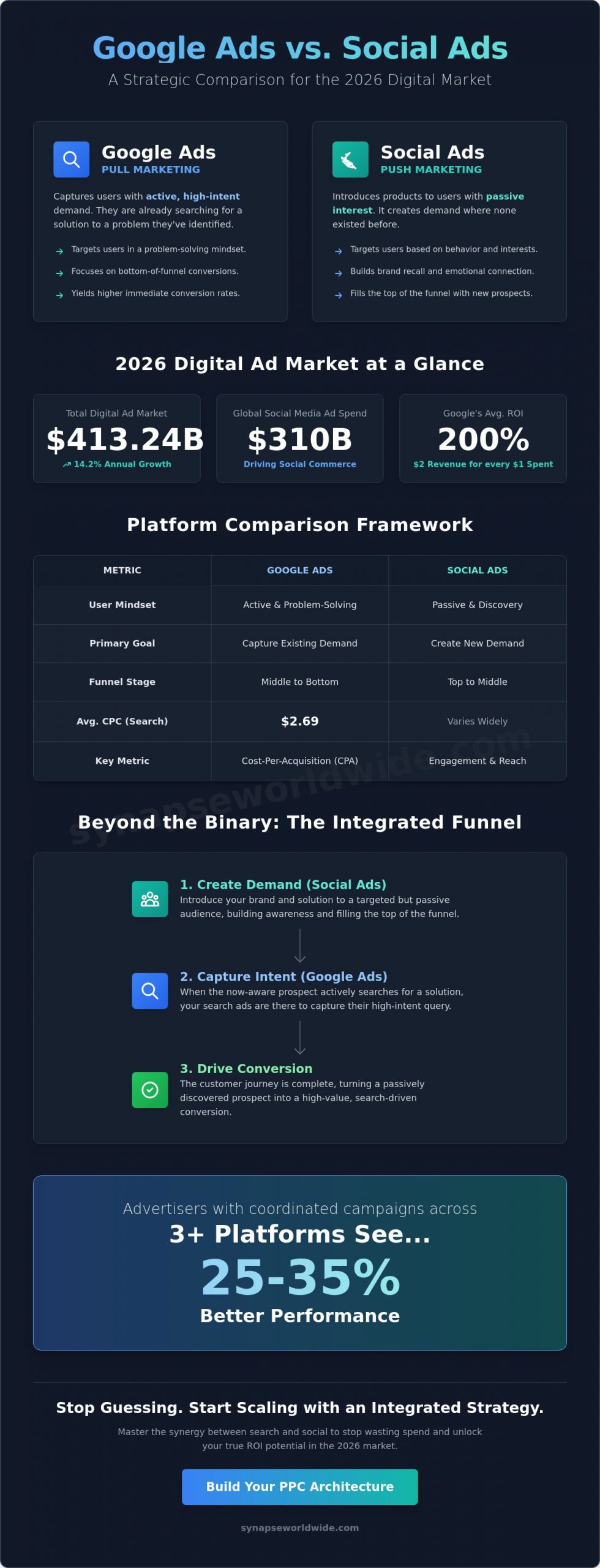
The 2026 digital advertising market is defined by a fundamental split between pull and push marketing strategies. Google Ads serves as the primary engine for pull marketing, capturing users who are actively seeking solutions. Social platforms represent push marketing, where sophisticated algorithms introduce products to users based on behavioral patterns. Successfully navigating the google ads vs social ads divide requires a deep understanding of this intent gap. While intent-based marketing often yields higher immediate conversion rates because it meets a pre-existing need, social discovery is essential for building the brand equity that fuels future searches. In this landscape, a bespoke strategy doesn’t choose one over the other; it aligns both to the customer’s psychological state.
By May 2026, AI integration has shifted from a luxury to a core requirement. Features like Google’s Performance Max and Meta’s Advantage+ now use predictive modeling to identify intent before a user even articulates a need. With US digital ad spend projected to grow 14.2% annually to reach $413.24 billion this year, the ability of these AI-driven systems to distinguish between casual browsing and commercial intent is the primary driver of ROI. Marketers who fail to calibrate their campaigns to these algorithmic shifts risk significant budget leakage on low-quality interactions.
The Psychology of Search: Why Intent Matters
Search marketing relies on a problem-solving mindset. When a user types a query into Google, they’ve already identified a pain point and are actively hunting for a resolution. This state of readiness is why high-intent keywords command a premium. The average cost-per-click on the Google Search network sits at $2.69 as of January 2026, reflecting the high value of capturing a user at the bottom of the funnel. Because these users are closer to a purchase decision, search-driven traffic typically converts faster and more reliably than passive traffic. It’s a high-efficiency environment where precision beats volume every time.
The Power of Passive Interest: How Social Ads Create Demand
Social ads operate on the power of interruption and discovery. Instead of waiting for a search, platforms like Meta and TikTok use vast datasets to present a solution to a user who didn’t yet know they needed it. This visual-first approach is highly effective for brand recall and emotional connection. With global social media ad spend reaching $310 billion in 2026, the focus has shifted toward social commerce and direct-to-consumer sales within the apps. Social ads create demand by moving users from a state of passive interest to active consideration, effectively filling the top of the funnel so that search ads can later close the deal.
Google Ads: Capturing High-Intent Demand in the 2026 Market
Google Ads remains the bedrock of performance marketing by capturing commercial intent at the exact moment of need. By January 7, 2026, Google is projected to capture 38.6% of the total US digital ad spend. This dominance isn’t just about search volume; it’s about the platform’s ability to interpret complex user behavior. The introduction of AI Overviews has transformed how users discover information, making visibility more competitive than ever. For businesses in regulated sectors like financial services or healthcare, the May 2026 rollout of text disclaimer assets ensures that legal compliance is seamlessly integrated into responsive search ads. This level of precision is why businesses earn an average of $2 in revenue for every $1 spent on the platform.
Success in this environment requires a move away from generic strategies. Performance Max and AI-driven bidding have become the standard for campaign management, but they require high-quality data to function effectively. Without a clear strategy, it’s easy to waste budget on broad queries that don’t convert. Professional PPC management ensures that these automated tools are guided by business objectives rather than just platform defaults. Our digital architects focus on refining these inputs to ensure your brand appears when the intent is highest.
The Search Network: Precision and Performance
In 2026, the concept of a keyword has evolved into intent-matching. Google’s algorithms now understand the context behind a search query, allowing for more relevant ad placements. While the average cost-per-click on the Search network is $2.69, prices for top-tier B2B keywords can be significantly higher. Maintaining a high Quality Score is the only way to reduce these costs over time. This requires a seamless transition from the ad to the destination. Implementing rigorous ppc landing page optimization is no longer optional; it’s a requirement for maintaining a competitive edge in auction-based bidding.
YouTube and Display: The Hybrid Intent Channels
YouTube has solidified its position as a search engine for educational and “how-to” content. It offers a unique middle ground in the google ads vs social ads comparison, combining the visual impact of social media with the intent-driven nature of search. Meanwhile, the Google Display Network provides a cost-effective way to stay top-of-mind, with an average CPC of only $0.63. We use Display for strategic remarketing, showing tailored ads to users who have already engaged with your site. This integrated approach ensures that your brand remains visible throughout the entire decision-making process, from the initial search to the final conversion.
Social Media Ads: Cultivating Brand Affinity and Discovery
Social media advertising has transformed from a mere awareness tool into a sophisticated engine for demand generation and direct commerce. By the end of 2026, global social media ad spend is projected to reach $310 billion, reflecting a massive shift in how brands reach their ideal customers. Unlike search engines that wait for a user to express a need, social platforms use deep behavioral data to predict desires. This proactive approach is the core differentiator in the google ads vs social ads comparison. Social ads don’t just capture traffic; they cultivate brand affinity by placing your message in front of users before they even think to search for a solution.
The 2026 digital landscape rewards creative excellence over granular manual targeting. Algorithms now prioritize high-quality video content and authentic storytelling to drive engagement. TikTok’s 2026 policies now mandate clear labeling for AI-generated content and promotional disclosures, ensuring a more transparent user experience. These shifts mean your brand must focus on “Social Commerce” strategies that allow for seamless, in-app purchases. Meta continues to lead the market with a 39% share of social ad spend, but platforms like Reddit are seeing explosive growth, with ad revenue increasing 74% year-over-year in Q1 2026. This diversity allows for a bespoke targeting approach that feeds the top of your marketing funnel, eventually driving high-intent searches on Google.
Meta vs. LinkedIn vs. TikTok: Choosing Your Battlefield
Selecting the right platform depends entirely on your Ideal Customer Profile (ICP). LinkedIn remains the premier choice for B2B precision, despite having the highest cost-per-click in the industry, ranging from $6 to $12. For Australian enterprises looking for broad reach and sophisticated retargeting, Meta’s 39% market share offers unparalleled scale. TikTok, capturing 12% of the market, utilizes an entertainment-first model that is essential for reaching younger demographics. We help you navigate these choices by aligning platform strengths with your specific business goals, ensuring your investment is placed where it will yield the highest return.
The Evolution of Social Targeting and Privacy
Privacy regulations in 2026 have fundamentally changed how we track success. The shift away from third-party cookies means that first-party data is now the most valuable asset in your digital arsenal. Meta’s March 2026 attribution update now distinguishes clearly between “click-through” and “engage-through” conversions, providing a more accurate picture of how likes and video views contribute to the bottom line. Because manual targeting has become less effective, broad targeting paired with rigorous creative testing has become the new standard. This AI-driven modeling allows the platform to find your best customers based on how they interact with your content, rather than just their static demographic profile.
Google Ads vs. Social Ads: A Strategic Comparison Framework
Choosing between platforms requires a clear-eyed analysis of your unit economics and growth objectives. The google ads vs social ads comparison isn’t just about where your audience spends time; it’s about the cost of acquisition relative to the speed of conversion. Google Search ads, with an average CPC of $2.69 as of January 2026, typically offer a shorter sales cycle because they capture users at the point of decision. In contrast, social platforms like LinkedIn command a premium of $6 to $12 per click, reflecting the high value of its professional demographic targeting. For SMBs, the decision matrix hinges on whether you need to harvest existing demand or create it from scratch.
Creative requirements also differ significantly between these ecosystems. Google Search demands text-based precision and headline optimization to win the auction. Social platforms require a heavy investment in visual assets, particularly video, to interrupt the scroll and build brand recall. Developing high converting ad copy that bridges user intent with tangible business value is essential across both channels, as generic messaging consistently underperforms in the increasingly competitive 2026 landscape. By May 2026, TikTok’s enforcement of mandatory promotional disclosures and AI labeling has made authentic, high-production content even more critical for maintaining trust. If you’re ready to stop wasting spend on low-quality leads, our team can design a bespoke PPC strategy that aligns your creative output with platform-specific requirements for maximum ROI.
Budget Allocation: Where to Spend Your First Dollar
Businesses with immediate revenue targets should prioritize Google Search to capture high-intent traffic. This “harvesting” phase ensures you’re visible when a prospect is ready to buy. Once search demand is saturated, social ads become the primary vehicle for scaling brand awareness and expanding your reach. We typically recommend a “70/30” split for balanced growth: 70% of the budget focused on high-intent search to maintain steady cash flow, and 30% dedicated to social discovery to fill the top of the funnel. This strategy mitigates the risk of rising search costs by building a proprietary audience on social channels before they even hit the search bar. For entrepreneurs who need a precise framework for allocating spend across these channels, understanding the fundamentals of a ppc budget for small business is an essential first step toward predictable, scalable growth.
Measuring ROI: Tracking the Multi-Touch Journey
Last-click attribution is obsolete in the 2026 digital landscape. Data shows that a user often sees a social ad, engages with the content, and then performs a branded Google search days later to complete the purchase. Meta’s March 2026 update to its attribution model, which now separates “click-through” from “engage-through” interactions, highlights this complexity. Relying solely on platform-reported ROAS can lead to incorrect budget decisions. Instead, focus on blended metrics like Marketing Efficiency Ratio (MER) to understand the true impact of your cross-channel efforts. Successful brands use integrated data to see how social awareness directly lowers the cost of their search conversions.
Beyond the Binary: Building an Integrated PPC Architecture
The most successful advertisers in 2026 have moved beyond the binary choice of google ads vs social ads. Instead, they build a unified digital ecosystem where data flows seamlessly between platforms. Research from February 10, 2026, indicates that brands running coordinated campaigns across three or more channels see a 25-35% performance increase compared to single-channel strategies. This isn’t just about presence; it’s about architecture. We use social ads to warm up cold audiences, introducing them to a solution so that when they eventually turn to Google with high-intent queries, your brand is already a trusted entity. This strategic alignment reduces the friction of the sales cycle and maximizes the efficiency of every dollar spent.
Managing this level of cross-channel complexity requires more than just platform knowledge; it demands a holistic view of the digital landscape. Our ppc management services are designed to bridge these gaps, ensuring that your search data informs your social creative and vice versa. For instance, if we identify high-converting search terms on Google, we integrate those specific pain points into your Meta or LinkedIn video scripts. This creates a feedback loop that lowers your overall blended cost-per-acquisition (CPA) and builds a robust, scalable growth engine for your business.
The Omnichannel Advantage: Why 1+1 = 3
A multi-channel presence creates a ‘halo effect’ that significantly boosts conversion rates. When a user sees your brand on TikTok or LinkedIn and then finds you at the top of Google Search, the perceived authority of your business doubles. We implement cross-channel remarketing to ensure no lead is left behind. If a user clicks a Google ad but doesn’t convert, we serve them a tailored social ad that addresses common objections or showcases social proof. This sequential messaging keeps your brand top-of-mind without being intrusive, guiding the prospect toward a decision with logic and consistency.
Scaling with Bespoke Digital Solutions
Cookie-cutter templates and automated defaults are the primary causes of wasted ad spend in the sophisticated 2026 market. As digital ad spend in the US approaches $413.24 billion, the competition for attention is fierce. A professional audit is the first step in identifying the leaks in your current funnel and transitioning to a bespoke strategy. We don’t believe in one-size-fits-all packages; we build custom architectures that reflect your specific business stage and ROI goals. If you’re ready to reach the next level of growth, contact Synapse Worldwide today for a consultation on a tailored national digital strategy that secures your 2026 marketing investment.
Securing Your Competitive Edge in the 2026 Digital Market
The digital landscape of 2026 leaves no room for guesswork. Success depends on your ability to synthesize high-intent search with the predictive power of social discovery. By aligning these channels, you create a robust ecosystem that captures demand while simultaneously building the brand equity needed for long-term scalability. The strategic debate regarding google ads vs social ads is no longer about choosing a winner; it’s about engineering these platforms to work in perfect harmony to serve your unique business goals.
Since 2005, Synapse Worldwide has acted as a digital architect for businesses seeking data-driven national growth strategies. We specialize in integrated CRM and marketing automation to ensure every lead is tracked and nurtured through a seamless funnel. Our expertise helps you navigate the complexities of modern attribution and platform shifts with total confidence. It’s time to stop reacting to market changes and start leading them. Scale your growth with a bespoke PPC strategy from Synapse Worldwide and transform your marketing investment into a predictable engine for success. Your next level of business achievement is within reach.
Frequently Asked Questions
Is Google Ads more expensive than Facebook Ads in 2026?
Google Ads typically command a higher cost-per-click compared to Meta platforms because they capture direct commercial intent. As of January 2026, the average CPC on the Google Search network is $2.69, while the Display network remains more affordable at $0.63. While Meta’s costs are often lower, your total cost-per-acquisition depends on your industry’s conversion rate and the quality of your landing page. Higher intent usually justifies the search premium.
Which platform is better for B2B lead generation in Australia?
LinkedIn is the superior choice for professional targeting in Australia, allowing you to reach decision-makers by job title and company size. However, the $6 to $12 average CPC requires a high customer lifetime value to remain viable. For capturing immediate needs, Google Search remains essential for B2B firms. A bespoke strategy often uses LinkedIn for building brand authority and Google for closing the lead when the prospect is ready to buy.
Can I run successful social ads without a large video production budget?
You don’t need a massive production budget to succeed, as 2026 algorithms increasingly favor authentic content over polished commercials. TikTok’s May 2026 policies now require labeling for realistic AI depictions, which has shifted user preference toward raw, human storytelling. High-performing ads often use simple smartphone footage that feels native to the platform’s feed. Authentic engagement consistently outperforms high-cost studio production in the current digital landscape.
How long does it take to see results from a new Google Ads campaign?
You’ll typically see initial traffic and data within 48 hours of campaign launch, but the learning phase for AI-driven bidding takes approximately 14 to 21 days. During this period, Google’s algorithms calibrate based on user interactions to improve your Quality Score. Realistically, a campaign requires three months of consistent management to reach peak efficiency and a stable return on investment. Patience during the initial optimization phase is critical for long-term success.
Should I stop social ads if my Google Ads are performing well?
Stopping social ads can negatively impact your search performance because these channels create the brand awareness that fuels future searches. Advertisers using three or more platforms see 25% to 35% better performance than those on a single channel. Social ads often introduce your brand to users who aren’t yet searching. This effectively lowers the long-term competition and cost of your search campaigns by building a proprietary audience.
What is the minimum budget required to start testing social media ads?
A testing budget should be large enough to generate at least 50 conversions per month for the algorithm to optimize effectively. While there’s no hard minimum, starting with less than $50 to $100 per day often results in slow data collection and delayed insights. This investment allows you to test multiple creative assets simultaneously. You’ll identify which visual hooks resonate with your specific audience segments much faster with an adequate testing floor.
How do 2026 privacy changes affect my ability to target ads?
Privacy regulations in 2026 have moved the industry away from third-party cookies toward first-party data and AI-driven predictive modeling. Meta’s March 2026 update now emphasizes “engage-through” attribution to better account for the value of non-click interactions. You must now rely on your own CRM data and platform-based “Lookalike” audiences. Success in this environment requires a robust data strategy that captures user information directly on your own digital properties.
Does social media activity improve my Google Ads Quality Score?
Social media activity doesn’t directly influence your Quality Score, but it improves the metrics that do. Higher brand awareness from social ads leads to a higher click-through rate when users eventually see your google ads vs social ads in search results. Since CTR is a major component of Quality Score, a strong social presence indirectly lowers your search CPC. It makes your ads appear more relevant and trustworthy to the user at the moment of search.

