
Tag Archives: PPC


Integrated Digital Marketing Strategy: The 2026 Framework for Scalable Growth

Integrated Digital Marketing Strategy: The 2026 Framework for Scalable Growth

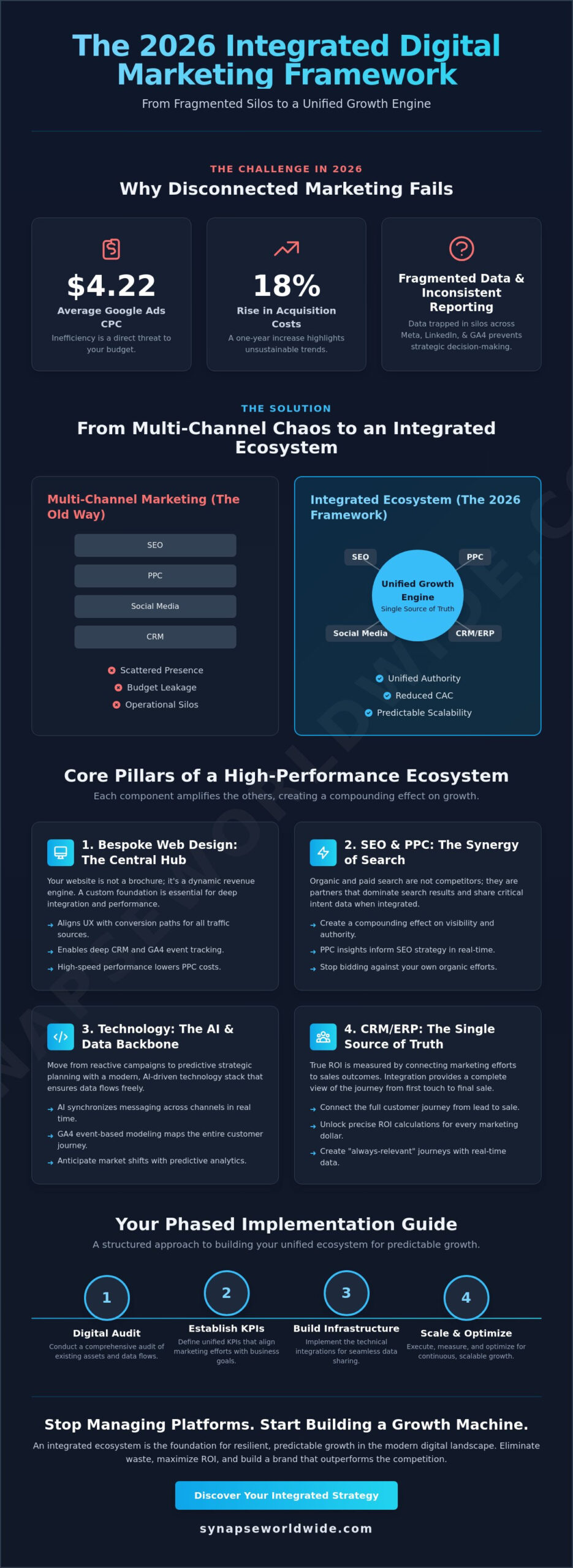
With the average Google Ads cost-per-click hitting $4.22 in 2026, your marketing budget is likely under more strain than ever before. It’s frustrating to watch acquisition costs rise by 18% in a single year while your data remains trapped in disconnected silos. You’re likely tired of the friction caused by inconsistent reporting across Meta and LinkedIn, which makes it nearly impossible to execute a high-performance integrated digital marketing strategy. This fragmentation doesn’t just waste money; it prevents your business from reaching its full potential and reaching the next level of success.

We believe your digital presence should function as a unified ecosystem rather than a collection of competing experiments. This guide introduces the 2026 framework for scalable growth designed to eliminate waste and maximize every dollar spent. You’ll discover how to align your SEO, PPC management, and CRM integration into a single engine that respects the latest CCPA privacy mandates. We’ll walk through the technical architecture needed to automate your operations, streamline your data via GA4, and turn fragmented touchpoints into a predictable path for business transformation. It’s time to stop managing individual platforms and start building a cohesive growth machine.

Key Takeaways

  • Transition from fragmented multi-channel tactics to a unified digital ecosystem that eliminates operational silos and prevents budget leakage.
  • Discover the architectural blueprint for an integrated digital marketing strategy that synchronizes SEO, PPC, and social media into a single growth engine.
  • Understand how CRM and ERP integrations provide a single source of truth for your ROI by connecting the entire customer journey from lead to sale.
  • Follow a phased implementation guide to conduct a comprehensive digital audit and establish the unified KPIs necessary for predictable scalability.
  • Learn why bespoke web design and customized technical solutions are essential for building a resilient brand that outperforms standardized competitors.

The Strategic Evolution of Integrated Digital Marketing in 2026

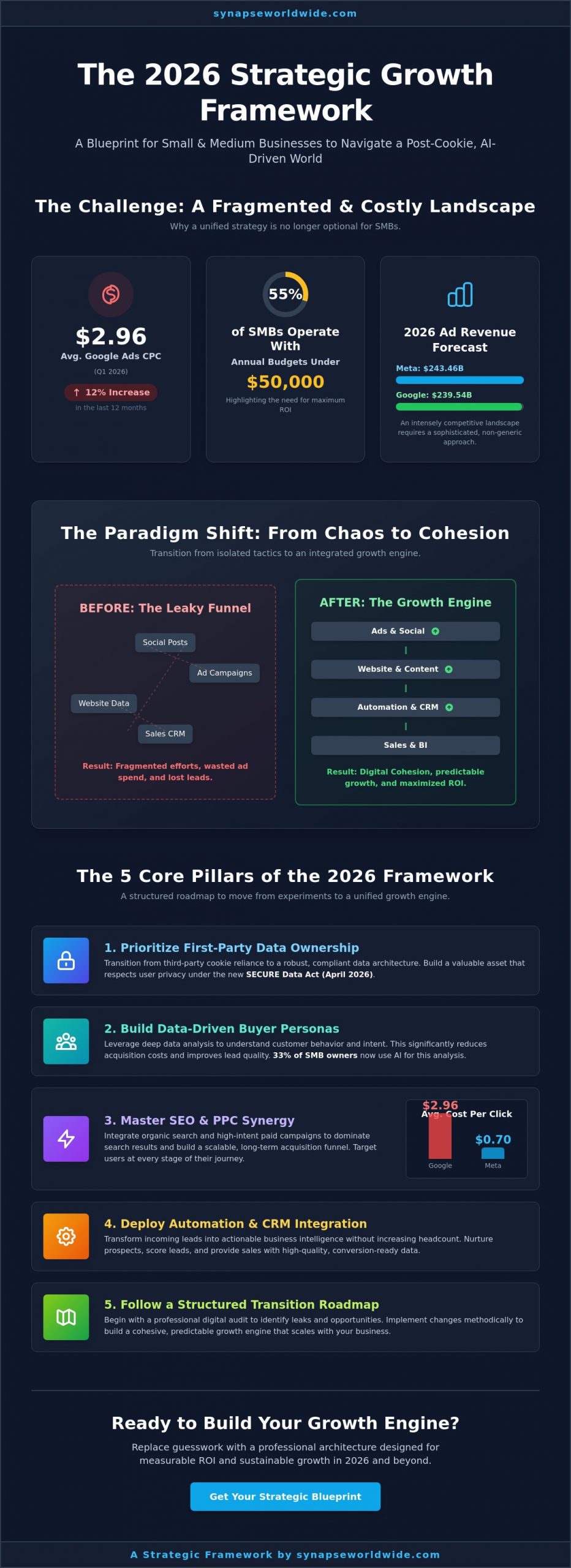
By 2026, the definition of digital success has shifted from mere visibility to total architectural cohesion. In a market where the average Google Ads cost-per-click has climbed to $4.22, an 18% increase from just a year ago, inefficiency is no longer just a nuisance; it’s a threat to your scalability. Fragmentation acts as a silent drain on your resources. When your SEO efforts don’t communicate with your PPC management, you’re essentially bidding against yourself or missing critical intent signals. A robust integrated digital marketing strategy ensures that every touchpoint reinforces the next, turning your website from a static digital brochure into a dynamic revenue engine. This evolution demands a shift toward “always-relevant” journeys where personalization is driven by real-time data rather than historical assumptions.

Integrated vs. Multi-Channel: The Critical Distinction

Market leadership in this decade isn’t earned by simply being present on every platform. While multi-channel marketing spreads your message wide, it often lacks the connective tissue required for high-level conversion. True integration is rooted in the principles of integrated marketing communications, where a consistent brand voice acts as the anchor across disparate platforms. This synergy directly impacts your bottom line by reducing customer acquisition costs (CAC). When your social media marketing and search strategies work in tandem, you create a compounding effect that drives efficiency and streamlines the path to purchase. It’s about moving from a scattered presence to a unified authority that commands attention.

The 2026 Digital Landscape: AI and Predictive Integration

The modern landscape relies on AI to do more than just generate content; it synchronizes messaging across SEO and paid search in real time. We’ve moved beyond reactive campaigns that look at last month’s performance. Today’s high-performance frameworks use predictive strategic planning to anticipate market shifts before they happen. This requires a seamless flow of data between your CRM integration and automated marketing funnels. By leveraging GA4’s event-based modeling, businesses can now interpret the entire customer journey with precision. This transition from reactive to predictive is the hallmark of a sophisticated integrated digital marketing strategy, allowing you to act on data intelligence before your competitors even recognize the trend. Establishing this real-time data flow is the first step toward building a resilient, self-optimizing growth engine.

Core Pillars of a High-Performance Integrated Ecosystem

A high-performance ecosystem isn’t a collection of disparate tools. It’s a synchronized engine where every component amplifies the others. To achieve scalable growth, your integrated digital marketing strategy must be anchored by four core pillars: bespoke web design, strategic SEO, high-performance PPC, and cohesive content marketing. When these elements operate in isolation, they create friction that slows your momentum. When they’re unified, they create a compounding effect that drives your business toward its next level of success. This structural integrity is what separates market leaders from those who are simply “online.”

Web Design as a Strategic Growth Engine

Your website is the central hub of your digital world. Off-the-shelf templates often struggle to handle the complex requirements of a modern growth strategy, such as deep CRM integration or advanced event tracking in GA4. Investing in custom web design for small business ensures your technical foundation is built specifically to support your unique marketing goals. A well-architected site aligns user experience with conversion paths, ensuring that traffic from your social media marketing or search campaigns doesn’t hit a dead end. High-speed, mobile-optimized pages aren’t just for users; they provide the technical performance required to maintain high quality scores for your paid media landing pages, which effectively lowers your overall acquisition costs.

The Synergy of SEO and Paid Search

In 2026, the most successful brands don’t choose between organic and paid visibility. They use them together to dominate the search engine results pages. By analyzing data from your paid search campaigns, you can identify high-converting keywords in real-time and feed those insights directly into your seo for small business strategy. This data sharing allows you to focus your organic efforts on terms that are proven to drive revenue rather than just empty traffic. This dual-threat approach ensures that your brand captures attention regardless of whether a user clicks an ad or an organic listing. It’s a sophisticated way to optimize ad spend while building long-term authority in your niche.

Content marketing serves as the narrative thread that connects these pillars. It isn’t just about writing articles; it’s about creating a consistent message that resonates from the first social media interaction to the final sale. When your messaging is unified, the customer journey feels seamless and intuitive, which builds the trust necessary for high-value conversions. If you’re looking to build a more resilient digital presence, you might consider how bespoke digital solutions can bridge the gaps in your current framework. Building this level of connectivity requires precision, but the return on investment is undeniable for businesses aiming for serious transformation.
Integrated Digital Marketing Strategy: The 2026 Framework for Scalable Growth

Eliminating Silos: Why Technical Infrastructure is the Backbone

Many businesses mistakenly treat integration as a creative or messaging challenge. In reality, it’s a technical one. Without a robust data layer, your integrated digital marketing strategy is essentially a series of educated guesses. We see growth stall most often when marketing teams can’t see what happens after a lead enters the pipeline. Infrastructure is the connective tissue that allows data to flow from a social media click to a final sale, providing the clarity needed to scale with confidence. Moving away from disconnected spreadsheets toward a unified dashboard isn’t just about organization; it’s about gaining a competitive edge through real-time intelligence.

Data centralization creates a single source of truth for your entire organization. ERP solutions play a critical role here, especially for national enterprises looking to streamline lead-to-sale workflows. By automating the feedback loop between sales data and marketing spend, you can identify exactly which channels produce the highest lifetime value customers. This level of visibility allows you to cut waste instantly and reallocate budget to high-performing segments. It’s a shift from reactive reporting to proactive optimization that ensures your digital presence is always working at peak efficiency.

CRM and Marketing Automation Integration

Connecting your website directly to your lead management systems eliminates the manual entry lag that often kills high-value conversions. It’s not enough to just capture a name; you need to personalize the user experience based on specific CRM data touchpoints. Custom API bridges and system bridges allow your marketing automation to respond to a prospect’s behavior in real time. When your systems talk to each other, the customer journey feels fluid and intentional. This technical harmony reduces friction for the user while providing your team with the granular data needed for sophisticated attribution modeling.

Scalable E-commerce Architecture

For brands selling online, the technical requirements are even more demanding. Sophisticated ecommerce website development requires a deep integration mindset from the start. You must connect inventory management directly with your real-time advertising feeds to ensure you aren’t wasting budget promoting out-of-stock items. Building for future growth means choosing a scalable digital infrastructure that can handle traffic surges without compromising performance. It’s about creating a resilient, interconnected foundation that supports your long-term vision for business transformation and reaches the next level of profitability.

Building Your Framework: A Step-by-Step Implementation Guide

Moving from a conceptual vision to a functional reality requires a disciplined, multi-phase approach. Building a high-performance integrated digital marketing strategy isn’t a weekend project; it’s a structural overhaul of how your business interacts with the digital world. The transition begins by stripping away assumptions and looking at raw data. Success in 2026 depends on your ability to execute these five phases with precision:

  • Phase 1: Conduct a Comprehensive Digital Audit to identify where your budget is leaking.
  • Phase 2: Define Unified KPIs that prioritize revenue over vanity metrics.
  • Phase 3: Execute Technical Synchronization between your website, CRM, and GA4 analytics.
  • Phase 4: Launch Content and Campaign Orchestration to ensure a singular brand voice.
  • Phase 5: Commit to Continuous Optimization to protect your ROI as market conditions shift.

This phased approach ensures that your growth is built on a stable foundation. By addressing technical debt and data silos early, you prevent the friction that typically slows down national enterprises. Each phase builds upon the last, creating a compounding effect that accelerates your transformation.

The Audit: Identifying Fragmented Touchpoints

A successful framework starts with a cold, hard look at your current assets. You can’t fix what you haven’t measured. We look for budget leaks where channels are competing rather than collaborating. For instance, if your social media marketing is driving traffic to pages with high bounce rates, it’s often a sign of a technical health failure or a messaging mismatch. Mapping your current customer journey against a desired state reveals the gaps in your funnel. This phase ensures your foundation is solid before you layer on additional spend. It’s about finding the “single source of truth” that has likely been missing from your previous reports.

Measurement: Tracking What Truly Matters

Vanity metrics like “likes” or “impressions” don’t pay the bills. In an era where Google Ads costs have risen significantly, every click must be accountable. You need revenue-based attribution that shows exactly how an initial search query eventually becomes a closed deal in your CRM. Implementing cross-channel tracking provides a 360-degree view of your ROI. Utilizing professional ppc management services allows for rapid data gathering during this phase, providing the insights needed to refine your long-term strategy. This data-first mindset ensures that every decision is backed by evidence rather than intuition. Ready to eliminate the silos holding your business back? Book a strategic consultation to begin your comprehensive digital audit and start your journey toward scalable growth.

Scaling with a Visionary Strategic Partner

While the framework for an integrated digital marketing strategy is clear, the difference between a plan on paper and a high-performance growth engine lies in the execution. Most businesses fail not because they lack ambition, but because they lack a visionary architect to manage the technical intricacies of their digital ecosystem. Partnering with a strategic consultant ensures that your SEO, PPC management, and CRM integration aren’t just line items in a budget, but interconnected components of a larger business transformation. This high-level oversight is what allows national enterprises to move beyond tactical experiments and toward predictable, scalable growth.

Future-proofing your business requires more than just staying current with trends; it requires building a resilient infrastructure that can withstand the next wave of digital disruption. As ad costs continue to rise and privacy mandates like the CCPA become more complex, having a partner who understands the underlying data layer is your greatest insurance policy. It’s about moving from a state of reactive maintenance to one of proactive, results-oriented leadership. This level of technical depth ensures your brand remains relevant and profitable regardless of how the landscape shifts.

Why a Custom Solution Beats a Standardised Package

Standardized marketing packages are designed for the average business, yet market leadership is rarely achieved by being average. Off-the-shelf solutions often create technical debt that limits your ability to pivot when search algorithms or consumer behaviors shift. Customization is the key to ROI because it allows your digital presence to mirror your unique operational strengths. Whether it’s bespoke e-commerce development or custom ERP solutions, these individualized architectures create a proprietary advantage that competitors can’t simply buy or copy. A long-term partnership focused on bespoke development ensures your infrastructure evolves alongside your ambitious business goals.

Taking the Next Step Toward Digital Integration

The transition from fragmented tactics to a unified strategy begins with expert technical consulting. You need a partner who can see the big picture while managing the intricate details of your automated marketing funnels. This planning phase is critical for identifying the technical bridges required to connect your social media marketing efforts with your sales data. By aligning your digital assets under a single strategic vision, you eliminate waste and create a clear path for expansion. It’s time to stop chasing individual metrics and start building a unified authority that commands the market. To begin your transformation, consult with our strategic architects today and discover how a truly custom solution can redefine your growth trajectory.

Architecting Your Digital Future

The transition from fragmented digital tactics to a unified ecosystem isn’t just a trend; it’s a strategic necessity for any business aiming to scale in 2026. By eliminating the silos between your SEO, PPC management, and web development, you create a resilient engine that turns rising ad costs into a competitive advantage. A successful integrated digital marketing strategy relies on a robust technical backbone where CRM and ERP data flow seamlessly to inform every strategic decision. This level of connectivity ensures that your marketing spend is always aligned with actual revenue growth rather than vanity metrics.

Since 2005, we’ve established a proven track record of driving national growth through bespoke web architecture and high-value system integrations. Our team specializes in custom software solutions that provide the authoritative expertise needed to navigate complex digital landscapes with confidence. You don’t have to settle for standardized packages that limit your transformation potential. Take the first step toward reaching the next level of business success and Partner with Synapse Worldwide for a Custom Strategic Framework. Your digital presence is ready for its next evolution, and the results you’ve been chasing are finally within reach.

Frequently Asked Questions

What is an integrated digital marketing strategy?

An integrated strategy is a unified framework that synchronizes all digital channels into a single growth engine. Instead of treating SEO, PPC, and social media marketing as isolated projects, this approach ensures they share data and messaging. This alignment eliminates budget waste and creates a consistent experience for the customer across every touchpoint, ensuring your brand voice remains authoritative and reliable.

How does integration differ from multi-channel marketing?

Multi-channel marketing simply means being present on various platforms, whereas integration focuses on how those platforms communicate. In a multi-channel setup, your PPC and SEO teams might operate in silos. An integrated digital marketing strategy connects these efforts through a shared technical architecture, allowing insights from one channel to optimize the performance of another and reducing your overall acquisition costs.

Why is CRM integration important for my marketing strategy?

CRM integration is vital because it bridges the gap between lead generation and actual revenue. By connecting your website directly to your sales data, you can track the entire customer journey with precision. This visibility allows you to identify which specific campaigns drive the highest lifetime value, shifting your focus from vanity metrics to tangible business outcomes and long-term transformation.

How long does it take to see results from an integrated approach?

Initial efficiency gains often appear within the first 90 days as budget leaks are identified and closed. While PPC management can drive immediate traffic, the full compounding effect of a unified ecosystem typically matures over six to twelve months. This timeline allows for deep data collection and the gradual build-up of organic authority through strategic SEO and consistent social media engagement.

What are the core components of a successful 2026 digital strategy?

The core pillars include bespoke web design, centralized technical infrastructure, and synchronized campaign orchestration. Success in 2026 requires a focus on data intelligence and privacy-first practices. A high-performance strategy must also include CRM and ERP solutions to ensure that lead-to-sale workflows are fully automated, providing a single source of truth for your business growth.

Do I need to overhaul my entire website to implement an integrated strategy?

An entire overhaul isn’t always mandatory, but your technical foundation must support deep data integration. If your current site cannot handle advanced GA4 tracking or custom API bridges, a strategic upgrade may be necessary. We prioritize the technical health of your digital assets to ensure they can function as a reliable hub for your growth engine and support your ambitious business goals.

How do I measure the ROI of an integrated marketing campaign?

ROI is measured through cross-channel attribution models that track how different touchpoints contribute to a single conversion. By moving away from last-click attribution, you gain a 360-degree view of your marketing spend. We focus on revenue-based KPIs that connect your digital activity directly to the bottom-line growth seen in your ERP systems, ensuring every dollar is accountable.

What role does AI play in digital marketing integration in 2026?

AI serves as the connective tissue that synchronizes messaging and predicts customer behavior in real time. In 2026, AI is used to optimize ad targeting and personalize content based on complex data patterns. It allows your integrated digital marketing strategy to remain agile, automatically adjusting to market shifts and predictive trends before they impact your performance or scalability.


Google Ads Management for E-commerce: The 2026 Strategic Growth Framework

Google Ads Management for E-commerce: The 2026 Strategic Growth Framework

In 2026, the success of your brand is no longer determined by how much you bid, but by the integrity of the data architecture fueling your automation. While Shopping ads now command 76.4% of all retail search spend, many retailers still struggle with climbing CPAs and fragmented tracking. You’ve likely felt the frustration of watching your budget disappear into low-margin products while your most profitable inventory sits idle. Effective google ads management for e-commerce now requires a shift from manual adjustments to sophisticated systems that bridge the gap between your warehouse and the Google Merchant API.

It’s exhausting to chase a target ROAS when your product feeds are outdated and your conversion data is incomplete. Growth should be intentional. You deserve a predictable path to scale that doesn’t sacrifice your margins. This guide introduces our 2026 Strategic Growth Framework, a data-driven blueprint designed to maximize your return on ad spend through deep inventory integration and advanced API utilization. We’ll explore how to navigate the sunset of the Content API for Shopping, leverage the new Data Manager API for offline conversions, and implement a hybrid campaign structure that puts you back in control of your growth.

Key Takeaways

  • Master the transition from manual keyword bidding to entity-based targeting to stay ahead of AI-driven campaign shifts.
  • Learn to architect a strategic product feed that serves as the high-performance engine for your entire digital storefront.
  • Establish deep connectivity between your Google Ads and internal business systems to eliminate wasted spend on low-margin inventory.
  • Discover why modern google ads management for e-commerce requires a focus on Profit on Ad Spend (POAS) and Lifetime Value rather than simple revenue metrics.
  • Understand the competitive advantage of partnering with a strategic architect who integrates technical development with marketing execution.

The Evolution of Google Ads Management for E-commerce in 2026

Modern e-commerce success is no longer a matter of simply outbidding the competition. It’s a precise blend of artificial intelligence, deep data science, and high-impact creative strategy. The days of manual keyword bidding have faded into the background, replaced by entity-based and audience-centric targeting that requires a holistic understanding of user intent. Success in this environment depends on your ability to feed the algorithm the right signals while maintaining strict control over your margins.

Standard “set-and-forget” campaigns are obsolete in a competitive national market. If you aren’t actively steering the machine, you’re likely funding inefficient experiments for Google’s algorithms. This is why professional google ads management for e-commerce has evolved into a discipline of architecture rather than just administration. You need a partner who understands how to build the infrastructure that allows AI to thrive without draining your profitability. Since the platform’s inception, Google Ads has undergone numerous transformations, but the current shift toward total automation is the most radical yet.

The complexity of the current ecosystem means that a single misconfiguration in your data layer can ripple through your entire account, skewing ROAS and leading to poor investment decisions. A strategic architect doesn’t just push buttons; they design the connectivity between your inventory, your CRM, and the ad platform. This ensures that every dollar spent is an investment in sustainable growth rather than a gamble on broad automation.

The Rise of AI-First Advertising

Performance Max campaigns now account for 67% of Shopping ad spend among advertisers using both Performance Max and Standard Shopping. This dominance highlights the shift toward AI-first advertising. These campaigns have redefined the e-commerce funnel by predicting behavior across every Google-owned property. However, the AI is only as good as the inputs it receives. High-quality creative signals are now the primary lever for guiding machine learning. Without professional oversight, these automated systems often prioritize volume over value, leading to “automated waste.” Strategic management ensures the AI focuses on your highest-margin products and most valuable customer segments.

Privacy and First-Party Data

As of June 15, 2026, Google has consolidated data controls with Consent Mode becoming the single control center for data collection. Navigating this cookieless environment requires a sophisticated approach to first-party data. Tools like Enhanced Conversions are no longer optional for brands that value accuracy. You must build a robust first-party data asset to fuel audience modeling and maintain a competitive edge. Server-side tagging is the gold standard for data accuracy in 2026, providing a secure and reliable way to capture conversion data without relying on fragile client-side scripts.

Architecting a High-Performance Google Merchant Center Strategy

The Google Merchant Center is the engine room of your digital storefront. While many retailers treat it as a secondary technical requirement, high-performance google ads management for e-commerce recognizes it as the primary catalyst for visibility. A standard feed is merely a data dump from your website. A strategic feed is a curated marketing asset designed to satisfy both the user’s intent and Google’s algorithmic requirements. This distinction is what separates stagnant brands from those that achieve predictable revenue scaling.

Rich product data is no longer optional. Detailed attributes like Global Trade Item Numbers (GTINs), high-resolution imagery, and granular product types directly impact your ad rank and cost-per-click. As of April 14, 2026, Google introduced mandatory shipping attributes, including handling_cutoff_time and minimum_order_value. Furthermore, warnings for images below 500×500 pixels began in April 2026, with full enforcement set for early 2027. Staying ahead of these technical shifts is vital. The transition from the Content API to the new Merchant API must be finalized by August 18, 2026, to avoid severe service interruptions. Professional PPC management ensures these updates become competitive advantages rather than operational hurdles.

Strategic Feed Optimization Steps

  • Step 1: Data Auditing. We begin by verifying attribute completeness across your entire catalog. Missing values for new shipping attributes can now trigger policy warnings that suppress your best-selling items.
  • Step 2: Title Engineering. Use supplemental feeds to inject high-converting keywords and specific brand terms into your product titles. This aligns your products with actual search queries rather than just internal SKU descriptions.
  • Step 3: Custom Labeling. Segment your products by margin, seasonality, or stock levels. This allows for precise budget allocation, ensuring you don’t waste spend on low-margin clearance items when your flagship products need visibility.
  • Step 4: Visual Testing. Continuous testing of product imagery is essential for maintaining a high CTR. With the optional video_link attribute now active, adding video content can significantly boost engagement on eligible surfaces starting June 30, 2026.

Dynamic Remarketing and Personalization

Your Merchant Center data fuels more than just the initial search click. It’s the foundation for dynamic remarketing that delivers hyper-specific ads to users based on the exact products they viewed. By leveraging cart abandoners with tailored messaging, you can recover lost revenue that would otherwise go to competitors. Dynamic prospecting takes this a step further by using your feed data to find new customers with profiles similar to your existing buyers. This ensures your brand remains visible to high-intent audiences throughout their decision-making process. Personalization at this scale isn’t just a trend; it’s a requirement for scaling profitability in the 2026 landscape.

Google Ads Management for E-commerce: The 2026 Strategic Growth Framework

Beyond the Click: Why Data Integration is Your Competitive Edge

The most common frustration for retail executives is seeing high traffic numbers that fail to translate into bottom-line growth. Clicks are a vanity metric if they don’t lead to profitable sales. To achieve true scale, your advertising engine must communicate directly with your internal business systems. Google Ads cannot operate in a vacuum. When your marketing data is siloed from your sales and inventory data, you’re essentially flying blind. Strategic CRM integration is the bridge that turns raw click data into actionable business intelligence.

As of June 15, 2026, the Data Manager API has become the primary tool for importing offline conversions, making this technical connectivity a requirement for modern google ads management for e-commerce. By passing profit margin data into your account, you move beyond revenue-based bidding. Instead of pursuing a generic ROAS, which averages between 2.87:1 and 4.0:1 in 2026 according to industry reports, you can optimize for actual profit. This ensures your budget prioritizes products that sustain your business rather than just those that generate high turnover with thin margins.

The ERP-to-Ad Pipeline

Synchronizing your ERP with your ad account ensures inventory levels are reflected in real-time. This prevents the costly mistake of paying for clicks on out-of-stock items, which is a primary source of wasted spend for large-scale retailers. You can also use this pipeline to exclude products with high return rates from premium bidding, protecting your margins from hidden costs. Real-time inventory data prevents customer friction and ad waste by ensuring you only promise what you can deliver. This level of technical discipline turns your supply chain into a marketing advantage.

CRM and Customer Lifetime Value (LTV)

Your CRM is a goldmine for audience modeling. By identifying high-value customer segments, you can instruct Google’s AI to bid more aggressively for users who mirror your best buyers. Simultaneously, excluding existing customers from “New Customer Acquisition” campaigns allows you to reallocate that budget toward finding fresh prospects. For high-ticket e-commerce items that require a consultative sales process, integrating lead scores ensures your google ads management for e-commerce is optimized for qualified interest rather than just initial inquiries. This precision ensures your growth is both sustainable and predictable.

Scaling Profitability: Measuring ROAS vs. Lifetime Value (LTV)

The traditional obsession with Return on Ad Spend (ROAS) often masks the true health of a retail business. While the average ROAS for e-commerce in 2026 sits between 2.87:1 and 4.0:1, these figures don’t account for the variable costs that dictate your actual take-home pay. Sophisticated google ads management for e-commerce has shifted toward Profit on Ad Spend (POAS). By integrating your cost of goods sold and shipping expenses into the bidding logic, you ensure that the algorithm prioritizes orders that actually contribute to your bottom line rather than just inflating top-line revenue numbers.

Dominating high-margin categories requires a framework for calculating an “allowable CPA” based on customer retention. If your CRM data reveals that a customer typically purchases three times within their first year, you can strategically afford a higher acquisition cost on the initial click. This long-term perspective allows you to outbid competitors who are restricted by a narrow 30-day window. Scaling is no longer about finding more clicks; it’s about identifying the most profitable paths to customer acquisition. If you want to transition from transactional bidding to a growth-oriented architecture, our PPC management services provide the technical depth needed to execute this shift.

The 2026 Measurement Framework

Measurement in 2026 has moved entirely beyond last-click models. Data-driven attribution is now the baseline requirement for understanding how different touchpoints contribute to a final sale. For national brands, we implement Marketing Mix Modeling (MMM) to quantify the cross-channel impact of Search, Shopping, and Demand Gen campaigns. This provides a holistic view of your marketing spend. It also allows us to set realistic KPIs for different product categories. You might accept a lower ROAS for “loss leader” products that drive high-value new customer acquisitions, while demanding a much higher return on your flagship, high-margin inventory.

Scaling Without Breaking the Algorithm

Scaling a successful campaign is a delicate process of maintaining algorithmic stability. We follow the “20% Rule,” where budget increases are capped at 20% every few days to prevent the campaign from re-entering a volatile “learning” phase. As you grow, you’ll eventually hit a point of diminishing returns in specific market segments. When this happens, we look toward architectural changes. This might involve moving from a single-account structure to a multi-regional or multi-brand setup. This ensures your google ads management for e-commerce remains efficient even as your reach expands into more competitive territories.

Partnering with a Strategic Architect for Sustainable Growth

Navigating the complexities of the 2026 digital marketplace requires more than just a tactical approach. As we’ve explored, the integration of the Merchant API, the shift to POAS-based bidding, and the necessity of server-side tracking have turned advertising into a high-stakes technical discipline. In this environment, professional PPC management services are no longer a luxury for growing brands. They’re a fundamental necessity. You need an architect who doesn’t just manage your spend but actively builds the infrastructure required for global scale.

Synapse Worldwide offers a unique synthesis of technical development and marketing strategy. We don’t believe in standardized, one-size-fits-all packages that many low-cost competitors favor. Instead, we focus on highly customized solutions that respect the intricate details of your specific business model. Effective google ads management for e-commerce demands a partner who understands your ERP systems as well as they understand your audience segments. By moving from a tactical vendor relationship to a strategic partnership, you ensure your brand remains resilient against algorithmic shifts and competitive pressure.

The Synapse Methodology

Our process begins with Deep Discovery. We dive into your specific profit margins, inventory turnover rates, and long-term business objectives. This isn’t just about keywords; it’s about business viability. From there, we move to Custom Architecture. This involves building the technical bridge between your digital storefront and Google’s AI ecosystem, ensuring every data point is captured and utilized. Finally, we commit to Continuous Evolution. The 2026 landscape moves fast, with monthly API updates and shifting consumer behaviors. We provide weekly optimizations and strategic pivots based on real-world performance data to keep your growth on track.

Ready to Scale Your E-commerce Empire?

Sustainable growth is only possible when your advertising is supported by a scalable ecommerce architecture. At Synapse Worldwide, we bridge the gap between local expertise and global best practices, providing the sophisticated oversight needed for complex national and international ventures. We invite you to step away from the stress of managing high CPAs and inaccurate tracking. Let our team of experts handle the technical discipline so you can focus on leading your business. google ads management for e-commerce is most effective when it’s part of a broader, visionary strategy. Consult with our strategic architects today to begin your transformation.

Architecting Your Path to E-commerce Dominance

The 2026 retail environment demands more than just visibility; it requires a sophisticated data ecosystem that prioritizes profit over volume. We’ve explored how the transition to the Merchant API and the implementation of server-side tracking have become the new baseline for performance. These technical foundations allow you to move from simple ROAS to a Profit on Ad Spend (POAS) model that reflects the true health of your inventory. Success today is defined by those who bridge the gap between their internal business systems and Google’s automated bidding engines.

Mastering google ads management for e-commerce is a journey toward technical maturity and predictable scaling. Established in 2005, Synapse Worldwide specializes in building bespoke digital architecture for brands that refuse to settle for standardized results. Our expertise in complex CRM and ERP integrations ensures that your advertising spend is always aligned with your actual margins. It’s time to stop reacting to platform changes and start leading your industry with a framework designed for long-term transformation.

Scale your e-commerce growth with a strategic Google Ads audit from Synapse Worldwide. Your next level of business success is within reach.

Frequently Asked Questions

How much should an e-commerce business spend on Google Ads in 2026?

Your investment should be determined by your unit economics and growth targets rather than a fixed industry average. Most national brands aim for a budget that allows for at least 50 conversions per month per campaign to satisfy machine learning requirements. This ensures the algorithm has enough data to optimize effectively. You should base your investment on your allowable CPA and the total addressable market for your high-margin products.

Is Performance Max better than Standard Shopping for e-commerce stores?

Performance Max is generally superior for broad reach and prospecting, but it works best when paired with Standard Shopping for granular control. While Performance Max accounts for roughly 67% of shopping spend in 2026, it can lack transparency in search term reporting. A hybrid approach allows you to capture high-intent traffic with Standard Shopping while using AI-driven campaigns to find new customers across YouTube, Gmail, and Search.

How do I track conversions accurately in a cookieless world?

Server-side tagging and Enhanced Conversions are the primary methods for maintaining data integrity in a cookieless environment. By moving your tracking from the browser to the server, you bypass the limitations of third-party cookie restrictions and ad blockers. This architecture ensures that your google ads management for e-commerce is fueled by accurate, first-party data. It’s the only way to maintain a clear view of your true ROAS.

Can I integrate my ERP system directly with Google Ads for better bidding?

Direct ERP integration allows you to feed real-time inventory and profit margin data into your bidding strategies. This prevents the system from bidding on out-of-stock items and shifts focus toward products with the highest net profitability. Using the Data Manager API or custom middleware, you can ensure your ad spend is always aligned with your physical warehouse reality. This level of connectivity is a hallmark of sophisticated digital architecture.

How long does it take to see a positive ROAS from a new Google Ads campaign?

Most new campaigns require a learning phase of two to four weeks to stabilize and begin showing a consistent return. During this period, Google’s AI experiments with different audiences and placements to find the most efficient path to conversion. While initial results may appear sooner, true scaling usually happens after the second month. This is when the system has gathered enough historical data to refine its bidding logic.

What is the difference between Google Ads management and simple media buying?

Media buying is the act of purchasing ad space, whereas google ads management for e-commerce is the holistic architecture of your sales funnel. Management involves product feed optimization, technical data integration, and creative strategy. It’s the difference between just spending a budget and building a scalable engine that talks to your CRM and ERP. A managed approach focuses on long-term business growth rather than just transactional clicks.

How do I prevent my ads from showing for irrelevant searches in 2026?

Advanced negative keyword lists are still vital, but you must also focus on negative signals in your audience data. By providing Google with high-quality first-party data, you train the AI to avoid users who don’t fit your ideal customer profile. Utilizing the new Merchant API to keep your product attributes precise also helps the system understand exactly what you sell. This reduces the likelihood of appearing for broad, non-converting queries.

Should I bid on my own brand name in Google Ads?

Bidding on your brand name is a defensive necessity to prevent competitors from poaching your most loyal customers. It ensures you dominate the top of the search results page and allows you to control the messaging users see first. Brand campaigns typically have the highest ROAS and lowest CPCs in any account. They provide a safety net that captures high-intent traffic that might otherwise be distracted by rival offers or AI-generated search overviews.


PPC Budget for Small Business: The 2026 Strategic Architecture for Growth

PPC Budget for Small Business: The 2026 Strategic Architecture for Growth

What if your marketing spend wasn’t a gamble, but a strategic data acquisition that fuels predictable growth? For many entrepreneurs, setting a ppc budget for small business feels like lighting money on fire while hoping for a miracle. You’ve likely felt the frustration of inconsistent results or the confusion of complex bidding models that seem designed to drain your bank account. It’s a common pain point, but it doesn’t have to be your reality.

This guide provides the professional framework you need to master the science of PPC budgeting in 2026. You’ll learn how to manage critical platform shifts, such as Google’s new 37-month data retention policy and the June 2026 transition to AI-driven asset reporting. We’ll show you how to eliminate wasted spend and transform your ad account into a scalable lead generation engine. We’ll break down the exact math behind high-level growth, giving you a clear understanding of the relationship between your spend and your revenue.

Key Takeaways

  • Learn how to structure a ppc budget for small business as a strategic fuel source rather than a simple expense by separating media spend from strategy.
  • Understand the financial commitment required to navigate the AI learning phase and achieve the algorithmic maturity necessary for predictable lead generation.
  • Master a step-by-step framework to calculate your ideal investment based on target Cost Per Acquisition and real-time 2026 performance benchmarks.
  • Identify the core differences between Search Intent and Interruption Marketing to allocate capital where it aligns best with your specific customer journey.
  • Discover how integrating PPC data with CRM and ERP systems enables closed-loop reporting to eliminate waste and maximize your total return on investment.

Defining the Strategic Architecture of a PPC Budget

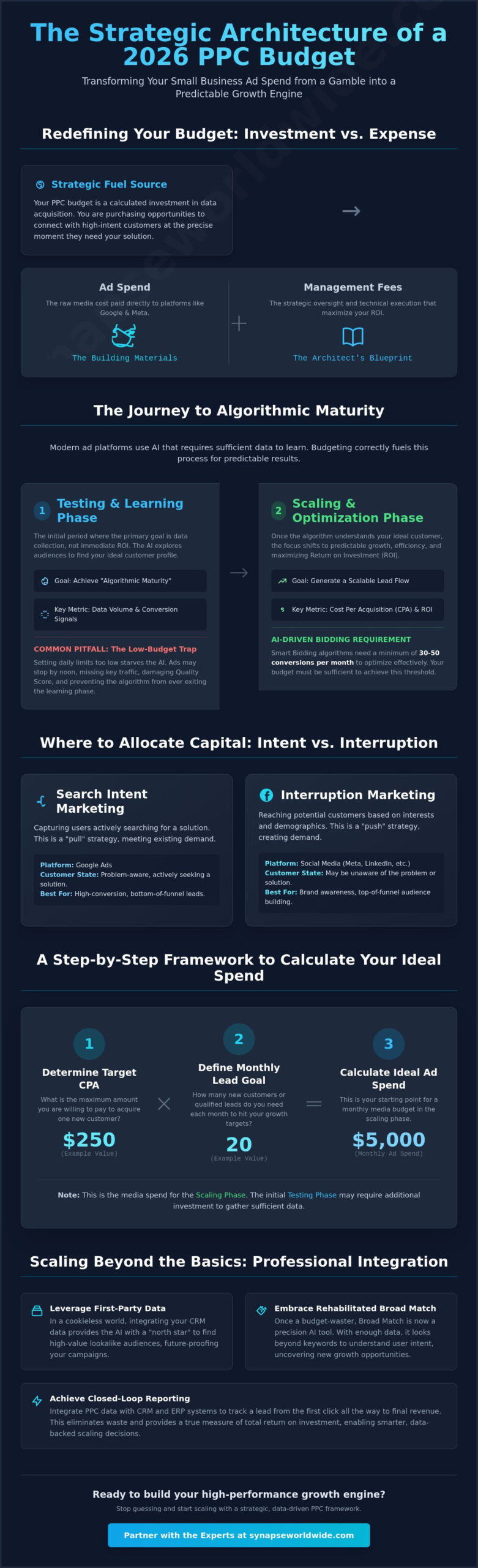
View your ppc budget for small business as the strategic fuel for a high-performance digital growth engine. It’s not a static line item or a cost to be minimized. Instead, it’s a calculated investment in data acquisition. In the 2026 landscape, Pay-per-click (PPC) has evolved from simple keyword bidding into a sophisticated system of intent-based audience targeting. You’re no longer just buying clicks; you’re purchasing the opportunity to present your brand to a specific individual at the exact moment their intent aligns with your solution.

Successful architecture requires a clear distinction between “Ad Spend” and “Management Fees.” Ad spend is your raw media cost paid directly to platforms like Google or Meta. Management fees represent the strategic oversight, technical execution, and continuous optimization that ensure your media spend isn’t wasted. Think of ad spend as the building materials and management fees as the architect’s blueprints. Without the strategy, you’re just piling bricks in a field.

What is a realistic PPC budget for small business in 2026?

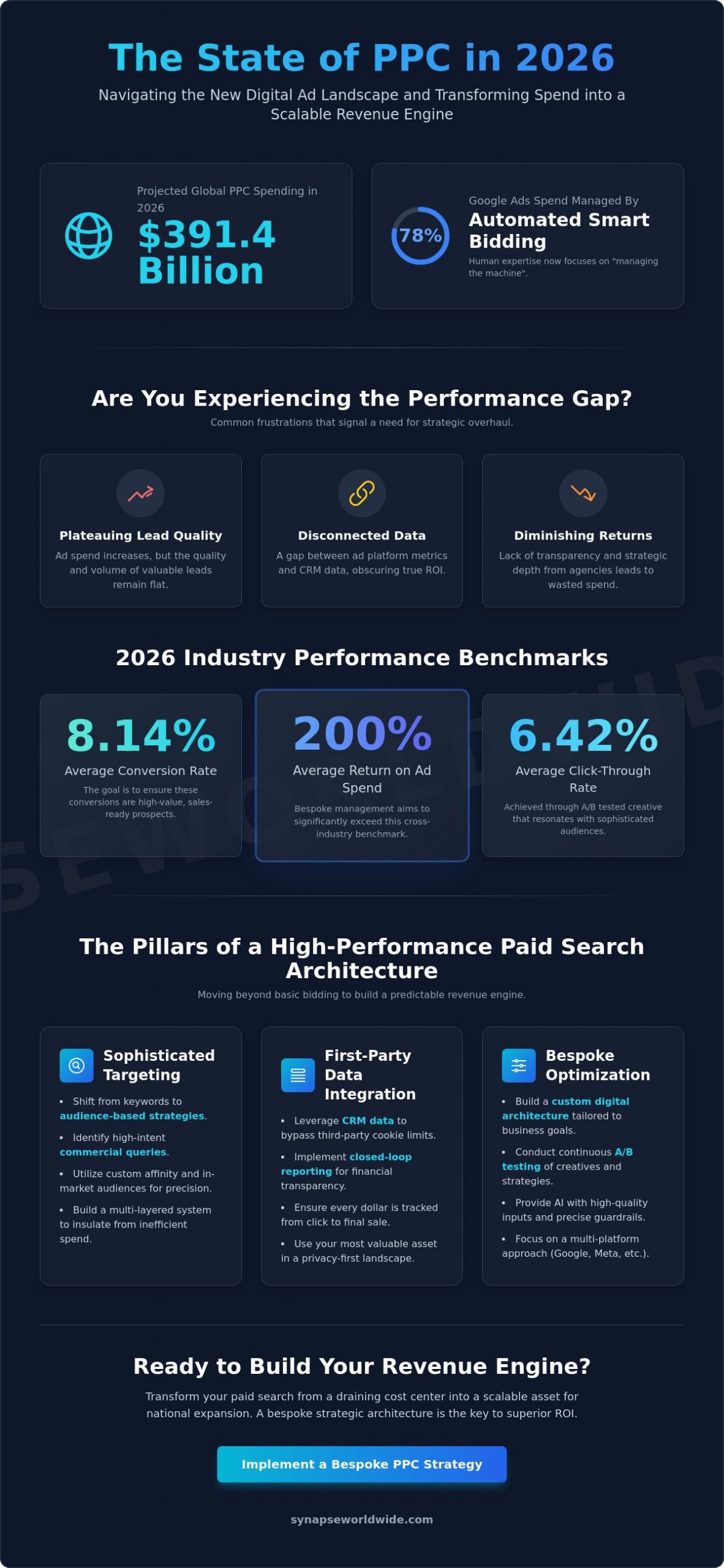
A realistic budget recognizes two distinct stages: the testing phase and the scaling phase. During the testing phase, your primary goal is to achieve “Algorithmic Maturity.” Modern ad platforms rely on machine learning to identify your ideal customer. If your budget is too thin, the algorithm never receives enough data to finish its learning phase. This leads to erratic performance and a high cost per lead. Professional ppc management services act as the bridge here, ensuring your initial investment is sufficient to trigger these automated efficiencies.

Why do most small business PPC campaigns fail to scale?

The most common pitfall is the “low-budget trap.” When a daily limit is set too low, your ads might stop showing by noon, missing high-intent searches that occur later in the day. This inconsistency damages your Quality Score, making every click more expensive over time. Scaling requires a steady hand and a commitment to high converting ad copy. Compelling creative does more than just attract clicks; it improves your engagement metrics, which lowers your costs and allows your budget to stretch further. If you don’t feed the engine enough fuel to run consistently, it will never reach the momentum needed for true growth.

The Mechanics of 2026 Paid Search: Data, AI, and Clicks

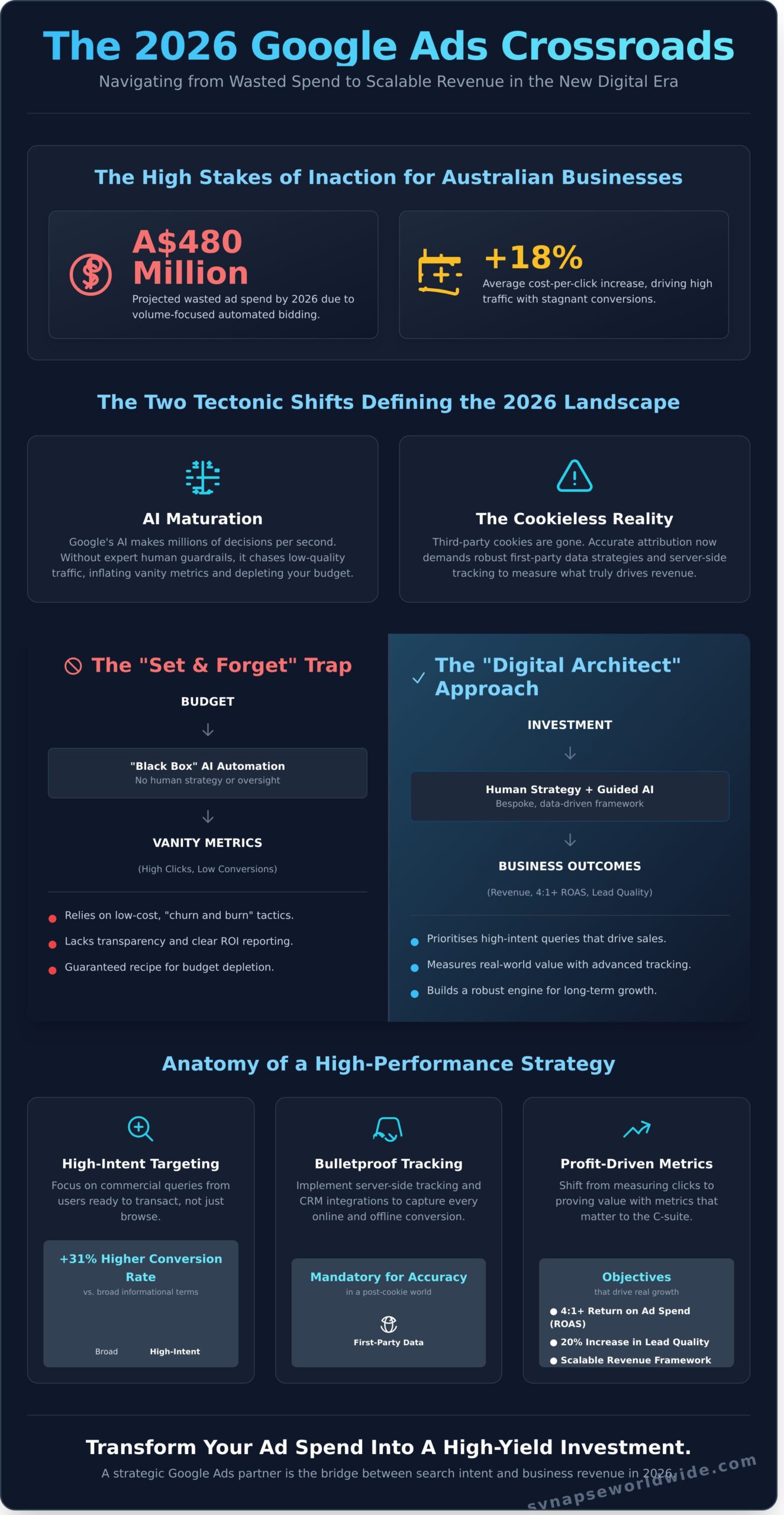
The machinery driving modern paid search has undergone a fundamental transformation. In 2026, Google Ads functions less like a directory and more like a predictive engine. It uses sophisticated machine learning to analyze billions of signals in real time, identifying users most likely to convert. This shift means your ppc budget for small business is no longer just buying space; it’s buying the processing power of an advanced algorithm. Aligning your spend with Small Business Administration marketing budget guidelines ensures you have the foundational capital to compete in these high-intent auctions.

One of the most notable shifts is the rehabilitation of “Broad Match.” Previously dismissed as a way to waste money on irrelevant clicks, Broad Match is now a precision tool when backed by a healthy budget. It allows the AI to look beyond the literal words a user types to understand their underlying intent. However, this only works if the system has enough data to learn. This is why a “Learning Phase” is unavoidable. During this period, the algorithm explores different audience segments to see what sticks. If you pull the plug or starve the budget too early, you’ll never see the ROI that comes with algorithmic maturity.

First-party data has become the lifeblood of successful campaigns in a cookieless environment. By integrating your customer data directly into the platform, you provide the AI with a “north star” to find similar high-value prospects. This level of technical integration is a hallmark of professional PPC management, ensuring that your digital strategy remains resilient against privacy-driven industry changes.

How does AI-driven bidding affect your daily budget?

Smart Bidding is the primary 2026 mechanism for ROI, but it requires a specific volume of data to function effectively. Most algorithms need a minimum of 30 to 50 conversions per month to optimize properly. If your budget only allows for five conversions, the AI remains in a perpetual state of guesswork. Google also uses “Budget Pacing” to distribute your spend across the week, sometimes spending up to double your daily limit on high-traffic days to capture peak opportunities. This flexibility is essential for capturing leads when they are most active.

The role of Quality Score in budget efficiency

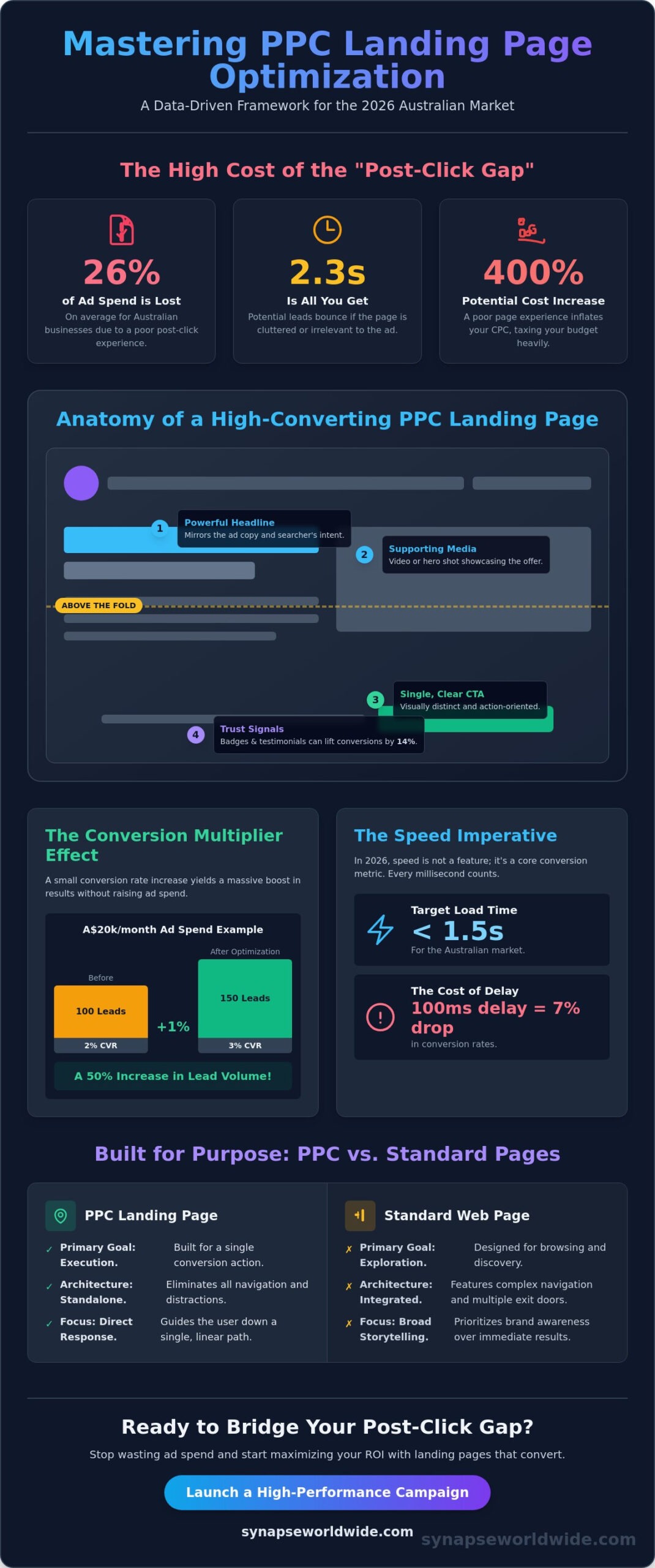
A high Quality Score is your best defense against rising ad costs. It acts as a discount on your Cost Per Click (CPC), allowing you to win better positions for less money. This score is heavily influenced by the relevance of your ads and the experience users have after they click. Implementing a ppc landing page optimization strategy is the most effective way to improve these metrics. When your landing page perfectly matches the user’s intent, the “waste” in your ad spend evaporates, and your budget achieves significantly higher efficiency.

PPC Budget for Small Business: The 2026 Strategic Architecture for Growth

Strategic Allocation: Google Ads vs Social Media Advertising

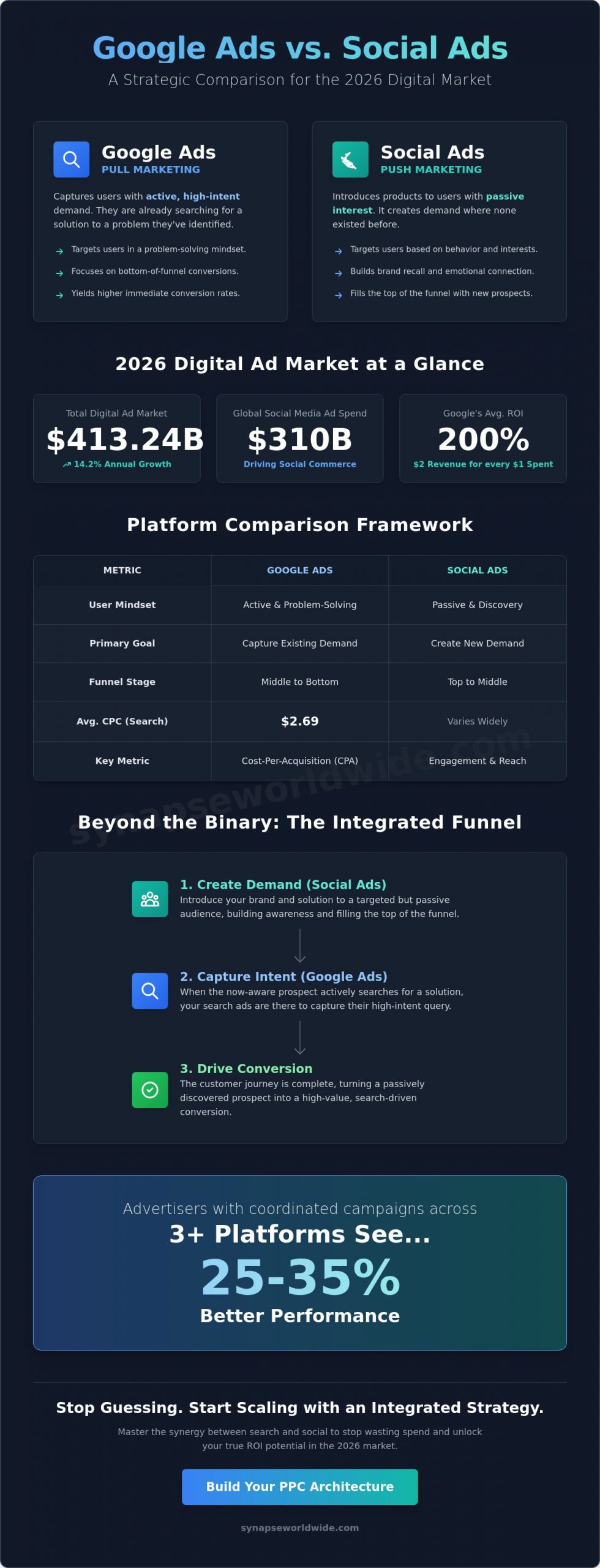
Distributing your ppc budget for small business requires a sophisticated understanding of how different platforms interact with the customer journey. You must distinguish between “Search Intent” and “Interruption Marketing.” Google Ads excels at capturing users who are actively hunting for a solution. They’ve identified a problem and are ready to engage. Conversely, social media advertising functions by interrupting a user’s browsing experience to introduce a brand or offer. While both are valuable, their roles in your strategic architecture are distinct. For a granular breakdown of these differences, explore our google ads vs social ads comparison guide.

A hybrid approach often demands a more robust total investment, but it typically delivers a more sustainable Customer Acquisition Cost (CAC). By capturing high-intent traffic through search and then nurturing those prospects through social retargeting, you create a cohesive digital presence that mirrors modern buying habits. This multi-channel strategy ensures that no lead is left behind, maximizing the utility of every dollar in your ppc budget for small business.

When should a small business prioritise Google Ads?

High-intent industries where the customer need is urgent or specific should lead with Google Ads. Sectors such as legal services, emergency trades, or specialized B2B software rely on search because the user is already at the bottom of the funnel. In these competitive spaces, you’ll encounter a higher budget “floor.” You aren’t just paying for a click; you’re paying to jump to the front of a line of people ready to purchase. This immediate lead generation is the primary driver of revenue for businesses that solve specific, time-sensitive problems.

Allocating budget for Social Media awareness and retargeting

Social media platforms are the ideal environment for building brand equity and executing retargeting campaigns. While social ads often provide a lower Cost Per Click (CPC), they usually require more “touchpoints” to convert a stranger into a customer. This makes the visual quality of your creative assets a non-negotiable part of your budget. You must invest in high-impact imagery and video to stop the scroll. Retargeting is particularly efficient, as it focuses your spend on individuals who have already interacted with your brand, significantly increasing the likelihood of an eventual conversion without the high cost of cold acquisition.

Calculating Your Ideal PPC Spend: A Step-by-Step Framework

Setting a ppc budget for small business requires shifting from a “what can I afford” mindset to a “what does the data require” mindset. To build a predictable lead generation engine, you must treat your budget as a mathematical formula rather than a discretionary expense. This framework ensures your investment is sufficient to trigger the platform’s machine learning capabilities while protecting your bottom line.

  • Step 1: Determine your target Cost Per Acquisition (CPA). Analyze your profit margins and customer lifetime value to decide exactly how much you can spend to acquire a single lead or sale.
  • Step 2: Estimate industry average CPC. Use 2026 benchmark data to set expectations. For example, Google Search Ads currently average between $1 and $3 per click, while LinkedIn remains higher at $5 to $10.
  • Step 3: Calculate required traffic. Divide your goal of 30 conversions by your website’s conversion rate. If you convert at 3%, you need approximately 1,000 clicks to hit your target.
  • Step 4: Multiply traffic by average CPC. This provides your “Monthly Floor,” the minimum amount needed to maintain presence in the auction.
  • Step 5: Factor in a 20% “Testing & Experimentation” buffer. This capital is dedicated to trying new asset types or audience segments without risking your core performance.

If you’re unsure how these variables apply to your specific industry, our team can help you design a customized PPC strategy that aligns with your growth goals.

The 30-Conversion Rule: Why it dictates your budget

In the 2026 advertising environment, data volume is the only path to efficiency. Without at least 30 conversions per month, the platform’s algorithm cannot effectively distinguish between a high-value buyer and a casual browser. For a service business facing a $2 CPC and a 5% conversion rate, you would need 600 clicks to reach 30 leads, resulting in a floor of $1,200 before the testing buffer. “In 2026, your budget is the fee you pay for the data that eventually makes your ads profitable.”

Adjusting for industry competitiveness and geographic scope

Your geographic targeting significantly impacts your required investment. A national campaign competes in a much larger pool than a local one, requiring a higher budget to maintain a healthy “Impression Share.” If you find yourself in a high-CPC industry with limited capital, the solution isn’t to spread your budget thin across many keywords. Instead, focus on niche targeting. By dominating a specific, long-tail segment of the market, you can achieve algorithmic maturity within a smaller geographic or topical scope, ensuring your spend isn’t diluted by broad, expensive competition.

Scaling Beyond the Basics: Professional Management and Automation

Allocating a ppc budget for small business is only the first step in a much larger strategic journey. Once the financial floor is established, the focus must shift toward maximizing the efficiency of every dollar spent. Professional ppc management services provide the technical oversight necessary to transform raw ad spend into a high-performance growth engine. By refining targeting and optimizing creative assets, expert management reduces the inherent waste that plagues unmonitored accounts. Synapse Worldwide acts as the visionary architect in this process, building the digital infrastructure required to support long-term scalability.

The true power of a modern budget lies in its connectivity. Integrating your PPC data with CRM and ERP systems creates a “Closed-Loop” reporting environment. This allows you to see exactly how an ad click translates into a signed contract or a repeat customer. When your marketing automation handles lead follow-up instantly, the return on ad spend (ROAS) for your initial budget increases exponentially. You’re no longer just buying traffic; you’re fueling a systematic process that converts interest into revenue.

When is it time to move from DIY to professional management?

There is a specific break-even point where the cost of professional fees is entirely offset by the savings generated through reduced ad-spend waste. While some suggest DIY for minimal budgets, the complexity of 2026 tracking makes this approach increasingly risky. Implementing Server-side GTM and Enhanced Conversions requires a level of technical discipline that goes beyond basic campaign setup. “Set and forget” strategies are the most expensive way to run a campaign, as they ignore the daily fluctuations in auction dynamics that can drain a budget in hours. If your account spend isn’t being actively managed, you’re likely overpaying for every lead you acquire.

Integrating PPC with your business automation ecosystem

A sophisticated ppc budget for small business leverages CRM integration to move beyond superficial metrics. Instead of bidding on “Leads” which may or may not be qualified, you can instruct the algorithm to bid on “Sales” or “Qualified Opportunities.” This strategic advantage allows you to identify which specific keywords drive your highest-value contracts. By seeing the full journey from click to cash, you can allocate capital with total confidence. Synapse Worldwide remains committed to delivering these ROI-driven, sophisticated digital solutions that bridge the gap between marketing spend and tangible business success.

Architecting Your Digital Dominance in 2026

Mastering your ppc budget for small business is no longer about guessing a monthly figure. It’s about respecting the mathematical requirements of modern algorithms and ensuring your data volume reaches the threshold for maturity. By shifting from a cost-minimization mindset to a strategic investment framework, you position your brand to capture high-intent traffic while competitors struggle with fragmented data. We’ve explored how the integration of CRM systems and AI-driven bidding transforms simple clicks into a predictable lead generation engine.

Synapse Worldwide has been at the forefront of this evolution since 2005. With over 20 years of digital expertise, we specialize in building the high-value digital infrastructure that corporate and government entities rely on for growth. Our results-oriented approach ensures that every tactical decision is anchored in long-term client ROI. It’s time to stop treating your marketing as an expense and start building your legacy. Request a Strategic PPC Audit and Budget Framework today to secure your place in the future of search. Your next level of success is within reach.

Frequently Asked Questions

What is a typical PPC budget for a small business in Australia?

A typical monthly ad spend for an Australian small business usually ranges between $1,000 and $10,000 depending on the industry and competitive landscape. Some highly competitive sectors like legal services or construction might require a higher entry point to maintain consistent visibility. It’s essential to align this investment with your specific revenue targets and local market conditions to ensure the spend is sustainable.

How long does it take for a PPC budget to start showing a return?

You should expect to see measurable data within the first 30 days, but a consistent ROI usually develops after the initial 90-day learning phase. This period allows the platform’s AI to gather enough conversion signals to optimize bidding strategies effectively. Patience during this stage is critical for building a stable lead generation engine that scales over time rather than providing a one-off spike.

Can I start with a $500 monthly PPC budget?

Starting with $500 is technically possible but often leads to the low-budget trap where the algorithm lacks sufficient data to learn. With such a limited ppc budget for small business, you risk reaching your daily limit by midday, which prevents you from capturing high-intent traffic later in the evening. Focusing on a very narrow niche or a tiny geographic area is the only way to make this level of spend viable.

Should I spend more on Google Ads or Facebook Ads?

Your choice depends on whether you need to capture existing demand or create brand awareness. Google Ads is the superior choice for high-intent search queries where users are ready to buy immediately. Facebook Ads excels at reaching specific demographic segments and nurturing leads who aren’t yet searching for your solution but fit your ideal customer profile perfectly.

How do I know if my PPC budget is being wasted?

Waste is typically identified by a high click-through rate coupled with a very low conversion rate or poor lead quality. If your ads are showing for irrelevant search terms or your landing pages have high bounce rates, your budget isn’t being used efficiently. Regular audits of your search term reports and conversion tracking setup are necessary to ensure your capital is driving tangible business outcomes.

Does the PPC budget include the cost of creating the ads?

No, the PPC budget typically refers to the media spend paid directly to the advertising platform like Google or Meta. The cost of strategic planning, copywriting, and graphic design for high-impact creative is usually handled separately as a management fee. Investing in professional creative is vital, as the quality of your assets directly impacts your Quality Score and overall cost per click.

What happens if I stop my PPC budget for a month?

Stopping your campaigns causes the platform’s algorithm to lose the momentum it gained during the learning phase. When you restart, the system often has to go through a period of re-learning, which can lead to temporary fluctuations in performance and higher costs. Consistent activity is the key to maintaining a low cost per acquisition and a stable presence in the digital auction.

How often should I review or change my PPC budget?

You should conduct a high-level review of your ppc budget for small business every quarter to ensure it aligns with seasonal trends and business goals. While daily optimizations are necessary for bid management and keyword performance, major budget shifts should be based on at least 30 to 90 days of data. This approach prevents knee-jerk reactions to short-term market volatility and ensures long-term stability.


Synapse Worldwide Services: A Strategic Guide to Bespoke Digital Solutions

Synapse Worldwide Services: A Strategic Guide to Bespoke Digital Solutions

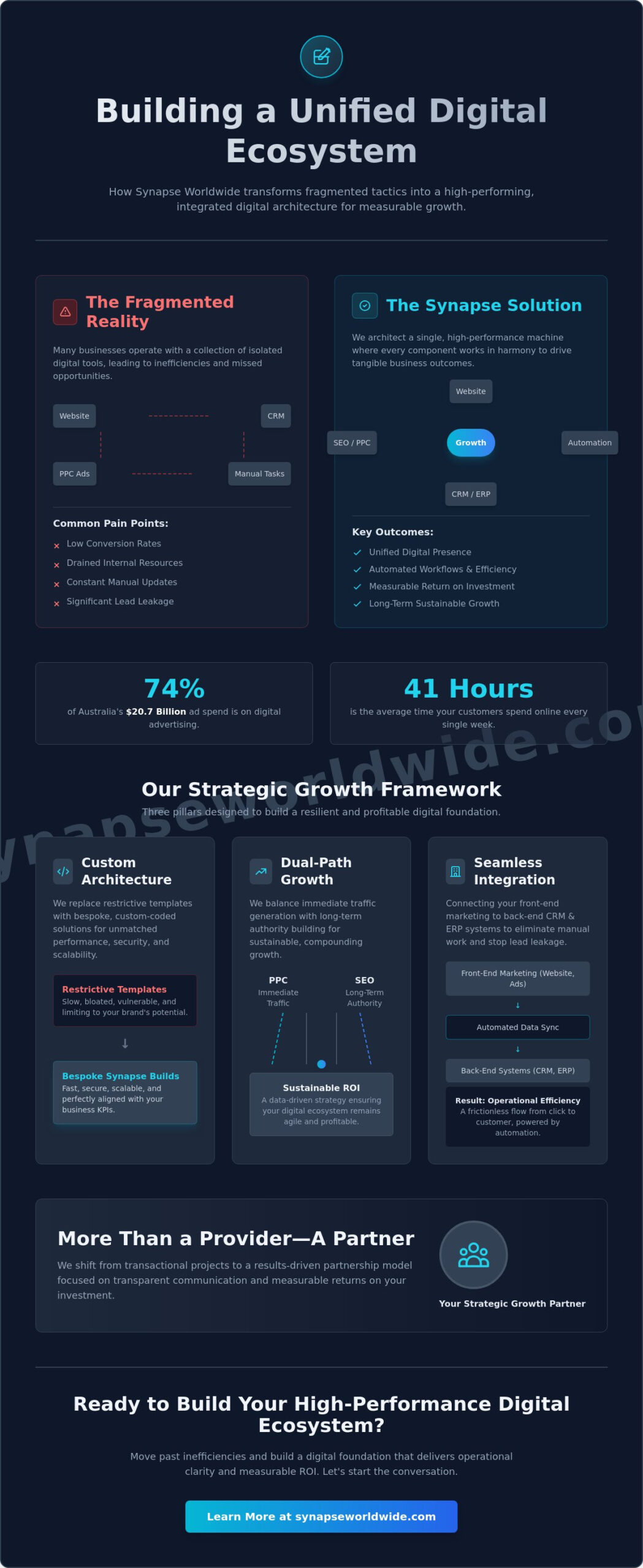
Did you know that digital advertising now accounts for 74% of the $20.7 billion total ad spend in Australia? This massive investment reflects a reality where your customers spend an average of 41 hours every week online. Yet, many organizations still struggle with a fragmented digital presence and manual processes that drain internal resources. Synapse worldwide services bridge this gap by transforming isolated tactics into a unified, high-performing digital architecture. We believe a website is only as strong as the integrated ecosystem supporting it.

You probably recognize the frustration of seeing low conversion rates despite a consistent marketing budget. It’s common to feel overwhelmed by the need for constant manual updates across disconnected platforms. This guide promises to show you how to move past these inefficiencies to build a digital ecosystem that drives measurable ROI and operational clarity. We’ll explore how integrating custom web design, CRM solutions, and precision SEO creates a seamless, automated path toward sustainable business growth and long-term success.

Key Takeaways

  • Replace restrictive templates with bespoke, custom-coded architectures designed to optimize every stage of the user journey.
  • Learn how synapse worldwide services unify your digital presence by seamlessly connecting front-end marketing to back-end CRM and ERP systems.
  • Adopt a dual-path growth strategy that balances immediate traffic from PPC with the sustainable, long-term authority of technical SEO.
  • Automate manual workflows and eliminate lead leakage through strategic business process integrations that prioritize operational efficiency.
  • Shift from transactional projects to a results-driven partnership model focused on transparent communication and measurable investment returns.

Defining the Synapse Worldwide Service Ecosystem

Many businesses treat digital growth as a series of isolated experiments. They buy a website here, run an ad campaign there, and hope the pieces eventually fit together. Synapse worldwide services operate on a fundamentally different premise. We view your digital presence as a living ecosystem where web design, SEO, and backend automation function as a single, high-performance machine. This holistic approach ensures that every dollar invested in digital marketing translates into a tangible business outcome rather than just a vanity metric.

Our philosophy centers on strategic architecture. We’ve moved beyond the era of generic, off-the-shelf templates that restrict your brand’s potential and compromise security. Instead, we prioritize custom-coded solutions. This bespoke methodology allows us to turn clicks into customers by removing the technical friction that often plagues standardized platforms. While our roots are firmly planted in the Australian market, we maintain international standards of delivery. This ensures our clients can compete effectively on a global stage while benefiting from local expertise.

Custom Digital Architecture

A website shouldn’t just look good; it has to perform under pressure. Custom builds offer a level of security and scalability that templates simply can’t match. By writing clean, purposeful code, we eliminate the bloat that slows down site speed and creates unnecessary vulnerabilities. In 2026, the stakes for web design and branding alignment are higher than ever. Your technical infrastructure must reflect your brand’s maturity, providing a stable foundation that adapts as your user behaviors shift. We tailor every technical solution to your specific KPIs, ensuring the architecture supports your unique operational flow.

Strategic Growth Framework

Success isn’t accidental. It’s the result of aligning digital assets with clear, long-term business objectives. Synapse worldwide services utilize data-driven insights to move beyond guesswork. This is particularly vital when formulating a digital marketing strategy for SMBs, where resources must be allocated with precision. We don’t just act as a service provider; we step in as a strategic growth partner. This means we’re constantly analyzing performance data to refine your trajectory. This ensures your digital ecosystem remains agile and profitable in an increasingly competitive landscape.

High-Performance Web and Ecommerce Development

A website shouldn’t just exist as a digital brochure. In an era where Australians spend an average of 41 hours per week online, your digital presence must function as a high-performance engine for conversion. Synapse worldwide services focus on engineering web applications that solve specific operational challenges while providing a frictionless user journey. We don’t just build sites; we architect environments where UI/UX design directly influences your bottom line. By integrating secure payment gateways and real-time inventory management, we ensure your technical infrastructure is robust enough to handle the complexities of modern trade.

Efficiency at this level requires more than just a pretty interface. Business process automation is the invisible force that powers our most successful builds. When your website automatically syncs with your internal systems, you eliminate the manual errors that stall growth. This mobile-first, automation-heavy approach ensures that whether a customer finds you through a search engine or a social media ad, their experience is fast, secure, and intuitive.

Bespoke Web Design

Templates often act as a ceiling for growing brands, limiting both aesthetic expression and technical capability. We move beyond these constraints to create unique brand identities that are search engine ready from day one. Our focus remains on the critical pillars of site speed, accessibility, and clean code architecture. Bespoke web design is the strategic process of building a unique, high-performance digital foundation that reflects a brand’s specific identity while outperforming standardized competitors in speed, security, and search engine visibility. This level of customization ensures your site can scale as your business evolves.

Scalable Ecommerce Solutions

Modern online stores must manage high volume and complex product catalogues without sacrificing performance. Our ecommerce development includes sophisticated features like multi-currency support, custom checkout flows, and direct ERP syncing. We’re looking ahead to the 2026 landscape, where headless commerce options allow for even greater flexibility in how you present your products across different devices. If you’re ready to transform your online store into a scalable asset, you can explore our custom development solutions to see how we bridge the gap between complex backend operations and elegant frontend experiences. This ensures that as your traffic grows, your infrastructure remains stable and profitable.

Synapse Worldwide Services: A Strategic Guide to Bespoke Digital Solutions

Sustainable Growth through SEO and PPC Management

Traffic is the lifeblood of any digital architecture. While the previous sections detailed how we build high-performance platforms, synapse worldwide services ensure those platforms are visible to the right audience at the exact moment of intent. We employ a dual-path approach to growth. This strategy balances the immediate visibility of paid campaigns with the enduring authority of organic search. Understanding the strategic nuance between SEO and PPC Management allows us to allocate your budget with clinical precision. We ensure you don’t overspend on temporary clicks while ignoring the long-term equity found in organic rankings.

The Australian digital market is highly competitive. With digital advertising accounting for 74% of the total $20.7 billion ad spend in the country, standing out requires more than just participation. It requires a sophisticated understanding of how search engines and social platforms interact to drive brand discovery. We monitor algorithm shifts continuously, adjusting your strategy to maintain a competitive edge as the digital environment matures.

Organic Search Visibility (SEO)

Search engines are undergoing a fundamental transformation. With the rise of AI overviews and zero-click searches in 2026, appearing at the top of a list is no longer sufficient. Your brand must be the authoritative source that AI tools cite. Our SEO framework addresses this by focusing on technical excellence and content relevance. We build industry leadership by creating high-quality assets that satisfy both complex human intent and evolving algorithmic requirements. This future-proofing ensures your visibility remains stable even as search platforms shift their primary delivery models.

Targeted Paid Search (PPC)

Paid search offers a different, immediate advantage. It provides instant access to high-intent users who are ready to convert. Our PPC management moves beyond vanity metrics like impressions to focus strictly on ROI and lead generation. We integrate these efforts with a sophisticated b2b social media marketing strategy to capture prospects at every stage of the sales funnel. Through rigorous A/B testing and landing page optimization, we refine every touchpoint to maximize conversion. This ensures that every dollar spent on Google Ads or social platforms is a calculated investment in your company’s measurable growth.

Business Process Automation: CRM and ERP Integration

A sophisticated digital presence creates demand, but operational efficiency determines whether you can fulfill it profitably. Many Australian businesses suffer from a “leaky bucket” syndrome. This happens when high-quality leads generated by SEO or PPC are lost due to disconnected internal systems. Synapse worldwide services resolve this friction by bridging the gap between front-end marketing and back-end operations. By implementing custom CRM and ERP integrations, we ensure that every customer interaction is captured, tracked, and utilized to drive business intelligence. This connectivity transforms your website from a simple lead generator into a fully integrated business tool.

Operational silos are the enemy of scalability. When your sales data doesn’t talk to your inventory management, or your marketing team can’t see customer lifetime value, you’re making decisions in the dark. ERP solutions centralize these functions, providing a unified view of finance, sales, and logistics. This integration significantly reduces the time spent on cross-referencing spreadsheets and manual reporting. The result is a sharper, more agile organization that responds to market changes with confidence. By removing these technical barriers, you create a foundation for sustainable, long-term growth.

Streamlining Operations

Manual data entry is a significant bottleneck that introduces human error and slows down growth. We eliminate these hurdles through seamless API connections that allow different software platforms to communicate in real-time. While generic third-party plugins might offer a quick fix, they often lack the security and specific tailoring required for complex business models. Our custom automation workflows are built to match your exact operational needs. This ensures your customer follow-up sequences are as unique as your brand. By utilizing synapse worldwide services for automation, you ensure that your technical debt remains low while your productivity stays high.

Data-Driven Decision Making

Integrated data provides a single source of truth for your entire organization. We create unified dashboards that offer real-time tracking of business performance. These tools allow you to see exactly which marketing channels are driving the highest lifetime value. This integrated approach makes it possible to forecast growth with accuracy and identify operational bottlenecks before they become critical issues. We also prioritize data security and privacy compliance, ensuring that your customer information is protected across every system in your ecosystem. This level of oversight turns raw data into a strategic asset.

If your current systems feel disconnected, you can consult with our integration experts to build a more efficient, automated future for your business.

The Partnership Model: Implementation and ROI

The transition from a visionary strategy to a live digital ecosystem requires more than technical skill. It demands a disciplined partnership. At the core of synapse worldwide services is a structured implementation process that moves seamlessly from project discovery to final deployment. We don’t believe in “set and forget” solutions. Instead, we act as a proactive project management partner, ensuring that every milestone is met with transparency and precision. This approach eliminates the ambiguity that often stalls complex digital transformations, providing you with a clear roadmap toward your objectives.

We measure our success through the lens of your revenue growth. While technical metrics like site speed and search rankings are vital indicators, the ultimate validation of our work is the impact on your bottom line. This commitment to ROI is why we prioritize evidence-based strategies over speculative tactics. We maintain a long-term perspective, offering the technical maintenance and support necessary to ensure your systems remain secure and high-performing as your business scales. This ensures that your initial investment continues to yield returns long after the initial launch phase is complete.

Fixed-Price vs. Retainer Models

Financial predictability is essential for Australian enterprises managing complex budgets. We offer two primary engagement structures to suit different business needs. Fixed-price models are ideal for defined project development, such as a custom web build or a specific ecommerce integration. This model provides a clear scope and a set fee, allowing for precise capital allocation. Conversely, monthly retainers are the most effective choice for ongoing digital marketing, social media management, and SEO. Retainers allow for the continuous optimization and agility required to stay ahead of market shifts and algorithm updates. Choosing the right model depends on whether you’re building a new asset or accelerating the growth of an existing one.

Support and Maintenance Subscriptions

A digital ecosystem is only as valuable as its reliability. Annual web hosting and maintenance subscriptions are a necessity, not an option, for businesses that prioritize security and user trust. These subscriptions cover the essential “invisible work” of keeping software updated, patches applied, and servers optimized. We also provide ad-hoc technical consulting to help you navigate new challenges as your operational needs evolve. Proactive maintenance is the most effective way to prevent the costly downtime that results from neglected system updates or security vulnerabilities. By investing in consistent support, you ensure your digital architecture remains a stable foundation for your daily operations.

Architecting Your Digital Future

Digital success in 2026 isn’t built on isolated tactics. It’s the result of a cohesive, high-performance architecture that prioritizes conversion and operational efficiency. By integrating custom web development with automated CRM and ERP systems, you eliminate the manual friction that stalls growth. Synapse worldwide services provide the strategic depth needed to transform your digital presence into a scalable business asset.

With over 20 years of expertise and more than 11,500 successfully managed deliverables, we specialize in the complex e-business solutions that drive measurable ROI. Since 2005, we’ve helped Australian enterprises move beyond generic templates to embrace bespoke digital ecosystems. It’s time to stop managing disconnected platforms and start leading a unified growth engine.

If you’re ready to reach the next level of operational maturity, you can book a discovery meeting to discuss your custom project today. Let’s build a digital foundation that supports your most ambitious business goals.

Frequently Asked Questions

What industries do Synapse Worldwide services cater to?

We provide strategic solutions for a diverse range of sectors, with a particular focus on B2B enterprises, complex ecommerce operations, and service-based businesses. Our expertise is most effective for organizations that require high-level data integration and custom digital workflows. Whether you’re in manufacturing, professional services, or retail, we tailor our technical architecture to meet your specific industry challenges and growth objectives.

How does Synapse Worldwide handle custom CRM and ERP integrations?

Our process begins with a deep-dive discovery phase to map your existing operational workflows and identify data silos. We then develop custom API connections that bridge the gap between your front-end marketing platforms and back-end management systems. This ensures that lead data, inventory levels, and financial records sync in real-time. This eliminates the need for manual data entry and provides a single source of truth for your business intelligence.

What is the difference between your fixed-price and hourly consulting fees?

Fixed-price models are typically utilized for projects with a clearly defined scope and set deliverables, such as a custom web design or a new ecommerce build. This provides budget certainty for your capital investment. Hourly consulting or monthly retainers are better suited for ongoing synapse worldwide services like SEO and PPC management. These models allow for the strategic flexibility needed to respond to changing market data and algorithm updates.

Do you provide ongoing support after a website or application launch?

Yes, we offer comprehensive support and maintenance subscriptions designed to protect your digital investment. These plans include essential security patches, server optimization, and technical consulting to help your systems evolve alongside your business. We believe in building long-term partnerships. Our team remains available to ensure your platform stays fast, secure, and aligned with the latest web standards long after the initial deployment.

How long does a typical custom web development project take?

Timelines for bespoke projects vary depending on the technical complexity, but most custom builds are completed within 8 to 16 weeks. This duration accounts for the entire lifecycle, including strategic planning, UI/UX design, custom coding, and rigorous quality assurance testing. We provide a detailed project roadmap during the discovery phase so you can coordinate the launch with your broader marketing and operational schedules.

Can you help with digital marketing if my website was built by another agency?

We frequently take over the management of existing digital assets to drive better performance and ROI. Synapse worldwide services include a comprehensive technical audit of your current site to ensure it can support advanced SEO and PPC strategies. If the underlying foundation is stable, we focus on optimizing your conversion paths and expanding your search visibility. If technical debt is hindering your growth, we’ll provide a clear plan to resolve those issues first.

What makes Synapse Worldwide different from other Australian digital agencies?

Our differentiator is the depth of our technical architecture and our 20-year history of managing complex e-business projects. Unlike agencies that rely on restrictive templates, we build custom-coded solutions that offer superior security and scalability. We act as both high-level strategic consultants and practical execution partners. This dual role ensures that your digital strategy is visionary yet grounded in technical reality.

How do you ensure the security of custom-built applications?

Security is a foundational element of our development process. We utilize clean coding practices and avoid the bloated third-party plugins that often create vulnerabilities in standardized platforms. Every application undergoes thorough testing and utilizes encrypted data transfers to protect sensitive information. By building bespoke systems, we significantly reduce your attack surface and ensure your data remains under your direct control.


High-Converting Ad Copy: A Strategic Architecture for 2026 Digital Growth

High-Converting Ad Copy: A Strategic Architecture for 2026 Digital Growth

Did you know that Meta’s AI-generated ad creative now outperforms human-designed assets by 18% in click-through rates? It’s a sobering statistic for any brand currently struggling with an average Meta CPC that’s climbed to $1.72. You likely feel the weight of rising acquisition costs and the frustration of ad fatigue as generic copy fails to resonate with your high-value leads. At Synapse Worldwide, we understand that high converting ad copy isn’t just creative writing. It’s a strategic architecture designed to bridge the gap between user intent and tangible business value.

You deserve a digital presence that’s expert, reliable, and tailored to your specific growth goals. We’ll show you how to master the psychological frameworks and data-driven strategies required to engineer ads that command attention and drive measurable ROI. This article provides a repeatable framework for building bespoke ad campaigns that align seamlessly with your landing pages while navigating 2026 transparency regulations. We’ll preview the exact methods used to transform your messaging from a simple line of text into a scalable engine for business transformation.

Key Takeaways

  • Shift your focus from clever wordplay to strategic alignment by balancing user intent, a compelling offer, and a direct call to action.
  • Implement psychological triggers like the PAS framework to build trust and resonance within the modern digital landscape.
  • Learn to engineer high converting ad copy by tailoring your messaging to the specific intent levels of search and social discovery platforms.
  • Apply a rigorous 2026 audit process to ensure your value propositions are clear, transparent, and compliant with current advertising regulations.
  • Integrate your copy into a scalable growth engine where bespoke web design and expert PPC management work in perfect synergy.

The Anatomy of High-Converting Ad Copy in 2026

High converting ad copy in 2026 is a precise strategic architecture, not a creative experiment. It represents the perfect alignment of user intent, a robust offer, and a clear path to action. While many brands still chase “clever” messaging that prioritizes brand ego over results, the most successful campaigns rely on clarity. In a digital landscape where attention is the scarcest resource, clear copy wins because it reduces the cognitive load on the prospect. To grasp the evolution of this discipline, one might ask What is Copywriting? in the context of modern performance marketing. It’s no longer just about writing; it’s about engineering a response.

Data-driven insights now dictate the first draft of every campaign. We don’t guess what might work; we analyze historical performance and real-time platform benchmarks to inform our messaging. There’s a fundamental distinction between brand awareness messaging and direct-response copy. Awareness seeks to occupy space in the mind, while direct-response copy is designed to trigger an immediate, measurable transaction. For a business to scale, its copy must be integrated into a broader strategy that prioritizes return on investment over vanity metrics.

The Shift from Creative to Strategic Writing

We approach ad copy as Digital Architects. This methodology replaces traditional agency “fluff” with a disciplined, technical framework. The cornerstone of this architecture is the value proposition. You must identify the “One Big Thing” your audience truly cares about. This isn’t a list of features; it’s the transformative outcome your service provides. With Google Ads restricting headlines to just 30 characters, every word must earn its place. A bespoke strategy ensures that these constraints don’t limit your message but instead force a level of precision that drives higher engagement.

Intent-Based Copywriting: Matching the Message to the Funnel

Success requires matching your message to the user’s specific stage in the buyer’s journey. Copy that fails to account for intent is copy that wastes budget. We categorize messaging into three distinct layers:

  • Top of Funnel (TOFU): These ads focus on problem awareness. Use educational hooks that address the prospect’s pain points without a hard sell.
  • Middle of Funnel (MOFU): At this stage, copy should build authority and facilitate solution comparison. This is where you demonstrate why your bespoke approach is superior to generic alternatives.
  • Bottom of Funnel (BOFU): This is pure direct-response territory. The copy must reduce friction, provide social proof, and present a clear, urgent call to action to finalize the transaction.

This structured flow ensures that your high converting ad copy remains relevant at every touchpoint, maximizing the efficiency of your digital spend.

Strategic Frameworks for Persuasive Messaging

Engineering high converting ad copy requires moving beyond basic intuition into the territory of structural psychology. We use time-tested frameworks, but we adapt them for a 2026 audience that is increasingly wary of traditional marketing tactics. The goal isn’t just to write; it’s to build a narrative that feels inevitable to the reader. Research into Digital Advertising Effectiveness suggests that messaging which resonates with specific psychological states outperforms generic calls to action every time. By treating copy as a strategic asset, we ensure every word serves a specific purpose in the conversion funnel.

The PAS Framework: Engineering the Solution

The PAS (Problem, Agitation, Solution) framework remains the gold standard for high-performance messaging. In 2026, the primary “problem” for many brands is a high cost-per-acquisition or a fragmented digital presence. You must identify the “bleeding neck” issue, the specific pain point that keeps your target audience awake at night. Agitation doesn’t mean being negative. It means highlighting the hidden costs of inaction, such as the 11% year-over-year increase in Meta CPC rates. Finally, position your bespoke solution as the logical path forward. If you’re looking for a partner to manage these complexities, our PPC management services can help refine your messaging architecture.

AIDA for Modern Social Platforms

The AIDA model (Attention, Interest, Desire, Action) is essential for multi-stage engagement on visual platforms. On Instagram Reels, where the average CPC is $1.28, you have less than three seconds to stop the scroll. Your first line must be an undeniable hook that commands immediate attention. Interest is then built through data-driven insights or unique industry perspectives. Desire represents the emotional bridge between a technical feature and a business benefit. It’s not about the mechanics of a CRM integration; it’s about the scalable growth and peace of mind that a robust system provides.

Beyond Formulas: The Logic of Bespoke Copy

Formulas are a starting point, but they aren’t the finish line. 2026 consumers can spot a template from a mile away and will quickly tune out generic messaging. They’re looking for authority, transparency, and a brand that understands their specific industry vertical. We inject brand-specific markers that prove you aren’t just another cookie-cutter competitor. Bespoke copy is the strategic antidote to ad fatigue in a saturated market. It ensures your message remains fresh and authoritative, even as platform algorithms and regulatory requirements continue to evolve.

High-Converting Ad Copy: A Strategic Architecture for 2026 Digital Growth

Platform-Specific Copywriting Strategies

Creating high converting ad copy requires a deep understanding of how user intent varies across different digital environments. The fundamental divide exists between active search and passive social discovery. On search engines, users are actively hunting for solutions, which demands precision and immediate relevance. On social platforms, you are interrupting a stream of content, which necessitates a more provocative, authority-driven approach. For a deeper dive into these platform dynamics, explore our Google Ads vs. Social Ads comparison. Successful brands maintain a consistent voice while pivoting their tactical execution to match these distinct user behaviors.

Google Ads: Precision and Relevance

In the world of Google Search, your copy is a direct answer to a specific question. With Responsive Search Ads allowing up to 15 headlines of 30 characters each, every word must be optimized for the click. You should incorporate your primary keywords naturally into the headlines to ensure the user feels an immediate match with their search query. We use ad extensions to claim more screen real estate, providing additional value propositions like “Bespoke Solutions” or “Data-Driven ROI” before the user even clicks. It’s also vital that your ad copy matches your landing page optimization strategy. This alignment reduces bounce rates and improves your Quality Score, which directly lowers your average $4.22 CPC on the search network.

LinkedIn and Meta: Visual Storytelling and Authority

Social advertising requires a shift from answering questions to sparking curiosity. On LinkedIn, where the average CPC for sponsored content ranges between $5 and $8, your tone must be professional and authoritative to resonate with B2B decision-makers. You aren’t just selling a service; you’re offering a strategic partnership. Conversely, Meta campaigns often thrive on emotional hooks and rapid social proof. With Meta CPCs rising to an average of $1.72, your “above the fold” copy is your most valuable asset. You have roughly 125 characters before the “See More” link appears. This space must be used to establish a connection or highlight a transformation. Whether you’re leveraging Instagram Reels or a Facebook Feed ad, the goal is to build an emotional bridge that leads the user from passive browsing to active engagement.

Consistency is the hallmark of a Digital Architect. While the length and tone may shift to suit the platform, the underlying value proposition remains steady. This integrated approach ensures that whether a lead finds you through a precise search query or a targeted social ad, they receive a seamless, robust brand experience that builds trust at every touchpoint.

The 2026 Ad Copy Optimisation Checklist

High converting ad copy isn’t a static asset; it’s a living component of your digital architecture that requires constant refinement. Every word on the page must earn its place by contributing to the final conversion. We use a rigorous audit process to ensure that messaging remains sharp and effective. A key part of this is “The Mom Test.” If a layperson cannot understand your core value proposition within five seconds of reading your ad, the copy is likely too complex or riddled with industry jargon. Clarity always outperforms cleverness when your budget is on the line.

Technical precision is equally vital. You must verify that your headlines stay within the 30-character limit for Google Responsive Search Ads and that your descriptions don’t exceed 90 characters. Readability scores should target a middle-school level to ensure broad accessibility. Finally, always check mobile rendering. An ad that looks perfect on a desktop may lose its impact if the primary hook is cut off on a smartphone screen. If you’re ready to build a more robust digital presence, partner with Synapse Worldwide to engineer your next campaign.

Phase 1: Pre-Launch Strategic Audit

Before any ad goes live, we verify the alignment between the hook and the specific audience segment. We look for a singular, clear call-to-action that leaves no room for ambiguity. A common mistake is “we-speak,” where the copy focuses on the agency’s or brand’s achievements. We pivot this to “you-speak,” ensuring the narrative is entirely focused on the customer’s transformation and the bespoke benefits they’ll receive. This shift in perspective is often the difference between a bounce and a lead.

Phase 2: Post-Launch A/B Testing

Our testing strategy focuses on the “Angle” before the “Headline.” Testing two different psychological triggers provides more valuable data than simply swapping a single word. We leverage platform tools like Dynamic Creative to let algorithms identify which phrases resonate best with specific users. This is crucial as ad fatigue sets in. When you notice frequency increasing and performance dipping, it’s time to pivot the copy to a fresh angle to maintain your ROAS.

Phase 3: Privacy-First Persuasion

In 2026, trust is the most valuable currency in advertising. With the FTC’s “Consumer Review” Rule and the upcoming EU AI Act transparency requirements, your copy must be beyond reproach. We avoid “creepy” hyper-personalisation that can alienate users. Instead, we build trust through high-integrity social proof and transparent messaging. By leveraging first-party data insights, we refine a bespoke narrative that feels deeply relevant without infringing on user privacy. This high-integrity approach ensures long-term stability and a stronger connection with high-value leads.

Integrating Copy into a Scalable Growth Engine

High converting ad copy functions as the tip of the spear, but its impact is entirely dependent on the strength of the shaft. Even the most persuasive messaging will falter if it isn’t supported by robust PPC management services. A strategic architecture ensures that your ads aren’t just seen; they’re served to the right person at the optimal moment within a complex, multi-channel auction. At Synapse Worldwide, we view ad copy as one component of a broader digital landscape that requires seamless integration from the initial click to the final CRM entry.

The Synergy of Design and Copy

Success in 2026 demands a flawless transition from the ad narrative to the website experience. This is where custom web design for small business provides the essential foundation. If your ad promises a bespoke solution but your landing page delivers a generic, slow-loading template, you’ll lose the trust you worked so hard to build. Visual hierarchy plays a critical role here; it reinforces the written word by guiding the eye toward the primary call to action. We ensure that the emotional hooks established in your high converting ad copy are visually and structurally validated once the user arrives on your site.

Scaling with Professional PPC Management

Modern ad auctions are too volatile for a “set it and forget it” mentality. Professional management is no longer optional; it’s a requirement for navigating the shifting regulatory environment and rising platform costs. A long-term strategic partnership allows for the deep data analysis needed to close the loop between marketing spend and business automation. We don’t just write ads; we architect growth engines that integrate seamlessly with your CRM and ERP solutions. Understanding how to structure a PPC budget for small business is a critical component of this holistic approach, transforming a simple transaction into a scalable system for long-term business success.

We invite you to consult with the Digital Architects at Synapse Worldwide. Let’s move beyond one-off copy projects and build a robust, integrated presence that positions your brand as an industry leader. By aligning your messaging with advanced technical execution, we ensure that every dollar of your digital investment is optimized for maximum ROI. Your journey toward measurable growth starts with a strategy that values precision, authority, and results.

Architecting Your Digital Future

Mastering high converting ad copy requires a transition from creative experimentation to disciplined strategic architecture. You’ve seen how matching your message to platform intent and maintaining transparency builds the trust necessary for 2026 growth. Success isn’t found in isolated ad variants. It lives in the seamless integration of copy, bespoke web design, and professional management. By following a structured optimization checklist, you ensure that every word drives measurable ROI and supports your broader business goals.

Established in 2005, Synapse Worldwide provides a Strategic Growth Framework tailored for Australian Enterprises seeking sophisticated digital solutions. We specialize in engineering bespoke digital infrastructure that transforms presence into performance. Our team acts as your Digital Architect, managing the intricate details while you focus on reaching the next level of business success. It’s time to move beyond generic templates and embrace a results-oriented approach that guarantees stability and growth.

Ready to transform your digital strategy? Partner with the Digital Architects at Synapse Worldwide for Bespoke PPC Strategy. Let’s build your path to measurable transformation today.

Frequently Asked Questions

What makes ad copy “high-converting” versus just “good”?

High converting ad copy is defined by its ability to drive a specific business transaction rather than just a click. While “good” copy may be clever or entertaining, it often lacks the strategic bridge needed to turn a visitor into a high-value lead. You must focus on the professional resolution of a specific pain point. By aligning your message with the prospect’s desired outcome, you create a narrative that feels both authoritative and inevitable.

How long should my ad copy be for a B2B audience?

The ideal length for B2B copy is dictated by the platform and the complexity of your offer. For search ads, you must be extremely concise to fit within strict character limits while still conveying authority. On social platforms, you have more space to build desire, but the most critical information must appear in the first 125 characters. Professional decision-makers value efficiency; every word must serve a strategic purpose.

Does AI-generated ad copy actually convert in 2026?

AI-generated copy is remarkably effective when integrated into a broader strategy. Meta’s Advantage+ Shopping campaigns have shown to deliver a 32% lower cost per acquisition than manual campaigns by using AI for optimization. However, AI cannot yet replicate the bespoke brand authority required for high-level consulting. We use AI to handle technical optimization while our human experts focus on the strategic architecture that ensures long-term business transformation and regulatory compliance.

How often should I refresh my ad copy to avoid ad fatigue?

You should refresh your copy when performance metrics indicate ad fatigue, which typically manifests as a rising CPA or falling CTR. In high-velocity social campaigns, a refresh every two to four weeks is common to maintain engagement. Instead of a complete overhaul, try testing a new psychological angle. This keeps the messaging fresh for the audience while allowing the platform’s learning algorithms to remain stable and effective.

What is the most important element of a high-converting ad?

The value proposition remains the most critical element of any successful ad. If your high converting ad copy doesn’t immediately communicate the unique benefit of your service, the prospect will simply keep scrolling. You must identify the primary outcome your customer desires and present it as a robust, reliable solution. This clarity of purpose acts as the foundation for the entire ad, ensuring that every other element supports a single, persuasive message.

How do I test which ad copy angle is working best?

We recommend using Dynamic Creative or structured A/B tests to evaluate different psychological angles. Testing a “Problem-Agitation” hook against a “Direct-Benefit” hook provides much more actionable data than testing minor word variations. This approach allows you to identify the core narrative that resonates most deeply with your target audience. Once the winning angle is established, you can refine the technical details to further optimize your conversion rates.

Should I use emojis in professional B2B ad copy?

Emojis can be used to guide the eye or break up long strings of text, but they must be used sparingly. In professional B2B environments, maintaining an authoritative and confident tone is paramount. Excessive use of symbols can undermine your credibility and distract from the strategic value of your offer. Use them only when they add clarity to your bespoke narrative without compromising your professional identity.

How does ad copy affect my Google Ads Quality Score?

Your ad copy directly influences your Quality Score by determining your “Expected CTR” and “Ad Relevance.” When your messaging aligns perfectly with the user’s search query, Google rewards you with higher ad positions and lower costs. It’s vital to ensure that your headlines and descriptions naturally incorporate keywords without sacrificing readability. This technical precision, combined with a seamless landing page experience, ensures your digital spend is utilized with maximum efficiency.


Google Ads vs. Social Ads: The 2026 Strategic Comparison for Growth

Google Ads vs. Social Ads: The 2026 Strategic Comparison for Growth

Advertisers running coordinated campaigns across three or more platforms are seeing 25-35% better performance than those tethered to a single channel. If you’re still treating the google ads vs social ads debate as a binary choice, you’re likely leaving a significant portion of that $413.24 billion 2026 digital ad market on the table. The margin for error has narrowed as platforms evolve, making a fragmented strategy a recipe for wasted spend and missed opportunities.

You’ve likely felt the frustration of watching your budget disappear into low-quality leads or struggling with Meta’s new engage-through attribution metrics. It’s exhausting to manage the complexity of modern tracking while trying to determine which platform actually drives your bottom line. We’ll help you master the fundamental differences between high-intent search and passive social discovery so you can stop guessing and start scaling with confidence. This strategic comparison breaks down the latest 2026 shifts, from Google’s new regulatory search disclaimers to TikTok’s mandatory disclosure rules, providing a bespoke roadmap for an integrated, high-ROI marketing investment.

Key Takeaways

  • Master the distinction between pull marketing and push marketing to ensure your budget aligns perfectly with your customer’s current intent stage.
  • Identify which high-intent search strategies and social discovery tactics will drive the most qualified leads for your specific business model in 2026.
  • Analyze the 2026 google ads vs social ads landscape using a data-driven framework that compares CPC, CPA, and total sales cycle length.
  • Build a robust, integrated PPC architecture that utilizes social platforms to warm up prospects before they transition into high-converting search queries.

Understanding the Digital Landscape: Search Intent vs. Social Discovery

The 2026 digital advertising market is defined by a fundamental split between pull and push marketing strategies. Google Ads serves as the primary engine for pull marketing, capturing users who are actively seeking solutions. Social platforms represent push marketing, where sophisticated algorithms introduce products to users based on behavioral patterns. Successfully navigating the google ads vs social ads divide requires a deep understanding of this intent gap. While intent-based marketing often yields higher immediate conversion rates because it meets a pre-existing need, social discovery is essential for building the brand equity that fuels future searches. In this landscape, a bespoke strategy doesn’t choose one over the other; it aligns both to the customer’s psychological state.

By May 2026, AI integration has shifted from a luxury to a core requirement. Features like Google’s Performance Max and Meta’s Advantage+ now use predictive modeling to identify intent before a user even articulates a need. With US digital ad spend projected to grow 14.2% annually to reach $413.24 billion this year, the ability of these AI-driven systems to distinguish between casual browsing and commercial intent is the primary driver of ROI. Marketers who fail to calibrate their campaigns to these algorithmic shifts risk significant budget leakage on low-quality interactions.

The Psychology of Search: Why Intent Matters

Search marketing relies on a problem-solving mindset. When a user types a query into Google, they’ve already identified a pain point and are actively hunting for a resolution. This state of readiness is why high-intent keywords command a premium. The average cost-per-click on the Google Search network sits at $2.69 as of January 2026, reflecting the high value of capturing a user at the bottom of the funnel. Because these users are closer to a purchase decision, search-driven traffic typically converts faster and more reliably than passive traffic. It’s a high-efficiency environment where precision beats volume every time.

The Power of Passive Interest: How Social Ads Create Demand

Social ads operate on the power of interruption and discovery. Instead of waiting for a search, platforms like Meta and TikTok use vast datasets to present a solution to a user who didn’t yet know they needed it. This visual-first approach is highly effective for brand recall and emotional connection. With global social media ad spend reaching $310 billion in 2026, the focus has shifted toward social commerce and direct-to-consumer sales within the apps. Social ads create demand by moving users from a state of passive interest to active consideration, effectively filling the top of the funnel so that search ads can later close the deal.

Google Ads remains the bedrock of performance marketing by capturing commercial intent at the exact moment of need. By January 7, 2026, Google is projected to capture 38.6% of the total US digital ad spend. This dominance isn’t just about search volume; it’s about the platform’s ability to interpret complex user behavior. The introduction of AI Overviews has transformed how users discover information, making visibility more competitive than ever. For businesses in regulated sectors like financial services or healthcare, the May 2026 rollout of text disclaimer assets ensures that legal compliance is seamlessly integrated into responsive search ads. This level of precision is why businesses earn an average of $2 in revenue for every $1 spent on the platform.

Success in this environment requires a move away from generic strategies. Performance Max and AI-driven bidding have become the standard for campaign management, but they require high-quality data to function effectively. Without a clear strategy, it’s easy to waste budget on broad queries that don’t convert. Professional PPC management ensures that these automated tools are guided by business objectives rather than just platform defaults. Our digital architects focus on refining these inputs to ensure your brand appears when the intent is highest.

The Search Network: Precision and Performance

In 2026, the concept of a keyword has evolved into intent-matching. Google’s algorithms now understand the context behind a search query, allowing for more relevant ad placements. While the average cost-per-click on the Search network is $2.69, prices for top-tier B2B keywords can be significantly higher. Maintaining a high Quality Score is the only way to reduce these costs over time. This requires a seamless transition from the ad to the destination. Implementing rigorous ppc landing page optimization is no longer optional; it’s a requirement for maintaining a competitive edge in auction-based bidding.

YouTube and Display: The Hybrid Intent Channels

YouTube has solidified its position as a search engine for educational and “how-to” content. It offers a unique middle ground in the google ads vs social ads comparison, combining the visual impact of social media with the intent-driven nature of search. Meanwhile, the Google Display Network provides a cost-effective way to stay top-of-mind, with an average CPC of only $0.63. We use Display for strategic remarketing, showing tailored ads to users who have already engaged with your site. This integrated approach ensures that your brand remains visible throughout the entire decision-making process, from the initial search to the final conversion.

Google Ads vs. Social Ads: The 2026 Strategic Comparison for Growth

Social Media Ads: Cultivating Brand Affinity and Discovery

Social media advertising has transformed from a mere awareness tool into a sophisticated engine for demand generation and direct commerce. By the end of 2026, global social media ad spend is projected to reach $310 billion, reflecting a massive shift in how brands reach their ideal customers. Unlike search engines that wait for a user to express a need, social platforms use deep behavioral data to predict desires. This proactive approach is the core differentiator in the google ads vs social ads comparison. Social ads don’t just capture traffic; they cultivate brand affinity by placing your message in front of users before they even think to search for a solution.

The 2026 digital landscape rewards creative excellence over granular manual targeting. Algorithms now prioritize high-quality video content and authentic storytelling to drive engagement. TikTok’s 2026 policies now mandate clear labeling for AI-generated content and promotional disclosures, ensuring a more transparent user experience. These shifts mean your brand must focus on “Social Commerce” strategies that allow for seamless, in-app purchases. Meta continues to lead the market with a 39% share of social ad spend, but platforms like Reddit are seeing explosive growth, with ad revenue increasing 74% year-over-year in Q1 2026. This diversity allows for a bespoke targeting approach that feeds the top of your marketing funnel, eventually driving high-intent searches on Google.

Meta vs. LinkedIn vs. TikTok: Choosing Your Battlefield

Selecting the right platform depends entirely on your Ideal Customer Profile (ICP). LinkedIn remains the premier choice for B2B precision, despite having the highest cost-per-click in the industry, ranging from $6 to $12. For Australian enterprises looking for broad reach and sophisticated retargeting, Meta’s 39% market share offers unparalleled scale. TikTok, capturing 12% of the market, utilizes an entertainment-first model that is essential for reaching younger demographics. We help you navigate these choices by aligning platform strengths with your specific business goals, ensuring your investment is placed where it will yield the highest return.

The Evolution of Social Targeting and Privacy

Privacy regulations in 2026 have fundamentally changed how we track success. The shift away from third-party cookies means that first-party data is now the most valuable asset in your digital arsenal. Meta’s March 2026 attribution update now distinguishes clearly between “click-through” and “engage-through” conversions, providing a more accurate picture of how likes and video views contribute to the bottom line. Because manual targeting has become less effective, broad targeting paired with rigorous creative testing has become the new standard. This AI-driven modeling allows the platform to find your best customers based on how they interact with your content, rather than just their static demographic profile.

Choosing between platforms requires a clear-eyed analysis of your unit economics and growth objectives. The google ads vs social ads comparison isn’t just about where your audience spends time; it’s about the cost of acquisition relative to the speed of conversion. Google Search ads, with an average CPC of $2.69 as of January 2026, typically offer a shorter sales cycle because they capture users at the point of decision. In contrast, social platforms like LinkedIn command a premium of $6 to $12 per click, reflecting the high value of its professional demographic targeting. For SMBs, the decision matrix hinges on whether you need to harvest existing demand or create it from scratch.

Creative requirements also differ significantly between these ecosystems. Google Search demands text-based precision and headline optimization to win the auction. Social platforms require a heavy investment in visual assets, particularly video, to interrupt the scroll and build brand recall. Developing high converting ad copy that bridges user intent with tangible business value is essential across both channels, as generic messaging consistently underperforms in the increasingly competitive 2026 landscape. By May 2026, TikTok’s enforcement of mandatory promotional disclosures and AI labeling has made authentic, high-production content even more critical for maintaining trust. If you’re ready to stop wasting spend on low-quality leads, our team can design a bespoke PPC strategy that aligns your creative output with platform-specific requirements for maximum ROI.

Budget Allocation: Where to Spend Your First Dollar

Businesses with immediate revenue targets should prioritize Google Search to capture high-intent traffic. This “harvesting” phase ensures you’re visible when a prospect is ready to buy. Once search demand is saturated, social ads become the primary vehicle for scaling brand awareness and expanding your reach. We typically recommend a “70/30” split for balanced growth: 70% of the budget focused on high-intent search to maintain steady cash flow, and 30% dedicated to social discovery to fill the top of the funnel. This strategy mitigates the risk of rising search costs by building a proprietary audience on social channels before they even hit the search bar. For entrepreneurs who need a precise framework for allocating spend across these channels, understanding the fundamentals of a ppc budget for small business is an essential first step toward predictable, scalable growth.

Measuring ROI: Tracking the Multi-Touch Journey

Last-click attribution is obsolete in the 2026 digital landscape. Data shows that a user often sees a social ad, engages with the content, and then performs a branded Google search days later to complete the purchase. Meta’s March 2026 update to its attribution model, which now separates “click-through” from “engage-through” interactions, highlights this complexity. Relying solely on platform-reported ROAS can lead to incorrect budget decisions. Instead, focus on blended metrics like Marketing Efficiency Ratio (MER) to understand the true impact of your cross-channel efforts. Successful brands use integrated data to see how social awareness directly lowers the cost of their search conversions.

Beyond the Binary: Building an Integrated PPC Architecture

The most successful advertisers in 2026 have moved beyond the binary choice of google ads vs social ads. Instead, they build a unified digital ecosystem where data flows seamlessly between platforms. Research from February 10, 2026, indicates that brands running coordinated campaigns across three or more channels see a 25-35% performance increase compared to single-channel strategies. This isn’t just about presence; it’s about architecture. We use social ads to warm up cold audiences, introducing them to a solution so that when they eventually turn to Google with high-intent queries, your brand is already a trusted entity. This strategic alignment reduces the friction of the sales cycle and maximizes the efficiency of every dollar spent.

Managing this level of cross-channel complexity requires more than just platform knowledge; it demands a holistic view of the digital landscape. Our ppc management services are designed to bridge these gaps, ensuring that your search data informs your social creative and vice versa. For instance, if we identify high-converting search terms on Google, we integrate those specific pain points into your Meta or LinkedIn video scripts. This creates a feedback loop that lowers your overall blended cost-per-acquisition (CPA) and builds a robust, scalable growth engine for your business.

The Omnichannel Advantage: Why 1+1 = 3

A multi-channel presence creates a ‘halo effect’ that significantly boosts conversion rates. When a user sees your brand on TikTok or LinkedIn and then finds you at the top of Google Search, the perceived authority of your business doubles. We implement cross-channel remarketing to ensure no lead is left behind. If a user clicks a Google ad but doesn’t convert, we serve them a tailored social ad that addresses common objections or showcases social proof. This sequential messaging keeps your brand top-of-mind without being intrusive, guiding the prospect toward a decision with logic and consistency.

Scaling with Bespoke Digital Solutions

Cookie-cutter templates and automated defaults are the primary causes of wasted ad spend in the sophisticated 2026 market. As digital ad spend in the US approaches $413.24 billion, the competition for attention is fierce. A professional audit is the first step in identifying the leaks in your current funnel and transitioning to a bespoke strategy. We don’t believe in one-size-fits-all packages; we build custom architectures that reflect your specific business stage and ROI goals. If you’re ready to reach the next level of growth, contact Synapse Worldwide today for a consultation on a tailored national digital strategy that secures your 2026 marketing investment.

Securing Your Competitive Edge in the 2026 Digital Market

The digital landscape of 2026 leaves no room for guesswork. Success depends on your ability to synthesize high-intent search with the predictive power of social discovery. By aligning these channels, you create a robust ecosystem that captures demand while simultaneously building the brand equity needed for long-term scalability. The strategic debate regarding google ads vs social ads is no longer about choosing a winner; it’s about engineering these platforms to work in perfect harmony to serve your unique business goals.

Since 2005, Synapse Worldwide has acted as a digital architect for businesses seeking data-driven national growth strategies. We specialize in integrated CRM and marketing automation to ensure every lead is tracked and nurtured through a seamless funnel. Our expertise helps you navigate the complexities of modern attribution and platform shifts with total confidence. It’s time to stop reacting to market changes and start leading them. Scale your growth with a bespoke PPC strategy from Synapse Worldwide and transform your marketing investment into a predictable engine for success. Your next level of business achievement is within reach.

Frequently Asked Questions

Is Google Ads more expensive than Facebook Ads in 2026?

Google Ads typically command a higher cost-per-click compared to Meta platforms because they capture direct commercial intent. As of January 2026, the average CPC on the Google Search network is $2.69, while the Display network remains more affordable at $0.63. While Meta’s costs are often lower, your total cost-per-acquisition depends on your industry’s conversion rate and the quality of your landing page. Higher intent usually justifies the search premium.

Which platform is better for B2B lead generation in Australia?

LinkedIn is the superior choice for professional targeting in Australia, allowing you to reach decision-makers by job title and company size. However, the $6 to $12 average CPC requires a high customer lifetime value to remain viable. For capturing immediate needs, Google Search remains essential for B2B firms. A bespoke strategy often uses LinkedIn for building brand authority and Google for closing the lead when the prospect is ready to buy.

Can I run successful social ads without a large video production budget?

You don’t need a massive production budget to succeed, as 2026 algorithms increasingly favor authentic content over polished commercials. TikTok’s May 2026 policies now require labeling for realistic AI depictions, which has shifted user preference toward raw, human storytelling. High-performing ads often use simple smartphone footage that feels native to the platform’s feed. Authentic engagement consistently outperforms high-cost studio production in the current digital landscape.

How long does it take to see results from a new Google Ads campaign?

You’ll typically see initial traffic and data within 48 hours of campaign launch, but the learning phase for AI-driven bidding takes approximately 14 to 21 days. During this period, Google’s algorithms calibrate based on user interactions to improve your Quality Score. Realistically, a campaign requires three months of consistent management to reach peak efficiency and a stable return on investment. Patience during the initial optimization phase is critical for long-term success.

Should I stop social ads if my Google Ads are performing well?

Stopping social ads can negatively impact your search performance because these channels create the brand awareness that fuels future searches. Advertisers using three or more platforms see 25% to 35% better performance than those on a single channel. Social ads often introduce your brand to users who aren’t yet searching. This effectively lowers the long-term competition and cost of your search campaigns by building a proprietary audience.

What is the minimum budget required to start testing social media ads?

A testing budget should be large enough to generate at least 50 conversions per month for the algorithm to optimize effectively. While there’s no hard minimum, starting with less than $50 to $100 per day often results in slow data collection and delayed insights. This investment allows you to test multiple creative assets simultaneously. You’ll identify which visual hooks resonate with your specific audience segments much faster with an adequate testing floor.

How do 2026 privacy changes affect my ability to target ads?

Privacy regulations in 2026 have moved the industry away from third-party cookies toward first-party data and AI-driven predictive modeling. Meta’s March 2026 update now emphasizes “engage-through” attribution to better account for the value of non-click interactions. You must now rely on your own CRM data and platform-based “Lookalike” audiences. Success in this environment requires a robust data strategy that captures user information directly on your own digital properties.

Does social media activity improve my Google Ads Quality Score?

Social media activity doesn’t directly influence your Quality Score, but it improves the metrics that do. Higher brand awareness from social ads leads to a higher click-through rate when users eventually see your google ads vs social ads in search results. Since CTR is a major component of Quality Score, a strong social presence indirectly lowers your search CPC. It makes your ads appear more relevant and trustworthy to the user at the moment of search.


Digital Marketing Strategy for SMBs: The 2026 Strategic Growth Framework

Digital Marketing Strategy for SMBs: The 2026 Strategic Growth Framework

With Google Ads search costs hitting an average of $2.96 per click in the first quarter of 2026, small businesses are paying 12% more for traffic than they did just twelve months ago. It’s a challenging environment where 55% of SMBs are attempting to scale with annual budgets under $50,000. If you feel like your marketing efforts are fragmented and your customer acquisition costs are spiraling, you aren’t alone. Developing a cohesive digital marketing strategy smb isn’t about spending more; it’s about building a professional architecture where your website, ads, and sales data work in total unison.

You deserve a roadmap that replaces guesswork with measurable ROI and sustainable organic growth. This guide provides the 2026 Strategic Growth Framework, a bespoke approach designed to integrate high-level consulting with practical execution. We’ll examine how to navigate the new SECURE Data Act regulations introduced on April 22, 2026, while leveraging the latest GA4 AI tools to ensure your digital presence is both compliant and highly profitable.

Key Takeaways

  • Transition from fragmented tactics to a bespoke blueprint that prioritizes first-party data ownership in the post-cookie landscape of 2026.
  • Leverage data-driven buyer personas and brand alignment to significantly reduce customer acquisition costs and improve lead quality.
  • Master the synergy between organic SEO and high-intent PPC to build a scalable digital marketing strategy smb that dominates search results.
  • Deploy marketing automation and CRM integration to transform incoming leads into actionable business intelligence without increasing your headcount.
  • Follow a structured transition roadmap that begins with a professional digital audit to move from isolated experiments to a unified growth engine.

What is a Digital Marketing Strategy for SMBs in 2026?

A digital marketing strategy smb is no longer a luxury or a side project; it’s the primary architectural blueprint for your revenue generation. In 2026, the distinction between having a website and owning a market has never been sharper. Digital marketing has evolved from simple online visibility into a complex ecosystem where every touchpoint must be intentional. With the introduction of the SECURE Data Act on April 22, 2026, the landscape has shifted permanently toward first-party data ownership. You can’t rely on third-party cookies to track users anymore. Success now requires a transition from fragmented tactical execution to a robust strategic architecture that captures, nurtures, and converts high-value leads with precision.

The core of a modern strategy lies in its ability to turn digital spend into a predictable growth engine. While many businesses still focus on isolated tactics like occasional social posts or disconnected ad campaigns, a professional framework integrates these elements into a single, cohesive unit. This approach ensures that your marketing efforts talk to each other, sharing data to lower your acquisition costs and maximize the value of every visitor.

The Evolution of SMB Marketing: From Presence to Performance

The days of the static brochure website are over. Modern SMBs must view their digital presence as a high-performance engine that operates with a national-scale perspective, even if their service area is local. This shift involves moving beyond mere online presence to a state of constant performance optimization. Digital strategy is the alignment of technology, data, and creative messaging. With the average marketing spend for a small business currently sitting at 8.11% of total revenue, there’s no room for waste. By treating your digital footprint as an integrated asset, you move from passive outreach to sophisticated lead nurturing that respects the 2026 consumer’s demand for privacy and relevance.

Why ‘Cookie-Cutter’ Solutions Fail in a Competitive Landscape

Generic, template-based marketing approaches are facing rapidly diminishing returns. When Meta is forecasted to reach $243.46 billion in ad revenue this year, surpassing Google’s $239.54 billion, the sheer volume of noise makes cookie-cutter solutions invisible. A bespoke digital marketing strategy smb creates a defensive moat around your business by building unique, non-replicable value for your audience. We call this Digital Cohesion. It’s the seamless integration of every channel to ensure that a lead generated on social media is nurtured through automated email sequences and converted by a data-informed sales team. This cohesion ensures that your $2.96 average cost-per-click investment isn’t lost to a leaky funnel, but is instead captured in a CRM system designed for long-term growth.

Building the Foundation: Audience Intelligence and Brand Alignment

Precision is the new currency for small businesses. With Google Search costs rising to $2.96 per click in the first quarter of 2026, you can’t afford to target a broad, undefined audience. High customer acquisition costs often stem from a fundamental lack of brand alignment. When your messaging doesn’t match the specific intent of the user, you’re essentially paying for curiosity rather than conversion. A professional Web Design and Branding Alignment ensures that your identity resonates instantly with high-value prospects. This isn’t just about aesthetics; it’s about building a digital marketing strategy smb that scales by establishing authority before the first sales call occurs.

Effective audience intelligence in 2026 relies on more than just basic demographics. 33% of small business owners now use AI for deep data analysis, allowing them to build personas based on actual behavioral patterns. This intelligence informs a comprehensive digital marketing strategy that prioritizes first-party data. By understanding the specific challenges your customers face, you can position your brand as the bespoke solution they’ve been searching for, effectively creating a defensive moat against lower-cost, cookie-cutter competitors.

Mapping the Modern Customer Journey

The journey from search to sale is no longer linear. A prospect might discover your brand through a Meta ad (where traffic costs average $0.70 per click) but won’t convert until they’ve interacted with your email content or read an authoritative blog post. Omnichannel consistency is vital. You must identify high-intent signals, such as multiple visits to a case study page or engagement with a “Task Assistant” on your site. These signals tell you exactly when to transition from automated awareness to direct sales outreach, ensuring you capture the 53% of SMB customers who prioritize businesses with a seamless digital experience.

The Strategic Intersection of Design and Trust

Trust is a technical requirement in the 2026 digital landscape. A custom web design for small business acts as the anchor for your entire growth framework. Template-based sites often feel fragile or generic, which triggers immediate skepticism in B2B and B2C buyers alike. To audit your current brand-web alignment, consider these critical factors:

  • Visual Cohesion: Does your social media presence mirror the sophisticated UI of your website?
  • Privacy-First UX: Are you meeting the new SECURE Data Act standards for consent and data transparency?
  • Authority Markers: Are your specific business outcomes and data-driven claims integrated directly into the narrative flow?

When these elements align, your website transforms from a static page into a strategic growth engine. If your current digital presence feels fragmented, a bespoke design strategy can help you reclaim your authority and lower your overall marketing spend.

Digital Marketing Strategy for SMBs: The 2026 Strategic Growth Framework

The Core Pillars: Integrating Content, Search, and Paid Channels

Siloed marketing is a legacy of the past. To build a truly scalable digital marketing strategy smb, you must treat your organic, paid, and social channels as a single, integrated ecosystem. Relying on just one pillar is a high-risk gamble. While 53% of small businesses currently utilize SEO, the most successful firms in 2026 are those that use paid data to accelerate their organic growth. This synergy allows you to capture high-intent traffic from Google Ads search campaigns, which currently boast an average conversion rate of 7.04%, while simultaneously building an organic asset that reduces your long-term reliance on rising ad costs.

Relationship-based growth is particularly critical for businesses with longer sales cycles. Implementing a sophisticated b2b social media marketing framework allows you to nurture prospects who aren’t yet ready to buy. With Meta projected to surpass Google in ad revenue for the first time in 2026, reaching $243.46 billion, the platform’s role in the B2B funnel has shifted from mere awareness to a primary lead generation tool. Authoritative content fuels this funnel, ensuring that when a prospect is finally ready to search, your brand is already the trusted authority.

Search Engine Optimization as a Long-Term Asset

Think of SEO as a strategic capital investment rather than a monthly marketing expense. In 2026, site architecture and technical health are the baseline requirements for visibility, not the finish line. We use content clusters to build topical authority, signaling to search engines that your business is a definitive source of truth in your industry. This long game strategy creates a sustainable flow of organic traffic that compounds over time, providing a vital buffer against the 12% year-over-year increase in search CPCs we’ve seen this year.

Precision PPC: Driving Sustainable Traffic

Precision in PPC means moving beyond basic keyword matching to AI-optimized bidding and bespoke landing pages. The automation trends in Google and Meta for 2026 require a higher level of strategic oversight than ever before. You cannot just set and forget your campaigns. By aligning your ad copy with your core brand values and driving traffic to high-performance landing pages, you ensure that every dollar of your digital spend is optimized for conversion. This paid data then flows back into your digital marketing strategy smb, highlighting exactly which topics deserve deep-dive content development based on real-world conversion data.

Operational Excellence: Automation, CRM, and Data Integration

Marketing success is often won or lost in the engine room of your business. While many focus on the top of the funnel, a truly scalable digital marketing strategy smb prioritizes what happens after the click. In 2026, manual lead handling is a liability. With 27% of small business owners planning to adopt AI for campaign management this year, the competitive advantage has shifted to those who can scale their operations without a linear increase in headcount. Operational excellence requires a transition from isolated spreadsheets to a robust, integrated digital architecture where your marketing spend is directly visible within your sales and operational data.

Integrated systems solve the common objection that modern marketing is too complex to manage. By connecting your digital presence to a CRM and ERP, you turn raw data into actionable business intelligence. This level of integration ensures that your marketing team isn’t just chasing traffic, but is instead focused on high-margin opportunities that align with your current inventory and operational capacity. It’s the difference between a fragmented series of ads and a cohesive growth engine that powers your entire enterprise. Exploring the full range of Synapse Worldwide services, from custom web design to CRM integration and precision SEO, reveals how each component works together to eliminate these inefficiencies at scale.

The Power of Integrated Lead Management

The journey from a website inquiry to a CRM record must be instantaneous and invisible. When a lead enters your system, automated follow-up sequences should trigger immediately. Data from 2026 shows that automated emails, such as welcome or nurture sequences, achieve a 31.4% open rate, significantly higher than the 21.33% industry average for general broadcasts. This automation prevents lead leakage and ensures that your $27.66 average cost per lead on Meta platforms isn’t wasted due to slow response times. Closed-loop reporting then allows you to trace every dollar of revenue back to the specific ad or keyword that generated it, providing the clarity needed for true optimization.

Scaling Through Business Process Automation

Common bottlenecks, such as manual data entry or disconnected inventory systems, can be eliminated through business process automation solutions. When your ERP is integrated into your digital framework, you gain a real-time view of marketing profitability. You can see exactly how a spike in search traffic affects your operational load and adjust your strategy accordingly. Automation is the bridge between marketing effort and operational efficiency. It allows your team to focus on high-level strategy and relationship building while the system handles the repetitive tasks of data synchronization and lead routing. To see how these systems can transform your workflow, explore our bespoke automation and CRM integration services.

Implementation and Scaling: Your 2026 Strategic Roadmap

Transitioning from fragmented tactics to a unified digital marketing strategy smb requires a shift in perspective. It’s not about running more ads; it’s about building a professional framework that scales with your ambition. In 2026, where email marketing is expected to generate $17.9 billion in global revenue, your roadmap must prioritize high-value channels while maintaining operational discipline. This transformation begins by moving away from a “test and see” mentality toward a state of data-driven conviction. By positioning yourself as a proactive participant in your digital architecture, you ensure that your marketing spend is an investment in a durable business asset.

Setting scalable KPIs is the next step in this evolution. Move beyond vanity metrics like “likes” or “impressions” and focus on data that reflects real business growth. In 2026, this means tracking the cost per qualified lead and the lifetime value of customers acquired through integrated channels. With the three most used channels being social media, SEO, and email, your metrics must show how these pillars interact to drive revenue. A professional roadmap replaces guesswork with a structured flow that guides your business from initial interest to a state of sustained market leadership.

The Discovery and Audit Phase

Every successful build starts with a discovery phase. A professional digital audit analyzes your existing technical architecture, from your GA4 “Generated insights” setup to your compliance with the SECURE Data Act introduced on April 22, 2026. We identify low-hanging fruit, such as unoptimized Google Business Profiles or broken lead paths, which can provide immediate performance gains. This phase ensures that your digital goals are perfectly aligned with your corporate objectives, creating a stable foundation for the complex technical details that follow. We don’t just look at what’s broken; we look at what’s possible when your technology and strategy are in total unison.

Executing the Bespoke Growth Framework

Executing a bespoke framework is a deliberate, phased process. We start with the core architecture, such as custom web development and CRM integration, before layering on sophisticated automation. This isn’t a one-off transaction but a continuous optimization cycle. We use tools like the GA4 Task Assistant, released on April 29, 2026, to monitor property configuration and refine tactics in real time. This “Monitor, Analyze, Refine” loop ensures your strategy remains robust as market conditions change. Partnering with a Digital Architect provides the visionary oversight and disciplined management needed to turn this framework into a long-term engine for success. For a professional audit of your current digital presence, connect with our strategic consulting team today.

Architecting Your Path to Sustained Digital Growth

The 2026 digital landscape demands a shift from isolated marketing experiments to a unified, professional architecture. By integrating your website, paid channels, and back-end systems, you create a robust ecosystem that reduces acquisition costs and captures high-value leads with precision. Owning your first-party data and leveraging automation aren’t just technical upgrades; they’re essential components of a digital marketing strategy smb that thrives in a privacy-first environment.

Success requires a partner who understands both the high-level strategy and the intricate technical details of execution. Since 2005, Synapse Worldwide has provided over two decades of digital expertise to businesses looking to reach the next level of success. We specialize in custom ERP and CRM integrations that turn fragmented data into seamless operations. Our proven track record of delivering scalable digital infrastructure across diverse industries ensures your business is built on a foundation of reliability and authoritative growth.

Partner with Synapse Worldwide to architect your bespoke digital growth strategy. Your business is ready for its next transformation. Let’s build a presence that doesn’t just participate in the market but leads it.

Frequently Asked Questions

What is the most effective digital marketing strategy for an SMB in 2026?

The most effective approach is an integrated digital marketing strategy smb that prioritizes first-party data and cross-channel synergy. In 2026, relying on a single platform is a high-risk gamble. You must align your organic content with paid search and email automation to ensure every touchpoint captures intent. This multi-channel framework creates a resilient ecosystem that adapts to shifting privacy laws and rising ad costs.

How much should a small business spend on digital marketing strategy?

Small businesses typically allocate an average of 8.11% of their total revenue to marketing efforts. While 55% of SMBs maintain annual budgets under $50,000, those partnering with professional agencies often invest in monthly retainers between $1,000 and $10,000. Your specific investment should reflect your growth targets and the competitive density of your industry. It’s an investment in your business’s scalable infrastructure.

Should I focus on SEO or PPC first for my small business?

You should ideally launch both simultaneously to balance immediate traffic with long-term asset building. PPC provides instant high-intent leads, with Google Ads search campaigns currently averaging a 7.04% conversion rate. This paid data identifies the most profitable keywords, which you can then target through your organic SEO efforts to reduce your future cost-per-acquisition. This integrated method ensures you aren’t waiting months for your first lead.

How long does it take to see results from a digital marketing strategy?

Paid campaigns can deliver results within 24 to 48 hours of launch. In contrast, a robust SEO strategy typically requires 3 to 6 months to demonstrate significant organic ranking improvements. This timeline depends on your site’s technical health and the quality of your content clusters. Consistency is the key to seeing these efforts compound into sustainable market authority and a lower overall cost per lead.

Why do small businesses need a custom website for their marketing strategy?

A custom website provides the technical infrastructure needed for advanced tracking and SECURE Data Act compliance. Template sites often lack the flexibility for deep CRM integration and bespoke user journeys. Since your website is the final destination for all your traffic, a professional UI/UX design is vital to convert visitors into leads at a higher rate than generic, cookie-cutter competitors.

Can marketing automation really help a small business scale?

Automation is the primary driver for scaling operations efficiently without a linear increase in headcount. By deploying automated nurture sequences, which currently see a 31.4% open rate, you can manage thousands of leads with minimal manual intervention. It ensures that no inquiry is ignored and allows your team to focus exclusively on closing high-value deals rather than performing repetitive administrative tasks.

How do I measure the ROI of my digital marketing efforts?

You measure ROI by integrating your website data with a CRM to track the full journey from click to closed sale. Using GA4 “Generated insights,” you can calculate the exact cost-per-lead and customer lifetime value. This closed-loop reporting shows you which channels are driving actual revenue versus those that only generate vanity metrics like impressions or clicks. It turns your digital marketing strategy smb into a predictable growth engine.

Is social media marketing still relevant for B2B SMBs in 2026?

Social media remains highly relevant for B2B SMBs as a tool for authority building and lead nurturing. With Meta ads offering an average CPC of $0.70 for traffic campaigns, it’s a cost-effective way to stay top-of-mind with decision-makers. A strong social presence validates your expertise and shortens the sales cycle by building trust before the initial consultation occurs.


PPC Management Services: The 2026 Strategic Architecture for Scalable Growth

PPC Management Services: The 2026 Strategic Architecture for Scalable Growth

Global PPC spending is projected to reach $391.4 billion in 2026, yet 78% of all Google Ads spend is now managed by automated Smart Bidding. It’s easy to feel like you’re losing control when your ad spend increases while your lead quality plateaus. You’ve likely experienced the frustration of disconnected data between your ads and CRM, or felt the sting of diminishing returns from agencies that lack transparency. Professional ppc management services must now function as a strategic co-pilot, navigating complex regulatory shifts like the New York AI disclosure law taking effect June 9, 2026.

You recognize that sustainable growth requires more than just high click-through rates; it demands a system that converts intent into revenue. We’ll show you how a bespoke strategic architecture transforms paid search from a draining cost center into a scalable engine for national expansion. This guide explores the transition to value-based optimization, the critical role of first-party data in a privacy-first world, and how to leverage the 8.14% average conversion rate seen across the industry this year.

Key Takeaways

  • Understand the critical shift from basic keyword bidding to the sophisticated audience-based targeting strategies required for 2026 market dominance.
  • Discover how professional ppc management services utilize high-intent commercial queries to transform paid search into a predictable revenue engine.
  • Compare the strategic advantages of specialist agency partnerships over the hidden inefficiencies of automated “Express” tools and internal team structures.
  • Learn to implement closed-loop reporting by seamlessly integrating your CRM data with live ad performance for total financial transparency.
  • Identify the core elements of a bespoke digital architecture that scales your business while maintaining a robust and reliable return on investment.

What are Professional PPC Management Services?

Professional ppc management services represent a comprehensive strategic framework designed to oversee every facet of a brand’s paid digital presence. It’s no longer a simple matter of selecting keywords; it’s a sophisticated discipline that encompasses high-level strategy, technical execution, and iterative optimization. At its core, the Pay-Per-Click (PPC) model requires a partner who acts as a Digital Architect, building a robust foundation that integrates directly with a company’s broader growth objectives. This bespoke approach ensures that every ad dollar is an investment in scalable revenue rather than a speculative expense.

In 2026, the complexity of the digital ecosystem has reached a tipping point. With global PPC spending projected to hit $391.4 billion this year, the margin for error has narrowed significantly. Professional management is essential for navigating rising costs and the intricate platform requirements that now define the industry. A strategic partner doesn’t just manage ad spend; they serve as a consultant who aligns paid search with national business scaling efforts, ensuring your brand remains visible and competitive in a crowded marketplace.

The Evolution of Paid Search in 2026

The role of the PPC manager has undergone a radical transformation. As of April 2026, 78% of all Google Ads spend is managed by Smart Bidding algorithms. This shift means that human expertise is now focused on “managing the machine” rather than manual bid adjustments. Strategists must provide the AI with high-quality creative inputs and precise guardrails to ensure performance doesn’t drift. Additionally, the move toward a privacy-first landscape makes first-party data the most valuable asset in your arsenal. Successful ppc management services now rely on deep integration with CRM systems to bypass the limitations of third-party cookies. While Google remains dominant, an effective 2026 strategy is multi-platform, incorporating Meta, Microsoft, and Amazon to capture the full customer journey. Understanding the nuanced google ads vs social ads dynamics is essential for allocating budget across these channels with confidence.

Core Objectives of Strategic Management

The primary goal is the relentless pursuit of a superior Return on Ad Spend (ROAS). While the cross-industry average ROAS currently sits at 200%, bespoke management aims to exceed these benchmarks through continuous refinement of audience segments. We focus on three critical pillars:

  • Refined Lead Quality: Using sophisticated intent-based targeting to ensure that the 8.14% average conversion rate consists of high-value, sales-ready prospects rather than window shoppers.
  • Brand Authority: Establishing a dominant and consistent presence in search results to build trust before a user even clicks your ad.
  • Data Integrity: Ensuring that every dollar spent is tracked through to the final sale; this provides total financial transparency for your marketing investment.

The Technical Pillars of a High-Performance Paid Search Architecture

Building a high-performance engine requires more than just launching campaigns; it demands a robust technical architecture. In an era where 78% of Google Ads spend is automated, the competitive advantage lies in the quality of your data and the precision of your inputs. Bespoke ppc management services prioritize a foundation that integrates deeply with your business logic. This ensures your ad spend isn’t just a cost, but a scalable asset that drives national growth. We move beyond basic keyword lists to build a multi-layered system that captures high-intent commercial queries while insulating your brand from inefficient spend.

Effective architecture relies on continuous A/B testing of ad creatives and bidding strategies. With the average click-through rate across Google Search sitting at 6.42% in 2026, standing out requires creative that resonates with sophisticated audiences. We maintain strict compliance with FTC guidelines on digital advertising to ensure your messaging is as ethical as it is persuasive. This disciplined approach prevents the high ad spend with diminishing returns that many businesses face when using cookie-cutter solutions.

Sophisticated Keyword and Audience Strategy

We focus on identifying “Goldilocks” keywords, those that strike the perfect balance between search volume, commercial intent, and cost-efficiency. Our strategists utilize custom affinity and in-market audiences to reach users who aren’t just searching, but are ready to convert. Negative keyword management is treated as a daily discipline to eliminate wasted spend. By filtering out low-intent traffic, we push your conversion rates toward the 2026 industry benchmark of 8.14%. This precision is a hallmark of elite ppc management services that value quality over sheer volume.

The Role of Data and Attribution

Accurate attribution is the backbone of strategic growth. We implement server-side tagging to bypass the limitations of modern browser privacy settings, ensuring every conversion is tracked with 100% accuracy. Understanding the complex, multi-touch buyer journey is essential for informed budget allocation across search, display, and remarketing channels. Data-driven insights from your campaigns should inform your entire digital marketing strategy, not just your ads. If you’re ready to move beyond basic tracking, it’s time to consult with a strategic digital partner who understands the intersection of code and commerce.

PPC Management Services: The 2026 Strategic Architecture for Scalable Growth

Evaluating PPC Management Services: Agency vs. In-House vs. Automated Solutions

Deciding who steers your paid search strategy is a critical fork in the road for national growth. Many firms weigh the control of an in-house team against the specialized expertise of professional ppc management services. While internal staff offer deep brand knowledge, they often struggle to keep pace with the rapid technical shifts of 2026. Agencies, by contrast, leverage cross-industry data and advanced toolsets that an internal hire might not access. As of April 2026, 72% of agencies use AI for task automation. This shift has led to a 15% reduction in management fees for bid optimization, but the true value of a partner isn’t found in their software. It’s found in their ability to provide high-level strategic oversight that aligns with your bottom line.

Automated “Express” tools often appeal to growing firms looking for a shortcut. These solutions frequently lead to inefficient spend because they prioritize volume over value. Without a human strategist to set guardrails, automation can ignore the nuances of your specific commercial goals. Low-cost, high-volume providers often hide their lack of depth behind tiered monthly plans that restrict your agility. These rigid structures are the antithesis of a bespoke strategic architecture. They focus on managing tasks rather than managing outcomes, which often results in the poorly qualified leads that don’t convert.

The Limitations of Cookie-Cutter PPC Plans

Rigid plans often impose arbitrary limits on campaign counts or keyword volume. This forces your business into a pre-defined box rather than allowing your strategy to evolve with the market. A “set and forget” mentality in automated management is a recipe for diminishing returns. Bespoke architecture outperforms standardized packages because it’s built to scale with your specific CRM data and lead quality requirements. You shouldn’t be penalized for growing; your ppc management services should be the catalyst for it.

Questions to Ask a Potential PPC Partner

Selecting a partner requires a deep dive into their operational transparency. Use these questions to separate digital architects from simple executioners:

  • Do you provide full data ownership and administrative access to our accounts?
  • How do you integrate our CRM data to optimize for sales rather than just clicks?
  • What specific measures do you take to comply with the 2026 New York AI in Advertising Law?
  • How do you measure success beyond vanity metrics like impressions?

A reliable partner will offer clear, data-driven answers that align with your long-term business outcomes. They should view paid search as a long-term partnership rather than a one-off transaction. Transparency is the bedrock of confidence, ensuring your digital presence is in expert hands.

Strategic Integration: Turning Clicks into Measurable Business Revenue

Generating traffic is only half the battle. In a digital landscape where mobile devices account for 68.4% of total search ad spend, the bridge between the initial click and the final transaction must be seamless. Clicks are a cost, but revenue is the benchmark of success. High-performance ppc management services act as a strategic integrator, ensuring that your paid search data doesn’t exist in a vacuum. By connecting ad performance directly to your business operations, we transform a series of digital interactions into a robust pipeline for national growth. This level of technical cohesion is what separates visionary architects from simple campaign managers.

Your paid search insights should fuel your entire marketing ecosystem. Data from high-converting search queries provides a roadmap for your SEO and content marketing strategies, identifying exactly what your audience wants before you invest in long-term organic assets. For businesses with complex logistics, we leverage ERP data to manage ad spend based on real-time inventory levels. This prevents wasting budget on out-of-stock items and ensures your ppc management services are always aligned with your physical operational capacity. A coordinated approach that addresses the strategic differences between Google Ads vs social ads allows you to deploy each channel where it delivers the highest return across the full customer journey.

Landing Page Optimisation: The Post-Click Secret

Directing high-intent traffic to a generic homepage is the fastest way to deplete a marketing budget. Each ad group requires a bespoke destination designed to fulfill the specific promise made in the ad copy. The impact of page speed and mobile responsiveness on your Quality Score cannot be overstated, especially as user expectations for instant loading continue to rise. To ensure your post-click experience is engineered for maximum conversion, refer to our ppc landing page optimization guide. A well-architected page doesn’t just look professional; it functions as a high-velocity sales tool that justifies every cent of your ad spend.

Closing the Loop with CRM Integration

True financial transparency requires closed-loop reporting. By integrating your PPC data with your CRM, we track leads from the first interaction to the final handshake. This allows us to identify which campaigns drive the highest lifetime value (LTV) customers rather than just the highest volume of inquiries. With Google’s April 2026 update to the Performance Max “Results” tab, we now have deeper transparency into automated recommendations, allowing us to refine your strategy with surgical precision. Automating lead follow-ups within your CRM further ensures that no qualified prospect falls through the cracks. If you’re ready to bridge the gap between ads and income, it’s time to partner with an agency that prioritizes your bottom line.

Why a Bespoke Approach to PPC Management Drives Superior ROI

Rigid, tiered service plans are the relic of a bygone era. In 2026, a “one-size-fits-all” approach is a liability that leads to wasted ad spend and stagnant growth. Synapse Worldwide operates as the Digital Architect of your paid search, constructing a bespoke strategic architecture that integrates code, data, and market psychology. We don’t just buy clicks; we build a scalable engine designed for national expansion. This tailored approach ensures your ppc management services remain agile, adapting to unique business models and shifting market dynamics with surgical precision.

Bespoke solutions prioritize long-term scalability over short-term vanity metrics like impressions or clicks. We focus on the metrics that actually impact your balance sheet. With the average ROAS across industries sitting at 200%, earning $8 for every $1.60 spent on Google Ads, the difference between average and elite performance is found in the technical details. We bridge the gap between high-level strategy and practical execution, ensuring your digital presence is in expert hands. There is no room for fluff when your goal is reaching the next level of business success.

The Synapse Worldwide Methodology

Our process begins with a rigorous discovery and audit phase. We uncover hidden inefficiencies in your existing accounts, from poor attribution to misaligned bidding strategies that ignore the 2025 pricing disclosure laws. Next, we build your bespoke architecture from the ground up. This includes utilizing the April 2026 updates to Google’s Performance Max “Results” tab to provide total transparency into automated recommendations. A critical component of this build phase is developing high converting ad copy that bridges the gap between user intent and measurable business value. Finally, we ensure continuous evolution. Our team makes proactive, daily adjustments based on real-time performance data, ensuring your campaigns never stagnate in a fast-moving digital landscape.

Your National Growth Partner

Scaling a business requires a partner who understands the full digital landscape. We leverage over 20 years of digital experience to navigate the complexities of modern advertising, including the New York AI in Advertising Law effective June 9, 2026. By seamlessly integrating ppc management services with custom web design for small business, we create a unified digital presence that converts. This commitment to ROI-focused results and professional transparency is what makes us a reliable partner for your next level of success. We don’t just manage accounts; we build long-term partnerships based on measurable growth and technical excellence.

Architecting Your Future in the 2026 Digital Landscape

The transition toward an AI-driven, privacy-first ecosystem demands a shift from manual campaign adjustments to high-level strategic oversight. You’ve discovered how integrating server-side tracking and CRM data turns a standard ad account into a robust growth engine. By prioritizing bespoke architecture over rigid, tiered plans, your business gains the agility needed to outpace competitors. Success in 2026 is reserved for those who treat their digital presence as a unified infrastructure rather than a series of isolated campaigns. High-performance ppc management services must now function as the technical bridge between your ads and your bottom line.

Synapse Worldwide has been at the forefront of this digital evolution since 2005. With over two decades of expertise, we specialize in building the custom infrastructure and marketing automation required for national scaling. Our proactive, data-driven approach ensures full transparency while focusing exclusively on measurable business outcomes. It’s time to move beyond vanity metrics and build a foundation that lasts. Partner with a Strategic Digital Architect for Your PPC Management and transform your paid search into a high-performance asset. Your next level of business success is within reach.

Frequently Asked Questions

How much do professional PPC management services typically cost?

Average agency fees in 2026 range between $1,500 and $5,000 per month, or approximately 15% of the total monthly ad spend. For accounts with a spend under $10,000, flat monthly fees are the most common pricing model. Freelancers typically charge between $500 and $2,000 per month. These professional ppc management services ensure your budget is allocated strategically to exceed industry benchmarks rather than just buying traffic.

What is included in a standard PPC management agreement?

A standard agreement covers comprehensive strategy development, keyword research, ad creative production, and ongoing bid optimization. It also includes technical tracking setup, such as server-side tagging, and monthly performance reporting. Sophisticated partners go further by integrating your CRM data for closed-loop reporting. This ensures the service isn’t just about launching ads; it’s about maintaining a robust digital architecture that scales with your specific business goals.

How long does it take to see measurable results from a new PPC campaign?

Initial traffic and lead data usually appear within the first 48 hours of a campaign launch. However, reaching full performance potential typically requires a three-month optimization period. This timeframe allows machine learning algorithms to process enough data to hit industry benchmarks, such as the current 8.14% average conversion rate. Continuous refinement during this window ensures your Return on Ad Spend (ROAS) moves toward the 200% industry average.

Can I manage my own Google Ads, or do I really need an agency?

You can manage your own ads, but the increasing complexity of the 2026 landscape makes this risky for firms seeking national growth. With 78% of spend now managed by automated bidding, the manager’s role has shifted to strategic oversight and technical governance. Professionals navigate critical regulatory hurdles, such as the New York AI in Advertising Law taking effect June 9, 2026. An agency acts as a Digital Architect, preventing inefficient spend.

What is the difference between PPC management and SEO?

PPC provides immediate visibility and traffic by paying for each click, while SEO focuses on building long-term organic authority through content and technical optimization. PPC is a “tap” you turn on for instant lead generation. SEO is an “asset” that grows in value over time. Integrating both allows ppc management services to use high-converting search data to inform your organic content strategy, creating a unified and scalable growth engine.

How do you ensure our ad spend is not being wasted on invalid clicks?

We use advanced click-fraud detection software and manual IP exclusions to protect your budget from bot traffic and competitor clicks. Google’s internal systems also filter out a significant portion of invalid activity before it’s billed to your account. By monitoring click-through rate (CTR) anomalies and conversion patterns, we ensure your ad spend is reserved for genuine human intent. This proactive management maintains data integrity and protects your profit margins.

What metrics should I be looking at to judge the success of my PPC partner?

Judge success based on Return on Ad Spend (ROAS) and Lead Quality rather than vanity metrics like impressions. The average ROAS across all industries is currently 200%, which means earning $8 for every $1.60 spent. You should also monitor the conversion rate, which averages 8.14% in 2026. A transparent partner will show you how these metrics translate into actual business revenue by integrating ad data directly with your CRM or ERP systems.


The Ultimate PPC Landing Page Optimization Checklist for 2026

The Ultimate PPC Landing Page Optimization Checklist for 2026

Did you know that Australian businesses currently lose an average of 26% of their digital ad spend because the post-click experience fails to deliver on the initial ad promise? It’s a sobering reality for many marketing managers who watch their A$15.00 cost-per-click campaigns yield diminishing returns. You’ve likely felt the sting of a rising Cost Per Acquisition (CPA) and the frustration of a stagnant Google Ads Quality Score that keeps your bids artificially high. Mastering ppc landing page optimization is no longer a luxury; it’s a strategic necessity to ensure your digital presence remains scalable and profitable in a competitive 2026 market.

We agree that throwing more budget at a leaky funnel is never the solution for sustainable growth. This guide promises to equip you with a robust, data-driven checklist designed to align your messaging and maximize your return on investment. We’ll examine the technical architecture, bespoke content strategies, and conversion triggers that define the world’s most successful paid campaigns. You’ll gain a repeatable framework to launch campaigns with the confidence that every Australian dollar spent is working toward a measurable business outcome.

Key Takeaways

  • Bridge the “Post-Click Gap” by aligning your ad promises with high-performance destinations that convert expensive traffic into measurable revenue.
  • Master the visual hierarchy and “Above the Fold” essentials required to guide the modern user’s eye toward your primary conversion goal.
  • Implement a data-driven ppc landing page optimization strategy that prioritises precise message match and sub-1.5 second load times for the Australian market.
  • Tailor your conversion strategy to your specific business model, whether reducing checkout friction for e-commerce or refining the value exchange for lead generation.
  • Move beyond the initial click by integrating bespoke landing pages with your CRM and ERP systems for seamless, real-time lead management and improved ROI.

What is PPC Landing Page Optimization and Why Does it Matter?

PPC landing page optimization is the strategic process of refining a post-click destination to ensure every dollar of your Australian ad spend translates into measurable growth. It’s the bridge between a user’s intent and your business’s bottom line. While high-performing ads grab attention, they only fulfill half the promise. The “Post-Click Gap” occurs when a sophisticated ad campaign directs traffic to a generic or cluttered page, causing potential leads to bounce within 2.3 seconds of arrival. Without a bespoke destination, even the most expensive Google Ads campaigns fail to deliver a positive return on investment.

The 2026 digital landscape demands more than static templates. We’ve entered an era of dynamic, intent-based experiences where 74% of users expect content to adapt to their specific search context. Understanding what is a landing page in a modern context means recognising it as a high-performance tool designed for a single conversion goal rather than a general information hub.

Optimization also dictates your overhead costs through the Quality Score. Google rewards relevance; a page that aligns perfectly with your keywords can reduce your Cost Per Click (CPC) by up to 50%. Conversely, a poor landing page experience can inflate your costs by 400%, effectively taxing your business for providing a poor user experience. Strategic refinement ensures your digital presence is both scalable and cost-efficient.

The Financial Impact of Optimization

Precision in ppc landing page optimization creates a compounding effect on your revenue. If you’re spending A$20,000 per month on traffic with a 2% conversion rate, a modest 1% increase in conversion doesn’t just add one percent to your results; it boosts your lead volume by 50% without increasing your ad spend by a single cent. This efficiency protects your budget during periods of market volatility in the Australian sector. Conversion scent is the seamless alignment of the visual and textual promises made in an ad with the immediate reality of the landing page.

PPC Pages vs. Standard Web Pages

Standard web pages are built for exploration, but PPC pages are built for execution. The “One Goal” rule is non-negotiable here. While your main website likely features a complex navigation menu, these links are conversion killers on a landing page, providing too many “exit doors” for the user. We utilise standalone architecture rather than integrated site subfolders to eliminate distractions. Our design priorities focus on direct response, using a robust hierarchy of information that guides the user toward a single call to action, whereas brand awareness pages often prioritise broad storytelling over immediate results.

The Anatomy of a High-Converting PPC Landing Page

High-performance ppc landing page optimization isn’t about aesthetics alone; it’s about engineering a path of least resistance. In 2026, the “above the fold” space remains the most critical real estate. You have less than two seconds to establish relevance. Your headline must mirror the searcher’s intent, supported by a sub-headline that clarifies the value proposition. The primary Call to Action (CTA) needs to be visually distinct, using contrasting colours that stand out against the brand palette. Successful campaigns often align with established PPC landing page best practices to ensure the transition from ad to page feels seamless and credible.

Visual hierarchy dictates where a user’s attention goes first. Most visitors scan in an F-pattern, focusing on the top and left sides of the screen. We position key benefits and trust signals along these natural eye paths. Integrating social proof, such as Australian business certifications or security badges like Norton or McAfee, builds immediate rapport. Data from 2024 indicates that pages featuring visible trust signals see a 14% uplift in conversion rates compared to those without. Technical standards have also shifted; 2026 requires sub-second load times. Google’s Core Web Vitals are no longer just SEO metrics; they are conversion metrics. A delay of just 100 milliseconds can drop conversion rates by 7%.

Psychological Triggers in Design

Effective design leverages human psychology to drive action. We use scarcity and urgency by highlighting limited-time A$500 vouchers or “3 spots remaining” for a consultation. This works best when it’s authentic rather than “spammy.” Our copy focuses on “Benefit-First” structures, telling the user what they gain rather than listing dry technical features. The Rule of One dictates that a single landing page must address one specific audience with one clear offer to achieve one singular goal. This clarity eliminates decision paralysis and focuses the user on the conversion.

Mobile-First Optimization

By 2026, mobile devices account for over 75% of high-intent PPC traffic in Australia. A “responsive” design is the bare minimum; true ppc landing page optimization requires a mobile-first architecture. This means placing CTAs within the natural “thumb zone” and simplifying forms to three fields or fewer. We reduce visual clutter by hiding non-essential elements on smaller screens, ensuring the user stays focused on the primary offer. Our strategic approach at Synapse Worldwide ensures these mobile experiences are bespoke and built for speed, turning clicks into clients with surgical precision.

The Ultimate PPC Landing Page Optimization Checklist for 2026

Lead Gen vs. E-commerce: Choosing Your Strategy

Strategic ppc landing page optimization requires a fundamental understanding of your conversion architecture. You shouldn’t apply a retail “Buy Now” mindset to a complex B2B service. Within the Australian market, the distinction between lead generation and direct sales dictates every design choice from the headline to the backend integration. Successful campaigns focus on the specific psychology of the local consumer, who values transparency and efficiency above all else.

Lead generation thrives on a balanced value exchange. If you’re asking for a phone number, you must provide something of equal weight, such as a bespoke whitepaper or a technical consultation. For B2B enterprise clients, the priority shifts toward lead qualification. Using multi-step forms allows you to filter out low-intent traffic. This ensures your sales team focuses on prospects with a high lifetime value, which often exceeds A$100,000 for local industrial or professional service providers.

E-commerce strategies focus on removing every possible barrier between the initial click and the final checkout. Reducing friction is the primary goal. While templates provide a quick start, high-growth brands often pivot to bespoke, custom-coded infrastructure. This investment ensures your site remains scalable and handles peak traffic during major events like Click Frenzy or Black Friday without performance degradation. Custom solutions also allow for deeper integration with Australian logistics and payment gateways.

Lead Capture Frameworks

Modern lead capture relies on the “Minimum Viable Data” principle. Conversion rates typically drop by 11% for every additional form field beyond the essential three. To combat this, we use progressive profiling to build lead depth over multiple interactions. This approach keeps the initial friction low while gathering critical intelligence over time. Multi-step funnels consistently outperform single-step forms by 86% because they reduce the cognitive load on the user by breaking questions into logical bites.

  • Single-step: Best for low-friction offers like newsletter signups or quick price guides.
  • Multi-step: Essential for qualifying high-ticket B2B leads where budget and authority must be confirmed.
  • Progressive Profiling: Uses smart fields to ask different questions on subsequent visits, building a robust profile.

Direct Sales Frameworks

Direct sales pages must act as a virtual closer. Integrating dynamic pricing and real-time stock levels creates a sense of urgency that drives immediate action. For Australian retailers, implementing “One-Click” checkout options like Apple Pay or Shop Pay is a requirement for effective ppc landing page optimization. These tools bypass traditional form-filling, which accounts for a 35% increase in mobile conversion rates according to 2024 industry benchmarks.

Strategic cross-selling within the flow can increase average order value by 15% without increasing your acquisition cost. Consider these elements:

  • Dynamic Scarcity: Show live stock counts to trigger immediate purchases based on real-time inventory.
  • Integrated Payments: Leverage digital wallets to facilitate instant transactions on mobile devices.
  • Post-Purchase Upsells: Offer complementary products immediately after the initial conversion to maximise revenue.

The 2026 PPC Landing Page Optimization Checklist

Precision defines the 2026 digital landscape. When you’re paying for every click, every millisecond and every word carries a tangible financial weight. This checklist ensures your ppc landing page optimization strategy is robust, scalable, and built for high-performance conversion. We don’t settle for “good enough” when your return on investment is at stake.

  • Message Match: Does your H1 exactly mirror the ad copy that drove the click? If your Google Ad promises “Bespoke Software Development in Sydney,” your landing page shouldn’t pivot to generic IT services. Disconnect leads to instant abandonment.
  • Technical Audit: Speed is a conversion killer. Your page must load in under 1.5 seconds on a standard Australian 4G connection. Use server-side rendering and optimized assets to meet this benchmark.
  • Friction Check: Remove the navigation bar and all external links. Your landing page is a closed environment designed for a single action. Don’t give your prospects an exit ramp before they’ve converted.
  • Social Proof: Trust is earned through evidence. Include at least three verifiable testimonials or direct links to case studies. In the Australian market, local business validation often outweighs global generic praise.
  • Accessibility: Inclusive design is a legal and ethical standard. Ensure your page meets WCAG 2.2 standards. This opens your services to the 18% of Australians living with a disability, ensuring no potential lead is left behind.

Copywriting and Messaging Audit

Your copy needs to be a silent salesman. Verify that every paragraph answers the prospect’s internal question: “What’s in it for me?” Use active voice and strong, action-oriented verbs in your CTAs. Instead of “Submit,” try “Claim Your Free Audit” or “Start Your Growth Phase.” Your unique value proposition (UVP) must be visible and understood within 3 seconds of the page loading. If a user has to scroll to find out why you’re the best choice, you’ve already lost them.

Conversion Tracking and Data Integrity

Data-driven decisions require flawless data collection. Verify your Google Tag Manager (GTM) setup and implement server-side tracking to bypass browser-based privacy restrictions. Test every form submission and ensure “Thank You” pages redirect correctly to trigger conversion events. We recommend implementing heatmaps, such as Microsoft Clarity, to observe user behaviour. If 60% of your users are dropping off at a specific form field, that’s a friction point that requires immediate refinement.

Success in digital advertising requires more than just high-quality traffic; it requires a destination that converts. If your current pages aren’t hitting these benchmarks, it’s time to audit your conversion funnel with a team that prioritizes results over fluff.

Beyond the Click: Integrating with CRM and ERP

A conversion on your landing page isn’t the finish line; it’s the starting gun for your sales process. High-performance ppc landing page optimization requires a seamless bridge between the front-end user experience and your back-end operations. If your leads sit in an email inbox for three hours before being processed, you’ve already lost the momentum. We focus on real-time data synchronization. This ensures every form submission triggers an immediate entry into your CRM or ERP system, allowing your team to strike while the intent is highest.

Closed-loop reporting changes the game for Australian enterprises. Instead of merely measuring a 5% conversion rate, you’re identifying which specific keywords and landing pages generated A$100,000 in actual settled revenue. This transparency allows for aggressive, data-backed scaling. The Synapse Approach involves building bespoke integration layers. These aren’t generic, fragile plugins. They’re robust systems designed for enterprise-level scalability, ensuring your tech stack grows alongside your ambitious revenue targets. Pairing this with professional ppc management services ensures your entire paid search architecture is optimised from the first click through to final revenue attribution.

  • Eliminate manual entry: Automated lead flow reduces human error and ensures 100% lead capture.
  • Revenue attribution: Connect digital clicks to offline sales for a true ROI calculation.
  • Operational efficiency: Sync marketing data with ERP systems to manage inventory or service capacity in real-time.

The Power of Marketing Automation

Speed defines success. Immediate auto-responders keep your brand at the forefront of a prospect’s mind. Beyond the initial contact, your CRM data should act as a feedback loop. By analyzing which leads turn into high-value clients, we can refine your ppc landing page optimization strategy. This creates a cycle of continuous improvement. Effective CRM Integration allows your marketing team to see the full picture, from the first click to the final invoice. Recent 2025 benchmarks indicate that Australian firms using integrated CRM data see a 23% higher ROI on their ad spend compared to those with siloed systems.

Future-Proofing Your PPC Strategy

As we move through 2026, the reliance on third-party cookies has vanished. Success now depends on your ability to collect and leverage first-party data. Your landing pages must serve as sophisticated data collection points that respect privacy while gathering actionable insights. We use AI to generate dynamic page variations at scale, tailoring the experience to the user’s specific industry or intent. Understanding how your paid search efforts complement your broader channel mix — including the Google Ads vs social ads strategic comparison — is essential for building a cohesive, future-ready digital architecture. To ensure your digital infrastructure is ready for these shifts, you can Contact Synapse Worldwide for a Strategic PPC Audit. We’ll help you build a digital architecture that isn’t just ready for the future, but actively shapes it.

Future-Proof Your Conversion Engine

Success in 2026 requires a shift from static design to dynamic, integrated experiences. You’ve seen how the right structural anatomy and deep CRM integration turn a standard click into a long-term asset. By applying this checklist, you ensure your digital presence isn’t just visible but authoritative and highly efficient. Mastering ppc landing page optimization means staying ahead of evolving user expectations while maintaining technical precision across your entire marketing funnel.

Don’t leave your growth to chance in an increasingly competitive Australian market. Synapse Worldwide brings over 20 years of digital engineering expertise to every project. As specialists in CRM and ERP marketing integrations, we provide the authoritative, Australian-based strategic consulting your brand needs to scale. It’s time to move beyond the click and build a robust foundation for your future success.

Maximize your ad spend with a bespoke PPC strategy from Synapse Worldwide

Your journey toward digital transformation starts with a single, strategic step. We’re ready to help you reach that next level of business excellence.

Frequently Asked Questions

How long should a PPC landing page be?

The length of your page should reflect the complexity of your offer and the price point of your service. For simple lead captures, a concise layout often performs best. Complex Australian B2B services costing over A$5,000 typically require longer pages with 800 words to establish trust. Data shows that pages with fewer than 200 words can increase conversion rates by 15% for low-friction offers.

Can I use my homepage as a PPC landing page?

You shouldn’t use your homepage for paid traffic because it lacks a singular focus. Homepages contain multiple navigation paths that distract users from the primary goal. Dedicated ppc landing page optimization ensures your message matches the ad exactly. Statistics show that using a tailored landing page instead of a homepage can boost conversions by 25% for Australian retail campaigns.

What is a good conversion rate for a PPC landing page in 2026?

A strong conversion rate in 2026 sits between 5% and 10% for competitive Australian sectors. While historical medians hover near 2.35%, top-tier campaigns now leverage AI-driven personalisation to exceed 12%. You’ve got to benchmark against current local industry data. Recent 2025 reports show that Australian professional services often outperform retail in lead generation efficiency.

How many CTAs should I have on one page?

Your page should feature one primary call to action (CTA) to avoid decision paralysis. While you can place multiple buttons throughout the layout, they must all lead to the same conversion goal. Research from VWO indicates that pages with a single focused offer achieve a 16% higher conversion rate than those with multiple competing offers. Stick to one clear objective to maintain a seamless user journey.

Does landing page speed affect my Google Ads Quality Score?

Page speed is a critical component of your Google Ads Quality Score and directly impacts your cost per click. Google’s core web vitals data shows that a load time increase from one to three seconds raises bounce probability by 32%. Fast pages improve your Quality Score, which lowers your auction prices in the Australian digital landscape. We prioritise technical performance to ensure your budget isn’t wasted on bounces.

What is the difference between A/B testing and multivariate testing?

A/B testing compares two distinct versions of a page, while multivariate testing (MVT) analyzes how multiple variables interact on a single page. Use A/B testing for major structural changes like a new headline or layout. MVT is better for refining smaller elements like button colours or image placements simultaneously. This data-driven approach is essential for effective ppc landing page optimization and long-term growth.

How often should I update or optimize my landing pages?

You should review your performance data weekly and implement structural updates at least every 90 days. Markets shift rapidly, and what worked in 2025 might not resonate now. Companies that test their landing pages at least once a month are 50% more likely to see a significant increase in sales. Continuous refinement ensures your digital presence remains scalable and competitive against local rivals.

Should I use video on my PPC landing page?

Including a video can be a powerful way to build immediate rapport and explain complex value propositions. EyeView Digital reports that using video on a landing page can increase conversion rates by 80%. Ensure the video is high-quality and includes a transcript for accessibility. It’s a strategic tool for Australian brands looking to humanise their digital presence and drive ambitious growth.


The Definitive Guide to Choosing a Google Ads Agency in 2026

The Definitive Guide to Choosing a Google Ads Agency in 2026

By the end of 2026, Australian businesses are projected to waste over A$480 million on automated bidding cycles that prioritise volume over actual profit. You’ve likely seen your cost-per-click climb by 18% across competitive local sectors, leaving you with high traffic but stagnant conversion rates. It’s exhausting to manage a budget that feels like a black box, especially when reporting lacks the transparency needed to prove ROI to your stakeholders.

This guide changes that trajectory. You’ll learn how to master the technical complexities of modern search and discover how a strategic google ads agency transforms vanity metrics into a robust, scalable revenue framework. We’re moving beyond simple campaign management to focus on bespoke integration and data-driven insights that satisfy board-level requirements. We’ll examine the specific criteria for selecting a partner that treats your digital spend as a high-performance investment rather than a recurring expense.

Key Takeaways

  • Master the 2026 advertising shift by leveraging AI-driven automation and navigating the complexities of a cookieless digital landscape.
  • Identify critical red flags when selecting a google ads agency to ensure your partnership is built on strategic adaptability rather than low-cost, “churn and burn” tactics.
  • Discover why bespoke strategies outperform cookie-cutter management by prioritising high-intent commercial queries that drive genuine business outcomes.
  • Shift your focus from simple clicks to scalable revenue by implementing advanced conversion tracking that measures real-world value in the Australian market.
  • Explore the “Digital Architect” methodology to build integrated systems that transform search advertising into a robust engine for long-term growth.

What is a Google Ads Agency and Why Does Your Business Need One in 2026?

A google ads agency operates as a specialized partner that designs, executes, and optimizes paid search strategies to drive measurable business outcomes. It isn’t merely a service provider that manages bids; it’s a dedicated extension of your marketing team. Google Ads is an online advertising platform that has grown increasingly complex, requiring a deep understanding of data science and consumer psychology to master. In the current 2026 environment, this expertise is the difference between a high-performing asset and a wasted budget.

The digital environment in 2026 is defined by two major shifts: the total maturation of AI-driven automation and the finality of a cookie-less world. Google’s Privacy Sandbox, which fully replaced third-party cookies in late 2024, now requires businesses to rely on first-party data and advanced modeling. A google ads agency navigates these technical hurdles by implementing robust tracking solutions that respect user privacy while maintaining attribution accuracy. Without this technical oversight, your conversion data becomes fragmented, leading to poor algorithmic learning and inefficient spend.

Relying on a “set and forget” approach is a guaranteed recipe for budget depletion. It’s a common trap for Canberra business owners who assume Google’s automation will handle everything. While AI is powerful, it’s also hungry for data. Without human guardrails, the system often pursues low-quality traffic that inflates vanity metrics but fails to impact the bottom line. Expert management ensures that every A$ spent is aligned with specific business objectives, such as a 20% increase in lead quality or a 4:1 return on ad spend (ROAS).

The Evolution of Search Advertising

Search has moved far beyond simple keyword matching. In 2026, we target intent and audience behavior rather than just phrases. The rise of Performance Max and AI-powered bidding strategies means that Google’s systems now make millions of decisions per second. However, manual management remains vital. An agency provides the necessary context that AI lacks, such as seasonal Canberra market trends or sudden competitor shifts. We ensure the automation stays within the boundaries of your brand’s unique value proposition, preventing the “black box” of AI from overspending on broad, irrelevant terms.

The Strategic Advantage of Agency Partnership

Partnering with a specialist provides access to proprietary data insights and cross-industry benchmarks that an in-house team rarely possesses. We utilize sophisticated tracking and attribution modeling to see exactly which touchpoints lead to a sale. This clarity allows for a bespoke strategy that scales with your growth. A Google Ads agency is a strategic bridge between search intent and business revenue. Beyond technical execution, we act as consultants who analyze the entire digital landscape to ensure your campaigns are integrated, scalable, and consistently profitable. This proactive stance transforms your advertising from a monthly expense into a high-yield investment.

The Anatomy of a High-Performance Google Ads Strategy

High-performance campaigns aren’t built on guesswork; they’re engineered through a rigorous framework that prioritizes bottom-line growth over vanity metrics. A January 2025 analysis of Australian retail accounts showed that businesses targeting high-intent commercial queries saw a 31% higher conversion rate than those focusing on broad informational terms. Precision wins in a competitive market like Canberra. Choosing an experienced google ads agency means moving beyond basic setups to a world of predictive modeling and strategic intent mapping.

We focus on the bottom of the funnel where users are ready to transact. This strategy ensures your A$10,000 monthly budget isn’t wasted on curiosity seekers. Every keyword is vetted for its ability to drive real-world business value. By the time a lead clicks your ad, they should already be halfway to a purchase decision. This level of focus is what separates a market leader from a company that’s simply “running ads.”

Technical Foundation: Tracking and Attribution

Tracking has evolved beyond the simple browser pixel. With the 2024 phase-out of third-party cookies by major browsers, server-side tracking is now mandatory for data accuracy. This method bypasses browser-based privacy limitations by capturing data directly from your server to Google’s API. We integrate your Google Ads account with CRMs like HubSpot or Salesforce to track offline conversions. This reveals which clicks actually turned into bankable revenue rather than just a form submission. While implementing these robust systems, we strictly adhere to rules and guidelines that protect consumers and ensure global data privacy compliance. Moving to a data-driven attribution model allows us to value every touchpoint in the customer journey accurately.

Campaign Structure and Management

The debate between the Hagakure method and Single Keyword Ad Groups (SKAGs) has shifted decisively. In 2026, the Hagakure structure is the gold standard for scalability. It uses broader match types paired with sophisticated machine learning to find high-value users that traditional structures miss. This approach requires fewer, more data-dense campaigns that feed Google’s algorithm the information it needs to optimize. We supplement this with aggressive negative keyword management to prune irrelevant traffic and protect your margins. Budgeting isn’t static; we dynamically allocate funds across Search, Display, and YouTube based on real-time performance data. A professional google ads agency utilizes these advanced structures to maintain a competitive edge as automation becomes the industry norm.

Creative excellence is the final, vital pillar of this anatomy. The 2026 consumer is sophisticated and has developed a natural immunity to generic “Buy Now” prompts. We deploy bespoke ad copy and visual assets that speak directly to specific pain points. Ensuring your visual identity is as compelling as your ad strategy is equally critical; partnering with a graphic design agency that builds bespoke visual identity systems ensures your brand converts at every touchpoint. Our optimization process includes:

  • Continuous A/B testing of headlines to improve click-through rates.
  • Landing page optimization that has historically delivered a 42% lift in ROAS for our service-based clients.
  • Dynamic search ads that adapt to the user’s specific query in real-time.
  • High-definition video assets for YouTube mid-roll placements.

Every element of the strategy is designed to be scalable and resilient. We don’t just look for a one-off win; we build a system that grows with your business. If you’re ready to move past basic tactics, consider how a tailored digital strategy can transform your commercial outcomes and secure your place at the top of the search results.

The Definitive Guide to Choosing a Google Ads Agency in 2026

Low-cost, high-volume agencies frequently fail because their business model relies on churn rather than client retention. When an account manager handles 60 clients simultaneously, your business receives less than 40 minutes of dedicated attention per week. This approach relies on “set and forget” settings that prioritize spend over profit. A sophisticated google ads agency operates differently. They adopt a Digital Architect mindset, viewing your account as a structural component of your entire business ecosystem. This involves mapping your specific profit margins, which might range from 15% to 60%, against your average lead-to-close ratio. Without this level of detail, you’re simply buying clicks without a clear path to revenue.

Automated reporting often serves as a smokescreen for poor performance. Many agencies provide 20-page reports filled with technical jargon and “vanity metrics” like impressions or total clicks. These numbers look impressive on paper but rarely correlate with bank balance growth. If your clicks increased by 25% last month but your actual sales remained stagnant, the campaign is failing. A custom-built strategy accounts for your unique sales cycle. For a Canberra-based professional services firm, that cycle might be six months; for an e-commerce brand, it’s six minutes. Your strategy must reflect these timelines to be effective.

Adopting a Digital Architect mindset means planning for the long term. This involves analyzing market saturation in the ACT region and identifying high-intent search patterns that competitors overlook. It’s about building a robust foundation that can scale as your business grows. Following FTC guidelines for online advertising ensures your brand maintains ethical standards while remaining competitive. This proactive approach prevents the common “performance plateau” that occurs when a google ads agency uses generic templates instead of tailored solutions.

The Integration Factor: Ads, CRM, and ERP

Your advertising doesn’t exist in a vacuum. Effective campaigns require a seamless flow of data between your front-end ads and your internal systems. If your ERP shows that a specific product line is out of stock, your ads should pause automatically to prevent wasted spend. CRM integration is equally vital. By feeding back data on which leads actually converted into A$10,000 contracts, we can build high-value “lookalike” audiences. This level of technical depth ensures your budget targets people most likely to drive revenue, not just traffic. It transforms your ads from a cost center into a scalable growth engine.

Transparency and Reporting Excellence

Meaningful growth requires moving beyond surface-level data. True transparency is the alignment of agency incentives with client profitability. We focus on business metrics such as Customer Acquisition Cost (CAC) and Lifetime Value (LTV) rather than just “cost per click.” If a campaign has a CAC of A$55 but your LTV is A$1,500, you have a clear green light to increase investment. Real-time dashboards provide this clarity 24/7, replacing the outdated practice of static monthly PDF reports. This ensures you always know exactly where your A$1 is going and how much it’s bringing back to your business.

  • Real-time inventory syncing via ERP to reduce wasted ad spend.
  • CRM-driven audience targeting to find high-value “lookalike” customers.
  • Shift from vanity metrics to concrete business outcomes like CAC and LTV.
  • Continuous optimization based on actual profit margins, not just click volume.

How to Choose the Right Partner: Red Flags and Green Flags

Selecting a google ads agency is a strategic alignment rather than a simple procurement task. In the Canberra market, businesses frequently encounter “churn and burn” agencies that prioritize client volume over campaign value. You can identify these providers by their reactive communication style. If an account manager only discusses “clicks” or “impressions” without referencing your A$100,000 annual revenue goal, they’re likely managing a revolving door of accounts. A sophisticated partner operates as a digital architect; they build structures designed for long-term stability and ROI.

Technical depth is best tested during the discovery phase. Avoid generic conversations. Instead, ask how the agency handles first-party data integration in compliance with the Privacy Act 1988. Inquire about their specific approach to negative keyword sculpting in the Canberra territory to prevent budget leakage on non-local searches. A partner with strategic adaptability will explain how they pivot when local search trends shift; they don’t rely on a static template. Evaluate their own digital presence too. If an agency claims to be an expert but their own site has a 5-second load time or lacks recent case studies from 2023 or 2024, their internal standards likely won’t meet your business needs.

Green Flags: What Search Excellence Looks Like

The most reliable indicator of quality is a Google Partner status. This badge confirms the agency manages a minimum of A$15,000 in ad spend every 90 days while maintaining a minimum 70% optimization score across their portfolio. Beyond certifications, look for a relentless focus on business outcomes. A high-tier google ads agency will proactively suggest bespoke strategies, such as implementing offline conversion tracking to bridge the gap between a web lead and a signed contract. They provide monthly reports that translate technical metrics into traditional business value, showing exactly how many Australian Dollars were generated for every dollar spent.

  • Active Google Partner or Premier Partner status with verified certifications.
  • Clear focus on “Cost Per Acquisition” (CPA) and “Return on Ad Spend” (ROAS) rather than vanity metrics.
  • Strategic suggestions that include landing page optimization and A/B testing schedules.
  • Transparent communication through dedicated account managers who understand the Australian market landscape.

Red Flags: When to Walk Away

Be cautious of any firm offering “guaranteed #1 rankings” or “magic” instant results. This is a notable weakness in the aggressive sales models used by firms like King Kong; the Google auction is far too dynamic for such absolute claims. Another non-negotiable red flag is the lack of account ownership. You must retain administrative access to your Google Ads account at all times. If an agency refuses this, they’re holding your data hostage. Finally, scrutinize the pricing. If a provider hides their management fee within the total ad spend, they’re often taking a hidden markup of 25% or more, which reduces your actual market reach.

  • Guarantees of specific positions or “secret” algorithms that bypass Google’s policies.
  • Refusal to grant you full ownership and administrative access to your own ad account.
  • Vague, bundled pricing that obscures the actual amount being paid to Google.
  • High-pressure sales tactics that demand an immediate signature without a technical audit.

A data-driven partnership built on transparency yields the highest ROI for your Canberra enterprise. If you’re ready to scale your business with a strategic google ads agency that prioritizes your bottom line, book a bespoke strategy session with our consultants today.

Synapse Worldwide: Your Partner in Strategic Search Excellence

Synapse Worldwide brings over 20 years of digital expertise to the Australian market. As we approach the 2026 advertising landscape, the complexity of search marketing has evolved beyond simple keyword bidding. High-performance campaigns now require a sophisticated blend of machine learning, privacy-compliant data handling, and human intuition. We don’t just act as a standard google ads agency; we serve as your Digital Architect. This means we focus on building robust, integrated systems that connect your advertising spend directly to your bottom line. Our philosophy is rooted in the belief that ads are only as strong as the infrastructure supporting them.

Transparency remains a cornerstone of our partnership. We utilize a fixed-price model to ensure your A$ investment is dedicated to growth rather than unpredictable management fees. Every strategy we deploy is bespoke, designed to meet the unique challenges of the Canberra business environment. From our local roots to our global reach, we’ve helped clients achieve a 42% average increase in lead quality by shifting away from cookie-cutter templates. Choosing a google ads agency shouldn’t feel like a gamble; it should feel like a calculated investment in your company’s future.

Our Digital Architect approach treats your marketing ecosystem as a structural entity. We build the technical pipes that carry data between your website, your CRM, and your sales team. This holistic view is why we’ve maintained a high client retention rate over the last decade. We prioritize long-term stability and scalable growth over short-term spikes that fail to convert into actual revenue.

The Synapse Methodology

Our approach is structured into three distinct phases to ensure reliability and performance. We leave nothing to chance, ensuring every A$1 spent is tracked and optimized for maximum impact.

  • Phase 1: We conduct a deep-dive discovery and a 50-point technical infrastructure audit. This identifies gaps in your current tracking and ensures your website is ready to convert high-value traffic.
  • Phase 2: Our team designs a custom campaign architecture. We focus on high-intent keyword mapping and seamless CRM integration to provide full visibility into your lead-to-sale journey.
  • Phase 3: We implement continuous optimization and provide sophisticated performance reporting. These reports translate complex data into actionable business intelligence that helps you make informed decisions.

Ready to Reach the Next Level?

Is your current PPC performance meeting your 2024 targets? Data shows that 35% of Canberra businesses waste a significant portion of their ad budget on inefficient search terms because their accounts lack a scalable foundation. Building an integrated marketing engine provides long-term value that outlasts any single campaign. It’s time to stop guessing and start scaling with precision. You can consult with a Synapse Digital Architect today to secure your competitive advantage in the local and global market.

The digital landscape doesn’t wait for those who hesitate. By auditing your current performance now, you position your business to lead rather than follow. We provide the technical mastery and strategic foresight needed to transform your digital presence into a high-yielding asset. Let’s build a system that works as hard as you do.

Architect Your Path to Market Leadership

Navigating the 2026 digital landscape requires more than just high bids; it demands a sophisticated integration of data and strategy. Success hinges on moving beyond automated templates to embrace bespoke solutions that connect directly with your bottom line. Choosing a google ads agency that prioritises custom CRM and ERP integrations ensures your marketing spend translates into measurable Australian business growth.

Since 2005, Synapse Worldwide has operated as a Digital Architect, leveraging over 20 years of technical expertise to build robust search strategies. We don’t just manage clicks; we engineer scalable systems that align with your specific commercial objectives. Whether you’re refining your local presence or scaling across the A$1.5 trillion Australian economy, our team provides the authoritative guidance needed to outperform the competition. A comprehensive approach to digital marketing in Canberra ensures your paid search efforts are part of a fully integrated growth framework that addresses the ACT market’s unique professional and public sector dynamics.

The right partnership transforms your advertising from a cost centre into a high-yield asset. Take the first step toward strategic search excellence today and watch your vision for growth become a reality.

Partner with a results-oriented Google Ads agency

Frequently Asked Questions

How much does a Google Ads agency typically charge in 2026?

Management fees for a professional partner in Australia typically range from A$2,000 to A$4,500 monthly for mid-market businesses. Some firms charge a flat fee while others apply a 15% management premium on your total ad spend. In 2026, these costs reflect the increased complexity of cross-channel attribution. Choosing a bespoke service ensures your budget isn’t wasted on generic templates that ignore Canberra’s specific competitive landscape.

Is Google Ads still effective for B2B companies with long sales cycles?

Google Ads remains highly effective for B2B firms, specifically those with sales cycles exceeding 6 months. By targeting high-intent search queries, you capture prospects at the exact moment they seek solutions. Data shows that B2B campaigns utilizing remarketing see a 150% increase in conversion frequency over time. We focus on a strategic, multi-touch approach that keeps your brand visible throughout the entire decision-making journey.

What is the difference between a Google Partner and a regular agency?

A Google Partner status requires an agency to maintain a 70% optimization score and manage a minimum spend of A$15,000 every 90 days. This certification proves the google ads agency possesses the technical discipline to handle complex budgets. Unlike a regular firm, a Partner has direct access to Google’s beta features and dedicated support teams. It’s a mark of reliability that ensures your digital landscape is managed by certified experts.

How long does it take to see a positive ROI from a new Google Ads campaign?

You’ll typically see a positive ROI within the first 90 days of your campaign’s lifecycle. The initial 30 days focus on data acquisition and identifying negative keywords to reduce waste. By day 60, we refine the bidding strategies based on conversion patterns. By the end of the third month, the account usually stabilizes, delivering a scalable flow of leads that justifies the initial strategic investment.

Should I manage Google Ads myself using the built-in AI tools?

Managing ads yourself using basic AI tools often results in a 25% higher cost-per-acquisition compared to expert management. While Google’s automated suggestions aim for simplicity, they often prioritize spend over specific business outcomes. A professional google ads agency uses these tools as a baseline but applies human oversight to ensure your budget aligns with actual profit margins. It’s the difference between a generic setup and a robust, results-oriented strategy.

What happens to my data if I decide to leave the agency?

You retain 100% ownership of your Google Ads account and all historical performance data if you choose to transition. We believe in transparency, so we build campaigns directly in your own Google Ads container. This ensures that every A$1 spent contributes to your long-term digital asset. You won’t lose your quality scores or campaign history, which are vital for maintaining a competitive edge in the Canberra market.

How does Google Ads integrate with my existing SEO strategy?

Google Ads provides immediate keyword performance data that speeds up your SEO results by 4 months. By identifying which terms convert into sales via paid search, we can prioritize those specific phrases for your long-term organic content strategy. This integrated approach ensures your digital presence is seamless. When your brand appears in both paid and organic results, data shows a 27% increase in total clicks. For businesses looking to maximise this synergy, understanding the full scope of Canberra digital marketing strategy in 2026 provides the broader framework needed to align paid and organic channels effectively.

Can a Google Ads agency help with my landing page conversion rates?

Yes, optimizing landing pages is a core component of a sophisticated digital strategy. Improving your conversion rate from 2% to 4% effectively doubles your lead volume without spending an extra cent on traffic. We implement A/B testing and heat-mapping to identify friction points in the user journey. This technical precision ensures that your Google Ads traffic arrives at a destination designed for high-performance results. A cohesive brand experience across every page is equally important, which is why working with a graphic design agency focused on strategic visual identity can significantly strengthen your overall conversion performance.