

Tag Archives: brand strategy


Web Design and Branding Alignment: A Strategic Guide to Digital Cohesion in 2026

Web Design and Branding Alignment: A Strategic Guide to Digital Cohesion in 2026

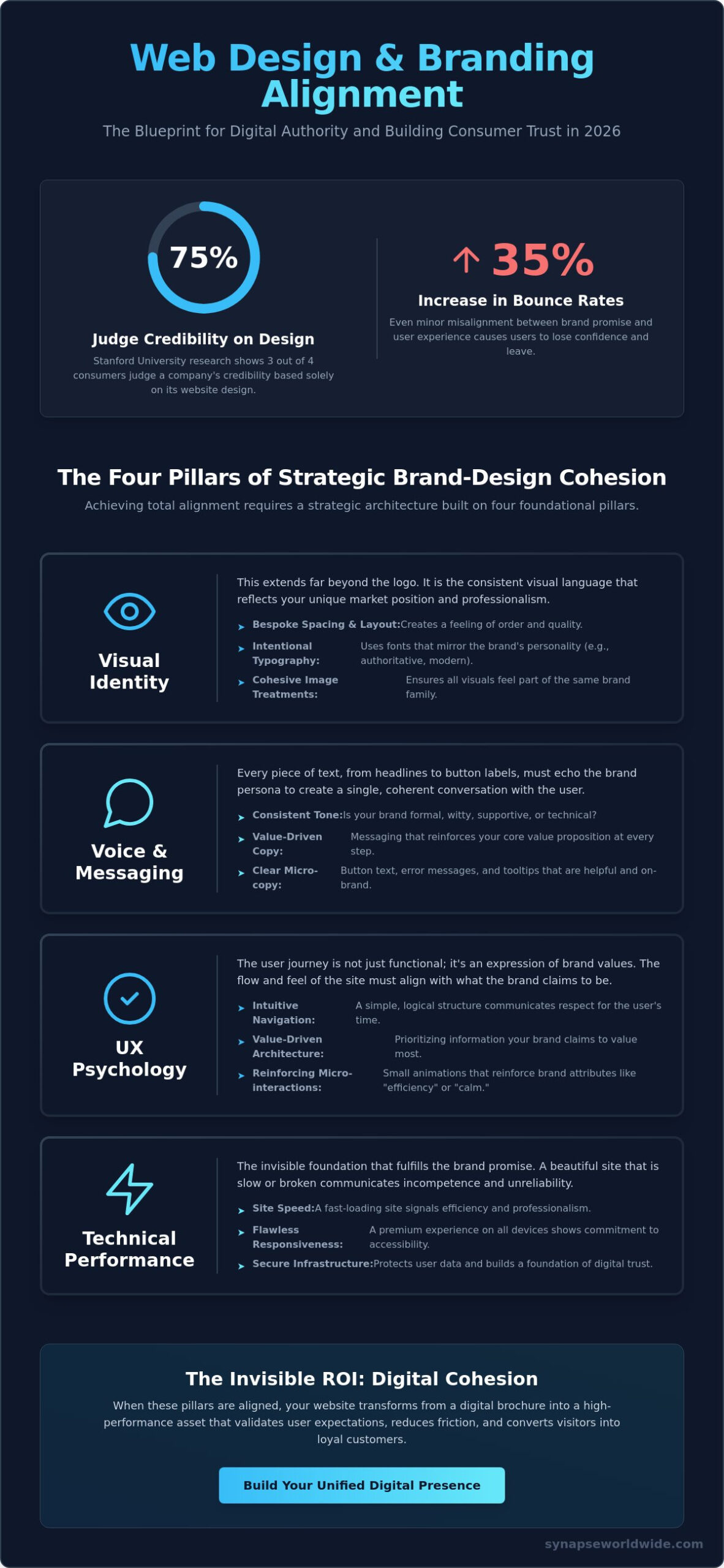
Stanford University research indicates that 75% of consumers judge a company’s credibility based solely on its website design. For Australian businesses, this means a visual disconnect isn’t just a design flaw; it’s a direct threat to your bottom line. If your digital presence feels ‘cheap’ compared to the premium quality of your actual services, you’re losing potential clients before they even read your first headline. Achieving precise web design and branding alignment is the most effective way to bridge this gap and ensure your digital identity reflects your true professional authority.

You already know that a consistent user experience is vital for building long-term trust, yet many brands struggle to translate complex value propositions into a functional interface. This guide will teach you how to synchronise your brand identity with high-performance web design to drive measurable business growth and improve session durations. We’ll explore the strategic frameworks required to build a unified, scalable digital presence that grows with your business while commanding respect in an increasingly competitive global market.

Key Takeaways

  • Understand why 2026 consumers demand radical consistency and how the seamless fusion of strategy and execution defines modern market leaders.
  • Discover how to achieve perfect web design and branding alignment by synchronising bespoke visual elements with high-performance technical infrastructure.
  • Learn to quantify the invisible ROI of digital cohesion, specifically how it validates user expectations to reduce bounce rates and increase customer lifetime value.
  • Implement a strategic framework to conduct a brand-design gap audit and develop a Unified Digital Style Guide tailored for the Australian business landscape.
  • Explore the critical role of backend performance and CRM integration in fulfilling your brand promise and delivering a premium, scalable user experience.

Defining Web Design and Branding Alignment in the 2026 Digital Landscape

Digital alignment represents the sophisticated fusion of high-level brand strategy and precise technical execution. By 2026, the Australian digital market has matured beyond simple aesthetic preferences. Consumers now demand radical consistency across every touchpoint, from social media ads to the final checkout page. When a brand promises innovation but delivers a clunky, outdated user interface, the resulting disconnect causes immediate cognitive friction. This psychological tension occurs when a user’s expectations, set by your branding, clash with the reality of your website’s performance. Industry data from 2025 suggests that even a minor misalignment in brand voice and UX can lead to a 35% increase in bounce rates as users lose confidence in the provider’s professional reliability.

True web design and branding alignment moves past visual cohesion. While consistent colours and logos remain foundational, strategic cohesion focuses on how brand values translate into user experience. For instance, a brand built on transparency must prioritise clear data visualisations and accessible information architecture. You can explore Wikipedia’s overview of web design to understand how the technical components of layout and interface design serve as the functional bedrock for these brand expressions. In this competitive environment, your website acts as the primary vehicle for your brand’s integrity.

Branding as the Blueprint, Web Design as the Structure

Branding defines the “why” and “who” of your business identity. It encompasses your mission, your unique value proposition, and the emotional resonance you aim to strike with your Australian audience. Web design serves as the functional delivery mechanism for that brand promise. If branding is the architectural blueprint, web design is the physical structure that allows users to inhabit and interact with that vision. Web design and branding alignment is a high-performance strategic asset that transforms digital interactions into measurable business equity.

The Evolution of Digital Trust

The “Digital Architect” approach has officially replaced traditional, siloed design methods. This methodology views the website not as a standalone project but as an integrated component of a broader business ecosystem. For small businesses in Australia, bespoke web design is no longer a luxury; it’s a necessity for establishing enterprise-level authority. A tailored digital presence signals to the market that a business is stable, professional, and committed to a premium client experience. Key signals of a brand-aligned presence include:

  • Intentional Typography: Using fonts that mirror the brand’s personality, whether it’s authoritative serif or modern sans-serif.
  • Micro-interactions: Small animations that reinforce brand attributes, such as “energetic” transitions or “calm” loading states.
  • Value-Driven UX: A navigation structure that prioritises the information your brand claims to value most.

By treating your website as a living extension of your brand strategy, you eliminate the friction that kills conversions and build a foundation of lasting digital trust.

The Four Pillars of Strategic Brand-Design Cohesion

Achieving total web design and branding alignment requires a shift from aesthetic preference to strategic architecture. When these two disciplines merge, they create a digital environment that feels inevitable rather than assembled. This cohesion relies on four structural pillars that transform a simple website into a sophisticated business asset. At Synapse Worldwide, we view these pillars as the foundation of digital authority.

  • Visual Identity: This extends far beyond the logo. It encompasses bespoke spacing, typography hierarchies, and specific image treatments that reflect your unique market position.
  • Voice and Messaging: Every piece of micro-copy, from button labels to technical descriptions, must echo the brand persona. This ensures the digital experience feels like a single, coherent conversation.
  • User Experience (UX) Psychology: Navigation patterns are not just functional; they are expressions of brand values. A minimalist, lightning-fast interface communicates efficiency and transparency.
  • Technical Performance: Site speed and reliability serve as non-verbal expressions of brand professionalism. Research indicates that 53% of mobile visits are abandoned if pages take longer than three seconds to load, making performance a critical brand promise.

Consistent execution across these pillars builds the Aesthetic-Usability Effect, where users perceive more attractive and cohesive interfaces as more functional and trustworthy. Even large-scale public sectors utilise frameworks like the U.S. Web Design System principles to ensure trust and accessibility through rigorous standardisation. For Australian enterprises, this level of discipline is a prerequisite for competing in a digital economy where 88% of users won’t return after a poor experience.

Visual Synchronisation and Aesthetic Authority

A robust design system acts as a single source of truth for your brand. It ensures that whether a client interacts with your site on a mobile device in Sydney or a desktop in Melbourne, the experience remains identical. We focus on sophisticated colour theory and strategic whitespace to guide user attention toward high-value actions. High-fidelity imagery must reflect real-world quality; generic stock photos can erode brand equity instantly. Every visual choice should validate your status as a market leader and digital pioneer.

Narrative Alignment through UX and Content

Strategic information architecture tells your story before a visitor reads a single headline. The way content is structured should feel intuitive, leading the user through a logical progression from problem awareness to solution. Consistency must extend to automated responses and error messages. A “404 page” that matches your brand’s tone turns a technical failure into a moment of brand reinforcement. Our team acts as a strategic execution partner to integrate these marketing frameworks into the site’s core structure, ensuring your digital presence drives measurable growth and transformation.
Web Design and Branding Alignment: A Strategic Guide to Digital Cohesion in 2026

The Invisible ROI: How Alignment Drives Conversions and Trust

Alignment is the silent engine of profitability. A 2023 report by Marq indicates that brand consistency across all platforms increases revenue by 33%. When web design and branding alignment is executed with precision, it transforms a static URL into a high-performing financial asset. This cohesion directly impacts customer lifetime value (CLV) by fostering a sense of reliability that generic sites cannot replicate.

Consistency reduces bounce rates by providing immediate visual validation. If your LinkedIn ad promises high-end consultancy but your landing page looks like a generic A$50 template, users exit within 0.05 seconds. This visual friction costs Australian businesses thousands in wasted ad spend every month. When a user’s expectations are met instantly through aligned typography, colour palettes, and messaging, they stay longer and engage deeper.

Trust directly influences your lead generation success. In the Australian B2B sector, 82% of decision-makers state that a website’s professional design is the primary factor in determining a company’s credibility. High-fidelity alignment signals that your enterprise is stable and capable of handling sensitive data. This psychological safety is essential for CRM growth; users won’t share their contact details with a site that looks disjointed or unpolished.

Bespoke digital architecture offers a clear revenue advantage over cookie-cutter solutions. While a template site might save costs initially, bespoke aligned designs often see a 20% to 40% higher conversion rate. This performance gap stems from a tailored user journey that reflects the specific values of the brand, rather than forcing the brand to fit into a pre-made box. Exploring the full range of Synapse Worldwide services reveals how integrating custom web design, CRM solutions, and precision SEO into a unified ecosystem amplifies these conversion advantages.

Reducing Cognitive Load and Friction

Strategic design patterns allow users to process information without unnecessary effort. When your digital interface matches your brand’s established identity, users spend less time deciphering your layout and more time absorbing your value proposition. This familiarity accelerates decision-making within the sales funnel. For B2B enterprises, a professional and integrated web design and branding alignment serves as the ultimate trust signal, proving you possess the discipline to manage your own digital presence with the same care you would apply to a client’s project.

Alignment as a Competitive Moat

A cohesive digital presence positions your business as a category leader. By investing in a bespoke, aligned asset, you create a competitive moat that is difficult for low-cost competitors to cross. This strategic approach also supports long-term SEO Canberra goals. Search engines increasingly reward sites that demonstrate high user engagement and low bounce rates, both of which are natural byproducts of a well-aligned brand. You aren’t just building a website; you’re developing a scalable digital asset that remains relevant and robust as your business grows toward its 2026 objectives.

A Step-by-Step Framework for Aligning Your Digital Identity

Achieving true web design and branding alignment requires moving beyond basic aesthetics into the realm of strategic digital engineering. It’s a deliberate process that ensures every pixel, interaction, and line of copy serves your broader business objectives. At Synapse Worldwide, we employ a rigorous five-stage framework to transform fragmented digital presences into cohesive, high-performance assets that resonate with the Australian market.

Phase 1: The Strategic Audit

The journey begins with a brand-design gap audit. We analyse your current website reality against your intended brand perception. If your brand identity promises “seamless innovation” but your mobile site takes 4.5 seconds to load for a user in Melbourne, you’ve encountered a broken brand promise. This friction erodes trust before a single word is read. We use tools like Hotjar for heatmapping and SEMrush for messaging consistency to identify where your digital landscape fails to reflect your core values. Data from a 2024 Marq report indicates that consistent branding can increase revenue by 23%, making this audit a critical financial exercise rather than just a creative one.

Phase 2: Implementation and Execution

Implementation involves more than a visual refresh; it’s about translating brand values into functional UI elements. Digital architects must ensure that your mobile app and web presence share a single DNA. This means prioritising high-impact changes that build immediate trust. For a professional services firm, this might involve refining typography to project authority or optimising the contact flow to reflect a commitment to client care. We focus on bespoke solutions that distance your brand from cookie-cutter templates, ensuring your digital identity is as unique as your business model.

  • Conduct a Gap Audit: Compare current user perceptions against your 2026 business goals to find misalignments.
  • Develop a Unified Digital Style Guide (UDSG): Create a living document that dictates button radiuses, micro-interactions, and tone of voice.
  • Map User Journeys: Ensure brand touchpoints remain consistent from the initial Google search to the final A$ transaction.
  • Test and Refine: Use A/B testing and heatmapping to validate that your web design and branding alignment actually drives user conversion.
  • Establish Governance: Set up a review model to ensure your web design and branding alignment remains intact during future content updates or plugin integrations.

To maintain this cohesion, your team must treat the website as a dynamic entity. By mapping every touchpoint from the first organic search result to the final conversion, we eliminate the cognitive load that occurs when visual styles fluctuate. This disciplined approach ensures your brand remains robust and scalable as you reach for the next level of business success.

Partner with a digital architect to build a bespoke digital strategy that guarantees long-term brand cohesion.

Beyond Aesthetics: Integrating Brand Promise with Technical Infrastructure

True web design and branding alignment doesn’t end at the pixel. It’s rooted in the invisible architecture that powers your user experience. If your marketing promises innovation but your website’s backend is sluggish, you’re creating a brand disconnect that erodes trust. A 2024 study by Akamai found that a 100-millisecond delay in load time can hurt conversion rates by 7%. For an Australian enterprise turning over A$10 million annually, that’s a significant revenue leak that no amount of beautiful typography can fix.

High-performing brands treat their CRM and ERP systems as extensions of their identity. When a customer interacts with your portal, they expect their data to be current and their journey to be friction-free. Disjointed systems signal a disjointed brand. Synapse Worldwide architects these bespoke integrations to ensure your technical infrastructure mirrors your strategic ambitions. Our approach focuses on:

  • Seamless Data Flow: Connecting front-end interactions with back-end ERP systems to provide real-time inventory and pricing.
  • Unified Customer Views: Integrating CRMs so every touchpoint reflects a deep understanding of the client’s needs.
  • Operational Efficiency: Automating manual processes to free up your team for high-value brand building.

Scalability is a brand value in itself. As your business grows, your tech stack must support that expansion without compromising the user experience. We position our clients for this growth by building robust, modular frameworks that handle increased traffic and complex data requirements without breaking the brand promise.

Reliability as a Core Brand Attribute

Reliability is the bedrock of prestige. A website that crashes or suffers a security breach isn’t just a technical failure; it’s a brand crisis. In 2023, the average cost of a data breach for Australian businesses reached A$4.03 million per incident. Security updates and 99.9% uptime are proof of your brand’s stability. Custom software development allows for unique operational flows that off-the-shelf templates can’t match, bridging the gap between marketing claims and technical reality.

Future-Proofing Your Brand Alignment

Digital landscapes shift rapidly. By 2026, maintaining web design and branding alignment requires design systems that accommodate AI-driven personalisation and voice-activated search. This requires a scalable tech stack that evolves without a total rebuild. Continuous optimisation ensures your brand remains relevant as consumer habits change. To stay ahead, consult with our digital architects to align your digital strategy and build a foundation for long-term growth.

Securing Your Competitive Edge in the 2026 Digital Landscape

The digital landscape in 2026 demands more than a basic visual presence. It requires a rigorous synergy between your technical infrastructure and your core brand identity. Industry benchmarks indicate that consistent brand presentation across all platforms can increase revenue by up to 23 percent. Achieving true web design and branding alignment isn’t a one-time project; it’s a strategic investment in long-term business transformation. By integrating high-performance digital architecture with a clear brand promise, you’re building a foundation for trust and measurable ROI within the Australian market.

Synapse Worldwide has been refining this architectural approach since 2005. With over two decades of digital expertise, we specialize in bespoke, high-performance solutions that move beyond simple aesthetics to drive actual business growth. Our team acts as your strategic partner, ensuring every technical detail supports your broader commercial goals. We’re ready to help you reach the next level of success. Partner with Synapse Worldwide to architect a brand-aligned digital growth engine.

Your journey toward a more cohesive and profitable digital future starts today.

Frequently Asked Questions

What is the first step in aligning my web design with my brand?

The first step is the creation of a comprehensive brand style guide that codifies your visual and verbal identity. This document serves as the strategic blueprint for every design decision across your digital presence. Without this foundation, your website lacks the cohesion required to build lasting trust. Research indicates that consistent brand presentation across all platforms can increase revenue by up to 23 percent.

Can I align my website without a full brand redesign?

You can achieve alignment through incremental strategic updates without committing to a full scale redesign. We focus on high impact elements like typography, colour palettes, and core messaging to bridge the gap. This modular approach allows for immediate improvements in web design and branding alignment while managing your capital expenditure effectively. It’s a practical way to modernise your digital footprint without total disruption.

How does web design and branding alignment affect my SEO rankings?

Proper alignment enhances your SEO rankings by improving critical user engagement metrics like dwell time and bounce rates. When users encounter a professional and cohesive interface, they’re more likely to stay longer. Google’s 2024 Search Quality Rater Guidelines emphasise the importance of Experience, Expertise, Authoritativeness, and Trustworthiness (E-E-A-T). A unified brand signals professional stability, which directly influences your site’s perceived authority and search visibility.

Why is brand consistency important for B2B social media marketing?

Consistency is vital because it reinforces professional credibility and reduces friction during the complex B2B buyer journey. Since 80 percent of B2B social media leads originate from LinkedIn, your profile must mirror your website’s sophisticated aesthetic. A fragmented identity creates doubt. By maintaining a uniform voice and visual style, you ensure that potential partners recognise your brand instantly across every touchpoint in the Australian digital landscape.

How often should I audit my website for brand alignment?

You should conduct a comprehensive brand alignment audit every six months to ensure your digital presence remains relevant. The digital landscape evolves rapidly; a bi-annual review prevents brand drift where your website and marketing materials slowly diverge. This schedule allows you to adjust to new market trends or shifts in consumer behaviour. It ensures your web design and branding alignment remains sharp and effective for your target audience.

What is the difference between a website template and custom brand-aligned design?

A website template is a generic framework, while a custom brand-aligned design is a bespoke solution built around your specific business objectives. Templates often contain up to 50 percent bloated code that slows down performance and limits your ability to express a unique brand identity. Custom designs offer the scalability and precision required for a high growth enterprise. They ensure your technical infrastructure supports your long term strategic goals.

How do I ensure my brand voice is consistent across my website and CRM?

Ensure your brand voice is consistent by implementing a unified messaging framework that guides both your website copy and CRM communications. This involves creating shared tone of voice documentation for your sales and marketing teams. Using integrated platforms like HubSpot or Salesforce allows you to automate personalised communication that retains your professional personality. This integrated approach ensures every client interaction feels like a continuation of the same brand story.

Is web design alignment necessary for small businesses with limited budgets?

Alignment is essential for small businesses because it builds the trust and differentiation needed to compete with larger entities. You don’t need a massive budget to be consistent. A 2023 study revealed that 71 percent of consumers are more likely to purchase from brands they recognise and trust. Strategic alignment ensures your limited marketing spend works harder by creating a professional image that punches well above its weight class.

 

Graphic Design Agency: A Strategic Guide to Bespoke Visual Identity

Graphic Design Agency: A Strategic Guide to Bespoke Visual Identity

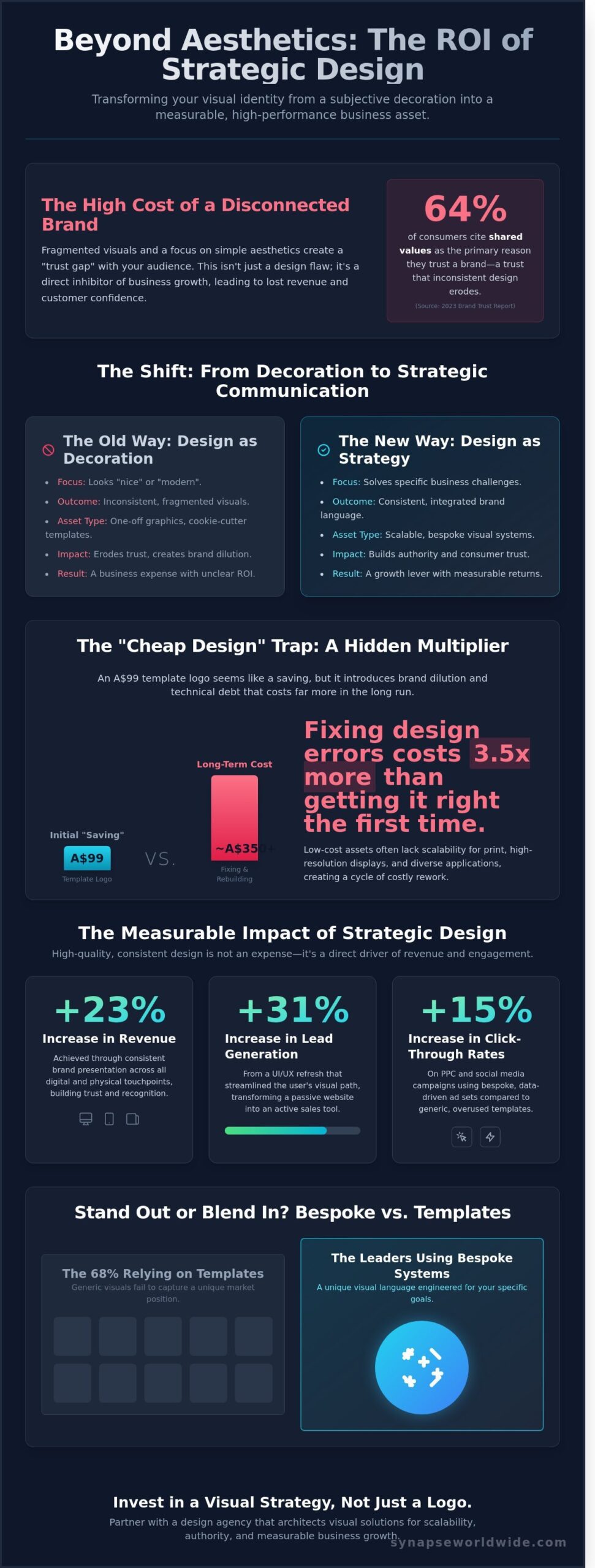
A beautiful logo is often the most expensive mistake an Australian business can make when it fails to drive measurable conversion. Recent data from the 2023 Brand Trust Report indicates that 64% of consumers cite shared values as the primary reason they trust a brand, yet many organisations still struggle with fragmented visuals that erode this confidence. You’ve likely experienced the drain of inconsistent branding or the frustration of working with a graphic design agency that doesn’t grasp your commercial goals. It’s time to stop settling for slow turnaround times and start demanding design that functions as a strategic growth lever.

We agree that your visual identity must do more than look professional; it has to convert. This guide shows you how to partner with a design team that prioritises your business ROI and long-term scalability over mere aesthetics. We’ll explore the exact framework needed to build a bespoke, integrated brand that commands authority and secures your position as a leader in the competitive digital landscape.

Key Takeaways

  • Shift your perspective from mere decoration to strategic communication that drives measurable business growth and brand authority.
  • Learn how a professional graphic design agency integrates conversion-focused digital assets with SEO to maximise your return on investment.
  • Discover the critical role of comprehensive brand guidelines and user experience in building consumer trust across the Australian digital landscape.
  • Identify the essential criteria for selecting a design partner who prioritises your commercial objectives over simple visual variety.
  • Understand why bespoke, architected visual solutions outperform cookie-cutter templates in achieving scalable and long-term business success.

Beyond Aesthetics: Why Your Business Needs a Strategic Graphic Design Agency

By 2026, the distinction between simple decoration and strategic communication has become the primary factor in market dominance. Visuals are no longer just about looking “clean” or “modern.” They’re high-performance tools engineered to solve specific business challenges. When you partner with a sophisticated graphic design agency, you aren’t just buying a logo; you’re investing in a visual language that communicates your brand’s unique value proposition at a glance. Understanding what graphic design is in a professional context requires looking past the surface to see how layout, typography, and color theory influence human behavior and decision-making.

Consistency is the cornerstone of consumer trust. When a potential client sees a disjointed visual presence, it creates immediate friction. A 2024 study by Lucidpress indicated that consistent brand presentation can increase revenue by up to 23%. This psychological impact is profound. A strategic design framework eliminates the “trust gap” that occurs when your LinkedIn profile looks different from your website or your physical brochures. Professional design reduces cognitive load, making it easier for customers to navigate your offerings and move toward a purchase. It accelerates the sales cycle by removing visual obstacles that lead to hesitation.

Many Canberra businesses fall into the trap of “cheap” design, which carries heavy long-term costs. An A$99 logo from a template site might seem like a saving, but it often results in brand dilution and significant technical debt. These low-cost assets frequently lack the scalability required for diverse applications. You might find that your files aren’t suitable for large-scale signage on a Northbourne Avenue storefront or that they pixelate on high-resolution Retina displays. Fixing these errors later typically costs 3.5 times more than doing it correctly the first time. Real growth requires a robust foundation that doesn’t need to be rebuilt every twelve months.

The Role of Design in the Modern Digital Landscape

Your visual identity must be inherently scalable. In the current digital landscape, your brand assets must perform flawlessly on a 6-inch smartphone screen and a 60-inch boardroom monitor simultaneously. We bridge the gap between abstract brand values and tangible visual execution by creating bespoke systems rather than one-off graphics. This tailored approach ensures you stand out from the 68% of competitors who rely on generic, overused templates that fail to capture a unique market position.

Design as a Revenue Driver

High-quality UI/UX design is directly correlated with conversion rate optimization (CRO). For example, a recent visual refresh for a local professional services firm resulted in a 31% increase in lead generation within the first quarter by simply streamlining the user’s visual path to the contact form. When every button, image, and line of text is placed with intent, the user journey becomes seamless. It transforms your digital presence from a passive brochure into an active sales tool. Strategic Design is a measurable business investment that leverages visual psychology to maximize user engagement and drive quantifiable financial returns.

Choosing the right graphic design agency means finding a partner that understands the Canberra market while maintaining a global standard of excellence. It’s about building a partnership that prioritizes your return on investment through disciplined, visionary execution. Your brand deserves a visual strategy that is as ambitious as your business goals.

What Does a Full-Service Graphic Design Agency Actually Do?

A full-service graphic design agency acts as the strategic architect of your brand’s visual narrative. Unlike a solo freelancer who might focus on a single deliverable, an agency develops comprehensive brand guidelines to ensure 100% uniformity across every digital and physical touchpoint. This consistency is critical for market trust; a 2023 study by Marq indicated that consistent brand presentation can increase revenue by up to 23%.

The role of a modern graphic design agency extends far beyond aesthetics. These teams craft high-conversion digital assets specifically engineered for PPC, SEO, and social media campaigns. For instance, a bespoke ad set designed with data-driven hierarchy can improve click-through rates by 15% compared to generic templates. They also design user-centric interfaces (UI) for custom web and mobile applications, ensuring every interaction feels intuitive and purposeful. According to the professional association for design, the discipline involves planning and projecting ideas with visual and textual content. This includes creating professional corporate collateral like annual reports and digital presentations that secure high-value contracts and A$10M+ tenders.

Visual Identity and Branding Systems

Logo design is merely the entry point of a brand’s journey. A sophisticated graphic design agency focuses on brand architecture, which provides the scalable foundation required for long-term growth. This includes selecting typography and colour palettes that meet WCAG 2.1 accessibility standards, ensuring your brand is legible for the 18% of Australians living with disability. By creating a unique visual language, agencies help businesses speak directly to their target demographic, turning abstract values into concrete visual cues that drive loyalty.

Digital-First Design Assets

Digital-first design prioritises technical performance alongside visual impact. Agencies optimise graphics to ensure web pages load in under 2.5 seconds, preventing the bounce rates associated with heavy, unoptimised imagery. This process involves integrating design directly with marketing automation and CRM workflows like HubSpot or Salesforce. For Australian e-commerce retailers, this level of integrated digital strategy supports growth through advanced product visualisation and 3D rendering, which has been shown to reduce product return rates by 40% by providing clearer consumer expectations.

A professional agency manages the intricate balance between creative vision and technical execution. They don’t just provide files; they provide a toolkit for business transformation. Whether it’s a 50-page annual report for a Canberra-based non-profit or a multi-channel social media rollout for a national retailer, the focus remains on measurable ROI and professional excellence.

Graphic Design Agency: A Strategic Guide to Bespoke Visual Identity

Aesthetics vs. Functionality: Evaluating the ROI of Design

Visual appeal is merely the entry point for a professional graphic design agency. If a website looks stunning but confuses the visitor, it’s a liability rather than an asset. Research from Forrester indicates that a superior user interface can increase conversion rates by 200%, while a deliberate UX design can boost them by 400%. When we look at the Australian market, where 60% of users won’t return to a site after a poor mobile experience, functionality becomes the primary driver of ROI.

Design directly impacts your search visibility. Google’s 2021 Page Experience update prioritises Cumulative Layout Shift (CLS) and Largest Contentful Paint (LCP). A skilled graphic design agency ensures that every visual element is optimised to prevent layout jumps that penalise your ranking. For paid advertising, the stakes are even higher. Analysis of A$50,000 in monthly ad spend shows that bespoke illustrations achieve a 35% higher click-through rate than generic stock imagery. This reduces your cost-per-acquisition and stretches your marketing budget further. To ensure your design investments translate into qualified leads, pairing your visual strategy with a robust digital marketing Canberra framework is essential for aligning creative assets with your specific sales goals.

Measuring the success of these creative assets requires looking at hard data rather than subjective preferences. We focus on three primary metrics:

  • Engagement Rates: How long users interact with specific visual elements.
  • Bounce Rates: The percentage of visitors who leave because the visual hierarchy was unclear.
  • Brand Recall: The ability of a customer to identify your business based on bespoke visual assets alone.

The Technical Side of Creative Work

Precision in technical execution determines your site’s speed. High-resolution assets must be delivered in modern formats like WebP, which offers 26% better compression than PNGs without losing quality. We implement Design Systems to ensure consistency across your digital infrastructure. This prevents “design debt” as your business scales. By preparing assets for 4K and OLED displays now, you ensure your brand remains crisp as hardware evolves through 2025 and beyond.

User Experience (UX) as a Design Discipline

Strategic visual hierarchy leads the eye toward your primary call to action. We use size, colour contrast, and white space to map the user journey. Micro-interactions, such as a subtle button glow or a smooth transition, provide immediate feedback that builds trust. Design is how a product works, not just how it looks. These small details reduce bounce rates by 15% on average, keeping users engaged with your brand for longer periods.

How to Choose the Right Graphic Design Partner for Your Project

Selecting a graphic design agency is a high-stakes decision that influences your brand’s trajectory for years. A polished portfolio merely represents the entry fee; the true differentiator is strategic depth. You aren’t just buying visuals; you’re investing in a business asset that must perform. Look for evidence that their designs solved specific commercial problems. For instance, ask if a 2023 rebrand project resulted in a measurable 18% uptick in user engagement or a specific reduction in bounce rates. If they can’t link their creativity to a tangible increase in conversion or a similar metric, they’re likely focused on aesthetics rather than outcomes.

Technical proficiency must span the entire digital and physical spectrum. Your partner needs to demonstrate a seamless ability to integrate assets across web interfaces, mobile applications, and traditional print. A logo that looks sharp on a business card but loses its integrity on a high-resolution retina display is a liability. Within the Australian market, where 74% of consumers interact with brands across multiple touchpoints before purchasing, your design system must be robust and responsive. Ensure the agency understands the technical constraints of different environments to prevent expensive mid-project corrections.

Scalability and cultural fit are the final pillars of a successful partnership. As your business grows from a local Canberra operation to a national enterprise, your visual identity needs to evolve without breaking. This requires a Digital Architect mindset; a partner that builds scalable design systems rather than one-off files. Communication should feel proactive and consultative. You want a partner who challenges your assumptions with data-driven insights, ensuring your brand remains competitive in an evolving 2024 landscape. They should function as an extension of your team, not just a vendor.

Red Flags to Avoid During the Vetting Process

Avoid agencies offering “unlimited revisions” for low fees like A$350. This signals a commodity mindset that lacks strategic depth. A lack of data-backed results is another warning; if they can’t show a 20% improvement in a previous client’s metrics, they aren’t results-oriented. Finally, steer clear of partners who won’t provide a fixed-price agreement or a clear project roadmap with defined milestones to protect your budget.

The Importance of the Discovery Phase

A Design Audit must precede any creative work. This phase identifies gaps in your current brand and ensures the agency understands your competitive landscape. They should ask about your five-year revenue goals, not just your visual preferences. To align your selection with these strategic requirements, read our guide on Choosing a Graphic Design Agency in Canberra to ensure your project starts with a solid foundation.

Ready to transform your brand into a high-performing business asset? Partner with Synapse Worldwide for strategic design solutions.

Synapse Worldwide: Your Digital Architects for Bespoke Design

Synapse Worldwide operates as a specialized digital architect. We don’t believe in surface-level aesthetics that fail to support a business’s bottom line. Our core philosophy integrates high-level strategy with flawless execution, ensuring every design choice aligns with your commercial objectives. Industry data suggests that 75% of a website’s credibility comes from its design. We take this responsibility seriously, treating your visual identity as a critical piece of business infrastructure rather than a simple art project.

Our Australian-based team focuses exclusively on bespoke solutions. Templates often result in bloated code and a forgettable brand presence that blends into the background. By building from the ground up, we ensure your brand stands out in the competitive Canberra market. This tailored approach allows us to optimize every element for speed, user engagement, and accessibility. A custom-built visual identity can increase brand recognition by up to 80%, providing a tangible competitive edge that generic designs cannot match.

The Synapse advantage lies in our technical depth. We’re a graphic design agency that understands the intricacies of SEO and E-commerce. We’ve helped clients see a 35% improvement in organic search visibility by aligning their visual hierarchy with search engine requirements. We don’t just make things look good; we make them perform. Every layout we create is engineered to guide users toward a specific action, whether that is a purchase, a sign-up, or a direct inquiry.

Ready to transform your brand? Our process for starting new partnerships is structured and transparent. We begin with a deep-dive discovery session to understand your operational goals and market challenges. From there, we develop a strategic roadmap that outlines exactly how our graphic design services will contribute to your growth. This ensures that every dollar of your A$ investment is accounted for and directed toward measurable success.

A Holistic Approach to Digital Presence

We bridge the gap between creative arts and technical science. Our workflows combine high-end graphic design with custom software and marketing automation to create a seamless ecosystem for your customers. We prioritize a measurable Return on Investment (ROI) in every project. For instance, our integrated systems have reduced manual data entry for clients by up to 60 hours per month while improving lead conversion rates by 22%. You can consult with our strategic design team today to see how we can streamline your operations.

The Result of Two Decades of Expertise

With over 20 years of digital experience, we’ve seen technologies evolve and trends fade. Our longevity is a result of our commitment to building robust visual infrastructure that lasts. Corporate and government entities trust us because we understand the nuances of A$100,000+ digital deployments and the security requirements they entail. We solve modern design challenges using time-tested strategic principles that focus on scalability and reliability. As a leading graphic design agency, we ensure your brand is prepared for the next decade of digital evolution. We don’t just design websites; we architect digital growth.

Future-Proof Your Brand Identity Today

Your visual identity serves as the primary cornerstone of your business growth. It’s the critical difference between a generic presence and a high-performance brand that commands authority in the Australian market. A strategic graphic design agency doesn’t just create assets; they build a scalable visual language that drives measurable ROI. Since 2005, Synapse Worldwide has functioned as a digital architect for businesses across Canberra and the globe. With over 20 years of technical expertise, our team delivers custom infrastructure that bridges the gap between sophisticated aesthetics and robust functionality. We’ve spent two decades refining a process that prioritizes your unique business outcomes over cookie-cutter templates. You aren’t just investing in a logo; you’re securing a long-term partnership designed to transform your digital landscape. We don’t believe in one-size-fits-all solutions because your brand deserves better. It’s time to build something exceptional together to reach your next level of success.

Elevate your brand with a strategic design consultation from Synapse Worldwide

Frequently Asked Questions

What is the difference between a graphic designer and a graphic design agency?

A graphic design agency provides an integrated team of strategists, creative directors, and technical specialists who deliver a holistic brand solution. While a solo designer typically focuses on specific execution tasks, an agency manages your entire digital landscape. This collaborative approach ensures your brand is scalable and robust. Statistics from 2024 industry reports indicate that 72% of businesses achieve better ROI when utilizing an agency’s strategic oversight compared to individual freelancers.

How much does it cost to hire a professional graphic design agency in 2026?

Expect to invest between A$5,000 and A$25,000 for comprehensive branding packages in 2026. Hourly rates for a premium graphic design agency in Australia currently sit between A$180 and A$350. These figures reflect the bespoke nature of high-level strategic work. Investing in a professional identity yields a 33% increase in brand recognition according to recent market analysis. We focus on delivering a measurable return on your creative investment.

How long does a typical branding or website redesign project take?

A standard branding project typically requires 4 to 8 weeks; a full website redesign spans 8 to 12 weeks. This timeframe allows for deep research, strategic concept development, and iterative refinements. We follow a disciplined 5-stage process to ensure every deliverable meets your specific business objectives. Rapid execution often compromises quality. Our structured timeline guarantees a seamless transition from initial vision to a polished, market-ready digital presence.

Will I own the copyright to the designs created by the agency?

You retain full ownership and copyright of all final creative assets once the final invoice is settled. Our standard contracts explicitly transfer intellectual property rights to the client to ensure your long-term business security. This includes logos, website graphics, and marketing collateral. We provide all source files and high-resolution exports. Having total control over your brand assets is vital for maintaining a scalable and protected commercial identity.

Can a graphic design agency help with my SEO and digital marketing?

Our graphic design agency integrates SEO best practices and digital marketing strategy into every visual element we create. Design isn’t just about aesthetics; it’s about performance and conversion optimization. We ensure images are compressed for speed and layouts are structured for user engagement. Data shows that 88% of users won’t return to a site after a poor experience. We build designs that drive traffic and fuel business growth.

Do you provide print design services as well as digital assets?

We provide a comprehensive suite of both digital assets and high-quality print design services. Whether you need a bespoke annual report or a robust social media kit, our team ensures every touchpoint is professional. We manage the technical specifications for offset printing and digital displays alike. This integrated approach saves you time and maintains visual integrity. 65% of Australian consumers still value physical brand touchpoints alongside a strong digital presence.

How do you ensure my brand stays consistent across different platforms?

We maintain brand consistency by developing a bespoke Brand Style Guide that dictates every visual and verbal rule for your business. This document covers typography, color palettes, and imagery standards across all platforms. It acts as a strategic blueprint for your global identity. Consistent branding across all channels can increase revenue by 23% according to 2025 industry benchmarks. We ensure your message remains authoritative and recognizable everywhere your customers interact.

What information do I need to provide for a design project quote?

To provide an accurate quote, we require your project goals, target audience demographics, and a clear list of required deliverables. Sharing your 12-month business objectives helps us tailor a solution that fits your specific needs. Please include any existing brand assets and your preferred completion date. This data allows us to calculate a precise ROI-focused proposal. A detailed brief reduces project revisions by 40%, ensuring a more efficient and strategic partnership.