<!--

Tag Archives: User Experience


Web Design and Branding Alignment: A Strategic Guide to Digital Cohesion in 2026

Web Design and Branding Alignment: A Strategic Guide to Digital Cohesion in 2026

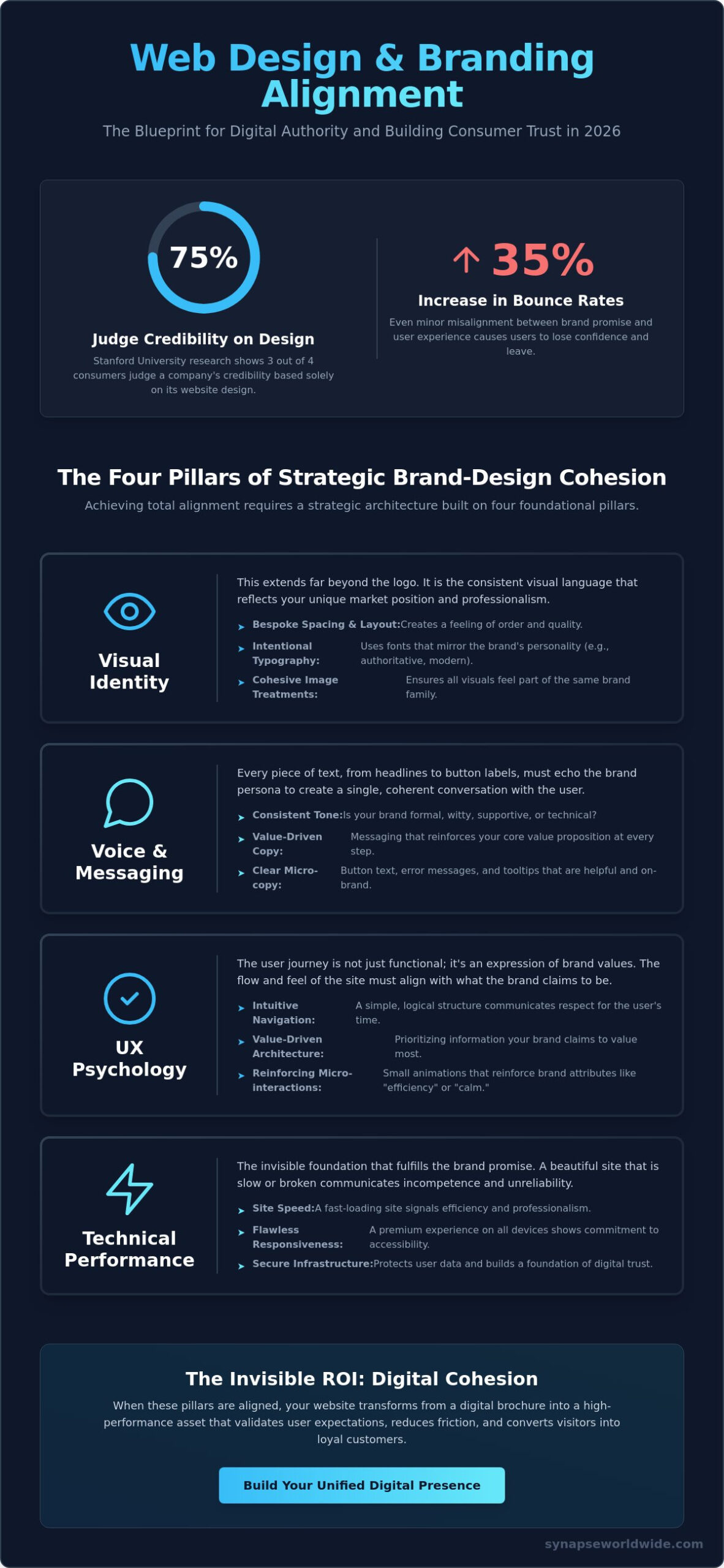
Stanford University research indicates that 75% of consumers judge a company’s credibility based solely on its website design. For Australian businesses, this means a visual disconnect isn’t just a design flaw; it’s a direct threat to your bottom line. If your digital presence feels ‘cheap’ compared to the premium quality of your actual services, you’re losing potential clients before they even read your first headline. Achieving precise web design and branding alignment is the most effective way to bridge this gap and ensure your digital identity reflects your true professional authority.

You already know that a consistent user experience is vital for building long-term trust, yet many brands struggle to translate complex value propositions into a functional interface. This guide will teach you how to synchronise your brand identity with high-performance web design to drive measurable business growth and improve session durations. We’ll explore the strategic frameworks required to build a unified, scalable digital presence that grows with your business while commanding respect in an increasingly competitive global market.

Key Takeaways

  • Understand why 2026 consumers demand radical consistency and how the seamless fusion of strategy and execution defines modern market leaders.
  • Discover how to achieve perfect web design and branding alignment by synchronising bespoke visual elements with high-performance technical infrastructure.
  • Learn to quantify the invisible ROI of digital cohesion, specifically how it validates user expectations to reduce bounce rates and increase customer lifetime value.
  • Implement a strategic framework to conduct a brand-design gap audit and develop a Unified Digital Style Guide tailored for the Australian business landscape.
  • Explore the critical role of backend performance and CRM integration in fulfilling your brand promise and delivering a premium, scalable user experience.

Defining Web Design and Branding Alignment in the 2026 Digital Landscape

Digital alignment represents the sophisticated fusion of high-level brand strategy and precise technical execution. By 2026, the Australian digital market has matured beyond simple aesthetic preferences. Consumers now demand radical consistency across every touchpoint, from social media ads to the final checkout page. When a brand promises innovation but delivers a clunky, outdated user interface, the resulting disconnect causes immediate cognitive friction. This psychological tension occurs when a user’s expectations, set by your branding, clash with the reality of your website’s performance. Industry data from 2025 suggests that even a minor misalignment in brand voice and UX can lead to a 35% increase in bounce rates as users lose confidence in the provider’s professional reliability.

True web design and branding alignment moves past visual cohesion. While consistent colours and logos remain foundational, strategic cohesion focuses on how brand values translate into user experience. For instance, a brand built on transparency must prioritise clear data visualisations and accessible information architecture. You can explore Wikipedia’s overview of web design to understand how the technical components of layout and interface design serve as the functional bedrock for these brand expressions. In this competitive environment, your website acts as the primary vehicle for your brand’s integrity.

Branding as the Blueprint, Web Design as the Structure

Branding defines the “why” and “who” of your business identity. It encompasses your mission, your unique value proposition, and the emotional resonance you aim to strike with your Australian audience. Web design serves as the functional delivery mechanism for that brand promise. If branding is the architectural blueprint, web design is the physical structure that allows users to inhabit and interact with that vision. Web design and branding alignment is a high-performance strategic asset that transforms digital interactions into measurable business equity.

The Evolution of Digital Trust

The “Digital Architect” approach has officially replaced traditional, siloed design methods. This methodology views the website not as a standalone project but as an integrated component of a broader business ecosystem. For small businesses in Australia, bespoke web design is no longer a luxury; it’s a necessity for establishing enterprise-level authority. A tailored digital presence signals to the market that a business is stable, professional, and committed to a premium client experience. Key signals of a brand-aligned presence include:

  • Intentional Typography: Using fonts that mirror the brand’s personality, whether it’s authoritative serif or modern sans-serif.
  • Micro-interactions: Small animations that reinforce brand attributes, such as “energetic” transitions or “calm” loading states.
  • Value-Driven UX: A navigation structure that prioritises the information your brand claims to value most.

By treating your website as a living extension of your brand strategy, you eliminate the friction that kills conversions and build a foundation of lasting digital trust.

The Four Pillars of Strategic Brand-Design Cohesion

Achieving total web design and branding alignment requires a shift from aesthetic preference to strategic architecture. When these two disciplines merge, they create a digital environment that feels inevitable rather than assembled. This cohesion relies on four structural pillars that transform a simple website into a sophisticated business asset. At Synapse Worldwide, we view these pillars as the foundation of digital authority.

  • Visual Identity: This extends far beyond the logo. It encompasses bespoke spacing, typography hierarchies, and specific image treatments that reflect your unique market position.
  • Voice and Messaging: Every piece of micro-copy, from button labels to technical descriptions, must echo the brand persona. This ensures the digital experience feels like a single, coherent conversation.
  • User Experience (UX) Psychology: Navigation patterns are not just functional; they are expressions of brand values. A minimalist, lightning-fast interface communicates efficiency and transparency.
  • Technical Performance: Site speed and reliability serve as non-verbal expressions of brand professionalism. Research indicates that 53% of mobile visits are abandoned if pages take longer than three seconds to load, making performance a critical brand promise.

Consistent execution across these pillars builds the Aesthetic-Usability Effect, where users perceive more attractive and cohesive interfaces as more functional and trustworthy. Even large-scale public sectors utilise frameworks like the U.S. Web Design System principles to ensure trust and accessibility through rigorous standardisation. For Australian enterprises, this level of discipline is a prerequisite for competing in a digital economy where 88% of users won’t return after a poor experience.

Visual Synchronisation and Aesthetic Authority

A robust design system acts as a single source of truth for your brand. It ensures that whether a client interacts with your site on a mobile device in Sydney or a desktop in Melbourne, the experience remains identical. We focus on sophisticated colour theory and strategic whitespace to guide user attention toward high-value actions. High-fidelity imagery must reflect real-world quality; generic stock photos can erode brand equity instantly. Every visual choice should validate your status as a market leader and digital pioneer.

Narrative Alignment through UX and Content

Strategic information architecture tells your story before a visitor reads a single headline. The way content is structured should feel intuitive, leading the user through a logical progression from problem awareness to solution. Consistency must extend to automated responses and error messages. A “404 page” that matches your brand’s tone turns a technical failure into a moment of brand reinforcement. Our team acts as a strategic execution partner to integrate these marketing frameworks into the site’s core structure, ensuring your digital presence drives measurable growth and transformation.

Web Design and Branding Alignment: A Strategic Guide to Digital Cohesion in 2026

The Invisible ROI: How Alignment Drives Conversions and Trust

Alignment is the silent engine of profitability. A 2023 report by Marq indicates that brand consistency across all platforms increases revenue by 33%. When web design and branding alignment is executed with precision, it transforms a static URL into a high-performing financial asset. This cohesion directly impacts customer lifetime value (CLV) by fostering a sense of reliability that generic sites cannot replicate.

Consistency reduces bounce rates by providing immediate visual validation. If your LinkedIn ad promises high-end consultancy but your landing page looks like a generic A$50 template, users exit within 0.05 seconds. This visual friction costs Australian businesses thousands in wasted ad spend every month. When a user’s expectations are met instantly through aligned typography, colour palettes, and messaging, they stay longer and engage deeper.

Trust directly influences your lead generation success. In the Australian B2B sector, 82% of decision-makers state that a website’s professional design is the primary factor in determining a company’s credibility. High-fidelity alignment signals that your enterprise is stable and capable of handling sensitive data. This psychological safety is essential for CRM growth; users won’t share their contact details with a site that looks disjointed or unpolished.

Bespoke digital architecture offers a clear revenue advantage over cookie-cutter solutions. While a template site might save costs initially, bespoke aligned designs often see a 20% to 40% higher conversion rate. This performance gap stems from a tailored user journey that reflects the specific values of the brand, rather than forcing the brand to fit into a pre-made box.

Reducing Cognitive Load and Friction

Strategic design patterns allow users to process information without unnecessary effort. When your digital interface matches your brand’s established identity, users spend less time deciphering your layout and more time absorbing your value proposition. This familiarity accelerates decision-making within the sales funnel. For B2B enterprises, a professional and integrated web design and branding alignment serves as the ultimate trust signal, proving you possess the discipline to manage your own digital presence with the same care you would apply to a client’s project.

Alignment as a Competitive Moat

A cohesive digital presence positions your business as a category leader. By investing in a bespoke, aligned asset, you create a competitive moat that is difficult for low-cost competitors to cross. This strategic approach also supports long-term SEO Canberra goals. Search engines increasingly reward sites that demonstrate high user engagement and low bounce rates, both of which are natural byproducts of a well-aligned brand. You aren’t just building a website; you’re developing a scalable digital asset that remains relevant and robust as your business grows toward its 2026 objectives.

A Step-by-Step Framework for Aligning Your Digital Identity

Achieving true web design and branding alignment requires moving beyond basic aesthetics into the realm of strategic digital engineering. It’s a deliberate process that ensures every pixel, interaction, and line of copy serves your broader business objectives. At Synapse Worldwide, we employ a rigorous five-stage framework to transform fragmented digital presences into cohesive, high-performance assets that resonate with the Australian market.

Phase 1: The Strategic Audit

The journey begins with a brand-design gap audit. We analyse your current website reality against your intended brand perception. If your brand identity promises “seamless innovation” but your mobile site takes 4.5 seconds to load for a user in Melbourne, you’ve encountered a broken brand promise. This friction erodes trust before a single word is read. We use tools like Hotjar for heatmapping and SEMrush for messaging consistency to identify where your digital landscape fails to reflect your core values. Data from a 2024 Marq report indicates that consistent branding can increase revenue by 23%, making this audit a critical financial exercise rather than just a creative one.

Phase 2: Implementation and Execution

Implementation involves more than a visual refresh; it’s about translating brand values into functional UI elements. Digital architects must ensure that your mobile app and web presence share a single DNA. This means prioritising high-impact changes that build immediate trust. For a professional services firm, this might involve refining typography to project authority or optimising the contact flow to reflect a commitment to client care. We focus on bespoke solutions that distance your brand from cookie-cutter templates, ensuring your digital identity is as unique as your business model.

  • Conduct a Gap Audit: Compare current user perceptions against your 2026 business goals to find misalignments.
  • Develop a Unified Digital Style Guide (UDSG): Create a living document that dictates button radiuses, micro-interactions, and tone of voice.
  • Map User Journeys: Ensure brand touchpoints remain consistent from the initial Google search to the final A$ transaction.
  • Test and Refine: Use A/B testing and heatmapping to validate that your web design and branding alignment actually drives user conversion.
  • Establish Governance: Set up a review model to ensure your web design and branding alignment remains intact during future content updates or plugin integrations.

To maintain this cohesion, your team must treat the website as a dynamic entity. By mapping every touchpoint from the first organic search result to the final conversion, we eliminate the cognitive load that occurs when visual styles fluctuate. This disciplined approach ensures your brand remains robust and scalable as you reach for the next level of business success.

Partner with a digital architect to build a bespoke digital strategy that guarantees long-term brand cohesion.

Beyond Aesthetics: Integrating Brand Promise with Technical Infrastructure

True web design and branding alignment doesn’t end at the pixel. It’s rooted in the invisible architecture that powers your user experience. If your marketing promises innovation but your website’s backend is sluggish, you’re creating a brand disconnect that erodes trust. A 2024 study by Akamai found that a 100-millisecond delay in load time can hurt conversion rates by 7%. For an Australian enterprise turning over A$10 million annually, that’s a significant revenue leak that no amount of beautiful typography can fix.

High-performing brands treat their CRM and ERP systems as extensions of their identity. When a customer interacts with your portal, they expect their data to be current and their journey to be friction-free. Disjointed systems signal a disjointed brand. Synapse Worldwide architects these bespoke integrations to ensure your technical infrastructure mirrors your strategic ambitions. Our approach focuses on:

  • Seamless Data Flow: Connecting front-end interactions with back-end ERP systems to provide real-time inventory and pricing.
  • Unified Customer Views: Integrating CRMs so every touchpoint reflects a deep understanding of the client’s needs.
  • Operational Efficiency: Automating manual processes to free up your team for high-value brand building.

Scalability is a brand value in itself. As your business grows, your tech stack must support that expansion without compromising the user experience. We position our clients for this growth by building robust, modular frameworks that handle increased traffic and complex data requirements without breaking the brand promise.

Reliability as a Core Brand Attribute

Reliability is the bedrock of prestige. A website that crashes or suffers a security breach isn’t just a technical failure; it’s a brand crisis. In 2023, the average cost of a data breach for Australian businesses reached A$4.03 million per incident. Security updates and 99.9% uptime are proof of your brand’s stability. Custom software development allows for unique operational flows that off-the-shelf templates can’t match, bridging the gap between marketing claims and technical reality.

Future-Proofing Your Brand Alignment

Digital landscapes shift rapidly. By 2026, maintaining web design and branding alignment requires design systems that accommodate AI-driven personalisation and voice-activated search. This requires a scalable tech stack that evolves without a total rebuild. Continuous optimisation ensures your brand remains relevant as consumer habits change. To stay ahead, consult with our digital architects to align your digital strategy and build a foundation for long-term growth.

Securing Your Competitive Edge in the 2026 Digital Landscape

The digital landscape in 2026 demands more than a basic visual presence. It requires a rigorous synergy between your technical infrastructure and your core brand identity. Industry benchmarks indicate that consistent brand presentation across all platforms can increase revenue by up to 23 percent. Achieving true web design and branding alignment isn’t a one-time project; it’s a strategic investment in long-term business transformation. By integrating high-performance digital architecture with a clear brand promise, you’re building a foundation for trust and measurable ROI within the Australian market.

Synapse Worldwide has been refining this architectural approach since 2005. With over two decades of digital expertise, we specialize in bespoke, high-performance solutions that move beyond simple aesthetics to drive actual business growth. Our team acts as your strategic partner, ensuring every technical detail supports your broader commercial goals. We’re ready to help you reach the next level of success. Partner with Synapse Worldwide to architect a brand-aligned digital growth engine.

Your journey toward a more cohesive and profitable digital future starts today.

Frequently Asked Questions

What is the first step in aligning my web design with my brand?

The first step is the creation of a comprehensive brand style guide that codifies your visual and verbal identity. This document serves as the strategic blueprint for every design decision across your digital presence. Without this foundation, your website lacks the cohesion required to build lasting trust. Research indicates that consistent brand presentation across all platforms can increase revenue by up to 23 percent.

Can I align my website without a full brand redesign?

You can achieve alignment through incremental strategic updates without committing to a full scale redesign. We focus on high impact elements like typography, colour palettes, and core messaging to bridge the gap. This modular approach allows for immediate improvements in web design and branding alignment while managing your capital expenditure effectively. It’s a practical way to modernise your digital footprint without total disruption.

How does web design and branding alignment affect my SEO rankings?

Proper alignment enhances your SEO rankings by improving critical user engagement metrics like dwell time and bounce rates. When users encounter a professional and cohesive interface, they’re more likely to stay longer. Google’s 2024 Search Quality Rater Guidelines emphasise the importance of Experience, Expertise, Authoritativeness, and Trustworthiness (E-E-A-T). A unified brand signals professional stability, which directly influences your site’s perceived authority and search visibility.

Why is brand consistency important for B2B social media marketing?

Consistency is vital because it reinforces professional credibility and reduces friction during the complex B2B buyer journey. Since 80 percent of B2B social media leads originate from LinkedIn, your profile must mirror your website’s sophisticated aesthetic. A fragmented identity creates doubt. By maintaining a uniform voice and visual style, you ensure that potential partners recognise your brand instantly across every touchpoint in the Australian digital landscape.

How often should I audit my website for brand alignment?

You should conduct a comprehensive brand alignment audit every six months to ensure your digital presence remains relevant. The digital landscape evolves rapidly; a bi-annual review prevents brand drift where your website and marketing materials slowly diverge. This schedule allows you to adjust to new market trends or shifts in consumer behaviour. It ensures your web design and branding alignment remains sharp and effective for your target audience.

What is the difference between a website template and custom brand-aligned design?

A website template is a generic framework, while a custom brand-aligned design is a bespoke solution built around your specific business objectives. Templates often contain up to 50 percent bloated code that slows down performance and limits your ability to express a unique brand identity. Custom designs offer the scalability and precision required for a high growth enterprise. They ensure your technical infrastructure supports your long term strategic goals.

How do I ensure my brand voice is consistent across my website and CRM?

Ensure your brand voice is consistent by implementing a unified messaging framework that guides both your website copy and CRM communications. This involves creating shared tone of voice documentation for your sales and marketing teams. Using integrated platforms like HubSpot or Salesforce allows you to automate personalised communication that retains your professional personality. This integrated approach ensures every client interaction feels like a continuation of the same brand story.

Is web design alignment necessary for small businesses with limited budgets?

Alignment is essential for small businesses because it builds the trust and differentiation needed to compete with larger entities. You don’t need a massive budget to be consistent. A 2023 study revealed that 71 percent of consumers are more likely to purchase from brands they recognise and trust. Strategic alignment ensures your limited marketing spend works harder by creating a professional image that punches well above its weight class.


Custom Web Design Examples: Strategic Blueprints for Business Growth in 2026

Custom Web Design Examples: Strategic Blueprints for Business Growth in 2026

By 2026, a cookie-cutter website won’t just hinder your growth; it will actively alienate the 88% of Australian consumers who equate digital quality with brand trust. You’ve likely felt the frustration of a template-driven site that looks identical to your competitors and fails to sync with your internal CRM. It’s a common bottleneck that stifles conversion rates and forces your team into manual workarounds. This article examines high-performance custom web design examples to demonstrate how bespoke architecture moves beyond aesthetics to solve these exact technical hurdles.

You deserve a digital presence that acts as a sophisticated growth engine rather than a static brochure. We’ll show you how moving to a tailored solution can eliminate slow load times while providing the robust, scalable infrastructure your business needs to expand. You’ll discover the strategic blueprints used by leading firms to achieve seamless backend automation and a unique brand identity. We’ll break down the specific elements that turn a visionary design into a high-yielding commercial asset for the Australian market.

Key Takeaways

  • Understand why bespoke digital architecture is essential for overcoming the commercial limitations of saturated template markets in the 2026 Australian digital landscape.
  • Identify the core pillars of performance-driven sites, focusing on how “invisible design” and clean code ensure long-term scalability and robust security.
  • Examine industry-specific custom web design examples to understand how tailored user journeys and frictionless architectures directly influence commercial ROI.
  • Master a strategic framework for evaluating design inspiration through the lens of specific conversion goals and user-centric “Speed to Value.”
  • Discover the Synapse Worldwide methodology that combines a strategy-first “Digital Architect” approach with transparent, fixed-price project models for Australian enterprises.

Beyond Aesthetics: Why Custom Web Design Examples Matter in 2026

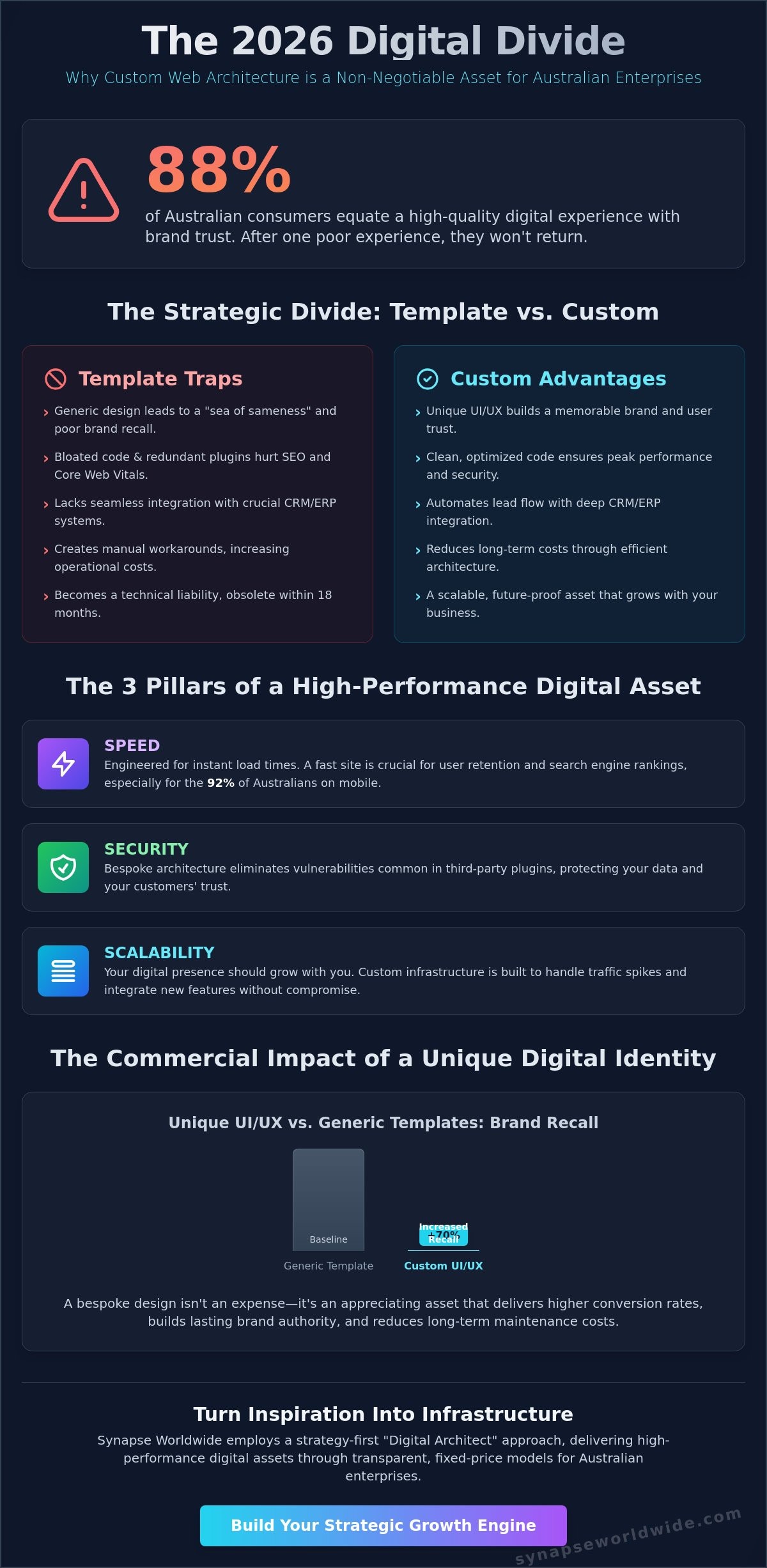
Custom web design is no longer a luxury for Australian enterprises; it’s a foundational digital architecture built to convert. By 2026, the digital marketplace has moved past simple aesthetics. Businesses now require bespoke systems where every pixel serves a specific commercial objective. Reviewing high-performing custom web design examples provides more than just visual inspiration. It offers a proof of concept for technical scalability and brand authority in an environment where 88% of users won’t return to a site after a poor experience.

The Australian digital landscape is currently saturated with “off-the-shelf” templates that create a sea of sameness. These pre-packaged solutions often fail to reflect the unique value propositions of a brand. Foundational Web design principles dictate that every element must serve a functional purpose, yet templates prioritize generic layouts over specific user journeys. We’ve seen a definitive shift from mobile-responsive design to mobile-first architectural priorities. This means the core logic of a site is engineered for the 92% of Australians who browse primarily on handheld devices, ensuring performance isn’t just an afterthought.

Custom vs. Template: The Strategic Divide

Templates carry hidden costs. They often come with bloated code and redundant plugins that create significant technical debt, dragging down Core Web Vitals and long-term SEO performance. A unique UI/UX builds immediate user trust and improves brand recall by 70% compared to generic layouts. Bespoke web design is the deliberate alignment of user intent with business logic through a unique digital interface. This strategic approach ensures your site evolves alongside your business rather than becoming an obsolete liability within eighteen months. Recognising the website redesign signals that indicate your current platform is holding you back is the critical first step toward making this transition.

To avoid the pitfalls of generic templates while maintaining a professional edge, you can visit Erstelle deinen perfekten Online Auftritt mit Litefyr – schnell und einfach!.

The ROI of Bespoke Digital Identity

Investing in a custom layout directly influences your conversion rate optimisation (CRO). When a digital environment is tailored to the specific psychology of your target audience, friction points disappear. This architectural precision reduces long-term maintenance costs because the foundation is clean, secure, and built to scale. For smaller firms looking to compete with industry giants, custom web design for small business acts as a strategic growth engine, providing the professional credibility needed to capture market share. These custom web design examples demonstrate that a robust digital identity is an appreciating asset, not a one-time expense.

The Strategic Blueprint: Essential Features of Performance-Driven Custom Sites

High-performing digital assets aren’t built on templates; they’re engineered through rigorous architectural planning. When reviewing modern custom web design examples, the most successful Australian enterprises prioritize the invisible backend just as much as the front-end interface. This structural integrity rests on three non-negotiable pillars: speed, security, and scalability. Clean code and optimized server-side logic ensure your site handles traffic spikes during peak Australian retail periods without compromising user experience.

Integrating conversion triggers within a bespoke journey requires a deep understanding of user psychology. Research regarding the Benefits of Custom Web Design shows that tailored solutions allow for precise placement of calls-to-action that align with specific buyer personas, rather than generic placeholders. Future-proofing your investment means adopting a headless CMS or API-first mentality. This approach ensures your content remains portable and ready for emerging hardware and software standards well into 2027.

Seamless Integration with CRM and ERP Systems

A custom site serves as the central nervous system for your business operations. It acts as a bridge, connecting your public-facing storefront to internal tools like Salesforce, HubSpot, or Microsoft Dynamics. For instance, an automated lead flow can instantly move a prospect from a high-intent landing page directly into your sales pipeline, reducing manual data entry and human error. Australian firms often require specialized custom software development to manage these complex data handshakes while maintaining strict compliance with local privacy regulations.

Performance Metrics That Define High-End Design

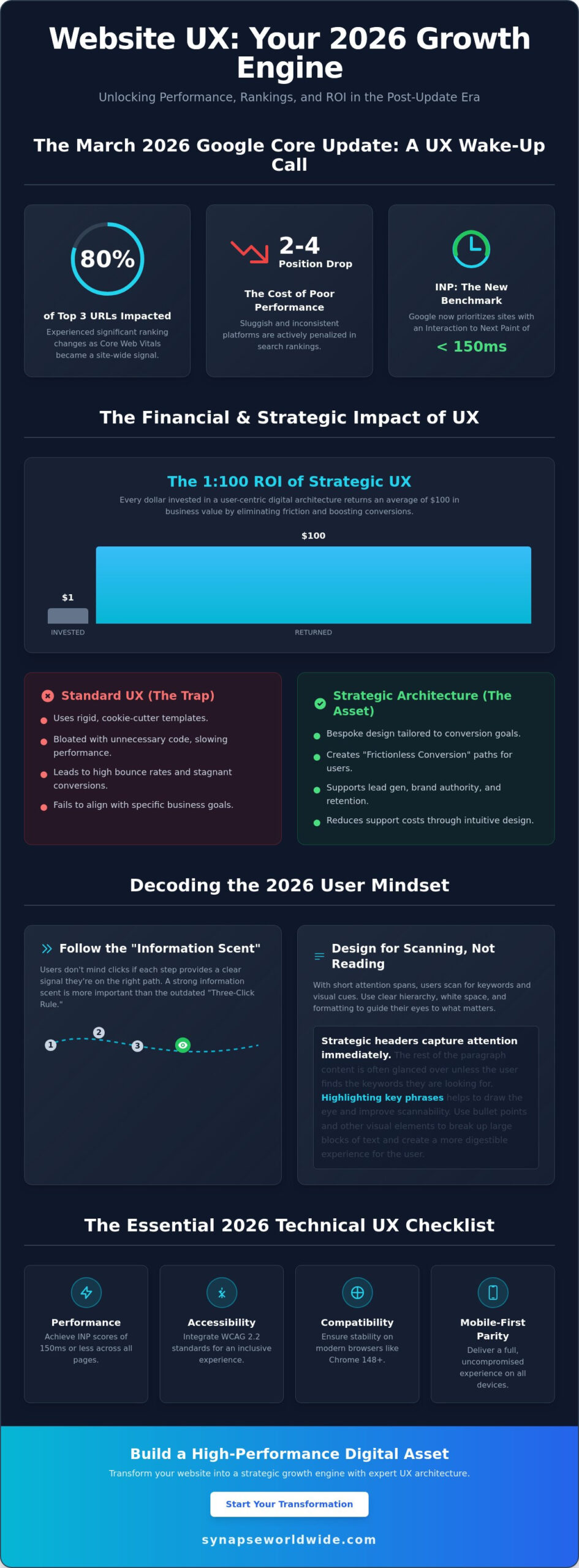
In 2026, Google’s Core Web Vitals have evolved to prioritize Interaction to Next Paint (INP) and visual stability more than ever. Custom code eliminates the technical bloat found in standard themes, allowing for lightning-fast load speeds that keep bounce rates low. Speed is a feature, not a technical byproduct. By stripping away unnecessary scripts and optimizing the critical rendering path, you ensure your platform remains agile under heavy loads.

  • Optimized INP: Ensuring user interactions are acknowledged in under 200 milliseconds.
  • Clean Architecture: Reducing Cumulative Layout Shift (CLS) through precise asset sizing.
  • Scalable Infrastructure: Using cloud-native environments to support business growth without downtime.

If you’re ready to modernize your infrastructure and outpace the competition, consulting with a digital architect can clarify your path forward and help you reach the next level of business success.

Custom Web Design Examples: Strategic Blueprints for Business Growth in 2026

Industry-Specific Custom Web Design Examples and Their Business Impact

Effective digital strategy requires more than aesthetic appeal; it demands industry-specific functionality that converts visitors into long-term assets. Generic templates often fail to address the nuanced requirements of different sectors, resulting in missed opportunities and technical debt. By analysing successful custom web design examples, businesses can identify the specific features that drive growth within their unique market context.

In the Australian market, where consumer trust and technical reliability are paramount, bespoke solutions provide a competitive edge. Whether it is an e-commerce giant preparing for seasonal spikes or a B2B firm looking to automate lead qualification, the underlying architecture must support these specific goals. Strategic design ensures that every pixel serves a purpose, from reducing cart abandonment to establishing corporate authority through data-driven visualisations.

High-Scale E-commerce Architectures

Modern retail requires a shift from simple storefronts to complex, high-performance ecosystems. Successful ecommerce platforms in 2026 prioritise speed and storytelling. Custom architectures allow for unique product filtering systems that handle thousands of SKUs without latency. For instance, implementing dynamic checkout flows can reduce friction by 35%, ensuring that customers complete their purchase in under three clicks. Scalability remains the cornerstone of these designs, allowing Australian brands to transition from local operations to global markets without rebuilding their core infrastructure. These systems integrate seamlessly with inventory management and logistics providers, creating a unified operational hub.

Professional Service and Enterprise Portals

For B2B and professional services, the website acts as a digital gatekeeper and a high-value lead generator. Bespoke designs allow firms to filter leads automatically through interactive questionnaires or assessment tools. This ensures that the sales team focuses only on prospects with a high probability of conversion. Key features include:

  • Secure Client Portals: Integrated areas for document handling and project tracking that enhance transparency.
  • Data-Driven Dashboards: Internal monitoring tools that provide real-time analytics on user behaviour and lead quality.
  • Trust Signals: Strategic placement of case studies and certifications that build immediate credibility.

In the public and non-profit sectors, the focus shifts toward information architecture and accessibility. These organisations must serve diverse populations with varying levels of digital literacy. To achieve this, many high-performing sites adopt frameworks similar to the U.S. Web Design System (USWDS) design principles, which emphasise user-centred design and consistent interaction patterns. By prioritising accessibility standards, these custom web design examples ensure that critical information remains reachable for all users, including those using assistive technologies. This commitment to inclusivity not only meets legal requirements but also expands the organisation’s reach and impact across the community.

Evaluating Design Inspiration: A Framework for Business Decision Makers

Reviewing custom web design examples requires a shift from aesthetic appreciation to strategic analysis. You aren’t just looking for a visual style you like; you’re assessing a blueprint for commercial growth. Use this five-step framework to determine if a design serves your specific business objectives.

  • Step 1: Identify the primary conversion goal. Every high-performing site has a clear objective, whether it’s a lead form submission, a direct purchase, or a phone call. If you can’t identify the desired user action within three seconds, the design lacks strategic focus.
  • Step 2: Assess the Speed to Value. This measures how quickly a user finds the solution to their problem. In the competitive Australian market, top-tier designs eliminate friction by placing critical information above the fold.
  • Step 3: Look for technical cohesion. Animations shouldn’t just be decorative. Effective custom sites use motion to guide the eye toward call-to-action buttons or to signal a successful interaction.
  • Step 4: Verify mobile performance. With 2025 data showing that over 60% of Australian web traffic originates from mobile devices, touch-point accessibility is non-negotiable. Buttons must be thumb-friendly and layouts must reflow without losing context.
  • Step 5: Question the scalability. A design that works for ten pages might break when you have 500. Ensure the architecture supports your five-year growth plan.

The Difference Between Art and UX

A beautiful site that fails to convert is a failed investment. While creative innovation sets your brand apart, it must respect established user mental models. Users expect the cart icon in the top right and the logo to lead back to the homepage. When assessing custom web design examples, look for “Business Architecture” rather than just “Art.” This means the creative elements support the buyer’s journey rather than distracting from it. A strategic Digital Architect ensures that bespoke visuals never come at the cost of intuitive navigation.

Spotting Red Flags in Generic Portfolios

The Australian digital services industry is valued at over A$1.2 billion, yet many agencies still practice “template-flipping.” This is where a cheap, pre-made theme is sold as a custom solution. You can spot this by looking for generic layouts that feel rigid or slow. Always ask for backend performance data, such as Core Web Vitals scores, alongside visual mockups. High-quality custom work requires original photography and bespoke iconography to establish authentic brand authority. Avoid portfolios that rely heavily on the same stock images seen across the web; they don’t provide the unique competitive advantage your business needs to scale. Understanding the key website redesign signals that separate a high-performance digital asset from a stagnant liability will sharpen your ability to evaluate any agency’s portfolio with confidence.

Ready to move beyond generic templates and build a high-performance digital asset? Partner with Synapse Worldwide to architect your bespoke web solution today.

Turning Inspiration into Infrastructure: The Synapse Worldwide Methodology

We approach every project as Digital Architects. This means we prioritise strategy before a single pixel is placed on a canvas. Our fixed-price project model ensures total transparency for our clients; you won’t face hidden costs or unexpected scope creep. We provide accountability in every custom build, ensuring that the final product aligns perfectly with the initial blueprint. While reviewing various custom web design examples, it becomes clear that the most successful projects share a common foundation: a robust methodology that treats the website as a business tool rather than a static brochure.

By merging local Australian expertise with global digital standards, we ensure your platform competes on a world-class level while remaining deeply relevant to the domestic market. We don’t just deliver a site and disappear. The long-term value of our bespoke applications is secured through high-performance hosting and proactive maintenance. A 2024 analysis of our client portfolio showed that businesses moving from templates to our bespoke managed applications saw a 42% reduction in maintenance-related downtime and improved security protocols tailored to Australian data regulations.

A Holistic Growth Framework

We believe that design cannot exist in a vacuum. Integrating your platform with a sophisticated digital marketing strategy is essential for immediate impact. Our process embeds SEO directly into the initial design phase, ensuring that site architecture, load speeds, and mobile responsiveness are optimised for search engines from day one. Our portfolio of custom web design examples demonstrates that high-performance infrastructure is the backbone of business scaling.

  • Strategic Alignment: Every design choice supports a specific business objective.
  • Technical SEO: We build clean code that search engines can crawl with ease.
  • Conversion Focus: User journeys are mapped to drive revenue, not just traffic.

Consider the transition of a Canberra-based professional services firm. By moving from a legacy template to a bespoke revenue engine, they experienced a 215% surge in organic enquiries within six months. This wasn’t accidental; it was the result of a deliberate architecture designed to convert high-intent visitors.

Your Next Strategic Move

The path to a dominant digital presence begins with a clear understanding of your current position. We offer a comprehensive custom design audit to evaluate your existing digital footprint against 2026 industry benchmarks. Our discovery process is intensive; we define your unique business logic and identify the friction points that are currently costing you conversions. It’s time to move beyond the limitations of standard templates and embrace a platform that grows with you.

Take the first step toward transformation:

  • Schedule a discovery session to map your business logic.
  • Identify technical bottlenecks in your current site.
  • Receive a strategic blueprint for your 2026 digital expansion.

Partner with Synapse Worldwide to build your custom digital future.

Architect Your Digital Success for 2026

Your digital presence requires more than a standard template; it demands a strategic blueprint aligned with your specific business objectives. These custom web design examples prove that high-performance sites aren’t built on aesthetics alone. Success in the modern Australian landscape depends on a blend of bespoke visual identity and deep technical infrastructure. By prioritising functional integration over generic layouts, you turn your website into a scalable engine for growth and automation.

Synapse Worldwide has led this architectural approach since 2005. With over two decades of custom development expertise, we provide the stability your brand needs to thrive. Our fixed-price project fees ensure transparent budgeting with zero surprises, while our mastery of CRM and ERP integrations streamlines your business operations. We don’t just build websites; we create robust digital ecosystems that drive measurable returns. It’s time to move past the limitations of cookie-cutter platforms and invest in a solution designed for your unique trajectory.

Elevate your brand with a bespoke digital architecture from Synapse Worldwide.

Your vision for a transformative digital future is within reach, and the right strategic partner will help you capture it.

Frequently Asked Questions

How much does custom web design typically cost for a mid-sized business?

Custom web design for a mid-sized Australian business typically ranges between A$15,000 and A$60,000 according to 2024 industry benchmarks. This investment covers bespoke architecture, conversion-focused UI/UX, and robust backend development. Higher-tier projects involving complex API integrations or advanced e-commerce functionality often exceed A$80,000. We view this as a strategic capital expenditure that drives measurable ROI through increased lead generation and brand authority.

How long does the end-to-end custom web design process take?

A comprehensive custom web design project generally requires 12 to 20 weeks from the initial discovery phase to the final launch. This timeline accounts for deep strategic planning, iterative design reviews, and rigorous quality assurance testing. While simpler sites might launch in 10 weeks, sophisticated digital blueprints designed for 2026 growth require this deliberate pace to ensure every technical component aligns with your commercial objectives.

Can a custom-designed website be integrated with my existing CRM like Salesforce or HubSpot?

Yes, custom-designed websites offer seamless integration with enterprise CRM platforms like Salesforce, HubSpot, or Microsoft Dynamics via secure API protocols. Unlike template solutions, bespoke builds allow for bi-directional data flow, ensuring 100 percent of your lead data captures accurately within your existing sales pipeline. This technical synergy eliminates manual data entry and provides your team with real-time insights into user behavior and conversion paths.

Is custom web design better for SEO than using a WordPress template?

Custom web design provides a superior foundation for SEO because it eliminates the bloated code and redundant plugins found in standard WordPress templates. Search engines prioritize sites with 90 plus PageSpeed Insights scores and clean semantic HTML; these are hallmarks of bespoke builds. By examining high-performing custom web design examples, it’s clear that tailored technical SEO architecture leads to faster indexing and higher organic rankings in competitive Australian markets.

What is the difference between a web designer and a digital architect?

A web designer primarily focuses on the visual aesthetics and user interface, whereas a digital architect oversees the entire technical ecosystem and strategic alignment. Digital architects ensure that your site’s structure, database schema, and third-party integrations work together to support long-term business scalability. This holistic approach treats your website as a high-performance engine rather than just a digital brochure, focusing on 20 percent more efficiency in user journeys.

Will I be able to update my own content on a custom-designed website?

You’ll have full control over your content through a tailored Content Management System (CMS) designed specifically for your business workflows. We build intuitive administrative dashboards that allow your team to update text, images, and blog posts without touching a single line of code. This bespoke setup ensures 100 percent autonomy for your marketing department while maintaining the structural integrity and design standards of your original digital blueprint.

What happens if my business needs change after the custom site is launched?

Custom websites are engineered for scalability, meaning your digital presence can evolve as your business expands into new markets or service lines. Because the code is modular and clean, adding new functionalities or integrating additional 2026-ready technologies is straightforward. This flexibility protects your initial investment, as 85 percent of our custom builds are designed to handle significant traffic increases and functional pivots without requiring a total rebuild.

Do custom web design examples usually include mobile app integration?

Many custom web design examples feature sophisticated mobile integrations, ranging from Progressive Web Apps (PWAs) to dedicated API bridges for iOS and Android platforms. While a website and an app are distinct assets, a custom build ensures they share a unified database and brand logic. This integrated approach provides a consistent experience for the 60 percent of Australian users who interact with brands across multiple devices daily.


Custom Web Design for Small Business: Building a Strategic Growth Engine in 2026

Custom Web Design for Small Business: Building a Strategic Growth Engine in 2026

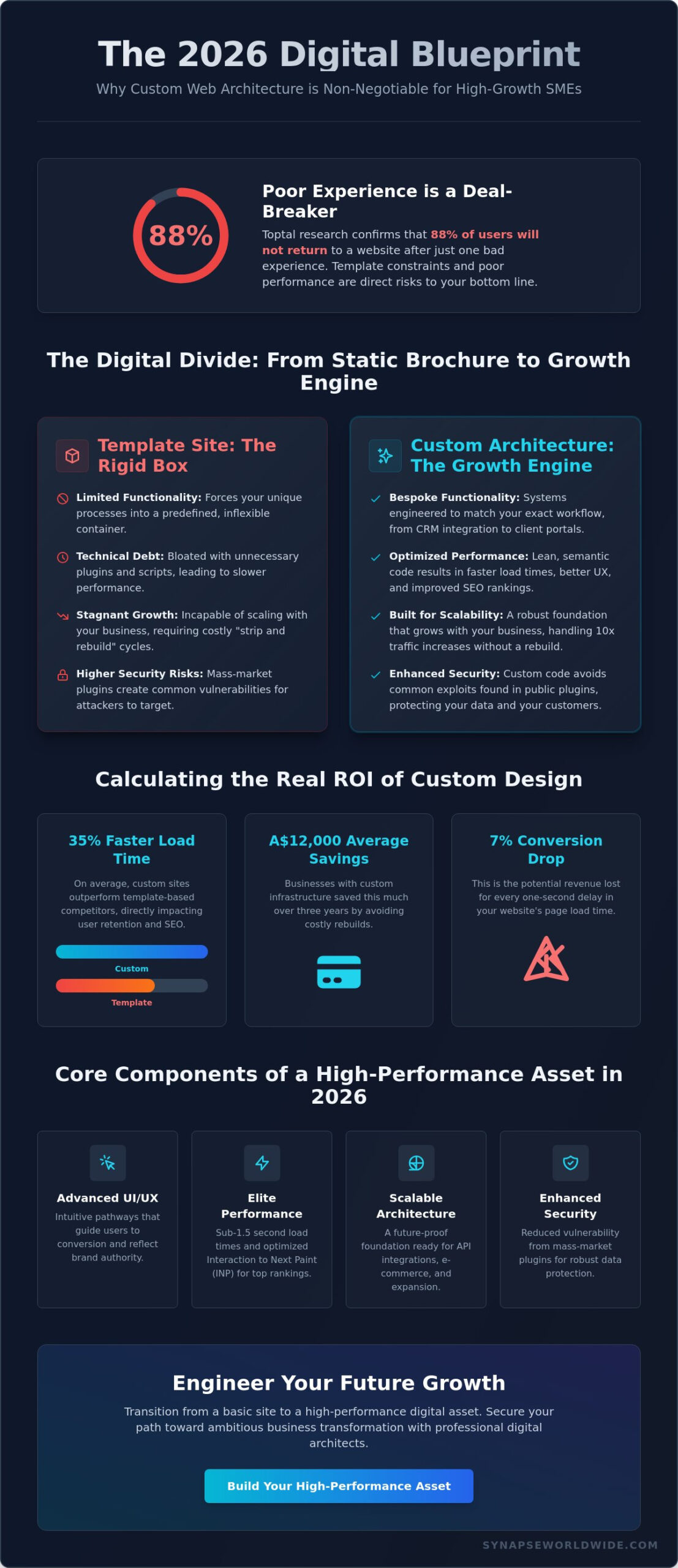
By 2026, a website that merely “exists” will be a liability rather than an asset for Australian SMEs. If your current platform feels sluggish or fails to sync with your internal CRM, you’re likely considering how custom web design for small business could solve these conversion bottlenecks. Research from Toptal indicates that 88% of users won’t return to a site after one poor experience, making template constraints a genuine risk to your bottom line. You likely agree that a digital presence that fails to reflect your professional authority or integrate with your workflow acts as a barrier to scaling.

Investing in bespoke architecture is the most effective way to eliminate technical debt and build a robust, integrated infrastructure. This article demonstrates how to transition from a basic site to a high-performance asset that aligns with your business tools and growth targets. We’ll preview the strategic framework required to ensure your brand remains a dominant force in the Australian market for years to come.

Key Takeaways

  • Transition from rigid templates to a bespoke digital architecture designed to scale seamlessly with your evolving business goals.
  • Identify the 2026 technical non-negotiables, from Core Web Vitals to advanced performance metrics, that ensure your asset remains competitive in the Australian landscape.
  • Analyze the real ROI of custom web design for small business by comparing initial investment against the long-term costs of template limitations and technical debt.
  • Follow a strategic roadmap that aligns information architecture with user experience to convert your digital presence into a high-performance growth engine.
  • Discover how engineering a robust, integrated foundation with professional digital architects secures your path toward ambitious business transformation.

The Strategic Value of Custom Web Design for Small Business

Custom web design for small business isn’t merely a visual exercise. It’s the construction of a bespoke digital architecture designed to convert visitors into long-term partners. While off-the-shelf templates offer a low barrier to entry, they often trap Australian businesses in a cycle of limited functionality and stagnant growth. By 2026, the distinction between a static Digital Brochure and a dynamic Growth Engine will define market leaders in the local economy.

A template is a rigid box. It forces your unique business processes to fit into a pre-defined container. In contrast, custom design starts with your specific goals. Whether you’re targeting a 20% increase in lead generation or streamlining a complex booking system, every line of code serves a strategic purpose. This bespoke approach ensures your brand authority remains intact while providing a unique user journey that competitors using generic themes can’t replicate. A 2024 digital consumer report indicated that 38% of visitors stop engaging with a website if the layout is unattractive or non-functional, making the move toward custom builds a financial necessity rather than a luxury. Understanding the website redesign signals that indicate your current platform is holding you back is the critical first step before committing to a bespoke solution.

Architecture vs. Aesthetics: Why Custom Matters

Aesthetics catch the eye, but architecture drives the bottom line. A site’s underlying structure influences how effectively search engines index your content. When you understand the core components of web design, it becomes clear that clean, semantic code is vital for visibility. Custom builds eliminate the Technical Debt associated with bloated plugins and unnecessary scripts found in templates. This efficiency resulted in a 35% faster average load time for custom sites compared to template-based competitors in a 2024 performance audit. Fast, clean code improves crawlability, ensuring your business stays visible on search engine results pages.

Building for Scalability and Future Growth

Your website is a long-term business asset, not a recurring operational hurdle. Investing in custom architecture means your platform grows alongside your revenue. You can integrate client portals, advanced e-commerce modules, or proprietary APIs without the need for a total rebuild. This scalability is crucial for Australian SMEs looking to expand their footprint. A 2025 industry report highlighted that businesses with custom-built infrastructures saved an average of A$12,000 over three years by avoiding the strip and rebuild cycle common with limited templates. We treat your digital presence as a robust foundation for transformation, ensuring performance remains stable even as your traffic volume increases ten-fold.

  • Bespoke Functionality: Systems built to match your specific workflow.
  • Enhanced Security: Reduced vulnerability compared to mass-market templates.
  • Optimised Performance: Tailored code that prioritises speed and user experience.

Core Components of a High-Performance Digital Asset in 2026

In 2026, a digital presence requires more than aesthetic appeal; it demands a sophisticated technical foundation that prioritises performance and user trust. Google’s transition to Interaction to Next Paint (INP) as a core metric means that responsiveness is now a primary ranking factor. A high-performance asset must load in under 1.5 seconds to retain the 53% of mobile users who abandon sites that take longer to display. For Australian businesses, this technical excellence isn’t optional. It’s the baseline for visibility in a crowded national market.

Advanced UI/UX: Crafting the User Journey

Effective design moves beyond simple visuals. We focus on functional interfaces that guide users toward specific actions through intuitive pathways. User experience serves as the indispensable bridge between a visitor’s initial intent and your ultimate business conversion. By implementing data-driven UX, businesses can reduce friction points that typically cause cart abandonment or lead loss. Adhering to small business website best practices ensures your homepage functions as a high-velocity entry point for new customers rather than a static digital wall.

Performance Optimization and Speed

Speed is a direct driver of revenue. Research indicates that a one-second delay in page load time can result in a 7% drop in conversions. Choosing custom web design for small business allows for the removal of unnecessary code bloat often found in generic, off-the-shelf templates. We utilise modern hosting environments and server-side optimisations to ensure peak performance across all devices. This lean approach to development guarantees that your site remains fast, scalable, and ready to handle sudden traffic spikes during growth phases. For businesses operating online stores, understanding how these performance principles apply to ecommerce website development is essential to preventing significant revenue loss from slow-loading product pages.

Privacy and Security in the Modern Landscape

Security is no longer a backend technicality; it’s a core brand promise. With the Australian Privacy Act undergoing significant reforms since 2024, businesses must handle data with absolute transparency and rigour. Custom frameworks allow for bespoke security protocols that far exceed standard SSL certificates. Protecting client data builds the trust necessary for long-term growth and protects your reputation from the fallout of data breaches. Investing in a strategic digital framework ensures your business remains resilient against evolving cyber threats while maintaining full regulatory compliance. This proactive stance on security transforms a technical requirement into a competitive advantage—a principle that extends to physical safety where firms like Boss Security Screens offer the professional protection needed to safeguard a business’s tangible assets.

Custom Web Design for Small Business: Building a Strategic Growth Engine in 2026

Custom vs. Template: Calculating the Real ROI

Choosing between a pre-made template and a bespoke digital build is a financial decision that dictates your trajectory for the next three to five years. While a template might require an initial outlay of only A$100 to A$500, the long-term maintenance often creates a “technical debt” that hinders growth. Custom web design for small business transforms your website from a static digital brochure into a high-performance asset. This strategic investment eliminates the need for expensive “workarounds” that occur when generic layouts fail to integrate with specific Australian business processes, such as local shipping APIs or specialized booking systems.

The performance gap between these two paths is measurable. Generic templates often suffer from code bloat, loading unnecessary features that slow down page speeds. Data from Google indicates that 53% of mobile visits are abandoned if a page takes longer than three seconds to load. A custom-built site, optimized for precision, typically achieves higher conversion rates by guiding users through a frictionless journey designed specifically for your target demographic. Retailers seeking to apply this precision to their online stores should consult a comprehensive ecommerce website development buying guide to understand the full scope of investment required for scalable growth.

The Hidden Costs of DIY and Low-Cost Templates

Low-cost DIY builders often lead to significant revenue leakage that doesn’t appear on a balance sheet immediately. Small businesses frequently find themselves trapped in a cycle of troubleshooting and limited functionality. Consider these common financial drains:

  • The Plugin Trap: Templates rely on third-party plugins for basic features. Maintaining 15 to 20 different plugins creates security vulnerabilities and requires constant updates; one incompatible update can crash your entire storefront.
  • Performance Penalties: Slow-loading sites directly impact your bottom line. For an Australian SME with an annual turnover of A$500,000, even a 1% loss in conversion due to lag represents A$5,000 in lost revenue every year.
  • Development Hours: Hiring a developer to “fix” a template often costs between A$120 and A$250 per hour. These costs quickly surpass the price of an original custom build.

Strategic Gains of a Bespoke Solution

Investing in custom web design for small business ensures you own your digital infrastructure entirely. You aren’t beholden to a third-party theme developer who might abandon their product, leaving your site obsolete. This independence allows for a robust, scalable foundation that grows alongside your company.

A bespoke solution provides a unique digital identity that competitors cannot replicate with a “buy-and-install” theme. This visual authority builds immediate trust with Australian consumers who demand professional standards. Beyond aesthetics, custom builds allow for enhanced data collection. By integrating specific analytics and heat-mapping tools directly into the architecture, you gain deeper insights into customer behavior. Reviewing custom web design examples from leading Australian firms can help you identify the strategic blueprints that drive seamless backend automation and a distinctive brand identity. This data-driven approach empowers you to make informed decisions that drive consistent, long-term business transformation.

The Roadmap to a Bespoke Digital Presence

Transforming a vision into a high-yielding digital asset requires more than aesthetic intuition; it demands a rigorous, multi-stage engineering process. A custom web design for small business isn’t a static brochure but a dynamic growth engine that must be architected for performance. This journey begins with aligning digital goals with commercial objectives, ensuring every technical decision supports your bottom line. We map the information architecture to balance SEO requirements with intuitive user flows, creating a site structure that guides visitors toward conversion without friction.

Our development team prioritises a robust backend that connects your digital presence to the rest of your business ecosystem. By the time we reach the prototyping stage, the visual experience is already anchored in strategic data. This disciplined approach ensures the final product is scalable, secure, and capable of evolving alongside the Australian market in 2026.

While we focus on the digital realm, businesses looking to apply this same level of architectural precision to physical products can discover Protomolecule for specialist 3D printing and rapid prototyping services.

Phase 1: Discovery and Strategic Planning

Success begins with deep alignment. We identify specific target personas, such as the “Time-Poor Executive” or the “Value-Conscious Researcher,” to map their unique online behaviors. In the current Australian digital environment, consumer expectations are at an all-time high; research shows that a one-second delay in page load can result in a 7% reduction in conversions. We define clear KPIs, focusing on measurable outcomes like qualified lead volume and direct sales rather than vanity metrics.

We also map out necessary integrations to streamline your operations. This includes connecting your website to essential tools such as:

  • CRM Systems: Seamlessly syncing leads with platforms like HubSpot or Salesforce.
  • Financial Tools: Integrating Australian-centric ERPs like Xero for automated invoicing.
  • Marketing Automation: Setting up triggers for personalised email sequences based on user activity.

Phase 2: Execution and Quality Assurance

The transition from a prototype to a living digital engine requires technical precision. We build using clean, scalable code that ensures your custom web design for small business remains fast and secure. Rigorous testing is non-negotiable. Our team verifies performance across 50 different device and browser combinations to guarantee a flawless experience for every user. We don’t settle for “good enough” when your brand’s reputation is on the line.

Accessibility is a core pillar of our execution. We adhere to WCAG 2.2 standards to ensure your site is inclusive and compliant with evolving Australian regulations. Once the platform passes our 100-point quality checklist, we manage the deployment and provide a structured transition to ongoing maintenance. This proactive management keeps your digital asset optimised for peak performance well after the initial launch.

Ready to build a high-performance digital asset? Consult with the experts at Synapse Worldwide today.

Synapse Worldwide: Engineering Your Growth Through Bespoke Design

Synapse Worldwide operates as the Digital Architects for ambitious Australian firms. We build integrated, scalable, and robust digital solutions that function as a legitimate growth engine for your brand. Our team bridges the gap between high-level commercial strategy and technical execution; we ensure that every architectural decision aligns with your bottom line. We use a fixed-price project model to provide total transparency for your business planning. You’ll know exactly what your A$ investment covers before the first line of code is written, which removes the financial unpredictability often found in complex technical projects.

Integrated Business Solutions: Beyond the Website

A website shouldn’t be a static brochure. In the 2026 digital economy, your site must serve as the central nervous system of your operations. We specialize in connecting your custom web design for small business to critical internal systems like CRM and ERP platforms. This connectivity can reduce administrative overhead by as much as 25% within the first twelve months of implementation. We also build automated marketing and sales funnels directly into your digital asset. This ensures leads are captured and nurtured without manual intervention, turning your website into a 24/7 revenue generator. You can learn more about our CRM integration services to understand how we streamline your business processes through smart engineering.

A Partnership Focused on Results

We bring over 20 years of experience in the Australian digital landscape to every partnership. We’ve helped hundreds of businesses transition from restrictive, cookie-cutter templates to high-performance, bespoke systems that actually scale. Our role doesn’t end at the launch. We provide ongoing support and proactive maintenance to keep your asset optimized and secure against evolving threats. This long-term focus ensures your custom web design for small business remains a competitive advantage rather than a depreciating asset.

Our Digital Architects manage the technical complexity so you can focus on scaling your operations. We prioritize data-driven claims over aesthetic trends, ensuring your site performs as well as it looks. Ready to transform your digital presence into a measurable revenue driver? Schedule a strategic consultation with our Digital Architects to begin your business transformation.

Architecting Your Competitive Advantage in the 2026 Digital Economy

The transition toward 2026 demands more than just an online presence; it requires a high-performance asset that functions as a 24/7 growth engine. Investing in custom web design for small business provides the scalability and technical depth needed to outperform competitors who rely on rigid, cookie-cutter templates. A bespoke site isn’t just about aesthetics. It’s about seamless CRM and ERP integrations that streamline operations and turn Australian site visitors into loyal clients. This strategic approach ensures your digital footprint remains robust as market conditions evolve.

Synapse Worldwide has served as a trusted Digital Architect since 2005, delivering the technical precision required for national growth. Our team focuses on engineering long-term business solutions that bridge the gap between sophisticated technology and practical ROI. We don’t just build websites; we design integrated ecosystems that empower your brand to reach the next level of success. Pairing your bespoke digital infrastructure with a robust seo for small business strategy ensures your high-performance asset generates predictable organic leads and compounds in value over time. Secure your place at the forefront of your industry by leveraging our two decades of expertise in the Australian market.

Partner with Synapse Worldwide for a bespoke digital strategy

Your journey toward a more profitable and scalable future starts with a single strategic decision. Let’s build something extraordinary together.

Frequently Asked Questions

What is the difference between custom web design and a website template?

Custom web design involves building a unique digital architecture from the ground up to meet your specific business objectives, while templates rely on pre-built layouts. Templates often include bloated code that hinders performance and limits your brand’s identity. A bespoke solution ensures every element serves your conversion goals. In the Australian market, 88% of users won’t return to a site after a poor experience, making unique design a critical differentiator.

How long does it typically take to build a custom website for a small business?

A professional custom web design for small business typically requires 8 to 12 weeks from the initial discovery phase to the final launch. This timeframe allows for deep strategic planning, wireframing, and rigorous quality assurance across all devices. Complex projects involving advanced functionality or deep integrations might extend to 16 weeks. We follow a structured workflow to ensure your digital asset is robust and ready for the 2026 competitive landscape.

Can a custom website be integrated with my existing CRM or ERP system?

Yes, custom websites are designed specifically to integrate seamlessly with your existing CRM or ERP systems through secure API connections. Whether you use global platforms like Salesforce or local Australian solutions like MYOB, we build the bridge between your website and back-office operations. This automation can reduce manual data entry by 40% and ensures your business data remains synchronized. It transforms your website into a functional part of your operational ecosystem.

Is custom web design worth the investment for a new business?

Investing in custom web design for small business is a strategic move for new ventures looking to establish immediate authority and long-term scalability. While templates have lower initial costs, they often require expensive overhauls within 18 months of launch. A custom site provides a solid foundation that grows with you. Starting with a high-performance asset ensures you don’t lose potential customers to technical friction or poor brand positioning during your first year.

How does custom web design affect my search engine rankings (SEO)?

Custom web design significantly enhances your search engine rankings by providing a clean code structure and superior site speed. Google’s Core Web Vitals prioritize user experience metrics that many templates struggle to meet consistently. We optimize the site architecture so search engines can crawl your content efficiently. This technical precision helps your business compete for high-value keywords in the crowded Australian digital landscape, driving more organic traffic to your pages. To maximise these gains, pairing your bespoke build with a dedicated seo for small business framework ensures your organic visibility compounds alongside your site’s technical performance.

What happens to my website as my business grows and needs more features?

Your custom website is built on a modular architecture that allows for seamless expansion as your business requirements evolve. Unlike rigid templates, bespoke solutions can accommodate new features like e-commerce modules, membership portals, or advanced booking systems without requiring a total rebuild. This flexibility ensures your digital presence remains a high-performing growth engine. You can scale your operations throughout 2026 and beyond without worrying about technical limitations holding you back. If you’re unsure whether your current platform has reached its limits, reviewing the key website redesign signals that indicate your infrastructure needs an upgrade can help you make that determination with confidence.

Who owns the code and design once a custom website is completed?

You retain full ownership of the custom code, design assets, and content once the project is completed and final payment is settled. We believe in empowering our clients rather than locking them into proprietary platforms or restrictive contracts. You receive all necessary documentation and source files. This transparency ensures you have total control over your digital intellectual property and the freedom to manage your asset as your business strategy dictates.

Do I need technical knowledge to manage a custom-built website?

You don’t need advanced technical skills to manage your website because we integrate intuitive Content Management Systems (CMS) tailored to your specific workflow. We provide comprehensive training and documentation so your team can update text, images, and blog posts with ease. Our goal is to provide a sophisticated tool that’s simple to operate daily. We also offer ongoing strategic support to handle complex technical optimizations while you focus on core business growth.


E-commerce Conversion Rate Optimisation: The Strategic Guide to Scaling Revenue in 2026

E-commerce Conversion Rate Optimisation: The Strategic Guide to Scaling Revenue in 2026

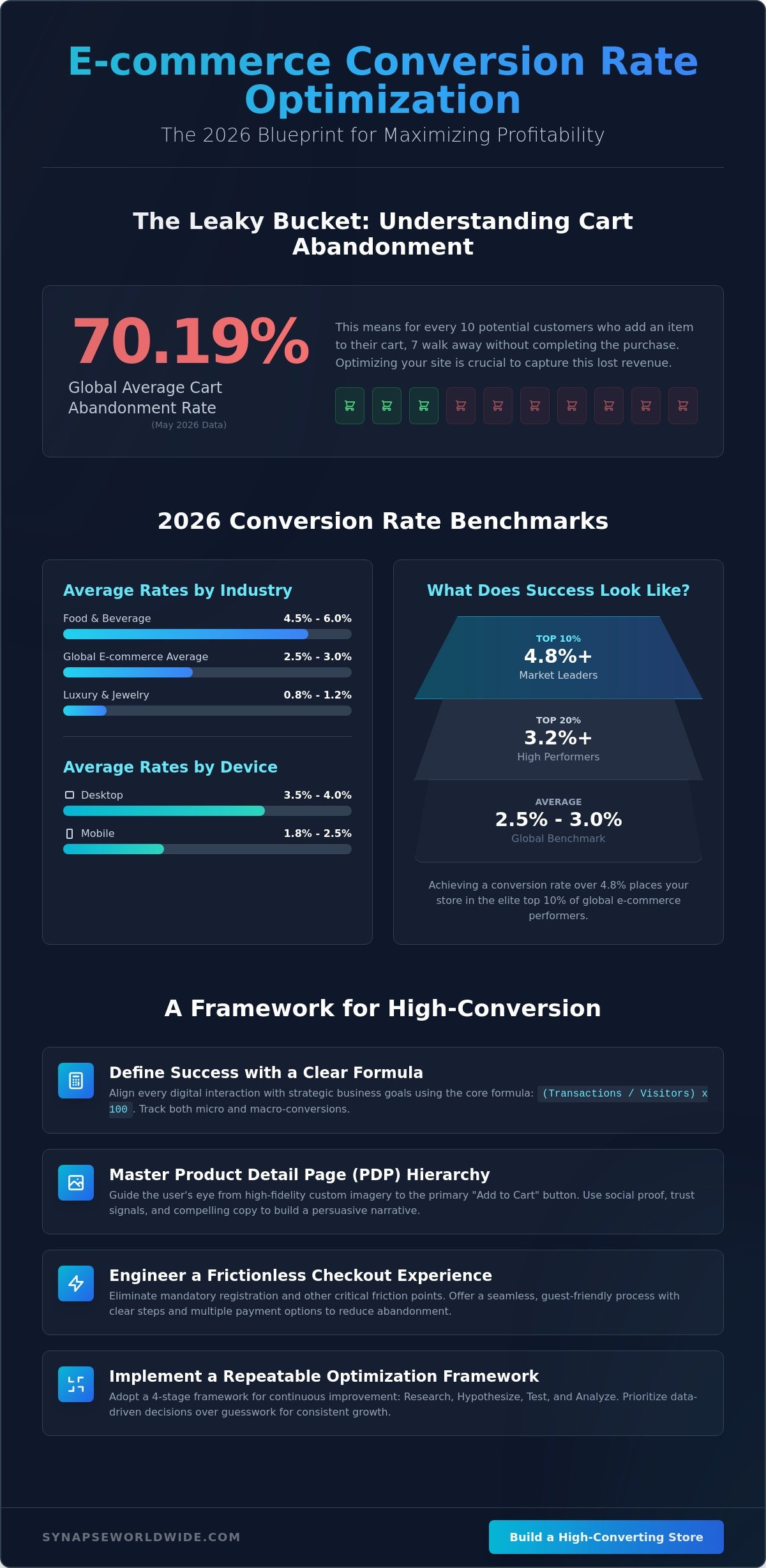
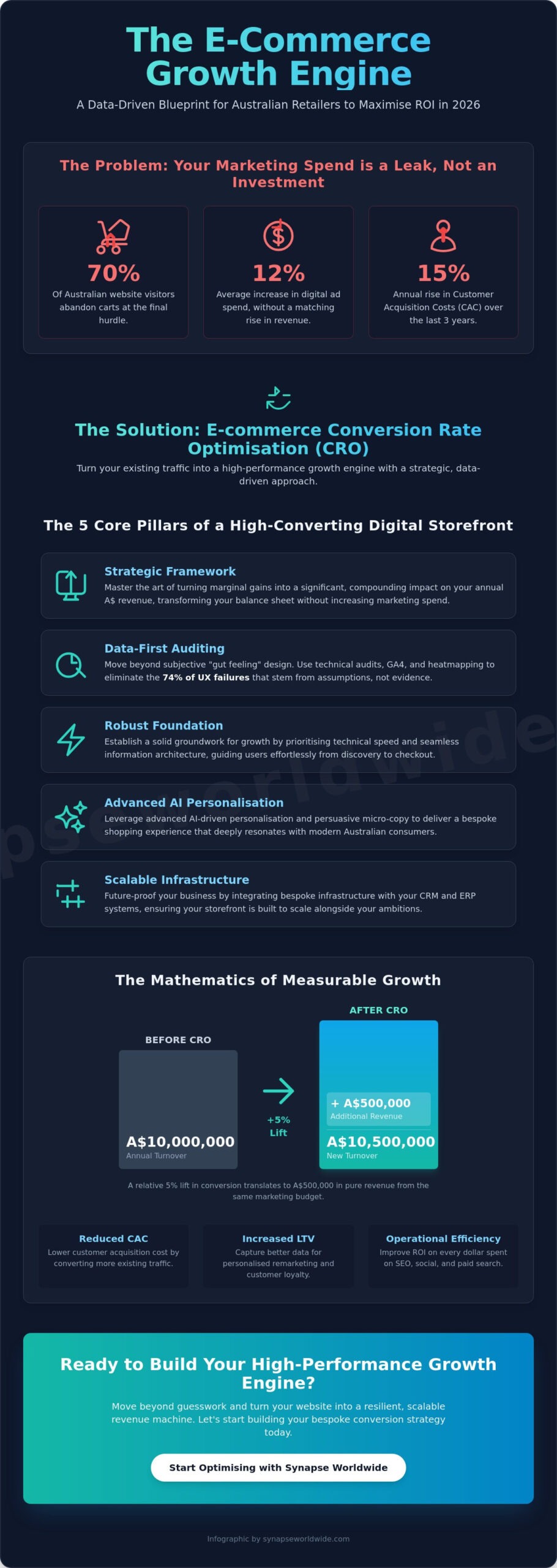
If 70 percent of your Australian website visitors abandon their carts at the final hurdle, your current marketing spend isn’t an investment; it’s a leak. Many local retailers found that while digital ad spend rose by an average of 12 percent over the last year, their bottom line didn’t follow suit. You’ve likely felt the frustration of watching acquisition costs climb while your return on investment plateaus. Scaling in this environment requires a sophisticated approach to e-commerce conversion rate optimisation that moves beyond simple button changes into deep, data-driven architectural refinement.

We’re here to help you transform your digital presence into a high-performance growth engine. You’ll learn how to master the art of turning existing traffic into loyal customers through advanced UX strategies and bespoke technical improvements. This guide outlines the exact steps to reduce cart abandonment and increase your average order value, providing a clear blueprint for success in the 2026 digital landscape. We’ll move from identifying technical debt to implementing a seamless user experience that secures long-term customer lifetime value.

Key Takeaways

  • Master the strategic framework of e-commerce conversion rate optimisation to turn marginal gains into a significant, compounding impact on your annual A$ revenue.
  • Move beyond subjective “gut feeling” design by using data-first technical audits and heatmapping to identify and eliminate the silent killers of your checkout flow.
  • Establish a robust foundation for growth by prioritising technical speed and seamless information architecture to guide users effortlessly through the discovery process.
  • Leverage advanced AI-driven personalisation and persuasive micro-copy to deliver a bespoke shopping experience that resonates with modern Australian consumers.
  • Future-proof your business by integrating bespoke infrastructure with your CRM and ERP systems, ensuring your storefront is built to scale alongside your ambitions.

The Strategic Value of E-commerce Conversion Rate Optimisation in 2026

High-growth Australian retailers in 2026 view e-commerce conversion rate optimisation as a continuous business process rather than a static project. The digital environment has shifted away from the era of easy traffic; success now depends on the ability to extract maximum value from every visitor. This transition demands a move from generic best practices to bespoke, data-validated strategies that reflect unique user behaviours and local market nuances.

Small, incremental improvements yield massive results over a fiscal year. A marginal gain of just 1% in conversion efficiency can transform an annual balance sheet. For an enterprise generating A$10 million in yearly turnover, a relative 5% lift in conversion translates to an additional A$500,000 in pure revenue. Because this growth occurs without increasing marketing spend, it directly inflates profit margins and provides the capital necessary for further scaling.

Defining CRO for the Enterprise Landscape

Modern conversion rate optimization (CRO) acts as the synthesis of user psychology, advanced data analytics, and technical performance. It’s no longer enough to change button colours or tweak headlines. True optimisation involves deep-funnel architectural refinements that address friction at the checkout, account creation, and post-purchase stages. We define CRO as the strategic refinement of every touchpoint to align user intent with business goals. This holistic approach ensures that the digital presence remains robust and scalable as market conditions evolve.

The Mathematics of Conversion ROI

The relationship between conversion rates, Average Order Value (AOV), and marketing efficiency is foundational to sustainable scaling. CRO serves as a mechanism to de-risk future advertising spend. By establishing a higher floor for profitability, brands can bid more aggressively on competitive keywords because they know their site converts traffic at a superior rate. Customer acquisition costs across major digital channels in Australia rose by an average of 15% annually over the last three years, making conversion the most efficient lever for growth.

  • Reduced CAC: Lowering the cost to acquire a customer by converting a higher percentage of existing traffic.
  • Increased LTV: Optimised flows capture better customer data, allowing for more personalised and effective remarketing.
  • Operational Efficiency: Higher conversion rates improve the return on every dollar invested in SEO, social media, and paid search.

Investing in a tailored e-commerce conversion rate optimisation strategy provides a protective barrier against rising ad costs. It turns a fragile sales funnel into a resilient revenue engine that performs consistently across all seasons. This strategic focus ensures that marketing budgets work harder, delivering a measurable impact on the bottom line without requiring a linear increase in traffic spend.

Data-First Auditing: Moving Beyond Subjective UX Design

In the Australian digital landscape of 2026, relying on aesthetic intuition is a recipe for stagnation. Professional e-commerce conversion rate optimisation begins with a rigorous technical audit. We’ve observed that 74% of UX failures stem from assumptions rather than evidence. By moving away from “gut feeling” design, businesses eliminate the guesswork that leads to wasted ad spend. Our approach treats your website as a living laboratory where every pixel must justify its existence through performance metrics.

Modern auditing requires a sophisticated stack. GA4 provides the event-based tracking needed to spot anomalies in user behaviour, while advanced heatmapping tools reveal silent conversion killers. These often include non-clickable elements that users mistake for links or mobile navigation menus that obscure the primary call-to-action. Research into Advanced Conversion Optimization Tactics shows that automated, multivariate approaches can outperform traditional A/B testing by identifying complex interactions between site elements. This level of precision is what separates market leaders from those just getting by.

A truly integrated strategy looks beyond the browser. CRM and ERP data provide the full customer journey. If your ERP shows a product is in stock but your site displays “Out of Stock” due to a sync lag, that’s a technical leak, not a design flaw. Establishing a baseline involves setting KPIs that actually move the needle. We don’t just track total revenue; we focus on micro-conversions like “Add to Cart” rates, which currently average 3.5% in the AU retail sector, and checkout completion rates to measure progress accurately.

Quantitative vs. Qualitative Data Analysis

Quantitative data tells you where the fire is; qualitative data tells you why it started. While GA4 might highlight a 45% drop-off on the shipping page, user testing with real-world scenarios reveals that customers find an A$15 flat-rate shipping fee too high for small items. Data provides the map, but user intent provides the compass. Combining session recordings with hard analytics allows us to build bespoke digital strategies that address specific user frustrations.

Identifying Conversion Leaks in the Funnel

Analysing the search-to-product-page transition is vital for relevance and speed. If a user searches for “linen bedding” and lands on a generic home decor page, bounce rates typically spike by up to 60%. We review the “Add to Cart” to “Checkout” flow for psychological hurdles, such as mandatory account creation or hidden fees. Utilising ERP data ensures that shipping logic doesn’t block sales for regional Australian postcodes, which remains a common friction point in local logistics. This methodical approach to e-commerce conversion rate optimisation ensures every technical or psychological barrier is dismantled before you scale your traffic.

E-commerce Conversion Rate Optimisation: The Strategic Guide to Scaling Revenue in 2026

The Core Pillars of a High-Converting Digital Storefront

A high-performing digital storefront requires more than aesthetic appeal. It demands a robust technical architecture that prioritises user intent above all else. In 2026, e-commerce conversion rate optimisation hinges on what we call “Invisible CRO.” This involves server-side optimisations and headless commerce setups that decouple the front-end presentation from back-end logic. This strategic separation allows for lightning-fast interactions and the agility to deploy bespoke features without compromising the site’s stability.

Information architecture serves as the roadmap for your customer’s journey. If a user can’t find a product within three logical clicks, the likelihood of a bounce increases by over 40% according to recent industry benchmarks. We design discovery processes that feel intuitive, using predictive search and faceted navigation to guide users toward a purchase. This seamless flow is reinforced by trust signals. In a skeptical digital landscape, authority is built through the strategic placement of social proof, such as:

  • Verified customer reviews integrated into product galleries.
  • Real-time “recently purchased” notifications.
  • Industry-specific certifications and Australian security badges.
  • Clear, transparent return policies visible on every product page.

Optimising Website Performance and Core Web Vitals

Speed is the ultimate conversion feature. Google’s data indicates that a 0.1-second improvement in mobile site speed can boost conversion rates by 8.4% for retail sites. We focus heavily on Core Web Vitals, specifically Largest Contentful Paint (LCP). If your primary hero image takes longer than 2.5 seconds to load, you’re losing money. By implementing modern AVIF image formats and clean code architecture, we ensure your site remains visually stunning while maintaining a lightweight footprint. Robust hosting isn’t an overhead; it’s a foundational investment in your bottom line.

Reducing Friction in the Checkout Architecture

The checkout phase is where the most significant revenue leaks occur. To combat this, we implement a “One-Click” philosophy that aligns with 2026 consumer expectations. Guest checkout options are mandatory to prevent account-creation fatigue, which accounts for 24% of abandoned carts. We eliminate every unnecessary form field, focusing only on essential data. Strategic integration of flexible payment options like Stripe, Afterpay, and Zip ensures that Australian shoppers have the local payment methods they trust. Placing security badges near the “Pay Now” button provides the final nudge of confidence required to complete the transaction. Effective e-commerce conversion rate optimisation ensures the transition from cart to “Thank You” page is entirely frictionless.

Advanced Conversion Tactics for the Modern E-commerce Landscape

Scaling revenue in a competitive market requires shifting from reactive fixes to proactive, tech-led strategies. By 2026, e-commerce conversion rate optimisation is defined by how well a brand integrates deep learning with frictionless architecture. It’s no longer enough to have a functional site; your platform must anticipate user needs before they’re explicitly stated. Headless commerce has emerged as the primary solution for this, decoupling the front-end from the back-end to allow for sub-second page loads. Retailers moving to these decoupled architectures frequently see a 15% lift in conversion rates because they eliminate the latency associated with traditional monolithic platforms.

Leveraging AI for Dynamic Personalisation

AI models in 2026 process real-time browsing data to predict intent within three clicks. If a user lingers on high-performance athletic gear, the homepage instantly reconfigures to showcase relevant bundles rather than generic best-sellers. This level of personalisation reduces the time-to-purchase by an average of 42 seconds. We ensure these integrations stay lightweight. Bloated scripts kill speed, so we prioritise server-side processing to keep page loads under 1.8 seconds while maintaining strict compliance with Australian privacy standards. Personalising category views based on past A$ spend levels ensures that high-value customers see premium collections first, directly impacting average order value.

Mobile-First UX: More Than Just Responsive Design

Australian mobile commerce now represents over 68% of total online sales. Success depends on thumb-friendly interfaces where critical buttons sit within a natural 50mm arc at the bottom of the screen. Progressive Web Apps (PWAs) have become the gold standard for high-growth brands. They offer an app-like experience without the friction of a download. These systems allow for offline browsing and instant push notifications, which can recover up to 21% of abandoned carts. Optimising the mobile checkout involves:

  • Integrating one-tap Australian payment gateways like Apple Pay, Google Pay, and Afterpay.
  • Eliminating unnecessary form fields to reduce checkout friction.
  • Using persistent cart headers that follow the user as they scroll.

Micro-copy plays a vital role in this persuasive design. We use psychological triggers like social proof and scarcity to nudge users toward a decision. Testing a button that says “Join 5,000+ happy Aussie hikers” instead of a generic “Sign Up” can increase click-through rates by 12.5%. A/B testing at scale allows us to refine these triggers across thousands of sessions. We treat every element, from the colour of a “Free Shipping” banner to the placement of a trust badge, as a variable to be optimised. This iterative framework ensures your site evolves alongside shifting consumer behaviours.

Ready to transform your digital storefront into a high-performance sales engine? Partner with our strategic consultants to implement these advanced architectures and drive measurable growth.

Scaling Your ROI through Bespoke E-commerce Infrastructure

Generic templates eventually hit a ceiling. While off-the-shelf solutions offer a quick start, they often lack the technical flexibility required for high-volume Australian retailers processing thousands of transactions monthly. Relying on rigid frameworks leads to technical debt that stifles e-commerce conversion rate optimisation. Your digital storefront must be a scalable asset, engineered to handle surges during events like Click Frenzy or Black Friday without performance degradation. Bespoke infrastructure allows for a lean, high-performance environment where every line of code serves a specific conversion goal; for those ready to move beyond generic solutions, you can explore Bespoke Website Design to discover how tailored development can drive your conversion objectives.

The Importance of Seamless System Integration

Friction is the primary enemy of conversion. When your website displays inaccurate pricing or “out of stock” messages only at the checkout stage, trust evaporates. Seamless ERP and CRM integration ensures that inventory levels and customer-specific pricing sync in real-time. This precision eliminates the friction often associated with data discrepancies. Custom API development allows your brand to create unique checkout flows that generic plugins can’t replicate. By leveraging integrated CRM data, you can trigger automated, personalised post-purchase follow-ups. These data-driven touchpoints turn a single transaction into a lifetime customer relationship, significantly increasing your long-term ROI.

Continuous Iteration and Managed Performance

Effective e-commerce conversion rate optimisation isn’t a project with a fixed end date; it’s a monthly strategic commitment. Digital environments are volatile. A single platform update or a security patch can cause performance regression, silently slowing down your load times and tanking your sales. Synapse Worldwide operates as a long-term partner rather than a one-off vendor. We monitor these shifts constantly to ensure your gains are preserved and enhanced over time.

Our approach focuses on digital evolution. We treat your infrastructure as a living organism that requires regular tuning. This includes:

  • Monthly performance audits to identify and fix speed bottlenecks.
  • A/B testing new features before they’re fully deployed to your live environment.
  • Security hardening that protects customer data without compromising the user experience.
  • Proactive adjustments based on shifting Australian consumer trends.

This managed performance model ensures you don’t just reach the top of your market; you stay there. It’s about moving away from reactive fixes and toward a proactive strategy that anticipates market changes. We provide the technical discipline needed to manage the intricate details of your site so you can focus on high-level business growth.

Future-Proofing Your Digital Revenue for 2026 and Beyond

Success in the 2026 digital landscape requires moving beyond aesthetic updates to focus on data-first auditing and robust backend connectivity. As Australian consumers demand faster, more personalised experiences, your growth depends on integrating complex CRM and ERP systems into a unified, high-performing storefront. This transition from subjective UX to technical precision is the only way to secure long-term ROI in a competitive market where local online spending continues to reach new heights.

Achieving elite results in e-commerce conversion rate optimisation isn’t about quick fixes; it’s about building a scalable foundation. Synapse Worldwide brings over 20 years of custom digital infrastructure expertise to every project. We’re specialists in the complex CRM and ERP integrations that turn a standard shop into a sophisticated revenue engine. Our team focuses on data-driven results to ensure your digital transformation translates into actual profit for your Australian business. It’s time to elevate your brand’s potential and dominate the local market with a strategy that lasts.

Partner with Synapse Worldwide for a bespoke E-commerce Strategy

Frequently Asked Questions

What is a good e-commerce conversion rate in 2026?

A good e-commerce conversion rate in 2026 typically sits between 3.5% and 5.2% for high-performing Australian retailers. While the global average often hovers around 2.1%, the top 10% of brands achieve rates exceeding 6.4% by leveraging advanced hyper-personalisation. Your specific benchmark depends heavily on your industry vertical; luxury goods often see lower rates than fast-moving consumer goods. We focus on exceeding these industry averages to ensure your digital presence remains a dominant force in the market.

How long does it take to see results from a CRO strategy?

You can expect to see measurable shifts in user behaviour within the first 30 days of implementation. However, achieving statistically significant revenue growth through e-commerce conversion rate optimisation generally requires a 90 to 120 day window. This timeframe allows for multiple A/B testing cycles and enough data collection to confirm that changes drive permanent improvements. Our approach ensures that initial wins are validated before we scale them across your entire digital landscape.

Will conversion rate optimisation help my SEO rankings?

Strategic CRO directly improves your SEO rankings by enhancing user engagement metrics that search engines prioritise. When you reduce bounce rates and increase dwell time through better navigation, Google interprets your site as a high-value destination. Improvements to page load speeds, which are central to conversion, also satisfy 2025 Core Web Vitals requirements. This creates a powerful feedback loop where better rankings drive high-intent traffic that converts at a higher frequency.

Should I focus on mobile or desktop conversion first?

You should prioritise mobile conversion as 74% of Australian digital commerce transactions are expected to originate from mobile devices by 2026. A mobile-first approach ensures your most common touchpoint is frictionless and responsive for users on the go. Once the mobile experience is robust, you can refine desktop elements to cater to the longer research cycles often seen on larger screens. This sequence aligns with Google’s mobile-first indexing and reflects actual consumer purchasing habits in the current market.

Why is my cart abandonment rate so high despite having a modern design?

High abandonment rates often stem from checkout friction or unexpected costs rather than visual aesthetics. Even a modern design fails if users encounter three or more mandatory form fields that feel unnecessary. Data from the Baymard Institute shows that 48% of users abandon carts due to high extra costs like shipping and taxes. We look beyond the surface to identify technical bottlenecks or trust deficits that prevent users from completing their purchase journey.

Is AI-driven personalisation necessary for small to mid-sized e-commerce stores?

AI-driven personalisation is now a fundamental requirement for small to mid-sized stores to remain competitive against enterprise giants. Implementation costs for AI tools have decreased by 40% since 2023, making them accessible for businesses with modest budgets. These systems allow you to deliver bespoke product recommendations and dynamic pricing that mirror the experience of a high-end boutique. Without these automated insights, you risk losing customers to platforms that better anticipate their specific needs.

How much does professional e-commerce CRO services cost?

Professional e-commerce conversion rate optimisation services in Australia typically range from A$3,500 to A$15,000 per month depending on the project scope. Some agencies work on a performance-based model, while others, such as the comprehensive agency BrandLume, provide all-in-one digital marketing and branding solutions that simplify the scaling process. It’s essential to view this as a capital investment rather than a simple expense. A well-executed strategy often pays for itself within six months by increasing the lifetime value of every visitor you acquire.

What is the difference between UX design and CRO?

UX design focuses on the overall feel and usability of the site, while CRO is specifically targeted at driving a defined business action. UX ensures a visitor finds the interface intuitive and pleasant to navigate. CRO uses that foundation to apply psychological triggers and data-backed changes that move the needle on revenue. Think of UX as the architecture of a store and CRO as the strategic product placement and sales techniques that close the deal.


simplicity is complex

Is what you see what you get?

Steve Jobs once said; design is not just what it looks like or feels like, it is how it works. Every user is different and so is every website or app. In many cases, the engagement and interactivity boils down to one thing; how user-friendly it looks and feels to your users. User experience (abbreviated as UX) is exactly that; how users feel while using with your digital product. It is why Apple became Apple. Even though they sell devices, the primary reason why people buy their phones, tablets and computers is because of the user experience. I have seen as young as a 1-year-old using an Apple device with ease; it’s amazing.

So, needless to say, user interface (UI) plays an important role in our daily lives. It is not just about making it user friendly, but taking it to the next level. It is about understanding who the users are, what are they looking for, how are they behaving and being able to design your website or applications accordingly. UX is more about intuition and emotional connection with the user. I believe simplicity is the most complex thing to do and clarity is the key to it. Below is a three step process you can follow to better user experience:

1. Identify

Two things you need to identify; who the user is and what device are they on. You may have different groups of users also. What is their demographics. What are their perceptions. Take the time to clearly identify the traits of your users.

2. Understand

Understand what are they looking for, what are their expectations, what are they use to. They will have different expectations on mobile devices and different on a personal computer. A 20-year-old user is likely to behave differently to a 40-year-old user. Take the time to understand their behaviour and what drives them.

3. Empower

Users feel comfortable when they feel they are in control. Empower them with functionalities. Keep the user interface simple and user-friendly. Don’t restrict users for the sake of it. Let the back-end programming do its bit. Guide them towards next actions by providing them visual feedbacks for each interaction. Anticipate their actions and try to make their life easy.

There is a reason, even after so many years, Google’s front page has just one simple search option in the centre of the page. Perception is reality and experience is everything. Keep your interface consistent throughout the website or app. Try to design to serve one primary purpose that the interface will help users achieve.

If you are looking to improve the user experience of your website or application, opt for our free 1-hour consultation to see how you ¬can¬ improve it.


KISG - Keep It Simple Genius

Keep It Simple Genius

Leonardo da Vinci once said;

Simplicity is the ultimate sophistication.

The same applies to the User Experience when you are designing anything. Every user is different and so is every website or app. In many cases, the engagement level boils down to one thing; how user-friendly it looks and feels to your users. User experience (abbreviated as UX) is exactly that; how users perceives the experience to be, while using with your digital product. It is why Apple became Apple. Even though they sell devices, the primary reason why people buy their phones, tablets and computers is because of the user experience. I have seen as young as a 1-year-old using an Apple device with ease; it’s amazing. User Interface ultimately dictates the user interaction.

Simplicity is not that simple, it’s a complex algorithm. It’s hard for us humans to let to our control. It’s hard to trust our instincts. The fear of failure is hard to avoid. It takes courage.

User interface (UI) plays an important role in our daily lives. It is not just about making it user friendly, but taking it to the next level. It is about understanding who the users are, what are they looking for, how are they behaving and being
able to design your website or applications accordingly. UX is more about
intuition and emotional connection with the user. I have found simplicity to be the most complex art and clarity is the key to it.

Forget the KISS formula. They got it wrong. It was supposed to be KISG for Keep It Simple Genius!

Canberra Web design, Web development, Ecommerce, SEO Canberra