

Did you know that Australian businesses currently lose an average of 26% of their digital ad spend because the post-click experience fails to deliver on the initial ad promise? It’s a sobering reality for many marketing managers who watch their A$15.00 cost-per-click campaigns yield diminishing returns. You’ve likely felt the sting of a rising Cost Per Acquisition (CPA) and the frustration of a stagnant Google Ads Quality Score that keeps your bids artificially high. Mastering ppc landing page optimization is no longer a luxury; it’s a strategic necessity to ensure your digital presence remains scalable and profitable in a competitive 2026 market.
We agree that throwing more budget at a leaky funnel is never the solution for sustainable growth. This guide promises to equip you with a robust, data-driven checklist designed to align your messaging and maximize your return on investment. We’ll examine the technical architecture, bespoke content strategies, and conversion triggers that define the world’s most successful paid campaigns. You’ll gain a repeatable framework to launch campaigns with the confidence that every Australian dollar spent is working toward a measurable business outcome.
Key Takeaways
- Bridge the “Post-Click Gap” by aligning your ad promises with high-performance destinations that convert expensive traffic into measurable revenue.
- Master the visual hierarchy and “Above the Fold” essentials required to guide the modern user’s eye toward your primary conversion goal.
- Implement a data-driven ppc landing page optimization strategy that prioritises precise message match and sub-1.5 second load times for the Australian market.
- Tailor your conversion strategy to your specific business model, whether reducing checkout friction for e-commerce or refining the value exchange for lead generation.
- Move beyond the initial click by integrating bespoke landing pages with your CRM and ERP systems for seamless, real-time lead management and improved ROI.
What is PPC Landing Page Optimization and Why Does it Matter?
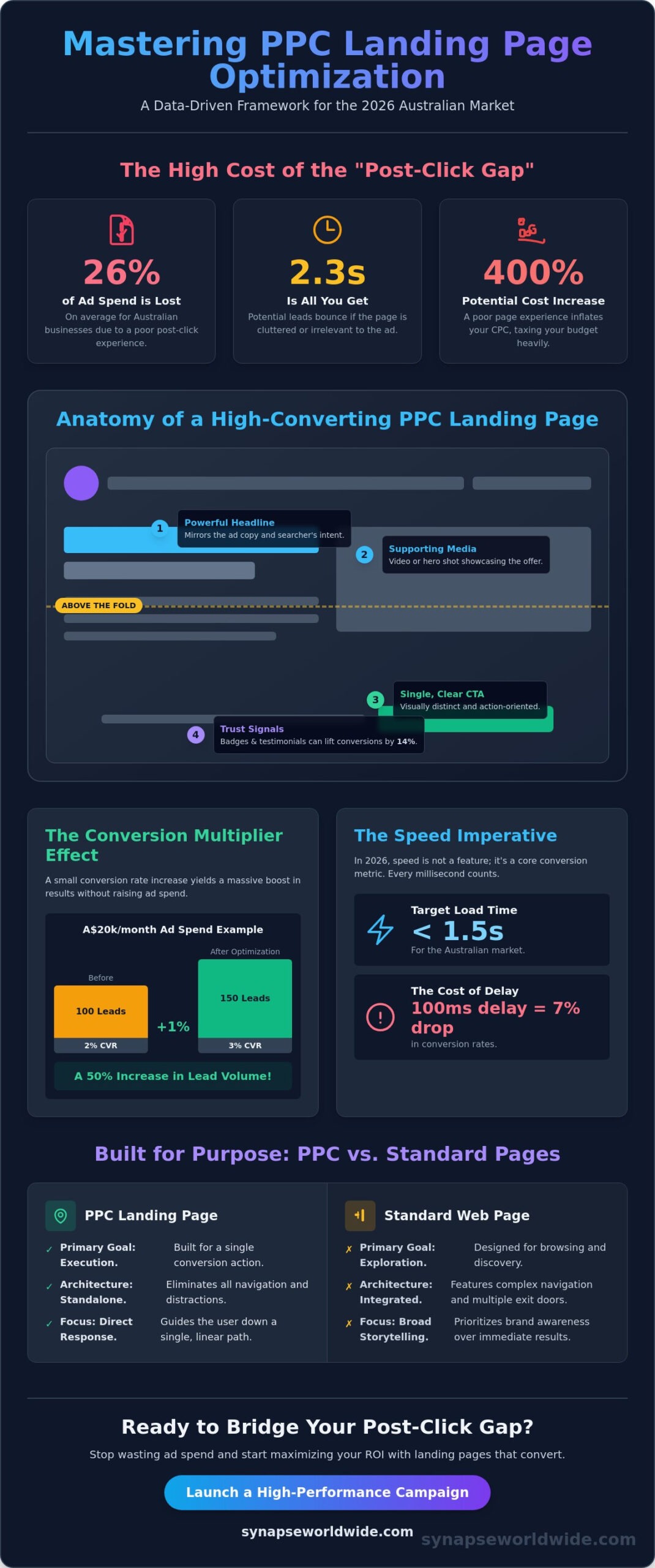
PPC landing page optimization is the strategic process of refining a post-click destination to ensure every dollar of your Australian ad spend translates into measurable growth. It’s the bridge between a user’s intent and your business’s bottom line. While high-performing ads grab attention, they only fulfill half the promise. The “Post-Click Gap” occurs when a sophisticated ad campaign directs traffic to a generic or cluttered page, causing potential leads to bounce within 2.3 seconds of arrival. Without a bespoke destination, even the most expensive Google Ads campaigns fail to deliver a positive return on investment.
The 2026 digital landscape demands more than static templates. We’ve entered an era of dynamic, intent-based experiences where 74% of users expect content to adapt to their specific search context. Understanding what is a landing page in a modern context means recognising it as a high-performance tool designed for a single conversion goal rather than a general information hub.
Optimization also dictates your overhead costs through the Quality Score. Google rewards relevance; a page that aligns perfectly with your keywords can reduce your Cost Per Click (CPC) by up to 50%. Conversely, a poor landing page experience can inflate your costs by 400%, effectively taxing your business for providing a poor user experience. Strategic refinement ensures your digital presence is both scalable and cost-efficient.
The Financial Impact of Optimization
Precision in ppc landing page optimization creates a compounding effect on your revenue. If you’re spending A$20,000 per month on traffic with a 2% conversion rate, a modest 1% increase in conversion doesn’t just add one percent to your results; it boosts your lead volume by 50% without increasing your ad spend by a single cent. This efficiency protects your budget during periods of market volatility in the Australian sector. Conversion scent is the seamless alignment of the visual and textual promises made in an ad with the immediate reality of the landing page.
PPC Pages vs. Standard Web Pages
Standard web pages are built for exploration, but PPC pages are built for execution. The “One Goal” rule is non-negotiable here. While your main website likely features a complex navigation menu, these links are conversion killers on a landing page, providing too many “exit doors” for the user. We utilise standalone architecture rather than integrated site subfolders to eliminate distractions. Our design priorities focus on direct response, using a robust hierarchy of information that guides the user toward a single call to action, whereas brand awareness pages often prioritise broad storytelling over immediate results.
The Anatomy of a High-Converting PPC Landing Page
High-performance ppc landing page optimization isn’t about aesthetics alone; it’s about engineering a path of least resistance. In 2026, the “above the fold” space remains the most critical real estate. You have less than two seconds to establish relevance. Your headline must mirror the searcher’s intent, supported by a sub-headline that clarifies the value proposition. The primary Call to Action (CTA) needs to be visually distinct, using contrasting colours that stand out against the brand palette. Successful campaigns often align with established PPC landing page best practices to ensure the transition from ad to page feels seamless and credible.
Visual hierarchy dictates where a user’s attention goes first. Most visitors scan in an F-pattern, focusing on the top and left sides of the screen. We position key benefits and trust signals along these natural eye paths. Integrating social proof, such as Australian business certifications or security badges like Norton or McAfee, builds immediate rapport. Data from 2024 indicates that pages featuring visible trust signals see a 14% uplift in conversion rates compared to those without. Technical standards have also shifted; 2026 requires sub-second load times. Google’s Core Web Vitals are no longer just SEO metrics; they are conversion metrics. A delay of just 100 milliseconds can drop conversion rates by 7%.
Psychological Triggers in Design
Effective design leverages human psychology to drive action. We use scarcity and urgency by highlighting limited-time A$500 vouchers or “3 spots remaining” for a consultation. This works best when it’s authentic rather than “spammy.” Our copy focuses on “Benefit-First” structures, telling the user what they gain rather than listing dry technical features. The Rule of One dictates that a single landing page must address one specific audience with one clear offer to achieve one singular goal. This clarity eliminates decision paralysis and focuses the user on the conversion.
Mobile-First Optimization
By 2026, mobile devices account for over 75% of high-intent PPC traffic in Australia. A “responsive” design is the bare minimum; true ppc landing page optimization requires a mobile-first architecture. This means placing CTAs within the natural “thumb zone” and simplifying forms to three fields or fewer. We reduce visual clutter by hiding non-essential elements on smaller screens, ensuring the user stays focused on the primary offer. Our strategic approach at Synapse Worldwide ensures these mobile experiences are bespoke and built for speed, turning clicks into clients with surgical precision.
Lead Gen vs. E-commerce: Choosing Your Strategy
Strategic ppc landing page optimization requires a fundamental understanding of your conversion architecture. You shouldn’t apply a retail “Buy Now” mindset to a complex B2B service. Within the Australian market, the distinction between lead generation and direct sales dictates every design choice from the headline to the backend integration. Successful campaigns focus on the specific psychology of the local consumer, who values transparency and efficiency above all else.
Lead generation thrives on a balanced value exchange. If you’re asking for a phone number, you must provide something of equal weight, such as a bespoke whitepaper or a technical consultation. For B2B enterprise clients, the priority shifts toward lead qualification. Using multi-step forms allows you to filter out low-intent traffic. This ensures your sales team focuses on prospects with a high lifetime value, which often exceeds A$100,000 for local industrial or professional service providers.
E-commerce strategies focus on removing every possible barrier between the initial click and the final checkout. Reducing friction is the primary goal. While templates provide a quick start, high-growth brands often pivot to bespoke, custom-coded infrastructure. This investment ensures your site remains scalable and handles peak traffic during major events like Click Frenzy or Black Friday without performance degradation. Custom solutions also allow for deeper integration with Australian logistics and payment gateways.
Lead Capture Frameworks
Modern lead capture relies on the “Minimum Viable Data” principle. Conversion rates typically drop by 11% for every additional form field beyond the essential three. To combat this, we use progressive profiling to build lead depth over multiple interactions. This approach keeps the initial friction low while gathering critical intelligence over time. Multi-step funnels consistently outperform single-step forms by 86% because they reduce the cognitive load on the user by breaking questions into logical bites.
- Single-step: Best for low-friction offers like newsletter signups or quick price guides.
- Multi-step: Essential for qualifying high-ticket B2B leads where budget and authority must be confirmed.
- Progressive Profiling: Uses smart fields to ask different questions on subsequent visits, building a robust profile.
Direct Sales Frameworks
Direct sales pages must act as a virtual closer. Integrating dynamic pricing and real-time stock levels creates a sense of urgency that drives immediate action. For Australian retailers, implementing “One-Click” checkout options like Apple Pay or Shop Pay is a requirement for effective ppc landing page optimization. These tools bypass traditional form-filling, which accounts for a 35% increase in mobile conversion rates according to 2024 industry benchmarks.
Strategic cross-selling within the flow can increase average order value by 15% without increasing your acquisition cost. Consider these elements:
- Dynamic Scarcity: Show live stock counts to trigger immediate purchases based on real-time inventory.
- Integrated Payments: Leverage digital wallets to facilitate instant transactions on mobile devices.
- Post-Purchase Upsells: Offer complementary products immediately after the initial conversion to maximise revenue.
The 2026 PPC Landing Page Optimization Checklist
Precision defines the 2026 digital landscape. When you’re paying for every click, every millisecond and every word carries a tangible financial weight. This checklist ensures your ppc landing page optimization strategy is robust, scalable, and built for high-performance conversion. We don’t settle for “good enough” when your return on investment is at stake.
- Message Match: Does your H1 exactly mirror the ad copy that drove the click? If your Google Ad promises “Bespoke Software Development in Sydney,” your landing page shouldn’t pivot to generic IT services. Disconnect leads to instant abandonment.
- Technical Audit: Speed is a conversion killer. Your page must load in under 1.5 seconds on a standard Australian 4G connection. Use server-side rendering and optimized assets to meet this benchmark.
- Friction Check: Remove the navigation bar and all external links. Your landing page is a closed environment designed for a single action. Don’t give your prospects an exit ramp before they’ve converted.
- Social Proof: Trust is earned through evidence. Include at least three verifiable testimonials or direct links to case studies. In the Australian market, local business validation often outweighs global generic praise.
- Accessibility: Inclusive design is a legal and ethical standard. Ensure your page meets WCAG 2.2 standards. This opens your services to the 18% of Australians living with a disability, ensuring no potential lead is left behind.
Copywriting and Messaging Audit
Your copy needs to be a silent salesman. Verify that every paragraph answers the prospect’s internal question: “What’s in it for me?” Use active voice and strong, action-oriented verbs in your CTAs. Instead of “Submit,” try “Claim Your Free Audit” or “Start Your Growth Phase.” Your unique value proposition (UVP) must be visible and understood within 3 seconds of the page loading. If a user has to scroll to find out why you’re the best choice, you’ve already lost them.
Conversion Tracking and Data Integrity
Data-driven decisions require flawless data collection. Verify your Google Tag Manager (GTM) setup and implement server-side tracking to bypass browser-based privacy restrictions. Test every form submission and ensure “Thank You” pages redirect correctly to trigger conversion events. We recommend implementing heatmaps, such as Microsoft Clarity, to observe user behaviour. If 60% of your users are dropping off at a specific form field, that’s a friction point that requires immediate refinement.
Success in digital advertising requires more than just high-quality traffic; it requires a destination that converts. If your current pages aren’t hitting these benchmarks, it’s time to audit your conversion funnel with a team that prioritizes results over fluff.
Beyond the Click: Integrating with CRM and ERP
A conversion on your landing page isn’t the finish line; it’s the starting gun for your sales process. High-performance ppc landing page optimization requires a seamless bridge between the front-end user experience and your back-end operations. If your leads sit in an email inbox for three hours before being processed, you’ve already lost the momentum. We focus on real-time data synchronization. This ensures every form submission triggers an immediate entry into your CRM or ERP system, allowing your team to strike while the intent is highest.
Closed-loop reporting changes the game for Australian enterprises. Instead of merely measuring a 5% conversion rate, you’re identifying which specific keywords and landing pages generated A$100,000 in actual settled revenue. This transparency allows for aggressive, data-backed scaling. The Synapse Approach involves building bespoke integration layers. These aren’t generic, fragile plugins. They’re robust systems designed for enterprise-level scalability, ensuring your tech stack grows alongside your ambitious revenue targets. Pairing this with professional ppc management services ensures your entire paid search architecture is optimised from the first click through to final revenue attribution.
- Eliminate manual entry: Automated lead flow reduces human error and ensures 100% lead capture.
- Revenue attribution: Connect digital clicks to offline sales for a true ROI calculation.
- Operational efficiency: Sync marketing data with ERP systems to manage inventory or service capacity in real-time.
The Power of Marketing Automation
Speed defines success. Immediate auto-responders keep your brand at the forefront of a prospect’s mind. Beyond the initial contact, your CRM data should act as a feedback loop. By analyzing which leads turn into high-value clients, we can refine your ppc landing page optimization strategy. This creates a cycle of continuous improvement. Effective CRM Integration allows your marketing team to see the full picture, from the first click to the final invoice. Recent 2025 benchmarks indicate that Australian firms using integrated CRM data see a 23% higher ROI on their ad spend compared to those with siloed systems.
Future-Proofing Your PPC Strategy
As we move through 2026, the reliance on third-party cookies has vanished. Success now depends on your ability to collect and leverage first-party data. Your landing pages must serve as sophisticated data collection points that respect privacy while gathering actionable insights. We use AI to generate dynamic page variations at scale, tailoring the experience to the user’s specific industry or intent. Understanding how your paid search efforts complement your broader channel mix — including the Google Ads vs social ads strategic comparison — is essential for building a cohesive, future-ready digital architecture. To ensure your digital infrastructure is ready for these shifts, you can Contact Synapse Worldwide for a Strategic PPC Audit. We’ll help you build a digital architecture that isn’t just ready for the future, but actively shapes it.
Future-Proof Your Conversion Engine
Success in 2026 requires a shift from static design to dynamic, integrated experiences. You’ve seen how the right structural anatomy and deep CRM integration turn a standard click into a long-term asset. By applying this checklist, you ensure your digital presence isn’t just visible but authoritative and highly efficient. Mastering ppc landing page optimization means staying ahead of evolving user expectations while maintaining technical precision across your entire marketing funnel.
Don’t leave your growth to chance in an increasingly competitive Australian market. Synapse Worldwide brings over 20 years of digital engineering expertise to every project. As specialists in CRM and ERP marketing integrations, we provide the authoritative, Australian-based strategic consulting your brand needs to scale. It’s time to move beyond the click and build a robust foundation for your future success.
Maximize your ad spend with a bespoke PPC strategy from Synapse Worldwide
Your journey toward digital transformation starts with a single, strategic step. We’re ready to help you reach that next level of business excellence.
Frequently Asked Questions
How long should a PPC landing page be?
The length of your page should reflect the complexity of your offer and the price point of your service. For simple lead captures, a concise layout often performs best. Complex Australian B2B services costing over A$5,000 typically require longer pages with 800 words to establish trust. Data shows that pages with fewer than 200 words can increase conversion rates by 15% for low-friction offers.
Can I use my homepage as a PPC landing page?
You shouldn’t use your homepage for paid traffic because it lacks a singular focus. Homepages contain multiple navigation paths that distract users from the primary goal. Dedicated ppc landing page optimization ensures your message matches the ad exactly. Statistics show that using a tailored landing page instead of a homepage can boost conversions by 25% for Australian retail campaigns.
What is a good conversion rate for a PPC landing page in 2026?
A strong conversion rate in 2026 sits between 5% and 10% for competitive Australian sectors. While historical medians hover near 2.35%, top-tier campaigns now leverage AI-driven personalisation to exceed 12%. You’ve got to benchmark against current local industry data. Recent 2025 reports show that Australian professional services often outperform retail in lead generation efficiency.
How many CTAs should I have on one page?
Your page should feature one primary call to action (CTA) to avoid decision paralysis. While you can place multiple buttons throughout the layout, they must all lead to the same conversion goal. Research from VWO indicates that pages with a single focused offer achieve a 16% higher conversion rate than those with multiple competing offers. Stick to one clear objective to maintain a seamless user journey.
Does landing page speed affect my Google Ads Quality Score?
Page speed is a critical component of your Google Ads Quality Score and directly impacts your cost per click. Google’s core web vitals data shows that a load time increase from one to three seconds raises bounce probability by 32%. Fast pages improve your Quality Score, which lowers your auction prices in the Australian digital landscape. We prioritise technical performance to ensure your budget isn’t wasted on bounces.
What is the difference between A/B testing and multivariate testing?
A/B testing compares two distinct versions of a page, while multivariate testing (MVT) analyzes how multiple variables interact on a single page. Use A/B testing for major structural changes like a new headline or layout. MVT is better for refining smaller elements like button colours or image placements simultaneously. This data-driven approach is essential for effective ppc landing page optimization and long-term growth.
How often should I update or optimize my landing pages?
You should review your performance data weekly and implement structural updates at least every 90 days. Markets shift rapidly, and what worked in 2025 might not resonate now. Companies that test their landing pages at least once a month are 50% more likely to see a significant increase in sales. Continuous refinement ensures your digital presence remains scalable and competitive against local rivals.
Should I use video on my PPC landing page?
Including a video can be a powerful way to build immediate rapport and explain complex value propositions. EyeView Digital reports that using video on a landing page can increase conversion rates by 80%. Ensure the video is high-quality and includes a transcript for accessibility. It’s a strategic tool for Australian brands looking to humanise their digital presence and drive ambitious growth.

