Tag Archives: Conversion Optimization


How to Reduce Customer Acquisition Cost: A Strategic Architecture for 2026

With Meta CPMs climbing 20 percent in the last year and B2B tech acquisition costs surging up to 60 percent since 2023, the era of buying growth through brute force is over. Learning how to reduce customer acquisition cost in 2026 requires shifting your perspective from tactical tweaks to architectural excellence. You’ve likely noticed that even high-performing PPC campaigns struggle against media inflation and fragmented data silos. It’s frustrating to watch margins shrink while conversion funnels leak leads at every stage.

This guide will show you how to master the structural and technical strategies required to lower your CAC and build a high-performance growth engine that prioritizes efficiency. We’ll explore how unifying your data ecosystem through CRM and ERP integration, optimizing for organic SEO, and leveraging AI-driven creative can hedge your business against rising costs. By the end, you’ll have a blueprint to transform your digital presence into a sustainable, conversion-heavy asset that delivers a reliable return on investment.

Key Takeaways

  • Transition from simple ad-spend calculations to a sophisticated architectural model that reflects the reality of 2026’s complex attribution windows.
  • Learn how to reduce customer acquisition cost by aligning your technical infrastructure with user intent to drive higher conversion efficiency.
  • Eliminate the hidden costs of fragmented data by integrating CRM and ERP systems to automate lead qualification and maximize sales team productivity.
  • Establish a long-term hedge against media inflation by building a strategic content foundation that captures organic demand without recurring ad spend.
  • Prioritize custom-built digital solutions over rigid, off-the-shelf software to ensure your growth strategy remains scalable and uniquely competitive.

Defining Customer Acquisition Cost in the 2026 Digital Economy

The math behind business growth has shifted from simple arithmetic to complex digital architecture. In previous years, marketers often relied on a basic division of ad spend by new customers. This narrow view is now a liability. Understanding how to reduce customer acquisition cost in 2026 requires a formula that accounts for privacy-first tracking, long attribution windows, and the rising cost of human capital. Traditional “ad-spend only” calculations lead to strategic failure because they ignore the technical infrastructure and data integration required to convert a modern lead. Relying on outdated metrics means you’re flying blind in a market where Meta CPMs have climbed 20 percent and Google Search CPCs average $4.22 across all industries.

A sophisticated approach to Defining Customer Acquisition Cost must incorporate every touchpoint in the funnel. For instance, the median B2B SaaS CAC for sales-led models has reached $11,400, while enterprise fintech acquisition can climb as high as $14,772. These figures aren’t just reflecting higher ad prices; they represent the total cost of the ecosystem. When your CAC exceeds healthy benchmarks, it’s often a signal of a structural flaw, such as a leaky conversion funnel or fragmented data, rather than just a market trend.

The Blended CAC Revolution

Success in 2026 demands a shift toward blended CAC, which integrates both paid and organic acquisition channels into a single efficiency metric. You must evaluate this against your Customer Lifetime Value (LTV) to ensure sustainability. A healthy LTV to CAC ratio remains at least 3:1. If you only track paid channels, you miss the cost-averaging benefits of SEO and organic social media. High-performance brands use these organic pillars to hedge against paid media inflation, ensuring that the total cost to acquire a customer remains manageable even as platform competition intensifies. This transition from transactional metrics to relationship-based acquisition is essential for long-term stability.

External Factors Driving Costs Upward

Privacy regulations have fundamentally altered the acquisition landscape. With new state privacy laws in Indiana, Kentucky, and Rhode Island, and expanded CCPA regulations in California, targeting has become less precise and more expensive. The death of third-party cookies means your digital infrastructure must work harder to capture first-party data through CRM integration and custom web design. Ad platform saturation has made standard PPC tactics less effective, leading to diminishing returns for those who don’t innovate. In 2026, Customer Acquisition Cost serves as a comprehensive diagnostic of your digital ecosystem’s total operational efficiency.

Optimizing Digital Infrastructure for Conversion Efficiency

Your digital infrastructure is the silent engine of your growth strategy. When business leaders ask how to reduce customer acquisition cost, they often look first at ad copy or bidding strategies. However, the most significant gains are found in the technical architecture that greets your visitors. A visionary architect understands that every pixel must serve a purpose beyond aesthetics. If your website lacks a strategic foundation, you’re essentially paying a high premium to drive traffic into a leaky bucket. Integrating custom web design for small business allows you to build a system where every interaction is engineered to move the prospect closer to a transaction.

Technical performance directly correlates to your cost per lead. When you’re calculating customer acquisition cost, you must account for the friction points that cause potential customers to drop off. Modern ad platforms, including Meta and Google, reward high-performance destinations with better quality scores and lower CPMs. By designing for intent rather than just visual appeal, you ensure that your paid media spend isn’t wasted on a bounce. A well-optimized site doesn’t just look professional; it functions as a high-performance conversion tool that justifies your marketing investment.

Performance Engineering as a Cost Reducer

Millisecond load times are no longer a luxury. In 2026, page speed is a primary driver of ad quality scores and organic rankings. Mobile-first architecture is mandatory to prevent bounced ad spend, as the majority of users interact with brands via smartphones. Technical debt acts as a hidden tax on your acquisition efforts. It slows down updates, creates bugs, and ultimately frustrates users. By addressing these technical foundations, you remove the barriers that prevent a 7.04 percent conversion rate from becoming your reality. Investing in Custom Web Design ensures your paid traffic lands on a foundation built for profit.

High-Conversion E-commerce Frameworks

With the median E-commerce CAC sitting at $87, every lost sale is a significant financial blow. You can structurally reduce cart abandonment by streamlining checkout logic and removing unnecessary fields. Custom product page architecture should prioritize trust signals and technical security to build conversion confidence. When users feel secure and the path to purchase is frictionless, your “Add to Cart” rates will naturally climb. This architectural approach transforms your e-commerce site into a scalable growth engine that maximizes the value of every single visitor.

Leveraging CRM and ERP Integration to Minimise Waste

Fragmented data is the silent killer of marketing ROI. When your marketing platforms don’t communicate with your sales and operational systems, you create a structural gap that inflates your spending. Identifying the precise point of friction in your sales funnel is the first step toward understanding how to reduce customer acquisition cost through data transparency. By closing the loop between a lead’s first click and their final invoice, you gain the visibility required to cut waste and double down on what actually converts. Professional ppc management services now rely on this real-time CRM synchronization to optimize bidding strategies based on actual revenue rather than just vanity metrics like clicks or impressions.

Operational data from an ERP system provides a strategic advantage that most competitors overlook. This integration allows you to identify your highest-value customer profiles by analyzing post-purchase behavior and long-term profitability. Instead of casting a wide, expensive net, you can use these insights to refine your targeting and focus your budget on prospects with the highest predicted lifetime value. This architectural approach ensures that every dollar spent is an investment in a high-performance growth engine rather than a shot in the dark.

The Power of Unified Data Ecosystems

A unified data ecosystem eliminates the “dead-end” leads that drain your sales team’s time and energy. Through automated CRM workflows, you can disqualify prospects who don’t meet your criteria before they ever reach a human representative. Furthermore, connecting your ERP to your digital storefront prevents the ultimate waste of ad spend: promoting out-of-stock items. When your inventory and pricing sync in real time with your ad platforms, you ensure a seamless user experience that preserves your brand’s reliability. This single source of truth aligns your marketing and sales teams, allowing them to work as proactive partners in your business’s transformation.

Marketing Automation: Beyond the Email

Modern automation leverages actual customer behavior data to drive dynamic retargeting. Instead of sending generic follow-ups, your system can trigger specific content based on the exact product a user viewed or the technical whitepaper they downloaded. Lead scoring models further enhance this efficiency by automatically prioritizing high-intent prospects for immediate sales intervention. By automating initial touchpoints and lead nurturing, CRM integration significantly lowers the labor costs associated with manual human follow-up. This level of connectivity ensures that no lead is forgotten and every high-intent prospect is handled with the urgency they require to convert.

Strategic Organic Growth: The Long-Term CAC Hedge

Organic growth isn’t just a side project; it’s a strategic hedge against the volatility of auction-based platforms. When you’re looking at how to reduce customer acquisition cost, you must view SEO as an investment in an appreciating asset rather than a recurring expense. Unlike PPC, where the flow of leads stops the moment you pause your budget, organic visibility provides a compounding return that lowers your blended CAC over time. By building a “Content Fortress,” you capture high-intent prospects at the top of the funnel before they become expensive targets for your competitors’ retargeting ads. This architectural approach ensures your brand is the first point of contact, establishing trust long before the transaction occurs.

Implementing a comprehensive seo for small business strategy allows you to transition from buying attention to earning authority. This shift is critical as platform saturation continues to drive up the cost of every click. Learning how to reduce customer acquisition cost through organic channels is about more than just traffic; it’s about building long-term equity. By focusing on high-value keywords that align with your CRM data, you ensure that your organic efforts attract the same high-performance customer profiles you target with your paid campaigns.

Content as a Conversion Multiplier

Educational content serves as a powerful pre-qualification layer for your sales funnel. By addressing common pain points and technical questions through deep-dive articles and guides, you filter out low-intent traffic before it drains your resources. This reduces the “time-to-close” because prospects arrive at the sales stage already informed and convinced of your expertise. Technical SEO plays a vital role here by ensuring your site architecture is crawlable and fast, which directly impacts your ability to maintain high-performance visibility. Mapping your content to the specific stages of the 2026 buyer journey ensures you remain relevant from initial discovery to final decision.

Authority Building and Brand Equity

Strong brand recognition creates a “halo effect” across all marketing channels. When users recognize your brand in organic search results, your Click-Through Rate (CTR) naturally improves. This authority also translates to your paid efforts; ad platforms often reward recognized, high-relevance brands with higher quality scores and lower CPCs. This synergy means that a dollar spent on SEO eventually makes your PPC spend more efficient. Over the long term, organic visibility builds a level of trust that paid media simply can’t replicate. Measuring this cross-channel impact is essential for a complete understanding of your digital strategy’s return on investment.

Build a sustainable foundation for growth today. Explore our custom SEO solutions to start earning your market share.

Designing a Scalable Growth Framework with Synapse Worldwide

Sustainable growth requires more than just a talented marketing team. It demands a robust digital foundation that aligns your technical capabilities with your commercial objectives. At Synapse Worldwide, we’ve refined a methodology that treats your digital presence as a cohesive ecosystem rather than a collection of separate silos. By auditing your infrastructure and integrating your systems, we provide the clarity needed to understand how to reduce customer acquisition cost permanently. This strategic digital transformation replaces short-term tactical fixes with a scalable framework built for the complexities of 2026.

Custom-built solutions consistently outperform off-the-shelf software because they are engineered to solve your specific business challenges. Generic templates and rigid platforms often introduce unnecessary friction, leading to the “leaky bucket” effect. Whether through custom web design or specialized e-commerce development, our focus remains on maximizing efficiency. We don’t just aim for clicks; we design for high-performance ROI. Our commitment to evidence-based claims ensures that every architectural shift we recommend is grounded in measurable data and transparent results, helping you reach the next level of business success.

The Architecture of Success

High-level strategy is only as effective as its technical implementation. We specialize in custom web applications designed specifically for operational efficiency, ensuring your site can handle high-performance conversion rates without the burden of technical debt. Our enterprise-grade CRM and ERP integrations are tailored to your unique workflows, eliminating the manual errors that drain your budget. This level of customization helps businesses strive for the ideal 12 to 18 month CAC payback period. This strategic consulting bridges the gap between sophisticated technology and ambitious growth.

Your Next Steps Toward a Lower CAC

The first step toward optimizing your acquisition engine is identifying where your current strategy is failing. A comprehensive digital audit reveals the structural leaks and data silos that are currently inflating your costs. You need a partner that understands both the visionary “big picture” and the intricate technical details of execution. By collaborating with experts who manage everything from SEO to complex system integrations, you ensure your digital presence is in expert hands. This is how to reduce customer acquisition cost while building a long-term partnership geared toward consistent return on investment.

Partner with Synapse Worldwide for a Strategic Growth Framework and transform your acquisition strategy into a high-performance asset.

Future-Proofing Your Acquisition Strategy

Navigating the complexities of the 2026 digital economy requires a shift from reactive spending to proactive architecture. You’ve seen that true efficiency stems from a unified data ecosystem where CRM and ERP integrations eliminate waste and technical performance drives conversion. Mastering how to reduce customer acquisition cost is ultimately about building a resilient engine that balances high-performance paid media with the compounding value of organic authority. By treating your digital presence as a strategic asset rather than a marketing expense, you position your brand for sustainable, long-term profitability.

Since 2005, Synapse Worldwide has provided the visionary leadership and technical discipline required to transform digital strategies into measurable success. With over two decades of expertise, our team specializes in high-value custom CRM and ERP integrations that bridge the gap between complex technology and business growth. We’re committed to delivering a results-oriented approach that prioritizes your return on investment and long-term stability. Your journey toward a more efficient, scalable future begins with a partner who understands the intricate details of digital transformation.

Scale Your Business with Synapse Worldwide’s Strategic Growth Architecture. Let’s reach the next level of business success together.

Frequently Asked Questions

What is a good target for Customer Acquisition Cost in 2026?

A sustainable target is defined by a Lifetime Value to CAC ratio of at least 3:1. While benchmarks vary, such as the $87 median for e-commerce or $11,400 for sales-led B2B SaaS models, your specific goal should focus on a payback period of 12 to 18 months. This ensures your acquisition strategy fuels long-term profitability rather than just driving short-term volume at the expense of your margins.

Can custom web design really lower my advertising costs?

Custom web design directly lowers advertising costs by improving conversion rates and ad quality scores. When your site architecture is engineered for speed and user intent, platforms like Google and Meta reward you with lower CPMs and CPCs. High-performance landing pages reduce the bounce rates that otherwise waste your paid media budget, ensuring that a higher percentage of your paid clicks turn into paying customers.

How does CRM integration help reduce marketing waste?

CRM integration reduces waste by providing a single source of truth that connects marketing spend to actual sales revenue. By automating lead qualification and scoring, you prevent your sales team from chasing “dead-end” leads that don’t meet your criteria. This transparency allows you to identify how to reduce customer acquisition cost by reallocating budget from underperforming segments to the high-value customer profiles identified in your database.

Why is my CAC increasing even though my ad campaigns are optimized?

Rising acquisition costs are often driven by external factors like media inflation and stricter privacy regulations. Meta CPMs have increased by 20 percent in 2026, and new state privacy laws make targeting more complex. If your campaigns are optimized but costs still climb, the issue is likely structural. Fragmented data or a generic user experience can’t compete in a saturated market where the baseline cost of attention is rising.

Is it better to focus on SEO or PPC for lowering CAC?

The most effective strategy uses SEO as a long-term hedge against PPC inflation. While PPC offers immediate scaling, SEO acts as an appreciating asset that lowers your blended customer acquisition cost over time. Integrating both ensures you capture high-intent traffic through organic authority while maintaining the precision of paid search. This balanced approach creates a high-performance growth engine that isn’t entirely dependent on rising auction prices.

What is the difference between CAC and CPA (Cost Per Acquisition)?

CAC measures the total cost of marketing and sales required to acquire a paying customer, while CPA typically tracks the cost of a specific action like a lead or sign-up. Understanding how to reduce customer acquisition cost requires looking at the entire ecosystem, including sales labor and technical overhead. CPA is a tactical campaign metric used for optimization; CAC is a holistic business efficiency metric used for strategic planning.

How long does it take to see a reduction in CAC after technical optimization?

You can see improvements in ad quality scores and conversion rates within weeks of technical optimizations like speed enhancements and UI refinements. However, a significant reduction in blended CAC usually takes three to six months as your CRM data matures and SEO authority builds. This timeline allows your new digital architecture to fully integrate and begin cost-averaging your more expensive paid channels through improved organic performance.


Mobile Responsive Web Design: The Strategic Guide for Business Growth in 2026

Mobile Responsive Web Design: The Strategic Guide for Business Growth in 2026

As of July 1, 2026, Google will entirely remove websites from its index if they lack a functional mobile version. This isn’t a mere ranking penalty; it’s a total exclusion from the digital marketplace. You likely recognize the urgency as mobile devices now command 52.8% of all global web traffic. It’s exhausting to watch high bounce rates climb while your competitors capture the smartphone audience you’ve worked hard to build. You need a digital foundation rooted in mobile responsive web design that commands respect on every screen size without getting lost in technical jargon.

Implementing a sophisticated mobile responsive web design transforms your digital infrastructure into a high-performance engine for user engagement and conversion. This guide provides the strategic roadmap to align your site with the CSS Snapshot 2026 standards and Google’s strict indexing requirements. We’ll explore how to optimize Core Web Vitals, ensure content parity, and reduce mobile cart abandonment rates that currently peak at 85.65% for many industries. You’ll gain the clarity needed to turn your website into a reliable asset for long-term business growth and reach the next level of digital success.

Key Takeaways

  • Adopt the “one site, every device” philosophy to streamline your digital presence. It’s the most efficient way to ensure a consistent brand experience across all platforms.
  • Discover how mobile responsive web design directly influences your SEO visibility and keeps bounce rates low.
  • Identify the critical differences between responsive, adaptive, and mobile-friendly layouts to avoid costly development mistakes.
  • Learn to use fluid grids and flexible images to maintain high-performance load speeds on any connection.
  • Implement a mobile-first strategy by auditing your performance and refining your content hierarchy for maximum conversion.

What is Mobile Responsive Web Design?

At its core, mobile responsive web design is an architectural approach where a single digital infrastructure adapts its layout, content, and functionality to any screen size. This “One Site, Every Device” philosophy eliminates the need for redundant subdomains or separate mobile applications. It ensures your brand maintains a singular, authoritative presence across the web. In 2026, this strategy is no longer optional. Google’s recent policy shift mandates that as of July 1, 2026, any website lacking a functional mobile version will be entirely excluded from search results. This makes responsiveness the primary gatekeeper for your business’s online visibility.

Modern standards defined by the CSS Snapshot 2026 require more than just making elements “fit” on a screen. High-performance design now integrates the viewport meta tag to instruct browsers on how to scale content correctly. This technical directive allows your site to render accurately across the diverse resolutions of 2026, from foldable devices to high-definition desktop monitors. By prioritizing this foundational layer, you protect your search rankings and provide a stable platform for growth.

The Evolution from Desktop-First to Mobile-First

The digital landscape has moved far beyond the era of “m.” sites. These separate mobile versions often failed because they lacked content parity and created fragmented user experiences. Australian businesses that once viewed mobile as a secondary concern now face a reality where 52.8% of global traffic originates from handheld devices. Users in 2026 demand desktop-level functionality on their smartphones. They expect fast load times and full access to every feature, making a unified Responsive Web Design (RWD) strategy essential for retaining high-value leads.

Core Characteristics of Responsive Architecture

Implementing a professional mobile responsive web design involves three pillars that ensure your digital presence is both flexible and resilient. These components work together to provide a seamless experience regardless of the hardware used by your visitors.

  • Fluidity: Content must act like water, flowing naturally into different container sizes without breaking the layout or requiring horizontal scrolling.
  • Intelligent Reflow: This involves more than just shrinking images. It requires a strategic reordering of elements so that the most critical business information remains at the top of the visual hierarchy on smaller screens.
  • Touch-Ready Interfaces: Mouse cursors are precise, but thumbs are not. Modern architecture prioritizes larger tap targets and intuitive gestures to accommodate the tactile nature of mobile browsing.

The Strategic Business Value of Responsive Design

Investing in mobile responsive web design is a high-level strategic decision that directly impacts your bottom line. It’s not merely a technical requirement; it’s a commitment to your digital infrastructure’s performance and reliability. By ensuring your site functions flawlessly across all devices, you eliminate the friction that causes potential clients to abandon their journey. A cohesive mobile experience builds immediate brand trust, positioning your business as a sophisticated and capable partner in an increasingly competitive global market. Using a single URL for all marketing campaigns also streamlines your tracking and management, ensuring your custom web design for small business delivers a consistent message regardless of how it’s accessed.

SEO and the Mobile-First Indexing Era

Google’s evaluation of your digital presence is now entirely dependent on your mobile version. Since mobile-first indexing is the absolute standard in 2026, Google treats your smartphone-optimized site as the primary version for ranking and indexing. This shift means that poor mobile performance will degrade your visibility even for desktop searches. To maintain a competitive edge, your site must excel in Core Web Vitals, specifically targeting metrics like Interaction to Next Paint (INP) and Largest Contentful Paint (LCP). A robust mobile responsive web design provides the stable foundation necessary for a successful SEO architecture. By Implementing a Mobile-First Strategy, you ensure that search engines can crawl and index your content with maximum efficiency.

Conversion Rate Optimization (CRO) on Mobile

There is a significant performance gap between mobile and desktop conversion rates that businesses must bridge. Statistics from April 2026 show mobile conversion rates averaging around 1.82%, compared to 3.14% on desktop. This discrepancy is often due to checkout friction and poor layout hierarchy. High mobile cart abandonment rates, which reached 85.65% in early 2026, are frequently the result of non-responsive elements that frustrate users. Responsive architecture solves this by prioritizing essential content and simplifying the path to purchase. When elements stack and reorder intelligently, you guide the user toward a conversion with minimal effort. This results-oriented approach transforms your website from a static brochure into a proactive lead-generation tool. If you’re looking to capture this lost revenue, our team can help you build a high-performance Custom Web Design solution tailored to your growth objectives.

Mobile Responsive Web Design: The Strategic Guide for Business Growth in 2026

Key Components: Fluid Grids, Flexible Images, and Media Queries

Building a resilient mobile responsive web design requires a shift from rigid, fixed-pixel layouts to a fluid architectural framework. In the past, designers built for a standard 1920×1080 desktop resolution. Today, your site must accommodate a fragmented landscape of devices, including the 11.28% of mobile users on 1080×2400 displays. Fluid grids achieve this by using proportional percentages rather than fixed units. This ensures that every element on the page scales harmoniously, preventing the awkward horizontal scrolling that drives users away. It’s about creating a container that adjusts to the user’s environment rather than forcing the user to adapt to your design.

Media queries act as the strategic brain of your website. These instructions, defined by the CSS Snapshot 2026, detect the user’s device capabilities and apply specific styling rules accordingly. By setting precise breakpoints, you create a seamless transition between a large desktop monitor and a handheld smartphone. This technical precision ensures that your brand’s digital presence remains professional and functional, regardless of the hardware your client chooses to use. It’s a disciplined approach that guarantees your content is always presented in its most readable and accessible format.

Modern Layout Tools: Flexbox and CSS Grid

The arrival of advanced CSS modules has revolutionized how we structure digital content. Flexbox is the ideal tool for one-dimensional layouts, such as navigation bars and centered call-to-action buttons. For more complex, two-dimensional page architectures, CSS Grid provides the discipline needed to manage intricate layouts without sacrificing speed. These tools are essential for meeting website UX best practices, as they allow for content to be reordered based on priority. On a smartphone, your most important lead-generation elements should always be the first things a user sees.

Optimising Media for Performance

Flexible images are a non-negotiable component of high-performance mobile responsive web design. Using the “srcset” attribute allows your site to serve the most appropriate image size for the user’s specific screen. This prevents mobile users from wasting data on high-resolution assets meant for 5K monitors. Performance is a critical design element; fast load times are essential for retention. Large video backgrounds, while visually striking on desktop, often cause friction on mobile. Implementing static “mobile-fallback” images ensures that your site remains fast and accessible for the 52.8% of global traffic originating from handheld devices. This disciplined approach to media management directly supports your conversion goals and reduces the high cart abandonment rates often seen on slower mobile connections. For a deeper understanding of how to achieve optimal load speeds, our website performance optimization guide provides the technical workflows needed to transform slow digital assets into high-performance revenue engines.

Responsive vs. Adaptive vs. Mobile-Friendly

Distinguishing between mobile-friendly, adaptive, and responsive frameworks is a critical step in defining your digital strategy. While these terms are often used interchangeably, they represent different levels of technical sophistication and business utility. A “mobile-friendly” site is the bare minimum requirement. It ensures your content doesn’t break on a smartphone, but it often lacks the intuitive touch-targets and optimized hierarchy needed for a high-performance experience. Adaptive design offers a more tailored approach by serving pre-set layouts for specific devices. However, this method is increasingly difficult to sustain as screen resolutions continue to fragment, requiring constant updates to accommodate every new hardware release.

The 2026 gold standard is mobile responsive web design. This fluid architecture uses a single codebase to serve every user, regardless of their device’s dimensions. By choosing a responsive model, you avoid the pitfalls of “mobile-only” subdomains, such as the outdated m.sites. These separate versions fragment your search engine authority and create a disjointed user journey. A unified responsive site consolidates your SEO power into a single URL, ensuring that every backlink and social share strengthens your primary domain’s ranking potential.

Which Framework is Right for Your Business?

Selecting the right framework requires a balanced evaluation of initial development investment versus long-term maintenance costs. While a single-codebase responsive approach may require a more disciplined initial build, it significantly reduces the total cost of ownership. You won’t need to pay for multiple design iterations or manage separate content databases. If your current site feels rigid or fails to render correctly on the 11.28% of devices using 1080×2400 viewports, you should review these website redesign signals. Identifying these issues early allows you to transition to a more resilient infrastructure before your conversion rates suffer.

The Maintenance Advantage

A primary benefit of mobile responsive web design is the “update once, deploy everywhere” efficiency. This ensures absolute consistency in your branding across all customer touchpoints, from desktop monitors to the latest foldable phones. This level of professional completeness is essential for building long-term trust with your audience. Furthermore, a responsive site is inherently future-proofed. As new technologies like smart glasses or multi-screen devices gain market share, a fluid layout will adapt to these new environments without requiring a complete overhaul. This strategic foresight protects your investment and ensures your digital presence remains authoritative as the hardware landscape evolves. Secure your competitive advantage with a Custom Web Design that scales with your business growth.

Implementing a Mobile-First Strategy for 2026

Executing a successful mobile-first strategy requires a disciplined shift from passive observation to active optimization. You must begin by auditing your current performance through Google Search Console. This platform provides direct insight into how Google’s 100% mobile-first indexing policy interprets your digital infrastructure. In 2026, failing to address these reports isn’t just a technical oversight; it’s a direct threat to your organic visibility. Your goal is to align your site with the latest Core Web Vitals, specifically targeting Interaction to Next Paint (INP) to ensure your mobile responsive web design feels instantaneous and reliable. Achieving these benchmarks requires the kind of deep architectural changes outlined in a comprehensive website performance optimization strategy that addresses technical debt at its root.

Content hierarchy is the next pillar of your strategy. On a smartphone, you don’t have the luxury of expansive screen real estate. You must decide what stays and what goes. This involves prioritizing your primary call-to-action and essential business information so they appear within the first two scrolls. A high-performance engine for user engagement doesn’t overwhelm the visitor. It guides them. By stripping away non-essential desktop elements, you reduce friction and lower the 80.02% average mobile cart abandonment rate seen in mid-2026.

The Design Audit: Is Your Site Truly Responsive?

A professional audit goes beyond browser simulators. While simulators are helpful for initial checks, they can’t replicate the tactile experience of a handheld device. You need to test on real hardware to ensure the user journey is flawless.

  • Step 1: Check for horizontal scrolling. This is a fundamental failure of fluid grids that immediately breaks user trust. Content must fit within the vertical flow of the device.
  • Step 2: Test for “fat-finger” accessibility. Buttons and links must be large enough to tap without misclicking. Small, cramped tap targets are a leading cause of mobile bounce rates.
  • Step 3: Evaluate typography legibility. Ensure your text is readable on a 360x800px viewport without requiring the user to zoom. If your font is too small, your message is lost.

Partnering for Custom Digital Infrastructure

Off-the-shelf templates frequently fail to meet complex business requirements. They are often bloated with unnecessary code that slows down your Largest Contentful Paint (LCP) and limits your ability to scale. Building a high-performance engine requires a tailored approach. Reviewing custom web design examples can help you visualize how a bespoke architecture supports specific growth objectives. A custom build ensures that your mobile responsive web design isn’t just a skin, but a deeply integrated component of your CRM and ERP solutions. Your digital presence is too important to leave to chance. Consult with Synapse Worldwide today for a professional responsive audit and take the first step toward reaching the next level of business success.

Secure Your Competitive Advantage Through Digital Transformation

Transitioning to a high-performance digital presence requires more than just technical adjustments. It demands a visionary approach to mobile responsive web design that prioritizes user experience across every potential touchpoint. By consolidating your search authority into a single, fluid codebase and optimizing for the latest Core Web Vitals, you protect your business from the risks of search exclusion and high abandonment rates. This strategic shift ensures your digital infrastructure remains resilient as user behaviors and hardware technologies continue to evolve.

Since 2005, Synapse Worldwide has operated as a trusted strategic partner for national corporate and government entities. With over 20 years of digital expertise, we specialize in complex custom ERP and CRM integrations that ensure your mobile experience is both seamless and powerful. Transform your digital infrastructure with a custom responsive design from Synapse Worldwide and take the first step toward your brand’s next level of transformation. Your digital future is in expert hands, and it’s time to build a website that works as hard as you do.

Frequently Asked Questions

What is the difference between mobile-friendly and mobile responsive?

Mobile-friendly design is a static approach where a website simply shrinks to fit a smaller screen, often resulting in tiny text and difficult navigation. In contrast, mobile responsive web design uses a fluid architecture that reorders and scales elements intelligently based on the device’s viewport. This ensures that your digital presence remains professional and functional, providing an optimized experience rather than just a scaled-down version of your desktop site.

Will a responsive design improve my Google rankings in 2026?

Yes, it is the single most important factor for search visibility following Google’s July 1, 2026, deadline. As of this date, websites without a functional mobile version are entirely excluded from Google’s index. Because Google uses mobile-first indexing for 100% of websites, a responsive framework is essential for maintaining your search engine rankings and ensuring your business remains discoverable to the 52.8% of global traffic originating from mobile devices.

Do I need a separate app if my website is mobile responsive?

For most businesses, a sophisticated responsive website eliminates the need for a costly separate mobile app. A single-codebase approach provides the same high-level functionality and connectivity without the fragmented maintenance requirements of an app. This streamlined strategy allows you to focus your marketing resources on one authoritative URL, ensuring a consistent brand experience and higher return on investment across all customer touchpoints.

How much does it cost to make an existing website responsive?

The investment required to transition an existing site depends on your current technical debt and the complexity of your required integrations. Factors such as custom CRM or ERP solutions and the volume of content will influence the scope of the project. Rather than a standard fee, professional architects provide tailored solutions based on a strategic audit of your digital infrastructure to ensure the final product meets your specific business growth objectives.

Can responsive design affect my website loading speed?

A well-engineered responsive site significantly improves loading speeds by serving optimized assets through modern CSS standards. By implementing “srcset” for images and prioritizing critical content, you can achieve better scores in Core Web Vitals like Largest Contentful Paint (LCP). Performance is a core design element; fast load times are critical for reducing the high mobile cart abandonment rates that reached 85.65% in early 2026.

Is responsive design necessary for B2B companies?

Mobile responsiveness is vital for B2B growth as decision-makers increasingly conduct initial research and vendor evaluations on handheld devices. A rigid, non-responsive site signals a lack of technical sophistication and can alienate high-value leads before they even contact your team. Professional B2B interactions require a stable, high-performance digital foundation that reflects your brand’s reliability and commitment to a seamless user experience on any device.

How do I test if my website is mobile responsive?

The most effective way to test your site is through a combination of Google Search Console reports and real-device testing. While browser simulators provide a quick overview, they don’t capture the tactile reality of navigating a site on a smartphone. You should check for common failures such as horizontal scrolling, small tap targets, and illegible typography. A professional audit will identify these friction points and provide a roadmap for reaching the next level of digital performance.


Website UX Best Practices: A Strategic Guide to High-Converting Digital Architecture in 2026

Website UX Best Practices: A Strategic Guide to High-Converting Digital Architecture in 2026

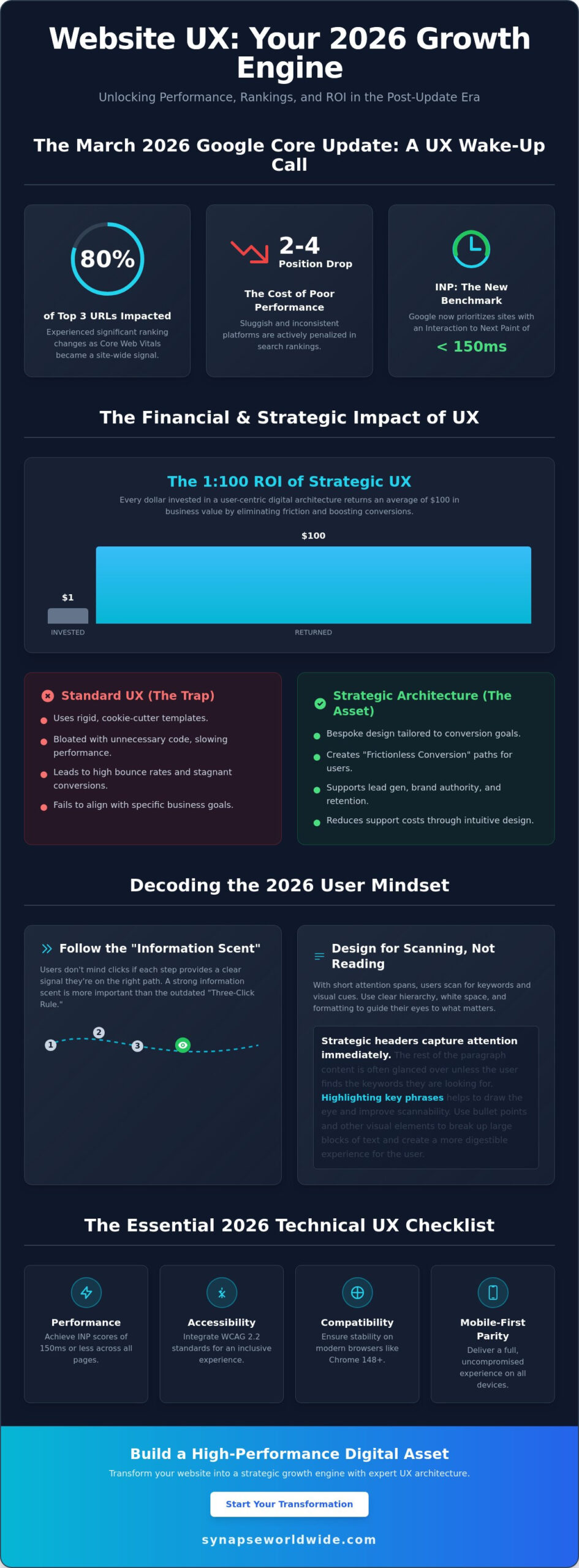
Following the March 2026 Google core update, nearly 80% of URLs in the top three search positions experienced ranking changes because Core Web Vitals became a site-wide signal. If your platform feels sluggish or inconsistent across devices, you aren’t just losing visitors; you’re likely dropping two to four positions in search rankings as Google now prioritizes Interaction to Next Paint (INP) thresholds of 150 milliseconds or less. Implementing modern website ux best practices is no longer a secondary design preference. It’s a fundamental requirement for maintaining a visible, scalable, and high-performance business asset.

You likely recognize that a sophisticated interface means nothing if your bounce rates remain high and conversion numbers stagnate despite steady traffic. It’s frustrating to invest in growth only to watch users abandon their journey because the architecture feels disjointed. This guide provides the strategic roadmap you need to master research-backed UX principles that drive measurable ROI and long-term transformation. We’ll explore how to integrate WCAG 2.2 accessibility standards, optimize for stable browser versions like Chrome 148, and build a bespoke digital presence that feels intuitive to every visitor.

Key Takeaways

  • Understand the 1:100 ROI potential of a strategic digital infrastructure by treating user experience as a core growth engine for your business.
  • Shift your focus from rigid click-counts to building a strong information scent that guides visitors through intuitive navigation and strategic content scanning.
  • Master website ux best practices by maintaining consistent interaction design and providing immediate system feedback to prevent user errors and frustration.
  • Ensure your technical architecture achieves full mobile-first parity and meets the latest performance benchmarks across all modern browser versions.
  • Use data-driven tools like heatmaps and session recordings to identify rage clicks and turn friction points into opportunities for scalable optimization.

The Strategic Foundation: Why Website UX is Your 2026 Growth Engine

User experience isn’t just a design layer. It’s the totality of a visitor’s interaction with your brand’s digital infrastructure. Professional User experience design involves much more than aesthetics; it maps the psychological journey of a customer through your entire digital ecosystem. When your site functions as a cohesive unit, you move beyond mere visibility and start driving real growth through meaningful engagement.

The financial impact of these architectural decisions is profound. Research consistently highlights a 1:100 ROI ratio, where every dollar spent on UX returns $100 in business value. This happens because high-quality design eliminates the friction that causes visitors to abandon their carts or contact forms. While many competitors settle for “Standard UX” using cookie-cutter templates, market leaders prioritize bespoke strategic architecture. Templates are rigid and often bloated with unnecessary code, whereas a tailored approach ensures every element serves a specific conversion goal.

Mastering website ux best practices creates what we call “Frictionless Conversion.” This is the primary goal of professional design. You want to remove every cognitive hurdle, ensuring that the path from the landing page to the “Thank You” screen is seamless. When users don’t have to think about how to use your site, they can focus entirely on the value of your offer. This clarity transforms a standard website into a high-performance business asset.

The Psychology of the Modern User

Modern users rely on a concept called “Information Scent.” Within seconds of landing on a page, they scan for visual and textual cues that indicate they’ll find what they need. If the scent is weak or confusing, they’ll leave immediately. Attention spans in 2026 are shorter than ever, so your site must deliver immediate value. Utilizing custom web design for small business establishes immediate trust. It shows that you care about the details, which reassures visitors that your products or services are equally robust and reliable.

Aligning UX with Business Objectives

UX serves as the backbone for your most critical business goals. It supports lead generation by making forms easy to fill and enhances brand authority by presenting a polished, professional image. Beyond sales, intuitive design improves customer retention and reduces support costs. If a user can find their own answers through a clear FAQ hierarchy or an integrated self-service portal, your team spends less time on basic inquiries and more time on high-value tasks. UX is a strategic business asset that drives growth, not a cost centre that diminishes your bottom line.

Architecting Seamless Navigation and Information Hierarchy

Efficiency in digital architecture isn’t about how few clicks it takes to reach a destination. While the old “Three-Click Rule” is a common myth, modern website ux best practices prioritize a strong “Information Scent” instead. This means users don’t mind extra clicks as long as every step provides a clear, confident signal that they’re moving closer to their goal. When the path is logical, the cognitive load stays low, even in complex environments.

Users in 2026 don’t read; they scan. To accommodate this, your site must use headers, bullet points, and white space as strategic tools rather than just aesthetic choices. Proper white space isn’t empty; it’s a functional element that prevents information overload and focuses the visitor’s attention on your most critical messaging. If your content is buried in dense blocks of text, even the most sophisticated value proposition will go unnoticed. You can see how this looks in practice by reviewing these custom web design examples that prioritize clarity over clutter.

A robust search functionality acts as an essential safety net for your digital ecosystem. While persistent navigation provides a steady anchor, search caters to users with high-intent who know exactly what they want. By integrating an intelligent search bar, you ensure that visitors don’t bounce simply because they couldn’t find a specific resource in your primary menu. This user-centered approach aligns with standards found in the Digital.gov User Experience guidelines, which emphasize making information accessible and easy to locate for all users.

The Anatomy of an Intuitive Menu

Primary navigation should remain lean, focusing strictly on the most important business categories. Secondary or “utility” menus can house administrative links like account logins or location finders, keeping the main header uncluttered. Use descriptive, plain-language labels. Avoid “clever” terminology that might confuse a visitor; if you mean “Services,” don’t call it “The Lab.” Finally, treat your footer as a secondary powerhouse. It’s the perfect place for an expansive site map, contact details, and trust signals that reassure the user before they commit to an action.

Visual Hierarchy: Guiding the Eye to Conversion

Visual hierarchy directs the eye toward the “Next Best Action” through the calculated use of size, colour, and contrast. By understanding gaze patterns like the Z-pattern for simple pages or the F-pattern for content-heavy layouts, you can place your calls-to-action where users are naturally looking. A bold, high-contrast button against a minimalist background creates a focal point that is impossible to ignore. Refining these pathways is a delicate process, and many growth-minded leaders choose to partner with a strategic digital architect to audit and optimize their site’s flow for maximum conversion.

Website UX Best Practices: A Strategic Guide to High-Converting Digital Architecture in 2026

Interaction Design: Consistency, Feedback, and Error Prevention

Predictability is the cornerstone of trust in digital architecture. Users arrive at your site with mental models formed by their experiences across the wider web, a concept known as external consistency. If your shopping cart isn’t in the top right or your logo doesn’t link to the homepage, you create unnecessary friction. Adhering to website ux best practices means you don’t reinvent the wheel where standard patterns already work. Internal consistency is equally vital; your buttons, typography, and spacing must remain uniform across every page to ensure the brand feels stable and professional.

Visibility of system status ensures that users always know what’s happening. They should never wonder if a button click registered or if a file is still uploading. The U.S. Web Design System design principles emphasize building trust through continuity and clear communication. By providing immediate feedback for every action, you reassure the visitor that the interface is responsive and under their control. This transparency reduces anxiety and encourages further exploration of your services.

Effective interaction design prioritizes recognition over recall. You should never force a visitor to remember information from one part of the site to complete a task in another. Instead, provide the necessary context within the current view. This reduces the cognitive load, allowing the user to focus on their primary goal. Additionally, you must design forgiving interfaces that prevent errors before they happen. For example, using a date picker instead of a blank text field eliminates the possibility of formatting mistakes, keeping the conversion path clear of technical hurdles.

Feedback Loops and Micro-interactions

Micro-interactions are the subtle visual cues that respond to user behavior, such as a button changing color on hover or a checkmark appearing after a successful save. These elements provide essential reassurance that the system is functioning as intended. Micro-copy also plays a significant role here by offering helpful hints or clarifying complex requirements within a form. Micro-interactions build a sense of bespoke quality by making the interface feel responsive, alive, and meticulously crafted for the user’s benefit.

Optimising Forms for Maximum Lead Generation

Forms are often the final barrier between a visitor and a conversion. Industry data consistently shows that reducing the number of fields correlates with higher completion rates, so only ask for essential information. Use inline validation to provide real-time feedback; it’s much more effective to correct a mistake as it happens than to force a user to hunt for errors after they hit submit. For complex data entry, utilize progressive disclosure to break the process into smaller, manageable steps. This prevents the user from feeling overwhelmed and maintains the momentum toward a successful submission.

The Technical UX Checklist: Performance, Accessibility, and Mobile

Performance is the bedrock of digital authority. You can’t build a high-performance business asset on a shaky technical foundation. Following the March 2026 Google core update, technical metrics like Interaction to Next Paint (INP) have become site-wide signals. This means the aggregate performance of your entire site affects how individual pages rank. If your site’s INP exceeds the 150-millisecond “Good” threshold, your entire domain’s visibility could suffer. website ux best practices now dictate that speed and responsiveness are core features, not just technical afterthoughts.

A robust technical checklist ensures your architecture remains scalable and compliant. This process involves four critical steps:

  • Step 1: Audit for Mobile-First Responsiveness. Ensure absolute parity across all breakpoints. It’s no longer acceptable to hide complex data or essential navigation on smaller screens. A comprehensive mobile responsive web design strategy is essential to meet Google’s 2026 indexing requirements and capture the majority of global web traffic.
  • Step 2: Optimise for Core Web Vitals. With 87% of websites failing at least one threshold in 2025, meeting these benchmarks provides a significant competitive advantage.
  • Step 3: Implement Accessibility (A11y). Adhering to WCAG 2.2 Level AA is both a legal necessity and a strategic advantage. Inclusivity ensures your site is usable for the more than 1 in 4 adults in the U.S. who report having a disability.
  • Step 4: Verify Touch Targets. Design for the “thumb zone” by ensuring interactive elements are large enough to prevent accidental clicks on mobile devices.

The Mobile-First Mandate in 2026

In 2026, the mobile experience is the primary touchpoint for the majority of global web traffic. Desktop design has become a secondary consideration. Handling intricate navigation on small screens requires a minimalist approach that reduces cognitive load without sacrificing functionality. Fast load times are critical, especially for users on variable mobile networks where every millisecond of delay increases the likelihood of a bounce. Your mobile interface must be as robust and integrated as your desktop version to maintain a seamless brand experience.

UX as an SEO Signal

Google’s Page Experience signals now explicitly reward high-quality UX. There is a direct, data-driven relationship between low bounce rates and high search rankings. Often, website redesign signals manifest first as poor technical performance or failing Core Web Vitals. If your site isn’t meeting these modern benchmarks, it’s time to audit your digital architecture to protect your search equity and drive consistent business growth.

The Synapse Framework: Testing, Refining, and Scaling UX

UX isn’t a one-time project; it’s a continuous cycle of optimization. While some agencies deliver a site and walk away, the Synapse Framework treats website ux best practices as a live, evolving strategy. This iterative process ensures that your digital infrastructure remains aligned with shifting user behaviors and competitive pressures. By moving beyond cookie-cutter templates that offer no room for growth, you build a bespoke asset that scales alongside your business. Every update should be a deliberate step toward higher conversion and improved brand authority.

Data must drive every refinement. We use heatmaps and session recordings to pinpoint “Rage Clicks” where users feel stuck or confused. These friction points are invisible to the naked eye but clear in the session data. Instead of relying on gut feel, A/B testing allows you to make informed decisions that directly impact your bottom line. Our approach bridges the gap between global design standards and specific national market insights, ensuring your platform resonates with your exact audience. It’s about turning passive visitors into active brand advocates through constant, measurable improvement.

Data-Driven Design Decisions

Integrating Google Analytics 4 (GA4) events with deep UX audits provides a granular view of user paths. You don’t need a massive budget to conduct effective usability testing; watching even a few users interact with your interface can reveal critical roadblocks. Applying consistent website ux best practices through regular heuristic evaluations is essential to stay ahead of competitors. These expert reviews assess your site against established usability principles, ensuring you never fall behind industry benchmarks as user expectations evolve in 2026.

Building for the Future

Your digital presence must be scalable. As you add new services or target new markets, your UX needs to adapt without breaking the core experience. A robust Design System acts as your single source of truth, maintaining visual and functional consistency over years of growth. This ensures that every new page or feature feels integrated and professional. A well-maintained system reduces future development costs and preserves the integrity of your digital landscape. Ready to transform your digital presence? Partner with Synapse Worldwide for bespoke UX strategy.

Architecting Your Digital Future

The digital landscape of 2026 demands more than just a functional interface; it requires a robust, integrated ecosystem that anticipates user needs. By prioritizing performance metrics like Interaction to Next Paint and ensuring full accessibility compliance, you transform your site from a static page into a high-performance business asset. Mastering website ux best practices isn’t a one-time task but a commitment to continuous refinement and data-driven growth. This strategic approach ensures your brand remains resilient and authoritative in an increasingly competitive market.

Since 2005, we’ve acted as Digital Architects for businesses seeking transformation rather than just a quick fix. We specialize in bespoke solutions designed for national growth, moving beyond templates to build scalable infrastructure that delivers measurable ROI. Your digital presence is the most critical touchpoint for your customers; it deserves the discipline of professional design and technical excellence. It’s time to reach the next level of success. Elevate your digital infrastructure with Synapse Worldwide and build a foundation that truly thrives.

Frequently Asked Questions

What is the difference between UI and UX design?

UX design focuses on the overall journey and strategic infrastructure of a visitor’s interaction with your brand. It addresses the “why” and “how” of the user experience to ensure the site is functional and intuitive. UI design is the visual layer that covers the “what” and “where,” focusing on the specific aesthetic elements like buttons, colors, and typography that users interact with directly.

How much does a professional UX audit cost in 2026?

The cost of a professional audit depends on the complexity of your digital landscape and the depth of the analysis required. A comprehensive review typically involves heuristic evaluations, accessibility checks, and performance audits. Because every business has unique goals, we recommend a bespoke consultation to determine the exact scope needed to transform your site into a high-performance growth engine.

Can good UX design really improve my SEO rankings?

Good UX is a critical factor in search engine visibility because Google uses Page Experience signals to rank websites. Implementing website ux best practices leads to lower bounce rates and higher engagement, which signals to search engines that your site is an authoritative resource. Following the March 2026 core update, technical UX metrics like Interaction to Next Paint are now site-wide signals that directly influence your position.

How often should I update my website’s UX?

UX is an iterative process that requires regular refinement rather than a “set and forget” approach. You should conduct a formal evaluation at least once a year or whenever your business objectives shift. Staying current with website ux best practices ensures your architecture remains scalable and continues to meet the evolving expectations of your visitors in a competitive digital landscape.

What are the most common UX mistakes small businesses make?

Small businesses often prioritize aesthetics over functionality or rely on rigid templates that don’t align with their specific conversion goals. Common errors include slow load times, poor mobile responsiveness, and vague navigation labels that weaken the “Information Scent.” These mistakes create friction in the user journey, causing potential leads to abandon the site in favor of more intuitive competitors.

Do I need a custom website or is a template enough for good UX?

A custom website is essential for achieving a bespoke digital presence that truly scales with your business. Templates often include bloated code and rigid structures that limit your ability to optimize for specific user behaviors or business outcomes. Custom architecture allows for the seamless integration of CRM or ERP solutions while ensuring your site meets the exact performance and accessibility standards required in 2026.

How do I measure the ROI of my website’s user experience?

You can measure ROI through key performance indicators like conversion rates, average session duration, and reduced customer support volume. By eliminating friction in the user journey, you increase the efficiency of your digital infrastructure and the likelihood of a sale. Strategic UX improvements often follow a 1:100 ROI ratio, where every dollar invested in professional design returns significant value through increased business growth.

Is accessibility (WCAG) mandatory for Australian business websites?

Accessibility is a legal requirement under the Disability Discrimination Act 1992, which applies to all Australian organizations. Following WCAG 2.2 Level AA is the current industry standard to ensure your digital presence is inclusive for all users. Beyond legal compliance, an accessible site expands your market reach and reinforces your brand’s authority by ensuring your services are available to the widest possible audience.


Website Redesign Signals: A Strategic Checklist for Business Infrastructure in 2026

Website Redesign Signals: A Strategic Checklist for Business Infrastructure in 2026

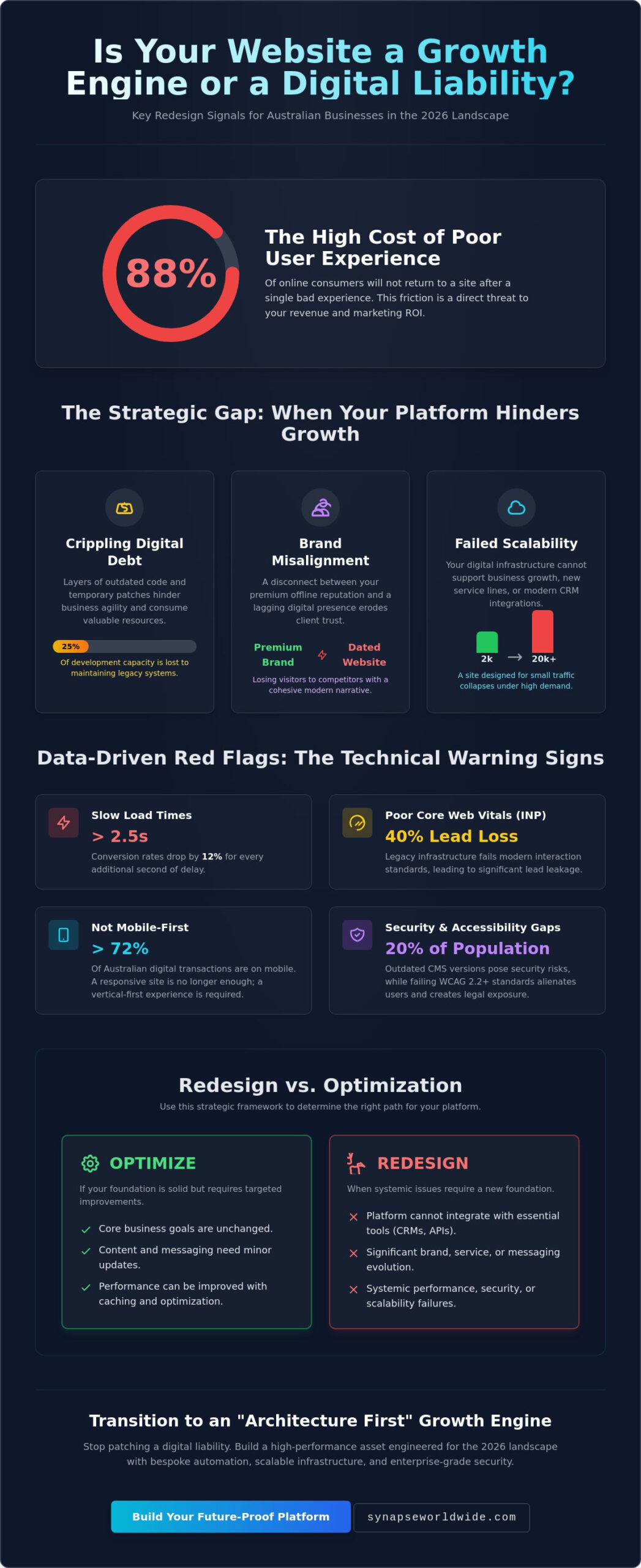
What if your digital storefront isn’t just a static asset, but is actively funneling potential revenue toward your competitors? For many Australian firms, a website that felt modern in 2022 now functions as a bottleneck rather than a bridge to growth. Recognizing the subtle website redesign signals is the difference between maintaining a digital liability and engineering a scalable business tool. You’ve likely noticed that high bounce rates are eroding your marketing ROI, or perhaps your team spends more time fighting a rigid CMS than closing leads. A 2024 industry report indicates that 88% of online consumers won’t return to a site after a poor user experience, making these technical frictions a direct threat to your bottom line.

It’s frustrating when your premium service offerings are trapped behind an interface that no longer reflects your brand’s sophistication. This guide identifies the critical performance and UX indicators that demand a strategic evolution of your digital infrastructure. We’ll provide a comprehensive checklist to help you integrate modern CRMs and optimize your presence for the 2026 landscape. You’ll learn how to pivot from a state of brand misalignment to a position of market authority and measurable results.

Key Takeaways

  • Learn to identify “digital debt” and assess whether your current infrastructure is a scalable asset or a technical liability hindering your business agility.
  • Master the critical website redesign signals emerging in 2026, from holistic Core Web Vitals to the security protocols required for modern Australian enterprise standards.
  • Discover how to eliminate conversion leaks and build the digital trust necessary to secure high-value corporate and government contracts.
  • Apply a strategic scoring framework and the “Rule of Three” to determine if your platform requires a minor optimization or a complete foundational redesign.
  • Transition to an “Architecture First” approach that integrates bespoke business process automation to turn your website into a high-performance growth engine.

Identifying the Strategic Gap: When Your Digital Infrastructure No Longer Scales

Recognising website redesign signals requires moving beyond visual preferences. It involves auditing the systemic indicators that dictate whether your platform accelerates or obstructs growth. By 2026, the gap between high-performing digital assets and legacy systems will widen. Many Australian firms currently carry heavy “Digital Debt,” where layers of outdated code and temporary patches hinder business agility. This technical debt often costs enterprises up to 25% of their development capacity just to maintain basic functionality.

While a “dated look” often triggers the initial conversation, it remains the least critical driver for a full rebuild. Real website redesign signals manifest as high bounce rates, server response times exceeding 3 seconds, or an inability to integrate modern AI-driven APIs. Effective platforms must adhere to the fundamental principles of web design, focusing on usability and technical robustness rather than surface-level trends. Strategic redesigns align your digital presence with 2026 revenue drivers, ensuring your infrastructure supports rather than stifles your trajectory.

The Evolution of Business Objectives

Your digital architecture must mirror your 2026 roadmap. If your firm has expanded into new service models since 2023, a static user journey will fail to convert. Scaling brings technical pressure; a site designed for 2,000 monthly visitors often collapses under the weight of 20,000. In Australia, where mobile commerce accounts for over 72% of digital transactions, failing to scale server architecture leads to immediate revenue loss. If your current site cannot support new product lines or integrated CRM systems, it’s a clear indicator that your infrastructure has reached its ceiling.

Messaging and Brand Misalignment

A disconnect between a premium offline reputation and a lagging digital presence creates cognitive dissonance for high-value clients. If your content reads like a 2019 resume rather than a solution-oriented narrative, you’ll lose approximately 88% of visitors to more agile competitors. Inconsistent branding across LinkedIn, Instagram, and your primary site isn’t just a design flaw; it’s a conversion killer. Modern visitors seek bespoke experiences. When your messaging feels generic or outdated, it erodes the professional trust you’ve spent years building. Aligning these touchpoints is essential for maintaining a cohesive omnichannel strategy that resonates with a sophisticated Australian audience.

Technical and Performance Red Flags: The Data-Driven Signals

In 2026, a slow website isn’t just an inconvenience; it’s a liability that actively drains your marketing budget. Google’s Core Web Vitals have moved beyond simple speed metrics to a holistic assessment of user interaction. We see Australian businesses losing up to 40% of potential leads because their legacy infrastructure can’t meet the Interaction to Next Paint (INP) standards established in 2024. Security vulnerabilities in outdated CMS versions serve as the final warning for migrating to more secure, bespoke environments. If your platform relies on patches for vulnerabilities discovered three years ago, your data integrity is at risk.

The “Mobile-Only” reality has superseded the era of responsive design. Modern search engines prioritise sites built specifically for vertical-first experiences. Australian brands must also acknowledge that accessibility is no longer a “nice-to-have” feature. Adhering to WCAG 2.2+ standards is a legal and ethical requirement for national brands under the Disability Discrimination Act. Failing these benchmarks doesn’t just hurt your SEO; it exposes your company to significant legal risks and alienates 20% of the population living with a disability.

Systemic Performance Degradation

High bounce rates often stem from technical friction rather than poor content. When your site takes longer than 2.5 seconds to load, your conversion floor drops by 12% for every additional second of delay. Implementing aggressive website performance optimization is the only way to retain impatient users in a high-speed market. Legacy platforms often suffer from “bloatware,” where redundant plugins and unoptimised code prevent rapid updates. This technical debt makes your business agile-resistant, stalling growth while competitors pivot with ease.

SEO and Visibility Decline

A gradual slide in organic rankings is one of the most reliable website redesign signals. Outdated site architecture often leads to keyword cannibalization, where multiple pages compete for the same search intent, diluting your authority. To understand the full scope of these transitions, consult a comprehensive website redesign guide to audit your current technical standing. Modern SEO also requires preparing for AI-driven search. If your site structure isn’t readable by LLM crawlers, your brand won’t appear in AI-generated summaries or voice search results. Your digital infrastructure must be clean, structured, and schema-heavy to remain visible.

If you’re noticing these technical red flags, it’s time to consult with a digital architect to secure your business infrastructure for the years ahead.

Website Redesign Signals: A Strategic Checklist for Business Infrastructure in 2026

User Experience and Conversion Friction: Why Visitors Are Not Becoming Leads

High bounce rates and stagnant lead counts aren’t just statistics; they’re symptoms of structural failure within your digital infrastructure. Conversion leaks often occur where user expectations clash with outdated architecture. For Australian firms pursuing high-value corporate or government contracts, your digital interface serves as a silent vetting tool. A clunky interface suggests a clunky operation. Implementing custom web design for small business ensures the path from interest to inquiry is frictionless. A surge in bounce rates and a decline in qualified inquiries are the most prominent website redesign signals a business can encounter. Identifying these website redesign signals early prevents the erosion of your market share to more agile competitors.

Navigational Complexity and High Friction

By 2026, the “Three Click Rule” has evolved into a demand for instant accessibility. It’s no longer just about the number of clicks but about the cognitive load required to find a solution. If session recordings show users hovering over menus without clicking, or bouncing after 15 seconds on a service page, you’re seeing clear signals for a website redesign. Data from 2025 UX audits indicates that contact forms with more than four fields can drop conversion rates by 67%. Your current forms might be the primary barrier to your ROI, acting as a gatekeeper rather than a gateway. Heatmaps often reveal “dead clicks” where users expect interactivity that doesn’t exist, leading to immediate frustration and exit.

The Messaging Disconnect

A visitor decides to stay or leave within five seconds. If your site doesn’t articulate your “Who, What, and How” immediately, you lose them to the next search result. Reviewing custom web design examples reveals that industry leaders prioritise clarity over cleverness. In the Australian market, where authenticity is a primary trust driver, generic stock imagery and vague copy are active conversion killers. Authentic visuals and precise, benefit-driven language establish authority. When your messaging is misaligned with user intent, even the highest traffic volume won’t yield results. Strategic redesign replaces fluff with facts, ensuring your site answers critical buyer questions before they’re even asked.

  • Friction Points: Identify where users drop off in the checkout or inquiry process.
  • Trust Indicators: Ensure certifications and case studies are visible within two scrolls.
  • Mobile Logic: Test if navigation is thumb-friendly on a standard 6.7-inch smartphone screen.
  • Loading Thresholds: Aim for a Largest Contentful Paint (LCP) of under 2.5 seconds to retain 80% of your visitors.

Redesign vs. Optimization: A Strategic Decision Framework

Deciding between a minor update and a total overhaul requires a cold, data-driven assessment. We use a proprietary scoring system to evaluate digital assets across performance, accessibility, and conversion metrics. If your site scores below 60% on a core performance audit, a cosmetic facelift won’t solve the underlying structural decay. You’re simply painting over cracks in a failing foundation. This is why identifying website redesign signals early is vital for maintaining a competitive edge in the Australian market.

Apply the “Rule of Three” to your current audit. If you identify three or more critical issues, such as a bounce rate exceeding 70%, a mobile conversion rate 50% lower than desktop, and a slow Largest Contentful Paint (LCP) over 2.5 seconds, a redesign is the only efficient path. Patchwork fixes on an outdated foundation often cost 40% more over a 24 month period than a clean, bespoke rebuild. Technical limitations in a generic CMS often lead to plugin bloat, where every new feature slows the site further. A bespoke solution is built for speed and specific business outcomes rather than generic convenience.

When Optimization Is Sufficient

Optimization works when the engine is sound but the exterior is tired. You can achieve a 20% lift in conversions by refining landing page copy or compressing oversized images to improve load times. A professional SEO audit identifies these low-hanging fruit opportunities without requiring a full code rewrite. If your current CMS supports modern schema markup and has a clean code base, testing incremental UX changes is a prudent first step. This approach preserves your existing equity while addressing specific friction points that hinder the user journey.

The Case for a Structural Redesign

Structural changes become mandatory when legacy code restricts growth. Old architectures often block seamless website crm integration, which prevents you from automating lead nurturing and tracking customer lifetimes accurately. If you’re pivoting your business model or entering a new market in 2026, your site must reflect that shift. A bespoke digital architecture eliminates the technical debt of A$5,000 to A$15,000 spent annually on emergency patches. Investing in a scalable solution ensures your infrastructure grows alongside your revenue. It’s a shift from viewing your website as a static brochure to seeing it as a dynamic business engine. Applying proven website ux best practices during a structural rebuild ensures your new architecture converts visitors into high-value leads from day one.

Stop wasting resources on temporary fixes and build a foundation for growth. Consult with our strategic architects today to determine the best path for your business infrastructure.

A successful transition requires more than aesthetic updates; it demands a structural evolution. At Synapse Worldwide, we employ an “Architecture First” methodology. This ensures your digital foundation supports long-term scaling rather than just immediate visual appeal. Identifying website redesign signals early allows you to move from a reactive posture to a proactive market position. We treat your website as the central engine for all national digital marketing efforts, ensuring every dollar spent on search or social media converts through a high-performance interface.

Modern infrastructure must go beyond simple content delivery. By integrating business process automation directly into your site structure, you eliminate manual data entry and reduce operational overhead. This strategic integration transforms your website from a passive brochure into a functional tool that manages leads, processes orders, and synchronizes with your internal workflows in real-time. It’s about creating a system that works as hard as your best employees.

Discovery and Strategic Planning

The discovery phase defines the project’s ROI. We map user journeys to align with your high-value customer personas, ensuring the path to conversion is frictionless. You shouldn’t settle for vague goals. We set hard KPIs such as a 25% increase in lead volume and ensuring Largest Contentful Paint (LCP) remains under 2.5 seconds to meet 2024 performance standards. While templates offer speed, bespoke solutions provide the robust framework necessary for complex Australian corporate environments where security and unique functionality are non-negotiable.

Implementation and Future-Proofing

Clean, scalable code is the difference between a site that lasts two years and one that thrives for five or more. Our developers focus on structural integrity to ensure seamless integration with existing ERP and CRM systems like Salesforce or Microsoft Dynamics. Protecting your SEO equity is a priority during this phase. We implement rigorous 301 redirect mapping and metadata migration to ensure your historical search rankings remain intact. After launch, our team conducts iterative performance tuning, using real-world data to refine the user experience and maintain your competitive edge in the Australian market.

Architecting Your Next Phase of Growth

Recognising website redesign signals early prevents technical debt from stalling your Australian business’s momentum. Your digital infrastructure shouldn’t just exist; it needs to scale alongside 2026 market demands. Performance red flags and conversion friction are often the first indicators that a legacy system is failing. Whether you’re managing complex corporate assets or government-level infrastructure, moving from basic optimization to a strategic architectural rebuild is often the most effective path to sustainable ROI.

Synapse Worldwide brings over 20 years of expertise to every project, delivering bespoke digital solutions that prioritize scalability and measurable results. We understand the unique nuances of the Australian digital landscape and provide the robust framework required for sophisticated operations. Don’t let outdated technology limit your vision for transformation. Our team is ready to help you build a high-performance engine that turns visitors into high-value leads.

Book a strategic consultation with Synapse Worldwide to start your journey toward a more powerful digital presence.

Frequently Asked Questions

How often should a professional business website be redesigned?

Most high-performing Australian businesses redesign their digital infrastructure every 2 to 3 years. This cycle ensures your brand remains compatible with the latest browser updates and security protocols. A 2023 study by HubSpot found that 88% of users are less likely to return to a site after a bad experience. Regular updates prevent technical debt from accumulating and keep your conversion pathways optimized for modern consumer behavior.

Can a website redesign hurt my current SEO rankings?

A website redesign can negatively impact your search visibility if you fail to implement a robust 301 redirect strategy. However, when executed with precision, identifying the right website redesign signals allows you to fix legacy crawl errors and improve site architecture. Data from SEMrush indicates that sites with clean migrations often see a 20% increase in organic traffic within 6 months. We focus on preserving your existing authority while building a more scalable foundation for future growth.

What is the average timeframe for a custom website redesign in Australia?

A sophisticated, bespoke website redesign typically requires a timeline of 12 to 16 weeks from discovery to deployment. This period accounts for deep strategic planning, custom UI/UX design, and rigorous quality assurance. Smaller projects might conclude in 8 weeks; however, complex enterprise solutions involving integrated APIs or custom databases often extend to 20 weeks. We prioritize a disciplined workflow to ensure every digital asset is polished and functional before the launch date.

Is it better to use a template or a bespoke design for a redesign?

Bespoke designs offer superior ROI and scalability for growing businesses that require a unique market position. Templates often include 30% more bloated code, which slows down performance and limits your ability to scale. A custom-built solution ensures your infrastructure aligns perfectly with your specific operational goals. While templates have lower initial costs, bespoke sites deliver a 40% higher conversion rate on average by providing a seamless, tailored user journey that reflects your brand’s authority.

How do I know if my website speed is a sign for a redesign?

Your website speed is a primary indicator for a redesign if your pages take longer than 3 seconds to load completely. Google’s Core Web Vitals data shows that bounce rates increase by 32% as page load time goes from 1 second to 3 seconds. If your current backend architecture cannot achieve a mobile speed score above 90 on PageSpeed Insights, it’s a clear sign your infrastructure is obsolete. We replace sluggish legacy code with high-performance frameworks to reclaim your competitive edge.

What are the most critical website redesign signals to watch for in 2026?

The most critical website redesign signals for 2026 include a drop in mobile engagement and the lack of integrated data analytics. If your current platform can’t support automated customer service portals or real-time personalization, you’re falling behind. Industry reports suggest that 75% of B2B buyers now expect a personalized digital experience. A strategic overhaul ensures your business infrastructure is ready to leverage these emerging technologies while maintaining a robust security posture. Ensuring your platform meets the latest mobile responsive web design standards is a foundational requirement for remaining competitive in 2026.

Should I redesign my website if my competitors just launched new sites?

You shouldn’t redesign simply because a competitor did, but you must analyze if their new site offers a superior user experience that threatens your lead volume. If 3 of your top 5 competitors have transitioned to faster, more intuitive platforms, your brand perception will suffer. Monitor your conversion metrics closely. If your cost per acquisition has risen by more than 15% since their launch, it’s time to consult with a digital architect to modernize your presence.

How much should I budget for a strategic website redesign?

A strategic redesign for an established Australian business generally requires an investment ranging from A$15,000 for standard professional sites to over A$100,000 for complex enterprise platforms. According to 2024 industry benchmarks, high-growth companies allocate 5% to 10% of their annual marketing budget to digital infrastructure. This investment covers strategic consulting, bespoke design, and seamless integration of business tools. We focus on delivering a robust solution that maximizes your return on investment through improved performance and scalability.


The Ultimate PPC Landing Page Optimization Checklist for 2026

The Ultimate PPC Landing Page Optimization Checklist for 2026

Did you know that Australian businesses currently lose an average of 26% of their digital ad spend because the post-click experience fails to deliver on the initial ad promise? It’s a sobering reality for many marketing managers who watch their A$15.00 cost-per-click campaigns yield diminishing returns. You’ve likely felt the sting of a rising Cost Per Acquisition (CPA) and the frustration of a stagnant Google Ads Quality Score that keeps your bids artificially high. Mastering ppc landing page optimization is no longer a luxury; it’s a strategic necessity to ensure your digital presence remains scalable and profitable in a competitive 2026 market.

We agree that throwing more budget at a leaky funnel is never the solution for sustainable growth. This guide promises to equip you with a robust, data-driven checklist designed to align your messaging and maximize your return on investment. We’ll examine the technical architecture, bespoke content strategies, and conversion triggers that define the world’s most successful paid campaigns. You’ll gain a repeatable framework to launch campaigns with the confidence that every Australian dollar spent is working toward a measurable business outcome.

Key Takeaways

  • Bridge the “Post-Click Gap” by aligning your ad promises with high-performance destinations that convert expensive traffic into measurable revenue.
  • Master the visual hierarchy and “Above the Fold” essentials required to guide the modern user’s eye toward your primary conversion goal.
  • Implement a data-driven ppc landing page optimization strategy that prioritises precise message match and sub-1.5 second load times for the Australian market.
  • Tailor your conversion strategy to your specific business model, whether reducing checkout friction for e-commerce or refining the value exchange for lead generation.
  • Move beyond the initial click by integrating bespoke landing pages with your CRM and ERP systems for seamless, real-time lead management and improved ROI.

What is PPC Landing Page Optimization and Why Does it Matter?

PPC landing page optimization is the strategic process of refining a post-click destination to ensure every dollar of your Australian ad spend translates into measurable growth. It’s the bridge between a user’s intent and your business’s bottom line. While high-performing ads grab attention, they only fulfill half the promise. The “Post-Click Gap” occurs when a sophisticated ad campaign directs traffic to a generic or cluttered page, causing potential leads to bounce within 2.3 seconds of arrival. Without a bespoke destination, even the most expensive Google Ads campaigns fail to deliver a positive return on investment.

The 2026 digital landscape demands more than static templates. We’ve entered an era of dynamic, intent-based experiences where 74% of users expect content to adapt to their specific search context. Understanding what is a landing page in a modern context means recognising it as a high-performance tool designed for a single conversion goal rather than a general information hub.

Optimization also dictates your overhead costs through the Quality Score. Google rewards relevance; a page that aligns perfectly with your keywords can reduce your Cost Per Click (CPC) by up to 50%. Conversely, a poor landing page experience can inflate your costs by 400%, effectively taxing your business for providing a poor user experience. Strategic refinement ensures your digital presence is both scalable and cost-efficient.

The Financial Impact of Optimization

Precision in ppc landing page optimization creates a compounding effect on your revenue. If you’re spending A$20,000 per month on traffic with a 2% conversion rate, a modest 1% increase in conversion doesn’t just add one percent to your results; it boosts your lead volume by 50% without increasing your ad spend by a single cent. This efficiency protects your budget during periods of market volatility in the Australian sector. Conversion scent is the seamless alignment of the visual and textual promises made in an ad with the immediate reality of the landing page.

PPC Pages vs. Standard Web Pages

Standard web pages are built for exploration, but PPC pages are built for execution. The “One Goal” rule is non-negotiable here. While your main website likely features a complex navigation menu, these links are conversion killers on a landing page, providing too many “exit doors” for the user. We utilise standalone architecture rather than integrated site subfolders to eliminate distractions. Our design priorities focus on direct response, using a robust hierarchy of information that guides the user toward a single call to action, whereas brand awareness pages often prioritise broad storytelling over immediate results.

The Anatomy of a High-Converting PPC Landing Page

High-performance ppc landing page optimization isn’t about aesthetics alone; it’s about engineering a path of least resistance. In 2026, the “above the fold” space remains the most critical real estate. You have less than two seconds to establish relevance. Your headline must mirror the searcher’s intent, supported by a sub-headline that clarifies the value proposition. The primary Call to Action (CTA) needs to be visually distinct, using contrasting colours that stand out against the brand palette. Successful campaigns often align with established PPC landing page best practices to ensure the transition from ad to page feels seamless and credible.

Visual hierarchy dictates where a user’s attention goes first. Most visitors scan in an F-pattern, focusing on the top and left sides of the screen. We position key benefits and trust signals along these natural eye paths. Integrating social proof, such as Australian business certifications or security badges like Norton or McAfee, builds immediate rapport. Data from 2024 indicates that pages featuring visible trust signals see a 14% uplift in conversion rates compared to those without. Technical standards have also shifted; 2026 requires sub-second load times. Google’s Core Web Vitals are no longer just SEO metrics; they are conversion metrics. A delay of just 100 milliseconds can drop conversion rates by 7%.

Psychological Triggers in Design

Effective design leverages human psychology to drive action. We use scarcity and urgency by highlighting limited-time A$500 vouchers or “3 spots remaining” for a consultation. This works best when it’s authentic rather than “spammy.” Our copy focuses on “Benefit-First” structures, telling the user what they gain rather than listing dry technical features. The Rule of One dictates that a single landing page must address one specific audience with one clear offer to achieve one singular goal. This clarity eliminates decision paralysis and focuses the user on the conversion.

Mobile-First Optimization

By 2026, mobile devices account for over 75% of high-intent PPC traffic in Australia. A “responsive” design is the bare minimum; true ppc landing page optimization requires a mobile-first architecture. This means placing CTAs within the natural “thumb zone” and simplifying forms to three fields or fewer. We reduce visual clutter by hiding non-essential elements on smaller screens, ensuring the user stays focused on the primary offer. Our strategic approach at Synapse Worldwide ensures these mobile experiences are bespoke and built for speed, turning clicks into clients with surgical precision.

The Ultimate PPC Landing Page Optimization Checklist for 2026

Lead Gen vs. E-commerce: Choosing Your Strategy

Strategic ppc landing page optimization requires a fundamental understanding of your conversion architecture. You shouldn’t apply a retail “Buy Now” mindset to a complex B2B service. Within the Australian market, the distinction between lead generation and direct sales dictates every design choice from the headline to the backend integration. Successful campaigns focus on the specific psychology of the local consumer, who values transparency and efficiency above all else.

Lead generation thrives on a balanced value exchange. If you’re asking for a phone number, you must provide something of equal weight, such as a bespoke whitepaper or a technical consultation. For B2B enterprise clients, the priority shifts toward lead qualification. Using multi-step forms allows you to filter out low-intent traffic. This ensures your sales team focuses on prospects with a high lifetime value, which often exceeds A$100,000 for local industrial or professional service providers.

E-commerce strategies focus on removing every possible barrier between the initial click and the final checkout. Reducing friction is the primary goal. While templates provide a quick start, high-growth brands often pivot to bespoke, custom-coded infrastructure. This investment ensures your site remains scalable and handles peak traffic during major events like Click Frenzy or Black Friday without performance degradation. Custom solutions also allow for deeper integration with Australian logistics and payment gateways.

Lead Capture Frameworks

Modern lead capture relies on the “Minimum Viable Data” principle. Conversion rates typically drop by 11% for every additional form field beyond the essential three. To combat this, we use progressive profiling to build lead depth over multiple interactions. This approach keeps the initial friction low while gathering critical intelligence over time. Multi-step funnels consistently outperform single-step forms by 86% because they reduce the cognitive load on the user by breaking questions into logical bites.

  • Single-step: Best for low-friction offers like newsletter signups or quick price guides.
  • Multi-step: Essential for qualifying high-ticket B2B leads where budget and authority must be confirmed.
  • Progressive Profiling: Uses smart fields to ask different questions on subsequent visits, building a robust profile.

Direct Sales Frameworks

Direct sales pages must act as a virtual closer. Integrating dynamic pricing and real-time stock levels creates a sense of urgency that drives immediate action. For Australian retailers, implementing “One-Click” checkout options like Apple Pay or Shop Pay is a requirement for effective ppc landing page optimization. These tools bypass traditional form-filling, which accounts for a 35% increase in mobile conversion rates according to 2024 industry benchmarks.

Strategic cross-selling within the flow can increase average order value by 15% without increasing your acquisition cost. Consider these elements:

  • Dynamic Scarcity: Show live stock counts to trigger immediate purchases based on real-time inventory.
  • Integrated Payments: Leverage digital wallets to facilitate instant transactions on mobile devices.
  • Post-Purchase Upsells: Offer complementary products immediately after the initial conversion to maximise revenue.

The 2026 PPC Landing Page Optimization Checklist

Precision defines the 2026 digital landscape. When you’re paying for every click, every millisecond and every word carries a tangible financial weight. This checklist ensures your ppc landing page optimization strategy is robust, scalable, and built for high-performance conversion. We don’t settle for “good enough” when your return on investment is at stake.

  • Message Match: Does your H1 exactly mirror the ad copy that drove the click? If your Google Ad promises “Bespoke Software Development in Sydney,” your landing page shouldn’t pivot to generic IT services. Disconnect leads to instant abandonment.
  • Technical Audit: Speed is a conversion killer. Your page must load in under 1.5 seconds on a standard Australian 4G connection. Use server-side rendering and optimized assets to meet this benchmark.
  • Friction Check: Remove the navigation bar and all external links. Your landing page is a closed environment designed for a single action. Don’t give your prospects an exit ramp before they’ve converted.
  • Social Proof: Trust is earned through evidence. Include at least three verifiable testimonials or direct links to case studies. In the Australian market, local business validation often outweighs global generic praise.
  • Accessibility: Inclusive design is a legal and ethical standard. Ensure your page meets WCAG 2.2 standards. This opens your services to the 18% of Australians living with a disability, ensuring no potential lead is left behind.

Copywriting and Messaging Audit

Your copy needs to be a silent salesman. Verify that every paragraph answers the prospect’s internal question: “What’s in it for me?” Use active voice and strong, action-oriented verbs in your CTAs. Instead of “Submit,” try “Claim Your Free Audit” or “Start Your Growth Phase.” Your unique value proposition (UVP) must be visible and understood within 3 seconds of the page loading. If a user has to scroll to find out why you’re the best choice, you’ve already lost them.

Conversion Tracking and Data Integrity

Data-driven decisions require flawless data collection. Verify your Google Tag Manager (GTM) setup and implement server-side tracking to bypass browser-based privacy restrictions. Test every form submission and ensure “Thank You” pages redirect correctly to trigger conversion events. We recommend implementing heatmaps, such as Microsoft Clarity, to observe user behaviour. If 60% of your users are dropping off at a specific form field, that’s a friction point that requires immediate refinement.

Success in digital advertising requires more than just high-quality traffic; it requires a destination that converts. If your current pages aren’t hitting these benchmarks, it’s time to audit your conversion funnel with a team that prioritizes results over fluff.

Beyond the Click: Integrating with CRM and ERP

A conversion on your landing page isn’t the finish line; it’s the starting gun for your sales process. High-performance ppc landing page optimization requires a seamless bridge between the front-end user experience and your back-end operations. If your leads sit in an email inbox for three hours before being processed, you’ve already lost the momentum. We focus on real-time data synchronization. This ensures every form submission triggers an immediate entry into your CRM or ERP system, allowing your team to strike while the intent is highest.

Closed-loop reporting changes the game for Australian enterprises. Instead of merely measuring a 5% conversion rate, you’re identifying which specific keywords and landing pages generated A$100,000 in actual settled revenue. This transparency allows for aggressive, data-backed scaling. The Synapse Approach involves building bespoke integration layers. These aren’t generic, fragile plugins. They’re robust systems designed for enterprise-level scalability, ensuring your tech stack grows alongside your ambitious revenue targets. Pairing this with professional ppc management services ensures your entire paid search architecture is optimised from the first click through to final revenue attribution.

  • Eliminate manual entry: Automated lead flow reduces human error and ensures 100% lead capture.
  • Revenue attribution: Connect digital clicks to offline sales for a true ROI calculation.
  • Operational efficiency: Sync marketing data with ERP systems to manage inventory or service capacity in real-time.

The Power of Marketing Automation

Speed defines success. Immediate auto-responders keep your brand at the forefront of a prospect’s mind. Beyond the initial contact, your CRM data should act as a feedback loop. By analyzing which leads turn into high-value clients, we can refine your ppc landing page optimization strategy. This creates a cycle of continuous improvement. Effective CRM Integration allows your marketing team to see the full picture, from the first click to the final invoice. Recent 2025 benchmarks indicate that Australian firms using integrated CRM data see a 23% higher ROI on their ad spend compared to those with siloed systems.

Future-Proofing Your PPC Strategy

As we move through 2026, the reliance on third-party cookies has vanished. Success now depends on your ability to collect and leverage first-party data. Your landing pages must serve as sophisticated data collection points that respect privacy while gathering actionable insights. We use AI to generate dynamic page variations at scale, tailoring the experience to the user’s specific industry or intent. Understanding how your paid search efforts complement your broader channel mix — including the Google Ads vs social ads strategic comparison — is essential for building a cohesive, future-ready digital architecture. To ensure your digital infrastructure is ready for these shifts, you can Contact Synapse Worldwide for a Strategic PPC Audit. We’ll help you build a digital architecture that isn’t just ready for the future, but actively shapes it.

Future-Proof Your Conversion Engine

Success in 2026 requires a shift from static design to dynamic, integrated experiences. You’ve seen how the right structural anatomy and deep CRM integration turn a standard click into a long-term asset. By applying this checklist, you ensure your digital presence isn’t just visible but authoritative and highly efficient. Mastering ppc landing page optimization means staying ahead of evolving user expectations while maintaining technical precision across your entire marketing funnel.

Don’t leave your growth to chance in an increasingly competitive Australian market. Synapse Worldwide brings over 20 years of digital engineering expertise to every project. As specialists in CRM and ERP marketing integrations, we provide the authoritative, Australian-based strategic consulting your brand needs to scale. It’s time to move beyond the click and build a robust foundation for your future success.

Maximize your ad spend with a bespoke PPC strategy from Synapse Worldwide

Your journey toward digital transformation starts with a single, strategic step. We’re ready to help you reach that next level of business excellence.

Frequently Asked Questions

How long should a PPC landing page be?

The length of your page should reflect the complexity of your offer and the price point of your service. For simple lead captures, a concise layout often performs best. Complex Australian B2B services costing over A$5,000 typically require longer pages with 800 words to establish trust. Data shows that pages with fewer than 200 words can increase conversion rates by 15% for low-friction offers.

Can I use my homepage as a PPC landing page?

You shouldn’t use your homepage for paid traffic because it lacks a singular focus. Homepages contain multiple navigation paths that distract users from the primary goal. Dedicated ppc landing page optimization ensures your message matches the ad exactly. Statistics show that using a tailored landing page instead of a homepage can boost conversions by 25% for Australian retail campaigns.

What is a good conversion rate for a PPC landing page in 2026?

A strong conversion rate in 2026 sits between 5% and 10% for competitive Australian sectors. While historical medians hover near 2.35%, top-tier campaigns now leverage AI-driven personalisation to exceed 12%. You’ve got to benchmark against current local industry data. Recent 2025 reports show that Australian professional services often outperform retail in lead generation efficiency.

How many CTAs should I have on one page?

Your page should feature one primary call to action (CTA) to avoid decision paralysis. While you can place multiple buttons throughout the layout, they must all lead to the same conversion goal. Research from VWO indicates that pages with a single focused offer achieve a 16% higher conversion rate than those with multiple competing offers. Stick to one clear objective to maintain a seamless user journey.

Does landing page speed affect my Google Ads Quality Score?

Page speed is a critical component of your Google Ads Quality Score and directly impacts your cost per click. Google’s core web vitals data shows that a load time increase from one to three seconds raises bounce probability by 32%. Fast pages improve your Quality Score, which lowers your auction prices in the Australian digital landscape. We prioritise technical performance to ensure your budget isn’t wasted on bounces.

What is the difference between A/B testing and multivariate testing?

A/B testing compares two distinct versions of a page, while multivariate testing (MVT) analyzes how multiple variables interact on a single page. Use A/B testing for major structural changes like a new headline or layout. MVT is better for refining smaller elements like button colours or image placements simultaneously. This data-driven approach is essential for effective ppc landing page optimization and long-term growth.

How often should I update or optimize my landing pages?

You should review your performance data weekly and implement structural updates at least every 90 days. Markets shift rapidly, and what worked in 2025 might not resonate now. Companies that test their landing pages at least once a month are 50% more likely to see a significant increase in sales. Continuous refinement ensures your digital presence remains scalable and competitive against local rivals.

Should I use video on my PPC landing page?

Including a video can be a powerful way to build immediate rapport and explain complex value propositions. EyeView Digital reports that using video on a landing page can increase conversion rates by 80%. Ensure the video is high-quality and includes a transcript for accessibility. It’s a strategic tool for Australian brands looking to humanise their digital presence and drive ambitious growth.