

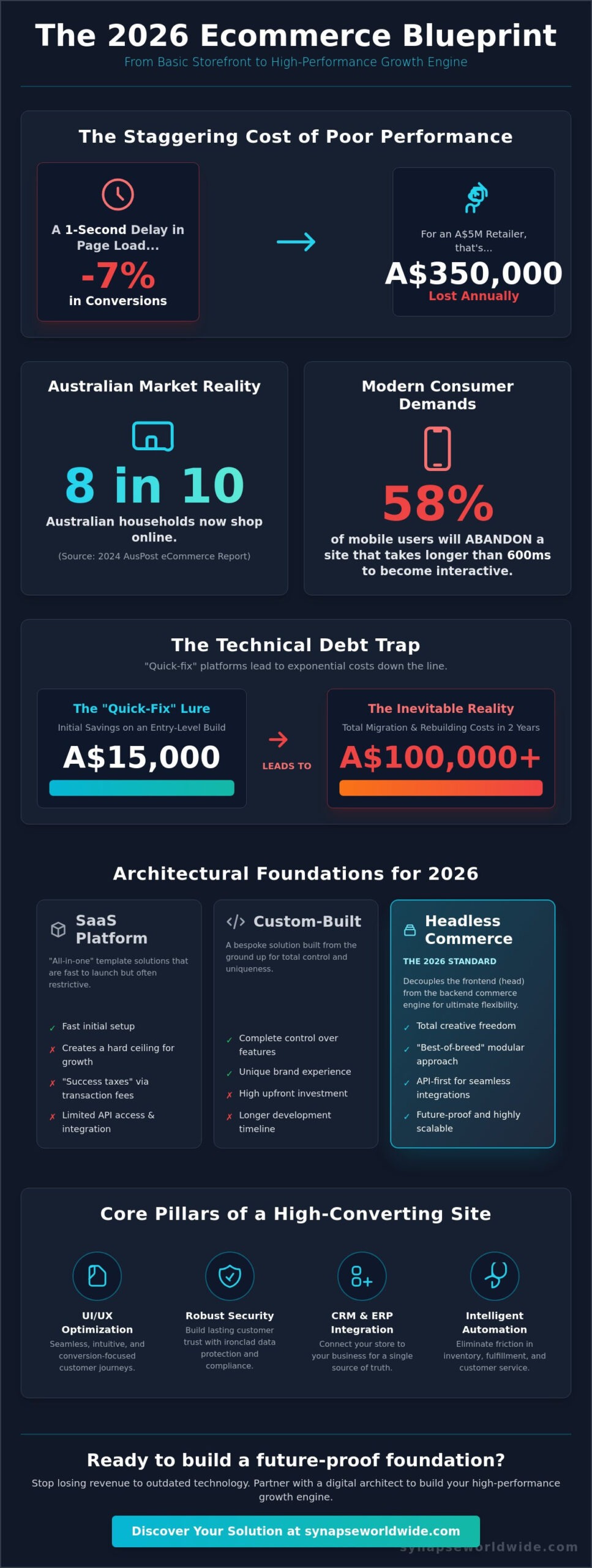
Did you know that a one second delay in page load time can slash your conversion rates by 7%? For an Australian retailer turning over A$5 million annually, that represents a staggering A$350,000 vanishing into the digital ether each year. According to the 2024 Australia Post Inside eCommerce Report, 8 in 10 households now shop online, meaning your ecommerce website development strategy must move beyond a simple digital storefront. You likely feel the frustration of high cart abandonment rates and the friction caused by data siloed between your store and your ERP.
The modern Australian consumer demands hyper-personalisation and AI-driven product discovery. Static product grids are obsolete; shoppers expect a dynamic interface that anticipates their needs based on real-time data. Sub-second load speeds are no longer a luxury; they’re a baseline requirement for conversion. Research indicates that 58% of mobile users in Australia will abandon a site if it takes longer than 600 milliseconds to become interactive. A mobile-first, omnichannel approach is necessary to ensure your brand provides a seamless experience across every digital touchpoint, from social commerce to voice-activated search interfaces, often requiring specialized Web & Mobile Development to manage the technical complexity.
We understand that managing complex product catalogues while maintaining peak performance is a balancing act that many brands fail to master. This guide provides the strategic framework you need to transform your online presence into a high-performance growth engine. You’ll discover how to implement a future-proof digital architecture that automates backend operations and delivers a seamless customer experience across every touchpoint.
Key Takeaways
- Understand why the 2026 digital landscape demands a shift from basic storefronts to strategic business infrastructure designed for high-performance growth.
- Evaluate the strategic trade-offs between SaaS, custom-built, and headless architectures to find the bespoke foundation that aligns with your specific revenue goals.
- Identify the core functional pillars of successful ecommerce website development, focusing on UI/UX optimization and robust security protocols to build lasting customer trust.
- Learn how to integrate your platform with CRM and ERP systems to automate inventory management and eliminate operational friction across your Australian enterprise.
- Discover the “Digital Architect” methodology and how a fixed-price project model ensures the transparent delivery of a scalable, future-proof online store.
The 2026 Ecommerce Landscape: Why Basic Storefronts No Longer Suffice
In 2026, ecommerce website development has moved far beyond the traditional concept of “setting up a shop.” It’s now the foundational architecture of a scalable enterprise. This shift means your digital presence must function as a high-performance engine rather than a static brochure. The Australian market has matured, moving from simple transactional stores to “experience-first” digital platforms that prioritise long-term customer relationships over one-off sales. Modern ecommerce development is the integration of UX, data, and automation.
To understand how we reached this point, one can review a comprehensive overview of e-commerce which tracks the journey from basic online listings to the complex global ecosystems we navigate today. The “all-in-one” template model, while accessible, often creates a hard ceiling for growing businesses. These cookie-cutter solutions lack the bespoke technical depth required to integrate with advanced ERPs or custom logistics software, effectively capping your revenue potential and limiting your ability to pivot as market conditions change.
The High Cost of Technical Debt
Opting for “quick-fix” platforms creates a financial burden that compounds over time. Many Australian retailers find that saving A$15,000 on an initial entry-level build leads to total migration costs exceeding A$100,000 just two years later. Poor architecture doesn’t just increase maintenance costs; it actively damages your SEO rankings and customer retention. Signals that your current platform is limiting your scalability include:
- Frequent downtime or performance lags during high-traffic periods like Black Friday.
- An inability to integrate with third-party logistics (3PL) providers without expensive custom middleware.
- Page load speeds that exceed 1.5 seconds despite heavy optimization efforts.
- Significant manual effort required to sync inventory across multiple digital sales channels.
Consumer Expectations in 2026
The modern Australian consumer demands hyper-personalisation and AI-driven product discovery. Static product grids are obsolete; shoppers expect a dynamic interface that anticipates their needs based on real-time data. Sub-second load speeds are no longer a luxury; they’re a baseline requirement for conversion. Research indicates that 58% of mobile users in Australia will abandon a site if it takes longer than 600 milliseconds to become interactive. A mobile-first, omnichannel approach is necessary to ensure your brand provides a seamless experience across every digital touchpoint, from social commerce to voice-activated search interfaces.
Strategic Architectures: Choosing the Right Foundation for Your Store
Your choice of architecture dictates your growth ceiling for the next five years. For 2026, ecommerce website development isn’t just about launching a digital storefront; it’s about building a resilient ecosystem that can pivot as fast as consumer trends. Australian enterprises often overlook the Total Cost of Ownership (TCO) by focusing solely on initial setup fees. While a basic SaaS subscription might start at A$450 per month, scaling to high volumes often triggers “success taxes” through transaction fees or restricted API access. A successful e-commerce strategy balances these immediate costs against long-term scalability and technical debt.
Open APIs serve as the nervous system of a future-proof landscape. They allow your store to communicate with inventory management, CRM, and logistics providers without friction. In the local market, where shipping logistics and GST compliance add layers of complexity, having a flexible API-first foundation ensures you can integrate with Australian-specific services like Australia Post or local payment gateways without rebuilding your core engine. This flexibility is what separates stagnant brands from those achieving double-digit year-on-year growth.
Headless and Composable Commerce
Headless commerce decouples the frontend presentation layer from the backend commerce engine. This separation gives your design team total creative freedom. It’s becoming the 2026 standard for brands that refuse to look like a generic template. By adopting a “best-of-breed” approach, you can select the industry’s best search tool, the best checkout module, and the best CMS independently. This modularity ensures that if one component becomes obsolete, you replace only that piece rather than the entire platform. Enterprises serious about future-proofing their operations should explore a scalable ecommerce architecture that supports this kind of decoupled, microservices-driven approach.
Custom Development vs. Template-Based SaaS
Template-based SaaS platforms offer speed, yet they often crumble under the weight of complex product configurations or unique B2B workflows. When your business model requires bespoke logic or advanced security protocols, template constraints become liabilities. Custom-coded infrastructures provide superior performance and tighter security because they lack the bloated, unnecessary code found in “all-in-one” solutions. For enterprises managing intricate supply chains, investing in custom software development ensures the technology bends to your business needs, not the other way around.
Selecting the right architecture requires a deep dive into your three-year revenue targets. If you’re aiming for a high-performance, bespoke digital presence, consulting with a digital architect can clarify which foundation will support your specific trajectory. Your infrastructure should be an asset that accelerates growth, not a bottleneck that requires a total overhaul every two years.
Core Functional Pillars of a High-Converting Ecommerce Site
Success in the 2026 digital marketplace requires more than a visually appealing storefront. It demands a sophisticated architectural approach to ecommerce website development that prioritises the user journey at every touchpoint. High-converting sites operate on a foundation of reduced friction, where every design choice serves the ultimate goal of conversion. By understanding the fundamentals of e-commerce, businesses can better appreciate why these functional pillars are critical for scaling operations in Australia’s competitive retail sector.
Security remains the bedrock of customer trust. Implementing robust security protocols and ensuring strict PCI-DSS compliance protects sensitive data and reduces the risk of A$2.1 billion in annual card-not-present fraud reported by the Australian Payments Network. Beyond security, the checkout flow must be engineered for extreme speed. Integrating one-click payment solutions like Apple Pay and guest checkout options can increase mobile conversion rates by 20% or more. Every millisecond saved during the transaction process directly impacts the bottom line, and understanding how to reduce cart abandonment through optimised checkout design is one of the most powerful levers available to Australian retailers. This makes it essential to build on a high-performance ecommerce foundation.
Advanced Product Discovery and Merchandising
Static product grids are no longer sufficient. Modern ecommerce website development leverages AI-powered search and filtering to ensure customers find exactly what they need within seconds. Dynamic product pages now adapt in real-time to user behaviour, displaying personalised content and tailored recommendations. Effective cross-sell and up-sell logic should feel like a helpful concierge service rather than an intrusive sales pitch. When these systems work in harmony, they can boost average order value (AOV) by up to 30% by presenting relevant accessories or premium alternatives at the precise moment of intent.
Performance and Technical SEO
In 2026, Core Web Vitals are the primary benchmark for both user experience and search engine rankings. Google’s focus on Largest Contentful Paint (LCP) and Interaction to Next Paint (INP) means that a delay of even 100 milliseconds can lead to a 7% drop in conversions. We implement server-side rendering (SSR) to ensure faster indexing and a seamless experience for users on low-bandwidth mobile connections. A site’s technical performance dictates its organic search visibility, as faster loading times signal to search algorithms that a page provides a superior user experience. Pairing this technical rigour with a robust SEO for small business strategy ensures your brand remains visible and accessible to your target audience.
Integration and Automation: Connecting Your Store to Your Business
A siloed online store is a growth bottleneck. Strategic ecommerce website development in 2026 requires a unified ecosystem where data flows effortlessly between your storefront and back-office systems. By integrating your platform with CRM and ERP software, you establish a single source of truth. This eliminates data fragmentation; it ensures your stock levels, customer profiles, and financial records remain perfectly synchronised at every touchpoint. Data is your leverage.
To achieve this level of synchronization, partnering with specialized firms like AP4 Digital can help businesses develop the custom software solutions needed to bridge the gap between their storefront and complex backend architectures.
Manual inventory updates are a liability. IHL Group reports that inventory distortion costs retailers over A$2.7 trillion globally. Automating your inventory management prevents the reputational damage of overselling. When a customer buys the last item in a Melbourne warehouse, your site must reflect that zero balance instantly across all channels. This level of automation streamlines procurement by triggering restock alerts based on real-time velocity, ensuring you never miss a sale due to stockouts.
CRM Integration for Personalised Marketing
Your store shouldn’t just process transactions; it should build relationships. Integrating a CRM allows you to capture granular customer data that fuels automated email and SMS campaigns. When you invest in custom web design for small business, you create a strategic engine capable of tracking purchase history to drive bespoke loyalty programs. According to 2024 industry benchmarks, personalised offers based on past behaviour can increase conversion rates by up to 15%. Complementing this with a data-driven SEO strategy for small business growth ensures your store attracts high-intent organic traffic that converts into loyal customers.
ERP and Logistics Synchronisation
The order-to-delivery lifecycle is where brand loyalty is won or lost. Connecting your storefront to shipping carriers like Australia Post or StarTrack enables real-time rate calculation and instant tracking updates for the customer. This technical integration also automates financial reporting. It ensures GST compliance across different Australian states and international regions is handled without manual intervention. Automation reduces administrative overhead by roughly 40%, allowing your team to focus on scaling rather than data entry.
Modern ecommerce website development prioritises these invisible connections to build a robust, scalable business. If your current systems don’t talk to each other, you’re leaving revenue on the table and inviting operational chaos. It’s time to build a platform that works as hard as you do.
Ready to transform your operations? Consult with our strategic architects to build a fully integrated ecommerce ecosystem.
Executing the Vision: The Synapse Worldwide Strategic Approach
Success in the competitive Australian digital market requires more than a generic template. Our “Digital Architect” methodology treats ecommerce website development as a structural evolution rather than a simple one-off build. We design for the 2026 digital landscape, where lightning-fast load speeds and seamless cross-platform integration are the baseline requirements for survival. To eliminate the financial ambiguity common in the tech sector, we operate on a fixed-price project model. This approach ensures your A$ investment is tied to tangible milestones and transparent delivery timelines. It moves the focus from billable hours to high-impact business outcomes; you know exactly what you’re paying for and what you’ll receive.
We position ourselves as a proactive partner in your digital transformation. This means we don’t just wait for instructions. We anticipate the shifts in consumer behaviour and technology. Our team ensures your site remains scalable, secure, and ready to handle the demands of a growing customer base. By choosing a partner that understands the nuances of the local market, you’re investing in a solution that’s built to last well beyond the initial launch date.
Our Discovery and Design Framework
We start by auditing your existing infrastructure to pinpoint technical debt and hidden operational bottlenecks. This phase identifies why your current conversion rate might be lagging or where server latency is causing friction during peak traffic periods. We map out a bespoke digital strategy that aligns your technology stack with your specific five-year growth targets. Every design choice is backed by rigorous data analysis. We don’t guess; we use evidence to ensure your site caters to the specific purchasing behaviours of local consumers. This collaborative process ensures that the final product is not just visually impressive, but functionally superior for ecommerce website development. Businesses looking to scale from thousands to millions of orders without accumulating technical debt will benefit from understanding the principles behind a scalable ecommerce architecture framework that underpins every decision we make.
Sustainable Growth and Performance Monitoring
Launching your platform is the starting line, not the finish. We use advanced analytics and heatmaps to observe how users interact with your interface in real time. This data allows us to refine the user journey continuously, removing the subtle friction points that hinder conversion. Our proactive maintenance protocols guarantee 99.9% uptime and enterprise-grade security, protecting your brand reputation around the clock. We act as your long-term strategic partner, managing the intricate technical details of your digital presence. This allows your team to focus on inventory management and customer acquisition while we handle the heavy lifting of digital optimization.
Ready to transform your online presence? Partner with Synapse Worldwide for your ecommerce development.
Secure Your Competitive Advantage in the 2026 Digital Economy
The Australian retail landscape in 2026 demands more than a simple digital shopfront; it requires a robust ecosystem designed for high-performance growth. Success now hinges on transitioning from siloed platforms to integrated, bespoke architectures that handle complex CRM and ERP data flows in real time. Businesses that fail to automate their backend operations face rising overheads and stagnating conversion rates. Since 2005, Synapse Worldwide has led the industry as digital architects, delivering over two decades of technical expertise to brands across Australia. We specialise in high-performance ecommerce website development that bridges the gap between sophisticated strategy and practical execution. Our team builds custom foundations that scale with your ambitions, ensuring every integration serves a specific business outcome. You’ve seen the shift in consumer expectations. It’s time to move beyond cookie-cutter templates and secure your place at the forefront of your industry. We’re ready to transform your digital presence into a powerful, automated revenue engine.
Architect your scalable ecommerce growth engine with Synapse Worldwide today.
Frequently Asked Questions
How long does a custom ecommerce website development project typically take?
A standard bespoke ecommerce website development project typically spans 16 to 36 weeks from initial discovery to final launch. This timeline accounts for strategic architecture, custom UI/UX design, and rigorous integration testing. Complex builds involving legacy system migrations or extensive third-party APIs often require the full nine-month window to ensure a stable, high-performance outcome. We provide a detailed roadmap with clear milestones to keep your growth strategy on track.
Should I choose a SaaS platform like BigCommerce or a custom headless solution?
The choice depends on your specific scalability needs and the complexity of your customer journey. SaaS platforms offer a 30% faster speed-to-market for businesses with standard retail requirements. However, 65% of enterprise-level brands now shift toward headless architectures to decouple the frontend from the backend. This provides total creative freedom and allows you to deliver seamless experiences across multiple digital touchpoints in the Australian market.
What are the most important features for an ecommerce site in 2026?
In 2026, the most critical features include AI-driven hyper-personalisation and integrated Augmented Reality for product visualisations. Research indicates that 72% of shoppers now expect tailored product recommendations based on real-time behaviour. Your platform must also incorporate biometric checkout options and 5G-optimised assets to meet rising consumer expectations for speed. These robust tools transform a basic storefront into a sophisticated, high-converting digital asset.
How much does ecommerce website development cost for a growing business?
Investment levels for professional ecommerce website development vary based on the technical complexity and the depth of required integrations. According to Australian industry benchmarks, mid-market enterprises typically allocate between A$50,000 and A$250,000 for a comprehensive, scalable build. This capital expenditure covers strategic planning, bespoke coding, and secure data migration. We focus on delivering a measurable return on investment by building systems that reduce long-term operational overhead.
Can you integrate my online store with my existing ERP or CRM system?
We specialise in the seamless integration of online stores with major enterprise systems like SAP, Microsoft Dynamics 365, and Salesforce. By using secure API protocols, we synchronise your inventory, customer data, and order processing in real-time. This strategic alignment eliminates manual data entry errors and can improve operational efficiency by 40% for most growing businesses. It’s an essential step for maintaining a unified view of your entire Australian operation.
How do you ensure the website will be fast and mobile-responsive?
Our team ensures peak performance by adhering to strict Core Web Vitals benchmarks and a mobile-first development philosophy. We implement advanced server-side rendering, image compression, and content delivery networks to achieve sub-2-second load times. Since mobile devices now account for over 60% of Australian ecommerce traffic, we prioritise responsive layouts that adapt perfectly to every screen size. This technical precision guarantees a smooth user journey that keeps customers engaged.
What kind of ongoing support and maintenance do you provide after launch?
We provide comprehensive post-launch support through managed service agreements that include 24/7 security monitoring and regular software patches. Our team conducts monthly performance audits to identify further optimization opportunities as your traffic scales. This proactive maintenance ensures your digital presence remains secure against evolving cyber threats and technical debt. We act as your long-term strategic partner; managing the intricate technical details while you focus on business expansion.
How does custom development improve my store’s conversion rate?
Custom development improves conversion rates by removing friction from the user journey and implementing data-backed UX design. Tailored checkout flows can reduce cart abandonment by up to 35% compared to restrictive, generic templates. By building a bespoke interface that reflects your unique brand identity, we establish deeper trust with your audience. Every element is strategically placed to guide users toward a purchase; directly impacting your bottom line and driving sustainable growth.

