

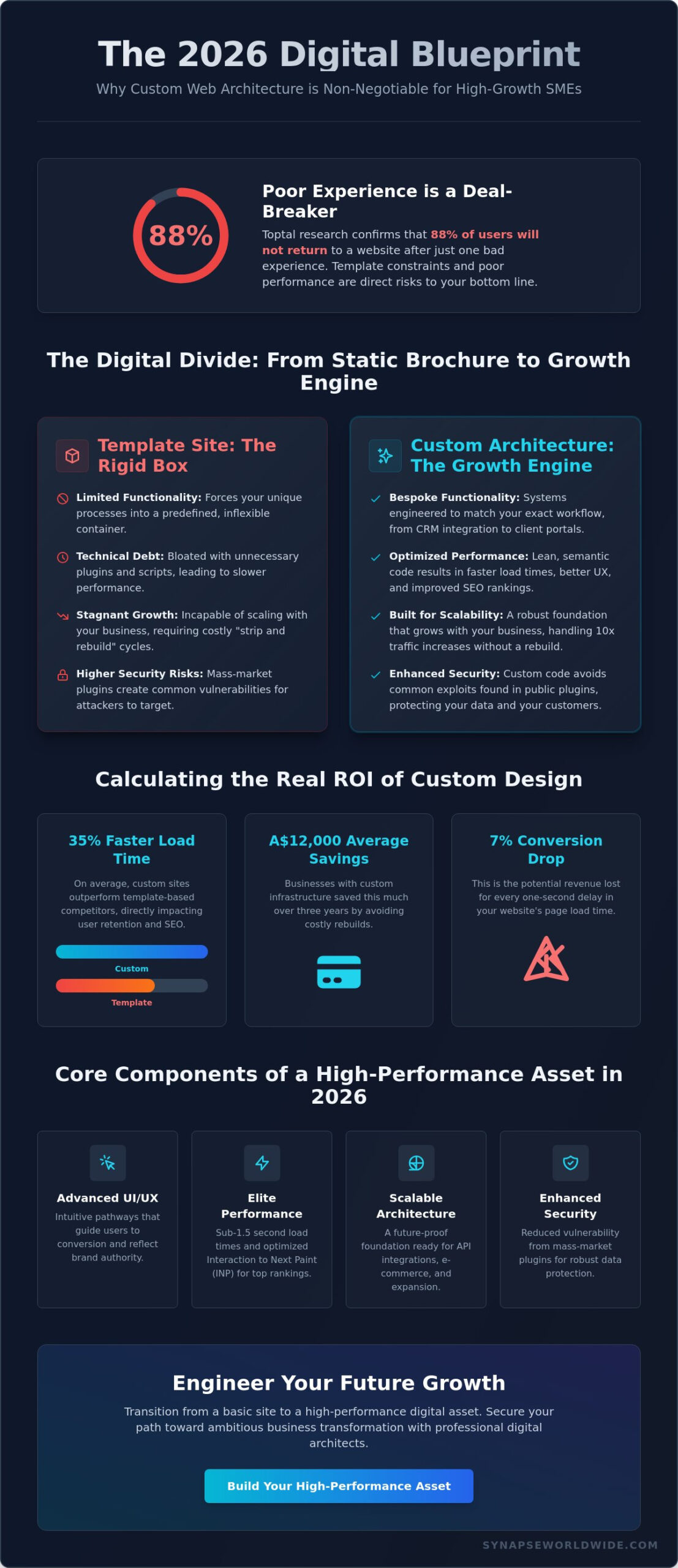
By 2026, a website that merely “exists” will be a liability rather than an asset for Australian SMEs. If your current platform feels sluggish or fails to sync with your internal CRM, you’re likely considering how custom web design for small business could solve these conversion bottlenecks. Research from Toptal indicates that 88% of users won’t return to a site after one poor experience, making template constraints a genuine risk to your bottom line. You likely agree that a digital presence that fails to reflect your professional authority or integrate with your workflow acts as a barrier to scaling.
Investing in bespoke architecture is the most effective way to eliminate technical debt and build a robust, integrated infrastructure. This article demonstrates how to transition from a basic site to a high-performance asset that aligns with your business tools and growth targets. We’ll preview the strategic framework required to ensure your brand remains a dominant force in the Australian market for years to come.
Key Takeaways
- Transition from rigid templates to a bespoke digital architecture designed to scale seamlessly with your evolving business goals.
- Identify the 2026 technical non-negotiables, from Core Web Vitals to advanced performance metrics, that ensure your asset remains competitive in the Australian landscape.
- Analyze the real ROI of custom web design for small business by comparing initial investment against the long-term costs of template limitations and technical debt.
- Follow a strategic roadmap that aligns information architecture with user experience to convert your digital presence into a high-performance growth engine.
- Discover how engineering a robust, integrated foundation with professional digital architects secures your path toward ambitious business transformation.
The Strategic Value of Custom Web Design for Small Business
Custom web design for small business isn’t merely a visual exercise. It’s the construction of a bespoke digital architecture designed to convert visitors into long-term partners. While off-the-shelf templates offer a low barrier to entry, they often trap Australian businesses in a cycle of limited functionality and stagnant growth. By 2026, the distinction between a static Digital Brochure and a dynamic Growth Engine will define market leaders in the local economy.
A template is a rigid box. It forces your unique business processes to fit into a pre-defined container. In contrast, custom design starts with your specific goals. Whether you’re targeting a 20% increase in lead generation or streamlining a complex booking system, every line of code serves a strategic purpose. This bespoke approach ensures your brand authority remains intact while providing a unique user journey that competitors using generic themes can’t replicate. A 2024 digital consumer report indicated that 38% of visitors stop engaging with a website if the layout is unattractive or non-functional, making the move toward custom builds a financial necessity rather than a luxury. Understanding the website redesign signals that indicate your current platform is holding you back is the critical first step before committing to a bespoke solution.
Architecture vs. Aesthetics: Why Custom Matters
Aesthetics catch the eye, but architecture drives the bottom line. A site’s underlying structure influences how effectively search engines index your content. When you understand the core components of web design, it becomes clear that clean, semantic code is vital for visibility. Custom builds eliminate the Technical Debt associated with bloated plugins and unnecessary scripts found in templates. This efficiency resulted in a 35% faster average load time for custom sites compared to template-based competitors in a 2024 performance audit. Fast, clean code improves crawlability, ensuring your business stays visible on search engine results pages.
Building for Scalability and Future Growth
Your website is a long-term business asset, not a recurring operational hurdle. Investing in custom architecture means your platform grows alongside your revenue. You can integrate client portals, advanced e-commerce modules, or proprietary APIs without the need for a total rebuild. This scalability is crucial for Australian SMEs looking to expand their footprint. A 2025 industry report highlighted that businesses with custom-built infrastructures saved an average of A$12,000 over three years by avoiding the strip and rebuild cycle common with limited templates. We treat your digital presence as a robust foundation for transformation, ensuring performance remains stable even as your traffic volume increases ten-fold.
- Bespoke Functionality: Systems built to match your specific workflow.
- Enhanced Security: Reduced vulnerability compared to mass-market templates.
- Optimised Performance: Tailored code that prioritises speed and user experience.
Core Components of a High-Performance Digital Asset in 2026
In 2026, a digital presence requires more than aesthetic appeal; it demands a sophisticated technical foundation that prioritises performance and user trust. Google’s transition to Interaction to Next Paint (INP) as a core metric means that responsiveness is now a primary ranking factor. A high-performance asset must load in under 1.5 seconds to retain the 53% of mobile users who abandon sites that take longer to display. For Australian businesses, this technical excellence isn’t optional. It’s the baseline for visibility in a crowded national market.
Advanced UI/UX: Crafting the User Journey
Effective design moves beyond simple visuals. We focus on functional interfaces that guide users toward specific actions through intuitive pathways. User experience serves as the indispensable bridge between a visitor’s initial intent and your ultimate business conversion. By implementing data-driven UX, businesses can reduce friction points that typically cause cart abandonment or lead loss. Adhering to small business website best practices ensures your homepage functions as a high-velocity entry point for new customers rather than a static digital wall.
Performance Optimization and Speed
Speed is a direct driver of revenue. Research indicates that a one-second delay in page load time can result in a 7% drop in conversions. Choosing custom web design for small business allows for the removal of unnecessary code bloat often found in generic, off-the-shelf templates. We utilise modern hosting environments and server-side optimisations to ensure peak performance across all devices. This lean approach to development guarantees that your site remains fast, scalable, and ready to handle sudden traffic spikes during growth phases. For businesses operating online stores, understanding how these performance principles apply to ecommerce website development is essential to preventing significant revenue loss from slow-loading product pages.
Privacy and Security in the Modern Landscape
Security is no longer a backend technicality; it’s a core brand promise. With the Australian Privacy Act undergoing significant reforms since 2024, businesses must handle data with absolute transparency and rigour. Custom frameworks allow for bespoke security protocols that far exceed standard SSL certificates. Protecting client data builds the trust necessary for long-term growth and protects your reputation from the fallout of data breaches. Investing in a strategic digital framework ensures your business remains resilient against evolving cyber threats while maintaining full regulatory compliance. This proactive stance on security transforms a technical requirement into a competitive advantage—a principle that extends to physical safety where firms like Boss Security Screens offer the professional protection needed to safeguard a business’s tangible assets.
Custom vs. Template: Calculating the Real ROI
Choosing between a pre-made template and a bespoke digital build is a financial decision that dictates your trajectory for the next three to five years. While a template might require an initial outlay of only A$100 to A$500, the long-term maintenance often creates a “technical debt” that hinders growth. Custom web design for small business transforms your website from a static digital brochure into a high-performance asset. This strategic investment eliminates the need for expensive “workarounds” that occur when generic layouts fail to integrate with specific Australian business processes, such as local shipping APIs or specialized booking systems.
The performance gap between these two paths is measurable. Generic templates often suffer from code bloat, loading unnecessary features that slow down page speeds. Data from Google indicates that 53% of mobile visits are abandoned if a page takes longer than three seconds to load. A custom-built site, optimized for precision, typically achieves higher conversion rates by guiding users through a frictionless journey designed specifically for your target demographic. Retailers seeking to apply this precision to their online stores should consult a comprehensive ecommerce website development buying guide to understand the full scope of investment required for scalable growth.
The Hidden Costs of DIY and Low-Cost Templates
Low-cost DIY builders often lead to significant revenue leakage that doesn’t appear on a balance sheet immediately. Small businesses frequently find themselves trapped in a cycle of troubleshooting and limited functionality. Consider these common financial drains:
- The Plugin Trap: Templates rely on third-party plugins for basic features. Maintaining 15 to 20 different plugins creates security vulnerabilities and requires constant updates; one incompatible update can crash your entire storefront.
- Performance Penalties: Slow-loading sites directly impact your bottom line. For an Australian SME with an annual turnover of A$500,000, even a 1% loss in conversion due to lag represents A$5,000 in lost revenue every year.
- Development Hours: Hiring a developer to “fix” a template often costs between A$120 and A$250 per hour. These costs quickly surpass the price of an original custom build.
Strategic Gains of a Bespoke Solution
Investing in custom web design for small business ensures you own your digital infrastructure entirely. You aren’t beholden to a third-party theme developer who might abandon their product, leaving your site obsolete. This independence allows for a robust, scalable foundation that grows alongside your company.
A bespoke solution provides a unique digital identity that competitors cannot replicate with a “buy-and-install” theme. This visual authority builds immediate trust with Australian consumers who demand professional standards. Beyond aesthetics, custom builds allow for enhanced data collection. By integrating specific analytics and heat-mapping tools directly into the architecture, you gain deeper insights into customer behavior. Reviewing custom web design examples from leading Australian firms can help you identify the strategic blueprints that drive seamless backend automation and a distinctive brand identity. This data-driven approach empowers you to make informed decisions that drive consistent, long-term business transformation.
The Roadmap to a Bespoke Digital Presence
Transforming a vision into a high-yielding digital asset requires more than aesthetic intuition; it demands a rigorous, multi-stage engineering process. A custom web design for small business isn’t a static brochure but a dynamic growth engine that must be architected for performance. This journey begins with aligning digital goals with commercial objectives, ensuring every technical decision supports your bottom line. We map the information architecture to balance SEO requirements with intuitive user flows, creating a site structure that guides visitors toward conversion without friction.
Our development team prioritises a robust backend that connects your digital presence to the rest of your business ecosystem. By the time we reach the prototyping stage, the visual experience is already anchored in strategic data. This disciplined approach ensures the final product is scalable, secure, and capable of evolving alongside the Australian market in 2026.
While we focus on the digital realm, businesses looking to apply this same level of architectural precision to physical products can discover Protomolecule for specialist 3D printing and rapid prototyping services.
Phase 1: Discovery and Strategic Planning
Success begins with deep alignment. We identify specific target personas, such as the “Time-Poor Executive” or the “Value-Conscious Researcher,” to map their unique online behaviors. In the current Australian digital environment, consumer expectations are at an all-time high; research shows that a one-second delay in page load can result in a 7% reduction in conversions. We define clear KPIs, focusing on measurable outcomes like qualified lead volume and direct sales rather than vanity metrics.
We also map out necessary integrations to streamline your operations. This includes connecting your website to essential tools such as:
- CRM Systems: Seamlessly syncing leads with platforms like HubSpot or Salesforce.
- Financial Tools: Integrating Australian-centric ERPs like Xero for automated invoicing.
- Marketing Automation: Setting up triggers for personalised email sequences based on user activity.
Phase 2: Execution and Quality Assurance
The transition from a prototype to a living digital engine requires technical precision. We build using clean, scalable code that ensures your custom web design for small business remains fast and secure. Rigorous testing is non-negotiable. Our team verifies performance across 50 different device and browser combinations to guarantee a flawless experience for every user. We don’t settle for “good enough” when your brand’s reputation is on the line.
Accessibility is a core pillar of our execution. We adhere to WCAG 2.2 standards to ensure your site is inclusive and compliant with evolving Australian regulations. Once the platform passes our 100-point quality checklist, we manage the deployment and provide a structured transition to ongoing maintenance. This proactive management keeps your digital asset optimised for peak performance well after the initial launch.
Ready to build a high-performance digital asset? Consult with the experts at Synapse Worldwide today.
Synapse Worldwide: Engineering Your Growth Through Bespoke Design
Synapse Worldwide operates as the Digital Architects for ambitious Australian firms. We build integrated, scalable, and robust digital solutions that function as a legitimate growth engine for your brand. Our team bridges the gap between high-level commercial strategy and technical execution; we ensure that every architectural decision aligns with your bottom line. We use a fixed-price project model to provide total transparency for your business planning. You’ll know exactly what your A$ investment covers before the first line of code is written, which removes the financial unpredictability often found in complex technical projects.
Integrated Business Solutions: Beyond the Website
A website shouldn’t be a static brochure. In the 2026 digital economy, your site must serve as the central nervous system of your operations. We specialize in connecting your custom web design for small business to critical internal systems like CRM and ERP platforms. This connectivity can reduce administrative overhead by as much as 25% within the first twelve months of implementation. We also build automated marketing and sales funnels directly into your digital asset. This ensures leads are captured and nurtured without manual intervention, turning your website into a 24/7 revenue generator. You can learn more about our CRM integration services to understand how we streamline your business processes through smart engineering.
A Partnership Focused on Results
We bring over 20 years of experience in the Australian digital landscape to every partnership. We’ve helped hundreds of businesses transition from restrictive, cookie-cutter templates to high-performance, bespoke systems that actually scale. Our role doesn’t end at the launch. We provide ongoing support and proactive maintenance to keep your asset optimized and secure against evolving threats. This long-term focus ensures your custom web design for small business remains a competitive advantage rather than a depreciating asset.
Our Digital Architects manage the technical complexity so you can focus on scaling your operations. We prioritize data-driven claims over aesthetic trends, ensuring your site performs as well as it looks. To maximise the return on your bespoke digital investment, pairing it with professional ppc management services transforms your high-performance site into a scalable engine for national expansion by converting paid traffic intent directly into qualified revenue. Ready to transform your digital presence into a measurable revenue driver? Schedule a strategic consultation with our Digital Architects to begin your business transformation.
Architecting Your Competitive Advantage in the 2026 Digital Economy
The transition toward 2026 demands more than just an online presence; it requires a high-performance asset that functions as a 24/7 growth engine. Investing in custom web design for small business provides the scalability and technical depth needed to outperform competitors who rely on rigid, cookie-cutter templates. A bespoke site isn’t just about aesthetics. It’s about seamless CRM and ERP integrations that streamline operations and turn Australian site visitors into loyal clients. This strategic approach ensures your digital footprint remains robust as market conditions evolve. To ensure your bespoke website operates as part of a cohesive system, developing a unified digital marketing strategy for your SMB ensures your website, paid campaigns, and sales data work in total unison to drive measurable growth.
Synapse Worldwide has served as a trusted Digital Architect since 2005, delivering the technical precision required for national growth. Our team focuses on engineering long-term business solutions that bridge the gap between sophisticated technology and practical ROI. We don’t just build websites; we design integrated ecosystems that empower your brand to reach the next level of success. Pairing your bespoke digital infrastructure with a robust seo for small business strategy ensures your high-performance asset generates predictable organic leads and compounds in value over time. Secure your place at the forefront of your industry by leveraging our two decades of expertise in the Australian market.
Partner with Synapse Worldwide for a bespoke digital strategy
Your journey toward a more profitable and scalable future starts with a single strategic decision. Let’s build something extraordinary together.
Frequently Asked Questions
What is the difference between custom web design and a website template?
Custom web design involves building a unique digital architecture from the ground up to meet your specific business objectives, while templates rely on pre-built layouts. Templates often include bloated code that hinders performance and limits your brand’s identity. A bespoke solution ensures every element serves your conversion goals. In the Australian market, 88% of users won’t return to a site after a poor experience, making unique design a critical differentiator.
How long does it typically take to build a custom website for a small business?
A professional custom web design for small business typically requires 8 to 12 weeks from the initial discovery phase to the final launch. This timeframe allows for deep strategic planning, wireframing, and rigorous quality assurance across all devices. Complex projects involving advanced functionality or deep integrations might extend to 16 weeks. We follow a structured workflow to ensure your digital asset is robust and ready for the 2026 competitive landscape.
Can a custom website be integrated with my existing CRM or ERP system?
Yes, custom websites are designed specifically to integrate seamlessly with your existing CRM or ERP systems through secure API connections. Whether you use global platforms like Salesforce or local Australian solutions like MYOB, we build the bridge between your website and back-office operations. This automation can reduce manual data entry by 40% and ensures your business data remains synchronized. It transforms your website into a functional part of your operational ecosystem.
Is custom web design worth the investment for a new business?
Investing in custom web design for small business is a strategic move for new ventures looking to establish immediate authority and long-term scalability. While templates have lower initial costs, they often require expensive overhauls within 18 months of launch. A custom site provides a solid foundation that grows with you. Starting with a high-performance asset ensures you don’t lose potential customers to technical friction or poor brand positioning during your first year.
How does custom web design affect my search engine rankings (SEO)?
Custom web design significantly enhances your search engine rankings by providing a clean code structure and superior site speed. Google’s Core Web Vitals prioritize user experience metrics that many templates struggle to meet consistently. We optimize the site architecture so search engines can crawl your content efficiently. This technical precision helps your business compete for high-value keywords in the crowded Australian digital landscape, driving more organic traffic to your pages. To maximise these gains, pairing your bespoke build with a dedicated seo for small business framework ensures your organic visibility compounds alongside your site’s technical performance.
What happens to my website as my business grows and needs more features?
Your custom website is built on a modular architecture that allows for seamless expansion as your business requirements evolve. Unlike rigid templates, bespoke solutions can accommodate new features like e-commerce modules, membership portals, or advanced booking systems without requiring a total rebuild. This flexibility ensures your digital presence remains a high-performing growth engine. You can scale your operations throughout 2026 and beyond without worrying about technical limitations holding you back. If you’re unsure whether your current platform has reached its limits, reviewing the key website redesign signals that indicate your infrastructure needs an upgrade can help you make that determination with confidence.
Who owns the code and design once a custom website is completed?
You retain full ownership of the custom code, design assets, and content once the project is completed and final payment is settled. We believe in empowering our clients rather than locking them into proprietary platforms or restrictive contracts. You receive all necessary documentation and source files. This transparency ensures you have total control over your digital intellectual property and the freedom to manage your asset as your business strategy dictates.
Do I need technical knowledge to manage a custom-built website?
You don’t need advanced technical skills to manage your website because we integrate intuitive Content Management Systems (CMS) tailored to your specific workflow. We provide comprehensive training and documentation so your team can update text, images, and blog posts with ease. Our goal is to provide a sophisticated tool that’s simple to operate daily. We also offer ongoing strategic support to handle complex technical optimizations while you focus on core business growth.

