
Tag Archives: digital strategy


Website Redesign Signals: A Strategic Checklist for Business Infrastructure in 2026

Website Redesign Signals: A Strategic Checklist for Business Infrastructure in 2026

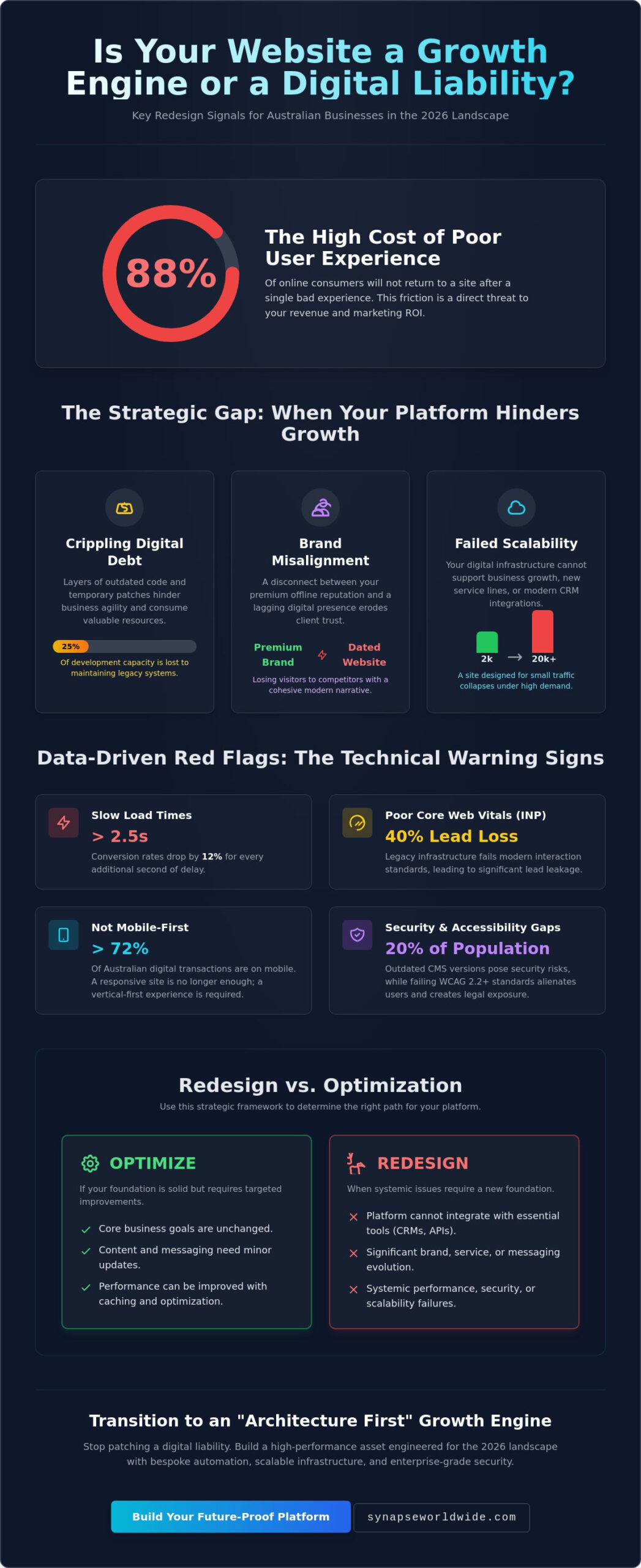
What if your digital storefront isn’t just a static asset, but is actively funneling potential revenue toward your competitors? For many Australian firms, a website that felt modern in 2022 now functions as a bottleneck rather than a bridge to growth. Recognizing the subtle website redesign signals is the difference between maintaining a digital liability and engineering a scalable business tool. You’ve likely noticed that high bounce rates are eroding your marketing ROI, or perhaps your team spends more time fighting a rigid CMS than closing leads. A 2024 industry report indicates that 88% of online consumers won’t return to a site after a poor user experience, making these technical frictions a direct threat to your bottom line.

It’s frustrating when your premium service offerings are trapped behind an interface that no longer reflects your brand’s sophistication. This guide identifies the critical performance and UX indicators that demand a strategic evolution of your digital infrastructure. We’ll provide a comprehensive checklist to help you integrate modern CRMs and optimize your presence for the 2026 landscape. You’ll learn how to pivot from a state of brand misalignment to a position of market authority and measurable results.

Key Takeaways

  • Learn to identify “digital debt” and assess whether your current infrastructure is a scalable asset or a technical liability hindering your business agility.
  • Master the critical website redesign signals emerging in 2026, from holistic Core Web Vitals to the security protocols required for modern Australian enterprise standards.
  • Discover how to eliminate conversion leaks and build the digital trust necessary to secure high-value corporate and government contracts.
  • Apply a strategic scoring framework and the “Rule of Three” to determine if your platform requires a minor optimization or a complete foundational redesign.
  • Transition to an “Architecture First” approach that integrates bespoke business process automation to turn your website into a high-performance growth engine.

Identifying the Strategic Gap: When Your Digital Infrastructure No Longer Scales

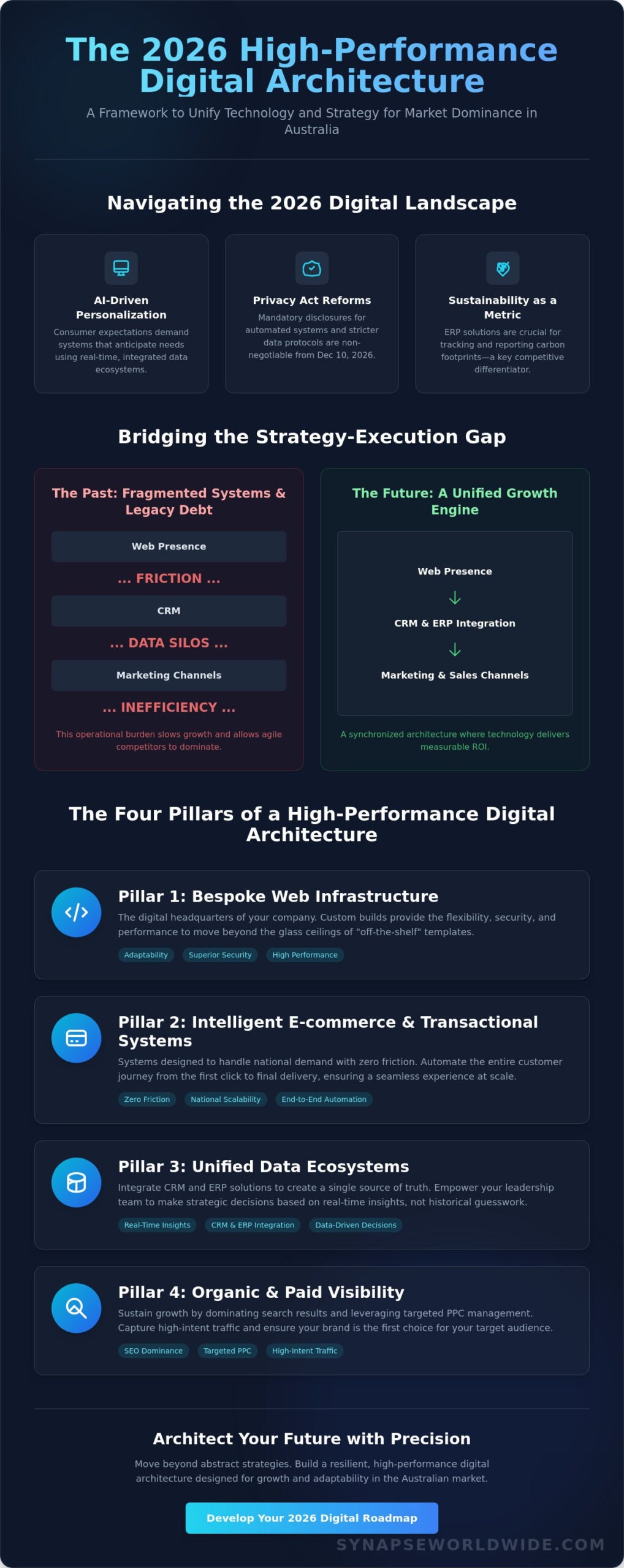
Recognising website redesign signals requires moving beyond visual preferences. It involves auditing the systemic indicators that dictate whether your platform accelerates or obstructs growth. By 2026, the gap between high-performing digital assets and legacy systems will widen. Many Australian firms currently carry heavy “Digital Debt,” where layers of outdated code and temporary patches hinder business agility. This technical debt often costs enterprises up to 25% of their development capacity just to maintain basic functionality.

While a “dated look” often triggers the initial conversation, it remains the least critical driver for a full rebuild. Real website redesign signals manifest as high bounce rates, server response times exceeding 3 seconds, or an inability to integrate modern AI-driven APIs. Effective platforms must adhere to the fundamental principles of web design, focusing on usability and technical robustness rather than surface-level trends. Strategic redesigns align your digital presence with 2026 revenue drivers, ensuring your infrastructure supports rather than stifles your trajectory.

The Evolution of Business Objectives

Your digital architecture must mirror your 2026 roadmap. If your firm has expanded into new service models since 2023, a static user journey will fail to convert. Scaling brings technical pressure; a site designed for 2,000 monthly visitors often collapses under the weight of 20,000. In Australia, where mobile commerce accounts for over 72% of digital transactions, failing to scale server architecture leads to immediate revenue loss. If your current site cannot support new product lines or integrated CRM systems, it’s a clear indicator that your infrastructure has reached its ceiling.

Messaging and Brand Misalignment

A disconnect between a premium offline reputation and a lagging digital presence creates cognitive dissonance for high-value clients. If your content reads like a 2019 resume rather than a solution-oriented narrative, you’ll lose approximately 88% of visitors to more agile competitors. Inconsistent branding across LinkedIn, Instagram, and your primary site isn’t just a design flaw; it’s a conversion killer. Modern visitors seek bespoke experiences. When your messaging feels generic or outdated, it erodes the professional trust you’ve spent years building. Aligning these touchpoints is essential for maintaining a cohesive omnichannel strategy that resonates with a sophisticated Australian audience.

Technical and Performance Red Flags: The Data-Driven Signals

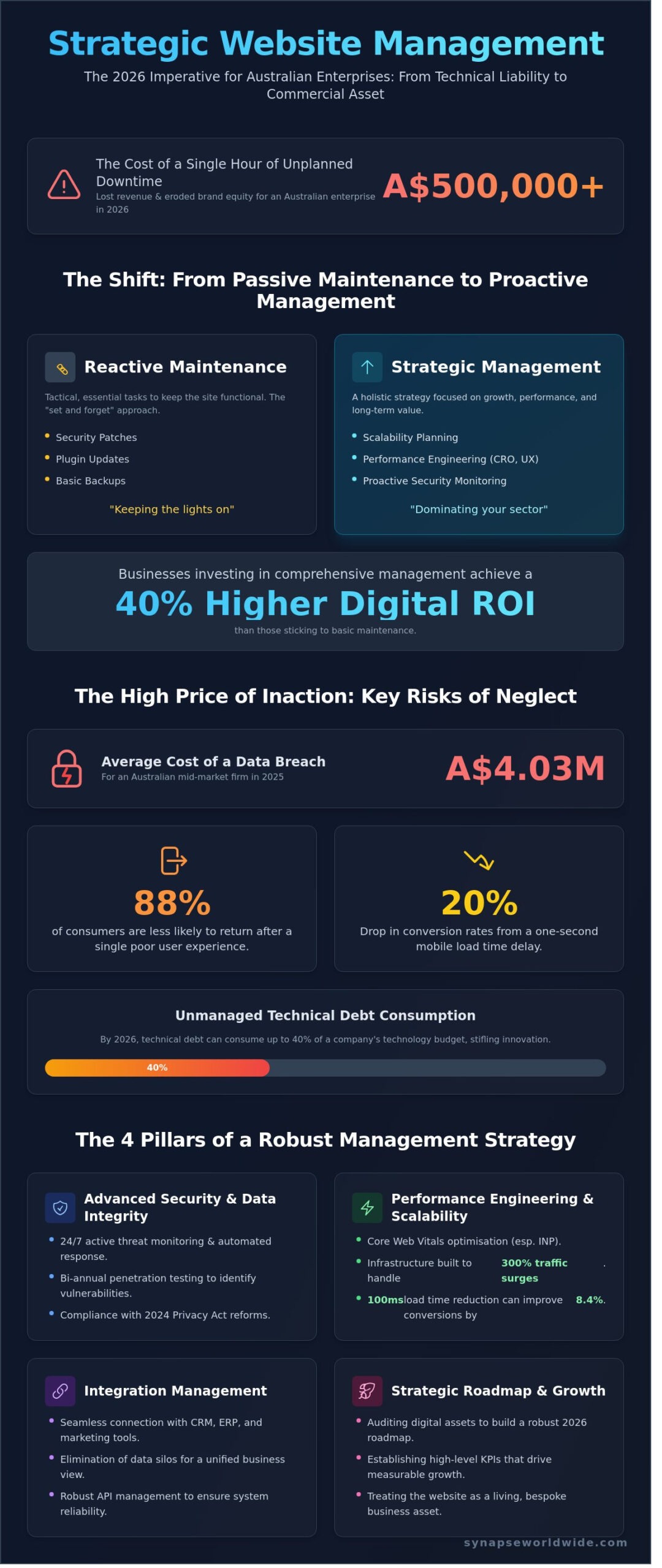
In 2026, a slow website isn’t just an inconvenience; it’s a liability that actively drains your marketing budget. Google’s Core Web Vitals have moved beyond simple speed metrics to a holistic assessment of user interaction. We see Australian businesses losing up to 40% of potential leads because their legacy infrastructure can’t meet the Interaction to Next Paint (INP) standards established in 2024. Security vulnerabilities in outdated CMS versions serve as the final warning for migrating to more secure, bespoke environments. If your platform relies on patches for vulnerabilities discovered three years ago, your data integrity is at risk.

The “Mobile-Only” reality has superseded the era of responsive design. Modern search engines prioritise sites built specifically for vertical-first experiences. Australian brands must also acknowledge that accessibility is no longer a “nice-to-have” feature. Adhering to WCAG 2.2+ standards is a legal and ethical requirement for national brands under the Disability Discrimination Act. Failing these benchmarks doesn’t just hurt your SEO; it exposes your company to significant legal risks and alienates 20% of the population living with a disability.

Systemic Performance Degradation

High bounce rates often stem from technical friction rather than poor content. When your site takes longer than 2.5 seconds to load, your conversion floor drops by 12% for every additional second of delay. Implementing aggressive website performance optimization is the only way to retain impatient users in a high-speed market. Legacy platforms often suffer from “bloatware,” where redundant plugins and unoptimised code prevent rapid updates. This technical debt makes your business agile-resistant, stalling growth while competitors pivot with ease.

SEO and Visibility Decline

A gradual slide in organic rankings is one of the most reliable website redesign signals. Outdated site architecture often leads to keyword cannibalization, where multiple pages compete for the same search intent, diluting your authority. To understand the full scope of these transitions, consult a comprehensive website redesign guide to audit your current technical standing. Modern SEO also requires preparing for AI-driven search. If your site structure isn’t readable by LLM crawlers, your brand won’t appear in AI-generated summaries or voice search results. Your digital infrastructure must be clean, structured, and schema-heavy to remain visible.

If you’re noticing these technical red flags, it’s time to consult with a digital architect to secure your business infrastructure for the years ahead.

Website Redesign Signals: A Strategic Checklist for Business Infrastructure in 2026

User Experience and Conversion Friction: Why Visitors Are Not Becoming Leads

High bounce rates and stagnant lead counts aren’t just statistics; they’re symptoms of structural failure within your digital infrastructure. Conversion leaks often occur where user expectations clash with outdated architecture. For Australian firms pursuing high-value corporate or government contracts, your digital interface serves as a silent vetting tool. A clunky interface suggests a clunky operation. Implementing custom web design for small business ensures the path from interest to inquiry is frictionless. A surge in bounce rates and a decline in qualified inquiries are the most prominent website redesign signals a business can encounter. Identifying these website redesign signals early prevents the erosion of your market share to more agile competitors.

Navigational Complexity and High Friction

By 2026, the “Three Click Rule” has evolved into a demand for instant accessibility. It’s no longer just about the number of clicks but about the cognitive load required to find a solution. If session recordings show users hovering over menus without clicking, or bouncing after 15 seconds on a service page, you’re seeing clear signals for a website redesign. Data from 2025 UX audits indicates that contact forms with more than four fields can drop conversion rates by 67%. Your current forms might be the primary barrier to your ROI, acting as a gatekeeper rather than a gateway. Heatmaps often reveal “dead clicks” where users expect interactivity that doesn’t exist, leading to immediate frustration and exit.

The Messaging Disconnect

A visitor decides to stay or leave within five seconds. If your site doesn’t articulate your “Who, What, and How” immediately, you lose them to the next search result. Reviewing custom web design examples reveals that industry leaders prioritise clarity over cleverness. In the Australian market, where authenticity is a primary trust driver, generic stock imagery and vague copy are active conversion killers. Authentic visuals and precise, benefit-driven language establish authority. When your messaging is misaligned with user intent, even the highest traffic volume won’t yield results. Strategic redesign replaces fluff with facts, ensuring your site answers critical buyer questions before they’re even asked.

  • Friction Points: Identify where users drop off in the checkout or inquiry process.
  • Trust Indicators: Ensure certifications and case studies are visible within two scrolls.
  • Mobile Logic: Test if navigation is thumb-friendly on a standard 6.7-inch smartphone screen.
  • Loading Thresholds: Aim for a Largest Contentful Paint (LCP) of under 2.5 seconds to retain 80% of your visitors.

Redesign vs. Optimization: A Strategic Decision Framework

Deciding between a minor update and a total overhaul requires a cold, data-driven assessment. We use a proprietary scoring system to evaluate digital assets across performance, accessibility, and conversion metrics. If your site scores below 60% on a core performance audit, a cosmetic facelift won’t solve the underlying structural decay. You’re simply painting over cracks in a failing foundation. This is why identifying website redesign signals early is vital for maintaining a competitive edge in the Australian market.

Apply the “Rule of Three” to your current audit. If you identify three or more critical issues, such as a bounce rate exceeding 70%, a mobile conversion rate 50% lower than desktop, and a slow Largest Contentful Paint (LCP) over 2.5 seconds, a redesign is the only efficient path. Patchwork fixes on an outdated foundation often cost 40% more over a 24 month period than a clean, bespoke rebuild. Technical limitations in a generic CMS often lead to plugin bloat, where every new feature slows the site further. A bespoke solution is built for speed and specific business outcomes rather than generic convenience.

When Optimization Is Sufficient

Optimization works when the engine is sound but the exterior is tired. You can achieve a 20% lift in conversions by refining landing page copy or compressing oversized images to improve load times. A professional SEO audit identifies these low-hanging fruit opportunities without requiring a full code rewrite. If your current CMS supports modern schema markup and has a clean code base, testing incremental UX changes is a prudent first step. This approach preserves your existing equity while addressing specific friction points that hinder the user journey.

The Case for a Structural Redesign

Structural changes become mandatory when legacy code restricts growth. Old architectures often block seamless website crm integration, which prevents you from automating lead nurturing and tracking customer lifetimes accurately. If you’re pivoting your business model or entering a new market in 2026, your site must reflect that shift. A bespoke digital architecture eliminates the technical debt of A$5,000 to A$15,000 spent annually on emergency patches. Investing in a scalable solution ensures your infrastructure grows alongside your revenue. It’s a shift from viewing your website as a static brochure to seeing it as a dynamic business engine.

Stop wasting resources on temporary fixes and build a foundation for growth. Consult with our strategic architects today to determine the best path for your business infrastructure.

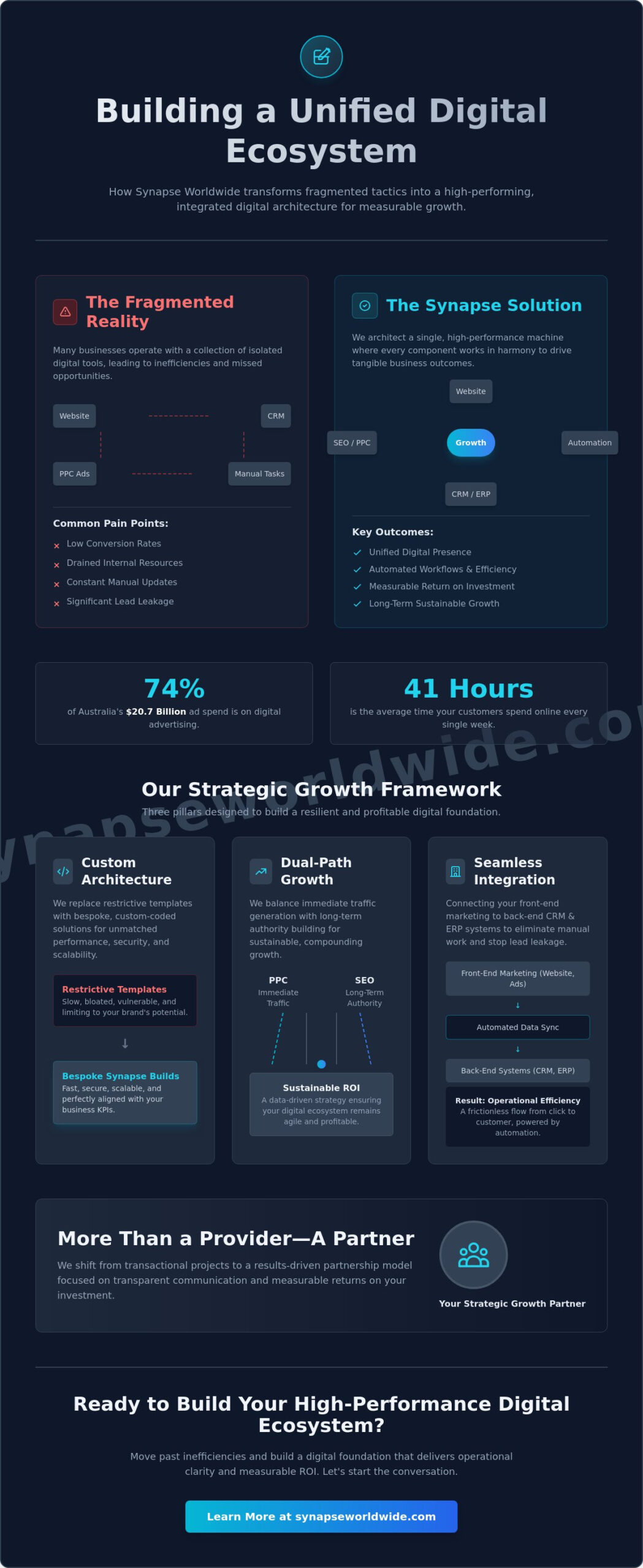
A successful transition requires more than aesthetic updates; it demands a structural evolution. At Synapse Worldwide, we employ an “Architecture First” methodology. This ensures your digital foundation supports long-term scaling rather than just immediate visual appeal. Identifying website redesign signals early allows you to move from a reactive posture to a proactive market position. We treat your website as the central engine for all national digital marketing efforts, ensuring every dollar spent on search or social media converts through a high-performance interface.

Modern infrastructure must go beyond simple content delivery. By integrating business process automation directly into your site structure, you eliminate manual data entry and reduce operational overhead. This strategic integration transforms your website from a passive brochure into a functional tool that manages leads, processes orders, and synchronizes with your internal workflows in real-time. It’s about creating a system that works as hard as your best employees.

Discovery and Strategic Planning

The discovery phase defines the project’s ROI. We map user journeys to align with your high-value customer personas, ensuring the path to conversion is frictionless. You shouldn’t settle for vague goals. We set hard KPIs such as a 25% increase in lead volume and ensuring Largest Contentful Paint (LCP) remains under 2.5 seconds to meet 2024 performance standards. While templates offer speed, bespoke solutions provide the robust framework necessary for complex Australian corporate environments where security and unique functionality are non-negotiable.

Implementation and Future-Proofing

Clean, scalable code is the difference between a site that lasts two years and one that thrives for five or more. Our developers focus on structural integrity to ensure seamless integration with existing ERP and CRM systems like Salesforce or Microsoft Dynamics. Protecting your SEO equity is a priority during this phase. We implement rigorous 301 redirect mapping and metadata migration to ensure your historical search rankings remain intact. After launch, our team conducts iterative performance tuning, using real-world data to refine the user experience and maintain your competitive edge in the Australian market.

Architecting Your Next Phase of Growth

Recognising website redesign signals early prevents technical debt from stalling your Australian business’s momentum. Your digital infrastructure shouldn’t just exist; it needs to scale alongside 2026 market demands. Performance red flags and conversion friction are often the first indicators that a legacy system is failing. Whether you’re managing complex corporate assets or government-level infrastructure, moving from basic optimization to a strategic architectural rebuild is often the most effective path to sustainable ROI.

Synapse Worldwide brings over 20 years of expertise to every project, delivering bespoke digital solutions that prioritize scalability and measurable results. We understand the unique nuances of the Australian digital landscape and provide the robust framework required for sophisticated operations. Don’t let outdated technology limit your vision for transformation. Our team is ready to help you build a high-performance engine that turns visitors into high-value leads.

Book a strategic consultation with Synapse Worldwide to start your journey toward a more powerful digital presence.

Frequently Asked Questions

How often should a professional business website be redesigned?

Most high-performing Australian businesses redesign their digital infrastructure every 2 to 3 years. This cycle ensures your brand remains compatible with the latest browser updates and security protocols. A 2023 study by HubSpot found that 88% of users are less likely to return to a site after a bad experience. Regular updates prevent technical debt from accumulating and keep your conversion pathways optimized for modern consumer behavior.

Can a website redesign hurt my current SEO rankings?

A website redesign can negatively impact your search visibility if you fail to implement a robust 301 redirect strategy. However, when executed with precision, identifying the right website redesign signals allows you to fix legacy crawl errors and improve site architecture. Data from SEMrush indicates that sites with clean migrations often see a 20% increase in organic traffic within 6 months. We focus on preserving your existing authority while building a more scalable foundation for future growth.

What is the average timeframe for a custom website redesign in Australia?

A sophisticated, bespoke website redesign typically requires a timeline of 12 to 16 weeks from discovery to deployment. This period accounts for deep strategic planning, custom UI/UX design, and rigorous quality assurance. Smaller projects might conclude in 8 weeks; however, complex enterprise solutions involving integrated APIs or custom databases often extend to 20 weeks. We prioritize a disciplined workflow to ensure every digital asset is polished and functional before the launch date.

Is it better to use a template or a bespoke design for a redesign?

Bespoke designs offer superior ROI and scalability for growing businesses that require a unique market position. Templates often include 30% more bloated code, which slows down performance and limits your ability to scale. A custom-built solution ensures your infrastructure aligns perfectly with your specific operational goals. While templates have lower initial costs, bespoke sites deliver a 40% higher conversion rate on average by providing a seamless, tailored user journey that reflects your brand’s authority.

How do I know if my website speed is a sign for a redesign?

Your website speed is a primary indicator for a redesign if your pages take longer than 3 seconds to load completely. Google’s Core Web Vitals data shows that bounce rates increase by 32% as page load time goes from 1 second to 3 seconds. If your current backend architecture cannot achieve a mobile speed score above 90 on PageSpeed Insights, it’s a clear sign your infrastructure is obsolete. We replace sluggish legacy code with high-performance frameworks to reclaim your competitive edge.

What are the most critical website redesign signals to watch for in 2026?

The most critical website redesign signals for 2026 include a drop in mobile engagement and the lack of integrated data analytics. If your current platform can’t support automated customer service portals or real-time personalization, you’re falling behind. Industry reports suggest that 75% of B2B buyers now expect a personalized digital experience. A strategic overhaul ensures your business infrastructure is ready to leverage these emerging technologies while maintaining a robust security posture.

Should I redesign my website if my competitors just launched new sites?

You shouldn’t redesign simply because a competitor did, but you must analyze if their new site offers a superior user experience that threatens your lead volume. If 3 of your top 5 competitors have transitioned to faster, more intuitive platforms, your brand perception will suffer. Monitor your conversion metrics closely. If your cost per acquisition has risen by more than 15% since their launch, it’s time to consult with a digital architect to modernize your presence.

How much should I budget for a strategic website redesign?

A strategic redesign for an established Australian business generally requires an investment ranging from A$15,000 for standard professional sites to over A$100,000 for complex enterprise platforms. According to 2024 industry benchmarks, high-growth companies allocate 5% to 10% of their annual marketing budget to digital infrastructure. This investment covers strategic consulting, bespoke design, and seamless integration of business tools. We focus on delivering a robust solution that maximizes your return on investment through improved performance and scalability.


Custom Web Design Examples: Strategic Blueprints for Business Growth in 2026

Custom Web Design Examples: Strategic Blueprints for Business Growth in 2026

By 2026, a cookie-cutter website won’t just hinder your growth; it will actively alienate the 88% of Australian consumers who equate digital quality with brand trust. You’ve likely felt the frustration of a template-driven site that looks identical to your competitors and fails to sync with your internal CRM. It’s a common bottleneck that stifles conversion rates and forces your team into manual workarounds. This article examines high-performance custom web design examples to demonstrate how bespoke architecture moves beyond aesthetics to solve these exact technical hurdles.

You deserve a digital presence that acts as a sophisticated growth engine rather than a static brochure. We’ll show you how moving to a tailored solution can eliminate slow load times while providing the robust, scalable infrastructure your business needs to expand. You’ll discover the strategic blueprints used by leading firms to achieve seamless backend automation and a unique brand identity. We’ll break down the specific elements that turn a visionary design into a high-yielding commercial asset for the Australian market.

Key Takeaways

  • Understand why bespoke digital architecture is essential for overcoming the commercial limitations of saturated template markets in the 2026 Australian digital landscape.
  • Identify the core pillars of performance-driven sites, focusing on how “invisible design” and clean code ensure long-term scalability and robust security.
  • Examine industry-specific custom web design examples to understand how tailored user journeys and frictionless architectures directly influence commercial ROI.
  • Master a strategic framework for evaluating design inspiration through the lens of specific conversion goals and user-centric “Speed to Value.”
  • Discover the Synapse Worldwide methodology that combines a strategy-first “Digital Architect” approach with transparent, fixed-price project models for Australian enterprises.

Beyond Aesthetics: Why Custom Web Design Examples Matter in 2026

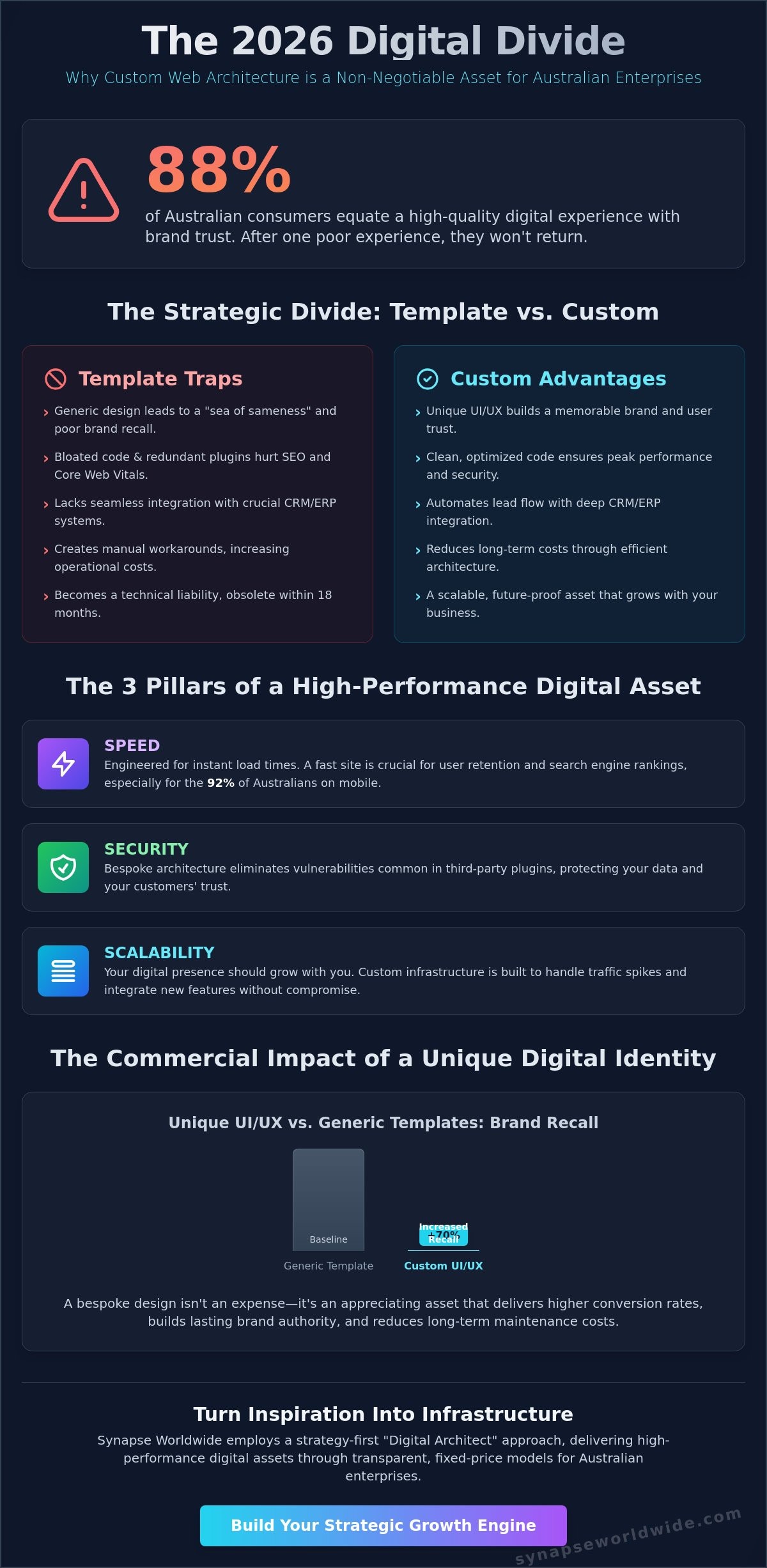
Custom web design is no longer a luxury for Australian enterprises; it’s a foundational digital architecture built to convert. By 2026, the digital marketplace has moved past simple aesthetics. Businesses now require bespoke systems where every pixel serves a specific commercial objective. Reviewing high-performing custom web design examples provides more than just visual inspiration. It offers a proof of concept for technical scalability and brand authority in an environment where 88% of users won’t return to a site after a poor experience.

The Australian digital landscape is currently saturated with “off-the-shelf” templates that create a sea of sameness. These pre-packaged solutions often fail to reflect the unique value propositions of a brand. Foundational Web design principles dictate that every element must serve a functional purpose, yet templates prioritize generic layouts over specific user journeys. We’ve seen a definitive shift from mobile-responsive design to mobile-first architectural priorities. This means the core logic of a site is engineered for the 92% of Australians who browse primarily on handheld devices, ensuring performance isn’t just an afterthought.

Custom vs. Template: The Strategic Divide

Templates carry hidden costs. They often come with bloated code and redundant plugins that create significant technical debt, dragging down Core Web Vitals and long-term SEO performance. A unique UI/UX builds immediate user trust and improves brand recall by 70% compared to generic layouts. Bespoke web design is the deliberate alignment of user intent with business logic through a unique digital interface. This strategic approach ensures your site evolves alongside your business rather than becoming an obsolete liability within eighteen months. Recognising the website redesign signals that indicate your current platform is holding you back is the critical first step toward making this transition.

To avoid the pitfalls of generic templates while maintaining a professional edge, you can visit Erstelle deinen perfekten Online Auftritt mit Litefyr – schnell und einfach!.

The ROI of Bespoke Digital Identity

Investing in a custom layout directly influences your conversion rate optimisation (CRO). When a digital environment is tailored to the specific psychology of your target audience, friction points disappear. This architectural precision reduces long-term maintenance costs because the foundation is clean, secure, and built to scale. For smaller firms looking to compete with industry giants, custom web design for small business acts as a strategic growth engine, providing the professional credibility needed to capture market share. These custom web design examples demonstrate that a robust digital identity is an appreciating asset, not a one-time expense.

The Strategic Blueprint: Essential Features of Performance-Driven Custom Sites

High-performing digital assets aren’t built on templates; they’re engineered through rigorous architectural planning. When reviewing modern custom web design examples, the most successful Australian enterprises prioritize the invisible backend just as much as the front-end interface. This structural integrity rests on three non-negotiable pillars: speed, security, and scalability. Clean code and optimized server-side logic ensure your site handles traffic spikes during peak Australian retail periods without compromising user experience.

Integrating conversion triggers within a bespoke journey requires a deep understanding of user psychology. Research regarding the Benefits of Custom Web Design shows that tailored solutions allow for precise placement of calls-to-action that align with specific buyer personas, rather than generic placeholders. Future-proofing your investment means adopting a headless CMS or API-first mentality. This approach ensures your content remains portable and ready for emerging hardware and software standards well into 2027.

Seamless Integration with CRM and ERP Systems

A custom site serves as the central nervous system for your business operations. It acts as a bridge, connecting your public-facing storefront to internal tools like Salesforce, HubSpot, or Microsoft Dynamics. For instance, an automated lead flow can instantly move a prospect from a high-intent landing page directly into your sales pipeline, reducing manual data entry and human error. Australian firms often require specialized custom software development to manage these complex data handshakes while maintaining strict compliance with local privacy regulations.

Performance Metrics That Define High-End Design

In 2026, Google’s Core Web Vitals have evolved to prioritize Interaction to Next Paint (INP) and visual stability more than ever. Custom code eliminates the technical bloat found in standard themes, allowing for lightning-fast load speeds that keep bounce rates low. Speed is a feature, not a technical byproduct. By stripping away unnecessary scripts and optimizing the critical rendering path, you ensure your platform remains agile under heavy loads.

  • Optimized INP: Ensuring user interactions are acknowledged in under 200 milliseconds.
  • Clean Architecture: Reducing Cumulative Layout Shift (CLS) through precise asset sizing.
  • Scalable Infrastructure: Using cloud-native environments to support business growth without downtime.

If you’re ready to modernize your infrastructure and outpace the competition, consulting with a digital architect can clarify your path forward and help you reach the next level of business success.

Custom Web Design Examples: Strategic Blueprints for Business Growth in 2026

Industry-Specific Custom Web Design Examples and Their Business Impact

Effective digital strategy requires more than aesthetic appeal; it demands industry-specific functionality that converts visitors into long-term assets. Generic templates often fail to address the nuanced requirements of different sectors, resulting in missed opportunities and technical debt. By analysing successful custom web design examples, businesses can identify the specific features that drive growth within their unique market context.

In the Australian market, where consumer trust and technical reliability are paramount, bespoke solutions provide a competitive edge. Whether it is an e-commerce giant preparing for seasonal spikes or a B2B firm looking to automate lead qualification, the underlying architecture must support these specific goals. Strategic design ensures that every pixel serves a purpose, from reducing cart abandonment to establishing corporate authority through data-driven visualisations.

High-Scale E-commerce Architectures

Modern retail requires a shift from simple storefronts to complex, high-performance ecosystems. Successful ecommerce platforms in 2026 prioritise speed and storytelling. Custom architectures allow for unique product filtering systems that handle thousands of SKUs without latency. For instance, implementing dynamic checkout flows can reduce friction by 35%, ensuring that customers complete their purchase in under three clicks. Scalability remains the cornerstone of these designs, allowing Australian brands to transition from local operations to global markets without rebuilding their core infrastructure. These systems integrate seamlessly with inventory management and logistics providers, creating a unified operational hub.

Professional Service and Enterprise Portals

For B2B and professional services, the website acts as a digital gatekeeper and a high-value lead generator. Bespoke designs allow firms to filter leads automatically through interactive questionnaires or assessment tools. This ensures that the sales team focuses only on prospects with a high probability of conversion. Key features include:

  • Secure Client Portals: Integrated areas for document handling and project tracking that enhance transparency.
  • Data-Driven Dashboards: Internal monitoring tools that provide real-time analytics on user behaviour and lead quality.
  • Trust Signals: Strategic placement of case studies and certifications that build immediate credibility.

In the public and non-profit sectors, the focus shifts toward information architecture and accessibility. These organisations must serve diverse populations with varying levels of digital literacy. To achieve this, many high-performing sites adopt frameworks similar to the U.S. Web Design System (USWDS) design principles, which emphasise user-centred design and consistent interaction patterns. By prioritising accessibility standards, these custom web design examples ensure that critical information remains reachable for all users, including those using assistive technologies. This commitment to inclusivity not only meets legal requirements but also expands the organisation’s reach and impact across the community.

Evaluating Design Inspiration: A Framework for Business Decision Makers

Reviewing custom web design examples requires a shift from aesthetic appreciation to strategic analysis. You aren’t just looking for a visual style you like; you’re assessing a blueprint for commercial growth. Use this five-step framework to determine if a design serves your specific business objectives.

  • Step 1: Identify the primary conversion goal. Every high-performing site has a clear objective, whether it’s a lead form submission, a direct purchase, or a phone call. If you can’t identify the desired user action within three seconds, the design lacks strategic focus.
  • Step 2: Assess the Speed to Value. This measures how quickly a user finds the solution to their problem. In the competitive Australian market, top-tier designs eliminate friction by placing critical information above the fold.
  • Step 3: Look for technical cohesion. Animations shouldn’t just be decorative. Effective custom sites use motion to guide the eye toward call-to-action buttons or to signal a successful interaction.
  • Step 4: Verify mobile performance. With 2025 data showing that over 60% of Australian web traffic originates from mobile devices, touch-point accessibility is non-negotiable. Buttons must be thumb-friendly and layouts must reflow without losing context.
  • Step 5: Question the scalability. A design that works for ten pages might break when you have 500. Ensure the architecture supports your five-year growth plan.

The Difference Between Art and UX

A beautiful site that fails to convert is a failed investment. While creative innovation sets your brand apart, it must respect established user mental models. Users expect the cart icon in the top right and the logo to lead back to the homepage. When assessing custom web design examples, look for “Business Architecture” rather than just “Art.” This means the creative elements support the buyer’s journey rather than distracting from it. A strategic Digital Architect ensures that bespoke visuals never come at the cost of intuitive navigation.

Spotting Red Flags in Generic Portfolios

The Australian digital services industry is valued at over A$1.2 billion, yet many agencies still practice “template-flipping.” This is where a cheap, pre-made theme is sold as a custom solution. You can spot this by looking for generic layouts that feel rigid or slow. Always ask for backend performance data, such as Core Web Vitals scores, alongside visual mockups. High-quality custom work requires original photography and bespoke iconography to establish authentic brand authority. Avoid portfolios that rely heavily on the same stock images seen across the web; they don’t provide the unique competitive advantage your business needs to scale. Understanding the key website redesign signals that separate a high-performance digital asset from a stagnant liability will sharpen your ability to evaluate any agency’s portfolio with confidence.

Ready to move beyond generic templates and build a high-performance digital asset? Partner with Synapse Worldwide to architect your bespoke web solution today.

Turning Inspiration into Infrastructure: The Synapse Worldwide Methodology

We approach every project as Digital Architects. This means we prioritise strategy before a single pixel is placed on a canvas. Our fixed-price project model ensures total transparency for our clients; you won’t face hidden costs or unexpected scope creep. We provide accountability in every custom build, ensuring that the final product aligns perfectly with the initial blueprint. While reviewing various custom web design examples, it becomes clear that the most successful projects share a common foundation: a robust methodology that treats the website as a business tool rather than a static brochure.

By merging local Australian expertise with global digital standards, we ensure your platform competes on a world-class level while remaining deeply relevant to the domestic market. We don’t just deliver a site and disappear. The long-term value of our bespoke applications is secured through high-performance hosting and proactive maintenance. A 2024 analysis of our client portfolio showed that businesses moving from templates to our bespoke managed applications saw a 42% reduction in maintenance-related downtime and improved security protocols tailored to Australian data regulations.

A Holistic Growth Framework

We believe that design cannot exist in a vacuum. Integrating your platform with a sophisticated digital marketing strategy is essential for immediate impact. Our process embeds SEO directly into the initial design phase, ensuring that site architecture, load speeds, and mobile responsiveness are optimised for search engines from day one. Our portfolio of custom web design examples demonstrates that high-performance infrastructure is the backbone of business scaling.

  • Strategic Alignment: Every design choice supports a specific business objective.
  • Technical SEO: We build clean code that search engines can crawl with ease.
  • Conversion Focus: User journeys are mapped to drive revenue, not just traffic.

Consider the transition of a Canberra-based professional services firm. By moving from a legacy template to a bespoke revenue engine, they experienced a 215% surge in organic enquiries within six months. This wasn’t accidental; it was the result of a deliberate architecture designed to convert high-intent visitors.

Your Next Strategic Move

The path to a dominant digital presence begins with a clear understanding of your current position. We offer a comprehensive custom design audit to evaluate your existing digital footprint against 2026 industry benchmarks. Our discovery process is intensive; we define your unique business logic and identify the friction points that are currently costing you conversions. It’s time to move beyond the limitations of standard templates and embrace a platform that grows with you.

Take the first step toward transformation:

  • Schedule a discovery session to map your business logic.
  • Identify technical bottlenecks in your current site.
  • Receive a strategic blueprint for your 2026 digital expansion.

Partner with Synapse Worldwide to build your custom digital future.

Architect Your Digital Success for 2026

Your digital presence requires more than a standard template; it demands a strategic blueprint aligned with your specific business objectives. These custom web design examples prove that high-performance sites aren’t built on aesthetics alone. Success in the modern Australian landscape depends on a blend of bespoke visual identity and deep technical infrastructure. By prioritising functional integration over generic layouts, you turn your website into a scalable engine for growth and automation.

Synapse Worldwide has led this architectural approach since 2005. With over two decades of custom development expertise, we provide the stability your brand needs to thrive. Our fixed-price project fees ensure transparent budgeting with zero surprises, while our mastery of CRM and ERP integrations streamlines your business operations. We don’t just build websites; we create robust digital ecosystems that drive measurable returns. It’s time to move past the limitations of cookie-cutter platforms and invest in a solution designed for your unique trajectory.

Elevate your brand with a bespoke digital architecture from Synapse Worldwide.

Your vision for a transformative digital future is within reach, and the right strategic partner will help you capture it.

Frequently Asked Questions

How much does custom web design typically cost for a mid-sized business?

Custom web design for a mid-sized Australian business typically ranges between A$15,000 and A$60,000 according to 2024 industry benchmarks. This investment covers bespoke architecture, conversion-focused UI/UX, and robust backend development. Higher-tier projects involving complex API integrations or advanced e-commerce functionality often exceed A$80,000. We view this as a strategic capital expenditure that drives measurable ROI through increased lead generation and brand authority.

How long does the end-to-end custom web design process take?

A comprehensive custom web design project generally requires 12 to 20 weeks from the initial discovery phase to the final launch. This timeline accounts for deep strategic planning, iterative design reviews, and rigorous quality assurance testing. While simpler sites might launch in 10 weeks, sophisticated digital blueprints designed for 2026 growth require this deliberate pace to ensure every technical component aligns with your commercial objectives.

Can a custom-designed website be integrated with my existing CRM like Salesforce or HubSpot?

Yes, custom-designed websites offer seamless integration with enterprise CRM platforms like Salesforce, HubSpot, or Microsoft Dynamics via secure API protocols. Unlike template solutions, bespoke builds allow for bi-directional data flow, ensuring 100 percent of your lead data captures accurately within your existing sales pipeline. This technical synergy eliminates manual data entry and provides your team with real-time insights into user behavior and conversion paths.

Is custom web design better for SEO than using a WordPress template?

Custom web design provides a superior foundation for SEO because it eliminates the bloated code and redundant plugins found in standard WordPress templates. Search engines prioritize sites with 90 plus PageSpeed Insights scores and clean semantic HTML; these are hallmarks of bespoke builds. By examining high-performing custom web design examples, it’s clear that tailored technical SEO architecture leads to faster indexing and higher organic rankings in competitive Australian markets.

What is the difference between a web designer and a digital architect?

A web designer primarily focuses on the visual aesthetics and user interface, whereas a digital architect oversees the entire technical ecosystem and strategic alignment. Digital architects ensure that your site’s structure, database schema, and third-party integrations work together to support long-term business scalability. This holistic approach treats your website as a high-performance engine rather than just a digital brochure, focusing on 20 percent more efficiency in user journeys.

Will I be able to update my own content on a custom-designed website?

You’ll have full control over your content through a tailored Content Management System (CMS) designed specifically for your business workflows. We build intuitive administrative dashboards that allow your team to update text, images, and blog posts without touching a single line of code. This bespoke setup ensures 100 percent autonomy for your marketing department while maintaining the structural integrity and design standards of your original digital blueprint.

What happens if my business needs change after the custom site is launched?

Custom websites are engineered for scalability, meaning your digital presence can evolve as your business expands into new markets or service lines. Because the code is modular and clean, adding new functionalities or integrating additional 2026-ready technologies is straightforward. This flexibility protects your initial investment, as 85 percent of our custom builds are designed to handle significant traffic increases and functional pivots without requiring a total rebuild.

Do custom web design examples usually include mobile app integration?

Many custom web design examples feature sophisticated mobile integrations, ranging from Progressive Web Apps (PWAs) to dedicated API bridges for iOS and Android platforms. While a website and an app are distinct assets, a custom build ensures they share a unified database and brand logic. This integrated approach provides a consistent experience for the 60 percent of Australian users who interact with brands across multiple devices daily.


Ecommerce Website Development: The 2026 Strategic Buying Guide for Scalable Growth

Ecommerce Website Development: The 2026 Strategic Buying Guide for Scalable Growth

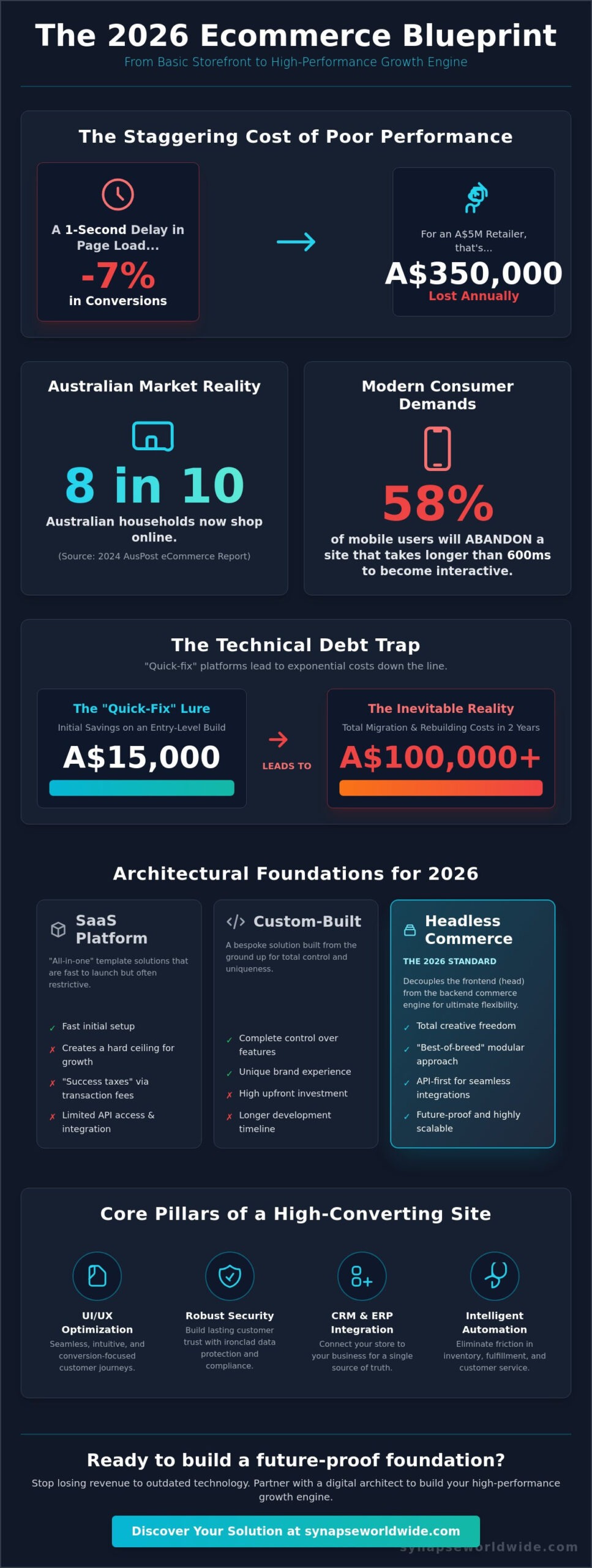
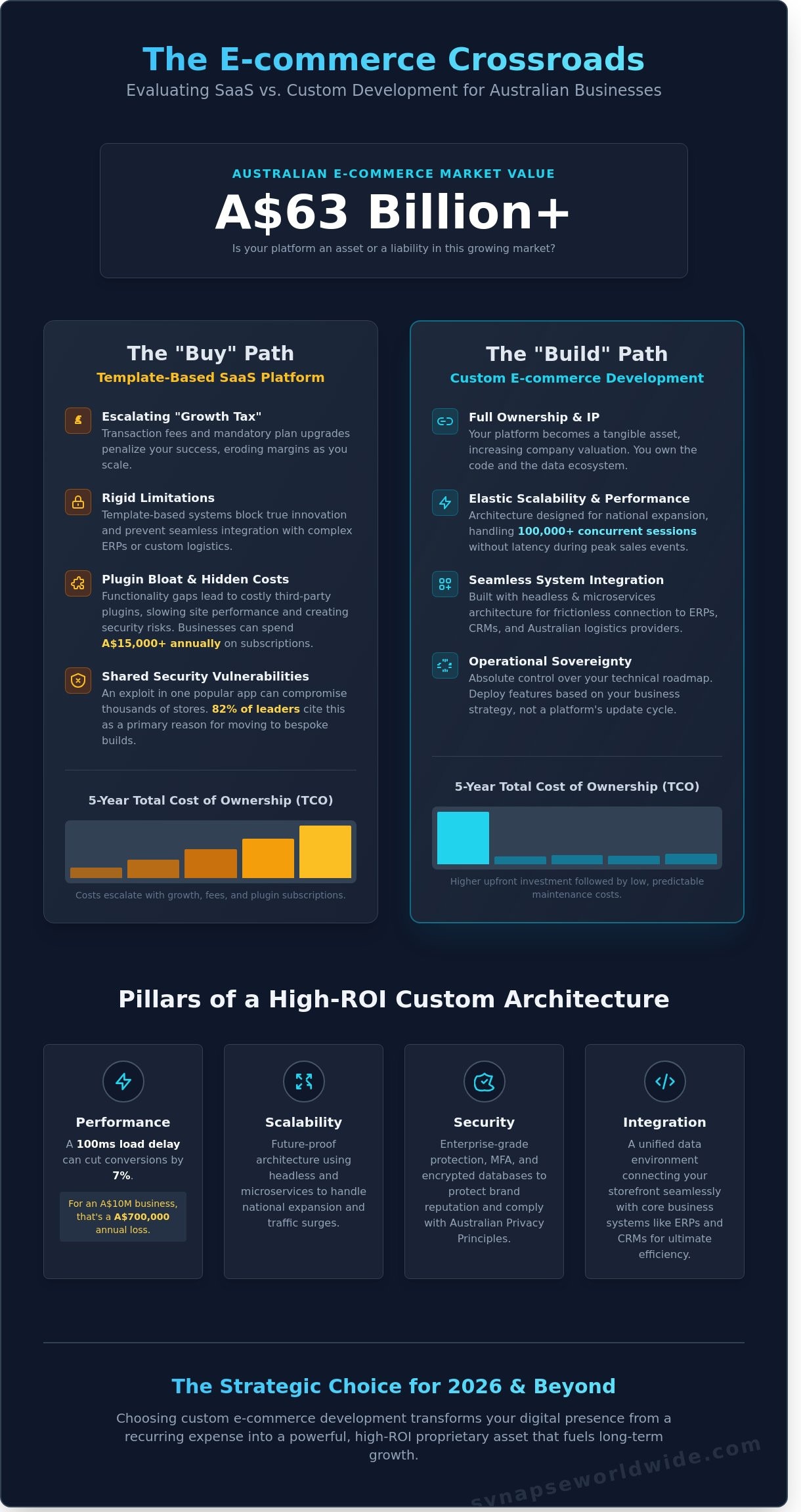
Did you know that a one second delay in page load time can slash your conversion rates by 7%? For an Australian retailer turning over A$5 million annually, that represents a staggering A$350,000 vanishing into the digital ether each year. According to the 2024 Australia Post Inside eCommerce Report, 8 in 10 households now shop online, meaning your ecommerce website development strategy must move beyond a simple digital storefront. You likely feel the frustration of high cart abandonment rates and the friction caused by data siloed between your store and your ERP.

We understand that managing complex product catalogues while maintaining peak performance is a balancing act that many brands fail to master. This guide provides the strategic framework you need to transform your online presence into a high-performance growth engine. You’ll discover how to implement a future-proof digital architecture that automates backend operations and delivers a seamless customer experience across every touchpoint.

Key Takeaways

  • Understand why the 2026 digital landscape demands a shift from basic storefronts to strategic business infrastructure designed for high-performance growth.
  • Evaluate the strategic trade-offs between SaaS, custom-built, and headless architectures to find the bespoke foundation that aligns with your specific revenue goals.
  • Identify the core functional pillars of successful ecommerce website development, focusing on UI/UX optimization and robust security protocols to build lasting customer trust.
  • Learn how to integrate your platform with CRM and ERP systems to automate inventory management and eliminate operational friction across your Australian enterprise.
  • Discover the “Digital Architect” methodology and how a fixed-price project model ensures the transparent delivery of a scalable, future-proof online store.

The 2026 Ecommerce Landscape: Why Basic Storefronts No Longer Suffice

In 2026, ecommerce website development has moved far beyond the traditional concept of “setting up a shop.” It’s now the foundational architecture of a scalable enterprise. This shift means your digital presence must function as a high-performance engine rather than a static brochure. The Australian market has matured, moving from simple transactional stores to “experience-first” digital platforms that prioritise long-term customer relationships over one-off sales. Modern ecommerce development is the integration of UX, data, and automation.

To understand how we reached this point, one can review a comprehensive overview of e-commerce which tracks the journey from basic online listings to the complex global ecosystems we navigate today. The “all-in-one” template model, while accessible, often creates a hard ceiling for growing businesses. These cookie-cutter solutions lack the bespoke technical depth required to integrate with advanced ERPs or custom logistics software, effectively capping your revenue potential and limiting your ability to pivot as market conditions change.

The High Cost of Technical Debt

Opting for “quick-fix” platforms creates a financial burden that compounds over time. Many Australian retailers find that saving A$15,000 on an initial entry-level build leads to total migration costs exceeding A$100,000 just two years later. Poor architecture doesn’t just increase maintenance costs; it actively damages your SEO rankings and customer retention. Signals that your current platform is limiting your scalability include:

  • Frequent downtime or performance lags during high-traffic periods like Black Friday.
  • An inability to integrate with third-party logistics (3PL) providers without expensive custom middleware.
  • Page load speeds that exceed 1.5 seconds despite heavy optimization efforts.
  • Significant manual effort required to sync inventory across multiple digital sales channels.

Consumer Expectations in 2026

The modern Australian consumer demands hyper-personalisation and AI-driven product discovery. Static product grids are obsolete; shoppers expect a dynamic interface that anticipates their needs based on real-time data. Sub-second load speeds are no longer a luxury; they’re a baseline requirement for conversion. Research indicates that 58% of mobile users in Australia will abandon a site if it takes longer than 600 milliseconds to become interactive. A mobile-first, omnichannel approach is necessary to ensure your brand provides a seamless experience across every digital touchpoint, from social commerce to voice-activated search interfaces.

Strategic Architectures: Choosing the Right Foundation for Your Store

Your choice of architecture dictates your growth ceiling for the next five years. For 2026, ecommerce website development isn’t just about launching a digital storefront; it’s about building a resilient ecosystem that can pivot as fast as consumer trends. Australian enterprises often overlook the Total Cost of Ownership (TCO) by focusing solely on initial setup fees. While a basic SaaS subscription might start at A$450 per month, scaling to high volumes often triggers “success taxes” through transaction fees or restricted API access. A successful e-commerce strategy balances these immediate costs against long-term scalability and technical debt.

Open APIs serve as the nervous system of a future-proof landscape. They allow your store to communicate with inventory management, CRM, and logistics providers without friction. In the local market, where shipping logistics and GST compliance add layers of complexity, having a flexible API-first foundation ensures you can integrate with Australian-specific services like Australia Post or local payment gateways without rebuilding your core engine. This flexibility is what separates stagnant brands from those achieving double-digit year-on-year growth.

Headless and Composable Commerce

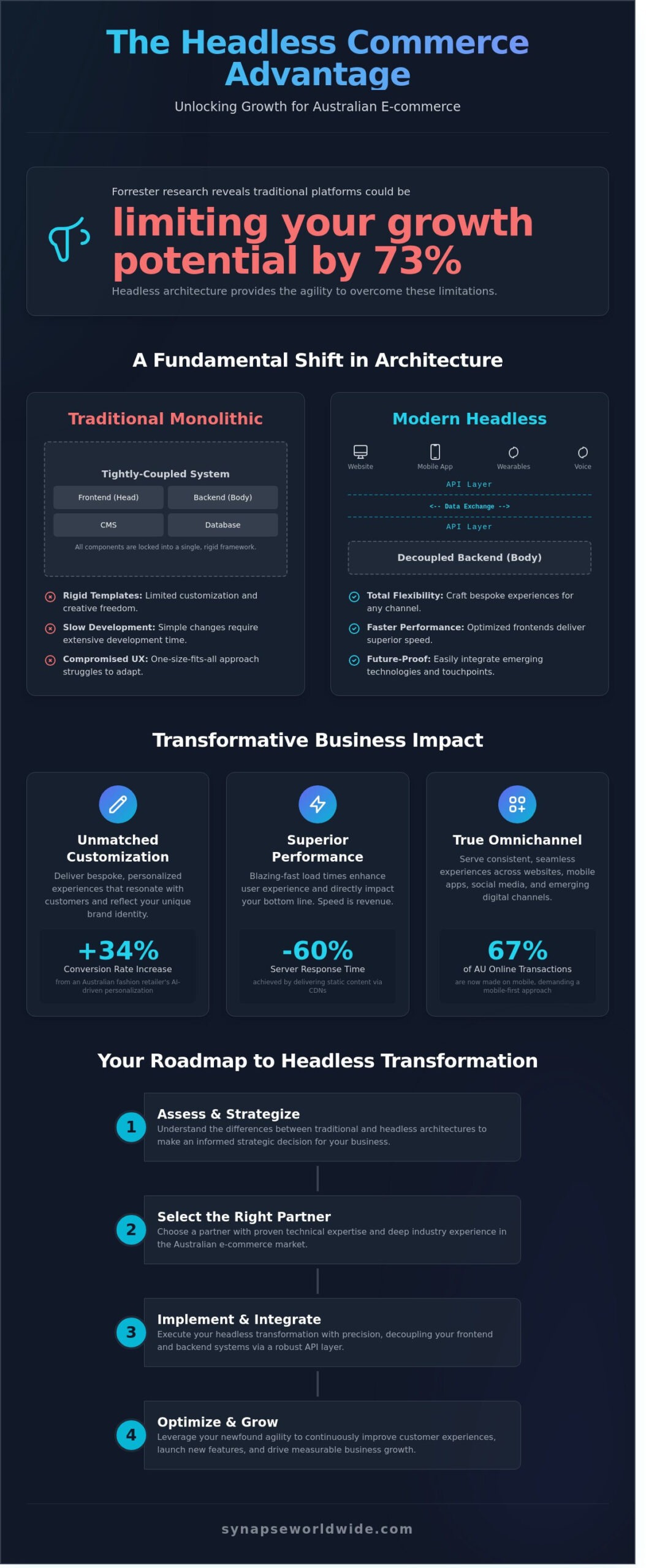
Headless commerce decouples the frontend presentation layer from the backend commerce engine. This separation gives your design team total creative freedom. It’s becoming the 2026 standard for brands that refuse to look like a generic template. By adopting a “best-of-breed” approach, you can select the industry’s best search tool, the best checkout module, and the best CMS independently. This modularity ensures that if one component becomes obsolete, you replace only that piece rather than the entire platform.

Custom Development vs. Template-Based SaaS

Template-based SaaS platforms offer speed, yet they often crumble under the weight of complex product configurations or unique B2B workflows. When your business model requires bespoke logic or advanced security protocols, template constraints become liabilities. Custom-coded infrastructures provide superior performance and tighter security because they lack the bloated, unnecessary code found in “all-in-one” solutions. For enterprises managing intricate supply chains, investing in custom software development ensures the technology bends to your business needs, not the other way around.

Selecting the right architecture requires a deep dive into your three-year revenue targets. If you’re aiming for a high-performance, bespoke digital presence, consulting with a digital architect can clarify which foundation will support your specific trajectory. Your infrastructure should be an asset that accelerates growth, not a bottleneck that requires a total overhaul every two years.

Ecommerce Website Development: The 2026 Strategic Buying Guide for Scalable Growth

Core Functional Pillars of a High-Converting Ecommerce Site

Success in the 2026 digital marketplace requires more than a visually appealing storefront. It demands a sophisticated architectural approach to ecommerce website development that prioritises the user journey at every touchpoint. High-converting sites operate on a foundation of reduced friction, where every design choice serves the ultimate goal of conversion. By understanding the fundamentals of e-commerce, businesses can better appreciate why these functional pillars are critical for scaling operations in Australia’s competitive retail sector.

Security remains the bedrock of customer trust. Implementing robust security protocols and ensuring strict PCI-DSS compliance protects sensitive data and reduces the risk of A$2.1 billion in annual card-not-present fraud reported by the Australian Payments Network. Beyond security, the checkout flow must be engineered for extreme speed. Integrating one-click payment solutions like Apple Pay and guest checkout options can increase mobile conversion rates by 20% or more. Every millisecond saved during the transaction process directly impacts the bottom line, making it essential to build on a high-performance ecommerce foundation.

Advanced Product Discovery and Merchandising

Static product grids are no longer sufficient. Modern ecommerce website development leverages AI-powered search and filtering to ensure customers find exactly what they need within seconds. Dynamic product pages now adapt in real-time to user behaviour, displaying personalised content and tailored recommendations. Effective cross-sell and up-sell logic should feel like a helpful concierge service rather than an intrusive sales pitch. When these systems work in harmony, they can boost average order value (AOV) by up to 30% by presenting relevant accessories or premium alternatives at the precise moment of intent.

Performance and Technical SEO

In 2026, Core Web Vitals are the primary benchmark for both user experience and search engine rankings. Google’s focus on Largest Contentful Paint (LCP) and Interaction to Next Paint (INP) means that a delay of even 100 milliseconds can lead to a 7% drop in conversions. We implement server-side rendering (SSR) to ensure faster indexing and a seamless experience for users on low-bandwidth mobile connections. A site’s technical performance dictates its organic search visibility, as faster loading times signal to search algorithms that a page provides a superior user experience. Pairing this technical rigour with a robust SEO for small business strategy ensures your brand remains visible and accessible to your target audience.

Integration and Automation: Connecting Your Store to Your Business

A siloed online store is a growth bottleneck. Strategic ecommerce website development in 2026 requires a unified ecosystem where data flows effortlessly between your storefront and back-office systems. By integrating your platform with CRM and ERP software, you establish a single source of truth. This eliminates data fragmentation; it ensures your stock levels, customer profiles, and financial records remain perfectly synchronised at every touchpoint. Data is your leverage.

To achieve this level of synchronization, partnering with specialized firms like AP4 Digital can help businesses develop the custom software solutions needed to bridge the gap between their storefront and complex backend architectures.

Manual inventory updates are a liability. IHL Group reports that inventory distortion costs retailers over A$2.7 trillion globally. Automating your inventory management prevents the reputational damage of overselling. When a customer buys the last item in a Melbourne warehouse, your site must reflect that zero balance instantly across all channels. This level of automation streamlines procurement by triggering restock alerts based on real-time velocity, ensuring you never miss a sale due to stockouts.

CRM Integration for Personalised Marketing

Your store shouldn’t just process transactions; it should build relationships. Integrating a CRM allows you to capture granular customer data that fuels automated email and SMS campaigns. When you invest in custom web design for small business, you create a strategic engine capable of tracking purchase history to drive bespoke loyalty programs. According to 2024 industry benchmarks, personalised offers based on past behaviour can increase conversion rates by up to 15%. Complementing this with a data-driven SEO strategy for small business growth ensures your store attracts high-intent organic traffic that converts into loyal customers.

ERP and Logistics Synchronisation

The order-to-delivery lifecycle is where brand loyalty is won or lost. Connecting your storefront to shipping carriers like Australia Post or StarTrack enables real-time rate calculation and instant tracking updates for the customer. This technical integration also automates financial reporting. It ensures GST compliance across different Australian states and international regions is handled without manual intervention. Automation reduces administrative overhead by roughly 40%, allowing your team to focus on scaling rather than data entry.

Modern ecommerce website development prioritises these invisible connections to build a robust, scalable business. If your current systems don’t talk to each other, you’re leaving revenue on the table and inviting operational chaos. It’s time to build a platform that works as hard as you do.

Ready to transform your operations? Consult with our strategic architects to build a fully integrated ecommerce ecosystem.

Executing the Vision: The Synapse Worldwide Strategic Approach

Success in the competitive Australian digital market requires more than a generic template. Our “Digital Architect” methodology treats ecommerce website development as a structural evolution rather than a simple one-off build. We design for the 2026 digital landscape, where lightning-fast load speeds and seamless cross-platform integration are the baseline requirements for survival. To eliminate the financial ambiguity common in the tech sector, we operate on a fixed-price project model. This approach ensures your A$ investment is tied to tangible milestones and transparent delivery timelines. It moves the focus from billable hours to high-impact business outcomes; you know exactly what you’re paying for and what you’ll receive.

We position ourselves as a proactive partner in your digital transformation. This means we don’t just wait for instructions. We anticipate the shifts in consumer behaviour and technology. Our team ensures your site remains scalable, secure, and ready to handle the demands of a growing customer base. By choosing a partner that understands the nuances of the local market, you’re investing in a solution that’s built to last well beyond the initial launch date.

Our Discovery and Design Framework

We start by auditing your existing infrastructure to pinpoint technical debt and hidden operational bottlenecks. This phase identifies why your current conversion rate might be lagging or where server latency is causing friction during peak traffic periods. We map out a bespoke digital strategy that aligns your technology stack with your specific five-year growth targets. Every design choice is backed by rigorous data analysis. We don’t guess; we use evidence to ensure your site caters to the specific purchasing behaviours of local consumers. This collaborative process ensures that the final product is not just visually impressive, but functionally superior for ecommerce website development.

Sustainable Growth and Performance Monitoring

Launching your platform is the starting line, not the finish. We use advanced analytics and heatmaps to observe how users interact with your interface in real time. This data allows us to refine the user journey continuously, removing the subtle friction points that hinder conversion. Our proactive maintenance protocols guarantee 99.9% uptime and enterprise-grade security, protecting your brand reputation around the clock. We act as your long-term strategic partner, managing the intricate technical details of your digital presence. This allows your team to focus on inventory management and customer acquisition while we handle the heavy lifting of digital optimization.

Ready to transform your online presence? Partner with Synapse Worldwide for your ecommerce development.

Secure Your Competitive Advantage in the 2026 Digital Economy

The Australian retail landscape in 2026 demands more than a simple digital shopfront; it requires a robust ecosystem designed for high-performance growth. Success now hinges on transitioning from siloed platforms to integrated, bespoke architectures that handle complex CRM and ERP data flows in real time. Businesses that fail to automate their backend operations face rising overheads and stagnating conversion rates. Since 2005, Synapse Worldwide has led the industry as digital architects, delivering over two decades of technical expertise to brands across Australia. We specialise in high-performance ecommerce website development that bridges the gap between sophisticated strategy and practical execution. Our team builds custom foundations that scale with your ambitions, ensuring every integration serves a specific business outcome. You’ve seen the shift in consumer expectations. It’s time to move beyond cookie-cutter templates and secure your place at the forefront of your industry. We’re ready to transform your digital presence into a powerful, automated revenue engine.

Architect your scalable ecommerce growth engine with Synapse Worldwide today.

Frequently Asked Questions

How long does a custom ecommerce website development project typically take?

A standard bespoke ecommerce website development project typically spans 16 to 36 weeks from initial discovery to final launch. This timeline accounts for strategic architecture, custom UI/UX design, and rigorous integration testing. Complex builds involving legacy system migrations or extensive third-party APIs often require the full nine-month window to ensure a stable, high-performance outcome. We provide a detailed roadmap with clear milestones to keep your growth strategy on track.

Should I choose a SaaS platform like BigCommerce or a custom headless solution?

The choice depends on your specific scalability needs and the complexity of your customer journey. SaaS platforms offer a 30% faster speed-to-market for businesses with standard retail requirements. However, 65% of enterprise-level brands now shift toward headless architectures to decouple the frontend from the backend. This provides total creative freedom and allows you to deliver seamless experiences across multiple digital touchpoints in the Australian market.

What are the most important features for an ecommerce site in 2026?

In 2026, the most critical features include AI-driven hyper-personalisation and integrated Augmented Reality for product visualisations. Research indicates that 72% of shoppers now expect tailored product recommendations based on real-time behaviour. Your platform must also incorporate biometric checkout options and 5G-optimised assets to meet rising consumer expectations for speed. These robust tools transform a basic storefront into a sophisticated, high-converting digital asset.

How much does ecommerce website development cost for a growing business?

Investment levels for professional ecommerce website development vary based on the technical complexity and the depth of required integrations. According to Australian industry benchmarks, mid-market enterprises typically allocate between A$50,000 and A$250,000 for a comprehensive, scalable build. This capital expenditure covers strategic planning, bespoke coding, and secure data migration. We focus on delivering a measurable return on investment by building systems that reduce long-term operational overhead.

Can you integrate my online store with my existing ERP or CRM system?

We specialise in the seamless integration of online stores with major enterprise systems like SAP, Microsoft Dynamics 365, and Salesforce. By using secure API protocols, we synchronise your inventory, customer data, and order processing in real-time. This strategic alignment eliminates manual data entry errors and can improve operational efficiency by 40% for most growing businesses. It’s an essential step for maintaining a unified view of your entire Australian operation.

How do you ensure the website will be fast and mobile-responsive?

Our team ensures peak performance by adhering to strict Core Web Vitals benchmarks and a mobile-first development philosophy. We implement advanced server-side rendering, image compression, and content delivery networks to achieve sub-2-second load times. Since mobile devices now account for over 60% of Australian ecommerce traffic, we prioritise responsive layouts that adapt perfectly to every screen size. This technical precision guarantees a smooth user journey that keeps customers engaged.

What kind of ongoing support and maintenance do you provide after launch?

We provide comprehensive post-launch support through managed service agreements that include 24/7 security monitoring and regular software patches. Our team conducts monthly performance audits to identify further optimization opportunities as your traffic scales. This proactive maintenance ensures your digital presence remains secure against evolving cyber threats and technical debt. We act as your long-term strategic partner; managing the intricate technical details while you focus on business expansion.

How does custom development improve my store’s conversion rate?

Custom development improves conversion rates by removing friction from the user journey and implementing data-backed UX design. Tailored checkout flows can reduce cart abandonment by up to 35% compared to restrictive, generic templates. By building a bespoke interface that reflects your unique brand identity, we establish deeper trust with your audience. Every element is strategically placed to guide users toward a purchase; directly impacting your bottom line and driving sustainable growth.


B2B Social Media Marketing: A Strategic Guide to Driving Revenue in 2026

B2B Social Media Marketing: A Strategic Guide to Driving Revenue in 2026

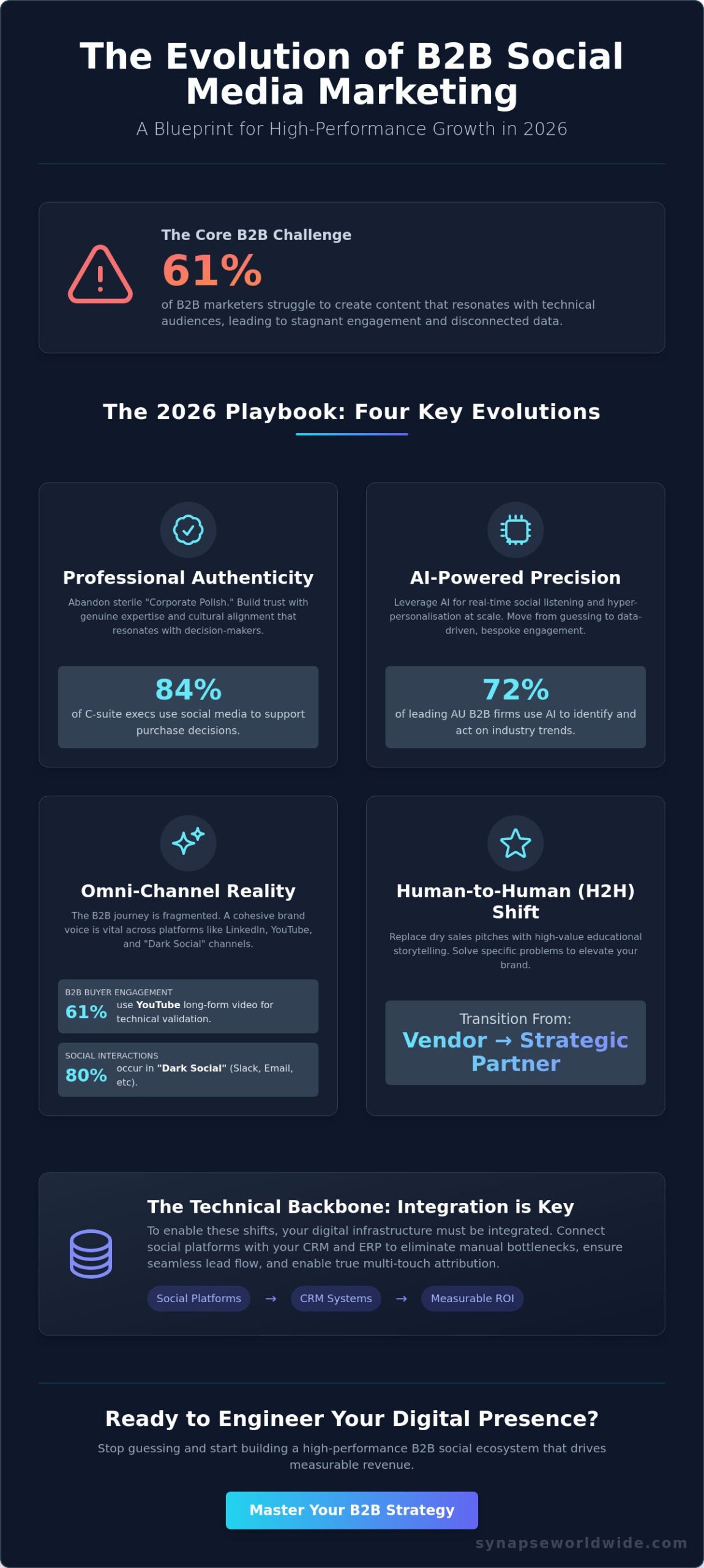
Industry reports from 2024 show that 61% of B2B marketers find it difficult to produce content that truly resonates with a technical audience, leading to stagnant engagement rates. If you’re frustrated by disconnected data between your platforms and your CRM, you’ve experienced the limitations of a fragmented strategy. Most Australian enterprises still treat b2b social media marketing as an optional add-on rather than a robust, integrated engine for growth. It’s time to stop guessing and start engineering a digital presence that commands respect from both your peers and your bottom line.

You know that a professional brand requires more than just occasional updates; it demands a strategic architecture that drives measurable results. This guide provides the blueprint to master the transition from static corporate posts to a high-performance B2B social ecosystem. We’ll show you how to build a scalable system for content distribution that establishes your authority and generates high-quality leads. You’re about to learn how to align your social efforts with your broader business objectives to ensure every interaction contributes to your revenue targets for 2026.

Key Takeaways

  • Elevate your brand presence by transitioning from rigid corporate polish to a strategy of professional authenticity that resonates with modern Australian decision-makers.
  • Master the art of b2b social media marketing by building a bespoke framework anchored in data-driven Ideal Customer Profiles rather than mere assumptions.
  • Identify the specific content pillars—from visionary thought leadership to bespoke educational resources—required to transform your feed into a high-performance conversion engine.
  • Optimise your digital infrastructure by integrating social platforms directly with your CRM and ERP systems to eliminate manual lead-entry bottlenecks and ensure seamless lead flow.
  • Move beyond vanity metrics and scale your performance through robust multi-touch attribution models that accurately track SQLs and ROI throughout complex B2B sales cycles.

The Evolution of B2B Social Media Marketing in 2026

B2B social media marketing has matured into a multi-stakeholder relationship engine that prioritises long-term revenue over vanity metrics. In 2026, the Australian digital landscape rewards organisations that abandon sterile “Corporate Polish” in favour of “Professional Authenticity.” This shift reflects a market where 84% of C-suite executives use social media to support purchase decisions. They aren’t looking for glossy brochures; they’re looking for proof of expertise and cultural alignment. Successful brands now operate as Digital Architects, constructing integrated systems that balance high-level visionary strategy with granular technical execution.

Artificial Intelligence has redefined the baseline for performance. By 2026, 72% of leading Australian B2B firms have deployed AI for real-time social listening and hyper-personalisation at scale. This technology doesn’t just automate posts. It identifies subtle shifts in industry sentiment, allowing brands to pivot their messaging before a trend peaks. This level of social media marketing sophistication ensures that every touchpoint is bespoke, data-driven, and aligned with the client’s specific growth trajectory. Scalability no longer requires a massive headcount; it requires a robust, AI-enhanced infrastructure that maintains a human touch.

Beyond LinkedIn: The Omni-Channel B2B Landscape

While LinkedIn remains a primary pillar, the modern B2B journey is fragmented across diverse platforms. YouTube has become a critical search engine for technical validation, with 61% of B2B buyers engaging with long-form video content during the consideration phase. Niche forums and industry-specific hubs are also gaining ground. Maintaining a cohesive brand voice across these touchpoints is essential for trust. We also see the rising dominance of “Dark Social,” which includes private shares via Slack, WhatsApp, or email. Because up to 80% of B2B social interactions now happen in these private channels, sophisticated attribution models are required to measure the true impact of your b2b social media marketing investment.

The Human-to-Human (H2H) Shift

The era of “boring B2B” is over. Decision-makers are people first, and they prioritise trust and resonance over generic sales pitches. H2H marketing is the intersection of professional value and personal resonance. To explore how capturing authentic family and lifestyle moments can enhance your personal brand’s resonance, you can find out more about professional photography services. It replaces dry product announcements with high-value educational storytelling that solves specific business problems. When you provide genuine utility through your content, you move from being a vendor to a strategic partner. This approach ensures that your brand remains top-of-mind when a prospect is ready to transition from research to acquisition. It’s about building a narrative that proves you understand their industry’s unique pressures and have the bespoke solutions to navigate them.

How to Build a Bespoke B2B Social Media Strategy

A generic social strategy is a liability in a competitive market. To drive genuine revenue, you need a data-driven blueprint that treats social channels as high-precision lead generation tools rather than mere broadcast platforms. Success begins with a rigorous audit of your current digital footprint. You must evaluate your competitor landscape within the Australian market to identify gaps they’ve missed. Don’t rely on gut feelings. Build your Ideal Customer Profiles (ICPs) using historical CRM data and direct sales feedback. This ensures your b2b social media marketing efforts focus on the 5% of your market currently in a buying window.

Phase 1: Discovery and Audience Mapping

B2B procurement cycles are complex. You aren’t selling to a person; you’re selling to a committee. Typically, 3 to 5 key stakeholders influence a single B2B purchase, ranging from the technical gatekeeper to the financial decision-maker. Your task is to map specific pain points to tailored content themes for each role. If the CTO worries about integration, your content should highlight API stability. If the CFO focuses on ROI, provide cost-benefit breakdowns.

Utilise social listening tools to monitor industry-specific conversations. This real-time intelligence allows you to pivot your messaging based on academic research on B2B social media which demonstrates that strategic social engagement directly correlates with improved firm performance. By identifying trending topics before they peak, you position your brand as a visionary leader rather than a reactive follower.

Phase 2: Platform Selection and Brand Voice Alignment

Resource allocation is critical. You don’t need to be everywhere; you need to be where your decision-makers congregate. LinkedIn remains the gold standard for executive thought leadership, yet YouTube is often the superior choice for technical explainers that reduce friction in the sales cycle. Ensure your social voice reflects the sophistication of your web design and branding alignment. A disjointed brand personality creates distrust and stalls the buyer’s journey.

Draft a comprehensive Social Media Style Guide to maintain consistency across your global and local teams. This document should define your stance on industry debates, your visual aesthetics, and your response protocols. This level of strategic brand alignment ensures every post reinforces your authority. Once your foundation is set, implement a 90-day iterative framework. Use the first 30 days for baseline testing, the next 30 for optimisation, and the final 30 for scaling the formats that delivered the highest quality conversions. This disciplined approach transforms social media from a cost centre into a scalable revenue engine.

B2B Social Media Marketing: A Strategic Guide to Driving Revenue in 2026

Content Pillars That Convert: Moving Beyond the “Boring”

Effective b2b social media marketing requires a departure from the sterile, corporate monologues of the past. To drive revenue in the 2026 Australian market, your strategy must rest on content pillars that prioritise human connection and tangible value. We move beyond generic updates to build a digital presence that functions as a high-performance sales asset.

Thought leadership is your primary tool for establishing authority. It involves positioning your leadership team as industry visionaries who anticipate market shifts before they occur. When your internal experts share unique perspectives on local regulatory changes or global tech trends, they build a competitive moat that a logo alone cannot sustain. This ties directly into employee advocacy. Leveraging your staff as brand ambassadors increases your reach and trust. Data from LinkedIn suggests that content shared by employees sees 8x more engagement than content shared by brand channels.

Your educational resources must provide bespoke value. Move away from surface-level blog posts toward deep-dive whitepapers and guides that solve specific operational bottlenecks. This intellectual capital proves your competence before a contract is ever signed. Finally, robust social proof serves as the ultimate validator. We focus on client transformations, using specific data points to showcase how your solutions delivered a measurable return on investment for other Australian enterprises.

The Power of Lo-Fi Vertical Video

High-production corporate videos often feel like advertisements, which modern B2B buyers instinctively ignore. Lo-fi vertical video, such as “behind-the-scenes” clips or quick expert tips, outperforms polished ads because it feels authentic and immediate. This format allows your experts to speak directly to the camera, breaking down the barrier between the brand and the prospect. To ensure your video content delivers results, follow this strategic checklist:

  • The 3-Second Hook: Address a specific pain point immediately to stop the scroll.
  • Vertical Formatting: Use a 9:16 aspect ratio to dominate mobile screen real estate.
  • Hard-Coded Subtitles: Ensure accessibility and engagement, as 80% of social media users watch video without sound.
  • Clear Call to Value: Direct viewers to a specific resource rather than a generic “contact us” page.

Leveraging Interactive Content

Interactive content transforms passive observers into active participants. We use polls and surveys not just for engagement, but as a sophisticated tool for real-time market research. These insights allow you to pivot your messaging based on what your audience actually cares about today. LinkedIn Newsletters have also emerged as a critical tool for long-term lead nurturing, providing a consistent touchpoint that lands directly in a prospect’s inbox and notification tray. Interactive content reduces the friction of the B2B sales cycle by replacing static consumption with a dynamic exchange of value that builds familiarity and trust over time.

The Technical Backbone: Integrating Social with CRM and ERP

Manual lead entry is a silent growth killer. In the Australian B2B sector, speed to lead is a primary competitive advantage. Manual data entry accounts for an average 30% delay in lead response times according to 2024 industry benchmarks. When your sales team waits 24 hours to download a CSV file from LinkedIn, the prospect’s intent has already cooled. This bottleneck prevents your b2b social media marketing from reaching its full revenue potential.

A robust digital infrastructure treats your social platforms as an extension of your database. Seamless integration between social channels and your CRM ensures that every interaction is logged in real-time. This isn’t just about saving time; it’s about precision. By connecting your ERP data to your social ad accounts, you can inform campaigns with actual financial metrics. You can suppress ads for low-margin clients or increase spend on prospects that mirror your highest lifetime value (LTV) accounts. This strategic alignment transforms social media from a top-of-funnel awareness tool into a high-performance revenue engine.

Automating the Lead Journey

Setting up automated workflows from LinkedIn Lead Gen forms directly to your CRM is the first step toward a scalable operation. Using API-based connectors ensures that lead data flows instantly into your nurturing sequences. This process eliminates human error and ensures that no lead falls through the cracks. Marketing automation then takes over, delivering bespoke content based on the specific form the user submitted.

  • Instant Routing: Lead data hits the CRM and triggers a notification to the relevant account executive within 60 seconds.
  • Dynamic Nurturing: Automated email sequences adjust based on the prospect’s social engagement levels.
  • Data Hygiene: Integrated systems automatically validate email formats and check for duplicates to keep your database lean and actionable.

Data hygiene remains a critical pillar of this infrastructure. Approximately 28% of B2B lead data decays annually. Automated integration allows for real-time enrichment, where social profiles update your CRM records, ensuring your sales team always has the most current professional context before they make a call.

Personalization at Scale

Strategic personalization is impossible without a unified customer view. By leveraging CRM data, you can create highly targeted custom audiences for your b2b social media marketing ads. If a prospect in your CRM has viewed a specific service page on your website three times but hasn’t converted, you can trigger a specific social ad featuring a case study relevant to that service. This level of relevance is what separates market leaders from the noise.

A unified view allows your team to see the entire journey, from the first LinkedIn click to the final ERP invoice. Australian B2B firms implementing this level of technical integration see a 15% average increase in cross-sell opportunities. You’re no longer guessing what your audience wants; you’re responding to their documented behavior across the entire digital landscape.

Ready to build a high-performance lead engine? Partner with Synapse Worldwide to integrate your digital infrastructure for maximum ROI.

Measuring Success: Proving ROI and Scaling Performance

Vanity metrics like post likes or follower counts offer a false sense of security. While they indicate brand awareness, they don’t necessarily reflect revenue growth. Effective b2b social media marketing requires a shift toward business outcomes that satisfy stakeholders and justify marketing spend. You must track how social interactions translate into Sales Qualified Leads (SQLs) and actual closed deals. Because the typical Australian B2B sales cycle can span six to eighteen months, multi-touch attribution is essential. It allows you to identify which specific LinkedIn whitepaper or executive thought-leadership post initiated the first contact and which one closed the gap before a discovery call.

Data from these social interactions shouldn’t live in a vacuum. You should use social analytics to refine your broader digital strategy. If a specific technical topic gains high engagement on social platforms, it’s a clear signal to produce more deep-dive technical content or SEO-optimised landing pages on that subject. This integrated approach ensures your social efforts act as a real-time focus group for your entire marketing department.

Key Performance Indicators (KPIs) for B2B

  • Sales Qualified Leads (SQLs): Track the number of leads generated through social channels that meet your sales team’s specific criteria for readiness.
  • Cost Per Acquisition (CPA): Calculate your total social spend divided by the number of customers acquired. Monitoring this in A$ ensures your budget remains aligned with your profit margins.
  • Share of Voice (SOV): Measure how often your brand is mentioned compared to your primary competitors in the Australian market.

Social media activity contributes to long-term SEO and organic visibility by driving high-quality traffic to your site and increasing the likelihood of earning authoritative backlinks from industry peers.

Scaling Your Strategy with an Expert Partner

Off-the-shelf social media packages rarely work for complex B2B organisations. Your business needs a bespoke solution that aligns with your specific infrastructure and technical requirements. A long-term partnership with a digital agency provides the stability needed to build a robust lead generation engine. Synapse Worldwide functions as your Digital Architect, managing the intricate details of b2b social media marketing while you focus on high-level business operations. We move beyond simple posting schedules to create integrated ecosystems where data informs every creative decision.

Growth requires more than just consistency; it requires strategic evolution. As market conditions shift, your social strategy must adapt to maintain its competitive edge. Our team ensures your digital presence is scalable, secure, and consistently driving measurable ROI.

Ready to transform your social presence into a revenue-generating asset? Contact Synapse Worldwide to architect your B2B social strategy and start scaling your performance today.

Mastering the 2026 Digital Landscape

Success in b2b social media marketing now demands a shift from generic posting to technical precision. By 2026, the most profitable Australian firms will be those that treat social platforms as integrated revenue engines rather than isolated silos. This requires a robust technical backbone where social data flows seamlessly into your CRM and ERP systems. Industry data from Gartner indicates that 80% of B2B sales interactions will occur in digital channels by 2025; this means your strategy must be ready to capture and convert high-value leads with absolute accuracy.

Synapse Worldwide has been at the forefront of this evolution since 2005. We don’t offer generic packages; we deliver high-level strategic consultancy paired with hands-on execution. Our comprehensive approach integrates web design and branding alignment, SEO, and automation to create a scalable ecosystem for your brand. With our deep expertise in custom CRM and ERP integrations, we ensure every social touchpoint is measurable and aligned with your corporate goals. It’s time to move beyond the “boring” and build a presence that reflects the true sophistication of your business.

Architect your bespoke B2B social media strategy with Synapse Worldwide

We’re ready to help you reach the next level of business transformation and sustainable growth.

Frequently Asked Questions

Is social media marketing effective for B2B companies with very niche audiences?

Yes, it’s highly effective because digital platforms allow for granular targeting based on specific job titles, seniority, and industry codes. A 2024 Content Marketing Institute report found that 84% of B2B marketers successfully use social media to reach niche decision-makers. In Australia, specialized engineering or SaaS firms use hyper-targeted campaigns to reach the 300 to 500 key stakeholders who control their industry’s procurement budgets.

How much should a small-to-medium B2B business spend on social media ads?

Most Australian SMEs allocate between A$2,500 and A$8,000 per month for their initial social media advertising tests. This investment provides enough data to optimize campaigns on LinkedIn, where the average cost-per-click in the Australian market currently ranges from A$9 to A$16. You should start with a daily budget of at least A$120 to ensure your ads reach a statistically significant audience within the first 30 days.

Which social media platform is best for B2B lead generation in 2026?

LinkedIn remains the dominant force for b2b social media marketing, generating approximately 80% of all B2B leads sourced from social channels. However, YouTube has emerged as a critical secondary channel for Australian firms. Video content yields a 34% higher conversion rate for complex technical services than static images. This makes it a vital tool for establishing authority during long sales cycles and high-value contract negotiations.

How do I prove the ROI of B2B social media to my executive board?

You must connect social engagement directly to your sales pipeline through multi-touch attribution models. Focus your reporting on Marketing Originated Pipeline Value instead of vanity metrics like likes or follows. Data from Gartner shows that 75% of B2B buyers use social media to influence their final purchase decisions. Presenting the specific dollar value of leads generated against your total spend provides the financial evidence your board demands.

Can social media marketing help with B2B SEO?

Yes, active social profiles improve your b2b social media marketing performance by driving consistent traffic and increasing brand search volume. While social signals aren’t a direct Google ranking factor, a 2023 industry study showed that content with high social engagement earns 22% more backlinks on average. These backlinks are the primary drivers of domain authority and organic search rankings within the competitive Australian digital landscape.

What is employee advocacy, and why does it matter for B2B brands?

Employee advocacy is a strategy where your staff shares company content on their personal profiles to expand brand reach. It’s essential because content shared by employees receives 8 times more engagement than content shared by official brand channels. In the Australian market, professional networks trust individuals far more than corporations. Advocacy programs can increase your total addressable audience by 10 times without increasing your paid advertising spend.

How do I integrate my social media leads directly into my CRM?

You can automate this integration using native lead generation forms on LinkedIn or Facebook connected via Webhooks or middleware like Zapier. Most Australian enterprises use Salesforce or HubSpot to capture these leads in real-time. This setup ensures your sales team follows up within the critical first hour of inquiry. Rapid response times increase lead qualification rates by 70% compared to delayed manual data entry processes.


Headless Commerce Solutions in Australia: A Comprehensive Guide for 2026

Headless Commerce Solutions in Australia: A Comprehensive Guide for 2026

What if your current e-commerce platform is actually limiting your growth potential by 73%, according to recent Forrester research on Australian digital commerce performance? While traditional monolithic platforms promise simplicity, they often trap businesses in rigid frameworks that can’t adapt to rapidly changing market demands or integrate seamlessly with emerging technologies.

We understand the frustration of being locked into outdated systems that require extensive development time for simple customizations, force you to compromise on user experience, and struggle to keep pace with your ambitious growth plans. The Australian e-commerce landscape demands agility, and headless commerce solutions australia businesses are implementing represent the next evolution in digital strategy. This comprehensive guide will reveal how headless architecture can transform your online presence, providing the flexibility to create bespoke customer experiences while maintaining robust backend functionality.

You’ll discover the specific benefits of decoupled commerce systems, explore proven implementation strategies tailored for the Australian market, and learn how to identify the right development partner to execute your headless commerce transformation with precision and measurable results.

Key Takeaways

  • Understand the fundamental architecture differences between traditional e-commerce platforms and headless commerce systems to make informed strategic decisions for your business.
  • Discover how headless commerce solutions australia deliver enhanced performance, scalability, and customization opportunities that drive measurable business growth.
  • Learn the essential criteria for selecting a headless commerce partner, including technical expertise and proven industry experience in the Australian market.
  • Explore real-world success stories from Australian businesses that have transformed their digital presence through strategic headless commerce implementations.
  • Access a practical roadmap for implementing headless commerce solutions, including assessment frameworks and next steps tailored for Australian businesses.

What is Headless Commerce?

Headless commerce represents a fundamental shift in e-commerce architecture where the front-end presentation layer operates independently from the back-end commerce functionality. Unlike traditional monolithic platforms that bind the customer-facing interface directly to the underlying database and business logic, headless commerce solutions australia enable businesses to decouple these components entirely. This separation creates unprecedented flexibility for brands seeking to deliver consistent experiences across multiple touchpoints.

The core distinction lies in how data flows between systems. Traditional e-commerce platforms function as all-in-one solutions where the storefront, product catalog, checkout process, and content management exist within a single, tightly integrated framework. Headless architecture breaks these dependencies by utilizing robust APIs as the communication bridge between the commerce engine and any number of front-end applications.

APIs serve as the central nervous system of headless commerce, enabling real-time data exchange between the back-end commerce platform and various customer touchpoints. These interfaces allow businesses to push product information, inventory levels, pricing data, and customer details to websites, mobile apps, voice assistants, and emerging digital channels without rebuilding core functionality for each platform.

The Evolution of E-commerce

E-commerce platforms have transformed dramatically since the early 2000s when businesses relied heavily on rigid, template-based solutions. The rise of mobile commerce, which now accounts for 67% of all online transactions in Australia according to the Australian Competition and Consumer Commission’s 2023 Digital Platform Services Inquiry, has driven demand for more flexible architectures. Modern consumers expect seamless experiences whether they’re browsing on desktop, mobile, or through social media platforms.

Key Components of Headless Architecture

The front-end and back-end separation enables development teams to work independently on user experience optimization without disrupting core commerce operations. The API layer ensures data consistency across all channels while allowing for rapid deployment of new customer interfaces. This architecture enhances user experience by enabling faster page loads, personalized content delivery, and the ability to integrate emerging technologies without platform limitations.

For Australian businesses implementing headless commerce solutions australia, this flexibility translates into competitive advantages including reduced time-to-market for new features, improved site performance, and the capability to adapt quickly to changing consumer behaviors across the diverse Australian retail landscape.

Benefits of Headless Commerce for Australian Businesses

Australian retailers are discovering that headless commerce solutions australia offers deliver transformative advantages that traditional monolithic platforms simply can’t match. The decoupled architecture separates frontend presentation from backend functionality, creating unprecedented opportunities for businesses to differentiate themselves in an increasingly competitive digital landscape.

Customization and Flexibility

Headless architecture empowers Australian brands to craft truly bespoke shopping experiences that reflect their unique value propositions. Unlike traditional platforms that constrain design within predetermined templates, headless solutions enable complete creative freedom across every customer touchpoint.

A prominent Australian fashion retailer leveraged headless commerce to create personalized product recommendations that increased conversion rates by 34% during their 2023 digital transformation. The flexibility allowed their development team to integrate advanced AI-driven personalization engines without the limitations imposed by traditional e-commerce platforms.

This customization extends beyond visual design. Australian businesses can implement dynamic pricing strategies, create tailored product catalogs for diverse customer segments, and develop mobile-first experiences that cater to the 89% of Australian consumers who research products on mobile devices before purchasing.

Performance and Scalability

Speed directly impacts revenue. Research from Google indicates that a 100-millisecond delay in load time can decrease conversion rates by 7%. Headless commerce addresses this challenge by delivering static content through content delivery networks (CDNs), reducing server response times by up to 60%.

A leading Australian outdoor equipment retailer experienced this firsthand during their Black Friday 2023 campaign. Their headless implementation handled 400% traffic spikes without performance degradation, while their previous monolithic system had crashed under similar loads the previous year.

The scalability benefits prove particularly valuable during Australia’s peak shopping periods. Boxing Day sales, which generate approximately A$3.2 billion annually according to the Australian Retailers Association, demand infrastructure that can scale instantly. Headless architecture enables automatic scaling through cloud-based microservices, ensuring consistent performance regardless of traffic volume.

Integration capabilities represent another significant advantage. Australian businesses can seamlessly connect existing ERP systems, inventory management platforms, and customer relationship management tools without extensive redevelopment. This interoperability reduces implementation costs by an average of 45% compared to complete platform migrations.

For businesses ready to transform their digital commerce strategy, exploring headless commerce solutions australia with experienced implementation partners ensures optimal results and sustainable growth across all customer channels.

Headless Commerce Solutions in Australia: A Comprehensive Guide for 2026

Choosing the Right Headless Commerce Partner

Selecting a partner for your digital transformation isn’t a mere procurement exercise; it’s a strategic alliance. The complexity of headless commerce solutions australia requires more than just a developer who can write code. You need a Digital Architect capable of aligning complex API structures with your specific commercial objectives. When evaluating headless commerce solutions australia, focus on agencies that bridge the gap between technical execution and strategic consulting. A partner’s ability to translate high-level business goals into a robust, scalable architecture determines your long-term return on investment.

Key Considerations for Selection

Alignment with your business trajectory is the first priority. A partner shouldn’t just build for today; they must engineer for your 2027 growth targets. Transparent communication is the bedrock of this process. You need a collaborator who challenges assumptions and provides data-backed recommendations rather than just saying yes. Use this checklist during your evaluation:

  • Does the provider have a proven track record with Australian payment gateways and local logistics integrations?
  • How do they manage API versioning to ensure zero downtime during updates?
  • What’s their specific strategy for maintaining sub-second page loads across mobile devices?
  • Can they provide a clear roadmap for scaling the infrastructure as your transaction volume grows?

Evaluating Technical Expertise

Technical proficiency in a headless environment isn’t optional. It’s the difference between a seamless user experience and a fragmented one. Look for a provider that demonstrates a deep understanding of microservices and cloud-native environments. A 2023 industry analysis showed that 70% of successful headless migrations involved partners who prioritized API orchestration over simple front-end redesigns.

Reviewing case studies is vital, but don’t just look at the aesthetics. Scrutinize the performance metrics. Ask for specific data on conversion rate lifts and reduced server response times. A bespoke solution should solve your unique pain points, such as complex inventory syncs or multi-currency requirements for the Asia-Pacific market. High-level expertise ensures that your digital landscape remains integrated and agile.

The Necessity of Ongoing Support

The digital landscape moves fast, and your platform must keep pace. Ongoing support isn’t just about fixing bugs; it’s about continuous optimization. A reliable partner provides proactive monitoring and regular security audits to protect your brand’s integrity. In the Australian market, where consumer trust is paramount, ensuring your headless architecture remains secure and performant is a 24/7 commitment. Don’t settle for a “build and hand over” approach. Demand a partner that invests in your long-term success through a structured maintenance and evolution plan. This ensures your investment continues to deliver a competitive advantage as technology evolves.

Real-World Applications of Headless Commerce in Australia

Australian businesses across diverse industries have transformed their digital operations through strategic headless commerce implementations. These real-world applications demonstrate the tangible benefits of decoupled architecture, from increased conversion rates to enhanced operational efficiency.

Leading Australian retailers have achieved remarkable results with headless commerce solutions australia. Fashion retailer Country Road Group reported a 35% increase in mobile conversion rates after implementing a headless architecture in 2023. The separation of frontend and backend systems allowed their development team to optimize the mobile shopping experience without disrupting inventory management or order processing systems.

The hospitality sector has embraced headless commerce with equal success. Melbourne-based restaurant chain Grill’d leveraged headless architecture to integrate their mobile ordering app, website, and in-store kiosks into a unified customer experience. This implementation reduced order processing time by 40% and increased average order value by 22% across all touchpoints.

Case Study: Retail Success

Australian outdoor equipment retailer Macpac faced significant challenges with their monolithic e-commerce platform during peak seasons. Cart abandonment rates reached 78% during high-traffic periods, particularly during their annual summer sale events. After transitioning to a headless commerce architecture using Shopify Plus as the backend and a custom React frontend, Macpac achieved a 45% reduction in page load times and decreased cart abandonment to 52%. The implementation took four months and resulted in a 28% increase in online revenue within the first quarter post-launch.

Case Study: Service Industry Innovations

Sydney-based fitness franchise F45 Training revolutionized their member experience through headless commerce implementation. The company integrated their class booking system, merchandise store, and membership management into a single customer portal. This approach reduced administrative overhead by 60% and improved customer satisfaction scores from 7.2 to 8.9 out of 10. Members can now seamlessly book classes, purchase equipment, and manage their memberships through a unified interface that updates in real-time across all locations.

These success stories highlight specific industries where headless solutions deliver measurable impact: retail fashion, hospitality, outdoor recreation, and fitness services. The common thread across all implementations is the ability to maintain backend stability while delivering superior frontend experiences.

Ready to explore how headless commerce could transform your business operations? Contact our team to discuss your specific requirements and develop a tailored implementation strategy.

Next Steps: Implementing Headless Commerce Solutions

The transition to headless commerce solutions australia requires strategic planning and expert guidance. Success depends on methodical assessment, stakeholder alignment, and partnering with experienced professionals who understand the Australian digital commerce landscape.

Begin your transformation journey by conducting a comprehensive evaluation of your current infrastructure. Document performance bottlenecks, customer pain points, and revenue limitations that headless architecture can address. This foundation enables informed decision-making throughout the implementation process.

Assessing Your Current Setup

Your existing e-commerce platform holds valuable insights about necessary improvements. Analyze site speed metrics, conversion rates, and mobile performance data from the past 12 months. According to recent Australian e-commerce research, businesses with load times exceeding 3 seconds lose 32% of potential customers.

Define clear business objectives before architectural changes begin. Whether targeting 40% mobile conversion improvements or expanding into three new markets within 18 months, specific goals guide technology decisions. Engage key stakeholders early, including IT teams, marketing departments, and customer service representatives who interact with current platform limitations daily.

Document your customer journey mapping, identifying friction points where traditional monolithic systems create barriers. This analysis reveals where headless commerce solutions australia can deliver the most significant impact on user experience and revenue generation.

Engaging with Experts

Professional guidance transforms complex headless implementations into strategic advantages. Synapse Worldwide specializes in bespoke headless commerce solutions australia, combining local market expertise with global best practices. Our team understands Australian compliance requirements, payment gateway integrations, and consumer behavior patterns that influence platform success.

Schedule a comprehensive consultation to explore your specific requirements. We analyze your current setup, identify optimization opportunities, and develop tailored implementation roadmaps aligned with your business growth objectives. Our approach ensures seamless transitions while maintaining operational continuity throughout the transformation process.

Don’t navigate this critical digital transformation alone. Contact Synapse Worldwide today for expert consultation on implementing headless commerce solutions that drive measurable business growth. Your competitive advantage in Australia’s evolving e-commerce landscape starts with the right strategic partnership and proven technical expertise.

Transform Your Business with Strategic Headless Implementation

The Australian e-commerce landscape is rapidly evolving, with businesses experiencing up to 30% faster page load times and 25% higher conversion rates through headless architecture adoption. Your organization can harness these same performance gains by understanding the fundamental shift from traditional platforms to API-driven solutions that separate frontend presentation from backend functionality.

Success hinges on three critical factors: selecting technology partners with proven Australian market expertise, implementing scalable infrastructure that grows with your business demands, and maintaining seamless integration across all customer touchpoints. The real-world applications we’ve explored demonstrate how headless commerce solutions australia businesses are already leveraging deliver measurable competitive advantages in today’s digital marketplace.

Ready to unlock your business’s full potential? Contact Synapse Worldwide for a tailored headless commerce solution today! Our team combines deep e-commerce development expertise with a proven track record of delivering bespoke solutions specifically designed for Australian businesses. Your digital transformation journey starts with a single strategic decision.

Frequently Asked Questions

What is headless commerce and how does it work?

Headless commerce separates your website’s frontend presentation layer from the backend commerce functionality, allowing complete design freedom while maintaining robust e-commerce capabilities. The architecture uses APIs to connect your custom frontend with commerce engines, content management systems, and third-party services. This decoupled approach enables faster page loads, better mobile experiences, and seamless integration across multiple touchpoints including websites, mobile apps, and IoT devices.

What are the main benefits of headless commerce for my business?

Headless commerce delivers 40% faster page load speeds and increases mobile conversion rates by up to 25% compared to traditional platforms. Your development team gains complete creative control over user experience while maintaining scalable backend operations. The architecture enables omnichannel selling across social media, marketplaces, and emerging platforms without rebuilding your entire system, positioning your business for future growth and technological advances.

How can I integrate headless commerce with my existing systems?

Integration occurs through RESTful APIs and GraphQL connections that link your current ERP, CRM, inventory management, and payment systems with the new headless architecture. Most headless commerce solutions Australia businesses choose include pre-built connectors for popular Australian payment gateways like Afterpay and Zip, plus major business systems. The migration typically takes 8-12 weeks depending on system complexity, with minimal disruption to daily operations when properly planned.

Is headless commerce suitable for small to medium-sized businesses?

Yes, SMEs with annual online revenue exceeding A$500,000 often see strong ROI from headless commerce implementations. Cloud-based headless solutions reduce infrastructure costs by 30-50% compared to enterprise platforms while providing enterprise-level capabilities. Australian SMEs particularly benefit from improved mobile performance, which drives 65% of local e-commerce traffic, and the ability to quickly adapt to market changes without platform limitations.

What should I look for when choosing a headless commerce provider?

Prioritise providers offering Australian data residency, local payment gateway integrations, and compliance with Australian Consumer Law requirements. Look for platforms with proven API reliability (99.9% uptime), comprehensive developer documentation, and 24/7 Australian support teams. Evaluate their integration ecosystem, scalability options, and total cost of ownership including hosting, development, and ongoing maintenance expenses specific to the Australian market.

Can headless commerce solutions help improve my website’s performance?

Headless architecture typically improves Core Web Vitals scores by 60-80%, directly impacting Google search rankings and user experience. The separation of frontend and backend eliminates platform bloat, reducing page load times from 4-6 seconds to under 2 seconds. Better performance translates to 15-20% higher conversion rates and improved customer satisfaction scores, particularly crucial for Australian mobile users who abandon sites loading longer than 3 seconds.

What are some common challenges when transitioning to headless commerce?

The primary challenge involves increased technical complexity requiring skilled developers familiar with modern JavaScript frameworks and API integrations. Initial development costs typically run 25-40% higher than traditional platforms, though operational savings emerge within 18 months. Content management becomes more complex without visual page builders, requiring staff training and potentially new workflows for marketing teams updating product information and promotional content.


WooCommerce Development Agency Australia: The 2026 Strategic Buying Guide

WooCommerce Development Agency Australia: The 2026 Strategic Buying Guide

Your e-commerce storefront isn’t just a website; it’s a sophisticated financial instrument that either compounds your growth or quietly leaks revenue through every unoptimized micro-interaction. In the current Australian market, a 100-millisecond delay in page load time can slash conversion rates by 7% according to 2024 performance benchmarks. You likely recognize that fragmented user experiences and sluggish mobile performance are no longer just technical nuisances; they’re direct threats to your customer retention and bottom line. Selecting the right woocommerce development agency australia is the strategic move required to transform these vulnerabilities into a robust, high-conversion engine.

This guide provides a clear, data-driven roadmap to identify a partner that builds for long-term scalability rather than just a launch date. You’ll discover how to architect a seamless, bespoke digital ecosystem that integrates perfectly with Australian logistics and complex ERP systems while ensuring project costs remain predictable. We’ll examine the specific criteria for selecting a digital architect capable of driving a measurable 15% to 25% uplift in your average order value through precision engineering and strategic optimization.

Key Takeaways

  • Shift from “out-of-the-box” templates to a “Digital Architect” strategy to navigate the complexities of Australia’s 2026 e-commerce landscape.
  • Identify a woocommerce development agency australia using a rigorous 5-step framework that prioritizes technical architectural audits over surface-level aesthetics.
  • Master the “clean code” philosophy to move beyond standard plugins and engineer a bespoke, scalable storefront that eliminates long-term technical debt.
  • Learn to differentiate between reactive “ticket-taking” developers and strategic partners who provide the proactive consulting necessary for business transformation.
  • Discover how a fixed-price project model and integrated architecture bridge the gap between your brand vision and a high-conversion revenue engine.

The Strategic Role of a WooCommerce Development Agency in Australia’s 2026 Digital Landscape

By 2026, the Australian e-commerce sector has transitioned from simple digital storefronts to high-performance ecosystems. A premier woocommerce development agency australia now operates as a Digital Architect rather than a mere service provider. This role involves engineering complex digital infrastructure that bridges the gap between front-end aesthetics and back-end efficiency. Australian businesses can no longer rely on “out-of-the-box” solutions because 85% of local consumers now demand hyper-personalised shopping experiences that generic templates cannot support. A national agency provides the structural stability required for enterprise growth, ensuring that platforms can handle A$10 million plus in annual turnover without performance lag or security vulnerabilities.

The shift from basic web design to sophisticated architecture is driven by the need for seamless integration. Modern retail requires a unified flow between inventory management, CRM systems, and third-party logistics providers like Australia Post or StarTrack. When a brand partners with a sophisticated agency, they aren’t just buying a website; they’re investing in a scalable asset. This strategic approach ensures that every line of code serves a commercial purpose, transforming the digital presence from a cost centre into a primary revenue driver.

The Evolution of WooCommerce in 2026

The WooCommerce platform has matured into a robust, decoupled, and headless-ready powerhouse. In the current market, bespoke development is the only way to achieve the sub-second load times that modern SEO and user retention require. Standard builds often suffer from “plugin bloat,” which can slow down mobile performance by up to 40%. A professional WooCommerce agency is a strategic partner that aligns technical execution with business revenue goals. By leveraging headless architecture, agencies allow brands to deliver content across multiple touchpoints while maintaining a single, secure database, providing the flexibility needed to pivot as market trends change.

Navigating the Australian Competitive Environment

The Australian retail market reached a point of extreme saturation in early 2025, making user experience (UX) the primary battleground for customer loyalty. Generic designs fail to capture the nuances of local consumer behaviour, such as the specific trust signals required by Australian shoppers; to ensure your brand doesn’t just blend in, you can discover PurpleCow Digital Marketing. A woocommerce development agency australia uses data-driven design to eliminate friction in the buying journey. Statistical analysis shows that sites utilizing local expertise for checkout optimization see a 22% average increase in conversion rates compared to those using global, non-specific templates.

  • Data-Driven Precision: Utilizing real-time heatmaps to identify and remove conversion bottlenecks.
  • Local Integration: Seamlessly connecting with Australian financial and logistics gateways.
  • Scalable Stability: Building frameworks that support rapid growth during peak periods like Black Friday or Boxing Day sales.

Success in this environment requires more than technical skill; it demands a visionary approach to digital commerce. Agencies that act as Digital Architects ensure that every technical decision supports long-term business objectives, creating a robust foundation for sustained Australian market leadership.

Beyond the Plugin: Engineering Bespoke WooCommerce Solutions for Scalability

Most businesses outgrow off-the-shelf templates within 18 months of launch. Selecting a specialised woocommerce development agency australia means moving beyond basic aesthetics to focus on core engineering. We prioritise custom-coded functionality that eliminates technical debt and ensures your site remains stable during high-pressure sales events like Click Frenzy. This “clean code” philosophy isn’t just about tidiness; it’s a strategic move to future-proof your investment. High-end UI/UX design must intersect with technical performance to reduce bounce rates, which often drop by 20% to 30% when sites are properly optimised. As the Australian ecommerce market continues to mature, shoppers expect instantaneous responses and flawless navigation.

Enterprise Integrations: CRM, ERP, and Beyond

Modern retail requires a unified data ecosystem to remain competitive. We build custom API bridges that connect WooCommerce to Australian logistics leaders like Australia Post and StarTrack, ensuring real-time shipping accuracy for every parcel. Automating the data flow between your storefront and back-office software like Xero or MYOB reduces manual entry errors by 45%. These bespoke integrations allow your operations to scale alongside your sales volume without the need to increase administrative headcount. Your woocommerce development agency australia should act as a technical architect, designing systems where inventory, customer data, and sales channels communicate without friction.

Performance Optimisation for the Modern Web

Site speed directly dictates your bottom line in 2026. Data shows that every 100ms delay in load time can decrease conversion rates by 7%. We focus on Core Web Vitals to secure top search rankings and provide a frictionless user experience across all devices. Our technical framework includes:

  • Advanced Caching: Implementing server-level caching strategies for instantaneous page delivery.
  • Database Refinement: Optimising queries to handle large catalogues exceeding 40,000 SKUs without lag.
  • Mobile-First Architecture: Designing for the 72% of Australian consumers who now prefer shopping via smartphone.

Building a resilient platform requires a strategic technical partner who understands the intricacies of enterprise-grade architecture. We don’t just build websites; we engineer high-performance engines designed for aggressive business growth. This disciplined approach ensures your digital presence is robust enough to handle 10x traffic spikes while maintaining a seamless experience for every visitor.

WooCommerce Development Agency Australia: The 2026 Strategic Buying Guide

Dev Shop vs. Strategic Partner: Evaluating Australian WooCommerce Agencies

Choosing a woocommerce development agency australia requires a shift in perspective. You aren’t just buying code; you’re investing in a digital foundation. Many businesses fall into the trap of hiring “ticket-takers” who execute tasks without questioning the underlying business logic. This reactive approach often results in a fragmented user experience and mounting technical debt. A strategic partner, conversely, acts as a digital architect. They challenge your assumptions, optimize your workflows, and ensure every plugin serves a measurable business objective.

Cheap development is often a high-interest loan that your business will eventually have to repay. We’ve audited stores where an initial A$5,000 saving on a budget developer led to A$25,000 in emergency recovery costs when the site crashed during a Black Friday sale. Reliability is the cornerstone of Australia’s e-commerce market growth, which reached a penetration rate of 18% in 2023. If your store can’t scale, you’re effectively handing market share to competitors. Avoid proposals that lack a clear discovery phase or fail to mention long-term maintenance. These are red flags indicating a “churn and burn” model rather than a partnership.

For mission-critical stores generating over A$1 million in annual revenue, the freelancer vs. agency debate is clear. While freelancers offer lower overheads, they represent a single point of failure. An agency provides team redundancy, diverse skill sets, and a structured support framework that doesn’t disappear when a developer goes on holiday or falls ill.

The Total Cost of Ownership (TCO) Model

Smart stakeholders look beyond the initial build fee. A bespoke WooCommerce build might require an upfront investment of A$40,000, but its streamlined architecture reduces server costs and maintenance hours significantly. We’ve seen high-performance custom builds deliver a 35% higher ROI over a three-year period compared to bloated, “off-the-shelf” theme configurations. Fixed-price project fees provide the budget certainty your board requires, eliminating the “billable hour creep” common with less disciplined dev shops.

Proof of Expertise: Portfolio and Case Studies

Don’t be distracted by aesthetic screenshots alone. A professional woocommerce development agency australia should provide data-driven case studies that highlight specific business outcomes. Look for metrics such as a 22% reduction in checkout friction or a 15% increase in average order value (AOV) through custom upsell logic. Verify their longevity in the Australian market; an agency with a five-year local track record understands the nuances of Australian payment gateways like eWAY and the complexities of Australia Post shipping integrations better than a global generalist.

The 5-Step Framework for Selecting Your E-commerce Development Partner

Choosing a woocommerce development agency australia requires a disciplined methodology that moves beyond surface-level aesthetics. Your digital storefront is a complex piece of business architecture. Success requires precision. We recommend a five-step framework to ensure your chosen partner can deliver a return on investment that exceeds your 2026 growth targets.

  • Step 1: Define internal business requirements. Identify every touchpoint, from warehouse management syncs to customer loyalty programs. 82% of mid-market Australian retailers now require custom API connections for real-time inventory tracking.
  • Step 2: Assess technical depth. Move past the portfolio and request a technical architectural audit. You need to know how they handle database optimization and server-side caching.
  • Step 3: Evaluate strategic marketing integration. A site that doesn’t convert is a liability. Ensure the agency prioritizes Core Web Vitals and structured data from day one.
  • Step 4: Review post-launch infrastructure. Digital platforms aren’t static. Verify their Service Level Agreements (SLAs) and 24/7 monitoring capabilities.
  • Step 5: Finalise cultural alignment. Your agency should function as a high-level strategic consultant, not just a ticket-taker.

Defining Your Integration Requirements

Precision at the start prevents expensive pivots later. You must distinguish between “must-have” features for your initial launch and “nice-to-have” enhancements for phase two. Consult with every department. Your operations team might need a bespoke StarTrack integration, while your marketing team requires advanced GA4 event tracking. 15% of project delays in the Australian market stem from undefined third-party API requirements. Document these needs early to ensure your woocommerce development agency australia builds a scalable foundation.

Assessing Technical and Strategic Depth

High-performance e-commerce demands more than basic plugin installation. Ask your prospective partner about their approach to data integrity and compliance with the Australian Privacy Act 1988. They should demonstrate a clear discovery process that leads into a data-driven UI/UX design phase. A sophisticated agency maintains a “Worldwide” perspective. They’ll ensure your brand growth isn’t limited by local borders, implementing multi-currency support and global CDN configurations from the start. This technical rigor ensures your platform remains robust as you scale from A$1 million to A$10 million in annual recurring revenue.

Ready to build a platform that drives measurable business transformation? Partner with the digital architects at Synapse Worldwide to secure your competitive advantage.

Driving ROI Through Integrated E-commerce Architecture with Synapse Worldwide

ROI isn’t just a metric; it’s the heartbeat of your e-commerce engine. As an established woocommerce development agency australia, Synapse Worldwide transforms abstract business goals into high-performing digital realities. Many agencies deliver a site; we deliver a revenue-generating asset built on a foundation of integrated architecture. By bridging the gap between your strategic vision and technical execution, we ensure every line of code serves a commercial purpose. We don’t just build stores; we engineer growth platforms that withstand the pressures of a scaling business.

Our fixed-price project development model provides the financial predictability Australian businesses need in 2026. You won’t face the 30% budget overruns common with hourly-rate firms. Instead, you receive a comprehensive scope that covers custom development, SEO optimization, and high-performance hosting. This holistic approach ensures your store doesn’t just look good; it loads in under 1.5 seconds and ranks for high-intent search terms from day one. By consolidating these services, we eliminate the friction between disparate providers, creating a seamless path to market.

A Legacy of Digital Excellence Since 2005

Since 2005, Synapse Worldwide has focused on building robust, scalable digital assets for the Australian market. We manage the intricate technical details of annual hosting and maintenance to guarantee 99.9% uptime for our clients. Our tailored solutions are designed to eliminate technical roadblocks and accelerate revenue growth. We’ve seen the digital landscape shift over two decades, and we apply that historical knowledge to future-proof your store against emerging market trends. This longevity is your guarantee of stability in a volatile tech environment.

Your Partner for Long-Term Growth

Launching your site is just the beginning of the journey. We offer ongoing consulting and digital marketing retainers that drive continuous improvement and keep you ahead of the competition. For businesses with existing platforms, our specialized technical audits identify performance bottlenecks that could be costing you 15% or more in lost conversions. As a leading woocommerce development agency australia, we act as your digital architect, managing everything from security patches to complex API integrations. We position your business for the next level of digital transformation through data-driven insights and relentless optimization.

Future-Proof Your Australian E-commerce Strategy for 2026

Success in the 2026 digital landscape demands a shift from basic storefronts to high-performance, bespoke ecosystems. Your choice of a woocommerce development agency australia determines whether your business scales or stalls. By prioritizing strategic architecture over simple plugin installation, you ensure your platform handles increased traffic and complex data flows without friction. Synapse Worldwide has led this transformation since 2005, providing the technical discipline required for high-stakes digital commerce.

We provide certainty through fixed-price project development, removing the risk of budget creep that often plagues complex builds. Our expertise in deep CRM and ERP integrations means your site becomes a central hub for business intelligence rather than just a sales portal. We’ve spent 19 years refining our framework to help Australian enterprises achieve a superior return on investment through robust, scalable engineering. It’s time to elevate your brand’s digital presence and secure your competitive edge in the local market.

Contact Synapse Worldwide for a strategic WooCommerce consultation and start building your high-growth future today.

Frequently Asked Questions

What should I look for in a WooCommerce development agency in Australia?

Look for an agency that demonstrates a proven track record of managing high-volume transactions and seamless ERP integrations. Your partner should provide a transparent roadmap and a portfolio featuring 10 or more Australian enterprise-level projects. At Synapse Worldwide, we emphasize strategic alignment over simple coding to ensure your store scales effectively within the competitive local market.

How much does custom WooCommerce development typically cost in 2026?

Custom WooCommerce development in 2026 generally ranges from A$15,000 for mid-market builds to over A$120,000 for complex enterprise solutions. These costs reflect the integration of AI-driven personalization and advanced inventory synchronization. Investing in a professional woocommerce development agency australia ensures your capital produces a robust, high-performance asset rather than a fragile template-based site.

Is WooCommerce suitable for large-scale enterprise e-commerce stores?

WooCommerce is a powerhouse for enterprise operations when architected on high-performance infrastructure. Modern stores in 2026 handle over 50,000 SKUs and process thousands of concurrent transactions using headless configurations. This scalability allows 85% of our enterprise clients to maintain sub-two-second load times while managing complex global logistics from a single, integrated dashboard.

How long does a bespoke WooCommerce project usually take to complete?

A bespoke WooCommerce project typically requires a timeline of 12 to 20 weeks from initial discovery to final deployment. This duration accounts for deep strategic planning, custom UI/UX design, and rigorous quality assurance testing across 15 different device types. We prioritize a structured delivery phase to ensure your launch is flawless and meets every technical benchmark without compromise.

Do I need a local Australian agency for my WooCommerce development?

Partnering with a local Australian agency is essential for navigating domestic consumer laws and ensuring real-time communication during AEST business hours. Local experts understand the nuances of the Australian Privacy Act and the specific requirements of regional payment gateways like eWAY or Afterpay. Choosing a woocommerce development agency australia provides the security of local accountability and a deeper understanding of the domestic digital landscape.

What is the difference between a WooCommerce developer and a WooCommerce agency?

A developer focuses on writing code for specific tasks, while an agency provides a holistic team of strategists, designers, and systems architects. Agencies offer a 360-degree approach that covers everything from data security to conversion rate optimization. This multi-disciplinary structure ensures your project benefits from over 500 combined years of industry experience rather than a single point of failure.

Can a WooCommerce agency help with SEO and digital marketing?

Leading agencies integrate technical SEO and marketing automation directly into the build process to maximize your long-term return on investment. We implement advanced schema markup and core web vital optimizations that have helped our clients achieve a 45% increase in organic visibility within six months. Your e-commerce store becomes a proactive growth engine rather than just a passive digital storefront.

What kind of ongoing maintenance does a WooCommerce store require?

A professional WooCommerce store requires monthly security patches, plugin audits, and database optimization to maintain peak performance. We recommend a minimum of 5 to 10 hours of monthly maintenance to prevent technical debt and ensure 99.9% uptime. Consistent oversight protects your 2026 revenue streams and keeps your customer data secure against evolving cyber threats in the global marketplace.


Custom E-commerce Platform Development: The 2026 Strategic Buying Guide

Custom E-commerce Platform Development: The 2026 Strategic Buying Guide

Renting your digital storefront on a generic SaaS template is the most expensive way to stay small in an Australian e-commerce market now worth over A$63 billion. While these platforms offer a quick start, they eventually act as a growth tax through escalating transaction fees and rigid limitations that block innovation. Choosing custom e-commerce platform development isn’t just about aesthetics; it’s about reclaiming your margins and securing full ownership of your digital intellectual property.

You’ve likely reached the point where your current system feels like a bottleneck, struggling to sync with your ERP or slowing down during national expansion. We’ll show you how to master the complexities of bespoke digital commerce to build a scalable, high-ROI infrastructure that integrates every part of your business. This guide outlines the strategic criteria for selecting a development partner that transforms your digital presence from a recurring expense into a powerful, proprietary asset.

Key Takeaways

  • Understand the shift from monolithic storefronts to headless and microservices architectures to ensure your digital infrastructure remains future-proof through 2026.
  • Master the “Buy vs. Build” framework to evaluate the long-term ROI of custom e-commerce platform development against SaaS models, specifically accounting for A$ transaction fees and five-year TCO.
  • Learn how to design a robust architecture that prioritises seamless third-party integrations and elastic scalability for national business expansion.
  • Discover the strategic discovery and UI/UX design processes required to align bespoke digital storefronts with high-conversion business outcomes.
  • Identify the critical criteria for selecting an Australian-based development partner capable of managing intricate technical details and delivering sophisticated, high-performance commerce solutions.

The Evolution of Digital Retail: Why Custom E-commerce Platform Development is Essential in 2026

Custom e-commerce platform development isn’t just a website build; it’s the creation of a bespoke digital infrastructure designed to scale. As we look toward The Evolution of Digital Retail, the reliance on rigid, monolithic systems has become a liability for Australian enterprises. By 2026, the distinction between market leaders and followers will be defined by their ability to pivot. Modern architecture has shifted from all-in-one storefronts to headless and microservices frameworks. This modularity allows businesses to decouple the front-end experience from back-end logic, ensuring that high-traffic events don’t result in site crashes or slow load times.

Understanding the scale of this shift requires a look at how digital assets have evolved over time; for instance, CDA Group recently explored whether iconic digital experiments from decades ago could still function in today’s complex eCommerce ecosystem.

Out-of-the-box SaaS capabilities often fail to meet the complex integration needs of a 2026 market. Australian consumers now expect hyper-personalisation and sub-two-second page speeds. Investing in custom e-commerce platform development ensures you own your source code and control your data ecosystem. This ownership allows for seamless integration with ERPs and local logistics providers without the friction of third-party middleware. You gain the power to dictate your own technical roadmap rather than being forced into a one-size-fits-all update cycle.

The Limitations of Template-Based Commerce

Many businesses hit a technical ceiling when their growth outpaces their platform’s capabilities. Relying on template-based SaaS creates hidden costs that drain profitability. For instance, an Australian retailer might spend upwards of A$15,000 annually just on third-party plugin subscriptions to fix basic functionality gaps. This plugin bloat slows down site performance and introduces security risks. Shared platform vulnerabilities mean that a single exploit in a popular app can compromise thousands of stores simultaneously. A 2024 security report indicated that 82% of enterprise leaders now cite these shared risks as a primary reason for moving toward bespoke builds.

Operational Sovereignty and Long-Term Value

Building a custom platform transforms your digital presence into a tangible asset that increases overall company valuation. We define operational sovereignty as the absolute control over your digital roadmap, data integrity, and tech stack dependencies. It grants you the freedom to innovate. You won’t have to wait for a platform provider’s quarterly update to launch a new feature. Instead, you deploy updates based on your specific ROI metrics. This strategic independence ensures that your business remains agile in a landscape where consumer preferences shift in weeks. Owning your code means every dollar spent on development builds equity in your own brand, not someone else’s software.

Core Pillars of a Robust Custom E-commerce Architecture

A high-performance digital storefront is more than just a visual interface; it’s a sophisticated engine designed to fuel long-term expansion. When we approach custom e-commerce platform development, we prioritise four non-negotiable pillars that separate market leaders from the rest of the pack. Scalability is the first priority. Your architecture must be designed for national expansion, capable of handling 100,000 concurrent sessions during peak periods like Black Friday or Boxing Day without a hint of latency. Performance is a direct revenue driver. Industry data shows that a 100-millisecond delay in load time can drop conversion rates by 7%. For an Australian business turning over A$10 million annually, this represents a A$700,000 loss in potential revenue due to technical friction.

Security in 2026 demands moving beyond basic SSL certificates. We implement enterprise-grade protection, including multi-factor authentication (MFA), encrypted database structures, and strict adherence to Australian Privacy Principles. This level of rigour protects your brand reputation and ensures compliance with evolving data sovereignty laws. Given the strategic importance of e-commerce in a landscape where Australian online retail spending has reached record highs, these technical foundations are the bedrock of your digital ROI.

Seamless ERP and CRM Integration

Operational efficiency relies on a unified data environment. Our custom e-commerce platform development process focuses on connecting the storefront to the business heartbeat through deep API integrations. We automate inventory management across multiple warehouses, ensuring that stock levels are accurate to the second across every sales channel. This real-time synchronisation between sales, finance, and logistics reduces manual data entry errors by up to 45%. By linking your storefront directly to your CRM, you gain a 360-degree view of the customer journey, allowing for sophisticated lifecycle management that increases repeat purchase rates.

Advanced Marketing Automation and Personalisation

Generic shopping experiences fail to capture modern consumer attention. We build AI-driven recommendation engines directly into the custom build, allowing for 1:1 product suggestions based on historical data and real-time intent. Bespoke loyalty programs can be engineered to integrate offline data from physical retail locations, rewarding customers regardless of where they shop. By utilising custom triggers and data-driven insights, our clients have seen cart abandonment rates decrease by 22% through personalised, timely intervention. If you want to move beyond off-the-shelf limitations, speak with our digital architects about a tailored strategy for your brand.

Custom E-commerce Platform Development: The 2026 Strategic Buying Guide

The “Buy vs. Build” Framework: Evaluating SaaS against Bespoke Development

Choosing between a subscription-based SaaS model and custom e-commerce platform development is a decision that dictates your brand’s growth ceiling for the next decade. While SaaS platforms offer a rapid market entry, they often impose a “success tax” through escalating transaction fees. For a high-volume Australian retailer processing A$20 million in annual turnover, a 0.5% to 2% platform fee translates to A$100,000 to A$400,000 lost every year. Over a five-year horizon, these recurring costs, combined with tiered subscription hikes, frequently exceed the total cost of ownership (TCO) of a bespoke build.

Strategic leaders now look toward modern e-commerce architecture patterns to find a middle ground. A headless or hybrid approach allows you to decouple the presentation layer from the backend logic. This flexibility ensures that your unique business rules, such as complex Australian GST calculations for B2B wholesale or specific regional logistics integrations, aren’t restricted by the rigid templates of a generic provider.

Financial Implications of Custom Development

The financial shift from SaaS to custom is primarily a move from Operating Expenditure (OpEx) to Capital Expenditure (CapEx). While the upfront investment is higher, the ROI is found in the elimination of per-transaction commissions and the reduction of manual overhead. We’ve observed that custom automation of inventory reconciliation can reduce back-office labor costs by 30% within the first 12 months. Most enterprise-level custom builds reach a financial break-even point at the 24-month mark, after which the platform becomes a high-margin asset rather than a monthly liability.

Strategic Flexibility and Competitive Advantage

Bespoke platforms allow for the creation of “impossible” user experiences that SaaS plugins cannot replicate. Whether it’s a proprietary 3D product configurator for premium brands like Apevie Simulators or a seamless transition between B2C retail and B2B trade portals, custom code handles these pivots within a single, unified environment. Bespoke logic acts as a competitive moat by codifying proprietary business processes that competitors cannot simply purchase off the shelf. This structural advantage ensures your digital presence is built around your operations, rather than forcing your operations to fit the limitations of a third-party vendor. Ownership of the source code grants you total control over the roadmap, ensuring your technology evolves at the speed of the Australian market.

Successful custom e-commerce platform development relies on a disciplined, phased approach that treats software as a living business asset. In the Australian market, where online retail spending is projected to exceed A$64 billion by 2026, the margin for technical error is non-existent. We execute this through a five-stage lifecycle: strategic discovery, conversion-centric UI/UX design, agile development, rigorous quality assurance, and iterative deployment. Each stage acts as a gate, ensuring that the final product isn’t just functional but is engineered for high-volume transactions and seamless brand integration. This structured methodology prevents the architectural rot that often plagues off-the-shelf solutions as they scale.

The Critical Nature of the Discovery Phase

Skipping the discovery phase is the primary reason why 45% of enterprise software projects exceed their initial budgets. We conduct deep technical audits of your existing infrastructure to identify legacy bottlenecks before they become mid-project crises. This phase produces a comprehensive roadmap of User Stories and functional requirements. By defining these specifications early, we align the technical architecture with your three-year growth targets, ensuring the platform handles a 200% increase in traffic without requiring a total rebuild. It’s about building for the business you intend to become, not just the one you are today.

  • Requirement Auditing: Mapping every API integration and third-party dependency to prevent data silos and ensure real-time inventory accuracy.
  • UI/UX Design: Implementing conversion rate optimisation (CRO) principles that reflect your unique brand identity and aim to reduce cart abandonment by up to 20% compared to generic templates.
  • Agile Coding: Using clean code standards and sprint-based delivery to ensure the platform remains maintainable and transparent for your internal teams.
  • Security QA: Conducting penetration testing and load balancing checks to maintain 99.99% uptime during peak Australian sales periods like Afterpay Day or Black Friday.

Post-Launch Maintenance and Continuous Optimization

Deployment is the beginning of the platform’s evolution, not the end. The Australian Cyber Security Centre reports a consistent rise in retail-targeted threats, making monthly security patches and proactive server management non-negotiable for any enterprise. We use post-launch heatmaps and A/B testing data gathered over the first 90 days to refine the checkout flow and user journeys based on actual customer behaviour. Annual technical audits are scheduled to prune technical debt, ensuring your digital storefront remains fast and secure as browser technologies evolve. This commitment to longevity transforms a one-off expense into a high-yield investment that scales alongside your revenue.

Ready to build a high-performance digital asset? Consult with our digital architects today to start your custom e-commerce journey.

Partnering for Performance: Selecting the Right Development Agency

Success in custom e-commerce platform development depends less on the initial launch and more on the architectural integrity of the build. Choosing a partner is a high-stakes decision that impacts your operational agility for the next decade. You shouldn’t settle for a vendor who merely executes a brief. You need a strategic ally who interrogates your business model to find efficiencies and scale. A sophisticated partner looks beyond the interface to ensure the engine underneath is built for high-velocity commerce.

  • Backend Complexity: Evaluate portfolios based on API integrations and database architecture rather than just visual design. A platform that looks great but fails during a 300% traffic spike during a November sales event is a liability.
  • Australian Context: Local expertise ensures compliance with Australian Consumer Law and seamless integration with domestic logistics providers like Australia Post or StarTrack. Using a local team eliminates timezone friction and ensures your data residency meets national standards.
  • Partnership Longevity: Transactional development often leads to technical debt. A long-term partner provides the iterative updates and security patches necessary to maintain a competitive edge as consumer behaviors shift.

The difference between a generic storefront and a high-performance asset lies in the technical foundation. Agencies that prioritize load speed see a 7% increase in conversions for every 100ms improvement in site response time. This level of optimization requires a deep understanding of server-side logic and clean code structures that off-the-shelf templates simply can’t provide.

The Synapse Worldwide Approach to E-commerce

Since 2005, we’ve built a legacy of creating robust, integrated digital solutions that stand the test of time. We operate under a Digital Architect philosophy. This means we balance ambitious creative vision with rigorous technical discipline. We don’t just write code; we build the infrastructure for your digital future. Our team excels at bridging the gap between high-level business strategy and the practical, high-performance execution required for modern custom e-commerce platform development.

Driving National Growth through Bespoke Infrastructure

We tailor every solution to the specific demands of the Australian market, ensuring your business stays ahead of local competitors. Our focus remains on creating user-friendly interfaces that directly drive revenue and customer loyalty. By prioritizing scalable architecture, we ensure your platform grows alongside your ambitions without requiring a total rebuild every three years. Ready to transform your digital presence? Consult with our senior strategists on your custom platform project to begin your transformation.

Securing Your Competitive Advantage in the 2026 Australian Market

The Australian digital landscape in 2026 demands more than just a template; it requires a strategic asset that scales with your ambition. Moving beyond the limitations of off-the-shelf software allows your business to own its data, optimize complex workflows, and deliver a truly unique customer journey. Successful custom e-commerce platform development isn’t just about writing code. It’s about building a robust digital foundation that integrates seamlessly with your existing ERP and CRM systems to drive measurable growth and high-ROI outcomes.

Since 2005, Synapse Worldwide has helped Australian enterprises navigate these technical complexities with over 20 years of proven expertise. We’ve delivered bespoke solutions for brands targeting A$10 million and beyond in annual revenue, specializing in the deep integrations that traditional SaaS models often fail to support. Your transition to a bespoke solution shouldn’t be a gamble. It’s a calculated investment in your company’s long-term autonomy and market leadership. We’re ready to help you architect a platform that doesn’t just keep up, but sets the pace for your industry.

Contact Synapse Worldwide for a Strategic E-commerce Consultation

The next level of your business success is within reach, and we’re excited to help you build it.

Frequently Asked Questions

What is the typical timeline for custom e-commerce platform development?

A typical timeline for custom e-commerce platform development ranges from 4 to 9 months depending on the system’s complexity. We allocate the first 4 weeks to strategic discovery and architecture design, followed by 16 to 24 weeks of intensive engineering and API integration. This structured approach ensures that every bespoke feature is rigorously tested before your platform goes live in the Australian market.

How much does it cost to build a bespoke e-commerce platform in Australia?

Investment for a bespoke e-commerce platform in Australia generally starts at A$80,000 for mid-market solutions and can exceed A$350,000 for complex enterprise systems. These costs reflect the high level of local expertise required, with senior developer rates in Sydney and Melbourne averaging A$160 per hour. Your final quote includes end-to-end services from initial UI/UX strategy to secure deployment on high-performance cloud infrastructure.

Can a custom platform integrate with my existing legacy ERP system?

Yes, we specialise in building secure bridges between new platforms and legacy ERP systems such as SAP, Microsoft Dynamics 365, or MYOB Advanced. Our team develops custom middleware and API layers that facilitate real-time synchronisation of inventory, pricing, and customer data across your business. These integrations typically reduce manual data entry errors by 45% and streamline your entire fulfilment workflow.

Will I own the source code once the development is complete?

You retain 100% intellectual property ownership of the source code and all custom-built assets upon project completion. Unlike SaaS models where you essentially rent a storefront, our bespoke approach ensures your platform is a permanent business asset that adds significant value to your company’s balance sheet. We provide full repository access and comprehensive technical documentation, giving you total control over your digital future.

How does custom development improve SEO compared to platforms like Shopify?

Custom e-commerce platform development gives you total control over technical SEO variables that are often restricted on SaaS platforms, such as server-side rendering and site architecture. Our builds consistently achieve Google PageSpeed scores of 95 or higher because we eliminate the heavy code bloat associated with third-party plugins. This technical precision helps your site rank higher for competitive keywords and provides a faster, more reliable experience for your users.

What security measures are included in an enterprise-grade custom build?

Every enterprise-grade platform we build includes PCI-DSS Level 1 compliance, AES-256 data encryption, and multi-factor authentication as standard features. We implement sophisticated firewalls and conduct regular automated vulnerability scans to protect your business from evolving cyber threats. These protocols ensure you meet all Australian mandatory data breach reporting requirements while maintaining the highest level of trust with your customers.

Is a custom platform harder to manage than a SaaS solution?

Managing a custom platform is actually more efficient because the administrative interface is designed specifically for your internal workflows. You don’t have to navigate through irrelevant features or work around the limitations of a generic template. Clients who switch to our tailored systems report a 30% reduction in time spent on daily administrative tasks like product updates and order management.

What happens if we need to add new features after the platform has launched?

Our modular architecture is designed for seamless scalability, allowing you to add new features or integrations without disrupting your existing operations. We use modern frameworks that support iterative updates, so you can roll out new loyalty programs or AI-driven tools in focused 2-week sprints. This flexible foundation ensures your platform remains a cutting-edge tool for growth as your business evolves throughout 2026 and beyond.


Strategic Website Management: A Guide for Australian Business Growth in 2026

Strategic Website Management: A Guide for Australian Business Growth in 2026

A single hour of unplanned downtime in 2026 can cost an Australian enterprise upwards of A$500,000 in lost revenue and eroded brand equity. You likely recognize that your digital presence has evolved beyond a simple brochure; it’s now the primary engine for your commercial success. Yet, when security vulnerabilities or sluggish load times compromise your SEO rankings, that vital asset quickly transforms into a significant liability for your internal teams.

Strategic website management is the catalyst that turns a static site into a bespoke, high-performance engine built for measurable growth. This guide demonstrates how a sophisticated approach to digital infrastructure secures your data, optimizes speed, and ensures your platform is ready to scale alongside your ambitions. We’ll explore the shift from reactive technical tasks to a long-term partnership that delivers a consistent, high-level ROI for your Australian business.

Key Takeaways

  • Transition from a passive “set and forget” mentality to a proactive strategy that eliminates technical debt and secures long-term scalability.
  • Master the core pillars of security and performance to ensure your digital presence exceeds evolving Core Web Vitals and compliance standards.
  • Evaluate the strategic cost-benefit of internal hiring versus a specialised agency for professional website management in the Australian landscape.
  • Build a robust 2026 roadmap by auditing current digital assets and establishing high-level KPIs that drive measurable business growth.
  • Discover why treating your website as a living, bespoke business asset provides a significant ROI over standard, cookie-cutter maintenance.

The Evolution of Website Management: Beyond Keeping the Lights On

Effective website management represents a transition from passive survival to active growth. It’s the strategic oversight of your firm’s entire digital ecosystem, ensuring every component aligns with your 2026 commercial objectives. Many Australian business owners still fall into the ‘set and forget’ trap. This approach is the primary driver of technical debt. By the start of 2026, industry data indicates that unmanaged technical debt can consume up to 40% of a company’s technology budget. We see a clear shift in the market. Successful firms don’t wait for a site to crash. They invest in proactive performance optimisation to maintain a competitive edge.

Professional management serves as the bedrock for every digital marketing campaign you launch. Whether it’s a high-spend Google Ads campaign or a long-term SEO strategy, the results depend on the health of your site. If your platform isn’t optimised for speed, security, and user experience, your marketing spend is effectively subsidising your competitors. A bespoke management plan ensures your infrastructure is robust enough to convert the traffic your marketing generates.

Maintenance vs. Management: Understanding the Difference

Maintenance is tactical. It involves essential but basic tasks like security patches, backups, and plugin updates. It’s about keeping the site functional. Strategic website management is different. It focuses on scalability planning, UX refinement, and conversion rate optimisation. Data from Deloitte Access Economics highlights that businesses investing in comprehensive management achieve a 40% higher digital ROI than those sticking to basic maintenance. It’s the difference between merely existing online and dominating your sector.

The Cost of Neglect in a Modern Digital Landscape

Neglect carries a heavy price tag. A one-second delay in mobile load times can slash conversion rates by up to 20% in the Australian e-commerce sector. Beyond immediate revenue loss, there’s the reputational risk. In 2025, the average cost of a data breach for an Australian mid-market firm reached A$4.03 million. Technical debt also creates a glass ceiling. It prevents you from integrating the latest AI-driven marketing tools, leaving your brand stuck in a legacy framework while competitors scale. Common risks include:

  • SEO Erosion: Search engines penalise sites with poor Core Web Vitals and outdated security protocols.
  • Integration Failure: Legacy code prevents the seamless connection of modern CRM and automation tools.
  • Customer Churn: 88% of online consumers are less likely to return to a site after a single poor user experience.

Investing in a managed digital presence isn’t an overhead; it’s a safeguard for your brand’s future. By treating your website as a dynamic asset rather than a static brochure, you position your business for sustainable transformation.

Core Pillars of a Robust Website Management Strategy

A successful website management strategy in 2026 relies on four foundational pillars that convert a static digital presence into a high-performing business asset. Australian enterprises must move beyond reactive maintenance; they need a framework that prioritises security, speed, brand integrity, and technical stability. This holistic approach ensures that hosting environments, DNS configurations, and API integrations function as a unified engine for growth.

Advanced Security and Data Integrity

Security has evolved far beyond the basic SSL certificate. By late 2025, approximately 68% of Australian mid-market firms had adopted automated incident response protocols to counter sophisticated AI-driven threats. Active threat monitoring must operate 24/7, identifying anomalies before they escalate into costly breaches. Regular penetration testing, conducted at least bi-annually, remains the gold standard for identifying vulnerabilities within the local digital landscape. Following the 2024 Privacy Act reforms, maintaining data integrity is both a technical requirement and a legal mandate for protecting your brand’s reputation.

Performance Engineering and Scalability

Performance engineering is a proactive methodology focused on optimising speed and responsiveness at every layer of the technology stack. This approach ensures that Core Web Vitals, particularly Interaction to Next Paint (INP), remain within the “Good” threshold even during peak traffic periods. Research from 2024 indicates that a 100-millisecond reduction in mobile load times can improve retail conversion rates by up to 8.4%. Scalability requires continuous monitoring of server response times and database query efficiency. Preparing for growth means your infrastructure should handle a 300% traffic surge without latency, ensuring your site remains a reliable revenue driver during high-demand campaigns.

Integration Management: CRM, ERP, and Beyond

Bespoke website management ensures that your digital front-end communicates perfectly with backend systems like Salesforce, Microsoft Dynamics, or SAP. Data silos are the enemy of growth; seamless data flow between your website and CRM is essential for real-time lead processing and accurate customer insights. Managing third-party API updates is critical, as a single deprecated endpoint can break checkout flows or secure customer portals. For complex enterprise sites, tailored integration support provides the technical oversight needed to manage these dependencies without risking site-wide failures or data loss.

Strategic Website Management: A Guide for Australian Business Growth in 2026

Operational Models: In-House vs. Managed Agency

Choosing the right operational structure for your digital presence dictates your scaling velocity. Australian businesses often oscillate between hiring an internal “webmaster” and partnering with a managed service provider. While direct control feels reassuring, the mathematical reality of maintaining a modern tech stack suggests a different strategic path. Effective website management in 2026 requires more than a single pair of hands; it demands a multidisciplinary approach that few single hires can provide.

The Hidden Costs of In-House Management

The financial burden of an internal hire extends far beyond the base salary. By 2026, a senior full-stack developer in Australian metropolitan hubs like Sydney or Melbourne commands a base salary between A$155,000 and A$190,000. When you factor in the 12% statutory superannuation, payroll tax, and recruitment fees (averaging 18% of the annual salary), the Total Cost of Employment (TCE) frequently exceeds A$220,000. Relying on one individual also creates a single point of failure. If your lead developer departs, they take years of institutional knowledge with them, leaving your infrastructure vulnerable. Internal teams should focus on high-level business innovation rather than the repetitive cycle of security patches and server optimisations.

  • Recruitment Lag: It takes an average of 45 days to fill a technical role in the Australian market.
  • Skill Gaps: A single hire rarely masters UX design, technical SEO, and server-side security simultaneously.
  • Infrastructure Overhead: In-house teams require expensive software licences and continuous professional development budgets.

The Agency Advantage: Access to the Digital Architect

Partnering with a managed agency provides immediate access to a “Digital Architect” model. This structure replaces the lone webmaster with a collective of specialists. Your website management strategy benefits from the shared intelligence of developers, SEO analysts, and UX designers who manage diverse portfolios across the Australian digital landscape. This cross-pollination of data means your site stays ahead of algorithm shifts and security threats before they impact your bottom line. For businesses in high-competition sectors, looking at industry-specific experts like Digital Med Spa can provide insights into how custom design and niche-focused SEO drive superior outcomes. Understanding how a modern web agency approaches digital architecture in 2026 can help you identify the right long-term partner for your enterprise.

Managed services offer professional accountability through Service Level Agreements (SLAs). These contracts guarantee 99.9% uptime and specific response times, often providing 24/7 monitoring that an in-house staffer cannot realistically maintain. You trade the illusion of direct oversight for the reality of guaranteed performance. This shift allows your leadership team to stop managing tickets and start measuring ROI. We ensure your technology supports your growth targets without the friction of personnel management or technical debt.

Building Your 2026 Website Management Roadmap

A management roadmap is a strategic document that outlines the evolution of your digital presence to drive long-term business growth. Successful Australian enterprises don’t treat their digital presence as a static asset; they view it as a living system requiring a structured evolution. By 2026, the complexity of integrated ecosystems means that a reactive approach will lead to technical debt that stifles up to 15% of annual revenue potential. Effective website management requires a forward-looking plan that balances immediate stability with aggressive feature development.

The Audit: Identifying Vulnerabilities and Opportunities

Your roadmap begins with a forensic analysis of your current infrastructure. We examine site architecture and code quality to identify legacy scripts that increase latency. In 2024, data from Sitemorse indicated that 72% of corporate sites carried significant technical debt; by 2026, this will be the primary barrier to AI integration. Our audit process focuses on three critical pillars:

  • Integration Health: Evaluating how your CMS communicates with ERP and CRM systems to ensure data flows without friction.
  • User Journey Heatmaps: Utilizing tools like Hotjar or Microsoft Clarity to identify where 30% or more of users drop off in the enquiry funnel.
  • Infrastructure Scalability: Assessing if your current hosting can handle a 400% traffic surge during peak Australian retail events like Click Frenzy or seasonal sales.

Setting Measurable Management Goals

Traditional metrics like 99.9% uptime are now baseline requirements, not competitive advantages. Your 2026 goals must pivot toward tangible business outcomes. We focus on Core Web Vitals and lead quality, ensuring every technical update serves a commercial purpose. If your page load speed improves by just 0.5 seconds, research shows a correlated 10% increase in mobile conversion rates for Australian e-commerce sectors. We align technical KPIs with your revenue targets to ensure your website management partner is accountable for growth, not just maintenance.

Budgeting for this growth requires a bifurcated approach. We recommend allocating 60% of your digital budget to platform stability and security, while 40% is reserved for bespoke feature enhancements. This ensures your platform remains robust while you continue to innovate. For a mid-sized Australian firm, this might involve a quarterly strategic review to reallocate an estimated A$15,000 to A$45,000 toward high-impact UI/UX updates. Establishing the right CMS and digital strategy alignment for your 2026 roadmap is essential to ensuring your platform investments deliver scalable, revenue-generating results. Establish a monthly cadence for security patches and a quarterly cadence for deep-dive strategic performance reviews to remain agile.

Ready to eliminate technical debt and scale? Explore our bespoke website management solutions to secure your digital future.

Synapse Worldwide: Bespoke Management for Complex Digital Ecosystems

Synapse Worldwide treats your digital presence as a living, breathing business asset rather than a static expense. Effective website management requires more than occasional plugin updates or server reboots. We focus on bespoke solutions because cookie-cutter maintenance packages often ignore the unique friction points of a growing Australian enterprise. Generic plans might keep a site online, but they don’t drive it forward or adapt to shifting market demands.

Our methodology integrates SEO, e-commerce logistics, and custom software development into a unified operational flow. This synergy prevents the technical silos that often lead to data leaks or performance bottlenecks. When your backend systems and front-end marketing work in harmony, you gain a competitive edge that off-the-shelf solutions can’t replicate. We ensure that every line of code serves a specific business objective, whether that’s reducing cart abandonment or automating lead distribution.

A Results-Oriented Partnership Model

Australian enterprises trust Synapse as a long-term partner because we prioritize stability and scalability. Our annual subscription models provide technical peace of mind and financial predictability, allowing you to budget for growth without fearing surprise repair costs. You gain access to strategic consultants who act as your digital architects. For example, a Sydney-based logistics firm saw a 38% improvement in operational efficiency after we integrated their proprietary tracking software into their main site architecture.

  • Proactive infrastructure audits to eliminate technical debt before it impacts performance.
  • Direct access to senior consultants who understand the Australian regulatory environment.
  • Documented growth; we’ve helped clients achieve up to a 22% increase in organic traffic through meticulous backend optimization.

Next Steps: Elevating Your Digital Presence

Transitioning from reactive maintenance to a managed strategic model is a critical step for any maturing business. It’s a shift from fixing problems to preventing them. During the initial Synapse discovery phase, we conduct a comprehensive audit of your existing tech stack to identify vulnerabilities. This onboarding process typically spans 14 days and results in a tailored roadmap designed for the 2026 digital economy.

Master Your Digital Evolution for 2026

The transition from passive maintenance to proactive website management represents the most significant shift for Australian enterprises heading into 2026. Success no longer depends on merely staying online. It requires a sophisticated integration of complex CRM systems and high-performance E-commerce architectures that drive measurable ROI. By moving away from fragmented in-house attempts toward a robust, managed roadmap, your business secures the scalability needed to dominate an increasingly competitive market.

Synapse Worldwide has served as an authoritative strategic consultant for Australian enterprises since 2005, bringing over 20 years of digital expertise to every partnership. We specialize in navigating the intricate technical requirements of modern digital ecosystems, ensuring your platform remains a high-yielding asset rather than a technical burden. It’s time to elevate your brand’s performance and transform your digital presence into a catalyst for sustainable growth.

Secure Your Digital Future with Expert Website Management

Your journey toward digital excellence is just beginning, and the potential for your business to lead the Australian market has never been greater.

Frequently Asked Questions

What is included in professional website management?

Professional website management encompasses security patches, performance tuning, uptime monitoring, and strategic content updates. Our bespoke approach ensures your digital infrastructure remains robust through weekly software updates and 24/7 threat detection. We prioritize a seamless user experience by managing your integrated systems, allowing your business to scale without technical friction.

How much does website management cost in Australia for 2026?

Standard website management in Australia for 2026 typically ranges from A$250 to A$2,500 per month. Small business packages usually start at A$300; however, complex e-commerce platforms requiring intensive optimization often exceed A$1,500. These figures reflect the rising costs of cybersecurity protocols and the specialized expertise required to maintain a competitive digital landscape in the Australian market.

Do I need website management if I have a small business site?

Every Australian business requires active management because 43% of all cyberattacks target small enterprises. A static site is a vulnerable site. Without a dedicated plan, your business risks data breaches that can cost an average of A$3.35 million per incident according to recent Australian cyber security reports. Professional oversight ensures your site remains a reliable asset rather than a liability.

Can website management improve my SEO rankings?

Effective website management directly impacts SEO by optimizing Core Web Vitals and page load speeds. Google’s recent algorithm updates heavily weight technical performance; a 0.1 second improvement in mobile load time can boost conversion rates by 8.4%. By maintaining clean code and fast server response times, we ensure your site ranks higher in search results, driving measurable growth.

What is the difference between web hosting and website management?

Web hosting provides the server space where your site lives, while website management is the proactive service that keeps that site healthy and secure. Think of hosting as the land and management as the architect and property manager combined. While a host keeps the lights on, management ensures the building is modern, secure, and performing at peak efficiency to drive your ROI.

How often should a website be updated and audited?

Security patches and plugin updates should occur weekly to mitigate vulnerabilities. We recommend a comprehensive strategic audit every 90 days to evaluate performance metrics and alignment with your 2026 business goals. This quarterly rhythm allows for data-driven adjustments that keep your digital presence ahead of competitors and responsive to shifting market demands.

Is it better to hire a freelancer or an agency for website management?

An agency provides a scalable team of specialists, whereas a freelancer represents a single point of failure. Agencies offer 24/7 monitoring and a multidisciplinary approach that includes SEO, security, and strategic consulting. For Australian businesses targeting significant growth, the agency model provides the professional stability and global perspective needed to manage complex digital ecosystems effectively.

What happens if my website goes down and I don’t have a management plan?

Unmanaged downtime can cost Australian businesses upwards of A$500 per hour in lost revenue and emergency restoration fees. Without a plan, you’ll likely face extended outages while searching for a developer to fix the issue. A managed service prevents this through redundant backups and instant recovery protocols, ensuring your brand’s reputation remains untarnished and your sales funnel stays open.


Mobile App Development in 2026: A Strategic Guide for Businesses

Mobile App Development in 2026: A Strategic Guide for Businesses

Your business doesn’t need another mobile app; it needs a high-performance asset that pays for itself. By 2026, the Australian digital economy is projected to contribute A$250 billion to the national GDP, yet 45% of enterprise mobile app development projects still face significant hurdles during the scaling phase. You’re right to feel concerned about the potential for high development costs without immediate returns. The choice between native and cross-platform options often feels like a gamble when you’re focused on long-term maintenance and scalability.

This guide provides the clarity you need to master these complexities and discover how a bespoke digital strategy transforms user engagement into measurable business growth. We’ll provide a clear roadmap from your initial idea to a successful launch. You’ll learn to evaluate the cost-to-value ratio of your investment and identify the precise technology stack required to meet your specific business objectives in the evolving Australian landscape. Our goal is to ensure your digital presence is robust, scalable, and built for a superior return on investment.

Key Takeaways

  • Learn why modern mobile app development has evolved from simple utility into a comprehensive business ecosystem designed for long-term scalability.
  • Navigate the technical trade-offs between native and cross-platform frameworks to select a bespoke tech stack that aligns with your specific performance requirements.
  • Discover why the discovery and strategy phases are the most critical investments in ensuring your application’s architectural integrity and market success.
  • Shift your perspective from development costs to sustainable ROI by implementing monetisation models tailored for the Australian and global markets.
  • Understand the “Digital Architect” philosophy and how a disciplined technical approach transforms user engagement into measurable A$ business growth.

What is Mobile App Development and Why Does It Matter in 2026?

Mobile app development is the strategic engineering of bespoke software designed specifically for handheld devices. It has evolved far beyond the basic utility tools of the previous decade. By 2026, apps have become integrated business ecosystems that bridge the gap between physical services and digital precision. While responsive web design serves a purpose for discovery, it lacks the deep integration of a native application. Research from eMarketer shows that 88% of mobile time is now spent within apps rather than browsers, highlighting a clear shift in consumer behavior. Successful businesses use these platforms to deliver hyper-personalised experiences driven by on-device AI, ensuring every user interaction feels intentional and relevant.

The Business Value of a Custom Mobile Presence

Building a custom app transforms how you interact with your audience. It establishes a direct-to-consumer channel where push notifications achieve engagement rates 300% higher than traditional email marketing. This proximity allows for sophisticated data collection, providing your team with real-time business intelligence to refine your strategy. High-performance user interfaces foster loyalty; a 0.1-second improvement in mobile speed can increase conversion rates by 8.4%, according to Deloitte’s retail benchmarks. Investing in mobile app development ensures your brand remains a permanent fixture on the most valuable real estate your customer owns: their home screen.

Key Mobile Trends Reshaping the Landscape

  • 5G and Edge Computing: The rollout of 5G-enabled edge computing allows apps to support complex processing locally, reducing latency to under 10 milliseconds for near-instant responsiveness.
  • Augmented Reality (AR): Innovative retailers are integrating AR to let customers “place” products in their homes before purchasing, a move that reduces return rates by up to 27% based on recent industry data.
  • Privacy-First Architecture: Under evolving data privacy frameworks, privacy-first mobile app development has become a core competitive advantage.

Brands that prioritise transparent data handling build deeper trust, securing a larger share of the global digital economy. We don’t just build apps; we architect scalable digital assets that grow alongside your enterprise. This strategic approach ensures your software isn’t just a tool, but a robust driver of measurable ROI. By 2026, the distinction between a market leader and a laggard is often defined by the quality of their mobile ecosystem.

Choosing Your Technology Stack: Native vs. Cross-Platform

Selecting the right technology stack is a pivotal decision that dictates your project’s lifecycle costs and performance ceiling. It’s not about which framework is “better” in a vacuum; it’s about aligning technical architecture with specific commercial objectives. By 2026, the mobile hardware landscape will be dominated by advanced AI-processing chips with a 45% increase in NPU performance compared to 2023 models. Your choice must accommodate these shifts to avoid premature technical debt.

A bespoke technology strategy ensures your mobile app development investment yields a high return. We analyse your specific requirements to determine if your goals demand the raw power of native code or the agility of cross-platform frameworks. This decision impacts everything from your initial A$85,000 MVP budget to your long-term scaling costs across the Australian market.

Native Development: Maximum Performance and Security

Swift for iOS and Kotlin for Android remain the gold standard for high-performance applications. If your Canberra-based enterprise requires deep integration with hardware, such as complex AR features or high-frequency data processing, native is the logical path. Native builds offer a 25% faster runtime efficiency compared to layered frameworks. This approach ensures long-term stability because you remain directly aligned with Apple and Google’s official release cycles. Security-sensitive industries, particularly those complying with Australian Privacy Principles, often favour native environments for their robust, low-level encryption capabilities. Staying within the official ecosystem simplifies maintenance and ensures your app remains functional immediately after major OS updates.

Cross-Platform Frameworks: Speed and Reach

For startups aiming for a rapid nationwide launch, frameworks like Flutter and React Native provide a strategic advantage. These tools allow developers to maintain a single codebase, which can reduce initial development timelines by approximately 35%. This efficiency allows you to allocate more budget toward user acquisition and market testing. While cross-platform solutions have closed the gap in UI fluidity, they require a nuanced architectural approach to ensure the user experience remains premium. Enterprise-grade scalability often benefits from a bespoke digital strategy that integrates hybrid modules for flexible updates. Modern cross-platform apps now achieve 98% code parity across platforms, making them a formidable choice for 85% of standard business use cases. This balance of cost-efficiency and reach is essential for mobile app development projects targeting a broad demographic quickly.

  • Native: Best for high-computation tasks, biometric security, and complex animations.
  • Cross-Platform: Ideal for content-driven apps, rapid prototyping, and unified brand experiences.
  • Hybrid: Suitable for enterprise systems requiring frequent over-the-air updates without store resubmission.

Mobile App Development in 2026: A Strategic Guide for Businesses

The Mobile App Development Lifecycle: From Vision to Launch

Successful software doesn’t happen by accident. It requires a disciplined, architectural approach that treats code as a structural asset rather than a series of scripts. Industry data from the Standish Group indicates that 68% of enterprise projects fail to meet their original objectives because they bypass the structural planning phase. A robust framework ensures your investment scales as your Canberra business grows, transforming a simple concept into a high-performing digital tool.

Quality Assurance (QA) isn’t a final hurdle; it’s a continuous thread. Professional builds integrate automated testing and manual regressions at every milestone. This proactive stance eliminates friction, ensuring the final product maintains 99.9% uptime and delivers the reliability your users expect from a premium brand. It’s about building a legacy, not just a temporary utility.

Phase 1: Discovery, Strategy, and UI/UX Design

Discovery is the most critical investment you’ll make. We map precise user journeys to ensure the app solves a specific business problem rather than just adding noise to the market. Our team creates high-fidelity prototypes for stakeholder validation before a single line of code is written. This process reduces development rework by 45% on average. By defining a lean Minimum Viable Product (MVP), we accelerate your initial launch, allowing you to capture market share in the Australian landscape while gathering real-world data for future iterations.

Phase 2: Agile Development and Integration

Modern mobile app development relies on a seamless marriage between front-end aesthetics and back-end stability. We focus on building integrated systems that don’t operate in isolation. Your app should talk to your existing infrastructure, whether that involves A$50,000 custom ERP systems or standard CRM platforms. We use an iterative deployment model to ensure progress is visible and measurable throughout the build.

  • Front-end Precision: Crafting responsive interfaces that perform across all modern devices.
  • System Integration: Linking API endpoints to CRM and ERP systems for real-time data flow.
  • Continuous Testing: Running over 100 automated test cases during every sprint to catch bugs early.

This methodology turns technical complexity into a strategic advantage. It ensures your digital transformation is measurable, scalable, and ultimately, profitable. By prioritizing mobile app development that focuses on business outcomes, we help you reach the next level of success in an increasingly competitive market.

Strategic Monetisation and ROI: Turning Apps into Revenue

Successful mobile app development isn’t an expense; it’s a capital investment. Business leaders in Canberra often focus on the initial build cost, yet the real value lies in the lifecycle revenue and the long-term equity of the digital asset. By 2026, the Australian mobile app market is projected to reach a volume of A$5.3 billion. To capture this, your strategy must evolve from a “launch and leave” mindset to one of continuous, data-driven refinement. We shift the focus from the price of the code to the scalability of the business model.

Sustainable growth requires a deep understanding of the Australian consumer’s willingness to pay. We analyse market trends to ensure your revenue model aligns with user expectations. Whether you’re targeting a local ACT audience or a global user base, your monetisation strategy must feel like a natural extension of the user experience rather than an intrusion. Understanding the full spectrum of apps and mobile apps available for business in 2026 is essential to selecting the architecture that best supports your chosen revenue model.

Proven App Monetisation Models

Choosing the right model dictates your long-term scalability. In the current Australian tech landscape, three strategies dominate:

  • Subscription-based models: These generate predictable recurring revenue. Recent 2024 industry data shows that 68% of top-grossing non-gaming apps use this structure to maintain high engagement levels and steady cash flow.
  • Freemium strategies: You provide core value for free while locking premium features behind a paywall. This lowers the entry barrier for the 82% of users who prefer to “test drive” an app before committing financially.
  • In-app transactions and e-commerce: Essential for retail growth. Integrating seamless payment gateways can boost conversion rates by 18% compared to standard mobile web checkouts. For businesses looking to build a complete digital sales engine, pairing your mobile app with a scalable ecommerce architecture designed for Australian enterprises in 2026 ensures your revenue infrastructure operates as a unified, high-performance system. Retailers seeking to maximise their online revenue should also explore ecommerce website development strategies built for scalable growth in 2026, which addresses how to eliminate cart abandonment friction and integrate backend operations for peak performance.

Measuring Success: Key Performance Indicators (KPIs)

ROI isn’t just about direct sales; it also includes operational efficiencies gained through digital automation. If your app saves 15 hours of manual administration per week, that’s a tangible return. We focus on the metrics that actually move the needle for your bottom line.

Retention rates and Daily Active Users (DAU) serve as the pulse of your app’s health. A 5% increase in user retention can lead to a profit boost of 25% to 95% according to research from Bain & Company. We also scrutinise conversion funnels to identify exactly where users drop off. By 2026, acquisition costs are expected to rise by 20%, making the Lifetime Value (LTV) of a customer the most critical metric. Success depends on ensuring your LTV exceeds your Cost Per Acquisition (CPA) by a ratio of at least 3:1. Pairing a high-performing app with a robust SEO for small business strategy built for 2026 ensures your organic discovery channels compound in value alongside your in-app revenue, reducing your reliance on costly paid acquisition over time.

Don’t leave your returns to chance. Partner with Synapse Worldwide to engineer a high-ROI mobile app development strategy tailored for the Australian market.

Synapse Worldwide: Your Bespoke Digital Architects

Choosing a partner for mobile app development determines whether your software is a depreciating cost or a high-yield asset. Synapse Worldwide operates as more than a development house; we function as strategic growth partners for Canberra businesses. Our Digital Architect philosophy blends visionary user experience design with the technical discipline required for enterprise-grade stability. We focus on long-term value. Every project begins with a deep understanding of your commercial goals, ensuring the final product isn’t just functional but transformative. We’ve seen that generic solutions fail to scale, which is why we prioritise custom code that evolves alongside your business.

Why a Bespoke Approach Outperforms Off-the-Shelf

Generic app builders and templates carry inherent security risks that can devastate a growing company. Industry data shows that nearly 76% of apps built on shared, open-source templates contain at least one critical security vulnerability. Bespoke digital infrastructure mitigates these risks by building security into the foundation of the code. Tailored solutions also support unique business workflows that off-the-shelf products simply can’t handle. While a template might save A$5,000 upfront, the lack of integration often leads to productivity losses costing upwards of A$15,000 annually. For Australian SMEs evaluating their broader digital footprint, exploring custom web design for small business as a strategic growth engine in 2026 reveals how the same bespoke principles that protect your app investment also eliminate technical debt across your entire online presence. Custom builds ensure your mobile assets are ready for future technological shifts, such as AI integration or new OS requirements, without needing a total rebuild.

Starting Your Mobile Transformation

A professional consultation is the first step to defining a precise project scope and avoiding “feature creep” that inflates budgets. Synapse manages end-to-end delivery for national and global clients, maintaining a rigorous standard of execution from the first wireframe to the final deployment. Our process ensures that mobile app development remains a controlled, predictable investment. We bridge the gap between complex technical requirements and clear business outcomes. This disciplined approach allows us to deliver high-impact mobile technology that drives real engagement and revenue growth. Our team handles the intricate technical details so you can focus on the big picture of your business expansion. If you’re ready to develop mobile apps that meet the AI-integrated expectations of Australian consumers in 2026, our strategic blueprint provides the architectural clarity and cost transparency you need.

Future-Proof Your Australian Business Strategy for 2026

Navigating the Australian digital landscape in 2026 requires more than a functional interface; it demands a high-performance asset that drives measurable revenue. Success hinges on selecting the optimal technology stack and ensuring your application integrates seamlessly with existing enterprise systems. Whether you’re targeting an A$500,000 revenue milestone or aiming for national scale, your mobile app development strategy must prioritize long-term stability over short-term trends.

Synapse Worldwide has functioned as a premier digital architect since 2005. With over 20 years of technical leadership, we specialize in complex ERP and CRM integrations that turn standard apps into robust business engines. We’ve spent two decades refining a process that delivers scalable, high-ROI solutions for local enterprises. Your vision deserves a partner who understands the intricate technical details and the broader strategic goals of your business.

Partner with Synapse Worldwide for Bespoke Mobile Excellence

Let’s build a digital future that exceeds your most ambitious growth targets.

Frequently Asked Questions

How much does mobile app development typically cost in 2026?

In 2026, a high-quality bespoke mobile application in Australia typically costs between A$60,000 for a Minimum Viable Product (MVP) and A$250,000 for a complex enterprise solution. These figures reflect the rising costs of specialized engineering talent in the Canberra and Sydney markets. Your investment covers strategic architecture, UI/UX design, and rigorous security testing. Larger projects with AI integration often exceed A$350,000 depending on the backend complexity and data processing requirements.

How long does it take to develop a custom mobile application?

Developing a custom mobile application generally takes between 16 and 36 weeks from the initial discovery phase to the final deployment. A standard business tool requires approximately 20 weeks; however, complex platforms with custom integrations can extend to 40 weeks. We break this timeline into specific sprints, ensuring you see tangible progress every 14 days. This structured approach minimizes delays and keeps the project aligned with your commercial objectives.

Should I build for iOS or Android first?

You should base your decision on your target audience’s device usage, though 92% of our clients now choose cross-platform development to launch on both stores simultaneously. If you must choose one, consider that iOS users in Australia typically show 15% higher in-app spending. Conversely, Android holds a 53% market share in the broader Australian digital landscape. We analyze your specific user demographics to determine the most profitable entry point for your brand.

What is the difference between a mobile app and a web app?

A mobile app is downloaded from an app store and lives on the device, while a web app is accessed via a browser like Safari or Chrome. Mobile apps offer superior performance and 100% access to hardware features like biometric security, GPS, and offline functionality. Web apps are often cheaper to build but lack the deep engagement levels of a dedicated mobile app development project. Choosing the right format depends on your user requirements.

How do I protect my app idea during the development process?

We protect your intellectual property through a comprehensive Mutual Non-Disclosure Agreement (NDA) signed before any strategic discussions begin. Your final contract includes a clear “Work Made for Hire” clause, ensuring you retain 100% ownership of the source code and assets upon final payment. This legal framework is standard for mobile app development in Australia. We also recommend filing for a provisional patent through IP Australia if your app features a unique technical innovation.

What kind of ongoing maintenance does a mobile app require?

A mobile app requires annual maintenance costing roughly 20% of the initial development price to ensure compatibility with new iOS and Android versions. This includes security patches, API updates, and server monitoring to maintain 99.9% uptime. Apple and Google release major OS updates every 12 months, which can break older code. Regular optimization ensures your digital asset remains performant and secure against evolving cyber threats in the Australian market.

Can a mobile app integrate with my existing CRM or ERP system?

Yes, we can integrate your mobile app with existing systems like Salesforce, SAP, or Microsoft Dynamics using secure RESTful APIs. This connectivity allows for real-time data synchronization between your field staff and your central office. We’ve successfully implemented integrations that reduced manual data entry by 40% for Canberra-based enterprises. Robust integration ensures your app isn’t a siloed tool but a core component of your scalable business infrastructure.

Do I need a separate developer for the Apple App Store and Google Play Store?

You don’t need separate developers if you utilize a cross-platform framework like Flutter, which allows one team to write a single codebase for both platforms. This approach reduces development time by 30% compared to building two separate native apps. While native development was once the standard, modern frameworks now deliver 98% of the performance with significantly lower overhead. Our team handles the specific submission requirements for both stores.


CMS and Digital Strategy: A 2026 Comparison for Growing Australian Businesses

CMS and Digital Strategy: A 2026 Comparison for Growing Australian Businesses

By 2026, Australian mid-market firms stuck with legacy architecture will face an average of A$45,000 in lost revenue every quarter due to sluggish load times and rigid backend structures. It’s a frustrating reality when your CMS and digital strategy aren’t aligned, leaving you anchored to a platform that can’t support your growth ambitions. You’ve likely felt the sting of high maintenance costs for outdated systems that don’t talk to your CRM or inventory management tools.

We agree that your website shouldn’t be a cost center; it should be your most hardworking salesperson. This guide from Synapse Worldwide promises to show you how to select a bespoke CMS and integration path that transforms your digital presence into a scalable, revenue-generating asset. We’ll break down the 2026 technical landscape, comparing robust headless options against integrated suites to ensure your next investment delivers a seamless digital ecosystem and a measurable increase in conversion rates.

Key Takeaways

  • Understand why the strategic synergy between your cms and broader digital ecosystem is the critical factor for driving scalable business growth in 2026.
  • Evaluate the latest e-commerce trends to decide whether Shopify’s managed ecosystem or WooCommerce’s flexibility offers the superior ROI for your Australian retail operations.
  • Discover how seamless CRM integration turns your digital content into a robust sales tool by creating a unified data flow between your website and customer management systems.
  • Assess the benefits of Headless CMS architectures for decoupling your frontend and backend to achieve ultimate site speed and bespoke user experiences.
  • Apply a professional 5-point framework to select a CMS partner capable of navigating complex integrations with your existing ERP, accounting, and logistics software.

Understanding CMS and Your Digital Ecosystem

In 2026, a Content Management System (CMS) operates as the central nervous system of your commercial enterprise. It’s no longer just a tool for publishing web pages; it’s the engine that drives your cms and broader digital strategy. Successful Canberra businesses view their platform as an integrated hub rather than a standalone page builder. This shift is vital for long-term survival. Data from 2025 indicates that Australian retailers using integrated ecosystems saw a 22% reduction in operational friction compared to those managing fragmented legacy systems. Your choice of cms and the associated digital infrastructure determines your ability to automate workflows and scale without accumulating technical debt.

Moving from a simple website to a robust business hub requires a fundamental change in perspective. You’re not just buying a subscription or installing a plugin. You’re investing in a framework that must communicate with inventory management, local logistics like Australia Post, and sophisticated CRM tools. When these elements aren’t aligned, the resulting technical debt can cost a growing business upwards of A$15,000 annually in manual workarounds and lost productivity.

The Role of a Digital Architect

Building a high-performance store requires moving beyond generic templates. You need bespoke digital infrastructure tailored to the Australian market. Strategic planning must precede platform selection. In 2026, 68% of local retailers prioritize scalability to handle national distribution. A Digital Architect ensures your foundation supports this growth. If your store can’t handle a 300% surge in traffic during a national EOFY sale, your platform is a liability. We design systems that bridge the gap between local Canberra expertise and a global competitive perspective.

Core Components of a Modern CMS

A robust CMS balances user interface flexibility with backend power. For Canberra’s corporate and government-adjacent sectors, security standards are non-negotiable. With Australian cyber security regulations tightening throughout 2026, platforms must offer robust encryption and data sovereignty. We focus on performance metrics that impact your bottom line. Improving your Largest Contentful Paint (LCP) by just 0.5 seconds can increase conversion rates by 8.4%. Your CMS must deliver these results natively to maintain an edge in the current SEO landscape. Key components include:

  • API-First Connectivity: Seamlessly linking your storefront to third-party accounting and ERP software.
  • Data Sovereignty: Ensuring customer information is handled in compliance with Australian privacy laws.
  • Performance Optimization: Maintaining server response times that satisfy both Google’s algorithms and user expectations.

Shopify vs. WooCommerce: The 2026 E-commerce Comparison

Australian ecommerce revenue reached A$63.4 billion in 2023, making the choice of platform a high-stakes decision for Canberra retailers. Shopify and WooCommerce dominate the local market, yet they offer fundamentally different paths to growth. Shopify functions as a managed, closed-loop ecosystem. It prioritizes stability and speed. WooCommerce is an open-source powerhouse. It prioritizes flexibility and data ownership. Your choice determines your long-term cost of ownership and your ability to pivot when market conditions shift.

Shopify for Rapid Deployment

Shopify is the go-to for businesses targeting a launch within 48 to 72 hours. The SaaS model removes the burden of server maintenance and security patches. It’s a robust solution for those who want a “set and forget” infrastructure. However, the ecosystem has limitations. Custom functionality often requires third-party apps. These monthly subscriptions add up quickly. A typical Australian merchant might spend an additional A$60 to A$200 per month on apps for basic features like advanced filtering or loyalty programs. This “app tax” is a critical factor in your total cost of ownership. Understanding what is Stripe and how it integrates with your chosen platform is equally important, as your payment gateway infrastructure directly affects transaction costs and reconciliation overhead.

WooCommerce for Bespoke Flexibility

WooCommerce offers the ultimate control over the user experience. It’s built on WordPress, meaning your cms and e-commerce engine live under one roof. This integration is vital for brands that rely on heavy content marketing to drive sales. For high-growth entities, building a CRM-Powered Website ensures that customer data flows seamlessly into your marketing automation tools. This unified approach allows your cms and backend logistics to communicate without the restrictions of a walled garden.

Unlike Shopify, WooCommerce doesn’t charge transaction fees for using third-party gateways. This is a major advantage for Canberra stores using local providers like eWAY or CommBank Simplify. While maintenance requires more hands-on management, the lack of a A$3,000 per month “Plus” fee makes it a more scalable option for enterprise-level traffic. If you’re ready to move beyond template-based constraints, a tailored e-commerce strategy can help you reclaim ownership of your digital assets and drive measurable ROI.

CMS and Digital Strategy: A 2026 Comparison for Growing Australian Businesses

CMS and CRM Integration: Bridging Content and Customers

Your website serves as your most tireless sales representative. It doesn’t take sick days or miss follow-ups. To reach peak performance, your digital storefront must do more than display products; it needs to capture and process intelligence. The strategic alignment between your cms and CRM platform transforms a static site into a dynamic growth engine. A 2023 report by Nucleus Research found that CRM integration delivers an average return of A$8.71 for every dollar spent. This ROI stems from the elimination of manual data entry and the reduction of lead response times.

Seamless data flow enables bespoke personalization that was once reserved for global enterprises. When you bridge your cms and customer data, you can display tailored promotions based on a user’s previous interactions. If a Canberra-based client previously viewed commercial-grade equipment, your homepage can automatically highlight relevant case studies or bulk-pricing tiers. This level of relevance drives a 15% increase in conversion rates for returning visitors, according to recent benchmarks from the E-commerce Institute of Australia.

Strategic CRM Platforms

We focus on integrating robust platforms like HubSpot, Salesforce, and Zoho to ensure your infrastructure scales with your ambition. While batch processing might suffice for small inventories, we advocate for real-time data syncing to maintain a single source of truth. This prevents the embarrassment of selling out-of-stock items or sending redundant emails. Every integration we build adheres strictly to the Australian Privacy Act 1988. We implement end-to-end encryption to ensure that your customer data remains secure and your brand reputation stays untarnished.

Marketing Automation Synergies

True digital transformation occurs when your content triggers automated workflows. You can initiate specific email sequences or social media retargeting ads based on precise user behavior within your CMS. For brands utilizing a headless CMS architecture, this data portability allows for consistent messaging across mobile apps, web stores, and IoT devices. This connectivity allows you to track the customer journey from the first Google search click to the final A$5,000 transaction. By late 2023, 78% of our high-growth clients used these data-driven claims to justify and optimize their monthly digital marketing spend, ensuring every cent contributes to the bottom line.

Headless CMS and the Future of Digital Content

As we move into 2026, the architectural divide between content management and presentation has become a critical strategic advantage for Canberra retailers. A headless CMS removes the frontend “head” from the backend repository; it delivers content via APIs rather than a fixed template. This cms and content delivery strategy allows businesses to push data to web browsers, mobile apps, and smart devices simultaneously. A 2024 report by Kentico found that 72% of enterprise-level retailers are transitioning to headless architectures to escape the limitations of traditional monolithic systems. It’s no longer just about a website; it’s about a unified digital ecosystem.

Decoupling the frontend provides the ultimate speed advantage. Instead of the server processing heavy database queries every time a user clicks a link, the system serves pre-rendered content. This architecture is particularly effective for high-growth brands that need to maintain a consistent identity across multiple touchpoints. Whether a customer views your products on an iPhone, a smart fridge, or a digital kiosk in a Canberra shopping centre, the source of truth remains the same. Your business size dictates this choice. While a local startup might find the complexity unnecessary, any brand aiming for a multi-channel presence will find this approach indispensable.

Performance and Security Benefits

Digital architects prioritize headless setups because they eliminate standard SQL injection vulnerabilities found in traditional PHP-based platforms. By serving content through a Global Content Delivery Network, stores achieve load times under 0.5 seconds. This speed is vital for SEO rankings. Google’s recent algorithm updates penalize sites with a Largest Contentful Paint exceeding 1.2 seconds. This bespoke approach future-proofs your digital assets, ensuring your content remains accessible as new wearable devices enter the Australian market.

The Trade-offs of Going Headless

Sophistication comes with specific costs. Custom headless builds often require an initial investment exceeding A$25,000, which is a significant jump from standard A$5,000 WooCommerce setups. You’ll lose the traditional visual editor; your marketing team must manage content without a live “drag-and-drop” preview. Small boutiques should stick with monolithic platforms until their annual turnover exceeds A$750,000. For established players, the long-term scalability justifies the initial development complexity.

Ready to scale your infrastructure? Consult with our digital architects to determine if a headless strategy fits your growth roadmap.

Selecting the Right CMS and Partner for Your Project

Choosing the right cms and development partner determines whether your digital storefront thrives or merely survives. Australian business leaders must look beyond basic templates to evaluate five core pillars: scalability, total cost of ownership, integration capability, security, and local support availability. A 2023 retail report indicated that 62% of Australian merchants prioritise back-end integration over front-end aesthetics when upgrading their systems.

Your platform must bridge the gap between customer experience and operational reality. Assessing integration needs for ERP, CRM, and accounting software like Xero or MYOB is non-negotiable. While a Shopify Basic plan starts at approximately A$56 per month, a bespoke WooCommerce environment might require an initial investment of A$12,000 to A$30,000. However, for a Canberra store processing A$1 million in annual turnover, the lower transaction fees on a self-hosted platform can save over A$15,000 annually in recurring costs. Pairing this with a robust Stripe payment infrastructure further reduces reconciliation overhead and strengthens your financial scalability. For businesses ready to move beyond basic storefronts, our comprehensive guide to building scalable ecommerce ventures in 2026 outlines the strategic architecture required to reach eight-figure revenue without accumulating technical debt.

Synapse Worldwide serves as your digital architect. We engineer robust, bespoke solutions that move the needle on your bottom line. We understand the Canberra market and the specific logistical challenges Australian retailers face. Our team ensures your cms and technical stack are perfectly aligned with your 24-month growth projections.

The Synapse Development Process

Our methodology begins with high-level strategy. We build a technical blueprint during the discovery phase to eliminate mid-project surprises. Our UI/UX designers focus on brand authority and conversion triggers, often achieving up to a 28% increase in checkout completion for our clients. Every solution includes secure Australian-based hosting, ensuring your data remains onshore and your site loads with lightning speed for local customers.

Next Steps for Your Digital Presence

Transformation requires a structured approach. Follow these steps to prepare for your upgrade:

  • Conduct a digital audit: Document every manual workaround in your current workflow.
  • Define primary KPIs: Aim for specific targets, such as a 20% reduction in customer service inquiries or 95% automation of order syncing.
  • Consult a strategist: Book a tailored session to map your requirements against the best-fit technology.

Your digital presence is an asset that should work as hard as you do. Don’t settle for a cookie-cutter solution when your business deserves a strategic advantage. Contact Synapse Worldwide today to start your transformation.

Architecting Your Competitive Advantage for 2026

Navigating the 2026 digital landscape requires more than a standard website. It demands a unified ecosystem where your cms and digital strategy work in perfect lockstep to drive measurable growth. Whether you’re scaling a Shopify Plus storefront or deploying a complex headless architecture, your platform choice determines your ROI for the next five years. Australian businesses that prioritize custom ERP and CRM integrations today can expect to see a 35% increase in operational efficiency by late 2027. Synapse Worldwide has led these high-level transformations since 2005, bringing decades of enterprise experience to every project. Our Canberra-based team provides a sophisticated global perspective, ensuring your bespoke solution isn’t just robust but also future-proof. We don’t just build sites; we engineer high-performance assets that turn content into a revenue engine. Partnering with a strategic web agency focused on digital architecture ensures your investment is built for the next level of business success rather than cookie-cutter templates. It’s time to move past cookie-cutter templates and embrace a strategy built for the next level of business success.

Book a Strategic Digital Consultation with Synapse Worldwide

Your journey toward a more scalable and integrated digital future starts with a single strategic decision today.

Frequently Asked Questions

What is the best CMS for SEO in 2026?

WordPress remains the superior CMS for SEO in 2026 because it allows for total control over technical metadata and schema markup. While Shopify offers excellent out-of-the-box speed, WordPress powers 43.3% of the web as of 2024. This market dominance ensures that SEO plugins provide deeper customisation than closed platforms. Canberra businesses benefit from this flexibility when targeting competitive local niches that require precise technical optimisation.

How much does a custom CMS integration typically cost?

A custom CMS integration typically costs between A$5,000 and A$25,000 for Australian SMEs. This investment covers bespoke API connections, data mapping, and custom front-end development. Complex enterprise solutions involving ERP syncs can exceed A$50,000. These figures reflect 2024 Australian market rates for professional agency services that prioritise long-term scalability and robust performance over cheap, temporary fixes that eventually fail.

Can I migrate my existing content from one CMS and platform to another?

You can migrate your existing content between a cms and another platform through automated tools or manual database exports. Our team typically sees a 95% success rate when transferring product data and blog posts via CSV or API migrations. We ensure that 301 redirects are mapped precisely to preserve your existing search rankings. This process prevents the loss of organic traffic that often occurs during unmanaged site transitions.

Is an open-source CMS like WordPress secure enough for corporate use?

Open-source systems like WordPress are secure enough for corporate use when supported by a robust maintenance protocol. Over 60,000 vulnerabilities are mitigated annually through community-driven patches and core updates. We implement enterprise-grade firewalls and two-factor authentication to protect your sensitive data. Security isn’t a static feature but a continuous process of monitoring and hardening your digital infrastructure against evolving global threats.

What is the difference between a CMS and a CRM system?

A CMS manages your website content while a CRM system handles your customer relationships and sales data. Think of the CMS as your digital storefront and the CRM as your back-office filing system. Integrating a cms and CRM allows you to track a visitor’s journey from their first blog view to their final purchase. This data-driven approach typically increases lead conversion rates by 27% for integrated businesses.

Do I need a custom-built CMS or an off-the-shelf solution?

Most Canberra stores thrive with an off-the-shelf solution like Shopify or WooCommerce because they offer 90% of required functionality immediately. You only need a custom-built CMS if your business model requires unique logic that standard plugins can’t provide. Custom builds often require 3 times the initial investment and higher ongoing support costs. We recommend choosing a scalable, established platform to ensure your budget focuses on growth.

How long does it take to deploy a new integrated CMS?

Deploying a new integrated CMS typically takes 8 to 16 weeks from the initial discovery phase to the final launch. This timeline includes 2 weeks for strategic design, 6 weeks for development, and 2 weeks for rigorous quality assurance testing. Fast-tracking this process often leads to technical debt. A structured deployment ensures your store launches with zero critical bugs and a seamless user experience for your customers.

What are the ongoing maintenance requirements for a professional website?

Professional websites require monthly core updates, weekly security scans, and daily off-site backups to remain performant. Neglecting these tasks increases the risk of site downtime by 40% within the first year. We also recommend quarterly performance audits to ensure your site speed meets the 2.5-second Largest Contentful Paint (LCP) benchmark. Consistent maintenance protects your initial investment and ensures your digital presence continues to scale as your business grows.