
Tag Archives: Digital Growth


The Strategic Integration of Content Marketing and SEO: A 2026 Framework for Growth

The Strategic Integration of Content Marketing and SEO: A 2026 Framework for Growth

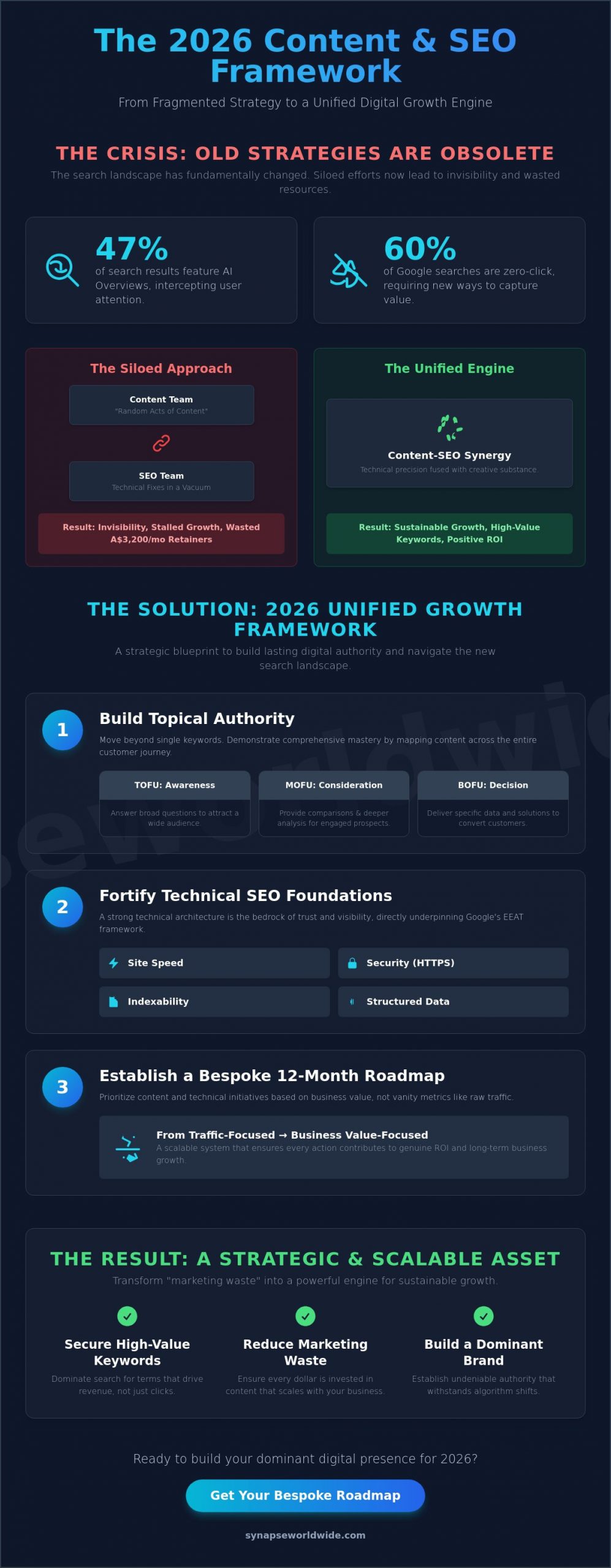
With AI Overviews now appearing in 47% of all search results and 60% of Google searches ending without a single click, a fragmented content marketing seo strategy is a recipe for invisibility. You’ve likely felt the frustration of investing in high quality assets that fail to rank, or perhaps you’re watching your organic visibility stall despite a steady publishing schedule. In an Australian market where average agency retainers sit around A$3,200 per month, wasting resources on uncoordinated efforts isn’t just inefficient; it’s a structural barrier to your business transformation.

We promise to provide a clear roadmap to unify your content and technical SEO into a single, high performance digital architecture. This article previews a 2026 framework designed to navigate the March 2026 Core Update, leverage AI powered optimization, and build a trust ecosystem that drives sustainable growth. You’ll discover how to move beyond “random acts of content” to create a scalable system that secures high value keywords and delivers a genuine return on investment. By integrating data driven insights with human expertise, you can ensure your brand remains a dominant force in the evolving digital landscape.

Key Takeaways

  • Understand why siloed marketing departments fail and how to build a unified digital growth engine for the 2026 search environment.
  • Learn to build topical authority by mapping your content marketing seo strategy across the entire customer journey, from awareness to decision.
  • Discover how technical SEO foundations like site speed and security directly underpin the “Trust” element of the 2026 EEAT framework.
  • Establish a bespoke 12-month roadmap that prioritises content based on its actual business value rather than just raw traffic numbers.
  • Reduce marketing waste by treating content as a strategic asset that scales seamlessly with your business growth.

The Convergence of Content Marketing and SEO Strategy in 2026

The landscape of digital growth has shifted. In 2026, a successful content marketing seo strategy is no longer a collection of separate tactics; it’s a unified digital growth engine. For years, businesses treated content and SEO as distinct departments. Writers focused on engagement while technical teams focused on metadata. This fragmented approach fails in the current search environment because Google’s March 2026 Core Update now evaluates holistic performance. If your technical architecture doesn’t support your narrative, or your content doesn’t satisfy technical quality signals, your visibility will suffer.

Traditional “siloed” marketing departments struggle because they lack a cohesive vision. When content teams work in isolation, they often produce assets that search engines can’t index properly or that don’t align with high-value search intent. This leads to a disconnect where high-quality writing fails to reach its intended audience. A unified content marketing seo strategy eliminates this friction, transforming content from a simple expense into a robust strategic asset. This shift from keyword-centric tactics to intent-based strategic planning ensures your brand answers the questions your customers are actually asking. Content-SEO Synergy is the structural fusion of technical precision and creative substance that establishes undeniable digital authority.

The Evolution of Search: Why Content is SEO

Search engines have evolved to prioritise user satisfaction over simple keyword matches. With AI Overviews appearing in 47% of all results, the focus has moved to semantic search. This technology connects disparate content pieces to understand the broader context of a brand’s expertise, meaning your site must demonstrate deep knowledge across entire topics rather than just individual terms. For Australian companies, investing in seo for small business remains a critical long-term play to capture this organic demand. Since organic search accounts for 53.3% of all web traffic, your content must satisfy the specific intent behind every query to remain competitive in a zero-click world.

Moving Beyond “Random Acts of Content”

Many brands still fall into the trap of “random acts of content.” They publish high volumes of blog posts without a technical SEO blueprint, leading to wasted resources and diluted authority. In 2026, volume-based posting is ineffective. Success requires authority-based strategic distribution. Instead of generic articles, you need a bespoke digital architecture tailored to your specific business goals. This ensures every piece of content serves a purpose within a larger, scalable system. With average agency retainers in Australia ranging from A$1,500 to A$5,000 for small businesses, precision is the only way to ensure a positive return on investment. By designing your content with a technical foundation from the outset, you create a robust presence that can withstand frequent algorithm shifts.

Building Topical Authority: Beyond Keyword Stuffing

Topical authority has replaced simple keyword density as the primary driver of organic success. In the 2026 search environment, Google rewards websites that demonstrate comprehensive mastery of a subject. A robust content marketing seo strategy requires you to move beyond individual pages and instead build a network of interconnected knowledge. This involves mapping your content across the entire customer journey. At the Top of Funnel (TOFU), you answer broad questions. At the Middle of Funnel (MOFU), you provide comparisons and deeper analysis. Finally, at the Bottom of Funnel (BOFU), you deliver the specific data needed to close a sale. For those just launching a digital presence, mastering keyword research for beginners is the first step in identifying the high-intent queries that actually drive revenue in the Australian market.

Internal linking serves as the connective tissue of this authority. By strategically linking related articles, you signal to search engines which pages are your primary pillars of expertise. This structure doesn’t just help bots; it guides users through a logical progression of information. If you’re looking to refine your digital architecture, a bespoke SEO audit can reveal the gaps in your current linking strategy. When your internal links are purposeful, you pass authority from high-performing pages to new content, accelerating the ranking process for your entire site.

Creating Content Hubs and Spoke Models

The “Hub and Spoke” model is a proven framework for scaling authority. A central pillar page provides a high-level overview of a broad topic, while multiple spoke articles dive deep into specific long-tail nuances. Technically, these hub pages must be optimized to pass link equity efficiently across the entire cluster. This approach significantly improves user dwell time. When a visitor finds all the answers they need in one ecosystem, they stay longer and bounce less. This signals to Google that your site is the definitive source for that niche, directly impacting your visibility for high-value keywords.

Optimising for AI Search and SGE

With AI Overviews now appearing in 47% of all search results, your content must be structured for machine readability and human authority. Search Generative Experiences (SGE) favour “snippet-ready” definitions and clear, authoritative claims that can be easily parsed. To survive in an era where AI-generated content is abundant, you must provide original insights and first-hand experience. Generic summaries are easily replaced by AI. Bespoke data, unique case studies, and expert opinions are the only way to ensure your brand remains a cited source in AI-generated answers. Structure your content with clear headings and concise answers to capture these prominent placements.
The Strategic Integration of Content Marketing and SEO: A 2026 Framework for Growth

The EEAT Framework: Why Authority is the New Currency

In the wake of the March 2026 Core Update, search engines have become significantly more sophisticated in identifying the human element behind the screen. Experience, Expertise, Authoritativeness, and Trustworthiness (EEAT) are no longer just guidelines; they’re the primary filters Google uses to separate high-value insights from the noise of scaled AI content. A sophisticated content marketing seo strategy must account for these signals across every touchpoint. Experience requires proof of first-hand usage. Expertise demands credentials. Authoritativeness comes from third-party validation. Trustworthiness is the foundation that holds the entire structure together. EEAT is not a checklist but a holistic brand signal.

Google now tracks author entities through complex digital footprints. This means the reputation of your individual contributors matters as much as the domain itself. Search engines look for consistent expertise across professional platforms, social proof, and citations from other authoritative sources. When your content is backed by a verifiable expert with a robust history in the industry, your visibility increases. This convergence of personal branding and technical SEO creates a resilient presence that’s difficult for competitors to replicate through automated means alone.

Demonstrating First-Hand Experience

Proving you’ve actually done the work is the most effective way to satisfy the Experience requirement. Use proprietary data and detailed case studies to show real-world applications of your services. For example, our internal data from early 2026 shows that websites using original, first-party imagery see a 30% higher engagement rate than those relying on stock photography. Original video content and links to a professional portfolio further validate your claims. These assets provide the authentic proof that search engines need to rank your content above generic summaries.

The Technical Side of Trust

Trust is fragile. A single security breach or a sluggish interface can dismantle years of authority-building in seconds. Technical SEO directly underpins the “Trust” element of EEAT through Core Web Vitals, specifically the holistic performance scores introduced in 2026. High-performance hosting and secure HTTPS protocols are baseline requirements for any serious growth strategy. When measuring success, your seo kpis for small business should include trust-based metrics like security uptime and interaction speed. If your site feels unstable, users won’t trust your content, and neither will Google. Ensuring a seamless, robust technical foundation is the only way to safeguard your brand’s digital reputation.

Designing a Data-Driven Content Roadmap for Growth

A high-performance content marketing seo strategy requires more than a simple editorial calendar; it demands a 12-month architectural roadmap. While many agencies rely on static search volume, a strategic approach prioritises topics based on their proximity to revenue. This process begins with a comprehensive competitive gap analysis to identify organic opportunities where your competitors are underperforming. By targeting these specific weaknesses, you can secure high-value visibility faster than through broad keyword targeting. Your roadmap must be a scalable system that evolves alongside your business objectives, ensuring that every asset published contributes to long-term digital stability.

Effective planning involves categorising content into tiers based on business value. High-intent topics that solve specific customer problems take precedence over viral, low-conversion trends. This disciplined focus ensures that your marketing budget is allocated toward activities with the highest potential return on investment. In the Australian market, where 61% of B2B marketers report that organic traffic generates more leads than any other channel, a data-driven roadmap is the difference between a growing brand and a stagnant one. We treat your digital presence as a dynamic asset that requires constant refinement based on real-time performance audits.

Integrating CRM and ERP Insights

Your internal data is the most significant competitive advantage you possess. By integrating CRM insights, you can transform common customer pain points into targeted content that addresses the exact barriers to purchase. Similarly, ERP data allows you to identify which products or services offer the highest profit margins. This allows us to focus your organic visibility efforts where they will have the greatest impact on your bottom line. Bespoke marketing automation then tracks these assets from the initial click to the final conversion, providing a clear picture of how your content drives growth. If you’re ready to align your data with your digital presence, book a strategic content consultation to begin building your roadmap.

Measuring What Matters

Success in 2026 is defined by ROI, not vanity metrics like raw page views. We move beyond surface-level data to focus on multi-touch attribution, which recognises the role each content piece plays in the customer journey. A user might discover your brand through a TOFU guide but only convert after reading a technical case study three weeks later. Understanding this path is essential for adjusting your roadmap. Regular performance audits ensure that your strategy remains agile. If a particular topic cluster isn’t delivering the expected lead volume, we pivot resources toward higher-performing categories, ensuring your digital architecture remains robust and results-oriented.

Seamless Integration: Transforming Content into a Strategic Asset

Achieving a seamless integration between technical performance and creative substance transforms your content marketing seo strategy from a series of tasks into a powerful business asset. This unified approach eliminates the waste associated with disconnected marketing efforts. Instead of producing content that fails to rank or technical optimisations that lack a narrative, you build a singular, scalable growth engine. We act as the Digital Architect in this process, ensuring that every element of your digital presence is designed to support a specific business outcome. By treating your website as a high-performance digital architecture, you ensure that every Australian Dollar invested contributes to a robust foundation for future expansion.

Unlike paid advertising, which stops the moment you cease spending, an integrated digital presence offers compounding value that grows over time. Research indicates that organic search accounts for 53.3% of all website traffic, and SEO-driven leads have an average close rate of 14.6%. This is a stark contrast to the 3% close rate typical of paid social media ads. Over a 12 to 18-month period, this infrastructure becomes a self-sustaining source of high-quality leads. It’s not just about visibility; it’s about creating a revenue-driving infrastructure that remains stable even as Google rolls out core updates roughly every three months.

The Role of Bespoke Digital Solutions

Cookie-cutter SEO packages often ignore the unique competitive landscape of your industry and the specific needs of Australian consumers. A bespoke content marketing seo strategy ensures that your technical foundations and creative assets work in perfect harmony. By integrating ERP solutions or CRM systems directly into your digital architecture, you can automate the process of turning organic traffic into actionable business data. This level of technical sophistication ensures that your content isn’t just being read; it’s being used to drive revenue and improve operational efficiency. Strategic integration means your site’s performance is qualified by its ability to generate ROI, not just its appearance. Following a comprehensive on-page seo checklist ensures that every page within your bespoke architecture meets the precise technical and content standards required to compete in the 2026 search environment.

Taking the Next Step Toward Digital Transformation

Reaching the next level of business success requires a shift from tactical fixes to a comprehensive digital strategy. In a competitive national market like Australia, professional execution is the only way to ensure your brand stands out among sophisticated competitors. We provide a clear pathway for businesses ready to move beyond basic visibility toward true digital transformation. This involves a commitment to a robust, revenue-driving infrastructure that is built to last. Your digital presence is in expert hands when you choose a partner that values precision as much as vision. It’s time to stop reacting to the digital landscape and start architecting your own growth.

Mastering Your Digital Architecture for Sustainable Growth

Success in the 2026 search environment depends on your ability to fuse technical precision with strategic substance. As we’ve explored, a fragmented approach no longer secures a place in AI-driven search results. By prioritising topical authority and aligning your content marketing seo strategy with real-world business data, you create a resilient presence that compounds in value over time. This framework isn’t just about ranking; it’s about building a robust, revenue-driving infrastructure that withstands algorithm shifts and market volatility.

Synapse Worldwide has served as a specialist in high-performance bespoke digital infrastructure since 2005. Our team brings a proven track record in national organic growth to every partnership, ensuring your brand reaches its full potential. Partner with the Digital Architects at Synapse Worldwide to build your bespoke growth strategy. The future of your digital presence starts with a commitment to transformation and professional execution. You have the tools to dominate your landscape; it’s time to build something extraordinary.

Frequently Asked Questions

How long does a content marketing SEO strategy take to show results?

It typically takes 6 to 12 months to see measurable traffic gains from a unified strategy, with full ROI realized within 12 to 18 months. This timeline allows search engines to validate your topical authority and index your content clusters. Unlike the temporary spikes of paid ads, these returns compound over time to create a sustainable lead generation engine.

Can I use AI to write all my SEO content in 2026?

No, relying solely on AI is a significant risk because the March 2026 Core Update specifically targets scaled AI-generated content. While AI is projected to automate 80% of SEO tasks, it cannot replicate the first-hand experience and original insights required by the EEAT framework. Successful brands use AI as a tool for optimization while maintaining human-led expertise for all published assets.

What is the difference between a blog post and a strategic SEO pillar page?

A strategic SEO pillar page acts as a comprehensive hub providing a high-level overview of a broad topic, while a blog post serves as a “spoke” that dives into a specific long-tail nuance. Pillar pages are the structural foundation of your site’s architecture. They pass link equity to supporting articles, which helps reduce bounce rates and signals deep expertise to search engines.

How much should a small business invest in an integrated SEO strategy?

Small businesses in Australia typically invest between A$1,500 and A$5,000 per month for a professional, integrated strategy. The average agency retainer in the current market sits at approximately A$3,200. Investing at this level ensures you have the technical precision and content volume necessary to compete for high-value keywords against established national competitors.

Does social media impact my content marketing SEO strategy?

Social media does not directly influence your search rankings, but it plays a vital role in your overall content marketing seo strategy by building trust signals. While SEO drives 1,000% more traffic than organic social media, social platforms help establish the “Experience” and “Authoritativeness” elements of EEAT. It functions as a distribution channel that can lead to third-party citations and brand mentions.

What are the most important SEO metrics for content performance?

You should focus on conversion rates and multi-touch attribution rather than vanity metrics like raw page views. Since 61% of B2B marketers state that organic search generates more leads than any other initiative, tracking the path from initial click to final sale is essential. Metrics such as interaction speed and user dwell time provide a more accurate picture of your digital ROI.

How often should I update my existing content for SEO purposes?

High-value content should be reviewed every three to six months to stay aligned with Google’s core update cadence. Search engines now roll out significant updates roughly every three months, making content freshness a critical ranking factor. Regular audits ensure your data remains accurate and your technical performance continues to meet the holistic Core Web Vitals scoring standards introduced in 2026.

Is a custom website necessary for a successful SEO strategy?

A custom website is essential for any high-performance content marketing seo strategy because it allows for total control over technical architecture. Cookie-cutter templates often suffer from bloated code that slows down interaction speeds and negatively impacts Core Web Vitals. Bespoke designs ensure your site is scalable, secure, and capable of integrating with the CRM or ERP systems needed to track growth.

 

Keyword Research for Beginners: A Strategic Guide to Digital Growth in 2026

Keyword Research for Beginners: A Strategic Guide to Digital Growth in 2026

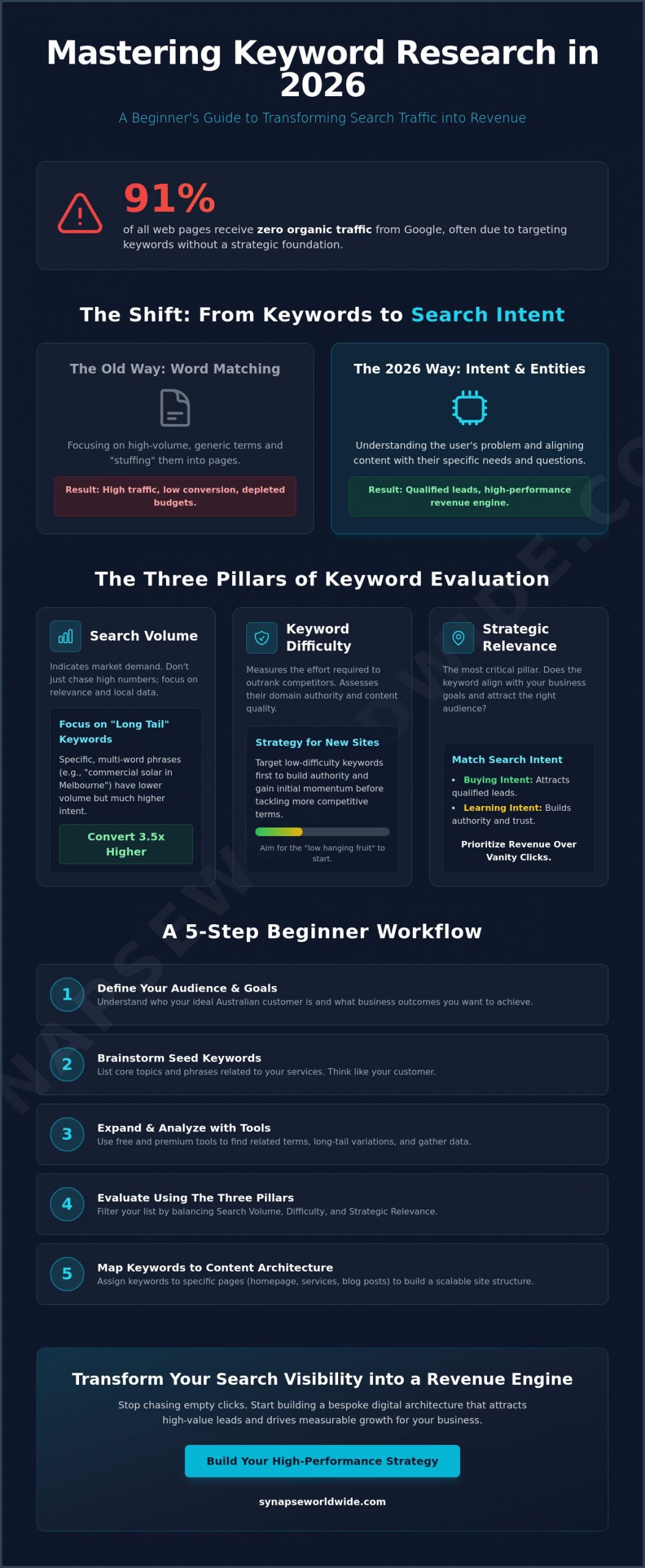
In 2026, the traditional pursuit of high-volume search terms is a fast track to a depleted marketing budget. Recent industry analysis shows that 91% of all web pages receive zero organic traffic from Google, largely because they target keywords without a strategic foundation. You’ve likely felt the exhaustion of navigating conflicting advice from generic blogs while watching your competitors capture the high-value leads you deserve. It’s frustrating to invest time into SEO only to find that your chosen terms drive clicks but fail to generate actual revenue in the Australian market.

Mastering keyword research for beginners is the first step in building a bespoke digital architecture that scales with your business. We’ll show you how to master the fundamental architecture of search intent to transform your digital presence into a high-performance revenue engine. This guide delivers a clear, repeatable process for identifying high-value keywords and provides a strategic framework for understanding modern customer search behavior. You’ll move beyond the confusion of AI search results to secure a robust, long-term competitive advantage for your core services.

Key Takeaways

  • Master the fundamental shift from simple word matching to complex search intent analysis to capture the digital language of your ideal Australian clientele.
  • Identify bespoke growth opportunities by evaluating the three pillars of keyword health: search volume, competitive difficulty, and strategic relevance.
  • Develop a professional 5-step workflow for keyword research for beginners that prioritizes a scalable content architecture over disorganized lists.
  • Evaluate free and premium tool ecosystems to ensure your digital investment provides the robust, actionable data required for the Australian market.
  • Transform search visibility into a high-performance revenue engine by seamlessly integrating strategic keywords into your technical site architecture.

What is Keyword Research and Why is it Critical in 2026?

Keyword research isn’t just a list of words; it’s the strategic discovery of the digital language your Australian audience uses to navigate the web. In 2026, successful digital growth requires more than just matching text. It demands a deep understanding of the user’s psyche. Understanding What is Keyword Research at its core allows you to identify the terms, questions, and phrases that bridge the gap between a customer’s problem and your bespoke solution. This foundation supports every piece of high-performance digital infrastructure we build. Without it, your website is a silent storefront on a busy Sydney street.

The post-AI search landscape has shifted the focus from simple word matching to complex precision. Search engines now act as sophisticated filters, discarding generic content in favour of highly relevant answers. Mastering keyword research for beginners is no longer about finding high-volume terms to “stuff” into a page. Instead, it’s about aligning your brand’s expertise with the specific queries your potential clients are typing into their devices. Precision is paramount because AI-driven algorithms can now detect the difference between a surface-level mention and genuine topical authority.

The Evolution of Search: Keywords vs. Entities

Search engines have moved beyond simple character matching to entity-based recognition. Entities are real-world concepts, people, places, or things that search engines now prioritise over raw text strings. If you want to rank for “commercial solar in Melbourne,” the engine doesn’t just look for those words. It looks for evidence that your site understands the broader entity of renewable energy regulations in Victoria. Your website must function as a definitive authority on these topics rather than a mere host for keywords. Search Intent is the primary driver of 2026 SEO success.

Business Impact: Traffic vs. Targeted Revenue

Many Australian businesses fall into the trap of chasing vanity metrics. High traffic numbers look impressive on a monthly report, but they don’t always pay the bills. Value metrics focus on qualified leads that actually convert into sales. A bespoke keyword strategy ensures that your e-commerce platform attracts users ready to spend A$500 rather than those just browsing for inspiration. When you focus on keyword research for beginners with a revenue-first mindset, you filter out the noise and capture the intent.

This approach is a core pillar of our SEO for small business framework, where we prioritise targeted revenue over empty clicks. By identifying “buying” keywords versus “learning” keywords, you can allocate your marketing budget more effectively. This ensures a higher conversion rate and a more robust return on investment for your digital assets.

The Three Pillars of Keyword Evaluation

Strategic digital growth requires a balanced framework that moves beyond simple intuition. For any new website, the “perfect” keyword isn’t just a term with high traffic; it’s the precise intersection of three critical metrics: volume, difficulty, and intent. When starting keyword research for beginners, you must prioritize relevance over raw numbers. This focused approach builds initial momentum and prevents the common “low-value traffic trap,” where a site attracts thousands of visitors who have no intention of engaging with the brand or making a purchase. Every selection must be a deliberate step toward a measurable business outcome.

Search Volume: Understanding Market Demand

Search volume indicates the average number of times users enter a specific query into a search engine each month. While high-volume terms are tempting, the “Long Tail” theory proves that specific, multi-word phrases often provide better results for emerging brands. These niche terms might only have 40 or 70 searches per month, yet they frequently convert at a rate 3.5 times higher than broad “head” terms. Australian businesses should specifically filter for national data rather than global volume. A phrase might show 15,000 global searches, but if only 100 of those occur within Australia, the global metric is a vanity stat that won’t drive local revenue.

Keyword Difficulty: Assessing the Competitive Landscape

Keyword difficulty measures how much effort is required to outrank the current leaders. This metric is defined by the domain authority of the ranking sites and the comprehensive nature of their content. A new site shouldn’t target broad head terms immediately because established competitors have spent years building backlink profiles that are difficult to displace overnight. Instead, look for “low-hanging fruit.” These are opportunities where the top results are outdated articles from 2022, irrelevant forum threads, or low-quality content. Identifying these gaps is a core component of a bespoke digital strategy that ensures your resources are spent where they can actually win.

Search Intent: The ‘Why’ Behind the Query

In 2026, matching your content format to search intent is the primary ranking factor. Google prioritizes pages that satisfy the user’s specific goal, which we divide into four categories: Informational (seeking knowledge), Navigational (finding a specific site), Commercial (investigating brands), and Transactional (ready to purchase). As noted in Ahrefs’ guide to keyword research, understanding these nuances is vital for conversion. You can identify intent by performing a SERP analysis. If the top results for your chosen term are all “how-to” videos, a text-heavy product page will likely fail to rank regardless of its quality. Effective keyword research for beginners involves looking at what Google is already rewarding and creating a superior version of that specific format.

Keyword Research for Beginners: A Strategic Guide to Digital Growth in 2026

Essential Tools for Beginner Keyword Research

Selecting a toolkit is the first step in transforming raw data into a scalable growth engine. For those starting keyword research for beginners, the digital landscape offers two distinct paths: free utilities that leverage Google’s ecosystem and professional platforms designed for deep competitive auditing. The most effective tool isn’t necessarily the most expensive; it’s the one that uncovers actionable intent within your specific Australian niche. Success relies on your “Seed Keywords,” which are the foundational terms describing your core business. These seeds act as the primary input for any tool, allowing the software to branch out into thousands of long-tail variations that your customers are actually typing into search bars.

A strategic budget-friendly stack for an Australian small business often includes a mix of Google’s native tools and a mid-tier aggregator like Ubersuggest or AnswerThePublic. This combination keeps monthly overheads low, typically under A$50, while providing enough data to outperform competitors who rely on guesswork. High-performing content isn’t a product of luck; it’s the result of using these tools to identify gaps in the market before your competitors do.

Free Resources: Tapping into Google’s Own Data

Google Keyword Planner remains a cornerstone for organic strategy, even though it’s housed within the Google Ads interface. It provides precise geographic data for the Australian market, letting you filter search volumes specifically for cities like Perth or Brisbane. Google Search Console offers a different advantage by showing you “hidden” opportunities. Industry reports from 2024 indicate that 70% of clicks go to the top three organic results. Search Console identifies keywords where you currently rank on page two, highlighting exactly where a small SEO push could yield a massive traffic spike. Finally, Google Trends is indispensable for navigating seasonality. It helps you anticipate when interest in your services will peak, ensuring your content is live and indexed well before the surge begins.

Professional Platforms: Scaling Your Strategy

When you’re ready to move beyond the basics, professional platforms like Ahrefs or Semrush provide a comprehensive competitive lens. These subscriptions usually start around A$160 per month, but the return on investment comes from their “Keyword Gap” features. This tool allows you to input your URL alongside three competitors to see exactly which high-value terms they rank for that you’ve missed. It’s a blueprint for content creation that removes all uncertainty. Professional agencies use these sophisticated data points to build a custom web design for small business, ensuring the site architecture supports the most lucrative search terms from day one. Transitioning to keyword research for beginners using these professional insights turns a simple website into a proactive sales tool that works around the clock.

How to Perform Keyword Research: A 5-Step Beginner Workflow

Approaching keyword research for beginners requires the mindset of a Digital Architect. You aren’t just compiling a spreadsheet of random words; you’re designing the structural integrity of your brand’s online presence. Data from 2024 indicates that the top result in Google captures approximately 27.6% of all clicks. To secure that position, your workflow must be repeatable, data-driven, and adaptable to the shifting Australian market. This process transforms raw data into a strategic content map that supports long-term growth.

Step 1: Brainstorming Seed Keywords

Begin with the foundation of your business. Identify your core services, such as “commercial fit-outs in Melbourne” or “bespoke financial planning.” Move beyond what you sell to how your clients think. Review your CRM for common FAQs. If three clients this week asked about “capital gains tax on Australian investment property,” that’s a high-value seed. Finally, target “problem” keywords. These are the phrases users search when they feel the pain but haven’t found the solution yet, like “why is my website bounce rate so high.”

Step 2 & 3: Expanding the List and Filtering by Metrics

Input your seeds into professional tools to generate a list of 500 or more related phrases. This expansion phase provides the raw materials for your strategy. You must then apply rigorous filters to refine the list. Remove terms with a difficulty score above 70 if your site is new. Prioritise keywords with “Commercial Intent.” For example, “buy solar panels Sydney” is significantly more valuable than “how do solar panels work” for a retail business. This ensures your efforts drive immediate business value rather than just vanity metrics.

Step 4 & 5: SERP Analysis and Content Mapping

Before you write a single word, examine the Search Engine Results Page (SERP). If the top three results are instructional videos, a 2,000-word blog post might not rank regardless of its quality. Assign every validated keyword to a specific page on your site to prevent keyword cannibalisation. This is where you build a “Topic Cluster.” Create one pillar page for a broad topic and link several smaller, specific articles back to it. This integrated structure signals to search engines that you possess deep topical authority in your niche.

Keyword Validation Checklist:

  • Does the keyword align with a specific service or product you provide?
  • Is the search volume higher than 100 monthly searches in Australia?
  • Does the current SERP match your intended content format?
  • Can you provide a more comprehensive answer than the current top 3 results?

Successful SEO isn’t a one-time setup; it’s a continuous process of refinement. Market trends evolve, and your keyword strategy must adapt to stay relevant. If you’re ready to build a robust digital foundation that delivers measurable ROI, partner with our strategic consultants to scale your business today.

From Keywords to Conversions: Strategic Implementation

Identifying high-value search terms is a significant milestone for any growing business. However, raw data doesn’t generate revenue; implementation is where your investment yields a tangible return. In the Australian market, where online competition has intensified by over 12% since 2024, a passive approach to data is no longer viable. Effective keyword research for beginners must transition from a static spreadsheet into the functional DNA of your website.

Keywords must dictate your technical site architecture rather than being treated as an afterthought. This integration is particularly critical during ecommerce website development. Your category hierarchies and product taxonomies should directly mirror the search intent of your primary audience. When site structure aligns with the user’s mental model, you reduce friction and accelerate the path to purchase. While these steps are foundational, professional SEO management is often required to scale these efforts into a sustainable, high-performance growth engine. A unified content marketing SEO strategy ensures that every piece of content you publish reinforces your keyword architecture and drives compounding organic growth.

On-Page Optimization Essentials

Strategic placement remains the cornerstone of visibility. You must integrate keywords into page titles, H1 headers, and meta descriptions to signal relevance to search crawlers. You shouldn’t sacrifice readability for rankings. Write for human users first; search engines have become sophisticated enough to reward natural, high-quality prose. Keywords also serve as the blueprint for a robust internal linking structure. By linking related topics, you guide users deeper into your sales funnel and help search engines index your most important pages more efficiently. Following a comprehensive on-page SEO checklist ensures that every technical and content element on your page is optimized to convert keyword visibility into measurable revenue.

Measuring Success: Beyond the Rankings

Securing a top position is a vanity metric if it fails to drive business outcomes. You need to look deeper into Google Analytics 4 to evaluate the health of your strategy. Focus on these key metrics:

  • Organic Traffic Volume: Monitoring the total number of unique sessions arriving from search engines.
  • Conversion Rate by Landing Page: Identifying which specific keywords lead to enquiries or sales.
  • Engagement Rate: Ensuring the traffic you attract is actually interacting with your content rather than bouncing.

True keyword research for beginners is never a finished task. It’s a continuous cycle of discovery, implementation, and refinement. As consumer behaviour in Australia evolves, your keyword strategy must adapt to ensure your digital presence remains both relevant and profitable.

Secure Your Competitive Advantage in the 2026 Digital Economy

The evolution of search algorithms means that keyword research for beginners is no longer just about finding high-volume phrases. It’s about decoding user intent and mastering the three pillars of evaluation to ensure your content resonates with the Australian market. By implementing the 5-step workflow we’ve outlined, you’re positioning your brand to capture high-value traffic that actually converts into revenue.

Success in this landscape requires a sophisticated approach to data. Since 2005, Synapse Worldwide has acted as a digital architect for national enterprises, building bespoke digital architecture that stands the test of time. We provide results-oriented strategic consulting that bridges the gap between technical optimization and tangible business growth. Whether you’re targeting local niche segments or scaling across the country, it’s time to stop guessing and start scaling with a framework built for the next decade of digital competition.

Ready to build a data-driven growth engine? Explore our Strategic SEO Services.

Your journey toward market leadership starts with a single, data-backed decision. Let’s build something remarkable together.

Frequently Asked Questions

How long does it take to rank for a new keyword?

Ranking for a new keyword typically requires 90 to 180 days of consistent optimization and authority building. According to a 2024 Ahrefs study, only 5.7% of newly published pages reach the top 10 search results within a year. Your timeline depends heavily on your domain authority and the competitiveness of the Australian digital landscape. We focus on scalable strategies that accelerate this process through technical precision and high-quality content alignment.

Should I focus on high-volume keywords or low-volume ones?

Prioritise low-volume, high-intent keywords to secure immediate conversions while building long-term authority for competitive terms. While high-volume keywords offer broader reach, long-tail queries often account for 70% of all search traffic. Beginners should target phrases with 50 to 200 monthly searches to gain traction quickly. This bespoke approach ensures your investment delivers measurable ROI before you tackle industry-leading benchmarks.

Is keyword research still necessary with the rise of AI search?

Keyword research remains a fundamental pillar of digital strategy even as AI-driven search models like Google’s Search Generative Experience evolve. AI engines still rely on linguistic patterns and entities to map user intent to relevant content. Effective keyword research for beginners in 2026 focuses on semantic clusters rather than isolated phrases. This ensures your brand remains visible in both traditional results and AI-curated snapshots.

How many keywords should I target on a single page?

Target one primary keyword and three to five secondary, related variations per page to maintain topical relevance. Modern search algorithms prefer comprehensive content that addresses a specific intent deeply. A 2024 analysis of top-ranking pages showed they often rank for 1,000 or more long-tail keywords naturally. We design integrated content structures that allow these variations to surface without compromising the user experience or page clarity.

Can I do keyword research for free without expensive tools?

You can conduct robust keyword research using free platforms like Google Keyword Planner, Google Trends, and AnswerThePublic. These tools provide authentic data directly from search engines, allowing you to identify trends within the Australian market without an initial software investment. While free tools offer a solid foundation, professional-grade analytics become necessary as your business scales. It’s best to start with these resources to validate your niche before moving to bespoke, data-heavy platforms.

What is the difference between a keyword and a search query?

A keyword is the specific term marketers target, while a search query is the actual string of words a user types into a search engine. For instance, your keyword might be “SEO services,” but a user’s query could be “best SEO agency in Melbourne for small business.” Understanding this distinction is vital for successful keyword research for beginners. It allows you to bridge the gap between your strategic goals and the real-world language of your customers.

How often should I update my keyword research?

Review and update your keyword strategy every 90 to 120 days to stay aligned with shifting market trends and competitor movements. The digital landscape moves rapidly; a keyword that converted well in January might lose relevance by June. Regular audits ensure your content remains optimized for the most current search behaviours. This disciplined approach prevents stagnation and keeps your growth trajectory on a steady, upward path.


Custom Web Design for Small Business: Building a Strategic Growth Engine in 2026

Custom Web Design for Small Business: Building a Strategic Growth Engine in 2026

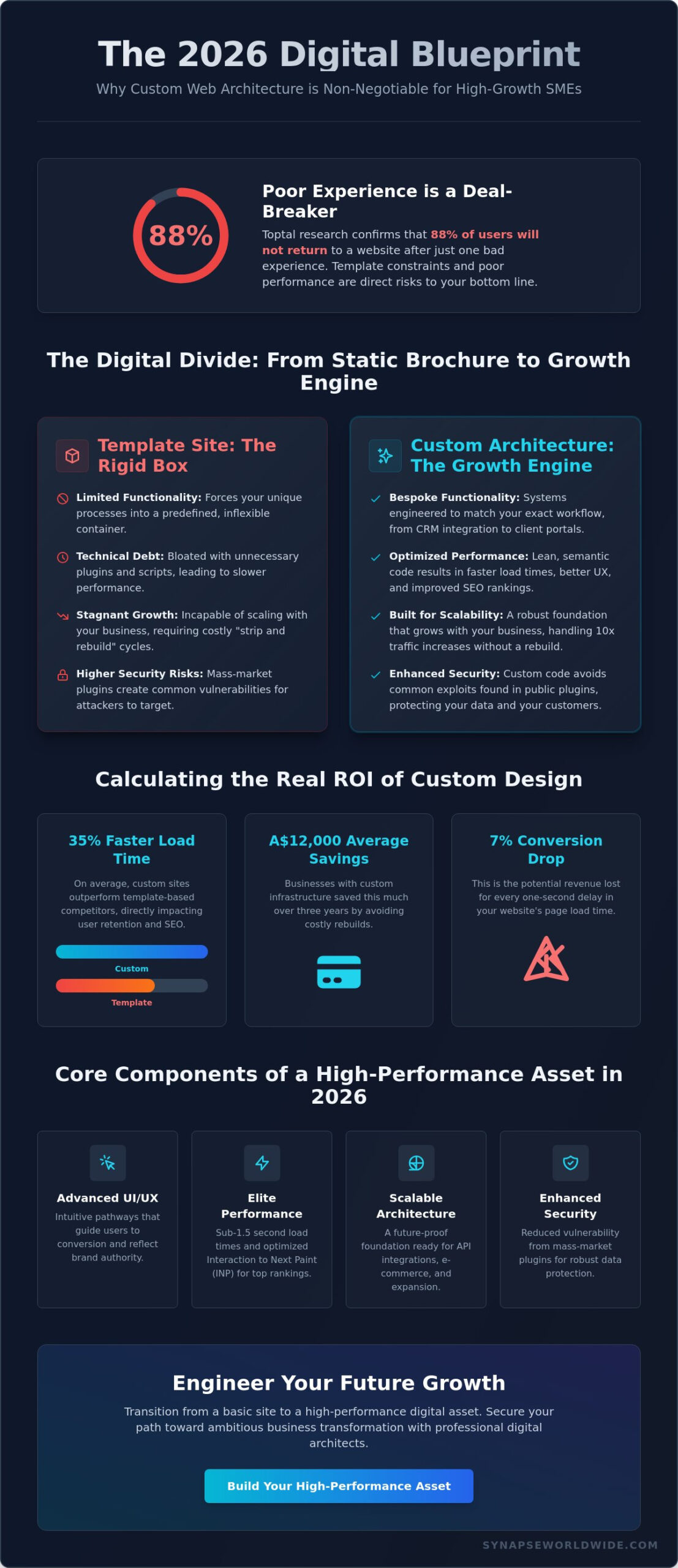
By 2026, a website that merely “exists” will be a liability rather than an asset for Australian SMEs. If your current platform feels sluggish or fails to sync with your internal CRM, you’re likely considering how custom web design for small business could solve these conversion bottlenecks. Research from Toptal indicates that 88% of users won’t return to a site after one poor experience, making template constraints a genuine risk to your bottom line. You likely agree that a digital presence that fails to reflect your professional authority or integrate with your workflow acts as a barrier to scaling.

Investing in bespoke architecture is the most effective way to eliminate technical debt and build a robust, integrated infrastructure. This article demonstrates how to transition from a basic site to a high-performance asset that aligns with your business tools and growth targets. We’ll preview the strategic framework required to ensure your brand remains a dominant force in the Australian market for years to come.

Key Takeaways

  • Transition from rigid templates to a bespoke digital architecture designed to scale seamlessly with your evolving business goals.
  • Identify the 2026 technical non-negotiables, from Core Web Vitals to advanced performance metrics, that ensure your asset remains competitive in the Australian landscape.
  • Analyze the real ROI of custom web design for small business by comparing initial investment against the long-term costs of template limitations and technical debt.
  • Follow a strategic roadmap that aligns information architecture with user experience to convert your digital presence into a high-performance growth engine.
  • Discover how engineering a robust, integrated foundation with professional digital architects secures your path toward ambitious business transformation.

The Strategic Value of Custom Web Design for Small Business

Custom web design for small business isn’t merely a visual exercise. It’s the construction of a bespoke digital architecture designed to convert visitors into long-term partners. While off-the-shelf templates offer a low barrier to entry, they often trap Australian businesses in a cycle of limited functionality and stagnant growth. By 2026, the distinction between a static Digital Brochure and a dynamic Growth Engine will define market leaders in the local economy.

A template is a rigid box. It forces your unique business processes to fit into a pre-defined container. In contrast, custom design starts with your specific goals. Whether you’re targeting a 20% increase in lead generation or streamlining a complex booking system, every line of code serves a strategic purpose. This bespoke approach ensures your brand authority remains intact while providing a unique user journey that competitors using generic themes can’t replicate. A 2024 digital consumer report indicated that 38% of visitors stop engaging with a website if the layout is unattractive or non-functional, making the move toward custom builds a financial necessity rather than a luxury. Understanding the website redesign signals that indicate your current platform is holding you back is the critical first step before committing to a bespoke solution.

Architecture vs. Aesthetics: Why Custom Matters

Aesthetics catch the eye, but architecture drives the bottom line. A site’s underlying structure influences how effectively search engines index your content. When you understand the core components of web design, it becomes clear that clean, semantic code is vital for visibility. Custom builds eliminate the Technical Debt associated with bloated plugins and unnecessary scripts found in templates. This efficiency resulted in a 35% faster average load time for custom sites compared to template-based competitors in a 2024 performance audit. Fast, clean code improves crawlability, ensuring your business stays visible on search engine results pages.

Building for Scalability and Future Growth

Your website is a long-term business asset, not a recurring operational hurdle. Investing in custom architecture means your platform grows alongside your revenue. You can integrate client portals, advanced e-commerce modules, or proprietary APIs without the need for a total rebuild. This scalability is crucial for Australian SMEs looking to expand their footprint. A 2025 industry report highlighted that businesses with custom-built infrastructures saved an average of A$12,000 over three years by avoiding the strip and rebuild cycle common with limited templates. We treat your digital presence as a robust foundation for transformation, ensuring performance remains stable even as your traffic volume increases ten-fold.

  • Bespoke Functionality: Systems built to match your specific workflow.
  • Enhanced Security: Reduced vulnerability compared to mass-market templates.
  • Optimised Performance: Tailored code that prioritises speed and user experience.

Core Components of a High-Performance Digital Asset in 2026

In 2026, a digital presence requires more than aesthetic appeal; it demands a sophisticated technical foundation that prioritises performance and user trust. Google’s transition to Interaction to Next Paint (INP) as a core metric means that responsiveness is now a primary ranking factor. A high-performance asset must load in under 1.5 seconds to retain the 53% of mobile users who abandon sites that take longer to display. For Australian businesses, this technical excellence isn’t optional. It’s the baseline for visibility in a crowded national market.

Advanced UI/UX: Crafting the User Journey

Effective design moves beyond simple visuals. We focus on functional interfaces that guide users toward specific actions through intuitive pathways. User experience serves as the indispensable bridge between a visitor’s initial intent and your ultimate business conversion. By implementing data-driven UX, businesses can reduce friction points that typically cause cart abandonment or lead loss. Adhering to small business website best practices ensures your homepage functions as a high-velocity entry point for new customers rather than a static digital wall.

Performance Optimization and Speed

Speed is a direct driver of revenue. Research indicates that a one-second delay in page load time can result in a 7% drop in conversions. Choosing custom web design for small business allows for the removal of unnecessary code bloat often found in generic, off-the-shelf templates. We utilise modern hosting environments and server-side optimisations to ensure peak performance across all devices. This lean approach to development guarantees that your site remains fast, scalable, and ready to handle sudden traffic spikes during growth phases. For businesses operating online stores, understanding how these performance principles apply to ecommerce website development is essential to preventing significant revenue loss from slow-loading product pages.

Privacy and Security in the Modern Landscape

Security is no longer a backend technicality; it’s a core brand promise. With the Australian Privacy Act undergoing significant reforms since 2024, businesses must handle data with absolute transparency and rigour. Custom frameworks allow for bespoke security protocols that far exceed standard SSL certificates. Protecting client data builds the trust necessary for long-term growth and protects your reputation from the fallout of data breaches. Investing in a strategic digital framework ensures your business remains resilient against evolving cyber threats while maintaining full regulatory compliance. This proactive stance on security transforms a technical requirement into a competitive advantage—a principle that extends to physical safety where firms like Boss Security Screens offer the professional protection needed to safeguard a business’s tangible assets.

Custom Web Design for Small Business: Building a Strategic Growth Engine in 2026

Custom vs. Template: Calculating the Real ROI

Choosing between a pre-made template and a bespoke digital build is a financial decision that dictates your trajectory for the next three to five years. While a template might require an initial outlay of only A$100 to A$500, the long-term maintenance often creates a “technical debt” that hinders growth. Custom web design for small business transforms your website from a static digital brochure into a high-performance asset. This strategic investment eliminates the need for expensive “workarounds” that occur when generic layouts fail to integrate with specific Australian business processes, such as local shipping APIs or specialized booking systems.

The performance gap between these two paths is measurable. Generic templates often suffer from code bloat, loading unnecessary features that slow down page speeds. Data from Google indicates that 53% of mobile visits are abandoned if a page takes longer than three seconds to load. A custom-built site, optimized for precision, typically achieves higher conversion rates by guiding users through a frictionless journey designed specifically for your target demographic. Retailers seeking to apply this precision to their online stores should consult a comprehensive ecommerce website development buying guide to understand the full scope of investment required for scalable growth.

The Hidden Costs of DIY and Low-Cost Templates

Low-cost DIY builders often lead to significant revenue leakage that doesn’t appear on a balance sheet immediately. Small businesses frequently find themselves trapped in a cycle of troubleshooting and limited functionality. Consider these common financial drains:

  • The Plugin Trap: Templates rely on third-party plugins for basic features. Maintaining 15 to 20 different plugins creates security vulnerabilities and requires constant updates; one incompatible update can crash your entire storefront.
  • Performance Penalties: Slow-loading sites directly impact your bottom line. For an Australian SME with an annual turnover of A$500,000, even a 1% loss in conversion due to lag represents A$5,000 in lost revenue every year.
  • Development Hours: Hiring a developer to “fix” a template often costs between A$120 and A$250 per hour. These costs quickly surpass the price of an original custom build.

Strategic Gains of a Bespoke Solution

Investing in custom web design for small business ensures you own your digital infrastructure entirely. You aren’t beholden to a third-party theme developer who might abandon their product, leaving your site obsolete. This independence allows for a robust, scalable foundation that grows alongside your company.

A bespoke solution provides a unique digital identity that competitors cannot replicate with a “buy-and-install” theme. This visual authority builds immediate trust with Australian consumers who demand professional standards. Beyond aesthetics, custom builds allow for enhanced data collection. By integrating specific analytics and heat-mapping tools directly into the architecture, you gain deeper insights into customer behavior. Reviewing custom web design examples from leading Australian firms can help you identify the strategic blueprints that drive seamless backend automation and a distinctive brand identity. This data-driven approach empowers you to make informed decisions that drive consistent, long-term business transformation.

The Roadmap to a Bespoke Digital Presence

Transforming a vision into a high-yielding digital asset requires more than aesthetic intuition; it demands a rigorous, multi-stage engineering process. A custom web design for small business isn’t a static brochure but a dynamic growth engine that must be architected for performance. This journey begins with aligning digital goals with commercial objectives, ensuring every technical decision supports your bottom line. We map the information architecture to balance SEO requirements with intuitive user flows, creating a site structure that guides visitors toward conversion without friction.

Our development team prioritises a robust backend that connects your digital presence to the rest of your business ecosystem. By the time we reach the prototyping stage, the visual experience is already anchored in strategic data. This disciplined approach ensures the final product is scalable, secure, and capable of evolving alongside the Australian market in 2026.

While we focus on the digital realm, businesses looking to apply this same level of architectural precision to physical products can discover Protomolecule for specialist 3D printing and rapid prototyping services.

Phase 1: Discovery and Strategic Planning

Success begins with deep alignment. We identify specific target personas, such as the “Time-Poor Executive” or the “Value-Conscious Researcher,” to map their unique online behaviors. In the current Australian digital environment, consumer expectations are at an all-time high; research shows that a one-second delay in page load can result in a 7% reduction in conversions. We define clear KPIs, focusing on measurable outcomes like qualified lead volume and direct sales rather than vanity metrics.

We also map out necessary integrations to streamline your operations. This includes connecting your website to essential tools such as:

  • CRM Systems: Seamlessly syncing leads with platforms like HubSpot or Salesforce.
  • Financial Tools: Integrating Australian-centric ERPs like Xero for automated invoicing.
  • Marketing Automation: Setting up triggers for personalised email sequences based on user activity.

Phase 2: Execution and Quality Assurance

The transition from a prototype to a living digital engine requires technical precision. We build using clean, scalable code that ensures your custom web design for small business remains fast and secure. Rigorous testing is non-negotiable. Our team verifies performance across 50 different device and browser combinations to guarantee a flawless experience for every user. We don’t settle for “good enough” when your brand’s reputation is on the line.

Accessibility is a core pillar of our execution. We adhere to WCAG 2.2 standards to ensure your site is inclusive and compliant with evolving Australian regulations. Once the platform passes our 100-point quality checklist, we manage the deployment and provide a structured transition to ongoing maintenance. This proactive management keeps your digital asset optimised for peak performance well after the initial launch.

Ready to build a high-performance digital asset? Consult with the experts at Synapse Worldwide today.

Synapse Worldwide: Engineering Your Growth Through Bespoke Design

Synapse Worldwide operates as the Digital Architects for ambitious Australian firms. We build integrated, scalable, and robust digital solutions that function as a legitimate growth engine for your brand. Our team bridges the gap between high-level commercial strategy and technical execution; we ensure that every architectural decision aligns with your bottom line. We use a fixed-price project model to provide total transparency for your business planning. You’ll know exactly what your A$ investment covers before the first line of code is written, which removes the financial unpredictability often found in complex technical projects.

Integrated Business Solutions: Beyond the Website

A website shouldn’t be a static brochure. In the 2026 digital economy, your site must serve as the central nervous system of your operations. We specialize in connecting your custom web design for small business to critical internal systems like CRM and ERP platforms. This connectivity can reduce administrative overhead by as much as 25% within the first twelve months of implementation. We also build automated marketing and sales funnels directly into your digital asset. This ensures leads are captured and nurtured without manual intervention, turning your website into a 24/7 revenue generator. You can learn more about our CRM integration services to understand how we streamline your business processes through smart engineering.

A Partnership Focused on Results

We bring over 20 years of experience in the Australian digital landscape to every partnership. We’ve helped hundreds of businesses transition from restrictive, cookie-cutter templates to high-performance, bespoke systems that actually scale. Our role doesn’t end at the launch. We provide ongoing support and proactive maintenance to keep your asset optimized and secure against evolving threats. This long-term focus ensures your custom web design for small business remains a competitive advantage rather than a depreciating asset.

Our Digital Architects manage the technical complexity so you can focus on scaling your operations. We prioritize data-driven claims over aesthetic trends, ensuring your site performs as well as it looks. To maximise the return on your bespoke digital investment, pairing it with professional ppc management services transforms your high-performance site into a scalable engine for national expansion by converting paid traffic intent directly into qualified revenue. Ready to transform your digital presence into a measurable revenue driver? Schedule a strategic consultation with our Digital Architects to begin your business transformation.

Architecting Your Competitive Advantage in the 2026 Digital Economy

The transition toward 2026 demands more than just an online presence; it requires a high-performance asset that functions as a 24/7 growth engine. Investing in custom web design for small business provides the scalability and technical depth needed to outperform competitors who rely on rigid, cookie-cutter templates. A bespoke site isn’t just about aesthetics. It’s about seamless CRM and ERP integrations that streamline operations and turn Australian site visitors into loyal clients. This strategic approach ensures your digital footprint remains robust as market conditions evolve. To ensure your bespoke website operates as part of a cohesive system, developing a unified digital marketing strategy for your SMB ensures your website, paid campaigns, and sales data work in total unison to drive measurable growth.

Synapse Worldwide has served as a trusted Digital Architect since 2005, delivering the technical precision required for national growth. Our team focuses on engineering long-term business solutions that bridge the gap between sophisticated technology and practical ROI. We don’t just build websites; we design integrated ecosystems that empower your brand to reach the next level of success. Pairing your bespoke digital infrastructure with a robust seo for small business strategy ensures your high-performance asset generates predictable organic leads and compounds in value over time. Secure your place at the forefront of your industry by leveraging our two decades of expertise in the Australian market.

Partner with Synapse Worldwide for a bespoke digital strategy

Your journey toward a more profitable and scalable future starts with a single strategic decision. Let’s build something extraordinary together.

Frequently Asked Questions

What is the difference between custom web design and a website template?

Custom web design involves building a unique digital architecture from the ground up to meet your specific business objectives, while templates rely on pre-built layouts. Templates often include bloated code that hinders performance and limits your brand’s identity. A bespoke solution ensures every element serves your conversion goals. In the Australian market, 88% of users won’t return to a site after a poor experience, making unique design a critical differentiator.

How long does it typically take to build a custom website for a small business?

A professional custom web design for small business typically requires 8 to 12 weeks from the initial discovery phase to the final launch. This timeframe allows for deep strategic planning, wireframing, and rigorous quality assurance across all devices. Complex projects involving advanced functionality or deep integrations might extend to 16 weeks. We follow a structured workflow to ensure your digital asset is robust and ready for the 2026 competitive landscape.

Can a custom website be integrated with my existing CRM or ERP system?

Yes, custom websites are designed specifically to integrate seamlessly with your existing CRM or ERP systems through secure API connections. Whether you use global platforms like Salesforce or local Australian solutions like MYOB, we build the bridge between your website and back-office operations. This automation can reduce manual data entry by 40% and ensures your business data remains synchronized. It transforms your website into a functional part of your operational ecosystem.

Is custom web design worth the investment for a new business?

Investing in custom web design for small business is a strategic move for new ventures looking to establish immediate authority and long-term scalability. While templates have lower initial costs, they often require expensive overhauls within 18 months of launch. A custom site provides a solid foundation that grows with you. Starting with a high-performance asset ensures you don’t lose potential customers to technical friction or poor brand positioning during your first year.

How does custom web design affect my search engine rankings (SEO)?

Custom web design significantly enhances your search engine rankings by providing a clean code structure and superior site speed. Google’s Core Web Vitals prioritize user experience metrics that many templates struggle to meet consistently. We optimize the site architecture so search engines can crawl your content efficiently. This technical precision helps your business compete for high-value keywords in the crowded Australian digital landscape, driving more organic traffic to your pages. To maximise these gains, pairing your bespoke build with a dedicated seo for small business framework ensures your organic visibility compounds alongside your site’s technical performance.

What happens to my website as my business grows and needs more features?

Your custom website is built on a modular architecture that allows for seamless expansion as your business requirements evolve. Unlike rigid templates, bespoke solutions can accommodate new features like e-commerce modules, membership portals, or advanced booking systems without requiring a total rebuild. This flexibility ensures your digital presence remains a high-performing growth engine. You can scale your operations throughout 2026 and beyond without worrying about technical limitations holding you back. If you’re unsure whether your current platform has reached its limits, reviewing the key website redesign signals that indicate your infrastructure needs an upgrade can help you make that determination with confidence.

Who owns the code and design once a custom website is completed?

You retain full ownership of the custom code, design assets, and content once the project is completed and final payment is settled. We believe in empowering our clients rather than locking them into proprietary platforms or restrictive contracts. You receive all necessary documentation and source files. This transparency ensures you have total control over your digital intellectual property and the freedom to manage your asset as your business strategy dictates.

Do I need technical knowledge to manage a custom-built website?

You don’t need advanced technical skills to manage your website because we integrate intuitive Content Management Systems (CMS) tailored to your specific workflow. We provide comprehensive training and documentation so your team can update text, images, and blog posts with ease. Our goal is to provide a sophisticated tool that’s simple to operate daily. We also offer ongoing strategic support to handle complex technical optimizations while you focus on core business growth.


SEO Services in 2026: A Strategic Guide to National Digital Growth

SEO Services in 2026: A Strategic Guide to National Digital Growth

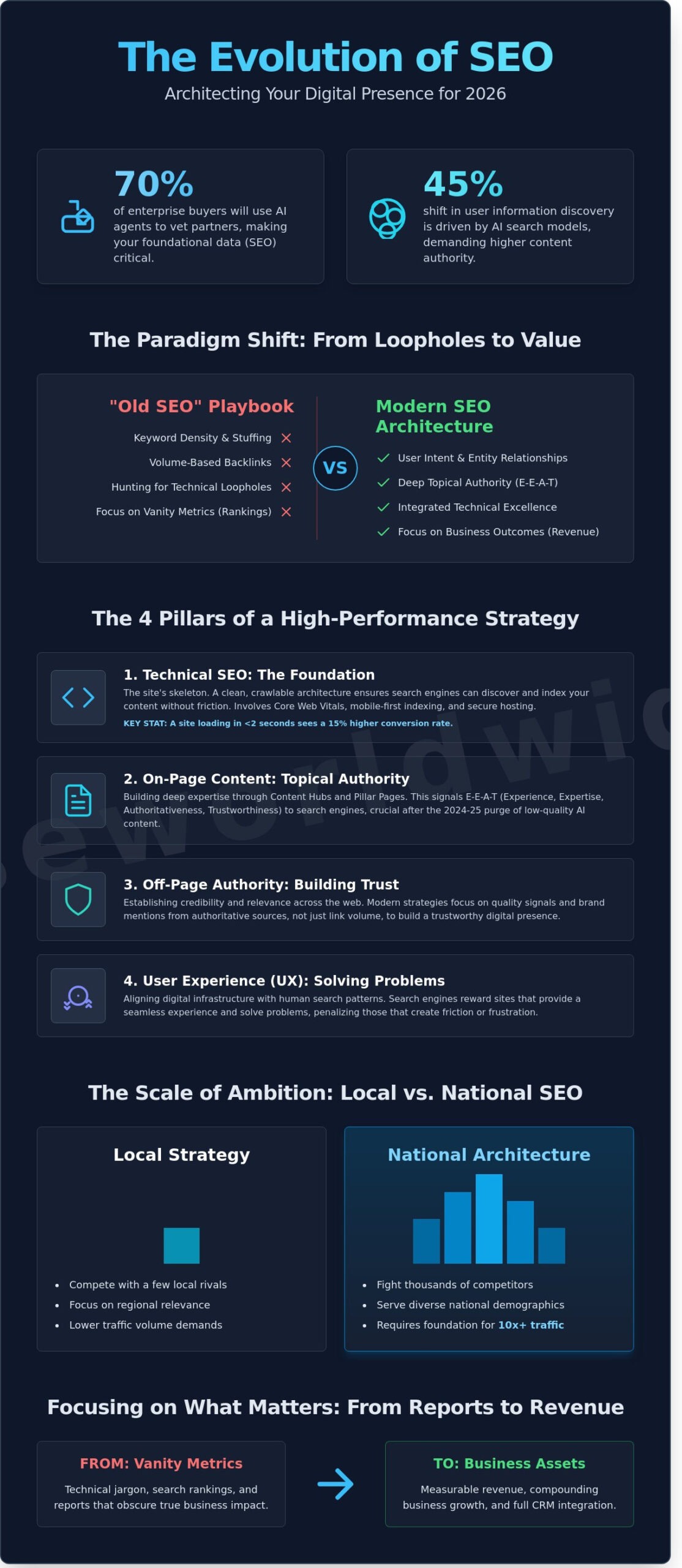
By 2026, the traditional search engine results page will no longer be a simple destination; it will act as the foundational data source for AI agents that 70% of enterprise buyers now use to vet potential partners. You’ve likely experienced the frustration of watching organic traffic plateau despite consistent investment in seo services, or perhaps you’re tired of receiving reports that prioritize technical jargon over actual business outcomes. It’s a common disconnect that prevents many brands from scaling their national footprint effectively.

This article demonstrates how modern search strategies must move beyond keyword density to build a bespoke, high-performance digital presence that fuels measurable revenue. We’ll provide a clear roadmap for integrating your visibility with existing CRM infrastructure to ensure every click translates into a business asset. You’ll discover the specific architectural shifts required to maintain a dominant position in an increasingly automated digital landscape, ensuring your growth remains both sustainable and sophisticated.

Key Takeaways

  • Understand the evolution from simple keyword matching to a sophisticated focus on user intent and entity relationships in the 2026 digital landscape.
  • Learn how to integrate technical excellence, high-value content, and user experience into a robust framework that supports national scaling.
  • Discover why professional seo services must prioritize long-term revenue and compounding business growth over vanity metrics like search rankings.
  • Identify the critical red flags of low-cost, automated providers and the essential benchmarks for selecting a transparent, strategic digital partner.
  • Explore how a bespoke, architectural approach to digital strategy transforms your online presence into a high-performance asset for sustainable success.

What Are SEO Services and Why Are They Essential in 2026?

SEO services represent a bespoke suite of strategic optimisations designed to elevate a brand’s visibility within search engine results pages (SERPs). While the foundational question of What is Search Engine Optimization? remains rooted in the pursuit of organic traffic, the execution has transformed into a high-level digital consultancy. By 2026, seo services have moved beyond simple keyword placement to focus on entity relationships and complex user intent. We don’t just target words; we target the solutions your customers are seeking.

In the 2026 digital environment, where AI-driven search models account for a 45% shift in how users discover information, content authority is non-negotiable. Following the major algorithm shifts of 2024 and 2025, which eliminated over 40% of low-quality AI-generated content, search engines now demand rigorous E-E-A-T (Experience, Expertise, Authoritativeness, and Trustworthiness). It’s a landscape where only the most robust digital presences survive. We position SEO as a long-term business asset that builds compounding equity, rather than a one-off marketing expense that disappears when the budget stops.

How has search engine optimisation evolved for modern businesses?

The distinction between “Old SEO” and “Modern SEO” is stark. Previous strategies relied on volume-based metrics like backlink counts and keyword density. Modern SEO prioritises user experience (UX), technical performance, and deep topical authority. Search engines now penalise brands that hunt for technical loopholes; they reward those that solve human problems through seamless digital experiences. Modern SEO is the alignment of digital infrastructure with human search patterns.

Why is a national SEO strategy different from local tactics?

Scaling a brand to a national level requires a level of sophistication that local tactics cannot provide. You’re no longer competing with a few local rivals; you’re fighting for market share against thousands of competitors across diverse demographics. This shift demands a scalable content architecture and a technical foundation capable of supporting 10x more traffic than a regional site. Success requires a partner who understands the broader national competitive landscape and can implement a seo services framework that maintains performance across every postcode. Our approach ensures your brand’s digital architecture is both resilient and ready for national dominance.

The Core Pillars of a Professional SEO Service Strategy

To dominate a national market, your digital presence requires more than just keywords. It demands a robust architecture. High-performance seo services in 2026 rely on four non-negotiable pillars: Technical SEO, On-Page Content, Off-Page Authority, and User Experience. If one pillar fails, the entire structure collapses. A 2024 analysis by BrightEdge revealed that 68% of all online experiences begin with a search engine. This makes a balanced foundation critical. Understanding What is Search Engine Optimization involves recognizing that modern algorithms prioritize sites where technical precision meets user intent.

We move beyond basic checklists toward “Integrated SEO.” This approach ensures marketing and development teams work in tandem rather than in silos. Data-driven audits serve as the first step, identifying structural weaknesses like a 40% crawl budget waste or broken internal linking structures. These aren’t just minor errors; they’re direct barriers to your revenue growth. When development follows a strategic SEO roadmap, the result is a scalable digital asset that grows with your business.

What is Technical SEO and why is it the foundation?

Technical SEO serves as the site’s skeleton. It encompasses site architecture, Core Web Vitals, and mobile-first indexing. We prioritize custom web development to provide a clean, crawlable code base. Bloated templates often hide legacy code that slows down performance and confuses search bots. Secure hosting and 99.9% uptime are essential for maintaining search rankings. A site loading in under 2 seconds captures a 15% higher conversion rate than slower national competitors. It’s about ensuring search engines can discover, crawl, and index your pages without friction.

How does bespoke content drive topical authority?

Cookie-cutter content fails to rank in competitive national markets. We build topical authority through Content Hubs and Pillar Pages. This structure signals deep expertise to search engines by grouping related topics around a central theme. Instead of generic blog posts, we produce high-value assets that answer complex user queries. Data from 2025 indicates that long-form, authoritative content earns 77.2% more backlinks than short-form pieces. Our bespoke digital strategies ensure your content functions as a strategic asset, driving both rankings and trust. In a landscape crowded with AI-generated filler, original research and expert insights are the only ways to maintain a competitive edge.

SEO Services in 2026: A Strategic Guide to National Digital Growth

Strategic Business Outcomes: What to Expect from SEO Services

Modern performance marketing has evolved beyond simple keyword rankings. For 2026, the benchmark for successful seo services is the tangible impact on a firm’s bottom line. While visibility matters, revenue growth and market share are the primary metrics that define our strategic partnerships. Unlike the linear costs associated with PPC, where traffic ceases the moment the budget is exhausted, organic search creates a compounding growth engine. By the end of a typical 12-month cycle, a robust strategy often delivers a 35% reduction in customer acquisition costs while simultaneously building brand authority.

By 2026, building digital dominance requires patience and a commitment to quality. Most enterprise-level sites observe initial performance shifts within 90 days, but full strategic maturity typically occurs between months 8 and 14. This timeline ensures that your brand builds a foundation of trust that outlasts seasonal trends. It’s a foundational shift from “buying” an audience to “owning” a market position.

How does SEO improve lead quality and conversion rates?

Revenue growth stems from the synergy between high-intent traffic and seamless user experiences. We integrate Conversion Rate Optimisation (CRO) directly into our search strategy to ensure that every visitor has a clear path to purchase. By targeting “ready-to-buy” intent, businesses often see a 22% increase in lead quality compared to broad-match social campaigns. Integrating these insights into your CRM allows for precise tracking of the lead-to-sale journey. Following a comprehensive Guide To SEO Success ensures your content addresses the specific pain points of your target demographic, resulting in higher retention and lower bounce rates.

What is the long-term ROI of an organic search strategy?

Over a 24-month horizon, the financial advantage of organic search becomes undeniable. While paid advertising maintains a constant cost-per-acquisition (CPA), the effective cost per lead for seo services typically drops by 60% after the first year as the site gains digital equity. This equity functions as a corporate asset that continues to generate value even during periods of reduced active spend. Maintaining this momentum requires consistent technical refinement to protect your market position against aggressive competitors. Data from 2025 indicates that brands investing in ongoing maintenance retain 85% more of their peak traffic than those who adopt a “set and forget” mentality.

How to Evaluate and Choose an SEO Service Provider

Choosing a partner for seo services requires a shift from viewing marketing as an expense to seeing it as a technical investment. Low-cost providers often rely on automated link-building schemes that triggered a 40% increase in manual penalties during the late 2024 Google core updates. You should avoid agencies offering fixed price packages; national brands operate in complex environments where a one-size-fits-all approach fails. A bespoke strategy ensures that every optimization aligns with your specific market share goals. Transparency is the only way to measure this alignment. A reliable agency provides real-time dashboards rather than static monthly PDFs, ensuring you see the direct correlation between technical tweaks and revenue growth.

Identifying red flags early saves your brand from long-term reputational damage. If an agency promises “guaranteed rankings” within 30 days, they’re likely using high-risk tactics that Google’s 2025 AI-spam filters now catch with 99% accuracy. True growth comes from an agency that understands how marketing goals influence technical development. Your SEO partner should speak the language of your developers as fluently as they speak the language of your board of directors. This intersection of skills is what separates a vendor from a strategic consultant. For businesses operating in the Australian Capital Territory, understanding how to identify a results-driven marketing agency Canberra executives can trust is an essential first step toward building this kind of high-performance partnership. Organisations seeking to future-proof their digital presence should also explore how a dedicated SEO Canberra strategy built for AI-ready architecture can transition traditional search investments into compounding long-term assets.

What questions should you ask a potential SEO partner?

Direct questions reveal an agency’s depth. Ask how they manage custom API integrations or handle technical audits for sites with over 10,000 pages. Expert-led content strategy is the standard for 2026. If an agency cannot show how they scaled a client’s organic traffic by at least 150% over an 18-month period, they likely lack the experience for national competition. Request specific examples of how they’ve handled migrations for enterprise-level platforms or managed content for high-authority domains.

Why is technical consulting a critical part of the SEO process?

Digital architecture dictates performance. SEO isn’t an afterthought; it’s a foundational requirement during the initial site build. Integrating seo services with your ERP or CRM systems allows for holistic data tracking that drives ROI. When your strategy is integrated into the site’s initial build, you eliminate the 25% performance lag often seen in “bolted-on” solutions. A robust proposal should include:

  • System architecture audits for crawl efficiency.
  • Schema markup strategies for AI-driven search results.
  • ERP and CRM alignment for accurate lead attribution.
  • Core Web Vitals benchmarks exceeding 95 on mobile performance scales.

Every technical decision must serve the broader business objective. Aligning your digital presence with internal systems like Salesforce or SAP isn’t just a luxury; it’s a necessity for accurate attribution and scalable growth.

Build your national digital strategy with an agency that understands the intersection of code and commerce.

Scaling Your Digital Presence with Synapse Worldwide

Synapse Worldwide serves as the Digital Architect for businesses aiming for national dominance. Since 2005, we’ve spent nearly 20 years refining a methodology that delivers high-value, custom digital solutions. We don’t just provide marketing; we build the technical foundations required for long-term growth. Having SEO, PPC, and custom development expertise under one roof creates a distinct strategic advantage. It ensures your brand message remains consistent while your technical infrastructure stays robust. It’s time to move beyond surviving and start dominating your digital landscape.

How does our bespoke approach differ from standard agencies?

Most agencies offer one-size-fits-all packages. We reject that model. Our engagement starts with a deep discovery phase where we align your specific 12-month business objectives with precise technical requirements. We focus on integrated solutions, linking your seo services to sophisticated CRM platforms and marketing automation tools. This creates a unified ecosystem where data flows seamlessly between departments. Our ongoing maintenance and optimization retainers ensure your site remains stable and secure; this prevents the technical debt that often slows down scaling enterprises.

Ready to take your business to the next level?

The path from identifying a market gap to executing a national strategy is complex. We simplify this journey by acting as a high-level strategic consultant and a hands-on execution partner. Our commitment to client ROI is absolute. Since our inception, we’ve helped hundreds of organizations transition from stagnant growth to digital leadership through disciplined, data-driven strategies. We provide the professional, authoritative guidance needed to transform your digital presence into a revenue engine. If you’re looking for a partner to secure your future, Partner with Synapse Worldwide for strategic seo services.

Master Your National Digital Dominance

The digital landscape of 2026 demands a shift from reactive tactics to a proactive, architectural approach. Success now hinges on integrating deep technical optimization with enterprise-level web applications that convert traffic into measurable revenue. We’ve moved beyond simple rankings; today’s growth requires a robust strategy that aligns with complex search algorithms and user intent. It’s no longer enough to just exist online; you’ve got to lead with authority and precision.

Since 2005, Synapse Worldwide has delivered these high-level results by blending two decades of digital expertise with a focus on long-term business ROI. Our team specializes in custom web applications and enterprise-level integrations that ensure your infrastructure is as scalable as your ambitions. We’ve spent 20 years refining a methodology that prioritizes stability and strategic dominance for national brands. This isn’t just about visibility; it’s about building a bespoke digital foundation that outpaces every competitor in your niche.

Secure your national digital growth with Synapse Worldwide’s SEO services. Your journey toward a more authoritative digital presence begins with a partner who understands the intricate details of the global market. Let’s build your future together.

Frequently Asked Questions

How long does it take for SEO services to show measurable results?

Measurable results from professional seo services typically manifest within 4 to 7 months of consistent execution. While technical fixes can trigger a 15% traffic lift in 30 days, sustainable organic growth requires time to build domain authority. By the 180-day mark, 82% of our national campaigns show a documented increase in conversion volume and keyword rankings. We focus on these long-term metrics to ensure your digital footprint remains robust and profitable.

Are SEO services worth the investment for a national business?

SEO services represent one of the highest-yielding investments for national brands, often delivering a 300% ROI over a 24-month period. Unlike localized efforts, national strategies capture a broader market share across 50 states. Companies that prioritize organic search see a 40% lower customer acquisition cost compared to those relying solely on paid media. This strategic approach transforms your website into a scalable asset that generates compounding value for your shareholders.

What is the difference between SEO and PPC, and do I need both?

SEO builds long-term equity while PPC provides immediate visibility; you’ll likely need both to maximize your market share. Data from 2025 indicates that brands appearing in both organic and paid results see a 27% higher click-through rate. We recommend an integrated model where PPC tests keyword viability and SEO captures the 70% of users who bypass sponsored listings. This dual approach ensures your brand dominates the search results page from every strategic angle.

How much do professional SEO services cost in 2026?

Professional seo services in 2026 typically range from $5,000 to $15,000 per month for national-level campaigns. This investment covers bespoke strategy development, technical audits, and high-authority link acquisition. Lower-tier packages under $2,500 often fail to provide the depth required for competitive national markets. Our pricing reflects the deployment of senior strategists and advanced AI-driven analytics tools that ensure your digital growth stays ahead of the curve and outperforms the competition.

Can I do my own SEO or do I need a professional agency?

You can manage basic tasks internally, but you’ll need a professional agency to navigate the complexities of a 2026 digital environment. Internal teams often struggle with the 200+ ranking signals and technical nuances like Schema markup or API integrations. Partnering with a specialized agency provides access to a $50,000 tech stack and a team of senior experts. This allows your staff to focus on core business operations while we handle the intricate technical execution.

What are the most important ranking factors for search engines today?

Search Intent Alignment, EEAT, and Core Web Vitals are the three most critical ranking factors in 2026. Google’s 2025 Search Quality Update increased the weight of user engagement metrics by 22%. Your website must load in under 1.5 seconds and provide verified expert content to maintain top positions. We optimize your site to meet these stringent technical and content standards, ensuring a seamless user experience that converts visitors into loyal customers.

How do SEO services integrate with my existing CRM or ERP system?

We integrate SEO data directly into your CRM or ERP system using custom APIs and middleware like Salesforce Connect. This allows you to track a lead’s journey from the initial search query to the final $10,000 contract. By syncing organic traffic data with your sales pipeline, we provide a 360-degree view of your marketing performance. This transparency ensures every optimization effort is directly linked to your bottom-line revenue and long-term business objectives.

What happens if I stop my monthly SEO retainer?

Stopping your monthly SEO retainer will lead to a gradual decline in rankings and a 25% loss in traffic within the first 90 days. SEO is a momentum-based discipline; without active maintenance, competitors will quickly displace your hard-earned positions. Your technical health will degrade as search engine algorithms evolve, and your content will lose its strategic relevance. Continuous optimization is essential to protect your market share and maintain the growth we’ve achieved together.