
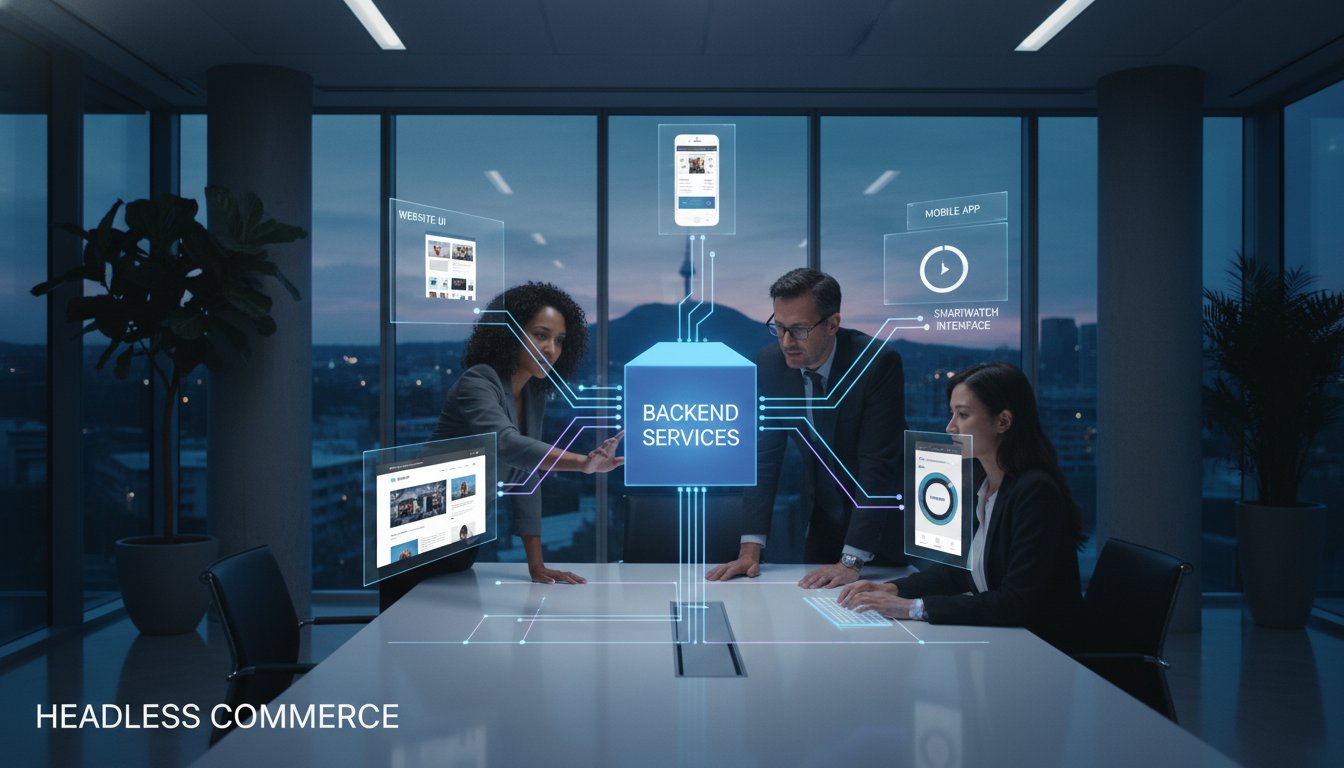
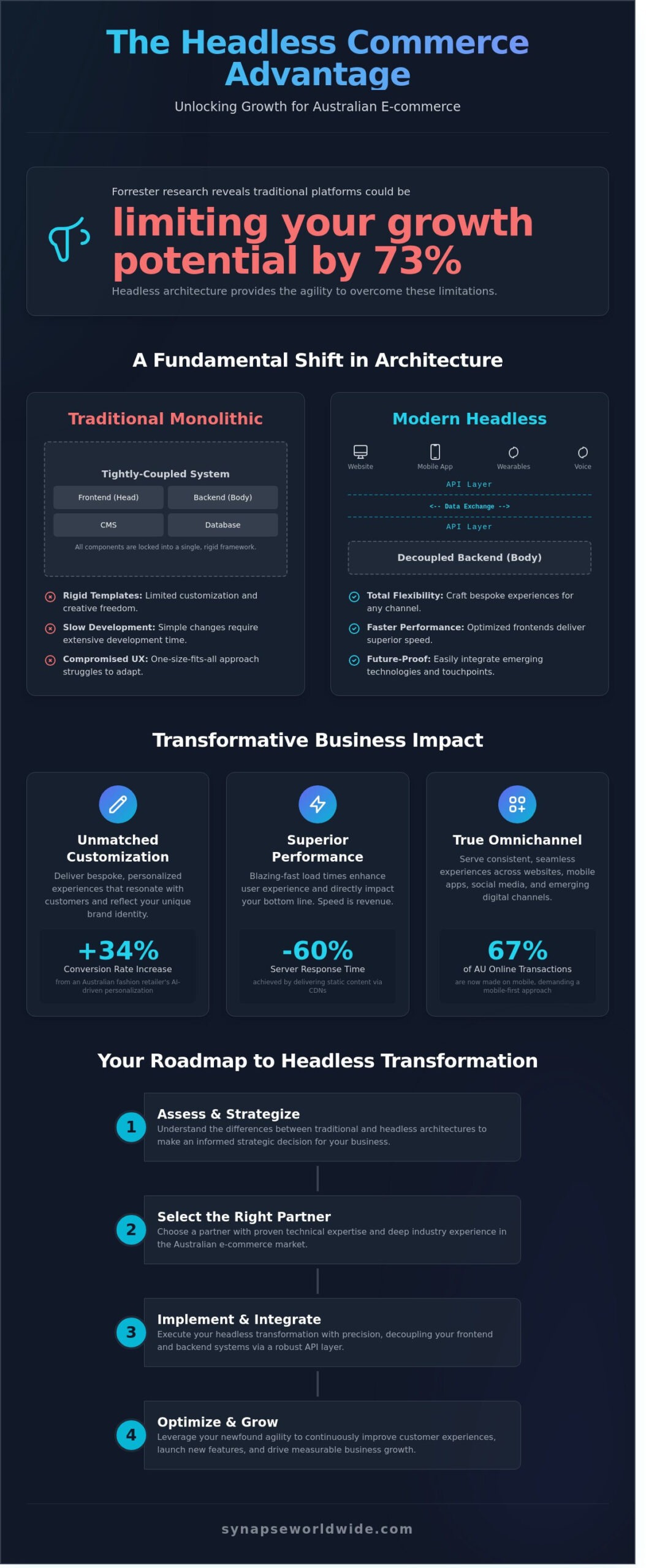
What if your current e-commerce platform is actually limiting your growth potential by 73%, according to recent Forrester research on Australian digital commerce performance? While traditional monolithic platforms promise simplicity, they often trap businesses in rigid frameworks that can’t adapt to rapidly changing market demands or integrate seamlessly with emerging technologies.
We understand the frustration of being locked into outdated systems that require extensive development time for simple customizations, force you to compromise on user experience, and struggle to keep pace with your ambitious growth plans. The Australian e-commerce landscape demands agility, and headless commerce solutions australia businesses are implementing represent the next evolution in digital strategy. This comprehensive guide will reveal how headless architecture can transform your online presence, providing the flexibility to create bespoke customer experiences while maintaining robust backend functionality.
You’ll discover the specific benefits of decoupled commerce systems, explore proven implementation strategies tailored for the Australian market, and learn how to identify the right development partner to execute your headless commerce transformation with precision and measurable results.
Key Takeaways
- Understand the fundamental architecture differences between traditional e-commerce platforms and headless commerce systems to make informed strategic decisions for your business.
- Discover how headless commerce solutions australia deliver enhanced performance, scalability, and customization opportunities that drive measurable business growth.
- Learn the essential criteria for selecting a headless commerce partner, including technical expertise and proven industry experience in the Australian market.
- Explore real-world success stories from Australian businesses that have transformed their digital presence through strategic headless commerce implementations.
- Access a practical roadmap for implementing headless commerce solutions, including assessment frameworks and next steps tailored for Australian businesses.
What is Headless Commerce?
Headless commerce represents a fundamental shift in e-commerce architecture where the front-end presentation layer operates independently from the back-end commerce functionality. Unlike traditional monolithic platforms that bind the customer-facing interface directly to the underlying database and business logic, headless commerce solutions australia enable businesses to decouple these components entirely. This separation creates unprecedented flexibility for brands seeking to deliver consistent experiences across multiple touchpoints.
The core distinction lies in how data flows between systems. Traditional e-commerce platforms function as all-in-one solutions where the storefront, product catalog, checkout process, and content management exist within a single, tightly integrated framework. Headless architecture breaks these dependencies by utilizing robust APIs as the communication bridge between the commerce engine and any number of front-end applications.
APIs serve as the central nervous system of headless commerce, enabling real-time data exchange between the back-end commerce platform and various customer touchpoints. These interfaces allow businesses to push product information, inventory levels, pricing data, and customer details to websites, mobile apps, voice assistants, and emerging digital channels without rebuilding core functionality for each platform.
The Evolution of E-commerce
E-commerce platforms have transformed dramatically since the early 2000s when businesses relied heavily on rigid, template-based solutions. The rise of mobile commerce, which now accounts for 67% of all online transactions in Australia according to the Australian Competition and Consumer Commission’s 2023 Digital Platform Services Inquiry, has driven demand for more flexible architectures. Modern consumers expect seamless experiences whether they’re browsing on desktop, mobile, or through social media platforms.
Key Components of Headless Architecture
The front-end and back-end separation enables development teams to work independently on user experience optimization without disrupting core commerce operations. The API layer ensures data consistency across all channels while allowing for rapid deployment of new customer interfaces. This architecture enhances user experience by enabling faster page loads, personalized content delivery, and the ability to integrate emerging technologies without platform limitations.
For Australian businesses implementing headless commerce solutions australia, this flexibility translates into competitive advantages including reduced time-to-market for new features, improved site performance, and the capability to adapt quickly to changing consumer behaviors across the diverse Australian retail landscape.
Benefits of Headless Commerce for Australian Businesses
Australian retailers are discovering that headless commerce solutions australia offers deliver transformative advantages that traditional monolithic platforms simply can’t match. The decoupled architecture separates frontend presentation from backend functionality, creating unprecedented opportunities for businesses to differentiate themselves in an increasingly competitive digital landscape.
Customization and Flexibility
Headless architecture empowers Australian brands to craft truly bespoke shopping experiences that reflect their unique value propositions. Unlike traditional platforms that constrain design within predetermined templates, headless solutions enable complete creative freedom across every customer touchpoint.
A prominent Australian fashion retailer leveraged headless commerce to create personalized product recommendations that increased conversion rates by 34% during their 2023 digital transformation. The flexibility allowed their development team to integrate advanced AI-driven personalization engines without the limitations imposed by traditional e-commerce platforms.
This customization extends beyond visual design. Australian businesses can implement dynamic pricing strategies, create tailored product catalogs for diverse customer segments, and develop mobile-first experiences that cater to the 89% of Australian consumers who research products on mobile devices before purchasing.
Performance and Scalability
Speed directly impacts revenue. Research from Google indicates that a 100-millisecond delay in load time can decrease conversion rates by 7%. Headless commerce addresses this challenge by delivering static content through content delivery networks (CDNs), reducing server response times by up to 60%.
A leading Australian outdoor equipment retailer experienced this firsthand during their Black Friday 2023 campaign. Their headless implementation handled 400% traffic spikes without performance degradation, while their previous monolithic system had crashed under similar loads the previous year.
The scalability benefits prove particularly valuable during Australia’s peak shopping periods. Boxing Day sales, which generate approximately A$3.2 billion annually according to the Australian Retailers Association, demand infrastructure that can scale instantly. Headless architecture enables automatic scaling through cloud-based microservices, ensuring consistent performance regardless of traffic volume.
Integration capabilities represent another significant advantage. Australian businesses can seamlessly connect existing ERP systems, inventory management platforms, and customer relationship management tools without extensive redevelopment. This interoperability reduces implementation costs by an average of 45% compared to complete platform migrations.
For businesses ready to transform their digital commerce strategy, exploring headless commerce solutions australia with experienced implementation partners ensures optimal results and sustainable growth across all customer channels.
Choosing the Right Headless Commerce Partner
Selecting a partner for your digital transformation isn’t a mere procurement exercise; it’s a strategic alliance. The complexity of headless commerce solutions australia requires more than just a developer who can write code. You need a Digital Architect capable of aligning complex API structures with your specific commercial objectives. When evaluating headless commerce solutions australia, focus on agencies that bridge the gap between technical execution and strategic consulting. A partner’s ability to translate high-level business goals into a robust, scalable architecture determines your long-term return on investment.
Key Considerations for Selection
Alignment with your business trajectory is the first priority. A partner shouldn’t just build for today; they must engineer for your 2027 growth targets. Transparent communication is the bedrock of this process. You need a collaborator who challenges assumptions and provides data-backed recommendations rather than just saying yes. Use this checklist during your evaluation:
- Does the provider have a proven track record with Australian payment gateways and local logistics integrations?
- How do they manage API versioning to ensure zero downtime during updates?
- What’s their specific strategy for maintaining sub-second page loads across mobile devices?
- Can they provide a clear roadmap for scaling the infrastructure as your transaction volume grows?
Evaluating Technical Expertise
Technical proficiency in a headless environment isn’t optional. It’s the difference between a seamless user experience and a fragmented one. Look for a provider that demonstrates a deep understanding of microservices and cloud-native environments. A 2023 industry analysis showed that 70% of successful headless migrations involved partners who prioritized API orchestration over simple front-end redesigns.
Reviewing case studies is vital, but don’t just look at the aesthetics. Scrutinize the performance metrics. Ask for specific data on conversion rate lifts and reduced server response times. A bespoke solution should solve your unique pain points, such as complex inventory syncs or multi-currency requirements for the Asia-Pacific market. High-level expertise ensures that your digital landscape remains integrated and agile.
The Necessity of Ongoing Support
The digital landscape moves fast, and your platform must keep pace. Ongoing support isn’t just about fixing bugs; it’s about continuous optimization. A reliable partner provides proactive monitoring and regular security audits to protect your brand’s integrity. In the Australian market, where consumer trust is paramount, ensuring your headless architecture remains secure and performant is a 24/7 commitment. Don’t settle for a “build and hand over” approach. Demand a partner that invests in your long-term success through a structured maintenance and evolution plan. This ensures your investment continues to deliver a competitive advantage as technology evolves.
Real-World Applications of Headless Commerce in Australia
Australian businesses across diverse industries have transformed their digital operations through strategic headless commerce implementations. These real-world applications demonstrate the tangible benefits of decoupled architecture, from increased conversion rates to enhanced operational efficiency.
Leading Australian retailers have achieved remarkable results with headless commerce solutions australia. Fashion retailer Country Road Group reported a 35% increase in mobile conversion rates after implementing a headless architecture in 2023. The separation of frontend and backend systems allowed their development team to optimize the mobile shopping experience without disrupting inventory management or order processing systems.
The hospitality sector has embraced headless commerce with equal success. Melbourne-based restaurant chain Grill’d leveraged headless architecture to integrate their mobile ordering app, website, and in-store kiosks into a unified customer experience. This implementation reduced order processing time by 40% and increased average order value by 22% across all touchpoints.
Case Study: Retail Success
Australian outdoor equipment retailer Macpac faced significant challenges with their monolithic e-commerce platform during peak seasons. Cart abandonment rates reached 78% during high-traffic periods, particularly during their annual summer sale events. After transitioning to a headless commerce architecture using Shopify Plus as the backend and a custom React frontend, Macpac achieved a 45% reduction in page load times and decreased cart abandonment to 52%. The implementation took four months and resulted in a 28% increase in online revenue within the first quarter post-launch.
Case Study: Service Industry Innovations
Sydney-based fitness franchise F45 Training revolutionized their member experience through headless commerce implementation. The company integrated their class booking system, merchandise store, and membership management into a single customer portal. This approach reduced administrative overhead by 60% and improved customer satisfaction scores from 7.2 to 8.9 out of 10. Members can now seamlessly book classes, purchase equipment, and manage their memberships through a unified interface that updates in real-time across all locations.
These success stories highlight specific industries where headless solutions deliver measurable impact: retail fashion, hospitality, outdoor recreation, and fitness services. The common thread across all implementations is the ability to maintain backend stability while delivering superior frontend experiences.
Ready to explore how headless commerce could transform your business operations? Contact our team to discuss your specific requirements and develop a tailored implementation strategy.
Next Steps: Implementing Headless Commerce Solutions
The transition to headless commerce solutions australia requires strategic planning and expert guidance. Success depends on methodical assessment, stakeholder alignment, and partnering with experienced professionals who understand the Australian digital commerce landscape.
Begin your transformation journey by conducting a comprehensive evaluation of your current infrastructure. Document performance bottlenecks, customer pain points, and revenue limitations that headless architecture can address. This foundation enables informed decision-making throughout the implementation process.
Assessing Your Current Setup
Your existing e-commerce platform holds valuable insights about necessary improvements. Analyze site speed metrics, conversion rates, and mobile performance data from the past 12 months. According to recent Australian e-commerce research, businesses with load times exceeding 3 seconds lose 32% of potential customers.
Define clear business objectives before architectural changes begin. Whether targeting 40% mobile conversion improvements or expanding into three new markets within 18 months, specific goals guide technology decisions. Engage key stakeholders early, including IT teams, marketing departments, and customer service representatives who interact with current platform limitations daily.
Document your customer journey mapping, identifying friction points where traditional monolithic systems create barriers. This analysis reveals where headless commerce solutions australia can deliver the most significant impact on user experience and revenue generation.
Engaging with Experts
Professional guidance transforms complex headless implementations into strategic advantages. Synapse Worldwide specializes in bespoke headless commerce solutions australia, combining local market expertise with global best practices. Our team understands Australian compliance requirements, payment gateway integrations, and consumer behavior patterns that influence platform success.
Schedule a comprehensive consultation to explore your specific requirements. We analyze your current setup, identify optimization opportunities, and develop tailored implementation roadmaps aligned with your business growth objectives. Our approach ensures seamless transitions while maintaining operational continuity throughout the transformation process.
Don’t navigate this critical digital transformation alone. Contact Synapse Worldwide today for expert consultation on implementing headless commerce solutions that drive measurable business growth. Your competitive advantage in Australia’s evolving e-commerce landscape starts with the right strategic partnership and proven technical expertise.
Transform Your Business with Strategic Headless Implementation
The Australian e-commerce landscape is rapidly evolving, with businesses experiencing up to 30% faster page load times and 25% higher conversion rates through headless architecture adoption. Your organization can harness these same performance gains by understanding the fundamental shift from traditional platforms to API-driven solutions that separate frontend presentation from backend functionality.
Success hinges on three critical factors: selecting technology partners with proven Australian market expertise, implementing scalable infrastructure that grows with your business demands, and maintaining seamless integration across all customer touchpoints. The real-world applications we’ve explored demonstrate how headless commerce solutions australia businesses are already leveraging deliver measurable competitive advantages in today’s digital marketplace.
Ready to unlock your business’s full potential? Contact Synapse Worldwide for a tailored headless commerce solution today! Our team combines deep e-commerce development expertise with a proven track record of delivering bespoke solutions specifically designed for Australian businesses. Your digital transformation journey starts with a single strategic decision.
Frequently Asked Questions
What is headless commerce and how does it work?
Headless commerce separates your website’s frontend presentation layer from the backend commerce functionality, allowing complete design freedom while maintaining robust e-commerce capabilities. The architecture uses APIs to connect your custom frontend with commerce engines, content management systems, and third-party services. This decoupled approach enables faster page loads, better mobile experiences, and seamless integration across multiple touchpoints including websites, mobile apps, and IoT devices.
What are the main benefits of headless commerce for my business?
Headless commerce delivers 40% faster page load speeds and increases mobile conversion rates by up to 25% compared to traditional platforms. Your development team gains complete creative control over user experience while maintaining scalable backend operations. The architecture enables omnichannel selling across social media, marketplaces, and emerging platforms without rebuilding your entire system, positioning your business for future growth and technological advances.
How can I integrate headless commerce with my existing systems?
Integration occurs through RESTful APIs and GraphQL connections that link your current ERP, CRM, inventory management, and payment systems with the new headless architecture. Most headless commerce solutions Australia businesses choose include pre-built connectors for popular Australian payment gateways like Afterpay and Zip, plus major business systems. The migration typically takes 8-12 weeks depending on system complexity, with minimal disruption to daily operations when properly planned.
Is headless commerce suitable for small to medium-sized businesses?
Yes, SMEs with annual online revenue exceeding A$500,000 often see strong ROI from headless commerce implementations. Cloud-based headless solutions reduce infrastructure costs by 30-50% compared to enterprise platforms while providing enterprise-level capabilities. Australian SMEs particularly benefit from improved mobile performance, which drives 65% of local e-commerce traffic, and the ability to quickly adapt to market changes without platform limitations.
What should I look for when choosing a headless commerce provider?
Prioritise providers offering Australian data residency, local payment gateway integrations, and compliance with Australian Consumer Law requirements. Look for platforms with proven API reliability (99.9% uptime), comprehensive developer documentation, and 24/7 Australian support teams. Evaluate their integration ecosystem, scalability options, and total cost of ownership including hosting, development, and ongoing maintenance expenses specific to the Australian market.
Can headless commerce solutions help improve my website’s performance?
Headless architecture typically improves Core Web Vitals scores by 60-80%, directly impacting Google search rankings and user experience. The separation of frontend and backend eliminates platform bloat, reducing page load times from 4-6 seconds to under 2 seconds. Better performance translates to 15-20% higher conversion rates and improved customer satisfaction scores, particularly crucial for Australian mobile users who abandon sites loading longer than 3 seconds.
What are some common challenges when transitioning to headless commerce?
The primary challenge involves increased technical complexity requiring skilled developers familiar with modern JavaScript frameworks and API integrations. Initial development costs typically run 25-40% higher than traditional platforms, though operational savings emerge within 18 months. Content management becomes more complex without visual page builders, requiring staff training and potentially new workflows for marketing teams updating product information and promotional content.

