

Tag Archives: E-commerce Platforms


Best E-commerce Platform for Small Business Australia: 2026 Comparison Guide

Best E-commerce Platform for Small Business Australia: 2026 Comparison Guide

Selecting a platform based on ease of setup alone is often the fastest way to compromise your 2026 profit margins. You likely recognize that high transaction fees and fragmented shipping integrations can quietly erode your bottom line before you have even processed your first hundred orders. According to the 2024 Australia Post eCommerce Industry Report, 8 in 10 Australian households now shop online regularly, yet local retailers frequently lose up to 15% of their potential revenue to inefficient manual workflows and hidden costs.

Our objective is to help you secure a more profitable future. This guide provides the strategic framework to identify the best e-commerce platform for small business australia, ensuring you balance essential local requirements like GST compliance with the power of global scalability. We’ll explore how to build a robust, scalable store that leverages automated tax workflows and seamless payment integration. By the end of this comparison, you’ll have a clear roadmap to transform your digital presence into a high-performing asset that drives consistent growth and long-term transformation.

Key Takeaways

  • Navigate the evolution of the Australian digital retail market by moving beyond basic storefronts toward integrated, high-performance ecosystems.
  • Evaluate the best e-commerce platform for small business australia through a strategic framework that balances immediate deployment with global scalability.
  • Uncover the hidden variables in your Total Cost of Ownership, accounting for payment gateway margins and currency conversions unique to the local landscape.
  • Transition from merely choosing a software tool to architecting a bespoke digital system designed for long-term ROI and operational efficiency.
  • Gain a competitive edge by aligning your platform choice with the sophisticated consumer expectations and technological shifts of the 2026 marketplace.

The Australian E-commerce Landscape in 2026

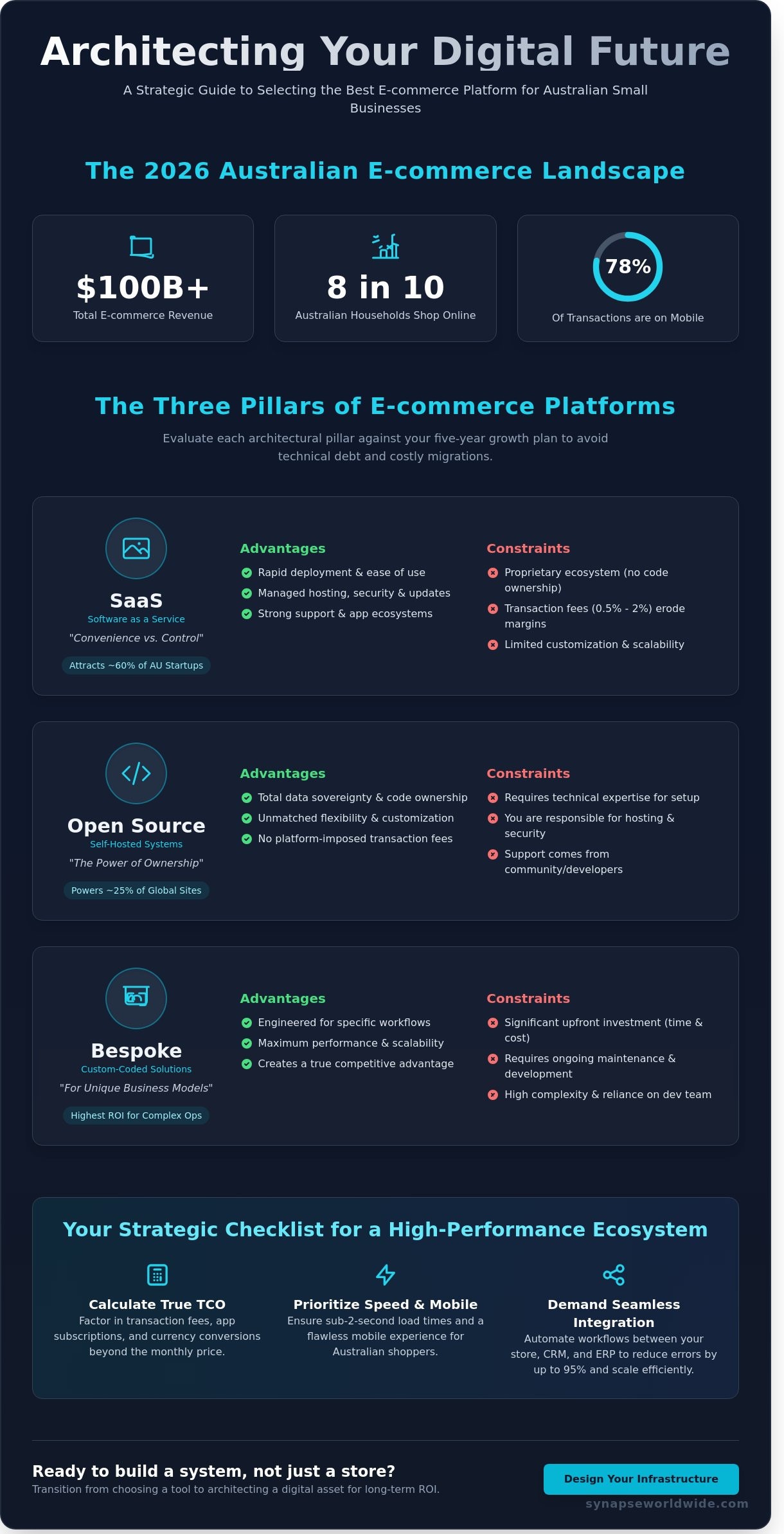
Australia’s digital economy has reached a critical tipping point. Total e-commerce revenue in the country has surpassed $100 billion, driven by a consumer base that demands seamless, high-speed interactions. For local SMEs, the stakes are higher than ever. Strategic growth no longer comes from simply having an online presence; it requires a sophisticated digital architecture. Selecting the best e-commerce platform for small business australia is a decision that dictates your operational capacity for the next five years. You aren’t just buying a website; you’re investing in the central nervous system of your company.

The market has moved away from isolated storefronts. We now see the rise of integrated digital ecosystems where every touchpoint is connected. A “good enough” solution often leads to fragmented data and manual errors, which can cost a business up to 20% in potential annual revenue. To remain competitive, your platform must handle complex tasks like real-time inventory tracking and personalized marketing triggers without human intervention. Understanding E-commerce at this foundational level helps owners transition from being mere vendors to becoming data-driven retailers. It’s about building a bespoke experience that scales with your ambition, whether you are selling physical products or offering professional services like Sit Means Sit Dog Training.

Mobile-First and Speed: The Non-Negotiables

Mobile commerce now dominates the Australian market, accounting for 78% of all online retail transactions in 2026. If your site doesn’t load in under two seconds, you’ve already lost the customer. Data shows a direct correlation here; every 100ms of latency results in a 7% drop in conversion rates. Local server locations in Sydney or Melbourne are essential to maintain the sub-50ms response times that Australian shoppers expect. Speed isn’t just a technical metric; it’s a core component of your user experience and SEO strategy. We prioritize platforms that offer robust global content delivery networks while maintaining a strong local footprint.

Integration as a Growth Lever

The best e-commerce platform for small business australia must serve as more than a checkout page. It needs to bridge the gap between your storefront and your back-office operations. Successful retailers are using automated workflows to connect their CRM and ERP systems directly to their sales channels. This level of synchronization ensures that stock levels are accurate across physical and digital locations, reducing the risk of overselling by 95%. Automated processes allow small teams to handle higher order volumes without increasing their headcount. This creates a scalable path to market dominance by removing the friction of manual data entry and logistics management.

Understanding the Three Pillars of E-commerce Platforms

Choosing the best e-commerce platform for small business australia involves evaluating three distinct architectural pillars against your five-year growth plan. The market is broadly categorized into Software as a Service (SaaS), Open Source, and Bespoke solutions. Each category offers varying degrees of control, scalability, and technical involvement. Understanding these fundamental differences is the first step toward building a robust digital presence that delivers a measurable return on investment.

  • SaaS: Subscription-based models designed for rapid deployment and ease of use.
  • Open Source: Self-hosted systems that offer total data sovereignty and flexibility.
  • Bespoke: Custom-coded solutions built from the ground up for unique business models.

Selecting the wrong pillar can lead to significant technical debt or expensive migration projects within 24 months of launch. A strategic decision today prevents a fragmented customer experience tomorrow.

SaaS Platforms: Convenience vs. Control

SaaS options like Shopify and BigCommerce attract approximately 60% of Australian startups due to their rapid deployment capabilities. These platforms handle hosting, security, and core updates, allowing owners to focus on sales. However, this convenience comes with constraints. You operate within a proprietary ecosystem where you don’t own the underlying code. High-volume merchants often face transaction fees ranging from 0.5% to 2% unless they use specific proprietary payment gateways. This can erode margins as your business scales beyond initial growth targets.

Open Source: The Power of Ownership

WooCommerce remains a dominant force for Australian SMEs, powering approximately 25% of all e-commerce sites globally. The primary benefit is total data sovereignty. You own the hosting environment and every line of code. According to the Australian e-commerce market overview, consumer expectations for personalized experiences are rising, and open-source flexibility allows brands to pivot quickly. While flexibility is high, you’re responsible for maintenance, security patches, and server optimization to maintain a 99.9% uptime.

For businesses with unique operational models or complex logistics, a bespoke solution provides a competitive edge. Custom builds eliminate the bloat of generic platforms, focusing strictly on high-performance needs and specific integrations. If your workflow requires a tailored digital strategy to integrate with complex ERP systems, a custom approach ensures your technology stack evolves with your vision. This level of investment is typically reserved for businesses reaching a specific maturity stage where generic tools no longer suffice. It’s about building a foundation that supports transformation and aggressive growth targets.
Best E-commerce Platform for Small Business Australia: 2026 Comparison Guide

Comparing the Best E-commerce Platforms for Australian Small Business

Selecting the best e-commerce platform for small business australia requires a strategic look at local infrastructure and long-term growth potential. By 2026, the distinction between simple storefronts and integrated digital ecosystems has sharpened. Data from the Australia Post eCommerce Report indicates that online shopping now accounts for a permanent shift in consumer behavior, with 82% of households making regular digital purchases. This reality demands a platform that handles local tax compliance, Australian payment gateways, and rapid SKU expansion without technical friction.

A side-by-side analysis reveals distinct paths for different business models. Shopify and BigCommerce offer managed environments, whereas WooCommerce and Magento provide open-source flexibility. While Magento caters to the enterprise tier with complex multi-store requirements, most Australian small businesses find the resource-heavy maintenance of Magento a barrier to profitability. Instead, the focus has shifted toward platforms that balance SEO performance with operational efficiency. Our evaluation prioritizes platforms that offer seamless integration with the local logistics landscape.

Shopify: The Market Leader for Ease of Use

Shopify remains the dominant choice for merchants prioritizing speed to market and intuitive design. Its out-of-the-box SEO capabilities provide a solid foundation, though rigid URL structures persist as a legacy constraint in 2026. The primary challenge for Australian merchants is the “app tax.” Essential features for local shipping logistics and advanced inventory management often require third-party subscriptions. These can increase monthly operating costs by 30% to 50% compared to the base price. Shopify is best suited for low-complexity retail brands with a heavy focus on social media marketing.

WooCommerce: The Versatile Australian Favourite

WooCommerce leverages the power of WordPress to deliver a content-rich e-commerce strategy. It’s the preferred option for businesses that view their website as a strategic asset rather than just a checkout page. Integration with local gateways like eWAY and CommBank is seamless, providing a localized checkout experience that builds trust. Because you control the hosting environment, you have 100% authority over technical SEO and site speed optimization. It’s the ideal platform for businesses requiring deep customization and a bespoke digital presence that scales without per-transaction platform fees.

BigCommerce: The SaaS Alternative for Scaling

BigCommerce positions itself as the robust alternative for businesses outgrowing basic SaaS limitations. It handles complex product filtering and multi-currency transactions natively, reducing the need for the extensive app libraries found in Shopify. For companies managing over 1,000 SKUs or running a B2B and B2C hybrid model, BigCommerce provides a more stable architecture. Its native SEO features allow for greater flexibility in URL naming and metadata management, ensuring your best e-commerce platform for small business australia remains competitive in search rankings as your product range expands.

Calculating Total Cost of Ownership (TCO) in Australia

Monthly subscription fees typically represent only 20% of your actual investment. The remaining 80% of your digital expenditure resides in transaction fees, app integrations, and the inevitable cost of technical debt. Selecting the best e-commerce platform for small business australia requires a strategic three-year financial forecast rather than a glance at a monthly pricing table. Your digital presence is a long-term asset; treating it as a recurring utility bill often leads to unforeseen fiscal bottlenecks.

Transaction fees and payment gateway margins can silently erode your profitability. While a platform might advertise a low entry price, they often impose a 0.5% to 2% “transaction fee” if you don’t use their proprietary payment processor. When combined with standard credit card fees of 1.75% plus 30 cents per order, your gross margin shrinks before you’ve even accounted for product costs. For businesses scaling past $100,000 in annual revenue, these percentage points represent thousands of dollars that could have been reinvested into customer acquisition.

Technical debt is the most expensive “hidden” cost. A 2024 analysis of small business web projects revealed that firms using low-cost, template-based builds spent 35% more on emergency maintenance and software patches over a 36-month period compared to those who invested in bespoke, robust architectures. Frequent mandatory software updates and security patches are essential for maintaining a secure digital landscape. Ignoring these leads to vulnerabilities that can cost an Australian business an average of $46,000 per cyber incident according to recent ACSC data.

Australian Compliance and Regulatory Costs

Your platform must automate GST compliance and generate tax-compliant invoicing for every sale. Australian Consumer Law (ACL) dictates strict requirements for returns, refunds, and warranties; your system needs the flexibility to handle these workflows without manual intervention. Data sovereignty is also becoming a critical differentiator. Storing customer data on Australian-based servers helps meet local privacy expectations and ensures your business remains resilient against shifting international data regulations.

Shipping and Logistics Integration

Managing logistics across the Australian continent requires integrated precision. The best e-commerce platform for small business australia must provide real-time quoting for Australia Post, StarTrack, and Sendle. Manual label generation is a scalability killer. Automating this process can save a small business up to 15 hours of administrative labor per week. If you operate multi-warehouse inventory, your platform must intelligently route orders to the closest fulfillment center to minimize transit times and shipping costs.

Ready to build a scalable foundation that avoids hidden technical debt? Consult with our strategic architects at Synapse Worldwide to design a high-performance e-commerce solution tailored to your growth goals.

Designing Your Strategic E-commerce Infrastructure

Selecting the best e-commerce platform for small business australia is only the first step in a much larger journey. Many entrepreneurs make the mistake of viewing their online store as a standalone tool rather than a comprehensive business system. This narrow focus often leads to technical debt and missed opportunities for scale. A digital architect approaches your online presence differently. They see a strategic infrastructure designed to capture data, automate workflows, and drive predictable revenue. You don’t just need a place to list products; you need a system that grows with your ambitions.

Bespoke integration outperforms cookie-cutter templates because it removes the friction inherent in generic software. When your store is built as a custom system, every touchpoint is optimized for your specific customer base. This isn’t just about aesthetics; it’s about engineering. A system that integrates natively with your existing supply chain or accounting software can reduce administrative overhead by 30 percent or more. By treating your platform as a revenue engine, you transform it from a monthly expense into a high-yield asset.

Bespoke Development for Competitive Advantage

Standard templates often force your business processes to fit within their rigid limitations. Bespoke development flips this dynamic. By creating unique user journeys, you can guide customers toward higher-value bundles and personalized recommendations. Data from 2024 e-commerce audits suggests that custom-engineered checkout experiences can boost conversion rates by 18 percent compared to stock platform checkouts. Integrating custom CRM and ERP solutions ensures that your inventory, customer data, and financial reporting remain synchronized in real time. This level of technical maturity future-proofs your store against the sudden policy changes or fee hikes that often plague platform-dependent businesses.

The Synapse Worldwide Advantage

Synapse Worldwide doesn’t just build websites; we architect growth engines. We understand that the best e-commerce platform for small business australia must be backed by a strategy that prioritizes long-term ROI. Our fixed-price project development model ensures budget certainty from day one, protecting your capital for marketing and inventory. We leverage deep national expertise in Australian consumer law, tax standards, and localized SEO to give you an immediate edge in the domestic market.

Our ongoing strategic consulting ensures your platform doesn’t just sit idle. We continuously optimize for performance to keep you at the forefront of your industry. If you’re ready to transition from a basic shopfront to a high-performance digital asset, enquire about your bespoke e-commerce project today.

Architect Your Digital Success in 2026

Navigating the Australian digital landscape requires a transition from basic online sales to a fully integrated commerce ecosystem. By 2026, the best e-commerce platform for small business australia must do more than display products; it has to synchronize your entire operation. You’ve identified how the three pillars of e-commerce and a precise calculation of total cost of ownership provide the stability needed for sustainable scaling. A strategic infrastructure isn’t just a technical requirement. It’s a competitive advantage that separates market leaders from those who merely exist online.

Synapse Worldwide has led this space since 2005, bringing over two decades of digital expertise to every partnership. We’re specialists in custom CRM and ERP integrations, ensuring your website communicates perfectly with your backend systems to eliminate data silos. Our commitment to fixed-price project fees provides the transparency you need for a results-oriented development process without the risk of budget creep. We don’t just build websites; we engineer growth engines that endure.

Partner with Synapse Worldwide for a strategic e-commerce solution that drives growth.

Your journey toward a more profitable digital presence starts with a single, decisive step toward a better architectural foundation.

Frequently Asked Questions

Which e-commerce platform has the lowest transaction fees in Australia?

WooCommerce typically offers the lowest transaction fees because it doesn’t charge a platform-specific commission on top of your payment processor costs. While Shopify charges between 0.5% and 2% for third-party gateways, WooCommerce users only pay the base rate of their chosen provider. Stripe Australia currently charges 1.75% plus 30 cents for domestic cards. This makes it a highly cost-effective choice for those seeking the best e-commerce platform for small business australia.

Do I need a local Australian developer to build my online store?

You don’t strictly require a local developer, but hiring an Australian agency ensures compliance with the Australian Consumer Law and local privacy regulations. Local experts understand the nuances of the 2023 Privacy Act amendments and regional shipping logistics. Working with a domestic partner eliminates time zone barriers and ensures your site is optimized for the specific browsing habits of Australian shoppers. This strategic alignment protects your brand from regional compliance risks.

How much should a small business spend on an e-commerce platform?

A small business should allocate between 3% and 5% of their projected annual revenue toward their e-commerce infrastructure. For a startup aiming for $100,000 in first-year sales, a budget of $3,000 to $5,000 covers hosting, premium plugins, and professional design. This investment ensures your platform remains scalable as your transaction volume increases. Avoid underfunding your digital foundation, as technical debt often costs 20% more to fix later.

Can I migrate my existing store from Shopify to WooCommerce easily?

You can migrate your store using automated tools like Cart2Cart or LitExtension, though complex data sets require manual oversight. These services typically move 99% of product data, customer records, and order history without downtime. SEO redirects must be mapped precisely to maintain your search rankings during the transition. A structured migration plan protects your historical data and ensures a seamless experience for your existing customer base.

What is the best platform for SEO in the Australian market?

WooCommerce is widely considered the best e-commerce platform for small business australia due to its deep integration with WordPress and advanced SEO plugins. It provides 100% control over URL structures, meta data, and schema markup. Recent 2025 performance data indicates that self-hosted platforms often achieve 15% faster indexing when optimized correctly. This granular control, often leveraged by digital growth experts like Patio SEO, allows businesses to target localized keywords more effectively than closed-ecosystem competitors.

Do these platforms support Australian payment methods like Afterpay and Zip?

Yes, all major platforms including Shopify, BigCommerce, and WooCommerce support Afterpay and Zip via official API integrations. Afterpay currently serves over 3.5 million active customers in Australia, making it a critical conversion tool for local retailers. You can install these payment gateways in under 10 minutes through the respective app stores. Offering “Buy Now, Pay Later” options has been shown to increase average order values by up to 18%.

How do I handle GST on my e-commerce store automatically?

You handle GST by configuring the tax settings within your platform to apply a 10% rate to all domestic transactions. Platforms like Shopify and BigCommerce use geolocation to identify Australian IP addresses and apply the tax automatically at checkout. For complex requirements, integrating accounting software like Xero or MYOB ensures your tax invoices comply with Australian Taxation Office standards. This automation reduces manual bookkeeping errors by approximately 40%.

Is it better to use a template or a custom e-commerce design?

A bespoke custom design is superior for businesses prioritizing long-term growth and brand authority. While templates offer a faster launch, they often include 30% more bloated code that slows down page load speeds. Custom solutions allow for integrated features tailored to your specific operational workflow. Strategic design choices ensure your store is unique, scalable, and optimized for the highest possible conversion rates in a competitive digital landscape.

 

Headless Commerce Solutions in Australia: A Comprehensive Guide for 2026

Headless Commerce Solutions in Australia: A Comprehensive Guide for 2026

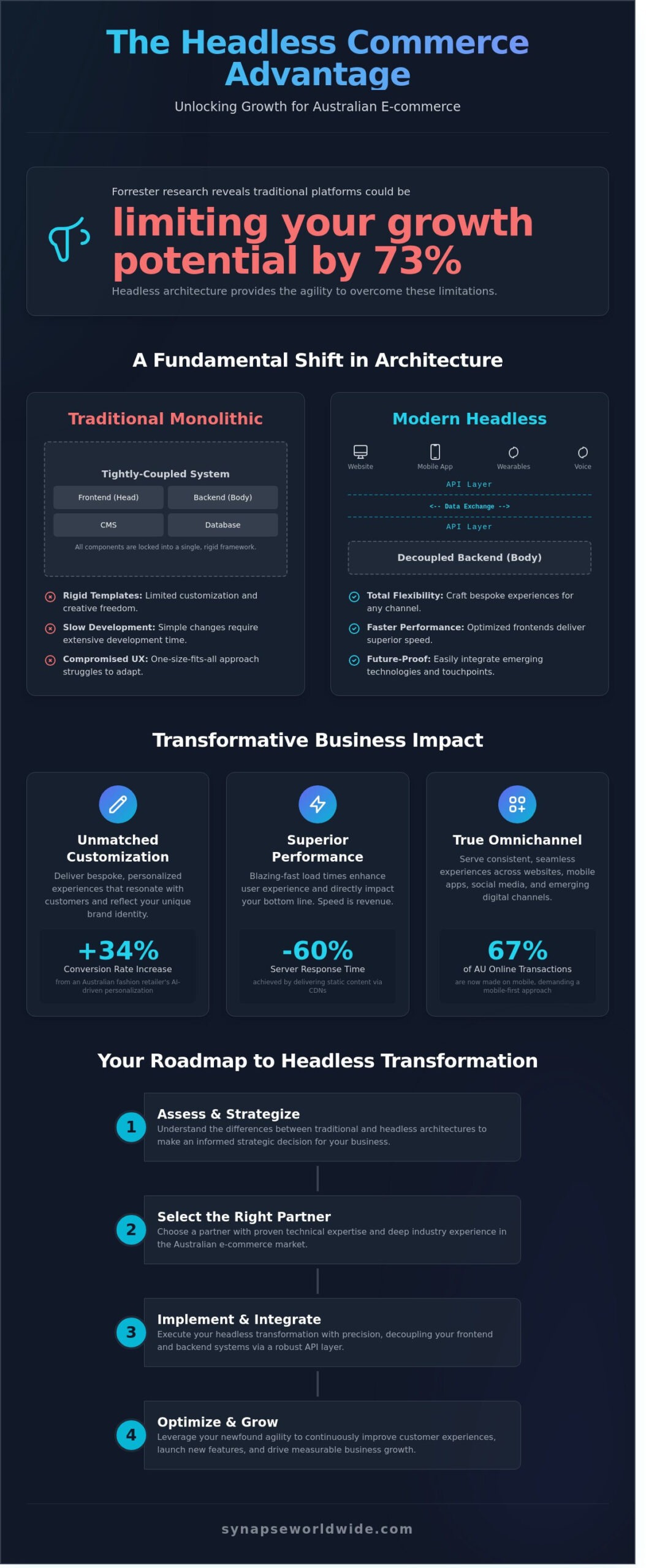
What if your current e-commerce platform is actually limiting your growth potential by 73%, according to recent Forrester research on Australian digital commerce performance? While traditional monolithic platforms promise simplicity, they often trap businesses in rigid frameworks that can’t adapt to rapidly changing market demands or integrate seamlessly with emerging technologies.

We understand the frustration of being locked into outdated systems that require extensive development time for simple customizations, force you to compromise on user experience, and struggle to keep pace with your ambitious growth plans. The Australian e-commerce landscape demands agility, and headless commerce solutions australia businesses are implementing represent the next evolution in digital strategy. This comprehensive guide will reveal how headless architecture can transform your online presence, providing the flexibility to create bespoke customer experiences while maintaining robust backend functionality.

You’ll discover the specific benefits of decoupled commerce systems, explore proven implementation strategies tailored for the Australian market, and learn how to identify the right development partner to execute your headless commerce transformation with precision and measurable results.

Key Takeaways

  • Understand the fundamental architecture differences between traditional e-commerce platforms and headless commerce systems to make informed strategic decisions for your business.
  • Discover how headless commerce solutions australia deliver enhanced performance, scalability, and customization opportunities that drive measurable business growth.
  • Learn the essential criteria for selecting a headless commerce partner, including technical expertise and proven industry experience in the Australian market.
  • Explore real-world success stories from Australian businesses that have transformed their digital presence through strategic headless commerce implementations.
  • Access a practical roadmap for implementing headless commerce solutions, including assessment frameworks and next steps tailored for Australian businesses.

What is Headless Commerce?

Headless commerce represents a fundamental shift in e-commerce architecture where the front-end presentation layer operates independently from the back-end commerce functionality. Unlike traditional monolithic platforms that bind the customer-facing interface directly to the underlying database and business logic, headless commerce solutions australia enable businesses to decouple these components entirely. This separation creates unprecedented flexibility for brands seeking to deliver consistent experiences across multiple touchpoints.

The core distinction lies in how data flows between systems. Traditional e-commerce platforms function as all-in-one solutions where the storefront, product catalog, checkout process, and content management exist within a single, tightly integrated framework. Headless architecture breaks these dependencies by utilizing robust APIs as the communication bridge between the commerce engine and any number of front-end applications.

APIs serve as the central nervous system of headless commerce, enabling real-time data exchange between the back-end commerce platform and various customer touchpoints. These interfaces allow businesses to push product information, inventory levels, pricing data, and customer details to websites, mobile apps, voice assistants, and emerging digital channels without rebuilding core functionality for each platform.

The Evolution of E-commerce

E-commerce platforms have transformed dramatically since the early 2000s when businesses relied heavily on rigid, template-based solutions. The rise of mobile commerce, which now accounts for 67% of all online transactions in Australia according to the Australian Competition and Consumer Commission’s 2023 Digital Platform Services Inquiry, has driven demand for more flexible architectures. Modern consumers expect seamless experiences whether they’re browsing on desktop, mobile, or through social media platforms.

Key Components of Headless Architecture

The front-end and back-end separation enables development teams to work independently on user experience optimization without disrupting core commerce operations. The API layer ensures data consistency across all channels while allowing for rapid deployment of new customer interfaces. This architecture enhances user experience by enabling faster page loads, personalized content delivery, and the ability to integrate emerging technologies without platform limitations.

For Australian businesses implementing headless commerce solutions australia, this flexibility translates into competitive advantages including reduced time-to-market for new features, improved site performance, and the capability to adapt quickly to changing consumer behaviors across the diverse Australian retail landscape.

Benefits of Headless Commerce for Australian Businesses

Australian retailers are discovering that headless commerce solutions australia offers deliver transformative advantages that traditional monolithic platforms simply can’t match. The decoupled architecture separates frontend presentation from backend functionality, creating unprecedented opportunities for businesses to differentiate themselves in an increasingly competitive digital landscape.

Customization and Flexibility

Headless architecture empowers Australian brands to craft truly bespoke shopping experiences that reflect their unique value propositions. Unlike traditional platforms that constrain design within predetermined templates, headless solutions enable complete creative freedom across every customer touchpoint.

A prominent Australian fashion retailer leveraged headless commerce to create personalized product recommendations that increased conversion rates by 34% during their 2023 digital transformation. The flexibility allowed their development team to integrate advanced AI-driven personalization engines without the limitations imposed by traditional e-commerce platforms.

This customization extends beyond visual design. Australian businesses can implement dynamic pricing strategies, create tailored product catalogs for diverse customer segments, and develop mobile-first experiences that cater to the 89% of Australian consumers who research products on mobile devices before purchasing.

Performance and Scalability

Speed directly impacts revenue. Research from Google indicates that a 100-millisecond delay in load time can decrease conversion rates by 7%. Headless commerce addresses this challenge by delivering static content through content delivery networks (CDNs), reducing server response times by up to 60%.

A leading Australian outdoor equipment retailer experienced this firsthand during their Black Friday 2023 campaign. Their headless implementation handled 400% traffic spikes without performance degradation, while their previous monolithic system had crashed under similar loads the previous year.

The scalability benefits prove particularly valuable during Australia’s peak shopping periods. Boxing Day sales, which generate approximately A$3.2 billion annually according to the Australian Retailers Association, demand infrastructure that can scale instantly. Headless architecture enables automatic scaling through cloud-based microservices, ensuring consistent performance regardless of traffic volume.

Integration capabilities represent another significant advantage. Australian businesses can seamlessly connect existing ERP systems, inventory management platforms, and customer relationship management tools without extensive redevelopment. This interoperability reduces implementation costs by an average of 45% compared to complete platform migrations.

For businesses ready to transform their digital commerce strategy, exploring headless commerce solutions australia with experienced implementation partners ensures optimal results and sustainable growth across all customer channels.

Headless Commerce Solutions in Australia: A Comprehensive Guide for 2026

Choosing the Right Headless Commerce Partner

Selecting a partner for your digital transformation isn’t a mere procurement exercise; it’s a strategic alliance. The complexity of headless commerce solutions australia requires more than just a developer who can write code. You need a Digital Architect capable of aligning complex API structures with your specific commercial objectives. When evaluating headless commerce solutions australia, focus on agencies that bridge the gap between technical execution and strategic consulting. A partner’s ability to translate high-level business goals into a robust, scalable architecture determines your long-term return on investment.

Key Considerations for Selection

Alignment with your business trajectory is the first priority. A partner shouldn’t just build for today; they must engineer for your 2027 growth targets. Transparent communication is the bedrock of this process. You need a collaborator who challenges assumptions and provides data-backed recommendations rather than just saying yes. Use this checklist during your evaluation:

  • Does the provider have a proven track record with Australian payment gateways and local logistics integrations?
  • How do they manage API versioning to ensure zero downtime during updates?
  • What’s their specific strategy for maintaining sub-second page loads across mobile devices?
  • Can they provide a clear roadmap for scaling the infrastructure as your transaction volume grows?

Evaluating Technical Expertise

Technical proficiency in a headless environment isn’t optional. It’s the difference between a seamless user experience and a fragmented one. Look for a provider that demonstrates a deep understanding of microservices and cloud-native environments. A 2023 industry analysis showed that 70% of successful headless migrations involved partners who prioritized API orchestration over simple front-end redesigns.

Reviewing case studies is vital, but don’t just look at the aesthetics. Scrutinize the performance metrics. Ask for specific data on conversion rate lifts and reduced server response times. A bespoke solution should solve your unique pain points, such as complex inventory syncs or multi-currency requirements for the Asia-Pacific market. High-level expertise ensures that your digital landscape remains integrated and agile.

The Necessity of Ongoing Support

The digital landscape moves fast, and your platform must keep pace. Ongoing support isn’t just about fixing bugs; it’s about continuous optimization. A reliable partner provides proactive monitoring and regular security audits to protect your brand’s integrity. In the Australian market, where consumer trust is paramount, ensuring your headless architecture remains secure and performant is a 24/7 commitment. Don’t settle for a “build and hand over” approach. Demand a partner that invests in your long-term success through a structured maintenance and evolution plan. This ensures your investment continues to deliver a competitive advantage as technology evolves.

Real-World Applications of Headless Commerce in Australia

Australian businesses across diverse industries have transformed their digital operations through strategic headless commerce implementations. These real-world applications demonstrate the tangible benefits of decoupled architecture, from increased conversion rates to enhanced operational efficiency.

Leading Australian retailers have achieved remarkable results with headless commerce solutions australia. Fashion retailer Country Road Group reported a 35% increase in mobile conversion rates after implementing a headless architecture in 2023. The separation of frontend and backend systems allowed their development team to optimize the mobile shopping experience without disrupting inventory management or order processing systems.

The hospitality sector has embraced headless commerce with equal success. Melbourne-based restaurant chain Grill’d leveraged headless architecture to integrate their mobile ordering app, website, and in-store kiosks into a unified customer experience. This implementation reduced order processing time by 40% and increased average order value by 22% across all touchpoints.

Case Study: Retail Success

Australian outdoor equipment retailer Macpac faced significant challenges with their monolithic e-commerce platform during peak seasons. Cart abandonment rates reached 78% during high-traffic periods, particularly during their annual summer sale events. After transitioning to a headless commerce architecture using Shopify Plus as the backend and a custom React frontend, Macpac achieved a 45% reduction in page load times and decreased cart abandonment to 52%. The implementation took four months and resulted in a 28% increase in online revenue within the first quarter post-launch.

Case Study: Service Industry Innovations

Sydney-based fitness franchise F45 Training revolutionized their member experience through headless commerce implementation. The company integrated their class booking system, merchandise store, and membership management into a single customer portal. This approach reduced administrative overhead by 60% and improved customer satisfaction scores from 7.2 to 8.9 out of 10. Members can now seamlessly book classes, purchase equipment, and manage their memberships through a unified interface that updates in real-time across all locations.

These success stories highlight specific industries where headless solutions deliver measurable impact: retail fashion, hospitality, outdoor recreation, and fitness services. The common thread across all implementations is the ability to maintain backend stability while delivering superior frontend experiences.

Ready to explore how headless commerce could transform your business operations? Contact our team to discuss your specific requirements and develop a tailored implementation strategy.

Next Steps: Implementing Headless Commerce Solutions

The transition to headless commerce solutions australia requires strategic planning and expert guidance. Success depends on methodical assessment, stakeholder alignment, and partnering with experienced professionals who understand the Australian digital commerce landscape.

Begin your transformation journey by conducting a comprehensive evaluation of your current infrastructure. Document performance bottlenecks, customer pain points, and revenue limitations that headless architecture can address. This foundation enables informed decision-making throughout the implementation process.

Assessing Your Current Setup

Your existing e-commerce platform holds valuable insights about necessary improvements. Analyze site speed metrics, conversion rates, and mobile performance data from the past 12 months. According to recent Australian e-commerce research, businesses with load times exceeding 3 seconds lose 32% of potential customers.

Define clear business objectives before architectural changes begin. Whether targeting 40% mobile conversion improvements or expanding into three new markets within 18 months, specific goals guide technology decisions. Engage key stakeholders early, including IT teams, marketing departments, and customer service representatives who interact with current platform limitations daily.

Document your customer journey mapping, identifying friction points where traditional monolithic systems create barriers. This analysis reveals where headless commerce solutions australia can deliver the most significant impact on user experience and revenue generation.

Engaging with Experts

Professional guidance transforms complex headless implementations into strategic advantages. Synapse Worldwide specializes in bespoke headless commerce solutions australia, combining local market expertise with global best practices. Our team understands Australian compliance requirements, payment gateway integrations, and consumer behavior patterns that influence platform success.

Schedule a comprehensive consultation to explore your specific requirements. We analyze your current setup, identify optimization opportunities, and develop tailored implementation roadmaps aligned with your business growth objectives. Our approach ensures seamless transitions while maintaining operational continuity throughout the transformation process.

Don’t navigate this critical digital transformation alone. Contact Synapse Worldwide today for expert consultation on implementing headless commerce solutions that drive measurable business growth. Your competitive advantage in Australia’s evolving e-commerce landscape starts with the right strategic partnership and proven technical expertise.

Transform Your Business with Strategic Headless Implementation

The Australian e-commerce landscape is rapidly evolving, with businesses experiencing up to 30% faster page load times and 25% higher conversion rates through headless architecture adoption. Your organization can harness these same performance gains by understanding the fundamental shift from traditional platforms to API-driven solutions that separate frontend presentation from backend functionality.

Success hinges on three critical factors: selecting technology partners with proven Australian market expertise, implementing scalable infrastructure that grows with your business demands, and maintaining seamless integration across all customer touchpoints. The real-world applications we’ve explored demonstrate how headless commerce solutions australia businesses are already leveraging deliver measurable competitive advantages in today’s digital marketplace.

Ready to unlock your business’s full potential? Contact Synapse Worldwide for a tailored headless commerce solution today! Our team combines deep e-commerce development expertise with a proven track record of delivering bespoke solutions specifically designed for Australian businesses. Your digital transformation journey starts with a single strategic decision.

Frequently Asked Questions

What is headless commerce and how does it work?

Headless commerce separates your website’s frontend presentation layer from the backend commerce functionality, allowing complete design freedom while maintaining robust e-commerce capabilities. The architecture uses APIs to connect your custom frontend with commerce engines, content management systems, and third-party services. This decoupled approach enables faster page loads, better mobile experiences, and seamless integration across multiple touchpoints including websites, mobile apps, and IoT devices.

What are the main benefits of headless commerce for my business?

Headless commerce delivers 40% faster page load speeds and increases mobile conversion rates by up to 25% compared to traditional platforms. Your development team gains complete creative control over user experience while maintaining scalable backend operations. The architecture enables omnichannel selling across social media, marketplaces, and emerging platforms without rebuilding your entire system, positioning your business for future growth and technological advances.

How can I integrate headless commerce with my existing systems?

Integration occurs through RESTful APIs and GraphQL connections that link your current ERP, CRM, inventory management, and payment systems with the new headless architecture. Most headless commerce solutions Australia businesses choose include pre-built connectors for popular Australian payment gateways like Afterpay and Zip, plus major business systems. The migration typically takes 8-12 weeks depending on system complexity, with minimal disruption to daily operations when properly planned.

Is headless commerce suitable for small to medium-sized businesses?

Yes, SMEs with annual online revenue exceeding A$500,000 often see strong ROI from headless commerce implementations. Cloud-based headless solutions reduce infrastructure costs by 30-50% compared to enterprise platforms while providing enterprise-level capabilities. Australian SMEs particularly benefit from improved mobile performance, which drives 65% of local e-commerce traffic, and the ability to quickly adapt to market changes without platform limitations.

What should I look for when choosing a headless commerce provider?

Prioritise providers offering Australian data residency, local payment gateway integrations, and compliance with Australian Consumer Law requirements. Look for platforms with proven API reliability (99.9% uptime), comprehensive developer documentation, and 24/7 Australian support teams. Evaluate their integration ecosystem, scalability options, and total cost of ownership including hosting, development, and ongoing maintenance expenses specific to the Australian market.

Can headless commerce solutions help improve my website’s performance?

Headless architecture typically improves Core Web Vitals scores by 60-80%, directly impacting Google search rankings and user experience. The separation of frontend and backend eliminates platform bloat, reducing page load times from 4-6 seconds to under 2 seconds. Better performance translates to 15-20% higher conversion rates and improved customer satisfaction scores, particularly crucial for Australian mobile users who abandon sites loading longer than 3 seconds.

What are some common challenges when transitioning to headless commerce?

The primary challenge involves increased technical complexity requiring skilled developers familiar with modern JavaScript frameworks and API integrations. Initial development costs typically run 25-40% higher than traditional platforms, though operational savings emerge within 18 months. Content management becomes more complex without visual page builders, requiring staff training and potentially new workflows for marketing teams updating product information and promotional content.