

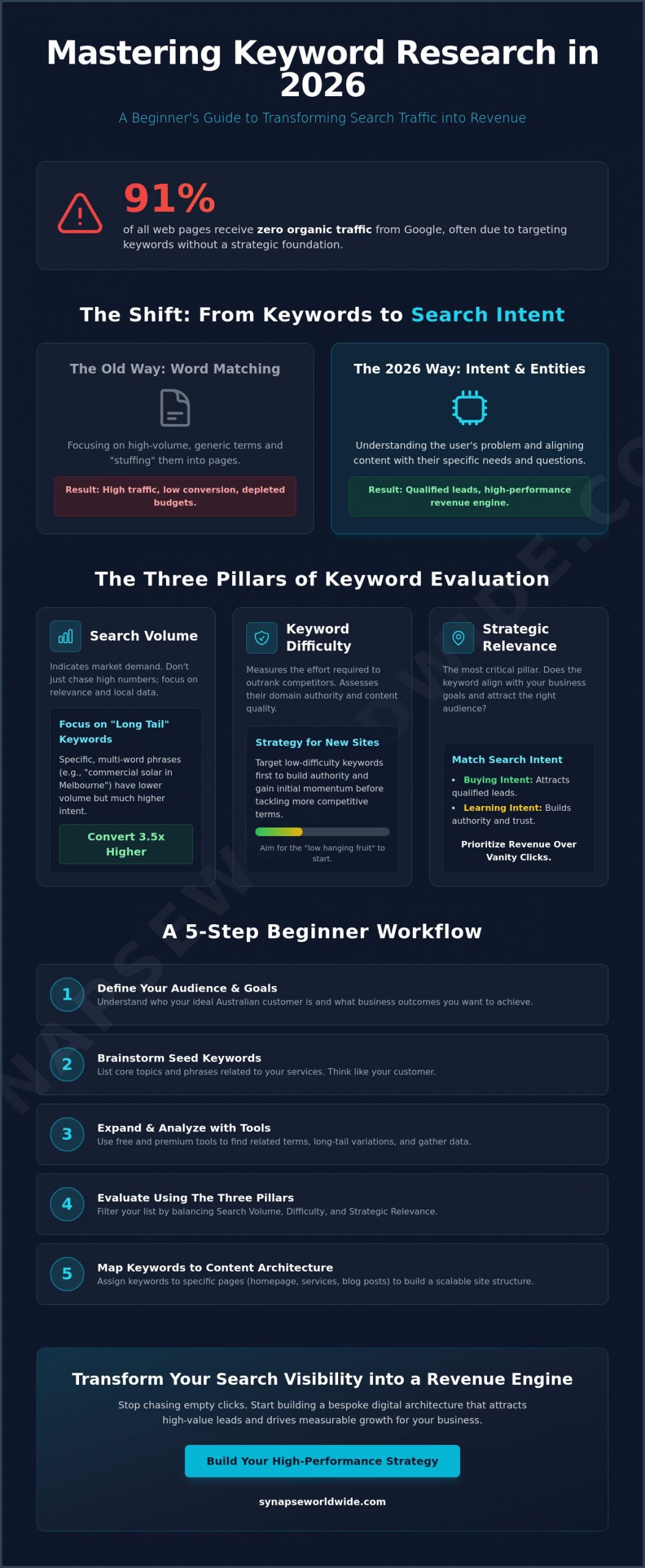
In 2026, the traditional pursuit of high-volume search terms is a fast track to a depleted marketing budget. Recent industry analysis shows that 91% of all web pages receive zero organic traffic from Google, largely because they target keywords without a strategic foundation. You’ve likely felt the exhaustion of navigating conflicting advice from generic blogs while watching your competitors capture the high-value leads you deserve. It’s frustrating to invest time into SEO only to find that your chosen terms drive clicks but fail to generate actual revenue in the Australian market.
Mastering keyword research for beginners is the first step in building a bespoke digital architecture that scales with your business. We’ll show you how to master the fundamental architecture of search intent to transform your digital presence into a high-performance revenue engine. This guide delivers a clear, repeatable process for identifying high-value keywords and provides a strategic framework for understanding modern customer search behavior. You’ll move beyond the confusion of AI search results to secure a robust, long-term competitive advantage for your core services.
Key Takeaways
- Master the fundamental shift from simple word matching to complex search intent analysis to capture the digital language of your ideal Australian clientele.
- Identify bespoke growth opportunities by evaluating the three pillars of keyword health: search volume, competitive difficulty, and strategic relevance.
- Develop a professional 5-step workflow for keyword research for beginners that prioritizes a scalable content architecture over disorganized lists.
- Evaluate free and premium tool ecosystems to ensure your digital investment provides the robust, actionable data required for the Australian market.
- Transform search visibility into a high-performance revenue engine by seamlessly integrating strategic keywords into your technical site architecture.
What is Keyword Research and Why is it Critical in 2026?
Keyword research isn’t just a list of words; it’s the strategic discovery of the digital language your Australian audience uses to navigate the web. In 2026, successful digital growth requires more than just matching text. It demands a deep understanding of the user’s psyche. Understanding What is Keyword Research at its core allows you to identify the terms, questions, and phrases that bridge the gap between a customer’s problem and your bespoke solution. This foundation supports every piece of high-performance digital infrastructure we build. Without it, your website is a silent storefront on a busy Sydney street.
The post-AI search landscape has shifted the focus from simple word matching to complex precision. Search engines now act as sophisticated filters, discarding generic content in favour of highly relevant answers. Mastering keyword research for beginners is no longer about finding high-volume terms to “stuff” into a page. Instead, it’s about aligning your brand’s expertise with the specific queries your potential clients are typing into their devices. Precision is paramount because AI-driven algorithms can now detect the difference between a surface-level mention and genuine topical authority.
The Evolution of Search: Keywords vs. Entities
Search engines have moved beyond simple character matching to entity-based recognition. Entities are real-world concepts, people, places, or things that search engines now prioritise over raw text strings. If you want to rank for “commercial solar in Melbourne,” the engine doesn’t just look for those words. It looks for evidence that your site understands the broader entity of renewable energy regulations in Victoria. Your website must function as a definitive authority on these topics rather than a mere host for keywords. Search Intent is the primary driver of 2026 SEO success.
Business Impact: Traffic vs. Targeted Revenue
Many Australian businesses fall into the trap of chasing vanity metrics. High traffic numbers look impressive on a monthly report, but they don’t always pay the bills. Value metrics focus on qualified leads that actually convert into sales. A bespoke keyword strategy ensures that your e-commerce platform attracts users ready to spend A$500 rather than those just browsing for inspiration. When you focus on keyword research for beginners with a revenue-first mindset, you filter out the noise and capture the intent.
This approach is a core pillar of our SEO for small business framework, where we prioritise targeted revenue over empty clicks. By identifying “buying” keywords versus “learning” keywords, you can allocate your marketing budget more effectively. This ensures a higher conversion rate and a more robust return on investment for your digital assets.
The Three Pillars of Keyword Evaluation
Strategic digital growth requires a balanced framework that moves beyond simple intuition. For any new website, the “perfect” keyword isn’t just a term with high traffic; it’s the precise intersection of three critical metrics: volume, difficulty, and intent. When starting keyword research for beginners, you must prioritize relevance over raw numbers. This focused approach builds initial momentum and prevents the common “low-value traffic trap,” where a site attracts thousands of visitors who have no intention of engaging with the brand or making a purchase. Every selection must be a deliberate step toward a measurable business outcome.
Search Volume: Understanding Market Demand
Search volume indicates the average number of times users enter a specific query into a search engine each month. While high-volume terms are tempting, the “Long Tail” theory proves that specific, multi-word phrases often provide better results for emerging brands. These niche terms might only have 40 or 70 searches per month, yet they frequently convert at a rate 3.5 times higher than broad “head” terms. Australian businesses should specifically filter for national data rather than global volume. A phrase might show 15,000 global searches, but if only 100 of those occur within Australia, the global metric is a vanity stat that won’t drive local revenue.
Keyword Difficulty: Assessing the Competitive Landscape
Keyword difficulty measures how much effort is required to outrank the current leaders. This metric is defined by the domain authority of the ranking sites and the comprehensive nature of their content. A new site shouldn’t target broad head terms immediately because established competitors have spent years building backlink profiles that are difficult to displace overnight. Instead, look for “low-hanging fruit.” These are opportunities where the top results are outdated articles from 2022, irrelevant forum threads, or low-quality content. Identifying these gaps is a core component of a bespoke digital strategy that ensures your resources are spent where they can actually win.
Search Intent: The ‘Why’ Behind the Query
In 2026, matching your content format to search intent is the primary ranking factor. Google prioritizes pages that satisfy the user’s specific goal, which we divide into four categories: Informational (seeking knowledge), Navigational (finding a specific site), Commercial (investigating brands), and Transactional (ready to purchase). As noted in Ahrefs’ guide to keyword research, understanding these nuances is vital for conversion. You can identify intent by performing a SERP analysis. If the top results for your chosen term are all “how-to” videos, a text-heavy product page will likely fail to rank regardless of its quality. Effective keyword research for beginners involves looking at what Google is already rewarding and creating a superior version of that specific format.
Essential Tools for Beginner Keyword Research
Selecting a toolkit is the first step in transforming raw data into a scalable growth engine. For those starting keyword research for beginners, the digital landscape offers two distinct paths: free utilities that leverage Google’s ecosystem and professional platforms designed for deep competitive auditing. The most effective tool isn’t necessarily the most expensive; it’s the one that uncovers actionable intent within your specific Australian niche. Success relies on your “Seed Keywords,” which are the foundational terms describing your core business. These seeds act as the primary input for any tool, allowing the software to branch out into thousands of long-tail variations that your customers are actually typing into search bars.
A strategic budget-friendly stack for an Australian small business often includes a mix of Google’s native tools and a mid-tier aggregator like Ubersuggest or AnswerThePublic. This combination keeps monthly overheads low, typically under A$50, while providing enough data to outperform competitors who rely on guesswork. High-performing content isn’t a product of luck; it’s the result of using these tools to identify gaps in the market before your competitors do.
Free Resources: Tapping into Google’s Own Data
Google Keyword Planner remains a cornerstone for organic strategy, even though it’s housed within the Google Ads interface. It provides precise geographic data for the Australian market, letting you filter search volumes specifically for cities like Perth or Brisbane. Google Search Console offers a different advantage by showing you “hidden” opportunities. Industry reports from 2024 indicate that 70% of clicks go to the top three organic results. Search Console identifies keywords where you currently rank on page two, highlighting exactly where a small SEO push could yield a massive traffic spike. Finally, Google Trends is indispensable for navigating seasonality. It helps you anticipate when interest in your services will peak, ensuring your content is live and indexed well before the surge begins.
Professional Platforms: Scaling Your Strategy
When you’re ready to move beyond the basics, professional platforms like Ahrefs or Semrush provide a comprehensive competitive lens. These subscriptions usually start around A$160 per month, but the return on investment comes from their “Keyword Gap” features. This tool allows you to input your URL alongside three competitors to see exactly which high-value terms they rank for that you’ve missed. It’s a blueprint for content creation that removes all uncertainty. Professional agencies use these sophisticated data points to build a custom web design for small business, ensuring the site architecture supports the most lucrative search terms from day one. Transitioning to keyword research for beginners using these professional insights turns a simple website into a proactive sales tool that works around the clock.
How to Perform Keyword Research: A 5-Step Beginner Workflow
Approaching keyword research for beginners requires the mindset of a Digital Architect. You aren’t just compiling a spreadsheet of random words; you’re designing the structural integrity of your brand’s online presence. Data from 2024 indicates that the top result in Google captures approximately 27.6% of all clicks. To secure that position, your workflow must be repeatable, data-driven, and adaptable to the shifting Australian market. This process transforms raw data into a strategic content map that supports long-term growth.
Step 1: Brainstorming Seed Keywords
Begin with the foundation of your business. Identify your core services, such as “commercial fit-outs in Melbourne” or “bespoke financial planning.” Move beyond what you sell to how your clients think. Review your CRM for common FAQs. If three clients this week asked about “capital gains tax on Australian investment property,” that’s a high-value seed. Finally, target “problem” keywords. These are the phrases users search when they feel the pain but haven’t found the solution yet, like “why is my website bounce rate so high.”
Step 2 & 3: Expanding the List and Filtering by Metrics
Input your seeds into professional tools to generate a list of 500 or more related phrases. This expansion phase provides the raw materials for your strategy. You must then apply rigorous filters to refine the list. Remove terms with a difficulty score above 70 if your site is new. Prioritise keywords with “Commercial Intent.” For example, “buy solar panels Sydney” is significantly more valuable than “how do solar panels work” for a retail business. This ensures your efforts drive immediate business value rather than just vanity metrics.
Step 4 & 5: SERP Analysis and Content Mapping
Before you write a single word, examine the Search Engine Results Page (SERP). If the top three results are instructional videos, a 2,000-word blog post might not rank regardless of its quality. Assign every validated keyword to a specific page on your site to prevent keyword cannibalisation. This is where you build a “Topic Cluster.” Create one pillar page for a broad topic and link several smaller, specific articles back to it. This integrated structure signals to search engines that you possess deep topical authority in your niche.
- Does the keyword align with a specific service or product you provide?
- Is the search volume higher than 100 monthly searches in Australia?
- Does the current SERP match your intended content format?
- Can you provide a more comprehensive answer than the current top 3 results?
Successful SEO isn’t a one-time setup; it’s a continuous process of refinement. Market trends evolve, and your keyword strategy must adapt to stay relevant. If you’re ready to build a robust digital foundation that delivers measurable ROI, partner with our strategic consultants to scale your business today.
From Keywords to Conversions: Strategic Implementation
Identifying high-value search terms is a significant milestone for any growing business. However, raw data doesn’t generate revenue; implementation is where your investment yields a tangible return. In the Australian market, where online competition has intensified by over 12% since 2024, a passive approach to data is no longer viable. Effective keyword research for beginners must transition from a static spreadsheet into the functional DNA of your website.
Keywords must dictate your technical site architecture rather than being treated as an afterthought. This integration is particularly critical during ecommerce website development. Your category hierarchies and product taxonomies should directly mirror the search intent of your primary audience. When site structure aligns with the user’s mental model, you reduce friction and accelerate the path to purchase. While these steps are foundational, professional SEO management is often required to scale these efforts into a sustainable, high-performance growth engine. A unified content marketing SEO strategy ensures that every piece of content you publish reinforces your keyword architecture and drives compounding organic growth.
On-Page Optimization Essentials
Strategic placement remains the cornerstone of visibility. You must integrate keywords into page titles, H1 headers, and meta descriptions to signal relevance to search crawlers. You shouldn’t sacrifice readability for rankings. Write for human users first; search engines have become sophisticated enough to reward natural, high-quality prose. Keywords also serve as the blueprint for a robust internal linking structure. By linking related topics, you guide users deeper into your sales funnel and help search engines index your most important pages more efficiently. Following a comprehensive on-page SEO checklist ensures that every technical and content element on your page is optimized to convert keyword visibility into measurable revenue.
Measuring Success: Beyond the Rankings
Securing a top position is a vanity metric if it fails to drive business outcomes. You need to look deeper into Google Analytics 4 to evaluate the health of your strategy. Focus on these key metrics:
- Organic Traffic Volume: Monitoring the total number of unique sessions arriving from search engines.
- Conversion Rate by Landing Page: Identifying which specific keywords lead to enquiries or sales.
- Engagement Rate: Ensuring the traffic you attract is actually interacting with your content rather than bouncing.
True keyword research for beginners is never a finished task. It’s a continuous cycle of discovery, implementation, and refinement. As consumer behaviour in Australia evolves, your keyword strategy must adapt to ensure your digital presence remains both relevant and profitable.
Secure Your Competitive Advantage in the 2026 Digital Economy
The evolution of search algorithms means that keyword research for beginners is no longer just about finding high-volume phrases. It’s about decoding user intent and mastering the three pillars of evaluation to ensure your content resonates with the Australian market. By implementing the 5-step workflow we’ve outlined, you’re positioning your brand to capture high-value traffic that actually converts into revenue.
Success in this landscape requires a sophisticated approach to data. Since 2005, Synapse Worldwide has acted as a digital architect for national enterprises, building bespoke digital architecture that stands the test of time. We provide results-oriented strategic consulting that bridges the gap between technical optimization and tangible business growth. Whether you’re targeting local niche segments or scaling across the country, it’s time to stop guessing and start scaling with a framework built for the next decade of digital competition.
Ready to build a data-driven growth engine? Explore our Strategic SEO Services.
Your journey toward market leadership starts with a single, data-backed decision. Let’s build something remarkable together.
Frequently Asked Questions
How long does it take to rank for a new keyword?
Ranking for a new keyword typically requires 90 to 180 days of consistent optimization and authority building. According to a 2024 Ahrefs study, only 5.7% of newly published pages reach the top 10 search results within a year. Your timeline depends heavily on your domain authority and the competitiveness of the Australian digital landscape. We focus on scalable strategies that accelerate this process through technical precision and high-quality content alignment.
Should I focus on high-volume keywords or low-volume ones?
Prioritise low-volume, high-intent keywords to secure immediate conversions while building long-term authority for competitive terms. While high-volume keywords offer broader reach, long-tail queries often account for 70% of all search traffic. Beginners should target phrases with 50 to 200 monthly searches to gain traction quickly. This bespoke approach ensures your investment delivers measurable ROI before you tackle industry-leading benchmarks.
Is keyword research still necessary with the rise of AI search?
Keyword research remains a fundamental pillar of digital strategy even as AI-driven search models like Google’s Search Generative Experience evolve. AI engines still rely on linguistic patterns and entities to map user intent to relevant content. Effective keyword research for beginners in 2026 focuses on semantic clusters rather than isolated phrases. This ensures your brand remains visible in both traditional results and AI-curated snapshots.
How many keywords should I target on a single page?
Target one primary keyword and three to five secondary, related variations per page to maintain topical relevance. Modern search algorithms prefer comprehensive content that addresses a specific intent deeply. A 2024 analysis of top-ranking pages showed they often rank for 1,000 or more long-tail keywords naturally. We design integrated content structures that allow these variations to surface without compromising the user experience or page clarity.
Can I do keyword research for free without expensive tools?
You can conduct robust keyword research using free platforms like Google Keyword Planner, Google Trends, and AnswerThePublic. These tools provide authentic data directly from search engines, allowing you to identify trends within the Australian market without an initial software investment. While free tools offer a solid foundation, professional-grade analytics become necessary as your business scales. It’s best to start with these resources to validate your niche before moving to bespoke, data-heavy platforms.
What is the difference between a keyword and a search query?
A keyword is the specific term marketers target, while a search query is the actual string of words a user types into a search engine. For instance, your keyword might be “SEO services,” but a user’s query could be “best SEO agency in Melbourne for small business.” Understanding this distinction is vital for successful keyword research for beginners. It allows you to bridge the gap between your strategic goals and the real-world language of your customers.
How often should I update my keyword research?
Review and update your keyword strategy every 90 to 120 days to stay aligned with shifting market trends and competitor movements. The digital landscape moves rapidly; a keyword that converted well in January might lose relevance by June. Regular audits ensure your content remains optimized for the most current search behaviours. This disciplined approach prevents stagnation and keeps your growth trajectory on a steady, upward path.

