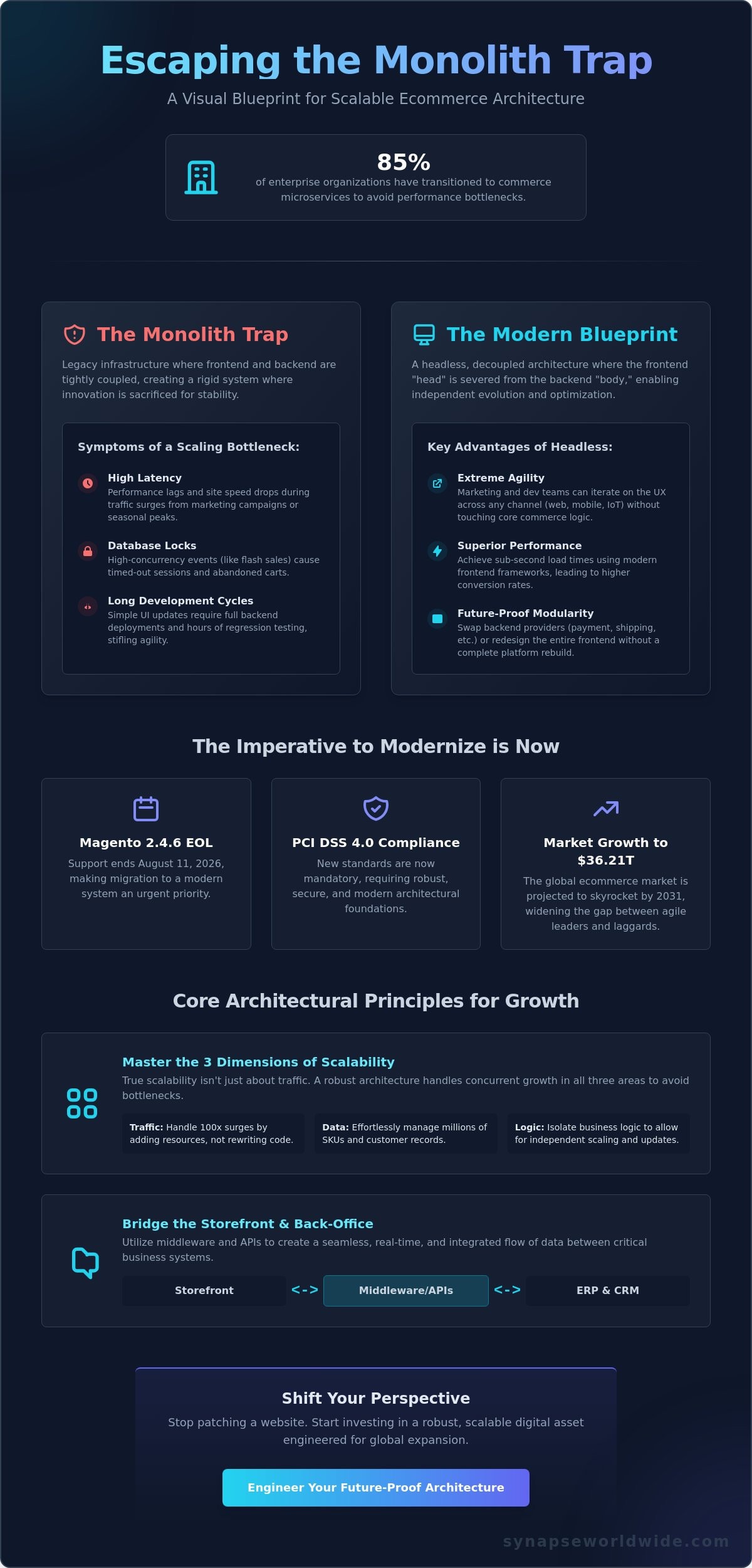

What if the looming August 11, 2026, end-of-life for Magento 2.4.6 isn’t a technical crisis, but your brand’s most significant opportunity to outpace the competition? Many enterprise leaders feel trapped by Magento’s high total cost of ownership and the frustratingly slow pace of deploying new features. You’ve likely spent years managing complex ERP and CRM integrations while fearing that a platform shift could trigger a devastating revenue drop. It’s a valid concern; however, maintaining a legacy system that loses its security patches this summer is a far greater risk to your long-term stability.
Our magento to shopify migration service is built on a 2026 Strategic Growth Framework that treats your transition as a sophisticated architectural overhaul rather than a simple data transfer. We promise a seamless execution with zero data loss, ensuring your customer profiles and order histories remain perfectly intact. By following this framework, you’ll learn how to replace technical debt with a high-performance, scalable online store that drastically lowers operational overhead. This article previews the exact path to achieving deep business automation and enterprise-level scaling without compromising your current operational workflow.
Key Takeaways
- Understand why the 2026 digital landscape requires transitioning from self-hosted technical debt to an agile, secure SaaS infrastructure.
- Discover how a professional magento to shopify migration service utilizes a five-step framework to guarantee data integrity and zero loss.
- Implement a strategic SEO mapping plan to preserve your organic rankings, metadata, and site hierarchy throughout the transition process.
- Seamlessly integrate your existing ERP and CRM systems into Shopify to create a unified, automated ecosystem for enterprise scaling.
- Achieve budget transparency and project certainty through fixed-price development fees backed by two decades of technical expertise.
The Strategic Case for Magento to Shopify Migration in 2026
The year 2026 marks a definitive shift in how enterprise brands view their digital infrastructure. It’s no longer just about having a functional storefront; it’s about the speed of evolution. For brands still operating on Magento 2.4.6, the August 11, 2026, end-of-life deadline represents a critical security and compliance threshold. Utilizing a professional magento to shopify migration service isn’t merely a tactical fix for this deadline. It’s a strategic move to shed years of technical debt that often accumulates in self-hosted environments. When your team spends more time applying monthly security patches than launching new marketing campaigns, your platform has become a bottleneck rather than an engine for growth.
The true cost of Magento technical debt is often hidden in development hours and missed opportunities. Since January 2026, Magento’s transition to a monthly patch release cycle has increased the operational burden on internal IT teams. Each update requires manual testing and potential troubleshooting for custom integrations. This constant state of maintenance drains resources that should be dedicated to understanding e-commerce trends and improving the customer journey. Moving to a SaaS model allows you to redirect these high-value hours toward innovation and revenue-generating activities.
From Technical Debt to Digital Agility
Agility in 2026 is defined by how quickly you can respond to market shifts. Shopify’s global CDN and fully managed hosting environment provide a level of stability that is difficult and expensive to replicate on a self-hosted Magento stack. You don’t have to worry about server clusters or database optimization during a viral social media surge. This architectural shift significantly reduces maintenance-related development hours. Instead of “keeping the lights on,” your developers can focus on building bespoke features that differentiate your brand in a crowded marketplace.
The 2026 E-commerce Landscape
The current market demands AI-native features and deep connectivity across every touchpoint. Shopify’s ecosystem has matured to include sophisticated AI tools for inventory forecasting and predictive customer analytics as standard offerings. These tools are designed to work out of the box, whereas implementing similar functionality on Magento often requires complex, custom-coded modules. By choosing a magento to shopify migration service, you’re positioning your business to leverage unified commerce. Whether your customers find you through social channels or physical points of sale, the data remains synchronized in real-time. This level of connectivity is the foundation for a future-proof digital transformation that scales alongside your ambitions.
The Synapse Migration Framework: A 5-Step Architectural Approach
A successful transition requires more than a simple export-import script. It demands a disciplined architectural approach that treats your store as a living ecosystem. Our magento to shopify migration service follows a rigorous five-step framework designed to eliminate technical bloat while enhancing operational capacity. We don’t just move data; we rebuild your digital foundation for the next decade of growth. This methodology ensures that every technical decision aligns with your high-level business objectives.
- Discovery and Digital Audit: Deep-dive analysis of your current Magento environment and technical requirements.
- Data Mapping and Clean-up: Scrubbing legacy records to ensure a high-integrity transfer without historical baggage.
- Theme and UX Reconstruction: Crafting a high-conversion interface built on Shopify’s high-performance Liquid architecture.
- App and Integration Engineering: Reconnecting ERP, CRM, and bespoke business logic through custom development.
- Pre-Launch Testing: Rigorous quality assurance to fulfill our zero-downtime commitment for a seamless go-live.
Phase 1 & 2: Strategy and Data Integrity
The Discovery Phase serves as the most critical ROI driver because it aligns technical requirements with business growth objectives. During this stage, we identify redundant data and legacy bloat within your Magento database. Years of logs, expired quotes, and unused extension tables often slow down legacy sites and complicate the migration process. We meticulously map your customer profiles, order histories, and product catalogs to Shopify’s streamlined structure. This ensures every piece of information retains its context and utility. If you’re looking for a partner to lead this transformation, our e-commerce development experts specialize in these complex data transitions.
Phase 3 & 4: Design and System Connectivity
Reimagining your brand for Shopify involves balancing sophisticated aesthetics with high-performance code. We reconstruct your user experience using Shopify’s modern architecture, which inherently prioritizes speed and mobile responsiveness. This is also the time to audit your current extensions. Many features that required heavy third-party modules in Magento are now native to Shopify or available through more efficient, managed apps. For unique business rules that can’t be found off-the-shelf, we engineer custom Shopify apps to preserve your specific logic. This step ensures your migration doesn’t mean compromising on the unique features that your customers value. Our magento to shopify migration service bridges the gap between your existing operations and the agility of a modern SaaS platform.

Preserving SEO Authority and Organic Visibility
One of the most significant risks during a platform shift is the sudden evaporation of organic traffic. If your site currently ranks for high-value keywords, those positions represent years of authority building and content investment. Our magento to shopify migration service prioritizes the preservation of this digital equity through a rigorous technical SEO protocol. We treat your search visibility as a vital asset that must be protected with the same precision as your financial data. A successful migration doesn’t just maintain your rankings; it provides a cleaner, faster foundation for future growth.
- URL Mapping: Strategic 1:1 mapping of every legacy Magento URL to its new Shopify equivalent.
- 301 Redirect Strategy: Implementation of permanent redirects to eliminate 404 errors and preserve link juice.
- Metadata Preservation: Ensuring page titles, meta descriptions, and alt tags remain consistent or improved.
- Site Hierarchy: Replicating your logical structure to ensure search engines understand your topical authority.
- Search Console Management: Proactive monitoring of indexing status and sitemap submission for rapid recovery.
Technical SEO Migration Protocols
A comprehensive pre-migration crawl is the first step in our process. It establishes a performance baseline that allows us to measure success and identify potential issues before the first line of code is moved. Magento often utilizes deep, custom URL structures that don’t align with Shopify’s standardized pathing for products and collections. We manage these discrepancies by creating a meticulous redirect map. This ensures that every legacy link, whether from an external blog or a customer’s bookmark, lands on the correct page. While our focus is on enterprise-level complexity, the core principles of SEO for Small Business remain essential; foundational site health is the prerequisite for all visibility.
Content and Metadata Continuity
Blog posts and informational pages often carry significant ranking power that drives top-of-funnel awareness. We ensure these assets retain their authority by mirroring their metadata and internal linking structures during the transition. In the 2026 search environment, structured data (Schema) is vital for achieving rich snippets and staying relevant in AI-driven search results. We implement advanced Schema markup to ensure your product data is interpreted correctly by modern crawlers. Precise URL mapping is a non-negotiable step for revenue because even a minor oversight in the redirect strategy can trigger a catastrophic decline in organic conversions. Our magento to shopify migration service includes a post-launch SEO audit to monitor keyword fluctuations and implement rapid recovery strategies if any anomalies appear in your traffic patterns.
Enterprise Integration: Connecting ERP, CRM, and Shopify
A successful migration shouldn’t exist in a vacuum. To truly capitalize on the agility of a new platform, your e-commerce engine must communicate flawlessly with your entire back-office suite. Our magento to shopify migration service treats these connections as the nervous system of your business. We focus on building a unified data environment where inventory, orders, and customer profiles flow without friction. This approach eliminates the manual data entry that often plagues legacy Magento setups, reducing human error and freeing your team for higher-value strategic work. Replatforming is your opportunity to move from a fragmented tech stack to a cohesive, enterprise-grade architecture.
- Inventory Synchronization: Real-time updates across multiple warehouses and sales channels to prevent overselling.
- Automated Fulfillment: Streamlined order processing that triggers directly from Shopify to your logistics provider.
- Bespoke Middleware: Engineering custom bridges for proprietary legacy systems that don’t have off-the-shelf connectors.
- Unified Reporting: Consolidated financial and operational data for a single source of truth across the organization.
Streamlining Business Operations
Efficiency is the primary driver of profitability in the 2026 market. We bridge the gap between Shopify and your existing tools by treating Business Process Automation as a core pillar of the migration process. Instead of relying on fragile third-party connectors, we engineer robust pipelines for your CRM Integration. This ensures that every customer interaction, from a support ticket to a repeat purchase, informs your marketing strategy in real-time. By automating these repetitive tasks, you transform your store from a simple sales portal into a sophisticated, self-optimizing engine that requires less manual oversight.
Post-Migration Growth Architecture
Replatforming serves as a strategic catalyst for broader digital transformation. Once the technical debt of Magento is removed, you can finally implement the marketing automation and international expansion strategies that were previously too complex to manage. A scalable tech stack supports omnichannel growth by allowing you to add new sales channels or regional storefronts with minimal friction. We help you transition to a data-driven scaling model where every decision is backed by unified insights from your ERP and CRM systems. This strategic foresight ensures that your new infrastructure doesn’t just meet today’s needs but anticipates the demands of tomorrow’s global market. If you’re ready to modernize your operations, explore our comprehensive ERP Solutions to see how we can unify your business data.
Why Synapse Worldwide is the Partner for Your Migration
Choosing a partner for your magento to shopify migration service is a decision that defines your brand’s trajectory for the next decade. It’s a move that requires more than technical proficiency; it demands a partner who understands the high stakes of enterprise-level commerce. With over 20 years of expertise in building high-value digital infrastructure, we’ve refined a process that prioritizes stability, security, and measurable growth. We don’t view migration as a simple change of software. Instead, we see it as an opportunity to rebuild your digital presence from the ground up, ensuring every architectural choice supports your long-term return on investment.
- Budget Certainty: We provide fixed-price project development fees, ensuring transparency and eliminating the risk of spiraling costs.
- Strategic Depth: Our team combines two decades of technical experience with high-level business consulting to align your tech stack with your revenue goals.
- End-to-End Ownership: We manage every phase of the transition, from initial discovery and data mapping to post-launch maintenance and optimization.
- Results-Oriented Focus: Every technical decision is filtered through the lens of business outcome, focusing on lower overhead and higher conversion rates.
The Visionary Architect Approach
We operate as visionary architects for your digital ecosystem. This means we balance sophisticated strategic consulting with disciplined, hands-on technical execution. We don’t just follow a checklist; we evaluate your entire business model to ensure the new Shopify environment enhances your competitive advantage. Our commitment is to build long-term partnerships rather than completing one-off transactions. This perspective allows us to bring a global outlook to your digital solutions, ensuring your store is prepared for international markets while maintaining the precision of local expertise. You’re not just hiring developers; you’re engaging a strategic partner dedicated to your transformation.
Getting Started with Your Transition
The journey toward a more agile platform begins with a detailed strategy session. During this initial consultation, we audit your existing Magento setup to identify the complexities of your data, integrations, and custom logic. We then tailor a migration timeline that respects your seasonal peaks and operational requirements, ensuring the transition happens with zero disruption to your current revenue. This phase is about clarity and confidence, providing you with a roadmap that addresses every concern from SEO preservation to ERP connectivity. If you’re ready to move beyond legacy limitations, our E-commerce Development team is prepared to architect your next phase of growth. Our magento to shopify migration service is the bridge between your current technical debt and a future of scalable, high-performance commerce.
Transforming Your Digital Foundation for 2026
The transition from a legacy Magento environment to a modern Shopify ecosystem is a strategic pivot that replaces technical debt with digital agility. By adopting a disciplined 5-step framework, you ensure that your data remains secure while your SEO authority stays protected during the shift. Replatforming also serves as the ideal moment to unify your operations through high-level ERP and CRM integrations, creating a seamless flow of information across your entire business. This isn’t just about changing software; it’s about building a scalable architecture that supports your vision for global expansion.
Established in 2005, Synapse Worldwide brings over 20 years of digital expertise to every project. We understand the complexity of enterprise systems and offer fixed-price project development for total budget transparency. Our magento to shopify migration service is designed to move your brand from maintenance-heavy legacy systems to a high-performance, results-oriented storefront. It’s time to stop managing servers and start managing growth. Secure Your Strategic Migration Consultation today and take the first step toward reaching the next level of business success. Your digital transformation is in expert hands.
Frequently Asked Questions
How long does a Magento to Shopify migration typically take?
The timeline for a transition depends on the complexity of your data and the depth of custom integrations required. While a basic store move might take less time, a comprehensive enterprise-level transition typically spans several months. This period includes the critical discovery phase, data cleaning, and rigorous pre-launch testing to ensure a flawless go-live.
Will I lose my customer order history during the migration?
You won’t lose your customer order history when using a professional magento to shopify migration service. We utilize advanced data mapping protocols to transfer historical orders, customer profiles, and transaction details with high integrity. Preserving this information is essential for maintaining customer loyalty and providing continuity in your CRM and reporting tools.
Can Shopify handle the complex product configurations I have on Magento?
Shopify easily handles complex product configurations through its robust metafield system and advanced variants. For highly specialized requirements, we engineer custom logic using Shopify’s modern architecture or bespoke app development. This ensures that even the most intricate product bundles or attribute sets from your Magento store function perfectly in their new environment.
What happens to my custom Magento extensions after the move?
Magento extensions don’t transfer directly because they are built on a fundamentally different code architecture. During the discovery phase, we audit your current extensions to determine which features are now native to Shopify and which require modern, managed apps. If a unique business rule requires it, we build custom functionality to replace legacy modules without compromising site performance.
How much does a professional Magento to Shopify migration service cost?
The investment for a professional magento to shopify migration service depends on the volume of data, the number of integrations, and the level of custom design required. We provide fixed-price project development fees to ensure total budget transparency from the start. This approach eliminates the uncertainty of hourly billing and allows you to focus on the long-term return on investment.
Is there a risk of downtime during the platform switch?
There is no reason for significant downtime during a properly managed platform switch. We utilize a staged deployment strategy where your new Shopify store is fully built and tested in a development environment while your Magento site remains live. The final cutover involves updating your DNS settings; this results in a seamless transition for your customers.
Will my SEO rankings drop after moving to Shopify?
Your SEO rankings can be preserved and even improved through a meticulous 301 redirect strategy and URL mapping. We establish a performance baseline before the move and monitor indexing status closely through Google Search Console. By cleaning up legacy site bloat and improving page load speeds, the migration often leads to better organic visibility over time.
Can I keep my existing payment gateway and shipping providers?
You can typically keep your existing payment gateways and shipping providers as Shopify integrates with hundreds of global partners. We evaluate your current contracts during the integration phase to ensure compatibility and optimal performance. If a specific provider isn’t natively supported, we explore custom API connections to maintain your established business relationships and operational workflows.