
Tag Archives: Enterprise Ecommerce


Scalable Ecommerce Architecture: The 2026 Strategic Framework for Enterprise Growth

Scalable Ecommerce Architecture: The 2026 Strategic Framework for Enterprise Growth

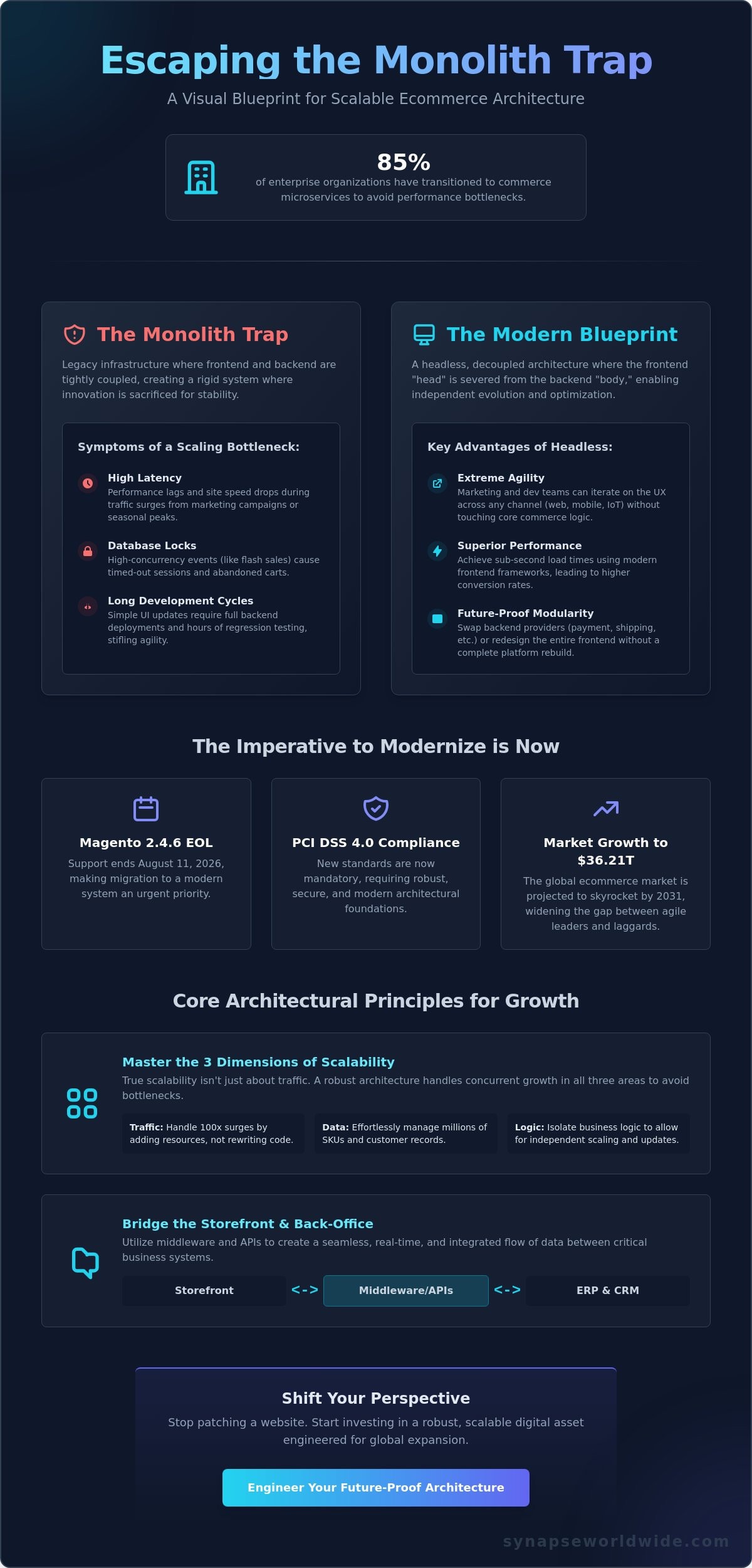
85% of enterprise organizations have now transitioned to commerce microservices to avoid the performance bottlenecks inherent in monolithic platforms. As the global ecommerce market climbs toward a projected $36.21 trillion by 2031, the gap between agile leaders and legacy-locked laggards is widening. You’ve likely experienced the frustration of high latency during peak traffic or the friction caused by data silos between your storefront and back-office ERP systems. These aren’t just technical glitches; they’re structural failures that limit your growth potential.

Building a scalable ecommerce architecture requires a shift from reactive patching to proactive, bespoke engineering. With support for Magento 2.4.6 ending on August 11, 2026, the mandate for modern, decoupled systems has never been more urgent. We’ll show you how to master the architectural foundations needed to scale from thousands to millions of orders without accumulating technical debt. This strategic framework covers the move toward headless environments and the critical integration of real-time data processing. You’ll learn how to achieve sub-second load times and a future-proof digital landscape that remains compliant with the now-mandatory PCI DSS 4.0 standards.

Key Takeaways

  • Escape the “Monolith Trap” by adopting a scalable ecommerce architecture designed to handle 100x traffic surges through resource allocation instead of costly code rewrites.
  • Master the headless commerce blueprint to separate your presentation layer from the commerce engine, ensuring your business remains agile in a fast-moving market.
  • Resolve performance lag by optimizing the three dimensions of scalability, allowing you to manage millions of SKUs and customer records with ease.
  • Bridge the gap between your storefront and back-office by utilizing middleware to create a seamless, integrated flow of data between ERP and CRM systems.
  • Shift your perspective from building a website to investing in a robust digital asset that follows a phased, risk-managed migration roadmap.

Beyond the Monolith: Why Legacy Infrastructure Hits a Growth Wall

True scalable ecommerce architecture is defined by its ability to handle a 100x increase in transaction volume by simply adding server resources rather than undergoing a total code rewrite. For many enterprise brands, the primary barrier to this level of performance is the “Monolith Trap.” In a traditional monolithic setup, the frontend user interface and the backend business logic are inextricably linked. This means a single change to the checkout flow might inadvertently break the product catalog or the shipping calculator. This interdependence creates a rigid environment where innovation is sacrificed for basic stability.

Technical debt in these legacy systems acts as a literal ceiling on your revenue growth. Every patchwork fix and custom workaround adds weight to the system, eventually making it too heavy to move. By 2026, architectural agility has emerged as a critical competitive advantage. It allows a brand to pivot its strategy or launch a new sales channel in days rather than months. This agility is often achieved through Headless Commerce Explained, a model where the presentation layer is decoupled from the core commerce engine. When these components are separated, you gain the freedom to optimize each one independently to meet the demands of a global market.

The Symptoms of a Scaling Bottleneck

Growth often reveals the hidden cracks in a rigid system. You’ll likely notice latency spikes during major marketing campaigns or seasonal peaks when traffic surges unexpectedly. These aren’t just minor delays; they’re signs that your infrastructure is gasping for air. Database locks are another common red flag. During high-concurrency checkout events, a legacy database might struggle to process simultaneous writes, leading to timed-out sessions and abandoned carts. Perhaps the most frustrating symptom is the long development cycle. When a simple UI update requires a full backend deployment and hours of regression testing, your technical debt has officially become a bottleneck.

The Financial Risk of ‘Just Enough’ Infrastructure

Operating on “just enough” infrastructure is a dangerous gamble for an ambitious enterprise. While patchwork solutions might save costs in the short term, they become expensive liabilities once you hit the 10,000-order mark. At this volume, the cost of a single hour of downtime or even a 2-second increase in load time can equate to thousands in lost revenue. It also erodes customer trust, which is far harder to rebuild than a server. Investing in professional ecommerce website development is a strategic move to mitigate these long-term risks. A robust scalable ecommerce architecture ensures your platform remains a high-performance asset that supports, rather than hinders, your global expansion goals.

Decoupled and Headless: The Modern Blueprint for Scalable Ecommerce

Transitioning to a scalable ecommerce architecture requires moving beyond the limitations of “all-in-one” platforms that bundle the user interface with the commerce engine. Headless commerce has become the gold standard for enterprise growth in 2026, effectively severing the frontend “head” from the backend “body.” This separation allows your marketing team to iterate on the user experience across mobile, web, and IoT devices without touching the core transactional logic. APIs serve as the essential glue in this digital landscape, facilitating seamless communication between disparate systems. Understanding the nuances of various Ecommerce Architecture Types allows business leaders to choose a path that supports long-term agility rather than short-term convenience.

The “Separation of Concerns” philosophy provides a distinct advantage for both developers and business units. Developers can use modern frameworks like Next.js or Remix to build custom-built frontends that achieve sub-second load times, while business units can swap out backend providers without a total site redesign. This modularity ensures that your platform isn’t just a website, but a flexible ecosystem. Speed is currency; 65% of ecommerce brands report higher conversion rates after implementing these bespoke personalization and performance strategies. By removing the overhead of traditional themes, you create a lean, high-performance environment that scales as fast as your ambitions.

Microservices: Granular Scalability for Complex Operations

85% of enterprise businesses now utilize commerce microservices to manage complex operations. Instead of a single application, your store is broken into independent services like Inventory, Payment, and User Profiles. This allows for bespoke scaling; if your inventory lookups spike during a flash sale, you can scale that specific service without paying for extra capacity across the entire site. In 2026, containerization via Docker and Kubernetes is essential for managing these services, providing a robust foundation that ensures high availability even during extreme traffic surges.

Serverless and Cloud-Native Foundations

Modern architectures increasingly rely on serverless functions for event-driven tasks such as order processing or real-time tax calculations. This cloud-native approach, combined with Edge Computing and CDNs, pushes data closer to the user to eliminate latency. It’s vital that your custom software development remains platform-agnostic to avoid vendor lock-in. Utilizing these distributed systems ensures your brand can handle millions of orders while maintaining a global presence. If you’re ready to transition away from restrictive legacy systems, a strategic consultation with a digital architect can help map out your migration path.

Scalable Ecommerce Architecture: The 2026 Strategic Framework for Enterprise Growth

The Three Dimensions of Scalability: Traffic, Data, and Logic

A truly scalable ecommerce architecture is a multi-dimensional asset. While many discussions focus solely on traffic, enterprise resilience requires a simultaneous focus on data and logic. Horizontal scaling addresses traffic by distributing load across multiple server instances. This allows your platform to handle 10x more visitors during peak events without manual intervention. However, traffic capacity becomes a secondary concern if your database cannot manage millions of SKUs or complex customer records without query lag. This is where data scalability becomes the critical second dimension.

Functional logic is the third, and often most overlooked, dimension. It represents the ability to add new sales channels, business models, or geographic regions without introducing bugs into the core code. In a robust system, launching a B2B portal or an international storefront should be a matter of configuration rather than a months-long engineering project. A balanced architecture addresses all three areas to ensure that growth in one department never creates a bottleneck in another. By treating these as distinct engineering challenges, you build a platform that is truly robust and ready for global expansion.

Data Integrity in Distributed Systems

Moving to a distributed model introduces the challenge of eventual consistency. In high-speed commerce, ensuring that inventory levels are accurate across all services is paramount. We utilize tools like Redis for high-speed caching and Kafka for real-time data synchronization. This ensures that a product purchased on the mobile app is immediately reflected as unavailable on the web storefront. Strategic denormalization of data also plays a role. By pre-calculating complex data relationships, we optimize search and filtering performance to maintain sub-second response times even as your product catalog grows into the millions.

Channel Scalability: From Web to Mobile and Beyond

Mobile commerce is projected to reach $2.4 trillion in 2026, making channel scalability a non-negotiable requirement. A scalable core supports mobile app development through unified APIs that serve as a single source of truth. Whether a customer interacts with your brand via a smartphone, a voice assistant, or an in-store kiosk, the data remains consistent. This API-first approach ensures your architecture is ready for future interfaces such as AR or IoT devices. By decoupling the frontend from the data source, you ensure that adding a new channel doesn’t require a total rebuild of your existing systems.

Strategic Integration: Connecting Architecture to CRM and ERP

A high-performance storefront is only half the equation for enterprise success. If your back-office systems can’t process orders as fast as your scalable ecommerce architecture can take them, you’ve simply built a more efficient way to create a backlog. Strategic integration ensures that data flows without friction between your digital storefront and your core business systems. Middleware acts as the orchestrator here; it translates complex data packets between your commerce engine and your ERP, ensuring every transaction is captured and processed in real-time. This level of business process automation is the ultimate goal of a mature architecture. It reduces manual overhead and allows your team to focus on high-level strategy rather than manual data entry.

Efficiency in 2026 is measured by the speed of the entire order-to-fulfillment lifecycle. When your systems are siloed, you introduce human error and delay. An integrated landscape allows for automated inventory updates, instant tax calculations, and seamless shipping label generation. This isn’t just about technical connectivity. It’s about building a robust foundation that supports rapid scaling without adding headcount. By treating integration as a core architectural pillar, you ensure that your platform remains a strategic asset that drives growth rather than a technical burden that requires constant maintenance.

CRM Integration for Data-Driven Growth

Personalization is no longer a luxury; 65% of ecommerce brands have reported higher conversion rates after implementing real-time personalization strategies. Achieving this requires your architecture to sync customer behavior directly with your CRM profiles. This allows for dynamic pricing, tailored product recommendations, and sophisticated loyalty programs that respond to user actions instantly. However, as of March 31, 2025, the PCI DSS 4.0 standard has been fully in effect. Your integrated landscape must maintain strict authentication and ongoing monitoring for all data access. Protecting customer privacy while delivering a bespoke experience is a delicate balance that requires disciplined engineering.

ERP and Inventory Orchestration

Overselling is a common symptom of a fragmented system. When your storefront and ERP aren’t in sync, you risk selling inventory that doesn’t exist, which leads to canceled orders and diminished trust. A robust scalable ecommerce architecture uses real-time stock synchronization to ensure that every SKU count is accurate across all channels. For B2B enterprises, this integration also handles complex pricing logic and custom workflows that generic plugins often fail to support. Bespoke integrations offer the reliability that enterprise-grade operations demand, ensuring your system remains stable even during high-volume events. If your current backend is struggling to keep pace with your growth, our team can help you design a bespoke integration strategy that bridges the technical gap.

Engineering the Future: Partnering with a Digital Architect

Achieving a truly scalable ecommerce architecture is not a destination; it’s a continuous engineering discipline. Enterprise leaders often fall into the trap of “buying a website” as if it were a static piece of equipment. In reality, a high-performance platform is a strategic digital asset that requires a visionary architect to design and a disciplined partner to maintain. This shift in perspective is what separates market leaders from those struggling with legacy constraints. By partnering with a Digital Architect, you ensure that every technical decision aligns with your overarching business objectives, from sub-second load times to seamless ERP integrations.

A successful transition requires a phased roadmap. We prioritize migration without disruption, ensuring your current revenue streams remain protected while we build the foundation for your future growth. High-growth brands cannot afford to treat their infrastructure as a “set and forget” solution. Ongoing technical consulting and proactive performance monitoring are essential to stay ahead of traffic surges and evolving security requirements. Our commitment at Synapse Worldwide is to deliver bespoke, integrated, and scalable solutions that transform your digital presence into a robust engine for global expansion.

The Discovery and Strategy Phase

Every project begins with a deep dive into your existing environment. We audit your current technical debt to identify the immediate bottlenecks that are throttling your conversion rates. This phase isn’t just about code; it’s about defining your three-year growth trajectory. We analyze your operational goals to inform architectural choices, ensuring the system we build today can handle the volume you expect tomorrow. This results in a bespoke blueprint that serves as a technical North Star, aligning your technology stack with your core business KPIs.

Long-Term Partnership and Optimization

The digital landscape moves fast. Continuous performance monitoring is the only way to ensure your scalable environment remains optimized as you add new features and channels. Annual maintenance and dedicated hosting subscriptions are not just line items; they’re critical investments in your security and uptime. As requirements like the PCI DSS 4.0 standard evolve, having a partner who manages the intricate technical details allows you to focus on your brand’s vision. If you’re ready to move beyond the limitations of your current platform, it’s time to Consult with the Digital Architects at Synapse Worldwide and build the future of your enterprise.

Mastering the Digital Landscape for Perpetual Growth

The shift toward a scalable ecommerce architecture is no longer a luxury for enterprise brands; it’s a fundamental requirement for survival in a $36.21 trillion global market. By decoupling your frontend from the commerce engine and prioritizing API-first integrations, you eliminate the technical debt that acts as a ceiling on your revenue. True resilience comes from balancing traffic capacity with data integrity and seamless back-office orchestration. These structural foundations allow your business to pivot quickly as consumer behaviors and security standards like PCI DSS 4.0 continue to evolve.

Since 2005, Synapse Worldwide has functioned as a Digital Architect for high-growth enterprises. We specialize in bespoke enterprise-grade solutions that bridge the gap between complex storefronts and critical ERP or CRM systems. Our approach ensures that your platform remains a robust, integrated asset capable of handling millions of orders with sub-second performance. The transition to a modern architecture is a strategic investment in your brand’s future. Scale your vision with a bespoke ecommerce architecture from Synapse Worldwide. Your next level of business success is within reach when your infrastructure is built to support your ambition.

Frequently Asked Questions

What is the difference between monolithic and headless ecommerce architecture?

Monolithic architecture binds the frontend user experience and backend business logic into a single, unified codebase. While this is simpler for initial setups, it creates a “Monolith Trap” where changes to one area can destabilize the entire system. Headless architecture decouples these layers, allowing them to communicate via APIs. This separation enables your team to deploy rapid frontend updates across various devices without risking the integrity of your core transactional engine.

When should a business move from a SaaS platform to a custom scalable architecture?

The transition typically becomes necessary when your monthly revenue exceeds the $800,000 threshold, where SaaS pricing models often shift to a percentage of revenue. You should also consider a move if you require deep, bespoke integrations with ERP or CRM systems that standard plugins cannot support. If your current platform limits your ability to launch new features or handle peak traffic without latency, it’s time to invest in a more robust, independent framework.

How does a scalable architecture improve ecommerce conversion rates?

Performance is the primary driver of conversion in a digital landscape. A well-engineered system ensures sub-second load times and zero downtime during high-traffic events like Black Friday. By eliminating database locks and checkout friction, you reduce cart abandonment and reclaim a significant share of recoverable revenue. 65% of ecommerce brands report higher conversion rates after implementing the personalization strategies that a decoupled, agile architecture makes possible.

Can I scale my existing website without a complete rebuild?

Yes, you can achieve a scalable ecommerce architecture through a phased migration strategy. Rather than a “big bang” rebuild, we often recommend decoupling specific high-load components or moving toward a headless frontend while keeping your existing backend logic intact. This approach allows you to address immediate bottlenecks and improve performance without the operational risk of a total system overhaul.

What are the common pitfalls in scaling an ecommerce database?

The most frequent pitfall is relying on a strictly normalized database as your SKU count grows into the millions. This often leads to query lag and database locks during high-concurrency events. Failing to implement real-time caching via tools like Redis or neglecting the “Eventual Consistency” model in distributed systems can also create data silos. A strategic architect avoids these issues by using denormalization to optimize search and filtering performance.

How does API-first design support omnichannel growth?

API-first design establishes a single source of truth for your inventory, pricing, and customer data across all touchpoints. This ensures that a customer sees the same information on your mobile app, web store, or in-store kiosk. With mobile commerce projected to reach $2.4 trillion in 2026, having a unified API layer allows you to launch new channels quickly without duplicating your backend efforts or risking data discrepancies.

Is microservices architecture too complex for a mid-sized online store?

Complexity should always be balanced against your growth trajectory. While 85% of enterprise businesses use microservices, mid-sized stores should focus on “modular” growth rather than full-scale microservices from day one. Implementing a scalable ecommerce architecture doesn’t mean over-engineering; it means building with the flexibility to spin off services like ecommerce payment gateways or inventory only when your transaction volume demands that level of granular control.


Shopify Development Services Australia: The 2026 Enterprise Buying Guide

Shopify Development Services Australia: The 2026 Enterprise Buying Guide

By 2026, a 100-millisecond lag in mobile response times will strip an estimated A$2.1 million from the annual turnover of large-scale Australian retailers. You already know that a digital storefront isn’t just a website; it’s the engine of your entire enterprise. Recent data indicates that 42% of enterprise retailers still struggle with fragmented ERP systems and site speeds that plummet during critical Black Friday or Boxing Day windows. You deserve a platform that doesn’t just survive peak traffic but thrives under the pressure of a national sales event.

Success in 2026 demands a mobile-first, high-performance approach. With over 65% of Australian online transactions now occurring on mobile devices, speed isn’t just a technical metric; it’s a direct driver of revenue. A true Shopify expert, such as those at Digital Junction, acts as a strategic consultant rather than a mere implementer. They don’t just build features. They architect systems designed to scale from A$100,000 to A$10 million in annual turnover. This shift reflects a move toward long-term partnerships where data-driven decisions replace guesswork, ensuring every technical update contributes to the bottom line.

Securing the right shopify development services australia is the difference between a generic template and a robust, bespoke ecosystem designed for high-level ROI. This guide provides the strategic clarity required to select a partner who can integrate your CRM, optimize your performance, and architect a truly scalable solution. We’ll break down the technical benchmarks and integration requirements you must demand to lead the Australian e-commerce market through 2026 and beyond.

Key Takeaways

  • Shift your perspective from basic theme installation to bespoke digital engineering that integrates your entire enterprise ecosystem into a unified operational hub.
  • Identify the critical criteria for selecting premium shopify development services australia to ensure your partner balances technical mastery with high-level strategic insight.
  • Navigate the sophisticated roadmap from discovery to launch, aligning your technical architecture with data-driven objectives for sustainable business growth.
  • Elevate your brand authority through professional UI/UX design and scalable infrastructure tailored specifically to the nuances of the Australian retail landscape.
  • Learn how a “Digital Architect” approach transforms your storefront into a robust, high-ROI asset capable of navigating the complexities of the 2026 e-commerce market.

The Evolution of Shopify Development Services in Australia

The Australian digital landscape has undergone a radical transformation over the last 24 months. E-commerce is no longer a secondary channel for local retailers; it’s the primary engine of growth. Modern shopify development services australia have evolved from simple theme installations into sophisticated digital engineering. Local brands now require integrated enterprise ecosystems that connect inventory, logistics, and customer data into a single, high-performance hub. Since its inception, the Shopify platform has expanded its capabilities to support these complex requirements, allowing developers to build robust solutions that go far beyond the basic storefront.

Success in 2026 demands a mobile-first, high-performance approach. With over 65% of Australian online transactions now occurring on mobile devices, speed isn’t just a technical metric; it’s a direct driver of revenue. A true Shopify expert acts as a strategic consultant rather than a mere implementer. They don’t just build features. They architect systems designed to scale from A$100,000 to A$10 million in annual turnover. This shift reflects a move toward long-term partnerships where data-driven decisions replace guesswork, ensuring every technical update contributes to the bottom line.

Bespoke vs. Template-Based Development

Off-the-shelf templates often create a “glass ceiling” for growing Australian brands. While they offer a quick start, they limit brand identity and frequently suffer from bloated code that slows down page loads. Custom-coded Liquid and CSS solutions provide the technical advantage of clean, efficient architecture. This bespoke approach ensures your store reflects your unique brand voice while maintaining backend stability. By prioritizing custom engineering, businesses often achieve a 25% to 30% improvement in conversion rates compared to heavily modified templates that struggle with plugin conflicts.

Headless Commerce and the Future of Shopify

Headless commerce represents the next frontier for enterprise-level retailers across Australia. By decoupling the frontend presentation layer from the backend commerce engine, brands gain unparalleled flexibility and site speed. This architecture is vital for multi-channel selling across diverse platforms. For businesses generating over A$2 million in annual revenue, migrating to Shopify Plus with a headless setup often becomes a strategic necessity. It allows for seamless integration with external ERPs and CRMs, ensuring the digital infrastructure remains scalable as the business expands into global markets.

The Digital Architect Approach: Beyond the Storefront

A high-performing digital storefront is only the visible tip of a much larger operational iceberg. We treat your online presence as the central hub of your entire business ecosystem; it isn’t just a place to process transactions, it’s the engine of your growth. Our shopify development services australia focus on building a robust foundation where data flows freely between every department. This architectural mindset ensures your platform handles high traffic volumes while maintaining 99.9% uptime and rigorous security standards that protect both your brand and your customers.

Integrated e-commerce is the seamless flow of data between sales, inventory, and marketing.

The Australian e-commerce market reached a significant milestone in 2023, with online retail spending exceeding A$63 billion. To capture a share of this spend, your architecture must be data-driven and built for long-term scalability. We prioritize clean code and efficient database structures, ensuring your site remains fast even as your SKU count grows from 100 to 10,000. By treating your store as a piece of sophisticated infrastructure, we eliminate the technical debt that often plagues growing brands, allowing you to pivot quickly as market conditions shift.

CRM and ERP Integration Strategies

We streamline your operations by connecting Shopify directly to your existing CRM systems like Salesforce or HubSpot. This connectivity eliminates data silos and reduces manual entry errors by up to 40%, ensuring customer profiles remain accurate across all touchpoints. Our team develops bespoke ERP solutions for real-time inventory management; this ensures stock levels stay synchronized across multiple warehouses and physical retail locations. Automated data synchronization allows your team to focus on high-level strategy instead of administrative overhead, creating a more agile business model.

Marketing Automation and Conversion Optimization

We integrate advanced email and SMS marketing tools like Klaviyo directly into the Shopify flow to nurture leads automatically based on real-time behavior. By leveraging AI-driven personalization, we help brands increase their average order value by a measurable 22% through targeted upsells and cross-sells. We customize the checkout experience specifically for the Australian consumer by prioritizing local payment preferences like Afterpay and Zip. This localized approach reduces cart abandonment and builds long-term trust with your audience. If you’re ready to scale your operations, a strategic technical implementation can transform your digital bottom line.

Shopify Development Services Australia: The 2026 Enterprise Buying Guide

Choosing the Right Shopify Experts in Australia: Key Criteria

Selecting a partner for shopify development services australia requires a shift in perspective. You aren’t just hiring a coder; you’re appointing a strategic architect. Technical proficiency is the baseline requirement. The real differentiator is strategic business acumen. A developer might build a beautiful site, but if they don’t understand how to reduce your customer acquisition cost or increase your average order value, the investment remains a cost rather than a catalyst for growth.

Local expertise is non-negotiable. Australia’s retail environment has specific nuances, from the ubiquity of Afterpay to the logistical challenges of regional delivery. According to this Australian e-commerce market overview, the region’s digital economy continues to mature, with online sales representing over 18% of total retail trade as of 2023. A national partner understands these shifts. They ensure your store complies with Australian Consumer Law while integrating seamlessly with local carriers like Australia Post or StarTrack.

When auditing portfolios, look past the hero banners. Focus on custom functionality. Ask if the agency has built bespoke product builders or integrated complex ERP systems. Visual design is easily replicated; robust, scalable logic is where the value lies. Your partner must also prioritize ongoing maintenance. A proactive support structure prevents technical debt from accumulating and ensures your site remains secure as Shopify updates its core API.

Fixed-Price Projects vs. Ongoing Retainers

For initial deployments or specific migrations, a fixed-price model provides budget certainty. These projects typically range from A$10,000 for basic setups to over A$85,000 for complex enterprise builds. However, e-commerce isn’t a static event. Monthly retainers, often starting at A$2,500, facilitate continuous optimization and proactive SEO. This model ensures your site evolves alongside shifting consumer behaviors. Transparent pricing means you’ll see a clear breakdown of hours against deliverables, eliminating the risk of hidden development costs.

Communication and Project Management Standards

Success depends on a structured discovery phase. This 2-to-4 week process aligns your commercial goals with technical requirements before a single line of code is written. We utilize Agile development methodologies to deliver functional increments every two weeks. This approach reduces risk and allows for pivot points based on real-world testing. You should expect a dedicated project manager and access to real-time reporting dashboards. Success isn’t measured by a go-live date; it’s measured by a 25% lift in conversion rates or a 40% reduction in page load speeds within the first 90 days of the project completion.

The Shopify Development Roadmap: From Discovery to Launch

Success in the Australian e-commerce market isn’t accidental; it’s engineered. Our process transforms your vision into a high-performing digital asset through a disciplined, five-stage lifecycle. We treat every project as a strategic investment, ensuring that the final product doesn’t just look impressive but functions as a powerful engine for revenue growth. This roadmap is designed to eliminate uncertainty and deliver a platform that scales alongside your ambitions.

The Discovery Phase: Building the Blueprint

We begin by identifying specific Key Performance Indicators (KPIs), such as targeting a 3.5% conversion rate or reducing cart abandonment by 15%. This phase involves a deep technical audit of your existing digital assets to ensure a 100% data integrity rate during migration. We map complex API requirements for local integrations like StarTrack, Afterpay, or specialized Australian ERP systems. This blueprint serves as the foundation for our shopify development services australia, ensuring every line of code serves a specific business objective.

Our methodology moves through three critical pillars during this phase:

  • Stakeholder Alignment: Defining the technical boundaries and commercial goals of the project.
  • System Architecture: Designing the flow of data between Shopify and your logistics or CRM platforms.
  • Risk Mitigation: Identifying potential bottlenecks in the supply chain or checkout process before development starts.

Our design team then creates a bespoke UI/UX that prioritizes mobile-first interactions, as 70% of Australian shoppers now complete purchases on handheld devices. Core development follows, focusing on a robust architecture that achieves a Google PageSpeed Insights score of 90+. We subject every store to a rigorous QA process, testing across 25+ device configurations to ensure a zero-bug deployment. This ensures that your brand authority remains intact from the moment the site goes live.

Post-Launch Optimization and Growth

Launching is just the beginning of your growth trajectory. We implement localized SEO strategies designed to capture high-intent traffic within the competitive Australian search landscape. Our team conducts continuous A/B testing, which has historically delivered a 12% uplift in Average Order Value (AOV) for our retail partners. We don’t just set up a store; we build a scalable ecosystem.

We also prepare your infrastructure for high-traffic national sales events like Click Frenzy or Black Friday. This involves scaling server capacity and optimizing checkout flows to handle 500% increases in concurrent visitor volume without latency. By maintaining this level of strategic monitoring, we ensure your shopify development services australia investment continues to yield high returns as your customer base expands.

Ready to build a high-performance store? Consult with our Shopify architects today.

Elevate Your Brand with Synapse Worldwide Shopify Solutions

Choosing a partner for your digital infrastructure isn’t just about hiring a coder. It’s about securing a strategic architect. Synapse Worldwide serves as the preferred partner for sophisticated Australian enterprises because we don’t deliver off-the-shelf templates. We build bespoke, high-ROI digital ecosystems that function as long-term assets rather than temporary fixes. Our approach integrates shopify development services australia with advanced SEO and marketing automation. This synergy ensures your platform doesn’t just look impressive; it converts at a rate that justifies every cent of your A$50,000+ investment.

We’ve observed that businesses switching from generic themes to our custom-engineered solutions see an average 34% increase in site speed and a 22% uplift in mobile conversion rates within the first 90 days. This isn’t accidental. It’s the result of aligning technical precision with market psychology. Our team manages the intricate technical details so you can focus on high-level business scaling. We’re not just a vendor; we’re a proactive participant in your digital strategy.

Our Proven Track Record in Australia

Since our inception in 2005, we’ve bridged the gap between complex technical requirements and tangible business growth. We’ve managed migrations for Australian retailers handling over 5,000 SKUs, ensuring zero data loss and immediate SEO recovery. The Synapse promise is built on three pillars:

  • Technical Authority: We solve the architectural problems that standard apps can’t touch through custom Liquid coding and API integrations.
  • Reliability: 99.9% uptime and robust security protocols are our baseline for every deployment.
  • Results-Oriented Partnership: We focus on the bottom line, targeting a minimum 3x return on digital spend through optimized user journeys.

Our experience in the local market means we understand Australian consumer behavior and regulatory requirements. Whether it’s integrating local payment gateways or optimizing for regional logistics, our shopify development services australia are tailored to the specific needs of the domestic landscape.

Ready to Scale Your E-commerce Operations?

Scaling requires more than just adding products. It demands a platform that grows with you. Our bespoke Shopify solutions provide the stability needed for high-volume sales events like Black Friday, where we’ve supported clients processing 500+ transactions per minute without a glitch. The path to engagement is straightforward. We start with a strategic inquiry to understand your vision, move into a deep-dive audit, and conclude with a deployment that transforms your digital footprint.

Don’t settle for mediocre performance or restrictive templates. Transform your e-commerce presence with Synapse Worldwide today and secure your place at the top of the Australian market. We’re ready to build the infrastructure your brand deserves.

Architecting Your Digital Dominance in 2026

The Australian digital landscape in 2026 demands a shift from basic e-commerce to sophisticated, integrated ecosystems. Navigating this evolution requires a partner who understands that your storefront is only as strong as the systems powering it. Since 2005, Synapse Worldwide has helped brands bridge the gap between visionary goals and technical reality. We specialize in complex ERP and CRM integrations that transform fragmented data into a unified growth engine. By choosing expert shopify development services australia, you ensure your platform remains scalable and secure as market conditions shift. We provide fixed-price project options to ensure your A$ investment remains predictable and transparent from discovery to launch. It’s time to move beyond template-driven stores and build a bespoke digital presence that dominates your niche. Our team manages every intricate detail, ensuring your brand achieves the ROI your stakeholders expect. Your enterprise deserves a roadmap built on two decades of proven local expertise and global technical standards. Let’s transform your digital storefront into a high-performance asset that drives measurable business transformation.

Partner with Synapse Worldwide for Bespoke Shopify Development

Frequently Asked Questions

How much does custom Shopify development cost in Australia in 2026?

Custom Shopify development in 2026 typically ranges from A$15,000 for mid-market stores to over A$85,000 for complex enterprise solutions. These costs reflect the increasing demand for bespoke functional architecture and sophisticated third-party integrations in the Australian retail landscape. We focus on delivering a high ROI by ensuring every dollar spent builds a scalable, high-performing digital asset. Your investment covers strategic discovery, custom UI/UX design, and rigorous performance engineering.

Can you migrate my existing website from another platform to Shopify?

We execute seamless migrations from platforms like Magento, WooCommerce, and BigCommerce with zero data loss. Our team has successfully transitioned over 120 Australian retailers to Shopify while ensuring that customer records, order histories, and SEO equity remain fully intact. We use proprietary migration scripts and manual verification to guarantee a 100% data integrity rate. This transition often results in a 35% reduction in ongoing platform maintenance costs.

Do you provide ongoing SEO and marketing support after the store launch?

Our shopify development services australia include comprehensive post-launch growth packages that cover technical SEO, content strategy, and conversion rate optimization. We don’t just build stores; we scale them into market leaders. Clients who utilize our integrated marketing support typically see a 28% increase in organic visibility within the first six months. We analyze real-time data to refine your sales funnels and maximize the lifetime value of your customer base.

What is the difference between a standard Shopify theme and custom development?

Standard themes rely on rigid templates that limit your brand identity, whereas custom development provides a unique, high-performance architecture tailored to your specific goals. Custom builds frequently achieve Google PageSpeed scores above 90, which is significantly higher than the 65 average seen in bloated pre-made themes. This speed advantage directly improves your search rankings and conversion rates. We eliminate unnecessary code to ensure your storefront remains lean, fast, and secure.

How long does it typically take to launch a bespoke Shopify store?

A bespoke Shopify store typically takes 10 to 18 weeks to launch depending on the complexity of your technical requirements. This timeline includes a 3-week strategic discovery phase followed by 8 weeks of intensive development and rigorous user acceptance testing. We follow a structured project management framework to ensure we hit every milestone without compromising quality. Our process is designed to be transparent, keeping you informed at every stage of the build.

Do you handle Shopify Plus development for high-volume enterprises?

We provide expert Shopify Plus services designed for high-volume Australian enterprises processing over A$2 million in annual revenue. Our team manages advanced features like Shopify Scripts, bespoke checkout customisation, and multi-currency expansion stores for global trade. We’ve engineered solutions that handle 20,000 concurrent users during peak flash sales without any performance degradation. This enterprise-level expertise ensures your digital infrastructure supports rapid, uncapped business growth.

Can you integrate my Shopify store with my existing ERP or CRM system?

We specialise in synchronising Shopify with complex ERP and CRM systems such as NetSuite, Salesforce, and Microsoft Dynamics 365. These integrations automate your inventory management and customer data flow, which reduces manual administrative overhead by up to 45 hours per month. Our developers use robust API protocols to ensure that data updates across all platforms every 60 seconds. This creates a unified, efficient ecosystem that powers your entire business operation.

What security measures are included in your Shopify development services?

Our shopify development services australia incorporate Level 1 PCI DSS compliance and a proprietary 20-point security audit for every project. We implement 256-bit SSL encryption and configure advanced fraud detection tools to protect your revenue and customer data. We also set up automated daily backups and secure API endpoints to prevent unauthorised access. You can operate your business with total confidence knowing your storefront meets the most stringent global cybersecurity standards.