

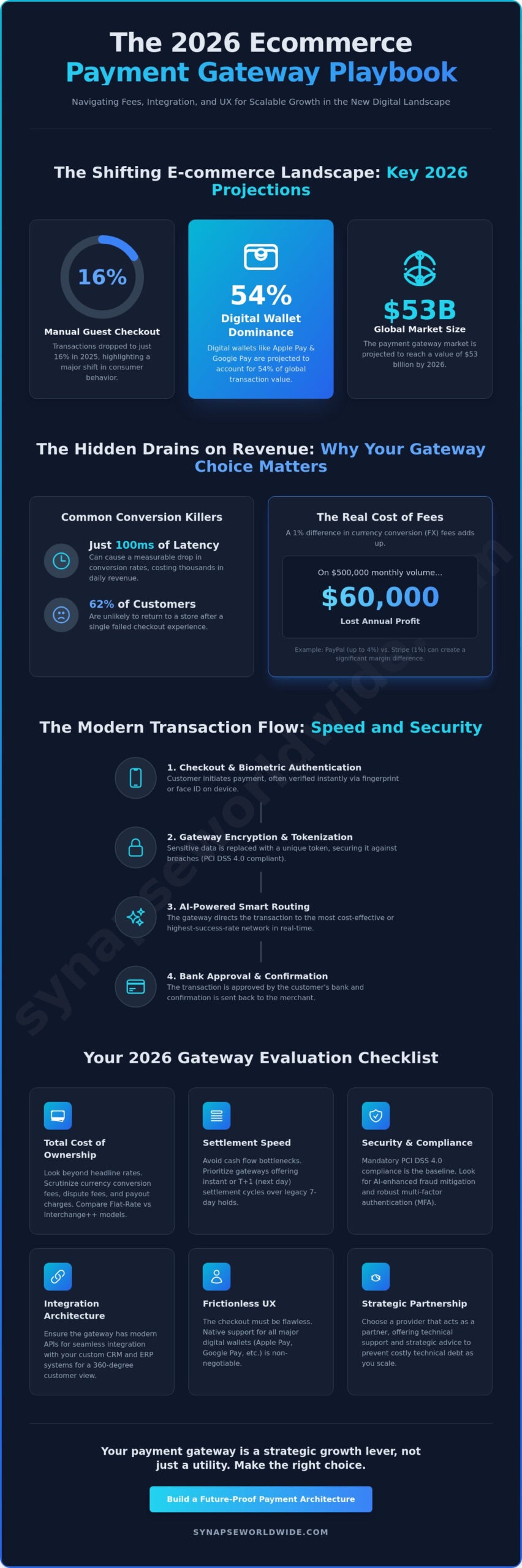
Did you know that manual guest checkout transactions dropped to just 16% of the global market in 2025? If your checkout process still relies on outdated manual entry, you’re likely seeing high cart abandonment rates that stifle your growth. Most ambitious merchants realize that ecommerce payment gateways are no longer just a utility; they’re a strategic UX asset that can either accelerate your scale or drain your margins through hidden 1% currency conversion fees and technical integration friction.
We understand the frustration of managing unpredictable costs like the 3.49% PayPal checkout rates or the complex Interchange++ models used by providers like Adyen. This comprehensive guide provides the technical clarity you need to select and integrate the ideal payment solution for your custom ERP and CRM systems. You’ll learn how to build a friction-free checkout experience that maximizes conversion, ensures robust fraud protection, and maintains full compliance with the mandatory PCI DSS 4.0 requirements. We compare the top-tier providers for 2026 to ensure your digital architecture is built for long-term, predictable success.
Key Takeaways
- Master the shift toward smart routing and AI-enhanced fraud mitigation to protect your margins in the 2026 digital landscape.
- Navigate the complexity of transaction fees and subscription models to determine the actual total cost of ownership for your scaling enterprise.
- Compare the technical capabilities of top ecommerce payment gateways to find the perfect balance between architectural stability and modern agility.
- Learn how to integrate your payment data with bespoke CRM and ERP solutions to create a unified, 360-degree view of your customer journey.
- Understand why a strategic infrastructure audit is essential to prevent the accumulation of costly technical debt during periods of rapid growth.
What is an Ecommerce Payment Gateway in the 2026 Landscape?
In its simplest form, a payment gateway is the digital infrastructure that authorizes and processes credit card or direct payments for online stores. While early iterations were merely digital pipes, ecommerce payment gateways in 2026 have evolved into sophisticated decision engines. They now utilize Smart Routing to direct transactions through the most cost-effective or highest-probability-of-success networks in real time. This shift is critical as the global payment gateway market is projected to reach $53 billion in 2026. Understanding What is a payment gateway beyond its basic function is essential for any merchant aiming for global scale. It represents the final, most critical link in your ecommerce website development strategy.
Don’t confuse a gateway with a merchant account or an aggregator. A merchant account is a specialized bank account for holding funds, while an aggregator, like Stripe or Square, combines both the gateway and the account into a single service. In a bespoke enterprise environment, choosing a standalone gateway often provides better control over transaction data and fee structures. This distinction allows you to negotiate better rates as your volume increases rather than being locked into a flat-rate model that eats into your profit margins.
How Payment Gateways Function in Milliseconds
The 2026 transaction flow is a marvel of speed and security. As digital wallets are expected to account for 54% of global e-commerce value this year, the process often begins with biometric authentication on a mobile device. Within milliseconds, the gateway encrypts data and transmits it for approval. A key component here is tokenization. Tokenisation is the process of replacing sensitive data with unique identification symbols. This ensures that even if a breach occurs, the actual card details remain inaccessible to bad actors, maintaining compliance with the latest PCI DSS 4.0 standards.
Why Gateway Choice is a Strategic Business Decision
Performance is a competitive advantage in a crowded market. Research consistently shows that 100ms of latency can lead to a measurable drop in conversion rates, potentially costing thousands in daily revenue for high-volume stores. Reliability directly influences brand trust; if a checkout fails, 62% of customers are unlikely to return to that store. Beyond the transaction, these gateways serve as the primary data source for your financial reporting and scalable ecommerce architecture. They facilitate the seamless flow of information between your storefront and back-office systems, ensuring that every cent is accounted for and every customer interaction is logged for future marketing optimization.
Key Criteria for Comparing Payment Gateways
Evaluating ecommerce payment gateways requires a clinical focus on the Total Cost of Ownership (TCO). While many providers lead with a standard 2.9% plus $0.30 transaction fee, the true cost often hides in currency conversion markups. These can range from 1% at Stripe to as much as 4% with PayPal. For a business processing $500,000 monthly, a 1% difference in FX fees represents $60,000 in lost annual profit. You must decide between flat-rate models, which offer simplicity, and Interchange++ structures like those offered by Adyen. The latter provides greater transparency for high-volume merchants by breaking down the specific costs paid to banks and card networks.
Settlement speed is another non-negotiable metric for scalable growth. In a high-velocity environment, waiting seven days for funds to clear is a bottleneck you can’t afford. Modern gateways now offer instant or T+1 settlement cycles to keep your cash flow fluid. This operational agility must be backed by a robust regulatory framework for electronic payments. Since the transition to PCI DSS 4.0 became mandatory on March 31, 2025, continuous monitoring and multi-factor authentication (MFA) have become standard requirements for any gateway you consider in 2026.
The UX Factor: Frictionless Checkouts
Frictionless checkouts are your primary weapon against revenue leakage. With digital wallets projected to capture 54% of transaction value this year, supporting Apple Pay, Google Pay, and Venmo is mandatory. You can significantly reduce cart abandonment by deploying mobile-optimized, one-click checkout flows that bypass manual entry entirely. A global perspective also requires multi-currency support. This allows customers to pay in their local currency, avoiding the high friction of forced conversion at the point of sale. Pairing an optimized gateway with a robust ecommerce conversion rate optimization strategy ensures that every improvement to your checkout flow translates directly into measurable revenue gains.
Technical Robustness and Scalability
Scalability hinges on technical robustness. Enterprise-grade gateways must maintain a 99.99% API uptime to handle seasonal traffic spikes without failure. For businesses running subscription models, the gateway’s ability to manage complex recurring billing and automated dunning is vital. If you’re planning a custom build, prioritize providers that offer a deep sandbox environment and comprehensive developer documentation. This ensures a seamless integration with your existing digital stack and prevents the accumulation of technical debt as you scale.
Strategic Comparison: Top Ecommerce Payment Gateways for 2026
Selecting the right infrastructure from the Top Ecommerce Payment Gateways requires moving past surface-level marketing claims. In 2026, the choice between ‘traditional’ and ‘modern’ providers isn’t just about stability; it’s about architectural agility. Modern platforms prioritize API-first, headless integrations that empower bespoke checkout experiences. While traditional gateways offer reliability, they often lack the “Agentic AI” capabilities now required to optimize payment routing and manage complex subscription logic automatically. Your choice must align with your long-term growth trajectory and the technical complexity of your existing digital stack.
The 2026 landscape demands that ecommerce payment gateways handle more than just credit cards. With digital wallets projected to facilitate 54% of global transaction value this year, your provider must offer native integration for Apple Pay, Google Pay, and various Buy Now, Pay Later (BNPL) services like Klarna or Afterpay. Furthermore, as the world moves toward cashless standards, the ability to process real-time payments with instant settlement has become a baseline expectation for high-growth enterprises. Providers that fail to offer these “Modern” features often create technical debt that requires expensive future migrations.
The All-Rounders: Stripe and Adyen
Stripe remains the gold standard for developer-centric, custom builds. Its “Radar” tool now utilizes advanced AI to block fraud with surgical precision, which is vital given the 1% international card fee and 1% currency conversion fee merchants must navigate. Adyen dominates the unified commerce space, making it the preferred choice for national retailers who need a single view of the customer across online and in-person channels. Adyen’s Interchange++ pricing model offers unparalleled transparency, though its typical €1,000 minimum monthly invoice makes it better suited for high-volume merchants rather than startups.
The Regional Specialists: Eway and Airwallex
Eway continues to hold a strong position for businesses that prioritize high-touch national support and localized expertise. Their value proposition centers on reliability and a deep understanding of local market nuances. In contrast, Airwallex has emerged as a strategic powerhouse for businesses managing multi-currency supply chains. By allowing merchants to collect, hold, and settle in multiple currencies without forced conversions, Airwallex directly addresses the pain of FX markups. Both providers have improved their settlement features, with many now offering same-day access to funds to support the high-velocity requirements of modern commerce. Choosing between these specialists depends on whether your growth is focused on domestic dominance or global expansion.
The Architecture of Integration: Beyond the ‘Buy’ Button
Modern commerce requires a seamless flow of data across your entire digital stack. When ecommerce payment gateways are viewed as architectural components rather than isolated tools, they facilitate a 360-degree customer view. This integration ensures that transaction data flows directly into your CRM; it allows for sophisticated segmentation based on actual spending behavior. Automating reconciliation by connecting gateway APIs to your ERP or accounting software doesn’t just save time. It eliminates the manual entry errors that plague 25% of mid-sized businesses during high-volume periods. Every transaction becomes a data point that informs your inventory management and financial forecasting.
Your technical infrastructure must also handle the failed payment loop with precision. In 2026, leading gateways utilize machine learning to execute automated retries at optimal times, such as immediately following common regional paydays. This proactive approach to revenue recovery can recover up to 10% of potentially lost sales without human intervention. To ensure your backend systems are perfectly synchronized, you need a strategy that prioritizes data integrity. You can explore how we build these high-performance environments through our specialized ecommerce development services.
The efficiency of this data exchange significantly influences your custom web design for small business. If the gateway integration is clunky, it introduces latency that negates the speed of a well-optimized front end. A strategic architect ensures that the payment layer is a performance asset, not a bottleneck that frustrates users at the most critical moment of their journey.
Headless Commerce and Payment APIs
Decoupled architectures demand a higher level of API robustness because the checkout experience is entirely custom-built. Headless commerce separates the front-end presentation layer from the back-end commerce logic. This separation allows for limitless design flexibility but requires the gateway to provide secure, low-latency endpoints that can handle complex calls without exposing sensitive data. Security in an API-first environment relies on rigorous tokenization and scoped access keys to maintain a hardened perimeter against evolving cyber threats.
Data Sovereignty and Compliance
Compliance is a moving target in 2026. With the mandatory shift to PCI DSS 4.0 on March 31, 2025, merchants must now prove continuous monitoring of their payment environments. National data privacy regulations often require that transaction logs and customer metadata be stored within specific geographic borders. Future-proofing your business means selecting a gateway that offers local data residency options. This ensures you remain compliant as global privacy laws become increasingly fragmented and stringent, protecting your brand from the heavy penalties associated with data mishandling.
Selecting Your Strategic Payment Partner
Choosing a generic solution often seems efficient during the early stages of a business. However, a ‘one-size-fits-all’ approach to ecommerce payment gateways frequently leads to substantial technical debt as your enterprise scales. When your transaction volume hits critical thresholds, the limitations of basic aggregators become apparent. You may find yourself locked into rigid fee structures or unable to implement the custom routing logic required for international expansion. A strategic audit is the first step toward reclaiming control over your margins and technical agility.
Synapse Worldwide functions as your Digital Architect in this complex landscape. We bridge the gap between sophisticated business strategy and hands-on technical execution. Our methodology involves a deep dive into your current checkout performance and conversion metrics. We don’t just look at whether a transaction succeeds; we analyze the entire path to purchase to ensure every millisecond is optimized for conversion. This proactive stance ensures that your digital presence remains in expert hands while you focus on reaching the next level of business success.
Tailored Solutions for Complex Needs
Our team evaluates your specific transaction volume and 2026 growth projections to recommend an architecture that fits your unique model. The Synapse approach treats payments as a core component of a holistic growth engine. For national e-commerce leaders, we have successfully optimized checkout flows by integrating bespoke CRM and ERP solutions. This creates a unified data environment where financial reconciliation is automated and customer insights are immediately actionable. We focus on the business outcome, ensuring your payment layer facilitates a seamless customer experience while protecting your bottom line.
Future-Proofing Your Digital Infrastructure
The payment landscape in 2026 is defined by rapid evolution. Your infrastructure must be capable of adapting to new payment methods, including biometric authentication and the emerging use of Central Bank Digital Currencies (CBDCs). Relying on a transactional vendor relationship leaves you vulnerable to sudden industry shifts. In contrast, a long-term strategic partnership provides the stability and foresight required for sustained success. We ensure your gateway is compliant with the latest PCI DSS 4.0 standards while remaining flexible enough to adopt future technologies. It’s time to transform your checkout from a cost center into a strategic asset. Consult with our strategic team to optimize your e-commerce payment architecture and ensure your digital presence is built for the next level of growth.
Secure Your Competitive Advantage for 2026
The transition to modern ecommerce payment gateways is no longer a choice; it’s a requirement for any brand targeting enterprise-level growth. By prioritizing smart routing and seamless API-driven checkouts, you eliminate the technical debt that hinders 25% of scaling businesses. Your payment infrastructure must do more than process transactions. It needs to serve as a robust data bridge between your storefront and back-office systems; this ensures every customer interaction is captured and every cent is reconciled with surgical precision.
Since 2005, Synapse Worldwide has operated as a Digital Architect for national brands, specializing in complex ERP and CRM integrations that turn standard checkouts into high-performance growth engines. We understand that your digital presence requires a sophisticated balance of security and speed. Don’t let legacy systems or hidden FX fees cap your potential. Scale your online store with our bespoke e-commerce development services. Your journey toward transformation and reaching the next level of business success starts with a single, strategic decision today.
Frequently Asked Questions
What is the most cost-effective payment gateway for a high-volume e-commerce store?
Interchange++ pricing models are typically the most cost-effective choice for merchants processing over $100,000 in monthly volume. Unlike the flat-rate 2.9% plus $0.30 fee structure used by aggregators, providers like Adyen offer transparent breakdowns of the actual costs paid to card networks. This allows high-volume stores to capture significant savings on every transaction as their scale increases.
How do payment gateways impact my website’s loading speed and SEO?
Gateway scripts can add 100ms to 300ms of latency if they aren’t implemented using modern, API-driven methods. Since Google’s Core Web Vitals prioritize Largest Contentful Paint (LCP), a slow-loading payment field can indirectly harm your search rankings. Utilizing headless architectures ensures that the payment layer doesn’t bottleneck your site’s performance or user experience metrics.
Can I use multiple payment gateways on a single custom-built website?
Yes, deploying multiple ecommerce payment gateways is a standard strategy for enterprise-level redundancy and regional optimization. Smart Routing technology allows your system to automatically toggle between providers based on the customer’s geographic location or the transaction’s success probability. This approach ensures your checkout remains operational even if one provider experiences a localized outage.
What is the difference between a payment gateway and a merchant account?
A payment gateway is the digital bridge that authorizes and encrypts the transaction data, while a merchant account is a specialized bank account where funds are held before settlement. While aggregators like Square combine these services for simplicity, enterprise builds often separate them. This separation provides greater control over your funds and allows for more competitive negotiation on processing rates.
How does AI fraud detection in 2026 differ from traditional security methods?
2026 AI fraud detection utilizes “Agentic AI” to analyze thousands of behavioral data points in real time rather than relying on static, rule-based filters. Traditional methods often block legitimate customers through “false positives,” which can cost merchants up to 3% of their total revenue. Modern AI models learn from global transaction patterns to identify genuine threats without adding friction to the customer journey.
What are the common pitfalls when integrating a gateway with a custom ERP system?
The most common pitfall is data synchronization lag, which accounts for 35% of integration failures in bespoke environments. If the payment data isn’t mapped correctly to your ERP endpoints, it leads to inventory discrepancies and manual reconciliation errors. Successful integration requires a robust API strategy that ensures a seamless, real-time flow of financial data between your storefront and back-office systems.
How do I ensure my payment gateway is compliant with Australian data privacy laws?
You must verify that your gateway provider complies with the Australian Privacy Principles (APPs) regarding the storage and disclosure of personal information. Since the mandatory shift to PCI DSS 4.0 on March 31, 2025, continuous monitoring of data residency has become a legal baseline. Choosing a partner with local data centers ensures that your transaction logs and metadata remain within the required geographic borders.
Is it worth switching gateways to save 0.5% on transaction fees?
For a business processing $2 million annually, a 0.5% reduction in fees translates to $10,000 in recovered profit every year. You should weigh this saving against the technical implementation costs, which typically involve 40 to 80 development hours for a custom integration. If your growth projections show sustained volume increases, the long-term ROI of switching to a more efficient provider is almost always positive.

