
Tag Archives: PCI Compliance


Ecommerce Payment Gateways: A Strategic Comparison for Scalable Growth in 2026

Ecommerce Payment Gateways: A Strategic Comparison for Scalable Growth in 2026

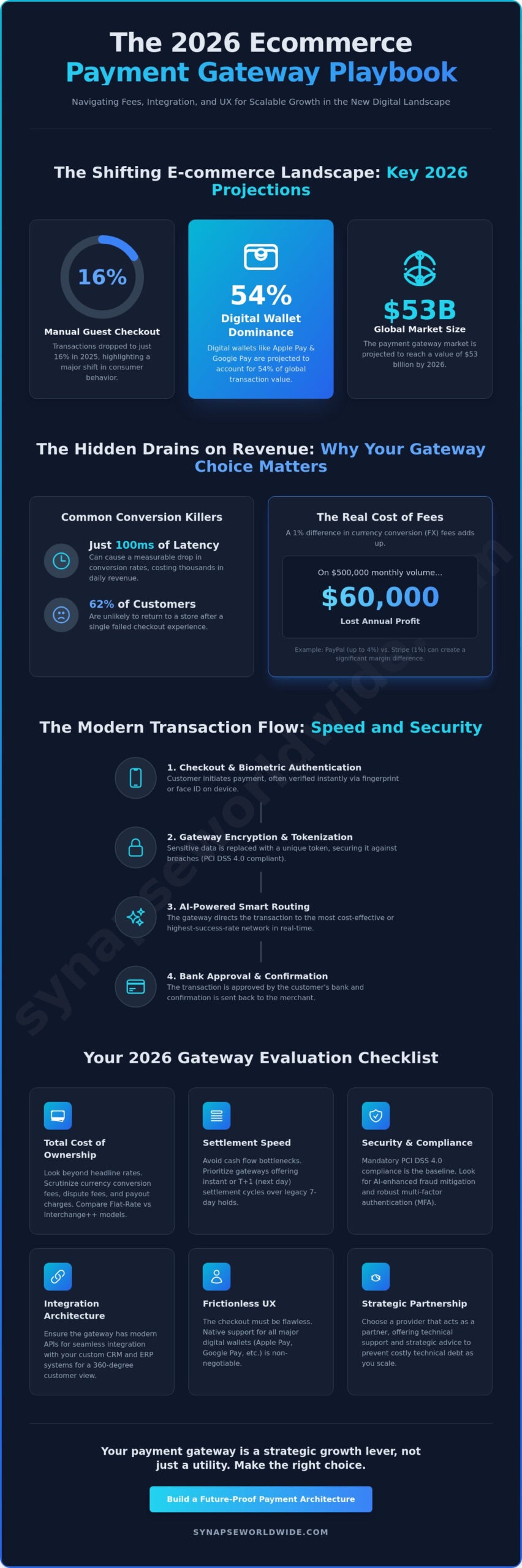
Did you know that manual guest checkout transactions dropped to just 16% of the global market in 2025? If your checkout process still relies on outdated manual entry, you’re likely seeing high cart abandonment rates that stifle your growth. Most ambitious merchants realize that ecommerce payment gateways are no longer just a utility; they’re a strategic UX asset that can either accelerate your scale or drain your margins through hidden 1% currency conversion fees and technical integration friction.

We understand the frustration of managing unpredictable costs like the 3.49% PayPal checkout rates or the complex Interchange++ models used by providers like Adyen. This comprehensive guide provides the technical clarity you need to select and integrate the ideal payment solution for your custom ERP and CRM systems. You’ll learn how to build a friction-free checkout experience that maximizes conversion, ensures robust fraud protection, and maintains full compliance with the mandatory PCI DSS 4.0 requirements. We compare the top-tier providers for 2026 to ensure your digital architecture is built for long-term, predictable success.

Key Takeaways

  • Master the shift toward smart routing and AI-enhanced fraud mitigation to protect your margins in the 2026 digital landscape.
  • Navigate the complexity of transaction fees and subscription models to determine the actual total cost of ownership for your scaling enterprise.
  • Compare the technical capabilities of top ecommerce payment gateways to find the perfect balance between architectural stability and modern agility.
  • Learn how to integrate your payment data with bespoke CRM and ERP solutions to create a unified, 360-degree view of your customer journey.
  • Understand why a strategic infrastructure audit is essential to prevent the accumulation of costly technical debt during periods of rapid growth.

What is an Ecommerce Payment Gateway in the 2026 Landscape?

In its simplest form, a payment gateway is the digital infrastructure that authorizes and processes credit card or direct payments for online stores. While early iterations were merely digital pipes, ecommerce payment gateways in 2026 have evolved into sophisticated decision engines. They now utilize Smart Routing to direct transactions through the most cost-effective or highest-probability-of-success networks in real time. This shift is critical as the global payment gateway market is projected to reach $53 billion in 2026. Understanding What is a payment gateway beyond its basic function is essential for any merchant aiming for global scale. It represents the final, most critical link in your ecommerce website development strategy.

Don’t confuse a gateway with a merchant account or an aggregator. A merchant account is a specialized bank account for holding funds, while an aggregator, like Stripe or Square, combines both the gateway and the account into a single service. In a bespoke enterprise environment, choosing a standalone gateway often provides better control over transaction data and fee structures. This distinction allows you to negotiate better rates as your volume increases rather than being locked into a flat-rate model that eats into your profit margins.

How Payment Gateways Function in Milliseconds

The 2026 transaction flow is a marvel of speed and security. As digital wallets are expected to account for 54% of global e-commerce value this year, the process often begins with biometric authentication on a mobile device. Within milliseconds, the gateway encrypts data and transmits it for approval. A key component here is tokenization. Tokenisation is the process of replacing sensitive data with unique identification symbols. This ensures that even if a breach occurs, the actual card details remain inaccessible to bad actors, maintaining compliance with the latest PCI DSS 4.0 standards.

Why Gateway Choice is a Strategic Business Decision

Performance is a competitive advantage in a crowded market. Research consistently shows that 100ms of latency can lead to a measurable drop in conversion rates, potentially costing thousands in daily revenue for high-volume stores. Reliability directly influences brand trust; if a checkout fails, 62% of customers are unlikely to return to that store. Beyond the transaction, these gateways serve as the primary data source for your financial reporting and scalable ecommerce architecture. They facilitate the seamless flow of information between your storefront and back-office systems, ensuring that every cent is accounted for and every customer interaction is logged for future marketing optimization.

Key Criteria for Comparing Payment Gateways

Evaluating ecommerce payment gateways requires a clinical focus on the Total Cost of Ownership (TCO). While many providers lead with a standard 2.9% plus $0.30 transaction fee, the true cost often hides in currency conversion markups. These can range from 1% at Stripe to as much as 4% with PayPal. For a business processing $500,000 monthly, a 1% difference in FX fees represents $60,000 in lost annual profit. You must decide between flat-rate models, which offer simplicity, and Interchange++ structures like those offered by Adyen. The latter provides greater transparency for high-volume merchants by breaking down the specific costs paid to banks and card networks.

Settlement speed is another non-negotiable metric for scalable growth. In a high-velocity environment, waiting seven days for funds to clear is a bottleneck you can’t afford. Modern gateways now offer instant or T+1 settlement cycles to keep your cash flow fluid. This operational agility must be backed by a robust regulatory framework for electronic payments. Since the transition to PCI DSS 4.0 became mandatory on March 31, 2025, continuous monitoring and multi-factor authentication (MFA) have become standard requirements for any gateway you consider in 2026.

The UX Factor: Frictionless Checkouts

Frictionless checkouts are your primary weapon against revenue leakage. With digital wallets projected to capture 54% of transaction value this year, supporting Apple Pay, Google Pay, and Venmo is mandatory. You can significantly reduce cart abandonment by deploying mobile-optimized, one-click checkout flows that bypass manual entry entirely. A global perspective also requires multi-currency support. This allows customers to pay in their local currency, avoiding the high friction of forced conversion at the point of sale. Pairing an optimized gateway with a robust ecommerce conversion rate optimization strategy ensures that every improvement to your checkout flow translates directly into measurable revenue gains.

Technical Robustness and Scalability

Scalability hinges on technical robustness. Enterprise-grade gateways must maintain a 99.99% API uptime to handle seasonal traffic spikes without failure. For businesses running subscription models, the gateway’s ability to manage complex recurring billing and automated dunning is vital. If you’re planning a custom build, prioritize providers that offer a deep sandbox environment and comprehensive developer documentation. This ensures a seamless integration with your existing digital stack and prevents the accumulation of technical debt as you scale.
Ecommerce Payment Gateways: A Strategic Comparison for Scalable Growth in 2026

Strategic Comparison: Top Ecommerce Payment Gateways for 2026

Selecting the right infrastructure from the Top Ecommerce Payment Gateways requires moving past surface-level marketing claims. In 2026, the choice between ‘traditional’ and ‘modern’ providers isn’t just about stability; it’s about architectural agility. Modern platforms prioritize API-first, headless integrations that empower bespoke checkout experiences. While traditional gateways offer reliability, they often lack the “Agentic AI” capabilities now required to optimize payment routing and manage complex subscription logic automatically. Your choice must align with your long-term growth trajectory and the technical complexity of your existing digital stack.

The 2026 landscape demands that ecommerce payment gateways handle more than just credit cards. With digital wallets projected to facilitate 54% of global transaction value this year, your provider must offer native integration for Apple Pay, Google Pay, and various Buy Now, Pay Later (BNPL) services like Klarna or Afterpay. Furthermore, as the world moves toward cashless standards, the ability to process real-time payments with instant settlement has become a baseline expectation for high-growth enterprises. Providers that fail to offer these “Modern” features often create technical debt that requires expensive future migrations.

The All-Rounders: Stripe and Adyen

Stripe remains the gold standard for developer-centric, custom builds. Its “Radar” tool now utilizes advanced AI to block fraud with surgical precision, which is vital given the 1% international card fee and 1% currency conversion fee merchants must navigate. Adyen dominates the unified commerce space, making it the preferred choice for national retailers who need a single view of the customer across online and in-person channels. Adyen’s Interchange++ pricing model offers unparalleled transparency, though its typical €1,000 minimum monthly invoice makes it better suited for high-volume merchants rather than startups.

The Regional Specialists: Eway and Airwallex

Eway continues to hold a strong position for businesses that prioritize high-touch national support and localized expertise. Their value proposition centers on reliability and a deep understanding of local market nuances. In contrast, Airwallex has emerged as a strategic powerhouse for businesses managing multi-currency supply chains. By allowing merchants to collect, hold, and settle in multiple currencies without forced conversions, Airwallex directly addresses the pain of FX markups. Both providers have improved their settlement features, with many now offering same-day access to funds to support the high-velocity requirements of modern commerce. Choosing between these specialists depends on whether your growth is focused on domestic dominance or global expansion.

The Architecture of Integration: Beyond the ‘Buy’ Button

Modern commerce requires a seamless flow of data across your entire digital stack. When ecommerce payment gateways are viewed as architectural components rather than isolated tools, they facilitate a 360-degree customer view. This integration ensures that transaction data flows directly into your CRM; it allows for sophisticated segmentation based on actual spending behavior. Automating reconciliation by connecting gateway APIs to your ERP or accounting software doesn’t just save time. It eliminates the manual entry errors that plague 25% of mid-sized businesses during high-volume periods. Every transaction becomes a data point that informs your inventory management and financial forecasting.

Your technical infrastructure must also handle the failed payment loop with precision. In 2026, leading gateways utilize machine learning to execute automated retries at optimal times, such as immediately following common regional paydays. This proactive approach to revenue recovery can recover up to 10% of potentially lost sales without human intervention. To ensure your backend systems are perfectly synchronized, you need a strategy that prioritizes data integrity. You can explore how we build these high-performance environments through our specialized ecommerce development services.

The efficiency of this data exchange significantly influences your custom web design for small business. If the gateway integration is clunky, it introduces latency that negates the speed of a well-optimized front end. A strategic architect ensures that the payment layer is a performance asset, not a bottleneck that frustrates users at the most critical moment of their journey.

Headless Commerce and Payment APIs

Decoupled architectures demand a higher level of API robustness because the checkout experience is entirely custom-built. Headless commerce separates the front-end presentation layer from the back-end commerce logic. This separation allows for limitless design flexibility but requires the gateway to provide secure, low-latency endpoints that can handle complex calls without exposing sensitive data. Security in an API-first environment relies on rigorous tokenization and scoped access keys to maintain a hardened perimeter against evolving cyber threats.

Data Sovereignty and Compliance

Compliance is a moving target in 2026. With the mandatory shift to PCI DSS 4.0 on March 31, 2025, merchants must now prove continuous monitoring of their payment environments. National data privacy regulations often require that transaction logs and customer metadata be stored within specific geographic borders. Future-proofing your business means selecting a gateway that offers local data residency options. This ensures you remain compliant as global privacy laws become increasingly fragmented and stringent, protecting your brand from the heavy penalties associated with data mishandling.

Selecting Your Strategic Payment Partner

Choosing a generic solution often seems efficient during the early stages of a business. However, a ‘one-size-fits-all’ approach to ecommerce payment gateways frequently leads to substantial technical debt as your enterprise scales. When your transaction volume hits critical thresholds, the limitations of basic aggregators become apparent. You may find yourself locked into rigid fee structures or unable to implement the custom routing logic required for international expansion. A strategic audit is the first step toward reclaiming control over your margins and technical agility.

Synapse Worldwide functions as your Digital Architect in this complex landscape. We bridge the gap between sophisticated business strategy and hands-on technical execution. Our methodology involves a deep dive into your current checkout performance and conversion metrics. We don’t just look at whether a transaction succeeds; we analyze the entire path to purchase to ensure every millisecond is optimized for conversion. This proactive stance ensures that your digital presence remains in expert hands while you focus on reaching the next level of business success.

Tailored Solutions for Complex Needs

Our team evaluates your specific transaction volume and 2026 growth projections to recommend an architecture that fits your unique model. The Synapse approach treats payments as a core component of a holistic growth engine. For national e-commerce leaders, we have successfully optimized checkout flows by integrating bespoke CRM and ERP solutions. This creates a unified data environment where financial reconciliation is automated and customer insights are immediately actionable. We focus on the business outcome, ensuring your payment layer facilitates a seamless customer experience while protecting your bottom line.

Future-Proofing Your Digital Infrastructure

The payment landscape in 2026 is defined by rapid evolution. Your infrastructure must be capable of adapting to new payment methods, including biometric authentication and the emerging use of Central Bank Digital Currencies (CBDCs). Relying on a transactional vendor relationship leaves you vulnerable to sudden industry shifts. In contrast, a long-term strategic partnership provides the stability and foresight required for sustained success. We ensure your gateway is compliant with the latest PCI DSS 4.0 standards while remaining flexible enough to adopt future technologies. It’s time to transform your checkout from a cost center into a strategic asset. Consult with our strategic team to optimize your e-commerce payment architecture and ensure your digital presence is built for the next level of growth.

Secure Your Competitive Advantage for 2026

The transition to modern ecommerce payment gateways is no longer a choice; it’s a requirement for any brand targeting enterprise-level growth. By prioritizing smart routing and seamless API-driven checkouts, you eliminate the technical debt that hinders 25% of scaling businesses. Your payment infrastructure must do more than process transactions. It needs to serve as a robust data bridge between your storefront and back-office systems; this ensures every customer interaction is captured and every cent is reconciled with surgical precision.

Since 2005, Synapse Worldwide has operated as a Digital Architect for national brands, specializing in complex ERP and CRM integrations that turn standard checkouts into high-performance growth engines. We understand that your digital presence requires a sophisticated balance of security and speed. Don’t let legacy systems or hidden FX fees cap your potential. Scale your online store with our bespoke e-commerce development services. Your journey toward transformation and reaching the next level of business success starts with a single, strategic decision today.

Frequently Asked Questions

What is the most cost-effective payment gateway for a high-volume e-commerce store?

Interchange++ pricing models are typically the most cost-effective choice for merchants processing over $100,000 in monthly volume. Unlike the flat-rate 2.9% plus $0.30 fee structure used by aggregators, providers like Adyen offer transparent breakdowns of the actual costs paid to card networks. This allows high-volume stores to capture significant savings on every transaction as their scale increases.

How do payment gateways impact my website’s loading speed and SEO?

Gateway scripts can add 100ms to 300ms of latency if they aren’t implemented using modern, API-driven methods. Since Google’s Core Web Vitals prioritize Largest Contentful Paint (LCP), a slow-loading payment field can indirectly harm your search rankings. Utilizing headless architectures ensures that the payment layer doesn’t bottleneck your site’s performance or user experience metrics.

Can I use multiple payment gateways on a single custom-built website?

Yes, deploying multiple ecommerce payment gateways is a standard strategy for enterprise-level redundancy and regional optimization. Smart Routing technology allows your system to automatically toggle between providers based on the customer’s geographic location or the transaction’s success probability. This approach ensures your checkout remains operational even if one provider experiences a localized outage.

What is the difference between a payment gateway and a merchant account?

A payment gateway is the digital bridge that authorizes and encrypts the transaction data, while a merchant account is a specialized bank account where funds are held before settlement. While aggregators like Square combine these services for simplicity, enterprise builds often separate them. This separation provides greater control over your funds and allows for more competitive negotiation on processing rates.

How does AI fraud detection in 2026 differ from traditional security methods?

2026 AI fraud detection utilizes “Agentic AI” to analyze thousands of behavioral data points in real time rather than relying on static, rule-based filters. Traditional methods often block legitimate customers through “false positives,” which can cost merchants up to 3% of their total revenue. Modern AI models learn from global transaction patterns to identify genuine threats without adding friction to the customer journey.

What are the common pitfalls when integrating a gateway with a custom ERP system?

The most common pitfall is data synchronization lag, which accounts for 35% of integration failures in bespoke environments. If the payment data isn’t mapped correctly to your ERP endpoints, it leads to inventory discrepancies and manual reconciliation errors. Successful integration requires a robust API strategy that ensures a seamless, real-time flow of financial data between your storefront and back-office systems.

How do I ensure my payment gateway is compliant with Australian data privacy laws?

You must verify that your gateway provider complies with the Australian Privacy Principles (APPs) regarding the storage and disclosure of personal information. Since the mandatory shift to PCI DSS 4.0 on March 31, 2025, continuous monitoring of data residency has become a legal baseline. Choosing a partner with local data centers ensures that your transaction logs and metadata remain within the required geographic borders.

Is it worth switching gateways to save 0.5% on transaction fees?

For a business processing $2 million annually, a 0.5% reduction in fees translates to $10,000 in recovered profit every year. You should weigh this saving against the technical implementation costs, which typically involve 40 to 80 development hours for a custom integration. If your growth projections show sustained volume increases, the long-term ROI of switching to a more efficient provider is almost always positive.

 

Scalable Ecommerce Architecture: The 2026 Strategic Framework for Enterprise Growth

Scalable Ecommerce Architecture: The 2026 Strategic Framework for Enterprise Growth

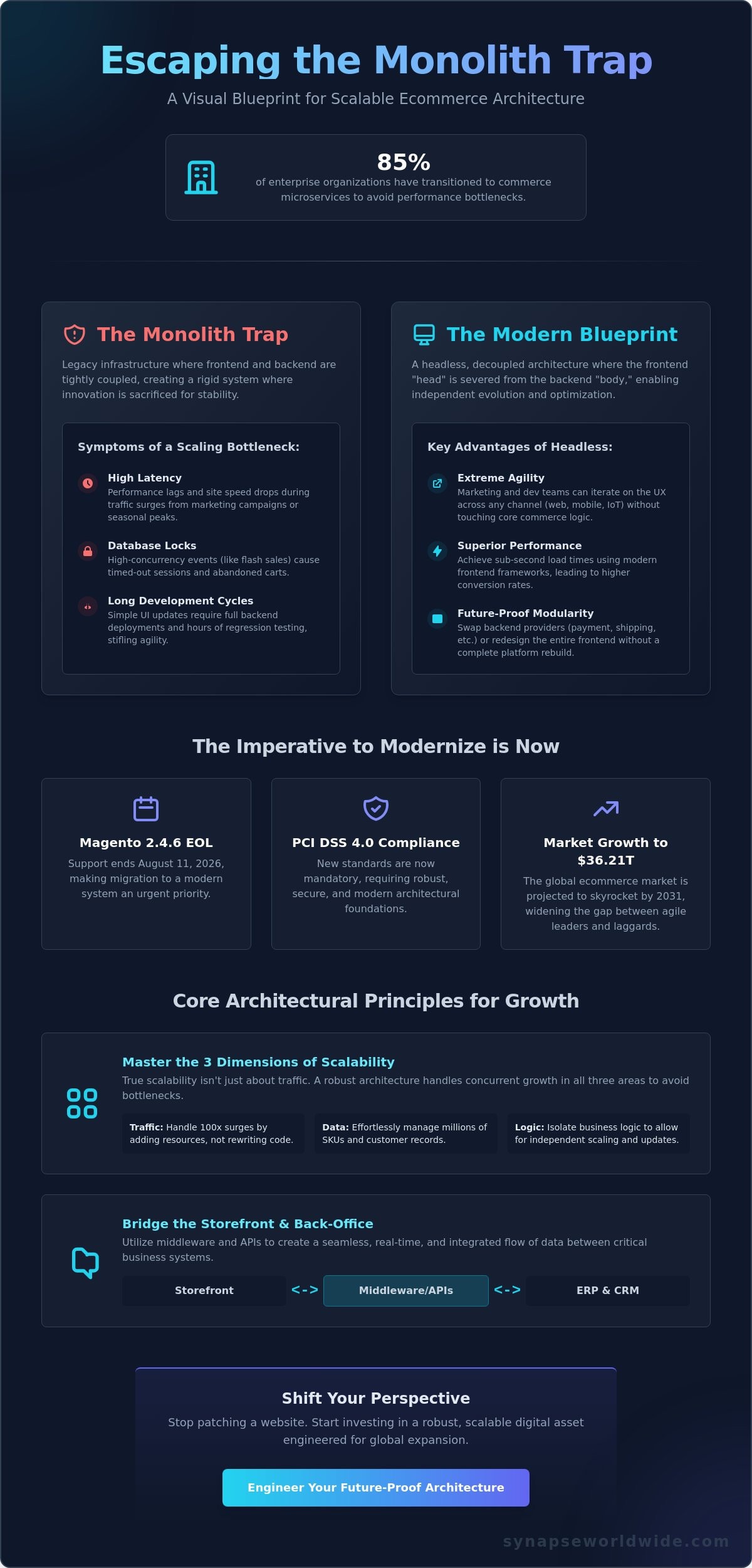
85% of enterprise organizations have now transitioned to commerce microservices to avoid the performance bottlenecks inherent in monolithic platforms. As the global ecommerce market climbs toward a projected $36.21 trillion by 2031, the gap between agile leaders and legacy-locked laggards is widening. You’ve likely experienced the frustration of high latency during peak traffic or the friction caused by data silos between your storefront and back-office ERP systems. These aren’t just technical glitches; they’re structural failures that limit your growth potential.

Building a scalable ecommerce architecture requires a shift from reactive patching to proactive, bespoke engineering. With support for Magento 2.4.6 ending on August 11, 2026, the mandate for modern, decoupled systems has never been more urgent. We’ll show you how to master the architectural foundations needed to scale from thousands to millions of orders without accumulating technical debt. This strategic framework covers the move toward headless environments and the critical integration of real-time data processing. You’ll learn how to achieve sub-second load times and a future-proof digital landscape that remains compliant with the now-mandatory PCI DSS 4.0 standards.

Key Takeaways

  • Escape the “Monolith Trap” by adopting a scalable ecommerce architecture designed to handle 100x traffic surges through resource allocation instead of costly code rewrites.
  • Master the headless commerce blueprint to separate your presentation layer from the commerce engine, ensuring your business remains agile in a fast-moving market.
  • Resolve performance lag by optimizing the three dimensions of scalability, allowing you to manage millions of SKUs and customer records with ease.
  • Bridge the gap between your storefront and back-office by utilizing middleware to create a seamless, integrated flow of data between ERP and CRM systems.
  • Shift your perspective from building a website to investing in a robust digital asset that follows a phased, risk-managed migration roadmap.

Beyond the Monolith: Why Legacy Infrastructure Hits a Growth Wall

True scalable ecommerce architecture is defined by its ability to handle a 100x increase in transaction volume by simply adding server resources rather than undergoing a total code rewrite. For many enterprise brands, the primary barrier to this level of performance is the “Monolith Trap.” In a traditional monolithic setup, the frontend user interface and the backend business logic are inextricably linked. This means a single change to the checkout flow might inadvertently break the product catalog or the shipping calculator. This interdependence creates a rigid environment where innovation is sacrificed for basic stability.

Technical debt in these legacy systems acts as a literal ceiling on your revenue growth. Every patchwork fix and custom workaround adds weight to the system, eventually making it too heavy to move. By 2026, architectural agility has emerged as a critical competitive advantage. It allows a brand to pivot its strategy or launch a new sales channel in days rather than months. This agility is often achieved through Headless Commerce Explained, a model where the presentation layer is decoupled from the core commerce engine. When these components are separated, you gain the freedom to optimize each one independently to meet the demands of a global market.

The Symptoms of a Scaling Bottleneck

Growth often reveals the hidden cracks in a rigid system. You’ll likely notice latency spikes during major marketing campaigns or seasonal peaks when traffic surges unexpectedly. These aren’t just minor delays; they’re signs that your infrastructure is gasping for air. Database locks are another common red flag. During high-concurrency checkout events, a legacy database might struggle to process simultaneous writes, leading to timed-out sessions and abandoned carts. Perhaps the most frustrating symptom is the long development cycle. When a simple UI update requires a full backend deployment and hours of regression testing, your technical debt has officially become a bottleneck.

The Financial Risk of ‘Just Enough’ Infrastructure

Operating on “just enough” infrastructure is a dangerous gamble for an ambitious enterprise. While patchwork solutions might save costs in the short term, they become expensive liabilities once you hit the 10,000-order mark. At this volume, the cost of a single hour of downtime or even a 2-second increase in load time can equate to thousands in lost revenue. It also erodes customer trust, which is far harder to rebuild than a server. Investing in professional ecommerce website development is a strategic move to mitigate these long-term risks. A robust scalable ecommerce architecture ensures your platform remains a high-performance asset that supports, rather than hinders, your global expansion goals.

Decoupled and Headless: The Modern Blueprint for Scalable Ecommerce

Transitioning to a scalable ecommerce architecture requires moving beyond the limitations of “all-in-one” platforms that bundle the user interface with the commerce engine. Headless commerce has become the gold standard for enterprise growth in 2026, effectively severing the frontend “head” from the backend “body.” This separation allows your marketing team to iterate on the user experience across mobile, web, and IoT devices without touching the core transactional logic. APIs serve as the essential glue in this digital landscape, facilitating seamless communication between disparate systems. Understanding the nuances of various Ecommerce Architecture Types allows business leaders to choose a path that supports long-term agility rather than short-term convenience.

The “Separation of Concerns” philosophy provides a distinct advantage for both developers and business units. Developers can use modern frameworks like Next.js or Remix to build custom-built frontends that achieve sub-second load times, while business units can swap out backend providers without a total site redesign. This modularity ensures that your platform isn’t just a website, but a flexible ecosystem. Speed is currency; 65% of ecommerce brands report higher conversion rates after implementing these bespoke personalization and performance strategies. By removing the overhead of traditional themes, you create a lean, high-performance environment that scales as fast as your ambitions.

Microservices: Granular Scalability for Complex Operations

85% of enterprise businesses now utilize commerce microservices to manage complex operations. Instead of a single application, your store is broken into independent services like Inventory, Payment, and User Profiles. This allows for bespoke scaling; if your inventory lookups spike during a flash sale, you can scale that specific service without paying for extra capacity across the entire site. In 2026, containerization via Docker and Kubernetes is essential for managing these services, providing a robust foundation that ensures high availability even during extreme traffic surges.

Serverless and Cloud-Native Foundations

Modern architectures increasingly rely on serverless functions for event-driven tasks such as order processing or real-time tax calculations. This cloud-native approach, combined with Edge Computing and CDNs, pushes data closer to the user to eliminate latency. It’s vital that your custom software development remains platform-agnostic to avoid vendor lock-in. Utilizing these distributed systems ensures your brand can handle millions of orders while maintaining a global presence. If you’re ready to transition away from restrictive legacy systems, a strategic consultation with a digital architect can help map out your migration path.

Scalable Ecommerce Architecture: The 2026 Strategic Framework for Enterprise Growth

The Three Dimensions of Scalability: Traffic, Data, and Logic

A truly scalable ecommerce architecture is a multi-dimensional asset. While many discussions focus solely on traffic, enterprise resilience requires a simultaneous focus on data and logic. Horizontal scaling addresses traffic by distributing load across multiple server instances. This allows your platform to handle 10x more visitors during peak events without manual intervention. However, traffic capacity becomes a secondary concern if your database cannot manage millions of SKUs or complex customer records without query lag. This is where data scalability becomes the critical second dimension.

Functional logic is the third, and often most overlooked, dimension. It represents the ability to add new sales channels, business models, or geographic regions without introducing bugs into the core code. In a robust system, launching a B2B portal or an international storefront should be a matter of configuration rather than a months-long engineering project. A balanced architecture addresses all three areas to ensure that growth in one department never creates a bottleneck in another. By treating these as distinct engineering challenges, you build a platform that is truly robust and ready for global expansion.

Data Integrity in Distributed Systems

Moving to a distributed model introduces the challenge of eventual consistency. In high-speed commerce, ensuring that inventory levels are accurate across all services is paramount. We utilize tools like Redis for high-speed caching and Kafka for real-time data synchronization. This ensures that a product purchased on the mobile app is immediately reflected as unavailable on the web storefront. Strategic denormalization of data also plays a role. By pre-calculating complex data relationships, we optimize search and filtering performance to maintain sub-second response times even as your product catalog grows into the millions.

Channel Scalability: From Web to Mobile and Beyond

Mobile commerce is projected to reach $2.4 trillion in 2026, making channel scalability a non-negotiable requirement. A scalable core supports mobile app development through unified APIs that serve as a single source of truth. Whether a customer interacts with your brand via a smartphone, a voice assistant, or an in-store kiosk, the data remains consistent. This API-first approach ensures your architecture is ready for future interfaces such as AR or IoT devices. By decoupling the frontend from the data source, you ensure that adding a new channel doesn’t require a total rebuild of your existing systems.

Strategic Integration: Connecting Architecture to CRM and ERP

A high-performance storefront is only half the equation for enterprise success. If your back-office systems can’t process orders as fast as your scalable ecommerce architecture can take them, you’ve simply built a more efficient way to create a backlog. Strategic integration ensures that data flows without friction between your digital storefront and your core business systems. Middleware acts as the orchestrator here; it translates complex data packets between your commerce engine and your ERP, ensuring every transaction is captured and processed in real-time. This level of business process automation is the ultimate goal of a mature architecture. It reduces manual overhead and allows your team to focus on high-level strategy rather than manual data entry.

Efficiency in 2026 is measured by the speed of the entire order-to-fulfillment lifecycle. When your systems are siloed, you introduce human error and delay. An integrated landscape allows for automated inventory updates, instant tax calculations, and seamless shipping label generation. This isn’t just about technical connectivity. It’s about building a robust foundation that supports rapid scaling without adding headcount. By treating integration as a core architectural pillar, you ensure that your platform remains a strategic asset that drives growth rather than a technical burden that requires constant maintenance.

CRM Integration for Data-Driven Growth

Personalization is no longer a luxury; 65% of ecommerce brands have reported higher conversion rates after implementing real-time personalization strategies. Achieving this requires your architecture to sync customer behavior directly with your CRM profiles. This allows for dynamic pricing, tailored product recommendations, and sophisticated loyalty programs that respond to user actions instantly. However, as of March 31, 2025, the PCI DSS 4.0 standard has been fully in effect. Your integrated landscape must maintain strict authentication and ongoing monitoring for all data access. Protecting customer privacy while delivering a bespoke experience is a delicate balance that requires disciplined engineering.

ERP and Inventory Orchestration

Overselling is a common symptom of a fragmented system. When your storefront and ERP aren’t in sync, you risk selling inventory that doesn’t exist, which leads to canceled orders and diminished trust. A robust scalable ecommerce architecture uses real-time stock synchronization to ensure that every SKU count is accurate across all channels. For B2B enterprises, this integration also handles complex pricing logic and custom workflows that generic plugins often fail to support. Bespoke integrations offer the reliability that enterprise-grade operations demand, ensuring your system remains stable even during high-volume events. If your current backend is struggling to keep pace with your growth, our team can help you design a bespoke integration strategy that bridges the technical gap.

Engineering the Future: Partnering with a Digital Architect

Achieving a truly scalable ecommerce architecture is not a destination; it’s a continuous engineering discipline. Enterprise leaders often fall into the trap of “buying a website” as if it were a static piece of equipment. In reality, a high-performance platform is a strategic digital asset that requires a visionary architect to design and a disciplined partner to maintain. This shift in perspective is what separates market leaders from those struggling with legacy constraints. By partnering with a Digital Architect, you ensure that every technical decision aligns with your overarching business objectives, from sub-second load times to seamless ERP integrations.

A successful transition requires a phased roadmap. We prioritize migration without disruption, ensuring your current revenue streams remain protected while we build the foundation for your future growth. High-growth brands cannot afford to treat their infrastructure as a “set and forget” solution. Ongoing technical consulting and proactive performance monitoring are essential to stay ahead of traffic surges and evolving security requirements. Our commitment at Synapse Worldwide is to deliver bespoke, integrated, and scalable solutions that transform your digital presence into a robust engine for global expansion.

The Discovery and Strategy Phase

Every project begins with a deep dive into your existing environment. We audit your current technical debt to identify the immediate bottlenecks that are throttling your conversion rates. This phase isn’t just about code; it’s about defining your three-year growth trajectory. We analyze your operational goals to inform architectural choices, ensuring the system we build today can handle the volume you expect tomorrow. This results in a bespoke blueprint that serves as a technical North Star, aligning your technology stack with your core business KPIs.

Long-Term Partnership and Optimization

The digital landscape moves fast. Continuous performance monitoring is the only way to ensure your scalable environment remains optimized as you add new features and channels. Annual maintenance and dedicated hosting subscriptions are not just line items; they’re critical investments in your security and uptime. As requirements like the PCI DSS 4.0 standard evolve, having a partner who manages the intricate technical details allows you to focus on your brand’s vision. If you’re ready to move beyond the limitations of your current platform, it’s time to Consult with the Digital Architects at Synapse Worldwide and build the future of your enterprise.

Mastering the Digital Landscape for Perpetual Growth

The shift toward a scalable ecommerce architecture is no longer a luxury for enterprise brands; it’s a fundamental requirement for survival in a $36.21 trillion global market. By decoupling your frontend from the commerce engine and prioritizing API-first integrations, you eliminate the technical debt that acts as a ceiling on your revenue. True resilience comes from balancing traffic capacity with data integrity and seamless back-office orchestration. These structural foundations allow your business to pivot quickly as consumer behaviors and security standards like PCI DSS 4.0 continue to evolve.

Since 2005, Synapse Worldwide has functioned as a Digital Architect for high-growth enterprises. We specialize in bespoke enterprise-grade solutions that bridge the gap between complex storefronts and critical ERP or CRM systems. Our approach ensures that your platform remains a robust, integrated asset capable of handling millions of orders with sub-second performance. The transition to a modern architecture is a strategic investment in your brand’s future. Scale your vision with a bespoke ecommerce architecture from Synapse Worldwide. Your next level of business success is within reach when your infrastructure is built to support your ambition.

Frequently Asked Questions

What is the difference between monolithic and headless ecommerce architecture?

Monolithic architecture binds the frontend user experience and backend business logic into a single, unified codebase. While this is simpler for initial setups, it creates a “Monolith Trap” where changes to one area can destabilize the entire system. Headless architecture decouples these layers, allowing them to communicate via APIs. This separation enables your team to deploy rapid frontend updates across various devices without risking the integrity of your core transactional engine.

When should a business move from a SaaS platform to a custom scalable architecture?

The transition typically becomes necessary when your monthly revenue exceeds the $800,000 threshold, where SaaS pricing models often shift to a percentage of revenue. You should also consider a move if you require deep, bespoke integrations with ERP or CRM systems that standard plugins cannot support. If your current platform limits your ability to launch new features or handle peak traffic without latency, it’s time to invest in a more robust, independent framework.

How does a scalable architecture improve ecommerce conversion rates?

Performance is the primary driver of conversion in a digital landscape. A well-engineered system ensures sub-second load times and zero downtime during high-traffic events like Black Friday. By eliminating database locks and checkout friction, you reduce cart abandonment and reclaim a significant share of recoverable revenue. 65% of ecommerce brands report higher conversion rates after implementing the personalization strategies that a decoupled, agile architecture makes possible.

Can I scale my existing website without a complete rebuild?

Yes, you can achieve a scalable ecommerce architecture through a phased migration strategy. Rather than a “big bang” rebuild, we often recommend decoupling specific high-load components or moving toward a headless frontend while keeping your existing backend logic intact. This approach allows you to address immediate bottlenecks and improve performance without the operational risk of a total system overhaul.

What are the common pitfalls in scaling an ecommerce database?

The most frequent pitfall is relying on a strictly normalized database as your SKU count grows into the millions. This often leads to query lag and database locks during high-concurrency events. Failing to implement real-time caching via tools like Redis or neglecting the “Eventual Consistency” model in distributed systems can also create data silos. A strategic architect avoids these issues by using denormalization to optimize search and filtering performance.

How does API-first design support omnichannel growth?

API-first design establishes a single source of truth for your inventory, pricing, and customer data across all touchpoints. This ensures that a customer sees the same information on your mobile app, web store, or in-store kiosk. With mobile commerce projected to reach $2.4 trillion in 2026, having a unified API layer allows you to launch new channels quickly without duplicating your backend efforts or risking data discrepancies.

Is microservices architecture too complex for a mid-sized online store?

Complexity should always be balanced against your growth trajectory. While 85% of enterprise businesses use microservices, mid-sized stores should focus on “modular” growth rather than full-scale microservices from day one. Implementing a scalable ecommerce architecture doesn’t mean over-engineering; it means building with the flexibility to spin off services like ecommerce payment gateways or inventory only when your transaction volume demands that level of granular control.


What is Stripe? The Strategic Guide to Modern Financial Infrastructure

What is Stripe? The Strategic Guide to Modern Financial Infrastructure

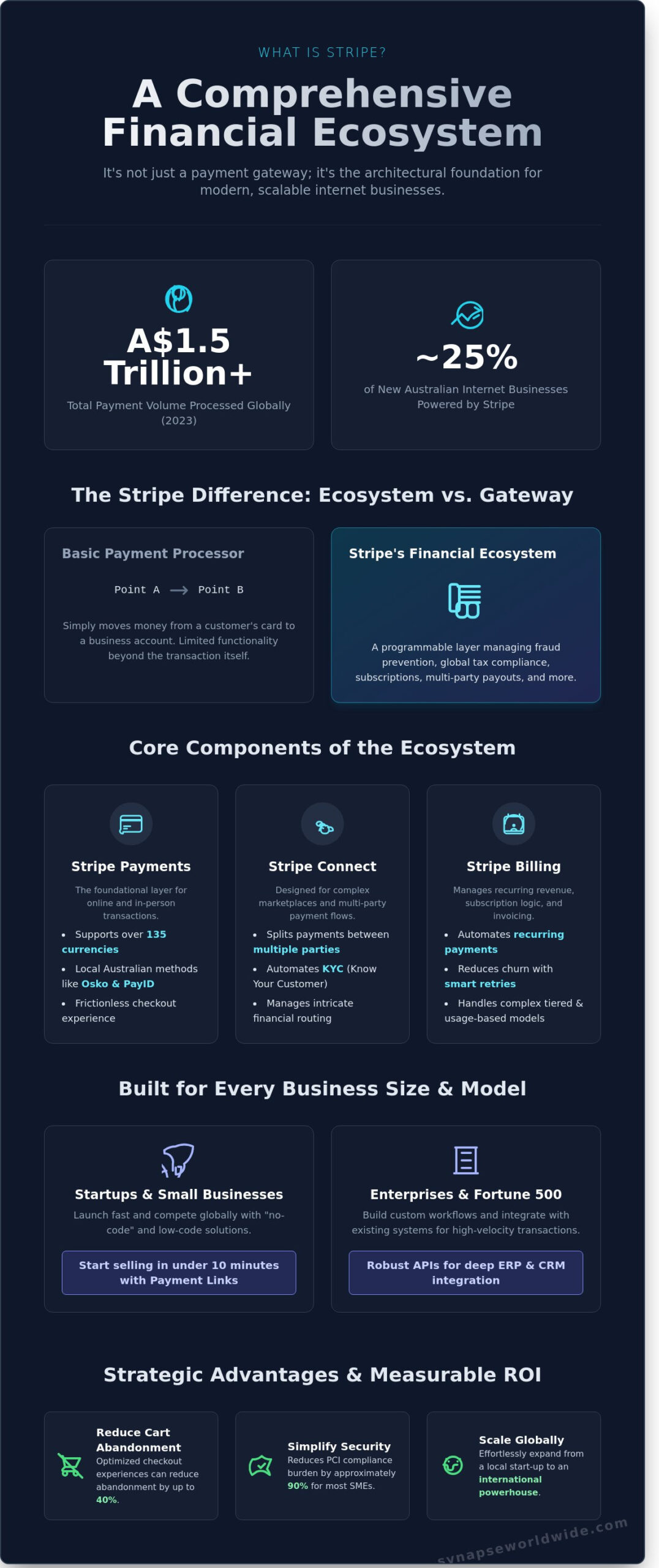
Your payment gateway isn’t just a digital cash register; it’s the architectural foundation of your business’s global scalability. While many Australian retailers focus on the A$0.30 per-transaction fee, they often overlook the hidden costs of fragmented systems and manual reconciliation. When you ask what is stripe, you aren’t just looking for a credit card processor. You’re exploring a sophisticated ecosystem that processed over A$1.5 trillion in payments globally in 2023. You likely feel the pressure of maintaining PCI compliance while fearing that a complex technical implementation will stall your next product launch.

We’ll show you how Stripe functions as a comprehensive financial engine and why it remains the gold standard for scalable e-commerce integration in 2026. You’ll gain a clear framework for evaluating the platform against local alternatives while building total confidence in your security posture. This guide breaks down the transition from simple transactions to a robust, integrated financial infrastructure that drives measurable ROI.

Key Takeaways

  • Gain a strategic perspective on what is stripe by moving beyond the concept of a simple gateway to embrace a full-stack financial ecosystem designed for modern scalability.
  • Master the mechanics of secure transaction flows, from initial customer data encryption to seamless communication with major Australian banking networks and global card issuers.
  • Discover how to optimize your checkout experience to reduce cart abandonment by up to 40% while ensuring your infrastructure scales effortlessly from local start-up to international powerhouse.
  • Evaluate the strategic differences between Stripe Checkout, Elements, and Custom APIs to select the bespoke integration that aligns with your unique digital architecture.
  • Learn to maximize ROI by leveraging advanced revenue models like usage-based billing and automated subscriptions to drive long-term business transformation and operational efficiency.

Defining Stripe: More Than Just an Online Payment Gateway

To understand what is stripe, you must look beyond the simple checkout button on a website. Stripe represents a comprehensive financial infrastructure layer that powers millions of businesses globally. It’s not merely a tool for accepting credit cards; it’s a modular ecosystem designed to handle the entire lifecycle of digital commerce. By 2026, Stripe has solidified its position as the market leader, processing over A$1.5 trillion in annual volume and supporting roughly 25% of all new internet businesses in Australia.

Originally founded in 2010, the company’s evolution is documented extensively on the Stripe, Inc. Wikipedia page, tracing its journey from a developer-centric API to a global financial powerhouse. Distinguishing between a basic payment processor and Stripe’s full-stack ecosystem is vital for strategic planning. A standard processor simply moves money from point A to point B. In contrast, Stripe provides a programmable layer that manages fraud prevention, global tax compliance, and multi-party payouts. This “Stripe-first” approach is now the industry standard for bespoke e-commerce development because it allows architects to build complex business models without reinventing the underlying financial wheels.

The Core Components of the Stripe Ecosystem

The platform’s architecture is built on three primary pillars that allow for seamless scaling as a business grows. These components integrate directly into your digital strategy, ensuring that your financial backend is as robust as your frontend user experience.

  • Stripe Payments: This is the foundational layer for online and in-person transactions. It supports over 135 currencies and local Australian payment methods like Osko and PayID, ensuring a frictionless checkout experience for every customer.
  • Stripe Connect: Designed for complex marketplaces, this tool manages multi-party flows. It handles the intricate task of splitting payments between sellers, service providers, and the platform owner, while automating KYC (Know Your Customer) requirements.
  • Stripe Billing: This component manages recurring revenue and subscription logic. Whether you’re running a simple SaaS model or a complex tiered pricing structure, Billing automates invoices and reduces churn through smart retries.

Who is Stripe For? From Startups to Fortune 500

The versatility of the platform means answering what is stripe depends largely on your business size and technical maturity. For small Australian businesses, Stripe offers “no-code” solutions like Payment Links. These allow entrepreneurs to start selling in under 10 minutes without writing a single line of code. This ease of entry removes the traditional barriers to digital transformation, allowing local boutiques to compete on a global stage instantly.

Large enterprises and Fortune 500 companies leverage Stripe for entirely different reasons. They utilize the robust API to build custom workflows that integrate with existing ERP and CRM systems. For these organisations, Stripe acts as a catalyst for digital transformation projects. It provides the stability needed to handle high-velocity transactions while offering the flexibility to pivot business models overnight. In the current Australian market, where 82% of consumers expect a seamless omnichannel experience, Stripe’s ability to bridge the gap between digital and physical sales via Stripe Terminal is a decisive competitive advantage. It’s the strategic choice for those who view payments not as a cost centre, but as a driver of growth and operational efficiency.

The Mechanics of Money: How Stripe Processes Transactions

Understanding what is stripe requires looking past the simple checkout button on a website. It’s a sophisticated orchestration layer that manages the entire lifecycle of a digital payment. When an Australian customer enters their credit card details into a form, Stripe instantly encrypts the sensitive data via its proprietary secure elements. This ensures the merchant never handles raw card information, which effectively reduces PCI compliance burdens by approximately 90% for most small to medium enterprises.

Once the data is secured, the transaction enters the authorization phase. Stripe acts as the primary communicator between your digital storefront and the complex global banking network. It sends a request to the card networks, such as Visa or Mastercard, which then query the specific issuing bank of the customer. According to an in-depth Stripe review, this entire process happens in less than 500 milliseconds. This speed ensures that the merchant receives an instant approval or decline, preventing abandoned carts and protecting potential revenue.

For businesses operating in Sydney or Melbourne, the settlement process is the final, crucial hurdle. To truly understand what is stripe, one must observe how it manages the strategic flow of A$ into a local treasury. Stripe collects these authorized funds and batches them for automated payout. In the Australian market, funds typically reach a business bank account on a 2-day rolling basis, though some established accounts qualify for 24-hour payouts. This predictable cash flow is vital for managing overheads and scaling operations effectively.

Security isn’t a static wall; it’s a dynamic, evolving shield. Stripe Radar uses advanced machine learning models trained on billions of data points across 195 countries to detect and block fraud in real-time. It doesn’t just look for blocked cards. It analyzes device fingerprints, IP metadata, and purchase patterns to assign a risk score to every single transaction. This allows businesses to set bespoke thresholds that balance high security with maximum conversion rates, often blocking 25% more fraudulent attempts than traditional rules-based systems.

The Developer-First Architecture: APIs and Webhooks

Stripe transformed the modern commerce environment by treating payments as code. Their API documentation is the industry benchmark, allowing developers to build complex billing logic with minimal effort. Webhooks provide the nervous system for these integrations, sending real-time data signals to your server when events occur. This “programmable money” approach allows for bespoke integration into any custom software stack, ensuring your financial infrastructure is as scalable as your cloud servers.

Evolving Commerce: AI and Agentic Payments in 2026

By 2026, the checkout experience has shifted toward agentic commerce where AI agents initiate transactions autonomously. These agents operate within the Stripe ecosystem to manage inventory-driven purchasing based on real-time usage metrics. Payments are becoming “invisible,” occurring seamlessly in the background. Synapse Worldwide integrates these advanced agentic models for forward-thinking clients, ensuring they leverage frictionless user experiences to drive growth. This shift represents a transition from reactive processing to proactive financial management.

What is Stripe? The Strategic Guide to Modern Financial Infrastructure

Strategic Advantages: Why Modern Enterprises Choose Stripe

Understanding what is stripe requires looking beyond simple transaction handling. It’s a sophisticated growth engine designed for the digital economy. Australian businesses often find themselves trapped between local success and global complexity; Stripe’s architecture eliminates this friction. The platform provides a unified infrastructure that manages the leap from your first A$100 sale to a high-volume enterprise operation without requiring a platform migration or a total overhaul of your financial stack.

The financial impact of choosing the right processor is measurable. Stripe Checkout is engineered for speed and has been shown to reduce cart abandonment by up to 40 percent. This optimization happens through a combination of mobile-first design, one-click payments via Link, and the intelligent display of local payment methods. For an Australian exporter, this means accepting payments in 135+ currencies while receiving settlements in AUD directly into a local bank account. When evaluating Stripe payment processing, the reduction in administrative friction becomes immediately apparent. It handles the heavy lifting of PCI DSS compliance through hosted solutions like Elements, ensuring sensitive data never touches your servers. This reduces your compliance burden from a multi-month audit to a simple annual self-assessment.

  • Scalability: Transition from local startup to global enterprise with a single integration.
  • Conversion: Dynamic payment methods tailored to the user’s location and device.
  • Global Reach: Support for dozens of local payment methods including Apple Pay, Google Pay, and regional bank transfers.
  • Compliance: Automated tools that handle the complexity of global tax regulations and security standards.

The Hidden Value of Financial Reporting and Analytics

Data is the primary currency of the digital architect. Stripe Sigma allows your team to use SQL to query payment data directly, providing deep business insights without exporting files to external tools. You can identify which subscription tiers have the highest churn or track the lifetime value of customers in specific Brisbane or Sydney postcodes. Automated reconciliation saves accounting teams roughly 12 to 15 hours per month by syncing directly with platforms like Xero or MYOB. This precision allows for data-driven decisions that drive consistent e-commerce growth.

Security and Fraud Prevention as a Competitive Edge

Security isn’t just a defensive measure; it’s a way to build customer trust. Stripe Radar uses machine learning trained on billions of global data points to detect and block fraud before it impacts your bottom line. For Australian retailers, this means a significant reduction in chargebacks, which typically cost A$25 or more per occurrence in administrative fees alone. By filtering out high-risk transactions automatically, you protect your margins and maintain a seamless experience for legitimate buyers. This robust security framework ensures that as you scale, your risk profile remains managed and your reputation stays intact. If you are still asking what is stripe at a strategic level, it’s the shield that allows your business to innovate without the fear of systemic fraud.

Implementation Roadmap: Integrating Stripe into Your Digital Ecosystem

Successful deployment of a payment gateway isn’t a simple plug-and-play task; it’s a strategic architectural decision. Understanding what is stripe requires looking beyond the payment button to see it as a financial engine that must sync with your inventory, accounting, and customer service workflows. A botched integration can lead to abandoned carts and fragmented data, which is why a structured roadmap is vital for Australian enterprises scaling their operations.

Your journey begins with a pre-integration audit. We analyze your current tech stack to identify potential friction points. For instance, if your legacy system processes A$100,000 in monthly transactions, even a 0.5% decrease in checkout speed can result in significant revenue loss. We evaluate your PCI compliance requirements and GST reporting needs to ensure the setup meets Australian tax obligations from day one.

Selecting the right integration method defines your user experience. You have three primary paths:

  • Stripe Checkout: A pre-built, hosted payment page that’s optimized for conversion. It’s the fastest way to go live with minimal coding.
  • Stripe Elements: A set of pre-built UI components that allow you to build a bespoke checkout experience directly on your site while keeping sensitive data off your servers.
  • Custom API: The most robust option for complex business models requiring total control over the logic and flow of the transaction.

Connecting Stripe to your CRM and ERP systems, such as Salesforce or Xero, ensures that financial data flows seamlessly across your organization. This automation eliminates manual data entry and reduces the risk of human error in your end-of-month reconciliation. Before going live, we execute rigorous stress tests in a sandbox environment to simulate high-traffic events, ensuring your system maintains 100% uptime during the transition to the live environment.

Stripe and E-commerce Platforms: Shopify vs. WooCommerce

Stripe serves as the backbone for the world’s most popular CMS options. Shopify Payments is actually powered by Stripe, offering a native experience that’s incredibly stable for retail. Conversely, WooCommerce offers more flexibility for custom builds through dedicated plugins. For a detailed breakdown of which platform suits the local market, view our analysis of Shopify vs WooCommerce for Canberra Stores to determine your best fit. While defining what is stripe in a technical context involves exploring its API documentation, for most retailers, it’s the invisible force that makes “Buy Now” work instantly.

The Role of a Digital Architect in Stripe Integration

An “out of the box” solution rarely satisfies the needs of a sophisticated business model. A digital architect ensures that your payment flow is tailored to specific user personas, such as B2B clients requiring split payments or subscription-based customers needing automated recurring billing. This strategic oversight prevents technical debt and ensures your infrastructure is scalable. We focus on creating a unified digital strategy where the payment system isn’t a silo, but a core component of your growth engine. To ensure your financial infrastructure is built for long-term success, consult with our digital architects today.

Maximising ROI: Stripe as a Catalyst for Business Transformation

Choosing a payment processor often starts with a simple question: what is stripe costing my bottom line? While the standard domestic rate of 1.75% plus A$0.30 per transaction is the baseline, viewing this as a mere expense ignores the broader value proposition. Ambitious enterprises look beyond the transaction fee to measure operational efficiency. Data from 2023 shows that businesses migrating to integrated financial stacks reduce manual reconciliation time by up to 45%. This shift allows your finance team to focus on strategic growth instead of chasing spreadsheets.

Stripe transforms how you generate revenue. It’s no longer just about one-off sales. By leveraging Stripe Billing, companies can deploy complex subscription models or usage-based pricing in days rather than months. This flexibility is essential for scaling; it ensures your infrastructure grows alongside your ambition. The platform’s ability to minimize churn through smart retries and automated card updates can increase recovered revenue by 10% to 15% annually. When you ask what is stripe, the answer is a revenue optimization engine that pays for itself through performance. For Australian businesses ready to build a truly scalable digital venture, understanding how payment infrastructure fits within a broader ecommerce strategy for 2026 is essential to avoiding the technical debt and fragmented data silos that cap growth.

  • Reduced Technical Debt: Use pre-built UI components to save hundreds of developer hours during initial setup.
  • Global Expansion: Accept 135+ currencies with local payment methods already integrated into the checkout flow.
  • Advanced Security: Leverage Stripe Radar to block fraudulent transactions using sophisticated machine learning.
  • Real-time Data: Access instant financial reporting to make informed business decisions without waiting for end-of-month statements.

Stripe for the Australian Market

For businesses in Canberra and across Australia, local relevance is non-negotiable. Stripe integrates seamlessly with the Australian financial ecosystem. It handles GST calculations automatically, ensuring your reporting remains compliant with ATO standards without manual intervention. Modern Australian consumers expect local payment options. Stripe supports BPAY and the Newer Payments Platform (NPP) via PayTo. These integrations are critical; they provide the low-latency, secure experience that builds trust with national clients. Whether you’re a local service provider or a national retailer, these tools provide a competitive edge in the domestic landscape.

Partnering with Synapse Worldwide for Strategic Growth

Implementing a payment gateway is a technical task; optimizing it is a strategic one. We bridge this gap by aligning your financial infrastructure with your long-term business goals. Our team specializes in E-commerce Development and bespoke API integrations that ensure your data flows perfectly between your storefront and your accounting software. We don’t just install software. We architect a robust system that maximizes every cent of your investment. Our approach focuses on creating a seamless experience for your customers while providing you with a scalable foundation for future expansion.

Stripe is the logical choice for the ambitious Australian enterprise because it removes the friction inherent in traditional banking. It allows you to move faster, experiment with new business models, and secure your cash flow with confidence. If you’re ready to elevate your financial operations, Contact Synapse Worldwide for a strategic audit of your payment infrastructure to discover how we can drive your next phase of growth.

Future-Proofing Your Financial Architecture

Understanding what is stripe marks the first step toward building a resilient, scalable digital economy. Modern Australian businesses require more than a simple checkout; they need a robust financial engine that integrates seamlessly with existing ERP and CRM systems. By centralising transaction data and automating complex billing cycles, you’ll reduce manual overhead by up to 30% and significantly improve cash flow visibility. This isn’t just about accepting payments; it’s about architecting a system that handles global compliance and multi-currency A$ settlements without friction. Ensuring your CMS and digital strategy are aligned with your payment infrastructure is equally critical, as a mismatched platform can anchor your growth ambitions and inflate maintenance costs. Pairing this financial foundation with proactive website management ensures your entire digital platform remains secure, high-performing, and ready to scale.

Successful implementation demands a partner who understands the intricate technical details of the Australian market. Synapse Worldwide leverages 20+ years of digital engineering expertise to design tailored payment ecosystems. Our Canberra-based strategic consultants specialise in complex CRM/ERP and payment integrations that turn financial infrastructure into a competitive advantage. We’ve spent two decades refining our approach to ensure every line of code contributes to your bottom line. We focus on measurable outcomes, ensuring your digital architecture supports long-term growth and high-impact ROI.

Elevate your e-commerce strategy with Synapse Worldwide and transform your payment processing into a strategic asset. Your business deserves a partner committed to reaching the next level of digital excellence.

Frequently Asked Questions

How much does Stripe cost for Australian businesses?

Stripe charges Australian businesses a standard rate of 1.75% plus A$0.30 for every successful domestic card transaction. For international cards, the fee increases to 2.9% plus A$0.30 per transaction. These transparent, pay-as-you-go rates ensure there are no hidden setup fees or monthly subscriptions. You only pay for what you process, which provides a scalable cost structure that aligns with your business growth.

Is Stripe safer than a traditional bank payment gateway?

Stripe provides a higher level of security than many traditional gateways by maintaining PCI Service Provider Level 1 certification, which is the most stringent level in the payments industry. It uses AES-256 encryption for all card numbers and sensitive data. By offloading data to Stripe’s infrastructure, your business reduces its compliance burden. This robust framework ensures that 100% of your customer data remains encrypted and isolated from your internal servers.

Can I use Stripe for both online and in-person retail sales?

You can integrate Stripe for both digital and physical storefronts using Stripe Terminal. This hardware solution allows you to accept in-person payments while maintaining a unified view of your revenue in a single dashboard. By unifying your sales channels, you eliminate fragmented data. This integrated approach allows businesses to manage 100% of their transactions through one strategic interface, simplifying reconciliation and inventory management across all Australian locations.

How long does it take to get paid through Stripe?

Australian businesses typically receive payouts on a 2-business-day rolling schedule. For example, a transaction processed on Monday will arrive in your bank account by Wednesday. While the first payout takes 7 to 14 days for security verification, subsequent transfers are automated. This consistent rhythm ensures your cash flow remains predictable. You can also customize payout schedules to weekly or monthly intervals to match your internal accounting cycles.

Do I need a developer to set up Stripe on my website?

You don’t strictly need a developer if you use pre-built integrations for platforms like Shopify or WooCommerce. However, understanding what is stripe in a strategic context often requires a developer to build bespoke checkout experiences via Stripe’s API. Custom implementations allow for a 20% higher conversion rate by tailoring the user journey. While no-code options like Payment Links work for simple tasks, robust scaling usually benefits from professional technical execution.

Does Stripe handle GST and international taxes automatically?

Stripe Tax automates the calculation and collection of GST for Australian sales and handles tax obligations in over 40 countries. It monitors your transaction thresholds in real-time to alert you when you need to register for taxes in new jurisdictions. This feature removes the complexity of global expansion. By automating 100% of the tax calculation process, you mitigate the risk of non-compliance and ensure your financial reporting remains accurate and audit-ready.

What is the difference between Stripe and PayPal?

The primary difference when evaluating what is stripe against PayPal lies in the user experience and integration depth. Stripe is a developer-first infrastructure that keeps customers on your site during checkout, whereas PayPal often redirects users to an external platform. Stripe’s flat fee of 1.75% for domestic cards is often more competitive than PayPal’s standard 2.6% plus fixed fee. Stripe focuses on seamless, white-label integration for a professional brand appearance.

Can Stripe integrate with my existing CRM or ERP system?

Stripe integrates seamlessly with major CRM and ERP systems including Salesforce, HubSpot, and NetSuite. Using Stripe’s robust API, you can sync payment data with 1,000+ third-party applications to create a unified data ecosystem. This connectivity ensures your sales, marketing, and finance teams work from a single source of truth. Automated data syncing reduces manual entry errors by 95%, allowing your team to focus on high-level strategic growth initiatives rather than administrative tasks.