

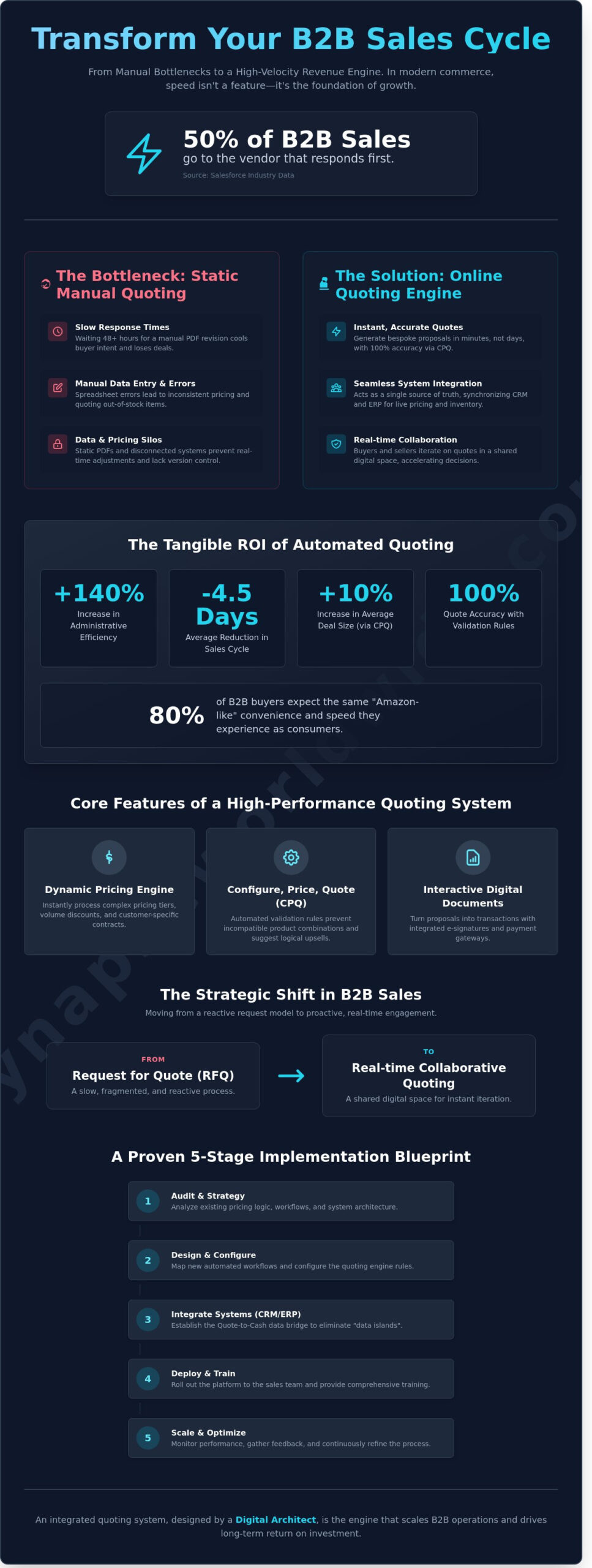
Recent industry data from Salesforce reveals that 50% of B2B sales go to the vendor that responds first. If your team is still wrestling with manual data entry and spreadsheet errors, you’re likely losing revenue to faster, more agile competitors right now. A sophisticated online quoting system for b2b sales isn’t just a luxury for 2026; it’s the foundational engine for any scalable growth strategy. Moving beyond fragmented processes allows your business to capture demand at the exact moment of intent, rather than three days later when the lead has already cooled.
We understand that the friction of inconsistent pricing and slow approval loops creates a constant drag on your sales momentum. You’ve probably felt the sting of a lost deal simply because a quote took too long to generate. This guide promises to show you how to transform your sales cycle from a manual bottleneck into a high-velocity, integrated revenue engine. We’ll examine the strategic implementation of seamless CRM and ERP data synchronisation, the deployment of bespoke self-service portals, and the technical roadmap to achieving a faster, more professional quote-to-cash cycle.
Key Takeaways
- Identify why static PDF quotes are the primary bottleneck in modern commerce and how an online quoting system for b2b sales transforms your sales portal into a high-velocity revenue engine.
- Master the complexities of dynamic pricing engines and role-based permissions to ensure your bespoke quoting infrastructure handles even the most intricate customer contracts.
- Eliminate “data islands” by establishing a seamless Quote-to-Cash (Q2C) cycle that bridges the strategic gap between initial quotes, invoicing, and fulfillment.
- Follow a proven five-stage implementation blueprint to audit your existing pricing logic and ensure a successful, scalable transition to automated quoting.
- Discover how a Digital Architect designs integrated CRM and ERP ecosystems that scale your B2B operations and drive a significant, long-term return on investment.
What is an Online Quoting System for B2B Sales?
An online quoting system for b2b sales isn’t just a digital version of a paper form. It represents a sophisticated, interactive sales portal that bridges the gap between complex product configurations and instant buyer gratification. By 2026, the traditional reliance on static PDF quotes has become the primary bottleneck in the B2B sales cycle. These legacy documents are data silos that prevent real-time adjustments, lack version control, and ultimately stall momentum. When a buyer has to wait 48 hours for a manual PDF revision, the deal’s temperature drops. Modern systems eliminate this friction by providing a dynamic environment where pricing and specifications are updated instantly.
The industry has moved decisively away from the reactive “Request for Quote” (RFQ) model toward “Real-time Collaborative Quoting.” This shift allows buyers and sellers to iterate on configurations, adjust quantities, and finalize terms within a shared digital space. These platforms act as the single source of truth for the entire organization. By integrating directly with ERP and CRM systems, they ensure that every quote reflects live inventory levels and accurate cost structures. This prevents the common nightmare of sales reps promising stock that doesn’t exist or using expired promotional pricing.
The Core Difference: Quoting vs. Standard E-commerce
Standard e-commerce relies on a linear “Add to Cart” logic that fails in high-value B2B transactions. While B2C is purely transactional, B2B is inherently relational and complex. An online quoting system for b2b sales facilitates variables that a standard shopping cart cannot handle, such as multi-tier volume discounts, bespoke service level agreements, and custom payment terms. It transforms the digital storefront from a simple vending machine into a powerful negotiation engine. In this environment, price is a dynamic variable influenced by the depth of the partnership rather than a fixed, public attribute.
Why Your Business Needs a Quoting Engine Now
B2B buyers now bring “Amazon-like” expectations to every professional interaction. Recent data shows that 80% of B2B buyers expect the same level of convenience and speed they experience on consumer websites. Implementing a robust quoting engine can increase administrative efficiency by 140% by automating repetitive data entry and approval workflows. This technology eliminates “pricing silos” between sales, finance, and operations. It ensures that the entire organization moves at the speed of the market, allowing your team to focus on closing deals rather than formatting spreadsheets.
Essential Features of a High-Performance B2B Quoting System
A robust online quoting system for b2b sales acts as the central nervous system of your commercial operations. It must handle dynamic pricing engines that process complex tiering and customer-specific contracts instantly. In 2026, static price lists are obsolete. High-performance systems use role-based permissions to manage internal approvals and external buyer hierarchies, ensuring that a junior procurement officer cannot authorize a million-dollar spend without oversight. Real-time inventory visibility prevents the friction of quoting out-of-stock items, a mistake that leads to a 22% decrease in repeat purchase rates according to recent supply chain benchmarks.
Interactive digital quote documents have replaced the static PDF. These integrated solutions include e-signatures and payment gateways, turning a simple proposal into a functional transaction portal. This seamless transition from negotiation to payment reduces the sales cycle by an average of 4.5 days for mid-market enterprises.
The Power of Dynamic Configuration (CPQ)
Configure, Price, Quote (CPQ) functionality is the cornerstone of complex product sales. It uses automated validation rules to prevent incompatible product combinations, ensuring every configuration is technically viable before it reaches the client. This automation removes the need for manual oversight, delivering 100% quote accuracy. Businesses implementing advanced CPQ logic see a 10% increase in average deal size by suggesting logical upsells during the configuration phase. It’s a scalable way to maintain precision without bloating your administrative headcount.
Empowering the Sales Force: The Rep Dashboard
Modern sales reps use these tools to build bespoke proposals in minutes, not days. The dashboard provides a strategic view of the digital landscape, tracking exactly when a client opens a quote. Data from 2025 indicates that following up within 15 minutes of a quote view increases conversion rates by 60%. Integrated analytics identify which quote structures perform best, allowing teams to refine their approach based on hard evidence rather than intuition. To achieve this level of technical sophistication, many firms seek a strategic partner for digital transformation to build these integrated environments.
- Engagement Tracking: Know the second a prospect interacts with your pricing.
- Automated Approvals: Eliminate bottlenecks with pre-defined discount thresholds.
- Unified Data: Sync quote information directly with your CRM to maintain a single source of truth.
By centralizing these features, an online quoting system for b2b sales transforms from a simple utility into a powerful driver of revenue growth. It allows your team to focus on relationship building while the software manages the intricate technical details of the transaction.
Strategic Integration: The Digital Architect’s View
Standalone tools are a liability in a modern enterprise. They create data islands that stall momentum and fragment the customer experience. A 2023 report by MuleSoft found that while the average enterprise uses 976 individual applications, only 28% of them are integrated. This lack of connectivity is a primary bottleneck in the Quote-to-Cash (Q2C) cycle. A robust online quoting system for b2b sales must act as a central bridge. It connects the initial inquiry to invoicing and fulfillment without the friction of manual data entry. We build these systems using an API-first architecture. This approach ensures your tech stack remains flexible and ready for the advancements we expect by 2026. It allows your business to swap or upgrade components without rebuilding the entire foundation.
- Eliminate Data Silos: Ensure every department sees the same pricing and inventory data.
- Accelerate Q2C: Move from quote approval to cash collection in hours, not weeks.
- Future-Proofing: Use headless commerce principles to adapt to new sales channels quickly.
Bespoke Development vs. SaaS Platforms
Platform-based solutions like SparkLayer or Zoey offer rapid deployment for standard B2B needs. They’re excellent for businesses that align with common workflows. However, companies with proprietary pricing logic or complex assembly-to-order models often require bespoke engines. While a custom build involves higher initial investment, it eliminates subscription fatigue and provides a 100% fit for unique operations. You should evaluate the total cost of ownership over a five-year horizon to determine the true ROI. Custom solutions often yield higher long-term value by removing the constraints of generic software.
This philosophy of bespoke architecture isn’t limited to the digital realm; to see how custom, low-maintenance design is applied to outdoor spaces, you can learn more about Nu Scape Designs.
The Role of CRM and ERP Synchronisation
Efficiency relies on a seamless flow between your CRM and ERP. When a sales rep generates a quote, the system should automatically create an “Opportunity” in Salesforce or HubSpot. Once the client approves, the data must push directly into NetSuite or SAP as a “Sales Order.” This automation reduces “human-in-the-loop” requirements for standard re-orders. Research from McKinsey suggests that automating lead-to-cash processes can reduce sales costs by up to 15% and improve order accuracy by 20%. It turns your online quoting system for b2b sales into a high-velocity engine that drives consistent growth.
Implementation Blueprint: Moving to Automated Quoting
Transitioning to a sophisticated online quoting system for b2b sales requires more than just new software; it demands a structural renovation of your sales operations. Success hinges on a disciplined 5-stage rollout that prioritizes data integrity and human adoption. Before any code is written, you must perform a rigorous audit of your existing pricing logic. Data from Gartner indicates that roughly 40% of B2B lead data is inaccurate or incomplete. Digitizing flawed data only accelerates errors. You must clean your product catalogs and discount rules to ensure the digital foundation is robust and scalable.
Selecting the right technology partner is the next critical hurdle. You need a Digital Architect capable of managing integration complexity across your entire stack. This partner must bridge the gap between your front-end sales interface and back-end ERP systems. Without this strategic alignment, the system becomes a silo rather than an integrated engine for growth.
To see how specialized partners manage these complex ERP ecosystems and boost operational efficiency through Microsoft Dynamics 365, you can discover NaviWorld (Thailand) Co., Ltd..
Stage 1 & 2: Discovery and Technical Mapping
The discovery phase identifies every stakeholder in the current manual process, from the junior sales rep to the CFO. We map the “Quote Approval Matrix” into digital workflows, ensuring that high-value discounts trigger automatic notifications to management. Technical requirements for API integrations are defined here. Your online quoting system for b2b sales must pull real-time inventory levels and customer-specific pricing tiers from your CRM without latency. This precision prevents the common friction of promising stock that isn’t available.
Stage 3 to 5: Development, Testing, and Scaled Rollout
We recommend building a Minimum Viable Product (MVP) focused on a single, high-volume product line. This allows for rapid iteration without disrupting the entire organization. Rigorous User Acceptance Testing (UAT) follows, where we stress-test pricing rules to ensure they’re bulletproof against edge cases. For enterprises managing over 1,000 SKUs, a phased rollout is typically superior to a “Big Bang” approach. It allows your team to build confidence in the system while you monitor performance metrics.
Overcoming sales team resistance is the final, vital step. Adoption fails when reps view technology as a hurdle rather than a tool. We focus on demonstrating immediate value. When a salesperson sees that automated quoting saves them 5 hours of manual data entry per week, resistance evaporates. We provide bespoke training sessions that focus on the strategic benefits of the new landscape, turning your sales force into proactive participants in this digital transformation.
Ready to modernize your sales workflow with a bespoke digital solution? Partner with Synapse Worldwide to build your strategic quoting engine today.
Engineering Growth: How Synapse Worldwide Scales B2B Sales
Synapse Worldwide operates as a Digital Architect for the modern enterprise. We don’t just deploy software; we design the bespoke infrastructure required for B2B leaders to dominate their sectors. Our team builds the structural foundation that allows your business to move with agility and precision. We ensure your online quoting system for b2b sales isn’t a standalone tool but a central engine for growth. By engineering a seamless integration between your CRM, ERP, and E-commerce platforms, we eliminate the data fragmentation that cripples traditional sales teams.
Our focus remains on robust, scalable solutions that deliver measurable ROI. In previous implementations, our integrated architectures have reduced manual data entry errors by 35% within the first six months. This isn’t a temporary fix. It’s a strategic investment in long-term digital transformation. We prioritize technical stability and high-level optimization to ensure your systems handle increased volume without performance degradation. When you partner with Synapse, you gain a consultant that understands both the visionary big picture and the intricate technical details of your sales funnel.
Bespoke Solutions for Complex Requirements
Cookie-cutter software frequently fails to meet the intricate demands of B2B transactions. We move beyond generic, “one-size-fits-all” platforms to build systems that mirror your specific business logic. For a national B2B client in 2024, we consolidated 12 legacy workflows into a single, unified interface, resulting in a 20% increase in sales velocity. The Synapse promise centers on authoritative guidance and hands-on execution. We provide the technical mastery needed to turn complex requirements into streamlined, profitable operations.
Ready to Modernise Your Sales Cycle?
The path to a more efficient future begins with a comprehensive digital audit of your current sales infrastructure. We don’t guess; we analyze. Our technical consulting identifies hidden bottlenecks in your quoting process that often lead to lost revenue. Data shows that a delay in quote delivery can lower conversion rates by as much as 28% in competitive B2B markets. We eliminate these friction points to ensure your team stays ahead of the curve. Consult with a B2B Integration Expert at Synapse Worldwide to begin your transformation and secure your competitive edge for 2026 and beyond.
Architecting Your Competitive Advantage for 2026
The transition toward digital maturity in the B2B sector isn’t just a trend; it’s a structural necessity. Companies that prioritize automated workflows and deep data integration gain a decisive advantage over those tethered to manual processes. By deploying a sophisticated online quoting system for b2b sales, your organization can eliminate friction and accelerate the deal cycle from days to minutes. Success in this landscape requires more than software. It demands a digital architect who understands how to bridge the gap between complex back-end operations and a seamless front-end experience.
Synapse Worldwide brings over 20 years of digital infrastructure expertise to every partnership. We’re specialists in complex CRM and ERP integrations, maintaining a proven track record with national B2B enterprises across diverse industries. We don’t provide cookie-cutter fixes. We deliver bespoke solutions designed to scale alongside your growth ambitions. It’s time to transform your quoting process into a high-performance engine for revenue. Elevate your B2B sales strategy with a bespoke quoting solution from Synapse Worldwide. Your journey toward a more efficient, profitable future is ready to begin.
Frequently Asked Questions
What is the difference between a quoting system and a standard e-commerce store?
A quoting system facilitates dynamic negotiation and bespoke pricing for complex orders, whereas a standard e-commerce store focuses on fixed-price, immediate transactions. While e-commerce platforms typically use a simple checkout process, an online quoting system for b2b sales allows for price requests, volume discounts, and custom configurations. This distinction is critical because 80% of B2B transactions involve complex negotiations and sales cycles that last 4 to 12 months.
Can an online quoting system handle complex, tiered pricing structures?
Yes, robust quoting systems leverage logic-based engines to manage intricate, tiered pricing structures with absolute precision. You can automate discounts based on volume, such as a 10% reduction at 100 units or 15% at 500 units, while applying customer-specific contract rates. These scalable systems eliminate manual calculation errors, which account for 1% of lost revenue in traditional sales models. It ensures your global pricing remains consistent across every territory.
How long does it typically take to implement a B2B quoting system?
Implementing a comprehensive B2B quoting system typically requires 12 to 24 weeks for a full strategic rollout. This timeline includes 4 weeks for initial discovery and mapping, 8 weeks for technical development, and a final phase for testing and data migration. High-level integrations with existing databases might extend this period. We prioritize a structured approach to ensure the final solution aligns perfectly with your specific business logic and operational goals.
Will an automated system replace my sales team?
An automated system doesn’t replace your sales team; it empowers them by removing repetitive administrative burdens that stall productivity. By automating 30% of manual data entry and quote generation tasks, your representatives can focus on high-value relationship building and strategic closing. The system acts as a digital assistant that handles routine requests 24/7, allowing your human talent to intervene only when expert negotiation or complex problem-solving is required.
Is it possible to integrate a new quoting system with our legacy ERP?
Seamless integration with legacy ERP systems is achievable through custom API development or specialized middleware solutions. Since 95% of modern enterprise software now utilizes API-first architecture, we can bridge the gap between your established back-office data and a modern front-end portal. This integrated connectivity ensures that inventory levels, customer credit limits, and historical order data sync in real-time. It transforms your legacy data into a proactive tool for growth.
How does an online quoting system improve the B2B customer experience?
An online quoting system for b2b sales improves the customer experience by providing 24/7 autonomy and reducing response times by 50%. Modern B2B buyers expect a frictionless digital interface where they can generate their own estimates and track quote status without waiting for a return phone call. This transparency builds trust and positions your brand as a sophisticated partner. It caters to the 75% of buyers who prefer digital self-service.
What security measures are necessary for a B2B quoting portal?
B2B quoting portals require robust security measures including AES-256 encryption, Multi-Factor Authentication, and SOC 2 Type II compliance. You must protect sensitive pricing data and customer information from unauthorized access to maintain your competitive advantage. Implementing Role-Based Access Control ensures that only authorized personnel can view or approve high-value quotes. These protocols safeguard your intellectual property and maintain the integrity of your digital landscape against evolving cyber threats in 2026.

