
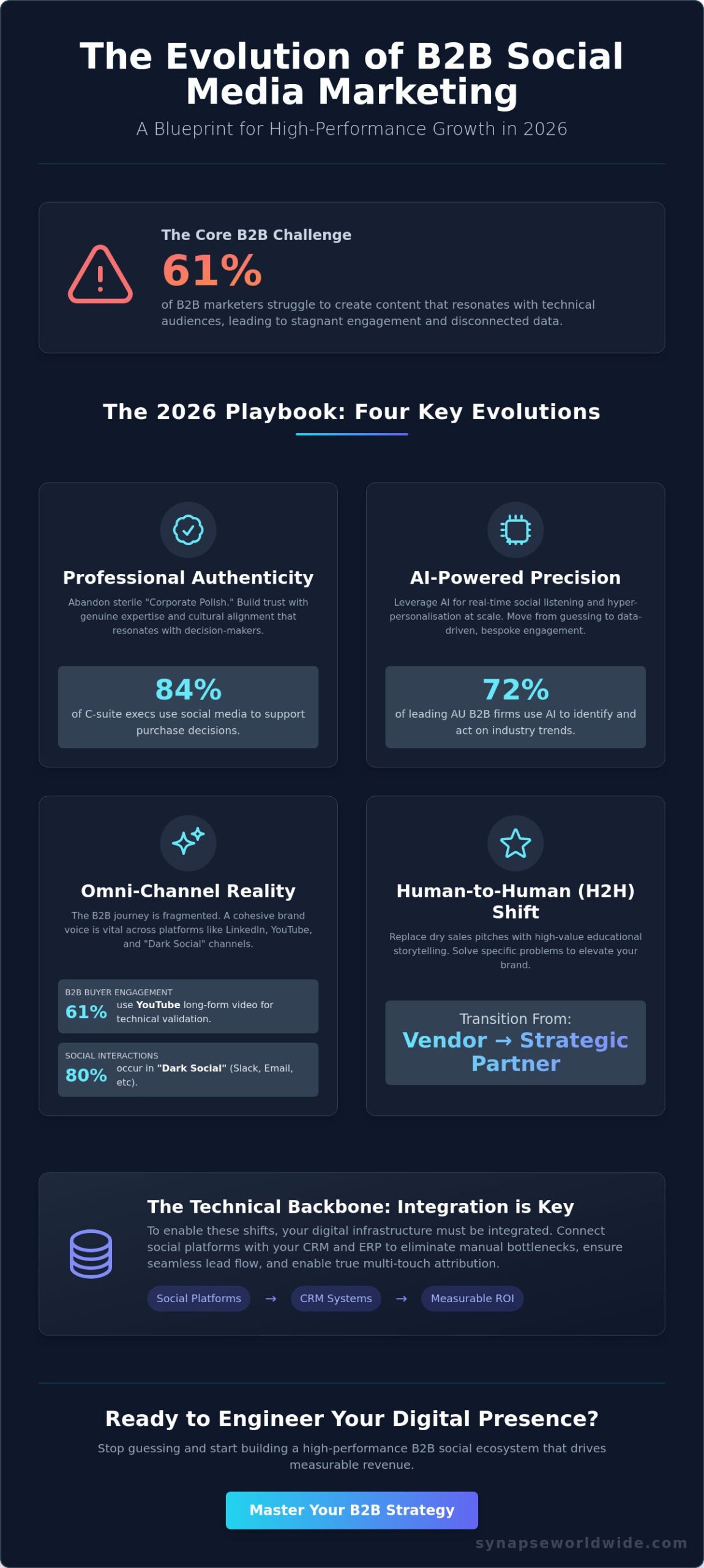
Industry reports from 2024 show that 61% of B2B marketers find it difficult to produce content that truly resonates with a technical audience, leading to stagnant engagement rates. If you’re frustrated by disconnected data between your platforms and your CRM, you’ve experienced the limitations of a fragmented strategy. Most Australian enterprises still treat b2b social media marketing as an optional add-on rather than a robust, integrated engine for growth. It’s time to stop guessing and start engineering a digital presence that commands respect from both your peers and your bottom line.
You know that a professional brand requires more than just occasional updates; it demands a strategic architecture that drives measurable results. This guide provides the blueprint to master the transition from static corporate posts to a high-performance B2B social ecosystem. We’ll show you how to build a scalable system for content distribution that establishes your authority and generates high-quality leads. You’re about to learn how to align your social efforts with your broader business objectives to ensure every interaction contributes to your revenue targets for 2026.
Key Takeaways
- Elevate your brand presence by transitioning from rigid corporate polish to a strategy of professional authenticity that resonates with modern Australian decision-makers.
- Master the art of b2b social media marketing by building a bespoke framework anchored in data-driven Ideal Customer Profiles rather than mere assumptions.
- Identify the specific content pillars—from visionary thought leadership to bespoke educational resources—required to transform your feed into a high-performance conversion engine.
- Optimise your digital infrastructure by integrating social platforms directly with your CRM and ERP systems to eliminate manual lead-entry bottlenecks and ensure seamless lead flow.
- Move beyond vanity metrics and scale your performance through robust multi-touch attribution models that accurately track SQLs and ROI throughout complex B2B sales cycles.
The Evolution of B2B Social Media Marketing in 2026
B2B social media marketing has matured into a multi-stakeholder relationship engine that prioritises long-term revenue over vanity metrics. In 2026, the Australian digital landscape rewards organisations that abandon sterile “Corporate Polish” in favour of “Professional Authenticity.” This shift reflects a market where 84% of C-suite executives use social media to support purchase decisions. They aren’t looking for glossy brochures; they’re looking for proof of expertise and cultural alignment. Successful brands now operate as Digital Architects, constructing integrated systems that balance high-level visionary strategy with granular technical execution.
Artificial Intelligence has redefined the baseline for performance. By 2026, 72% of leading Australian B2B firms have deployed AI for real-time social listening and hyper-personalisation at scale. This technology doesn’t just automate posts. It identifies subtle shifts in industry sentiment, allowing brands to pivot their messaging before a trend peaks. This level of social media marketing sophistication ensures that every touchpoint is bespoke, data-driven, and aligned with the client’s specific growth trajectory. Scalability no longer requires a massive headcount; it requires a robust, AI-enhanced infrastructure that maintains a human touch.
Beyond LinkedIn: The Omni-Channel B2B Landscape
While LinkedIn remains a primary pillar, the modern B2B journey is fragmented across diverse platforms. YouTube has become a critical search engine for technical validation, with 61% of B2B buyers engaging with long-form video content during the consideration phase. Niche forums and industry-specific hubs are also gaining ground. Maintaining a cohesive brand voice across these touchpoints is essential for trust. We also see the rising dominance of “Dark Social,” which includes private shares via Slack, WhatsApp, or email. Because up to 80% of B2B social interactions now happen in these private channels, sophisticated attribution models are required to measure the true impact of your b2b social media marketing investment.
The Human-to-Human (H2H) Shift
The era of “boring B2B” is over. Decision-makers are people first, and they prioritise trust and resonance over generic sales pitches. H2H marketing is the intersection of professional value and personal resonance. To explore how capturing authentic family and lifestyle moments can enhance your personal brand’s resonance, you can find out more about professional photography services. It replaces dry product announcements with high-value educational storytelling that solves specific business problems. When you provide genuine utility through your content, you move from being a vendor to a strategic partner. This approach ensures that your brand remains top-of-mind when a prospect is ready to transition from research to acquisition. It’s about building a narrative that proves you understand their industry’s unique pressures and have the bespoke solutions to navigate them.
How to Build a Bespoke B2B Social Media Strategy
A generic social strategy is a liability in a competitive market. To drive genuine revenue, you need a data-driven blueprint that treats social channels as high-precision lead generation tools rather than mere broadcast platforms. Success begins with a rigorous audit of your current digital footprint. You must evaluate your competitor landscape within the Australian market to identify gaps they’ve missed. Don’t rely on gut feelings. Build your Ideal Customer Profiles (ICPs) using historical CRM data and direct sales feedback. This ensures your b2b social media marketing efforts focus on the 5% of your market currently in a buying window.
Phase 1: Discovery and Audience Mapping
B2B procurement cycles are complex. You aren’t selling to a person; you’re selling to a committee. Typically, 3 to 5 key stakeholders influence a single B2B purchase, ranging from the technical gatekeeper to the financial decision-maker. Your task is to map specific pain points to tailored content themes for each role. If the CTO worries about integration, your content should highlight API stability. If the CFO focuses on ROI, provide cost-benefit breakdowns.
Utilise social listening tools to monitor industry-specific conversations. This real-time intelligence allows you to pivot your messaging based on academic research on B2B social media which demonstrates that strategic social engagement directly correlates with improved firm performance. By identifying trending topics before they peak, you position your brand as a visionary leader rather than a reactive follower.
Phase 2: Platform Selection and Brand Voice Alignment
Resource allocation is critical. You don’t need to be everywhere; you need to be where your decision-makers congregate. LinkedIn remains the gold standard for executive thought leadership, yet YouTube is often the superior choice for technical explainers that reduce friction in the sales cycle. Ensure your social voice reflects the sophistication of your web design and branding alignment. A disjointed brand personality creates distrust and stalls the buyer’s journey.
Draft a comprehensive Social Media Style Guide to maintain consistency across your global and local teams. This document should define your stance on industry debates, your visual aesthetics, and your response protocols. This level of strategic brand alignment ensures every post reinforces your authority. Once your foundation is set, implement a 90-day iterative framework. Use the first 30 days for baseline testing, the next 30 for optimisation, and the final 30 for scaling the formats that delivered the highest quality conversions. This disciplined approach transforms social media from a cost centre into a scalable revenue engine.
Content Pillars That Convert: Moving Beyond the “Boring”
Effective b2b social media marketing requires a departure from the sterile, corporate monologues of the past. To drive revenue in the 2026 Australian market, your strategy must rest on content pillars that prioritise human connection and tangible value. We move beyond generic updates to build a digital presence that functions as a high-performance sales asset.
Thought leadership is your primary tool for establishing authority. It involves positioning your leadership team as industry visionaries who anticipate market shifts before they occur. When your internal experts share unique perspectives on local regulatory changes or global tech trends, they build a competitive moat that a logo alone cannot sustain. This ties directly into employee advocacy. Leveraging your staff as brand ambassadors increases your reach and trust. Data from LinkedIn suggests that content shared by employees sees 8x more engagement than content shared by brand channels.
Your educational resources must provide bespoke value. Move away from surface-level blog posts toward deep-dive whitepapers and guides that solve specific operational bottlenecks. This intellectual capital proves your competence before a contract is ever signed. Finally, robust social proof serves as the ultimate validator. We focus on client transformations, using specific data points to showcase how your solutions delivered a measurable return on investment for other Australian enterprises.
The Power of Lo-Fi Vertical Video
High-production corporate videos often feel like advertisements, which modern B2B buyers instinctively ignore. Lo-fi vertical video, such as “behind-the-scenes” clips or quick expert tips, outperforms polished ads because it feels authentic and immediate. This format allows your experts to speak directly to the camera, breaking down the barrier between the brand and the prospect. To ensure your video content delivers results, follow this strategic checklist:
- The 3-Second Hook: Address a specific pain point immediately to stop the scroll.
- Vertical Formatting: Use a 9:16 aspect ratio to dominate mobile screen real estate.
- Hard-Coded Subtitles: Ensure accessibility and engagement, as 80% of social media users watch video without sound.
- Clear Call to Value: Direct viewers to a specific resource rather than a generic “contact us” page.
Leveraging Interactive Content
Interactive content transforms passive observers into active participants. We use polls and surveys not just for engagement, but as a sophisticated tool for real-time market research. These insights allow you to pivot your messaging based on what your audience actually cares about today. LinkedIn Newsletters have also emerged as a critical tool for long-term lead nurturing, providing a consistent touchpoint that lands directly in a prospect’s inbox and notification tray. Interactive content reduces the friction of the B2B sales cycle by replacing static consumption with a dynamic exchange of value that builds familiarity and trust over time.
The Technical Backbone: Integrating Social with CRM and ERP
Manual lead entry is a silent growth killer. In the Australian B2B sector, speed to lead is a primary competitive advantage. Manual data entry accounts for an average 30% delay in lead response times according to 2024 industry benchmarks. When your sales team waits 24 hours to download a CSV file from LinkedIn, the prospect’s intent has already cooled. This bottleneck prevents your b2b social media marketing from reaching its full revenue potential.
A robust digital infrastructure treats your social platforms as an extension of your database. Seamless integration between social channels and your CRM ensures that every interaction is logged in real-time. This isn’t just about saving time; it’s about precision. By connecting your ERP data to your social ad accounts, you can inform campaigns with actual financial metrics. You can suppress ads for low-margin clients or increase spend on prospects that mirror your highest lifetime value (LTV) accounts. This strategic alignment transforms social media from a top-of-funnel awareness tool into a high-performance revenue engine.
Automating the Lead Journey
Setting up automated workflows from LinkedIn Lead Gen forms directly to your CRM is the first step toward a scalable operation. Using API-based connectors ensures that lead data flows instantly into your nurturing sequences. This process eliminates human error and ensures that no lead falls through the cracks. Marketing automation then takes over, delivering bespoke content based on the specific form the user submitted.
- Instant Routing: Lead data hits the CRM and triggers a notification to the relevant account executive within 60 seconds.
- Dynamic Nurturing: Automated email sequences adjust based on the prospect’s social engagement levels.
- Data Hygiene: Integrated systems automatically validate email formats and check for duplicates to keep your database lean and actionable.
Data hygiene remains a critical pillar of this infrastructure. Approximately 28% of B2B lead data decays annually. Automated integration allows for real-time enrichment, where social profiles update your CRM records, ensuring your sales team always has the most current professional context before they make a call.
Personalization at Scale
Strategic personalization is impossible without a unified customer view. By leveraging CRM data, you can create highly targeted custom audiences for your b2b social media marketing ads. If a prospect in your CRM has viewed a specific service page on your website three times but hasn’t converted, you can trigger a specific social ad featuring a case study relevant to that service. This level of relevance is what separates market leaders from the noise.
A unified view allows your team to see the entire journey, from the first LinkedIn click to the final ERP invoice. Australian B2B firms implementing this level of technical integration see a 15% average increase in cross-sell opportunities. You’re no longer guessing what your audience wants; you’re responding to their documented behavior across the entire digital landscape.
Ready to build a high-performance lead engine? Partner with Synapse Worldwide to integrate your digital infrastructure for maximum ROI.
Measuring Success: Proving ROI and Scaling Performance
Vanity metrics like post likes or follower counts offer a false sense of security. While they indicate brand awareness, they don’t necessarily reflect revenue growth. Effective b2b social media marketing requires a shift toward business outcomes that satisfy stakeholders and justify marketing spend. You must track how social interactions translate into Sales Qualified Leads (SQLs) and actual closed deals. Because the typical Australian B2B sales cycle can span six to eighteen months, multi-touch attribution is essential. It allows you to identify which specific LinkedIn whitepaper or executive thought-leadership post initiated the first contact and which one closed the gap before a discovery call.
Data from these social interactions shouldn’t live in a vacuum. You should use social analytics to refine your broader digital strategy. If a specific technical topic gains high engagement on social platforms, it’s a clear signal to produce more deep-dive technical content or SEO-optimised landing pages on that subject. This integrated approach ensures your social efforts act as a real-time focus group for your entire marketing department.
Key Performance Indicators (KPIs) for B2B
- Sales Qualified Leads (SQLs): Track the number of leads generated through social channels that meet your sales team’s specific criteria for readiness.
- Cost Per Acquisition (CPA): Calculate your total social spend divided by the number of customers acquired. Monitoring this in A$ ensures your budget remains aligned with your profit margins.
- Share of Voice (SOV): Measure how often your brand is mentioned compared to your primary competitors in the Australian market.
Social media activity contributes to long-term SEO and organic visibility by driving high-quality traffic to your site and increasing the likelihood of earning authoritative backlinks from industry peers.
Scaling Your Strategy with an Expert Partner
Off-the-shelf social media packages rarely work for complex B2B organisations. Your business needs a bespoke solution that aligns with your specific infrastructure and technical requirements. A long-term partnership with a digital agency provides the stability needed to build a robust lead generation engine. Synapse Worldwide functions as your Digital Architect, managing the intricate details of b2b social media marketing while you focus on high-level business operations. We move beyond simple posting schedules to create integrated ecosystems where data informs every creative decision.
Growth requires more than just consistency; it requires strategic evolution. As market conditions shift, your social strategy must adapt to maintain its competitive edge. Our team ensures your digital presence is scalable, secure, and consistently driving measurable ROI. For smaller organisations looking to build this foundation from the ground up, our digital marketing strategy for SMBs provides a practical framework for integrating your social, paid, and organic channels into a unified growth engine.
Ready to transform your social presence into a revenue-generating asset? Contact Synapse Worldwide to architect your B2B social strategy and start scaling your performance today.
Mastering the 2026 Digital Landscape
Success in b2b social media marketing now demands a shift from generic posting to technical precision. By 2026, the most profitable Australian firms will be those that treat social platforms as integrated revenue engines rather than isolated silos. This requires a robust technical backbone where social data flows seamlessly into your CRM and ERP systems. Industry data from Gartner indicates that 80% of B2B sales interactions will occur in digital channels by 2025; this means your strategy must be ready to capture and convert high-value leads with absolute accuracy.
Synapse Worldwide has been at the forefront of this evolution since 2005. We don’t offer generic packages; we deliver high-level strategic consultancy paired with hands-on execution. Our comprehensive approach integrates web design and branding alignment, SEO, and automation to create a scalable ecosystem for your brand. With our deep expertise in custom CRM and ERP integrations, we ensure every social touchpoint is measurable and aligned with your corporate goals. It’s time to move beyond the “boring” and build a presence that reflects the true sophistication of your business.
Architect your bespoke B2B social media strategy with Synapse Worldwide
We’re ready to help you reach the next level of business transformation and sustainable growth.
Frequently Asked Questions
Is social media marketing effective for B2B companies with very niche audiences?
Yes, it’s highly effective because digital platforms allow for granular targeting based on specific job titles, seniority, and industry codes. A 2024 Content Marketing Institute report found that 84% of B2B marketers successfully use social media to reach niche decision-makers. In Australia, specialized engineering or SaaS firms use hyper-targeted campaigns to reach the 300 to 500 key stakeholders who control their industry’s procurement budgets.
How much should a small-to-medium B2B business spend on social media ads?
Most Australian SMEs allocate between A$2,500 and A$8,000 per month for their initial social media advertising tests. This investment provides enough data to optimize campaigns on LinkedIn, where the average cost-per-click in the Australian market currently ranges from A$9 to A$16. You should start with a daily budget of at least A$120 to ensure your ads reach a statistically significant audience within the first 30 days.
Which social media platform is best for B2B lead generation in 2026?
LinkedIn remains the dominant force for b2b social media marketing, generating approximately 80% of all B2B leads sourced from social channels. However, YouTube has emerged as a critical secondary channel for Australian firms. Video content yields a 34% higher conversion rate for complex technical services than static images. This makes it a vital tool for establishing authority during long sales cycles and high-value contract negotiations.
How do I prove the ROI of B2B social media to my executive board?
You must connect social engagement directly to your sales pipeline through multi-touch attribution models. Focus your reporting on Marketing Originated Pipeline Value instead of vanity metrics like likes or follows. Data from Gartner shows that 75% of B2B buyers use social media to influence their final purchase decisions. Presenting the specific dollar value of leads generated against your total spend provides the financial evidence your board demands.
Can social media marketing help with B2B SEO?
Yes, active social profiles improve your b2b social media marketing performance by driving consistent traffic and increasing brand search volume. While social signals aren’t a direct Google ranking factor, a 2023 industry study showed that content with high social engagement earns 22% more backlinks on average. These backlinks are the primary drivers of domain authority and organic search rankings within the competitive Australian digital landscape.
What is employee advocacy, and why does it matter for B2B brands?
Employee advocacy is a strategy where your staff shares company content on their personal profiles to expand brand reach. It’s essential because content shared by employees receives 8 times more engagement than content shared by official brand channels. In the Australian market, professional networks trust individuals far more than corporations. Advocacy programs can increase your total addressable audience by 10 times without increasing your paid advertising spend.
How do I integrate my social media leads directly into my CRM?
You can automate this integration using native lead generation forms on LinkedIn or Facebook connected via Webhooks or middleware like Zapier. Most Australian enterprises use Salesforce or HubSpot to capture these leads in real-time. This setup ensures your sales team follows up within the critical first hour of inquiry. Rapid response times increase lead qualification rates by 70% compared to delayed manual data entry processes. If you’re working with a constrained budget, our guide on building a cohesive digital marketing strategy for SMBs outlines how to prioritise these integrations for maximum impact without overspending.