

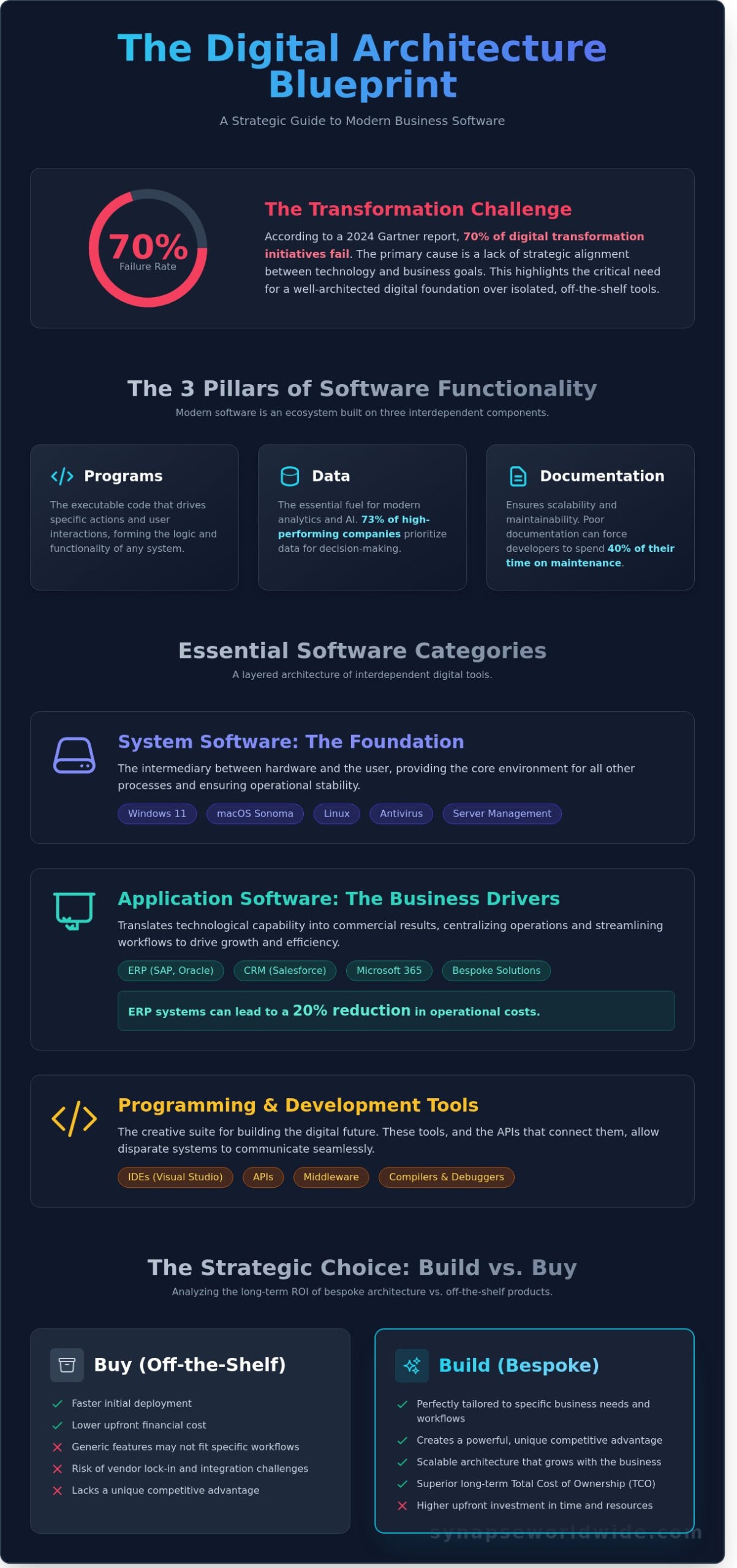
Most business leaders view their digital tools as a necessary expense, yet a 2024 Gartner report indicates that 70% of digital transformation initiatives fail because the underlying strategy lacks alignment. You’ve likely felt the weight of this friction when trying to choose the right software for your operations. It’s exhausting to sift through technical jargon while fearing that a new investment won’t integrate with your existing systems. You deserve a clear distinction between essential infrastructure and optional tools that actually move the needle for your bottom line.
We understand that a robust digital presence requires more than just off-the-shelf fixes; it requires a visionary approach to architecture. This article provides a clear mental map of the technology landscape and explains how bespoke solutions drive measurable growth. We’ll explore the fundamental categories of modern tools, compare the long-term ROI of custom versus pre-packaged options, and give you the confidence to lead your next transformation project. By the end, you’ll see exactly how strategic digital choices turn complex problems into seamless, scalable results for your enterprise.
Key Takeaways
- Understand how modern software has evolved from simple scripts into intelligent, cloud-native ecosystems that define the current digital landscape.
- Navigate the essential categories of digital tools to identify which systems and applications are most critical for your specific operational goals.
- Analyze the strategic “Build vs. Buy” dilemma to determine if a bespoke architecture or an off-the-shelf product delivers a superior long-term total cost of ownership.
- Uncover how integrated digital workflows eliminate departmental silos and convert manual bottlenecks into streamlined, automated growth engines.
- Gain a clear roadmap for your digital transformation journey, emphasizing the vital roles of discovery and user-centric design in achieving scalable success.
Defining Software in the 2026 Digital Landscape
Software serves as the essential set of instructions that direct physical hardware to execute precise tasks. While early computing relied on rigid, linear scripts, the 2026 environment demands highly adaptive, AI-driven, and cloud-native ecosystems. Understanding what is software requires moving beyond simple definitions; it’s the digital nervous system that powers every strategic move a business makes. By 2025, Gartner predicted that 95% of new digital workloads would be deployed on cloud-native platforms. This shift confirms that software isn’t just a tool, it’s the very infrastructure of growth.
We approach software from the perspective of a Digital Architect. This means viewing every line of code as strategic infrastructure rather than a mere utility. When software is bespoke and integrated correctly, it transforms from a back-office expense into a front-line competitive advantage. This evolution has moved us from siloed applications to interconnected environments where software manages everything from global supply chains to personalized customer experiences in real time.
The Core Components: Programs, Data, and Documentation
Modern software functionality relies on three distinct pillars. Programs act as the executable code that drives specific actions and user interactions. Data serves as the essential fuel, powering the predictive analytics and machine learning models that 73% of high-performing companies now prioritize for decision-making. Documentation ensures these systems remain scalable and maintainable. Without robust documentation, technical debt accumulates quickly; research suggests this often forces developers to spend 40% of their time on maintenance instead of innovation.
How Software Interacts with Hardware
Software acts as a sophisticated abstraction layer, hiding the complex binary operations of hardware behind intuitive interfaces. This interaction depends on drivers and firmware to translate digital intent into physical action. Our focus remains on seamless integration. When physical assets and digital logic align perfectly, organizations see a measurable lift in operational efficiency. This synergy allows for “zero-friction” deployments where hardware limitations no longer bottleneck strategic expansion. By 2026, the boundary between physical devices and digital control has largely vanished, replaced by a unified, software-defined ecosystem.
Essential Categories and Real-World Software Examples
Modern business relies on a layered architecture of digital tools. We categorize these assets into three distinct yet interdependent pillars: System, Application, and Programming tools. Each serves a specific strategic purpose, ensuring that a company’s digital landscape remains robust and scalable.
System Software: The Foundation
System tools act as the intermediary between hardware and the user. Operating Systems like Windows 11, macOS Sonoma, and various Linux distributions provide the core environment for all other processes. Beyond the OS, utility programs ensure operational stability. Antivirus tools, file management systems, and diagnostic suites maintain the health of your infrastructure. For global enterprises, server management tools are non-negotiable. They secure the 99.9% uptime required for modern digital commerce and prevent costly service interruptions.
Application Software: The Business Drivers
This category translates technological capability into commercial results. Enterprise Resource Planning (ERP) systems like SAP or Oracle centralize operations, often leading to a 20% reduction in operational costs. Customer Relationship Management (CRM) platforms, such as Salesforce, function as growth engines by streamlining sales pipelines. While generic productivity suites like Microsoft 365 offer broad utility, many firms invest in tailored digital solutions to gain a competitive edge. These bespoke tools address specific workflow bottlenecks that off-the-shelf products often ignore.
Programming and Development Tools
Developers use Integrated Development Environments (IDEs) like Visual Studio or IntelliJ IDEA to build the digital future. These tools facilitate the creation of complex Real-World Software Examples that power modern industry. APIs (Application Programming Interfaces) serve as the vital connective tissue here. They allow disparate systems to communicate, enabling the rise of Middleware. This layer bridges the gap between legacy systems and modern cloud applications. By 2025, analysts expect the middleware market to exceed $50 billion as businesses prioritize seamless data integration. Integration doesn’t happen by accident; it requires a strategic approach to how these tools overlap within your organization.
Custom vs. Off-the-Shelf: Choosing the Right Architecture
The decision to build proprietary systems or purchase existing licenses represents a critical strategic fork in the road. Organizations must evaluate whether their core processes are standard enough for a generic solution or unique enough to demand a tailored engine. While a 2023 Gartner report indicates that global enterprise software spending reached $913 billion, much of that investment is lost to inefficient, cookie-cutter tools that fail to map to specific operational workflows. To fully grasp the strategic implications, one must first define What is Software? in the context of modern infrastructure versus specific business applications.
The Case for Off-the-Shelf Software
Software as a Service (SaaS) provides an immediate answer for non-core functions like accounting or basic HR. These platforms offer rapid deployment, often allowing teams to begin work within 24 hours of purchase. However, the convenience of standardized features carries hidden costs. Research from 2023 suggests that 38% of SaaS licenses in mid-market firms go unused, a phenomenon known as feature bloat. Paying for a massive suite when your team only requires five specific tools creates a drag on the total cost of ownership (TCO) that often offsets the lower initial price point.
The Power of Bespoke Development
For enterprises aiming to disrupt their industry, bespoke development offers a level of optimization that generic tools can’t match. Custom software architectures align perfectly with your internal logic, removing the friction of manual workarounds. This strategic alignment directly impacts the bottom line; a 2022 McKinsey study found that companies with high developer velocity see revenue growth four to five times faster than their peers. Bespoke solutions provide three primary advantages:
- Full IP Ownership: You own the code, eliminating recurring licensing fees and third-party dependency.
- Scalability: The system expands based on your specific growth trajectory, not a vendor’s rigid roadmap.
- Competitive Moats: Unique digital tools create barriers to entry that competitors using off-the-shelf products can’t replicate.
Strategic architecture isn’t just about code; it’s about building a robust digital asset that scales with your ambition. By choosing an integrated approach that mirrors your business model, you ensure that your technology acts as an accelerator rather than a constraint. It’s the difference between renting a generic space and owning a facility designed for peak performance.
How Bespoke Software Solves Complex Business Challenges
Manual processes are the silent killers of scalability. When a business relies on disconnected spreadsheets, they aren’t just losing time; they’re losing 20% to 30% of their operational efficiency through redundant data entry. Transitioning to automated digital workflows ensures that every action triggers a logical next step without human intervention. This shift transforms software from a mere tool into a strategic asset that powers growth.
Custom architecture provides three primary advantages over generic alternatives:
- Elimination of Data Silos: Information moves freely between departments, ensuring marketing, sales, and operations share one source of truth.
- Optimized User Experience: Interfaces are designed around your specific team’s habits, reducing training time by 40% compared to complex legacy systems.
- Financial Scalability: The system grows with your transaction volume without requiring expensive per-user license upgrades that often drain 10% of annual IT budgets.
The primary objection to custom development is usually the initial cost. However, the ROI is realized by eliminating the “technical debt” and inefficiency costs that drain revenue in misaligned businesses. By building exactly what you need, you avoid paying for bloated features that 80% of your staff will never use. A disciplined focus on a simple project approach to custom development ensures your investment targets only the features that deliver tangible returns.
Streamlining Operations with ERP and CRM Integration
Disjointed data silos prevent a unified view of the customer journey. By integrating ERP and CRM systems, organizations achieve a 15% reduction in administrative overhead. Data flows seamlessly from the initial lead capture to final fulfillment. This level of integration provides executives with real-time visibility; you can track a project’s profitability the moment a task is completed, rather than waiting for end-of-month reconciliations.
Enhancing Security and Compliance
Generic applications are frequent targets for mass-scale cyberattacks. The 2023 Progress MOVEit breach demonstrated how one vulnerability in a widely used tool can compromise thousands of organizations simultaneously. Bespoke software allows for the implementation of specific security protocols that align with your unique risk profile. We build solutions with robust data encryption and granular access controls that meet strict regulatory standards like GDPR or SOC2 from the ground up.
Ready to transform your operations? Learn more about our bespoke software development services to scale your business with confidence.
Designing Your Future: Implementing Scalable Software Solutions
Success in digital transformation requires a roadmap rather than a reaction. Businesses that prioritize a structured implementation see 25% higher profit margins than peers who rush the process. This transition begins with a shift in perspective; viewing technology as a profit center rather than a cost. We help you build a foundation that supports immediate needs while anticipating future expansion. By focusing on scalability from day one, you avoid the technical debt that hampers 70% of growing enterprises.
The Discovery Phase: Aligning Technology with Strategy
A deep audit of business processes must precede the first line of code. We identify the specific growth bottlenecks, like manual data entry errors that cost mid-sized firms $4.3 million annually according to recent industry benchmarks. By mapping these workflows, we ensure the software solves real-world operational friction. Synapse Worldwide utilizes a fixed-price project model to provide total budget certainty, effectively eliminating the 45% cost overruns common in traditional development cycles. This phase also prioritizes UI/UX design, as intuitive interfaces increase employee productivity by 35% and reduce training costs by half. Teams that follow a streamlined custom development process focused on simplicity consistently achieve faster time-to-market and stronger returns on their initial investment.
Maintenance and Evolution in the Digital Landscape
Software is a living asset. It requires constant refinement to remain secure and efficient. We provide proactive technical support and secure hosting that guarantees 99.99% uptime for enterprise clients. This long-term partnership approach ensures your digital infrastructure scales alongside your revenue. Regular updates prevent the 60% performance degradation typically seen in unmaintained legacy systems after 24 months. Our team focuses on seamless optimization to keep your operations running at peak capacity through every market cycle. We treat your infrastructure as a strategic priority, not a background task.
Partnering with Synapse Worldwide means choosing a Digital Architect dedicated to your ROI. We combine global perspective with hands-on execution to build robust, bespoke solutions. Our commitment to excellence ensures your software remains a competitive advantage for years to come. Reach out today to begin your transformation with a team that values precision as much as you do. Let’s build the digital future your business deserves.
Mastering Your Digital Evolution
Navigating the 2026 digital landscape requires more than just basic tools; it demands a strategic alignment of technology and business objectives. You’ve explored how the right architecture separates market leaders from those struggling with technical debt. Choosing between off-the-shelf products and bespoke systems is a foundational decision that impacts your operational efficiency for years. High-performing organizations prioritize scalability and seamless integration to ensure their software remains a driver of growth rather than a bottleneck.
Since 2005, Synapse Worldwide has delivered over 20 years of technical expertise to high-value corporate and government sectors. We eliminate financial uncertainty through our fixed-price project models; this ensures your budget remains transparent while your infrastructure becomes world-class. Our team acts as your digital architect, building robust solutions tailored to your unique challenges. It’s time to move beyond standard applications and embrace a system designed specifically for your success.
Transform your business with bespoke software solutions from Synapse Worldwide and secure your competitive advantage in an ever-changing market.
Frequently Asked Questions
What is the difference between system software and application software?
System software serves as the foundational layer that manages hardware components, while application software allows users to perform specific business or personal tasks. Windows 11 and macOS are primary examples of system layers that coordinate your computer’s resources. In contrast, 95% of tools used in a professional environment, such as accounting platforms or CRM systems, are applications. These programs rely on the system layer to function but focus entirely on user-facing outcomes.
How much does custom software development typically cost in 2026?
Custom software development in 2026 typically requires an investment ranging from $60,000 for mid-range applications to over $350,000 for complex enterprise systems. These figures reflect a 12% increase in global development rates compared to 2024 benchmarks. Investing in a bespoke solution ensures your architecture scales with your growth. This strategic allocation of capital eliminates the recurring per-seat licensing fees that often drain 15% of annual IT budgets in larger organizations.
Is custom software more secure than off-the-shelf SaaS solutions?
Custom software provides a higher security ceiling because its unique code isn’t a known target for mass-market exploits. Off-the-shelf SaaS solutions are targeted by 85% of automated bot attacks because a single vulnerability can compromise thousands of different companies at once. A bespoke build allows for specific encryption protocols tailored to your industry’s compliance needs. You control the security roadmap, which significantly reduces the risk of third-party data breaches.
How long does it take to develop a bespoke business application?
Developing a bespoke business application generally takes between 4 and 10 months from the initial discovery phase to final deployment. Our data shows that 70% of high-performing digital projects achieve a functional Minimum Viable Product within 18 weeks. This timeline includes rigorous testing and quality assurance to ensure the final product is robust. A structured development sprint ensures your team sees a tangible return on investment within the first year of operation.
What are the most common examples of enterprise-level software?
Enterprise-level software includes robust platforms like SAP for resource planning and Salesforce for relationship management. Other critical examples include Microsoft Dynamics 365 and Oracle NetSuite, which handle high-volume data processing for organizations with over 500 employees. Integrating these tools into your digital landscape creates a unified source of truth. This coordination improves cross-departmental efficiency by 25% compared to fragmented legacy systems that don’t communicate effectively.
Can custom software integrate with my existing tools like Xero or Salesforce?
Your custom solution can integrate seamlessly with existing tools like Xero or Salesforce through secure API connections. Approximately 82% of modern business applications utilize RESTful APIs to facilitate real-time data exchange between different platforms. This connectivity prevents the creation of data silos and eliminates manual entry errors. By bridging these platforms, you create a cohesive ecosystem where financial and customer data flow automatically between your proprietary and third-party systems.
Why is UI/UX design important for internal business software?
UI/UX design is critical for internal software because it directly influences employee adoption rates and daily operational speed. Research indicates that intuitive interfaces can increase internal task completion rates by 35% across most departments. When your team doesn’t struggle with complex navigation, they focus on high-value strategic work instead of troubleshooting. A well-designed digital environment reduces training costs and minimizes the human error that often plagues poorly optimized legacy applications.
What happens to my software if the development agency closes?
Your business remains protected if a development agency closes because our professional contracts grant you 100% ownership of the source code. We provide comprehensive technical documentation and host the code in independent repositories like GitHub or GitLab. This ensures any qualified engineering team can step in and maintain the software without interruption. Securing your intellectual property is a non-negotiable step in building a resilient, long-term digital asset for your company.

