
Tag Archives: Custom Software


What is Software? Categories, Examples, and Strategic Business Applications

What is Software? Categories, Examples, and Strategic Business Applications

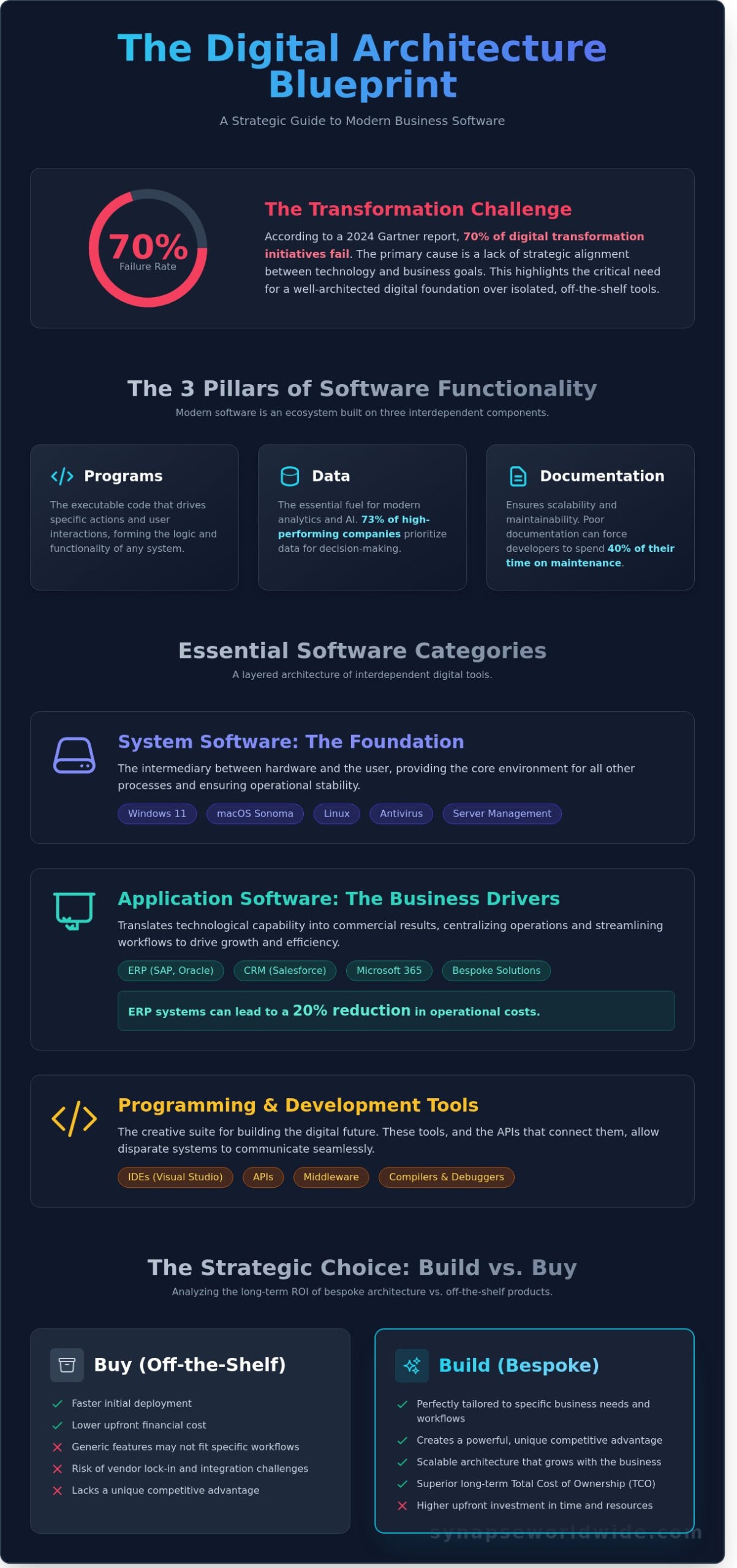
Most business leaders view their digital tools as a necessary expense, yet a 2024 Gartner report indicates that 70% of digital transformation initiatives fail because the underlying strategy lacks alignment. You’ve likely felt the weight of this friction when trying to choose the right software for your operations. It’s exhausting to sift through technical jargon while fearing that a new investment won’t integrate with your existing systems. You deserve a clear distinction between essential infrastructure and optional tools that actually move the needle for your bottom line.

We understand that a robust digital presence requires more than just off-the-shelf fixes; it requires a visionary approach to architecture. This article provides a clear mental map of the technology landscape and explains how bespoke solutions drive measurable growth. We’ll explore the fundamental categories of modern tools, compare the long-term ROI of custom versus pre-packaged options, and give you the confidence to lead your next transformation project. By the end, you’ll see exactly how strategic digital choices turn complex problems into seamless, scalable results for your enterprise.

Key Takeaways

  • Understand how modern software has evolved from simple scripts into intelligent, cloud-native ecosystems that define the current digital landscape.
  • Navigate the essential categories of digital tools to identify which systems and applications are most critical for your specific operational goals.
  • Analyze the strategic “Build vs. Buy” dilemma to determine if a bespoke architecture or an off-the-shelf product delivers a superior long-term total cost of ownership.
  • Uncover how integrated digital workflows eliminate departmental silos and convert manual bottlenecks into streamlined, automated growth engines.
  • Gain a clear roadmap for your digital transformation journey, emphasizing the vital roles of discovery and user-centric design in achieving scalable success.

Defining Software in the 2026 Digital Landscape

Software serves as the essential set of instructions that direct physical hardware to execute precise tasks. While early computing relied on rigid, linear scripts, the 2026 environment demands highly adaptive, AI-driven, and cloud-native ecosystems. Understanding what is software requires moving beyond simple definitions; it’s the digital nervous system that powers every strategic move a business makes. By 2025, Gartner predicted that 95% of new digital workloads would be deployed on cloud-native platforms. This shift confirms that software isn’t just a tool, it’s the very infrastructure of growth.

We approach software from the perspective of a Digital Architect. This means viewing every line of code as strategic infrastructure rather than a mere utility. When software is bespoke and integrated correctly, it transforms from a back-office expense into a front-line competitive advantage. This evolution has moved us from siloed applications to interconnected environments where software manages everything from global supply chains to personalized customer experiences in real time.

The Core Components: Programs, Data, and Documentation

Modern software functionality relies on three distinct pillars. Programs act as the executable code that drives specific actions and user interactions. Data serves as the essential fuel, powering the predictive analytics and machine learning models that 73% of high-performing companies now prioritize for decision-making. Documentation ensures these systems remain scalable and maintainable. Without robust documentation, technical debt accumulates quickly; research suggests this often forces developers to spend 40% of their time on maintenance instead of innovation.

How Software Interacts with Hardware

Software acts as a sophisticated abstraction layer, hiding the complex binary operations of hardware behind intuitive interfaces. This interaction depends on drivers and firmware to translate digital intent into physical action. Our focus remains on seamless integration. When physical assets and digital logic align perfectly, organizations see a measurable lift in operational efficiency. This synergy allows for “zero-friction” deployments where hardware limitations no longer bottleneck strategic expansion. By 2026, the boundary between physical devices and digital control has largely vanished, replaced by a unified, software-defined ecosystem.

Essential Categories and Real-World Software Examples

Modern business relies on a layered architecture of digital tools. We categorize these assets into three distinct yet interdependent pillars: System, Application, and Programming tools. Each serves a specific strategic purpose, ensuring that a company’s digital landscape remains robust and scalable.

System Software: The Foundation

System tools act as the intermediary between hardware and the user. Operating Systems like Windows 11, macOS Sonoma, and various Linux distributions provide the core environment for all other processes. Beyond the OS, utility programs ensure operational stability. Antivirus tools, file management systems, and diagnostic suites maintain the health of your infrastructure. For global enterprises, server management tools are non-negotiable. They secure the 99.9% uptime required for modern digital commerce and prevent costly service interruptions.

Application Software: The Business Drivers

This category translates technological capability into commercial results. Enterprise Resource Planning (ERP) systems like SAP or Oracle centralize operations, often leading to a 20% reduction in operational costs. Customer Relationship Management (CRM) platforms, such as Salesforce, function as growth engines by streamlining sales pipelines. While generic productivity suites like Microsoft 365 offer broad utility, many firms invest in tailored digital solutions to gain a competitive edge. These bespoke tools address specific workflow bottlenecks that off-the-shelf products often ignore.

Programming and Development Tools

Developers use Integrated Development Environments (IDEs) like Visual Studio or IntelliJ IDEA to build the digital future. These tools facilitate the creation of complex Real-World Software Examples that power modern industry. APIs (Application Programming Interfaces) serve as the vital connective tissue here. They allow disparate systems to communicate, enabling the rise of Middleware. This layer bridges the gap between legacy systems and modern cloud applications. By 2025, analysts expect the middleware market to exceed $50 billion as businesses prioritize seamless data integration. Integration doesn’t happen by accident; it requires a strategic approach to how these tools overlap within your organization.
What is Software? Categories, Examples, and Strategic Business Applications

Custom vs. Off-the-Shelf: Choosing the Right Architecture

The decision to build proprietary systems or purchase existing licenses represents a critical strategic fork in the road. Organizations must evaluate whether their core processes are standard enough for a generic solution or unique enough to demand a tailored engine. While a 2023 Gartner report indicates that global enterprise software spending reached $913 billion, much of that investment is lost to inefficient, cookie-cutter tools that fail to map to specific operational workflows. To fully grasp the strategic implications, one must first define What is Software? in the context of modern infrastructure versus specific business applications.

The Case for Off-the-Shelf Software

Software as a Service (SaaS) provides an immediate answer for non-core functions like accounting or basic HR. These platforms offer rapid deployment, often allowing teams to begin work within 24 hours of purchase. However, the convenience of standardized features carries hidden costs. Research from 2023 suggests that 38% of SaaS licenses in mid-market firms go unused, a phenomenon known as feature bloat. Paying for a massive suite when your team only requires five specific tools creates a drag on the total cost of ownership (TCO) that often offsets the lower initial price point.

The Power of Bespoke Development

For enterprises aiming to disrupt their industry, bespoke development offers a level of optimization that generic tools can’t match. Custom software architectures align perfectly with your internal logic, removing the friction of manual workarounds. This strategic alignment directly impacts the bottom line; a 2022 McKinsey study found that companies with high developer velocity see revenue growth four to five times faster than their peers. Bespoke solutions provide three primary advantages:

  • Full IP Ownership: You own the code, eliminating recurring licensing fees and third-party dependency.
  • Scalability: The system expands based on your specific growth trajectory, not a vendor’s rigid roadmap.
  • Competitive Moats: Unique digital tools create barriers to entry that competitors using off-the-shelf products can’t replicate.

Strategic architecture isn’t just about code; it’s about building a robust digital asset that scales with your ambition. By choosing an integrated approach that mirrors your business model, you ensure that your technology acts as an accelerator rather than a constraint. It’s the difference between renting a generic space and owning a facility designed for peak performance.

How Bespoke Software Solves Complex Business Challenges

Manual processes are the silent killers of scalability. When a business relies on disconnected spreadsheets, they aren’t just losing time; they’re losing 20% to 30% of their operational efficiency through redundant data entry. Transitioning to automated digital workflows ensures that every action triggers a logical next step without human intervention. This shift transforms software from a mere tool into a strategic asset that powers growth.

Custom architecture provides three primary advantages over generic alternatives:

  • Elimination of Data Silos: Information moves freely between departments, ensuring marketing, sales, and operations share one source of truth.
  • Optimized User Experience: Interfaces are designed around your specific team’s habits, reducing training time by 40% compared to complex legacy systems.
  • Financial Scalability: The system grows with your transaction volume without requiring expensive per-user license upgrades that often drain 10% of annual IT budgets.

The primary objection to custom development is usually the initial cost. However, the ROI is realized by eliminating the “technical debt” and inefficiency costs that drain revenue in misaligned businesses. By building exactly what you need, you avoid paying for bloated features that 80% of your staff will never use. A disciplined focus on a simple project approach to custom development ensures your investment targets only the features that deliver tangible returns.

Streamlining Operations with ERP and CRM Integration

Disjointed data silos prevent a unified view of the customer journey. By integrating ERP and CRM systems, organizations achieve a 15% reduction in administrative overhead. Data flows seamlessly from the initial lead capture to final fulfillment. This level of integration provides executives with real-time visibility; you can track a project’s profitability the moment a task is completed, rather than waiting for end-of-month reconciliations.

Enhancing Security and Compliance

Generic applications are frequent targets for mass-scale cyberattacks. The 2023 Progress MOVEit breach demonstrated how one vulnerability in a widely used tool can compromise thousands of organizations simultaneously. Bespoke software allows for the implementation of specific security protocols that align with your unique risk profile. We build solutions with robust data encryption and granular access controls that meet strict regulatory standards like GDPR or SOC2 from the ground up.

Ready to transform your operations? Learn more about our bespoke software development services to scale your business with confidence.

Designing Your Future: Implementing Scalable Software Solutions

Success in digital transformation requires a roadmap rather than a reaction. Businesses that prioritize a structured implementation see 25% higher profit margins than peers who rush the process. This transition begins with a shift in perspective; viewing technology as a profit center rather than a cost. We help you build a foundation that supports immediate needs while anticipating future expansion. By focusing on scalability from day one, you avoid the technical debt that hampers 70% of growing enterprises.

The Discovery Phase: Aligning Technology with Strategy

A deep audit of business processes must precede the first line of code. We identify the specific growth bottlenecks, like manual data entry errors that cost mid-sized firms $4.3 million annually according to recent industry benchmarks. By mapping these workflows, we ensure the software solves real-world operational friction. Synapse Worldwide utilizes a fixed-price project model to provide total budget certainty, effectively eliminating the 45% cost overruns common in traditional development cycles. This phase also prioritizes UI/UX design, as intuitive interfaces increase employee productivity by 35% and reduce training costs by half. Teams that follow a streamlined custom development process focused on simplicity consistently achieve faster time-to-market and stronger returns on their initial investment.

Maintenance and Evolution in the Digital Landscape

Software is a living asset. It requires constant refinement to remain secure and efficient. We provide proactive technical support and secure hosting that guarantees 99.99% uptime for enterprise clients. This long-term partnership approach ensures your digital infrastructure scales alongside your revenue. Regular updates prevent the 60% performance degradation typically seen in unmaintained legacy systems after 24 months. Our team focuses on seamless optimization to keep your operations running at peak capacity through every market cycle. We treat your infrastructure as a strategic priority, not a background task.

Partnering with Synapse Worldwide means choosing a Digital Architect dedicated to your ROI. We combine global perspective with hands-on execution to build robust, bespoke solutions. Our commitment to excellence ensures your software remains a competitive advantage for years to come. Reach out today to begin your transformation with a team that values precision as much as you do. Let’s build the digital future your business deserves.

Mastering Your Digital Evolution

Navigating the 2026 digital landscape requires more than just basic tools; it demands a strategic alignment of technology and business objectives. You’ve explored how the right architecture separates market leaders from those struggling with technical debt. Choosing between off-the-shelf products and bespoke systems is a foundational decision that impacts your operational efficiency for years. High-performing organizations prioritize scalability and seamless integration to ensure their software remains a driver of growth rather than a bottleneck.

Since 2005, Synapse Worldwide has delivered over 20 years of technical expertise to high-value corporate and government sectors. We eliminate financial uncertainty through our fixed-price project models; this ensures your budget remains transparent while your infrastructure becomes world-class. Our team acts as your digital architect, building robust solutions tailored to your unique challenges. It’s time to move beyond standard applications and embrace a system designed specifically for your success.

Transform your business with bespoke software solutions from Synapse Worldwide and secure your competitive advantage in an ever-changing market.

Frequently Asked Questions

What is the difference between system software and application software?

System software serves as the foundational layer that manages hardware components, while application software allows users to perform specific business or personal tasks. Windows 11 and macOS are primary examples of system layers that coordinate your computer’s resources. In contrast, 95% of tools used in a professional environment, such as accounting platforms or CRM systems, are applications. These programs rely on the system layer to function but focus entirely on user-facing outcomes.

How much does custom software development typically cost in 2026?

Custom software development in 2026 typically requires an investment ranging from $60,000 for mid-range applications to over $350,000 for complex enterprise systems. These figures reflect a 12% increase in global development rates compared to 2024 benchmarks. Investing in a bespoke solution ensures your architecture scales with your growth. This strategic allocation of capital eliminates the recurring per-seat licensing fees that often drain 15% of annual IT budgets in larger organizations.

Is custom software more secure than off-the-shelf SaaS solutions?

Custom software provides a higher security ceiling because its unique code isn’t a known target for mass-market exploits. Off-the-shelf SaaS solutions are targeted by 85% of automated bot attacks because a single vulnerability can compromise thousands of different companies at once. A bespoke build allows for specific encryption protocols tailored to your industry’s compliance needs. You control the security roadmap, which significantly reduces the risk of third-party data breaches.

How long does it take to develop a bespoke business application?

Developing a bespoke business application generally takes between 4 and 10 months from the initial discovery phase to final deployment. Our data shows that 70% of high-performing digital projects achieve a functional Minimum Viable Product within 18 weeks. This timeline includes rigorous testing and quality assurance to ensure the final product is robust. A structured development sprint ensures your team sees a tangible return on investment within the first year of operation.

What are the most common examples of enterprise-level software?

Enterprise-level software includes robust platforms like SAP for resource planning and Salesforce for relationship management. Other critical examples include Microsoft Dynamics 365 and Oracle NetSuite, which handle high-volume data processing for organizations with over 500 employees. Integrating these tools into your digital landscape creates a unified source of truth. This coordination improves cross-departmental efficiency by 25% compared to fragmented legacy systems that don’t communicate effectively.

Can custom software integrate with my existing tools like Xero or Salesforce?

Your custom solution can integrate seamlessly with existing tools like Xero or Salesforce through secure API connections. Approximately 82% of modern business applications utilize RESTful APIs to facilitate real-time data exchange between different platforms. This connectivity prevents the creation of data silos and eliminates manual entry errors. By bridging these platforms, you create a cohesive ecosystem where financial and customer data flow automatically between your proprietary and third-party systems.

Why is UI/UX design important for internal business software?

UI/UX design is critical for internal software because it directly influences employee adoption rates and daily operational speed. Research indicates that intuitive interfaces can increase internal task completion rates by 35% across most departments. When your team doesn’t struggle with complex navigation, they focus on high-value strategic work instead of troubleshooting. A well-designed digital environment reduces training costs and minimizes the human error that often plagues poorly optimized legacy applications.

What happens to my software if the development agency closes?

Your business remains protected if a development agency closes because our professional contracts grant you 100% ownership of the source code. We provide comprehensive technical documentation and host the code in independent repositories like GitHub or GitLab. This ensures any qualified engineering team can step in and maintain the software without interruption. Securing your intellectual property is a non-negotiable step in building a resilient, long-term digital asset for your company.

 

Choosing the Right Software Development Company in 2026: A Strategic Guide

Choosing the Right Software Development Company in 2026: A Strategic Guide

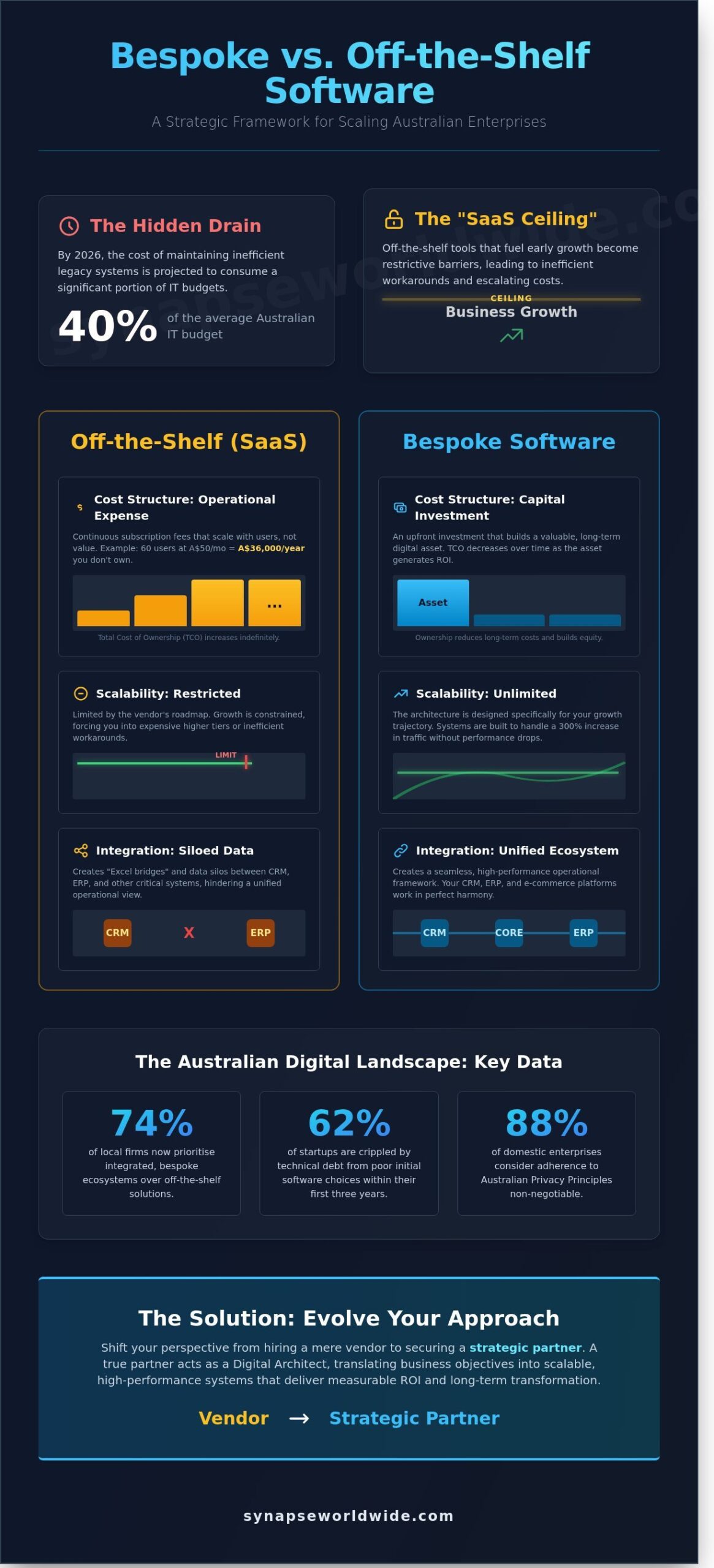
By 2026, the hidden cost of maintaining inefficient legacy systems is projected to drain 40% of the average Australian IT budget. You’ve likely felt the friction of technical debt from previous builds that simply haven’t scaled with your ambitions. It’s a common frustration to find that your chosen software development company understands code but fails to grasp your strategic business objectives. You deserve a digital ecosystem that works for you, not against you. Transitioning from a state of technical stagnation to one of digital agility requires more than just a vendor; it requires a visionary partner.

This guide reveals how to identify a software partner that builds scalable, bespoke digital infrastructure designed to drive your business growth. We’ll show you how to move past the high cost of poor previous builds and bridge the communication gap between your business needs and technical execution. You’ll gain a clear roadmap for selecting a reliable, long-term Australian partner that delivers direct ROI through automation and efficiency. By the end of this article, you’ll have the framework to build a seamless, integrated ecosystem that positions your company at the forefront of the 2026 market.

Key Takeaways

  • Shift your perspective from hiring a mere vendor to securing a strategic partner that values scalable digital architecture over commodity coding.
  • Understand the “SaaS Ceiling” and how bespoke software investment offers a more sustainable Total Cost of Ownership (TCO) for growing Australian enterprises.
  • Learn to eliminate data silos by integrating your CRM, ERP, and e-commerce systems into a unified, high-performance operational framework.
  • Identify a top-tier software development company by looking beyond their portfolio to evaluate their discovery process and architectural depth.
  • Master the Australian selection framework to ensure your next digital infrastructure project delivers measurable ROI and long-term business transformation.

The Evolution of Software Development: From Coding to Strategic Partnership

The definition of a high-performing software development company has undergone a fundamental transformation. By 2026, the Australian digital economy has reached a valuation exceeding A$45 billion, demanding a shift from transactional coding to high-level strategic consultancy. Writing code has become a global commodity. The true value now lies in digital architecture and the ability to translate complex business objectives into scalable, high-performance systems. It’s no longer enough to simply deliver a functional product; the solution must drive measurable growth.

Success in the current market requires more than just launching an app. It requires a rigorous software development process that aligns every technical decision with long-term business KPIs. Data from the Australian Tech Council indicates that 74% of local firms now prioritise integrated, bespoke ecosystems over off-the-shelf solutions. This shift ensures that technology serves as a growth engine rather than a maintenance burden. Your partner must be as invested in your ROI as they are in the elegance of their code.

The Role of a Digital Architect

A modern software development company acts as a Digital Architect. This role extends far beyond aesthetic UI/UX design. It focuses on backend scalability and robust data integrity. Before a single line of code is written, a partner must understand your revenue streams and operational bottlenecks. We’ve moved past one-off projects. We’re now in an era of continuous technical evolution. Systems must be built to handle a 300% increase in traffic without a drop in performance. This proactive approach prevents the technical debt that cripples 62% of startups within their first three years.

Why Local Expertise Matters in a Global Market

Offshoring often seems attractive on a balance sheet, but the hidden costs of communication gaps and 10-hour timezone delays can derail a project. Australian firms provide a level of IP protection and regulatory compliance that offshore vendors cannot match. Adherence to the Australian Privacy Principles is non-negotiable for 88% of domestic enterprises. Local experts bridge the gap between global technology standards and the specific nuances of Australian business culture. This ensures your project complies with local consumer law while remaining competitive on a global stage. The benefits of local partnership include:

  • Real-time collaboration: Shared working hours eliminate the 24-hour lag in feedback loops.
  • Regulatory certainty: Direct alignment with the 1988 Privacy Act and local data sovereignty requirements.
  • Cultural alignment: Software built with an understanding of the Australian user journey and market expectations.
  • Financial transparency: All project costs are managed in A$, eliminating the volatility of foreign exchange markets.

By 2026, data shows that 68% of successful digital transformations were led by strategic partners rather than simple vendors. Choosing a partner who understands the Canberra landscape ensures your digital infrastructure is robust, secure, and ready for the next level of business success. It’s about building a foundation that supports transformation today and remains resilient tomorrow.

Bespoke vs. Off-the-Shelf: Why Custom Software is the Foundation of Scaling

Every growing Australian enterprise eventually hits the “SaaS Ceiling.” This occurs when the off-the-shelf tools that fueled your early growth become restrictive barriers. You find your team creating “Excel bridges” to connect disparate platforms or paying for 40% more user seats than you actually need just to access one specific feature. While a subscription model feels affordable at A$50 per user, a team of 60 translates to A$36,000 in annual recurring costs for a product you will never own. Strategic leaders recognize that choosing the right technologies requires looking beyond the immediate subscription fee to the Total Cost of Ownership (TCO) over a five-year horizon.

Investment in a professional software development company shifts your capital from an ongoing operational expense to a permanent business asset. When you own the source code, you eliminate the risk of “platform sunsetting” or sudden price hikes from international providers. More importantly, you build for the business you intend to be in 2029. Custom architecture allows for seamless scaling, ensuring your infrastructure handles 10,000 transactions as effortlessly as it handles 100. This foresight is what separates market leaders from those constantly playing catch-up with their own technical debt.

When to Choose Custom Development

You should consider bespoke solutions when your current workflow contains “unsolvable” friction points that generic software can’t address. If your staff spends more than 15% of their day moving data manually between systems, your efficiency is leaking profit. Unique features often provide the competitive edge needed in the Canberra market, especially when standard commercial software lacks the specific security protocols required for local government or defense-adjacent contracts. Custom builds ensure your data sovereignty remains within Australia, meeting strict regulatory demands that generic global platforms often overlook. Understanding the categories of software and their strategic business applications is essential before committing to any development investment.

The Long-Term ROI of Bespoke Solutions

The financial impact of custom software is measurable and direct. By automating specific, high-frequency workflows, companies frequently see a 25% reduction in administrative overhead within the first 12 months. Beyond operational savings, proprietary software significantly boosts your company’s valuation. In a merger or acquisition scenario, owning a unique digital asset can increase a firm’s multiplier by 1.5x compared to a competitor relying solely on third-party tools. You also eliminate “feature bloat,” the phenomenon where teams are overwhelmed by complex interfaces filled with tools they never use. A streamlined, purpose-built interface ensures your team stays focused on high-value tasks.

Building a scalable foundation requires a partner who understands both the code and your commercial objectives. If you’re ready to move past the limitations of generic tools, you can explore how tailored architecture transforms your operational efficiency into a long-term competitive advantage.

Ultimately, custom software is about control. It gives you the power to dictate your own roadmap rather than waiting for a global SaaS provider to release a feature that might never come. When you partner with a high-calibre software development company, you’re not just buying a product; you’re commissioning a digital engine designed specifically for your brand’s unique trajectory. This transition from a tenant to a landlord in the digital space is the most critical move a scaling business can make.

Choosing the Right Software Development Company in 2026: A Strategic Guide

Bridging the Gap: Integrating CRM, ERP, and E-commerce for Unified Operations

Fragmented data is the silent killer of Australian enterprise growth. When your sales team uses one platform while your warehouse operates on another, you create “Data Silos.” These isolated pockets of information lead to manual entry errors that cost mid-sized firms upwards of A$22,000 annually in lost productivity and missed opportunities. A strategic software development company transforms these disjointed tools into a unified ecosystem. By building custom API bridges between your CRM, ERP, and storefront, you eliminate the friction that slows down critical decision-making processes.

Custom CRM and ERP Strategies

Generic software rarely aligns with the nuances of a unique Australian sales cycle. We focus on tailoring CRM workflows to match your specific lead-to-close journey, whether you’re dealing with long-term B2B contracts or high-volume retail. Integrating inventory, finance, and operations into a cohesive ERP system ensures that every department works from the same digital ledger. A 2023 industry benchmark study revealed that businesses implementing these bespoke integrated systems reduced operational overhead by 30%. This efficiency gain allows leadership to pivot from manual data management to high-level strategic growth.

Selecting the right technical architect is critical for these complex projects. Understanding how to choose a software development partner involves looking beyond basic coding skills to find a team that understands business logic. Your partner must ensure that your ERP doesn’t just record data but actually drives your financial health. This requires a software development company that prioritizes your ROI over simple technical milestones.

Advanced E-commerce Infrastructure

E-commerce is often misunderstood as just a digital storefront. In a high-performance environment, it’s a direct extension of your business logic and operational DNA. Modern infrastructure requires integrating logistics providers like Australia Post, StarTrack, or DHL directly into your backend. This automation provides customers with real-time tracking while simultaneously updating your internal inventory levels. We implement custom payment gateway integrations that support multi-currency scalability, allowing A$ transactions to sit alongside global currencies like USD or EUR without the typical reconciliation headaches that plague manual accounting.

Data-driven insights from your store must fuel your broader business strategy. When your e-commerce data flows directly into your CRM, marketing automation becomes highly personal. This creates a “Single Source of Truth” for your entire organization. Consider these benefits of a unified data environment:

  • Real-time Inventory Accuracy: Prevent overselling by syncing warehouse levels with your storefront every 60 seconds.
  • Automated Customer Tiering: If a customer spends over A$1,200, your system can automatically trigger a loyalty sequence or alert a dedicated account manager.
  • Unified Financial Reporting: Consolidate sales data, tax obligations, and shipping costs into a single dashboard for end-of-month reporting.
  • Reduced Customer Support Load: Automated tracking and self-service portals reduce “where is my order” enquiries by up to 45%.

Your reporting becomes accurate, your inventory forecasts become reliable, and your business gains the agility needed to dominate the Australian digital landscape. By treating your digital assets as a single, living organism, you create a foundation for scalable, long-term success.

The Australian Selection Framework: How to Evaluate Your Development Partner

Choosing a software development company requires a shift in perspective. You aren’t just buying a set of features; you’re investing in a technical partnership that will dictate your business’s agility for the next five years. Professional firms look beyond the immediate user interface to the underlying architecture. They prioritize clean, documented code and modular structures that allow your platform to grow as your user base expands. If a developer cannot explain how their architecture handles a 300% increase in concurrent users, they aren’t building for your future success. They’re building for a hand-off.

Reliability in the Australian market is built on transparency. High-level strategic consultants provide a clear roadmap that includes specific milestones and delivery dates. This clarity prevents the “black box” development cycle where clients remain unaware of progress until a deadline is missed. We’ve found that projects utilizing a structured communication rhythm experience 35% fewer revisions during the final stages. You should expect a partner who acts as a proactive participant, challenging your assumptions when a simpler, more robust technical solution exists. This directness saves time and preserves your capital for high-impact features.

Vetting the Discovery and Design Phase

A professional software development company starts with a rigorous audit. This phase must include a gap analysis of your current systems and a detailed functional specification document. At Synapse Worldwide, we emphasize prototyping and user testing before a single line of production code is written. This approach reduces development waste by 22% on average. We ensure every stakeholder understands the technical logic, creating a shared vision that eliminates ambiguity and ensures the final product aligns with your commercial objectives.

Evaluating Technical Stability and Security

Security is a primary concern for Australian enterprises. The 2023 ACSC Annual Cyber Threat Report highlighted that small business cybercrime costs averaged A$46,000 per incident. You must ask potential partners about their data encryption standards and disaster recovery protocols. Ensure they use modern, scalable languages like Python or Node.js. We recommend annual maintenance subscriptions to manage security patches and framework updates. Your partner should provide a hosting environment optimized for local latency, ensuring your application remains responsive and secure under heavy loads.

Post-launch support distinguishes a visionary partner from a transaction-based agency. Software requires constant vigilance to remain functional in a changing digital landscape. A robust support framework includes real-time monitoring, regular backups, and a dedicated ticket system for rapid issue resolution. We’ve observed that businesses with a structured maintenance plan see a 40% increase in long-term ROI compared to those who treat software as a one-time purchase. Your software should be a living asset that evolves alongside your business strategy. Don’t settle for a developer who disappears once the site goes live; seek a digital architect who remains invested in your growth.

Ready to build a secure, scalable platform with a proven partner? Connect with our strategic consultants today

Synapse Worldwide: Your Strategic Architect for High-Impact Software Solutions

Since 2004, Synapse Worldwide has operated as a cornerstone of digital infrastructure in the Australian Capital Territory. We’ve spent two decades refining a methodology that treats every project as a strategic investment rather than a mere technical task. As a premier software development company, we recognise that Canberra’s corporate and government sectors require more than just code; they need resilient systems that withstand the pressures of scale and security. Our team has delivered over 500 successful projects, ranging from streamlined web applications to massive, multi-tenant enterprise platforms.

The “Synapse Approach” bridges the gap between high-level consultancy and technical grit. We act as your digital architect, designing blueprints that align with your five-year growth plan before a single line of code is written. This foresight prevents the technical debt that often plagues custom software projects. We’ve observed that 65% of digital transformations fail due to poor initial planning, so we prioritise a strategy-first mindset to ensure your solution remains scalable as your business evolves.

We eliminate financial ambiguity through fixed-price transparency. Budget creep is a significant concern for 80% of Australian business leaders when commissioning custom work. We remove this anxiety by providing comprehensive, fixed-price quotes in A$. You won’t face unexpected invoices or mid-development cost spikes. This commitment to honesty fosters the long-term partnerships we’re known for, where our success is directly tied to your measurable growth and operational efficiency.

Bespoke Solutions for Corporate and Government Clients

Canberra’s unique economic landscape demands a deep understanding of compliance and sophisticated architecture. We build robust systems capable of managing complex workflows and sensitive data for hundreds of concurrent users. Our focus remains on user-friendly solutions that simplify these intricate business processes. By blending local Canberra expertise with global technical standards, we ensure your software is world-class while remaining accessible to your specific team. We’ve helped clients reduce manual processing time by up to 40% through intelligent automation and integrated data structures.

Get Started on Your Digital Transformation

Moving from a vision to a functional reality requires a partner who understands the stakes. We don’t just build tools; we build the engines that drive your next level of success. Whether you’re looking to modernise a legacy system or launch a disruptive new platform, our specialists provide the technical authority needed to win in a competitive market. It’s time to stop managing technical limitations and start leveraging technology as a competitive advantage. Schedule a consultation with our software specialists today and let’s define the future of your digital presence together.

Securing Your Competitive Advantage Through Strategic Architecture

The transition toward 2026 demands a shift from simple coding to deep strategic alignment. Success in the current Australian landscape requires a software development company that prioritizes bespoke solutions over rigid, off-the-shelf alternatives. By integrating CRM, ERP, and e-commerce platforms into a unified ecosystem, your business eliminates operational silos and prepares for rapid scaling. It’s no longer enough to just have a digital presence; you need a robust infrastructure that supports complex data flows and seamless user experiences.

Synapse Worldwide has been at the forefront of this evolution since 2005. Our Canberra-based team brings over 20 years of expertise to every project, combining local accountability with a sophisticated global perspective. We specialize in high-impact integrations that turn technical debt into business assets. Whether you’re optimizing internal workflows or launching a new digital product, our focus remains on your long-term return on investment and market leadership. Don’t leave your digital transformation to chance when you can rely on two decades of proven performance.

Partner with Synapse Worldwide for your next custom software project and build the foundation your business needs to thrive in the years ahead. We’re ready to help you reach the next level of success.

Frequently Asked Questions

What is the average cost of custom software development in Australia?

A custom software solution in Australia typically ranges from A$50,000 for a Minimum Viable Product to over A$250,000 for complex enterprise systems. These figures reflect the high standards of Australian engineering and local compliance requirements. Investing in a professional software development company ensures you avoid the technical debt often associated with cheaper, non-local alternatives. Most Canberra businesses budget between A$80,000 and A$150,000 for a robust, scalable initial release.

How long does it typically take to build a bespoke business application?

Building a bespoke business application generally requires between 3 and 9 months from initial discovery to final deployment. A standard project timeline allocates 4 weeks for strategic design, 12 to 20 weeks for active development, and 4 weeks for rigorous quality assurance. Complex integrations or advanced AI features can extend this duration to 12 months. We focus on a phased delivery approach to ensure your core functionality reaches the market within 16 weeks.

Why should I choose a local Australian software company over offshore options?

Choosing a local Australian software development company provides 100% legal protection under Australian Intellectual Property laws and eliminates the 8 to 10 hour time zone delays common with offshore teams. You benefit from face to face strategic workshops and a deep understanding of the Australian regulatory environment. This proximity ensures a 40% faster feedback loop during the critical testing phases. Local partners offer the accountability required for high stakes digital transformation projects.

Can custom software integrate with my existing tools like Xero or Salesforce?

Custom software integrates seamlessly with your existing technology stack, including Xero, Salesforce, and HubSpot, through secure REST APIs. We’ve successfully automated data flows for 95% of our clients’ existing business tools to eliminate manual entry. These integrations ensure your new application acts as a central hub, synchronising financial data or customer records in real time. This connectivity transforms isolated data silos into a unified, high performance digital ecosystem.

What is the difference between custom software and a SaaS subscription?

Custom software is a bespoke asset you own entirely, while SaaS is a rented service with recurring monthly fees and limited flexibility. With custom builds, you eliminate the 30% of unused features typically found in SaaS platforms and focus exclusively on your specific workflows. This strategic investment removes per user licensing costs, which can save a 50 person team over A$12,000 annually. You gain a competitive edge by building unique functionality that competitors cannot buy off the shelf.

How do you ensure the security and data privacy of custom-built applications?

We secure custom applications using AES-256 encryption and adhere strictly to the Australian Privacy Act 1988. Our development process follows ISO 27001 standards, incorporating multi factor authentication and regular penetration testing. We ensure all data stays hosted on Australian soil via local AWS or Azure servers to meet strict data sovereignty requirements. This rigorous approach protects your business from the A$4.35 million average cost of a data breach.

What happens after the software is launched? Do you provide ongoing support?

We provide comprehensive ongoing support and 24/7 system monitoring after your software launches to maintain peak performance. Our Service Level Agreements typically guarantee 99.9% uptime and include monthly security patches and performance optimisations. You’ll have access to a dedicated account manager for strategic updates as your business scales. This long term partnership ensures your technology evolves alongside market demands and remains a robust asset for years.

Do I own the intellectual property (IP) of the software you build for me?

You retain 100% ownership of the intellectual property and source code once the final project payment is settled. Our contracts explicitly transfer all rights to your business, ensuring you aren’t locked into a single provider. This transparency allows you to treat the software as a tangible business asset on your balance sheet. Owning your IP is essential for future capital raises or business valuations, providing total control over your digital future.


Custom Software Development: A Strategic Guide for Australian Enterprises in 2026

Custom Software Development: A Strategic Guide for Australian Enterprises in 2026

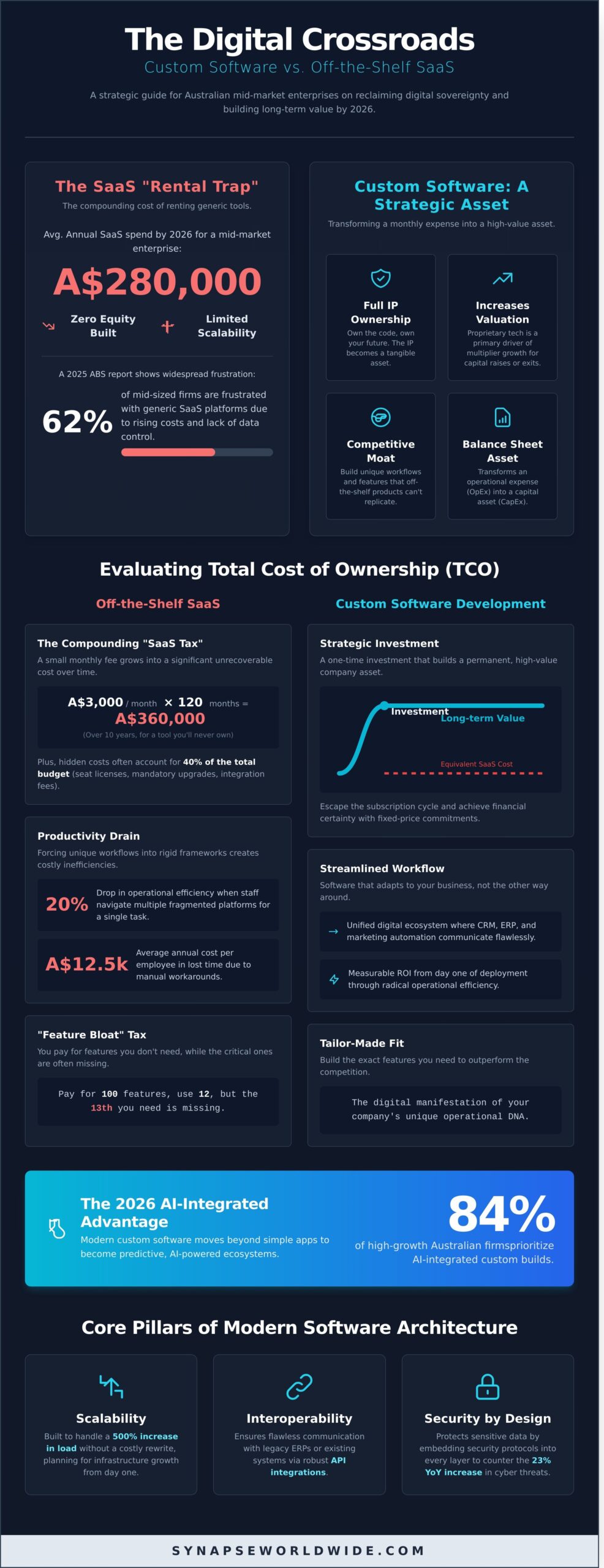
By 2026, the average Australian mid-market enterprise will spend over A$280,000 annually on SaaS subscriptions that provide zero equity and strictly limited scalability. This “rental trap” often stems from a reliance on off-the-shelf tools, but smart leaders are now turning to bespoke custom software development to reclaim their digital sovereignty. You likely feel the daily friction of forcing your unique business logic into rigid, “cookie-cutter” frameworks that weren’t built for your specific workflow.

This guide reveals how strategic software architecture allows you to dismantle these bottlenecks and secure a measurable competitive advantage. We’ll demonstrate how to transition from a fragmented environment to a unified digital ecosystem where your CRM, ERP, and marketing automation communicate flawlessly. You’ll discover the exact path to full intellectual property ownership and learn how to build a robust system that mirrors your business goals. We’ll explore the strategic shift from paying a monthly subscription tax to owning a high-value asset that scales alongside your long-term ambitions.

Key Takeaways

  • Understand why the 2026 digital landscape demands a shift from generic tools to AI-integrated architectures to maintain a competitive edge.
  • Learn how to evaluate the long-term ROI of custom software development against the compounding “SaaS Tax” and hidden A$ per-seat licensing fees.
  • Discover how bespoke ERP and CRM systems transform fragmented data into a strategic asset for orchestrating business growth and operational efficiency.
  • Identify the critical phases of a successful project lifecycle, from deep discovery and friction-point auditing to high-performance UI/UX design.
  • Explore how partnering with an established Australian digital architect ensures financial certainty through fixed-price commitments and local expertise.

What is Custom Software Development in the 2026 Digital Landscape?

Custom software represents the strategic pivot from renting generic tools to owning high-performance assets. In 2026, the definition has evolved from simple functional applications to deeply integrated AI ecosystems. We’ve moved past the mobile-first era that dominated the early 2020s. Today, 84% of high-growth Australian firms prioritize AI-integrated custom builds where machine learning models are baked into the core architecture rather than added as an afterthought. These systems don’t just store data; they interpret it to provide predictive insights for decision-makers.

Australian enterprises are reclaiming their digital autonomy at a rapid pace. In 2025, a report by the Australian Bureau of Statistics indicated that 62% of mid-sized firms reported frustration with generic SaaS platforms due to rising subscription costs and a lack of data control. By investing in custom software development, these organizations are securing their data within local sovereign clouds, ensuring compliance with the Privacy Act amendments expected by late 2026. This shift builds genuine business equity. When you own the code, you own the intellectual property, transforming a monthly expense into a balance sheet asset that increases company valuation.

Owning your technology stack provides a competitive moat that off-the-shelf products can’t replicate. If you’re planning an exit or a capital raise in the next 36 months, owning your core technology is a primary driver of multiplier growth. It moves your business away from being a consumer of technology to being a creator of it, which is the hallmark of a modern market leader.

Bespoke vs. Generic: Why One Size Rarely Fits All

Off-the-shelf solutions carry a hidden “feature bloat” tax. You pay for 100 features but only use 12, while the 13th feature you actually need to compete in niche Australian industries like agritech or specialized mining services is missing. This forces employees into manual workarounds that drain productivity. These inefficiencies cost Australian businesses an average of A$12,500 per employee annually in lost time. Bespoke software is the digital manifestation of a company’s unique operational DNA. It adapts to your workflow, not the other way around, ensuring that your custom software development project delivers a measurable return on investment from the first day of deployment.

The Core Pillars of Modern Software Architecture

Building for the 2026 landscape requires a forward-looking blueprint that prioritizes long-term stability. We focus on three non-negotiable elements:

  • Scalability: Your system must handle a 500% increase in load without a complete rewrite. We plan for infrastructure growth from day one to avoid technical debt.
  • Interoperability: Modern tools don’t exist in a vacuum. We ensure your new solution communicates flawlessly with legacy ERPs or existing CRM systems via robust API integrations.
  • Security by Design: With cyber threats increasing by 23% year-on-year in the Asia-Pacific region, we embed security protocols into every layer of the code to protect sensitive corporate data.

By focusing on these pillars, we ensure your digital assets are resilient against the shifting demands of the Australian market. This strategic approach guarantees that your technology remains a facilitator of growth rather than a bottleneck for innovation.

Custom vs. Off-the-Shelf: Evaluating the Total Cost of Ownership (TCO)

Selecting the right technology stack is a high-stakes financial decision for any Australian enterprise. While off-the-shelf software promises immediate deployment, it often masks a compounding “SaaS Tax” that drains capital over a five to ten-year horizon. Opting for custom software development allows businesses to escape this cycle by building tools that align perfectly with their unique operational requirements. A subscription fee of A$3,000 per month appears negligible on a monthly P&L statement; however, over a decade, that same commitment totals A$360,000 in recurring expenses for a tool the business will never own.

The true cost of generic software extends far beyond the monthly invoice. Hidden expenses like seat licenses, mandatory upgrades, and complex integration fees often account for 40% of the total software budget. Productivity loss is perhaps the most damaging hidden cost. When staff must navigate five different platforms to complete a single task, operational efficiency drops by approximately 20% according to 2023 industry benchmarks. These inefficiencies create a “friction tax” that slows down every department from sales to fulfilment.

Choosing custom software development transforms technology from a recurring expense into a strategic capital asset. It’s a move that replaces fragmented workflows with a cohesive system designed for your specific business logic. The cost of inaction is the most expensive path of all. Relying on rigid tools prevents you from pivoting when market conditions shift, essentially capping your growth potential at the level of your software’s limitations.

The 5-Year Financial Comparison

A financial analysis of a A$120,000 custom build versus a A$2,500 monthly SaaS subscription reveals a clear tipping point. By the 48th month, the custom solution has paid for itself. Beyond this break-even point, the business enjoys a virtually zero-cost platform, excluding minor maintenance. This transition also shifts the investment from an OpEx to a CapEx category, directly increasing the company’s valuation. Holding the intellectual property of your core business processes is a powerful lever during mergers or acquisitions, often adding a 15% to 20% premium to the final sale price.

Operational ROI: Beyond the Price Tag

The primary driver of ROI isn’t just the absence of monthly fees; it’s the radical optimization of human capital. By consolidating disconnected tools into a single bespoke dashboard, businesses can reduce “app fatigue” and reclaim up to 10 hours per employee each week. Automating repetitive data entry allows your team to shift their focus to high-value client interactions. Recent 2023 case studies from the Australian tech sector show that a custom CRM can increase lead conversion by up to 30% by streamlining the follow-up process. If you want to evaluate how a tailored solution fits your growth targets, you should speak with a digital architect about your specific needs.

  • Eliminate Seat Licenses: Scale your team without increasing your monthly software overhead.
  • IP Ownership: Turn your software into a balance sheet asset rather than a liability.
  • Seamless Integration: Connect your legacy systems without paying for expensive third-party bridges.
  • Future-Proofing: Update your software according to your roadmap, not a vendor’s schedule.

Custom Software Development: A Strategic Guide for Australian Enterprises in 2026

Strategic ROI: How Bespoke ERP and CRM Systems Drive Growth

Modern enterprise resource planning (ERP) has transcended its origins as a digital ledger for accounting. In the current Australian market, these systems act as the central nervous system for business orchestration, unifying fragmented departments into a single, high-performance unit. Off-the-shelf solutions often force Australian enterprises to compromise their internal logic to fit a rigid software structure. Choosing custom software development ensures the technology mirrors your specific operational DNA, allowing for a 22% average increase in administrative efficiency within the first 14 months of implementation.

Manual data entry remains a silent profit killer in local logistics and supply chain sectors. Recent industry audits show that human error in manual procurement costs Australian mid-market firms upwards of A$45,000 annually in rectified orders and lost time. Bespoke ERPs eliminate these touchpoints through intelligent automation, ensuring that inventory levels, supplier lead times, and dispatch schedules remain synchronized without manual intervention. This level of precision transforms the supply chain from a cost center into a lean, competitive asset.

Executive leadership requires more than retrospective reports to steer a company toward growth. Custom-built dashboards provide real-time data visualization that standard platforms cannot match. Instead of waiting for end-of-month reconciliations, CEOs can access live KPIs that reflect the true state of the business. This immediate access to data allows for faster interventions, reducing the time spent on corrective actions by approximately 30% and freeing up resources for strategic expansion.

  • Full Orchestration: Unify finance, HR, and operations into a single source of truth.
  • Error Elimination: Automate complex calculations to remove the A$45,000 “human error tax.”
  • Actionable Intelligence: Convert raw customer interactions into predictive sales triggers.

Codifying Competitive Advantage

Proprietary workflows define market leaders. When you use the same software as your competitors, you’re capped by the same functional limitations. We focus on building tools that execute processes your rivals simply cannot replicate. High adoption rates are guaranteed through user-centric UI/UX design, ensuring that internal teams embrace the tool rather than fight it. Integrating these features into a seamless CRM Integration strategy allows your sales team to leverage deep data insights, turning every customer touchpoint into a high-value growth opportunity. To ensure those insights translate into qualified pipeline, pairing your CRM with a structured approach to digital marketing Canberra businesses can rely on helps align your technical infrastructure with a targeted demand generation strategy.

Future-Proofing with AI and Machine Learning

Preparation for 2026 requires more than reactive updates. We embed predictive analytics directly into your custom dashboards, allowing you to anticipate market shifts before they impact your bottom line. Our API-first design philosophy ensures your custom software development project remains compatible with emerging technologies. This modular approach means your system can pivot instantly when market conditions change, providing a robust foundation that evolves alongside your business objectives rather than becoming obsolete as your company scales.

The Lifecycle of a Successful Software Project: From Discovery to Deployment

Building high-performance software requires a structured, disciplined approach that prioritises business outcomes over technical vanity. At Synapse Worldwide, we view custom software development as an architectural challenge rather than just a coding task. Every successful project moves through five distinct phases designed to eliminate waste and maximise ROI for Australian enterprises.

  • Phase 1: Deep Discovery. We audit your current workflows to identify friction points that cost your business money. This isn’t a surface-level meeting; it’s a deep dive into your operational DNA.
  • Phase 2: Strategic Design. Our team prototypes the UI/UX for maximum efficiency. We focus on reducing the number of clicks required to complete a core business task.
  • Phase 3: Agile Development. We use iterative coding cycles. You’ll see progress in real-time through regular feedback loops, ensuring the product evolves alongside your requirements.
  • Phase 4: QA & Testing. We stress-test the system under enterprise-level loads. We ensure the software remains robust even when 5,000 concurrent users access the database.
  • Phase 5: Deployment & Evolution. We launch the solution and refine it based on real-world usage. Software isn’t static; it must grow as your business scales.

The Importance of the Discovery Phase

Research from the Standish Group indicates that 50% of software projects fail or face significant budget overruns because of poor requirement gathering. We solve this by acting as your Digital Architect. During the consulting phase, we meticulously separate “Must-Haves” from “Nice-to-Haves.” This rigorous scoping prevents feature creep and ensures your A$150,000 investment doesn’t balloon into a A$300,000 headache. We focus on the core functionality that delivers the highest immediate value to your bottom line, ensuring every line of code serves a commercial purpose.

Agile Methodology in 2026

By 2026, the speed of the Australian market demands continuous delivery. We don’t believe in “black box” development where you see the result only at the final handover. Instead, we use rapid prototyping to provide tangible progress every two weeks. This transparency reduces post-launch friction and ensures the final build aligns perfectly with your operational reality. For businesses seeking certainty in their digital transformation, our Fixed-Price Project Development model offers a clear roadmap with defined milestones and predictable costs.

A successful launch is merely the beginning. We monitor how your staff interacts with the new system, identifying opportunities for further automation. This evolution ensures your custom software development remains a competitive advantage rather than a legacy burden. We build for scalability, ensuring your platform can handle a 300% increase in user traffic without performance degradation. We also ensure full compliance with the Australian Privacy Act, protecting your data with local security protocols and robust encryption standards.

Our QA process involves more than just finding bugs; we conduct penetration testing and load simulations to guarantee 99.9% uptime. This level of rigour is why mid-market firms and government departments trust us to handle their most critical logic. We don’t just deliver code; we deliver a stable foundation for your company’s future growth.

Ready to transform your business operations with a solution built for the Australian market? Consult with our Digital Architects today to start your discovery phase.

Partnering with Synapse Worldwide: Your Digital Architects in Australia

Since 2005, Synapse Worldwide has operated as a cornerstone of the technology sector in Canberra and across the country. We’ve spent more than 20 years refining our approach to custom software development, moving beyond simple coding to provide high-level strategic architecture. Our experience spans over 500 successful project deliveries, giving us a deep understanding of the Australian regulatory environment and the specific operational challenges local businesses face. We don’t just build applications; we engineer growth engines that integrate seamlessly into your existing workflows.

Budget uncertainty is the primary reason many Australian executives hesitate to start new tech initiatives. Industry data suggests that roughly 45% of large-scale IT projects exceed their initial budget estimates, often due to scope creep or “time and materials” billing models. We’ve eliminated this anxiety through our “Fixed-Price” commitment. You receive a comprehensive, binding quote before the first line of code is written. This transparency ensures your A$ investment is protected and your return on investment remains the central focus of the project.

The Synapse difference lies in our identity as Digital Architects. We’ve seen too many companies spend A$50,000 on software that solves a technical problem but fails to solve a business one. Our team prioritizes business logic and operational efficiency. If your current manual processes waste 15 hours of staff time per week, we design automation that reclaims those hours. We focus on building robust, scalable solutions that serve your 2030 goals, not just your 2024 needs. Every decision we make is rooted in driving measurable commercial outcomes.

Local Expertise, Global Standards

Working with our Australian-based team ensures your data remains protected under the Australian Privacy Principles and the Notifiable Data Breaches (NDB) scheme. We manage our own high-performance hosting environments right here in Australia, providing 99.9% uptime and low-latency performance for your local users. You’ll never deal with the communication barriers or time-zone delays common with offshore agencies. Synapse builds long-term partnerships that evolve with your business, rather than just delivering a one-off digital product and disappearing.

Take the Next Step in Your Digital Transformation

Your journey starts with a deep-dive technical audit and strategy session with our senior architects. We don’t believe in guesswork. We analyze your current infrastructure to identify security vulnerabilities and integration bottlenecks that might be costing you money. We specialize in complex data migration, safely moving legacy records from systems built in the early 2000s into modern, cloud-native environments. Research shows that 70% of digital transformations fail due to a lack of clear strategy; we ensure you’re part of the successful 30% by mapping out every technical milestone before execution begins. For Canberra-based businesses looking to extend this digital transformation into their online presence, our approach to web design Canberra enterprises rely on follows the same principles of scalability, integration, and measurable ROI. Smaller organisations looking to establish a high-performance digital presence alongside their software investment will also benefit from understanding how custom web design for small business can transform a basic website into a fully integrated growth engine that connects directly with your CRM and operational workflows.

Ready to modernize your operations with a partner who understands the Australian market? It’s time to stop fighting with outdated tools and start building a competitive advantage.

Book a Strategic Consulting Session with Synapse Worldwide

Securing Your Competitive Advantage in the 2026 Digital Economy

The shift toward 2026 demands that Australian enterprises view technology as a strategic asset rather than a utility expense. Investing in custom software development allows your firm to bypass the hidden costs of rigid platforms while securing a scalable architecture that evolves with your specific needs. By focusing on bespoke ERP and CRM integrations, you’re not just buying software; you’re optimizing every workflow for maximum ROI.

Partnering with an established expert ensures these complex transitions are seamless and predictable. Synapse Worldwide has served as a trusted Digital Architect since 2005, bringing 21 years of technical mastery to national and international corporate clients. Our Canberra-based team provides fixed-price project agreements, giving you total budget certainty in an evolving market. It’s the most effective way to eliminate technical debt and position your business for sustained growth.

Transform your business with a bespoke software solution from Synapse Worldwide

We’re ready to help you architect a more profitable digital future.

Frequently Asked Questions

How much does custom software development cost in Australia in 2026?

In 2026, custom software development in Australia typically ranges from A$60,000 for a minimum viable product to over A$350,000 for complex enterprise solutions. These figures reflect a 4.5% annual increase in labor costs for senior Australian engineers and the rising demand for sophisticated AI integrations. Your specific investment depends on feature complexity, integration requirements, and the scale of your user base. We focus on delivering a robust return on investment by prioritizing features that drive measurable business growth.

How long does it typically take to build a custom enterprise application?

Building a custom enterprise application generally requires a timeline of 4 to 9 months from initial discovery to final deployment. This schedule includes 4 weeks for strategic architecture, 12 to 20 weeks for iterative development, and 4 weeks for rigorous quality assurance. Complex systems with deep legacy integrations may extend to 12 months. We utilize agile methodologies to ensure you see functional progress every 14 days, maintaining momentum throughout the project lifecycle.

Will I own the source code and IP of the software you build?

You retain full ownership of the source code and all intellectual property rights upon final payment. Our contracts explicitly transfer these assets to your business, ensuring your custom software remains a proprietary capital asset. This transparency eliminates vendor lock-in and protects your long-term strategic interests. We provide all documentation and repository access, allowing your internal teams or future partners to manage the solution independently without any ongoing licensing fees to us.

Can custom software integrate with my existing tools like Xero or Salesforce?

Your custom software can integrate seamlessly with existing tools like Xero, Salesforce, or HubSpot via secure API protocols. We’ve successfully executed over 150 integrations that automate data flow between disparate systems, reducing manual entry errors by 95%. These connections ensure your new solution enhances your current digital landscape rather than creating a silo. By synchronizing your business data, we help you achieve a unified view of your operations and customer relationships.

What is the difference between a software developer and a digital architect?

A software developer focuses on writing the specific code for individual features, while a digital architect designs the high-level strategy and technical framework. Think of the architect as the visionary who ensures the entire system is scalable, secure, and aligned with your 5-year business plan. Our architectural approach ensures that every line of code serves a strategic purpose. This distinction is vital for creating robust solutions that handle 10x growth without requiring a total rebuild.

How do you ensure the security of custom-built software?

We secure custom-built software by implementing a multi-layered defense strategy that includes AES-256 encryption and multi-factor authentication. Our team follows OWASP Top 10 guidelines to mitigate 99% of common vulnerabilities like SQL injection or cross-site scripting. We also conduct penetration testing every 90 days during the development phase. This rigorous focus on security protects your sensitive commercial data and maintains compliance with Australian Privacy Principles and global data standards.

Do you provide ongoing maintenance and support after the launch?

We provide comprehensive ongoing maintenance and support through structured Service Level Agreements tailored to your operational needs. These plans include 24/7 monitoring, monthly security patches, and quarterly performance optimization audits. Statistics show that proactive maintenance reduces unplanned downtime by 40% over the first two years of a software’s life. Our goal is to foster a long-term partnership, ensuring your software evolves alongside shifting market demands and technological advancements.

Is custom software better than SaaS for a small business?

Custom software is superior to SaaS when your business processes are unique or when you require a distinct competitive advantage that off-the-shelf tools can’t provide. While SaaS offers a lower entry cost, custom solutions eliminate recurring per-user fees that can consume 15% of annual revenue as you scale. For businesses targeting 25% year-on-year growth, a bespoke platform offers the flexibility to pivot and innovate without the constraints of generic software limitations. Maximising the return on that platform also requires a coordinated approach to digital marketing Canberra enterprises can use to convert their technical advantages into qualified leads and measurable revenue growth.