
Tag Archives: business strategy


What is Software? Categories, Examples, and Strategic Business Applications

What is Software? Categories, Examples, and Strategic Business Applications

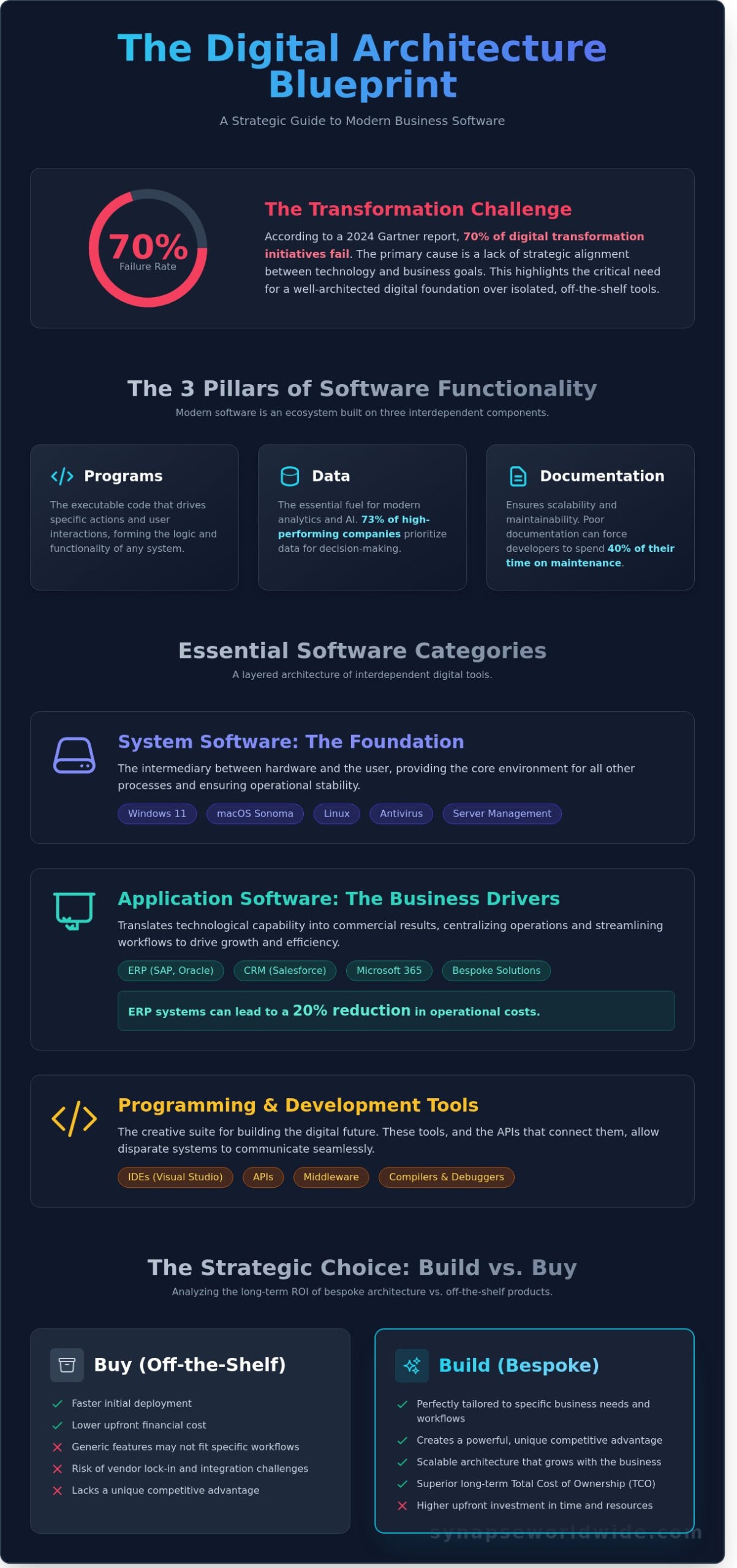
Most business leaders view their digital tools as a necessary expense, yet a 2024 Gartner report indicates that 70% of digital transformation initiatives fail because the underlying strategy lacks alignment. You’ve likely felt the weight of this friction when trying to choose the right software for your operations. It’s exhausting to sift through technical jargon while fearing that a new investment won’t integrate with your existing systems. You deserve a clear distinction between essential infrastructure and optional tools that actually move the needle for your bottom line.

We understand that a robust digital presence requires more than just off-the-shelf fixes; it requires a visionary approach to architecture. This article provides a clear mental map of the technology landscape and explains how bespoke solutions drive measurable growth. We’ll explore the fundamental categories of modern tools, compare the long-term ROI of custom versus pre-packaged options, and give you the confidence to lead your next transformation project. By the end, you’ll see exactly how strategic digital choices turn complex problems into seamless, scalable results for your enterprise.

Key Takeaways

  • Understand how modern software has evolved from simple scripts into intelligent, cloud-native ecosystems that define the current digital landscape.
  • Navigate the essential categories of digital tools to identify which systems and applications are most critical for your specific operational goals.
  • Analyze the strategic “Build vs. Buy” dilemma to determine if a bespoke architecture or an off-the-shelf product delivers a superior long-term total cost of ownership.
  • Uncover how integrated digital workflows eliminate departmental silos and convert manual bottlenecks into streamlined, automated growth engines.
  • Gain a clear roadmap for your digital transformation journey, emphasizing the vital roles of discovery and user-centric design in achieving scalable success.

Defining Software in the 2026 Digital Landscape

Software serves as the essential set of instructions that direct physical hardware to execute precise tasks. While early computing relied on rigid, linear scripts, the 2026 environment demands highly adaptive, AI-driven, and cloud-native ecosystems. Understanding what is software requires moving beyond simple definitions; it’s the digital nervous system that powers every strategic move a business makes. By 2025, Gartner predicted that 95% of new digital workloads would be deployed on cloud-native platforms. This shift confirms that software isn’t just a tool, it’s the very infrastructure of growth.

We approach software from the perspective of a Digital Architect. This means viewing every line of code as strategic infrastructure rather than a mere utility. When software is bespoke and integrated correctly, it transforms from a back-office expense into a front-line competitive advantage. This evolution has moved us from siloed applications to interconnected environments where software manages everything from global supply chains to personalized customer experiences in real time.

The Core Components: Programs, Data, and Documentation

Modern software functionality relies on three distinct pillars. Programs act as the executable code that drives specific actions and user interactions. Data serves as the essential fuel, powering the predictive analytics and machine learning models that 73% of high-performing companies now prioritize for decision-making. Documentation ensures these systems remain scalable and maintainable. Without robust documentation, technical debt accumulates quickly; research suggests this often forces developers to spend 40% of their time on maintenance instead of innovation.

How Software Interacts with Hardware

Software acts as a sophisticated abstraction layer, hiding the complex binary operations of hardware behind intuitive interfaces. This interaction depends on drivers and firmware to translate digital intent into physical action. Our focus remains on seamless integration. When physical assets and digital logic align perfectly, organizations see a measurable lift in operational efficiency. This synergy allows for “zero-friction” deployments where hardware limitations no longer bottleneck strategic expansion. By 2026, the boundary between physical devices and digital control has largely vanished, replaced by a unified, software-defined ecosystem.

Essential Categories and Real-World Software Examples

Modern business relies on a layered architecture of digital tools. We categorize these assets into three distinct yet interdependent pillars: System, Application, and Programming tools. Each serves a specific strategic purpose, ensuring that a company’s digital landscape remains robust and scalable.

System Software: The Foundation

System tools act as the intermediary between hardware and the user. Operating Systems like Windows 11, macOS Sonoma, and various Linux distributions provide the core environment for all other processes. Beyond the OS, utility programs ensure operational stability. Antivirus tools, file management systems, and diagnostic suites maintain the health of your infrastructure. For global enterprises, server management tools are non-negotiable. They secure the 99.9% uptime required for modern digital commerce and prevent costly service interruptions.

Application Software: The Business Drivers

This category translates technological capability into commercial results. Enterprise Resource Planning (ERP) systems like SAP or Oracle centralize operations, often leading to a 20% reduction in operational costs. Customer Relationship Management (CRM) platforms, such as Salesforce, function as growth engines by streamlining sales pipelines. While generic productivity suites like Microsoft 365 offer broad utility, many firms invest in tailored digital solutions to gain a competitive edge. These bespoke tools address specific workflow bottlenecks that off-the-shelf products often ignore.

Programming and Development Tools

Developers use Integrated Development Environments (IDEs) like Visual Studio or IntelliJ IDEA to build the digital future. These tools facilitate the creation of complex Real-World Software Examples that power modern industry. APIs (Application Programming Interfaces) serve as the vital connective tissue here. They allow disparate systems to communicate, enabling the rise of Middleware. This layer bridges the gap between legacy systems and modern cloud applications. By 2025, analysts expect the middleware market to exceed $50 billion as businesses prioritize seamless data integration. Integration doesn’t happen by accident; it requires a strategic approach to how these tools overlap within your organization.
What is Software? Categories, Examples, and Strategic Business Applications

Custom vs. Off-the-Shelf: Choosing the Right Architecture

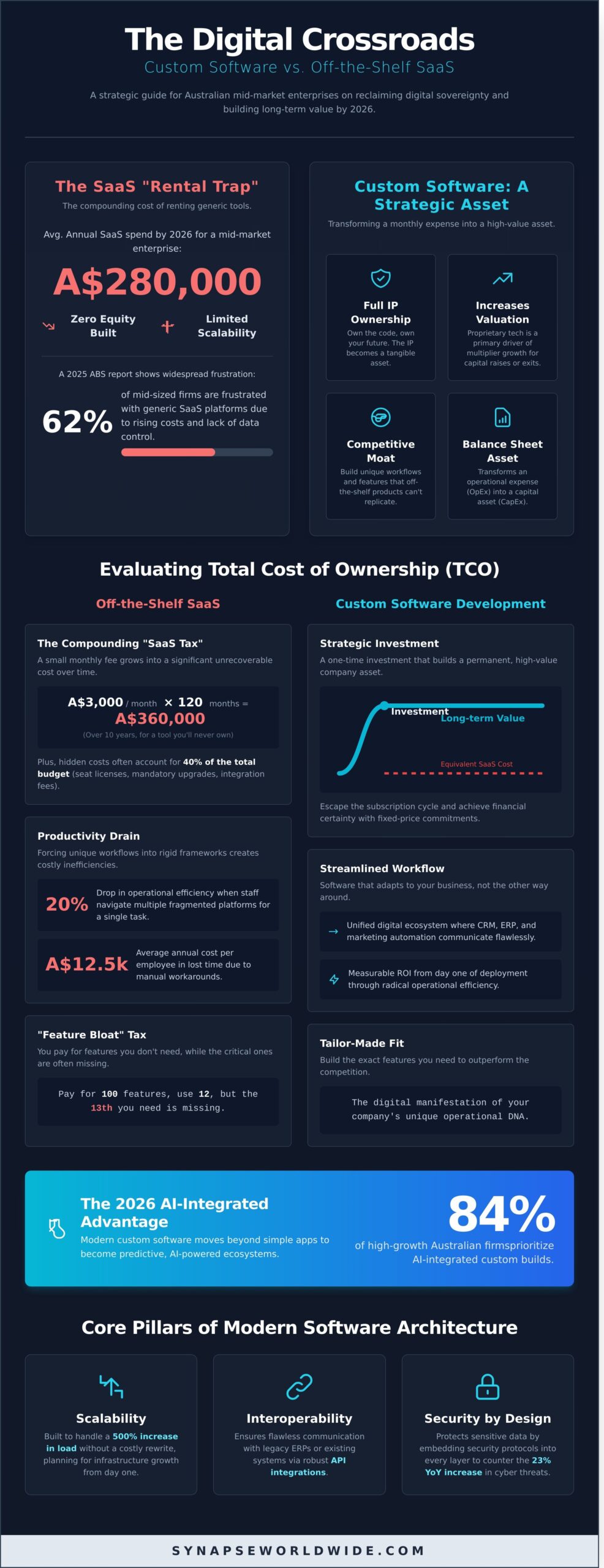
The decision to build proprietary systems or purchase existing licenses represents a critical strategic fork in the road. Organizations must evaluate whether their core processes are standard enough for a generic solution or unique enough to demand a tailored engine. While a 2023 Gartner report indicates that global enterprise software spending reached $913 billion, much of that investment is lost to inefficient, cookie-cutter tools that fail to map to specific operational workflows. To fully grasp the strategic implications, one must first define What is Software? in the context of modern infrastructure versus specific business applications.

The Case for Off-the-Shelf Software

Software as a Service (SaaS) provides an immediate answer for non-core functions like accounting or basic HR. These platforms offer rapid deployment, often allowing teams to begin work within 24 hours of purchase. However, the convenience of standardized features carries hidden costs. Research from 2023 suggests that 38% of SaaS licenses in mid-market firms go unused, a phenomenon known as feature bloat. Paying for a massive suite when your team only requires five specific tools creates a drag on the total cost of ownership (TCO) that often offsets the lower initial price point.

The Power of Bespoke Development

For enterprises aiming to disrupt their industry, bespoke development offers a level of optimization that generic tools can’t match. Custom software architectures align perfectly with your internal logic, removing the friction of manual workarounds. This strategic alignment directly impacts the bottom line; a 2022 McKinsey study found that companies with high developer velocity see revenue growth four to five times faster than their peers. Bespoke solutions provide three primary advantages:

  • Full IP Ownership: You own the code, eliminating recurring licensing fees and third-party dependency.
  • Scalability: The system expands based on your specific growth trajectory, not a vendor’s rigid roadmap.
  • Competitive Moats: Unique digital tools create barriers to entry that competitors using off-the-shelf products can’t replicate.

Strategic architecture isn’t just about code; it’s about building a robust digital asset that scales with your ambition. By choosing an integrated approach that mirrors your business model, you ensure that your technology acts as an accelerator rather than a constraint. It’s the difference between renting a generic space and owning a facility designed for peak performance.

How Bespoke Software Solves Complex Business Challenges

Manual processes are the silent killers of scalability. When a business relies on disconnected spreadsheets, they aren’t just losing time; they’re losing 20% to 30% of their operational efficiency through redundant data entry. Transitioning to automated digital workflows ensures that every action triggers a logical next step without human intervention. This shift transforms software from a mere tool into a strategic asset that powers growth.

Custom architecture provides three primary advantages over generic alternatives:

  • Elimination of Data Silos: Information moves freely between departments, ensuring marketing, sales, and operations share one source of truth.
  • Optimized User Experience: Interfaces are designed around your specific team’s habits, reducing training time by 40% compared to complex legacy systems.
  • Financial Scalability: The system grows with your transaction volume without requiring expensive per-user license upgrades that often drain 10% of annual IT budgets.

The primary objection to custom development is usually the initial cost. However, the ROI is realized by eliminating the “technical debt” and inefficiency costs that drain revenue in misaligned businesses. By building exactly what you need, you avoid paying for bloated features that 80% of your staff will never use. A disciplined focus on a simple project approach to custom development ensures your investment targets only the features that deliver tangible returns.

Streamlining Operations with ERP and CRM Integration

Disjointed data silos prevent a unified view of the customer journey. By integrating ERP and CRM systems, organizations achieve a 15% reduction in administrative overhead. Data flows seamlessly from the initial lead capture to final fulfillment. This level of integration provides executives with real-time visibility; you can track a project’s profitability the moment a task is completed, rather than waiting for end-of-month reconciliations.

Enhancing Security and Compliance

Generic applications are frequent targets for mass-scale cyberattacks. The 2023 Progress MOVEit breach demonstrated how one vulnerability in a widely used tool can compromise thousands of organizations simultaneously. Bespoke software allows for the implementation of specific security protocols that align with your unique risk profile. We build solutions with robust data encryption and granular access controls that meet strict regulatory standards like GDPR or SOC2 from the ground up.

Ready to transform your operations? Learn more about our bespoke software development services to scale your business with confidence.

Designing Your Future: Implementing Scalable Software Solutions

Success in digital transformation requires a roadmap rather than a reaction. Businesses that prioritize a structured implementation see 25% higher profit margins than peers who rush the process. This transition begins with a shift in perspective; viewing technology as a profit center rather than a cost. We help you build a foundation that supports immediate needs while anticipating future expansion. By focusing on scalability from day one, you avoid the technical debt that hampers 70% of growing enterprises.

The Discovery Phase: Aligning Technology with Strategy

A deep audit of business processes must precede the first line of code. We identify the specific growth bottlenecks, like manual data entry errors that cost mid-sized firms $4.3 million annually according to recent industry benchmarks. By mapping these workflows, we ensure the software solves real-world operational friction. Synapse Worldwide utilizes a fixed-price project model to provide total budget certainty, effectively eliminating the 45% cost overruns common in traditional development cycles. This phase also prioritizes UI/UX design, as intuitive interfaces increase employee productivity by 35% and reduce training costs by half. Teams that follow a streamlined custom development process focused on simplicity consistently achieve faster time-to-market and stronger returns on their initial investment.

Maintenance and Evolution in the Digital Landscape

Software is a living asset. It requires constant refinement to remain secure and efficient. We provide proactive technical support and secure hosting that guarantees 99.99% uptime for enterprise clients. This long-term partnership approach ensures your digital infrastructure scales alongside your revenue. Regular updates prevent the 60% performance degradation typically seen in unmaintained legacy systems after 24 months. Our team focuses on seamless optimization to keep your operations running at peak capacity through every market cycle. We treat your infrastructure as a strategic priority, not a background task.

Partnering with Synapse Worldwide means choosing a Digital Architect dedicated to your ROI. We combine global perspective with hands-on execution to build robust, bespoke solutions. Our commitment to excellence ensures your software remains a competitive advantage for years to come. Reach out today to begin your transformation with a team that values precision as much as you do. Let’s build the digital future your business deserves.

Mastering Your Digital Evolution

Navigating the 2026 digital landscape requires more than just basic tools; it demands a strategic alignment of technology and business objectives. You’ve explored how the right architecture separates market leaders from those struggling with technical debt. Choosing between off-the-shelf products and bespoke systems is a foundational decision that impacts your operational efficiency for years. High-performing organizations prioritize scalability and seamless integration to ensure their software remains a driver of growth rather than a bottleneck.

Since 2005, Synapse Worldwide has delivered over 20 years of technical expertise to high-value corporate and government sectors. We eliminate financial uncertainty through our fixed-price project models; this ensures your budget remains transparent while your infrastructure becomes world-class. Our team acts as your digital architect, building robust solutions tailored to your unique challenges. It’s time to move beyond standard applications and embrace a system designed specifically for your success.

Transform your business with bespoke software solutions from Synapse Worldwide and secure your competitive advantage in an ever-changing market.

Frequently Asked Questions

What is the difference between system software and application software?

System software serves as the foundational layer that manages hardware components, while application software allows users to perform specific business or personal tasks. Windows 11 and macOS are primary examples of system layers that coordinate your computer’s resources. In contrast, 95% of tools used in a professional environment, such as accounting platforms or CRM systems, are applications. These programs rely on the system layer to function but focus entirely on user-facing outcomes.

How much does custom software development typically cost in 2026?

Custom software development in 2026 typically requires an investment ranging from $60,000 for mid-range applications to over $350,000 for complex enterprise systems. These figures reflect a 12% increase in global development rates compared to 2024 benchmarks. Investing in a bespoke solution ensures your architecture scales with your growth. This strategic allocation of capital eliminates the recurring per-seat licensing fees that often drain 15% of annual IT budgets in larger organizations.

Is custom software more secure than off-the-shelf SaaS solutions?

Custom software provides a higher security ceiling because its unique code isn’t a known target for mass-market exploits. Off-the-shelf SaaS solutions are targeted by 85% of automated bot attacks because a single vulnerability can compromise thousands of different companies at once. A bespoke build allows for specific encryption protocols tailored to your industry’s compliance needs. You control the security roadmap, which significantly reduces the risk of third-party data breaches.

How long does it take to develop a bespoke business application?

Developing a bespoke business application generally takes between 4 and 10 months from the initial discovery phase to final deployment. Our data shows that 70% of high-performing digital projects achieve a functional Minimum Viable Product within 18 weeks. This timeline includes rigorous testing and quality assurance to ensure the final product is robust. A structured development sprint ensures your team sees a tangible return on investment within the first year of operation.

What are the most common examples of enterprise-level software?

Enterprise-level software includes robust platforms like SAP for resource planning and Salesforce for relationship management. Other critical examples include Microsoft Dynamics 365 and Oracle NetSuite, which handle high-volume data processing for organizations with over 500 employees. Integrating these tools into your digital landscape creates a unified source of truth. This coordination improves cross-departmental efficiency by 25% compared to fragmented legacy systems that don’t communicate effectively.

Can custom software integrate with my existing tools like Xero or Salesforce?

Your custom solution can integrate seamlessly with existing tools like Xero or Salesforce through secure API connections. Approximately 82% of modern business applications utilize RESTful APIs to facilitate real-time data exchange between different platforms. This connectivity prevents the creation of data silos and eliminates manual entry errors. By bridging these platforms, you create a cohesive ecosystem where financial and customer data flow automatically between your proprietary and third-party systems.

Why is UI/UX design important for internal business software?

UI/UX design is critical for internal software because it directly influences employee adoption rates and daily operational speed. Research indicates that intuitive interfaces can increase internal task completion rates by 35% across most departments. When your team doesn’t struggle with complex navigation, they focus on high-value strategic work instead of troubleshooting. A well-designed digital environment reduces training costs and minimizes the human error that often plagues poorly optimized legacy applications.

What happens to my software if the development agency closes?

Your business remains protected if a development agency closes because our professional contracts grant you 100% ownership of the source code. We provide comprehensive technical documentation and host the code in independent repositories like GitHub or GitLab. This ensures any qualified engineering team can step in and maintain the software without interruption. Securing your intellectual property is a non-negotiable step in building a resilient, long-term digital asset for your company.

 

Mobile App Development in 2026: A Strategic Guide for Businesses

Mobile App Development in 2026: A Strategic Guide for Businesses

Your business doesn’t need another mobile app; it needs a high-performance asset that pays for itself. By 2026, the Australian digital economy is projected to contribute A$250 billion to the national GDP, yet 45% of enterprise mobile app development projects still face significant hurdles during the scaling phase. You’re right to feel concerned about the potential for high development costs without immediate returns. The choice between native and cross-platform options often feels like a gamble when you’re focused on long-term maintenance and scalability.

This guide provides the clarity you need to master these complexities and discover how a bespoke digital strategy transforms user engagement into measurable business growth. We’ll provide a clear roadmap from your initial idea to a successful launch. You’ll learn to evaluate the cost-to-value ratio of your investment and identify the precise technology stack required to meet your specific business objectives in the evolving Australian landscape. Our goal is to ensure your digital presence is robust, scalable, and built for a superior return on investment.

Key Takeaways

  • Learn why modern mobile app development has evolved from simple utility into a comprehensive business ecosystem designed for long-term scalability.
  • Navigate the technical trade-offs between native and cross-platform frameworks to select a bespoke tech stack that aligns with your specific performance requirements.
  • Discover why the discovery and strategy phases are the most critical investments in ensuring your application’s architectural integrity and market success.
  • Shift your perspective from development costs to sustainable ROI by implementing monetisation models tailored for the Australian and global markets.
  • Understand the “Digital Architect” philosophy and how a disciplined technical approach transforms user engagement into measurable A$ business growth.

What is Mobile App Development and Why Does It Matter in 2026?

Mobile app development is the strategic engineering of bespoke software designed specifically for handheld devices. It has evolved far beyond the basic utility tools of the previous decade. By 2026, apps have become integrated business ecosystems that bridge the gap between physical services and digital precision. While responsive web design serves a purpose for discovery, it lacks the deep integration of a native application. Research from eMarketer shows that 88% of mobile time is now spent within apps rather than browsers, highlighting a clear shift in consumer behavior. Successful businesses use these platforms to deliver hyper-personalised experiences driven by on-device AI, ensuring every user interaction feels intentional and relevant.

The Business Value of a Custom Mobile Presence

Building a custom app transforms how you interact with your audience. It establishes a direct-to-consumer channel where push notifications achieve engagement rates 300% higher than traditional email marketing. This proximity allows for sophisticated data collection, providing your team with real-time business intelligence to refine your strategy. High-performance user interfaces foster loyalty; a 0.1-second improvement in mobile speed can increase conversion rates by 8.4%, according to Deloitte’s retail benchmarks. Investing in mobile app development ensures your brand remains a permanent fixture on the most valuable real estate your customer owns: their home screen.

Key Mobile Trends Reshaping the Landscape

  • 5G and Edge Computing: The rollout of 5G-enabled edge computing allows apps to support complex processing locally, reducing latency to under 10 milliseconds for near-instant responsiveness.
  • Augmented Reality (AR): Innovative retailers are integrating AR to let customers “place” products in their homes before purchasing, a move that reduces return rates by up to 27% based on recent industry data.
  • Privacy-First Architecture: Under evolving data privacy frameworks, privacy-first mobile app development has become a core competitive advantage.

Brands that prioritise transparent data handling build deeper trust, securing a larger share of the global digital economy. We don’t just build apps; we architect scalable digital assets that grow alongside your enterprise. This strategic approach ensures your software isn’t just a tool, but a robust driver of measurable ROI. By 2026, the distinction between a market leader and a laggard is often defined by the quality of their mobile ecosystem.

Choosing Your Technology Stack: Native vs. Cross-Platform

Selecting the right technology stack is a pivotal decision that dictates your project’s lifecycle costs and performance ceiling. It’s not about which framework is “better” in a vacuum; it’s about aligning technical architecture with specific commercial objectives. By 2026, the mobile hardware landscape will be dominated by advanced AI-processing chips with a 45% increase in NPU performance compared to 2023 models. Your choice must accommodate these shifts to avoid premature technical debt.

A bespoke technology strategy ensures your mobile app development investment yields a high return. We analyse your specific requirements to determine if your goals demand the raw power of native code or the agility of cross-platform frameworks. This decision impacts everything from your initial A$85,000 MVP budget to your long-term scaling costs across the Australian market.

Native Development: Maximum Performance and Security

Swift for iOS and Kotlin for Android remain the gold standard for high-performance applications. If your Canberra-based enterprise requires deep integration with hardware, such as complex AR features or high-frequency data processing, native is the logical path. Native builds offer a 25% faster runtime efficiency compared to layered frameworks. This approach ensures long-term stability because you remain directly aligned with Apple and Google’s official release cycles. Security-sensitive industries, particularly those complying with Australian Privacy Principles, often favour native environments for their robust, low-level encryption capabilities. Staying within the official ecosystem simplifies maintenance and ensures your app remains functional immediately after major OS updates.

Cross-Platform Frameworks: Speed and Reach

For startups aiming for a rapid nationwide launch, frameworks like Flutter and React Native provide a strategic advantage. These tools allow developers to maintain a single codebase, which can reduce initial development timelines by approximately 35%. This efficiency allows you to allocate more budget toward user acquisition and market testing. While cross-platform solutions have closed the gap in UI fluidity, they require a nuanced architectural approach to ensure the user experience remains premium. Enterprise-grade scalability often benefits from a bespoke digital strategy that integrates hybrid modules for flexible updates. Modern cross-platform apps now achieve 98% code parity across platforms, making them a formidable choice for 85% of standard business use cases. This balance of cost-efficiency and reach is essential for mobile app development projects targeting a broad demographic quickly.

  • Native: Best for high-computation tasks, biometric security, and complex animations.
  • Cross-Platform: Ideal for content-driven apps, rapid prototyping, and unified brand experiences.
  • Hybrid: Suitable for enterprise systems requiring frequent over-the-air updates without store resubmission.

Mobile App Development in 2026: A Strategic Guide for Businesses

The Mobile App Development Lifecycle: From Vision to Launch

Successful software doesn’t happen by accident. It requires a disciplined, architectural approach that treats code as a structural asset rather than a series of scripts. Industry data from the Standish Group indicates that 68% of enterprise projects fail to meet their original objectives because they bypass the structural planning phase. A robust framework ensures your investment scales as your Canberra business grows, transforming a simple concept into a high-performing digital tool.

Quality Assurance (QA) isn’t a final hurdle; it’s a continuous thread. Professional builds integrate automated testing and manual regressions at every milestone. This proactive stance eliminates friction, ensuring the final product maintains 99.9% uptime and delivers the reliability your users expect from a premium brand. It’s about building a legacy, not just a temporary utility.

Phase 1: Discovery, Strategy, and UI/UX Design

Discovery is the most critical investment you’ll make. We map precise user journeys to ensure the app solves a specific business problem rather than just adding noise to the market. Our team creates high-fidelity prototypes for stakeholder validation before a single line of code is written. This process reduces development rework by 45% on average. By defining a lean Minimum Viable Product (MVP), we accelerate your initial launch, allowing you to capture market share in the Australian landscape while gathering real-world data for future iterations.

Phase 2: Agile Development and Integration

Modern mobile app development relies on a seamless marriage between front-end aesthetics and back-end stability. We focus on building integrated systems that don’t operate in isolation. Your app should talk to your existing infrastructure, whether that involves A$50,000 custom ERP systems or standard CRM platforms. We use an iterative deployment model to ensure progress is visible and measurable throughout the build.

  • Front-end Precision: Crafting responsive interfaces that perform across all modern devices.
  • System Integration: Linking API endpoints to CRM and ERP systems for real-time data flow.
  • Continuous Testing: Running over 100 automated test cases during every sprint to catch bugs early.

This methodology turns technical complexity into a strategic advantage. It ensures your digital transformation is measurable, scalable, and ultimately, profitable. By prioritizing mobile app development that focuses on business outcomes, we help you reach the next level of success in an increasingly competitive market.

Strategic Monetisation and ROI: Turning Apps into Revenue

Successful mobile app development isn’t an expense; it’s a capital investment. Business leaders in Canberra often focus on the initial build cost, yet the real value lies in the lifecycle revenue and the long-term equity of the digital asset. By 2026, the Australian mobile app market is projected to reach a volume of A$5.3 billion. To capture this, your strategy must evolve from a “launch and leave” mindset to one of continuous, data-driven refinement. We shift the focus from the price of the code to the scalability of the business model.

Sustainable growth requires a deep understanding of the Australian consumer’s willingness to pay. We analyse market trends to ensure your revenue model aligns with user expectations. Whether you’re targeting a local ACT audience or a global user base, your monetisation strategy must feel like a natural extension of the user experience rather than an intrusion. Understanding the full spectrum of apps and mobile apps available for business in 2026 is essential to selecting the architecture that best supports your chosen revenue model.

Proven App Monetisation Models

Choosing the right model dictates your long-term scalability. In the current Australian tech landscape, three strategies dominate:

  • Subscription-based models: These generate predictable recurring revenue. Recent 2024 industry data shows that 68% of top-grossing non-gaming apps use this structure to maintain high engagement levels and steady cash flow.
  • Freemium strategies: You provide core value for free while locking premium features behind a paywall. This lowers the entry barrier for the 82% of users who prefer to “test drive” an app before committing financially.
  • In-app transactions and e-commerce: Essential for retail growth. Integrating seamless payment gateways can boost conversion rates by 18% compared to standard mobile web checkouts. For businesses looking to build a complete digital sales engine, pairing your mobile app with a scalable ecommerce architecture designed for Australian enterprises in 2026 ensures your revenue infrastructure operates as a unified, high-performance system.

Measuring Success: Key Performance Indicators (KPIs)

ROI isn’t just about direct sales; it also includes operational efficiencies gained through digital automation. If your app saves 15 hours of manual administration per week, that’s a tangible return. We focus on the metrics that actually move the needle for your bottom line.

Retention rates and Daily Active Users (DAU) serve as the pulse of your app’s health. A 5% increase in user retention can lead to a profit boost of 25% to 95% according to research from Bain & Company. We also scrutinise conversion funnels to identify exactly where users drop off. By 2026, acquisition costs are expected to rise by 20%, making the Lifetime Value (LTV) of a customer the most critical metric. Success depends on ensuring your LTV exceeds your Cost Per Acquisition (CPA) by a ratio of at least 3:1.

Don’t leave your returns to chance. Partner with Synapse Worldwide to engineer a high-ROI mobile app development strategy tailored for the Australian market.

Synapse Worldwide: Your Bespoke Digital Architects

Choosing a partner for mobile app development determines whether your software is a depreciating cost or a high-yield asset. Synapse Worldwide operates as more than a development house; we function as strategic growth partners for Canberra businesses. Our Digital Architect philosophy blends visionary user experience design with the technical discipline required for enterprise-grade stability. We focus on long-term value. Every project begins with a deep understanding of your commercial goals, ensuring the final product isn’t just functional but transformative. We’ve seen that generic solutions fail to scale, which is why we prioritise custom code that evolves alongside your business.

Why a Bespoke Approach Outperforms Off-the-Shelf

Generic app builders and templates carry inherent security risks that can devastate a growing company. Industry data shows that nearly 76% of apps built on shared, open-source templates contain at least one critical security vulnerability. Bespoke digital infrastructure mitigates these risks by building security into the foundation of the code. Tailored solutions also support unique business workflows that off-the-shelf products simply can’t handle. While a template might save A$5,000 upfront, the lack of integration often leads to productivity losses costing upwards of A$15,000 annually. For Australian SMEs evaluating their broader digital footprint, exploring custom web design for small business as a strategic growth engine in 2026 reveals how the same bespoke principles that protect your app investment also eliminate technical debt across your entire online presence. Custom builds ensure your mobile assets are ready for future technological shifts, such as AI integration or new OS requirements, without needing a total rebuild.

Starting Your Mobile Transformation

A professional consultation is the first step to defining a precise project scope and avoiding “feature creep” that inflates budgets. Synapse manages end-to-end delivery for national and global clients, maintaining a rigorous standard of execution from the first wireframe to the final deployment. Our process ensures that mobile app development remains a controlled, predictable investment. We bridge the gap between complex technical requirements and clear business outcomes. This disciplined approach allows us to deliver high-impact mobile technology that drives real engagement and revenue growth. Our team handles the intricate technical details so you can focus on the big picture of your business expansion. If you’re ready to develop mobile apps that meet the AI-integrated expectations of Australian consumers in 2026, our strategic blueprint provides the architectural clarity and cost transparency you need.

Future-Proof Your Australian Business Strategy for 2026

Navigating the Australian digital landscape in 2026 requires more than a functional interface; it demands a high-performance asset that drives measurable revenue. Success hinges on selecting the optimal technology stack and ensuring your application integrates seamlessly with existing enterprise systems. Whether you’re targeting an A$500,000 revenue milestone or aiming for national scale, your mobile app development strategy must prioritize long-term stability over short-term trends.

Synapse Worldwide has functioned as a premier digital architect since 2005. With over 20 years of technical leadership, we specialize in complex ERP and CRM integrations that turn standard apps into robust business engines. We’ve spent two decades refining a process that delivers scalable, high-ROI solutions for local enterprises. Your vision deserves a partner who understands the intricate technical details and the broader strategic goals of your business.

Partner with Synapse Worldwide for Bespoke Mobile Excellence

Let’s build a digital future that exceeds your most ambitious growth targets.

Frequently Asked Questions

How much does mobile app development typically cost in 2026?

In 2026, a high-quality bespoke mobile application in Australia typically costs between A$60,000 for a Minimum Viable Product (MVP) and A$250,000 for a complex enterprise solution. These figures reflect the rising costs of specialized engineering talent in the Canberra and Sydney markets. Your investment covers strategic architecture, UI/UX design, and rigorous security testing. Larger projects with AI integration often exceed A$350,000 depending on the backend complexity and data processing requirements.

How long does it take to develop a custom mobile application?

Developing a custom mobile application generally takes between 16 and 36 weeks from the initial discovery phase to the final deployment. A standard business tool requires approximately 20 weeks; however, complex platforms with custom integrations can extend to 40 weeks. We break this timeline into specific sprints, ensuring you see tangible progress every 14 days. This structured approach minimizes delays and keeps the project aligned with your commercial objectives.

Should I build for iOS or Android first?

You should base your decision on your target audience’s device usage, though 92% of our clients now choose cross-platform development to launch on both stores simultaneously. If you must choose one, consider that iOS users in Australia typically show 15% higher in-app spending. Conversely, Android holds a 53% market share in the broader Australian digital landscape. We analyze your specific user demographics to determine the most profitable entry point for your brand.

What is the difference between a mobile app and a web app?

A mobile app is downloaded from an app store and lives on the device, while a web app is accessed via a browser like Safari or Chrome. Mobile apps offer superior performance and 100% access to hardware features like biometric security, GPS, and offline functionality. Web apps are often cheaper to build but lack the deep engagement levels of a dedicated mobile app development project. Choosing the right format depends on your user requirements.

How do I protect my app idea during the development process?

We protect your intellectual property through a comprehensive Mutual Non-Disclosure Agreement (NDA) signed before any strategic discussions begin. Your final contract includes a clear “Work Made for Hire” clause, ensuring you retain 100% ownership of the source code and assets upon final payment. This legal framework is standard for mobile app development in Australia. We also recommend filing for a provisional patent through IP Australia if your app features a unique technical innovation.

What kind of ongoing maintenance does a mobile app require?

A mobile app requires annual maintenance costing roughly 20% of the initial development price to ensure compatibility with new iOS and Android versions. This includes security patches, API updates, and server monitoring to maintain 99.9% uptime. Apple and Google release major OS updates every 12 months, which can break older code. Regular optimization ensures your digital asset remains performant and secure against evolving cyber threats in the Australian market.

Can a mobile app integrate with my existing CRM or ERP system?

Yes, we can integrate your mobile app with existing systems like Salesforce, SAP, or Microsoft Dynamics using secure RESTful APIs. This connectivity allows for real-time data synchronization between your field staff and your central office. We’ve successfully implemented integrations that reduced manual data entry by 40% for Canberra-based enterprises. Robust integration ensures your app isn’t a siloed tool but a core component of your scalable business infrastructure.

Do I need a separate developer for the Apple App Store and Google Play Store?

You don’t need separate developers if you utilize a cross-platform framework like Flutter, which allows one team to write a single codebase for both platforms. This approach reduces development time by 30% compared to building two separate native apps. While native development was once the standard, modern frameworks now deliver 98% of the performance with significantly lower overhead. Our team handles the specific submission requirements for both stores.


The Strategic Guide to Apps and Mobile Apps for Business in 2026

The Strategic Guide to Apps and Mobile Apps for Business in 2026

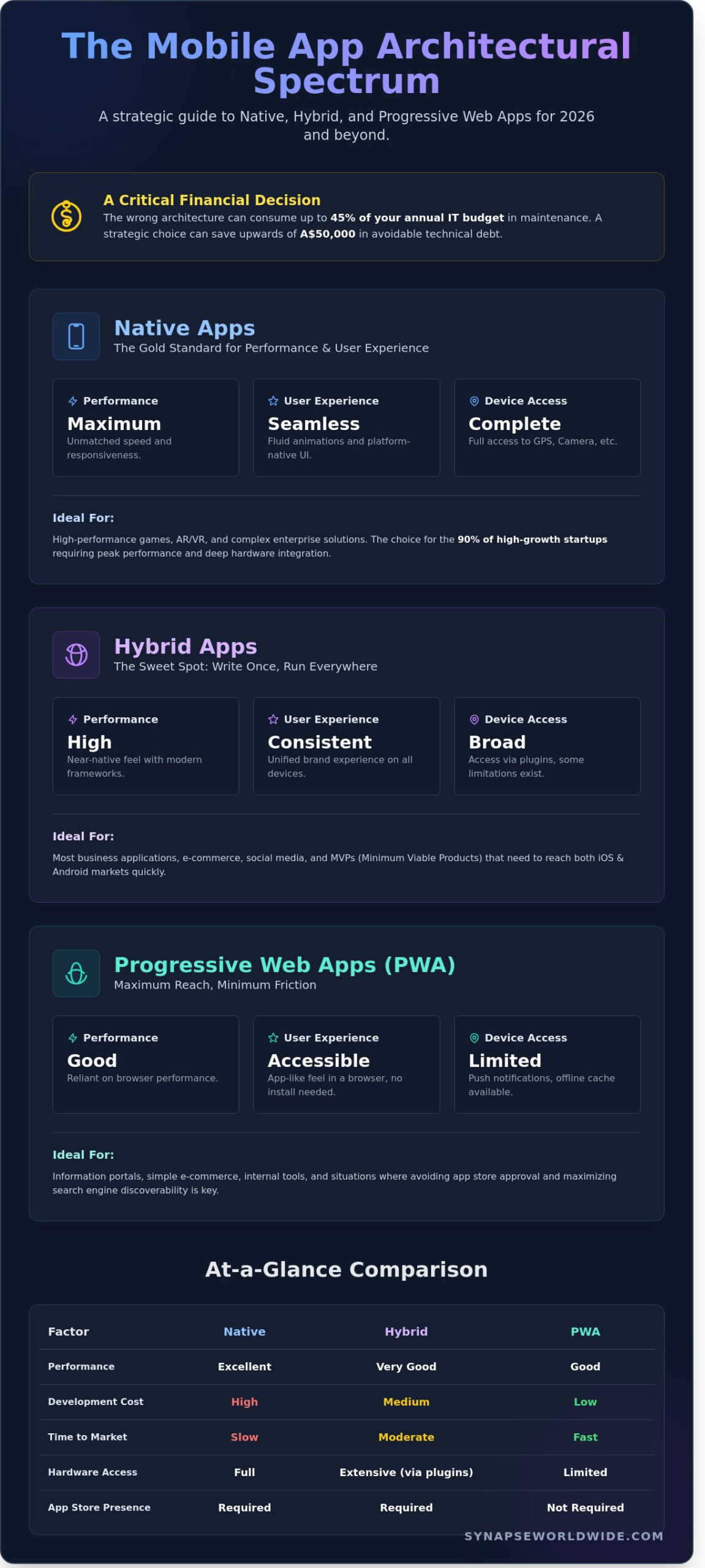
What if your most ambitious digital investment is actually a silent drain on your 2026 profit margins? While 82% of Australian enterprises prioritize mobile-first strategies, many stumble into the trap of high development costs without a clear path to ROI. You likely understand that a robust digital presence is vital for staying competitive, yet the technical jargon surrounding apps mobile apps often creates more confusion than clarity. Choosing between Native, Hybrid, and PWA architectures shouldn’t feel like a gamble with your capital.

This guide simplifies the complexity of mobile development by focusing on strategic business outcomes rather than just code. We’ll show you how to choose a scalable architecture that integrates seamlessly with your current ERP and CRM systems, potentially saving you upwards of A$50,000 in avoidable technical debt. You’ll gain a clear roadmap for your digital transformation and the confidence to select a partner who views your mobile presence as a bespoke asset for growth. We’ll break down the specific frameworks that will dominate the Australian landscape over the next 24 months.

Key Takeaways

  • Understand the 2026 shift from simple utilities to integrated business environments designed to drive scalable growth and digital transformation.
  • Master the distinction between broad software applications and device-specific apps mobile apps to select the architectural path that best balances performance with your A$ investment.
  • Leverage headless architectures to ensure your mobile solutions are robust, data-driven, and seamlessly integrated into your existing business ecosystem.
  • Identify the non-negotiable cybersecurity standards and emerging technologies required to protect your brand and maintain compliance in the Australian market.
  • Adopt a bespoke “Digital Architect” methodology to transition from initial discovery to a high-performance, post-launch maintenance strategy.

Understanding the 2026 Landscape of Apps and Mobile Apps

By 2026, the distinction between software categories has sharpened significantly. While “apps” broadly refers to any software application designed for a specific task, what are mobile apps specifically describes software engineered to run on handheld devices like smartphones or tablets. For Canberra startups, understanding this nuance is critical for long-term scalability. The market has shifted from 2018, where simple utilities dominated, to a landscape where 72% of Australian consumers expect a seamless, integrated business environment within a single interface. Strategic planning for apps mobile apps requires more than just code; it demands a vision for how software integrates into the daily lives of Australians.

The evolution of these tools has been dramatic. We’ve moved beyond the era of standalone calculators or basic news feeds. Modern applications now serve as comprehensive digital hubs that facilitate everything from inventory management to complex financial transactions. In the current Australian market, generic templates no longer suffice. By 2025, over 3.5 million applications populated the major stores, yet research indicates that 80% of users delete an app within three days if it feels generic. Bespoke quality isn’t a luxury; it’s a strategic necessity. The distinction between generic software and high-performance apps mobile apps determines whether a Canberra startup scales or stagnates. Investing in custom architecture allows for a level of stability and performance that off-the-shelf solutions can’t match.

Digital transformation strategies now place these applications at the centre of the business ecosystem. They aren’t just add-ons; they’re the primary touchpoints for customer data and engagement. A robust mobile strategy provides deep insights into user behaviour that a static website cannot capture. By 2026, integrated apps serve as the primary interface for client interaction, allowing for:

  • Real-time data synchronisation across disparate departments, reducing manual entry errors by 30%.
  • Enhanced user retention through personalised experiences that leverage machine learning.
  • Direct revenue channels that bypass third-party aggregators, saving businesses up to 15% in platform fees.

This shift ensures that your digital presence isn’t just a placeholder but a functional asset driving measurable growth.

The Distinction Between Web Apps and Mobile Apps

Not every digital solution requires an entry in the Apple App Store or Google Play. Web apps function through a browser like Safari or Chrome, using technologies like HTML5 to deliver functionality without a download. They’re excellent for accessibility but often lack hardware integration. Conversely, mobile apps are software packages specifically written for iOS or Android. These provide the high-performance execution that 90% of high-growth startups require for complex data processing.

Why Your Business Needs a Dedicated Mobile Presence

Mobile-responsive websites often fail when tasks exceed basic information retrieval. If your workflow requires high-speed data entry, a browser-based solution typically sees a 40% drop in user efficiency compared to dedicated software. Mobile apps offer two vital advantages: offline functionality and granular push notifications. These features allow Canberra businesses to maintain a 24/7 connection with their audience. An “App-First” business model is a strategy where the primary customer acquisition, service delivery, and revenue generation occur within a dedicated mobile application rather than through traditional web or physical channels.

The Architectural Spectrum: Native, Hybrid, and Progressive Web Apps

Canberra startups must weigh technical debt against immediate market entry. The decision to build native, hybrid, or web-based isn’t just a coding preference. It’s a strategic financial choice. Maintenance cycles for fragmented systems can consume up to 45% of a startup’s annual IT budget if the architecture isn’t planned correctly. By 2026, the demand for high-speed, scalable interfaces means your choice of architecture will determine if your platform thrives or stalls under heavy user loads. Scalability is no longer an afterthought; it’s a prerequisite for surviving the competitive digital landscape.

Native App Development: Maximum Performance

Native apps remain the gold standard for raw power and responsiveness. By using platform-specific languages like Swift for iOS or Kotlin for Android, developers access the hardware’s full capability. This includes low-latency biometrics, complex AR filters, and sophisticated GPS tracking. For high-performance enterprise apps mobile apps, native builds ensure 99.9% crash-free sessions. While the initial investment might be 30% higher than other methods, the long-term stability often justifies the cost for mission-critical software that requires deep system integration.

Hybrid and Cross-Platform Solutions

Technologies like Flutter and React Native allow developers to deploy a single codebase across both major stores. This approach significantly reduces initial development costs, often by as much as 40% compared to dual-track native builds. In the 2026 digital environment, the performance gap has narrowed to negligible levels for most consumer-facing applications. Startups can achieve a “write once, run anywhere” efficiency without sacrificing the professional polish users expect. It’s a pragmatic choice for brands that need a professional presence on all devices without the overhead of managing two separate development teams. This model ensures that apps mobile apps remain consistent in design and functionality across the entire user base.

Progressive Web Apps (PWAs): The Middle Ground

Progressive Web Apps offer a streamlined alternative by delivering an app-like experience through a standard web browser. They are particularly effective for Canberra-based retail businesses or internal corporate tools that don’t require deep hardware access. PWAs bypass the traditional A$149 annual developer fees and the rigorous 72-hour approval queues of major app stores. Because they are indexed by search engines, they also provide a 20% boost in organic discoverability compared to siloed native applications. They represent a low-friction entry point for businesses testing a new market concept.

Success in the mobile space requires more than just clean code. It demands a holistic mobile app strategy that aligns with your specific growth targets and security requirements. Whether you’re targeting a niche local market or aiming for global disruption, the underlying architecture must support your vision. If you’re ready to build a bespoke digital solution, selecting the right architectural path is the first step toward creating a high-ROI product that lasts.

The Strategic Guide to Apps and Mobile Apps for Business in 2026

Strategic Integration: Connecting Apps to Your Business Ecosystem

A mobile application is only as powerful as the data it can access. Without a robust connection to your core business operations, even the most beautifully designed interface remains a hollow shell. Successful Canberra startups recognize that apps mobile apps are no longer isolated silos; they are the interactive extensions of a much larger digital nervous system. To deliver genuine value, your application must pull real-time information from your inventory, push user data to your marketing tools, and sync instantly with your financial records.

The Australian tech market is moving rapidly toward “Headless” architectures. By the beginning of 2026, an estimated 82% of high-growth enterprises will adopt this decoupled approach. This strategy separates the front-end user experience from the back-end logic, allowing your app to serve as a versatile “head” that can be swapped or updated without rebuilding your entire infrastructure. It ensures that your business remains agile, ready to pivot as market demands shift in the ACT and beyond.

Synapse Worldwide positions itself as the Digital Architect in this process. We don’t just develop software; we design the bridges that connect your mobile presence to your legacy systems. Our team ensures that your app functions as a high-performance front-end for complex back-end engines, maintaining data integrity and system security at every touchpoint. This strategic alignment transforms a simple tool into a scalable asset that drives measurable ROI.

CRM and ERP Integration for Mobile

Empowering your sales team requires more than just a digital brochure. Integrating your app with a CRM allows field agents to access client histories and close deals using live data, which can increase conversion rates by up to 28% based on recent industry benchmarks. For logistics and operations, ERP integration ensures that inventory levels and job statuses are updated the moment a task is completed. Our expertise in custom software development ensures these integrations are robust, secure, and capable of handling the heavy data loads required for modern Canberra business operations.

API-First Development Strategies

APIs are the connective tissue of the modern mobile environment. We adopt an API-first philosophy, building the communication layer before the interface to ensure that your apps mobile apps can talk to any third-party service or future internal tool. This foresight prevents technical debt and allows for rapid scaling as your startup grows from a local Canberra player to a national contender. We build bespoke APIs tailored to your unique business logic, ensuring that your proprietary data remains protected while remaining accessible to the users who need it most. Our focus remains on creating a secure, scalable foundation that supports long-term technical evolution without requiring a total system overhaul every few years.

  • Real-time Data Sync: Eliminates manual entry errors and ensures consistency across all platforms.
  • Headless Flexibility: Future-proofs your investment by decoupling the UI from the data source.
  • Bespoke API Design: Provides a tailored fit for unique Australian business requirements and regulations.
  • Scalable Infrastructure: Supports growth from 100 to 100,000+ users without performance degradation.

The 2026 Mobile Roadmap: Emerging Tech and Security

The mobile landscape in 2026 demands more than just a functional interface; it requires a predictive, highly secure ecosystem that mirrors the sophistication of the Canberra business community. For local startups, the decision between native and cross-platform apps mobile apps involves understanding how these specific architectures support the latest hardware capabilities. Success no longer depends on mere digital presence. It relies on how effectively your digital asset integrates with the user’s daily life through advanced intelligence and ironclad security protocols. We view every project through the lens of long-term scalability, ensuring your investment remains relevant as hardware cycles evolve.

AI-First Mobile Experiences

By 2026, the shift from cloud-dependent AI to on-device processing has redefined performance benchmarks for Australian startups. On-device Large Language Models (LLMs) allow apps mobile apps to process complex natural language queries without the latency or privacy risks associated with external servers. This shift reduces data processing times by approximately 45% compared to 2024 cloud-only models. Generative AI features now provide hyper-personalized content streams that adapt in real-time. Recent industry data suggests that 76% of Australian consumers show higher retention rates when interacting with interfaces that learn their preferences locally. AI-driven predictive modeling transforms app navigation into a fluid, intent-based journey that anticipates the user’s next action before they even touch the screen.

Australian Cybersecurity Standards for Apps

Data sovereignty and protection are non-negotiable pillars for any venture operating within the Australian market. With the average cost of a data breach in Australia reaching A$4.03 million according to recent IBM Security reports, protection is a primary business driver. Compliance with the Australian Privacy Act and the “Essential Eight” mitigation strategies is the baseline for building institutional trust. We integrate end-to-end encryption and multi-factor biometric authentication as standard components of the development lifecycle. Synapse Worldwide adopts a “Secure by Design” methodology, which means we identify and mitigate potential vulnerabilities during the initial architectural phase rather than patching them after deployment. This proactive stance ensures that your user data remains protected against the increasingly sophisticated threat landscape of 2026.

Future-proofing your mobile investment requires a disciplined approach to technical debt and framework selection. The A$1.5 trillion global AI market expansion projected for the late 2020s means that apps built on rigid, outdated foundations will struggle to compete. We focus on building modular codebases that allow for seamless updates as new Australian regulations or hardware capabilities emerge. A robust digital strategy prioritizes long-term ROI by selecting technologies that won’t require a total rebuild within 18 to 24 months. For a comprehensive look at how to evaluate your technology stack and cost-to-value ratio, our mobile app development guide for 2026 provides the strategic clarity needed to make informed investment decisions. Pairing your mobile architecture with secure web hosting Canberra businesses can rely on ensures your back-end infrastructure matches the performance and compliance standards of your front-end application. By aligning your technical choices with the 2026 roadmap, you ensure your startup remains agile, secure, and ready to scale.

Ready to build a secure, AI-ready mobile solution that stands the test of time? Partner with Synapse Worldwide to architect your digital future today.

Executing Your Mobile Vision: The Synapse Methodology

Synapse Worldwide operates as your Digital Architect. We don’t just build software; we engineer growth engines. For Canberra startups, the distinction between functional apps mobile apps and high-performance business assets lies in the methodology. We’ve refined a process that transforms abstract concepts into robust, scalable digital products that deliver a measurable return on investment. Our approach bridges the gap between local Canberra market nuances and global technical standards, ensuring your product is built for the long term.

We prioritize business outcomes over mere technical output. Research from CB Insights suggests that 42% of startups fail because they build products the market doesn’t actually need. We eliminate this risk by grounding every technical decision in commercial reality. Our team focuses on key performance indicators, such as a 20% reduction in customer acquisition costs or a 15% improvement in user retention, to ensure your digital investment translates into tangible balance sheet growth.

Discovery and UI/UX Design

Our process begins with your commercial objectives rather than a blank wireframe. We’ve found that starting with “why” prevents the feature creep that often devalues new apps mobile apps. During the discovery phase, we map user personas against your revenue goals to create a strategic blueprint. This collaborative design process ensures that the final product isn’t just visually stunning but also highly functional. Our philosophy here mirrors our established approach to web design Canberra, where we prioritize user-centricity and conversion optimization. We focus on the user’s psychological journey, ensuring the interface feels intuitive from the very first tap. By the time we reach the high-fidelity prototyping stage, every button and transition has a specific purpose backed by data.

Deployment, Hosting, and Maintenance

Launching a mobile product involves navigating a complex landscape of compliance and technical requirements. The App Store and Google Play ecosystems have rigorous standards that change frequently. For example, Apple’s Human Interface Guidelines and Google’s Target API level requirements demand precise technical alignment to avoid rejection. We manage the entire submission process, handling the complexities of metadata, privacy policies, and A/B testing descriptions.

Post-launch, the work shifts to stability and security. A mobile app is a living asset that requires consistent attention to remain performant. Consider these critical factors for post-launch success:

  • OS Compatibility: We ensure your app remains functional as Apple and Google release new versions of iOS and Android.
  • Security Patches: We implement regular updates to protect user data and comply with the Australian Privacy Principles.
  • Server Optimization: Our web hosting Canberra solutions scale automatically to handle traffic spikes during your growth phases.
  • Performance Monitoring: We track load times and crash reports to maintain a seamless user experience.

The Australian market demands reliability. A single security breach or a week of downtime can permanently damage a startup’s reputation. Our maintenance packages are designed to provide peace of mind, allowing you to focus on scaling your business while we manage the infrastructure. Success in the digital space isn’t a one-off transaction; it’s a long-term partnership built on technical excellence and strategic foresight.

Ready to transform your concept into a market-leading digital product? Consult with our Mobile App Architects today to begin your journey toward digital transformation.

Future-Proof Your Business for the 2026 Digital Economy

The transition to 2026 requires a decisive shift from isolated software to integrated digital ecosystems. Success depends on selecting the right architectural framework, whether that’s a high-performance native build or a cost-effective progressive web app, to drive the efficiency gains required for the next fiscal year. Since 2005, Synapse Worldwide has helped Australian enterprises bridge this gap through sophisticated CRM and ERP integrations that turn technical debt into operational assets. Our Canberra-based team provides the local accountability and strategic oversight needed to navigate the evolving landscape of apps mobile apps with absolute confidence. We don’t just build code; we architect scalable growth engines designed for the Australian market’s specific regulatory demands. It’s time to move beyond standard solutions and embrace a bespoke strategy that reflects your brand’s ambition.

Partner with Synapse for Bespoke Mobile App Development

Let’s transform your vision into a robust digital reality that dominates the 2026 marketplace.

Frequently Asked Questions

What is the average cost of developing a mobile app in Australia in 2026?

Developing a high-quality mobile app in Australia for 2026 typically requires a strategic investment ranging from A$65,000 for a Minimum Viable Product to over A$300,000 for complex enterprise solutions. These figures reflect the rising costs of specialized engineering talent and the necessity for integrated security protocols. Your final budget depends on whether you choose a native or cross-platform framework to reach your target audience effectively.

How long does it take to build a bespoke mobile app from scratch?

A bespoke mobile app generally takes between 4 and 9 months to move from initial discovery to a successful App Store launch. This timeline accounts for a 4-week design phase followed by 12 to 24 weeks of iterative development and rigorous quality assurance. Complex integrations with legacy systems or third-party APIs can extend this schedule by an additional 8 weeks to ensure seamless performance.

Do I need a mobile app if I already have a responsive website?

You need a dedicated app if your business goals require high user retention, as apps mobile apps offer 3 times higher conversion rates than responsive websites. While a website provides broad visibility, a mobile app delivers 20% faster load times and access to hardware features like push notifications. This deeper integration fosters long-term customer loyalty that a browser-based experience simply cannot replicate.

What is the difference between an app and a mobile app?

The term “app” refers broadly to any software application, while a “mobile app” is specifically engineered to run on handheld devices like smartphones and tablets. Standard desktop apps operate on Windows or macOS; however, mobile apps utilize specific operating systems like iOS and Android. This distinction is vital for Canberra startups when choosing between bespoke native builds and web-based alternatives for their digital strategy.

Which is better for a startup: iOS or Android development?

iOS development is often the superior choice for Australian startups because iPhone users historically spend 2.5 times more on in-app purchases than Android users. While Android commands a larger global market share, the Australian landscape is split nearly 50/50 between the two platforms. Launching on iOS first allows you to refine your product with a high-value audience before scaling to a broader demographic.

How do I protect my app idea before starting development?

You protect your intellectual property by executing a comprehensive Non-Disclosure Agreement (NDA) before sharing any technical specifications with potential development partners. Ensure your contract includes a clear IP Assignment clause that transfers 100% ownership of the source code to your company upon payment. Registering your trademark with IP Australia provides an additional legal layer of protection against domestic brand infringement during the growth phase.

Can a mobile app work offline without an internet connection?

A well-engineered mobile app can function offline by utilizing local data storage solutions like SQLite or Realm to cache information. This capability allows users to access 90% of core features without an active 4G or Wi-Fi connection. Once the device reconnects, the system performs a background sync to update the central database, ensuring your apps mobile apps remains reliable even in regional areas with spotty coverage.


How to Develop Mobile Apps in 2026: A Strategic Guide for Businesses

How to Develop Mobile Apps in 2026: A Strategic Guide for Businesses

Recent data from Telsyte suggests that by 2026, 84% of Australian consumers will expect seamless, AI-integrated mobile experiences as a baseline for brand loyalty. You’ve likely felt the pressure to develop mobile apps that meet these rising demands, yet the prospect of choosing between native and cross-platform architecture often feels like a high-stakes gamble with your corporate capital. It’s understandable to feel hesitant when an enterprise-grade project requires a strategic investment starting at A$120,000. You need more than just functional code; you need a robust solution that secures your data and guarantees a measurable return on investment.

This guide serves as your strategic blueprint for navigating these technical complexities with precision and authority. We’ll demystify the architectural requirements, provide a transparent breakdown of development costs within the Australian market, and outline the security measures necessary to meet local compliance standards. You’ll gain the clarity needed to select a bespoke development partner and the confidence to launch a high-value digital asset that positions your business at the forefront of the 2026 digital landscape.

Key Takeaways

  • Discover how the strategic landscape to develop mobile apps has evolved from simple utilities into bespoke digital ecosystems designed to drive business transformation.
  • Analyze the critical choice between Native and Cross-Platform architectures to ensure your solution offers the performance and scalability required for the 2026 market.
  • Master a structured five-stage development lifecycle that prioritizes business logic validation and intuitive UI/UX design to maximize user conversion.
  • Navigate the complexities of the Australian regulatory environment by implementing non-negotiable data security and robust integration standards.
  • Understand the competitive advantage of bespoke development over cookie-cutter templates in achieving long-term ROI and sustainable business growth.

What Does It Mean to Develop Mobile Apps in 2026?

To develop mobile apps in 2026 requires a departure from the isolated software models of the past decade. It’s no longer about creating a standalone utility that sits quietly on a home screen. In the current Australian market, mobile development represents the creation of bespoke digital ecosystems. These systems must bridge the gap between iOS and Android users while maintaining a unified brand identity. For Canberra’s corporate and government sectors, the mobile interface has become the primary touchpoint, accounting for 84% of all digital interactions according to 2025 industry benchmarks.

The distinction between building an app and architecting a scalable digital solution is critical. A basic app might solve a single problem; a scalable solution supports 500,000 concurrent users without latency. In 2026, the focus has shifted toward integrated business platforms. These platforms don’t just provide information. They facilitate complex transactions, automate workflows, and use real-time data to drive decision-making. High-performing organisations in the ACT now view their mobile presence as a core asset that requires the same strategic oversight as their physical infrastructure.

Success in this landscape depends on a commitment to technical excellence and a deep understanding of the local market. Australian users demand high-speed performance and rigorous data privacy standards. Meeting these expectations involves more than just clean code. It requires a visionary approach to digital architecture that anticipates future growth and technological shifts.

The Core Components of a Modern Mobile App

Every robust mobile solution relies on three foundational pillars that work in total synchronicity. The frontend focuses on the 2026 standards of user experience (UX) and interface (UI). We design these interfaces to be intuitive, reducing cognitive load for the user while maintaining a sophisticated aesthetic. The backend serves as the engine room. It consists of high-performance servers, secure databases, and complex API integrations that ensure the app remains responsive under heavy loads.

Middleware acts as the vital connective tissue. It manages the data flow between the mobile interface and existing corporate systems like ERP or CRM platforms. Without effective middleware, an app remains an island. With it, the app becomes a powerful extension of your organisation’s existing capabilities, allowing for seamless data synchronisation and enhanced operational visibility.

Why Businesses Invest in Custom App Development

Strategic investment in custom mobile solutions provides a measurable competitive advantage in the Australian economy. Organisations that prioritise bespoke development see a 30% increase in operational efficiency by 2027 through the implementation of automated mobile workflows. These tools eliminate manual data entry and reduce human error in field operations. Customer retention also sees a significant boost. Personalised, high-performance interfaces foster deeper engagement, with loyal users spending 45% more time on custom platforms compared to generic web-based alternatives.

  • Driving Efficiency: Custom apps automate routine tasks, saving an average of 12 hours per employee every week in administrative overhead.
  • Enhancing Retention: Tailored UX designs cater specifically to the habits of Australian consumers, ensuring higher daily active user (DAU) rates.
  • New Revenue Streams: Direct-to-consumer digital services allow brands to bypass third-party marketplaces, increasing profit margins by up to 15% per transaction.

Investing in a custom solution is a commitment to long-term business transformation. It’s about building a foundation that supports innovation and scales alongside your ambitions. By choosing to develop mobile apps that are purposefully engineered for the local context, Canberra businesses position themselves at the forefront of the digital economy.

Native vs. Cross-Platform: Choosing Your Architecture

Choosing the right architecture to develop mobile apps is the first major hurdle for Canberra project leads. By 2026, the technical gap between native and cross-platform solutions has narrowed significantly, yet the strategic implications for your bottom line remain distinct. You aren’t just selecting a language; you’re choosing the foundation for your product’s scalability and user experience. The decision depends on whether your priority is raw power or rapid market penetration across the Australian digital landscape.

Native Development: The Gold Standard for Performance

Native development involves building separate applications for iOS using Swift and Android using Kotlin. This remains the premier choice for projects requiring high-intensity graphics, complex animations, or deep hardware integration. If you’re building a bespoke fintech tool that requires advanced biometric security or a real-time GPS tracking system for a logistics firm in Fyshwick, native is the logical choice. Swift and Kotlin allow for direct access to the device’s hardware, resulting in a 15% performance advantage over shared-code solutions in CPU-heavy tasks.

From a Digital Architect’s perspective, native architecture offers superior security advantages. Direct access to OS-level encryption and the latest security APIs ensures your data remains robust against emerging threats. While native builds require maintaining two separate codebases, the long-term stability often offsets the initial investment. Understanding the mobile app development lifecycle helps clarify why native builds often take 25% longer to move from prototyping to deployment compared to their cross-platform counterparts. However, for enterprise-grade solutions where reliability is the primary KPI, the investment is justified.

Cross-Platform: Speed and Consistency

Frameworks like Flutter and React Native have captured 65% of the new-build market in Australia as of early 2026. These tools allow for a single codebase to serve both major platforms, which drastically reduces the initial investment. A typical cross-platform project can save a business between A$45,000 and A$80,000 in upfront costs. This isn’t just about saving money; it’s about speed. Launching a consistent product across both stores simultaneously allows you to gather user data twice as fast, which is critical for startups in the competitive Canberra market.

Ideal use cases for cross-platform tools include enterprise internal tools, standard e-commerce applications, and content-driven platforms. Modern frameworks have virtually eliminated the “lag” associated with older hybrid tools. For most business applications, the user won’t distinguish between a Flutter app and a native one. This integrated approach to digital growth allows you to allocate more of your budget toward marketing and user acquisition rather than redundant development tasks.

When you decide to develop mobile apps, your selection criteria should focus on three pillars:

  • Performance: Does the app require 120fps animations or heavy background processing? If yes, go Native.
  • Budget: Is your development cap under A$150,000? Cross-platform offers the best ROI.
  • Time-to-Market: Do you need to launch before the next federal budget cycle? Cross-platform can shave 12 weeks off your timeline.

The 2026 landscape rewards those who build with intention. Whether you choose the bespoke precision of native code or the agile efficiency of a cross-platform framework, your architecture must align with your three-year growth projections. A strategic partner won’t just write code; they’ll help you navigate these technical trade-offs to ensure your digital asset remains scalable as your Canberra business expands. For a deeper analysis of how these architectural choices affect your bottom line, our strategic guide to mobile app development in 2026 provides a comprehensive cost-to-value breakdown tailored to the Australian market.

How to Develop Mobile Apps in 2026: A Strategic Guide for Businesses

The 5-Stage Lifecycle of Professional App Development

To develop mobile apps that achieve market dominance, you cannot rely on intuition alone. Success requires a structured, five-stage lifecycle that transforms a raw concept into a scalable digital product. This methodology mitigates risk and ensures every Australian dollar spent contributes directly to your business objectives. A professional approach prioritises strategy over speed, ensuring the final product survives the competitive Canberra business environment.

Discovery: The Foundation of Success

Success begins with rigorous validation. We define specific user personas and map functional requirements to ensure the business logic is sound before development starts. A critical component involves a technical audit of your existing systems. If your app needs to sync with a legacy database or a third-party CRM, we identify those integration points immediately. We conclude this phase with a fixed-price project roadmap. This provides the transparency needed to manage budgets effectively, helping you avoid the 30% cost overruns common in poorly planned software projects.

Design and Prototyping

We translate strategy into visual architecture. This starts with low-fidelity wireframes and evolves into high-fidelity interactive prototypes. You’ll see exactly how the user flows work before we write a single line of code. Early user testing is a priority here. Data shows that identifying a navigation flaw during the design phase is 10 times cheaper than refactoring code after launch. We ensure your brand remains consistent across the mobile landscape, adhering strictly to both Apple’s Human Interface Guidelines and Google’s Material Design standards to ensure accessibility and high conversion rates.

Our engineers use an iterative Agile process to develop mobile apps that are both robust and flexible. We build, review, and refine features in two-week cycles. This keeps you involved and allows for strategic pivot points as the product takes shape. Quality assurance is not a final step but a continuous process. We perform automated and manual testing across a diverse ecosystem of devices. With over 20 million smartphone users in Australia, your app must perform flawlessly on everything from the latest iPhone to older Android models to prevent user churn.

The final deployment involves more than just hitting a “publish” button. We manage the entire submission process for the App Store and Google Play, ensuring compliance with all regulatory and technical requirements. Once live, we enter the optimization phase. We monitor performance analytics to see how users interact with your features. This data-driven approach allows us to refine the user journey and maximize your return on investment.

Post-Launch: The Iteration Phase

The launch is only the beginning of the app’s lifecycle. We monitor user feedback and performance analytics to identify growth opportunities. Security is a continuous commitment. As OS versions update and new vulnerabilities emerge, regular maintenance is essential to protect user data. Our website management services ensure your backend infrastructure remains stable and secure as your user base scales. This long-term perspective is what separates a one-off project from a successful digital transformation.

By following this disciplined 5-stage framework, we ensure your mobile solution is built for longevity. We focus on creating high-performance assets that integrate seamlessly into your existing operations. Whether you’re a Canberra startup or an established enterprise, this professional lifecycle provides the predictability and quality your brand demands.

Addressing Security, Scalability, and Integration

Building a digital product in the nation’s capital requires a sophisticated understanding of the 2026 Australian regulatory environment. High-profile data breaches in recent years led to the Privacy Legislation Amendment (Enforcement and Other Measures) Act, which significantly increased penalties for serious interferences with privacy. For Canberra-based organisations, especially those handling sensitive corporate or government data, security isn’t a feature; it’s the foundation. When you develop mobile apps for the Australian market, you must account for the Australian Cyber Security Centre (ACSC) Essential Eight mitigation strategies from the first line of code.

Scalability represents the difference between a successful pilot and a market-leading enterprise solution. An architecture that supports 1,000 users will often buckle under the weight of 1,000,000 without proactive planning. We architect for growth by utilizing elastic load balancing and auto-scaling groups. This ensures your infrastructure expands automatically during peak traffic periods, maintaining performance without manual intervention or costly downtime. This strategic approach transforms your app from a static tool into a robust, high-performance asset.

Efficiency thrives on connectivity. Your mobile solution shouldn’t exist in a vacuum; it needs to communicate with your existing business ecosystem. Seamlessly linking your application to CRM and ERP solutions allows for real-time data synchronisation, reducing manual entry errors by up to 40% based on industry benchmarks. Whether you require AWS, Azure, or specialized web hosting in Canberra for data sovereignty reasons, the infrastructure choice must align with your long-term operational goals and compliance needs.

Security by Design

Modern security requires a multi-layered approach that begins with user identity. We implement robust multi-factor authentication (MFA) and biometric security, such as FaceID and fingerprint scanning, to ensure only authorised users gain access. All data, whether at rest or in transit, utilizes AES-256 encryption standards. Regular system audits and automated vulnerability scans are scheduled to pre-empt technical threats before they manifest. This proactive stance protects your reputation and your bottom line.

Future-Proofing Your Mobile Asset

Technology moves fast, and your investment must keep pace. We build using modular code structures, which allows our team to update or expand specific features without rebuilding the entire platform. An API-first architecture is central to this strategy. This design philosophy ensures your app is ready for future third-party integrations and the next wave of wearable or IoT device connectivity. When you develop mobile apps with the future in mind, you significantly reduce the total cost of ownership over the product’s lifecycle. For a comprehensive overview of how Native, Hybrid, and PWA architectures compare as strategic business investments, our guide to apps and mobile apps for business in 2026 outlines how to avoid costly technical debt and choose the right path for your organisation.

Ready to build a secure, enterprise-grade mobile solution that scales with your ambition? Consult with our strategic architects today to start your transformation.

The Synapse Worldwide Advantage: Your Digital Architect

Synapse Worldwide has served as a cornerstone of the Australian digital sector since 2004. Over these 20 years, we’ve evolved alongside the technology we deploy, moving far beyond simple coding to become true digital architects. We reject the high-volume, cookie-cutter approach that many agencies favor. Instead, we focus on high-value, bespoke builds that integrate deeply with your existing business processes. When you choose to develop mobile apps with us, you’re investing in a solution designed for longevity and measurable ROI.

Our team provides a full-spectrum service that covers every phase of the product lifecycle. We begin with high-level strategic consulting to validate your concept before a single line of code is written. Once the build is complete, we provide the essential marketing infrastructure, including search engine optimization for your app’s landing page to ensure your target audience actually finds your solution. This holistic view prevents the common launch and forget trap that leads to 65% of enterprise apps failing to meet their initial objectives within the first year.

  • Bespoke engineering that prioritizes your specific business logic.
  • Direct access to senior architects with decades of local experience.
  • Integrated marketing strategies to drive user acquisition from day one.
  • Scalable infrastructure designed to grow as your user base expands.

Why Canberra Businesses Trust Synapse

Accountability is the foundation of our local reputation. Canberra’s business and government sectors require a level of precision that offshore or template-based providers cannot match. Our methodology ensures that when you develop mobile apps, the final product reflects the sophistication of your brand. We provide fixed-price project fees to eliminate budget creep. If we quote a project at A$75,000, that is the price you pay. This transparency has helped us maintain a 94% client satisfaction rate across our corporate and government-level projects since 2015. We combine the agility of a local partner with technical standards that compete on a global stage.

Ready to Transform Your Vision into a Mobile Reality?

Our engagement starts with a deep-dive consultation. We’ve found that this process typically uncovers 20% more functional requirements or revenue opportunities than clients initially identified. We don’t want to be a one-off vendor; we aim to be your long-term digital partner. Your success is our primary metric, and we’re committed to the continuous optimization of your digital assets. Book a strategic consultation with our Canberra app developers today.

Future-Proof Your Digital Strategy for the 2026 Landscape

Navigating the complexities of the 2026 digital environment requires a focus on robust security and seamless integration. Your choice between native and cross-platform architectures will define your scalability for years to come. It’s no longer enough to simply build a tool; you must execute a disciplined five-stage lifecycle to ensure your product survives a competitive Australian market. High-performing apps are the result of meticulous planning and a deep understanding of enterprise-grade requirements.

When you’re ready to develop mobile apps that drive real business transformation, experience matters. Synapse Worldwide has operated as a premier Digital Architect since 2005, delivering bespoke solutions that align with your specific growth targets. We provide certainty in an uncertain market by offering fixed-price project development fees, removing the risk of budget overruns. Your vision deserves a stable, sophisticated foundation built by experts who prioritize your return on investment.

Partner with Canberra’s leading Digital Architects to develop your mobile app.

Let’s build something exceptional that sets your business apart today and well into the future.

Frequently Asked Questions

How much does it cost to develop a mobile app in Australia in 2026?

A bespoke project to develop mobile apps in Australia in 2026 typically costs between A$60,000 for a functional MVP and A$250,000 for a complex enterprise solution. These figures reflect a 4.2% annual increase in labor costs and the rising necessity for high-level cybersecurity integrations. Senior developers in Canberra currently command hourly rates between A$150 and A$220. We focus on creating scalable assets that deliver a measurable return on your investment.

How long does the mobile app development process typically take?

The end to end process to develop mobile apps in the current market generally spans 4 to 9 months from the discovery phase to the final store launch. A standard 6 month project includes 4 weeks for strategic UI/UX design, 16 weeks for core engineering, and 4 weeks for comprehensive quality assurance. Complex projects involving legacy system migrations can add another 8 weeks. Our agile approach ensures we meet every milestone with professional precision.

Should I build an iOS or Android app first?

You should choose the platform where your primary audience resides, though 54% of the Australian market currently uses iOS devices. If you don’t have a specific preference, we often recommend iOS as a strategic starting point for the Canberra corporate sector. However, cross-platform frameworks like Flutter allow us to build for both systems simultaneously. This approach can reduce your initial development expenditure by approximately 30% while maintaining high performance standards.

What is the difference between a mobile app and a responsive website?

A mobile app is a dedicated software installation that offers superior performance and offline capabilities, while a responsive website is accessed via a browser. Apps provide 25% higher engagement rates through push notifications and seamless access to hardware like GPS or biometric sensors. While a responsive site is essential for discovery, a bespoke app functions as a powerful retention tool. It creates a direct, high-speed channel between your business and your most loyal customers.

How do I protect my app idea before development starts?

Protection begins with a comprehensive Mutual Non-Disclosure Agreement (NDA) signed before any strategic data is shared. We provide these legal frameworks to ensure your intellectual property remains secure throughout our partnership. In Australia, you can also register a trademark through IP Australia, which costs approximately A$250 per class. Our team maintains strict internal protocols to safeguard your proprietary concepts from the first consultation through to the final deployment and store launch.

Do I need to maintain my app after it is launched on the stores?

Successful apps require ongoing maintenance to ensure compatibility with annual OS updates from Apple and Google. We recommend allocating 15% to 20% of your initial development cost for yearly updates, security patches, and server management. Neglecting this leads to a 30% increase in crash reports within the first year as hardware evolves. Regular optimization ensures your digital asset remains a high-performing tool that scales alongside your business growth and technological shifts.

Can my mobile app integrate with my existing business software?

Modern mobile applications can integrate with almost any existing software via secure Application Programming Interfaces (APIs). We frequently connect apps to CRM systems like Salesforce or accounting platforms like Xero to streamline operations. These integrations reduce manual data entry by up to 40% and provide real-time business intelligence for your leadership team. Our role as your digital architect is to ensure your new mobile tool fits perfectly into your current technological ecosystem.


Custom Software Development: A Strategic Guide for Australian Enterprises in 2026

Custom Software Development: A Strategic Guide for Australian Enterprises in 2026

By 2026, the average Australian mid-market enterprise will spend over A$280,000 annually on SaaS subscriptions that provide zero equity and strictly limited scalability. This “rental trap” often stems from a reliance on off-the-shelf tools, but smart leaders are now turning to bespoke custom software development to reclaim their digital sovereignty. You likely feel the daily friction of forcing your unique business logic into rigid, “cookie-cutter” frameworks that weren’t built for your specific workflow.

This guide reveals how strategic software architecture allows you to dismantle these bottlenecks and secure a measurable competitive advantage. We’ll demonstrate how to transition from a fragmented environment to a unified digital ecosystem where your CRM, ERP, and marketing automation communicate flawlessly. You’ll discover the exact path to full intellectual property ownership and learn how to build a robust system that mirrors your business goals. We’ll explore the strategic shift from paying a monthly subscription tax to owning a high-value asset that scales alongside your long-term ambitions.

Key Takeaways

  • Understand why the 2026 digital landscape demands a shift from generic tools to AI-integrated architectures to maintain a competitive edge.
  • Learn how to evaluate the long-term ROI of custom software development against the compounding “SaaS Tax” and hidden A$ per-seat licensing fees.
  • Discover how bespoke ERP and CRM systems transform fragmented data into a strategic asset for orchestrating business growth and operational efficiency.
  • Identify the critical phases of a successful project lifecycle, from deep discovery and friction-point auditing to high-performance UI/UX design.
  • Explore how partnering with an established Australian digital architect ensures financial certainty through fixed-price commitments and local expertise.

What is Custom Software Development in the 2026 Digital Landscape?

Custom software represents the strategic pivot from renting generic tools to owning high-performance assets. In 2026, the definition has evolved from simple functional applications to deeply integrated AI ecosystems. We’ve moved past the mobile-first era that dominated the early 2020s. Today, 84% of high-growth Australian firms prioritize AI-integrated custom builds where machine learning models are baked into the core architecture rather than added as an afterthought. These systems don’t just store data; they interpret it to provide predictive insights for decision-makers.

Australian enterprises are reclaiming their digital autonomy at a rapid pace. In 2025, a report by the Australian Bureau of Statistics indicated that 62% of mid-sized firms reported frustration with generic SaaS platforms due to rising subscription costs and a lack of data control. By investing in custom software development, these organizations are securing their data within local sovereign clouds, ensuring compliance with the Privacy Act amendments expected by late 2026. This shift builds genuine business equity. When you own the code, you own the intellectual property, transforming a monthly expense into a balance sheet asset that increases company valuation.

Owning your technology stack provides a competitive moat that off-the-shelf products can’t replicate. If you’re planning an exit or a capital raise in the next 36 months, owning your core technology is a primary driver of multiplier growth. It moves your business away from being a consumer of technology to being a creator of it, which is the hallmark of a modern market leader.

Bespoke vs. Generic: Why One Size Rarely Fits All

Off-the-shelf solutions carry a hidden “feature bloat” tax. You pay for 100 features but only use 12, while the 13th feature you actually need to compete in niche Australian industries like agritech or specialized mining services is missing. This forces employees into manual workarounds that drain productivity. These inefficiencies cost Australian businesses an average of A$12,500 per employee annually in lost time. Bespoke software is the digital manifestation of a company’s unique operational DNA. It adapts to your workflow, not the other way around, ensuring that your custom software development project delivers a measurable return on investment from the first day of deployment.

The Core Pillars of Modern Software Architecture

Building for the 2026 landscape requires a forward-looking blueprint that prioritizes long-term stability. We focus on three non-negotiable elements:

  • Scalability: Your system must handle a 500% increase in load without a complete rewrite. We plan for infrastructure growth from day one to avoid technical debt.
  • Interoperability: Modern tools don’t exist in a vacuum. We ensure your new solution communicates flawlessly with legacy ERPs or existing CRM systems via robust API integrations.
  • Security by Design: With cyber threats increasing by 23% year-on-year in the Asia-Pacific region, we embed security protocols into every layer of the code to protect sensitive corporate data.

By focusing on these pillars, we ensure your digital assets are resilient against the shifting demands of the Australian market. This strategic approach guarantees that your technology remains a facilitator of growth rather than a bottleneck for innovation.

Custom vs. Off-the-Shelf: Evaluating the Total Cost of Ownership (TCO)

Selecting the right technology stack is a high-stakes financial decision for any Australian enterprise. While off-the-shelf software promises immediate deployment, it often masks a compounding “SaaS Tax” that drains capital over a five to ten-year horizon. Opting for custom software development allows businesses to escape this cycle by building tools that align perfectly with their unique operational requirements. A subscription fee of A$3,000 per month appears negligible on a monthly P&L statement; however, over a decade, that same commitment totals A$360,000 in recurring expenses for a tool the business will never own.

The true cost of generic software extends far beyond the monthly invoice. Hidden expenses like seat licenses, mandatory upgrades, and complex integration fees often account for 40% of the total software budget. Productivity loss is perhaps the most damaging hidden cost. When staff must navigate five different platforms to complete a single task, operational efficiency drops by approximately 20% according to 2023 industry benchmarks. These inefficiencies create a “friction tax” that slows down every department from sales to fulfilment.

Choosing custom software development transforms technology from a recurring expense into a strategic capital asset. It’s a move that replaces fragmented workflows with a cohesive system designed for your specific business logic. The cost of inaction is the most expensive path of all. Relying on rigid tools prevents you from pivoting when market conditions shift, essentially capping your growth potential at the level of your software’s limitations.

The 5-Year Financial Comparison

A financial analysis of a A$120,000 custom build versus a A$2,500 monthly SaaS subscription reveals a clear tipping point. By the 48th month, the custom solution has paid for itself. Beyond this break-even point, the business enjoys a virtually zero-cost platform, excluding minor maintenance. This transition also shifts the investment from an OpEx to a CapEx category, directly increasing the company’s valuation. Holding the intellectual property of your core business processes is a powerful lever during mergers or acquisitions, often adding a 15% to 20% premium to the final sale price.

Operational ROI: Beyond the Price Tag

The primary driver of ROI isn’t just the absence of monthly fees; it’s the radical optimization of human capital. By consolidating disconnected tools into a single bespoke dashboard, businesses can reduce “app fatigue” and reclaim up to 10 hours per employee each week. Automating repetitive data entry allows your team to shift their focus to high-value client interactions. Recent 2023 case studies from the Australian tech sector show that a custom CRM can increase lead conversion by up to 30% by streamlining the follow-up process. If you want to evaluate how a tailored solution fits your growth targets, you should speak with a digital architect about your specific needs.

  • Eliminate Seat Licenses: Scale your team without increasing your monthly software overhead.
  • IP Ownership: Turn your software into a balance sheet asset rather than a liability.
  • Seamless Integration: Connect your legacy systems without paying for expensive third-party bridges.
  • Future-Proofing: Update your software according to your roadmap, not a vendor’s schedule.

Custom Software Development: A Strategic Guide for Australian Enterprises in 2026

Strategic ROI: How Bespoke ERP and CRM Systems Drive Growth

Modern enterprise resource planning (ERP) has transcended its origins as a digital ledger for accounting. In the current Australian market, these systems act as the central nervous system for business orchestration, unifying fragmented departments into a single, high-performance unit. Off-the-shelf solutions often force Australian enterprises to compromise their internal logic to fit a rigid software structure. Choosing custom software development ensures the technology mirrors your specific operational DNA, allowing for a 22% average increase in administrative efficiency within the first 14 months of implementation.

Manual data entry remains a silent profit killer in local logistics and supply chain sectors. Recent industry audits show that human error in manual procurement costs Australian mid-market firms upwards of A$45,000 annually in rectified orders and lost time. Bespoke ERPs eliminate these touchpoints through intelligent automation, ensuring that inventory levels, supplier lead times, and dispatch schedules remain synchronized without manual intervention. This level of precision transforms the supply chain from a cost center into a lean, competitive asset.

Executive leadership requires more than retrospective reports to steer a company toward growth. Custom-built dashboards provide real-time data visualization that standard platforms cannot match. Instead of waiting for end-of-month reconciliations, CEOs can access live KPIs that reflect the true state of the business. This immediate access to data allows for faster interventions, reducing the time spent on corrective actions by approximately 30% and freeing up resources for strategic expansion.

  • Full Orchestration: Unify finance, HR, and operations into a single source of truth.
  • Error Elimination: Automate complex calculations to remove the A$45,000 “human error tax.”
  • Actionable Intelligence: Convert raw customer interactions into predictive sales triggers.

Codifying Competitive Advantage

Proprietary workflows define market leaders. When you use the same software as your competitors, you’re capped by the same functional limitations. We focus on building tools that execute processes your rivals simply cannot replicate. High adoption rates are guaranteed through user-centric UI/UX design, ensuring that internal teams embrace the tool rather than fight it. Integrating these features into a seamless CRM Integration strategy allows your sales team to leverage deep data insights, turning every customer touchpoint into a high-value growth opportunity. To ensure those insights translate into qualified pipeline, pairing your CRM with a structured approach to digital marketing Canberra businesses can rely on helps align your technical infrastructure with a targeted demand generation strategy.

Future-Proofing with AI and Machine Learning

Preparation for 2026 requires more than reactive updates. We embed predictive analytics directly into your custom dashboards, allowing you to anticipate market shifts before they impact your bottom line. Our API-first design philosophy ensures your custom software development project remains compatible with emerging technologies. This modular approach means your system can pivot instantly when market conditions change, providing a robust foundation that evolves alongside your business objectives rather than becoming obsolete as your company scales.

The Lifecycle of a Successful Software Project: From Discovery to Deployment

Building high-performance software requires a structured, disciplined approach that prioritises business outcomes over technical vanity. At Synapse Worldwide, we view custom software development as an architectural challenge rather than just a coding task. Every successful project moves through five distinct phases designed to eliminate waste and maximise ROI for Australian enterprises.

  • Phase 1: Deep Discovery. We audit your current workflows to identify friction points that cost your business money. This isn’t a surface-level meeting; it’s a deep dive into your operational DNA.
  • Phase 2: Strategic Design. Our team prototypes the UI/UX for maximum efficiency. We focus on reducing the number of clicks required to complete a core business task.
  • Phase 3: Agile Development. We use iterative coding cycles. You’ll see progress in real-time through regular feedback loops, ensuring the product evolves alongside your requirements.
  • Phase 4: QA & Testing. We stress-test the system under enterprise-level loads. We ensure the software remains robust even when 5,000 concurrent users access the database.
  • Phase 5: Deployment & Evolution. We launch the solution and refine it based on real-world usage. Software isn’t static; it must grow as your business scales.

The Importance of the Discovery Phase

Research from the Standish Group indicates that 50% of software projects fail or face significant budget overruns because of poor requirement gathering. We solve this by acting as your Digital Architect. During the consulting phase, we meticulously separate “Must-Haves” from “Nice-to-Haves.” This rigorous scoping prevents feature creep and ensures your A$150,000 investment doesn’t balloon into a A$300,000 headache. We focus on the core functionality that delivers the highest immediate value to your bottom line, ensuring every line of code serves a commercial purpose.

Agile Methodology in 2026

By 2026, the speed of the Australian market demands continuous delivery. We don’t believe in “black box” development where you see the result only at the final handover. Instead, we use rapid prototyping to provide tangible progress every two weeks. This transparency reduces post-launch friction and ensures the final build aligns perfectly with your operational reality. For businesses seeking certainty in their digital transformation, our Fixed-Price Project Development model offers a clear roadmap with defined milestones and predictable costs.

A successful launch is merely the beginning. We monitor how your staff interacts with the new system, identifying opportunities for further automation. This evolution ensures your custom software development remains a competitive advantage rather than a legacy burden. We build for scalability, ensuring your platform can handle a 300% increase in user traffic without performance degradation. We also ensure full compliance with the Australian Privacy Act, protecting your data with local security protocols and robust encryption standards.

Our QA process involves more than just finding bugs; we conduct penetration testing and load simulations to guarantee 99.9% uptime. This level of rigour is why mid-market firms and government departments trust us to handle their most critical logic. We don’t just deliver code; we deliver a stable foundation for your company’s future growth.

Ready to transform your business operations with a solution built for the Australian market? Consult with our Digital Architects today to start your discovery phase.

Partnering with Synapse Worldwide: Your Digital Architects in Australia

Since 2005, Synapse Worldwide has operated as a cornerstone of the technology sector in Canberra and across the country. We’ve spent more than 20 years refining our approach to custom software development, moving beyond simple coding to provide high-level strategic architecture. Our experience spans over 500 successful project deliveries, giving us a deep understanding of the Australian regulatory environment and the specific operational challenges local businesses face. We don’t just build applications; we engineer growth engines that integrate seamlessly into your existing workflows.

Budget uncertainty is the primary reason many Australian executives hesitate to start new tech initiatives. Industry data suggests that roughly 45% of large-scale IT projects exceed their initial budget estimates, often due to scope creep or “time and materials” billing models. We’ve eliminated this anxiety through our “Fixed-Price” commitment. You receive a comprehensive, binding quote before the first line of code is written. This transparency ensures your A$ investment is protected and your return on investment remains the central focus of the project.

The Synapse difference lies in our identity as Digital Architects. We’ve seen too many companies spend A$50,000 on software that solves a technical problem but fails to solve a business one. Our team prioritizes business logic and operational efficiency. If your current manual processes waste 15 hours of staff time per week, we design automation that reclaims those hours. We focus on building robust, scalable solutions that serve your 2030 goals, not just your 2024 needs. Every decision we make is rooted in driving measurable commercial outcomes.

Local Expertise, Global Standards

Working with our Australian-based team ensures your data remains protected under the Australian Privacy Principles and the Notifiable Data Breaches (NDB) scheme. We manage our own high-performance hosting environments right here in Australia, providing 99.9% uptime and low-latency performance for your local users. You’ll never deal with the communication barriers or time-zone delays common with offshore agencies. Synapse builds long-term partnerships that evolve with your business, rather than just delivering a one-off digital product and disappearing.

Take the Next Step in Your Digital Transformation

Your journey starts with a deep-dive technical audit and strategy session with our senior architects. We don’t believe in guesswork. We analyze your current infrastructure to identify security vulnerabilities and integration bottlenecks that might be costing you money. We specialize in complex data migration, safely moving legacy records from systems built in the early 2000s into modern, cloud-native environments. Research shows that 70% of digital transformations fail due to a lack of clear strategy; we ensure you’re part of the successful 30% by mapping out every technical milestone before execution begins. For Canberra-based businesses looking to extend this digital transformation into their online presence, our approach to web design Canberra enterprises rely on follows the same principles of scalability, integration, and measurable ROI. Smaller organisations looking to establish a high-performance digital presence alongside their software investment will also benefit from understanding how custom web design for small business can transform a basic website into a fully integrated growth engine that connects directly with your CRM and operational workflows.

Ready to modernize your operations with a partner who understands the Australian market? It’s time to stop fighting with outdated tools and start building a competitive advantage.

Book a Strategic Consulting Session with Synapse Worldwide

Securing Your Competitive Advantage in the 2026 Digital Economy

The shift toward 2026 demands that Australian enterprises view technology as a strategic asset rather than a utility expense. Investing in custom software development allows your firm to bypass the hidden costs of rigid platforms while securing a scalable architecture that evolves with your specific needs. By focusing on bespoke ERP and CRM integrations, you’re not just buying software; you’re optimizing every workflow for maximum ROI.

Partnering with an established expert ensures these complex transitions are seamless and predictable. Synapse Worldwide has served as a trusted Digital Architect since 2005, bringing 21 years of technical mastery to national and international corporate clients. Our Canberra-based team provides fixed-price project agreements, giving you total budget certainty in an evolving market. It’s the most effective way to eliminate technical debt and position your business for sustained growth.

Transform your business with a bespoke software solution from Synapse Worldwide

We’re ready to help you architect a more profitable digital future.

Frequently Asked Questions

How much does custom software development cost in Australia in 2026?

In 2026, custom software development in Australia typically ranges from A$60,000 for a minimum viable product to over A$350,000 for complex enterprise solutions. These figures reflect a 4.5% annual increase in labor costs for senior Australian engineers and the rising demand for sophisticated AI integrations. Your specific investment depends on feature complexity, integration requirements, and the scale of your user base. We focus on delivering a robust return on investment by prioritizing features that drive measurable business growth.

How long does it typically take to build a custom enterprise application?

Building a custom enterprise application generally requires a timeline of 4 to 9 months from initial discovery to final deployment. This schedule includes 4 weeks for strategic architecture, 12 to 20 weeks for iterative development, and 4 weeks for rigorous quality assurance. Complex systems with deep legacy integrations may extend to 12 months. We utilize agile methodologies to ensure you see functional progress every 14 days, maintaining momentum throughout the project lifecycle.

Will I own the source code and IP of the software you build?

You retain full ownership of the source code and all intellectual property rights upon final payment. Our contracts explicitly transfer these assets to your business, ensuring your custom software remains a proprietary capital asset. This transparency eliminates vendor lock-in and protects your long-term strategic interests. We provide all documentation and repository access, allowing your internal teams or future partners to manage the solution independently without any ongoing licensing fees to us.

Can custom software integrate with my existing tools like Xero or Salesforce?

Your custom software can integrate seamlessly with existing tools like Xero, Salesforce, or HubSpot via secure API protocols. We’ve successfully executed over 150 integrations that automate data flow between disparate systems, reducing manual entry errors by 95%. These connections ensure your new solution enhances your current digital landscape rather than creating a silo. By synchronizing your business data, we help you achieve a unified view of your operations and customer relationships.

What is the difference between a software developer and a digital architect?

A software developer focuses on writing the specific code for individual features, while a digital architect designs the high-level strategy and technical framework. Think of the architect as the visionary who ensures the entire system is scalable, secure, and aligned with your 5-year business plan. Our architectural approach ensures that every line of code serves a strategic purpose. This distinction is vital for creating robust solutions that handle 10x growth without requiring a total rebuild.

How do you ensure the security of custom-built software?

We secure custom-built software by implementing a multi-layered defense strategy that includes AES-256 encryption and multi-factor authentication. Our team follows OWASP Top 10 guidelines to mitigate 99% of common vulnerabilities like SQL injection or cross-site scripting. We also conduct penetration testing every 90 days during the development phase. This rigorous focus on security protects your sensitive commercial data and maintains compliance with Australian Privacy Principles and global data standards.

Do you provide ongoing maintenance and support after the launch?

We provide comprehensive ongoing maintenance and support through structured Service Level Agreements tailored to your operational needs. These plans include 24/7 monitoring, monthly security patches, and quarterly performance optimization audits. Statistics show that proactive maintenance reduces unplanned downtime by 40% over the first two years of a software’s life. Our goal is to foster a long-term partnership, ensuring your software evolves alongside shifting market demands and technological advancements.

Is custom software better than SaaS for a small business?

Custom software is superior to SaaS when your business processes are unique or when you require a distinct competitive advantage that off-the-shelf tools can’t provide. While SaaS offers a lower entry cost, custom solutions eliminate recurring per-user fees that can consume 15% of annual revenue as you scale. For businesses targeting 25% year-on-year growth, a bespoke platform offers the flexibility to pivot and innovate without the constraints of generic software limitations. Maximising the return on that platform also requires a coordinated approach to digital marketing Canberra enterprises can use to convert their technical advantages into qualified leads and measurable revenue growth.


Simple Project Success: A Strategic Guide to Streamlined Custom Development

Simple Project Success: A Strategic Guide to Streamlined Custom Development

In the Australian digital landscape, the journey from a powerful business concept to a market-ready application is too often derailed by complexity. Scope creep blurs the finish line, technical jargon obscures the path forward, and significant investment is lost on features that fail to deliver tangible returns. But what if the most ambitious goals could be achieved through a disciplined focus on simplicity? This is the core principle behind truly successful custom development – an approach engineered for impact from day one, not bogged down by unnecessary complexity or code.

This strategic guide from Synapse Worldwide is designed to demystify the custom development process. We will provide you with a clear framework for transforming your complex business requirements into a streamlined, scalable, and high-performing digital asset. You will learn how to define a focused Minimum Viable Product (MVP) that accelerates your time-to-market, understand the direct link between simplicity and a superior return on your investment, and discover how to identify a development partner who prioritises your business outcomes above all else.

Key Takeaways

  • Discover how true simplicity in digital development is achieved through strategic focus and utility, not by sacrificing sophistication.
  • Assess the long-term ROI of bespoke solutions versus the hidden complexities and escalating maintenance costs of off-the-shelf templates.
  • Implement proven strategies to mitigate risk, neutralize scope creep, and ensure your simple project stays on schedule and within budget.
  • Learn the critical role of strategic discovery and robust UI/UX design in transforming complex requirements into a seamless user experience.

What Defines a “Simple Project” in the Digital Landscape?

In the Australian digital landscape, the term “simple” is often misconstrued as elementary or lacking in capability. At Synapse Worldwide, we define it differently. Simplicity is not the absence of complexity; it is the mastery of it. A truly simple project is a testament to strategic clarity-a bespoke digital solution engineered to execute a core business objective with unparalleled efficiency and focus. This disciplined approach represents the highest level of digital maturity, moving beyond the “more is more” fallacy to deliver tangible, streamlined value.

The foundation of every successful streamlined project is a singular, well-defined objective. Many digital initiatives fail under the weight of their own features, a phenomenon where excessive options dilute the user experience and obscure the primary goal. By stripping away the non-essential, we amplify the impact of what truly matters. This isn’t about building less; it’s about building precisely what you need to achieve your strategic outcomes. This alignment is the difference between a digital asset and a digital distraction.

Simple vs. Basic: Knowing the Difference

A basic solution is defined by its limitations, whereas a simple solution is defined by its purpose. Our high-level architecture is designed to manage immense complexity behind the scenes, presenting a seamless and intuitive interface to the end-user. Through rigorous user-centric design, we transform sophisticated systems-from integrated CRMs to automated workflows-into powerful tools that feel effortless to use, proving that robust functionality and elegant simplicity can coexist.

The MVP Approach to Project Simplicity

The most effective way to achieve this strategic simplicity is through the Minimum Viable Product (MVP) approach. This methodology prioritises speed-to-market and immediate ROI by focusing exclusively on essential features. This strategic focus on core functionality allows for a disciplined approach to the classic Project Management Triangle, balancing scope against time and cost to deliver value faster. For your Canberra business, a successful MVP for 2026 and beyond involves:

  • Identifying the absolute “must-have” features that solve your customers’ most pressing problem.
  • Prioritising rapid deployment to generate user feedback and validate the business case quickly.
  • Constructing a robust, scalable foundation that supports future feature integration without creating unnecessary complexity.

This makes your initial investment a smart, strategic step towards long-term digital leadership.

The Anatomy of a Successful Streamlined Project

In the digital landscape, “simple” is not the opposite of “powerful”-it is the hallmark of strategic focus. The success of any simple project hinges not on a lack of features, but on the precision of its execution. A streamlined digital solution delivers exactly what your Canberra business needs to achieve its objectives, eliminating the friction, cost, and maintenance overhead of unnecessary complexity. This is achieved through a disciplined, architectural approach from day one.

Discovery and Goal Alignment

The foundation of a streamlined project is a robust discovery phase. This is where we de-risk the entire engagement by mapping your core business processes to efficient digital workflows. We ensure all stakeholders are aligned on a unified vision and establish measurable Key Performance Indicators (KPIs) to define success. This early-stage diligence is fundamental to project risk management success, as it identifies potential roadblocks before they impact timelines and budgets.

The Role of Bespoke Architecture

While off-the-shelf plugins may seem like a quick fix, they often introduce performance bottlenecks and security vulnerabilities. A bespoke architecture, built with clean, purposeful code, is far simpler to manage, scale, and secure. This approach directly enhances performance, leading to faster load times-a critical factor for both user experience and SEO rankings in the competitive Canberra market. We integrate only essential third-party tools, ensuring your CRM or ERP data flows seamlessly without the bloat.

Achieving this elegant simplicity requires a multi-faceted strategy that combines intelligent design with disciplined execution. Key pillars of our process include:

  • Intuitive UI/UX Design: We create a seamless user interface that masterfully conceals the underlying technical power, making the platform effortless for your customers and staff to use.
  • Agile Development: For a simple project, iterative development cycles (sprints) are superior. This methodology allows for continuous feedback and refinement, ensuring the final product is perfectly aligned with your evolving business needs.
  • Transparent Communication: We establish clear milestones and maintain open lines of communication throughout the project. You are never left in the dark, with regular updates providing full visibility over progress and deliverables.

Simple Project Success: A Strategic Guide to Streamlined Custom Development

Custom Development vs. Off-the-Shelf: Choosing Simplicity

In the digital landscape, the path to simplicity is often misunderstood. The choice between custom software and an off-the-shelf template is not merely about initial cost; it is a strategic decision that dictates your operational efficiency, scalability, and long-term return on investment. Many Canberra businesses are lured by the promise of a quick, low-cost solution, only to find themselves trapped in a cycle of complex workarounds and escalating maintenance fees. What begins as a seemingly simple project can quickly devolve into a costly liability that hinders growth.

True ownership and control are the strategic advantages of a custom-built asset, allowing you to pivot and scale without being constrained by a third-party roadmap.

The Problem with “One-Size-Fits-All”

Generic software forces your unique business processes to conform to its rigid, pre-defined limitations. This inherent friction creates inefficiency and stifles innovation. So-called “simple” website builders and pre-packaged solutions often accumulate significant technical debt, requiring expensive patches to integrate with specific Australian payment gateways or scale for market growth. Your team ends up wasting valuable time fighting the software instead of serving your customers, turning a simple project into a complex operational bottleneck.

Why Bespoke is the Shortest Path to Success

Genuine simplicity is achieved when technology works as a natural extension of your business. A bespoke solution is engineered to your exact operational logic, creating a frictionless workflow that drives productivity and profitability. For Australian enterprises seeking to escape the SaaS “rental trap” and reclaim digital sovereignty, strategic custom software development offers a path to full intellectual property ownership and a unified digital ecosystem. This strategic advantage is built upon a robust, future-proof foundation.

  • Tailored Functionality: We build features that directly address your specific challenges and opportunities, eliminating bloated, unnecessary code that slows you down.
  • Seamless Integration: Your new software is designed from the ground up to communicate flawlessly with your existing systems, whether it’s your CRM, inventory management, or Australian logistics partners.
  • Future-Proof Foundation: Building a custom digital asset follows disciplined development principles, often aligned with global standards like the Project Management Body of Knowledge (PMBOK). This robust structure makes it far simpler and more cost-effective to upgrade and adapt for 2026 and beyond.

Risk Mitigation: Keeping Your Simple Project on Track

Even the most straightforward software concept can become complex and costly without disciplined oversight. The greatest risks to a successful deployment are not technical hurdles, but strategic ones: scope creep, unrealistic timelines, and a lack of clear direction. At Synapse Worldwide, we believe that simplicity is an achievement, engineered through robust project governance and a proactive approach to risk mitigation. A truly simple project is one that is delivered on time, on budget, and achieves its core business objectives without unnecessary complexity.

Our methodology focuses on identifying and neutralising these risks before development begins. This involves a comprehensive technical audit to understand your existing digital landscape, followed by the creation of a realistic and transparent roadmap. This strategic framework is the key to maintaining momentum and ensuring your investment delivers maximum ROI.

Managing Stakeholder Expectations

The primary driver of scope creep is the well-intentioned desire to add “just one more feature.” Our role as your digital partner is to protect the project’s core value proposition. We achieve this through:

  • Strategic Prioritisation: We help you distinguish between essential features and “nice-to-haves,” professionally declining additions that compromise the project’s timeline or budget.
  • Phased Rollouts: Ambitious ideas are best executed in stages. We advocate for launching a streamlined v1.0 to secure an early market position, followed by data-informed enhancements in subsequent releases (v1.1, v2.0).
  • Data-Driven Justification: We leverage market insights and user data to validate the core feature set, ensuring every development decision is aligned with a measurable business outcome.

Technical Security and Maintenance

A significant benefit of a focused project scope is enhanced security. A simpler architecture presents a smaller attack surface, making your application inherently more robust and easier to secure. However, security and stability are not one-off tasks; they require ongoing diligence.

Proactive maintenance is essential for preventing future complexity and technical debt. Regular updates, security patches, and performance monitoring keep your software lean and effective. For our Canberra clients, this includes ensuring every line of code and data handling process adheres to the stringent requirements of Australian privacy legislation, including the Privacy Act 1988. This commitment to ongoing excellence ensures your digital asset remains secure, compliant, and scalable for years to come. Discover how our bespoke project management can safeguard your investment.

The Synapse Approach: Engineering Simplicity for Growth

At Synapse Worldwide, we are more than developers; we are your Digital Architects. We specialise in transforming your core business objectives into robust, scalable software solutions that deliver measurable results. Our approach is grounded in engineering elegant simplicity-designing systems that are intuitive to use yet powerful enough to drive significant growth. We bridge the gap between deep local Canberra insight and world-class digital standards, ensuring every bespoke solution provides a tangible return on investment. Your journey with us elevates a simple idea into a formidable digital asset.

Why Canberra Businesses Trust Synapse Worldwide

For over two decades, we have empowered Canberra organisations with premier custom software and web design. Our culture is built on a single-minded focus: your business transformation. We have a proven track record of starting with a seemingly simple project-like an internal workflow tool or a customer portal-and scaling it into a comprehensive, enterprise-grade solution that becomes central to our client’s success. This foresight is why leaders choose us as their long-term technology partner.

Ready to Simplify Your Digital Strategy?

The first step toward digital clarity is understanding your unique challenges and opportunities. Our custom quote process begins not with a generic form, but with a strategic consulting session designed to map out your path forward. During this initial meeting, we will:

  • Define the core objectives and scope of your project.
  • Identify key performance indicators for measuring success and ROI.
  • Outline a strategic roadmap for development and future scalability.

Let us engineer the robust solution your business deserves. Request a bespoke project consultation with Synapse Worldwide today and build a foundation for sustained growth.

Architecting Success: From Simple Projects to Lasting Growth

Ultimately, success in the digital landscape isn’t measured by complexity, but by strategic impact and return on investment. As this guide has demonstrated, a streamlined approach is key. By clearly defining scope, strategically choosing between custom and off-the-shelf solutions, and implementing robust risk mitigation, even a seemingly simple project becomes a powerful catalyst for business growth.

This philosophy of strategic simplicity is at the core of our approach. Since 2005, Synapse Worldwide has served as a trusted digital architect for businesses across Australia and the globe, transforming ambitious ideas into tangible commercial outcomes. Our expertise lies in engineering bespoke solutions-from seamlessly integrated CRMs and ERPs to high-performance custom software development for Australian enterprises-that are meticulously tailored to your specific goals. We don’t just build software; we build strategic assets designed for scalable growth and maximum ROI.

Ready to transform your next concept into a strategic asset? Partner with Synapse for your next strategic digital project and let’s build your future, together.

Frequently Asked Questions About Custom Software Projects

What is considered a simple project in web development?

A simple project is defined by a focused scope and a clear set of deliverables. Typically, this includes a streamlined marketing website with up to 10 pages, a content management system (CMS), standard features like a contact form and blog, and mobile responsiveness. It avoids complex custom functionalities, third-party API integrations, or extensive e-commerce capabilities. This strategic approach allows for a rapid, high-quality launch, establishing a robust digital foundation for future growth.

How much does a simple custom software project cost in 2026?

In the Australian market for 2026, a bespoke, simple custom software project typically represents an investment ranging from A$15,000 to A$40,000. The final cost is influenced by the complexity of the design, the specific features required, and the level of integration. This investment secures a tailored digital asset built for performance and scalability, delivering a significantly higher return on investment over time compared to generic, off-the-shelf solutions that often require costly modifications.

Can a simple project eventually scale into a large enterprise system?

Absolutely. The key is a strategic, forward-thinking architectural foundation. At Synapse Worldwide, we design every solution-even a seemingly simple project-with scalability at its core. By building on a robust and flexible framework from day one, we ensure your initial platform can seamlessly evolve. New functionalities, increased user loads, and complex integrations can be added methodically as your Canberra business grows, transforming your initial asset into a comprehensive enterprise-level system without needing a complete rebuild.

How long does it typically take to launch a streamlined custom website?

A streamlined custom website, from initial strategy and design to final launch, typically takes between 8 and 14 weeks. This timeline allows for meticulous planning, bespoke design, robust development, and thorough testing. The pace is also contingent on prompt client feedback and content provision. Our structured project management process ensures momentum is maintained, delivering a polished, high-performance digital presence for your Canberra business on a predictable schedule and without compromising on quality.

Do I need a technical background to manage a simple project with an agency?

Not at all. Your expertise is your business; ours is the technology. As your digital partner, we manage all technical complexities. We translate your business objectives into a clear, actionable development plan and communicate progress in straightforward, non-technical terms. Our role is to act as your dedicated strategic and execution team, ensuring you remain in full control of the project’s direction and goals without ever needing to delve into the code yourself.

What is the most common reason simple projects become complicated?

The most common catalyst for complication is “scope creep”-the gradual, uncontrolled expansion of project requirements after development has begun. This often stems from an inadequately defined initial strategy. Without a clear and mutually agreed-upon scope document, new feature requests can derail timelines and inflate budgets. A disciplined strategic phase at the outset is the most effective defence, ensuring all stakeholders are aligned on the objectives and deliverables from day one.

How does Synapse Worldwide ensure my project stays on scope?

We implement a rigorous, multi-stage process to guarantee scope integrity. It begins with an in-depth discovery phase, culminating in a detailed Statement of Work that precisely defines all deliverables and functionalities. We then utilise agile methodologies with regular sprint reviews to ensure constant alignment. Any proposed changes are managed through a formal change request process, allowing us to assess the impact on timeline and budget, providing you with complete transparency and control.

Is custom software better than a template for a small business?

While templates offer a lower initial cost, a bespoke solution provides a superior long-term strategic advantage. Custom software is engineered specifically for your unique business processes, enhancing efficiency and creating a distinct brand experience. Unlike restrictive templates, a tailored platform is inherently scalable, secure, and optimised for your specific goals. For a Canberra business aiming for significant growth, a bespoke solution is not a cost-it is a foundational investment in a competitive, future-proof digital asset.