

Your payment gateway isn’t just a digital cash register; it’s the architectural foundation of your business’s global scalability. While many Australian retailers focus on the A$0.30 per-transaction fee, they often overlook the hidden costs of fragmented systems and manual reconciliation. When you ask what is stripe, you aren’t just looking for a credit card processor. You’re exploring a sophisticated ecosystem that processed over A$1.5 trillion in payments globally in 2023. You likely feel the pressure of maintaining PCI compliance while fearing that a complex technical implementation will stall your next product launch.
We’ll show you how Stripe functions as a comprehensive financial engine and why it remains the gold standard for scalable e-commerce integration in 2026. You’ll gain a clear framework for evaluating the platform against local alternatives while building total confidence in your security posture. This guide breaks down the transition from simple transactions to a robust, integrated financial infrastructure that drives measurable ROI.
Key Takeaways
- Gain a strategic perspective on what is stripe by moving beyond the concept of a simple gateway to embrace a full-stack financial ecosystem designed for modern scalability.
- Master the mechanics of secure transaction flows, from initial customer data encryption to seamless communication with major Australian banking networks and global card issuers.
- Discover how to optimize your checkout experience to reduce cart abandonment by up to 40% while ensuring your infrastructure scales effortlessly from local start-up to international powerhouse.
- Evaluate the strategic differences between Stripe Checkout, Elements, and Custom APIs to select the bespoke integration that aligns with your unique digital architecture.
- Learn to maximize ROI by leveraging advanced revenue models like usage-based billing and automated subscriptions to drive long-term business transformation and operational efficiency.
Defining Stripe: More Than Just an Online Payment Gateway
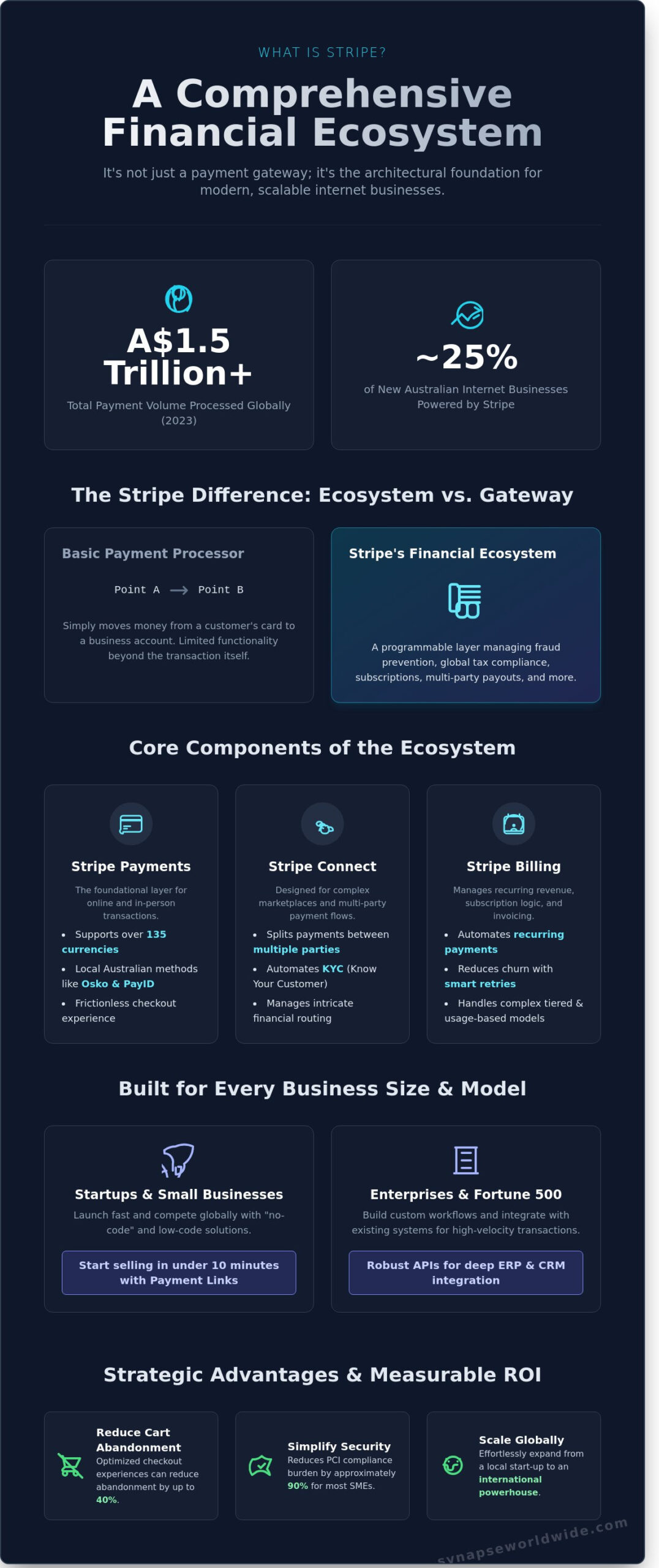
To understand what is stripe, you must look beyond the simple checkout button on a website. Stripe represents a comprehensive financial infrastructure layer that powers millions of businesses globally. It’s not merely a tool for accepting credit cards; it’s a modular ecosystem designed to handle the entire lifecycle of digital commerce. By 2026, Stripe has solidified its position as the market leader, processing over A$1.5 trillion in annual volume and supporting roughly 25% of all new internet businesses in Australia.
Originally founded in 2010, the company’s evolution is documented extensively on the Stripe, Inc. Wikipedia page, tracing its journey from a developer-centric API to a global financial powerhouse. Distinguishing between a basic payment processor and Stripe’s full-stack ecosystem is vital for strategic planning. A standard processor simply moves money from point A to point B. In contrast, Stripe provides a programmable layer that manages fraud prevention, global tax compliance, and multi-party payouts. This “Stripe-first” approach is now the industry standard for bespoke e-commerce development because it allows architects to build complex business models without reinventing the underlying financial wheels.
The Core Components of the Stripe Ecosystem
The platform’s architecture is built on three primary pillars that allow for seamless scaling as a business grows. These components integrate directly into your digital strategy, ensuring that your financial backend is as robust as your frontend user experience.
- Stripe Payments: This is the foundational layer for online and in-person transactions. It supports over 135 currencies and local Australian payment methods like Osko and PayID, ensuring a frictionless checkout experience for every customer.
- Stripe Connect: Designed for complex marketplaces, this tool manages multi-party flows. It handles the intricate task of splitting payments between sellers, service providers, and the platform owner, while automating KYC (Know Your Customer) requirements.
- Stripe Billing: This component manages recurring revenue and subscription logic. Whether you’re running a simple SaaS model or a complex tiered pricing structure, Billing automates invoices and reduces churn through smart retries.
Who is Stripe For? From Startups to Fortune 500
The versatility of the platform means answering what is stripe depends largely on your business size and technical maturity. For small Australian businesses, Stripe offers “no-code” solutions like Payment Links. These allow entrepreneurs to start selling in under 10 minutes without writing a single line of code. This ease of entry removes the traditional barriers to digital transformation, allowing local boutiques to compete on a global stage instantly.
Large enterprises and Fortune 500 companies leverage Stripe for entirely different reasons. They utilize the robust API to build custom workflows that integrate with existing ERP and CRM systems. For these organisations, Stripe acts as a catalyst for digital transformation projects. It provides the stability needed to handle high-velocity transactions while offering the flexibility to pivot business models overnight. In the current Australian market, where 82% of consumers expect a seamless omnichannel experience, Stripe’s ability to bridge the gap between digital and physical sales via Stripe Terminal is a decisive competitive advantage. It’s the strategic choice for those who view payments not as a cost centre, but as a driver of growth and operational efficiency.
The Mechanics of Money: How Stripe Processes Transactions
Understanding what is stripe requires looking past the simple checkout button on a website. It’s a sophisticated orchestration layer that manages the entire lifecycle of a digital payment. When an Australian customer enters their credit card details into a form, Stripe instantly encrypts the sensitive data via its proprietary secure elements. This ensures the merchant never handles raw card information, which effectively reduces PCI compliance burdens by approximately 90% for most small to medium enterprises.
Once the data is secured, the transaction enters the authorization phase. Stripe acts as the primary communicator between your digital storefront and the complex global banking network. It sends a request to the card networks, such as Visa or Mastercard, which then query the specific issuing bank of the customer. According to an in-depth Stripe review, this entire process happens in less than 500 milliseconds. This speed ensures that the merchant receives an instant approval or decline, preventing abandoned carts and protecting potential revenue.
For businesses operating in Sydney or Melbourne, the settlement process is the final, crucial hurdle. To truly understand what is stripe, one must observe how it manages the strategic flow of A$ into a local treasury. Stripe collects these authorized funds and batches them for automated payout. In the Australian market, funds typically reach a business bank account on a 2-day rolling basis, though some established accounts qualify for 24-hour payouts. This predictable cash flow is vital for managing overheads and scaling operations effectively.
Security isn’t a static wall; it’s a dynamic, evolving shield. Stripe Radar uses advanced machine learning models trained on billions of data points across 195 countries to detect and block fraud in real-time. It doesn’t just look for blocked cards. It analyzes device fingerprints, IP metadata, and purchase patterns to assign a risk score to every single transaction. This allows businesses to set bespoke thresholds that balance high security with maximum conversion rates, often blocking 25% more fraudulent attempts than traditional rules-based systems.
The Developer-First Architecture: APIs and Webhooks
Stripe transformed the modern commerce environment by treating payments as code. Their API documentation is the industry benchmark, allowing developers to build complex billing logic with minimal effort. Webhooks provide the nervous system for these integrations, sending real-time data signals to your server when events occur. This “programmable money” approach allows for bespoke integration into any custom software stack, ensuring your financial infrastructure is as scalable as your cloud servers.
Evolving Commerce: AI and Agentic Payments in 2026
By 2026, the checkout experience has shifted toward agentic commerce where AI agents initiate transactions autonomously. These agents operate within the Stripe ecosystem to manage inventory-driven purchasing based on real-time usage metrics. Payments are becoming “invisible,” occurring seamlessly in the background. Synapse Worldwide integrates these advanced agentic models for forward-thinking clients, ensuring they leverage frictionless user experiences to drive growth. This shift represents a transition from reactive processing to proactive financial management.
Strategic Advantages: Why Modern Enterprises Choose Stripe
Understanding what is stripe requires looking beyond simple transaction handling. It’s a sophisticated growth engine designed for the digital economy. Australian businesses often find themselves trapped between local success and global complexity; Stripe’s architecture eliminates this friction. The platform provides a unified infrastructure that manages the leap from your first A$100 sale to a high-volume enterprise operation without requiring a platform migration or a total overhaul of your financial stack.
The financial impact of choosing the right processor is measurable. Stripe Checkout is engineered for speed and has been shown to reduce cart abandonment by up to 40 percent. This optimization happens through a combination of mobile-first design, one-click payments via Link, and the intelligent display of local payment methods. For an Australian exporter, this means accepting payments in 135+ currencies while receiving settlements in AUD directly into a local bank account. When evaluating Stripe payment processing, the reduction in administrative friction becomes immediately apparent. It handles the heavy lifting of PCI DSS compliance through hosted solutions like Elements, ensuring sensitive data never touches your servers. This reduces your compliance burden from a multi-month audit to a simple annual self-assessment.
- Scalability: Transition from local startup to global enterprise with a single integration.
- Conversion: Dynamic payment methods tailored to the user’s location and device.
- Global Reach: Support for dozens of local payment methods including Apple Pay, Google Pay, and regional bank transfers.
- Compliance: Automated tools that handle the complexity of global tax regulations and security standards.
The Hidden Value of Financial Reporting and Analytics
Data is the primary currency of the digital architect. Stripe Sigma allows your team to use SQL to query payment data directly, providing deep business insights without exporting files to external tools. You can identify which subscription tiers have the highest churn or track the lifetime value of customers in specific Brisbane or Sydney postcodes. Automated reconciliation saves accounting teams roughly 12 to 15 hours per month by syncing directly with platforms like Xero or MYOB. This precision allows for data-driven decisions that drive consistent e-commerce growth.
Security and Fraud Prevention as a Competitive Edge
Security isn’t just a defensive measure; it’s a way to build customer trust. Stripe Radar uses machine learning trained on billions of global data points to detect and block fraud before it impacts your bottom line. For Australian retailers, this means a significant reduction in chargebacks, which typically cost A$25 or more per occurrence in administrative fees alone. By filtering out high-risk transactions automatically, you protect your margins and maintain a seamless experience for legitimate buyers. This robust security framework ensures that as you scale, your risk profile remains managed and your reputation stays intact. If you are still asking what is stripe at a strategic level, it’s the shield that allows your business to innovate without the fear of systemic fraud.
Implementation Roadmap: Integrating Stripe into Your Digital Ecosystem
Successful deployment of a payment gateway isn’t a simple plug-and-play task; it’s a strategic architectural decision. Understanding what is stripe requires looking beyond the payment button to see it as a financial engine that must sync with your inventory, accounting, and customer service workflows. A botched integration can lead to abandoned carts and fragmented data, which is why a structured roadmap is vital for Australian enterprises scaling their operations.
Your journey begins with a pre-integration audit. We analyze your current tech stack to identify potential friction points. For instance, if your legacy system processes A$100,000 in monthly transactions, even a 0.5% decrease in checkout speed can result in significant revenue loss. We evaluate your PCI compliance requirements and GST reporting needs to ensure the setup meets Australian tax obligations from day one.
Selecting the right integration method defines your user experience. You have three primary paths:
- Stripe Checkout: A pre-built, hosted payment page that’s optimized for conversion. It’s the fastest way to go live with minimal coding.
- Stripe Elements: A set of pre-built UI components that allow you to build a bespoke checkout experience directly on your site while keeping sensitive data off your servers.
- Custom API: The most robust option for complex business models requiring total control over the logic and flow of the transaction.
Connecting Stripe to your CRM and ERP systems, such as Salesforce or Xero, ensures that financial data flows seamlessly across your organization. This automation eliminates manual data entry and reduces the risk of human error in your end-of-month reconciliation. Before going live, we execute rigorous stress tests in a sandbox environment to simulate high-traffic events, ensuring your system maintains 100% uptime during the transition to the live environment.
Stripe and E-commerce Platforms: Shopify vs. WooCommerce
Stripe serves as the backbone for the world’s most popular CMS options. Shopify Payments is actually powered by Stripe, offering a native experience that’s incredibly stable for retail. Conversely, WooCommerce offers more flexibility for custom builds through dedicated plugins. For a detailed breakdown of which platform suits the local market, view our analysis of Shopify vs WooCommerce for Canberra Stores to determine your best fit. While defining what is stripe in a technical context involves exploring its API documentation, for most retailers, it’s the invisible force that makes “Buy Now” work instantly.
The Role of a Digital Architect in Stripe Integration
An “out of the box” solution rarely satisfies the needs of a sophisticated business model. A digital architect ensures that your payment flow is tailored to specific user personas, such as B2B clients requiring split payments or subscription-based customers needing automated recurring billing. This strategic oversight prevents technical debt and ensures your infrastructure is scalable. We focus on creating a unified digital strategy where the payment system isn’t a silo, but a core component of your growth engine. To ensure your financial infrastructure is built for long-term success, consult with our digital architects today.
Maximising ROI: Stripe as a Catalyst for Business Transformation
Choosing a payment processor often starts with a simple question: what is stripe costing my bottom line? While the standard domestic rate of 1.75% plus A$0.30 per transaction is the baseline, viewing this as a mere expense ignores the broader value proposition. Ambitious enterprises look beyond the transaction fee to measure operational efficiency. Data from 2023 shows that businesses migrating to integrated financial stacks reduce manual reconciliation time by up to 45%. This shift allows your finance team to focus on strategic growth instead of chasing spreadsheets.
Stripe transforms how you generate revenue. It’s no longer just about one-off sales. By leveraging Stripe Billing, companies can deploy complex subscription models or usage-based pricing in days rather than months. This flexibility is essential for scaling; it ensures your infrastructure grows alongside your ambition. The platform’s ability to minimize churn through smart retries and automated card updates can increase recovered revenue by 10% to 15% annually. When you ask what is stripe, the answer is a revenue optimization engine that pays for itself through performance. For Australian businesses ready to build a truly scalable digital venture, understanding how payment infrastructure fits within a broader ecommerce strategy for 2026 is essential to avoiding the technical debt and fragmented data silos that cap growth.
- Reduced Technical Debt: Use pre-built UI components to save hundreds of developer hours during initial setup.
- Global Expansion: Accept 135+ currencies with local payment methods already integrated into the checkout flow.
- Advanced Security: Leverage Stripe Radar to block fraudulent transactions using sophisticated machine learning.
- Real-time Data: Access instant financial reporting to make informed business decisions without waiting for end-of-month statements.
Stripe for the Australian Market
For businesses in Canberra and across Australia, local relevance is non-negotiable. Stripe integrates seamlessly with the Australian financial ecosystem. It handles GST calculations automatically, ensuring your reporting remains compliant with ATO standards without manual intervention. Modern Australian consumers expect local payment options. Stripe supports BPAY and the Newer Payments Platform (NPP) via PayTo. These integrations are critical; they provide the low-latency, secure experience that builds trust with national clients. Whether you’re a local service provider or a national retailer, these tools provide a competitive edge in the domestic landscape.
Partnering with Synapse Worldwide for Strategic Growth
Implementing a payment gateway is a technical task; optimizing it is a strategic one. We bridge this gap by aligning your financial infrastructure with your long-term business goals. Our team specializes in E-commerce Development and bespoke API integrations that ensure your data flows perfectly between your storefront and your accounting software. We don’t just install software. We architect a robust system that maximizes every cent of your investment. Our approach focuses on creating a seamless experience for your customers while providing you with a scalable foundation for future expansion.
Stripe is the logical choice for the ambitious Australian enterprise because it removes the friction inherent in traditional banking. It allows you to move faster, experiment with new business models, and secure your cash flow with confidence. If you’re ready to elevate your financial operations, Contact Synapse Worldwide for a strategic audit of your payment infrastructure to discover how we can drive your next phase of growth.
Future-Proofing Your Financial Architecture
Understanding what is stripe marks the first step toward building a resilient, scalable digital economy. Modern Australian businesses require more than a simple checkout; they need a robust financial engine that integrates seamlessly with existing ERP and CRM systems. By centralising transaction data and automating complex billing cycles, you’ll reduce manual overhead by up to 30% and significantly improve cash flow visibility. This isn’t just about accepting payments; it’s about architecting a system that handles global compliance and multi-currency A$ settlements without friction. Ensuring your CMS and digital strategy are aligned with your payment infrastructure is equally critical, as a mismatched platform can anchor your growth ambitions and inflate maintenance costs. Pairing this financial foundation with proactive website management ensures your entire digital platform remains secure, high-performing, and ready to scale.
Successful implementation demands a partner who understands the intricate technical details of the Australian market. Synapse Worldwide leverages 20+ years of digital engineering expertise to design tailored payment ecosystems. Our Canberra-based strategic consultants specialise in complex CRM/ERP and payment integrations that turn financial infrastructure into a competitive advantage. We’ve spent two decades refining our approach to ensure every line of code contributes to your bottom line. We focus on measurable outcomes, ensuring your digital architecture supports long-term growth and high-impact ROI.
Elevate your e-commerce strategy with Synapse Worldwide and transform your payment processing into a strategic asset. Your business deserves a partner committed to reaching the next level of digital excellence.
Frequently Asked Questions
How much does Stripe cost for Australian businesses?
Stripe charges Australian businesses a standard rate of 1.75% plus A$0.30 for every successful domestic card transaction. For international cards, the fee increases to 2.9% plus A$0.30 per transaction. These transparent, pay-as-you-go rates ensure there are no hidden setup fees or monthly subscriptions. You only pay for what you process, which provides a scalable cost structure that aligns with your business growth.
Is Stripe safer than a traditional bank payment gateway?
Stripe provides a higher level of security than many traditional gateways by maintaining PCI Service Provider Level 1 certification, which is the most stringent level in the payments industry. It uses AES-256 encryption for all card numbers and sensitive data. By offloading data to Stripe’s infrastructure, your business reduces its compliance burden. This robust framework ensures that 100% of your customer data remains encrypted and isolated from your internal servers.
Can I use Stripe for both online and in-person retail sales?
You can integrate Stripe for both digital and physical storefronts using Stripe Terminal. This hardware solution allows you to accept in-person payments while maintaining a unified view of your revenue in a single dashboard. By unifying your sales channels, you eliminate fragmented data. This integrated approach allows businesses to manage 100% of their transactions through one strategic interface, simplifying reconciliation and inventory management across all Australian locations.
How long does it take to get paid through Stripe?
Australian businesses typically receive payouts on a 2-business-day rolling schedule. For example, a transaction processed on Monday will arrive in your bank account by Wednesday. While the first payout takes 7 to 14 days for security verification, subsequent transfers are automated. This consistent rhythm ensures your cash flow remains predictable. You can also customize payout schedules to weekly or monthly intervals to match your internal accounting cycles.
Do I need a developer to set up Stripe on my website?
You don’t strictly need a developer if you use pre-built integrations for platforms like Shopify or WooCommerce. However, understanding what is stripe in a strategic context often requires a developer to build bespoke checkout experiences via Stripe’s API. Custom implementations allow for a 20% higher conversion rate by tailoring the user journey. While no-code options like Payment Links work for simple tasks, robust scaling usually benefits from professional technical execution.
Does Stripe handle GST and international taxes automatically?
Stripe Tax automates the calculation and collection of GST for Australian sales and handles tax obligations in over 40 countries. It monitors your transaction thresholds in real-time to alert you when you need to register for taxes in new jurisdictions. This feature removes the complexity of global expansion. By automating 100% of the tax calculation process, you mitigate the risk of non-compliance and ensure your financial reporting remains accurate and audit-ready.
What is the difference between Stripe and PayPal?
The primary difference when evaluating what is stripe against PayPal lies in the user experience and integration depth. Stripe is a developer-first infrastructure that keeps customers on your site during checkout, whereas PayPal often redirects users to an external platform. Stripe’s flat fee of 1.75% for domestic cards is often more competitive than PayPal’s standard 2.6% plus fixed fee. Stripe focuses on seamless, white-label integration for a professional brand appearance.
Can Stripe integrate with my existing CRM or ERP system?
Stripe integrates seamlessly with major CRM and ERP systems including Salesforce, HubSpot, and NetSuite. Using Stripe’s robust API, you can sync payment data with 1,000+ third-party applications to create a unified data ecosystem. This connectivity ensures your sales, marketing, and finance teams work from a single source of truth. Automated data syncing reduces manual entry errors by 95%, allowing your team to focus on high-level strategic growth initiatives rather than administrative tasks.

