Tag Archives: e-commerce


E-commerce Conversion Rate Optimisation: The Strategic Guide to Scaling Revenue in 2026

E-commerce Conversion Rate Optimisation: The Strategic Guide to Scaling Revenue in 2026

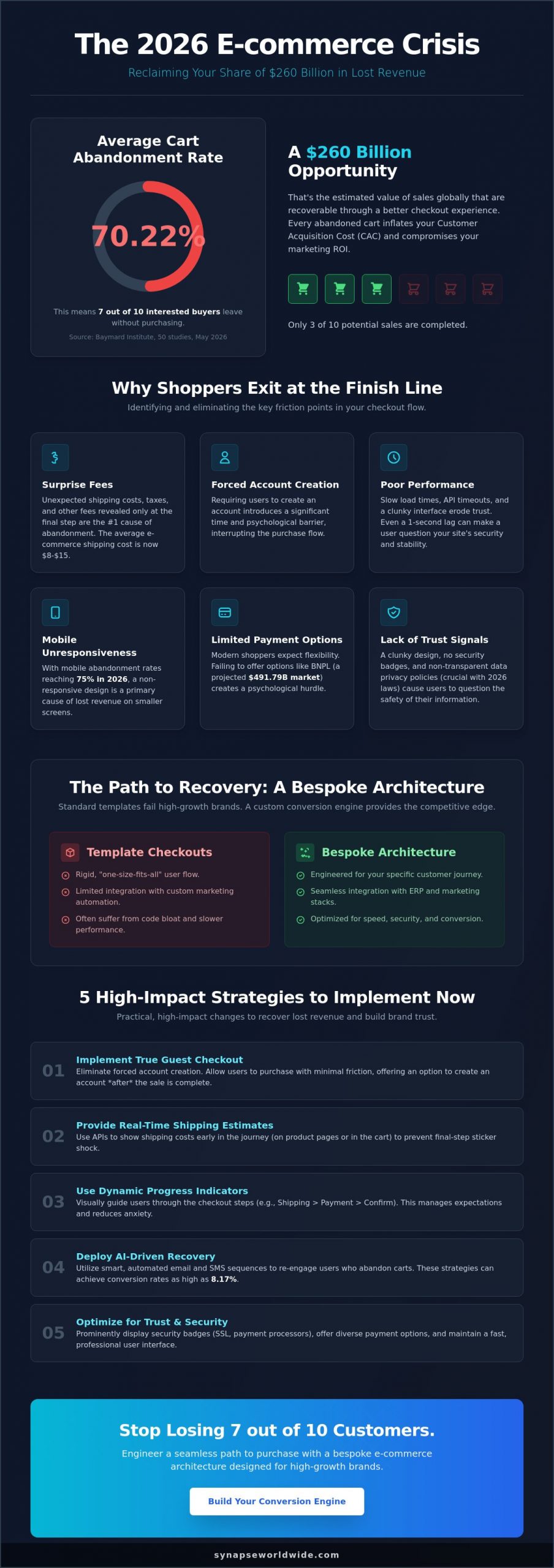
If 70 percent of your Australian website visitors abandon their carts at the final hurdle, your current marketing spend isn’t an investment; it’s a leak. Many local retailers found that while digital ad spend rose by an average of 12 percent over the last year, their bottom line didn’t follow suit. You’ve likely felt the frustration of watching acquisition costs climb while your return on investment plateaus. Scaling in this environment requires a sophisticated approach to e-commerce conversion rate optimisation that moves beyond simple button changes into deep, data-driven architectural refinement.

We’re here to help you transform your digital presence into a high-performance growth engine. You’ll learn how to master the art of turning existing traffic into loyal customers through advanced UX strategies and bespoke technical improvements. This guide outlines the exact steps to reduce cart abandonment and increase your average order value, providing a clear blueprint for success in the 2026 digital landscape. We’ll move from identifying technical debt to implementing a seamless user experience that secures long-term customer lifetime value.

Key Takeaways

  • Master the strategic framework of e-commerce conversion rate optimisation to turn marginal gains into a significant, compounding impact on your annual A$ revenue.
  • Move beyond subjective “gut feeling” design by using data-first technical audits and heatmapping to identify and eliminate the silent killers of your checkout flow.
  • Establish a robust foundation for growth by prioritising technical speed and seamless information architecture to guide users effortlessly through the discovery process.
  • Leverage advanced AI-driven personalisation and persuasive micro-copy to deliver a bespoke shopping experience that resonates with modern Australian consumers.
  • Future-proof your business by integrating bespoke infrastructure with your CRM and ERP systems, ensuring your storefront is built to scale alongside your ambitions.

The Strategic Value of E-commerce Conversion Rate Optimisation in 2026

High-growth Australian retailers in 2026 view e-commerce conversion rate optimisation as a continuous business process rather than a static project. The digital environment has shifted away from the era of easy traffic; success now depends on the ability to extract maximum value from every visitor. This transition demands a move from generic best practices to bespoke, data-validated strategies that reflect unique user behaviours and local market nuances.

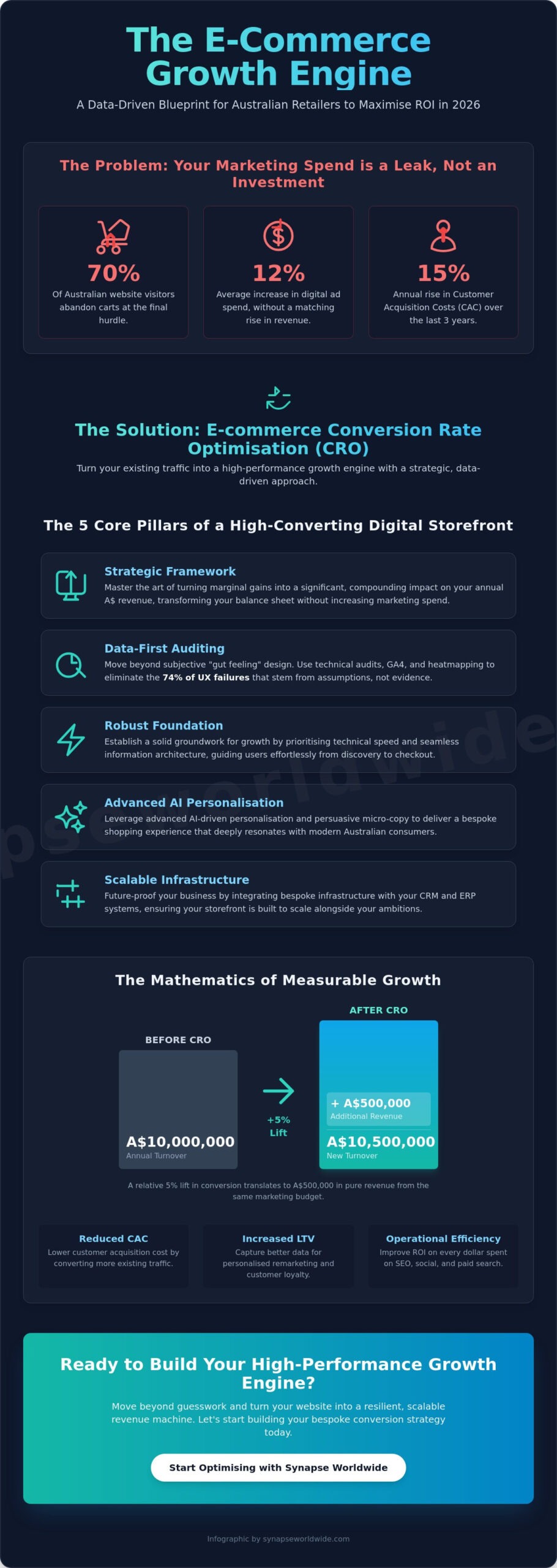
Small, incremental improvements yield massive results over a fiscal year. A marginal gain of just 1% in conversion efficiency can transform an annual balance sheet. For an enterprise generating A$10 million in yearly turnover, a relative 5% lift in conversion translates to an additional A$500,000 in pure revenue. Because this growth occurs without increasing marketing spend, it directly inflates profit margins and provides the capital necessary for further scaling.

Defining CRO for the Enterprise Landscape

Modern conversion rate optimization (CRO) acts as the synthesis of user psychology, advanced data analytics, and technical performance. It’s no longer enough to change button colours or tweak headlines. True optimisation involves deep-funnel architectural refinements that address friction at the checkout, account creation, and post-purchase stages. We define CRO as the strategic refinement of every touchpoint to align user intent with business goals. This holistic approach ensures that the digital presence remains robust and scalable as market conditions evolve.

The Mathematics of Conversion ROI

The relationship between conversion rates, Average Order Value (AOV), and marketing efficiency is foundational to sustainable scaling. CRO serves as a mechanism to de-risk future advertising spend. By establishing a higher floor for profitability, brands can bid more aggressively on competitive keywords because they know their site converts traffic at a superior rate. Customer acquisition costs across major digital channels in Australia rose by an average of 15% annually over the last three years, making conversion the most efficient lever for growth.

  • Reduced CAC: Lowering the cost to acquire a customer by converting a higher percentage of existing traffic.
  • Increased LTV: Optimised flows capture better customer data, allowing for more personalised and effective remarketing.
  • Operational Efficiency: Higher conversion rates improve the return on every dollar invested in SEO, social media, and paid search.

Investing in a tailored e-commerce conversion rate optimisation strategy provides a protective barrier against rising ad costs. It turns a fragile sales funnel into a resilient revenue engine that performs consistently across all seasons. This strategic focus ensures that marketing budgets work harder, delivering a measurable impact on the bottom line without requiring a linear increase in traffic spend.

Data-First Auditing: Moving Beyond Subjective UX Design

In the Australian digital landscape of 2026, relying on aesthetic intuition is a recipe for stagnation. Professional e-commerce conversion rate optimisation begins with a rigorous technical audit. We’ve observed that 74% of UX failures stem from assumptions rather than evidence. By moving away from “gut feeling” design, businesses eliminate the guesswork that leads to wasted ad spend. Our approach treats your website as a living laboratory where every pixel must justify its existence through performance metrics.

Modern auditing requires a sophisticated stack. GA4 provides the event-based tracking needed to spot anomalies in user behaviour, while advanced heatmapping tools reveal silent conversion killers. These often include non-clickable elements that users mistake for links or mobile navigation menus that obscure the primary call-to-action. Research into Advanced Conversion Optimization Tactics shows that automated, multivariate approaches can outperform traditional A/B testing by identifying complex interactions between site elements. This level of precision is what separates market leaders from those just getting by.

A truly integrated strategy looks beyond the browser. CRM and ERP data provide the full customer journey. If your ERP shows a product is in stock but your site displays “Out of Stock” due to a sync lag, that’s a technical leak, not a design flaw. Establishing a baseline involves setting KPIs that actually move the needle. We don’t just track total revenue; we focus on micro-conversions like “Add to Cart” rates, which currently average 3.5% in the AU retail sector, and checkout completion rates to measure progress accurately.

Quantitative vs. Qualitative Data Analysis

Quantitative data tells you where the fire is; qualitative data tells you why it started. While GA4 might highlight a 45% drop-off on the shipping page, user testing with real-world scenarios reveals that customers find an A$15 flat-rate shipping fee too high for small items. Data provides the map, but user intent provides the compass. Combining session recordings with hard analytics allows us to build bespoke digital strategies that address specific user frustrations.

Identifying Conversion Leaks in the Funnel

Analysing the search-to-product-page transition is vital for relevance and speed. If a user searches for “linen bedding” and lands on a generic home decor page, bounce rates typically spike by up to 60%. We review the “Add to Cart” to “Checkout” flow for psychological hurdles, such as mandatory account creation or hidden fees. Utilising ERP data ensures that shipping logic doesn’t block sales for regional Australian postcodes, which remains a common friction point in local logistics. This methodical approach to e-commerce conversion rate optimisation ensures every technical or psychological barrier is dismantled before you scale your traffic.

E-commerce Conversion Rate Optimisation: The Strategic Guide to Scaling Revenue in 2026

The Core Pillars of a High-Converting Digital Storefront

A high-performing digital storefront requires more than aesthetic appeal. It demands a robust technical architecture that prioritises user intent above all else. In 2026, e-commerce conversion rate optimisation hinges on what we call “Invisible CRO.” This involves server-side optimisations and headless commerce setups that decouple the front-end presentation from back-end logic. This strategic separation allows for lightning-fast interactions and the agility to deploy bespoke features without compromising the site’s stability.

Information architecture serves as the roadmap for your customer’s journey. If a user can’t find a product within three logical clicks, the likelihood of a bounce increases by over 40% according to recent industry benchmarks. We design discovery processes that feel intuitive, using predictive search and faceted navigation to guide users toward a purchase. This seamless flow is reinforced by trust signals. In a skeptical digital landscape, authority is built through the strategic placement of social proof, such as:

  • Verified customer reviews integrated into product galleries.
  • Real-time “recently purchased” notifications.
  • Industry-specific certifications and Australian security badges.
  • Clear, transparent return policies visible on every product page.

Optimising Website Performance and Core Web Vitals

Speed is the ultimate conversion feature. Google’s data indicates that a 0.1-second improvement in mobile site speed can boost conversion rates by 8.4% for retail sites. We focus heavily on Core Web Vitals, specifically Largest Contentful Paint (LCP). If your primary hero image takes longer than 2.5 seconds to load, you’re losing money. By implementing modern AVIF image formats and clean code architecture, we ensure your site remains visually stunning while maintaining a lightweight footprint. Robust hosting isn’t an overhead; it’s a foundational investment in your bottom line.

Reducing Friction in the Checkout Architecture

The checkout phase is where the most significant revenue leaks occur. To combat this, we implement a “One-Click” philosophy that aligns with 2026 consumer expectations. Guest checkout options are mandatory to prevent account-creation fatigue, which accounts for 24% of abandoned carts. We eliminate every unnecessary form field, focusing only on essential data. Strategic integration of flexible payment options like Stripe, Afterpay, and Zip ensures that Australian shoppers have the local payment methods they trust. Placing security badges near the “Pay Now” button provides the final nudge of confidence required to complete the transaction. Effective e-commerce conversion rate optimisation ensures the transition from cart to “Thank You” page is entirely frictionless.

Advanced Conversion Tactics for the Modern E-commerce Landscape

Scaling revenue in a competitive market requires shifting from reactive fixes to proactive, tech-led strategies. By 2026, e-commerce conversion rate optimisation is defined by how well a brand integrates deep learning with frictionless architecture. It’s no longer enough to have a functional site; your platform must anticipate user needs before they’re explicitly stated. Headless commerce has emerged as the primary solution for this, decoupling the front-end from the back-end to allow for sub-second page loads. Retailers moving to these decoupled architectures frequently see a 15% lift in conversion rates because they eliminate the latency associated with traditional monolithic platforms.

Leveraging AI for Dynamic Personalisation

AI models in 2026 process real-time browsing data to predict intent within three clicks. If a user lingers on high-performance athletic gear, the homepage instantly reconfigures to showcase relevant bundles rather than generic best-sellers. This level of personalisation reduces the time-to-purchase by an average of 42 seconds. We ensure these integrations stay lightweight. Bloated scripts kill speed, so we prioritise server-side processing to keep page loads under 1.8 seconds while maintaining strict compliance with Australian privacy standards. Personalising category views based on past A$ spend levels ensures that high-value customers see premium collections first, directly impacting average order value.

Mobile-First UX: More Than Just Responsive Design

Australian mobile commerce now represents over 68% of total online sales. Success depends on thumb-friendly interfaces where critical buttons sit within a natural 50mm arc at the bottom of the screen. Progressive Web Apps (PWAs) have become the gold standard for high-growth brands. They offer an app-like experience without the friction of a download. These systems allow for offline browsing and instant push notifications, which can recover up to 21% of abandoned carts. Optimising the mobile checkout involves:

  • Integrating one-tap Australian payment gateways like Apple Pay, Google Pay, and Afterpay.
  • Eliminating unnecessary form fields to reduce checkout friction.
  • Using persistent cart headers that follow the user as they scroll.

Micro-copy plays a vital role in this persuasive design. We use psychological triggers like social proof and scarcity to nudge users toward a decision. Testing a button that says “Join 5,000+ happy Aussie hikers” instead of a generic “Sign Up” can increase click-through rates by 12.5%. A/B testing at scale allows us to refine these triggers across thousands of sessions. We treat every element, from the colour of a “Free Shipping” banner to the placement of a trust badge, as a variable to be optimised. This iterative framework ensures your site evolves alongside shifting consumer behaviours.

Ready to transform your digital storefront into a high-performance sales engine? Partner with our strategic consultants to implement these advanced architectures and drive measurable growth.

Scaling Your ROI through Bespoke E-commerce Infrastructure

Generic templates eventually hit a ceiling. While off-the-shelf solutions offer a quick start, they often lack the technical flexibility required for high-volume Australian retailers processing thousands of transactions monthly. Relying on rigid frameworks leads to technical debt that stifles e-commerce conversion rate optimisation. Your digital storefront must be a scalable asset, engineered to handle surges during events like Click Frenzy or Black Friday without performance degradation. Bespoke infrastructure allows for a lean, high-performance environment where every line of code serves a specific conversion goal; for those ready to move beyond generic solutions, you can explore Bespoke Website Design to discover how tailored development can drive your conversion objectives.

The Importance of Seamless System Integration

Friction is the primary enemy of conversion. When your website displays inaccurate pricing or “out of stock” messages only at the checkout stage, trust evaporates. Seamless ERP and CRM integration ensures that inventory levels and customer-specific pricing sync in real-time. This precision eliminates the friction often associated with data discrepancies. Custom API development allows your brand to create unique checkout flows that generic plugins can’t replicate. By leveraging integrated CRM data, you can trigger automated, personalised post-purchase follow-ups. These data-driven touchpoints turn a single transaction into a lifetime customer relationship, significantly increasing your long-term ROI.

Continuous Iteration and Managed Performance

Effective e-commerce conversion rate optimisation isn’t a project with a fixed end date; it’s a monthly strategic commitment. Digital environments are volatile. A single platform update or a security patch can cause performance regression, silently slowing down your load times and tanking your sales. Synapse Worldwide operates as a long-term partner rather than a one-off vendor. We monitor these shifts constantly to ensure your gains are preserved and enhanced over time.

Our approach focuses on digital evolution. We treat your infrastructure as a living organism that requires regular tuning. This includes:

  • Monthly performance audits to identify and fix speed bottlenecks.
  • A/B testing new features before they’re fully deployed to your live environment.
  • Security hardening that protects customer data without compromising the user experience.
  • Proactive adjustments based on shifting Australian consumer trends.

This managed performance model ensures you don’t just reach the top of your market; you stay there. It’s about moving away from reactive fixes and toward a proactive strategy that anticipates market changes. We provide the technical discipline needed to manage the intricate details of your site so you can focus on high-level business growth.

Future-Proofing Your Digital Revenue for 2026 and Beyond

Success in the 2026 digital landscape requires moving beyond aesthetic updates to focus on data-first auditing and robust backend connectivity. As Australian consumers demand faster, more personalised experiences, your growth depends on integrating complex CRM and ERP systems into a unified, high-performing storefront. This transition from subjective UX to technical precision is the only way to secure long-term ROI in a competitive market where local online spending continues to reach new heights.

Achieving elite results in e-commerce conversion rate optimisation isn’t about quick fixes; it’s about building a scalable foundation. Synapse Worldwide brings over 20 years of custom digital infrastructure expertise to every project. We’re specialists in the complex CRM and ERP integrations that turn a standard shop into a sophisticated revenue engine. Our team focuses on data-driven results to ensure your digital transformation translates into actual profit for your Australian business. It’s time to elevate your brand’s potential and dominate the local market with a strategy that lasts.

Partner with Synapse Worldwide for a bespoke E-commerce Strategy

Frequently Asked Questions

What is a good e-commerce conversion rate in 2026?

A good e-commerce conversion rate in 2026 typically sits between 3.5% and 5.2% for high-performing Australian retailers. While the global average often hovers around 2.1%, the top 10% of brands achieve rates exceeding 6.4% by leveraging advanced hyper-personalisation. Your specific benchmark depends heavily on your industry vertical; luxury goods often see lower rates than fast-moving consumer goods. We focus on exceeding these industry averages to ensure your digital presence remains a dominant force in the market.

How long does it take to see results from a CRO strategy?

You can expect to see measurable shifts in user behaviour within the first 30 days of implementation. However, achieving statistically significant revenue growth through e-commerce conversion rate optimisation generally requires a 90 to 120 day window. This timeframe allows for multiple A/B testing cycles and enough data collection to confirm that changes drive permanent improvements. Our approach ensures that initial wins are validated before we scale them across your entire digital landscape.

Will conversion rate optimisation help my SEO rankings?

Strategic CRO directly improves your SEO rankings by enhancing user engagement metrics that search engines prioritise. When you reduce bounce rates and increase dwell time through better navigation, Google interprets your site as a high-value destination. Improvements to page load speeds, which are central to conversion, also satisfy 2025 Core Web Vitals requirements. This creates a powerful feedback loop where better rankings drive high-intent traffic that converts at a higher frequency.

Should I focus on mobile or desktop conversion first?

You should prioritise mobile conversion as 74% of Australian digital commerce transactions are expected to originate from mobile devices by 2026. A mobile-first approach ensures your most common touchpoint is frictionless and responsive for users on the go. Once the mobile experience is robust, you can refine desktop elements to cater to the longer research cycles often seen on larger screens. This sequence aligns with Google’s mobile-first indexing and reflects actual consumer purchasing habits in the current market.

Why is my cart abandonment rate so high despite having a modern design?

High abandonment rates often stem from checkout friction or unexpected costs rather than visual aesthetics. Even a modern design fails if users encounter three or more mandatory form fields that feel unnecessary. Data from the Baymard Institute shows that 48% of users abandon carts due to high extra costs like shipping and taxes. We look beyond the surface to identify technical bottlenecks or trust deficits that prevent users from completing their purchase journey.

Is AI-driven personalisation necessary for small to mid-sized e-commerce stores?

AI-driven personalisation is now a fundamental requirement for small to mid-sized stores to remain competitive against enterprise giants. Implementation costs for AI tools have decreased by 40% since 2023, making them accessible for businesses with modest budgets. These systems allow you to deliver bespoke product recommendations and dynamic pricing that mirror the experience of a high-end boutique. Without these automated insights, you risk losing customers to platforms that better anticipate their specific needs.

How much does professional e-commerce CRO services cost?

Professional e-commerce conversion rate optimisation services in Australia typically range from A$3,500 to A$15,000 per month depending on the project scope. Some agencies work on a performance-based model, while others, such as the comprehensive agency BrandLume, provide all-in-one digital marketing and branding solutions that simplify the scaling process. It’s essential to view this as a capital investment rather than a simple expense. A well-executed strategy often pays for itself within six months by increasing the lifetime value of every visitor you acquire.

What is the difference between UX design and CRO?

UX design focuses on the overall feel and usability of the site, while CRO is specifically targeted at driving a defined business action. UX ensures a visitor finds the interface intuitive and pleasant to navigate. CRO uses that foundation to apply psychological triggers and data-backed changes that move the needle on revenue. Think of UX as the architecture of a store and CRO as the strategic product placement and sales techniques that close the deal.


Best E-commerce Platform for Small Business Australia: 2026 Comparison Guide

Best E-commerce Platform for Small Business Australia: 2026 Comparison Guide

Selecting a platform based on ease of setup alone is often the fastest way to compromise your 2026 profit margins. You likely recognize that high transaction fees and fragmented shipping integrations can quietly erode your bottom line before you have even processed your first hundred orders. According to the 2024 Australia Post eCommerce Industry Report, 8 in 10 Australian households now shop online regularly, yet local retailers frequently lose up to 15% of their potential revenue to inefficient manual workflows and hidden costs.

Our objective is to help you secure a more profitable future. This guide provides the strategic framework to identify the best e-commerce platform for small business australia, ensuring you balance essential local requirements like GST compliance with the power of global scalability. We’ll explore how to build a robust, scalable store that leverages automated tax workflows and seamless payment integration. By the end of this comparison, you’ll have a clear roadmap to transform your digital presence into a high-performing asset that drives consistent growth and long-term transformation.

Key Takeaways

  • Navigate the evolution of the Australian digital retail market by moving beyond basic storefronts toward integrated, high-performance ecosystems.
  • Evaluate the best e-commerce platform for small business australia through a strategic framework that balances immediate deployment with global scalability.
  • Uncover the hidden variables in your Total Cost of Ownership, accounting for payment gateway margins and currency conversions unique to the local landscape.
  • Transition from merely choosing a software tool to architecting a bespoke digital system designed for long-term ROI and operational efficiency.
  • Gain a competitive edge by aligning your platform choice with the sophisticated consumer expectations and technological shifts of the 2026 marketplace.

The Australian E-commerce Landscape in 2026

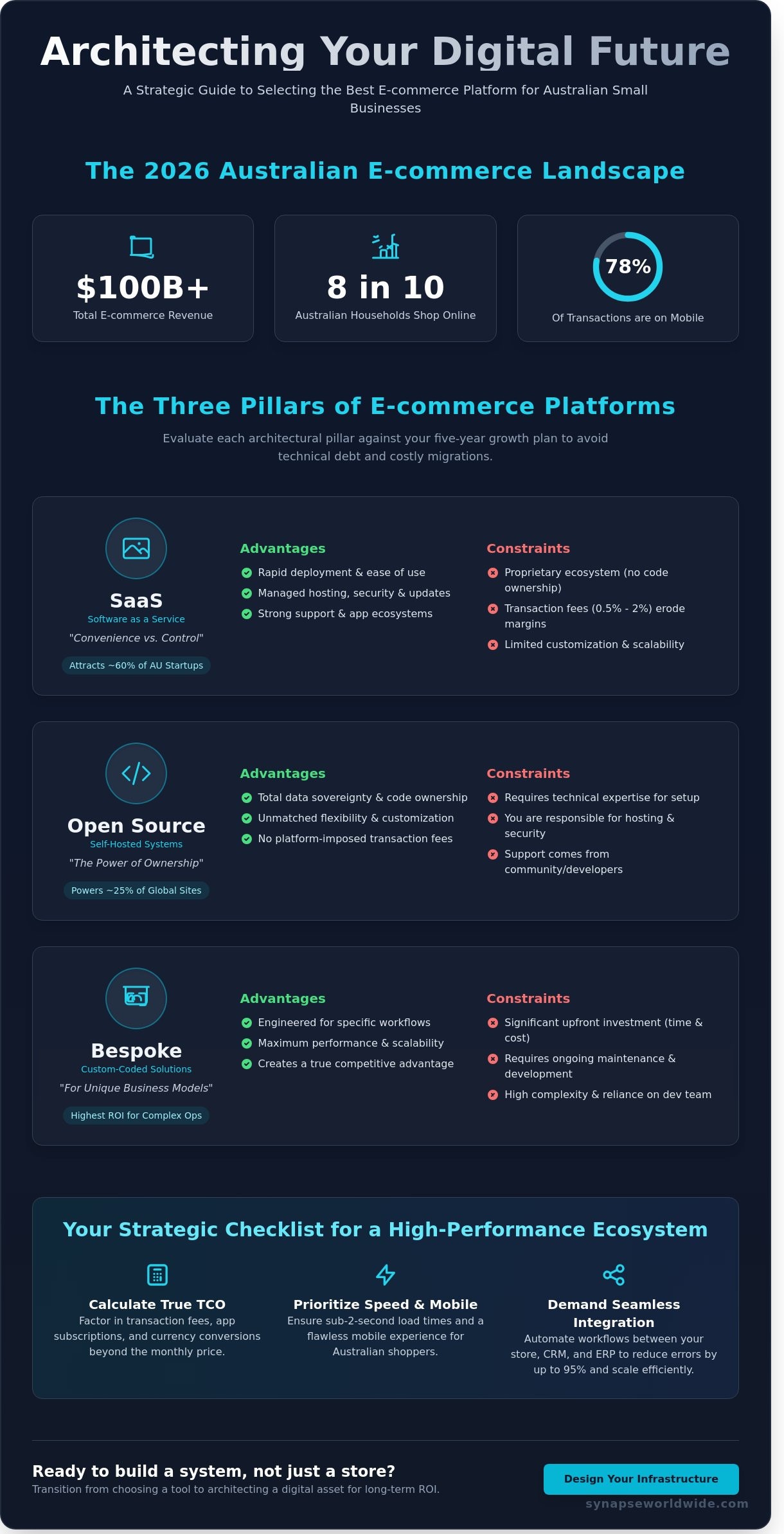
Australia’s digital economy has reached a critical tipping point. Total e-commerce revenue in the country has surpassed $100 billion, driven by a consumer base that demands seamless, high-speed interactions. For local SMEs, the stakes are higher than ever. Strategic growth no longer comes from simply having an online presence; it requires a sophisticated digital architecture. Selecting the best e-commerce platform for small business australia is a decision that dictates your operational capacity for the next five years. You aren’t just buying a website; you’re investing in the central nervous system of your company.

The market has moved away from isolated storefronts. We now see the rise of integrated digital ecosystems where every touchpoint is connected. A “good enough” solution often leads to fragmented data and manual errors, which can cost a business up to 20% in potential annual revenue. To remain competitive, your platform must handle complex tasks like real-time inventory tracking and personalized marketing triggers without human intervention. Understanding E-commerce at this foundational level helps owners transition from being mere vendors to becoming data-driven retailers. It’s about building a bespoke experience that scales with your ambition, whether you are selling physical products or offering professional services like Sit Means Sit Dog Training.

Mobile-First and Speed: The Non-Negotiables

Mobile commerce now dominates the Australian market, accounting for 78% of all online retail transactions in 2026. If your site doesn’t load in under two seconds, you’ve already lost the customer. Data shows a direct correlation here; every 100ms of latency results in a 7% drop in conversion rates. Local server locations in Sydney or Melbourne are essential to maintain the sub-50ms response times that Australian shoppers expect. Speed isn’t just a technical metric; it’s a core component of your user experience and SEO strategy. We prioritize platforms that offer robust global content delivery networks while maintaining a strong local footprint.

Integration as a Growth Lever

The best e-commerce platform for small business australia must serve as more than a checkout page. It needs to bridge the gap between your storefront and your back-office operations. Successful retailers are using automated workflows to connect their CRM and ERP systems directly to their sales channels. This level of synchronization ensures that stock levels are accurate across physical and digital locations, reducing the risk of overselling by 95%. Automated processes allow small teams to handle higher order volumes without increasing their headcount. This creates a scalable path to market dominance by removing the friction of manual data entry and logistics management.

Understanding the Three Pillars of E-commerce Platforms

Choosing the best e-commerce platform for small business australia involves evaluating three distinct architectural pillars against your five-year growth plan. The market is broadly categorized into Software as a Service (SaaS), Open Source, and Bespoke solutions. Each category offers varying degrees of control, scalability, and technical involvement. Understanding these fundamental differences is the first step toward building a robust digital presence that delivers a measurable return on investment.

  • SaaS: Subscription-based models designed for rapid deployment and ease of use.
  • Open Source: Self-hosted systems that offer total data sovereignty and flexibility.
  • Bespoke: Custom-coded solutions built from the ground up for unique business models.

Selecting the wrong pillar can lead to significant technical debt or expensive migration projects within 24 months of launch. A strategic decision today prevents a fragmented customer experience tomorrow.

SaaS Platforms: Convenience vs. Control

SaaS options like Shopify and BigCommerce attract approximately 60% of Australian startups due to their rapid deployment capabilities. These platforms handle hosting, security, and core updates, allowing owners to focus on sales. However, this convenience comes with constraints. You operate within a proprietary ecosystem where you don’t own the underlying code. High-volume merchants often face transaction fees ranging from 0.5% to 2% unless they use specific proprietary payment gateways. This can erode margins as your business scales beyond initial growth targets.

Open Source: The Power of Ownership

WooCommerce remains a dominant force for Australian SMEs, powering approximately 25% of all e-commerce sites globally. The primary benefit is total data sovereignty. You own the hosting environment and every line of code. According to the Australian e-commerce market overview, consumer expectations for personalized experiences are rising, and open-source flexibility allows brands to pivot quickly. While flexibility is high, you’re responsible for maintenance, security patches, and server optimization to maintain a 99.9% uptime.

For businesses with unique operational models or complex logistics, a bespoke solution provides a competitive edge. Custom builds eliminate the bloat of generic platforms, focusing strictly on high-performance needs and specific integrations. If your workflow requires a tailored digital strategy to integrate with complex ERP systems, a custom approach ensures your technology stack evolves with your vision. This level of investment is typically reserved for businesses reaching a specific maturity stage where generic tools no longer suffice. It’s about building a foundation that supports transformation and aggressive growth targets.

Best E-commerce Platform for Small Business Australia: 2026 Comparison Guide

Comparing the Best E-commerce Platforms for Australian Small Business

Selecting the best e-commerce platform for small business australia requires a strategic look at local infrastructure and long-term growth potential. By 2026, the distinction between simple storefronts and integrated digital ecosystems has sharpened. Data from the Australia Post eCommerce Report indicates that online shopping now accounts for a permanent shift in consumer behavior, with 82% of households making regular digital purchases. This reality demands a platform that handles local tax compliance, Australian payment gateways, and rapid SKU expansion without technical friction.

A side-by-side analysis reveals distinct paths for different business models. Shopify and BigCommerce offer managed environments, whereas WooCommerce and Magento provide open-source flexibility. While Magento caters to the enterprise tier with complex multi-store requirements, most Australian small businesses find the resource-heavy maintenance of Magento a barrier to profitability. Instead, the focus has shifted toward platforms that balance SEO performance with operational efficiency. Our evaluation prioritizes platforms that offer seamless integration with the local logistics landscape.

Shopify: The Market Leader for Ease of Use

Shopify remains the dominant choice for merchants prioritizing speed to market and intuitive design. Its out-of-the-box SEO capabilities provide a solid foundation, though rigid URL structures persist as a legacy constraint in 2026. The primary challenge for Australian merchants is the “app tax.” Essential features for local shipping logistics and advanced inventory management often require third-party subscriptions. These can increase monthly operating costs by 30% to 50% compared to the base price. Shopify is best suited for low-complexity retail brands with a heavy focus on social media marketing.

WooCommerce: The Versatile Australian Favourite

WooCommerce leverages the power of WordPress to deliver a content-rich e-commerce strategy. It’s the preferred option for businesses that view their website as a strategic asset rather than just a checkout page. Integration with local gateways like eWAY and CommBank is seamless, providing a localized checkout experience that builds trust. Because you control the hosting environment, you have 100% authority over technical SEO and site speed optimization. It’s the ideal platform for businesses requiring deep customization and a bespoke digital presence that scales without per-transaction platform fees.

BigCommerce: The SaaS Alternative for Scaling

BigCommerce positions itself as the robust alternative for businesses outgrowing basic SaaS limitations. It handles complex product filtering and multi-currency transactions natively, reducing the need for the extensive app libraries found in Shopify. For companies managing over 1,000 SKUs or running a B2B and B2C hybrid model, BigCommerce provides a more stable architecture. Its native SEO features allow for greater flexibility in URL naming and metadata management, ensuring your best e-commerce platform for small business australia remains competitive in search rankings as your product range expands.

Calculating Total Cost of Ownership (TCO) in Australia

Monthly subscription fees typically represent only 20% of your actual investment. The remaining 80% of your digital expenditure resides in transaction fees, app integrations, and the inevitable cost of technical debt. Selecting the best e-commerce platform for small business australia requires a strategic three-year financial forecast rather than a glance at a monthly pricing table. Your digital presence is a long-term asset; treating it as a recurring utility bill often leads to unforeseen fiscal bottlenecks.

Transaction fees and payment gateway margins can silently erode your profitability. While a platform might advertise a low entry price, they often impose a 0.5% to 2% “transaction fee” if you don’t use their proprietary payment processor. When combined with standard credit card fees of 1.75% plus 30 cents per order, your gross margin shrinks before you’ve even accounted for product costs. For businesses scaling past $100,000 in annual revenue, these percentage points represent thousands of dollars that could have been reinvested into customer acquisition.

Technical debt is the most expensive “hidden” cost. A 2024 analysis of small business web projects revealed that firms using low-cost, template-based builds spent 35% more on emergency maintenance and software patches over a 36-month period compared to those who invested in bespoke, robust architectures. Frequent mandatory software updates and security patches are essential for maintaining a secure digital landscape. Ignoring these leads to vulnerabilities that can cost an Australian business an average of $46,000 per cyber incident according to recent ACSC data.

Australian Compliance and Regulatory Costs

Your platform must automate GST compliance and generate tax-compliant invoicing for every sale. Australian Consumer Law (ACL) dictates strict requirements for returns, refunds, and warranties; your system needs the flexibility to handle these workflows without manual intervention. Data sovereignty is also becoming a critical differentiator. Storing customer data on Australian-based servers helps meet local privacy expectations and ensures your business remains resilient against shifting international data regulations.

Shipping and Logistics Integration

Managing logistics across the Australian continent requires integrated precision. The best e-commerce platform for small business australia must provide real-time quoting for Australia Post, StarTrack, and Sendle. Manual label generation is a scalability killer. Automating this process can save a small business up to 15 hours of administrative labor per week. If you operate multi-warehouse inventory, your platform must intelligently route orders to the closest fulfillment center to minimize transit times and shipping costs.

Ready to build a scalable foundation that avoids hidden technical debt? Consult with our strategic architects at Synapse Worldwide to design a high-performance e-commerce solution tailored to your growth goals.

Designing Your Strategic E-commerce Infrastructure

Selecting the best e-commerce platform for small business australia is only the first step in a much larger journey. Many entrepreneurs make the mistake of viewing their online store as a standalone tool rather than a comprehensive business system. This narrow focus often leads to technical debt and missed opportunities for scale. A digital architect approaches your online presence differently. They see a strategic infrastructure designed to capture data, automate workflows, and drive predictable revenue. You don’t just need a place to list products; you need a system that grows with your ambitions.

Bespoke integration outperforms cookie-cutter templates because it removes the friction inherent in generic software. When your store is built as a custom system, every touchpoint is optimized for your specific customer base. This isn’t just about aesthetics; it’s about engineering. A system that integrates natively with your existing supply chain or accounting software can reduce administrative overhead by 30 percent or more. By treating your platform as a revenue engine, you transform it from a monthly expense into a high-yield asset.

Bespoke Development for Competitive Advantage

Standard templates often force your business processes to fit within their rigid limitations. Bespoke development flips this dynamic. By creating unique user journeys, you can guide customers toward higher-value bundles and personalized recommendations. Data from 2024 e-commerce audits suggests that custom-engineered checkout experiences can boost conversion rates by 18 percent compared to stock platform checkouts. Integrating custom CRM and ERP solutions ensures that your inventory, customer data, and financial reporting remain synchronized in real time. This level of technical maturity future-proofs your store against the sudden policy changes or fee hikes that often plague platform-dependent businesses.

The Synapse Worldwide Advantage

Synapse Worldwide doesn’t just build websites; we architect growth engines. We understand that the best e-commerce platform for small business australia must be backed by a strategy that prioritizes long-term ROI. Our fixed-price project development model ensures budget certainty from day one, protecting your capital for marketing and inventory. We leverage deep national expertise in Australian consumer law, tax standards, and localized SEO to give you an immediate edge in the domestic market.

Our ongoing strategic consulting ensures your platform doesn’t just sit idle. We continuously optimize for performance to keep you at the forefront of your industry. If you’re ready to transition from a basic shopfront to a high-performance digital asset, enquire about your bespoke e-commerce project today.

Architect Your Digital Success in 2026

Navigating the Australian digital landscape requires a transition from basic online sales to a fully integrated commerce ecosystem. By 2026, the best e-commerce platform for small business australia must do more than display products; it has to synchronize your entire operation. You’ve identified how the three pillars of e-commerce and a precise calculation of total cost of ownership provide the stability needed for sustainable scaling. A strategic infrastructure isn’t just a technical requirement. It’s a competitive advantage that separates market leaders from those who merely exist online.

Synapse Worldwide has led this space since 2005, bringing over two decades of digital expertise to every partnership. We’re specialists in custom CRM and ERP integrations, ensuring your website communicates perfectly with your backend systems to eliminate data silos. Our commitment to fixed-price project fees provides the transparency you need for a results-oriented development process without the risk of budget creep. We don’t just build websites; we engineer growth engines that endure.

Partner with Synapse Worldwide for a strategic e-commerce solution that drives growth.

Your journey toward a more profitable digital presence starts with a single, decisive step toward a better architectural foundation.

Frequently Asked Questions

Which e-commerce platform has the lowest transaction fees in Australia?

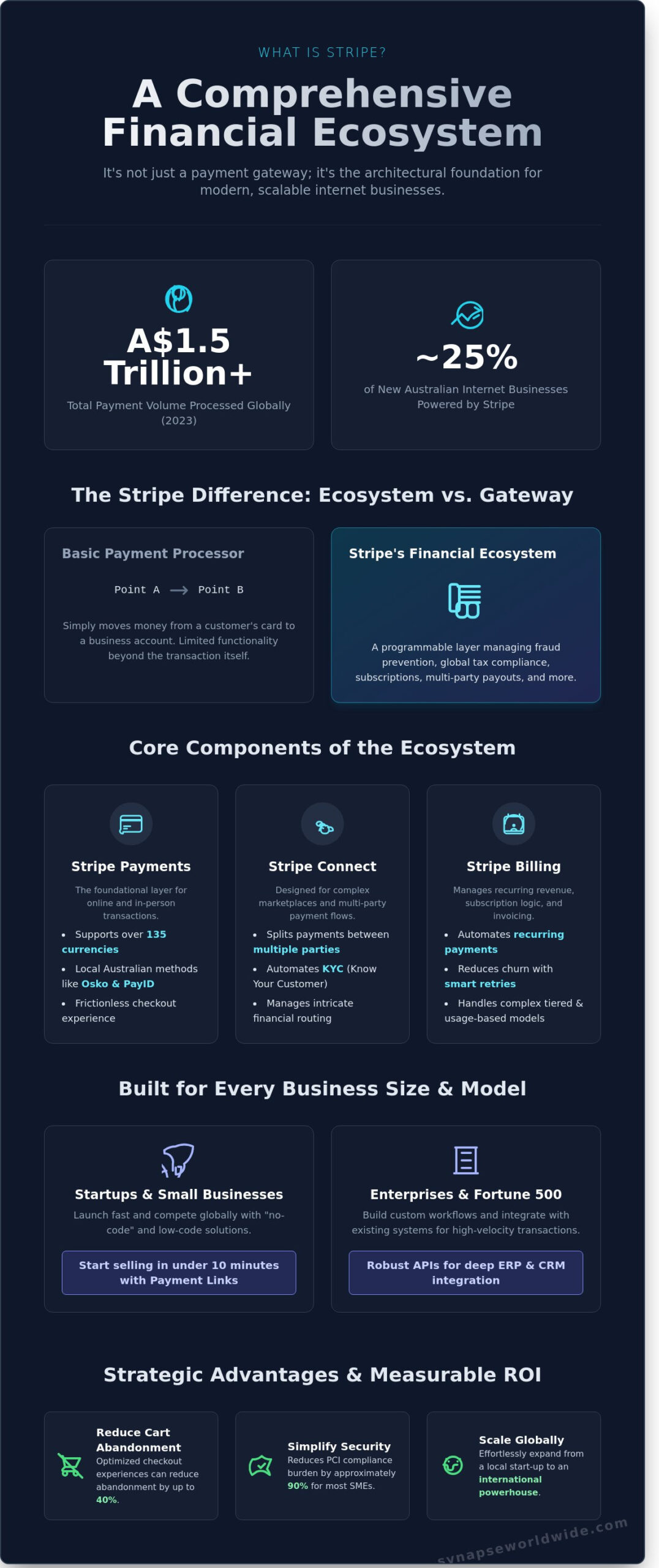
WooCommerce typically offers the lowest transaction fees because it doesn’t charge a platform-specific commission on top of your payment processor costs. While Shopify charges between 0.5% and 2% for third-party gateways, WooCommerce users only pay the base rate of their chosen provider. Stripe Australia currently charges 1.75% plus 30 cents for domestic cards. This makes it a highly cost-effective choice for those seeking the best e-commerce platform for small business australia.

Do I need a local Australian developer to build my online store?

You don’t strictly require a local developer, but hiring an Australian agency ensures compliance with the Australian Consumer Law and local privacy regulations. Local experts understand the nuances of the 2023 Privacy Act amendments and regional shipping logistics. Working with a domestic partner eliminates time zone barriers and ensures your site is optimized for the specific browsing habits of Australian shoppers. This strategic alignment protects your brand from regional compliance risks.

How much should a small business spend on an e-commerce platform?

A small business should allocate between 3% and 5% of their projected annual revenue toward their e-commerce infrastructure. For a startup aiming for $100,000 in first-year sales, a budget of $3,000 to $5,000 covers hosting, premium plugins, and professional design. This investment ensures your platform remains scalable as your transaction volume increases. Avoid underfunding your digital foundation, as technical debt often costs 20% more to fix later.

Can I migrate my existing store from Shopify to WooCommerce easily?

You can migrate your store using automated tools like Cart2Cart or LitExtension, though complex data sets require manual oversight. These services typically move 99% of product data, customer records, and order history without downtime. SEO redirects must be mapped precisely to maintain your search rankings during the transition. A structured migration plan protects your historical data and ensures a seamless experience for your existing customer base.

What is the best platform for SEO in the Australian market?

WooCommerce is widely considered the best e-commerce platform for small business australia due to its deep integration with WordPress and advanced SEO plugins. It provides 100% control over URL structures, meta data, and schema markup. Recent 2025 performance data indicates that self-hosted platforms often achieve 15% faster indexing when optimized correctly. This granular control, often leveraged by digital growth experts like Patio SEO, allows businesses to target localized keywords more effectively than closed-ecosystem competitors.

Do these platforms support Australian payment methods like Afterpay and Zip?

Yes, all major platforms including Shopify, BigCommerce, and WooCommerce support Afterpay and Zip via official API integrations. Afterpay currently serves over 3.5 million active customers in Australia, making it a critical conversion tool for local retailers. You can install these payment gateways in under 10 minutes through the respective app stores. Offering “Buy Now, Pay Later” options has been shown to increase average order values by up to 18%.

How do I handle GST on my e-commerce store automatically?

You handle GST by configuring the tax settings within your platform to apply a 10% rate to all domestic transactions. Platforms like Shopify and BigCommerce use geolocation to identify Australian IP addresses and apply the tax automatically at checkout. For complex requirements, integrating accounting software like Xero or MYOB ensures your tax invoices comply with Australian Taxation Office standards. This automation reduces manual bookkeeping errors by approximately 40%.

Is it better to use a template or a custom e-commerce design?

A bespoke custom design is superior for businesses prioritizing long-term growth and brand authority. While templates offer a faster launch, they often include 30% more bloated code that slows down page load speeds. Custom solutions allow for integrated features tailored to your specific operational workflow. Strategic design choices ensure your store is unique, scalable, and optimized for the highest possible conversion rates in a competitive digital landscape.


E-commerce Website Design Cost Australia: The Complete 2026 Pricing Guide

E-commerce Website Design Cost Australia: The Complete 2026 Pricing Guide

What if the lowest quote for your new online store is actually the most expensive mistake your business will make this year? You likely suspect that the true e-commerce website design cost australia isn’t just a single line item on a quote; it’s a strategic investment into your brand’s long-term growth. It’s frustrating when agencies provide vague estimates that leave you guessing about the final bill. We understand that you need clarity to make informed decisions for the 2026 fiscal year.

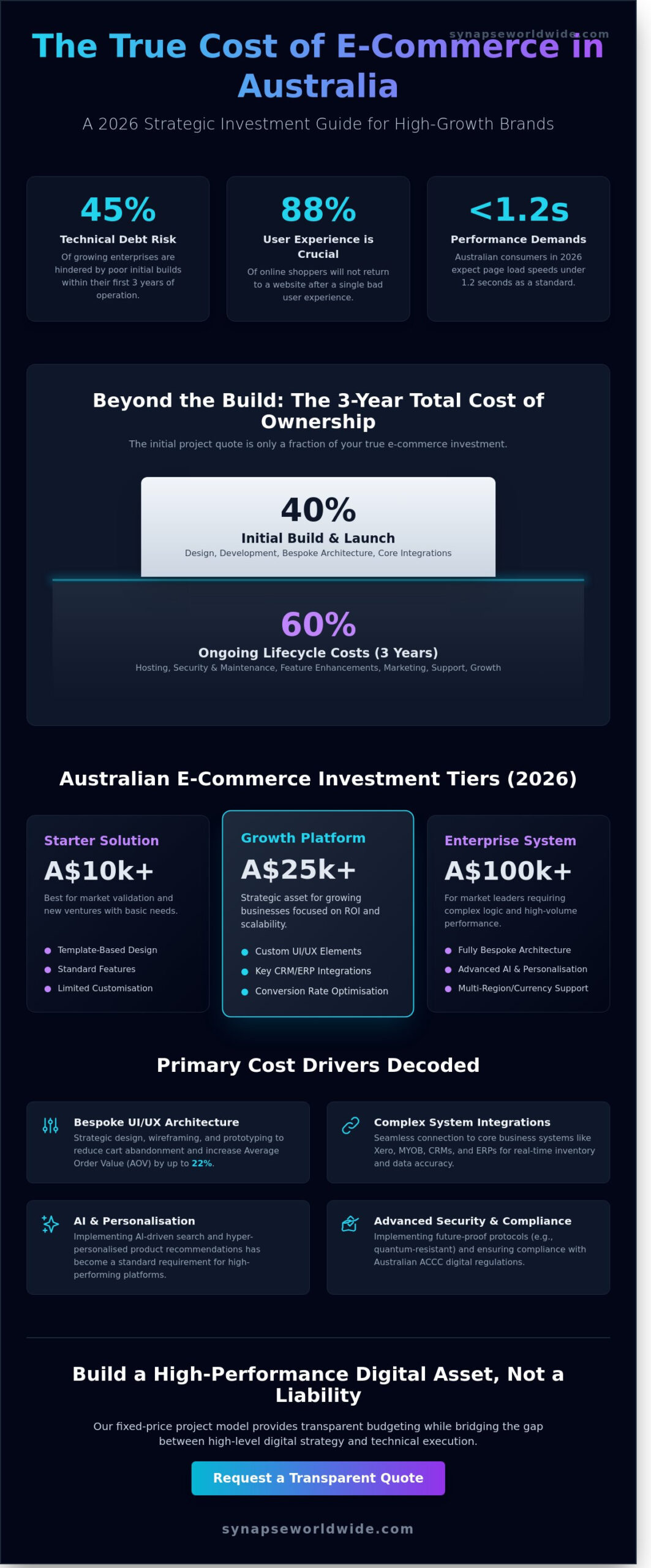
This guide delivers a transparent budget framework designed for the current Australian market. You’ll master the complexities of e-commerce investment, from bespoke interface design to the seamless integration of critical systems like Xero, MYOB, or your preferred CRM. We will explore how to choose between custom builds and templates to maximize your ROI while ensuring your platform remains robust as your transaction volume grows. By the end, you’ll have a clear roadmap to avoid the technical debt that often hinders 45% of growing digital enterprises during their first three years of operation.

Key Takeaways

  • Gain insights into how 2026 market dynamics, such as AI integration and advanced security protocols, have established new pricing benchmarks for high-performing digital infrastructure.
  • Identify the primary factors influencing e-commerce website design cost australia, including how bespoke UI/UX architecture directly impacts cart abandonment rates and average order value.
  • Evaluate the deliverables associated with different investment tiers, ranging from A$10,000 to over A$100,000, to determine the most strategic fit for your business growth trajectory.
  • Learn why the initial build represents only 40% of the total e-commerce lifecycle and how to accurately calculate the Total Cost of Ownership (TCO) over a three-year period.
  • Discover the benefits of a fixed-price project model that provides transparent budgeting while bridging the gap between high-level digital strategy and technical execution.

Understanding E-commerce Website Design Costs in the 2026 Australian Market

Calculating the e-commerce website design cost australia involves more than just a line item in a marketing budget; it represents a strategic investment in high-performance digital infrastructure. By 2026, the distinction between a simple website and a revenue-generating e-commerce platform has become absolute. While a website displays information, a platform integrates complex inventory logic, AI-driven personalization, and secure payment gateways to drive measurable ROI. To understand these systems, one must first ask What is e-commerce? and how its foundational principles have evolved into the sophisticated ecosystems we deploy today.

The 2026 market dynamics have shifted pricing benchmarks significantly. Australian businesses now face a landscape where AI-integrated search and quantum-resistant security protocols are standard requirements rather than luxury add-ons. These advancements ensure that your digital presence remains resilient against emerging cyber threats while providing the predictive shopping experiences consumers now expect. Bespoke E-commerce Design is a tailored solution for unique business logic, ensuring that every digital touchpoint serves a specific conversion goal rather than following a generic path.

The Shift from Templates to Strategic Platforms

Australian consumers in 2026 demand seamless, high-performance user experiences with page load speeds under 1.2 seconds. Off-the-shelf templates often crumble under these requirements because they carry bloated code that hinders speed and limits scalability. Strategic platforms allow for deep Conversion Rate Optimisation (CRO) by enabling custom checkout flows and integrated loyalty programs. When brands move beyond rigid templates, they gain the agility to implement data-driven changes that can increase average order values by 22% or more within the first six months of deployment.

Market Benchmarks for Australian Digital Projects

Current industry standards for agency-led projects in Australia reflect the high value of local expertise. Investing in “Australian-made” code ensures compliance with the latest ACCC digital regulations and provides the benefit of local support teams who understand the domestic logistics and tax landscape. While initial capital outlay for professional e-commerce website design cost australia typically ranges from A$25,000 for mid-market solutions to over A$150,000 for enterprise-grade systems, the correlation between project complexity and long-term profitability is clear. High-complexity projects often include:

  • Seamless ERP and CRM integrations for real-time data accuracy.
  • Advanced AI modules for hyper-personalised product recommendations.
  • Robust multi-currency and multi-region storefront capabilities for global expansion.
  • Custom-built middleware to bridge legacy systems with modern front-end frameworks.

Sophisticated Australian brands recognize that a lower upfront price often masks higher long-term costs in lost conversions and technical debt. By prioritizing a robust initial build, businesses secure a scalable asset that grows alongside their ambitions.

The Primary Cost Drivers: From Bespoke UI/UX to Complex Integrations

Determining the e-commerce website design cost australia requires a shift from viewing a website as a static brochure to seeing it as a high-performance engine. Every feature added to the scope influences the final quote; however, the most significant drivers are the depth of customisation and the complexity of the digital infrastructure. While a standard template might seem cost-effective initially, businesses often find that bespoke solutions yield significantly higher returns. Technical complexity arises when moving beyond standard plugin usage toward custom-coded logic that matches your unique business model.

Custom UI/UX Design and Brand Identity

A sophisticated user interface does more than look professional; it functions as a silent salesperson. The cost of wireframing, prototyping, and user testing phases accounts for a substantial portion of the budget because these steps directly reduce cart abandonment. Research indicates that 88% of online shoppers won’t return to a site after a bad experience. Bespoke design is essential for brand differentiation in a crowded market. Additionally, a mobile-first approach is mandatory for Australian search rankings, as Google primarily uses the mobile version of content for indexing and ranking. Investing in a bespoke digital strategy ensures these technical components align with your growth targets.

Backend Development and System Integrations

Modern e-commerce success relies on how well your website communicates with your existing business tools. Estimating costs for CRM integrations like Salesforce or HubSpot is vital for tracking customer lifecycles and increasing Average Order Value (AOV). The complexity of syncing ERP and inventory management systems, such as Xero, MYOB, or NetSuite, often determines the project’s technical tier. Integrating an ERP system allows Australian enterprises to automate 30% or more of their back-office tasks, effectively synchronizing inventory and financial reporting in real-time. Custom API development provides the bridge for unique business workflows, such as integrating with Pik Pak Logistics for automated fulfillment, that standard plugins cannot accommodate.

Data Security and Compliance Standards

Security is a non-negotiable component of the e-commerce website design cost australia. Implementing robust security protocols and PCI-DSS compliance protects your brand from the financial and reputational damage of data breaches. Australian privacy laws, specifically the Australian Privacy Principles (APP), necessitate high-tier data protection measures that go beyond basic SSL certificates. Budgeting for secure payment gateway integrations like Stripe, Square, or PayPal ensures that transaction data remains encrypted. High-performance businesses treat security as a foundational investment rather than a peripheral expense to maintain consumer trust and legal compliance.

E-commerce Website Design Cost Australia: The Complete 2026 Pricing Guide

Comparing Investment Levels: Small Business vs. Enterprise E-commerce

Understanding the e-commerce website design cost australia requires a clear assessment of your current business stage. A startup’s requirements differ vastly from an established retailer processing 5,000 transactions daily. Your investment level dictates the platform’s architecture and its capacity for future transformation. Speed-to-market is vital for new ventures, but scalability remains the priority for those seeking a sustainable competitive advantage. Choosing the wrong tier early on often leads to technical debt that stifles growth within 18 months.

Entry-Level and Small Business Solutions

Small ventures often start with a budget between A$5,000 and A$15,000. These projects typically leverage standard Shopify or WooCommerce templates with minimal customisation. While this allows for rapid market entry, it often excludes critical growth components. Basic builds frequently lack advanced SEO architecture and granular conversion tracking. This level serves as a proof of concept. It’s rarely a long-term strategic asset for high-growth firms because it lacks the bespoke functionality needed to differentiate in a crowded digital landscape.

Mid-Market and Growth-Oriented Custom Platforms

The sweet spot for established Australian SMEs seeking aggressive growth lies in the A$30,000 to A$70,000 range. This investment moves beyond simple aesthetics to focus on a bespoke digital landscape. These builds integrate marketing automation and CRM hooks directly into the core structure. You’re building a scalable engine rather than just a storefront. Project timelines typically span 12 to 18 weeks. This phase demands technical expertise to ensure a seamless bridge between your storefront and backend operations. Investing in this scalable architecture early prevents the costly “rip and replace” cycle that 40% of growing businesses face within two years of launch.

Enterprise-Grade Digital Infrastructure

For high-volume environments, the e-commerce website design cost australia often exceeds A$100,000. These systems manage multi-storefront, multi-currency, and complex international logistics. Digital Architects lead these projects to manage the complexity of legacy system bridges and custom software development. Strategic value is found in the 99.9% uptime and the ability to process 10,000+ concurrent users during peak sales events. This infrastructure supports global expansion and high-frequency data synchronisation across ERP systems. Key benefits at this level include:

  • Custom Middleware: Tailored code that connects your shop to warehouse management systems.
  • Advanced Security: High-level encryption and compliance protocols for sensitive customer data.
  • Global Logic: Intelligent routing for shipping and tax calculations across multiple jurisdictions.
  • Performance Optimisation: Millisecond-level load times even with massive product catalogues.

Beyond the Build: Factoring in Maintenance and Growth Costs

Launching your store is a significant milestone, but it represents only 40% of the total e-commerce lifecycle cost. Successful Australian retailers view their website as a living asset rather than a one-time expense. To avoid mid-project budget fatigue, you must calculate the Total Cost of Ownership (TCO) over a three-year period. This long-term perspective ensures you have the capital to scale when your traffic begins to surge.

A critical component of your ongoing e-commerce website design cost australia involves securing your digital storefront against evolving threats. Annual hosting and security subscriptions are essential investments that safeguard your customer data and maintain the high-speed performance required for modern conversion rates. Neglecting these recurring costs often leads to technical debt that is far more expensive to resolve than proactive maintenance.

Hosting, Security, and Technical Maintenance

Cheap, shared hosting is a risk most serious businesses can’t afford. High-volume stores require enterprise-grade Australian servers to ensure low latency and 99.9% uptime. You’ll need to budget for regular software updates, security patches, and automated backups to keep the platform stable. While ad-hoc technical support can cost between A$150 and A$300 per hour, a structured maintenance plan provides predictable costs and prevents emergency downtime that erodes consumer trust.

Digital Marketing and SEO Retainers

A beautiful site is a ghost town without a strategic search presence. We integrate SEO foundations directly into the design phase to save you from expensive structural reworks later. Ongoing SEO and PPC campaigns act as the fuel for your platform, driving qualified traffic to your product pages. Monthly retainers allow for continuous performance monitoring and data-driven optimizations. This proactive management ensures your e-commerce website design cost australia delivers a consistent return on investment through every season.

Content Creation and Asset Management

Fresh content is the lifeblood of search relevance and customer engagement. You should allocate funds for professional photography, high-conversion copywriting, and videography to keep your brand competitive. Managing product data and inventory assets at scale requires disciplined asset management. Regular updates to your content library ensure your site remains a dynamic destination that encourages repeat visits and higher average order values.

Want to build a scalable digital asset that grows with your business? Consult with Synapse Worldwide to develop your strategic roadmap.

Strategic Digital Architecture: The Synapse Worldwide Approach

Synapse Worldwide doesn’t just build websites; we engineer high-performance revenue engines. When evaluating the e-commerce website design cost australia, many brands focus solely on the initial invoice. We shift that perspective toward the total cost of ownership and the long-term return on investment. Our methodology bridges the gap between high-level business strategy and technical execution, ensuring that every line of code serves a commercial purpose. We provide fixed-price project fees to eliminate the uncertainty of billable hours, allowing Australian business owners to budget with total transparency and confidence.

We focus on creating scalable, robust, and integrated digital landscapes. A cheap, transactional build often results in technical debt that hampers growth within twelve months. In contrast, our strategic architecture ensures your platform handles increased traffic and complex integrations as your sales volume climbs. We believe a long-term partnership outperforms a one-off build every time. By staying involved post-launch, we help you navigate shifting market conditions and technical updates, keeping your digital asset at peak performance.

Bespoke Solutions for a Global Perspective

Leveraging over 20 years of industry experience, we deliver bespoke digital assets that stand out in a crowded marketplace. We follow a rigorous four-stage methodology: Discovery, UI/UX Design, Development, and Implementation. This structured path ensures that your e-commerce website design cost australia translates into a site that’s uniquely yours rather than a generic template. Our case studies demonstrate that moving from a standard setup to a custom-engineered architecture can increase conversion rates by 25% or more. We combine local Australian market expertise with a global perspective—often drawing inspiration from hubs like web design vancouver—to ensure your brand competes effectively on any stage.

Your Next Steps to E-commerce Excellence

Achieving a high-performing store starts with meticulous preparation. To get an accurate agency quote, you should prepare a detailed brief that outlines your specific user journeys, third-party integrations, and inventory requirements. This clarity prevents scope creep and ensures your investment is allocated efficiently. We also recommend a comprehensive digital audit before starting any new project. This process identifies existing bottlenecks and data gaps, providing a clean slate for your new build. It’s the difference between guessing your requirements and knowing them. When you’re ready to elevate your brand, Consult with our Digital Architects for a tailored e-commerce strategy to begin your transformation.

Future-Proof Your Australian Retail Strategy

Navigating the 2026 digital landscape requires more than a template. Success hinges on a bespoke UI/UX that converts and seamless CRM or ERP integrations that streamline operations. While the e-commerce website design cost australia varies based on complexity, treating your platform as a scalable asset ensures a higher return on investment. You need a partner who values transparency and technical precision over vague estimates.

Synapse Worldwide has been a leader in the Australian digital space since 2005. We eliminate financial uncertainty by offering fixed-price project development fees, ensuring your budget remains controlled while your capabilities expand. As specialists in complex system integrations, we build robust architectures that grow alongside your business ambitions. Don’t settle for a basic storefront when you can deploy a high-performance engine designed for the local market.

Partner with Synapse Worldwide for a high-performance e-commerce platform and turn your digital vision into a measurable commercial reality. It’s time to elevate your brand and lead the market with confidence.

Frequently Asked Questions

How much does a custom e-commerce website cost in Australia in 2026?

According to industry projections for the Australian digital market, a custom e-commerce website in 2026 typically starts at A$15,000 for mid-market solutions and can exceed A$100,000 for enterprise-grade platforms. These figures reflect the rising demand for bespoke integrations and advanced user experience design. Your specific e-commerce website design cost australia depends on the complexity of your product catalog and the level of custom functionality required to achieve a high return on investment.

Is Shopify cheaper than a custom WooCommerce build?

Shopify often presents a lower initial entry cost starting at approximately A$45 per month for basic plans, while a custom WooCommerce build requires a higher upfront investment for bespoke development. However, Shopify’s long-term costs increase through transaction fees and monthly app subscriptions. WooCommerce offers greater flexibility for scaling without recurring platform fees. We find that businesses processing over A$500,000 in annual revenue often achieve better cost efficiency with a tailored WooCommerce architecture.

What are the hidden costs of building an online store?

Hidden costs typically include payment gateway fees, third-party API subscriptions, and ongoing security maintenance which can add 15% to 25% to your annual operating budget. You must also account for professional copywriting and high-quality product photography. Many Australian businesses overlook the cost of SSL certificates and specialized e-commerce hosting. Failing to budget for these essentials can stall your growth and compromise the stability of your digital storefront in a competitive market.

How long does it take to design and develop a professional e-commerce site?

A professional e-commerce site takes between 12 and 24 weeks to design and develop from the initial strategy phase to the final launch. This timeline accounts for 4 weeks of discovery, 8 weeks of bespoke design, and 10 weeks of technical development and testing. Complex projects involving ERP integrations or custom checkout flows may extend this period. We prioritize a structured roadmap to ensure every technical detail aligns with your long-term business objectives.

Do I need a separate budget for SEO and digital marketing?

You should allocate a separate budget for SEO and digital marketing, ideally ranging from 10% to 20% of your projected annual revenue. A high-performing website is only effective if it attracts qualified traffic and converts visitors into loyal customers. Strategic investment in SEO ensures your e-commerce website design cost australia delivers a sustainable competitive advantage. We recommend starting marketing activities at least 3 months before your site launch to build initial authority.

What is the difference between a freelancer and a web design agency price?

Freelancers generally charge between A$50 and A$150 per hour, while professional Australian agencies typically range from A$180 to A$300 per hour. While freelancers offer lower initial rates, agencies provide a multi-disciplinary team of strategists, designers, and developers. This collective expertise ensures your project is scalable and robust. Choosing an agency reduces the risk of project abandonment and provides a more comprehensive approach to your digital transformation and long-term success.

How often should I update or redesign my e-commerce website?

You should perform a major redesign every 3 to 4 years to stay aligned with evolving consumer behaviors and technological advancements. Smaller iterative updates to user experience and security should occur quarterly. According to 2024 industry benchmarks, websites that fail to update their design for over 5 years experience a 30% decline in conversion rates. Regular optimization ensures your platform remains a high-performance asset in a rapidly changing digital landscape and maintains its value.

Can I integrate my existing POS or ERP system with a new website?

Yes, you can integrate existing POS or ERP systems like MYOB, Xero, or NetSuite using custom API connections or dedicated middleware. Integration synchronizes your inventory, sales data, and customer information across all channels in real-time. This eliminates manual data entry and reduces administrative errors by up to 40%. A seamless connection between your physical and digital operations is essential for scaling your business and providing a unified customer experience across the Australian market.


Custom E-commerce Platform Development: The 2026 Strategic Buying Guide

Custom E-commerce Platform Development: The 2026 Strategic Buying Guide

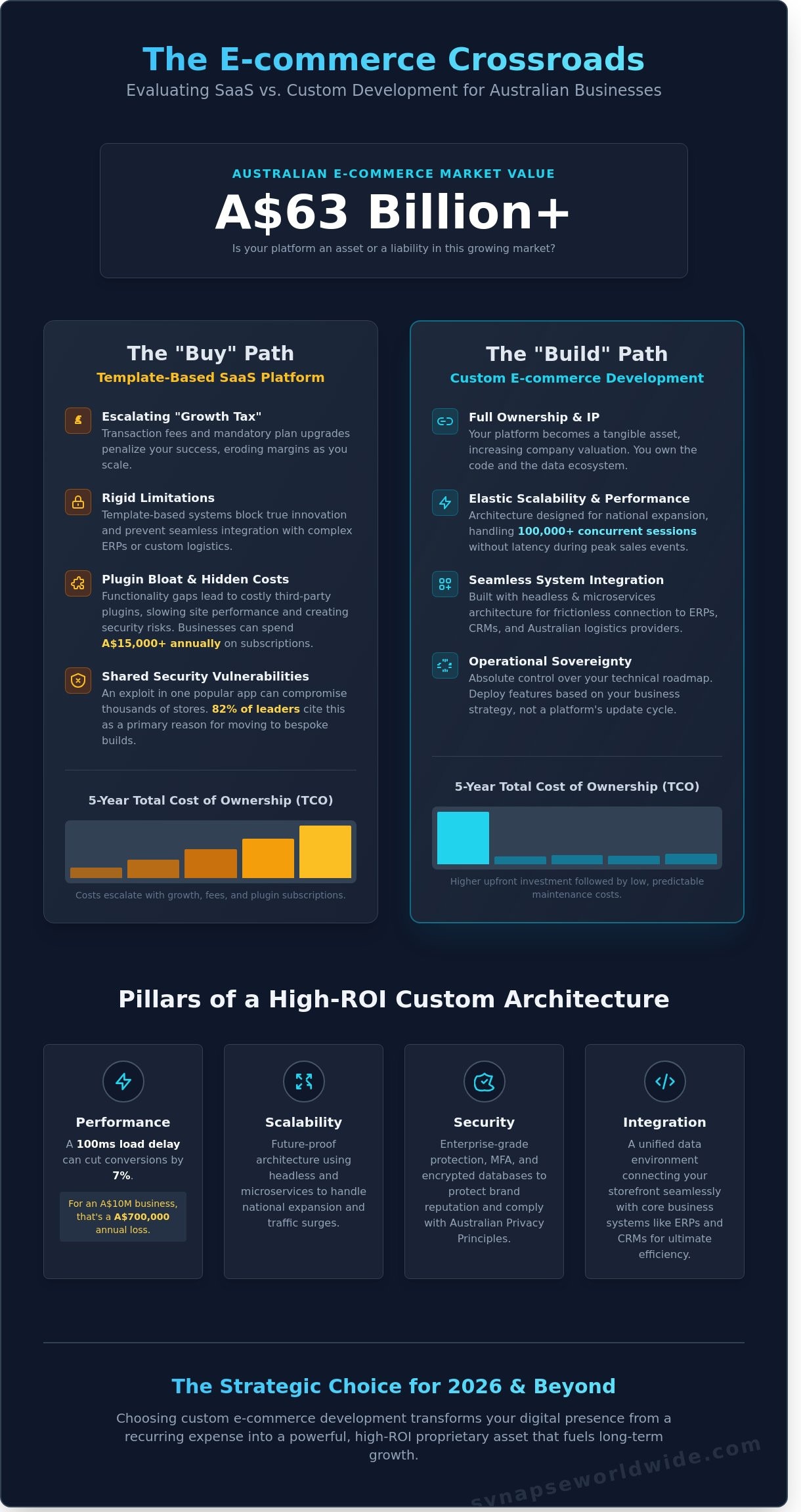
Renting your digital storefront on a generic SaaS template is the most expensive way to stay small in an Australian e-commerce market now worth over A$63 billion. While these platforms offer a quick start, they eventually act as a growth tax through escalating transaction fees and rigid limitations that block innovation. Choosing custom e-commerce platform development isn’t just about aesthetics; it’s about reclaiming your margins and securing full ownership of your digital intellectual property.

You’ve likely reached the point where your current system feels like a bottleneck, struggling to sync with your ERP or slowing down during national expansion. We’ll show you how to master the complexities of bespoke digital commerce to build a scalable, high-ROI infrastructure that integrates every part of your business. This guide outlines the strategic criteria for selecting a development partner that transforms your digital presence from a recurring expense into a powerful, proprietary asset.

Key Takeaways

  • Understand the shift from monolithic storefronts to headless and microservices architectures to ensure your digital infrastructure remains future-proof through 2026.
  • Master the “Buy vs. Build” framework to evaluate the long-term ROI of custom e-commerce platform development against SaaS models, specifically accounting for A$ transaction fees and five-year TCO.
  • Learn how to design a robust architecture that prioritises seamless third-party integrations and elastic scalability for national business expansion.
  • Discover the strategic discovery and UI/UX design processes required to align bespoke digital storefronts with high-conversion business outcomes.
  • Identify the critical criteria for selecting an Australian-based development partner capable of managing intricate technical details and delivering sophisticated, high-performance commerce solutions.

The Evolution of Digital Retail: Why Custom E-commerce Platform Development is Essential in 2026

Custom e-commerce platform development isn’t just a website build; it’s the creation of a bespoke digital infrastructure designed to scale. As we look toward The Evolution of Digital Retail, the reliance on rigid, monolithic systems has become a liability for Australian enterprises. By 2026, the distinction between market leaders and followers will be defined by their ability to pivot. Modern architecture has shifted from all-in-one storefronts to headless and microservices frameworks. This modularity allows businesses to decouple the front-end experience from back-end logic, ensuring that high-traffic events don’t result in site crashes or slow load times.

Understanding the scale of this shift requires a look at how digital assets have evolved over time; for instance, CDA Group recently explored whether iconic digital experiments from decades ago could still function in today’s complex eCommerce ecosystem.

Out-of-the-box SaaS capabilities often fail to meet the complex integration needs of a 2026 market. Australian consumers now expect hyper-personalisation and sub-two-second page speeds. Investing in custom e-commerce platform development ensures you own your source code and control your data ecosystem. This ownership allows for seamless integration with ERPs and local logistics providers without the friction of third-party middleware. You gain the power to dictate your own technical roadmap rather than being forced into a one-size-fits-all update cycle.

The Limitations of Template-Based Commerce

Many businesses hit a technical ceiling when their growth outpaces their platform’s capabilities. Relying on template-based SaaS creates hidden costs that drain profitability. For instance, an Australian retailer might spend upwards of A$15,000 annually just on third-party plugin subscriptions to fix basic functionality gaps. This plugin bloat slows down site performance and introduces security risks. Shared platform vulnerabilities mean that a single exploit in a popular app can compromise thousands of stores simultaneously. A 2024 security report indicated that 82% of enterprise leaders now cite these shared risks as a primary reason for moving toward bespoke builds.

Operational Sovereignty and Long-Term Value

Building a custom platform transforms your digital presence into a tangible asset that increases overall company valuation. We define operational sovereignty as the absolute control over your digital roadmap, data integrity, and tech stack dependencies. It grants you the freedom to innovate. You won’t have to wait for a platform provider’s quarterly update to launch a new feature. Instead, you deploy updates based on your specific ROI metrics. This strategic independence ensures that your business remains agile in a landscape where consumer preferences shift in weeks. Owning your code means every dollar spent on development builds equity in your own brand, not someone else’s software.

Core Pillars of a Robust Custom E-commerce Architecture

A high-performance digital storefront is more than just a visual interface; it’s a sophisticated engine designed to fuel long-term expansion. When we approach custom e-commerce platform development, we prioritise four non-negotiable pillars that separate market leaders from the rest of the pack. Scalability is the first priority. Your architecture must be designed for national expansion, capable of handling 100,000 concurrent sessions during peak periods like Black Friday or Boxing Day without a hint of latency. Performance is a direct revenue driver. Industry data shows that a 100-millisecond delay in load time can drop conversion rates by 7%. For an Australian business turning over A$10 million annually, this represents a A$700,000 loss in potential revenue due to technical friction.

Security in 2026 demands moving beyond basic SSL certificates. We implement enterprise-grade protection, including multi-factor authentication (MFA), encrypted database structures, and strict adherence to Australian Privacy Principles. This level of rigour protects your brand reputation and ensures compliance with evolving data sovereignty laws. Given the strategic importance of e-commerce in a landscape where Australian online retail spending has reached record highs, these technical foundations are the bedrock of your digital ROI.

Seamless ERP and CRM Integration

Operational efficiency relies on a unified data environment. Our custom e-commerce platform development process focuses on connecting the storefront to the business heartbeat through deep API integrations. We automate inventory management across multiple warehouses, ensuring that stock levels are accurate to the second across every sales channel. This real-time synchronisation between sales, finance, and logistics reduces manual data entry errors by up to 45%. By linking your storefront directly to your CRM, you gain a 360-degree view of the customer journey, allowing for sophisticated lifecycle management that increases repeat purchase rates.

Advanced Marketing Automation and Personalisation

Generic shopping experiences fail to capture modern consumer attention. We build AI-driven recommendation engines directly into the custom build, allowing for 1:1 product suggestions based on historical data and real-time intent. Bespoke loyalty programs can be engineered to integrate offline data from physical retail locations, rewarding customers regardless of where they shop. By utilising custom triggers and data-driven insights, our clients have seen cart abandonment rates decrease by 22% through personalised, timely intervention. If you want to move beyond off-the-shelf limitations, speak with our digital architects about a tailored strategy for your brand.

Custom E-commerce Platform Development: The 2026 Strategic Buying Guide

The “Buy vs. Build” Framework: Evaluating SaaS against Bespoke Development

Choosing between a subscription-based SaaS model and custom e-commerce platform development is a decision that dictates your brand’s growth ceiling for the next decade. While SaaS platforms offer a rapid market entry, they often impose a “success tax” through escalating transaction fees. For a high-volume Australian retailer processing A$20 million in annual turnover, a 0.5% to 2% platform fee translates to A$100,000 to A$400,000 lost every year. Over a five-year horizon, these recurring costs, combined with tiered subscription hikes, frequently exceed the total cost of ownership (TCO) of a bespoke build.

Strategic leaders now look toward modern e-commerce architecture patterns to find a middle ground. A headless or hybrid approach allows you to decouple the presentation layer from the backend logic. This flexibility ensures that your unique business rules, such as complex Australian GST calculations for B2B wholesale or specific regional logistics integrations, aren’t restricted by the rigid templates of a generic provider.

Financial Implications of Custom Development

The financial shift from SaaS to custom is primarily a move from Operating Expenditure (OpEx) to Capital Expenditure (CapEx). While the upfront investment is higher, the ROI is found in the elimination of per-transaction commissions and the reduction of manual overhead. We’ve observed that custom automation of inventory reconciliation can reduce back-office labor costs by 30% within the first 12 months. Most enterprise-level custom builds reach a financial break-even point at the 24-month mark, after which the platform becomes a high-margin asset rather than a monthly liability.

Strategic Flexibility and Competitive Advantage

Bespoke platforms allow for the creation of “impossible” user experiences that SaaS plugins cannot replicate. Whether it’s a proprietary 3D product configurator for premium brands like Apevie Simulators or a seamless transition between B2C retail and B2B trade portals, custom code handles these pivots within a single, unified environment. Bespoke logic acts as a competitive moat by codifying proprietary business processes that competitors cannot simply purchase off the shelf. This structural advantage ensures your digital presence is built around your operations, rather than forcing your operations to fit the limitations of a third-party vendor. Ownership of the source code grants you total control over the roadmap, ensuring your technology evolves at the speed of the Australian market.

Successful custom e-commerce platform development relies on a disciplined, phased approach that treats software as a living business asset. In the Australian market, where online retail spending is projected to exceed A$64 billion by 2026, the margin for technical error is non-existent. We execute this through a five-stage lifecycle: strategic discovery, conversion-centric UI/UX design, agile development, rigorous quality assurance, and iterative deployment. Each stage acts as a gate, ensuring that the final product isn’t just functional but is engineered for high-volume transactions and seamless brand integration. This structured methodology prevents the architectural rot that often plagues off-the-shelf solutions as they scale.

The Critical Nature of the Discovery Phase

Skipping the discovery phase is the primary reason why 45% of enterprise software projects exceed their initial budgets. We conduct deep technical audits of your existing infrastructure to identify legacy bottlenecks before they become mid-project crises. This phase produces a comprehensive roadmap of User Stories and functional requirements. By defining these specifications early, we align the technical architecture with your three-year growth targets, ensuring the platform handles a 200% increase in traffic without requiring a total rebuild. It’s about building for the business you intend to become, not just the one you are today.

  • Requirement Auditing: Mapping every API integration and third-party dependency to prevent data silos and ensure real-time inventory accuracy.
  • UI/UX Design: Implementing conversion rate optimisation (CRO) principles that reflect your unique brand identity and aim to reduce cart abandonment by up to 20% compared to generic templates.
  • Agile Coding: Using clean code standards and sprint-based delivery to ensure the platform remains maintainable and transparent for your internal teams.
  • Security QA: Conducting penetration testing and load balancing checks to maintain 99.99% uptime during peak Australian sales periods like Afterpay Day or Black Friday.

Post-Launch Maintenance and Continuous Optimization

Deployment is the beginning of the platform’s evolution, not the end. The Australian Cyber Security Centre reports a consistent rise in retail-targeted threats, making monthly security patches and proactive server management non-negotiable for any enterprise. We use post-launch heatmaps and A/B testing data gathered over the first 90 days to refine the checkout flow and user journeys based on actual customer behaviour. Annual technical audits are scheduled to prune technical debt, ensuring your digital storefront remains fast and secure as browser technologies evolve. This commitment to longevity transforms a one-off expense into a high-yield investment that scales alongside your revenue.

Ready to build a high-performance digital asset? Consult with our digital architects today to start your custom e-commerce journey.

Partnering for Performance: Selecting the Right Development Agency

Success in custom e-commerce platform development depends less on the initial launch and more on the architectural integrity of the build. Choosing a partner is a high-stakes decision that impacts your operational agility for the next decade. You shouldn’t settle for a vendor who merely executes a brief. You need a strategic ally who interrogates your business model to find efficiencies and scale. A sophisticated partner looks beyond the interface to ensure the engine underneath is built for high-velocity commerce.

  • Backend Complexity: Evaluate portfolios based on API integrations and database architecture rather than just visual design. A platform that looks great but fails during a 300% traffic spike during a November sales event is a liability.
  • Australian Context: Local expertise ensures compliance with Australian Consumer Law and seamless integration with domestic logistics providers like Australia Post or StarTrack. Using a local team eliminates timezone friction and ensures your data residency meets national standards.
  • Partnership Longevity: Transactional development often leads to technical debt. A long-term partner provides the iterative updates and security patches necessary to maintain a competitive edge as consumer behaviors shift.

The difference between a generic storefront and a high-performance asset lies in the technical foundation. Agencies that prioritize load speed see a 7% increase in conversions for every 100ms improvement in site response time. This level of optimization requires a deep understanding of server-side logic and clean code structures that off-the-shelf templates simply can’t provide.

The Synapse Worldwide Approach to E-commerce

Since 2005, we’ve built a legacy of creating robust, integrated digital solutions that stand the test of time. We operate under a Digital Architect philosophy. This means we balance ambitious creative vision with rigorous technical discipline. We don’t just write code; we build the infrastructure for your digital future. Our team excels at bridging the gap between high-level business strategy and the practical, high-performance execution required for modern custom e-commerce platform development.

Driving National Growth through Bespoke Infrastructure

We tailor every solution to the specific demands of the Australian market, ensuring your business stays ahead of local competitors. Our focus remains on creating user-friendly interfaces that directly drive revenue and customer loyalty. By prioritizing scalable architecture, we ensure your platform grows alongside your ambitions without requiring a total rebuild every three years. Ready to transform your digital presence? Consult with our senior strategists on your custom platform project to begin your transformation.

Securing Your Competitive Advantage in the 2026 Australian Market

The Australian digital landscape in 2026 demands more than just a template; it requires a strategic asset that scales with your ambition. Moving beyond the limitations of off-the-shelf software allows your business to own its data, optimize complex workflows, and deliver a truly unique customer journey. Successful custom e-commerce platform development isn’t just about writing code. It’s about building a robust digital foundation that integrates seamlessly with your existing ERP and CRM systems to drive measurable growth and high-ROI outcomes.

Since 2005, Synapse Worldwide has helped Australian enterprises navigate these technical complexities with over 20 years of proven expertise. We’ve delivered bespoke solutions for brands targeting A$10 million and beyond in annual revenue, specializing in the deep integrations that traditional SaaS models often fail to support. Your transition to a bespoke solution shouldn’t be a gamble. It’s a calculated investment in your company’s long-term autonomy and market leadership. We’re ready to help you architect a platform that doesn’t just keep up, but sets the pace for your industry.

Contact Synapse Worldwide for a Strategic E-commerce Consultation

The next level of your business success is within reach, and we’re excited to help you build it.

Frequently Asked Questions

What is the typical timeline for custom e-commerce platform development?

A typical timeline for custom e-commerce platform development ranges from 4 to 9 months depending on the system’s complexity. We allocate the first 4 weeks to strategic discovery and architecture design, followed by 16 to 24 weeks of intensive engineering and API integration. This structured approach ensures that every bespoke feature is rigorously tested before your platform goes live in the Australian market.

How much does it cost to build a bespoke e-commerce platform in Australia?

Investment for a bespoke e-commerce platform in Australia generally starts at A$80,000 for mid-market solutions and can exceed A$350,000 for complex enterprise systems. These costs reflect the high level of local expertise required, with senior developer rates in Sydney and Melbourne averaging A$160 per hour. Your final quote includes end-to-end services from initial UI/UX strategy to secure deployment on high-performance cloud infrastructure.

Can a custom platform integrate with my existing legacy ERP system?

Yes, we specialise in building secure bridges between new platforms and legacy ERP systems such as SAP, Microsoft Dynamics 365, or MYOB Advanced. Our team develops custom middleware and API layers that facilitate real-time synchronisation of inventory, pricing, and customer data across your business. These integrations typically reduce manual data entry errors by 45% and streamline your entire fulfilment workflow.

Will I own the source code once the development is complete?

You retain 100% intellectual property ownership of the source code and all custom-built assets upon project completion. Unlike SaaS models where you essentially rent a storefront, our bespoke approach ensures your platform is a permanent business asset that adds significant value to your company’s balance sheet. We provide full repository access and comprehensive technical documentation, giving you total control over your digital future.

How does custom development improve SEO compared to platforms like Shopify?

Custom e-commerce platform development gives you total control over technical SEO variables that are often restricted on SaaS platforms, such as server-side rendering and site architecture. Our builds consistently achieve Google PageSpeed scores of 95 or higher because we eliminate the heavy code bloat associated with third-party plugins. This technical precision helps your site rank higher for competitive keywords and provides a faster, more reliable experience for your users.

What security measures are included in an enterprise-grade custom build?

Every enterprise-grade platform we build includes PCI-DSS Level 1 compliance, AES-256 data encryption, and multi-factor authentication as standard features. We implement sophisticated firewalls and conduct regular automated vulnerability scans to protect your business from evolving cyber threats. These protocols ensure you meet all Australian mandatory data breach reporting requirements while maintaining the highest level of trust with your customers.

Is a custom platform harder to manage than a SaaS solution?

Managing a custom platform is actually more efficient because the administrative interface is designed specifically for your internal workflows. You don’t have to navigate through irrelevant features or work around the limitations of a generic template. Clients who switch to our tailored systems report a 30% reduction in time spent on daily administrative tasks like product updates and order management.

What happens if we need to add new features after the platform has launched?

Our modular architecture is designed for seamless scalability, allowing you to add new features or integrations without disrupting your existing operations. We use modern frameworks that support iterative updates, so you can roll out new loyalty programs or AI-driven tools in focused 2-week sprints. This flexible foundation ensures your platform remains a cutting-edge tool for growth as your business evolves throughout 2026 and beyond.


What is Stripe? The Strategic Guide to Modern Financial Infrastructure

What is Stripe? The Strategic Guide to Modern Financial Infrastructure

Your payment gateway isn’t just a digital cash register; it’s the architectural foundation of your business’s global scalability. While many Australian retailers focus on the A$0.30 per-transaction fee, they often overlook the hidden costs of fragmented systems and manual reconciliation. When you ask what is stripe, you aren’t just looking for a credit card processor. You’re exploring a sophisticated ecosystem that processed over A$1.5 trillion in payments globally in 2023. You likely feel the pressure of maintaining PCI compliance while fearing that a complex technical implementation will stall your next product launch.

We’ll show you how Stripe functions as a comprehensive financial engine and why it remains the gold standard for scalable e-commerce integration in 2026. You’ll gain a clear framework for evaluating the platform against local alternatives while building total confidence in your security posture. This guide breaks down the transition from simple transactions to a robust, integrated financial infrastructure that drives measurable ROI.

Key Takeaways

  • Gain a strategic perspective on what is stripe by moving beyond the concept of a simple gateway to embrace a full-stack financial ecosystem designed for modern scalability.
  • Master the mechanics of secure transaction flows, from initial customer data encryption to seamless communication with major Australian banking networks and global card issuers.
  • Discover how to optimize your checkout experience to reduce cart abandonment by up to 40% while ensuring your infrastructure scales effortlessly from local start-up to international powerhouse.
  • Evaluate the strategic differences between Stripe Checkout, Elements, and Custom APIs to select the bespoke integration that aligns with your unique digital architecture.
  • Learn to maximize ROI by leveraging advanced revenue models like usage-based billing and automated subscriptions to drive long-term business transformation and operational efficiency.

Defining Stripe: More Than Just an Online Payment Gateway

To understand what is stripe, you must look beyond the simple checkout button on a website. Stripe represents a comprehensive financial infrastructure layer that powers millions of businesses globally. It’s not merely a tool for accepting credit cards; it’s a modular ecosystem designed to handle the entire lifecycle of digital commerce. By 2026, Stripe has solidified its position as the market leader, processing over A$1.5 trillion in annual volume and supporting roughly 25% of all new internet businesses in Australia.

Originally founded in 2010, the company’s evolution is documented extensively on the Stripe, Inc. Wikipedia page, tracing its journey from a developer-centric API to a global financial powerhouse. Distinguishing between a basic payment processor and Stripe’s full-stack ecosystem is vital for strategic planning. A standard processor simply moves money from point A to point B. In contrast, Stripe provides a programmable layer that manages fraud prevention, global tax compliance, and multi-party payouts. This “Stripe-first” approach is now the industry standard for bespoke e-commerce development because it allows architects to build complex business models without reinventing the underlying financial wheels.

The Core Components of the Stripe Ecosystem

The platform’s architecture is built on three primary pillars that allow for seamless scaling as a business grows. These components integrate directly into your digital strategy, ensuring that your financial backend is as robust as your frontend user experience.

  • Stripe Payments: This is the foundational layer for online and in-person transactions. It supports over 135 currencies and local Australian payment methods like Osko and PayID, ensuring a frictionless checkout experience for every customer.
  • Stripe Connect: Designed for complex marketplaces, this tool manages multi-party flows. It handles the intricate task of splitting payments between sellers, service providers, and the platform owner, while automating KYC (Know Your Customer) requirements.
  • Stripe Billing: This component manages recurring revenue and subscription logic. Whether you’re running a simple SaaS model or a complex tiered pricing structure, Billing automates invoices and reduces churn through smart retries.

Who is Stripe For? From Startups to Fortune 500

The versatility of the platform means answering what is stripe depends largely on your business size and technical maturity. For small Australian businesses, Stripe offers “no-code” solutions like Payment Links. These allow entrepreneurs to start selling in under 10 minutes without writing a single line of code. This ease of entry removes the traditional barriers to digital transformation, allowing local boutiques to compete on a global stage instantly.

Large enterprises and Fortune 500 companies leverage Stripe for entirely different reasons. They utilize the robust API to build custom workflows that integrate with existing ERP and CRM systems. For these organisations, Stripe acts as a catalyst for digital transformation projects. It provides the stability needed to handle high-velocity transactions while offering the flexibility to pivot business models overnight. In the current Australian market, where 82% of consumers expect a seamless omnichannel experience, Stripe’s ability to bridge the gap between digital and physical sales via Stripe Terminal is a decisive competitive advantage. It’s the strategic choice for those who view payments not as a cost centre, but as a driver of growth and operational efficiency.

The Mechanics of Money: How Stripe Processes Transactions

Understanding what is stripe requires looking past the simple checkout button on a website. It’s a sophisticated orchestration layer that manages the entire lifecycle of a digital payment. When an Australian customer enters their credit card details into a form, Stripe instantly encrypts the sensitive data via its proprietary secure elements. This ensures the merchant never handles raw card information, which effectively reduces PCI compliance burdens by approximately 90% for most small to medium enterprises.

Once the data is secured, the transaction enters the authorization phase. Stripe acts as the primary communicator between your digital storefront and the complex global banking network. It sends a request to the card networks, such as Visa or Mastercard, which then query the specific issuing bank of the customer. According to an in-depth Stripe review, this entire process happens in less than 500 milliseconds. This speed ensures that the merchant receives an instant approval or decline, preventing abandoned carts and protecting potential revenue.

For businesses operating in Sydney or Melbourne, the settlement process is the final, crucial hurdle. To truly understand what is stripe, one must observe how it manages the strategic flow of A$ into a local treasury. Stripe collects these authorized funds and batches them for automated payout. In the Australian market, funds typically reach a business bank account on a 2-day rolling basis, though some established accounts qualify for 24-hour payouts. This predictable cash flow is vital for managing overheads and scaling operations effectively.

Security isn’t a static wall; it’s a dynamic, evolving shield. Stripe Radar uses advanced machine learning models trained on billions of data points across 195 countries to detect and block fraud in real-time. It doesn’t just look for blocked cards. It analyzes device fingerprints, IP metadata, and purchase patterns to assign a risk score to every single transaction. This allows businesses to set bespoke thresholds that balance high security with maximum conversion rates, often blocking 25% more fraudulent attempts than traditional rules-based systems.

The Developer-First Architecture: APIs and Webhooks

Stripe transformed the modern commerce environment by treating payments as code. Their API documentation is the industry benchmark, allowing developers to build complex billing logic with minimal effort. Webhooks provide the nervous system for these integrations, sending real-time data signals to your server when events occur. This “programmable money” approach allows for bespoke integration into any custom software stack, ensuring your financial infrastructure is as scalable as your cloud servers.

Evolving Commerce: AI and Agentic Payments in 2026

By 2026, the checkout experience has shifted toward agentic commerce where AI agents initiate transactions autonomously. These agents operate within the Stripe ecosystem to manage inventory-driven purchasing based on real-time usage metrics. Payments are becoming “invisible,” occurring seamlessly in the background. Synapse Worldwide integrates these advanced agentic models for forward-thinking clients, ensuring they leverage frictionless user experiences to drive growth. This shift represents a transition from reactive processing to proactive financial management.

What is Stripe? The Strategic Guide to Modern Financial Infrastructure

Strategic Advantages: Why Modern Enterprises Choose Stripe

Understanding what is stripe requires looking beyond simple transaction handling. It’s a sophisticated growth engine designed for the digital economy. Australian businesses often find themselves trapped between local success and global complexity; Stripe’s architecture eliminates this friction. The platform provides a unified infrastructure that manages the leap from your first A$100 sale to a high-volume enterprise operation without requiring a platform migration or a total overhaul of your financial stack.

The financial impact of choosing the right processor is measurable. Stripe Checkout is engineered for speed and has been shown to reduce cart abandonment by up to 40 percent. This optimization happens through a combination of mobile-first design, one-click payments via Link, and the intelligent display of local payment methods. For an Australian exporter, this means accepting payments in 135+ currencies while receiving settlements in AUD directly into a local bank account. When evaluating Stripe payment processing, the reduction in administrative friction becomes immediately apparent. It handles the heavy lifting of PCI DSS compliance through hosted solutions like Elements, ensuring sensitive data never touches your servers. This reduces your compliance burden from a multi-month audit to a simple annual self-assessment.

  • Scalability: Transition from local startup to global enterprise with a single integration.
  • Conversion: Dynamic payment methods tailored to the user’s location and device.
  • Global Reach: Support for dozens of local payment methods including Apple Pay, Google Pay, and regional bank transfers.
  • Compliance: Automated tools that handle the complexity of global tax regulations and security standards.

The Hidden Value of Financial Reporting and Analytics

Data is the primary currency of the digital architect. Stripe Sigma allows your team to use SQL to query payment data directly, providing deep business insights without exporting files to external tools. You can identify which subscription tiers have the highest churn or track the lifetime value of customers in specific Brisbane or Sydney postcodes. Automated reconciliation saves accounting teams roughly 12 to 15 hours per month by syncing directly with platforms like Xero or MYOB. This precision allows for data-driven decisions that drive consistent e-commerce growth.

Security and Fraud Prevention as a Competitive Edge

Security isn’t just a defensive measure; it’s a way to build customer trust. Stripe Radar uses machine learning trained on billions of global data points to detect and block fraud before it impacts your bottom line. For Australian retailers, this means a significant reduction in chargebacks, which typically cost A$25 or more per occurrence in administrative fees alone. By filtering out high-risk transactions automatically, you protect your margins and maintain a seamless experience for legitimate buyers. This robust security framework ensures that as you scale, your risk profile remains managed and your reputation stays intact. If you are still asking what is stripe at a strategic level, it’s the shield that allows your business to innovate without the fear of systemic fraud.

Implementation Roadmap: Integrating Stripe into Your Digital Ecosystem

Successful deployment of a payment gateway isn’t a simple plug-and-play task; it’s a strategic architectural decision. Understanding what is stripe requires looking beyond the payment button to see it as a financial engine that must sync with your inventory, accounting, and customer service workflows. A botched integration can lead to abandoned carts and fragmented data, which is why a structured roadmap is vital for Australian enterprises scaling their operations.

Your journey begins with a pre-integration audit. We analyze your current tech stack to identify potential friction points. For instance, if your legacy system processes A$100,000 in monthly transactions, even a 0.5% decrease in checkout speed can result in significant revenue loss. We evaluate your PCI compliance requirements and GST reporting needs to ensure the setup meets Australian tax obligations from day one.

Selecting the right integration method defines your user experience. You have three primary paths:

  • Stripe Checkout: A pre-built, hosted payment page that’s optimized for conversion. It’s the fastest way to go live with minimal coding.
  • Stripe Elements: A set of pre-built UI components that allow you to build a bespoke checkout experience directly on your site while keeping sensitive data off your servers.
  • Custom API: The most robust option for complex business models requiring total control over the logic and flow of the transaction.

Connecting Stripe to your CRM and ERP systems, such as Salesforce or Xero, ensures that financial data flows seamlessly across your organization. This automation eliminates manual data entry and reduces the risk of human error in your end-of-month reconciliation. Before going live, we execute rigorous stress tests in a sandbox environment to simulate high-traffic events, ensuring your system maintains 100% uptime during the transition to the live environment.

Stripe and E-commerce Platforms: Shopify vs. WooCommerce

Stripe serves as the backbone for the world’s most popular CMS options. Shopify Payments is actually powered by Stripe, offering a native experience that’s incredibly stable for retail. Conversely, WooCommerce offers more flexibility for custom builds through dedicated plugins. For a detailed breakdown of which platform suits the local market, view our analysis of Shopify vs WooCommerce for Canberra Stores to determine your best fit. While defining what is stripe in a technical context involves exploring its API documentation, for most retailers, it’s the invisible force that makes “Buy Now” work instantly.

The Role of a Digital Architect in Stripe Integration

An “out of the box” solution rarely satisfies the needs of a sophisticated business model. A digital architect ensures that your payment flow is tailored to specific user personas, such as B2B clients requiring split payments or subscription-based customers needing automated recurring billing. This strategic oversight prevents technical debt and ensures your infrastructure is scalable. We focus on creating a unified digital strategy where the payment system isn’t a silo, but a core component of your growth engine. To ensure your financial infrastructure is built for long-term success, consult with our digital architects today.

Maximising ROI: Stripe as a Catalyst for Business Transformation

Choosing a payment processor often starts with a simple question: what is stripe costing my bottom line? While the standard domestic rate of 1.75% plus A$0.30 per transaction is the baseline, viewing this as a mere expense ignores the broader value proposition. Ambitious enterprises look beyond the transaction fee to measure operational efficiency. Data from 2023 shows that businesses migrating to integrated financial stacks reduce manual reconciliation time by up to 45%. This shift allows your finance team to focus on strategic growth instead of chasing spreadsheets.

Stripe transforms how you generate revenue. It’s no longer just about one-off sales. By leveraging Stripe Billing, companies can deploy complex subscription models or usage-based pricing in days rather than months. This flexibility is essential for scaling; it ensures your infrastructure grows alongside your ambition. The platform’s ability to minimize churn through smart retries and automated card updates can increase recovered revenue by 10% to 15% annually. When you ask what is stripe, the answer is a revenue optimization engine that pays for itself through performance. For Australian businesses ready to build a truly scalable digital venture, understanding how payment infrastructure fits within a broader ecommerce strategy for 2026 is essential to avoiding the technical debt and fragmented data silos that cap growth.

  • Reduced Technical Debt: Use pre-built UI components to save hundreds of developer hours during initial setup.
  • Global Expansion: Accept 135+ currencies with local payment methods already integrated into the checkout flow.
  • Advanced Security: Leverage Stripe Radar to block fraudulent transactions using sophisticated machine learning.
  • Real-time Data: Access instant financial reporting to make informed business decisions without waiting for end-of-month statements.

Stripe for the Australian Market

For businesses in Canberra and across Australia, local relevance is non-negotiable. Stripe integrates seamlessly with the Australian financial ecosystem. It handles GST calculations automatically, ensuring your reporting remains compliant with ATO standards without manual intervention. Modern Australian consumers expect local payment options. Stripe supports BPAY and the Newer Payments Platform (NPP) via PayTo. These integrations are critical; they provide the low-latency, secure experience that builds trust with national clients. Whether you’re a local service provider or a national retailer, these tools provide a competitive edge in the domestic landscape.

Partnering with Synapse Worldwide for Strategic Growth

Implementing a payment gateway is a technical task; optimizing it is a strategic one. We bridge this gap by aligning your financial infrastructure with your long-term business goals. Our team specializes in E-commerce Development and bespoke API integrations that ensure your data flows perfectly between your storefront and your accounting software. We don’t just install software. We architect a robust system that maximizes every cent of your investment. Our approach focuses on creating a seamless experience for your customers while providing you with a scalable foundation for future expansion.

Stripe is the logical choice for the ambitious Australian enterprise because it removes the friction inherent in traditional banking. It allows you to move faster, experiment with new business models, and secure your cash flow with confidence. If you’re ready to elevate your financial operations, Contact Synapse Worldwide for a strategic audit of your payment infrastructure to discover how we can drive your next phase of growth.

Future-Proofing Your Financial Architecture

Understanding what is stripe marks the first step toward building a resilient, scalable digital economy. Modern Australian businesses require more than a simple checkout; they need a robust financial engine that integrates seamlessly with existing ERP and CRM systems. By centralising transaction data and automating complex billing cycles, you’ll reduce manual overhead by up to 30% and significantly improve cash flow visibility. This isn’t just about accepting payments; it’s about architecting a system that handles global compliance and multi-currency A$ settlements without friction. Ensuring your CMS and digital strategy are aligned with your payment infrastructure is equally critical, as a mismatched platform can anchor your growth ambitions and inflate maintenance costs. Pairing this financial foundation with proactive website management ensures your entire digital platform remains secure, high-performing, and ready to scale.

Successful implementation demands a partner who understands the intricate technical details of the Australian market. Synapse Worldwide leverages 20+ years of digital engineering expertise to design tailored payment ecosystems. Our Canberra-based strategic consultants specialise in complex CRM/ERP and payment integrations that turn financial infrastructure into a competitive advantage. We’ve spent two decades refining our approach to ensure every line of code contributes to your bottom line. We focus on measurable outcomes, ensuring your digital architecture supports long-term growth and high-impact ROI.

Elevate your e-commerce strategy with Synapse Worldwide and transform your payment processing into a strategic asset. Your business deserves a partner committed to reaching the next level of digital excellence.

Frequently Asked Questions

How much does Stripe cost for Australian businesses?

Stripe charges Australian businesses a standard rate of 1.75% plus A$0.30 for every successful domestic card transaction. For international cards, the fee increases to 2.9% plus A$0.30 per transaction. These transparent, pay-as-you-go rates ensure there are no hidden setup fees or monthly subscriptions. You only pay for what you process, which provides a scalable cost structure that aligns with your business growth.

Is Stripe safer than a traditional bank payment gateway?

Stripe provides a higher level of security than many traditional gateways by maintaining PCI Service Provider Level 1 certification, which is the most stringent level in the payments industry. It uses AES-256 encryption for all card numbers and sensitive data. By offloading data to Stripe’s infrastructure, your business reduces its compliance burden. This robust framework ensures that 100% of your customer data remains encrypted and isolated from your internal servers.

Can I use Stripe for both online and in-person retail sales?

You can integrate Stripe for both digital and physical storefronts using Stripe Terminal. This hardware solution allows you to accept in-person payments while maintaining a unified view of your revenue in a single dashboard. By unifying your sales channels, you eliminate fragmented data. This integrated approach allows businesses to manage 100% of their transactions through one strategic interface, simplifying reconciliation and inventory management across all Australian locations.

How long does it take to get paid through Stripe?

Australian businesses typically receive payouts on a 2-business-day rolling schedule. For example, a transaction processed on Monday will arrive in your bank account by Wednesday. While the first payout takes 7 to 14 days for security verification, subsequent transfers are automated. This consistent rhythm ensures your cash flow remains predictable. You can also customize payout schedules to weekly or monthly intervals to match your internal accounting cycles.

Do I need a developer to set up Stripe on my website?

You don’t strictly need a developer if you use pre-built integrations for platforms like Shopify or WooCommerce. However, understanding what is stripe in a strategic context often requires a developer to build bespoke checkout experiences via Stripe’s API. Custom implementations allow for a 20% higher conversion rate by tailoring the user journey. While no-code options like Payment Links work for simple tasks, robust scaling usually benefits from professional technical execution.

Does Stripe handle GST and international taxes automatically?

Stripe Tax automates the calculation and collection of GST for Australian sales and handles tax obligations in over 40 countries. It monitors your transaction thresholds in real-time to alert you when you need to register for taxes in new jurisdictions. This feature removes the complexity of global expansion. By automating 100% of the tax calculation process, you mitigate the risk of non-compliance and ensure your financial reporting remains accurate and audit-ready.

What is the difference between Stripe and PayPal?

The primary difference when evaluating what is stripe against PayPal lies in the user experience and integration depth. Stripe is a developer-first infrastructure that keeps customers on your site during checkout, whereas PayPal often redirects users to an external platform. Stripe’s flat fee of 1.75% for domestic cards is often more competitive than PayPal’s standard 2.6% plus fixed fee. Stripe focuses on seamless, white-label integration for a professional brand appearance.

Can Stripe integrate with my existing CRM or ERP system?

Stripe integrates seamlessly with major CRM and ERP systems including Salesforce, HubSpot, and NetSuite. Using Stripe’s robust API, you can sync payment data with 1,000+ third-party applications to create a unified data ecosystem. This connectivity ensures your sales, marketing, and finance teams work from a single source of truth. Automated data syncing reduces manual entry errors by 95%, allowing your team to focus on high-level strategic growth initiatives rather than administrative tasks.