
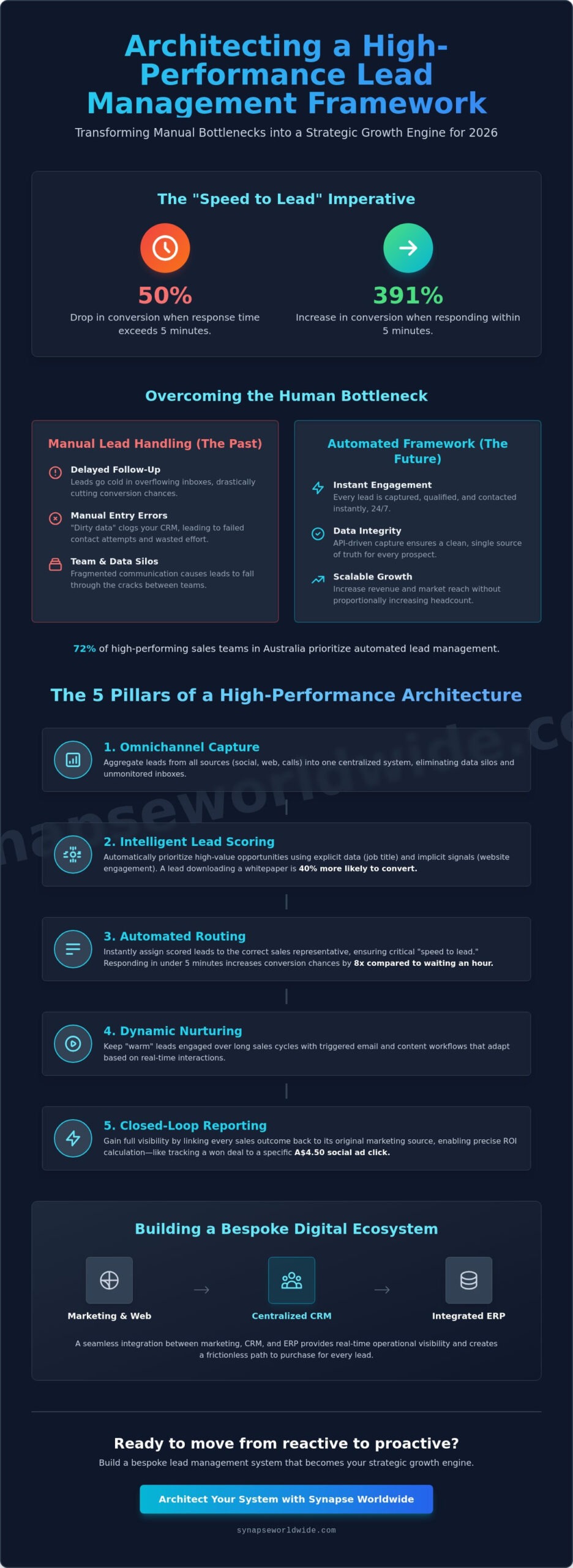
Research from the 2024 Salesforce State of Sales report indicates that 72% of high performing sales teams in Australia now prioritize automated lead management to combat the 50% drop in conversion that occurs when response times exceed five minutes. You likely already feel the pressure of this reality. It’s frustrating to watch a high quality inquiry go cold because a manual entry error delayed the follow up or a team silo left a prospect waiting in an overflowing inbox.
We’re here to change that trajectory. This guide shows you how to architect a bespoke framework that eliminates these human bottlenecks and accelerates your conversion rates for the 2026 market. You’ll learn how to build a seamless bridge between your marketing assets and CRM, ensuring every lead is captured, qualified, and contacted instantly. We’ll examine the specific steps to create a scalable system that grows your revenue without the need to increase your headcount.
Key Takeaways
- Transition from reactive lead handling to a proactive, data-driven framework designed for scalable growth in the competitive Australian market.
- Architect a high-performance automated lead management system that leverages omnichannel capture and intelligent scoring to prioritise high-value opportunities.
- Identify and eliminate the costly manual bottlenecks and data leakage that compromise your conversion rates and ROI.
- Map a seamless lead journey that integrates your CRM and ERP to provide real-time operational visibility and a frictionless path to purchase.
- Discover how to build a bespoke digital ecosystem that transforms lead management from a technical process into a strategic growth engine for 2026.
Understanding Automated Lead Management in the 2026 Digital Landscape
In the high-stakes Australian business environment of 2026, automated lead management has shifted from a technical convenience to a core strategic framework. It isn’t merely a software tool you install; it’s a proactive architecture designed to capture, qualify, and convert interest with surgical precision. Businesses that rely on reactive, manual processes often find themselves sidelined by competitors who’ve mastered data-driven engagement. This transition represents a fundamental change in how we perceive the sales funnel, moving from a static bucket to a dynamic, self-optimising ecosystem.
Success now hinges on the “speed to lead” imperative. Research consistently shows that responding to an inquiry within five minutes increases conversion rates by a staggering 391%. In a market where consumer expectations are immediate, a ten-minute delay can be the difference between a secured consultation and a lost opportunity. Modern systems leverage artificial intelligence and machine learning to predict lead intent and behavior. These algorithms analyse patterns in real-time, allowing your team to focus on high-value prospects while the system handles the initial heavy lifting of qualification.
The Evolution of the Lead Lifecycle
The days of manual data entry and disjointed spreadsheets are over. Modern lead management relies on API-driven capture methods that pull data directly from social platforms, landing pages, and interactive tools into a centralised hub. This integration preserves data integrity across every touchpoint, creating a seamless digital thread from the first click to the final sale. It ensures that no prospect falls through the cracks due to human error or fragmented communication channels, maintaining a professional standard of service at every step.
Why Automation is Essential for National Scalability
Scaling a business across Australia requires a presence that operates 24/7, far beyond the constraints of a standard eight-hour workday. Human-only sales teams can’t maintain the necessary pace in a digital economy that never sleeps. Automation ensures a consistent brand voice across every initial interaction, providing a bespoke experience for every prospect regardless of their time zone or entry point. This level of operational efficiency directly correlates to a higher ROI on your digital marketing campaigns. By removing the bottleneck of manual qualification, you empower your sales architects to engage only when a lead is primed for conversion, maximising the value of every marketing dollar spent.
The 5 Essential Pillars of a High-Performance Lead Management Architecture
Establishing a high-performance automated lead management framework is the difference between erratic growth and a predictable revenue engine. By 2026, the average Australian B2B buyer interacts with 10 or more digital touchpoints before engaging with a sales representative. Your architecture must capture, validate, and move these prospects through the funnel without manual friction or data leakage. Five foundational pillars support every high-performance architecture:
- Omnichannel Capture: You must aggregate data from LinkedIn ads, Google Search, and inbound calls into one central source of truth. This prevents silos and ensures no lead is left in an unmonitored inbox.
- Intelligent Lead Scoring: Systems should assign point values based on job title (explicit data) and website engagement (implicit signals). A lead downloading a technical whitepaper is statistically 40% more likely to convert than one only viewing a homepage.
- Automated Routing: Speed to lead is critical. In the Australian market, responding within five minutes increases conversion chances by 8x compared to waiting an hour.
- Dynamic Nurturing: Triggered workflows keep “warm” leads engaged over long sales cycles. These sequences adapt based on real-time interactions, such as clicking a specific case study link.
- Closed-Loop Reporting: You need to link every sales outcome back to its original marketing source. This transparency allows you to track a won deal back to a specific A$4.50 click on a social campaign.
Lead Capture and Data Normalisation
Data integrity begins at the point of entry. Standard forms often result in “dirty data” that clogs your CRM and frustrates your sales team. High-performance systems use custom web forms that validate phone formats and business emails in real-time. By utilising hidden fields, you can capture critical UTM parameters and lead source data without adding friction for the user. It’s essential that your custom web design is architected to support these technical requirements while maintaining a seamless user experience. In an environment where 68% of users abandon poorly designed mobile forms, technical precision is non-negotiable.
Qualification and Scoring Logic
Sales teams face burnout when they chase low-quality leads. A bespoke scoring matrix solves this by balancing explicit data, like company size, with implicit signals, such as visiting a pricing page three times in 48 hours. Setting strict Marketing Qualified Lead (MQL) thresholds ensures your specialists only receive high-intent opportunities. Modern automated lead management now leverages AI to identify “ready-to-buy” clusters. These algorithms predict a 25% higher conversion probability before a prospect even requests a formal quote. If you want to see how these architectures can transform your bottom line, exploring a tailored digital strategy is the next logical step for your business.
Overcoming the Human Bottleneck: Manual vs. Automated Systems
Manual lead management is no longer a viable strategy for Australian businesses aiming for high-level growth. Relying on staff to manually input data, send initial follow-ups, and track progress in spreadsheets creates a dangerous bottleneck. This approach leads to data leakage and missed opportunities that directly impact your bottom line. An automated lead management system replaces these fragile human processes with a robust, scalable architecture that ensures no prospect is ever ignored.
Management often struggles with data graveyards where information is siloed in individual inboxes or messy spreadsheets. Transitioning to automation provides 100% visibility into the sales pipeline. This transparency allows directors to identify exactly where leads stall, providing the tactical data needed to refine the sales process. It’s about moving away from guesswork and toward a culture of accountability and precision.
The Cost of Lead Leakage
Lead leakage occurs when potential clients exit your sales funnel due to slow response times or inconsistent follow-up. This inefficiency significantly erodes the profitability of your SEO and PPC investments. When you spend thousands of A$ to attract traffic, allowing a lead to leak is a direct hit to your marketing ROI. Statistics from Velocify indicate that conversion rates for automated follow-ups are 391% higher than those managed manually.
- Response Speed: 78% of customers buy from the company that responds to their inquiry first.
- Follow-up Consistency: Automated systems ensure every lead receives at least five touchpoints, whereas manual efforts often stop after two.
- Pipeline Integrity: Automation captures 100% of lead data, eliminating the risk of lost contact details or forgotten entries.
Lead Decay is the rapid decline in a prospect’s interest and intent that occurs within the first 30 minutes of their initial inquiry.
Personalisation at Scale
A common objection is that automation feels too robotic for high-end, bespoke services. In reality, modern automated lead management allows for deeper personalisation than manual systems. By using merge tags and conditional logic, you can tailor communications based on the specific industry or pain point the lead identified in their initial form. Dynamic content on landing pages ensures that a prospect sees information relevant to their unique segment, increasing trust from the first click.
We advocate for a Hybrid Approach. This strategy automates the mundane, repetitive tasks like initial acknowledgement and appointment scheduling. This empowers your human sales team to focus their energy on complex, high-value closing conversations. Maintaining a professional, authoritative tone in automated SMS and email sequences ensures your brand remains sophisticated while operating at a speed no human can match.
A Step-by-Step Guide to Implementing Lead Automation
Success in 2026 requires more than just buying a CRM subscription; it demands a rigorous audit of your existing lead flow. Start by identifying specific friction points where potential customers drop off. Data from late 2024 suggests that Australian B2B firms lose up to 30% of their lead value due to response times exceeding four hours. By pinpointing these gaps, you can build an automated lead management system that prioritizes high-intent prospects instantly.
Mapping the Lead Journey
Create a visual flow chart of your sales funnel to define “Trigger Events” that launch automated sequences. A webinar registration or a pricing page visit should trigger an immediate CRM entry. Compliance is non-negotiable for Australian enterprises. Your system must be architected to satisfy the Australian Privacy Act 1988 and the SPAM Act 2003. This includes implementing clear double opt-in protocols and automated “right to be forgotten” workflows to protect your brand’s legal standing.
Integration Best Practices
Standard native integrations often hit a ceiling when business logic grows complex. To achieve true scalability, focus on a tech stack that allows for custom software development and robust API connectivity. Bespoke API middleware acts as the glue between your CRM and ERP, ensuring that sales data translates perfectly into operational tasks. We recommend a “Zero-Loss” testing protocol. Run 50 simulated lead entries to verify that every data point reaches the final ERP entry without corruption.
Once your workflows are live, focus on your highest-volume sources first. Monitor conversion data and gather direct feedback from your sales team every 14 days. If the sales team finds that automated leads are under-qualified, adjust your scoring logic. It’s about constant iteration. Organizations that refine their automated lead management logic quarterly see a 15% higher conversion rate compared to those who set and forget their systems.
Ready to transform your sales pipeline into a high-performance engine? Consult with Synapse Worldwide today to build your bespoke automation framework.
Bespoke Lead Infrastructure: Integrating CRM, ERP, and Web
Growth in 2026 requires more than just a contact form; it demands a unified digital ecosystem where data flows without friction. A siloed approach to data is a primary cause of stagnation. When your website, CRM, and ERP operate in isolation, your team loses 25% of their productive time manually syncing records. A bespoke automated lead management system eliminates this inefficiency by creating a direct bridge between customer interest and operational capacity.
Integrating your ERP into the lead phase provides a distinct strategic advantage. For Australian businesses managing physical inventory or service-based capacity, real-time data is essential. If a prospect enquires about a specific solution, the system can instantly verify stock levels or consultant availability before the first sales call even happens. This prevents the friction of over-promising and under-delivering, which is critical in a market where 73% of customers cite experience as a top factor in their purchasing decisions.
Synapse Worldwide acts as the Digital Architect for these complex environments. We design custom dashboards that serve as your Single Source of Truth. These interfaces allow you to see exactly how your marketing spend converts into revenue, tracking lead velocity and conversion rates with precision. We don’t just install software; we engineer growth engines that provide the clarity needed for high-stakes decision-making.
The Power of CRM and Website Integration
Modern ecommerce platforms must do more than process transactions. They function as high-intent data sensors. By tracking user behavior on-site, such as the specific technical specifications a visitor downloads, your CRM can prep the sales team with a detailed interest profile. A strategic approach to website CRM integration ensures that your A$10,000 monthly ad spend is targeted toward the behaviors that actually drive high-value conversions. It turns cold data into actionable intelligence.
Future-Proofing Your Lead Management
The digital landscape is shifting toward AI-driven lead agents capable of 24/7 autonomous negotiation and qualification. Preparing for this shift requires a robust, scalable architecture today. Whether you’re expanding from a local Sydney presence to a national footprint or entering international markets, your automated lead management must be flexible enough to handle increased volume without a total rebuild. Our systems are built for this exact trajectory.
Ready to transform your lead infrastructure? Contact Synapse Worldwide today for a strategic consultation on bespoke automation solutions tailored for the 2026 market.
Future-Proofing Your Sales Pipeline for 2026 and Beyond
The shift toward automated lead management isn’t just a technical upgrade; it’s a strategic necessity for Australian enterprises aiming to dominate the 2026 digital landscape. By eliminating manual bottlenecks and integrating your CRM and ERP systems, you create a robust infrastructure that converts interest into revenue without friction. Data from the 2024 Australian Digital Transformation Report indicates that businesses utilizing integrated automation see a 15% increase in operational efficiency. Successful scaling relies on moving past generic software toward a bespoke architecture that reflects your unique business logic. Businesses that invest in website CRM integration as a foundational growth strategy consistently report stronger pipeline visibility and higher customer retention rates.
Synapse Worldwide brings over 20 years of custom digital infrastructure expertise to your project. We’re specialists in high-value CRM and ERP integrations with a proven track record of scaling Australian enterprises through intelligent automation. Your growth shouldn’t be limited by manual processes or disconnected systems. Architect your growth engine with bespoke lead automation solutions from Synapse Worldwide.
We’re ready to help you transform your digital presence into a high-performance asset that drives consistent results and secures your competitive advantage.
Frequently Asked Questions
What is the difference between lead generation and lead management?
Lead generation is the process of attracting interest and capturing contact details, while lead management is the strategic framework for nurturing and qualifying those contacts until they’re ready to buy. Lead generation fills the top of your funnel. Lead management ensures that 100% of those inquiries receive a timely response and progress through a bespoke nurturing sequence.
How much does it cost to implement automated lead management?
Implementation costs for automated lead management typically range from A$5,000 for basic setups to over A$50,000 for enterprise-grade, integrated systems. These figures cover software licensing, technical integration, and strategic workflow design. According to 2024 industry benchmarks, Australian SMEs often allocate 15% of their total marketing budget to automation infrastructure to ensure long-term scalability.
Can lead automation work for B2B companies with long sales cycles?
Automated lead management is specifically designed for B2B environments where sales cycles often exceed six months. It maintains consistent engagement through automated touchpoints, ensuring your brand stays top-of-mind during the research phase. Data shows that B2B companies using automated nurturing see a 10% increase in sales pipeline contribution within the first year of implementation.
Will automated lead management replace my sales team?
No, automation doesn’t replace your sales team; it empowers them by removing repetitive administrative tasks and manual data entry. By automating lead scoring and initial outreach, your reps focus exclusively on high-value conversations with sales-ready prospects. This strategic shift typically leads to a 14.5% increase in sales productivity, according to historical Nucleus Research data.
What are the best tools for automated lead management in 2026?
The leading tools for automated lead management in 2026 include HubSpot for integrated CRM capabilities, Salesforce for enterprise-level customization, and ActiveCampaign for mid-market automation. These platforms now leverage predictive AI to identify buyer intent with 85% accuracy. Selecting a bespoke combination of these technologies creates a robust foundation for your digital growth.
How do I ensure my automated emails don’t end up in the spam folder?
You ensure emails avoid the spam folder by maintaining high sender reputation scores and implementing technical protocols like SPF, DKIM, and DMARC. Regularly cleaning your database to remove inactive contacts reduces bounce rates, which should stay below 2% to protect deliverability. Personalised content and relevant triggers also signal to providers that your communications are valuable to the recipient.
Is automated lead management compliant with Australian privacy laws?
Automated lead management systems must comply with the Australian Privacy Act 1988 and the Spam Act 2003 to ensure legal operation. This involves securing explicit consent for marketing, providing clear opt-out mechanisms, and storing data according to Australian Privacy Principles (APPs). Non-compliance leads to significant penalties, making a robust, compliant architecture essential for any Australian business.
How long does it take to see results from lead automation?
Businesses typically observe measurable improvements in lead response times and engagement rates within the first 30 to 60 days of implementation. Full ROI, characterised by increased conversion rates and reduced cost-per-acquisition, generally materialises between six and nine months. A 2023 study found that companies with mature automation processes achieve 32% higher revenue growth compared to those without.

