
Tag Archives: marketing automation


Integrated Digital Marketing Strategy: The 2026 Framework for Scalable Growth

Integrated Digital Marketing Strategy: The 2026 Framework for Scalable Growth

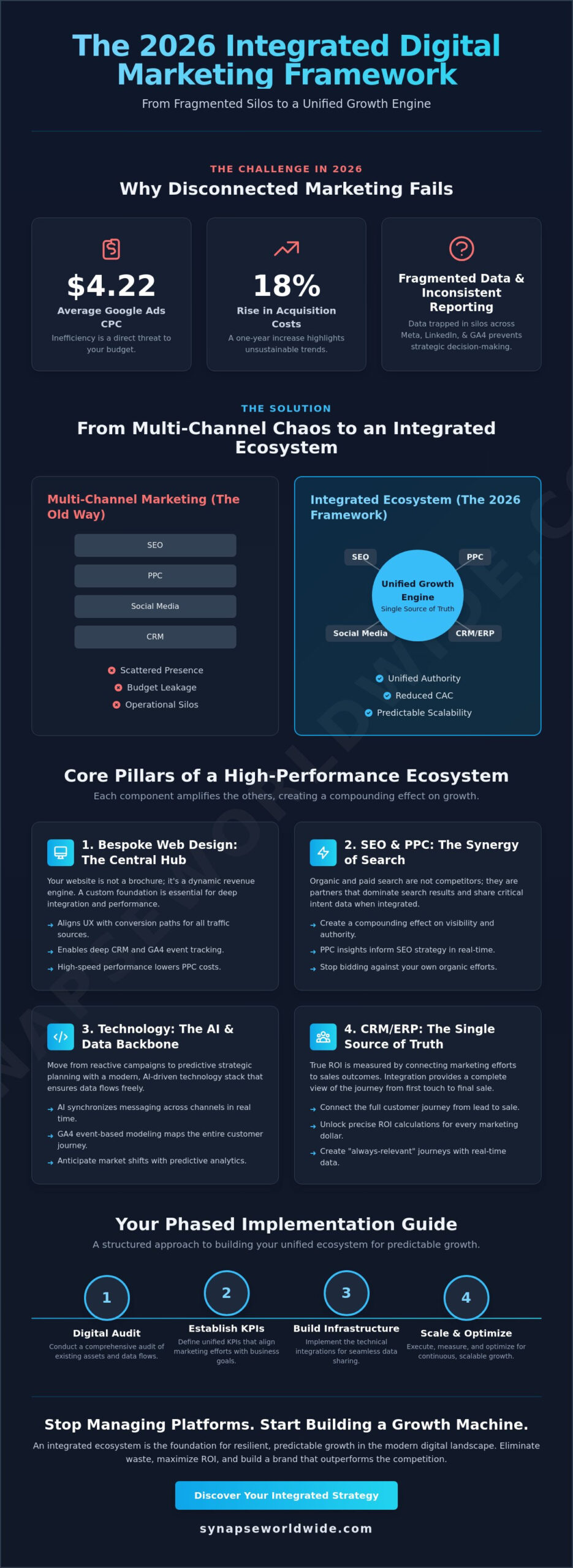
With the average Google Ads cost-per-click hitting $4.22 in 2026, your marketing budget is likely under more strain than ever before. It’s frustrating to watch acquisition costs rise by 18% in a single year while your data remains trapped in disconnected silos. You’re likely tired of the friction caused by inconsistent reporting across Meta and LinkedIn, which makes it nearly impossible to execute a high-performance integrated digital marketing strategy. This fragmentation doesn’t just waste money; it prevents your business from reaching its full potential and reaching the next level of success.

We believe your digital presence should function as a unified ecosystem rather than a collection of competing experiments. This guide introduces the 2026 framework for scalable growth designed to eliminate waste and maximize every dollar spent. You’ll discover how to align your SEO, PPC management, and CRM integration into a single engine that respects the latest CCPA privacy mandates. We’ll walk through the technical architecture needed to automate your operations, streamline your data via GA4, and turn fragmented touchpoints into a predictable path for business transformation. It’s time to stop managing individual platforms and start building a cohesive growth machine.

Key Takeaways

  • Transition from fragmented multi-channel tactics to a unified digital ecosystem that eliminates operational silos and prevents budget leakage.
  • Discover the architectural blueprint for an integrated digital marketing strategy that synchronizes SEO, PPC, and social media into a single growth engine.
  • Understand how CRM and ERP integrations provide a single source of truth for your ROI by connecting the entire customer journey from lead to sale.
  • Follow a phased implementation guide to conduct a comprehensive digital audit and establish the unified KPIs necessary for predictable scalability.
  • Learn why bespoke web design and customized technical solutions are essential for building a resilient brand that outperforms standardized competitors.

The Strategic Evolution of Integrated Digital Marketing in 2026

By 2026, the definition of digital success has shifted from mere visibility to total architectural cohesion. In a market where the average Google Ads cost-per-click has climbed to $4.22, an 18% increase from just a year ago, inefficiency is no longer just a nuisance; it’s a threat to your scalability. Fragmentation acts as a silent drain on your resources. When your SEO efforts don’t communicate with your PPC management, you’re essentially bidding against yourself or missing critical intent signals. A robust integrated digital marketing strategy ensures that every touchpoint reinforces the next, turning your website from a static digital brochure into a dynamic revenue engine. This evolution demands a shift toward “always-relevant” journeys where personalization is driven by real-time data rather than historical assumptions.

Integrated vs. Multi-Channel: The Critical Distinction

Market leadership in this decade isn’t earned by simply being present on every platform. While multi-channel marketing spreads your message wide, it often lacks the connective tissue required for high-level conversion. True integration is rooted in the principles of integrated marketing communications, where a consistent brand voice acts as the anchor across disparate platforms. This synergy directly impacts your bottom line by reducing customer acquisition costs (CAC). When your social media marketing and search strategies work in tandem, you create a compounding effect that drives efficiency and streamlines the path to purchase. It’s about moving from a scattered presence to a unified authority that commands attention.

The 2026 Digital Landscape: AI and Predictive Integration

The modern landscape relies on AI to do more than just generate content; it synchronizes messaging across SEO and paid search in real time. We’ve moved beyond reactive campaigns that look at last month’s performance. Today’s high-performance frameworks use predictive strategic planning to anticipate market shifts before they happen. This requires a seamless flow of data between your CRM integration and automated marketing funnels. By leveraging GA4’s event-based modeling, businesses can now interpret the entire customer journey with precision. This transition from reactive to predictive is the hallmark of a sophisticated integrated digital marketing strategy, allowing you to act on data intelligence before your competitors even recognize the trend. Establishing this real-time data flow is the first step toward building a resilient, self-optimizing growth engine.

Core Pillars of a High-Performance Integrated Ecosystem

A high-performance ecosystem isn’t a collection of disparate tools. It’s a synchronized engine where every component amplifies the others. To achieve scalable growth, your integrated digital marketing strategy must be anchored by four core pillars: bespoke web design, strategic SEO, high-performance PPC, and cohesive content marketing. When these elements operate in isolation, they create friction that slows your momentum. When they’re unified, they create a compounding effect that drives your business toward its next level of success. This structural integrity is what separates market leaders from those who are simply “online.”

Web Design as a Strategic Growth Engine

Your website is the central hub of your digital world. Off-the-shelf templates often struggle to handle the complex requirements of a modern growth strategy, such as deep CRM integration or advanced event tracking in GA4. Investing in custom web design for small business ensures your technical foundation is built specifically to support your unique marketing goals. A well-architected site aligns user experience with conversion paths, ensuring that traffic from your social media marketing or search campaigns doesn’t hit a dead end. High-speed, mobile-optimized pages aren’t just for users; they provide the technical performance required to maintain high quality scores for your paid media landing pages, which effectively lowers your overall acquisition costs.

The Synergy of SEO and Paid Search

In 2026, the most successful brands don’t choose between organic and paid visibility. They use them together to dominate the search engine results pages. By analyzing data from your paid search campaigns, you can identify high-converting keywords in real-time and feed those insights directly into your seo for small business strategy. This data sharing allows you to focus your organic efforts on terms that are proven to drive revenue rather than just empty traffic. This dual-threat approach ensures that your brand captures attention regardless of whether a user clicks an ad or an organic listing. It’s a sophisticated way to optimize ad spend while building long-term authority in your niche.

Content marketing serves as the narrative thread that connects these pillars. It isn’t just about writing articles; it’s about creating a consistent message that resonates from the first social media interaction to the final sale. When your messaging is unified, the customer journey feels seamless and intuitive, which builds the trust necessary for high-value conversions. If you’re looking to build a more resilient digital presence, you might consider how bespoke digital solutions can bridge the gaps in your current framework. Building this level of connectivity requires precision, but the return on investment is undeniable for businesses aiming for serious transformation.
Integrated Digital Marketing Strategy: The 2026 Framework for Scalable Growth

Eliminating Silos: Why Technical Infrastructure is the Backbone

Many businesses mistakenly treat integration as a creative or messaging challenge. In reality, it’s a technical one. Without a robust data layer, your integrated digital marketing strategy is essentially a series of educated guesses. We see growth stall most often when marketing teams can’t see what happens after a lead enters the pipeline. Infrastructure is the connective tissue that allows data to flow from a social media click to a final sale, providing the clarity needed to scale with confidence. Moving away from disconnected spreadsheets toward a unified dashboard isn’t just about organization; it’s about gaining a competitive edge through real-time intelligence.

Data centralization creates a single source of truth for your entire organization. ERP solutions play a critical role here, especially for national enterprises looking to streamline lead-to-sale workflows. By automating the feedback loop between sales data and marketing spend, you can identify exactly which channels produce the highest lifetime value customers. This level of visibility allows you to cut waste instantly and reallocate budget to high-performing segments. It’s a shift from reactive reporting to proactive optimization that ensures your digital presence is always working at peak efficiency.

CRM and Marketing Automation Integration

Connecting your website directly to your lead management systems eliminates the manual entry lag that often kills high-value conversions. It’s not enough to just capture a name; you need to personalize the user experience based on specific CRM data touchpoints. Custom API bridges and system bridges allow your marketing automation to respond to a prospect’s behavior in real time. When your systems talk to each other, the customer journey feels fluid and intentional. This technical harmony reduces friction for the user while providing your team with the granular data needed for sophisticated attribution modeling.

Scalable E-commerce Architecture

For brands selling online, the technical requirements are even more demanding. Sophisticated ecommerce website development requires a deep integration mindset from the start. You must connect inventory management directly with your real-time advertising feeds to ensure you aren’t wasting budget promoting out-of-stock items. Building for future growth means choosing a scalable digital infrastructure that can handle traffic surges without compromising performance. It’s about creating a resilient, interconnected foundation that supports your long-term vision for business transformation and reaches the next level of profitability.

Building Your Framework: A Step-by-Step Implementation Guide

Moving from a conceptual vision to a functional reality requires a disciplined, multi-phase approach. Building a high-performance integrated digital marketing strategy isn’t a weekend project; it’s a structural overhaul of how your business interacts with the digital world. The transition begins by stripping away assumptions and looking at raw data. Success in 2026 depends on your ability to execute these five phases with precision:

  • Phase 1: Conduct a Comprehensive Digital Audit to identify where your budget is leaking.
  • Phase 2: Define Unified KPIs that prioritize revenue over vanity metrics.
  • Phase 3: Execute Technical Synchronization between your website, CRM, and GA4 analytics.
  • Phase 4: Launch Content and Campaign Orchestration to ensure a singular brand voice.
  • Phase 5: Commit to Continuous Optimization to protect your ROI as market conditions shift.

This phased approach ensures that your growth is built on a stable foundation. By addressing technical debt and data silos early, you prevent the friction that typically slows down national enterprises. Each phase builds upon the last, creating a compounding effect that accelerates your transformation.

The Audit: Identifying Fragmented Touchpoints

A successful framework starts with a cold, hard look at your current assets. You can’t fix what you haven’t measured. We look for budget leaks where channels are competing rather than collaborating. For instance, if your social media marketing is driving traffic to pages with high bounce rates, it’s often a sign of a technical health failure or a messaging mismatch. Mapping your current customer journey against a desired state reveals the gaps in your funnel. This phase ensures your foundation is solid before you layer on additional spend. It’s about finding the “single source of truth” that has likely been missing from your previous reports.

Measurement: Tracking What Truly Matters

Vanity metrics like “likes” or “impressions” don’t pay the bills. In an era where Google Ads costs have risen significantly, every click must be accountable. You need revenue-based attribution that shows exactly how an initial search query eventually becomes a closed deal in your CRM. Implementing cross-channel tracking provides a 360-degree view of your ROI. Utilizing professional ppc management services allows for rapid data gathering during this phase, providing the insights needed to refine your long-term strategy. This data-first mindset ensures that every decision is backed by evidence rather than intuition. Ready to eliminate the silos holding your business back? Book a strategic consultation to begin your comprehensive digital audit and start your journey toward scalable growth.

Scaling with a Visionary Strategic Partner

While the framework for an integrated digital marketing strategy is clear, the difference between a plan on paper and a high-performance growth engine lies in the execution. Most businesses fail not because they lack ambition, but because they lack a visionary architect to manage the technical intricacies of their digital ecosystem. Partnering with a strategic consultant ensures that your SEO, PPC management, and CRM integration aren’t just line items in a budget, but interconnected components of a larger business transformation. This high-level oversight is what allows national enterprises to move beyond tactical experiments and toward predictable, scalable growth.

Future-proofing your business requires more than just staying current with trends; it requires building a resilient infrastructure that can withstand the next wave of digital disruption. As ad costs continue to rise and privacy mandates like the CCPA become more complex, having a partner who understands the underlying data layer is your greatest insurance policy. It’s about moving from a state of reactive maintenance to one of proactive, results-oriented leadership. This level of technical depth ensures your brand remains relevant and profitable regardless of how the landscape shifts.

Why a Custom Solution Beats a Standardised Package

Standardized marketing packages are designed for the average business, yet market leadership is rarely achieved by being average. Off-the-shelf solutions often create technical debt that limits your ability to pivot when search algorithms or consumer behaviors shift. Customization is the key to ROI because it allows your digital presence to mirror your unique operational strengths. Whether it’s bespoke e-commerce development or custom ERP solutions, these individualized architectures create a proprietary advantage that competitors can’t simply buy or copy. A long-term partnership focused on bespoke development ensures your infrastructure evolves alongside your ambitious business goals.

Taking the Next Step Toward Digital Integration

The transition from fragmented tactics to a unified strategy begins with expert technical consulting. You need a partner who can see the big picture while managing the intricate details of your automated marketing funnels. This planning phase is critical for identifying the technical bridges required to connect your social media marketing efforts with your sales data. By aligning your digital assets under a single strategic vision, you eliminate waste and create a clear path for expansion. It’s time to stop chasing individual metrics and start building a unified authority that commands the market. To begin your transformation, consult with our strategic architects today and discover how a truly custom solution can redefine your growth trajectory.

Architecting Your Digital Future

The transition from fragmented digital tactics to a unified ecosystem isn’t just a trend; it’s a strategic necessity for any business aiming to scale in 2026. By eliminating the silos between your SEO, PPC management, and web development, you create a resilient engine that turns rising ad costs into a competitive advantage. A successful integrated digital marketing strategy relies on a robust technical backbone where CRM and ERP data flow seamlessly to inform every strategic decision. This level of connectivity ensures that your marketing spend is always aligned with actual revenue growth rather than vanity metrics.

Since 2005, we’ve established a proven track record of driving national growth through bespoke web architecture and high-value system integrations. Our team specializes in custom software solutions that provide the authoritative expertise needed to navigate complex digital landscapes with confidence. You don’t have to settle for standardized packages that limit your transformation potential. Take the first step toward reaching the next level of business success and Partner with Synapse Worldwide for a Custom Strategic Framework. Your digital presence is ready for its next evolution, and the results you’ve been chasing are finally within reach.

Frequently Asked Questions

What is an integrated digital marketing strategy?

An integrated strategy is a unified framework that synchronizes all digital channels into a single growth engine. Instead of treating SEO, PPC, and social media marketing as isolated projects, this approach ensures they share data and messaging. This alignment eliminates budget waste and creates a consistent experience for the customer across every touchpoint, ensuring your brand voice remains authoritative and reliable.

How does integration differ from multi-channel marketing?

Multi-channel marketing simply means being present on various platforms, whereas integration focuses on how those platforms communicate. In a multi-channel setup, your PPC and SEO teams might operate in silos. An integrated digital marketing strategy connects these efforts through a shared technical architecture, allowing insights from one channel to optimize the performance of another and reducing your overall acquisition costs.

Why is CRM integration important for my marketing strategy?

CRM integration is vital because it bridges the gap between lead generation and actual revenue. By connecting your website directly to your sales data, you can track the entire customer journey with precision. This visibility allows you to identify which specific campaigns drive the highest lifetime value, shifting your focus from vanity metrics to tangible business outcomes and long-term transformation.

How long does it take to see results from an integrated approach?

Initial efficiency gains often appear within the first 90 days as budget leaks are identified and closed. While PPC management can drive immediate traffic, the full compounding effect of a unified ecosystem typically matures over six to twelve months. This timeline allows for deep data collection and the gradual build-up of organic authority through strategic SEO and consistent social media engagement.

What are the core components of a successful 2026 digital strategy?

The core pillars include bespoke web design, centralized technical infrastructure, and synchronized campaign orchestration. Success in 2026 requires a focus on data intelligence and privacy-first practices. A high-performance strategy must also include CRM and ERP solutions to ensure that lead-to-sale workflows are fully automated, providing a single source of truth for your business growth.

Do I need to overhaul my entire website to implement an integrated strategy?

An entire overhaul isn’t always mandatory, but your technical foundation must support deep data integration. If your current site cannot handle advanced GA4 tracking or custom API bridges, a strategic upgrade may be necessary. We prioritize the technical health of your digital assets to ensure they can function as a reliable hub for your growth engine and support your ambitious business goals.

How do I measure the ROI of an integrated marketing campaign?

ROI is measured through cross-channel attribution models that track how different touchpoints contribute to a single conversion. By moving away from last-click attribution, you gain a 360-degree view of your marketing spend. We focus on revenue-based KPIs that connect your digital activity directly to the bottom-line growth seen in your ERP systems, ensuring every dollar is accountable.

What role does AI play in digital marketing integration in 2026?

AI serves as the connective tissue that synchronizes messaging and predicts customer behavior in real time. In 2026, AI is used to optimize ad targeting and personalize content based on complex data patterns. It allows your integrated digital marketing strategy to remain agile, automatically adjusting to market shifts and predictive trends before they impact your performance or scalability.

 

Marketing Automation Setup Services: The 2026 Strategic Architecture for Scalable Growth

Marketing Automation Setup Services: The 2026 Strategic Architecture for Scalable Growth

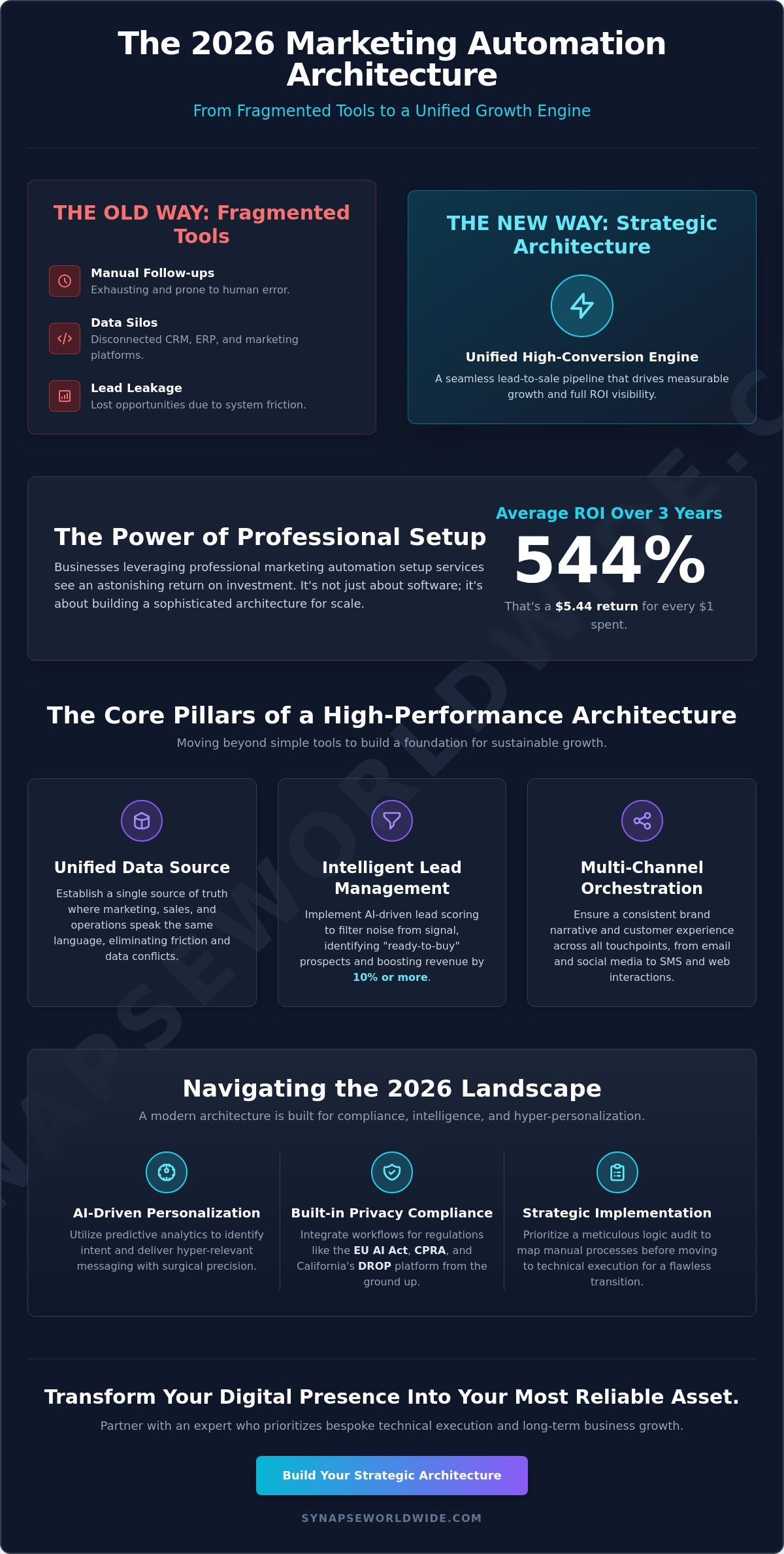
Did you know that businesses leveraging automation see an average ROI of 544% over three years? That is a $5.44 return for every dollar spent. Yet, most organizations fail to capture this value because they treat software as a standalone tool rather than a strategic foundation. When you invest in professional marketing automation setup services, you aren’t just buying a subscription; you’re building a sophisticated architecture for scale. You likely recognize the deep frustration of lead leakage and the friction caused by persistent data silos between your marketing and sales teams. It’s exhausting to manage manual follow-ups while your CRM and ERP systems remain disconnected and out of sync.

We’ll show you how to transform these fragmented efforts into a unified, high-conversion engine. By moving beyond basic email blasts, you’ll build a seamless lead-to-sale pipeline that drives clear, measurable growth. This article explores the 2026 strategic architecture required to integrate your digital tools, comply with evolving privacy regulations like the EU AI Act, and finally achieve full visibility into your marketing ROI. We’ll examine how a visionary approach to connectivity and customization can turn your digital presence into your most reliable asset for long-term success.

Key Takeaways

  • Shift your perspective from viewing automation as a set of isolated tools to a strategic infrastructure that orchestrates sophisticated, multi-channel customer journeys.
  • Learn how professional marketing automation setup services establish a ‘Unified Data Source’ where marketing, sales, and operations finally speak the same language.
  • Resolve the silo effect by integrating your CRM and ERP systems to eliminate fragmented communication and capture every lead opportunity.
  • Master a framework that starts with meticulous logic auditing to map manual processes before moving into technical implementation.
  • Discover the competitive advantage of a visionary partnership that prioritizes bespoke technical execution and long-term business growth over simple software installation.

Redefining Marketing Automation Setup Services in 2026

Marketing is no longer a series of disconnected campaigns; it’s a structural discipline. As we move through 2026, Marketing automation has transitioned from a supplementary tool to the central nervous system of the modern enterprise. Successful organizations don’t just “buy” software. They invest in marketing automation setup services to build a resilient, scalable architecture. This shift moves away from simple email triggers and toward AI-driven multi-channel orchestration. It requires a visionary architect who understands how to bridge the gap between front-end engagement and back-end operational data.

When you approach your digital strategy with this mindset, you transform your marketing department from a cost center into a high-performance revenue engine. A professional setup ensures that every technical decision aligns with your long-term growth objectives. It’s about seeing the big picture while maintaining a disciplined focus on the intricate technical details that make or break a lead-to-sale pipeline.

Beyond Software: The Strategic Value of Professional Setup

Infrastructure is the foundation of scale. Industry data suggests that a vast majority of automation projects fail to meet their objectives because they lack a professional implementation roadmap. Without a strategic guide, businesses often end up with “fragmented automation,” where tools exist but don’t communicate. Professional setup services prioritize custom data mapping to ensure your systems remain scalable as your contact database grows. This process moves your business from a “set and forget” mentality to a dynamic, data-driven growth framework. It ensures that your CRM and ERP systems aren’t just connected; they’re synchronized to provide a 360-degree view of the customer journey.

The 2026 Landscape: AI, Data Privacy, and Personalization

The regulatory environment in 2026 has fundamentally changed how we handle consumer information. Modern setup services must now account for the EU AI Act enforcement that began in early 2026, which imposes strict transparency obligations on marketing applications. Additionally, under California’s CPRA regulations, your business is required to conduct rigorous risk assessments for automated technologies. We also see the emergence of California’s “Delete and Opt-Out Platform” (DROP), which processes deletion requests every 45 days. A professional setup builds these compliance workflows directly into your architecture. This allows you to transition from generic blasts to hyper-personalized customer experiences while maintaining total data integrity. By integrating predictive analytics into your standard stack, you can identify “ready-to-buy” prospects with surgical precision, ensuring your messaging is always relevant and timely.

The Core Pillars of a High-Performance Automation Architecture

Establishing a high-performance architecture requires moving beyond simple tool connections. It demands a Unified Data Source where every department shares a single version of truth. When your marketing, sales, and operations teams speak the same language, you eliminate the friction that typically stalls growth. Professional marketing automation setup services focus on architecting this logic first. We design the lead scoring systems that filter noise from signal, identifying prospects who are genuinely ready to buy based on behavioral data rather than guesswork. Companies that automate lead management in this way often see a revenue increase of 10% or more within just nine months.

Effective marketing automation strategy relies on multi-channel synchronization. Your brand narrative must remain consistent whether a customer interacts via email, social media, or SMS. This orchestration ensures that a lead doesn’t receive a generic discount code via text minutes after they’ve already purchased through your site. Achieving this level of precision starts with a robust digital foundation. For many organizations, investing in custom web design for small business serves as the essential data capture engine. It provides the structured environment necessary to track user intent long before the first form is submitted. This foundational work allows for the 451% increase in qualified leads that top-tier automation can provide.

CRM and ERP Synergy: The Back-Office Connection

True scalability happens when front-end engagement meets back-end efficiency. By leveraging business process automation, you bridge the critical gap between a captured lead and a fulfilled order. We specialize in synchronizing inventory levels and service availability with your live marketing campaigns. This prevents the costly mistake of promoting out-of-stock items or overbooking service slots. Sophisticated API integrations eliminate manual data entry, allowing your team to focus on high-value strategic tasks rather than administrative upkeep. If your current systems feel disjointed, our experts can help you design a more cohesive CRM integration strategy to unify your operations.

Conversion-Centric Web Infrastructure

Your website is the primary entry point for your automation ecosystem. High-performance landing pages must do more than just look professional; they must function as intelligent data entry points. We implement custom tracking protocols to monitor the entire user journey. This ensures your ecommerce website development fully supports complex automation triggers, such as abandoned cart sequences or personalized product recommendations. By building these triggers into the site architecture, you ensure that no lead falls through the cracks of a manual follow-up process.

Marketing Automation Setup Services: The 2026 Strategic Architecture for Scalable Growth

Overcoming the Silo Effect: Why Integration Trumps Isolated Tools

Owning a suite of marketing tools isn’t the same as having a functional automation system. Many leaders express frustration because they’ve invested in a top-tier CRM and an expensive email platform, yet their results remain stagnant. This usually happens because the tools exist in isolation. When your tech stack is fragmented, your brand voice becomes inconsistent and leads slip through the gaps. Professional marketing automation setup services solve this by moving beyond the “tool-first” mentality. We focus on the business logic that connects these systems, ensuring that data flows bi-directionally and in real-time.

Out-of-the-box integrations often fall short of enterprise-level requirements. They might sync basic contact info but fail to carry over the complex behavioral data needed for sophisticated triggers. This is where bespoke APIs and custom middleware become essential. By architecting a solution that mirrors your specific internal workflows, you ensure that your sales team isn’t just getting more leads; they’re getting the right context at the right time. This level of connectivity turns a collection of software into a unified, high-conversion engine.

The Hidden Costs of DIY Automation Setup

Attempting a DIY setup often leads to significant technical debt. Poorly mapped data structures might work for a month, but they eventually break as you scale, leading to expensive cleanup projects later. Inaccurate lead scoring is another silent killer of productivity. If your system incorrectly flags cold prospects as “ready-to-buy,” your sales team wastes hours on dead-end calls. There is also a security risk to consider. Many businesses rely on “free” third-party plugins to bridge gaps, but these often lack the rigorous updates required to stay ahead of modern vulnerabilities. Investing in a professional roadmap from the start protects your data and your reputation.

Bespoke vs. Standardised Solutions

Standard SaaS integrations are fine for basic tasks, but they rarely support long-term growth. You need a partner who understands the intersection of technical development and high-level strategy. For instance, your automation should work in tandem with your SEO for small business efforts. When your search strategy brings in high-intent traffic, your automation must be ready to capture and nurture that specific intent through custom code if necessary. Future-proofing your stack means building an architecture that isn’t tied to the limitations of a single platform. This flexibility allows you to adapt as new technologies emerge, ensuring your digital presence remains an asset rather than a liability.

A Strategic Framework for Implementing Enterprise-Grade Automation

Implementing enterprise-grade automation isn’t a weekend project; it’s a phased deployment that requires precision at every turn. While many competitors suggest starting with a simple email template, our marketing automation setup services begin with a rigorous Discovery and Logic Audit. We map your existing manual customer journey to uncover exactly where potential revenue is leaking. This architectural approach ensures that your technical stack supports your business goals rather than dictating them. Once the logic is sound, we define the technical architecture, selecting the integration points that will sustain your growth for years to come.

A high-performance engine requires high-quality fuel. The third step in our framework involves deep data migration and cleaning. We ensure no legacy errors or duplicate records disrupt your new workflows, as “hidden costs” in automation often stem from contact overages caused by messy databases. Following this, we move into campaign building and logic testing. We deploy your workflows in a controlled environment to verify every trigger and branch before they go live. Finally, we focus on optimization. By leveraging sophisticated ppc management services, you can feed your new automation engine with high-intent traffic, creating a self-sustaining cycle of growth and conversion.

Phase 1: Mapping the Customer Lifecycle

Mapping the customer lifecycle allows us to identify specific friction points in your sales funnel where automation can have the most immediate impact. Perhaps leads are stalling at the mid-funnel stage, or your sales team is overwhelmed by low-quality inquiries that haven’t been properly vetted. We define your Ideal Customer Profile (ICP) within the database logic to ensure your automation prioritizes the most valuable opportunities. Our primary goal is often singular and impactful: “Reducing lead response time to under 5 minutes.” This clarity ensures every automated sequence serves a distinct purpose in moving the prospect toward a sale.

Phase 2: Technical Execution and Integration

Technical execution creates the “Digital Handshake” between your website and CRM. This isn’t a simple form-to-email link. It is a deep integration that captures source attribution, behavioral cues, and intent signals. We implement advanced tracking codes that allow for precise attribution modeling, so you know exactly which touchpoint triggered a conversion. Automated reporting dashboards then provide real-time visibility into your marketing ROI. This gives you the confidence to scale your budget where it works best. Ready to build your scalable architecture? Explore our CRM integration solutions to start unifying your data today.

Partnering for Success: Custom Automation Solutions by Synapse Worldwide

Synapse Worldwide treats every digital project as a bespoke architectural challenge. We don’t just install software; we engineer growth engines. Our marketing automation setup services focus on the deep connectivity between your front-end engagement and back-end operations. This visionary strategy ensures that every automated trigger serves a specific business outcome. By moving away from standardized, low-cost templates, we provide the stability and quality required for long-term success. We believe that true digital transformation requires a sophisticated balance between high-level strategy and meticulous technical execution.

A partnership with our team is an investment in continuous transformation. Unlike a one-off software installation that quickly becomes obsolete, our approach adapts to your evolving business needs. We bridge the gap between national market reach and localized business requirements, ensuring your digital presence remains relevant across diverse audiences. This commitment to client ROI is what transforms a simple technical process into a long-term strategic asset. You can finally move from the struggle of manual lead management to a state of automated, predictable growth.

Why Experience Matters in Automation Architecture

Success in digital infrastructure isn’t accidental. It’s the result of leveraging over 20 years of expertise in building resilient systems for diverse industries. We manage your entire digital ecosystem, from custom web design to complex ERP solutions. This holistic view allows us to deliver highly individualized, evidence-based solutions that standardized agencies simply cannot match. We don’t guess what works; we use data to validate every integration point in your architecture. This disciplined focus ensures that your automation stack remains a proactive participant in your business strategy rather than a technical burden.

Next Steps: Your Roadmap to Automated Growth

Preparing your team for automated workflows is a critical step in the transition. It requires a shift in mindset from reactive tasks to proactive logic management. During a Synapse discovery session, we’ll deep-dive into your current processes to identify the most impactful opportunities for orchestration. We’ll examine your lead flow, data hygiene, and existing tech stack to build a roadmap that prioritizes immediate wins and long-term scalability. It’s time to stop letting leads slip through the cracks of manual follow-ups. Take the first step toward a unified, high-conversion engine and Book a Strategic Automation Audit to see how we can elevate your digital presence.

Architecting Your Future Growth

Success in the digital landscape of 2026 demands more than just adopting new software; it requires a disciplined commitment to structural integrity. We have examined how a unified data source and the strategic orchestration of customer journeys can turn fragmented marketing efforts into a high-performance revenue engine. By prioritizing logic auditing and technical synchronization, you move beyond the limitations of isolated tools to create a resilient foundation for scale.

Professional marketing automation setup services provide the bridge between high-level strategic consulting and meticulous hands-on execution. Synapse Worldwide leverages over 20 years of technical excellence to deliver custom-built CRM and ERP integrations tailored to your specific business logic. We don’t just solve today’s problems; we help you anticipate tomorrow’s opportunities through results-oriented strategy. It’s time to stop managing manual friction and start driving measurable ROI. Scale your business with expert marketing automation setup services today. Your journey toward a transformed, highly automated digital presence starts with a single visionary step. We are ready to help you reach the next level of business success.

Frequently Asked Questions

What is included in a professional marketing automation setup service?

A professional service includes deep discovery, logic auditing, and custom technical integration between your digital presence and sales tools. We focus on architecting a lead-to-sale pipeline that reflects your unique business workflows. This process ensures that your marketing automation setup services result in a scalable growth engine rather than just a collection of triggered emails. We prioritize custom data mapping to ensure your systems remain resilient as your database expands.

How long does it typically take to see ROI from marketing automation?

Organizations that automate lead management typically see a revenue increase of 10% or more within six to nine months. Long-term data shows that businesses using these systems achieve an average ROI of 544% over three years. This equates to a return of $5.44 for every dollar invested. These results depend on a sound initial architecture that eliminates lead leakage and manual friction from the start.

Do I need to replace my current CRM to implement advanced automation?

You don’t necessarily need to replace your existing CRM to achieve high-level results. Our approach focuses on sophisticated CRM integration to bridge the gap between your marketing data and sales activity. We evaluate your current stack to ensure it can handle the advanced API calls and data mapping required for 2026 growth strategies. If your current system has limitations, we build custom middleware to ensure seamless connectivity.

Can marketing automation help with B2B lead nurturing and long sales cycles?

Automation is essential for managing the complexity of B2B sales cycles. It allows you to maintain consistent, personalized communication with prospects over months or even years without manual intervention. By using behavioral triggers, you can identify exactly when a long-term lead is ready for a direct sales conversation. This prevents lead leakage and ensures your sales team focuses only on high-intent opportunities.

What is the difference between an email marketing tool and a full automation setup?

An email tool is a tactical delivery system, while a full automation setup is a strategic infrastructure. While email tools primarily send messages to lists, full automation orchestrates multi-channel journeys based on real-time user behavior. It integrates your website, CRM, and ERP to ensure every touchpoint is informed by the customer’s entire history with your brand. This creates a unified narrative rather than isolated messages.

How does marketing automation integrate with my existing ERP system?

Integration with your ERP system happens through custom-built APIs and secure middleware. This connection allows your marketing campaigns to respond to live operational data, such as inventory levels or service availability. This ensures your marketing automation setup services provide a seamless flow from the initial lead capture to the final fulfilled order. It eliminates the need for manual data entry and reduces the risk of human error.

Is marketing automation setup a one-time project or an ongoing service?

The initial technical architecture is an intensive project, but the most successful businesses treat automation as an ongoing strategic asset. You need a long-term partnership to optimize workflows, adapt to new privacy regulations like the EU AI Act, and refine your lead scoring logic. This continuous improvement ensures your engine stays efficient as your business scales and as consumer behaviors shift in the digital marketplace.

What are the most common mistakes businesses make when setting up automation?

The most frequent error is adopting a tool-first mentality that ignores underlying business logic. Many organizations also suffer from poor data hygiene, which leads to inaccurate lead scoring and wasted sales efforts. Skipping the discovery phase often results in a fragmented system that fails to provide a clear view of marketing ROI. A professional roadmap avoids these pitfalls by prioritizing strategy and data integrity before technical deployment.


Digital Marketing Strategy for SMBs: The 2026 Strategic Growth Framework

Digital Marketing Strategy for SMBs: The 2026 Strategic Growth Framework

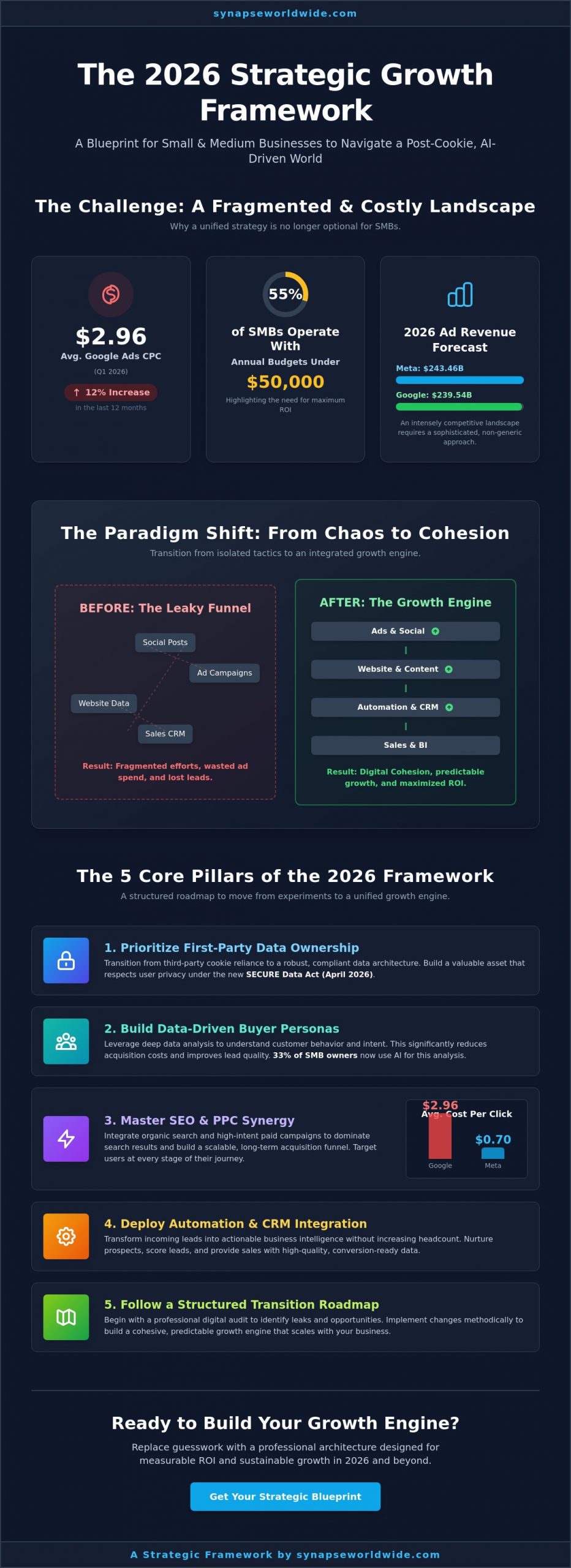
With Google Ads search costs hitting an average of $2.96 per click in the first quarter of 2026, small businesses are paying 12% more for traffic than they did just twelve months ago. It’s a challenging environment where 55% of SMBs are attempting to scale with annual budgets under $50,000. If you feel like your marketing efforts are fragmented and your customer acquisition costs are spiraling, you aren’t alone. Developing a cohesive digital marketing strategy smb isn’t about spending more; it’s about building a professional architecture where your website, ads, and sales data work in total unison.

You deserve a roadmap that replaces guesswork with measurable ROI and sustainable organic growth. This guide provides the 2026 Strategic Growth Framework, a bespoke approach designed to integrate high-level consulting with practical execution. We’ll examine how to navigate the new SECURE Data Act regulations introduced on April 22, 2026, while leveraging the latest GA4 AI tools to ensure your digital presence is both compliant and highly profitable.

Key Takeaways

  • Transition from fragmented tactics to a bespoke blueprint that prioritizes first-party data ownership in the post-cookie landscape of 2026.
  • Leverage data-driven buyer personas and brand alignment to significantly reduce customer acquisition costs and improve lead quality.
  • Master the synergy between organic SEO and high-intent PPC to build a scalable digital marketing strategy smb that dominates search results.
  • Deploy marketing automation and CRM integration to transform incoming leads into actionable business intelligence without increasing your headcount.
  • Follow a structured transition roadmap that begins with a professional digital audit to move from isolated experiments to a unified growth engine.

What is a Digital Marketing Strategy for SMBs in 2026?

A digital marketing strategy smb is no longer a luxury or a side project; it’s the primary architectural blueprint for your revenue generation. In 2026, the distinction between having a website and owning a market has never been sharper. Digital marketing has evolved from simple online visibility into a complex ecosystem where every touchpoint must be intentional. With the introduction of the SECURE Data Act on April 22, 2026, the landscape has shifted permanently toward first-party data ownership. You can’t rely on third-party cookies to track users anymore. Success now requires a transition from fragmented tactical execution to a robust strategic architecture that captures, nurtures, and converts high-value leads with precision.

The core of a modern strategy lies in its ability to turn digital spend into a predictable growth engine. While many businesses still focus on isolated tactics like occasional social posts or disconnected ad campaigns, a professional framework integrates these elements into a single, cohesive unit. This approach ensures that your marketing efforts talk to each other, sharing data to lower your acquisition costs and maximize the value of every visitor.

The Evolution of SMB Marketing: From Presence to Performance

The days of the static brochure website are over. Modern SMBs must view their digital presence as a high-performance engine that operates with a national-scale perspective, even if their service area is local. This shift involves moving beyond mere online presence to a state of constant performance optimization. Digital strategy is the alignment of technology, data, and creative messaging. With the average marketing spend for a small business currently sitting at 8.11% of total revenue, there’s no room for waste. By treating your digital footprint as an integrated asset, you move from passive outreach to sophisticated lead nurturing that respects the 2026 consumer’s demand for privacy and relevance.

Why ‘Cookie-Cutter’ Solutions Fail in a Competitive Landscape

Generic, template-based marketing approaches are facing rapidly diminishing returns. When Meta is forecasted to reach $243.46 billion in ad revenue this year, surpassing Google’s $239.54 billion, the sheer volume of noise makes cookie-cutter solutions invisible. A bespoke digital marketing strategy smb creates a defensive moat around your business by building unique, non-replicable value for your audience. We call this Digital Cohesion. It’s the seamless integration of every channel to ensure that a lead generated on social media is nurtured through automated email sequences and converted by a data-informed sales team. This cohesion ensures that your $2.96 average cost-per-click investment isn’t lost to a leaky funnel, but is instead captured in a CRM system designed for long-term growth.

Building the Foundation: Audience Intelligence and Brand Alignment

Precision is the new currency for small businesses. With Google Search costs rising to $2.96 per click in the first quarter of 2026, you can’t afford to target a broad, undefined audience. High customer acquisition costs often stem from a fundamental lack of brand alignment. When your messaging doesn’t match the specific intent of the user, you’re essentially paying for curiosity rather than conversion. A professional Web Design and Branding Alignment ensures that your identity resonates instantly with high-value prospects. This isn’t just about aesthetics; it’s about building a digital marketing strategy smb that scales by establishing authority before the first sales call occurs.

Effective audience intelligence in 2026 relies on more than just basic demographics. 33% of small business owners now use AI for deep data analysis, allowing them to build personas based on actual behavioral patterns. This intelligence informs a comprehensive digital marketing strategy that prioritizes first-party data. By understanding the specific challenges your customers face, you can position your brand as the bespoke solution they’ve been searching for, effectively creating a defensive moat against lower-cost, cookie-cutter competitors.

Mapping the Modern Customer Journey

The journey from search to sale is no longer linear. A prospect might discover your brand through a Meta ad (where traffic costs average $0.70 per click) but won’t convert until they’ve interacted with your email content or read an authoritative blog post. Omnichannel consistency is vital. You must identify high-intent signals, such as multiple visits to a case study page or engagement with a “Task Assistant” on your site. These signals tell you exactly when to transition from automated awareness to direct sales outreach, ensuring you capture the 53% of SMB customers who prioritize businesses with a seamless digital experience.

The Strategic Intersection of Design and Trust

Trust is a technical requirement in the 2026 digital landscape. A custom web design for small business acts as the anchor for your entire growth framework. Template-based sites often feel fragile or generic, which triggers immediate skepticism in B2B and B2C buyers alike. To audit your current brand-web alignment, consider these critical factors:

  • Visual Cohesion: Does your social media presence mirror the sophisticated UI of your website?
  • Privacy-First UX: Are you meeting the new SECURE Data Act standards for consent and data transparency?
  • Authority Markers: Are your specific business outcomes and data-driven claims integrated directly into the narrative flow?

When these elements align, your website transforms from a static page into a strategic growth engine. If your current digital presence feels fragmented, a bespoke design strategy can help you reclaim your authority and lower your overall marketing spend.

Digital Marketing Strategy for SMBs: The 2026 Strategic Growth Framework

The Core Pillars: Integrating Content, Search, and Paid Channels

Siloed marketing is a legacy of the past. To build a truly scalable digital marketing strategy smb, you must treat your organic, paid, and social channels as a single, integrated ecosystem. Relying on just one pillar is a high-risk gamble. While 53% of small businesses currently utilize SEO, the most successful firms in 2026 are those that use paid data to accelerate their organic growth. This synergy allows you to capture high-intent traffic from Google Ads search campaigns, which currently boast an average conversion rate of 7.04%, while simultaneously building an organic asset that reduces your long-term reliance on rising ad costs.

Relationship-based growth is particularly critical for businesses with longer sales cycles. Implementing a sophisticated b2b social media marketing framework allows you to nurture prospects who aren’t yet ready to buy. With Meta projected to surpass Google in ad revenue for the first time in 2026, reaching $243.46 billion, the platform’s role in the B2B funnel has shifted from mere awareness to a primary lead generation tool. Authoritative content fuels this funnel, ensuring that when a prospect is finally ready to search, your brand is already the trusted authority.

Search Engine Optimization as a Long-Term Asset

Think of SEO as a strategic capital investment rather than a monthly marketing expense. In 2026, site architecture and technical health are the baseline requirements for visibility, not the finish line. We use content clusters to build topical authority, signaling to search engines that your business is a definitive source of truth in your industry. This long game strategy creates a sustainable flow of organic traffic that compounds over time, providing a vital buffer against the 12% year-over-year increase in search CPCs we’ve seen this year.

Precision PPC: Driving Sustainable Traffic

Precision in PPC means moving beyond basic keyword matching to AI-optimized bidding and bespoke landing pages. The automation trends in Google and Meta for 2026 require a higher level of strategic oversight than ever before. You cannot just set and forget your campaigns. By aligning your ad copy with your core brand values and driving traffic to high-performance landing pages, you ensure that every dollar of your digital spend is optimized for conversion. This paid data then flows back into your digital marketing strategy smb, highlighting exactly which topics deserve deep-dive content development based on real-world conversion data.

Operational Excellence: Automation, CRM, and Data Integration

Marketing success is often won or lost in the engine room of your business. While many focus on the top of the funnel, a truly scalable digital marketing strategy smb prioritizes what happens after the click. In 2026, manual lead handling is a liability. With 27% of small business owners planning to adopt AI for campaign management this year, the competitive advantage has shifted to those who can scale their operations without a linear increase in headcount. Operational excellence requires a transition from isolated spreadsheets to a robust, integrated digital architecture where your marketing spend is directly visible within your sales and operational data.

Integrated systems solve the common objection that modern marketing is too complex to manage. By connecting your digital presence to a CRM and ERP, you turn raw data into actionable business intelligence. This level of integration ensures that your marketing team isn’t just chasing traffic, but is instead focused on high-margin opportunities that align with your current inventory and operational capacity. It’s the difference between a fragmented series of ads and a cohesive growth engine that powers your entire enterprise. Exploring the full range of Synapse Worldwide services, from custom web design to CRM integration and precision SEO, reveals how each component works together to eliminate these inefficiencies at scale.

The Power of Integrated Lead Management

The journey from a website inquiry to a CRM record must be instantaneous and invisible. When a lead enters your system, automated follow-up sequences should trigger immediately. Data from 2026 shows that automated emails, such as welcome or nurture sequences, achieve a 31.4% open rate, significantly higher than the 21.33% industry average for general broadcasts. This automation prevents lead leakage and ensures that your $27.66 average cost per lead on Meta platforms isn’t wasted due to slow response times. Closed-loop reporting then allows you to trace every dollar of revenue back to the specific ad or keyword that generated it, providing the clarity needed for true optimization.

Scaling Through Business Process Automation

Common bottlenecks, such as manual data entry or disconnected inventory systems, can be eliminated through business process automation solutions. When your ERP is integrated into your digital framework, you gain a real-time view of marketing profitability. You can see exactly how a spike in search traffic affects your operational load and adjust your strategy accordingly. Automation is the bridge between marketing effort and operational efficiency. It allows your team to focus on high-level strategy and relationship building while the system handles the repetitive tasks of data synchronization and lead routing. To see how these systems can transform your workflow, explore our bespoke automation and CRM integration services.

Implementation and Scaling: Your 2026 Strategic Roadmap

Transitioning from fragmented tactics to a unified digital marketing strategy smb requires a shift in perspective. It’s not about running more ads; it’s about building a professional framework that scales with your ambition. In 2026, where email marketing is expected to generate $17.9 billion in global revenue, your roadmap must prioritize high-value channels while maintaining operational discipline. This transformation begins by moving away from a “test and see” mentality toward a state of data-driven conviction. By positioning yourself as a proactive participant in your digital architecture, you ensure that your marketing spend is an investment in a durable business asset.

Setting scalable KPIs is the next step in this evolution. Move beyond vanity metrics like “likes” or “impressions” and focus on data that reflects real business growth. In 2026, this means tracking the cost per qualified lead and the lifetime value of customers acquired through integrated channels. With the three most used channels being social media, SEO, and email, your metrics must show how these pillars interact to drive revenue. A professional roadmap replaces guesswork with a structured flow that guides your business from initial interest to a state of sustained market leadership.

The Discovery and Audit Phase

Every successful build starts with a discovery phase. A professional digital audit analyzes your existing technical architecture, from your GA4 “Generated insights” setup to your compliance with the SECURE Data Act introduced on April 22, 2026. We identify low-hanging fruit, such as unoptimized Google Business Profiles or broken lead paths, which can provide immediate performance gains. This phase ensures that your digital goals are perfectly aligned with your corporate objectives, creating a stable foundation for the complex technical details that follow. We don’t just look at what’s broken; we look at what’s possible when your technology and strategy are in total unison.

Executing the Bespoke Growth Framework

Executing a bespoke framework is a deliberate, phased process. We start with the core architecture, such as custom web development and CRM integration, before layering on sophisticated automation. This isn’t a one-off transaction but a continuous optimization cycle. We use tools like the GA4 Task Assistant, released on April 29, 2026, to monitor property configuration and refine tactics in real time. This “Monitor, Analyze, Refine” loop ensures your strategy remains robust as market conditions change. Partnering with a Digital Architect provides the visionary oversight and disciplined management needed to turn this framework into a long-term engine for success. For a professional audit of your current digital presence, connect with our strategic consulting team today.

Architecting Your Path to Sustained Digital Growth

The 2026 digital landscape demands a shift from isolated marketing experiments to a unified, professional architecture. By integrating your website, paid channels, and back-end systems, you create a robust ecosystem that reduces acquisition costs and captures high-value leads with precision. Owning your first-party data and leveraging automation aren’t just technical upgrades; they’re essential components of a digital marketing strategy smb that thrives in a privacy-first environment.

Success requires a partner who understands both the high-level strategy and the intricate technical details of execution. Since 2005, Synapse Worldwide has provided over two decades of digital expertise to businesses looking to reach the next level of success. We specialize in custom ERP and CRM integrations that turn fragmented data into seamless operations. Our proven track record of delivering scalable digital infrastructure across diverse industries ensures your business is built on a foundation of reliability and authoritative growth.

Partner with Synapse Worldwide to architect your bespoke digital growth strategy. Your business is ready for its next transformation. Let’s build a presence that doesn’t just participate in the market but leads it.

Frequently Asked Questions

What is the most effective digital marketing strategy for an SMB in 2026?

The most effective approach is an integrated digital marketing strategy smb that prioritizes first-party data and cross-channel synergy. In 2026, relying on a single platform is a high-risk gamble. You must align your organic content with paid search and email automation to ensure every touchpoint captures intent. This multi-channel framework creates a resilient ecosystem that adapts to shifting privacy laws and rising ad costs.

How much should a small business spend on digital marketing strategy?

Small businesses typically allocate an average of 8.11% of their total revenue to marketing efforts. While 55% of SMBs maintain annual budgets under $50,000, those partnering with professional agencies often invest in monthly retainers between $1,000 and $10,000. Your specific investment should reflect your growth targets and the competitive density of your industry. It’s an investment in your business’s scalable infrastructure.

Should I focus on SEO or PPC first for my small business?

You should ideally launch both simultaneously to balance immediate traffic with long-term asset building. PPC provides instant high-intent leads, with Google Ads search campaigns currently averaging a 7.04% conversion rate. This paid data identifies the most profitable keywords, which you can then target through your organic SEO efforts to reduce your future cost-per-acquisition. This integrated method ensures you aren’t waiting months for your first lead.

How long does it take to see results from a digital marketing strategy?

Paid campaigns can deliver results within 24 to 48 hours of launch. In contrast, a robust SEO strategy typically requires 3 to 6 months to demonstrate significant organic ranking improvements. This timeline depends on your site’s technical health and the quality of your content clusters. Consistency is the key to seeing these efforts compound into sustainable market authority and a lower overall cost per lead.

Why do small businesses need a custom website for their marketing strategy?

A custom website provides the technical infrastructure needed for advanced tracking and SECURE Data Act compliance. Template sites often lack the flexibility for deep CRM integration and bespoke user journeys. Since your website is the final destination for all your traffic, a professional UI/UX design is vital to convert visitors into leads at a higher rate than generic, cookie-cutter competitors.

Can marketing automation really help a small business scale?

Automation is the primary driver for scaling operations efficiently without a linear increase in headcount. By deploying automated nurture sequences, which currently see a 31.4% open rate, you can manage thousands of leads with minimal manual intervention. It ensures that no inquiry is ignored and allows your team to focus exclusively on closing high-value deals rather than performing repetitive administrative tasks.

How do I measure the ROI of my digital marketing efforts?

You measure ROI by integrating your website data with a CRM to track the full journey from click to closed sale. Using GA4 “Generated insights,” you can calculate the exact cost-per-lead and customer lifetime value. This closed-loop reporting shows you which channels are driving actual revenue versus those that only generate vanity metrics like impressions or clicks. It turns your digital marketing strategy smb into a predictable growth engine.

Is social media marketing still relevant for B2B SMBs in 2026?

Social media remains highly relevant for B2B SMBs as a tool for authority building and lead nurturing. With Meta ads offering an average CPC of $0.70 for traffic campaigns, it’s a cost-effective way to stay top-of-mind with decision-makers. A strong social presence validates your expertise and shortens the sales cycle by building trust before the initial consultation occurs.


Automated lead management system for scalable business growth and CRM automation in 2026

How to Build an Automated Lead Management System for Scalable Growth in 2026

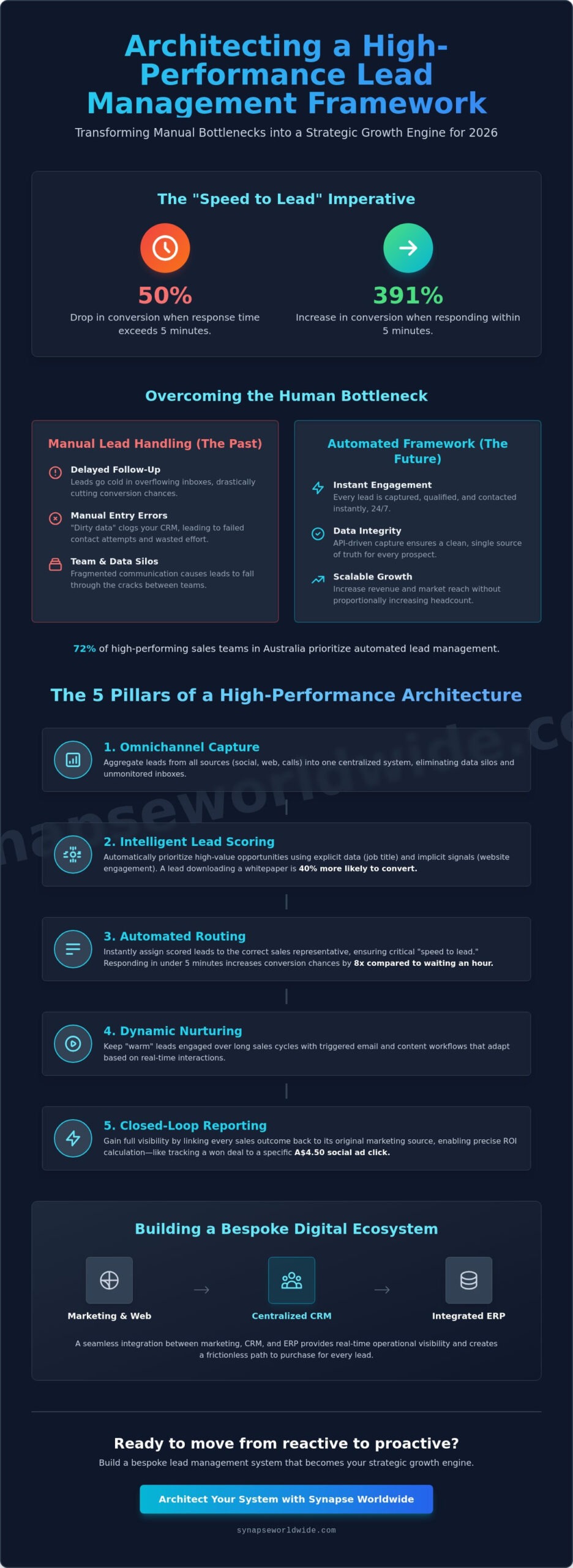
Research from the 2024 Salesforce State of Sales report indicates that 72% of high performing sales teams in Australia now prioritize automated lead management to combat the 50% drop in conversion that occurs when response times exceed five minutes. You likely already feel the pressure of this reality. It’s frustrating to watch a high quality inquiry go cold because a manual entry error delayed the follow up or a team silo left a prospect waiting in an overflowing inbox.

We’re here to change that trajectory. This guide shows you how to architect a bespoke framework that eliminates these human bottlenecks and accelerates your conversion rates for the 2026 market. You’ll learn how to build a seamless bridge between your marketing assets and CRM, ensuring every lead is captured, qualified, and contacted instantly. We’ll examine the specific steps to create a scalable system that grows your revenue without the need to increase your headcount.

Key Takeaways

  • Transition from reactive lead handling to a proactive, data-driven framework designed for scalable growth in the competitive Australian market.
  • Architect a high-performance automated lead management system that leverages omnichannel capture and intelligent scoring to prioritise high-value opportunities.
  • Identify and eliminate the costly manual bottlenecks and data leakage that compromise your conversion rates and ROI.
  • Map a seamless lead journey that integrates your CRM and ERP to provide real-time operational visibility and a frictionless path to purchase.
  • Discover how to build a bespoke digital ecosystem that transforms lead management from a technical process into a strategic growth engine for 2026.

Understanding Automated Lead Management in the 2026 Digital Landscape

In the high-stakes Australian business environment of 2026, automated lead management has shifted from a technical convenience to a core strategic framework. It isn’t merely a software tool you install; it’s a proactive architecture designed to capture, qualify, and convert interest with surgical precision. Businesses that rely on reactive, manual processes often find themselves sidelined by competitors who’ve mastered data-driven engagement. This transition represents a fundamental change in how we perceive the sales funnel, moving from a static bucket to a dynamic, self-optimising ecosystem.

Success now hinges on the “speed to lead” imperative. Research consistently shows that responding to an inquiry within five minutes increases conversion rates by a staggering 391%. In a market where consumer expectations are immediate, a ten-minute delay can be the difference between a secured consultation and a lost opportunity. Modern systems leverage artificial intelligence and machine learning to predict lead intent and behavior. These algorithms analyse patterns in real-time, allowing your team to focus on high-value prospects while the system handles the initial heavy lifting of qualification.

The Evolution of the Lead Lifecycle

The days of manual data entry and disjointed spreadsheets are over. Modern lead management relies on API-driven capture methods that pull data directly from social platforms, landing pages, and interactive tools into a centralised hub. This integration preserves data integrity across every touchpoint, creating a seamless digital thread from the first click to the final sale. It ensures that no prospect falls through the cracks due to human error or fragmented communication channels, maintaining a professional standard of service at every step.

Why Automation is Essential for National Scalability

Scaling a business across Australia requires a presence that operates 24/7, far beyond the constraints of a standard eight-hour workday. Human-only sales teams can’t maintain the necessary pace in a digital economy that never sleeps. Automation ensures a consistent brand voice across every initial interaction, providing a bespoke experience for every prospect regardless of their time zone or entry point. This level of operational efficiency directly correlates to a higher ROI on your digital marketing campaigns. By removing the bottleneck of manual qualification, you empower your sales architects to engage only when a lead is primed for conversion, maximising the value of every marketing dollar spent.

The 5 Essential Pillars of a High-Performance Lead Management Architecture

Establishing a high-performance automated lead management framework is the difference between erratic growth and a predictable revenue engine. By 2026, the average Australian B2B buyer interacts with 10 or more digital touchpoints before engaging with a sales representative. Your architecture must capture, validate, and move these prospects through the funnel without manual friction or data leakage. Five foundational pillars support every high-performance architecture:

  • Omnichannel Capture: You must aggregate data from LinkedIn ads, Google Search, and inbound calls into one central source of truth. This prevents silos and ensures no lead is left in an unmonitored inbox.
  • Intelligent Lead Scoring: Systems should assign point values based on job title (explicit data) and website engagement (implicit signals). A lead downloading a technical whitepaper is statistically 40% more likely to convert than one only viewing a homepage.
  • Automated Routing: Speed to lead is critical. In the Australian market, responding within five minutes increases conversion chances by 8x compared to waiting an hour.
  • Dynamic Nurturing: Triggered workflows keep “warm” leads engaged over long sales cycles. These sequences adapt based on real-time interactions, such as clicking a specific case study link.
  • Closed-Loop Reporting: You need to link every sales outcome back to its original marketing source. This transparency allows you to track a won deal back to a specific A$4.50 click on a social campaign.

Lead Capture and Data Normalisation

Data integrity begins at the point of entry. Standard forms often result in “dirty data” that clogs your CRM and frustrates your sales team. High-performance systems use custom web forms that validate phone formats and business emails in real-time. By utilising hidden fields, you can capture critical UTM parameters and lead source data without adding friction for the user. It’s essential that your custom web design is architected to support these technical requirements while maintaining a seamless user experience. In an environment where 68% of users abandon poorly designed mobile forms, technical precision is non-negotiable.

Qualification and Scoring Logic

Sales teams face burnout when they chase low-quality leads. A bespoke scoring matrix solves this by balancing explicit data, like company size, with implicit signals, such as visiting a pricing page three times in 48 hours. Setting strict Marketing Qualified Lead (MQL) thresholds ensures your specialists only receive high-intent opportunities. Modern automated lead management now leverages AI to identify “ready-to-buy” clusters. These algorithms predict a 25% higher conversion probability before a prospect even requests a formal quote. If you want to see how these architectures can transform your bottom line, exploring a tailored digital strategy is the next logical step for your business.

How to Build an Automated Lead Management System for Scalable Growth in 2026

Overcoming the Human Bottleneck: Manual vs. Automated Systems

Manual lead management is no longer a viable strategy for Australian businesses aiming for high-level growth. Relying on staff to manually input data, send initial follow-ups, and track progress in spreadsheets creates a dangerous bottleneck. This approach leads to data leakage and missed opportunities that directly impact your bottom line. An automated lead management system replaces these fragile human processes with a robust, scalable architecture that ensures no prospect is ever ignored.

Management often struggles with data graveyards where information is siloed in individual inboxes or messy spreadsheets. Transitioning to automation provides 100% visibility into the sales pipeline. This transparency allows directors to identify exactly where leads stall, providing the tactical data needed to refine the sales process. It’s about moving away from guesswork and toward a culture of accountability and precision.

The Cost of Lead Leakage

Lead leakage occurs when potential clients exit your sales funnel due to slow response times or inconsistent follow-up. This inefficiency significantly erodes the profitability of your SEO and PPC investments. When you spend thousands of A$ to attract traffic, allowing a lead to leak is a direct hit to your marketing ROI. Statistics from Velocify indicate that conversion rates for automated follow-ups are 391% higher than those managed manually.

  • Response Speed: 78% of customers buy from the company that responds to their inquiry first.
  • Follow-up Consistency: Automated systems ensure every lead receives at least five touchpoints, whereas manual efforts often stop after two.
  • Pipeline Integrity: Automation captures 100% of lead data, eliminating the risk of lost contact details or forgotten entries.

Lead Decay is the rapid decline in a prospect’s interest and intent that occurs within the first 30 minutes of their initial inquiry.

Personalisation at Scale

A common objection is that automation feels too robotic for high-end, bespoke services. In reality, modern automated lead management allows for deeper personalisation than manual systems. By using merge tags and conditional logic, you can tailor communications based on the specific industry or pain point the lead identified in their initial form. Dynamic content on landing pages ensures that a prospect sees information relevant to their unique segment, increasing trust from the first click.

We advocate for a Hybrid Approach. This strategy automates the mundane, repetitive tasks like initial acknowledgement and appointment scheduling. This empowers your human sales team to focus their energy on complex, high-value closing conversations. Maintaining a professional, authoritative tone in automated SMS and email sequences ensures your brand remains sophisticated while operating at a speed no human can match.

A Step-by-Step Guide to Implementing Lead Automation

Success in 2026 requires more than just buying a CRM subscription; it demands a rigorous audit of your existing lead flow. Start by identifying specific friction points where potential customers drop off. Data from late 2024 suggests that Australian B2B firms lose up to 30% of their lead value due to response times exceeding four hours. By pinpointing these gaps, you can build an automated lead management system that prioritizes high-intent prospects instantly.

Mapping the Lead Journey

Create a visual flow chart of your sales funnel to define “Trigger Events” that launch automated sequences. A webinar registration or a pricing page visit should trigger an immediate CRM entry. Compliance is non-negotiable for Australian enterprises. Your system must be architected to satisfy the Australian Privacy Act 1988 and the SPAM Act 2003. This includes implementing clear double opt-in protocols and automated “right to be forgotten” workflows to protect your brand’s legal standing.

Integration Best Practices

Standard native integrations often hit a ceiling when business logic grows complex. To achieve true scalability, focus on a tech stack that allows for custom software development and robust API connectivity. Bespoke API middleware acts as the glue between your CRM and ERP, ensuring that sales data translates perfectly into operational tasks. We recommend a “Zero-Loss” testing protocol. Run 50 simulated lead entries to verify that every data point reaches the final ERP entry without corruption.

Once your workflows are live, focus on your highest-volume sources first. Monitor conversion data and gather direct feedback from your sales team every 14 days. If the sales team finds that automated leads are under-qualified, adjust your scoring logic. It’s about constant iteration. Organizations that refine their automated lead management logic quarterly see a 15% higher conversion rate compared to those who set and forget their systems.

Ready to transform your sales pipeline into a high-performance engine? Consult with Synapse Worldwide today to build your bespoke automation framework.

Bespoke Lead Infrastructure: Integrating CRM, ERP, and Web

Growth in 2026 requires more than just a contact form; it demands a unified digital ecosystem where data flows without friction. A siloed approach to data is a primary cause of stagnation. When your website, CRM, and ERP operate in isolation, your team loses 25% of their productive time manually syncing records. A bespoke automated lead management system eliminates this inefficiency by creating a direct bridge between customer interest and operational capacity.

Integrating your ERP into the lead phase provides a distinct strategic advantage. For Australian businesses managing physical inventory or service-based capacity, real-time data is essential. If a prospect enquires about a specific solution, the system can instantly verify stock levels or consultant availability before the first sales call even happens. This prevents the friction of over-promising and under-delivering, which is critical in a market where 73% of customers cite experience as a top factor in their purchasing decisions.

Synapse Worldwide acts as the Digital Architect for these complex environments. We design custom dashboards that serve as your Single Source of Truth. These interfaces allow you to see exactly how your marketing spend converts into revenue, tracking lead velocity and conversion rates with precision. We don’t just install software; we engineer growth engines that provide the clarity needed for high-stakes decision-making.

The Power of CRM and Website Integration

Modern ecommerce platforms must do more than process transactions. They function as high-intent data sensors. By tracking user behavior on-site, such as the specific technical specifications a visitor downloads, your CRM can prep the sales team with a detailed interest profile. A strategic approach to website CRM integration ensures that your A$10,000 monthly ad spend is targeted toward the behaviors that actually drive high-value conversions. It turns cold data into actionable intelligence.

Future-Proofing Your Lead Management

The digital landscape is shifting toward AI-driven lead agents capable of 24/7 autonomous negotiation and qualification. Preparing for this shift requires a robust, scalable architecture today. Whether you’re expanding from a local Sydney presence to a national footprint or entering international markets, your automated lead management must be flexible enough to handle increased volume without a total rebuild. Our systems are built for this exact trajectory.

Ready to transform your lead infrastructure? Contact Synapse Worldwide today for a strategic consultation on bespoke automation solutions tailored for the 2026 market.

Future-Proofing Your Sales Pipeline for 2026 and Beyond

The shift toward automated lead management isn’t just a technical upgrade; it’s a strategic necessity for Australian enterprises aiming to dominate the 2026 digital landscape. By eliminating manual bottlenecks and integrating your CRM and ERP systems, you create a robust infrastructure that converts interest into revenue without friction. Data from the 2024 Australian Digital Transformation Report indicates that businesses utilizing integrated automation see a 15% increase in operational efficiency. Successful scaling relies on moving past generic software toward a bespoke architecture that reflects your unique business logic. Businesses that invest in website CRM integration as a foundational growth strategy consistently report stronger pipeline visibility and higher customer retention rates.

Synapse Worldwide brings over 20 years of custom digital infrastructure expertise to your project. We’re specialists in high-value CRM and ERP integrations with a proven track record of scaling Australian enterprises through intelligent automation. Your growth shouldn’t be limited by manual processes or disconnected systems. Architect your growth engine with bespoke lead automation solutions from Synapse Worldwide.

We’re ready to help you transform your digital presence into a high-performance asset that drives consistent results and secures your competitive advantage.

Frequently Asked Questions

What is the difference between lead generation and lead management?

Lead generation is the process of attracting interest and capturing contact details, while lead management is the strategic framework for nurturing and qualifying those contacts until they’re ready to buy. Lead generation fills the top of your funnel. Lead management ensures that 100% of those inquiries receive a timely response and progress through a bespoke nurturing sequence.

How much does it cost to implement automated lead management?

Implementation costs for automated lead management typically range from A$5,000 for basic setups to over A$50,000 for enterprise-grade, integrated systems. These figures cover software licensing, technical integration, and strategic workflow design. According to 2024 industry benchmarks, Australian SMEs often allocate 15% of their total marketing budget to automation infrastructure to ensure long-term scalability.

Can lead automation work for B2B companies with long sales cycles?

Automated lead management is specifically designed for B2B environments where sales cycles often exceed six months. It maintains consistent engagement through automated touchpoints, ensuring your brand stays top-of-mind during the research phase. Data shows that B2B companies using automated nurturing see a 10% increase in sales pipeline contribution within the first year of implementation.

Will automated lead management replace my sales team?

No, automation doesn’t replace your sales team; it empowers them by removing repetitive administrative tasks and manual data entry. By automating lead scoring and initial outreach, your reps focus exclusively on high-value conversations with sales-ready prospects. This strategic shift typically leads to a 14.5% increase in sales productivity, according to historical Nucleus Research data.

What are the best tools for automated lead management in 2026?

The leading tools for automated lead management in 2026 include HubSpot for integrated CRM capabilities, Salesforce for enterprise-level customization, and ActiveCampaign for mid-market automation. These platforms now leverage predictive AI to identify buyer intent with 85% accuracy. Selecting a bespoke combination of these technologies creates a robust foundation for your digital growth.

How do I ensure my automated emails don’t end up in the spam folder?

You ensure emails avoid the spam folder by maintaining high sender reputation scores and implementing technical protocols like SPF, DKIM, and DMARC. Regularly cleaning your database to remove inactive contacts reduces bounce rates, which should stay below 2% to protect deliverability. Personalised content and relevant triggers also signal to providers that your communications are valuable to the recipient.

Is automated lead management compliant with Australian privacy laws?

Automated lead management systems must comply with the Australian Privacy Act 1988 and the Spam Act 2003 to ensure legal operation. This involves securing explicit consent for marketing, providing clear opt-out mechanisms, and storing data according to Australian Privacy Principles (APPs). Non-compliance leads to significant penalties, making a robust, compliant architecture essential for any Australian business.

How long does it take to see results from lead automation?

Businesses typically observe measurable improvements in lead response times and engagement rates within the first 30 to 60 days of implementation. Full ROI, characterised by increased conversion rates and reduced cost-per-acquisition, generally materialises between six and nine months. A 2023 study found that companies with mature automation processes achieve 32% higher revenue growth compared to those without.


inbound marketing automation

How to improve sales via inbound marketing

Just because someone visits your website doesn’t mean they are ready to buy. Your sales life cycle will vary depending upon the nature
of your business. However, one thing is evident in the recent times; the old style of advertising is just not working anymore. Customers now-a-days do their research before they buy. It is no longer about ‘bombarding people with heaps of advertising and they will buy’ idea. There are just too many options out there and customers are becoming an expert in ignoring you. Simply put, the old style sales model is broken. So, what’s the alternative?

Continue reading How to improve sales via inbound marketing