

Tag Archives: lead management


Website CRM Integration: The Strategic Guide to Seamless Business Growth in 2026

Website CRM Integration: The Strategic Guide to Seamless Business Growth in 2026

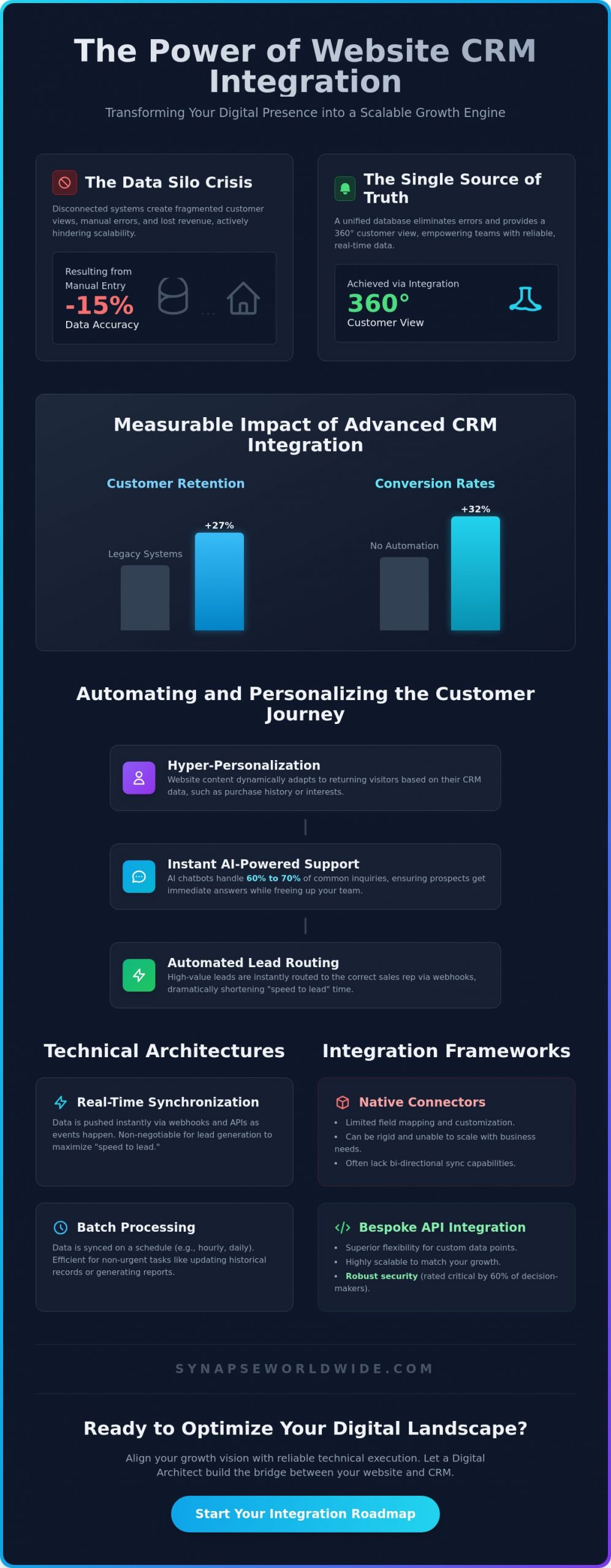
Companies leveraging advanced CRM features report 27% higher customer retention rates and 32% improved conversion rates compared to those relying on legacy systems. You likely recognize the drain of manual lead entry errors and the friction caused by disconnected data silos. It’s difficult to scale when you lack visibility into the customer journey. Strategic website crm integration is no longer an optional upgrade. It is the architectural foundation of a digital-first business that ensures every interaction counts.

You’re right to feel that your current setup should be doing more to support your growth. This guide will show you how to transform your website from a simple brochure into a powerful data engine through strategic CRM integration. We’ll explore the steps to automate your lead management and build a scalable digital infrastructure that serves as a single source of truth for your customer data. We’ll cover everything from meeting the January 2026 CCPA regulations regarding neural data to leveraging AI chatbots that handle 70% of common inquiries. It’s time to move beyond fragmented processes and reach the next level of business success.

Key Takeaways

  • Transform your digital presence by bridging the gap between front-end user experience and back-end business operations to eliminate costly data silos.
  • Determine whether real-time synchronization or batch processing is the most effective technical architecture for your unique website crm integration requirements.
  • Compare the limitations of native, out-of-the-box connectors against the high-performance benefits of bespoke integration frameworks designed for scalability.
  • Follow a strategic roadmap to audit your current digital assets and define precise data objectives for a seamless, automated workflow.
  • Leverage the expertise of a Digital Architect to align your high-level growth vision with reliable, hands-on technical execution.

Beyond the Form: Why Website CRM Integration is a Strategic Growth Engine

Website CRM integration is the vital bridge between your digital user experience and your internal business operations. Many organizations treat their website as a standalone entity, yet this creates a “Data Silo Crisis” that actively hinders scalability. In 2026, disconnected systems lead to fragmented customer identities and lost revenue. By unifying these platforms, you achieve a 360-degree view of your customer, ensuring that every touchpoint informs the next. Website CRM integration is a strategic business architecture that powers growth, not merely a technical synchronization of data fields.

High-growth companies use their digital presence to feed a robust Customer Relationship Management (CRM) system. This connection transforms passive visitors into actionable data points. It ensures that the marketing team understands exactly which campaigns drive the highest lifetime value, rather than just tracking clicks.

The Single Source of Truth

A unified database is the only way to generate reliable reporting for your leadership team. When your website and CRM exist in isolation, manual data entry errors become inevitable. These errors often lead to a 15% decrease in data accuracy across the organization. Eliminating these manual steps ensures your sales team works with high-quality information. This data consistency builds deep trust. When sales reps know that lead data is current and accurate, they pursue opportunities with greater confidence. Companies utilizing advanced CRM features already report 27% higher customer retention rates because they have the “single source of truth” required to serve clients effectively.

Enhancing the Customer Journey

Strategic integration allows you to personalize the web experience based on existing CRM data. If a returning client visits your site, the content can shift to reflect their specific interests or purchase history. This level of hyper-personalization is now a 2026 standard for competitive markets. Automated lead routing also plays a critical role by shortening response times. By implementing automated lead management, businesses can improve conversion rates by up to 32%. AI chatbots can now handle 60% to 70% of common inquiries instantly. This ensures your prospects never feel ignored while your team focuses on high-value strategic tasks.

Technical Architectures: How Your Website and CRM Communicate

The mechanism of data synchronization in 2026 relies on precision and speed. A successful website crm integration functions as the nervous system of your business, ensuring that every digital interaction reflects accurately in your central database. Understanding the opportunities and challenges of a CRM architecture is essential before committing to a technical path. You must decide between real-time synchronization and batch processing based on your operational needs. Real-time sync is non-negotiable for lead generation, as “speed to lead” remains a primary driver of conversion. Batch processing, conversely, is often more efficient for non-urgent tasks like updating historical purchase records or generating weekly reports.

Webhooks play a critical role in this ecosystem by triggering instant sales notifications. When a high-value prospect completes a specific action on your site, a webhook pushes that data to your CRM immediately. This eliminates the lag time associated with traditional polling methods. To maintain a truly cohesive digital landscape, your integration must be bi-directional. This ensures that if a sales rep updates a lead’s status in the CRM, the website experience can adapt accordingly, perhaps by showing the user a “client-only” portal or specific onboarding content. If you’re unsure which architecture fits your growth goals, consulting with a specialist in CRM integration can clarify your roadmap.

API-First Integration Strategies

Modern architectures favor RESTful APIs for their superior flexibility and scalability. Unlike generic plugins that offer limited field mapping, custom API development allows you to sync bespoke data points unique to your business model. Security is the highest priority here. With 60% of sales and marketing decision-makers rating security as critical, you must secure your API endpoints with robust encryption and authentication protocols. This protects sensitive customer data and ensures compliance with 2026 privacy standards. A custom-built API doesn’t just move data; it protects your brand’s reputation.

Middleware and Connector Tools

Connector tools like Zapier or Make serve as useful bridges for simple, linear tasks. They’re excellent for startups using entry-level tiers of HubSpot or Zoho. However, these third-party connectors often reveal significant limitations as your business scales. They can struggle with complex logic, high data volumes, or deep bi-directional syncing. A cost-benefit analysis often shows that while middleware has lower upfront costs, the long-term subscription fees and potential for “integration debt” make direct, bespoke integration a more stable investment for established enterprises. Choosing the right framework now prevents technical bottlenecks during your next growth phase.
Website CRM Integration: The Strategic Guide to Seamless Business Growth in 2026

Bespoke vs. Native Integration: Selecting the Right Framework

Choosing between a native connector and a bespoke solution is the difference between a temporary patch and a permanent foundation. Native integrations, such as the standard plugins offered by platforms like Zoho or Pipedrive, provide a fast entry point for businesses with basic requirements. They’re often “one-click” setups that handle simple contact forms effectively. However, these out-of-the-box solutions frequently hit a “breaking point” as your data complexity grows. Bespoke website crm integration is the hallmark of a high-performance digital landscape because it prioritizes your specific business logic over generic templates.

Custom frameworks offer superior scalability and granular security controls. With 60% of decision-makers rating security as their top priority in 2026, the ability to control every data endpoint is a significant competitive advantage. You shouldn’t settle for a system that forces your business processes to fit within the constraints of a plugin’s limited field mapping. A strategic approach ensures that your technical infrastructure supports your growth rather than creating new bottlenecks.

The Limitations of Cookie-Cutter Plugins

Generic plugins often rely on bloated code that can degrade your website’s loading speed. This negative impact on performance can directly hurt your SEO rankings and user experience. These tools also use generic data mapping. If your sales process requires unique business insights or custom field logic, a standard plugin won’t capture that information accurately. There’s also the persistent risk of plugin obsolescence. If a third-party developer stops providing updates, your entire lead pipeline could become a security vulnerability overnight. This creates a fragile digital environment that is difficult to scale with confidence.

The Case for Custom Software Development

Custom solutions allow you to tailor the data flow to match your exact operational requirements. This is especially critical for organizations with complex ERP or CRM needs that require deep synchronization across multiple departments. By investing in custom software development, you ensure your infrastructure is built to scale. You’re not just solving today’s data silos; you’re future-proofing your business for the evolving digital landscape of 2026 and beyond. This approach provides the flexibility to integrate new AI tools or conversational interfaces without rebuilding your entire system from scratch. It positions your brand as a proactive participant in its own growth strategy.

The Strategic Roadmap: Planning a Seamless System Integration

Successful system integration is never an accident. It’s the result of a disciplined, architectural approach to your digital landscape. To begin, you must conduct a comprehensive audit of your current digital assets and data flow. This involves identifying every entry point where a customer interacts with your brand, from landing page forms to e-commerce checkout sequences. Once you’ve mapped these touchpoints, define your objectives with surgical precision. You need to decide exactly which data points must be synced to drive your sales process, whether that’s basic contact info or complex behavioral triggers. Selecting the right website crm integration method depends entirely on your projected growth trajectory over the next three to five years.

Before moving to a full-scale launch, you must develop a robust testing phase. Data integrity is the lifeblood of your sales team. If the synchronization fails or duplicates records, you risk alienating prospects and wasting marketing spend. A phased rollout allows you to monitor performance in a controlled environment and optimize the connection for maximum efficiency. If you’re ready to move from planning to execution, our team can help you build a bespoke CRM integration strategy tailored to your enterprise.

Data Mapping and Field Alignment

Precision in data mapping ensures that your web forms and CRM entries speak the same language. You must identify essential fields like names, emails, and custom lead sources while ensuring format compatibility across both platforms. This is the stage where you clean “dirty data” before it enters your sales ecosystem. Inconsistent entries, such as varying phone number formats or misspelled city names, can disrupt automated workflows. By standardizing these inputs at the point of capture, you maintain a high-quality database that your sales team can actually use for targeted outreach.

Security and Compliance Protocols

Security is no longer just a technical requirement; it’s a legal mandate. As of January 1, 2026, new CCPA regulations have significantly expanded the definition of sensitive personal information to include neural data. Your integration must adhere to these national and global privacy standards to avoid heavy penalties. Implementing SSL/TLS encryption for all data in transit is the baseline. Beyond encryption, you must establish clear user access levels within the CRM to ensure that sensitive information is only available to authorized personnel. Since consumers can now request all personal information collected since January 1, 2022, your system must be capable of retrieving and managing this data efficiently. Protecting your customer’s privacy is the most effective way to build long-term brand trust.

Optimizing Your Digital Landscape with Synapse Worldwide

Synapse Worldwide functions as your Digital Architect, providing the vision and technical discipline required to automate your business at scale. We don’t just connect software; we build integrated ecosystems where your digital presence and operational tools work in perfect harmony. Achieving a seamless website crm integration requires more than a simple technical plugin. It demands a sophisticated understanding of how data flow influences customer retention and conversion rates in the 2026 landscape. Our team bridges the gap between high-level business strategy and practical, hands-on execution.

Starting with a custom web design for small business ensures your site is architected for integration from the very first line of code. This proactive approach prevents the performance lags and security gaps common with generic, cookie-cutter templates. We’re committed to delivering robust, scalable solutions that provide a measurable return on investment for our global partners. Every project we undertake is designed to evolve alongside your business, ensuring your digital infrastructure never becomes a bottleneck during rapid expansion.

Our Bespoke Integration Process

Our process begins with a deep discovery and strategy phase. We align your technical choices with your specific growth goals, ensuring every synchronized data point serves a clear operational purpose. Implementation is handled exclusively by senior developers who understand the nuances of bi-directional data flow and RESTful API security. We don’t believe in “set and forget” solutions that leave your team vulnerable to technical debt. Our team provides ongoing support and maintenance to ensure 100% uptime for your lead capture systems. This reliability is essential, especially as 57% of CRM users now consider their software critical to their daily operations. We ensure your data remains accurate, accessible, and compliant with the latest privacy standards.

Transforming Your Operations Today

Transitioning from manual data entry to automated precision is the fastest way to reclaim your team’s time and energy. By eliminating the friction of disconnected systems, you allow your sales professionals to focus on high-value interactions rather than clerical tasks. Pairing your CRM integration with a broader business process automation strategy amplifies these efficiency gains across every department. This integrated data also fuels advanced digital marketing strategies that drive real results. With a clear, 360-degree view of the customer journey, you can deploy hyper-personalized campaigns that resonate with your audience’s actual behavior. It’s time to stop managing data silos and start leading a data-driven enterprise. Contact our experts today for a strategic system audit to identify the optimization opportunities within your digital landscape and reach the next level of business success.

Architect Your Future for Scalable Growth

Strategic website crm integration serves as the foundation for a business that operates with automated precision. You’ve seen how moving beyond generic plugins allows for a secure, bi-directional flow of data that meets the rigorous 2026 compliance standards. By choosing a bespoke framework, you eliminate the technical debt that often stalls growth during rapid expansion. This transformation ensures your website is no longer a static brochure but a high-performance engine for lead generation and customer retention.

Synapse Worldwide has served as a trusted Digital Architect for global clients since 2005. We specialize in fixed-price project delivery, ensuring your digital transformation remains predictable, transparent, and results-oriented. Our expert team is ready to bridge the gap between your high-level vision and complex technical execution. Book a Strategic Consultation for Your CRM Integration today to audit your systems and identify your next level of growth. We’re committed to building a robust partnership that turns your digital landscape into a sustainable competitive advantage.

Frequently Asked Questions

What is the primary benefit of website CRM integration?

The primary benefit is the elimination of manual lead entry and the creation of a single source of truth for your customer data. By automating the data flow, you ensure that 100% of leads are captured and routed to the correct sales representative instantly. This visibility allows your team to prioritize high-value prospects and reduces the risk of human error during the lead capture process.

How much does it cost to integrate a website with a CRM in 2026?

CRM software costs vary based on the platform and user count. As of May 2026, HubSpot CRM offers a free tier, while paid plans start at $15 per user per month. Salesforce begins at $25 per user per month, and Zoho CRM offers paid plans starting at $14 per user per month. The cost of the actual website crm integration depends on whether you choose a native connector or a bespoke API solution.

Can I integrate my CRM with a custom-built website?

You can absolutely integrate a CRM with a custom-built website using RESTful APIs or webhooks. Custom sites often provide a superior foundation for website crm integration because they aren’t hindered by the bloated code found in generic templates. This flexibility allows you to sync unique data points that are specific to your business logic, ensuring your digital architecture remains fully scalable as you grow.

How long does a typical CRM integration project take?

A professional integration project typically takes between 4 and 12 weeks to complete. This timeline includes the initial strategic audit, data mapping, technical development, and a rigorous testing phase. While simple native connections might be established faster, bespoke enterprise solutions require a more deliberate approach to ensure data integrity and full compliance with the latest 2026 privacy regulations.

Is my customer data safe during the integration process?

Your data is secure when you implement enterprise-grade encryption and strict security protocols. We conduct risk assessments before sharing any personal information, as required by the 2026 CCPA updates. Since 60% of decision-makers now rank security as their top priority, we focus on securing API endpoints and implementing SSL/TLS encryption for all data in transit to protect your brand’s reputation and customer trust.

Do I need a developer for CRM integration, or can I use a plugin?

Plugins work for basic needs, but a developer is essential for high-performance, bespoke systems. Plugins often create technical debt and can slow down your website’s loading speed. A professional developer ensures a robust, bi-directional sync that handles complex data logic while maintaining 100% uptime. This approach is necessary for businesses that have outgrown the limited field mapping of cookie-cutter tools.

What happens to existing data when I connect my website to a CRM?

Existing data is audited, cleaned, and mapped to ensure compatibility with the new integration framework. We standardize formats to prevent duplicates and “dirty data” from entering your sales ecosystem. This process ensures that your historical records remain intact while new leads flow seamlessly into the correct categories. It’s a critical step for maintaining a reliable record of the entire customer journey.

Which CRM platforms are best for small to medium businesses?

HubSpot, Zoho, and Pipedrive are excellent choices for small to medium businesses in 2026. Pipedrive starts at $14 per user per month, while Zoho CRM offers a free tier for up to 3 users. These platforms provide the essential features needed for business automation without the extreme complexity of high-end enterprise systems. For organizations also managing inventory, finances, and operations, pairing your CRM with a dedicated erp for small business solution can deliver a truly unified operational foundation. They offer a scalable path for organizations looking to reach the next level of success.
 

How to Build an Automated Lead Management System for Scalable Growth in 2026

How to Build an Automated Lead Management System for Scalable Growth in 2026

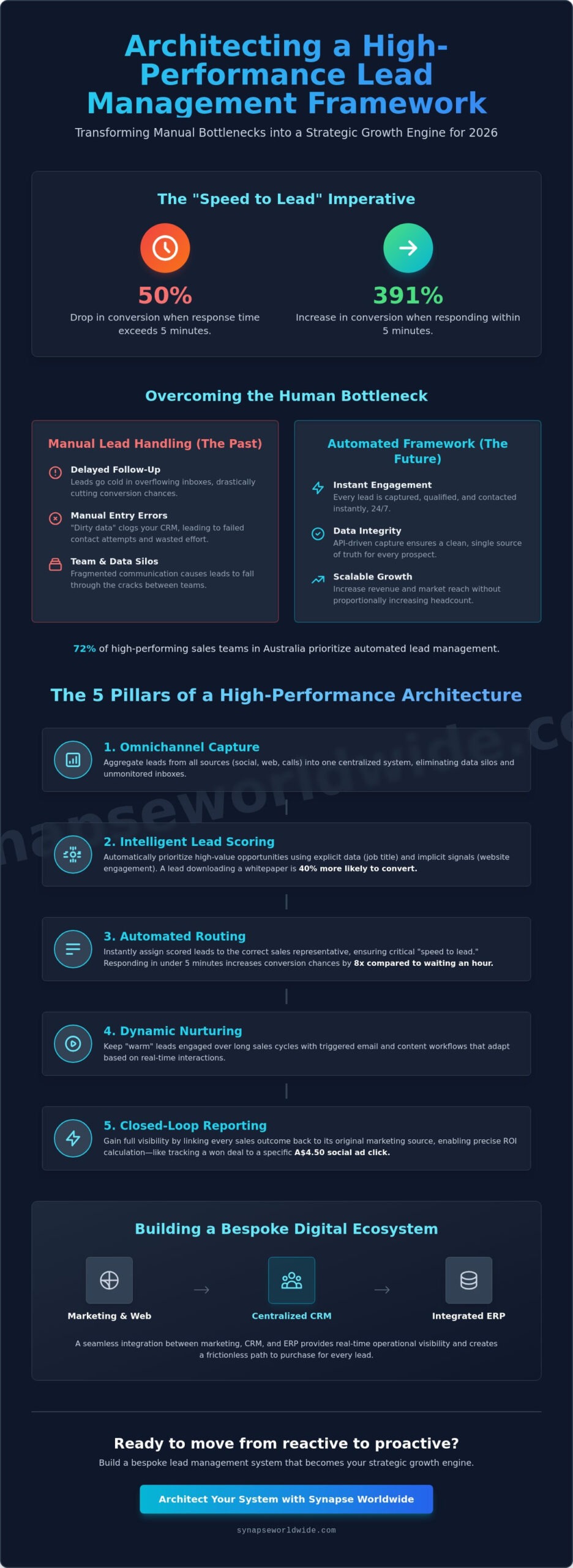
Research from the 2024 Salesforce State of Sales report indicates that 72% of high performing sales teams in Australia now prioritize automated lead management to combat the 50% drop in conversion that occurs when response times exceed five minutes. You likely already feel the pressure of this reality. It’s frustrating to watch a high quality inquiry go cold because a manual entry error delayed the follow up or a team silo left a prospect waiting in an overflowing inbox.

We’re here to change that trajectory. This guide shows you how to architect a bespoke framework that eliminates these human bottlenecks and accelerates your conversion rates for the 2026 market. You’ll learn how to build a seamless bridge between your marketing assets and CRM, ensuring every lead is captured, qualified, and contacted instantly. We’ll examine the specific steps to create a scalable system that grows your revenue without the need to increase your headcount.

Key Takeaways

  • Transition from reactive lead handling to a proactive, data-driven framework designed for scalable growth in the competitive Australian market.
  • Architect a high-performance automated lead management system that leverages omnichannel capture and intelligent scoring to prioritise high-value opportunities.
  • Identify and eliminate the costly manual bottlenecks and data leakage that compromise your conversion rates and ROI.
  • Map a seamless lead journey that integrates your CRM and ERP to provide real-time operational visibility and a frictionless path to purchase.
  • Discover how to build a bespoke digital ecosystem that transforms lead management from a technical process into a strategic growth engine for 2026.

Understanding Automated Lead Management in the 2026 Digital Landscape

In the high-stakes Australian business environment of 2026, automated lead management has shifted from a technical convenience to a core strategic framework. It isn’t merely a software tool you install; it’s a proactive architecture designed to capture, qualify, and convert interest with surgical precision. Businesses that rely on reactive, manual processes often find themselves sidelined by competitors who’ve mastered data-driven engagement. This transition represents a fundamental change in how we perceive the sales funnel, moving from a static bucket to a dynamic, self-optimising ecosystem.

Success now hinges on the “speed to lead” imperative. Research consistently shows that responding to an inquiry within five minutes increases conversion rates by a staggering 391%. In a market where consumer expectations are immediate, a ten-minute delay can be the difference between a secured consultation and a lost opportunity. Modern systems leverage artificial intelligence and machine learning to predict lead intent and behavior. These algorithms analyse patterns in real-time, allowing your team to focus on high-value prospects while the system handles the initial heavy lifting of qualification.

The Evolution of the Lead Lifecycle

The days of manual data entry and disjointed spreadsheets are over. Modern lead management relies on API-driven capture methods that pull data directly from social platforms, landing pages, and interactive tools into a centralised hub. This integration preserves data integrity across every touchpoint, creating a seamless digital thread from the first click to the final sale. It ensures that no prospect falls through the cracks due to human error or fragmented communication channels, maintaining a professional standard of service at every step.

Why Automation is Essential for National Scalability

Scaling a business across Australia requires a presence that operates 24/7, far beyond the constraints of a standard eight-hour workday. Human-only sales teams can’t maintain the necessary pace in a digital economy that never sleeps. Automation ensures a consistent brand voice across every initial interaction, providing a bespoke experience for every prospect regardless of their time zone or entry point. This level of operational efficiency directly correlates to a higher ROI on your digital marketing campaigns. By removing the bottleneck of manual qualification, you empower your sales architects to engage only when a lead is primed for conversion, maximising the value of every marketing dollar spent.

The 5 Essential Pillars of a High-Performance Lead Management Architecture

Establishing a high-performance automated lead management framework is the difference between erratic growth and a predictable revenue engine. By 2026, the average Australian B2B buyer interacts with 10 or more digital touchpoints before engaging with a sales representative. Your architecture must capture, validate, and move these prospects through the funnel without manual friction or data leakage. Five foundational pillars support every high-performance architecture:

  • Omnichannel Capture: You must aggregate data from LinkedIn ads, Google Search, and inbound calls into one central source of truth. This prevents silos and ensures no lead is left in an unmonitored inbox.
  • Intelligent Lead Scoring: Systems should assign point values based on job title (explicit data) and website engagement (implicit signals). A lead downloading a technical whitepaper is statistically 40% more likely to convert than one only viewing a homepage.
  • Automated Routing: Speed to lead is critical. In the Australian market, responding within five minutes increases conversion chances by 8x compared to waiting an hour.
  • Dynamic Nurturing: Triggered workflows keep “warm” leads engaged over long sales cycles. These sequences adapt based on real-time interactions, such as clicking a specific case study link.
  • Closed-Loop Reporting: You need to link every sales outcome back to its original marketing source. This transparency allows you to track a won deal back to a specific A$4.50 click on a social campaign.

Lead Capture and Data Normalisation

Data integrity begins at the point of entry. Standard forms often result in “dirty data” that clogs your CRM and frustrates your sales team. High-performance systems use custom web forms that validate phone formats and business emails in real-time. By utilising hidden fields, you can capture critical UTM parameters and lead source data without adding friction for the user. It’s essential that your custom web design is architected to support these technical requirements while maintaining a seamless user experience. In an environment where 68% of users abandon poorly designed mobile forms, technical precision is non-negotiable.

Qualification and Scoring Logic

Sales teams face burnout when they chase low-quality leads. A bespoke scoring matrix solves this by balancing explicit data, like company size, with implicit signals, such as visiting a pricing page three times in 48 hours. Setting strict Marketing Qualified Lead (MQL) thresholds ensures your specialists only receive high-intent opportunities. Modern automated lead management now leverages AI to identify “ready-to-buy” clusters. These algorithms predict a 25% higher conversion probability before a prospect even requests a formal quote. If you want to see how these architectures can transform your bottom line, exploring a tailored digital strategy is the next logical step for your business.

How to Build an Automated Lead Management System for Scalable Growth in 2026

Overcoming the Human Bottleneck: Manual vs. Automated Systems

Manual lead management is no longer a viable strategy for Australian businesses aiming for high-level growth. Relying on staff to manually input data, send initial follow-ups, and track progress in spreadsheets creates a dangerous bottleneck. This approach leads to data leakage and missed opportunities that directly impact your bottom line. An automated lead management system replaces these fragile human processes with a robust, scalable architecture that ensures no prospect is ever ignored.

Management often struggles with data graveyards where information is siloed in individual inboxes or messy spreadsheets. Transitioning to automation provides 100% visibility into the sales pipeline. This transparency allows directors to identify exactly where leads stall, providing the tactical data needed to refine the sales process. It’s about moving away from guesswork and toward a culture of accountability and precision.

The Cost of Lead Leakage

Lead leakage occurs when potential clients exit your sales funnel due to slow response times or inconsistent follow-up. This inefficiency significantly erodes the profitability of your SEO and PPC investments. When you spend thousands of A$ to attract traffic, allowing a lead to leak is a direct hit to your marketing ROI. Statistics from Velocify indicate that conversion rates for automated follow-ups are 391% higher than those managed manually.

  • Response Speed: 78% of customers buy from the company that responds to their inquiry first.
  • Follow-up Consistency: Automated systems ensure every lead receives at least five touchpoints, whereas manual efforts often stop after two.
  • Pipeline Integrity: Automation captures 100% of lead data, eliminating the risk of lost contact details or forgotten entries.

Lead Decay is the rapid decline in a prospect’s interest and intent that occurs within the first 30 minutes of their initial inquiry.

Personalisation at Scale

A common objection is that automation feels too robotic for high-end, bespoke services. In reality, modern automated lead management allows for deeper personalisation than manual systems. By using merge tags and conditional logic, you can tailor communications based on the specific industry or pain point the lead identified in their initial form. Dynamic content on landing pages ensures that a prospect sees information relevant to their unique segment, increasing trust from the first click.

We advocate for a Hybrid Approach. This strategy automates the mundane, repetitive tasks like initial acknowledgement and appointment scheduling. This empowers your human sales team to focus their energy on complex, high-value closing conversations. Maintaining a professional, authoritative tone in automated SMS and email sequences ensures your brand remains sophisticated while operating at a speed no human can match.

A Step-by-Step Guide to Implementing Lead Automation

Success in 2026 requires more than just buying a CRM subscription; it demands a rigorous audit of your existing lead flow. Start by identifying specific friction points where potential customers drop off. Data from late 2024 suggests that Australian B2B firms lose up to 30% of their lead value due to response times exceeding four hours. By pinpointing these gaps, you can build an automated lead management system that prioritizes high-intent prospects instantly.

Mapping the Lead Journey

Create a visual flow chart of your sales funnel to define “Trigger Events” that launch automated sequences. A webinar registration or a pricing page visit should trigger an immediate CRM entry. Compliance is non-negotiable for Australian enterprises. Your system must be architected to satisfy the Australian Privacy Act 1988 and the SPAM Act 2003. This includes implementing clear double opt-in protocols and automated “right to be forgotten” workflows to protect your brand’s legal standing.

Integration Best Practices

Standard native integrations often hit a ceiling when business logic grows complex. To achieve true scalability, focus on a tech stack that allows for custom software development and robust API connectivity. Bespoke API middleware acts as the glue between your CRM and ERP, ensuring that sales data translates perfectly into operational tasks. We recommend a “Zero-Loss” testing protocol. Run 50 simulated lead entries to verify that every data point reaches the final ERP entry without corruption.

Once your workflows are live, focus on your highest-volume sources first. Monitor conversion data and gather direct feedback from your sales team every 14 days. If the sales team finds that automated leads are under-qualified, adjust your scoring logic. It’s about constant iteration. Organizations that refine their automated lead management logic quarterly see a 15% higher conversion rate compared to those who set and forget their systems.

Ready to transform your sales pipeline into a high-performance engine? Consult with Synapse Worldwide today to build your bespoke automation framework.

Bespoke Lead Infrastructure: Integrating CRM, ERP, and Web

Growth in 2026 requires more than just a contact form; it demands a unified digital ecosystem where data flows without friction. A siloed approach to data is a primary cause of stagnation. When your website, CRM, and ERP operate in isolation, your team loses 25% of their productive time manually syncing records. A bespoke automated lead management system eliminates this inefficiency by creating a direct bridge between customer interest and operational capacity.

Integrating your ERP into the lead phase provides a distinct strategic advantage. For Australian businesses managing physical inventory or service-based capacity, real-time data is essential. If a prospect enquires about a specific solution, the system can instantly verify stock levels or consultant availability before the first sales call even happens. This prevents the friction of over-promising and under-delivering, which is critical in a market where 73% of customers cite experience as a top factor in their purchasing decisions.

Synapse Worldwide acts as the Digital Architect for these complex environments. We design custom dashboards that serve as your Single Source of Truth. These interfaces allow you to see exactly how your marketing spend converts into revenue, tracking lead velocity and conversion rates with precision. We don’t just install software; we engineer growth engines that provide the clarity needed for high-stakes decision-making.

The Power of CRM and Website Integration

Modern ecommerce platforms must do more than process transactions. They function as high-intent data sensors. By tracking user behavior on-site, such as the specific technical specifications a visitor downloads, your CRM can prep the sales team with a detailed interest profile. A strategic approach to website CRM integration ensures that your A$10,000 monthly ad spend is targeted toward the behaviors that actually drive high-value conversions. It turns cold data into actionable intelligence.

Future-Proofing Your Lead Management

The digital landscape is shifting toward AI-driven lead agents capable of 24/7 autonomous negotiation and qualification. Preparing for this shift requires a robust, scalable architecture today. Whether you’re expanding from a local Sydney presence to a national footprint or entering international markets, your automated lead management must be flexible enough to handle increased volume without a total rebuild. Our systems are built for this exact trajectory.

Ready to transform your lead infrastructure? Contact Synapse Worldwide today for a strategic consultation on bespoke automation solutions tailored for the 2026 market.

Future-Proofing Your Sales Pipeline for 2026 and Beyond

The shift toward automated lead management isn’t just a technical upgrade; it’s a strategic necessity for Australian enterprises aiming to dominate the 2026 digital landscape. By eliminating manual bottlenecks and integrating your CRM and ERP systems, you create a robust infrastructure that converts interest into revenue without friction. Data from the 2024 Australian Digital Transformation Report indicates that businesses utilizing integrated automation see a 15% increase in operational efficiency. Successful scaling relies on moving past generic software toward a bespoke architecture that reflects your unique business logic. Businesses that invest in website CRM integration as a foundational growth strategy consistently report stronger pipeline visibility and higher customer retention rates.

Synapse Worldwide brings over 20 years of custom digital infrastructure expertise to your project. We’re specialists in high-value CRM and ERP integrations with a proven track record of scaling Australian enterprises through intelligent automation. Your growth shouldn’t be limited by manual processes or disconnected systems. Architect your growth engine with bespoke lead automation solutions from Synapse Worldwide.

We’re ready to help you transform your digital presence into a high-performance asset that drives consistent results and secures your competitive advantage.

Frequently Asked Questions

What is the difference between lead generation and lead management?

Lead generation is the process of attracting interest and capturing contact details, while lead management is the strategic framework for nurturing and qualifying those contacts until they’re ready to buy. Lead generation fills the top of your funnel. Lead management ensures that 100% of those inquiries receive a timely response and progress through a bespoke nurturing sequence.

How much does it cost to implement automated lead management?

Implementation costs for automated lead management typically range from A$5,000 for basic setups to over A$50,000 for enterprise-grade, integrated systems. These figures cover software licensing, technical integration, and strategic workflow design. According to 2024 industry benchmarks, Australian SMEs often allocate 15% of their total marketing budget to automation infrastructure to ensure long-term scalability.

Can lead automation work for B2B companies with long sales cycles?

Automated lead management is specifically designed for B2B environments where sales cycles often exceed six months. It maintains consistent engagement through automated touchpoints, ensuring your brand stays top-of-mind during the research phase. Data shows that B2B companies using automated nurturing see a 10% increase in sales pipeline contribution within the first year of implementation.

Will automated lead management replace my sales team?

No, automation doesn’t replace your sales team; it empowers them by removing repetitive administrative tasks and manual data entry. By automating lead scoring and initial outreach, your reps focus exclusively on high-value conversations with sales-ready prospects. This strategic shift typically leads to a 14.5% increase in sales productivity, according to historical Nucleus Research data.

What are the best tools for automated lead management in 2026?

The leading tools for automated lead management in 2026 include HubSpot for integrated CRM capabilities, Salesforce for enterprise-level customization, and ActiveCampaign for mid-market automation. These platforms now leverage predictive AI to identify buyer intent with 85% accuracy. Selecting a bespoke combination of these technologies creates a robust foundation for your digital growth.

How do I ensure my automated emails don’t end up in the spam folder?

You ensure emails avoid the spam folder by maintaining high sender reputation scores and implementing technical protocols like SPF, DKIM, and DMARC. Regularly cleaning your database to remove inactive contacts reduces bounce rates, which should stay below 2% to protect deliverability. Personalised content and relevant triggers also signal to providers that your communications are valuable to the recipient.

Is automated lead management compliant with Australian privacy laws?

Automated lead management systems must comply with the Australian Privacy Act 1988 and the Spam Act 2003 to ensure legal operation. This involves securing explicit consent for marketing, providing clear opt-out mechanisms, and storing data according to Australian Privacy Principles (APPs). Non-compliance leads to significant penalties, making a robust, compliant architecture essential for any Australian business.

How long does it take to see results from lead automation?

Businesses typically observe measurable improvements in lead response times and engagement rates within the first 30 to 60 days of implementation. Full ROI, characterised by increased conversion rates and reduced cost-per-acquisition, generally materialises between six and nine months. A 2023 study found that companies with mature automation processes achieve 32% higher revenue growth compared to those without.