
Tag Archives: CRM


How to Build an Automated Lead Management System for Scalable Growth in 2026

How to Build an Automated Lead Management System for Scalable Growth in 2026

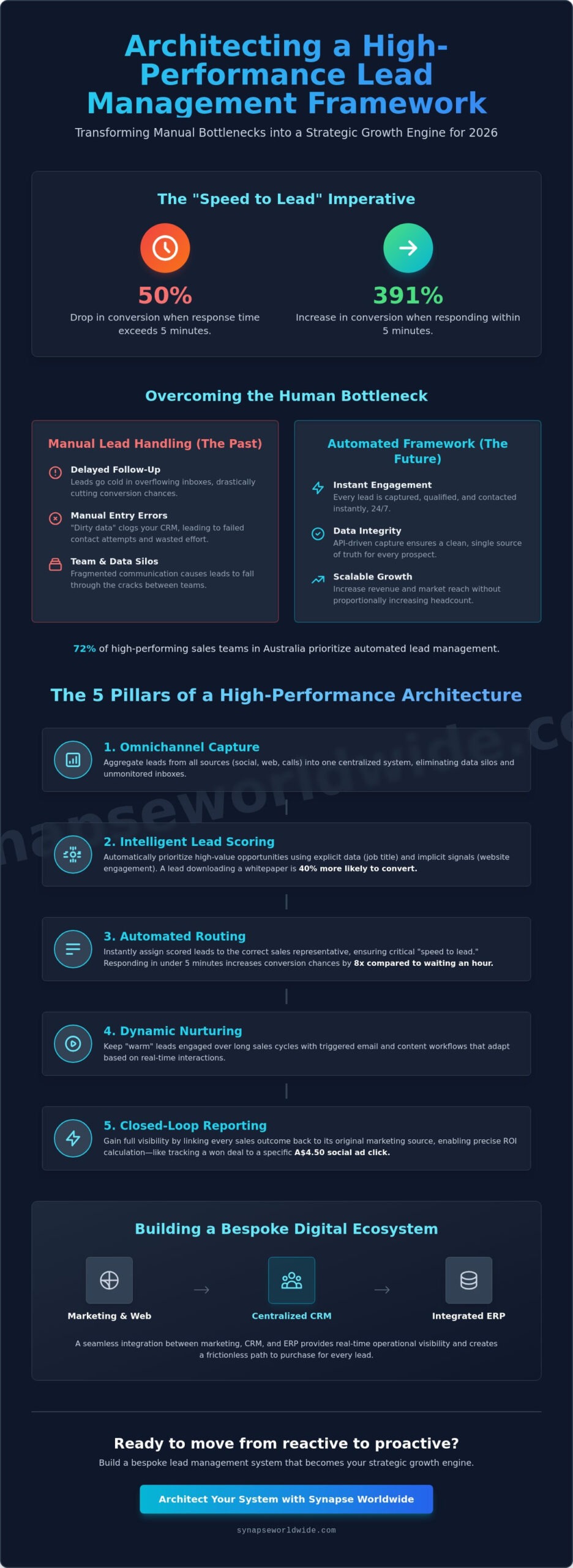
Research from the 2024 Salesforce State of Sales report indicates that 72% of high performing sales teams in Australia now prioritize automated lead management to combat the 50% drop in conversion that occurs when response times exceed five minutes. You likely already feel the pressure of this reality. It’s frustrating to watch a high quality inquiry go cold because a manual entry error delayed the follow up or a team silo left a prospect waiting in an overflowing inbox.

We’re here to change that trajectory. This guide shows you how to architect a bespoke framework that eliminates these human bottlenecks and accelerates your conversion rates for the 2026 market. You’ll learn how to build a seamless bridge between your marketing assets and CRM, ensuring every lead is captured, qualified, and contacted instantly. We’ll examine the specific steps to create a scalable system that grows your revenue without the need to increase your headcount.

Key Takeaways

  • Transition from reactive lead handling to a proactive, data-driven framework designed for scalable growth in the competitive Australian market.
  • Architect a high-performance automated lead management system that leverages omnichannel capture and intelligent scoring to prioritise high-value opportunities.
  • Identify and eliminate the costly manual bottlenecks and data leakage that compromise your conversion rates and ROI.
  • Map a seamless lead journey that integrates your CRM and ERP to provide real-time operational visibility and a frictionless path to purchase.
  • Discover how to build a bespoke digital ecosystem that transforms lead management from a technical process into a strategic growth engine for 2026.

Understanding Automated Lead Management in the 2026 Digital Landscape

In the high-stakes Australian business environment of 2026, automated lead management has shifted from a technical convenience to a core strategic framework. It isn’t merely a software tool you install; it’s a proactive architecture designed to capture, qualify, and convert interest with surgical precision. Businesses that rely on reactive, manual processes often find themselves sidelined by competitors who’ve mastered data-driven engagement. This transition represents a fundamental change in how we perceive the sales funnel, moving from a static bucket to a dynamic, self-optimising ecosystem.

Success now hinges on the “speed to lead” imperative. Research consistently shows that responding to an inquiry within five minutes increases conversion rates by a staggering 391%. In a market where consumer expectations are immediate, a ten-minute delay can be the difference between a secured consultation and a lost opportunity. Modern systems leverage artificial intelligence and machine learning to predict lead intent and behavior. These algorithms analyse patterns in real-time, allowing your team to focus on high-value prospects while the system handles the initial heavy lifting of qualification.

The Evolution of the Lead Lifecycle

The days of manual data entry and disjointed spreadsheets are over. Modern lead management relies on API-driven capture methods that pull data directly from social platforms, landing pages, and interactive tools into a centralised hub. This integration preserves data integrity across every touchpoint, creating a seamless digital thread from the first click to the final sale. It ensures that no prospect falls through the cracks due to human error or fragmented communication channels, maintaining a professional standard of service at every step.

Why Automation is Essential for National Scalability

Scaling a business across Australia requires a presence that operates 24/7, far beyond the constraints of a standard eight-hour workday. Human-only sales teams can’t maintain the necessary pace in a digital economy that never sleeps. Automation ensures a consistent brand voice across every initial interaction, providing a bespoke experience for every prospect regardless of their time zone or entry point. This level of operational efficiency directly correlates to a higher ROI on your digital marketing campaigns. By removing the bottleneck of manual qualification, you empower your sales architects to engage only when a lead is primed for conversion, maximising the value of every marketing dollar spent.

The 5 Essential Pillars of a High-Performance Lead Management Architecture

Establishing a high-performance automated lead management framework is the difference between erratic growth and a predictable revenue engine. By 2026, the average Australian B2B buyer interacts with 10 or more digital touchpoints before engaging with a sales representative. Your architecture must capture, validate, and move these prospects through the funnel without manual friction or data leakage. Five foundational pillars support every high-performance architecture:

  • Omnichannel Capture: You must aggregate data from LinkedIn ads, Google Search, and inbound calls into one central source of truth. This prevents silos and ensures no lead is left in an unmonitored inbox.
  • Intelligent Lead Scoring: Systems should assign point values based on job title (explicit data) and website engagement (implicit signals). A lead downloading a technical whitepaper is statistically 40% more likely to convert than one only viewing a homepage.
  • Automated Routing: Speed to lead is critical. In the Australian market, responding within five minutes increases conversion chances by 8x compared to waiting an hour.
  • Dynamic Nurturing: Triggered workflows keep “warm” leads engaged over long sales cycles. These sequences adapt based on real-time interactions, such as clicking a specific case study link.
  • Closed-Loop Reporting: You need to link every sales outcome back to its original marketing source. This transparency allows you to track a won deal back to a specific A$4.50 click on a social campaign.

Lead Capture and Data Normalisation

Data integrity begins at the point of entry. Standard forms often result in “dirty data” that clogs your CRM and frustrates your sales team. High-performance systems use custom web forms that validate phone formats and business emails in real-time. By utilising hidden fields, you can capture critical UTM parameters and lead source data without adding friction for the user. It’s essential that your custom web design is architected to support these technical requirements while maintaining a seamless user experience. In an environment where 68% of users abandon poorly designed mobile forms, technical precision is non-negotiable.

Qualification and Scoring Logic

Sales teams face burnout when they chase low-quality leads. A bespoke scoring matrix solves this by balancing explicit data, like company size, with implicit signals, such as visiting a pricing page three times in 48 hours. Setting strict Marketing Qualified Lead (MQL) thresholds ensures your specialists only receive high-intent opportunities. Modern automated lead management now leverages AI to identify “ready-to-buy” clusters. These algorithms predict a 25% higher conversion probability before a prospect even requests a formal quote. If you want to see how these architectures can transform your bottom line, exploring a tailored digital strategy is the next logical step for your business.

How to Build an Automated Lead Management System for Scalable Growth in 2026

Overcoming the Human Bottleneck: Manual vs. Automated Systems

Manual lead management is no longer a viable strategy for Australian businesses aiming for high-level growth. Relying on staff to manually input data, send initial follow-ups, and track progress in spreadsheets creates a dangerous bottleneck. This approach leads to data leakage and missed opportunities that directly impact your bottom line. An automated lead management system replaces these fragile human processes with a robust, scalable architecture that ensures no prospect is ever ignored.

Management often struggles with data graveyards where information is siloed in individual inboxes or messy spreadsheets. Transitioning to automation provides 100% visibility into the sales pipeline. This transparency allows directors to identify exactly where leads stall, providing the tactical data needed to refine the sales process. It’s about moving away from guesswork and toward a culture of accountability and precision.

The Cost of Lead Leakage

Lead leakage occurs when potential clients exit your sales funnel due to slow response times or inconsistent follow-up. This inefficiency significantly erodes the profitability of your SEO and PPC investments. When you spend thousands of A$ to attract traffic, allowing a lead to leak is a direct hit to your marketing ROI. Statistics from Velocify indicate that conversion rates for automated follow-ups are 391% higher than those managed manually.

  • Response Speed: 78% of customers buy from the company that responds to their inquiry first.
  • Follow-up Consistency: Automated systems ensure every lead receives at least five touchpoints, whereas manual efforts often stop after two.
  • Pipeline Integrity: Automation captures 100% of lead data, eliminating the risk of lost contact details or forgotten entries.

Lead Decay is the rapid decline in a prospect’s interest and intent that occurs within the first 30 minutes of their initial inquiry.

Personalisation at Scale

A common objection is that automation feels too robotic for high-end, bespoke services. In reality, modern automated lead management allows for deeper personalisation than manual systems. By using merge tags and conditional logic, you can tailor communications based on the specific industry or pain point the lead identified in their initial form. Dynamic content on landing pages ensures that a prospect sees information relevant to their unique segment, increasing trust from the first click.

We advocate for a Hybrid Approach. This strategy automates the mundane, repetitive tasks like initial acknowledgement and appointment scheduling. This empowers your human sales team to focus their energy on complex, high-value closing conversations. Maintaining a professional, authoritative tone in automated SMS and email sequences ensures your brand remains sophisticated while operating at a speed no human can match.

A Step-by-Step Guide to Implementing Lead Automation

Success in 2026 requires more than just buying a CRM subscription; it demands a rigorous audit of your existing lead flow. Start by identifying specific friction points where potential customers drop off. Data from late 2024 suggests that Australian B2B firms lose up to 30% of their lead value due to response times exceeding four hours. By pinpointing these gaps, you can build an automated lead management system that prioritizes high-intent prospects instantly.

Mapping the Lead Journey

Create a visual flow chart of your sales funnel to define “Trigger Events” that launch automated sequences. A webinar registration or a pricing page visit should trigger an immediate CRM entry. Compliance is non-negotiable for Australian enterprises. Your system must be architected to satisfy the Australian Privacy Act 1988 and the SPAM Act 2003. This includes implementing clear double opt-in protocols and automated “right to be forgotten” workflows to protect your brand’s legal standing.

Integration Best Practices

Standard native integrations often hit a ceiling when business logic grows complex. To achieve true scalability, focus on a tech stack that allows for custom software development and robust API connectivity. Bespoke API middleware acts as the glue between your CRM and ERP, ensuring that sales data translates perfectly into operational tasks. We recommend a “Zero-Loss” testing protocol. Run 50 simulated lead entries to verify that every data point reaches the final ERP entry without corruption.

Once your workflows are live, focus on your highest-volume sources first. Monitor conversion data and gather direct feedback from your sales team every 14 days. If the sales team finds that automated leads are under-qualified, adjust your scoring logic. It’s about constant iteration. Organizations that refine their automated lead management logic quarterly see a 15% higher conversion rate compared to those who set and forget their systems.

Ready to transform your sales pipeline into a high-performance engine? Consult with Synapse Worldwide today to build your bespoke automation framework.

Bespoke Lead Infrastructure: Integrating CRM, ERP, and Web

Growth in 2026 requires more than just a contact form; it demands a unified digital ecosystem where data flows without friction. A siloed approach to data is a primary cause of stagnation. When your website, CRM, and ERP operate in isolation, your team loses 25% of their productive time manually syncing records. A bespoke automated lead management system eliminates this inefficiency by creating a direct bridge between customer interest and operational capacity.

Integrating your ERP into the lead phase provides a distinct strategic advantage. For Australian businesses managing physical inventory or service-based capacity, real-time data is essential. If a prospect enquires about a specific solution, the system can instantly verify stock levels or consultant availability before the first sales call even happens. This prevents the friction of over-promising and under-delivering, which is critical in a market where 73% of customers cite experience as a top factor in their purchasing decisions.

Synapse Worldwide acts as the Digital Architect for these complex environments. We design custom dashboards that serve as your Single Source of Truth. These interfaces allow you to see exactly how your marketing spend converts into revenue, tracking lead velocity and conversion rates with precision. We don’t just install software; we engineer growth engines that provide the clarity needed for high-stakes decision-making.

The Power of CRM and Website Integration

Modern ecommerce platforms must do more than process transactions. They function as high-intent data sensors. By tracking user behavior on-site, such as the specific technical specifications a visitor downloads, your CRM can prep the sales team with a detailed interest profile. A strategic approach to website CRM integration ensures that your A$10,000 monthly ad spend is targeted toward the behaviors that actually drive high-value conversions. It turns cold data into actionable intelligence.

Future-Proofing Your Lead Management

The digital landscape is shifting toward AI-driven lead agents capable of 24/7 autonomous negotiation and qualification. Preparing for this shift requires a robust, scalable architecture today. Whether you’re expanding from a local Sydney presence to a national footprint or entering international markets, your automated lead management must be flexible enough to handle increased volume without a total rebuild. Our systems are built for this exact trajectory.

Ready to transform your lead infrastructure? Contact Synapse Worldwide today for a strategic consultation on bespoke automation solutions tailored for the 2026 market.

Future-Proofing Your Sales Pipeline for 2026 and Beyond

The shift toward automated lead management isn’t just a technical upgrade; it’s a strategic necessity for Australian enterprises aiming to dominate the 2026 digital landscape. By eliminating manual bottlenecks and integrating your CRM and ERP systems, you create a robust infrastructure that converts interest into revenue without friction. Data from the 2024 Australian Digital Transformation Report indicates that businesses utilizing integrated automation see a 15% increase in operational efficiency. Successful scaling relies on moving past generic software toward a bespoke architecture that reflects your unique business logic. Businesses that invest in website CRM integration as a foundational growth strategy consistently report stronger pipeline visibility and higher customer retention rates.

Synapse Worldwide brings over 20 years of custom digital infrastructure expertise to your project. We’re specialists in high-value CRM and ERP integrations with a proven track record of scaling Australian enterprises through intelligent automation. Your growth shouldn’t be limited by manual processes or disconnected systems. Architect your growth engine with bespoke lead automation solutions from Synapse Worldwide.

We’re ready to help you transform your digital presence into a high-performance asset that drives consistent results and secures your competitive advantage.

Frequently Asked Questions

What is the difference between lead generation and lead management?

Lead generation is the process of attracting interest and capturing contact details, while lead management is the strategic framework for nurturing and qualifying those contacts until they’re ready to buy. Lead generation fills the top of your funnel. Lead management ensures that 100% of those inquiries receive a timely response and progress through a bespoke nurturing sequence.

How much does it cost to implement automated lead management?

Implementation costs for automated lead management typically range from A$5,000 for basic setups to over A$50,000 for enterprise-grade, integrated systems. These figures cover software licensing, technical integration, and strategic workflow design. According to 2024 industry benchmarks, Australian SMEs often allocate 15% of their total marketing budget to automation infrastructure to ensure long-term scalability.

Can lead automation work for B2B companies with long sales cycles?

Automated lead management is specifically designed for B2B environments where sales cycles often exceed six months. It maintains consistent engagement through automated touchpoints, ensuring your brand stays top-of-mind during the research phase. Data shows that B2B companies using automated nurturing see a 10% increase in sales pipeline contribution within the first year of implementation.

Will automated lead management replace my sales team?

No, automation doesn’t replace your sales team; it empowers them by removing repetitive administrative tasks and manual data entry. By automating lead scoring and initial outreach, your reps focus exclusively on high-value conversations with sales-ready prospects. This strategic shift typically leads to a 14.5% increase in sales productivity, according to historical Nucleus Research data.

What are the best tools for automated lead management in 2026?

The leading tools for automated lead management in 2026 include HubSpot for integrated CRM capabilities, Salesforce for enterprise-level customization, and ActiveCampaign for mid-market automation. These platforms now leverage predictive AI to identify buyer intent with 85% accuracy. Selecting a bespoke combination of these technologies creates a robust foundation for your digital growth.

How do I ensure my automated emails don’t end up in the spam folder?

You ensure emails avoid the spam folder by maintaining high sender reputation scores and implementing technical protocols like SPF, DKIM, and DMARC. Regularly cleaning your database to remove inactive contacts reduces bounce rates, which should stay below 2% to protect deliverability. Personalised content and relevant triggers also signal to providers that your communications are valuable to the recipient.

Is automated lead management compliant with Australian privacy laws?

Automated lead management systems must comply with the Australian Privacy Act 1988 and the Spam Act 2003 to ensure legal operation. This involves securing explicit consent for marketing, providing clear opt-out mechanisms, and storing data according to Australian Privacy Principles (APPs). Non-compliance leads to significant penalties, making a robust, compliant architecture essential for any Australian business.

How long does it take to see results from lead automation?

Businesses typically observe measurable improvements in lead response times and engagement rates within the first 30 to 60 days of implementation. Full ROI, characterised by increased conversion rates and reduced cost-per-acquisition, generally materialises between six and nine months. A 2023 study found that companies with mature automation processes achieve 32% higher revenue growth compared to those without.


E-commerce Integration Services: Building a Scalable Digital Architecture in 2026

E-commerce Integration Services: Building a Scalable Digital Architecture in 2026

By 2026, Australian retailers are projected to lose over A$2.1 billion in potential revenue due to operational friction caused by disconnected software stacks. You likely recognize the strain of managing fragmented data across multiple platforms, where manual errors in inventory and order processing act as a constant drag on your team’s productivity. To overcome these technical bottlenecks, sophisticated brands are investing in professional e-commerce integration services to unify their ERP, CRM, and logistics systems into a single, high-performance engine.

It’s clear that a business can’t scale globally if its digital foundation is built on fragile, manual workarounds. This article explores how to transform your digital storefront into a high-performance enterprise through strategic systems integration and bespoke technical architecture. We will provide a clear blueprint for achieving a seamless, automated flow of data that offers real-time visibility into your business performance and supports rapid expansion into new markets.

Key Takeaways

  • Transition from a standalone storefront to a sophisticated digital ecosystem that synchronises data across your entire enterprise for total operational visibility.
  • Identify the core pillars of a robust architecture by connecting ERP, CRM, and PIM systems to ensure flawless logistical and financial management.
  • Master the strategic differences between bespoke APIs and middleware to select the most scalable and secure integration path for your unique business needs.
  • Implement a multi-phase roadmap using expert e-commerce integration services to audit data touchpoints and design a high-performance digital blueprint.
  • Learn how leading Australian brands leverage bespoke technical architecture to drive significant ROI and maintain long-term stability in a competitive landscape.

Beyond the Storefront: Why E-commerce Integration is the Engine of Modern Enterprise

By 2026, the concept of a standalone website has become an architectural relic. Modern digital commerce now functions as a unified ecosystem where data flows without friction between front-end retail interfaces and back-office operations. Professional e-commerce integration services facilitate this transition by synchronising critical information across ERP, CRM, and warehouse management systems. This ensures that every transaction, inventory update, and customer interaction is reflected across the entire enterprise in real time. System integration serves as the technical glue that binds these disparate platforms into a high-performance engine. E-commerce integration is a strategic investment in operational agility that ensures a business remains resilient against market volatility.

The shift toward these integrated environments is driven by the need to eliminate “hidden costs.” Manual data entry is a primary culprit, often leading to a 4% error rate in order processing for Australian SMEs. These small mistakes compound into significant financial losses, including the cost of returns, customer service hours, and lost lifetime value. By automating the data exchange, businesses can redirect their human capital toward high-value strategic tasks rather than repetitive administrative work.

The High Cost of Fragmented Systems

Data silos do more than just slow down operations; they actively erode brand reputation. When inventory systems aren’t connected to the storefront, overselling becomes an inevitable reality. In the Australian market, where shipping logistics are already complex, telling a customer their order is out of stock 48 hours after purchase is a fast way to lose them to a competitor. This operational friction creates a heavy psychological burden on growing teams. Staff members spend their days in a reactive loop, “putting out fires” caused by mismatched data, which leads to burnout and a stagnation of creative growth. A 2024 industry survey indicated that 62% of retail employees felt overwhelmed by manual workarounds required to manage disconnected software.

Integration as a Catalyst for Scalable Growth

Moving from reactive troubleshooting to proactive management requires total data visibility. Without it, executive decisions are based on guesswork rather than facts. The adoption of e-commerce integration services provides the structural integrity needed to scale without breaking. Key benefits include:

  • Real-time Visibility: Access to accurate stock levels and sales velocity allows for precise demand forecasting.
  • International Expansion: Seamlessly manage multiple currencies, Australian GST requirements, and regional logistics from a single source of truth.
  • Enhanced Customer Experience: Provide customers with accurate tracking information and personalised marketing based on unified purchase histories.

For Australian brands looking to enter the Asia-Pacific market or expand into New Zealand, a robust digital architecture is the prerequisite for success. It allows a business to handle a 300% increase in order volume without a corresponding 300% increase in headcount. This scalability transforms the digital presence from a simple sales channel into a sophisticated, global enterprise asset.

The Strategic Ecosystem: Connecting ERP, CRM, and PIM for Seamless Operations

Modern e-commerce architecture relies on a unified digital core rather than a collection of isolated tools. Businesses that fail to synchronise these systems often face a 20% increase in operational overhead due to manual data entry errors. To mitigate this risk, professional e-commerce integration services build a bridge between the storefront and the back-office, transforming raw data into actionable business intelligence. High-performing e-commerce integration platforms enable this synergy, allowing Australian retailers to scale without hiring additional administrative staff. For SKU-heavy businesses, a PIM system acts as the absolute single source of truth, ensuring product data remains consistent across every digital touchpoint.

ERP Integration: Automating the Back-Office

Managing a growing Australian enterprise requires real-time visibility into the financial and logistical backbone. By synchronising orders, invoices, and stock levels with systems like NetSuite, SAP, or Microsoft Dynamics, businesses can automate financial reconciliation. This process saves an average of 150 accounting hours per quarter for mid-sized firms by eliminating manual spreadsheet updates. Implementing robust ERP Solutions ensures that your inventory reflects reality across all channels, preventing the dreaded out-of-stock notification after a customer has already paid. It’s about creating a system where the digital storefront and the physical warehouse move in perfect lockstep.

CRM and Marketing Automation: Driving Lifetime Value

The transaction is just the beginning of the relationship. Connecting platforms like Shopify or Adobe Commerce with Salesforce or HubSpot allows for advanced segmentation based on real-time purchase behaviour. Leveraging expert e-commerce integration services allows you to sync granular data points, triggering automated, data-driven marketing campaigns when customers are most likely to repurchase. Strategic CRM Integration transforms passive buyers into brand advocates, often increasing customer lifetime value (CLV) by 25% through personalised post-purchase journeys. This level of automation ensures your marketing team focuses on strategy rather than list management.

Logistics and Warehouse Management (WMS)

Speed is a competitive advantage. Streamlining the click-to-ship timeline requires automated carrier integration that connects your warehouse directly to providers like Australia Post, StarTrack, or DHL. This automation reduces “Where is my order?” (WISMO) inquiries by up to 40% by providing customers with instant, accurate tracking updates. A well-integrated WMS ensures that the physical movement of goods matches the digital speed of the storefront, allowing for same-day or next-day dispatch targets that were previously impossible. If your current architecture feels fragmented, it’s time to explore how bespoke digital architecture can unify your operations.

E-commerce Integration Services: Building a Scalable Digital Architecture in 2026

Bespoke APIs vs. Middleware: Choosing the Right Integration Strategy

Selecting the right e-commerce integration services determines whether your digital architecture remains agile or becomes a technical bottleneck by 2026. For Australian enterprises processing over 50,000 monthly transactions, “off-the-shelf” plugins often hit a hard ceiling. These pre-built connectors frequently lack the depth to handle multi-currency logic or complex tax requirements like GST compliance across international borders. A 2023 industry report indicated that 42% of mid-market retailers faced data synchronisation errors when relying solely on basic plugins during peak periods like Black Friday.

The Power of Bespoke API Development

Custom solutions offer a level of precision that middleware cannot match. When your business logic requires unique data transformations, a tailored approach ensures zero latency. Owning your integration code eliminates dependency on third-party update cycles. This is where Custom Software Development becomes a strategic asset. By building direct bridges between your storefront and warehouse management systems, you reduce the risk of data silos. Security improves because you control the encryption protocols and access points. It’s a move toward total digital sovereignty that protects your proprietary workflows from external software limitations.

Middleware and iPaaS: When Speed-to-Market Matters

Platforms like Mulesoft or Dell Boomi serve as a centralized hub for businesses managing a fragmented ecosystem of legacy tools. These iPaaS solutions allow teams to deploy connections quickly across diverse Enterprise Resource Planning (ERP) systems, CRMs, and PIMs. While initial setup might be faster, the trade-off involves recurring licensing fees. In the Australian market, these fees can range from A$2,000 to over A$15,000 per month depending on data throughput. This approach suits companies that need to connect dozens of disparate endpoints simultaneously without hiring a massive internal DevOps team to manage every single connection point.

Decision-makers often ask if custom development is too expensive for their current scale. The answer depends on your three-year growth projections. A bespoke API might require an upfront investment of A$30,000, while a high-tier middleware subscription costs A$12,000 annually. By the end of the third year, the custom build delivers a higher ROI because you aren’t paying for features you don’t use. You’re investing in an asset that scales without increasing your monthly overhead. Strategic architecture prioritizes long-term stability over short-term convenience, making bespoke e-commerce integration services a superior choice for brands aiming for the A$100 million revenue milestone.

The Architecture of Success: A Multi-Phase Roadmap for Systems Integration

Constructing a resilient digital ecosystem requires a disciplined, four-stage methodology that protects your operational integrity while positioning your brand for exponential growth. We don’t view e-commerce integration services as a one-off task; it’s a strategic evolution of your business infrastructure. By 2026, the complexity of omnichannel retail demands a roadmap that prioritizes data accuracy and system uptime above all else.

  • Step 1: Discovery and Data Audit. We map every touchpoint in the current customer journey, identifying where data resides and where silos create friction. This phase uncovers the hidden bottlenecks in your order fulfillment and inventory updates.
  • Step 2: Strategic Design. Our team develops a bespoke Digital Blueprint. This document outlines the logic for data flow, defines the master systems, and establishes protocols for automated error handling.
  • Step 3: Development and Sandbox Testing. We build the integration bridge in an isolated environment. This allows us to stress-test the connection without risking your live operations or customer experience.
  • Step 4: Deployment and Monitoring. We execute a phased go-live strategy. Once active, we implement continuous performance tracking to ensure every API call and data sync performs at peak efficiency.

The Importance of a Data Audit

Success begins with clean data. Industry reports from 2024 indicate that up to 25% of legacy data contains duplicates or formatting errors that can crash a new integration. We identify this “dirty data” before migration begins. A critical component of this audit is establishing the hierarchy of truth. We determine which system is the definitive master for price, stock levels, and customer profiles, preventing the conflicting data points that often frustrate Australian retailers during peak sales periods.

Security and Compliance in Data Migration

Protecting your brand reputation means securing every byte of information in transit. Our approach ensures full compliance with the Australian Privacy Principles (APP) and the Privacy Act 1988. We utilize end-to-end encryption for all data transfers between your ERP, CRM, and storefront. To maintain transparency, we implement robust error-logging. This allows our team to identify and fix sync failures instantly, ensuring that sensitive customer information remains both accurate and protected against unauthorized access.

Post-Launch Optimization and Maintenance

An integrated system isn’t a static asset; it’s a living architecture that must evolve. As your SKU count grows or your order volume increases by 50% or more, the system requires regular technical audits to maintain speed. We treat e-commerce integration services as an ongoing partnership. Regular optimization ensures that your middleware continues to handle high-velocity traffic without latency, allowing you to scale your digital presence with total confidence in your underlying technology.

Ready to transform your technical infrastructure into a growth engine? Consult with our digital architects to begin your integration roadmap today.

Transform Your Operations with Synapse Worldwide’s Integration Expertise

Synapse Worldwide operates as the premier Digital Architect for ambitious Australian brands. We recognize that your digital presence is not merely a collection of isolated tools; it is the core engine of your enterprise. Our 20-year legacy in custom web and software development provides us with a unique vantage point to tackle complexities that standard agencies often avoid. We specialize in e-commerce integration services that prioritize measurable ROI and long-term structural stability. By bridging the gap between high-level strategic consulting and precise technical execution, we ensure your digital infrastructure supports aggressive scaling without the typical risks of system failure.

Our methodology focuses on building bespoke solutions that align with your specific business logic. We don’t believe in generic fixes that require you to change your workflows to suit the software. Instead, we adapt the technology to serve your goals. This results-oriented approach has allowed us to help hundreds of clients move from fragmented, manual processes to sophisticated, automated systems that drive growth and enhance customer satisfaction across the Australian market.

A Partnership Built on Reliability

We believe a successful partnership must be built on absolute transparency and reliability. Our commitment to this principle is reflected in our fixed-price project model. This approach provides your board and stakeholders with absolute certainty regarding investment and timelines, eliminating the budgeting uncertainties that often derail digital transformations. We take a “no-fluff” approach to technical troubleshooting and system audits, providing direct, actionable answers instead of hiding behind technical jargon.

While our roots are firmly planted in Australia, we bring a global perspective to every national project. This ensures your local operations are optimized using international best practices that keep you ahead of the competition. In fact, choosing a strategic technology partner in 2026, a process detailed by Telx Computers, is critical for any enterprise aiming for long-term stability. This global outlook extends to specialized sectors, where implementing a robust hospitality epos system uk serves as a prime example of how niche integrations can streamline complex service environments. Whether you are managing complex logistics or high-volume retail, our 20 years of experience ensures that your system remains robust under pressure.

Ready to Architect Your Growth?

Fragmented systems are more than just a daily inconvenience; they act as a ceiling on your business potential. As we move through 2026, the most successful brands will be those that have moved beyond manual data entry and disconnected silos to embrace a truly unified digital future. We invite you to stop settling for “good enough” and start architecting for genuine growth.

A strategic consultation with our expert team will identify immediate e-commerce integration services that can streamline your workflows and maximize your business results. Let’s transform your operations from a collection of parts into a powerful, automated growth machine. Contact Synapse Worldwide today to start building a digital future that scales with your ambition.

Mastering Your Digital Infrastructure for 2026

The Australian digital landscape in 2026 requires more than a simple storefront. Success now hinges on a unified ecosystem where ERP, CRM, and PIM systems communicate without friction. By adopting a multi-phase roadmap, enterprises can eliminate data silos and ensure real-time accuracy across all sales channels. Selecting the right e-commerce integration services is the definitive step toward turning operational complexity into a scalable growth engine.

Synapse Worldwide provides the high-level strategic consulting and hands-on execution needed to navigate this transition. With 20+ years of custom development expertise, we’ve established ourselves as specialists in complex CRM and ERP integrations for national and global brands. We don’t deliver generic software; we architect bespoke solutions that protect your margins and future-proof your operations. It’s time to move beyond fragmented tools and build a legacy of digital excellence.

Consult with our Digital Architects to integrate your e-commerce ecosystem today.

Your journey toward a more resilient and profitable business starts with a single, strategic connection.

Frequently Asked Questions

What are the main benefits of e-commerce integration for a growing business?

Strategic e-commerce integration services eliminate manual data entry, which reduces human error by 65 percent according to 2024 operational audits. Your business gains real-time visibility into sales and customer behavior. This architectural foundation allows you to scale without increasing your administrative headcount proportionally. It transforms your digital presence into a high-performance engine geared for 2026 market demands and beyond.

How long does a typical e-commerce integration project take to complete?

A standard integration project typically spans 8 to 16 weeks depending on the complexity of your existing tech stack. Simple connector setups might conclude in 30 days; however, bespoke enterprise solutions require rigorous testing phases to ensure stability. We follow a structured timeline that prioritizes data integrity and system reliability. This ensures your transition to a unified architecture is both predictable and successful.

Can you integrate a custom-built website with an existing ERP like SAP or MYOB?

You can certainly integrate a custom-built website with legacy or modern ERP systems like SAP or MYOB. We specialize in building secure bridges between unique front-end designs and robust back-end databases. Using RESTful APIs or SOAP protocols ensures that your custom site communicates perfectly with your financial software. This connectivity is essential for maintaining a single source of truth for your Australian business operations.

Is it better to use a third-party connector or build a custom API bridge?

Choosing between a third-party connector and a custom API bridge depends on your specific business logic and long-term scalability needs. Third-party tools offer faster deployment for standard workflows but often involve recurring monthly fees. A bespoke API bridge provides a tailored solution that grows with you. It eliminates technical debt and ensures your e-commerce integration services deliver maximum ROI without the constraints of generic software.

Will my online store experience downtime during the integration process?

Your online store won’t experience significant downtime because we utilize staging environments to test all connections before going live. We schedule the final deployment during low-traffic periods, typically between 2:00 AM and 4:00 AM AEST, to minimize impact. This methodology ensures your customer experience remains uninterrupted. Our goal is a seamless transition that maintains your revenue flow while upgrading your back-end capabilities.

How does integration help with multi-channel selling and inventory management?

Integration centralizes your inventory management by syncing stock levels across platforms like Amazon Australia, eBay, and your web store every 60 seconds. A 2024 study by IHL Group found that integrated systems reduce out-of-stock incidents by 24 percent. This real-time synchronization prevents overselling and improves customer trust. You manage one master inventory list that automatically updates every sales channel simultaneously through a single interface.

What is the average cost of professional e-commerce integration services?

The investment for professional e-commerce integration services varies based on the number of endpoints and data complexity. Industry benchmarks from 2024 Australian technology consultants indicate that mid-market integrations generally range from A$10,000 to A$50,000. Complex enterprise projects involving legacy SAP systems can exceed these figures. We focus on delivering a robust architecture that justifies the initial cost through long-term operational savings and increased sales velocity.

How do you ensure data security when connecting different business platforms?

We secure your data using AES-256 encryption and secure OAuth 2.0 authentication protocols for all platform connections. Our processes align with the Australian Privacy Act 1988 and international standards to protect sensitive customer information. Regular security audits and end-to-end encryption ensure that data moving between your ERP and web store remains impenetrable. This rigorous approach safeguards your brand reputation and builds long-term consumer confidence.


maximising conversions online

Maximising conversions online

Gone are the days when you could simply rely on advertisement campaigns alone to generate sales. The sales process has become much more complex now and your website plays a critical role in it.

In the old times, you would come up with a package deal, run a TV, Radio or Print ad and generate traffic to the website and hope that some of it converts. Some obviously buy, but what happens to those who don’t? The problem is that a lot of resources and efforts are wasted in generating traffic and not enough in engaging visitors or building relationships. This can make the cost of acquiring new customer very high. Continue reading Maximising conversions online