

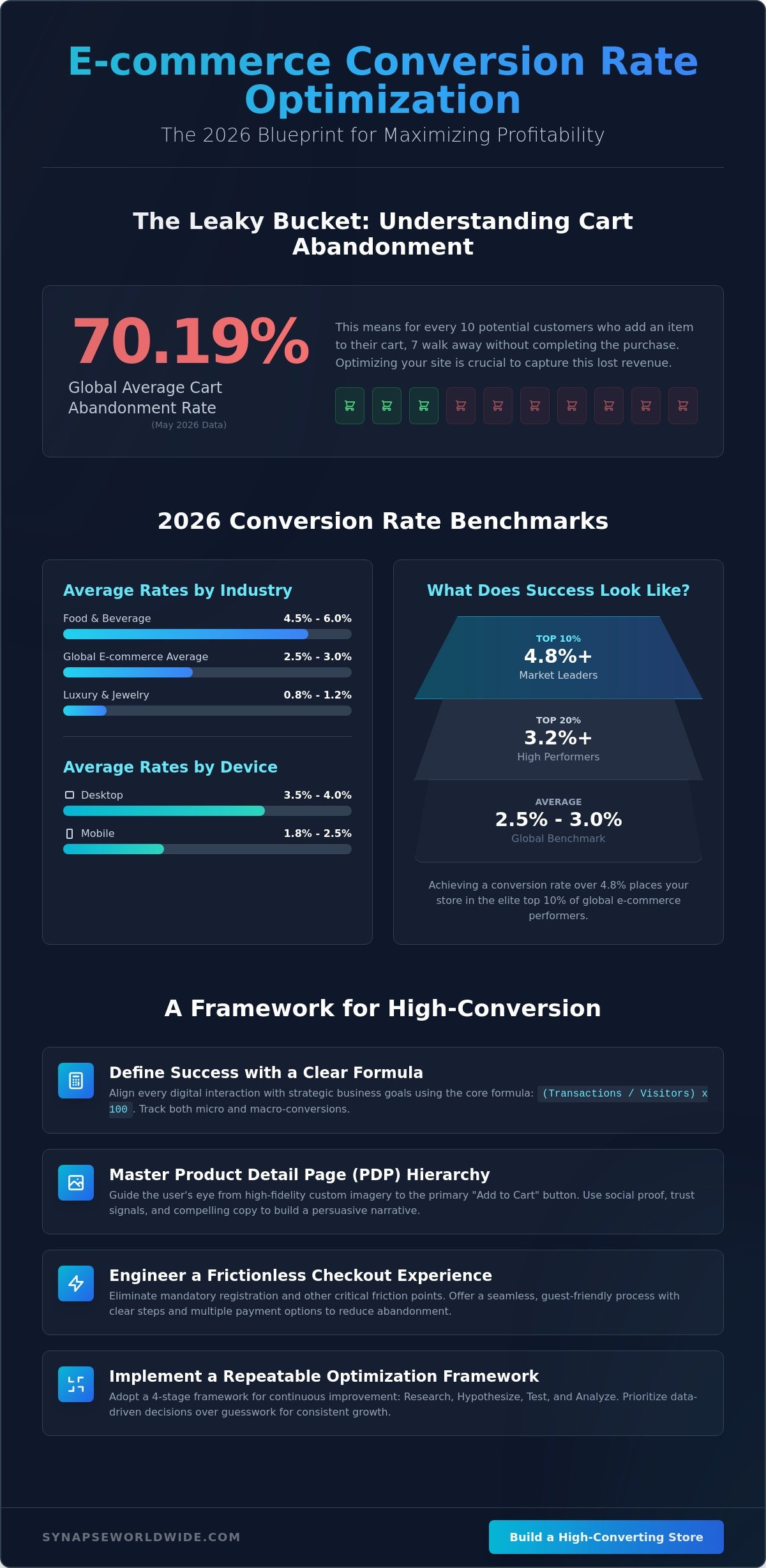
With the global average cart abandonment rate holding steady at 70.19% as of May 2026, most online retailers are effectively paying to watch seven out of ten customers walk away at the final payment step. You’ve likely felt the sting of high customer acquisition costs eating into your margins while wondering which site changes actually drive results. It’s frustrating to manage healthy traffic that doesn’t reach its full revenue potential. This guide establishes a sophisticated framework for ecommerce conversion rate optimization, moving beyond superficial tweaks to engineer a truly frictionless digital environment. You’ll master a bespoke strategy to identify friction, enhance user experience, and maximize your store’s profitability through data-driven precision.
We’ll explore how to navigate the July 2026 EU customs duty changes and the new Right to Repair mandates while building a repeatable testing framework. You’ll discover how to join the top 10% of performers who achieve conversion rates of 4.8% or higher. This article provides the strategic roadmap to integrate your marketing and sales data, ensuring every digital interaction serves your bottom line and helps you reach the next level of business success.
Key Takeaways
- Define success using the 2026 conversion formula to align every digital interaction with your strategic business objectives.
- Master the visual hierarchy of a high-converting product detail page by leveraging custom imagery to drive user action.
- Eliminate registration barriers and critical friction points to create a seamless, guest-friendly checkout experience.
- Implement a repeatable, four-stage framework for ecommerce conversion rate optimization that prioritizes research and data-driven testing.
- Surpass the limitations of standard templates by integrating bespoke web design with robust ERP systems for scalable growth.
Understanding Ecommerce Conversion Rate Optimization (CRO) in 2026
In the sophisticated digital landscape of 2026, Conversion rate optimization (CRO) has evolved beyond simple A/B testing or button-color tweaks. It’s now a systematic engineering process where we refine the digital journey to align user intent with specific business goals. At its core, the standard formula is precise: (Total Transactions / Total Unique Visitors) x 100. However, the execution is where the Digital Architect separates from the amateur. Mastering ecommerce conversion rate optimization allows you to scale revenue without the constant pressure of increasing your advertising budget. It’s the most efficient lever for growth because it focuses on extracting more value from the traffic you already own.
We distinguish between micro-conversions and macro-conversions to understand the full health of your sales funnel. A micro-conversion, such as a newsletter signup, adding an item to a wishlist, or engaging with a product configurator, indicates engagement and intent. A macro-conversion is the final sale that directly impacts your bottom line. Tracking both ensures you aren’t just optimizing for the final click, but for every strategic touchpoint in the customer relationship. This holistic view prevents short-term gains from damaging long-term brand loyalty.
The Economics of Conversion: Why Traffic is Only Half the Battle
Acquiring new traffic is increasingly expensive as 2026 customer acquisition costs (CAC) continue to climb across all major platforms. Many brands fall into the “leaky bucket” trap, where they pour investment into high-intent search ads while their site leaks potential revenue through poor user experience. Optimizing your existing traffic offers a far higher ROI than simply buying more clicks. This is why robust ecommerce website development serves as the essential foundation. You can’t build a high-converting store on a fractured infrastructure; your technical foundation must be as strategic and scalable as your marketing campaigns.
Setting Benchmarks: What Does Success Look Like?
Success is relative to your specific industry and device landscape. In May 2026, the global average ecommerce conversion rate sits between 2.5% and 3.0%. If you’re in the luxury or jewelry sector, you’ll see lower averages of 0.8% to 1.2%, while food and beverage brands often see peaks between 4.5% and 6.0%. Device type also dictates performance; desktop computers maintain a higher rate of 3.5% to 4.0% compared to the 1.8% to 2.5% seen on mobile devices. A good conversion rate is any figure above 3.2%, as this places your store in the top 20% of performers globally. Achieving a rate of 4.8% or higher signifies you’ve reached the top 10% of the market through bespoke optimization and a deep understanding of user behavior.
The Anatomy of a High-Converting Product Detail Page (PDP)
The Product Detail Page (PDP) is where your brand’s promise meets the customer’s decision. It’s the most critical junction in the digital landscape. A high-converting PDP relies on a rigid visual hierarchy that guides the eye from the product title and high-fidelity imagery directly to the primary “Add to Cart” button. In 2026, stock photography is a conversion killer. Custom, high-resolution imagery and lifestyle shots provide the psychological reassurance consumers need to visualize the product in their lives. By implementing advanced ecommerce conversion rate optimization strategies, you transform a simple gallery into a persuasive narrative. Trust signals, such as secure payment badges and clear money-back guarantees, must sit within the immediate “buy box” to mitigate risk at the exact moment of commitment. For the modern Australian consumer, this experience must be delivered through a mobile-first architecture, as 65% to 75% of your traffic likely originates from handheld devices.
Optimizing Product Descriptions and Social Proof
Effective copy balances technical precision with emotional resonance. You shouldn’t just list specifications; you must explain how those features solve a specific pain point. We enhance this through dynamic social proof. Real-time purchase notifications and verified customer reviews act as digital word-of-mouth, validating the user’s choice. To further drive ecommerce conversion rate optimization, we integrate video content and 3D modeling. These tools allow users to inspect products from every angle, which significantly reduces uncertainty and has been shown to lower return rates by up to 30% in high-performance stores.
Technical Foundations: Speed and Core Web Vitals
Infrastructure is the silent driver of revenue. Even the most beautiful PDP will fail if it’s slow. In 2026, a mere 100ms delay in page load time can result in a 7% drop in conversions. This is why we prioritize “Time to Interactive” (TTI) for mobile shoppers. A robust, scalable ecommerce architecture ensures your site remains responsive during high-traffic events like Black Friday or flash sales. When your technical foundation is optimized, your marketing spend works harder. If you’re ready to audit your current page performance, our team can provide a bespoke technical assessment to identify hidden friction points.
Engineering a Frictionless Checkout Experience
The checkout flow is the final hurdle in the digital journey. It’s where your hard-earned traffic either converts or contributes to the global 70.19% cart abandonment average. To master ecommerce conversion rate optimization, you must eliminate the five primary friction points: forced account registration, hidden shipping costs revealed too late, overly complex form fields, a lack of preferred payment methods, and sluggish page transitions. Eliminating these barriers isn’t just a design choice; it’s a strategic necessity for protecting your margins. You’re not just moving a user through a form; you’re securing a commitment.
Guest checkout is no longer optional. It’s a critical tool for reducing initial friction. By allowing new customers to complete a purchase without creating an account, you respect their time and lower the barrier to entry. We also analyze the “Single Page vs. Multi-Step” debate through the lens of product complexity. While single-page checkouts excel for impulse purchases, multi-step flows often perform better for high-ticket items where customers require a sense of deliberate progress. Visual progress indicators further reduce user anxiety by clearly communicating how many steps remain before the transaction is complete. This sense of order builds the confidence needed to finalize the sale.
Strategic Payment Gateway Integration
Your choice of payment infrastructure directly impacts your bottom line. In 2026, customers expect a blend of traditional card processing and modern “Buy Now, Pay Later” (BNPL) options. However, you must stay compliant with the EU Consumer Credit Directive effective November 20, 2026, which requires stricter advertising and explicit warnings for interest-free loans. Integrating ecommerce payment gateways that support one-click solutions like Apple Pay and Google Pay is essential for mobile shoppers. These methods bypass manual data entry, which is the leading cause of mobile abandonment. Whether you use Stripe at 2.9% plus 30 cents or Braintree at 2.59% plus 49 cents, the integration must be seamless and robust to ensure every transaction is protected.
Combatting Cart Abandonment at the Finish Line
Even with a streamlined flow, some users will hesitate. We deploy exit-intent popups as a sophisticated recovery tool, offering immediate value like a shipping discount rather than a generic newsletter prompt. Transparency is your greatest ally here. You can significantly impact reducing cart abandonment by displaying shipping costs and return policies early in the journey. This eliminates the “sticker shock” that occurs at the final step. For high-ticket items, the abandonment threshold usually occurs within the first 45 seconds of arriving at the checkout page if the user perceives any lack of security or clarity in the final price.
A 4-Stage Framework for Continuous Optimization
Sustainable growth isn’t the result of random site changes. It requires a disciplined, four-stage framework that treats your online store as a living laboratory. We begin with a “Research First” mindset. This involves a deep audit of Google Analytics 4 and behavioral heatmaps to move beyond guesswork. By May 2026, the market for conversion rate optimization software is projected to reach $5.07 billion, reflecting a global shift toward data-driven decision-making. You must identify exactly where users drop off before you attempt to fix the path. This initial audit ensures your strategy is built on reality rather than assumptions.
Once the friction is identified, we draft a formal hypothesis: “If we change [X], then [Y] will happen because of [Z].” This structure forces a strategic rationale behind every modification. We then move into the execution phase, utilizing A/B and multivariate testing. This allows us to compare different versions of a page simultaneously without disrupting your site’s overall stability. The final stage is the “Analyze and Pivot” phase. A failed test isn’t a loss; it’s a data point that prevents you from implementing a change that would have hurt your bottom line. This level of rigor ensures that ecommerce conversion rate optimization remains a predictable driver of revenue.
Leveraging Behavioral Analytics and AI
The technological landscape of 2026 has introduced AI agents that predict user behavior with startling accuracy. We use heatmaps and scroll maps to identify “dead zones” on your homepage where user interest tapers off. Session replays allow us to watch real-time struggles, such as a broken filter or a confusing navigation menu, without infringing on consumer privacy. These insights allow for a proactive approach to site maintenance. Instead of waiting for sales to drop, you can identify and resolve friction before it impacts your conversion rate. This data-driven culture is what separates market leaders from those struggling with stagnant growth.
Personalization: The New Standard for Conversion
Generic experiences no longer suffice. We implement dynamic content that changes based on the visitor’s location, referral source, or past purchase behavior. Product recommendation engines are essential for increasing Average Order Value (AOV) by presenting items that align with the user’s demonstrated intent. This isn’t about intrusive automation; it’s about a human-centric, bespoke brand voice that makes every customer feel understood. If you want to move beyond cookie-cutter solutions, our team can help you integrate a custom optimization framework tailored to your specific business goals.
The Role of Custom Infrastructure in Long-Term Growth
While basic platforms like Shopify or BigCommerce offer accessible entry points, growing brands eventually hit a “conversion ceiling” with standard templates. These cookie-cutter solutions lack the flexibility to handle the complex regulatory and data requirements of 2026. For instance, the removal of the EU customs duty exemption in July 2026 and the implementation of the Carbon Border Adjustment Mechanism (CBAM) on January 1, 2026, demand a level of transparency that standard themes simply can’t provide. True ecommerce conversion rate optimization requires a bespoke architectural strategy that connects your front-end user experience with robust back-end systems. You aren’t just building a website; you’re engineering an integrated digital ecosystem that can adapt to a changing global market.
Integrating CRM and ERP for Seamless UX
Synergy between your ecommerce platform and ERP solutions is critical for maintaining pre-purchase trust. When a customer sees real-time stock levels and accurate shipping tracking, their anxiety decreases and their likelihood to convert increases. This is especially vital given the EU “Right to Repair” mandate effective July 31, 2026, which requires retailers to provide transparent information on spare parts and repairability. If your backend doesn’t communicate with your frontend, you risk violating these transparency requirements and losing customer trust. CRM integration takes this further by allowing for post-purchase optimization. By leveraging unified data, you can trigger personalized re-engagement campaigns based on a high-value user’s specific purchase history. This reduces customer support friction and ensures your marketing spend drives long-term profitability rather than one-off transactions. A unified system means your sales and marketing teams see the same data, eliminating the silos that often stall growth.
Scaling Sustainably with Synapse Worldwide
Managing the intricate technical details of a global store requires a partner who acts as a Digital Architect. We move beyond surface-level tweaks to manage the complex multi-channel conversions that define enterprise success. Our approach ensures your CRM, ERP, and marketing data flow seamlessly, creating a stable foundation for scalable growth. We focus on the business outcomes of every technical implementation, ensuring your digital presence is both visionary and disciplined. You don’t need another vendor; you need a strategic consultant who understands how custom infrastructure drives ROI. If you’re ready to transition from a basic store to a high-performance ecosystem, you can partner with Synapse Worldwide for bespoke e-commerce growth. We provide the professional expertise needed to reach the next level of business success through strategic ecommerce conversion rate optimization.
Engineering Your Store for Scalable Success
Mastering ecommerce conversion rate optimization is no longer about small adjustments. It’s about building a robust, integrated digital ecosystem that aligns with the complex regulatory landscape of 2026. By moving beyond cookie-cutter templates and adopting a research-first framework, you ensure that every site change is a data-driven investment. This strategic shift allows you to lower acquisition costs while maximizing the lifetime value of every visitor. You’ve seen how high-fidelity imagery and seamless checkout flows turn traffic into revenue; now it’s time to solidify those gains through custom infrastructure.
Since 2005, Synapse Worldwide has acted as a Digital Architect for brands seeking enterprise-level growth. With over two decades of experience, we specialize in bespoke CRM and ERP integrations that provide the technical stability your store needs to scale. We combine a national Australian focus with a sophisticated global perspective on ecommerce trends. You don’t have to navigate these technical complexities alone. Elevate your online revenue with Synapse Worldwide’s strategic CRO expertise. Your digital presence is in expert hands, and we’re ready to help you reach the next level of business success.
Frequently Asked Questions
What is a good ecommerce conversion rate in 2026?
A good rate is any figure above 3.2%, as this places your store in the top 20% of global performers. If you reach 4.8%, you’ve entered the top 10% of ecommerce sites. These numbers vary by traffic source. Email marketing typically drives the highest engagement at 4.0% to 5.3%, whereas paid social media often converts at a much lower rate of 0.7% to 1.2%.
How much does ecommerce conversion rate optimization cost?
The cost of a professional program varies based on your chosen platform and the scale of your testing. Basic plans for Shopify and BigCommerce start at $39 per month, while Advanced and Pro plans reach $399. However, the sticker price is often only a third of the total cost of ownership. The global market for optimization software is projected to reach $5.07 billion by 2026, highlighting the significant investment brands are making to stay competitive.
Can I do CRO on a small budget without expensive tools?
You can start optimizing your store using foundational tools like Google Analytics 4 and basic heatmap software. Effective ecommerce conversion rate optimization begins with a “Research First” mindset rather than expensive subscriptions. By auditing your existing user paths and identifying obvious friction points in your checkout flow, you can drive measurable ROI before investing in more advanced multivariate testing suites or bespoke architectural changes.
How long does it take to see results from a CRO program?
Most businesses begin to see actionable data within 14 to 30 days of launching a structured testing cycle. The exact timeline depends on your unique visitor volume; you need enough traffic to reach statistical significance. A disciplined framework ensures that even tests that don’t result in a “win” provide valuable behavioral insights. These data points inform your next strategic pivot, ensuring long-term profitability rather than just quick, temporary gains.
Does site speed really affect my conversion rate significantly?
Site speed is a primary driver of user retention, particularly since mobile devices account for up to 75% of web traffic. A slow “Time to Interactive” creates immediate friction that leads shoppers to abandon their journey before viewing a single product. Since a 100ms delay can reduce sales by 7%, maintaining a lean, high-performance infrastructure is essential for protecting your advertising ROI and ensuring a seamless experience for every visitor.
What are the most common CRO mistakes businesses make?
The most frequent error is treating ecommerce conversion rate optimization as a series of isolated hacks rather than a high-level strategy. Many businesses focus on surface-level changes while ignoring backend systems like CRM or ERP integrations. This neglect creates a “conversion ceiling” that prevents the store from scaling. Another common mistake is failing to prepare for new transparency regulations, such as the EU “Right to Repair” mandate coming in July 2026.
Should I focus on mobile or desktop optimization first?
You should prioritize mobile optimization because it represents the largest share of your audience, yet it typically has a lower conversion rate of 1.8% to 2.5%. In contrast, desktop users convert at 3.5% to 4.0%. By focusing on the mobile experience first, you address the biggest “conversion gap” in your funnel. This approach ensures you’re capturing the maximum value from the 65% to 75% of visitors using handheld devices.

