
Tag Archives: checkout optimization


Ecommerce Conversion Rate Optimization: The 2026 Guide to Turning Traffic into Revenue

Ecommerce Conversion Rate Optimization: The 2026 Guide to Turning Traffic into Revenue

With the global average cart abandonment rate holding steady at 70.19% as of May 2026, most online retailers are effectively paying to watch seven out of ten customers walk away at the final payment step. You’ve likely felt the sting of high customer acquisition costs eating into your margins while wondering which site changes actually drive results. It’s frustrating to manage healthy traffic that doesn’t reach its full revenue potential. This guide establishes a sophisticated framework for ecommerce conversion rate optimization, moving beyond superficial tweaks to engineer a truly frictionless digital environment. You’ll master a bespoke strategy to identify friction, enhance user experience, and maximize your store’s profitability through data-driven precision.

We’ll explore how to navigate the July 2026 EU customs duty changes and the new Right to Repair mandates while building a repeatable testing framework. You’ll discover how to join the top 10% of performers who achieve conversion rates of 4.8% or higher. This article provides the strategic roadmap to integrate your marketing and sales data, ensuring every digital interaction serves your bottom line and helps you reach the next level of business success.

Key Takeaways

  • Define success using the 2026 conversion formula to align every digital interaction with your strategic business objectives.
  • Master the visual hierarchy of a high-converting product detail page by leveraging custom imagery to drive user action.
  • Eliminate registration barriers and critical friction points to create a seamless, guest-friendly checkout experience.
  • Implement a repeatable, four-stage framework for ecommerce conversion rate optimization that prioritizes research and data-driven testing.
  • Surpass the limitations of standard templates by integrating bespoke web design with robust ERP systems for scalable growth.

Understanding Ecommerce Conversion Rate Optimization (CRO) in 2026

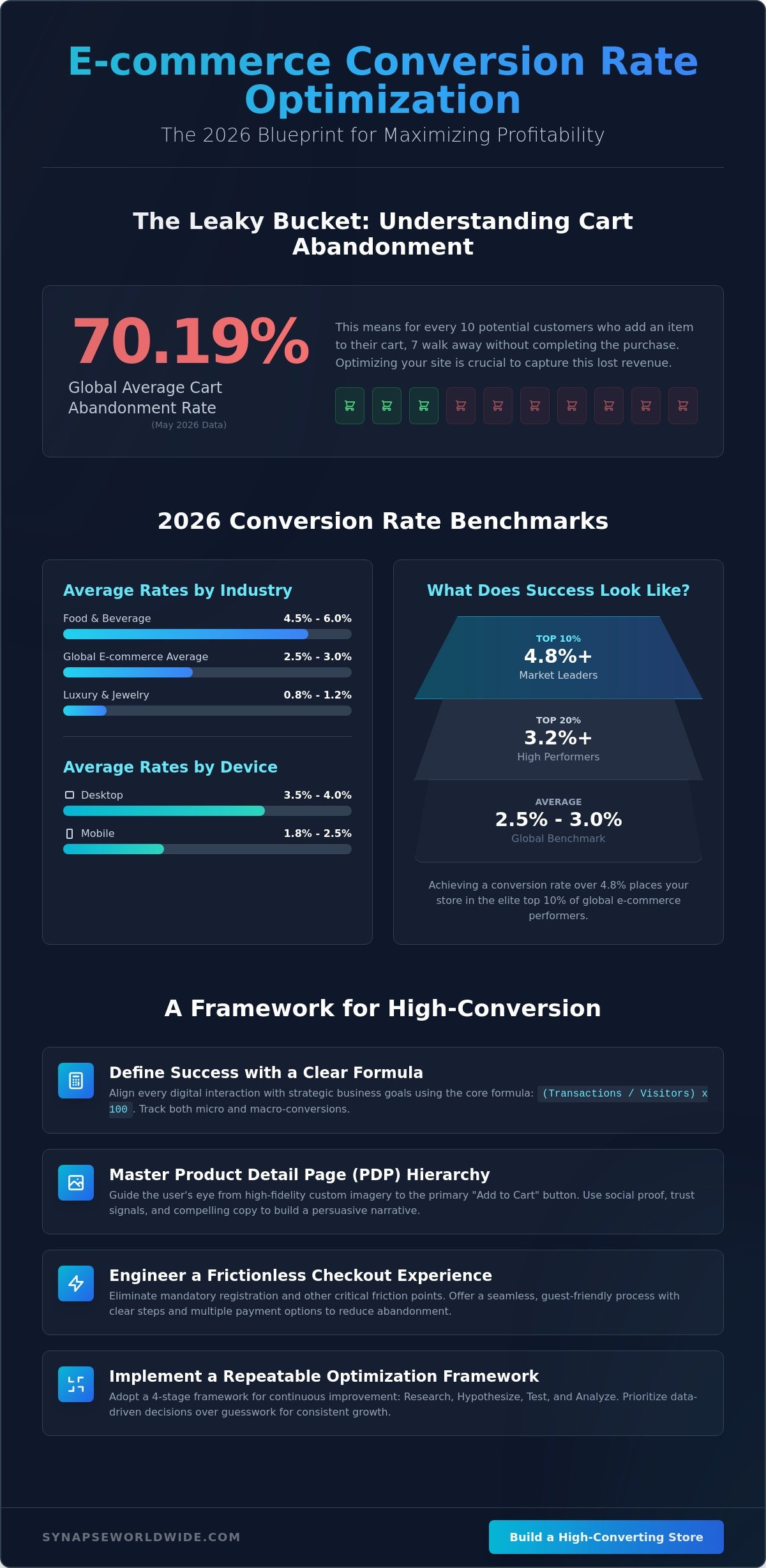
In the sophisticated digital landscape of 2026, Conversion rate optimization (CRO) has evolved beyond simple A/B testing or button-color tweaks. It’s now a systematic engineering process where we refine the digital journey to align user intent with specific business goals. At its core, the standard formula is precise: (Total Transactions / Total Unique Visitors) x 100. However, the execution is where the Digital Architect separates from the amateur. Mastering ecommerce conversion rate optimization allows you to scale revenue without the constant pressure of increasing your advertising budget. It’s the most efficient lever for growth because it focuses on extracting more value from the traffic you already own.

We distinguish between micro-conversions and macro-conversions to understand the full health of your sales funnel. A micro-conversion, such as a newsletter signup, adding an item to a wishlist, or engaging with a product configurator, indicates engagement and intent. A macro-conversion is the final sale that directly impacts your bottom line. Tracking both ensures you aren’t just optimizing for the final click, but for every strategic touchpoint in the customer relationship. This holistic view prevents short-term gains from damaging long-term brand loyalty.

The Economics of Conversion: Why Traffic is Only Half the Battle

Acquiring new traffic is increasingly expensive as 2026 customer acquisition costs (CAC) continue to climb across all major platforms. Many brands fall into the “leaky bucket” trap, where they pour investment into high-intent search ads while their site leaks potential revenue through poor user experience. Optimizing your existing traffic offers a far higher ROI than simply buying more clicks. This is why robust ecommerce website development serves as the essential foundation. You can’t build a high-converting store on a fractured infrastructure; your technical foundation must be as strategic and scalable as your marketing campaigns.

Setting Benchmarks: What Does Success Look Like?

Success is relative to your specific industry and device landscape. In May 2026, the global average ecommerce conversion rate sits between 2.5% and 3.0%. If you’re in the luxury or jewelry sector, you’ll see lower averages of 0.8% to 1.2%, while food and beverage brands often see peaks between 4.5% and 6.0%. Device type also dictates performance; desktop computers maintain a higher rate of 3.5% to 4.0% compared to the 1.8% to 2.5% seen on mobile devices. A good conversion rate is any figure above 3.2%, as this places your store in the top 20% of performers globally. Achieving a rate of 4.8% or higher signifies you’ve reached the top 10% of the market through bespoke optimization and a deep understanding of user behavior.

The Anatomy of a High-Converting Product Detail Page (PDP)

The Product Detail Page (PDP) is where your brand’s promise meets the customer’s decision. It’s the most critical junction in the digital landscape. A high-converting PDP relies on a rigid visual hierarchy that guides the eye from the product title and high-fidelity imagery directly to the primary “Add to Cart” button. In 2026, stock photography is a conversion killer. Custom, high-resolution imagery and lifestyle shots provide the psychological reassurance consumers need to visualize the product in their lives. By implementing advanced ecommerce conversion rate optimization strategies, you transform a simple gallery into a persuasive narrative. Trust signals, such as secure payment badges and clear money-back guarantees, must sit within the immediate “buy box” to mitigate risk at the exact moment of commitment. For the modern Australian consumer, this experience must be delivered through a mobile-first architecture, as 65% to 75% of your traffic likely originates from handheld devices.

Optimizing Product Descriptions and Social Proof

Effective copy balances technical precision with emotional resonance. You shouldn’t just list specifications; you must explain how those features solve a specific pain point. We enhance this through dynamic social proof. Real-time purchase notifications and verified customer reviews act as digital word-of-mouth, validating the user’s choice. To further drive ecommerce conversion rate optimization, we integrate video content and 3D modeling. These tools allow users to inspect products from every angle, which significantly reduces uncertainty and has been shown to lower return rates by up to 30% in high-performance stores.

Technical Foundations: Speed and Core Web Vitals

Infrastructure is the silent driver of revenue. Even the most beautiful PDP will fail if it’s slow. In 2026, a mere 100ms delay in page load time can result in a 7% drop in conversions. This is why we prioritize “Time to Interactive” (TTI) for mobile shoppers. A robust, scalable ecommerce architecture ensures your site remains responsive during high-traffic events like Black Friday or flash sales. When your technical foundation is optimized, your marketing spend works harder. If you’re ready to audit your current page performance, our team can provide a bespoke technical assessment to identify hidden friction points.
Ecommerce Conversion Rate Optimization: The 2026 Guide to Turning Traffic into Revenue

Engineering a Frictionless Checkout Experience

The checkout flow is the final hurdle in the digital journey. It’s where your hard-earned traffic either converts or contributes to the global 70.19% cart abandonment average. To master ecommerce conversion rate optimization, you must eliminate the five primary friction points: forced account registration, hidden shipping costs revealed too late, overly complex form fields, a lack of preferred payment methods, and sluggish page transitions. Eliminating these barriers isn’t just a design choice; it’s a strategic necessity for protecting your margins. You’re not just moving a user through a form; you’re securing a commitment.

Guest checkout is no longer optional. It’s a critical tool for reducing initial friction. By allowing new customers to complete a purchase without creating an account, you respect their time and lower the barrier to entry. We also analyze the “Single Page vs. Multi-Step” debate through the lens of product complexity. While single-page checkouts excel for impulse purchases, multi-step flows often perform better for high-ticket items where customers require a sense of deliberate progress. Visual progress indicators further reduce user anxiety by clearly communicating how many steps remain before the transaction is complete. This sense of order builds the confidence needed to finalize the sale.

Strategic Payment Gateway Integration

Your choice of payment infrastructure directly impacts your bottom line. In 2026, customers expect a blend of traditional card processing and modern “Buy Now, Pay Later” (BNPL) options. However, you must stay compliant with the EU Consumer Credit Directive effective November 20, 2026, which requires stricter advertising and explicit warnings for interest-free loans. Integrating ecommerce payment gateways that support one-click solutions like Apple Pay and Google Pay is essential for mobile shoppers. These methods bypass manual data entry, which is the leading cause of mobile abandonment. Whether you use Stripe at 2.9% plus 30 cents or Braintree at 2.59% plus 49 cents, the integration must be seamless and robust to ensure every transaction is protected.

Combatting Cart Abandonment at the Finish Line

Even with a streamlined flow, some users will hesitate. We deploy exit-intent popups as a sophisticated recovery tool, offering immediate value like a shipping discount rather than a generic newsletter prompt. Transparency is your greatest ally here. You can significantly impact reducing cart abandonment by displaying shipping costs and return policies early in the journey. This eliminates the “sticker shock” that occurs at the final step. For high-ticket items, the abandonment threshold usually occurs within the first 45 seconds of arriving at the checkout page if the user perceives any lack of security or clarity in the final price.

A 4-Stage Framework for Continuous Optimization

Sustainable growth isn’t the result of random site changes. It requires a disciplined, four-stage framework that treats your online store as a living laboratory. We begin with a “Research First” mindset. This involves a deep audit of Google Analytics 4 and behavioral heatmaps to move beyond guesswork. By May 2026, the market for conversion rate optimization software is projected to reach $5.07 billion, reflecting a global shift toward data-driven decision-making. You must identify exactly where users drop off before you attempt to fix the path. This initial audit ensures your strategy is built on reality rather than assumptions.

Once the friction is identified, we draft a formal hypothesis: “If we change [X], then [Y] will happen because of [Z].” This structure forces a strategic rationale behind every modification. We then move into the execution phase, utilizing A/B and multivariate testing. This allows us to compare different versions of a page simultaneously without disrupting your site’s overall stability. The final stage is the “Analyze and Pivot” phase. A failed test isn’t a loss; it’s a data point that prevents you from implementing a change that would have hurt your bottom line. This level of rigor ensures that ecommerce conversion rate optimization remains a predictable driver of revenue.

Leveraging Behavioral Analytics and AI

The technological landscape of 2026 has introduced AI agents that predict user behavior with startling accuracy. We use heatmaps and scroll maps to identify “dead zones” on your homepage where user interest tapers off. Session replays allow us to watch real-time struggles, such as a broken filter or a confusing navigation menu, without infringing on consumer privacy. These insights allow for a proactive approach to site maintenance. Instead of waiting for sales to drop, you can identify and resolve friction before it impacts your conversion rate. This data-driven culture is what separates market leaders from those struggling with stagnant growth.

Personalization: The New Standard for Conversion

Generic experiences no longer suffice. We implement dynamic content that changes based on the visitor’s location, referral source, or past purchase behavior. Product recommendation engines are essential for increasing Average Order Value (AOV) by presenting items that align with the user’s demonstrated intent. This isn’t about intrusive automation; it’s about a human-centric, bespoke brand voice that makes every customer feel understood. If you want to move beyond cookie-cutter solutions, our team can help you integrate a custom optimization framework tailored to your specific business goals.

The Role of Custom Infrastructure in Long-Term Growth

While basic platforms like Shopify or BigCommerce offer accessible entry points, growing brands eventually hit a “conversion ceiling” with standard templates. These cookie-cutter solutions lack the flexibility to handle the complex regulatory and data requirements of 2026. For instance, the removal of the EU customs duty exemption in July 2026 and the implementation of the Carbon Border Adjustment Mechanism (CBAM) on January 1, 2026, demand a level of transparency that standard themes simply can’t provide. True ecommerce conversion rate optimization requires a bespoke architectural strategy that connects your front-end user experience with robust back-end systems. You aren’t just building a website; you’re engineering an integrated digital ecosystem that can adapt to a changing global market.

Integrating CRM and ERP for Seamless UX

Synergy between your ecommerce platform and ERP solutions is critical for maintaining pre-purchase trust. When a customer sees real-time stock levels and accurate shipping tracking, their anxiety decreases and their likelihood to convert increases. This is especially vital given the EU “Right to Repair” mandate effective July 31, 2026, which requires retailers to provide transparent information on spare parts and repairability. If your backend doesn’t communicate with your frontend, you risk violating these transparency requirements and losing customer trust. CRM integration takes this further by allowing for post-purchase optimization. By leveraging unified data, you can trigger personalized re-engagement campaigns based on a high-value user’s specific purchase history. This reduces customer support friction and ensures your marketing spend drives long-term profitability rather than one-off transactions. A unified system means your sales and marketing teams see the same data, eliminating the silos that often stall growth.

Scaling Sustainably with Synapse Worldwide

Managing the intricate technical details of a global store requires a partner who acts as a Digital Architect. We move beyond surface-level tweaks to manage the complex multi-channel conversions that define enterprise success. Our approach ensures your CRM, ERP, and marketing data flow seamlessly, creating a stable foundation for scalable growth. We focus on the business outcomes of every technical implementation, ensuring your digital presence is both visionary and disciplined. You don’t need another vendor; you need a strategic consultant who understands how custom infrastructure drives ROI. If you’re ready to transition from a basic store to a high-performance ecosystem, you can partner with Synapse Worldwide for bespoke e-commerce growth. We provide the professional expertise needed to reach the next level of business success through strategic ecommerce conversion rate optimization.

Engineering Your Store for Scalable Success

Mastering ecommerce conversion rate optimization is no longer about small adjustments. It’s about building a robust, integrated digital ecosystem that aligns with the complex regulatory landscape of 2026. By moving beyond cookie-cutter templates and adopting a research-first framework, you ensure that every site change is a data-driven investment. This strategic shift allows you to lower acquisition costs while maximizing the lifetime value of every visitor. You’ve seen how high-fidelity imagery and seamless checkout flows turn traffic into revenue; now it’s time to solidify those gains through custom infrastructure.

Since 2005, Synapse Worldwide has acted as a Digital Architect for brands seeking enterprise-level growth. With over two decades of experience, we specialize in bespoke CRM and ERP integrations that provide the technical stability your store needs to scale. We combine a national Australian focus with a sophisticated global perspective on ecommerce trends. You don’t have to navigate these technical complexities alone. Elevate your online revenue with Synapse Worldwide’s strategic CRO expertise. Your digital presence is in expert hands, and we’re ready to help you reach the next level of business success.

Frequently Asked Questions

What is a good ecommerce conversion rate in 2026?

A good rate is any figure above 3.2%, as this places your store in the top 20% of global performers. If you reach 4.8%, you’ve entered the top 10% of ecommerce sites. These numbers vary by traffic source. Email marketing typically drives the highest engagement at 4.0% to 5.3%, whereas paid social media often converts at a much lower rate of 0.7% to 1.2%.

How much does ecommerce conversion rate optimization cost?

The cost of a professional program varies based on your chosen platform and the scale of your testing. Basic plans for Shopify and BigCommerce start at $39 per month, while Advanced and Pro plans reach $399. However, the sticker price is often only a third of the total cost of ownership. The global market for optimization software is projected to reach $5.07 billion by 2026, highlighting the significant investment brands are making to stay competitive.

Can I do CRO on a small budget without expensive tools?

You can start optimizing your store using foundational tools like Google Analytics 4 and basic heatmap software. Effective ecommerce conversion rate optimization begins with a “Research First” mindset rather than expensive subscriptions. By auditing your existing user paths and identifying obvious friction points in your checkout flow, you can drive measurable ROI before investing in more advanced multivariate testing suites or bespoke architectural changes.

How long does it take to see results from a CRO program?

Most businesses begin to see actionable data within 14 to 30 days of launching a structured testing cycle. The exact timeline depends on your unique visitor volume; you need enough traffic to reach statistical significance. A disciplined framework ensures that even tests that don’t result in a “win” provide valuable behavioral insights. These data points inform your next strategic pivot, ensuring long-term profitability rather than just quick, temporary gains.

Does site speed really affect my conversion rate significantly?

Site speed is a primary driver of user retention, particularly since mobile devices account for up to 75% of web traffic. A slow “Time to Interactive” creates immediate friction that leads shoppers to abandon their journey before viewing a single product. Since a 100ms delay can reduce sales by 7%, maintaining a lean, high-performance infrastructure is essential for protecting your advertising ROI and ensuring a seamless experience for every visitor.

What are the most common CRO mistakes businesses make?

The most frequent error is treating ecommerce conversion rate optimization as a series of isolated hacks rather than a high-level strategy. Many businesses focus on surface-level changes while ignoring backend systems like CRM or ERP integrations. This neglect creates a “conversion ceiling” that prevents the store from scaling. Another common mistake is failing to prepare for new transparency regulations, such as the EU “Right to Repair” mandate coming in July 2026.

Should I focus on mobile or desktop optimization first?

You should prioritize mobile optimization because it represents the largest share of your audience, yet it typically has a lower conversion rate of 1.8% to 2.5%. In contrast, desktop users convert at 3.5% to 4.0%. By focusing on the mobile experience first, you address the biggest “conversion gap” in your funnel. This approach ensures you’re capturing the maximum value from the 65% to 75% of visitors using handheld devices.

 

Ecommerce Payment Gateways: A Strategic Comparison for Scalable Growth in 2026

Ecommerce Payment Gateways: A Strategic Comparison for Scalable Growth in 2026

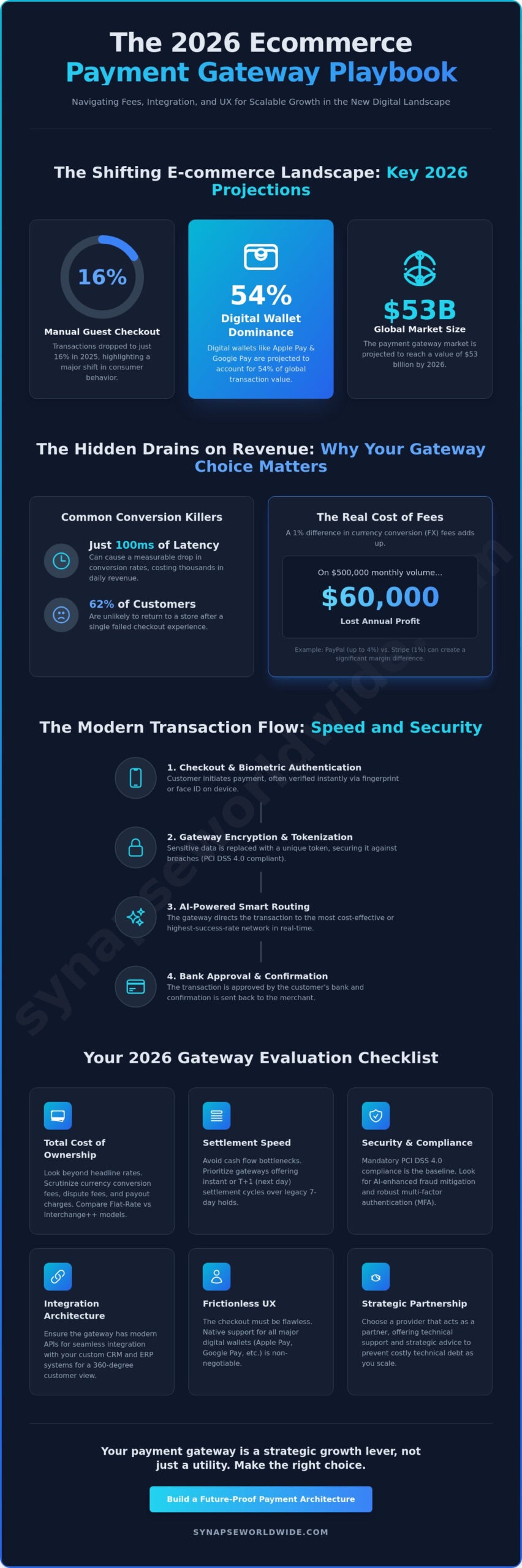
Did you know that manual guest checkout transactions dropped to just 16% of the global market in 2025? If your checkout process still relies on outdated manual entry, you’re likely seeing high cart abandonment rates that stifle your growth. Most ambitious merchants realize that ecommerce payment gateways are no longer just a utility; they’re a strategic UX asset that can either accelerate your scale or drain your margins through hidden 1% currency conversion fees and technical integration friction.

We understand the frustration of managing unpredictable costs like the 3.49% PayPal checkout rates or the complex Interchange++ models used by providers like Adyen. This comprehensive guide provides the technical clarity you need to select and integrate the ideal payment solution for your custom ERP and CRM systems. You’ll learn how to build a friction-free checkout experience that maximizes conversion, ensures robust fraud protection, and maintains full compliance with the mandatory PCI DSS 4.0 requirements. We compare the top-tier providers for 2026 to ensure your digital architecture is built for long-term, predictable success.

Key Takeaways

  • Master the shift toward smart routing and AI-enhanced fraud mitigation to protect your margins in the 2026 digital landscape.
  • Navigate the complexity of transaction fees and subscription models to determine the actual total cost of ownership for your scaling enterprise.
  • Compare the technical capabilities of top ecommerce payment gateways to find the perfect balance between architectural stability and modern agility.
  • Learn how to integrate your payment data with bespoke CRM and ERP solutions to create a unified, 360-degree view of your customer journey.
  • Understand why a strategic infrastructure audit is essential to prevent the accumulation of costly technical debt during periods of rapid growth.

What is an Ecommerce Payment Gateway in the 2026 Landscape?

In its simplest form, a payment gateway is the digital infrastructure that authorizes and processes credit card or direct payments for online stores. While early iterations were merely digital pipes, ecommerce payment gateways in 2026 have evolved into sophisticated decision engines. They now utilize Smart Routing to direct transactions through the most cost-effective or highest-probability-of-success networks in real time. This shift is critical as the global payment gateway market is projected to reach $53 billion in 2026. Understanding What is a payment gateway beyond its basic function is essential for any merchant aiming for global scale. It represents the final, most critical link in your ecommerce website development strategy.

Don’t confuse a gateway with a merchant account or an aggregator. A merchant account is a specialized bank account for holding funds, while an aggregator, like Stripe or Square, combines both the gateway and the account into a single service. In a bespoke enterprise environment, choosing a standalone gateway often provides better control over transaction data and fee structures. This distinction allows you to negotiate better rates as your volume increases rather than being locked into a flat-rate model that eats into your profit margins.

How Payment Gateways Function in Milliseconds

The 2026 transaction flow is a marvel of speed and security. As digital wallets are expected to account for 54% of global e-commerce value this year, the process often begins with biometric authentication on a mobile device. Within milliseconds, the gateway encrypts data and transmits it for approval. A key component here is tokenization. Tokenisation is the process of replacing sensitive data with unique identification symbols. This ensures that even if a breach occurs, the actual card details remain inaccessible to bad actors, maintaining compliance with the latest PCI DSS 4.0 standards.

Why Gateway Choice is a Strategic Business Decision

Performance is a competitive advantage in a crowded market. Research consistently shows that 100ms of latency can lead to a measurable drop in conversion rates, potentially costing thousands in daily revenue for high-volume stores. Reliability directly influences brand trust; if a checkout fails, 62% of customers are unlikely to return to that store. Beyond the transaction, these gateways serve as the primary data source for your financial reporting and scalable ecommerce architecture. They facilitate the seamless flow of information between your storefront and back-office systems, ensuring that every cent is accounted for and every customer interaction is logged for future marketing optimization.

Key Criteria for Comparing Payment Gateways

Evaluating ecommerce payment gateways requires a clinical focus on the Total Cost of Ownership (TCO). While many providers lead with a standard 2.9% plus $0.30 transaction fee, the true cost often hides in currency conversion markups. These can range from 1% at Stripe to as much as 4% with PayPal. For a business processing $500,000 monthly, a 1% difference in FX fees represents $60,000 in lost annual profit. You must decide between flat-rate models, which offer simplicity, and Interchange++ structures like those offered by Adyen. The latter provides greater transparency for high-volume merchants by breaking down the specific costs paid to banks and card networks.

Settlement speed is another non-negotiable metric for scalable growth. In a high-velocity environment, waiting seven days for funds to clear is a bottleneck you can’t afford. Modern gateways now offer instant or T+1 settlement cycles to keep your cash flow fluid. This operational agility must be backed by a robust regulatory framework for electronic payments. Since the transition to PCI DSS 4.0 became mandatory on March 31, 2025, continuous monitoring and multi-factor authentication (MFA) have become standard requirements for any gateway you consider in 2026.

The UX Factor: Frictionless Checkouts

Frictionless checkouts are your primary weapon against revenue leakage. With digital wallets projected to capture 54% of transaction value this year, supporting Apple Pay, Google Pay, and Venmo is mandatory. You can significantly reduce cart abandonment by deploying mobile-optimized, one-click checkout flows that bypass manual entry entirely. A global perspective also requires multi-currency support. This allows customers to pay in their local currency, avoiding the high friction of forced conversion at the point of sale. Pairing an optimized gateway with a robust ecommerce conversion rate optimization strategy ensures that every improvement to your checkout flow translates directly into measurable revenue gains.

Technical Robustness and Scalability

Scalability hinges on technical robustness. Enterprise-grade gateways must maintain a 99.99% API uptime to handle seasonal traffic spikes without failure. For businesses running subscription models, the gateway’s ability to manage complex recurring billing and automated dunning is vital. If you’re planning a custom build, prioritize providers that offer a deep sandbox environment and comprehensive developer documentation. This ensures a seamless integration with your existing digital stack and prevents the accumulation of technical debt as you scale.

Ecommerce Payment Gateways: A Strategic Comparison for Scalable Growth in 2026

Strategic Comparison: Top Ecommerce Payment Gateways for 2026

Selecting the right infrastructure from the Top Ecommerce Payment Gateways requires moving past surface-level marketing claims. In 2026, the choice between ‘traditional’ and ‘modern’ providers isn’t just about stability; it’s about architectural agility. Modern platforms prioritize API-first, headless integrations that empower bespoke checkout experiences. While traditional gateways offer reliability, they often lack the “Agentic AI” capabilities now required to optimize payment routing and manage complex subscription logic automatically. Your choice must align with your long-term growth trajectory and the technical complexity of your existing digital stack.

The 2026 landscape demands that ecommerce payment gateways handle more than just credit cards. With digital wallets projected to facilitate 54% of global transaction value this year, your provider must offer native integration for Apple Pay, Google Pay, and various Buy Now, Pay Later (BNPL) services like Klarna or Afterpay. Furthermore, as the world moves toward cashless standards, the ability to process real-time payments with instant settlement has become a baseline expectation for high-growth enterprises. Providers that fail to offer these “Modern” features often create technical debt that requires expensive future migrations.

The All-Rounders: Stripe and Adyen

Stripe remains the gold standard for developer-centric, custom builds. Its “Radar” tool now utilizes advanced AI to block fraud with surgical precision, which is vital given the 1% international card fee and 1% currency conversion fee merchants must navigate. Adyen dominates the unified commerce space, making it the preferred choice for national retailers who need a single view of the customer across online and in-person channels. Adyen’s Interchange++ pricing model offers unparalleled transparency, though its typical €1,000 minimum monthly invoice makes it better suited for high-volume merchants rather than startups.

The Regional Specialists: Eway and Airwallex

Eway continues to hold a strong position for businesses that prioritize high-touch national support and localized expertise. Their value proposition centers on reliability and a deep understanding of local market nuances. In contrast, Airwallex has emerged as a strategic powerhouse for businesses managing multi-currency supply chains. By allowing merchants to collect, hold, and settle in multiple currencies without forced conversions, Airwallex directly addresses the pain of FX markups. Both providers have improved their settlement features, with many now offering same-day access to funds to support the high-velocity requirements of modern commerce. Choosing between these specialists depends on whether your growth is focused on domestic dominance or global expansion.

The Architecture of Integration: Beyond the ‘Buy’ Button

Modern commerce requires a seamless flow of data across your entire digital stack. When ecommerce payment gateways are viewed as architectural components rather than isolated tools, they facilitate a 360-degree customer view. This integration ensures that transaction data flows directly into your CRM; it allows for sophisticated segmentation based on actual spending behavior. Automating reconciliation by connecting gateway APIs to your ERP or accounting software doesn’t just save time. It eliminates the manual entry errors that plague 25% of mid-sized businesses during high-volume periods. Every transaction becomes a data point that informs your inventory management and financial forecasting.

Your technical infrastructure must also handle the failed payment loop with precision. In 2026, leading gateways utilize machine learning to execute automated retries at optimal times, such as immediately following common regional paydays. This proactive approach to revenue recovery can recover up to 10% of potentially lost sales without human intervention. To ensure your backend systems are perfectly synchronized, you need a strategy that prioritizes data integrity. You can explore how we build these high-performance environments through our specialized ecommerce development services.

The efficiency of this data exchange significantly influences your custom web design for small business. If the gateway integration is clunky, it introduces latency that negates the speed of a well-optimized front end. A strategic architect ensures that the payment layer is a performance asset, not a bottleneck that frustrates users at the most critical moment of their journey.

Headless Commerce and Payment APIs

Decoupled architectures demand a higher level of API robustness because the checkout experience is entirely custom-built. Headless commerce separates the front-end presentation layer from the back-end commerce logic. This separation allows for limitless design flexibility but requires the gateway to provide secure, low-latency endpoints that can handle complex calls without exposing sensitive data. Security in an API-first environment relies on rigorous tokenization and scoped access keys to maintain a hardened perimeter against evolving cyber threats.

Data Sovereignty and Compliance

Compliance is a moving target in 2026. With the mandatory shift to PCI DSS 4.0 on March 31, 2025, merchants must now prove continuous monitoring of their payment environments. National data privacy regulations often require that transaction logs and customer metadata be stored within specific geographic borders. Future-proofing your business means selecting a gateway that offers local data residency options. This ensures you remain compliant as global privacy laws become increasingly fragmented and stringent, protecting your brand from the heavy penalties associated with data mishandling.

Selecting Your Strategic Payment Partner

Choosing a generic solution often seems efficient during the early stages of a business. However, a ‘one-size-fits-all’ approach to ecommerce payment gateways frequently leads to substantial technical debt as your enterprise scales. When your transaction volume hits critical thresholds, the limitations of basic aggregators become apparent. You may find yourself locked into rigid fee structures or unable to implement the custom routing logic required for international expansion. A strategic audit is the first step toward reclaiming control over your margins and technical agility.

Synapse Worldwide functions as your Digital Architect in this complex landscape. We bridge the gap between sophisticated business strategy and hands-on technical execution. Our methodology involves a deep dive into your current checkout performance and conversion metrics. We don’t just look at whether a transaction succeeds; we analyze the entire path to purchase to ensure every millisecond is optimized for conversion. This proactive stance ensures that your digital presence remains in expert hands while you focus on reaching the next level of business success.

Tailored Solutions for Complex Needs

Our team evaluates your specific transaction volume and 2026 growth projections to recommend an architecture that fits your unique model. The Synapse approach treats payments as a core component of a holistic growth engine. For national e-commerce leaders, we have successfully optimized checkout flows by integrating bespoke CRM and ERP solutions. This creates a unified data environment where financial reconciliation is automated and customer insights are immediately actionable. We focus on the business outcome, ensuring your payment layer facilitates a seamless customer experience while protecting your bottom line.

Future-Proofing Your Digital Infrastructure

The payment landscape in 2026 is defined by rapid evolution. Your infrastructure must be capable of adapting to new payment methods, including biometric authentication and the emerging use of Central Bank Digital Currencies (CBDCs). Relying on a transactional vendor relationship leaves you vulnerable to sudden industry shifts. In contrast, a long-term strategic partnership provides the stability and foresight required for sustained success. We ensure your gateway is compliant with the latest PCI DSS 4.0 standards while remaining flexible enough to adopt future technologies. It’s time to transform your checkout from a cost center into a strategic asset. Consult with our strategic team to optimize your e-commerce payment architecture and ensure your digital presence is built for the next level of growth.

Secure Your Competitive Advantage for 2026

The transition to modern ecommerce payment gateways is no longer a choice; it’s a requirement for any brand targeting enterprise-level growth. By prioritizing smart routing and seamless API-driven checkouts, you eliminate the technical debt that hinders 25% of scaling businesses. Your payment infrastructure must do more than process transactions. It needs to serve as a robust data bridge between your storefront and back-office systems; this ensures every customer interaction is captured and every cent is reconciled with surgical precision.

Since 2005, Synapse Worldwide has operated as a Digital Architect for national brands, specializing in complex ERP and CRM integrations that turn standard checkouts into high-performance growth engines. We understand that your digital presence requires a sophisticated balance of security and speed. Don’t let legacy systems or hidden FX fees cap your potential. Scale your online store with our bespoke e-commerce development services. Your journey toward transformation and reaching the next level of business success starts with a single, strategic decision today.

Frequently Asked Questions

What is the most cost-effective payment gateway for a high-volume e-commerce store?

Interchange++ pricing models are typically the most cost-effective choice for merchants processing over $100,000 in monthly volume. Unlike the flat-rate 2.9% plus $0.30 fee structure used by aggregators, providers like Adyen offer transparent breakdowns of the actual costs paid to card networks. This allows high-volume stores to capture significant savings on every transaction as their scale increases.

How do payment gateways impact my website’s loading speed and SEO?

Gateway scripts can add 100ms to 300ms of latency if they aren’t implemented using modern, API-driven methods. Since Google’s Core Web Vitals prioritize Largest Contentful Paint (LCP), a slow-loading payment field can indirectly harm your search rankings. Utilizing headless architectures ensures that the payment layer doesn’t bottleneck your site’s performance or user experience metrics.

Can I use multiple payment gateways on a single custom-built website?

Yes, deploying multiple ecommerce payment gateways is a standard strategy for enterprise-level redundancy and regional optimization. Smart Routing technology allows your system to automatically toggle between providers based on the customer’s geographic location or the transaction’s success probability. This approach ensures your checkout remains operational even if one provider experiences a localized outage.

What is the difference between a payment gateway and a merchant account?

A payment gateway is the digital bridge that authorizes and encrypts the transaction data, while a merchant account is a specialized bank account where funds are held before settlement. While aggregators like Square combine these services for simplicity, enterprise builds often separate them. This separation provides greater control over your funds and allows for more competitive negotiation on processing rates.

How does AI fraud detection in 2026 differ from traditional security methods?

2026 AI fraud detection utilizes “Agentic AI” to analyze thousands of behavioral data points in real time rather than relying on static, rule-based filters. Traditional methods often block legitimate customers through “false positives,” which can cost merchants up to 3% of their total revenue. Modern AI models learn from global transaction patterns to identify genuine threats without adding friction to the customer journey.

What are the common pitfalls when integrating a gateway with a custom ERP system?

The most common pitfall is data synchronization lag, which accounts for 35% of integration failures in bespoke environments. If the payment data isn’t mapped correctly to your ERP endpoints, it leads to inventory discrepancies and manual reconciliation errors. Successful integration requires a robust API strategy that ensures a seamless, real-time flow of financial data between your storefront and back-office systems.

How do I ensure my payment gateway is compliant with Australian data privacy laws?

You must verify that your gateway provider complies with the Australian Privacy Principles (APPs) regarding the storage and disclosure of personal information. Since the mandatory shift to PCI DSS 4.0 on March 31, 2025, continuous monitoring of data residency has become a legal baseline. Choosing a partner with local data centers ensures that your transaction logs and metadata remain within the required geographic borders.

Is it worth switching gateways to save 0.5% on transaction fees?

For a business processing $2 million annually, a 0.5% reduction in fees translates to $10,000 in recovered profit every year. You should weigh this saving against the technical implementation costs, which typically involve 40 to 80 development hours for a custom integration. If your growth projections show sustained volume increases, the long-term ROI of switching to a more efficient provider is almost always positive.


How to Reduce Cart Abandonment: Strategic Tips for E-commerce Growth in 2026

How to Reduce Cart Abandonment: Strategic Tips for E-commerce Growth in 2026

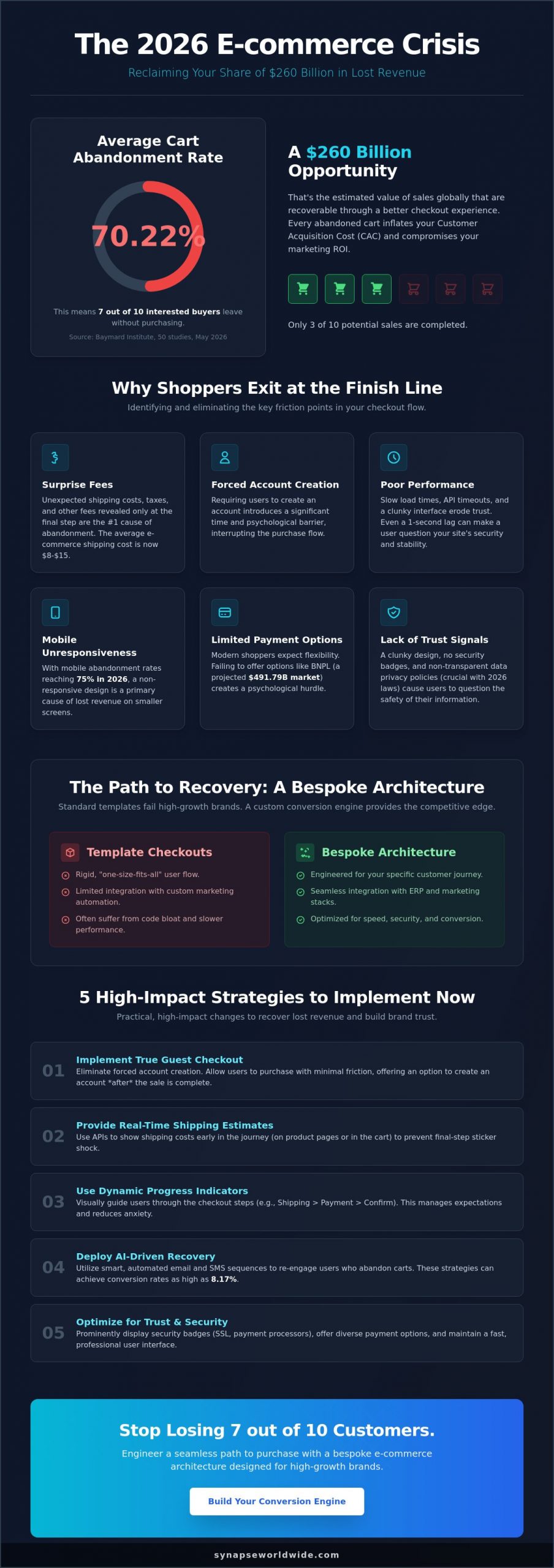
70.22% of your potential revenue is likely evaporating at the final stage of the customer journey, according to the latest data from the Baymard Institute. This means most businesses are losing seven out of every ten interested buyers, making the mandate to reduce cart abandonment the most significant growth lever for 2026. You’ve likely felt the impact of the January 18, 2026, USPS rate increases and rising fuel surcharges, which have turned shipping costs into a major friction point. It’s frustrating to watch high customer acquisition costs go to waste because of a checkout process that lacks the necessary technical performance or trust signals.

We’re here to show you how to reclaim your share of the $260 billion in recoverable global revenue through a streamlined, bespoke e-commerce architecture. You’ll learn how to navigate the complex data privacy laws that took effect in Indiana and Kentucky on January 1, 2026, while implementing AI-driven recovery strategies that deliver an 8.17% conversion rate. This guide provides a strategic roadmap to optimize your digital landscape, integrate robust marketing automation, and secure a higher ROI on your digital marketing spend.

Key Takeaways

  • Identify the specific financial and psychological friction points that cause shoppers to exit your funnel before completing a transaction.
  • Evaluate why standard, cookie-cutter checkout templates often fail high-growth brands and how bespoke architecture provides a competitive edge.
  • Master practical, high-impact strategies to reduce cart abandonment, such as implementing true guest checkout and dynamic progress indicators.
  • Shift your focus from minor technical fixes to building a comprehensive conversion engine that integrates seamlessly with your marketing automation.

The Strategic Impact of Cart Abandonment in 2026

Cart abandonment represents the critical disconnect between a consumer’s desire to purchase and the final payment confirmation. As of May 2026, the average shopping cart abandonment rate remains stagnant at 70.22% according to 50 studies by the Baymard Institute. This suggests that despite technological advancements, many e-commerce platforms still suffer from fundamental architectural flaws. To reduce cart abandonment, you must view it as a symptom of digital friction, which includes any technical or psychological barrier that halts the buyer’s journey.

Every lost transaction inflates your customer acquisition cost (CAC). If you’re driving high-quality traffic through SEO or PPC but failing to convert seven out of ten visitors, your marketing ROI is severely compromised. Recent geopolitical events, such as the closure of the Strait of Hormuz in February 2026, have surged global freight rates and fuel surcharges by up to $4,000 per container. These external pressures make every completed sale more valuable. When you reduce cart abandonment, you’re not just fixing a technical glitch; you’re protecting your business’s bottom line against a volatile global economy.

The Hidden Costs Beyond Lost Revenue

The damage isn’t limited to immediate revenue loss. High abandonment rates lead to inventory locking, where items are held in “ghost” carts and remain unavailable to actual buyers. This creates significant friction in your ERP solutions and inventory management systems. Additionally, skewed analytics from incomplete sessions lead to poor strategic decisions, while a clunky checkout process erodes the brand trust you’ve worked hard to build.

Why 2026 Shoppers Have Zero Tolerance for Friction

Shoppers now demand instant gratification and a seamless, one-click experience. In 2026, mobile abandonment rates have reached 75%, driven by a lower patience threshold for non-responsive designs. Users also have heightened sensitivity toward data privacy. With new comprehensive consumer laws taking effect globally this year, transparency regarding data processing is no longer optional. If your checkout doesn’t communicate security and speed instantly, modern consumers will simply move to a competitor who does.

Identifying Friction Points: Why Shoppers Exit at the Finish Line

Pinpointing why users leave your store requires a granular audit of the technical, financial, and psychological drivers behind their behavior. The most common catalyst for an exit is the “Surprise Fee” trap. Industry reports indicate that the average cost to ship an e-commerce order in 2026 is between $8 and $15. When these costs are hidden until the final step, shoppers feel a breach of trust. To reduce cart abandonment, transparency must begin on the product page. Providing real-time shipping estimates early in the journey prevents the sticker shock that often leads to a discarded cart.

Forced account creation remains a significant barrier to conversion. It’s perceived as a time-consuming obstacle that interrupts the flow of a transaction. Technical performance is equally critical; even a one-second lag during the payment processing stage can make a user question the security of your site. If your platform suffers from API timeouts or slow responsiveness, the customer will likely seek a more stable competitor. If you’re seeing high drop-off rates at the final gate, our team can help you build a bespoke e-commerce strategy to eliminate these bottlenecks.

Technical vs. Psychological Barriers

Technical barriers include mobile unresponsiveness and slow load times, which are fatal in a market where shoppers expect immediate results. Psychological barriers are more nuanced, often involving a lack of trust signals or limited payment flexibility. The global Buy Now, Pay Later (BNPL) market is projected to reach $491.79 billion in 2026. Failing to offer these modern, flexible payment options creates an immediate psychological hurdle. Selecting the right ecommerce payment gateways is a critical architectural decision that directly impacts your ability to convert hesitant visitors. Utilizing custom web design for small business ensures your site projects the professional authority needed to convert hesitant visitors.

The “Comparison Shopping” Dilemma

Many shoppers use the cart as a temporary “wish list” or a tool for price comparison. This behavior is a reality of the modern digital landscape. You must distinguish between “intent to buy” and “intent to research” by offering low-friction entry points. Implementing tactics to reduce cart abandonment, such as guest checkout and persistent carts, allows shoppers to return and complete their purchase when they’re ready. By providing a seamless path back to their saved items, you turn window shoppers into committed customers before they exit your ecosystem.

How to Reduce Cart Abandonment: Strategic Tips for E-commerce Growth in 2026

Architectural Solutions: Custom vs. Template Checkout Frameworks

Many businesses rely on off-the-shelf plugins from platforms like Shopify or WooCommerce to manage their transactions. While these templates offer a quick entry point, they often impose rigid structures that cannot accommodate unique B2B logic or complex shipping requirements. To truly reduce cart abandonment, your checkout architecture must feel invisible to the user. High-growth brands frequently outgrow “cookie-cutter” flows because they lack the granular control required to optimize micro-interactions. A template might look professional, but its underlying code is often shared by thousands of other stores, making it difficult to differentiate your brand through a superior user experience.

Headless commerce has emerged as a critical strategic solution in 2026. By decoupling the frontend presentation layer from the backend commerce logic, you achieve ultra-fast load times that templates simply cannot replicate. Data shows that 57% of shoppers will exit if a page takes three seconds to load. A headless approach ensures your checkout isn’t bogged down by legacy code or unnecessary scripts. This level of ecommerce website development prioritizes architectural stability. It ensures your store remains robust during high-traffic events while allowing for the seamless integration of advanced tactics to reduce cart abandonment that templates often struggle to support.

The Power of Bespoke E-commerce Integration

Bespoke solutions allow you to tailor the checkout flow to match specific buyer journeys. Whether you’re handling bulk B2B orders or high-frequency B2C sales, a custom build enables single-page checkouts that eliminate redundant steps. You can implement custom logic for shipping, taxes, and multi-currency transactions that reflect real-time changes, such as the January 2026 USPS rate increases. This level of integration ensures that the financial transparency discussed earlier is technically supported by your site’s architecture.

Scalability and Technical Debt

Template-heavy sites often accumulate technical debt as transaction volumes increase. “Plugin bloat” is a primary cause of slow performance, particularly for mobile users who already face a 73% to 75% abandonment rate. Custom builds eliminate this bloat by including only the necessary features for your specific business model. By investing in a scalable, integrated digital landscape, you ensure that your backend infrastructure can handle the projected growth of modern payment trends like Buy Now, Pay Later, which is expected to reach $491.79 billion this year. Professional execution at the architectural level is the only way to safeguard your long-term ROI.

5 High-Impact Tips to Reduce Cart Abandonment and Recover Revenue

Tactical execution is what ultimately secures the transaction once your architecture is in place. In the 2026 digital landscape, businesses must move beyond basic fixes and implement sophisticated, data-driven interventions. To effectively reduce cart abandonment, you must address the specific friction points where shoppers hesitate. Implementing the following five strategies will help you reclaim revenue and optimize your store’s performance.

  • Implement “True” Guest Checkout: Don’t force account creation during the transaction. Use background account creation that captures user data without adding extra steps to the flow.
  • Use Dynamic Progress Indicators: Visual cues reduce checkout anxiety by showing the user exactly how close they are to the finish line. Transparency in the process keeps the buyer engaged.
  • Deploy AI-Driven Exit Intent: Standard pop-ups are ignored. Use AI-powered triggers that offer personalised value propositions based on the items in the cart. AI recovery tools currently deliver an 8.17% conversion rate.
  • Integrate Real-Time Calculators: With global fuel surcharges and freight rates fluctuating, providing instant calculations on the product page prevents “sticker shock” at the final step.
  • Optimise for “One-Tap” Mobile Payments: Since mobile users face higher friction, integrating Apple Pay, Google Pay, and modern digital wallets is mandatory for a seamless experience.

Ready to stop the revenue leak? You can audit your checkout performance with our strategic consulting team to identify your specific growth opportunities.

Advanced Recovery through Marketing Automation

Recovery doesn’t end when a user leaves your site. Modern marketing automation allows you to reach customers through SMS and push notifications, which often see higher engagement than traditional email. By leveraging your CRM data, you can offer bespoke incentives to high-value shoppers who abandoned large carts. This integrated approach ensures that your PPC management services are supported by a robust retargeting strategy. Re-engaging lost visitors with specific, relevant messaging is a proven way to reduce cart abandonment over the long term.

Optimising Payment Versatility

Payment flexibility is a requirement for modern commerce. While you’ve already seen the massive growth projections for Buy Now, Pay Later (BNPL), the key is in the implementation. If you don’t offer BNPL or localised payment methods for international shoppers, you’re creating an unnecessary barrier to entry. Maintaining strict PCI compliance is essential for trust, but it shouldn’t come at the cost of a clunky user interface. Understanding how different ecommerce payment gateways handle currency conversion fees, fraud protection, and PCI compliance is essential for building a checkout that balances security and speed. A strategic digital architect ensures that security and speed coexist, providing a stable environment that encourages shoppers to complete their purchase with confidence.

Bespoke E-commerce Development: Engineering a Seamless Path to Purchase

Successful brands in 2026 recognize that a shopping cart is not an isolated feature; it’s the culmination of a complex digital ecosystem. To effectively reduce cart abandonment, you must shift your perspective from simply fixing a broken checkout to engineering a high-performance conversion engine. Synapse Worldwide approaches e-commerce development as a strategic digital architecture, ensuring every technical decision supports long-term business goals. By conducting deep, data-driven audits, we identify the exact micro-moments where your customers exit, allowing for surgical optimizations that off-the-shelf templates cannot provide. A comprehensive approach to ecommerce conversion rate optimization ensures that every element of your store, from product pages to payment confirmation, is engineered to maximize revenue from the traffic you’ve already earned.

Custom development offers a permanent solution to the recurring issues of technical debt and plugin bloat. While a standard store might struggle with the 73% to 75% mobile abandonment rates seen this year, a bespoke build is optimized for the specific hardware and browsing habits of your target audience. This architectural precision ensures that your site remains stable during high-traffic periods, maintaining the trust required to capture your share of the $260 billion in recoverable global revenue. Investing in a tailored solution is the most reliable way to secure a scalable future for your digital presence.

Integrated Systems for Maximum Efficiency

A seamless path to purchase requires more than just a fast frontend. True efficiency comes from connecting your e-commerce platform directly to your CRM and ERP systems. This integration provides a unified view of your inventory, customer history, and shipping logistics, which is vital given that last-mile delivery now accounts for 53% of total shipping costs. Automation reduces the risk of manual errors and ensures that the post-purchase experience is as smooth as the checkout itself. Bespoke integration is the bridge between sales and operations.

Partnering for Strategic Growth

High-stakes e-commerce transformation requires the expertise of a professional agency that understands both high-level strategy and technical execution. At Synapse Worldwide, our commitment to ROI means we don’t just build websites; we build growth engines. We ensure that your digital landscape is robust, secure, and ready to adapt to the evolving demands of the 2026 market. If you’re ready to reduce cart abandonment and reach the next level of business success, it’s time to move beyond cookie-cutter solutions.

Contact Synapse Worldwide to engineer your high-conversion e-commerce platform and reclaim your lost revenue today.

Engineering Your Conversion Engine for 2026

Reclaiming the 70.22% of revenue lost at checkout requires more than surface-level tweaks. It demands a fundamental shift toward bespoke architecture and seamless system integration. By identifying technical bottlenecks and removing psychological barriers, you position your brand to capture a significant portion of the $260 billion in recoverable global revenue. The goal is to move beyond the limitations of cookie-cutter templates and build a robust, scalable digital landscape that prioritizes the user’s journey.

Synapse Worldwide has been a leader in digital strategy since 2005. With 20 years of expertise, we specialize in creating bespoke e-commerce solutions that integrate perfectly with your CRM and ERP systems. Our role as your Digital Architect is to ensure every technical detail serves your long-term ROI. To reduce cart abandonment and reach the next level of business success, you need a partner who understands the intricate details of high-stakes commerce.

Partner with Synapse Worldwide to transform your e-commerce conversion rates

Your growth potential is waiting; let’s build the engine to unlock it.

Frequently Asked Questions

What is the average cart abandonment rate in 2026?

The average e-commerce cart abandonment rate for 2026 stands at 70.22%, according to ongoing research by the Baymard Institute. This figure reflects a broader trend where desktop users abandon at 65% to 68%, while mobile users see higher rates of 73% to 75%. These benchmarks highlight the consistent gap between consumer intent and final transaction completion across the global digital landscape.

How can I identify why my customers are abandoning their carts?

You can identify specific friction points by performing a comprehensive data audit of your checkout funnel. Tools like heatmaps and session recordings reveal where users hesitate, while Google Analytics 4 provides precise drop-off percentages at each step. This evidence-based approach allows you to distinguish between technical failures, such as slow API responses, and psychological barriers like unexpected shipping fees or a lack of trust.

Does a slow website really cause cart abandonment?

Speed is a critical conversion factor; 57% of shoppers will abandon their session if a page takes longer than three seconds to load. Even a one-second delay can reduce customer satisfaction and trust, particularly during the payment processing phase. High-performance architecture is required to maintain the momentum of the buyer’s journey and effectively reduce cart abandonment across all devices.

Should I offer guest checkout to reduce abandonment?

Offering a guest checkout option is one of the most effective ways to lower the barrier to entry for new customers. Research consistently shows that forced account creation is a primary driver for exit, as users prioritize speed over long-term relationship building. You can still capture essential data for your CRM through background account creation once the transaction is finalized, ensuring a seamless user experience.

Can marketing automation help recover abandoned carts?

Marketing automation is a powerful tool for reclaiming revenue that would otherwise be lost. AI-powered recovery sequences currently achieve an 8.17% conversion rate, which is double the performance of standard template emails. By integrating your store with a robust CRM, you can send personalized SMS or email reminders that address the specific items left behind, encouraging the user to return and complete their purchase.

Is custom web design better than templates for reducing abandonment?

Bespoke web design is superior to templates because it eliminates the technical debt and “plugin bloat” that often slow down standard sites. Custom builds allow you to engineer a frictionless, single-page checkout tailored to your specific business logic and buyer personas. This architectural precision is essential for high-growth brands that need to scale without sacrificing performance or the stability of their digital landscape.

What payment methods should I offer to improve conversion rates?

You should offer a mix of traditional credit card processing and modern digital wallets like Apple Pay and Google Pay to cater to mobile shoppers. Including Buy Now, Pay Later (BNPL) options is also crucial, as this market is projected to reach $491.79 billion in 2026. Providing diverse, localized payment methods ensures that customers don’t exit due to a lack of their preferred financial tools.

How does mobile optimization affect cart abandonment?

Mobile optimization is no longer optional; mobile users face a significantly higher abandonment rate of 73% to 75% compared to desktop. Small screens and touch interfaces require a streamlined UI that minimizes typing and simplifies navigation. If your mobile checkout isn’t perfectly responsive, you’re likely losing a majority of your potential revenue to competitors with better reduce cart abandonment strategies and faster load times.