

Tag Archives: AI in SEO


How to Justify SEO Investment to Management: The 2026 Executive Framework

How to Justify SEO Investment to Management: The 2026 Executive Framework

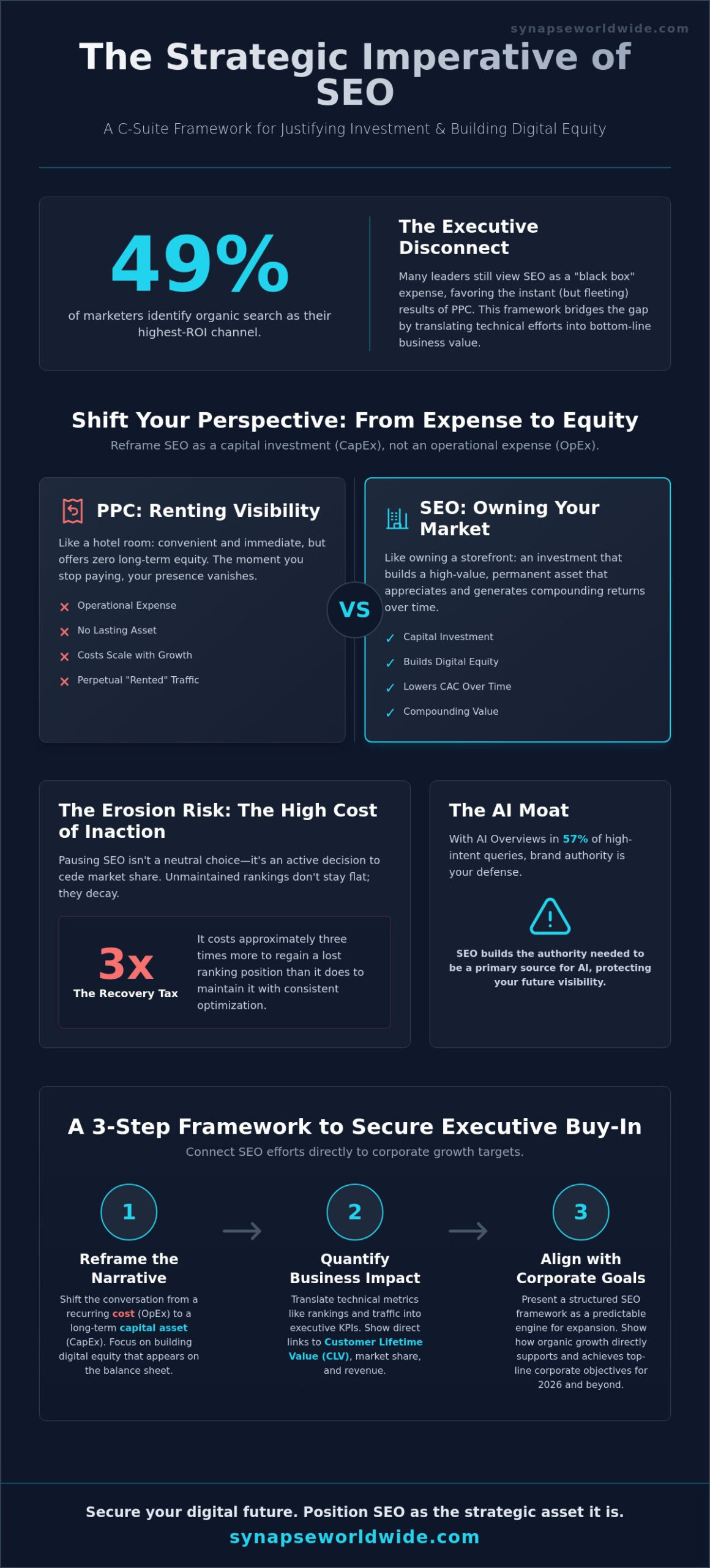
49% of marketers identify organic search as their highest-ROI channel, yet many struggle with justifying seo investment to management when PPC offers the allure of instant results. You’ve likely felt the frustration of watching a high-performing strategy get sidelined because leadership views organic growth as a black box expense rather than a strategic asset. In a landscape where Google’s AI Overviews now appear in 57% of high-intent queries, staying stagnant isn’t just a missed opportunity; it’s a direct risk to your brand’s future visibility and market share.

We understand that securing a budget requires a shift in vocabulary from technical metrics to corporate growth goals. This article provides a clear framework to master the strategic language and data-backed models needed to secure executive buy-in. You’ll learn how to position SEO as a compounding capital asset that builds a defensive moat against AI-driven market shifts. We’ll break down the specific frameworks that connect organic visibility directly to bottom-line revenue, ensuring your digital strategy aligns perfectly with executive expectations for 2026 and beyond.

Key Takeaways

  • Reframe SEO as a strategic digital asset rather than a recurring cost. You’ll build long-term equity instead of perpetually renting visibility through paid channels.
  • Quantify the cost of doing nothing by modeling the decay of organic rankings. This helps you illustrate how competitors capture your market share during periods of stagnation.
  • Master the art of justifying seo investment to management by translating technical metrics into executive-level KPIs like Customer Lifetime Value.
  • Establish a defensive moat using brand authority. It’s a critical strategy to ensure your business remains a primary source for AI-generated answers.
  • Use a structured framework to align search goals with corporate growth targets. This approach transforms SEO into a predictable engine for expansion.

Redefining SEO as a Strategic Capital Investment

Management often views digital marketing through the lens of monthly expenditures. That perspective is outdated. In 2026, search visibility is digital equity. It isn’t a bill you pay to exist online; it’s a building you construct to dominate your market. Justifying seo investment to management begins by shifting the narrative from “spending” to “asset building.” You aren’t just buying clicks; you’re developing a high-value property in the digital world.

Think of Pay Per Click (PPC) as a hotel room. It’s convenient, immediate, and effective for a short stay. But the moment you stop paying the daily rate, you’re out on the street with zero equity. SEO is the permanent storefront. It’s the difference between renting a temporary billboard and owning the land under your feet. A visionary architect understands that a brand’s digital presence requires a structural foundation that isn’t dependent on a third party’s daily auction price. This is especially true when integrating search optimization into custom web design or e-commerce development from the ground up.

The Shift from OpEx to CapEx Thinking

CFOs prioritize assets that provide long-term value. When you present SEO as a simple operational expense (OpEx), it’s often the first item cut during a budget squeeze. Instead, frame it as a capital investment (CapEx). For those seeking a comprehensive overview of SEO, the core principles of technical health and site authority demonstrate that search optimization is a structural component of your business. Owning your market share through organic rankings provides a level of stability that “rented” traffic can’t match. It’s about building unearned media value that lives on your balance sheet for years.

The Compounding Yield of Organic Search

Organic growth scales without a proportional increase in cost. This is the SEO Flywheel effect. Early efforts in technical health and high-quality content create a baseline of authority. That authority then makes it easier to rank for new, competitive keywords without needing to double your budget. Unlike paid ads where every click has a fixed price, the cost per visit in organic search trends toward zero as your authority compounds. SEO is a strategic asset that lowers customer acquisition costs over time. While marketing budgets remain flat at roughly 7.8% of company revenue in 2026, the compounding nature of organic search allows you to achieve exponential growth while your competitors are stuck paying for every single lead.

The Erosion Risk: Assessing the Hidden Costs of SEO Stagnation

Choosing to pause your search strategy isn’t a neutral decision. It’s an active choice to lose market share. In the digital economy of 2026, unmaintained rankings don’t just sit still; they decay as search algorithms evolve. With the May 21, 2026 core update prioritizing real-time expertise and trustworthiness, stagnant content quickly becomes a liability. When justifying seo investment to management, you must highlight that the cost of inaction is often higher than the cost of the campaign itself.

Competitive displacement is the most immediate risk. Your rivals aren’t waiting for you to catch up. When your brand drops from the first page, a competitor captures that visibility, that traffic, and that customer’s trust. This creates a “Recovery Tax.” Industry data suggests it costs approximately three times more to regain a lost ranking position than it does to maintain it through consistent optimization. You can learn more about what to expect from your SEO investment by looking at how long-term consistency beats sporadic bursts of activity.

Quantifying Market Share Vulnerability

Market share is a zero-sum game in search results. Every click your competitor gains is one you’ve lost. This erosion directly impacts brand authority. When potential clients can’t find you for high-intent queries, they perceive your brand as less relevant or successful. For organizations focusing on SEO for small business, this defensive posture is essential for survival. Constant movement is required just to stay in the same place as search engines refine how they evaluate E-E-A-T signals.

The Opportunity Cost of Silence

The revenue lost during the “discovery” phase is often invisible on a balance sheet but devastating to growth. If your brand is absent when a user asks an AI agent for a recommendation, you’ve lost the sale before it even began. As of January 2026, ChatGPT holds a 60.7% share of the AI search market. Stagnation makes your site invisible to these platforms. This silence also degrades the performance of your Pay Per Click (PPC) Management and social media efforts, as organic trust often validates paid interactions. Neglected site health creates technical debt that eventually breaks the user experience, leading to lower conversion rates across all channels. Maintaining a robust organic presence ensures your Search Engine Optimization strategy supports every other touchpoint in the customer journey.
How to Justify SEO Investment to Management: The 2026 Executive Framework

Quantifying Return: Moving from Technical Metrics to Business Outcomes

Executives rarely find value in reports filled with keyword rankings or technical crawl errors. To succeed in justifying seo investment to management, you must translate these technical indicators into the language of the boardroom: market share and Customer Lifetime Value (LTV). While 49% of marketers report that organic search provides the highest ROI of any channel, that return is only visible when you connect search data to the bottom line. By shifting the focus to Customer Acquisition Cost (CAC), you position SEO as a primary driver of marketing efficiency.

High-performance custom web design serves as the essential prerequisite for this ROI. Without a strategic digital foundation, even the best traffic fails to convert. SEO influences the entire sales funnel, capturing users during the initial awareness phase and guiding them through to transactional intent. In the B2B SaaS sector, for instance, companies see an average SEO ROI of 702%, with a break-even point occurring around the seven-month mark. This level of performance turns your website into a high-yield asset rather than a static brochure.

SEO vs. PPC: A Balanced Portfolio Approach

A healthy digital strategy requires a balance between short-term wins and long-term sustainability. While Pay Per Click (PPC) Management offers immediate visibility, it also carries a linear cost that never decreases. SEO acts as a strategic safety net, protecting your lead flow when ad auctions become prohibitively expensive. The synergy between these channels is undeniable. Data shows that appearing in both organic and paid results for the same query can increase total click-through rates by up to 30%.

  • PPC Management: High immediate cost, results stop when spending ends, linear ROI.
  • Search Engine Optimization: Upfront investment, compounding long-term value, declining CAC over time.

The CFO Dashboard: Metrics That Actually Matter

Move beyond vanity metrics by focusing on organic lead quality and conversion value. One of the most persuasive figures for a CFO is the “Media Value Equivalent.” This calculation shows exactly what your organic traffic would cost if you had to purchase it through Google Ads. By demonstrating that your organic presence generates the equivalent of tens of thousands of dollars in “free” media every month, the value proposition becomes undeniable. Strategic SEO investment improves the overall valuation of a digital enterprise by building a predictable, low-cost engine for customer acquisition that remains on the balance sheet as a permanent asset.

Strategic Defensive Value: SEO as a Moat Against AI-Driven Market Shifts

The search landscape of 2026 has transformed into an era of AI agents and conversational interfaces. Google’s AI Overviews now appear in 57% of high-intent, long-tail queries, fundamentally changing how users interact with information. While some view this as a threat to traditional traffic, it actually serves as a powerful tool for justifying seo investment to management. In this environment, SEO isn’t just about driving clicks; it’s about building a defensive moat that ensures your brand is the primary source cited by AI engines.

AI platforms like ChatGPT, which holds a 60.7% share of the AI search market as of January 2026, rely on authoritative data to generate answers. If your brand isn’t optimized to be a trusted entity, you risk becoming invisible to the 15-20% of users who now prefer AI platforms for informational queries. Positioning SEO as an insurance policy protects your organization against platform volatility. It ensures that when an AI agent answers a customer’s question, your proprietary data and unique insights are the foundation of that response.

Establishing Authority in the Age of SGE

Modern search architecture has shifted away from simple keyword matching toward entity authority. To be a highly cited source in Search Generative Experience (SGE) or AI Overviews, you need a foundation of E-E-A-T that only consistent SEO can provide. Brands cited in an AI Overview see a 35% higher organic CTR than non-cited competitors on the same page. This is a critical pillar of any high-level digital marketing strategy. It moves your brand from being a participant in search to being the preferred authority that AI engines respect and reference.

Future-Proofing the Customer Journey

Zero-click searches account for 64.82% of all Google queries in 2026. This reality requires a resilient digital presence that survives beyond the traditional blue link. Technical SEO now includes making your site data perfectly readable for AI crawlers, preventing LLMs from hallucinating your brand’s facts or pricing. By creating data-rich, custom content that AI cannot easily replicate, you provide the unique value that search agents prioritize. This technical health ensures your infrastructure is ready for the next generation of searchers who use voice and conversational agents to make purchasing decisions.

Don’t leave your brand’s visibility to chance in an AI-driven market. Secure your competitive advantage with professional Search Engine Optimization that builds lasting digital equity.

Presenting the Case: A Three-Step Framework for C-Suite Buy-In

Convincing an executive team requires a fundamental shift in presentation style. You aren’t just asking for a budget; you’re proposing a strategic initiative that secures the company’s future visibility. To succeed in justifying seo investment to management, you must move beyond the technical “how” and focus entirely on the commercial “why.” This three-step framework provides the literal script needed to transform search data into a compelling business case.

Step 1: Align with Corporate KPIs. Start by connecting search goals directly to the metrics your C-suite cares about, such as total revenue growth, market share expansion, and operational efficiency. If the company’s goal is a 15% increase in market share, demonstrate how capturing specific high-intent search clusters facilitates that growth. Step 2: Present the Investment vs. Inaction Model. Use data to highlight the risk of standing still. Based on current trends, where marketing budgets average 7.8% of revenue, show the “Recovery Tax” discussed earlier. Contrast the compounding value of a digital asset against the escalating costs of purely paid acquisition. Step 3: Define the Execution Roadmap. Transparency is the currency of leadership. Present a clear timeline with specific milestones and reporting intervals to eliminate the perception of SEO as a “black box” expense.

Bridging the Communication Gap

Language matters in the boardroom. High-level executives don’t need to hear about “backlinks” or “canonical tags.” Instead, use terms that resonate with their professional experience. Replace “backlinks” with “industry endorsements” and “technical audits” with “infrastructure optimization.” It’s also vital to set realistic expectations for the “momentum phase.” SEO doesn’t happen overnight; it’s a building process. Use case studies to show the transformation of a brand from an invisible participant to a recognized industry leader, emphasizing that the most significant gains occur after the initial foundation is set.

The Execution Roadmap

Reducing perceived financial risk is the fastest way to get a “yes.” A structured approach often begins with a “Fixed-Price” discovery phase. This allows management to see the depth of the strategy and the quality of the technical health check before committing to a long-term partnership. Once the foundation is laid, ongoing retainers ensure your digital moat remains impenetrable to competitors who are likely already targeting your visibility. This consistent effort is what transforms your search presence into a permanent, high-yield asset.

Ready to secure your brand’s future in the 2026 search landscape? Partner with Synapse Worldwide to build your strategic SEO architecture and turn organic search into your most reliable growth engine.

Securing Your Digital Legacy

Transitioning from a tactical mindset to a strategic one is the first step toward long-term digital dominance. You now have the framework to reframe search visibility as a high-yield capital asset rather than a recurring expense. By focusing on compounding returns and establishing an authoritative moat, you protect your market share against the inevitable shifts of an AI-driven economy.

Success in 2026 demands a sophisticated digital infrastructure that integrates with your core business operations. Synapse Worldwide has led this space since 2005, focusing on high-value digital architecture for Australian enterprise growth. Our expertise in custom software and ERP integrations ensures your SEO performance is built on a foundation of technical excellence. Mastering the narrative for justifying seo investment to management is the final piece of the puzzle. It allows you to secure the resources needed to scale effectively.

Secure your market share with a strategic SEO framework from Synapse Worldwide. Your digital presence is your most valuable asset. We’re ready to help you reach the next level of business success and transform your vision into a measurable competitive advantage.

Frequently Asked Questions

How long does it typically take to see a return on SEO investment in 2026?

Measurable momentum usually begins within four to six months of a campaign launch. However, a full positive return on investment often occurs between the six and twelve month marks. This timeline allows for the structural indexing of new digital infrastructure and the accumulation of authority signals that search engines require to rank your brand for competitive, high-intent queries.

Why should we invest in SEO when we are already running successful Google Ads?

Relying exclusively on paid channels creates a linear cost structure where your lead flow stops the moment your budget ends. Search optimization builds a permanent asset that generates traffic without a per-click fee, effectively lowering your overall customer acquisition cost over time. The synergy between the two is powerful, as appearing in both organic and paid results simultaneously can increase total click-through rates by up to 30%.

How does AI search change the way we should justify our SEO budget?

AI search shifts the focus from simple traffic volume to “Citation Share” and brand authority. Since AI engines like ChatGPT and Google’s AI Overviews prioritize highly authoritative sources, your budget is now a defensive investment to ensure your brand is the primary source for conversational answers. In an era where 64.82% of searches end without a click, being the cited authority is the only way to maintain visibility.

What is the most important metric to show a CFO when discussing SEO?

The “Media Value Equivalent” is the most persuasive metric for financial leadership. It translates organic visibility into a dollar figure by showing exactly what that same traffic would cost if purchased through a paid auction. Demonstrating that your organic strategy provides the equivalent of a massive monthly ad spend for a fixed investment helps in justifying seo investment to management as a high-yield capital asset.

Can we stop SEO investment once we reach the number one spot?

Stopping at the top is a high-risk decision that leads to inevitable market share decay. Your competitors are constantly optimizing to displace you, and the “Recovery Tax” makes it three times more expensive to regain a lost ranking than to maintain one. Continuous investment ensures your technical health stays current with algorithm updates and keeps your digital moat impenetrable to rivals.

How do we calculate the ROI of an SEO campaign accurately?

Accurate calculation requires integrating your search data with CRM and ERP solutions to track a lead from the initial organic click to the final sale. By assigning a precise dollar value to these conversions and comparing it against your total campaign spend, you can determine the exact yield of your digital equity. This data-driven approach moves the conversation away from vanity metrics and toward bottom-line growth.

What happens to our organic traffic if we cut the SEO budget for six months?

Cutting the budget triggers a gradual erosion of visibility as your content becomes stagnant and technical debt accumulates. Search algorithms prioritize sites that demonstrate consistent expertise and authority, so a six-month silence allows aggressive competitors to capture your rankings. Rebuilding that lost momentum later will require a significantly larger investment than the cost of maintaining your current position.

Is SEO still relevant for B2B enterprises with long sales cycles?

SEO is essential for B2B enterprises because it captures prospects during the critical research phase of a long sales cycle. Establishing authority through organic search builds trust long before a formal inquiry is made. This makes the strategy a vital part of justifying seo investment to management, as it ensures your brand is the first one considered when a prospect is ready to move from education to a purchase decision.

 

SEO Services in 2026: A Strategic Guide to National Digital Growth

SEO Services in 2026: A Strategic Guide to National Digital Growth

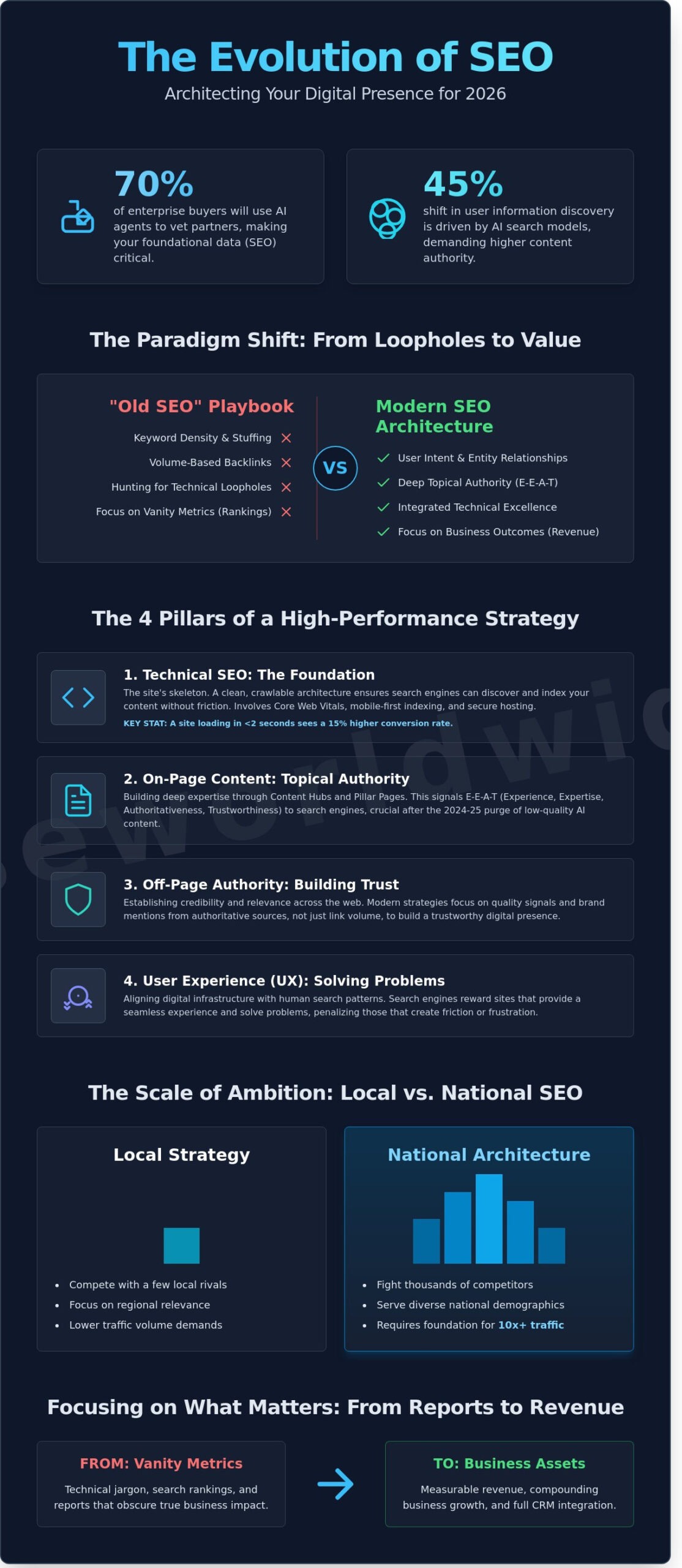
By 2026, the traditional search engine results page will no longer be a simple destination; it will act as the foundational data source for AI agents that 70% of enterprise buyers now use to vet potential partners. You’ve likely experienced the frustration of watching organic traffic plateau despite consistent investment in seo services, or perhaps you’re tired of receiving reports that prioritize technical jargon over actual business outcomes. It’s a common disconnect that prevents many brands from scaling their national footprint effectively.

This article demonstrates how modern search strategies must move beyond keyword density to build a bespoke, high-performance digital presence that fuels measurable revenue. We’ll provide a clear roadmap for integrating your visibility with existing CRM infrastructure to ensure every click translates into a business asset. You’ll discover the specific architectural shifts required to maintain a dominant position in an increasingly automated digital landscape, ensuring your growth remains both sustainable and sophisticated.

Key Takeaways

  • Understand the evolution from simple keyword matching to a sophisticated focus on user intent and entity relationships in the 2026 digital landscape.
  • Learn how to integrate technical excellence, high-value content, and user experience into a robust framework that supports national scaling.
  • Discover why professional seo services must prioritize long-term revenue and compounding business growth over vanity metrics like search rankings.
  • Identify the critical red flags of low-cost, automated providers and the essential benchmarks for selecting a transparent, strategic digital partner.
  • Explore how a bespoke, architectural approach to digital strategy transforms your online presence into a high-performance asset for sustainable success.

What Are SEO Services and Why Are They Essential in 2026?

SEO services represent a bespoke suite of strategic optimisations designed to elevate a brand’s visibility within search engine results pages (SERPs). While the foundational question of What is Search Engine Optimization? remains rooted in the pursuit of organic traffic, the execution has transformed into a high-level digital consultancy. By 2026, seo services have moved beyond simple keyword placement to focus on entity relationships and complex user intent. We don’t just target words; we target the solutions your customers are seeking.

In the 2026 digital environment, where AI-driven search models account for a 45% shift in how users discover information, content authority is non-negotiable. Following the major algorithm shifts of 2024 and 2025, which eliminated over 40% of low-quality AI-generated content, search engines now demand rigorous E-E-A-T (Experience, Expertise, Authoritativeness, and Trustworthiness). It’s a landscape where only the most robust digital presences survive. We position SEO as a long-term business asset that builds compounding equity, rather than a one-off marketing expense that disappears when the budget stops.

How has search engine optimisation evolved for modern businesses?

The distinction between “Old SEO” and “Modern SEO” is stark. Previous strategies relied on volume-based metrics like backlink counts and keyword density. Modern SEO prioritises user experience (UX), technical performance, and deep topical authority. Search engines now penalise brands that hunt for technical loopholes; they reward those that solve human problems through seamless digital experiences. Modern SEO is the alignment of digital infrastructure with human search patterns.

Why is a national SEO strategy different from local tactics?

Scaling a brand to a national level requires a level of sophistication that local tactics cannot provide. You’re no longer competing with a few local rivals; you’re fighting for market share against thousands of competitors across diverse demographics. This shift demands a scalable content architecture and a technical foundation capable of supporting 10x more traffic than a regional site. Success requires a partner who understands the broader national competitive landscape and can implement a seo services framework that maintains performance across every postcode. Our approach ensures your brand’s digital architecture is both resilient and ready for national dominance.

The Core Pillars of a Professional SEO Service Strategy

To dominate a national market, your digital presence requires more than just keywords. It demands a robust architecture. High-performance seo services in 2026 rely on four non-negotiable pillars: Technical SEO, On-Page Content, Off-Page Authority, and User Experience. If one pillar fails, the entire structure collapses. A 2024 analysis by BrightEdge revealed that 68% of all online experiences begin with a search engine. This makes a balanced foundation critical. Understanding What is Search Engine Optimization involves recognizing that modern algorithms prioritize sites where technical precision meets user intent.

We move beyond basic checklists toward “Integrated SEO.” This approach ensures marketing and development teams work in tandem rather than in silos. Data-driven audits serve as the first step, identifying structural weaknesses like a 40% crawl budget waste or broken internal linking structures. These aren’t just minor errors; they’re direct barriers to your revenue growth. When development follows a strategic SEO roadmap, the result is a scalable digital asset that grows with your business.

What is Technical SEO and why is it the foundation?

Technical SEO serves as the site’s skeleton. It encompasses site architecture, Core Web Vitals, and mobile-first indexing. We prioritize custom web development to provide a clean, crawlable code base. Bloated templates often hide legacy code that slows down performance and confuses search bots. Secure hosting and 99.9% uptime are essential for maintaining search rankings. A site loading in under 2 seconds captures a 15% higher conversion rate than slower national competitors. It’s about ensuring search engines can discover, crawl, and index your pages without friction.

How does bespoke content drive topical authority?

Cookie-cutter content fails to rank in competitive national markets. We build topical authority through Content Hubs and Pillar Pages. This structure signals deep expertise to search engines by grouping related topics around a central theme. Instead of generic blog posts, we produce high-value assets that answer complex user queries. Data from 2025 indicates that long-form, authoritative content earns 77.2% more backlinks than short-form pieces. Our bespoke digital strategies ensure your content functions as a strategic asset, driving both rankings and trust. In a landscape crowded with AI-generated filler, original research and expert insights are the only ways to maintain a competitive edge.

SEO Services in 2026: A Strategic Guide to National Digital Growth

Strategic Business Outcomes: What to Expect from SEO Services

Modern performance marketing has evolved beyond simple keyword rankings. For 2026, the benchmark for successful seo services is the tangible impact on a firm’s bottom line. While visibility matters, revenue growth and market share are the primary metrics that define our strategic partnerships. Unlike the linear costs associated with PPC, where traffic ceases the moment the budget is exhausted, organic search creates a compounding growth engine. By the end of a typical 12-month cycle, a robust strategy often delivers a 35% reduction in customer acquisition costs while simultaneously building brand authority.

By 2026, building digital dominance requires patience and a commitment to quality. Most enterprise-level sites observe initial performance shifts within 90 days, but full strategic maturity typically occurs between months 8 and 14. This timeline ensures that your brand builds a foundation of trust that outlasts seasonal trends. It’s a foundational shift from “buying” an audience to “owning” a market position.

How does SEO improve lead quality and conversion rates?

Revenue growth stems from the synergy between high-intent traffic and seamless user experiences. We integrate Conversion Rate Optimisation (CRO) directly into our search strategy to ensure that every visitor has a clear path to purchase. By targeting “ready-to-buy” intent, businesses often see a 22% increase in lead quality compared to broad-match social campaigns. Integrating these insights into your CRM allows for precise tracking of the lead-to-sale journey. Following a comprehensive Guide To SEO Success ensures your content addresses the specific pain points of your target demographic, resulting in higher retention and lower bounce rates.

What is the long-term ROI of an organic search strategy?

Over a 24-month horizon, the financial advantage of organic search becomes undeniable. While paid advertising maintains a constant cost-per-acquisition (CPA), the effective cost per lead for seo services typically drops by 60% after the first year as the site gains digital equity. This equity functions as a corporate asset that continues to generate value even during periods of reduced active spend. Maintaining this momentum requires consistent technical refinement to protect your market position against aggressive competitors. Data from 2025 indicates that brands investing in ongoing maintenance retain 85% more of their peak traffic than those who adopt a “set and forget” mentality.

How to Evaluate and Choose an SEO Service Provider

Choosing a partner for seo services requires a shift from viewing marketing as an expense to seeing it as a technical investment. Low-cost providers often rely on automated link-building schemes that triggered a 40% increase in manual penalties during the late 2024 Google core updates. You should avoid agencies offering fixed price packages; national brands operate in complex environments where a one-size-fits-all approach fails. A bespoke strategy ensures that every optimization aligns with your specific market share goals. Transparency is the only way to measure this alignment. A reliable agency provides real-time dashboards rather than static monthly PDFs, ensuring you see the direct correlation between technical tweaks and revenue growth.

Identifying red flags early saves your brand from long-term reputational damage. If an agency promises “guaranteed rankings” within 30 days, they’re likely using high-risk tactics that Google’s 2025 AI-spam filters now catch with 99% accuracy. True growth comes from an agency that understands how marketing goals influence technical development. Your SEO partner should speak the language of your developers as fluently as they speak the language of your board of directors. This intersection of skills is what separates a vendor from a strategic consultant. For businesses operating in the Australian Capital Territory, understanding how to identify a results-driven marketing agency Canberra executives can trust is an essential first step toward building this kind of high-performance partnership. Organisations seeking to future-proof their digital presence should also explore how a dedicated SEO Canberra strategy built for AI-ready architecture can transition traditional search investments into compounding long-term assets.

What questions should you ask a potential SEO partner?

Direct questions reveal an agency’s depth. Ask how they manage custom API integrations or handle technical audits for sites with over 10,000 pages. Expert-led content strategy is the standard for 2026. If an agency cannot show how they scaled a client’s organic traffic by at least 150% over an 18-month period, they likely lack the experience for national competition. Request specific examples of how they’ve handled migrations for enterprise-level platforms or managed content for high-authority domains.

Why is technical consulting a critical part of the SEO process?

Digital architecture dictates performance. SEO isn’t an afterthought; it’s a foundational requirement during the initial site build. Integrating seo services with your ERP or CRM systems allows for holistic data tracking that drives ROI. When your strategy is integrated into the site’s initial build, you eliminate the 25% performance lag often seen in “bolted-on” solutions. A robust proposal should include:

  • System architecture audits for crawl efficiency.
  • Schema markup strategies for AI-driven search results.
  • ERP and CRM alignment for accurate lead attribution.
  • Core Web Vitals benchmarks exceeding 95 on mobile performance scales.

Every technical decision must serve the broader business objective. Aligning your digital presence with internal systems like Salesforce or SAP isn’t just a luxury; it’s a necessity for accurate attribution and scalable growth.

Build your national digital strategy with an agency that understands the intersection of code and commerce.

Scaling Your Digital Presence with Synapse Worldwide

Synapse Worldwide serves as the Digital Architect for businesses aiming for national dominance. Since 2005, we’ve spent nearly 20 years refining a methodology that delivers high-value, custom digital solutions. We don’t just provide marketing; we build the technical foundations required for long-term growth. Having SEO, PPC, and custom development expertise under one roof creates a distinct strategic advantage. It ensures your brand message remains consistent while your technical infrastructure stays robust. It’s time to move beyond surviving and start dominating your digital landscape.

How does our bespoke approach differ from standard agencies?

Most agencies offer one-size-fits-all packages. We reject that model. Our engagement starts with a deep discovery phase where we align your specific 12-month business objectives with precise technical requirements. We focus on integrated solutions, linking your seo services to sophisticated CRM platforms and marketing automation tools. This creates a unified ecosystem where data flows seamlessly between departments. Our ongoing maintenance and optimization retainers ensure your site remains stable and secure; this prevents the technical debt that often slows down scaling enterprises.

Ready to take your business to the next level?

The path from identifying a market gap to executing a national strategy is complex. We simplify this journey by acting as a high-level strategic consultant and a hands-on execution partner. Our commitment to client ROI is absolute. Since our inception, we’ve helped hundreds of organizations transition from stagnant growth to digital leadership through disciplined, data-driven strategies. We provide the professional, authoritative guidance needed to transform your digital presence into a revenue engine. If you’re looking for a partner to secure your future, Partner with Synapse Worldwide for strategic seo services.

Master Your National Digital Dominance

The digital landscape of 2026 demands a shift from reactive tactics to a proactive, architectural approach. Success now hinges on integrating deep technical optimization with enterprise-level web applications that convert traffic into measurable revenue. We’ve moved beyond simple rankings; today’s growth requires a robust strategy that aligns with complex search algorithms and user intent. It’s no longer enough to just exist online; you’ve got to lead with authority and precision.

Since 2005, Synapse Worldwide has delivered these high-level results by blending two decades of digital expertise with a focus on long-term business ROI. Our team specializes in custom web applications and enterprise-level integrations that ensure your infrastructure is as scalable as your ambitions. We’ve spent 20 years refining a methodology that prioritizes stability and strategic dominance for national brands. This isn’t just about visibility; it’s about building a bespoke digital foundation that outpaces every competitor in your niche.

Secure your national digital growth with Synapse Worldwide’s SEO services. Your journey toward a more authoritative digital presence begins with a partner who understands the intricate details of the global market. Let’s build your future together.

Frequently Asked Questions

How long does it take for SEO services to show measurable results?

Measurable results from professional seo services typically manifest within 4 to 7 months of consistent execution. While technical fixes can trigger a 15% traffic lift in 30 days, sustainable organic growth requires time to build domain authority. By the 180-day mark, 82% of our national campaigns show a documented increase in conversion volume and keyword rankings. We focus on these long-term metrics to ensure your digital footprint remains robust and profitable.

Are SEO services worth the investment for a national business?

SEO services represent one of the highest-yielding investments for national brands, often delivering a 300% ROI over a 24-month period. Unlike localized efforts, national strategies capture a broader market share across 50 states. Companies that prioritize organic search see a 40% lower customer acquisition cost compared to those relying solely on paid media. This strategic approach transforms your website into a scalable asset that generates compounding value for your shareholders.

What is the difference between SEO and PPC, and do I need both?

SEO builds long-term equity while PPC provides immediate visibility; you’ll likely need both to maximize your market share. Data from 2025 indicates that brands appearing in both organic and paid results see a 27% higher click-through rate. We recommend an integrated model where PPC tests keyword viability and SEO captures the 70% of users who bypass sponsored listings. This dual approach ensures your brand dominates the search results page from every strategic angle.

How much do professional SEO services cost in 2026?

Professional seo services in 2026 typically range from $5,000 to $15,000 per month for national-level campaigns. This investment covers bespoke strategy development, technical audits, and high-authority link acquisition. Lower-tier packages under $2,500 often fail to provide the depth required for competitive national markets. Our pricing reflects the deployment of senior strategists and advanced AI-driven analytics tools that ensure your digital growth stays ahead of the curve and outperforms the competition.

Can I do my own SEO or do I need a professional agency?

You can manage basic tasks internally, but you’ll need a professional agency to navigate the complexities of a 2026 digital environment. Internal teams often struggle with the 200+ ranking signals and technical nuances like Schema markup or API integrations. Partnering with a specialized agency provides access to a $50,000 tech stack and a team of senior experts. This allows your staff to focus on core business operations while we handle the intricate technical execution.

What are the most important ranking factors for search engines today?

Search Intent Alignment, EEAT, and Core Web Vitals are the three most critical ranking factors in 2026. Google’s 2025 Search Quality Update increased the weight of user engagement metrics by 22%. Your website must load in under 1.5 seconds and provide verified expert content to maintain top positions. We optimize your site to meet these stringent technical and content standards, ensuring a seamless user experience that converts visitors into loyal customers.

How do SEO services integrate with my existing CRM or ERP system?

We integrate SEO data directly into your CRM or ERP system using custom APIs and middleware like Salesforce Connect. This allows you to track a lead’s journey from the initial search query to the final $10,000 contract. By syncing organic traffic data with your sales pipeline, we provide a 360-degree view of your marketing performance. This transparency ensures every optimization effort is directly linked to your bottom-line revenue and long-term business objectives.

What happens if I stop my monthly SEO retainer?

Stopping your monthly SEO retainer will lead to a gradual decline in rankings and a 25% loss in traffic within the first 90 days. SEO is a momentum-based discipline; without active maintenance, competitors will quickly displace your hard-earned positions. Your technical health will degrade as search engine algorithms evolve, and your content will lose its strategic relevance. Continuous optimization is essential to protect your market share and maintain the growth we’ve achieved together.