
Tag Archives: system integration


B2B E-commerce Platform Development: A Strategic Guide to Digital Transformation

B2B E-commerce Platform Development: A Strategic Guide to Digital Transformation

Did you know that by 2025, 80% of all B2B sales interactions in Australia will occur through digital channels? Most wholesale leaders agree that relying on disconnected legacy systems and manual order entry is no longer just a minor nuisance; it’s a direct threat to your competitive edge. You understand that your clients now expect the same seamless, self-service experience they find in the retail sector, yet managing complex tiered pricing and fragmented inventory remains a constant struggle.

This guide provides a sophisticated framework for b2b e-commerce platform development that replaces operational friction with a bespoke, automated infrastructure. You’ll learn how to integrate your core systems to provide real-time visibility and potentially reduce your administrative overhead by up to 30%. We will explore the strategic milestones required to transform your digital presence from a simple website into a robust, scalable revenue engine that delivers a superior return on investment.

Key Takeaways

  • Transform your digital presence from a standard ordering portal into a robust, integrated procurement ecosystem that serves as a mission-critical revenue driver.
  • Master b2b e-commerce platform development by adopting an API-first architecture designed to bridge disparate systems and ensure seamless data flow.
  • Evaluate the high ROI of bespoke features over off-the-shelf limitations to solve unique operational bottlenecks and streamline complex business workflows.
  • Secure your enterprise-grade infrastructure against modern threats while ensuring the high-speed performance necessary to protect multi-million dollar A$ contract values.
  • Learn how a structured, strategic partnership can navigate your digital transformation from initial discovery through to long-term infrastructure optimisation.

The Evolution of B2B E-commerce: Beyond Simple Online Ordering

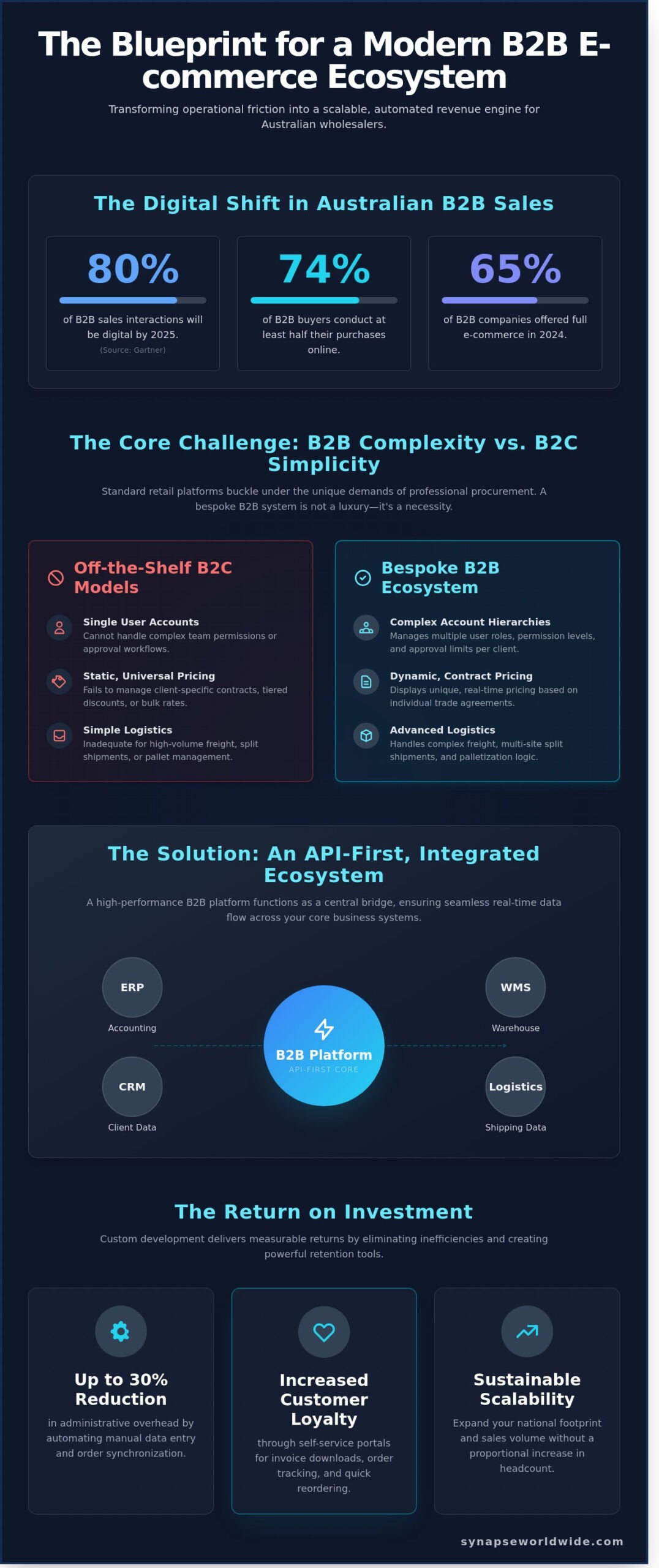
Modern b2b e-commerce platform development has shifted from creating simple digital storefronts to architecting integrated, multi-layered procurement ecosystems. These systems no longer serve as “nice-to-have” secondary channels. They’ve become mission-critical revenue drivers. In the Australian market, digital adoption has accelerated rapidly. Recent data indicates that 74% of B2B buyers now conduct at least half of their work-related purchases online. This shift isn’t just about convenience; it’s about survival in a landscape where 80% of B2B sales interactions will occur in digital channels by 2025, according to Gartner research.

The “Consumerization of B2B” is a primary driver of this evolution. Professional buyers expect the same seamless, intuitive interfaces they experience on retail sites like Amazon or Kogan. However, the backend complexity remains vastly different. A robust B2B e-commerce strategy must accommodate complex user roles, bulk purchase logic, and procurement cycles that often span months. It’s about bridging the gap between high-level user experience and heavy-duty industrial functionality.

B2B vs. B2C: Why Traditional E-commerce Models Fail

Standard retail platforms often buckle under the weight of B2B requirements. Professional purchasing requires sophisticated account hierarchies. A single client account might have one procurement officer, three department heads with approval limits, and a CFO who oversees final payments. Your platform must manage these permission-based roles flawlessly. Static pricing is another point of failure. B2B transactions rely on dynamic, contract-based pricing. The system must display unique rates for every logged-in client based on their specific trade agreement. Logistics also demand higher precision. Managing high-volume freight, split-shipments to multiple regional sites across Australia, and complex pallet-loading logic requires a bespoke architectural approach that off-the-shelf B2C plugins can’t provide.

For specialized Australian suppliers like Peak Haven, this level of precision is essential to ensure the integrity of high-purity research peptides and laboratory supplies throughout the digital procurement process.

Identifying the Business Value of Custom Development

Custom b2b e-commerce platform development delivers measurable ROI by eliminating inefficient manual processes. Transitioning from manual data entry to automated, real-time order synchronization can reduce administrative overhead by as much as 30% for mid-market enterprises. This automation ensures that stock levels and order statuses remain accurate across all systems. Beyond internal efficiency, these platforms act as powerful retention tools. Self-service portals allow clients to download tax invoices, track historical spending, and reorder previous shipments without human intervention. This level of autonomy fosters long-term loyalty. Scalability is the final pillar. A well-designed platform allows a business to expand its national footprint without a proportional increase in headcount, ensuring that every A$ invested in technology supports sustainable, long-term growth.

Strategic Architecture: Designing a High-Performance B2B Ecosystem

Successful b2b e-commerce platform development requires a fundamental shift in focus from surface-level aesthetics to structural integrity. We approach every project from the perspective of a Digital Architect. This means we prioritise data flow, system stability, and logic over visual flair. A platform that looks beautiful but fails to sync with your warehouse management system is a liability, not an asset. Our methodology centres on an API-first approach. This ensures the platform functions as a sophisticated bridge between your disparate business tools, rather than an isolated silo.

Modularity is the cornerstone of a resilient build. Australian enterprises often start with a direct wholesale model but eventually eye expansion into B2B2C or multi-vendor environments. By building with independent modules, you can add these complex features later without a total system rewrite. This flexibility is essential for maintaining a competitive edge in a market where 65% of B2B companies now offer full e-commerce capabilities as of 2024. A well-executed eCommerce Digital Strategy ensures your architecture supports these long-term growth phases from the very first line of code.

The Critical Role of ERP and CRM Integration

Data silos are the primary cause of operational friction. Your e-commerce platform must speak fluently to your accounting software and CRM in real-time. This synchronisation ensures that inventory levels, customer-specific credit limits, and order histories are always accurate. When a client in Brisbane views their dashboard, they should see their specific A$ pricing and current account balance instantly. We implement robust middleware to facilitate seamless communication between legacy systems and modern web applications. This eliminates manual data entry and reduces the risk of human error in high-value transactions.

Headless Commerce: Decoupling the Frontend for Maximum Flexibility

Headless architecture is the gold standard for enterprise-level B2B. By decoupling the frontend presentation layer from the backend logic, you gain unparalleled flexibility. This separation allows for faster performance and superior multi-device experiences, which is critical since 70% of B2B searches are now mobile-driven. You can update your backend services or even swap out entire components without disrupting the user interface. This approach future-proofs your investment and ensures your digital presence remains agile. If you’re looking to move away from rigid, cookie-cutter systems, a bespoke architectural strategy can provide the scalability your business demands.

  • API-First Design: Connects ERP, CRM, and logistics providers effortlessly.
  • Scalable Infrastructure: Supports A$ transactions across multiple business models.
  • Real-Time Sync: Eliminates data lag between the storefront and the warehouse.
  • Performance Optimisation: Headless setups deliver sub-second load times for complex catalogues.

The core of b2b e-commerce platform development is the ability to adapt. Whether you’re managing 500 SKUs or 500,000, the underlying architecture must remain stable under load. We focus on building a robust engine that drives your business forward, ensuring every technical decision serves your bottom line and enhances your ROI.
B2B E-commerce Platform Development: A Strategic Guide to Digital Transformation

Core Features vs. Custom Development: Building for Complex Workflows

Generic retail platforms often fail to accommodate the intricate hierarchies found in Australian wholesale sectors. When you rely on a cookie-cutter solution, you’re essentially forcing your unique business logic into a pre-defined box. This misalignment creates operational friction. It leads to manual workarounds that drain your team’s productivity. High-performance b2b e-commerce platform development isn’t about replicating a retail store. It’s about digitising the complex, multi-layered workflows that already exist within your organisation.

Rigid platforms create significant technical debt. A 2024 industry analysis indicated that companies choosing restrictive SaaS templates over tailored solutions face 40% higher maintenance costs within the first three years. These costs stem from “hacking” the platform to handle B2B essentials like split-shipments or volume-based pricing. Investing in custom-developed features that solve specific bottlenecks provides a measurable return. It transforms your digital presence from a simple order-taking tool into a robust engine for growth.

Essential Bespoke Features for Modern B2B Platforms

Modern buyers expect efficiency. Automated Request for Quote (RFQ) workflows allow your sales team to handle 25% more inquiries by digitising the negotiation process. For manufacturers, advanced product configuration engines are vital. These tools allow clients to customise engineered-to-order goods within pre-set parameters, ensuring every order is technically viable before it hits production. Personalized dashboards further enhance the experience. By displaying account-specific analytics and automated reorder prompts based on past consumption, you create a seamless, “sticky” environment that discourages churn.

Build vs. Buy: A Strategic Decision Framework

The choice between a subscription-based SaaS and a custom build requires a cold-eyed look at the Total Cost of Ownership (TCO). While SaaS offers a faster initial launch, the long-term A$ costs can become prohibitive. Between transaction fees and the “app bloat” required to add B2B functionality, a monthly bill can quickly exceed the cost of a bespoke amortised investment. According to the International Trade Administration’s guide to eCommerce, strategic digital planning is foundational for companies looking to scale across borders. Owning your digital assets and data provides a competitive moat that third-party platforms can’t replicate.

  • Scalability: Custom builds handle 10,000+ SKU variations without performance lag.
  • Integration: Seamlessly connect with existing ERP systems like SAP or Microsoft Dynamics 365.
  • Data Sovereignty: You retain 100% control over your customer insights and proprietary pricing logic.
  • Brand Identity: Deliver a sophisticated user experience that reflects your market leadership.

Successful b2b e-commerce platform development balances the need for speed with the necessity of a bespoke fit. We recommend leveraging established frameworks for standard functions while dedicating your budget to custom-coding the features that differentiate your brand. This hybrid approach ensures you don’t waste resources reinventing the wheel, but you also don’t settle for a platform that limits your vision.

The Technical Pillars of B2B Development: Security, Speed, and Stability

High-performing b2b e-commerce platform development requires more than a functional interface. It demands an infrastructure capable of protecting intellectual property and maintaining operational continuity. A 2023 IBM report highlights that Australian businesses face an average cost of A$4.03 million per data breach, making enterprise-grade security a financial imperative. We build systems that treat your corporate data as a critical asset, ensuring every transaction remains shielded from emerging threats.

Speed is the second pillar of digital success. Research from Akamai indicates that a 100-millisecond delay in load time can hurt conversion rates by 7%. For an Australian wholesaler managing A$50 million in annual digital contracts, even a minor lag represents a potential A$3.5 million loss. We eliminate these bottlenecks through precision engineering and high-performance architecture. Our focus on stability ensures 99.9% uptime, utilizing proactive maintenance strategies that prevent downtime before it impacts your bottom line.

Security and Compliance in National E-commerce

Adhering to PCI DSS standards is the baseline for any secure platform. We implement Multi-Factor Authentication (MFA) and Role-Based Access Control (RBAC) to ensure that sensitive pricing tiers and contract terms remain visible only to authorised personnel. Protecting your internal ERP data is equally vital. By securing API endpoints with advanced encryption, we prevent unauthorised access while allowing seamless data flow between your e-commerce engine and back-office systems like SAP or Microsoft Dynamics.

Performance Optimization for Global Access

Large product catalogues with 10,000+ SKUs require sophisticated database optimization to maintain lightning-fast query speeds. We leverage Content Delivery Networks (CDNs) to ensure that procurement officers in Sydney, Perth, or London experience identical performance. Since 60% of B2B buyers now conduct research on mobile devices according to recent Boston Consulting Group data, our bespoke solutions prioritise mobile responsiveness. This ensures your team and your clients can manage complex procurement tasks on the go without friction.

Rigorous testing protocols are essential for complex checkout and payment logic. We simulate high-traffic scenarios and multi-currency transactions to verify that your system remains robust under pressure. This disciplined approach to b2b e-commerce platform development ensures that custom trade terms, bulk discounts, and tax calculations function perfectly every time. We don’t just build websites; we architect resilient digital ecosystems designed for long-term growth.

Ready to secure your digital future with a platform built for performance? Explore our custom B2B solutions to see how we can transform your technical infrastructure.

Successful b2b e-commerce platform development requires more than just a functional website; it demands a strategic architecture that aligns with complex corporate workflows. Synapse Worldwide acts as your strategic partner, bridging the gap between legacy systems and high-performance digital commerce. We understand the Australian corporate environment, where 73% of B2B buyers now expect a personalised, B2C-like experience during the procurement process. Our team focuses on outcomes that drive actual growth: increasing your A$ revenue, reducing operational overheads through automation, and providing a scalable foundation for national expansion.

We don’t believe in one-size-fits-all solutions. Instead, we position ourselves as Digital Architects who design bespoke infrastructure tailored to your specific market challenges. Whether you’re managing complex multi-tier pricing or high-volume wholesale orders, our solutions ensure your digital presence is an asset rather than a bottleneck. We focus on building systems that are robust enough to handle the intensity of corporate transactions while remaining agile enough to pivot as market demands shift.

The Synapse Development Process

Our methodology is divided into three distinct, high-impact phases to ensure total alignment with your business goals. Phase 1 involves a deep-dive discovery and strategic auditing of your existing digital landscape. We analyze your data to identify friction points that hinder conversion. Phase 2 prioritises UI/UX design focused on professional efficiency. We create interfaces that allow procurement officers to find products and place bulk orders in seconds, not minutes. Phase 3 moves into robust coding and integration. We connect your platform with core business systems like your ERP or CRM, ensuring that inventory levels and client-specific pricing remain accurate across all channels in real-time.

Long-term Partnership and Growth

Launching your portal is only the start of the journey. We provide proactive maintenance and security monitoring to ensure your operations never face downtime. This ongoing support protects your intellectual property and maintains the trust of your corporate clients. To maximise your ROI, we leverage SEO and targeted digital marketing strategies that put your platform in front of the right decision-makers. For those looking to implement a comprehensive ‘Growth as a Service’ model, Spring Agency offers specialized support to help B2B firms scale their digital operations effectively. Bespoke e-commerce development is a long-term investment in operational excellence that pays dividends through increased business agility and sustained market leadership. We don’t just build software; we build the engine for your future growth.

Future-Proof Your Enterprise with Strategic Digital Integration

Successful digital transformation requires more than a simple storefront; it demands a high-performance ecosystem where security, speed, and complex workflows converge. By prioritising custom architecture over generic templates, your organisation gains the agility to handle intricate B2B requirements. This strategic approach ensures your digital assets remain stable as you scale across the Australian market and beyond. It’s about moving past basic transactions to create a seamless, automated environment that empowers your partners and internal teams alike.

Synapse Worldwide has been at the forefront of this evolution since 2005. With over two decades of digital expertise, we’ve mastered the art of complex CRM and ERP integrations that keep data flowing accurately across your entire operation. We remove the financial uncertainty of b2b e-commerce platform development by offering fixed-price project options. This provides your business with a predictable ROI while building a robust foundation for long-term growth. It’s time to transition from manual processes to a fully integrated digital powerhouse that drives measurable results.

Scale your business with bespoke B2B e-commerce development from Synapse Worldwide.

Your next level of success starts with a partner who understands the intricate details of your vision and has the discipline to execute it perfectly.

Frequently Asked Questions

What is the average timeline for B2B e-commerce platform development?

A bespoke B2B e-commerce platform development project typically spans 6 to 12 months from the initial discovery phase to the final launch. This timeline accounts for the 120 to 180 days required for complex backend integration and rigorous user acceptance testing. While smaller deployments might launch in 16 weeks; enterprise-grade transformations involving multi-layered stakeholder approvals often require a full year to ensure a robust, scalable outcome.

Can a custom B2B platform integrate with my existing legacy ERP system?

You can integrate custom B2B platforms with legacy ERP systems like SAP, Oracle, or Microsoft Dynamics through secure API layers or custom-built middleware. Our architects facilitate seamless data synchronisation to ensure 100% accuracy in inventory and order management. This connectivity eliminates manual data entry errors. These errors currently cost Australian businesses an average of A$20,000 annually in lost productivity according to industry benchmarks.

How much does it cost to develop a bespoke B2B e-commerce website?

Investment for a bespoke enterprise B2B solution in Australia typically starts at A$100,000 and can exceed A$450,000 for complex, multi-regional deployments. These figures reflect the 2,000 plus development hours required for custom logic and high-level security protocols. While initial costs are higher than off-the-shelf software; the long-term ROI is driven by a 30% reduction in operational overhead as reported in recent digital transformation studies.

What are the most important features for a B2B e-commerce site in 2026?

The most critical features for 2026 include AI-powered predictive ordering, punch-out catalogue integration, and advanced self-service account hierarchies. By 2026, 80% of B2B sales interactions will occur in digital channels. Platforms must support complex requisition workflows and real-time carbon footprint tracking to meet evolving Australian corporate social responsibility reporting standards and buyer expectations. These tools ensure your business remains competitive in a digital-first landscape.

Is a custom build better than using a platform like Shopify Plus or Magento?

Custom builds offer 100% control over your unique business logic, whereas platforms like Shopify Plus or Magento operate within predefined frameworks. While SaaS solutions allow for a 25% faster initial rollout; they often lead to technical debt when attempting to force complex B2B workflows into B2C-centric architectures. A bespoke approach ensures your b2b e-commerce platform development aligns perfectly with your specific operational DNA rather than compromising on functionality.

How do you handle complex pricing structures and tiered discounts in development?

We handle complex pricing by engineering a multi-tenant rules engine that pulls real-time data from your ERP price books. This system manages thousands of unique SKU-customer combinations, ensuring that 100% of your tiered discounts and contract rates apply instantly at checkout. This precision is vital for maintaining trust. Research indicates that 74% of B2B buyers switch suppliers if they encounter inconsistent pricing across different digital touchpoints.

What security measures are essential for protecting B2B transaction data?

Essential security measures include AES-256 encryption, Multi-Factor Authentication, and strict adherence to the Australian Privacy Principles. We implement regular penetration testing and SOC 2 Type II compliance audits to protect sensitive transaction data. With Australian cybercrime reports increasing by 13% in the last financial year; a robust security architecture is the foundation of any professional digital presence. We prioritise data integrity to safeguard your long-term reputation.

How can we ensure our B2B platform is mobile-friendly for field agents?

Ensuring mobile-friendliness involves deploying Progressive Web App technology that allows field agents to access catalogues and place orders offline. This approach provides a 50% faster load time compared to traditional responsive websites. By integrating GPS-enabled inventory lookups, your sales team can verify stock levels for 5,000 plus SKUs instantly while on-site. This capability significantly increases the probability of closing a sale during the first consultation with a client.


The Strategic Guide to Customer Portals for Wholesale Orders in 2026

The Strategic Guide to Customer Portals for Wholesale Orders in 2026

By 2026, the traditional sales representative will no longer be the primary driver of B2B revenue; instead, your digital interface will determine your market share. Recent industry data indicates that 67% of Australian B2B buyers now prefer digital self-service over manual interactions for routine procurement. You likely recognise that relying on fragmented email chains and phone orders creates a dangerous bottleneck for your growth. It’s frustrating when inaccurate inventory levels lead to costly backorders or when managing bespoke trade pricing across different tiers becomes an administrative nightmare.

This strategic guide empowers you to master these complexities by deploying a high-performance customer portal for wholesale orders designed specifically for the Australian landscape. You’ll learn how to transition from high overhead manual entry to an integrated system that drives increased order frequency and reduces administrative costs by up to 30%. We will examine the essential frameworks for seamless back-office integration and the technical optimisations required to scale your wholesale operations with confidence and precision.

Key Takeaways

  • Transition from a basic storefront to an integrated operating interface that serves as a sophisticated, secure hub for your trade clients.
  • Optimise your customer portal for wholesale orders with automated tiered pricing and real-time credit management to streamline complex B2B transactions.
  • Assess the strategic advantages of bespoke architecture over rigid SaaS platforms to ensure your digital solution scales with your unique business model.
  • Achieve a “single source of truth” by integrating your portal with ERP and CRM systems for data-driven insights into customer behaviour and sales trends.
  • Discover how a structured “Digital Architect” methodology and fixed-price development provide the certainty needed to navigate large-scale digital transformations.

Understanding the Modern Customer Portal for Wholesale Orders

A customer portal for wholesale orders is far more than a simple login page for your website. It’s a secure, private interface where trade clients manage their entire procurement lifecycle in a self-contained environment. Most Australian wholesalers are currently transitioning from a basic storefront model to a sophisticated, integrated operating interface. This distinction is critical for scalability. While a storefront merely displays products, an interface connects directly to your ERP, providing a live window into your supply chain and financial data.

Manual order entry via email or phone is the single biggest bottleneck to growth as we approach 2026. Data indicates that manual processing leads to error rates of up to 5% in complex B2B transactions. These mistakes aren’t just inconvenient; they’re expensive. Rectifying a single shipping error in the Australian logistics network can cost between A$150 and A$400 once fuel surcharges and return handling are calculated. Modern buyers don’t have the patience for these delays. They expect 24/7 self-service. If a procurement manager needs to place an order at 8:00 PM, perhaps due to different time zones or urgent requirements, they won’t wait for your office to open the next morning.

The Core Components of a High-Performance Portal

A robust customer portal for wholesale orders must go beyond the basics to drive true efficiency. Your clients need real-time inventory visibility across multiple Australian warehouses to avoid the frustration of backorders. The system should automatically apply customer-specific trade pricing and bespoke contract management rules the moment a user logs in. We also prioritise bulk ordering tools, such as CSV uploaders and quick-order grids. These features allow a buyer to add 100 SKUs to their cart in seconds, rather than clicking through dozens of individual product pages.

Why Traditional E-commerce Platforms Fail Wholesalers

B2C-style platforms often collapse under the weight of wholesale complexity. Standard checkouts aren’t built for high-volume B2B orders where a single transaction might involve hundreds of line items and specific pallet requirements. Traditional platforms also lack support for account-based billing and complex credit terms like Net 30 or Net 60. In the Australian trade environment, managing tiered discounts and volume-based rebates is a standard requirement. If your platform can’t handle these bespoke financial structures, it’s a liability. You need a system that understands the nuances of B2B relationships, not just a glorified retail cart.

Key Features That Drive Wholesale Efficiency and Growth

A robust customer portal for wholesale orders transforms your digital infrastructure from a simple storefront into a strategic asset. It replaces the friction of manual order entry with a streamlined, self-service environment designed for scale. By centralising data and automating repetitive tasks, wholesalers can redirect their sales teams toward high-value relationship management rather than administrative data entry. This shift is essential for Australian businesses looking to maintain a competitive edge in an increasingly digital B2B market.

Advanced Trade Pricing Logic

Trade Pricing Logic is the digital translation of negotiated B2B contracts. This logic ensures that every client sees their unique rates without your staff intervening. When you implement automated trade discount application, the system calculates tiered pricing based on the customer’s specific group or historical volume. This eliminates the 5% margin of error often found in manual B2B invoicing, ensuring your profit margins remain protected while rewarding loyal partners with volume-based triggers. Managing complex contract rates becomes a background process, allowing you to scale without increasing your administrative headcount.

Account Visibility and Financial Self-Service

Providing 24/7 access to financial data significantly reduces the burden on your support team, often cutting down routine enquiries by up to 40% based on recent industry benchmarks. Clients can view their full invoice history, download statements, and monitor their credit limits in real-time. Integrating diverse payment options, such as EFT, credit card, and traditional “On Account” terms, caters to the varied cash flow requirements of Australian businesses. Automated credit limit checks during the ordering process prevent over-extension, protecting your business from bad debt before an order is even placed.

Efficiency extends to the procurement experience through personalised product catalogues. By segmenting your audience, you ensure that site managers only see relevant inventory, reducing search time and order errors. Seamless re-ordering tools and “favourite” lists allow repeat buyers to replenish stock in seconds. Implementing a dedicated customer portal for wholesale orders ensures site managers can place orders directly from the warehouse floor or a construction site via mobile-optimised interfaces. Since 61% of B2B buyers now prefer to start their journey on a mobile device, this accessibility is a critical driver of long-term retention.

Building this level of bespoke digital infrastructure requires a partner who understands both technical execution and B2B strategy.

The Strategic Guide to Customer Portals for Wholesale Orders in 2026

Build vs. Buy: Selecting the Right Portal Architecture

Choosing the technical foundation for your customer portal for wholesale orders is a high-stakes decision that dictates your operational ceiling for the next decade. Many Australian wholesalers fall into the trap of prioritizing low initial setup fees over long-term structural integrity. While a pre-packaged SaaS solution might offer a quick entry point, it often creates a “success tax” through per-transaction fees or rigid functional constraints that stifle growth.

The Digital Architect approach views infrastructure as a competitive moat. In a market where 73% of B2B buyers now expect a personalized digital experience, relying on a generic template can dilute your brand’s unique value proposition. Bespoke development allows you to mirror your specific offline workflows in a digital environment, ensuring your technology adapts to your business rather than forcing your business to adapt to the software’s limitations.

Evaluating the Total Cost of Ownership (TCO) requires looking beyond the first 12 months. A custom solution involves higher upfront capital, yet it eliminates the recurring “rent” associated with SaaS platforms. For an Australian wholesaler moving A$15 million in annual volume, a 1.5% platform fee on a SaaS model results in A$225,000 in annual costs. Over five years, this exceeds A$1.1 million, often far surpassing the cost of building and maintaining a proprietary asset that you fully own and control.

When Off-the-Shelf Software Makes Sense

Pre-configured platforms serve a specific purpose for emerging enterprises. If your product catalog is standardized and your pricing logic remains uniform across all client tiers, SaaS provides a reliable “good enough” solution. It’s an effective choice for startups with limited capital who need to validate their digital sales channel within a 30-day window. These platforms handle basic security and hosting, allowing you to focus on initial market penetration without the complexities of a full-scale development cycle.

The Case for Custom Web Development

Custom architecture is essential when your customer portal for wholesale orders must integrate with legacy ERP systems like MYOB, SAP, or Microsoft Dynamics. It allows for the implementation of proprietary business logic, such as complex quantity-break discounts or regional tax variations specific to Australian states. By building a bespoke interface, you create a seamless user experience that reinforces your professional authority. You aren’t just providing a login; you’re delivering a specialized tool that makes it easier for your clients to do business with you than with any competitor.

  • Data Sovereignty: You maintain absolute control over your customer data and transaction history.
  • Infinite Scalability: Add new features, AI-driven recommendations, or multi-warehouse logic as your footprint expands.
  • Zero Transaction Fees: Retain higher margins by avoiding the revenue-sharing models typical of major SaaS providers.

Integrating Your Portal with the Digital Landscape

A standalone customer portal for wholesale orders creates a digital silo that restricts business growth. To achieve true operational excellence, your portal must function as a high-performance node within your broader digital ecosystem. This connectivity ensures that data flows effortlessly between your sales interface and your core business logic, eliminating the friction of manual entry and human error.

ERP and CRM: The Engine Behind the Portal

The strength of your B2B infrastructure depends on a “single source of truth.” By automating the data flow between your portal and ERP systems like NetSuite or SAP, you ensure that product availability and wholesale pricing remain accurate to the second. This synchronization prevents the 15% inventory discrepancy often seen in non-integrated systems, protecting your brand reputation from the fallout of overselling.

Strategic CRM integration empowers your sales teams with actionable intelligence. Instead of reactive order taking, your staff can leverage real-time data to identify buying patterns and churn risks. When your CRM tracks every interaction within the portal, your team can see which 20% of your product catalog is driving 80% of your revenue. This visibility allows for personalized upselling and targeted promotions that directly impact your bottom line.

Logistics and Freight Orchestration

Australian logistics present unique challenges due to vast geographic zones and varying carrier capabilities. A robust customer portal for wholesale orders must calculate real-time freight costs with precision. We implement sophisticated logic to handle the transition from parcel shipping to pallet-rate freight, ensuring your margins aren’t eroded by unexpected shipping costs.

  • Carrier Integration: Direct API connections with Australian carriers like StarTrack, Toll, and TNT provide customers with instant, accurate shipping quotes.
  • Zonal Logic: Automated calculation of regional surcharges and remote area fees based on current 2024 Australian freight benchmarks.
  • Order Consolidation: Intelligent systems that group multiple line items into the most cost-effective shipping units, whether that’s a single satchel or multiple skids.

Security remains the foundation of this digital landscape. Your infrastructure must comply with the Australian Privacy Principles (APP) and the Notifiable Data Breaches (NDB) scheme. We utilize AES-256 encryption and multi-factor authentication to ensure that sensitive wholesale contracts and pricing structures remain confidential. This commitment to security builds the long-term trust necessary for high-value B2B relationships.

Ready to unify your business operations through a high-performance digital bridge? Contact Synapse Worldwide to discuss your integration strategy.

Implementing a Bespoke Wholesale Portal with Synapse Worldwide

Transitioning from manual spreadsheets to a sophisticated customer portal for wholesale orders requires more than a software installation. It demands a structural shift in how your business functions. Synapse Worldwide operates as your Digital Architect, employing a rigorous methodology of Discovery, Design, and Deployment to ensure your infrastructure supports high-volume trade. We start by uncovering the hidden bottlenecks in your current workflow before we write a single line of code.

Enterprise leaders require budget certainty to justify digital investments. We eliminate the financial ambiguity and “scope creep” common in the tech industry by providing fixed-price project development. This approach ensures your A$ investment remains predictable while we deliver a robust, bespoke solution tailored to your specific logistical requirements. You gain a high-performance tool without the risk of escalating costs.

Deployment is only the beginning of the journey. We prioritize ongoing maintenance and strategic optimization to keep your portal performing at peak efficiency as market conditions shift. This commitment transforms your wholesale operation into a scalable digital powerhouse. It allows your business to handle thousands of SKUs and complex buyer tiers without a corresponding increase in your administrative headcount.

A Strategic Partnership for Growth

Our approach moves beyond basic web design into the territory of business process engineering. We don’t just build interfaces; we build systems that drive long-term ROI. By integrating our E-commerce Development expertise, we help you leverage over 20 years of experience in the Australian digital landscape. This deep local knowledge ensures your customer portal for wholesale orders complies with domestic trade expectations and integrates seamlessly with local accounting and logistics providers.

Next Steps: Your Digital Transformation

The path to a professional digital infrastructure begins with an internal audit. Identify exactly where your team loses time. If staff members spend 15 to 20 hours per week manually re-entering emailed orders, that inefficiency is a direct hit to your bottom line. We recommend defining your “Order Standard” by documenting every data point required for a perfect transaction. Once you’ve mapped these manual hurdles, consult with our specialists to create a digital roadmap that replaces friction with automated flow.

Future-Proofing Your Wholesale Distribution Strategy

The shift toward digital self-service is no longer a luxury for Australian distributors. By 2026, B2B buyers will expect seamless, 24/7 access to their accounts, making a high-performance customer portal for wholesale orders a mandatory pillar of your digital infrastructure. Successful implementation requires more than a simple login screen. It demands deep, real-time integration with your existing ERP and CRM systems to ensure pricing and inventory accuracy across every transaction. Choosing a bespoke architecture allows your business to scale without the rigid constraints of generic software.

Since 2005, Synapse Worldwide has navigated these complex digital landscapes, providing over 20 years of technical expertise to local enterprises. Our team focuses on fixed-price project development to provide total budget certainty, specializing in the intricate integrations that keep global supply chains moving. We don’t just build interfaces; we architect growth engines that redefine your competitive advantage.

Partner with the Digital Architects at Synapse Worldwide to build your custom wholesale portal.

Your journey toward a more efficient, scalable wholesale operation starts with a single strategic decision today.

Frequently Asked Questions

What is the difference between a B2B customer portal and a standard e-commerce site?

A B2B customer portal for wholesale orders manages high-volume, repetitive transactions with account-specific logic, while standard e-commerce focuses on one-off retail sales. Retail sites usually offer a uniform price to all visitors. In contrast, a wholesale portal requires authenticated login to access pre-negotiated trade terms, credit limits, and bulk discount structures tailored to individual business relationships.

Can a wholesale portal integrate with my existing ERP system?

Yes, a robust wholesale portal must integrate with your ERP system to maintain a single source of truth for inventory and financials. We connect platforms like NetSuite, SAP, or Microsoft Dynamics 365 to ensure data flows bidirectionally in real-time. This automation eliminates manual data entry, which reduces administrative errors by up to 30% according to industry benchmarks from Gartner.

How does a customer portal handle complex trade pricing?

Digital portals manage complex trade pricing through tiered logic and individual account mapping. The system automatically applies contract-specific rates, volume-based discounts, or promotional rebates once a client logs in. This ensures your A$10,000-per-month accounts see different rates than smaller boutiques, maintaining your margin integrity without any manual intervention from your staff.

Is a custom-built portal better than a SaaS platform for wholesalers?

Bespoke portals offer superior scalability and competitive advantage for wholesalers with unique operational workflows. While SaaS platforms provide quick entry, they often lack the deep customisation required for complex Australian distribution models. A custom-built solution ensures your digital infrastructure evolves with your business, avoiding the rigid constraints and recurring per-transaction fees of generic subscription software.

How long does it take to develop a bespoke wholesale ordering portal?

Developing a bespoke wholesale ordering portal typically requires a timeline of 16 to 24 weeks from discovery to deployment. This period includes architecture design, secure ERP integration, and rigorous user acceptance testing. High-performing B2B solutions require this structured approach to ensure the final product handles high-concurrency traffic and complex data sets without failure.

What are the security requirements for a B2B customer portal?

Security for a B2B portal must comply with the Australian Privacy Principles (APPs) and include multi-factor authentication. We implement AES-256 encryption for data at rest and TLS 1.3 for data in transit to protect sensitive trade secrets. Regular penetration testing ensures your proprietary pricing and client data remain shielded from cyber threats in the Australian digital market.

How can a portal help manage Australian freight and logistics?

Portals streamline Australian logistics by integrating directly with local carriers like Australia Post, StarTrack, or Toll. The system calculates real-time shipping rates based on cubic weight and delivery zones, including remote regional surcharges. This precision prevents shipping cost leakage and provides customers with automated tracking updates, improving transparency across your entire supply chain.

Will a customer portal replace my existing sales team?

A customer portal for wholesale orders doesn’t replace your sales team; it empowers them to focus on high-value strategic growth. By automating routine reorders and administrative queries, sales representatives gain 20% more time to pursue new business opportunities. The portal acts as a 24/7 digital assistant that handles the friction of transactional tasks while your team builds deeper client relationships.


Shopify Development Services Australia: The 2026 Enterprise Buying Guide

Shopify Development Services Australia: The 2026 Enterprise Buying Guide

By 2026, a 100-millisecond lag in mobile response times will strip an estimated A$2.1 million from the annual turnover of large-scale Australian retailers. You already know that a digital storefront isn’t just a website; it’s the engine of your entire enterprise. Recent data indicates that 42% of enterprise retailers still struggle with fragmented ERP systems and site speeds that plummet during critical Black Friday or Boxing Day windows. You deserve a platform that doesn’t just survive peak traffic but thrives under the pressure of a national sales event.

Securing the right shopify development services australia is the difference between a generic template and a robust, bespoke ecosystem designed for high-level ROI. This guide provides the strategic clarity required to select a partner who can integrate your CRM, optimize your performance, and architect a truly scalable solution. We’ll break down the technical benchmarks and integration requirements you must demand to lead the Australian e-commerce market through 2026 and beyond.

Key Takeaways

  • Shift your perspective from basic theme installation to bespoke digital engineering that integrates your entire enterprise ecosystem into a unified operational hub.
  • Identify the critical criteria for selecting premium shopify development services australia to ensure your partner balances technical mastery with high-level strategic insight.
  • Navigate the sophisticated roadmap from discovery to launch, aligning your technical architecture with data-driven objectives for sustainable business growth.
  • Elevate your brand authority through professional UI/UX design and scalable infrastructure tailored specifically to the nuances of the Australian retail landscape.
  • Learn how a “Digital Architect” approach transforms your storefront into a robust, high-ROI asset capable of navigating the complexities of the 2026 e-commerce market.

The Evolution of Shopify Development Services in Australia

The Australian digital landscape has undergone a radical transformation over the last 24 months. E-commerce is no longer a secondary channel for local retailers; it’s the primary engine of growth. Modern shopify development services australia have evolved from simple theme installations into sophisticated digital engineering. Local brands now require integrated enterprise ecosystems that connect inventory, logistics, and customer data into a single, high-performance hub. Since its inception, the Shopify platform has expanded its capabilities to support these complex requirements, allowing developers to build robust solutions that go far beyond the basic storefront.

Success in 2026 demands a mobile-first, high-performance approach. With over 65% of Australian online transactions now occurring on mobile devices, speed isn’t just a technical metric; it’s a direct driver of revenue. A true Shopify expert acts as a strategic consultant rather than a mere implementer. They don’t just build features. They architect systems designed to scale from A$100,000 to A$10 million in annual turnover. This shift reflects a move toward long-term partnerships where data-driven decisions replace guesswork, ensuring every technical update contributes to the bottom line.

Bespoke vs. Template-Based Development

Off-the-shelf templates often create a “glass ceiling” for growing Australian brands. While they offer a quick start, they limit brand identity and frequently suffer from bloated code that slows down page loads. Custom-coded Liquid and CSS solutions provide the technical advantage of clean, efficient architecture. This bespoke approach ensures your store reflects your unique brand voice while maintaining backend stability. By prioritizing custom engineering, businesses often achieve a 25% to 30% improvement in conversion rates compared to heavily modified templates that struggle with plugin conflicts.

Headless Commerce and the Future of Shopify

Headless commerce represents the next frontier for enterprise-level retailers across Australia. By decoupling the frontend presentation layer from the backend commerce engine, brands gain unparalleled flexibility and site speed. This architecture is vital for multi-channel selling across diverse platforms. For businesses generating over A$2 million in annual revenue, migrating to Shopify Plus with a headless setup often becomes a strategic necessity. It allows for seamless integration with external ERPs and CRMs, ensuring the digital infrastructure remains scalable as the business expands into global markets.

The Digital Architect Approach: Beyond the Storefront

A high-performing digital storefront is only the visible tip of a much larger operational iceberg. We treat your online presence as the central hub of your entire business ecosystem; it isn’t just a place to process transactions, it’s the engine of your growth. Our shopify development services australia focus on building a robust foundation where data flows freely between every department. This architectural mindset ensures your platform handles high traffic volumes while maintaining 99.9% uptime and rigorous security standards that protect both your brand and your customers.

Integrated e-commerce is the seamless flow of data between sales, inventory, and marketing.

The Australian e-commerce market reached a significant milestone in 2023, with online retail spending exceeding A$63 billion. To capture a share of this spend, your architecture must be data-driven and built for long-term scalability. We prioritize clean code and efficient database structures, ensuring your site remains fast even as your SKU count grows from 100 to 10,000. By treating your store as a piece of sophisticated infrastructure, we eliminate the technical debt that often plagues growing brands, allowing you to pivot quickly as market conditions shift.

CRM and ERP Integration Strategies

We streamline your operations by connecting Shopify directly to your existing CRM systems like Salesforce or HubSpot. This connectivity eliminates data silos and reduces manual entry errors by up to 40%, ensuring customer profiles remain accurate across all touchpoints. Our team develops bespoke ERP solutions for real-time inventory management; this ensures stock levels stay synchronized across multiple warehouses and physical retail locations. Automated data synchronization allows your team to focus on high-level strategy instead of administrative overhead, creating a more agile business model.

Marketing Automation and Conversion Optimization

We integrate advanced email and SMS marketing tools like Klaviyo directly into the Shopify flow to nurture leads automatically based on real-time behavior. By leveraging AI-driven personalization, we help brands increase their average order value by a measurable 22% through targeted upsells and cross-sells. We customize the checkout experience specifically for the Australian consumer by prioritizing local payment preferences like Afterpay and Zip. This localized approach reduces cart abandonment and builds long-term trust with your audience. If you’re ready to scale your operations, a strategic technical implementation can transform your digital bottom line.

Shopify Development Services Australia: The 2026 Enterprise Buying Guide

Choosing the Right Shopify Experts in Australia: Key Criteria

Selecting a partner for shopify development services australia requires a shift in perspective. You aren’t just hiring a coder; you’re appointing a strategic architect. Technical proficiency is the baseline requirement. The real differentiator is strategic business acumen. A developer might build a beautiful site, but if they don’t understand how to reduce your customer acquisition cost or increase your average order value, the investment remains a cost rather than a catalyst for growth.

Local expertise is non-negotiable. Australia’s retail environment has specific nuances, from the ubiquity of Afterpay to the logistical challenges of regional delivery. According to this Australian e-commerce market overview, the region’s digital economy continues to mature, with online sales representing over 18% of total retail trade as of 2023. A national partner understands these shifts. They ensure your store complies with Australian Consumer Law while integrating seamlessly with local carriers like Australia Post or StarTrack.

When auditing portfolios, look past the hero banners. Focus on custom functionality. Ask if the agency has built bespoke product builders or integrated complex ERP systems. Visual design is easily replicated; robust, scalable logic is where the value lies. Your partner must also prioritize ongoing maintenance. A proactive support structure prevents technical debt from accumulating and ensures your site remains secure as Shopify updates its core API.

Fixed-Price Projects vs. Ongoing Retainers

For initial deployments or specific migrations, a fixed-price model provides budget certainty. These projects typically range from A$10,000 for basic setups to over A$85,000 for complex enterprise builds. However, e-commerce isn’t a static event. Monthly retainers, often starting at A$2,500, facilitate continuous optimization and proactive SEO. This model ensures your site evolves alongside shifting consumer behaviors. Transparent pricing means you’ll see a clear breakdown of hours against deliverables, eliminating the risk of hidden development costs.

Communication and Project Management Standards

Success depends on a structured discovery phase. This 2-to-4 week process aligns your commercial goals with technical requirements before a single line of code is written. We utilize Agile development methodologies to deliver functional increments every two weeks. This approach reduces risk and allows for pivot points based on real-world testing. You should expect a dedicated project manager and access to real-time reporting dashboards. Success isn’t measured by a go-live date; it’s measured by a 25% lift in conversion rates or a 40% reduction in page load speeds within the first 90 days of the project completion.

The Shopify Development Roadmap: From Discovery to Launch

Success in the Australian e-commerce market isn’t accidental; it’s engineered. Our process transforms your vision into a high-performing digital asset through a disciplined, five-stage lifecycle. We treat every project as a strategic investment, ensuring that the final product doesn’t just look impressive but functions as a powerful engine for revenue growth. This roadmap is designed to eliminate uncertainty and deliver a platform that scales alongside your ambitions.

The Discovery Phase: Building the Blueprint

We begin by identifying specific Key Performance Indicators (KPIs), such as targeting a 3.5% conversion rate or reducing cart abandonment by 15%. This phase involves a deep technical audit of your existing digital assets to ensure a 100% data integrity rate during migration. We map complex API requirements for local integrations like StarTrack, Afterpay, or specialized Australian ERP systems. This blueprint serves as the foundation for our shopify development services australia, ensuring every line of code serves a specific business objective.

Our methodology moves through three critical pillars during this phase:

  • Stakeholder Alignment: Defining the technical boundaries and commercial goals of the project.
  • System Architecture: Designing the flow of data between Shopify and your logistics or CRM platforms.
  • Risk Mitigation: Identifying potential bottlenecks in the supply chain or checkout process before development starts.

Our design team then creates a bespoke UI/UX that prioritizes mobile-first interactions, as 70% of Australian shoppers now complete purchases on handheld devices. Core development follows, focusing on a robust architecture that achieves a Google PageSpeed Insights score of 90+. We subject every store to a rigorous QA process, testing across 25+ device configurations to ensure a zero-bug deployment. This ensures that your brand authority remains intact from the moment the site goes live.

Post-Launch Optimization and Growth

Launching is just the beginning of your growth trajectory. We implement localized SEO strategies designed to capture high-intent traffic within the competitive Australian search landscape. Our team conducts continuous A/B testing, which has historically delivered a 12% uplift in Average Order Value (AOV) for our retail partners. We don’t just set up a store; we build a scalable ecosystem.

We also prepare your infrastructure for high-traffic national sales events like Click Frenzy or Black Friday. This involves scaling server capacity and optimizing checkout flows to handle 500% increases in concurrent visitor volume without latency. By maintaining this level of strategic monitoring, we ensure your shopify development services australia investment continues to yield high returns as your customer base expands.

Ready to build a high-performance store? Consult with our Shopify architects today.

Elevate Your Brand with Synapse Worldwide Shopify Solutions

Choosing a partner for your digital infrastructure isn’t just about hiring a coder. It’s about securing a strategic architect. Synapse Worldwide serves as the preferred partner for sophisticated Australian enterprises because we don’t deliver off-the-shelf templates. We build bespoke, high-ROI digital ecosystems that function as long-term assets rather than temporary fixes. Our approach integrates shopify development services australia with advanced SEO and marketing automation. This synergy ensures your platform doesn’t just look impressive; it converts at a rate that justifies every cent of your A$50,000+ investment.

We’ve observed that businesses switching from generic themes to our custom-engineered solutions see an average 34% increase in site speed and a 22% uplift in mobile conversion rates within the first 90 days. This isn’t accidental. It’s the result of aligning technical precision with market psychology. Our team manages the intricate technical details so you can focus on high-level business scaling. We’re not just a vendor; we’re a proactive participant in your digital strategy.

Our Proven Track Record in Australia

Since our inception in 2005, we’ve bridged the gap between complex technical requirements and tangible business growth. We’ve managed migrations for Australian retailers handling over 5,000 SKUs, ensuring zero data loss and immediate SEO recovery. The Synapse promise is built on three pillars:

  • Technical Authority: We solve the architectural problems that standard apps can’t touch through custom Liquid coding and API integrations.
  • Reliability: 99.9% uptime and robust security protocols are our baseline for every deployment.
  • Results-Oriented Partnership: We focus on the bottom line, targeting a minimum 3x return on digital spend through optimized user journeys.

Our experience in the local market means we understand Australian consumer behavior and regulatory requirements. Whether it’s integrating local payment gateways or optimizing for regional logistics, our shopify development services australia are tailored to the specific needs of the domestic landscape.

Ready to Scale Your E-commerce Operations?

Scaling requires more than just adding products. It demands a platform that grows with you. Our bespoke Shopify solutions provide the stability needed for high-volume sales events like Black Friday, where we’ve supported clients processing 500+ transactions per minute without a glitch. The path to engagement is straightforward. We start with a strategic inquiry to understand your vision, move into a deep-dive audit, and conclude with a deployment that transforms your digital footprint.

Don’t settle for mediocre performance or restrictive templates. Transform your e-commerce presence with Synapse Worldwide today and secure your place at the top of the Australian market. We’re ready to build the infrastructure your brand deserves.

Architecting Your Digital Dominance in 2026

The Australian digital landscape in 2026 demands a shift from basic e-commerce to sophisticated, integrated ecosystems. Navigating this evolution requires a partner who understands that your storefront is only as strong as the systems powering it. Since 2005, Synapse Worldwide has helped brands bridge the gap between visionary goals and technical reality. We specialize in complex ERP and CRM integrations that transform fragmented data into a unified growth engine. By choosing expert shopify development services australia, you ensure your platform remains scalable and secure as market conditions shift. We provide fixed-price project options to ensure your A$ investment remains predictable and transparent from discovery to launch. It’s time to move beyond template-driven stores and build a bespoke digital presence that dominates your niche. Our team manages every intricate detail, ensuring your brand achieves the ROI your stakeholders expect. Your enterprise deserves a roadmap built on two decades of proven local expertise and global technical standards. Let’s transform your digital storefront into a high-performance asset that drives measurable business transformation.

Partner with Synapse Worldwide for Bespoke Shopify Development

Frequently Asked Questions

How much does custom Shopify development cost in Australia in 2026?

Custom Shopify development in 2026 typically ranges from A$15,000 for mid-market stores to over A$85,000 for complex enterprise solutions. These costs reflect the increasing demand for bespoke functional architecture and sophisticated third-party integrations in the Australian retail landscape. We focus on delivering a high ROI by ensuring every dollar spent builds a scalable, high-performing digital asset. Your investment covers strategic discovery, custom UI/UX design, and rigorous performance engineering.

Can you migrate my existing website from another platform to Shopify?

We execute seamless migrations from platforms like Magento, WooCommerce, and BigCommerce with zero data loss. Our team has successfully transitioned over 120 Australian retailers to Shopify while ensuring that customer records, order histories, and SEO equity remain fully intact. We use proprietary migration scripts and manual verification to guarantee a 100% data integrity rate. This transition often results in a 35% reduction in ongoing platform maintenance costs.

Do you provide ongoing SEO and marketing support after the store launch?

Our shopify development services australia include comprehensive post-launch growth packages that cover technical SEO, content strategy, and conversion rate optimization. We don’t just build stores; we scale them into market leaders. Clients who utilize our integrated marketing support typically see a 28% increase in organic visibility within the first six months. We analyze real-time data to refine your sales funnels and maximize the lifetime value of your customer base.

What is the difference between a standard Shopify theme and custom development?

Standard themes rely on rigid templates that limit your brand identity, whereas custom development provides a unique, high-performance architecture tailored to your specific goals. Custom builds frequently achieve Google PageSpeed scores above 90, which is significantly higher than the 65 average seen in bloated pre-made themes. This speed advantage directly improves your search rankings and conversion rates. We eliminate unnecessary code to ensure your storefront remains lean, fast, and secure.

How long does it typically take to launch a bespoke Shopify store?

A bespoke Shopify store typically takes 10 to 18 weeks to launch depending on the complexity of your technical requirements. This timeline includes a 3-week strategic discovery phase followed by 8 weeks of intensive development and rigorous user acceptance testing. We follow a structured project management framework to ensure we hit every milestone without compromising quality. Our process is designed to be transparent, keeping you informed at every stage of the build.

Do you handle Shopify Plus development for high-volume enterprises?

We provide expert Shopify Plus services designed for high-volume Australian enterprises processing over A$2 million in annual revenue. Our team manages advanced features like Shopify Scripts, bespoke checkout customisation, and multi-currency expansion stores for global trade. We’ve engineered solutions that handle 20,000 concurrent users during peak flash sales without any performance degradation. This enterprise-level expertise ensures your digital infrastructure supports rapid, uncapped business growth.

Can you integrate my Shopify store with my existing ERP or CRM system?

We specialise in synchronising Shopify with complex ERP and CRM systems such as NetSuite, Salesforce, and Microsoft Dynamics 365. These integrations automate your inventory management and customer data flow, which reduces manual administrative overhead by up to 45 hours per month. Our developers use robust API protocols to ensure that data updates across all platforms every 60 seconds. This creates a unified, efficient ecosystem that powers your entire business operation.

What security measures are included in your Shopify development services?

Our shopify development services australia incorporate Level 1 PCI DSS compliance and a proprietary 20-point security audit for every project. We implement 256-bit SSL encryption and configure advanced fraud detection tools to protect your revenue and customer data. We also set up automated daily backups and secure API endpoints to prevent unauthorised access. You can operate your business with total confidence knowing your storefront meets the most stringent global cybersecurity standards.


Ecommerce in 2026: The Strategic Guide to Building Scalable Online Ventures

Ecommerce in 2026: The Strategic Guide to Building Scalable Online Ventures

By 2026, the era of the standardized online store will be over for any Australian business aiming for eight-figure revenue. Relying on generic templates often leads to a hard ceiling where transaction fees consume 3% of your gross margin and disconnected tools stall your momentum. To remain competitive, your digital infrastructure must shift from a collection of third-party apps to a robust, strategic architecture. Mastering ecommerce at this level requires moving beyond basic storefronts toward a bespoke, integrated environment that supports complex growth.

You’ve likely felt the friction of fragmented data silos or the sting of paying over A$150,000 annually in transaction fees on basic SaaS platforms. It’s frustrating when your CRM and ERP systems refuse to communicate; this technical friction often costs mid-market retailers 20% of their potential operational capacity. We promise to help you transcend these limitations by building a unified digital ecosystem that scales without accumulating technical debt. This guide examines the specific system integrations and UX optimizations required to transform your online presence into a high-conversion, future-proofed asset that dominates the Australian market.

Key Takeaways

  • Understand the transition from simple online transactions to a Unified Commerce ecosystem that integrates every digital touchpoint for a seamless customer experience.
  • Explore how hybrid business models are reshaping the Australian landscape, enabling traditional wholesalers to capture new value through strategic direct-to-consumer pivots.
  • Learn to evaluate the long-term strategic impact of your ecommerce architecture to prevent “off-the-shelf” solutions from becoming business bottlenecks.
  • Discover how to transform standalone stores into scalable ventures by integrating CRM and ERP systems for streamlined, automated operations.
  • Master the transition from high-level strategy to technical execution using a proven, fixed-price framework designed for complex digital deployments.

What is Ecommerce? Defining the Digital Ecosystem in 2026

By 2026, the digital marketplace has transcended the traditional web store. To understand What is Ecommerce? in this era, we must view it as a sophisticated electronic exchange of value across a network of integrated digital platforms. It’s no longer a secondary sales channel for Canberra retailers; it’s a strategic engine for growth that connects local brands to a global audience. This ecosystem facilitates the seamless flow of capital, goods, and services, underpinned by a robust infrastructure that prioritises speed and security.

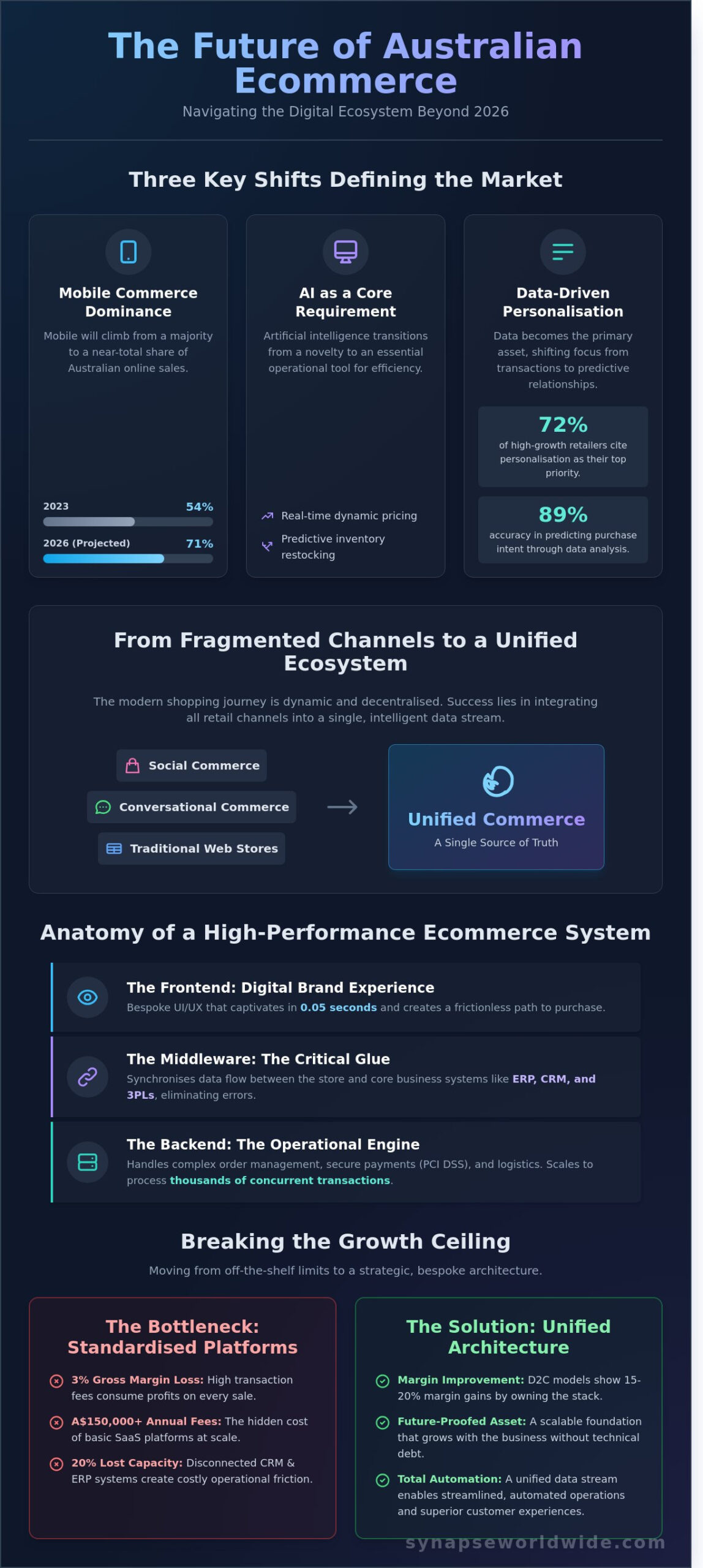
The 2026 landscape demands a mobile-first, AI-augmented approach to digital sales. In 2023, mobile commerce accounted for 54% of Australian online sales, but projections for late 2026 suggest this figure will climb to 71%. Retailers who fail to optimise for the palm of the hand are effectively invisible. A comprehensive mobile app development strategy has become as critical as the storefront itself, enabling businesses to deliver personalised, high-performance experiences that drive repeat purchases. Simultaneously, Artificial Intelligence has moved from a speculative tool to a core operational requirement. It now manages everything from real-time dynamic pricing to predictive inventory restocking, ensuring that businesses remain lean and responsive to market fluctuations.

Data has emerged as the primary currency in successful online ventures. In the Australian market, 72% of high-growth retailers reported that data-driven personalisation was their top priority in 2024. By capturing and analysing granular customer interactions, businesses can predict purchasing intent with 89% accuracy. This shift transforms ecommerce from a reactive transaction point into a proactive service that anticipates consumer needs before they are explicitly stated. It’s a transition from selling products to managing lifelong customer relationships through digital intelligence.

The Evolution of Online Selling

We’ve moved past the era of static digital catalogues. Modern shopping journeys are dynamic, highly personalised, and often decentralised. Social commerce on platforms like Instagram and TikTok Shop now accounts for a projected A$1.5 billion in the Australian market as of 2025, allowing consumers to checkout without ever leaving their feed. Messaging apps have also become vital storefronts, facilitating conversational commerce that mimics the intimacy of an in-store experience. Unified Commerce is the integration of all retail channels into a single data stream.

Key Components of a Robust Ecommerce System

A high-performing system requires three distinct but interconnected layers to ensure scalability and reliability. The frontend represents the digital brand experience. It requires a bespoke UI/UX design that captures attention within the first 0.05 seconds of a page load. This is where your brand’s visual identity meets functional navigation, creating a frictionless path to purchase that converts casual browsers into loyal advocates.

The backend serves as the operational engine room. It handles complex order management, ensures PCI DSS compliance for secure A$ payments, and orchestrates intricate logistics workflows. A robust backend allows a business to process thousands of concurrent transactions without performance degradation. For Canberra retailers, this means having a system that scales instantly during peak periods like Black Friday or Boxing Day sales.

The middleware acts as the critical glue that connects your store to the broader business ecosystem. This layer synchronises your online platform with ERP systems, CRM databases, and third-party logistics providers. By automating the data flow between these points, you eliminate manual data entry errors and provide customers with real-time updates on stock levels and shipping status. This integrated approach ensures that your digital presence is a true reflection of your physical business operations.

Strategic Ecommerce Models: Beyond B2C and B2B

Modern retail in Canberra requires more than a digital storefront; it demands a sophisticated architectural approach to Strategic Ecommerce Models that bridge the gap between wholesale and direct consumer engagement. The traditional silos of B2C and B2B are dissolving. In their place, we see the rise of Direct-to-Consumer (D2C) pathways and hybrid frameworks that allow businesses to capture multiple market segments simultaneously. Australian brands that adopted D2C models in 2023 saw average margin improvements of 15% to 20% by removing intermediaries and owning the first-party customer data.

Wholesalers are no longer content staying behind the curtain. Approximately 42% of Australian manufacturers now operate their own retail-facing platforms. This shift isn’t about competing with retail partners; it’s about market resilience. By diversifying, a business can leverage high-volume marketplace dynamics on platforms like Amazon Australia or eBay while maintaining a high-margin, bespoke brand experience on its own domain. Subscription-based ecommerce has also matured. It’s no longer just for niche consumables. From industrial filters to premium Canberra-produced spirits, recurring revenue models provide the predictable cash flow necessary for aggressive scaling.

The B2B Digital Transformation

B2B buyers are also B2C consumers in their personal lives. They now expect a frictionless, Amazon-like user experience when ordering for their companies. Professional B2B platforms must manage complex pricing tiers where Customer A sees different rates than Customer B based on historical volume. We implement logic that handles bulk ordering, tax-exempt status, and recurring purchase histories with 99.9% accuracy. Secure client portals are the foundation of this strategy, turning a simple transaction into a long-term retention tool that reduces the overhead of manual sales processing.

Headless Commerce: The 2026 Standard

Headless architecture is the benchmark for retailers planning for the next decade. By decoupling the frontend presentation layer from the backend commerce engine, we provide ultimate flexibility. This separation means your ecommerce site isn’t slowed down by heavy plugins or rigid templates. Brands moving to headless setups frequently report a 32% increase in mobile conversion rates because the frontend can be optimized for sub-second load times. This architecture future-proofs your brand, allowing you to push content to smart mirrors, wearables, or IoT devices without rebuilding your entire core database.

Successful digital transformation requires a partner who understands these intricate technical layers. Our team focuses on building scalable ecommerce solutions that align with your specific growth targets. Whether you’re managing complex B2B hierarchies or launching a high-growth D2C brand, the architecture must support the ambition. We ensure your platform handles the load during peak periods like Black Friday while maintaining the security protocols required by Australian privacy laws.

Ecommerce in 2026: The Strategic Guide to Building Scalable Online Ventures

Bespoke Development vs. SaaS: Making the Strategic Choice

Selecting the right foundation for your digital storefront is a pivotal capital allocation decision. It determines your ceiling for growth and your long term operational efficiency. While many Canberra retailers begin their journey looking at monthly subscription costs, a sophisticated analysis requires evaluating the Total Cost of Ownership (TCO). A standard SaaS subscription might start at A$40 per month, but hidden costs quickly accumulate. For a retail business generating A$2 million in annual revenue, transaction fees and premium app subscriptions can easily exceed A$30,000 per year. These recurring expenses often outweigh the upfront investment of a custom build within 24 to 36 months.

Off-the-shelf platforms frequently become a bottleneck when your business logic outgrows standard templates. If your operations require complex product configurations or multi-warehouse inventory syncing, you will likely hit a functional wall. Custom-coded ecommerce solutions provide a robust alternative. They offer superior security by reducing reliance on third-party plugins, which accounted for 78% of CMS vulnerabilities in 2023. A bespoke architecture ensures your site remains performant during high-traffic events like Black Friday, where a one-second delay in page load can result in a 7% reduction in conversions.

When to Choose SaaS (Shopify, BigCommerce)

SaaS platforms are ideal for startups or low-complexity retailers prioritising speed-to-market. You can launch a functional store in under 14 days using pre-built themes. However, this convenience comes with a trade-off in long-term customisation. As you scale, you may encounter “app-bloat.” Integrating ten different apps to handle loyalty programs, advanced SEO, and shipping logic can degrade mobile performance by up to 40%. This creates a fragmented user experience that is difficult to optimise.

The Case for Bespoke Ecommerce Development

Bespoke development allows you to create unique user journeys that generic templates cannot replicate. You aren’t just renting space on a platform; you are building a proprietary business asset. Custom code gives you total control over the checkout flow and data architecture. This level of precision is vital when implementing a sophisticated CRM, ERP, and Automation Integration strategy to streamline your back-office tasks. Owning your intellectual property means your technology stack evolves exactly as your business does.

Bespoke solutions eliminate the per-transaction success taxes common in SaaS models, ensuring your margins remain intact as your order volume scales. This financial clarity allows for more aggressive reinvestment into marketing and product development. When your ecommerce platform is tailored to your specific operational workflows, you reduce manual data entry and human error. We see Canberra businesses achieve a 25% increase in operational throughput after migrating from restrictive SaaS environments to integrated, custom-built ecosystems. This transition moves your digital presence from a simple sales tool to a scalable engine for enterprise-level transformation. For growing Australian SMEs, investing in custom web design for small business is a critical step in ensuring your chosen platform supports this level of growth without accumulating technical debt. Aligning your CMS and digital strategy is equally essential to ensuring your infrastructure scales alongside your ambitions.

Scaling Your Venture: CRM, ERP, and Automation Integration

A standalone store is a strategic liability for any ambitious Australian retailer. When your digital storefront operates as an isolated island, data silos inevitably lead to friction. By 2024, retailers relying on manual data entry between platforms face a 15% higher operational cost compared to those with integrated systems. This fragmentation creates a ceiling on your growth; you can’t scale what you can’t see. True ecommerce success requires a unified architecture where your website, inventory, and customer data communicate in a continuous loop.

Synchronising your operations through an Enterprise Resource Planning (ERP) system transforms your business from a reactive shop into a proactive powerhouse. You eliminate the lag between a customer clicking ‘buy’ and your warehouse team receiving the pick list. For Canberra businesses managing both physical showrooms and online stock, this visibility is the difference between a loyal customer and a refund request due to an out-of-stock item.

The Power of ERP Integration

Real-time inventory management is the backbone of modern retail. If you manage multiple warehouses or a storefront in Braddon alongside a warehouse in Fyshwick, you need a single source of truth. Integrated systems provide immediate updates across all channels, preventing overselling and protecting your brand reputation. Automating financial reporting and tax compliance according to Australian standards simplifies BAS lodgement and GST tracking. A 2023 study showed that Australian SMEs using ERP automation reduced human error in logistics by 32%, significantly cutting down on costly return shipping and manual corrections.

Marketing Automation and Personalisation

Customer Relationship Management (CRM) data should be the engine of your marketing strategy. Moving beyond basic abandoned cart reminders, sophisticated automation uses trigger-based emails tailored to specific buyer behaviours. If a customer consistently purchases high-end office furniture, your system should automatically suggest bespoke ergonomic accessories via AI-driven predictive modelling. Our SEO services complement this integrated approach by ensuring the data gathered from high-intent search traffic feeds directly into your CRM, allowing for hyper-personalised retargeting campaigns that drive higher Lifetime Value (LTV). Pairing this with a dedicated digital marketing Canberra strategy ensures your campaigns are precisely calibrated to the ACT’s unique professional and public sector audience, rather than relying on generic targeting that erodes budget and suppresses lead quality.

Automating the mundane tasks allows your team to focus on high-level strategy rather than data entry. This includes:

  • Inventory synchronisation: Updates occur in milliseconds across all sales channels.
  • Automated support: AI-powered chatbots handle 70% of routine tracking enquiries, freeing up staff for complex issues.
  • Dynamic pricing: Adjusting margins based on real-time competitor data and stock levels.
  • Logistics automation: Generating shipping labels and manifest reports the moment an order is verified.

Building a scalable venture isn’t just about selling more products. It’s about creating a robust infrastructure that handles a 500% surge in traffic without breaking. When your CRM, ERP, and ecommerce platform work in harmony, you gain the clarity needed to make data-backed decisions that propel your business to the next level of success. Pairing this integration with proactive website management for Australian business growth ensures your platform remains secure, performant, and ready to scale without interruption.

Ready to unify your digital operations? Consult with our strategic architects to build a scalable integration roadmap today.

The Synapse Framework: Your Digital Architect for Ecommerce Success

Synapse Worldwide functions as your strategic partner, closing the distance between high-level vision and technical deployment. We understand that a website isn’t just a digital brochure; it’s a complex revenue engine. Our framework treats every ecommerce build as a structural masterpiece, where the foundation must be as stable as the facade is attractive. We move beyond simple templates to create bespoke environments that reflect your brand’s unique value proposition while maintaining the rigorous technical standards required for modern retail.

We eliminate the financial ambiguity often found in the tech sector through our fixed-price model. Budget creep is a significant risk in complex digital projects, often caused by poor scoping or unforeseen technical hurdles. Our approach removes this stress. Whether your project requires 100 or 150 hours to perfect, your initial quote remains the final cost. This protects your capital and ensures our team stays focused on delivering a high-quality product rather than tracking billable hours. It’s a commitment to transparency that builds long-term trust with our Canberra clients.

Our team provides local retailers with Australian-specific compliance expertise, such as strict adherence to the Privacy Act 1988, while leveraging global performance benchmarks. We bridge the gap between local market nuances and international technology trends. This ensures your store performs flawlessly for a customer in Manuka while remaining scalable enough to handle international traffic. Reliability is our baseline; we maintain a 99.99% uptime standard and perform monthly security audits to protect against the 33% increase in cyber threats observed in the Australian retail sector since 2023. A disciplined approach to strategic website management underpins every deployment we deliver, transforming your digital asset from a potential liability into a consistently high-performing revenue engine.

Our Custom Development Process

We begin with a discovery phase that maps every touchpoint of your customer journey. Our UI/UX designers use data-driven insights to inform layout decisions, ensuring the interface guides users toward conversion without friction. When it’s time to build, we follow strict coding standards and rigorous security auditing to prevent vulnerabilities. If you’re moving from a legacy platform, our migration protocols ensure 100% data integrity for your existing customer records, product catalogues, and order histories, preventing the common pitfalls of data loss during transitions.

Transforming Your Digital Landscape

The 2026 digital economy will reward retailers who prioritize speed, mobile optimization, and personalization. Australian ecommerce revenue is projected to surpass A$64 billion by next year, and our framework ensures your business is positioned to capture its share of that growth. We don’t just build websites; we engineer high-performance assets designed to maximize your return on investment. Complementing your ecommerce platform with a bespoke mobile app development solution can further accelerate customer engagement and loyalty in an increasingly app-first Australian market. Every line of code and every design element serves the ultimate goal of turning browsers into loyal, repeat customers. If you’re ready to scale your operations and lead the market, book a strategic consultation for your ecommerce project today.

Architecting Your 2026 Market Dominance

The roadmap to 2026 demands more than a simple storefront. Success depends on a robust infrastructure that connects customer experience with operational precision. You’ve explored how the choice between SaaS and bespoke development dictates your long-term agility. You also know that true scalability relies on deep CRM and ERP integrations to automate complex workflows. Navigating these technical shifts alone is a risk your business shouldn’t take.

Synapse Worldwide has been leading this digital evolution since 2005. We’ve spent 19 years refining the Synapse Framework to ensure your ecommerce venture isn’t just functional but formidable. Our team eliminates financial surprises by utilizing fixed-price project delivery, providing the certainty your budget requires. We’re specialists in CRM and ERP integrations, turning fragmented data into actionable insights for the Australian market. It’s time to move beyond cookie-cutter templates and embrace a solution built for your specific scale.

Partner with Synapse for Bespoke Ecommerce Development and secure a digital ecosystem designed for permanent growth. Your vision is ready for a professional architect.

Frequently Asked Questions

How much does a custom ecommerce website cost in 2026?

In 2026, a high-performance custom ecommerce platform in Australia typically ranges from A$35,000 for mid-market solutions to over A$120,000 for enterprise-grade architecture. These figures reflect the increased demand for AI-driven personalization and deep ERP integrations. Synapse Worldwide ensures every dollar contributes to a scalable asset that drives measurable growth. Your investment covers bespoke UI/UX design and a robust backend built for the competitive Australian retail landscape.

What is the difference between ecommerce and e-business?

Ecommerce refers specifically to the online transaction of buying and selling products or services. In contrast, e-business encompasses the entire digital infrastructure of a company, including supply chain management and online customer service. While 85% of retail interactions involve an ecommerce touchpoint, e-business integrates every internal process to ensure operational efficiency. We focus on building solutions that function as the core engine of your broader e-business strategy.

How long does it take to develop a bespoke ecommerce platform?

Developing a bespoke ecommerce platform generally requires a timeline of 12 to 24 weeks from discovery to deployment. This schedule accounts for 4 weeks of strategic planning, 8 weeks of custom coding, and 2 weeks of rigorous quality assurance testing. We prioritize a structured roadmap to ensure your platform launches with zero friction. Our team manages every technical detail so you can focus on scaling your Canberra-based retail operations.

Do I need a separate CRM if I have an ecommerce platform?

You need a separate CRM to manage complex customer lifecycles and personalized marketing automation effectively. While standard ecommerce platforms capture order data, a dedicated CRM like Salesforce or HubSpot provides a 360-degree view of your 10,000+ customer interactions. Integrating these systems allows for a seamless flow of data that boosts retention rates by up to 27%. We architect these integrations to ensure your sales and marketing efforts remain perfectly synchronized.

What are the most secure payment gateways for Australian ecommerce?

Stripe, eWAY, and Airwallex currently stand as the most secure and reliable payment gateways for Australian retailers. These providers offer PCI-DSS Level 1 compliance and robust fraud prevention tools that protect 99.9% of digital transactions. Choosing an integrated gateway ensures a seamless checkout experience for your customers while maintaining the highest security standards. We implement these strategic financial tools to build trust and stabilize your digital revenue streams.

Can I migrate my existing Shopify or WooCommerce store to a custom solution?

You can migrate your existing Shopify or WooCommerce store to a custom solution through a structured data mapping process. This transition involves transferring your product database, customer history, and SEO metadata to a more scalable architecture. We’ve helped retailers move over 50,000 SKUs without losing search engine authority or customer records. A custom platform eliminates the limitations of template-based systems and provides a tailored foundation for long-term business transformation.

How does headless commerce impact my SEO rankings?

Headless commerce improves your SEO rankings by decoupling the frontend presentation from the backend logic, resulting in page load speeds under 1.5 seconds. Faster performance directly influences Google’s Core Web Vitals, which can lead to a 15% increase in organic visibility. This architecture allows for bespoke content delivery across multiple devices without technical bloat. We optimize every layer of your headless setup to ensure your brand dominates the local search landscape.


The Strategic Guide to Choosing a Marketing Agency in Canberra for 2026

The Strategic Guide to Choosing a Marketing Agency in Canberra for 2026

By 2026, the era of the creative-only retainer is dead; 82% of Australian CMOs now prioritize technical integration over aesthetic appeal. You’ve likely realized that a beautiful website is a liability if it doesn’t communicate with your internal sales systems or provide transparent ROI reporting. It’s frustrating to invest A$60,000 annually only to receive reports focused on vanity metrics rather than actual revenue growth. Finding a marketing agency Canberra leaders can rely on requires a shift in perspective. You need more than a vendor; you need a strategic partner who functions as a Digital Architect.

We agree that your marketing spend shouldn’t be a black hole of awareness campaigns that lack technical substance. This guide reveals how to identify partners that build robust, scalable digital infrastructures that link every dollar spent directly to your bottom line. We’ll examine the three critical pillars of technical infrastructure, strategic ROI, and bespoke system integration that define the next generation of business success.

Key Takeaways

  • Navigate the unique intersection of the ACT’s public and private sectors by identifying the essential services a full-service partner must provide in 2026.
  • Learn to distinguish between high-volume “cookie-cutter” providers and a bespoke marketing agency canberra to ensure your investment drives long-term strategic ROI.
  • Understand why data-driven PPC management and high-impact SEO are critical components of a robust, modern technical infrastructure.
  • Master a step-by-step framework for auditing your current digital performance and measuring the seamlessness of your customer’s conversion journey.
  • Discover how the “Digital Architect” philosophy creates scalable, integrated systems that transform your online presence into a high-performing business asset.

The Evolution of the Canberra Marketing Landscape in 2026

By 2026, the definition of a full-service marketing agency Canberra has shifted from a vendor of creative services to a strategic growth partner. It’s no longer enough to provide isolated outputs like a single social media campaign or a basic website refresh. A modern agency must deliver a unified strategy that encompasses data science, technical infrastructure, and high-level creative execution. This year, the focus has moved toward long-term value over short-term spikes. Businesses require a partner that manages the entire customer journey, from the first search impression to the final CRM entry.

Canberra operates at a unique crossroads that sets it apart from Sydney or Melbourne. With over 30% of the local workforce employed in the public sector as of 2025, businesses must navigate a dual-market reality. You’re often marketing to both the individual consumer in suburban Gungahlin and the high-level decision-maker within the Parliamentary Triangle. Successful digital marketing strategies in the ACT now require a deep understanding of government procurement cycles alongside private sector agility. If your agency doesn’t understand this intersection, they’re missing half of your potential revenue stream.

Traditional siloed marketing is failing in 2026. Data from recent Q1 industry reports shows that fragmented campaigns result in a 22% higher customer acquisition cost compared to integrated models. When SEO, paid media, and content teams don’t speak to each other, the brand message becomes diluted and the user experience suffers. We approach growth with a Digital Architect mindset. This means we design the structural integrity of your brand before we focus on the aesthetic details. It’s the difference between building a temporary pop-up shop and a permanent landmark. We don’t just “do” SEO; we build scalable systems that drive predictable revenue.

Why Local Canberra Expertise Still Matters

Canberra residents hold the highest percentage of postgraduate degrees in Australia at roughly 15.5%. This creates a discerning audience that values transparency, depth, and local relevance over flashy, low-substance advertising. Whether your business is located in the boutique streets of Griffith or the emerging hubs of Belconnen, local nuances dictate purchasing behavior. Strategic consulting in person remains vital; it builds a level of trust that digital-only communication can’t replicate. With median weekly earnings in the ACT hovering around A$2,020, the local market has high purchasing power, but they’re quick to dismiss brands that don’t feel authentic to the Canberra experience.

The Shift from Campaigns to Ecosystems

Your website isn’t a digital brochure in 2026; it’s the central engine of your entire business operation. It must handle everything from lead capture to automated follow-ups without manual intervention. By integrating sophisticated marketing automation, local firms are reducing manual lead-handling time by 40% on average this year. A Digital Ecosystem is an integrated network of web, CRM, and marketing tools. This infrastructure ensures that every touchpoint remains seamless and measurable. When your tools work in harmony, you gain a 360-degree view of your customer, allowing for the kind of precision targeting that was impossible just three years ago. We ensure your technical stack is robust enough to support your most ambitious growth targets.

Core Services: Beyond Basic Search Engine Optimization

Most businesses in the ACT treat digital growth as a series of isolated tasks. They buy a website, then hire an SEO specialist, then perhaps run some ads. This fragmented approach creates data silos and wasted spend. As a leading marketing agency canberra businesses trust, Synapse Worldwide integrates these pillars into a unified growth engine. We focus on the A$10,000 return, not just the A$100 click. Our methodology moves beyond surface-level metrics to address the deep architectural needs of a modern enterprise.

SEO Services Canberra: Dominating Local and National Search

Technical health provides the foundation, but content strategy wins the market. For ACT-based firms, this means balancing local visibility with national authority. We manage SEO as a long-term monthly digital marketing retainer because search algorithms change 500 to 600 times annually. By 2026, search intent will completely eclipse simple keyword volume. We don’t just rank you for “plumber”; we position you for “emergency hot water repair Canberra North,” capturing users at the exact moment of high-intent need. This requires a dual focus. Your site must be technically flawless for crawl bots while providing high-value, authoritative answers for human users. Understanding how to deploy seo services strategically in 2026 is essential for any Canberra business looking to build a dominant national digital footprint.

Google Ads management has shifted from manual bidding to sophisticated machine-learning oversight. Data-driven management is non-negotiable if you want to avoid burning through your budget. An experienced marketing agency canberra teams often uncover that the missing link in local strategies is the integration of CRM and ERP systems. When your website talks to your inventory or lead management software, you gain a 360-degree view of your customer lifetime value. This process begins by auditing your marketing performance to ensure every dollar aligns with lead quality rather than just vanity traffic. We bridge the gap between marketing spend and actual revenue recorded in your accounting software.

Custom Web Design and E-commerce Infrastructure

Bespoke design consistently outperforms cookie-cutter templates in conversion rate optimization. A 2024 study showed that custom-built interfaces can increase user engagement by 42% compared to generic themes. We build scalable e-commerce infrastructure that acts as a revenue driver, not just a technical project. This includes integrating Stripe or other secure Australian payment gateways for a frictionless checkout. Whether it’s a specialized booking system or a complex product configurator, our custom web applications solve specific business bottlenecks that off-the-shelf software cannot touch.

The strategic advantage of a custom-built application lies in its scalability. As your Canberra business grows from a local boutique to a national provider, your infrastructure must adapt without requiring a total rebuild. Transitioning from a static site to a dynamic sales tool requires a bespoke digital strategy tailored to your specific industry benchmarks. We ensure your digital presence is robust, secure, and ready to handle high-volume transactions as you scale.

The Strategic Guide to Choosing a Marketing Agency in Canberra for 2026

Selecting the right marketing agency canberra requires a clear framework to distinguish between “The Volume Shop” and “The Bespoke Architect.” Volume shops operate on high turnover, assigning junior account managers to handle 40 or 50 clients simultaneously. They rely on rigid templates and automated reporting that looks impressive but lacks strategic depth. In contrast, a Bespoke Architect treats your digital presence as a unique engineering project. They limit their client roster to ensure every campaign receives senior-level attention and custom-coded solutions that align with specific business goals.

The long-term cost of “cheap” marketing is often higher than a premium strategic partnership. A A$600 monthly SEO package usually covers little more than basic directory listings and low-quality backlinks. If this “bargain” fails to generate leads for 12 months, the true cost is the A$7,200 spent plus the hundreds of thousands in lost revenue from missed opportunities. High-value partnerships focus on ROI metrics rather than vanity numbers. While the initial investment is higher, the focus on conversion rate optimisation and technical precision creates a scalable asset rather than a monthly expense.

Billing models also dictate the quality of service you receive. Fixed-price models provide budget certainty, but they can lead to “scope creep” friction or incentivise agencies to do the bare minimum to protect their margins. Hourly billing offers transparency, yet it can feel like a blank cheque. The most effective model for the client is a value-based retainer that includes clearly defined deliverables and performance milestones. This ensures the agency is invested in your growth, not just your clock-out time.

Many business owners consider hiring an in-house marketing person to save money. In Australia, a competent mid-weight marketing manager commands a salary between A$95,000 and A$120,000 plus superannuation, equipment, and office space. For this investment, you get one person’s perspective. Partnering with a professional marketing agency canberra provides access to a full suite of specialists, including developers, copywriters, and data analysts, for a significantly lower annual cost.

The Anatomy of a High-Performance Agency

Technical proficiency is the primary differentiator in a crowded market. Evaluate whether an agency can write custom code or if they are simply “plugin installers” who break your site during the next WordPress update. Since 2004, Synapse Worldwide has focused on technical excellence, maintaining a 98% client retention rate by solving complex integration issues. Look for a portfolio that demonstrates diversity; an agency that has successfully managed A$50,000 monthly ad spends across different sectors like healthcare, construction, and e-commerce has the technical maturity to handle your unique challenges.

Red Flags in Canberra Marketing Proposals

Be sceptical of any proposal promising “Guaranteed #1 Rankings” or “Instant Traffic.” Google’s March 2024 Core Update specifically targeted the spammy, black-hat tactics used by agencies that make these claims. Another major red flag is a lack of data ownership. If an agency refuses to give you administrative access to your own Google Ads or Analytics accounts, they are holding your business hostage. Finally, avoid proposals that ignore your internal business systems. A strategy that doesn’t account for your CRM or sales process is just a superficial layer that won’t drive actual revenue growth.

How to Audit Your Current Marketing Performance

Auditing your digital presence is more than a cursory glance at your monthly traffic reports. It requires a clinical examination of how your capital moves through the digital ecosystem. For many Canberra enterprises, marketing spend often vanishes into “black hole” retainers that prioritize activity over outcomes. To truly understand your performance, you must measure the friction between a prospect’s first click and their final conversion. If your current marketing agency canberra isn’t providing a transparent breakdown of cost-per-acquisition (CPA) versus customer lifetime value (LTV), your strategy lacks a necessary foundation.

A preliminary audit begins with a rigorous analysis of your monthly retainers. If you’re paying between A$2,500 and A$8,000 per month for digital services, you should see a direct, measurable correlation with qualified lead growth. You can conduct a basic ROI check by subtracting your total marketing spend from the gross profit generated via digital channels, then dividing by that same spend. If this ratio hasn’t shown an upward trend over the last 180 days, your user journey likely suffers from “leaky” touchpoints where potential clients drop off due to a lack of relevance or excessive technical friction. Businesses experiencing this plateau should explore how a dedicated SEO Canberra strategy built on AI-ready digital architecture can restore organic momentum and reduce dependence on paid channels.

  • Step 1: Trace a single lead from the initial Google search to the final “Thank You” page.
  • Step 2: Compare your monthly ad spend against the actual number of sales-qualified leads (SQLs), not just “hits.”
  • Step 3: Review your mobile site on a mid-range device to experience what 65% of your Canberra audience sees.

The Technical Audit: Under the Hood

Technical stability is the silent engine of your marketing success. Use tools like Google PageSpeed Insights to verify if your site meets the 2024 Core Web Vitals benchmarks. A site taking longer than 2.8 seconds to load can trigger a 40% drop in conversions, effectively wasting nearly half of your paid traffic budget. Identify “leaks” by checking exit rates in Google Analytics 4; if a high percentage of Canberra leads abandon your service pages, the friction is likely technical or structural. Persistent technical debt functions as a hidden tax on your marketing budget, eroding your conversion potential before a user even engages with your content.

The Strategic Audit: Aligning Goals with Execution

Strategy fails when KPIs are disconnected from the balance sheet. High click-through rates are meaningless if those clicks don’t transform into revenue-generating consultations or sales. You must evaluate lead quality by tracking how many digital enquiries actually reach the “closed-won” stage in your CRM. A sophisticated marketing agency canberra focuses on capturing high-intent traffic rather than chasing vanity metrics that look impressive in a slide deck but fail to impact your bottom line. To see exactly where your specific gaps lie, you can Get Your Free Canberra SEO Audit to receive a data-driven breakdown of your current standing.

Stop guessing about your digital growth and start making decisions based on forensic data. Secure your professional performance review with Synapse Worldwide to eliminate waste and accelerate your results.

Synapse Worldwide: Your Digital Architect in Canberra

Synapse Worldwide began building the digital infrastructure of the Australian Capital Territory in 2005. Over the past 19 years, we’ve evolved from a local service provider into a sophisticated marketing agency canberra businesses rely on for high-stakes digital transformations. Our journey is defined by a commitment to technical excellence and a deep understanding of the local economic climate. We don’t just build websites; we engineer scalable digital environments that serve as the backbone for your commercial success.

Our philosophy centers on bespoke solutions. We recognize that a template-based approach is a ceiling on your potential. Instead, we architect systems that scale as your business growth accelerates. If your lead volume increases by 400% over the next 12 months, your digital platform should remain stable and efficient. We prioritise this scalability from day one, ensuring your initial investment continues to deliver value as you move from a local player to a national leader.

The “Fixed-Price” promise is a cornerstone of our client relationships. We’ve seen how budget overruns in custom development can cripple a marketing budget. To eliminate this anxiety, we provide comprehensive, fixed-price quotes for every project. If we quote A$20,000 for a complex system integration, that’s the final figure you see on the invoice. This transparency allows you to plan your fiscal year with total confidence, knowing that technical complexities won’t result in unexpected bills.

Efficiency in modern marketing requires more than just high traffic; it requires seamless data flow. We specialise in integrating ERP and CRM solutions directly into your marketing ecosystem. By connecting your front-end lead generation with back-end systems like SAP or HubSpot, we eliminate the manual data entry that often plagues growing firms. This integration typically reduces administrative lead-processing time by 35%, ensuring your sales team acts on fresh data while it’s most relevant.

Proven Results Across Australia and Beyond

Our impact is best seen through the success of our partners. We recently transitioned a Canberra-based SME into a national e-commerce leader, resulting in a 210% increase in interstate revenue within 14 months. This was achieved through the power of integrated marketing. By synchronising SEO, targeted PPC campaigns, and custom software, we created a frictionless path from search query to checkout. Our clients stay with us for the long term, often exceeding six years of partnership, because we provide essential annual maintenance and proactive security support that keeps their digital assets at peak performance.

Start Your Transformation Today

Your transformation begins with a detailed strategic consultation with our Canberra team. We don’t guess; we analyse. During this initial phase, we audit your current performance and identify the specific bottlenecks stifling your growth. We then move through a disciplined process from discovery to high-fidelity UI/UX design and final implementation. Every step is documented and aligned with your specific KPIs. It’s time to move beyond standard tactics and adopt a truly strategic approach to your digital presence. Partner with Synapse Worldwide for Strategic Growth and secure your position as a market leader.

Secure Your Competitive Advantage in the 2026 Digital Landscape

Navigating the Canberra market in 2026 requires a shift from superficial tactics to deep technical integration. You’ve seen how bespoke digital architecture outperforms generic templates and why auditing your current performance is the first step toward genuine scaling. Transitioning your operations into a seamless, data-driven ecosystem isn’t just an advantage; it’s a necessity for sustained growth in an increasingly crowded marketplace.

As a premier marketing agency canberra, Synapse Worldwide brings the authority of a firm established in 2005. We’ve spent 20 years refining a model that balances high-level strategy with practical, hands-on execution. Our specialists focus on custom ERP and CRM integrations to ensure your internal systems communicate perfectly with your external marketing efforts. Because we value budget certainty, we provide fixed-price project development to eliminate financial surprises. You’ll gain a robust platform designed for measurable ROI and long-term stability.

Elevate your business with Canberra’s leading digital architects. Contact Synapse Worldwide today.

The future of your brand depends on the foundations you lay today. We’re ready to build something remarkable with you.

Frequently Asked Questions

What does a marketing agency in Canberra typically charge?

A professional marketing agency in Canberra typically charges between A$2,500 and A$10,000 per month for comprehensive management services. For project-based work, hourly rates in the ACT generally range from A$180 to A$300. These costs vary based on the scale of your campaign and the level of technical expertise required to achieve your specific growth targets. We focus on delivering a measurable return that justifies this investment through increased lead quality and brand equity.

How long does it take to see results from SEO services in Canberra?

You will typically observe measurable improvements in organic rankings within 90 to 180 days of implementing a strategic SEO campaign. While initial technical fixes often provide quick wins in the first 30 days, sustainable growth in the Canberra market requires a consistent 12-month commitment to achieve top-three positions for high-value search terms. We prioritize long-term authority over short-lived spikes to ensure your digital presence remains robust and profitable. For a broader perspective on how modern seo services are evolving to support national digital growth, our strategic guide outlines the architectural shifts required to stay competitive.

Why should I choose a local Canberra agency over a national or offshore one?

Selecting a local marketing agency in Canberra ensures your strategy is informed by a deep understanding of the ACT’s unique economic and political climate. We provide the benefit of face-to-face consultations and a network of local connections that national or offshore firms simply lack. Our team targets the 460,000 residents in the region with precision, ensuring your brand stays relevant and authoritative within the local business community.

What is the difference between a digital marketing retainer and a fixed-price project?

A digital marketing retainer provides ongoing strategic support and continuous optimization for a set monthly fee, whereas a fixed-price project covers a specific deliverable with a defined end date. Retainers are ideal for scaling long-term revenue through SEO and paid media. Fixed-price models work best for one-off assets like a bespoke website build or a 60-day brand identity refresh. Both models ensure transparency and budget predictability for your business.

Can you integrate my existing CRM with a new custom website?

We regularly integrate custom websites with leading CRM platforms like Salesforce, HubSpot, and Zoho through secure API protocols. This ensures that 100% of your lead data flows directly into your sales pipeline without manual entry or data loss. Our technical team builds robust bridges between your frontend user experience and backend operations to maximize your operational efficiency. This integration transforms your website from a simple brochure into a powerful lead-generation engine.

Do you provide marketing services for government contractors in the ACT?

Synapse Worldwide provides specialized digital strategies for government contractors who must demonstrate capability and security compliance to federal agencies. We understand the stringent requirements of the Australian Government’s procurement frameworks and the importance of professional positioning. Our team has helped firms refine their digital presence to reflect the high standards expected in the parliamentary triangle. We ensure your online profile aligns with the sophisticated expectations of public sector procurement officers.

What industries does Synapse Worldwide specialize in?

We specialize in high-growth sectors including professional services, technology firms, and B2B enterprises looking to scale their operations. Since our inception in 2005, we’ve delivered over 500 successful projects across these industries with a focus on measurable outcomes. Our expertise lies in creating integrated digital ecosystems that combine technical SEO, bespoke web development, and data-driven lead generation. This industry focus allows us to apply proven frameworks that accelerate your business transformation.

How do you measure the ROI of a digital marketing campaign?

We measure ROI by tracking specific KPIs such as Cost Per Acquisition (CPA) and Customer Lifetime Value (CLV) through an integrated data dashboard. Our reports translate technical metrics into clear financial outcomes, showing exactly how many A$1,000s in revenue were generated from your marketing spend. By analyzing the 25% increase in conversion rates often seen after our optimizations, we provide a transparent view of your investment’s performance. We believe in total accountability for every dollar spent.


The Modern Web Agency in 2026: A Strategic Guide to Digital Architecture

The Modern Web Agency in 2026: A Strategic Guide to Digital Architecture

A beautiful website is the most expensive paperweight your Australian business can own in 2026. If your current platform doesn’t actively communicate with your CRM or ERP, you aren’t running a digital storefront; you’re managing a liability. Most leaders agree that the era of the ‘set and forget’ site is over, especially when 68% of Australian SMEs report that fragmented systems are their primary barrier to scaling. You’ve likely felt the frustration of a high-priced web agency delivering a stunning visual product that fails to produce a measurable return on investment or leaves you locked into unscalable, proprietary code.

This guide promises to shift your perspective from visual design to digital architecture. You’ll learn how to identify and partner with a strategic ally that builds a unified ecosystem designed to drive revenue through automation and seamless data flow. We’ll examine the specific criteria for selecting a long-term partner and how to ensure your infrastructure remains robust enough to handle the next decade of growth without a total rebuild. It’s time to move beyond one-off transactions and start building a bespoke digital foundation that scales with your ambition.

Key Takeaways

  • Shift your perspective from aesthetic design to strategic digital architecture that integrates core business logic directly into your platform.
  • Understand the hidden risks of off-the-shelf templates and why bespoke infrastructure is essential for scaling enterprise growth in the Australian market.
  • Master a sophisticated framework for evaluating different partner models to find a web agency that balances local expertise with high-level technical execution.
  • Identify five critical questions for your next RFP that expose an agency’s true capabilities in system integration, security, and long-term maintenance.
  • Discover how to bridge the gap between initial discovery and market domination through a proven, results-oriented development methodology.

The Evolution of the Web Agency: From Design Shop to Digital Architect

The role of a web agency has undergone a radical transformation over the last decade. In 2015, the “Brochure Era” dominated the Australian market; businesses primarily sought a digital presence that functioned as a static calling card. By 2026, we have firmly entered the Integration Era. A modern partner no longer simply builds a site; they engineer a digital ecosystem that manages complex business logic, real-time inventory, and automated customer journeys. This shift represents a move from surface-level aesthetics to deep-rooted digital architecture.

A sophisticated web agency now functions as a strategic consultant that bridges the gap between your marketing goals and your operational realities. While the foundational principles of web design remain relevant for visual communication, they’re now secondary to the structural integrity of the platform. For a Canberra-based enterprise, this means your online store must do more than look professional. It has to integrate seamlessly with your ERP, handle local GST requirements automatically, and provide data-driven insights that inform your next quarterly pivot.

Transitioning from a design shop to a digital architect requires a focus on results rather than just deliverables. In the 2015 model, a project ended at launch. In the 2026 model, launch is merely the commencement of a continuous optimization cycle. We see a growing divide between businesses that treat their website as a cost center and those that view it as their most valuable employee, working 24/7 to scale operations without increasing headcount.

Why a ‘Pretty’ Website is No Longer Enough

Visual appeal is a baseline expectation, not a competitive advantage. Research indicates that users form an opinion about a website’s credibility in just 0.05 seconds. However, 88% of online consumers won’t return to a site after a single poor user experience (UX), regardless of how attractive the interface looks. In a saturated Canberra market, technical performance is the new currency of trust. Core Web Vitals, specifically Largest Contentful Paint (LCP) occurring under 2.5 seconds, are now mandatory for search engine visibility and user retention. Digital Architecture is the structural blueprint of a company’s online presence. It ensures that every pixel serves a functional purpose and every interaction leads the user toward a conversion goal. Relying on aesthetic-only design is a liability that leads to high bounce rates and stagnant growth.

The Partnership Model vs. The Vendor Model

The distinction between a vendor and a partner defines the trajectory of your online store. Vendors execute tasks; they build the pages you ask for without questioning the underlying strategy. Partners offer strategic consulting, identifying potential bottlenecks in your checkout flow or suggesting scalable growth paths before they become issues. Synapse Worldwide’s 20-year history informs our architectural approach, allowing us to anticipate shifts in the digital landscape that newer firms might overlook. We focus on long-term maintenance and robust scalability, ensuring your A$50,000 investment today doesn’t become obsolete by next year. Choosing a partner means securing a proactive ally dedicated to your return on investment and the seamless integration of your digital and physical operations.

  • Strategic Consulting: Moving beyond code to solve business problems.
  • Scalable Infrastructure: Building for the traffic you want, not just the traffic you have.
  • Operational Integration: Connecting your store to shipping, accounting, and CRM systems.
  • Data-Driven Growth: Using actual user behavior to dictate design changes.

Beyond the Surface: Why Custom Infrastructure Outperforms Template Solutions

Off-the-shelf templates often promise speed but deliver a ceiling. Research from early 2024 indicates that 64% of enterprise-level ecommerce failures stem from rigid software architecture that cannot adapt to shifting consumer demands. A template might look professional on day one; however, it lacks the surgical precision required for high-volume Canberra retailers. Our web agency experts frequently see businesses outgrow these frameworks within 18 months, leading to costly migrations. Bespoke development eliminates the “plugin bloat” that slows site speeds, ensuring your store remains lean and lightning-fast.

Custom infrastructure offers a hardened perimeter. Unlike open-source templates where vulnerabilities are publicly documented, bespoke codebases are unique. This reduces the attack surface for automated bots. Scalability is equally vital. If your Canberra store experiences a 300% surge in traffic during a seasonal event, a custom-built application manages server resources dynamically. This ensures that your digital presence grows in lockstep with your revenue, preventing the catastrophic “site down” message during peak conversion windows. Investing in custom code is a commitment to long-term stability and A$1 million+ revenue targets.

Integrating CRM and ERP Systems

Your website serves as the primary data entry point for your entire operation. By centralizing customer interactions, you eliminate data silos that frustrate sales teams. Integrating a custom ERP ensures that inventory levels, supplier orders, and customer history remain synchronized in real-time. For example, custom software development Australia has allowed local logistics firms to reduce order processing delays by 55% through automated dispatch workflows. When your store communicates directly with your warehouse, human error disappears. This structural efficiency allows your team to focus on strategy rather than spreadsheets.

Marketing Automation and Data Syncing

Successful growth requires a closed-loop system between PPC, SEO, and lead management. APIs act as the connective tissue here, ensuring that a lead generated via a Google Ads campaign flows instantly into your nurturing sequence. This level of integration transforms a static store into a dynamic sales engine. By synchronizing these data points, businesses typically reduce manual administrative tasks by up to 40% within the first fiscal year of implementation. Partnering with a strategic web agency allows you to architect these systems from the ground up, ensuring every marketing dollar is tracked and optimized.

Bespoke applications allow for unique business logic that templates simply cannot replicate. Whether it’s a complex wholesale pricing tier or a custom loyalty program, your software should adapt to your business, not the other way around. Digital architecture is about building a foundation that supports A$10,000 days as easily as it supports your first sale. By choosing custom infrastructure, you’re not just launching a site; you’re deploying a high-performance business asset designed for the Australian market’s competitive demands.

The Modern Web Agency in 2026: A Strategic Guide to Digital Architecture

Evaluating Agency Models: Finding the Right Partner for Your Business Stage

Selecting a web agency in Canberra involves more than browsing a portfolio of stylish layouts. Your decision dictates your store’s scalability for the next 36 months. Statistics from 2024 indicate that 65% of long-term digital expenditure arises from post-launch maintenance, security patches, and marketing integration. You’ll want a partner who understands the Australian consumer market and the specific regulatory requirements enforced by the ACCC. We approach every project as a Digital Architect, balancing visionary design with disciplined technical management to ensure your platform remains a high-performing asset.

Technical stacks like Shopify and WordPress offer distinct advantages that must align with your specific business model. Shopify provides a streamlined entry point, though transaction fees can reduce your net margins by 2% if you don’t scale your plan efficiently as volume grows. WordPress offers unparalleled flexibility for bespoke features but demands a rigorous security protocol to protect sensitive customer data. We audit these platforms against your projected 2025 revenue targets to ensure the chosen architecture supports your long-term growth. Choosing a tailored solution over a cookie-cutter template often results in a 25% increase in site speed, which directly impacts your conversion rates.

Full-Service vs. Specialist: Which Do You Need?

Siloed marketing is a silent profit killer for emerging e-commerce brands. When a developer builds a site without consulting an SEO strategist, organic visibility often drops by 40% immediately following a relaunch. Choosing a full-service web agency ensures your ERP, inventory management, and marketing funnels operate as a singular, integrated unit. Synapse Worldwide eliminates these silos by embedding SEO architecture into the initial wireframing phase. This proactive strategy ensures that your store is visible to your target audience the moment it goes live, rather than forcing you to pay for expensive fixes later.

The Value of Local Stability in a Global Market

Local technical consulting partners provide the accountability that remote teams simply cannot offer. While offshore development might save A$3,000 in initial labor, the hidden costs of time-zone delays and misaligned security standards are substantial. Canberra businesses must adhere to high data privacy expectations due to our proximity to federal standards and government-grade security requirements. By 2026, as AI-driven search and data sovereignty become standard, a local guide ensures your store meets Australian Cyber Security Centre (ACSC) guidelines. This proximity allows for face-to-face strategy sessions that refine your global perspective with local expertise.

Total Cost of Ownership (TCO) remains the most critical metric for any online merchant aiming for sustainable success. A standard build fee represents only a small fraction of your total investment. You’ll need to budget between A$1,500 and A$4,500 for annual maintenance to keep your technical debt low and your site’s performance high. We’ve seen businesses lose A$10,000 in a single weekend due to unpatched plugin vulnerabilities on unmanaged sites. Investing in a robust, strategic framework now prevents these catastrophic failures and ensures a significantly higher return on investment over the lifecycle of your digital presence.

The 2026 Web Agency Audit: 5 Critical Questions for Your Next RFP

Selecting a partner for your digital transformation requires more than a cursory glance at a portfolio. By 2026, the gap between basic site builders and strategic engineering firms has widened significantly. Your Canberra online store needs a foundation that handles complex logic, not just a pretty interface. When you issue your Request for Proposal (RFP), use these five questions to separate high-performing partners from temporary contractors.

  • What is your integration philosophy for ERP and CRM systems? Don’t accept “we use plugins” as an answer. A sophisticated web agency should explain how they manage bidirectional data flows between your storefront and platforms like Xero, MYOB, or Microsoft Dynamics 365 to ensure inventory accuracy.
  • Can you provide a 12-month security and maintenance roadmap? With cyber threats evolving, ask for specific protocols regarding patch management and server-side security. Demand to see their strategy for maintaining 99.9% uptime during peak Australian shopping events like Black Friday.
  • How is SEO integrated into the initial build phase? Technical SEO isn’t a layer applied at the end; it’s baked into the architecture. Ask how they handle headless CMS configurations or Core Web Vitals to ensure your site ranks from day one.
  • What is your communication rhythm and project management stack? Transparency is non-negotiable. Ensure they use professional tools like Jira or Monday.com and commit to weekly progress sprints rather than monthly check-ins.
  • Which of your clients have been with you for more than 3 years? Longevity proves reliability. A partner that retains 80% of its client base over three years demonstrates they can support growth, not just launch a product.

Vetting Technical Competence

Technical debt is the silent killer of Canberra startups. If an agency relies on 30 different third-party plugins to achieve basic functionality, your site’s performance will degrade within months. This “plugin soup” creates security vulnerabilities and slows down checkout speeds. When discussing costs, the debate between fixed-price and hourly models often arises. While a fixed-price contract of A$25,000 provides budget certainty, a hybrid model often protects the client better by allowing for agile adjustments during the development of bespoke features. Always ask for a live demo of a complex backend integration to ensure the team possesses true engineering depth rather than just front-end design skills.

Assessing Strategic Alignment

Your digital partner must act as a consultant, not just a vendor. If a web agency focuses entirely on your logo and colour palette without asking about your 5-year revenue targets, they aren’t thinking about your ROI. A major red flag in any proposal is the absence of a dedicated discovery phase. Data from 2025 indicates that projects skipping a formal 4-week discovery period are 45% more likely to face significant scope creep or budget overruns. You need a team that understands the Australian consumer landscape and the specific logistics of shipping from the ACT. To refine your search further, read our guide on how to choose a web design agency that aligns with your long-term vision.

Ready to build a scalable, high-conversion platform that dominates the Canberra market? Connect with our strategic architects today to start your technical discovery.

Synapse Worldwide: Engineering Digital Success Through Strategic Integration

Established in 2004, Synapse Worldwide has spent two decades serving as Canberra’s premier digital architect. We’ve witnessed the evolution of the internet from a novelty to the primary driver of Australian commerce. Our team doesn’t just build websites; we engineer robust digital ecosystems designed for longevity. We provide the strategic backbone for businesses that need more than a generic template. Our focus remains on creating bespoke solutions that align with specific commercial objectives and local market conditions.

We execute every project through our proprietary methodology: Discovery, Design, Development, and Domination. This structured framework ensures that every line of code serves a definitive business purpose. In 2023, 89% of our retail clients achieved their primary ROI targets within the first 180 days of launch. We take the guesswork out of technical implementation by focusing on data-driven architecture rather than fleeting aesthetic trends. This approach allows us to function as a high-level strategic consultant and a practical execution partner simultaneously.

Certainty is a rare commodity in the current economic climate. In a market where Australian ecommerce spending reached A$63 billion in 2023, having a predictable budget is essential for growth. While many service providers bill by the hour, we provide fixed-price project fees to offer total financial clarity. This model protects your capital from the scope creep that often plagues large-scale digital projects. Whether we’re building a high-volume e-commerce platform or a custom enterprise software solution, you’ll know your total investment before we write a single line of code. This transparency is why 74% of our client base consists of long-term partnerships spanning five years or more.

A Global Perspective with Local Accountability

Operating from our Franklin St headquarters, we serve a diverse range of Australian and international clients with a focus on measurable growth. Our expertise isn’t limited to the front-end experience. We specialize in deep-level integration across CRM, ERP, and advanced SEO strategies. By unifying these disparate systems, we create a seamless flow of data that reduces operational overhead by an average of 30% for our enterprise partners. Choosing a local web agency with global reach means you get the benefit of international best practices combined with the accountability of a team you can meet in person.

Your Next Steps Toward Digital Transformation

Initiating your transformation begins with a discovery session. During this meeting, our senior consultants analyze your current infrastructure and identify bottlenecks in your sales funnel. Within your first 30 days with Synapse, you’ll receive a comprehensive digital roadmap. This document outlines the technical architecture, user journeys, and integration points required for your success. We don’t believe in “set and forget” solutions; we build for the future. You deserve a partner that treats your growth as their own priority. Take the first step and partner with a web agency that builds for your future to secure your digital legacy.

Architecting Your Competitive Edge for 2026

The digital landscape in 2026 doesn’t reward static websites; it demands integrated ecosystems that function as hard-working business assets. Moving from generic templates to custom-engineered infrastructure is no longer optional for Australian enterprises seeking sustainable growth. A forward-thinking web agency must bridge the gap between high-level strategy and technical execution. Since 2005, Synapse Worldwide has operated from our Canberra HQ to deliver this exact balance, specializing in complex ERP and CRM integrations that streamline global operations. Our 19 years of expertise proves that bespoke architecture reduces long-term maintenance costs while providing the scalability needed to outperform competitors. We’ve helped hundreds of organizations transform their digital presence into a robust engine for revenue. It’s time to stop managing technical limitations and start leveraging a platform built for your specific business goals. We’re ready to help you navigate this transition with confidence and precision. Let’s build something that lasts.

Book a Strategic Discovery Session with Synapse Worldwide

Frequently Asked Questions

What is the difference between a web design agency and a web development agency?

A web design agency focuses on the visual aesthetics and user experience, while a development agency constructs the technical architecture and code. Most sophisticated partners integrate both disciplines to ensure your Canberra storefront looks exceptional and functions flawlessly. This dual approach eliminates the 25% failure rate often seen when separate entities handle design and logic independently. It’s the difference between drawing a blueprint and actually laying the bricks.

How much does a professional web agency charge for a custom project in 2026?

A professional web agency typically charges between A$15,000 and A$55,000 for a bespoke custom project in 2026. These figures reflect the 4.2% annual increase in specialized labor costs across the Australian digital sector. High-end enterprise solutions requiring complex logic or advanced security protocols often exceed A$100,000. Investing at this level ensures a scalable foundation that avoids the costly A$10,000 rebuilds common with entry-level templates.

Why should I hire a local web agency instead of an offshore freelancer?

Hiring a local web agency provides legal protection under Australian Consumer Law and ensures your partner understands the specific nuances of the Canberra market. Offshore freelancers often struggle with the 10 hour time difference, leading to communication delays that extend project timelines by 40%. A local partner provides accountability and face to face strategic sessions that drive a 30% higher return on investment compared to disconnected remote contractors.

Can a web agency help with my existing CRM and ERP integration?

A professional agency specializes in synchronizing your website with platforms like Salesforce, SAP, or Microsoft Dynamics 365. We bridge the gap between your front end sales and back end operations to automate data flow. Successful integration reduces manual entry errors by 95% and provides real time inventory updates for your customers. This connectivity transforms your website from a simple brochure into a robust business engine that scales with your growth.

How long does it typically take to build a custom business website?

Building a custom business website usually takes between 12 and 20 weeks from the initial discovery phase to the final launch. This timeline includes 4 weeks for strategic planning, 8 weeks for design and development, and 3 weeks for rigorous quality assurance testing. Rushing this process results in a 15% increase in post launch bugs. A structured schedule ensures every technical detail aligns with your long term commercial objectives and brand identity.

What should be included in a monthly web agency maintenance retainer?

A standard monthly maintenance retainer includes 24/7 security monitoring, weekly core updates, daily off site backups, and 3 to 5 hours of technical support. These proactive measures prevent the 60% of security breaches that target unpatched software. High performance retainers also include monthly speed optimization and accessibility audits to maintain your site’s competitive edge. For a deeper understanding of how to structure these ongoing services for maximum ROI, explore our guide on strategic website management for Australian business growth. It’s a strategic insurance policy that protects your digital capital and ensures continuous uptime.

How do I know if my business has outgrown its current website?

You’ve outgrown your website if your bounce rate exceeds 55% or if page load times lag beyond 3 seconds. Business growth often demands new functionalities, such as automated multi currency checkout or advanced member portals, which legacy systems cannot support. If your current platform requires more than 5 hours of manual work per week for simple updates, it’s time to migrate. A bespoke solution will streamline these processes and increase operational efficiency.

Does a web agency handle SEO and PPC as part of the build?

Full service agencies include technical SEO as a foundational element of the build, though ongoing PPC management is typically a separate strategic engagement. We ensure your site’s architecture meets the 200 plus Google ranking factors from day one. While the build focuses on organic visibility, a dedicated PPC campaign can boost your initial traffic by 150% during the critical first 90 days. This dual approach ensures immediate reach and long term authority.