

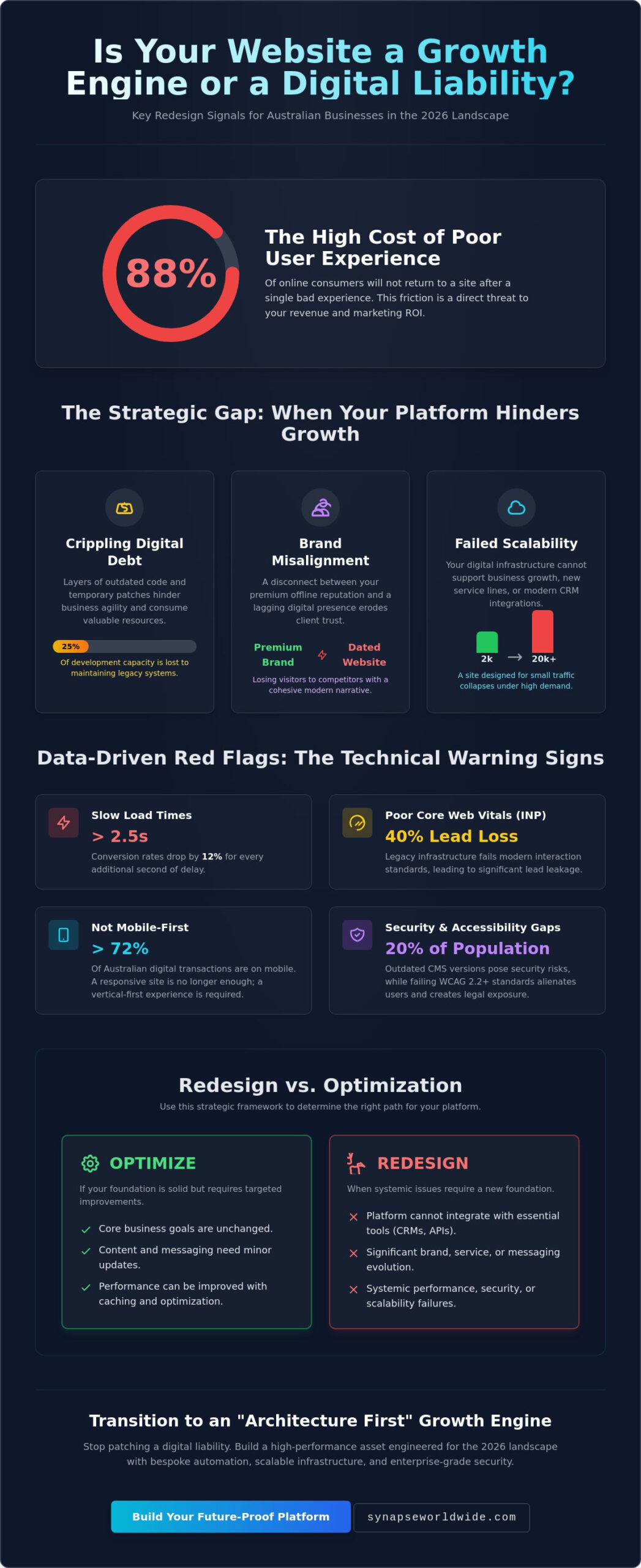
What if your digital storefront isn’t just a static asset, but is actively funneling potential revenue toward your competitors? For many Australian firms, a website that felt modern in 2022 now functions as a bottleneck rather than a bridge to growth. Recognizing the subtle website redesign signals is the difference between maintaining a digital liability and engineering a scalable business tool. You’ve likely noticed that high bounce rates are eroding your marketing ROI, or perhaps your team spends more time fighting a rigid CMS than closing leads. A 2024 industry report indicates that 88% of online consumers won’t return to a site after a poor user experience, making these technical frictions a direct threat to your bottom line.
It’s frustrating when your premium service offerings are trapped behind an interface that no longer reflects your brand’s sophistication. This guide identifies the critical performance and UX indicators that demand a strategic evolution of your digital infrastructure. We’ll provide a comprehensive checklist to help you integrate modern CRMs and optimize your presence for the 2026 landscape. You’ll learn how to pivot from a state of brand misalignment to a position of market authority and measurable results.
Key Takeaways
- Learn to identify “digital debt” and assess whether your current infrastructure is a scalable asset or a technical liability hindering your business agility.
- Master the critical website redesign signals emerging in 2026, from holistic Core Web Vitals to the security protocols required for modern Australian enterprise standards.
- Discover how to eliminate conversion leaks and build the digital trust necessary to secure high-value corporate and government contracts.
- Apply a strategic scoring framework and the “Rule of Three” to determine if your platform requires a minor optimization or a complete foundational redesign.
- Transition to an “Architecture First” approach that integrates bespoke business process automation to turn your website into a high-performance growth engine.
Identifying the Strategic Gap: When Your Digital Infrastructure No Longer Scales
Recognising website redesign signals requires moving beyond visual preferences. It involves auditing the systemic indicators that dictate whether your platform accelerates or obstructs growth. By 2026, the gap between high-performing digital assets and legacy systems will widen. Many Australian firms currently carry heavy “Digital Debt,” where layers of outdated code and temporary patches hinder business agility. This technical debt often costs enterprises up to 25% of their development capacity just to maintain basic functionality.
While a “dated look” often triggers the initial conversation, it remains the least critical driver for a full rebuild. Real website redesign signals manifest as high bounce rates, server response times exceeding 3 seconds, or an inability to integrate modern AI-driven APIs. Effective platforms must adhere to the fundamental principles of web design, focusing on usability and technical robustness rather than surface-level trends. Strategic redesigns align your digital presence with 2026 revenue drivers, ensuring your infrastructure supports rather than stifles your trajectory.
The Evolution of Business Objectives
Your digital architecture must mirror your 2026 roadmap. If your firm has expanded into new service models since 2023, a static user journey will fail to convert. Scaling brings technical pressure; a site designed for 2,000 monthly visitors often collapses under the weight of 20,000. In Australia, where mobile commerce accounts for over 72% of digital transactions, failing to scale server architecture leads to immediate revenue loss. If your current site cannot support new product lines or integrated CRM systems, it’s a clear indicator that your infrastructure has reached its ceiling.
Messaging and Brand Misalignment
A disconnect between a premium offline reputation and a lagging digital presence creates cognitive dissonance for high-value clients. If your content reads like a 2019 resume rather than a solution-oriented narrative, you’ll lose approximately 88% of visitors to more agile competitors. Inconsistent branding across LinkedIn, Instagram, and your primary site isn’t just a design flaw; it’s a conversion killer. Modern visitors seek bespoke experiences. When your messaging feels generic or outdated, it erodes the professional trust you’ve spent years building. Aligning these touchpoints is essential for maintaining a cohesive omnichannel strategy that resonates with a sophisticated Australian audience.
Technical and Performance Red Flags: The Data-Driven Signals
In 2026, a slow website isn’t just an inconvenience; it’s a liability that actively drains your marketing budget. Google’s Core Web Vitals have moved beyond simple speed metrics to a holistic assessment of user interaction. We see Australian businesses losing up to 40% of potential leads because their legacy infrastructure can’t meet the Interaction to Next Paint (INP) standards established in 2024. Security vulnerabilities in outdated CMS versions serve as the final warning for migrating to more secure, bespoke environments. If your platform relies on patches for vulnerabilities discovered three years ago, your data integrity is at risk.
The “Mobile-Only” reality has superseded the era of responsive design. Modern search engines prioritise sites built specifically for vertical-first experiences. Australian brands must also acknowledge that accessibility is no longer a “nice-to-have” feature. Adhering to WCAG 2.2+ standards is a legal and ethical requirement for national brands under the Disability Discrimination Act. Failing these benchmarks doesn’t just hurt your SEO; it exposes your company to significant legal risks and alienates 20% of the population living with a disability.
Systemic Performance Degradation
High bounce rates often stem from technical friction rather than poor content. When your site takes longer than 2.5 seconds to load, your conversion floor drops by 12% for every additional second of delay. Implementing aggressive website performance optimization is the only way to retain impatient users in a high-speed market. Legacy platforms often suffer from “bloatware,” where redundant plugins and unoptimised code prevent rapid updates. This technical debt makes your business agile-resistant, stalling growth while competitors pivot with ease.
SEO and Visibility Decline
A gradual slide in organic rankings is one of the most reliable website redesign signals. Outdated site architecture often leads to keyword cannibalization, where multiple pages compete for the same search intent, diluting your authority. To understand the full scope of these transitions, consult a comprehensive website redesign guide to audit your current technical standing. Modern SEO also requires preparing for AI-driven search. If your site structure isn’t readable by LLM crawlers, your brand won’t appear in AI-generated summaries or voice search results. Your digital infrastructure must be clean, structured, and schema-heavy to remain visible.
If you’re noticing these technical red flags, it’s time to consult with a digital architect to secure your business infrastructure for the years ahead.
User Experience and Conversion Friction: Why Visitors Are Not Becoming Leads
High bounce rates and stagnant lead counts aren’t just statistics; they’re symptoms of structural failure within your digital infrastructure. Conversion leaks often occur where user expectations clash with outdated architecture. For Australian firms pursuing high-value corporate or government contracts, your digital interface serves as a silent vetting tool. A clunky interface suggests a clunky operation. Implementing custom web design for small business ensures the path from interest to inquiry is frictionless. A surge in bounce rates and a decline in qualified inquiries are the most prominent website redesign signals a business can encounter. Identifying these website redesign signals early prevents the erosion of your market share to more agile competitors.
Navigational Complexity and High Friction
By 2026, the “Three Click Rule” has evolved into a demand for instant accessibility. It’s no longer just about the number of clicks but about the cognitive load required to find a solution. If session recordings show users hovering over menus without clicking, or bouncing after 15 seconds on a service page, you’re seeing clear signals for a website redesign. Data from 2025 UX audits indicates that contact forms with more than four fields can drop conversion rates by 67%. Your current forms might be the primary barrier to your ROI, acting as a gatekeeper rather than a gateway. Heatmaps often reveal “dead clicks” where users expect interactivity that doesn’t exist, leading to immediate frustration and exit.
The Messaging Disconnect
A visitor decides to stay or leave within five seconds. If your site doesn’t articulate your “Who, What, and How” immediately, you lose them to the next search result. Reviewing custom web design examples reveals that industry leaders prioritise clarity over cleverness. In the Australian market, where authenticity is a primary trust driver, generic stock imagery and vague copy are active conversion killers. Authentic visuals and precise, benefit-driven language establish authority. When your messaging is misaligned with user intent, even the highest traffic volume won’t yield results. Strategic redesign replaces fluff with facts, ensuring your site answers critical buyer questions before they’re even asked.
- Friction Points: Identify where users drop off in the checkout or inquiry process.
- Trust Indicators: Ensure certifications and case studies are visible within two scrolls.
- Mobile Logic: Test if navigation is thumb-friendly on a standard 6.7-inch smartphone screen.
- Loading Thresholds: Aim for a Largest Contentful Paint (LCP) of under 2.5 seconds to retain 80% of your visitors.
Redesign vs. Optimization: A Strategic Decision Framework
Deciding between a minor update and a total overhaul requires a cold, data-driven assessment. We use a proprietary scoring system to evaluate digital assets across performance, accessibility, and conversion metrics. If your site scores below 60% on a core performance audit, a cosmetic facelift won’t solve the underlying structural decay. You’re simply painting over cracks in a failing foundation. This is why identifying website redesign signals early is vital for maintaining a competitive edge in the Australian market.
Apply the “Rule of Three” to your current audit. If you identify three or more critical issues, such as a bounce rate exceeding 70%, a mobile conversion rate 50% lower than desktop, and a slow Largest Contentful Paint (LCP) over 2.5 seconds, a redesign is the only efficient path. Patchwork fixes on an outdated foundation often cost 40% more over a 24 month period than a clean, bespoke rebuild. Technical limitations in a generic CMS often lead to plugin bloat, where every new feature slows the site further. A bespoke solution is built for speed and specific business outcomes rather than generic convenience.
When Optimization Is Sufficient
Optimization works when the engine is sound but the exterior is tired. You can achieve a 20% lift in conversions by refining landing page copy or compressing oversized images to improve load times. A professional SEO audit identifies these low-hanging fruit opportunities without requiring a full code rewrite. If your current CMS supports modern schema markup and has a clean code base, testing incremental UX changes is a prudent first step. This approach preserves your existing equity while addressing specific friction points that hinder the user journey.
The Case for a Structural Redesign
Structural changes become mandatory when legacy code restricts growth. Old architectures often block seamless website crm integration, which prevents you from automating lead nurturing and tracking customer lifetimes accurately. If you’re pivoting your business model or entering a new market in 2026, your site must reflect that shift. A bespoke digital architecture eliminates the technical debt of A$5,000 to A$15,000 spent annually on emergency patches. Investing in a scalable solution ensures your infrastructure grows alongside your revenue. It’s a shift from viewing your website as a static brochure to seeing it as a dynamic business engine. Applying proven website ux best practices during a structural rebuild ensures your new architecture converts visitors into high-value leads from day one.
Stop wasting resources on temporary fixes and build a foundation for growth. Consult with our strategic architects today to determine the best path for your business infrastructure.
Navigating the Redesign Process: Building Your Future Growth Engine
A successful transition requires more than aesthetic updates; it demands a structural evolution. At Synapse Worldwide, we employ an “Architecture First” methodology. This ensures your digital foundation supports long-term scaling rather than just immediate visual appeal. Identifying website redesign signals early allows you to move from a reactive posture to a proactive market position. We treat your website as the central engine for all national digital marketing efforts, ensuring every dollar spent on search or social media converts through a high-performance interface.
Modern infrastructure must go beyond simple content delivery. By integrating business process automation directly into your site structure, you eliminate manual data entry and reduce operational overhead. This strategic integration transforms your website from a passive brochure into a functional tool that manages leads, processes orders, and synchronizes with your internal workflows in real-time. It’s about creating a system that works as hard as your best employees.
Discovery and Strategic Planning
The discovery phase defines the project’s ROI. We map user journeys to align with your high-value customer personas, ensuring the path to conversion is frictionless. You shouldn’t settle for vague goals. We set hard KPIs such as a 25% increase in lead volume and ensuring Largest Contentful Paint (LCP) remains under 2.5 seconds to meet 2024 performance standards. While templates offer speed, bespoke solutions provide the robust framework necessary for complex Australian corporate environments where security and unique functionality are non-negotiable.
Implementation and Future-Proofing
Clean, scalable code is the difference between a site that lasts two years and one that thrives for five or more. Our developers focus on structural integrity to ensure seamless integration with existing ERP and CRM systems like Salesforce or Microsoft Dynamics. Protecting your SEO equity is a priority during this phase. We implement rigorous 301 redirect mapping and metadata migration to ensure your historical search rankings remain intact. After launch, our team conducts iterative performance tuning, using real-world data to refine the user experience and maintain your competitive edge in the Australian market.
Architecting Your Next Phase of Growth
Recognising website redesign signals early prevents technical debt from stalling your Australian business’s momentum. Your digital infrastructure shouldn’t just exist; it needs to scale alongside 2026 market demands. Performance red flags and conversion friction are often the first indicators that a legacy system is failing. Whether you’re managing complex corporate assets or government-level infrastructure, moving from basic optimization to a strategic architectural rebuild is often the most effective path to sustainable ROI.
Synapse Worldwide brings over 20 years of expertise to every project, delivering bespoke digital solutions that prioritize scalability and measurable results. We understand the unique nuances of the Australian digital landscape and provide the robust framework required for sophisticated operations. Don’t let outdated technology limit your vision for transformation. Our team is ready to help you build a high-performance engine that turns visitors into high-value leads.
Book a strategic consultation with Synapse Worldwide to start your journey toward a more powerful digital presence.
Frequently Asked Questions
How often should a professional business website be redesigned?
Most high-performing Australian businesses redesign their digital infrastructure every 2 to 3 years. This cycle ensures your brand remains compatible with the latest browser updates and security protocols. A 2023 study by HubSpot found that 88% of users are less likely to return to a site after a bad experience. Regular updates prevent technical debt from accumulating and keep your conversion pathways optimized for modern consumer behavior.
Can a website redesign hurt my current SEO rankings?
A website redesign can negatively impact your search visibility if you fail to implement a robust 301 redirect strategy. However, when executed with precision, identifying the right website redesign signals allows you to fix legacy crawl errors and improve site architecture. Data from SEMrush indicates that sites with clean migrations often see a 20% increase in organic traffic within 6 months. We focus on preserving your existing authority while building a more scalable foundation for future growth.
What is the average timeframe for a custom website redesign in Australia?
A sophisticated, bespoke website redesign typically requires a timeline of 12 to 16 weeks from discovery to deployment. This period accounts for deep strategic planning, custom UI/UX design, and rigorous quality assurance. Smaller projects might conclude in 8 weeks; however, complex enterprise solutions involving integrated APIs or custom databases often extend to 20 weeks. We prioritize a disciplined workflow to ensure every digital asset is polished and functional before the launch date.
Is it better to use a template or a bespoke design for a redesign?
Bespoke designs offer superior ROI and scalability for growing businesses that require a unique market position. Templates often include 30% more bloated code, which slows down performance and limits your ability to scale. A custom-built solution ensures your infrastructure aligns perfectly with your specific operational goals. While templates have lower initial costs, bespoke sites deliver a 40% higher conversion rate on average by providing a seamless, tailored user journey that reflects your brand’s authority.
How do I know if my website speed is a sign for a redesign?
Your website speed is a primary indicator for a redesign if your pages take longer than 3 seconds to load completely. Google’s Core Web Vitals data shows that bounce rates increase by 32% as page load time goes from 1 second to 3 seconds. If your current backend architecture cannot achieve a mobile speed score above 90 on PageSpeed Insights, it’s a clear sign your infrastructure is obsolete. We replace sluggish legacy code with high-performance frameworks to reclaim your competitive edge.
What are the most critical website redesign signals to watch for in 2026?
The most critical website redesign signals for 2026 include a drop in mobile engagement and the lack of integrated data analytics. If your current platform can’t support automated customer service portals or real-time personalization, you’re falling behind. Industry reports suggest that 75% of B2B buyers now expect a personalized digital experience. A strategic overhaul ensures your business infrastructure is ready to leverage these emerging technologies while maintaining a robust security posture. Ensuring your platform meets the latest mobile responsive web design standards is a foundational requirement for remaining competitive in 2026.
Should I redesign my website if my competitors just launched new sites?
You shouldn’t redesign simply because a competitor did, but you must analyze if their new site offers a superior user experience that threatens your lead volume. If 3 of your top 5 competitors have transitioned to faster, more intuitive platforms, your brand perception will suffer. Monitor your conversion metrics closely. If your cost per acquisition has risen by more than 15% since their launch, it’s time to consult with a digital architect to modernize your presence.
How much should I budget for a strategic website redesign?
A strategic redesign for an established Australian business generally requires an investment ranging from A$15,000 for standard professional sites to over A$100,000 for complex enterprise platforms. According to 2024 industry benchmarks, high-growth companies allocate 5% to 10% of their annual marketing budget to digital infrastructure. This investment covers strategic consulting, bespoke design, and seamless integration of business tools. We focus on delivering a robust solution that maximizes your return on investment through improved performance and scalability.

