

Renting your digital storefront on a generic SaaS template is the most expensive way to stay small in an Australian e-commerce market now worth over A$63 billion. While these platforms offer a quick start, they eventually act as a growth tax through escalating transaction fees and rigid limitations that block innovation. Choosing custom e-commerce platform development isn’t just about aesthetics; it’s about reclaiming your margins and securing full ownership of your digital intellectual property.
You’ve likely reached the point where your current system feels like a bottleneck, struggling to sync with your ERP or slowing down during national expansion. We’ll show you how to master the complexities of bespoke digital commerce to build a scalable, high-ROI infrastructure that integrates every part of your business. This guide outlines the strategic criteria for selecting a development partner that transforms your digital presence from a recurring expense into a powerful, proprietary asset.
Key Takeaways
- Understand the shift from monolithic storefronts to headless and microservices architectures to ensure your digital infrastructure remains future-proof through 2026.
- Master the “Buy vs. Build” framework to evaluate the long-term ROI of custom e-commerce platform development against SaaS models, specifically accounting for A$ transaction fees and five-year TCO.
- Learn how to design a robust architecture that prioritises seamless third-party integrations and elastic scalability for national business expansion.
- Discover the strategic discovery and UI/UX design processes required to align bespoke digital storefronts with high-conversion business outcomes.
- Identify the critical criteria for selecting an Australian-based development partner capable of managing intricate technical details and delivering sophisticated, high-performance commerce solutions.
The Evolution of Digital Retail: Why Custom E-commerce Platform Development is Essential in 2026
Custom e-commerce platform development isn’t just a website build; it’s the creation of a bespoke digital infrastructure designed to scale. As we look toward The Evolution of Digital Retail, the reliance on rigid, monolithic systems has become a liability for Australian enterprises. By 2026, the distinction between market leaders and followers will be defined by their ability to pivot. Modern architecture has shifted from all-in-one storefronts to headless and microservices frameworks. This modularity allows businesses to decouple the front-end experience from back-end logic, ensuring that high-traffic events don’t result in site crashes or slow load times.
Understanding the scale of this shift requires a look at how digital assets have evolved over time; for instance, CDA Group recently explored whether iconic digital experiments from decades ago could still function in today’s complex eCommerce ecosystem.
Out-of-the-box SaaS capabilities often fail to meet the complex integration needs of a 2026 market. Australian consumers now expect hyper-personalisation and sub-two-second page speeds. Investing in custom e-commerce platform development ensures you own your source code and control your data ecosystem. This ownership allows for seamless integration with ERPs and local logistics providers without the friction of third-party middleware. You gain the power to dictate your own technical roadmap rather than being forced into a one-size-fits-all update cycle.
The Limitations of Template-Based Commerce
Many businesses hit a technical ceiling when their growth outpaces their platform’s capabilities. Relying on template-based SaaS creates hidden costs that drain profitability. For instance, an Australian retailer might spend upwards of A$15,000 annually just on third-party plugin subscriptions to fix basic functionality gaps. This plugin bloat slows down site performance and introduces security risks. Shared platform vulnerabilities mean that a single exploit in a popular app can compromise thousands of stores simultaneously. A 2024 security report indicated that 82% of enterprise leaders now cite these shared risks as a primary reason for moving toward bespoke builds.
Operational Sovereignty and Long-Term Value
Building a custom platform transforms your digital presence into a tangible asset that increases overall company valuation. We define operational sovereignty as the absolute control over your digital roadmap, data integrity, and tech stack dependencies. It grants you the freedom to innovate. You won’t have to wait for a platform provider’s quarterly update to launch a new feature. Instead, you deploy updates based on your specific ROI metrics. This strategic independence ensures that your business remains agile in a landscape where consumer preferences shift in weeks. Owning your code means every dollar spent on development builds equity in your own brand, not someone else’s software.
Core Pillars of a Robust Custom E-commerce Architecture
A high-performance digital storefront is more than just a visual interface; it’s a sophisticated engine designed to fuel long-term expansion. When we approach custom e-commerce platform development, we prioritise four non-negotiable pillars that separate market leaders from the rest of the pack. Scalability is the first priority. Your architecture must be designed for national expansion, capable of handling 100,000 concurrent sessions during peak periods like Black Friday or Boxing Day without a hint of latency. Performance is a direct revenue driver. Industry data shows that a 100-millisecond delay in load time can drop conversion rates by 7%. For an Australian business turning over A$10 million annually, this represents a A$700,000 loss in potential revenue due to technical friction.
Security in 2026 demands moving beyond basic SSL certificates. We implement enterprise-grade protection, including multi-factor authentication (MFA), encrypted database structures, and strict adherence to Australian Privacy Principles. This level of rigour protects your brand reputation and ensures compliance with evolving data sovereignty laws. Given the strategic importance of e-commerce in a landscape where Australian online retail spending has reached record highs, these technical foundations are the bedrock of your digital ROI.
Seamless ERP and CRM Integration
Operational efficiency relies on a unified data environment. Our custom e-commerce platform development process focuses on connecting the storefront to the business heartbeat through deep API integrations. We automate inventory management across multiple warehouses, ensuring that stock levels are accurate to the second across every sales channel. This real-time synchronisation between sales, finance, and logistics reduces manual data entry errors by up to 45%. By linking your storefront directly to your CRM, you gain a 360-degree view of the customer journey, allowing for sophisticated lifecycle management that increases repeat purchase rates.
Advanced Marketing Automation and Personalisation
Generic shopping experiences fail to capture modern consumer attention. We build AI-driven recommendation engines directly into the custom build, allowing for 1:1 product suggestions based on historical data and real-time intent. Bespoke loyalty programs can be engineered to integrate offline data from physical retail locations, rewarding customers regardless of where they shop. By utilising custom triggers and data-driven insights, our clients have seen cart abandonment rates decrease by 22% through personalised, timely intervention. If you want to move beyond off-the-shelf limitations, speak with our digital architects about a tailored strategy for your brand.
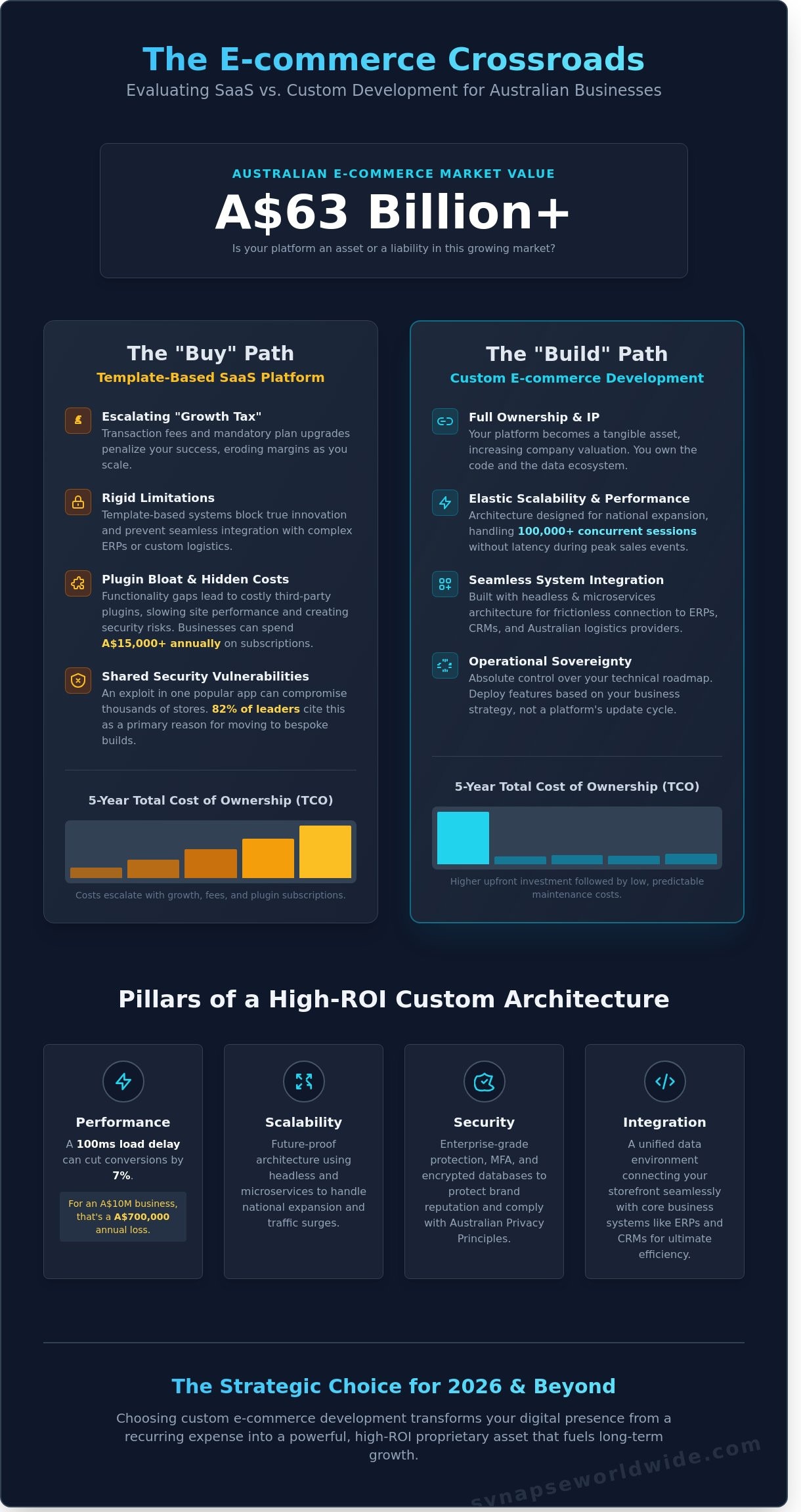
The “Buy vs. Build” Framework: Evaluating SaaS against Bespoke Development
Choosing between a subscription-based SaaS model and custom e-commerce platform development is a decision that dictates your brand’s growth ceiling for the next decade. While SaaS platforms offer a rapid market entry, they often impose a “success tax” through escalating transaction fees. For a high-volume Australian retailer processing A$20 million in annual turnover, a 0.5% to 2% platform fee translates to A$100,000 to A$400,000 lost every year. Over a five-year horizon, these recurring costs, combined with tiered subscription hikes, frequently exceed the total cost of ownership (TCO) of a bespoke build.
Strategic leaders now look toward modern e-commerce architecture patterns to find a middle ground. A headless or hybrid approach allows you to decouple the presentation layer from the backend logic. This flexibility ensures that your unique business rules, such as complex Australian GST calculations for B2B wholesale or specific regional logistics integrations, aren’t restricted by the rigid templates of a generic provider.
Financial Implications of Custom Development
The financial shift from SaaS to custom is primarily a move from Operating Expenditure (OpEx) to Capital Expenditure (CapEx). While the upfront investment is higher, the ROI is found in the elimination of per-transaction commissions and the reduction of manual overhead. We’ve observed that custom automation of inventory reconciliation can reduce back-office labor costs by 30% within the first 12 months. Most enterprise-level custom builds reach a financial break-even point at the 24-month mark, after which the platform becomes a high-margin asset rather than a monthly liability.
Strategic Flexibility and Competitive Advantage
Bespoke platforms allow for the creation of “impossible” user experiences that SaaS plugins cannot replicate. Whether it’s a proprietary 3D product configurator for premium brands like Apevie Simulators or a seamless transition between B2C retail and B2B trade portals, custom code handles these pivots within a single, unified environment. Bespoke logic acts as a competitive moat by codifying proprietary business processes that competitors cannot simply purchase off the shelf. This structural advantage ensures your digital presence is built around your operations, rather than forcing your operations to fit the limitations of a third-party vendor. Ownership of the source code grants you total control over the roadmap, ensuring your technology evolves at the speed of the Australian market.
Navigating the Development Lifecycle: From Strategic Discovery to Deployment
Successful custom e-commerce platform development relies on a disciplined, phased approach that treats software as a living business asset. In the Australian market, where online retail spending is projected to exceed A$64 billion by 2026, the margin for technical error is non-existent. We execute this through a five-stage lifecycle: strategic discovery, conversion-centric UI/UX design, agile development, rigorous quality assurance, and iterative deployment. Each stage acts as a gate, ensuring that the final product isn’t just functional but is engineered for high-volume transactions and seamless brand integration. This structured methodology prevents the architectural rot that often plagues off-the-shelf solutions as they scale.
The Critical Nature of the Discovery Phase
Skipping the discovery phase is the primary reason why 45% of enterprise software projects exceed their initial budgets. We conduct deep technical audits of your existing infrastructure to identify legacy bottlenecks before they become mid-project crises. This phase produces a comprehensive roadmap of User Stories and functional requirements. By defining these specifications early, we align the technical architecture with your three-year growth targets, ensuring the platform handles a 200% increase in traffic without requiring a total rebuild. It’s about building for the business you intend to become, not just the one you are today.
- Requirement Auditing: Mapping every API integration and third-party dependency to prevent data silos and ensure real-time inventory accuracy.
- UI/UX Design: Implementing conversion rate optimisation (CRO) principles that reflect your unique brand identity and aim to reduce cart abandonment by up to 20% compared to generic templates.
- Agile Coding: Using clean code standards and sprint-based delivery to ensure the platform remains maintainable and transparent for your internal teams.
- Security QA: Conducting penetration testing and load balancing checks to maintain 99.99% uptime during peak Australian sales periods like Afterpay Day or Black Friday.
Post-Launch Maintenance and Continuous Optimization
Deployment is the beginning of the platform’s evolution, not the end. The Australian Cyber Security Centre reports a consistent rise in retail-targeted threats, making monthly security patches and proactive server management non-negotiable for any enterprise. We use post-launch heatmaps and A/B testing data gathered over the first 90 days to refine the checkout flow and user journeys based on actual customer behaviour. Annual technical audits are scheduled to prune technical debt, ensuring your digital storefront remains fast and secure as browser technologies evolve. This commitment to longevity transforms a one-off expense into a high-yield investment that scales alongside your revenue.
Partnering for Performance: Selecting the Right Development Agency
Success in custom e-commerce platform development depends less on the initial launch and more on the architectural integrity of the build. Choosing a partner is a high-stakes decision that impacts your operational agility for the next decade. You shouldn’t settle for a vendor who merely executes a brief. You need a strategic ally who interrogates your business model to find efficiencies and scale. A sophisticated partner looks beyond the interface to ensure the engine underneath is built for high-velocity commerce.
- Backend Complexity: Evaluate portfolios based on API integrations and database architecture rather than just visual design. A platform that looks great but fails during a 300% traffic spike during a November sales event is a liability.
- Australian Context: Local expertise ensures compliance with Australian Consumer Law and seamless integration with domestic logistics providers like Australia Post or StarTrack. Using a local team eliminates timezone friction and ensures your data residency meets national standards.
- Partnership Longevity: Transactional development often leads to technical debt. A long-term partner provides the iterative updates and security patches necessary to maintain a competitive edge as consumer behaviors shift.
The difference between a generic storefront and a high-performance asset lies in the technical foundation. Agencies that prioritize load speed see a 7% increase in conversions for every 100ms improvement in site response time. This level of optimization requires a deep understanding of server-side logic and clean code structures that off-the-shelf templates simply can’t provide.
The Synapse Worldwide Approach to E-commerce
Since 2005, we’ve built a legacy of creating robust, integrated digital solutions that stand the test of time. We operate under a Digital Architect philosophy. This means we balance ambitious creative vision with rigorous technical discipline. We don’t just write code; we build the infrastructure for your digital future. Our team excels at bridging the gap between high-level business strategy and the practical, high-performance execution required for modern custom e-commerce platform development.
Driving National Growth through Bespoke Infrastructure
We tailor every solution to the specific demands of the Australian market, ensuring your business stays ahead of local competitors. Our focus remains on creating user-friendly interfaces that directly drive revenue and customer loyalty. By prioritizing scalable architecture, we ensure your platform grows alongside your ambitions without requiring a total rebuild every three years. Ready to transform your digital presence? Consult with our senior strategists on your custom platform project to begin your transformation.
Securing Your Competitive Advantage in the 2026 Australian Market
The Australian digital landscape in 2026 demands more than just a template; it requires a strategic asset that scales with your ambition. Moving beyond the limitations of off-the-shelf software allows your business to own its data, optimize complex workflows, and deliver a truly unique customer journey. Successful custom e-commerce platform development isn’t just about writing code. It’s about building a robust digital foundation that integrates seamlessly with your existing ERP and CRM systems to drive measurable growth and high-ROI outcomes.
Since 2005, Synapse Worldwide has helped Australian enterprises navigate these technical complexities with over 20 years of proven expertise. We’ve delivered bespoke solutions for brands targeting A$10 million and beyond in annual revenue, specializing in the deep integrations that traditional SaaS models often fail to support. Your transition to a bespoke solution shouldn’t be a gamble. It’s a calculated investment in your company’s long-term autonomy and market leadership. We’re ready to help you architect a platform that doesn’t just keep up, but sets the pace for your industry.
Contact Synapse Worldwide for a Strategic E-commerce Consultation
The next level of your business success is within reach, and we’re excited to help you build it.
Frequently Asked Questions
What is the typical timeline for custom e-commerce platform development?
A typical timeline for custom e-commerce platform development ranges from 4 to 9 months depending on the system’s complexity. We allocate the first 4 weeks to strategic discovery and architecture design, followed by 16 to 24 weeks of intensive engineering and API integration. This structured approach ensures that every bespoke feature is rigorously tested before your platform goes live in the Australian market.
How much does it cost to build a bespoke e-commerce platform in Australia?
Investment for a bespoke e-commerce platform in Australia generally starts at A$80,000 for mid-market solutions and can exceed A$350,000 for complex enterprise systems. These costs reflect the high level of local expertise required, with senior developer rates in Sydney and Melbourne averaging A$160 per hour. Your final quote includes end-to-end services from initial UI/UX strategy to secure deployment on high-performance cloud infrastructure.
Can a custom platform integrate with my existing legacy ERP system?
Yes, we specialise in building secure bridges between new platforms and legacy ERP systems such as SAP, Microsoft Dynamics 365, or MYOB Advanced. Our team develops custom middleware and API layers that facilitate real-time synchronisation of inventory, pricing, and customer data across your business. These integrations typically reduce manual data entry errors by 45% and streamline your entire fulfilment workflow.
Will I own the source code once the development is complete?
You retain 100% intellectual property ownership of the source code and all custom-built assets upon project completion. Unlike SaaS models where you essentially rent a storefront, our bespoke approach ensures your platform is a permanent business asset that adds significant value to your company’s balance sheet. We provide full repository access and comprehensive technical documentation, giving you total control over your digital future.
How does custom development improve SEO compared to platforms like Shopify?
Custom e-commerce platform development gives you total control over technical SEO variables that are often restricted on SaaS platforms, such as server-side rendering and site architecture. Our builds consistently achieve Google PageSpeed scores of 95 or higher because we eliminate the heavy code bloat associated with third-party plugins. This technical precision helps your site rank higher for competitive keywords and provides a faster, more reliable experience for your users.
What security measures are included in an enterprise-grade custom build?
Every enterprise-grade platform we build includes PCI-DSS Level 1 compliance, AES-256 data encryption, and multi-factor authentication as standard features. We implement sophisticated firewalls and conduct regular automated vulnerability scans to protect your business from evolving cyber threats. These protocols ensure you meet all Australian mandatory data breach reporting requirements while maintaining the highest level of trust with your customers.
Is a custom platform harder to manage than a SaaS solution?
Managing a custom platform is actually more efficient because the administrative interface is designed specifically for your internal workflows. You don’t have to navigate through irrelevant features or work around the limitations of a generic template. Clients who switch to our tailored systems report a 30% reduction in time spent on daily administrative tasks like product updates and order management.
What happens if we need to add new features after the platform has launched?
Our modular architecture is designed for seamless scalability, allowing you to add new features or integrations without disrupting your existing operations. We use modern frameworks that support iterative updates, so you can roll out new loyalty programs or AI-driven tools in focused 2-week sprints. This flexible foundation ensures your platform remains a cutting-edge tool for growth as your business evolves throughout 2026 and beyond.

