

Tag Archives: web development


Custom E-commerce Platform Development: The 2026 Strategic Buying Guide

Custom E-commerce Platform Development: The 2026 Strategic Buying Guide

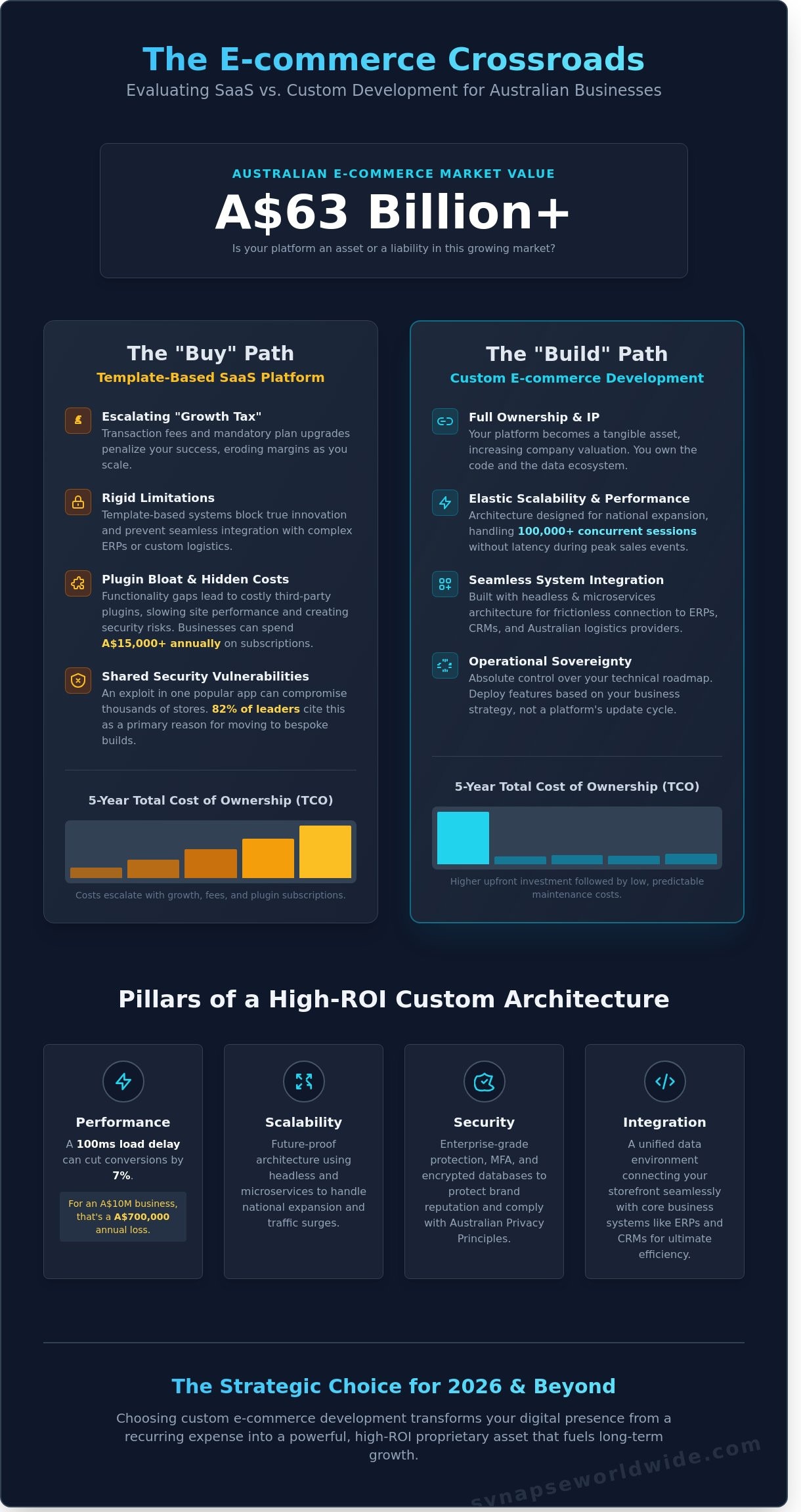
Renting your digital storefront on a generic SaaS template is the most expensive way to stay small in an Australian e-commerce market now worth over A$63 billion. While these platforms offer a quick start, they eventually act as a growth tax through escalating transaction fees and rigid limitations that block innovation. Choosing custom e-commerce platform development isn’t just about aesthetics; it’s about reclaiming your margins and securing full ownership of your digital intellectual property.

You’ve likely reached the point where your current system feels like a bottleneck, struggling to sync with your ERP or slowing down during national expansion. We’ll show you how to master the complexities of bespoke digital commerce to build a scalable, high-ROI infrastructure that integrates every part of your business. This guide outlines the strategic criteria for selecting a development partner that transforms your digital presence from a recurring expense into a powerful, proprietary asset.

Key Takeaways

  • Understand the shift from monolithic storefronts to headless and microservices architectures to ensure your digital infrastructure remains future-proof through 2026.
  • Master the “Buy vs. Build” framework to evaluate the long-term ROI of custom e-commerce platform development against SaaS models, specifically accounting for A$ transaction fees and five-year TCO.
  • Learn how to design a robust architecture that prioritises seamless third-party integrations and elastic scalability for national business expansion.
  • Discover the strategic discovery and UI/UX design processes required to align bespoke digital storefronts with high-conversion business outcomes.
  • Identify the critical criteria for selecting an Australian-based development partner capable of managing intricate technical details and delivering sophisticated, high-performance commerce solutions.

The Evolution of Digital Retail: Why Custom E-commerce Platform Development is Essential in 2026

Custom e-commerce platform development isn’t just a website build; it’s the creation of a bespoke digital infrastructure designed to scale. As we look toward The Evolution of Digital Retail, the reliance on rigid, monolithic systems has become a liability for Australian enterprises. By 2026, the distinction between market leaders and followers will be defined by their ability to pivot. Modern architecture has shifted from all-in-one storefronts to headless and microservices frameworks. This modularity allows businesses to decouple the front-end experience from back-end logic, ensuring that high-traffic events don’t result in site crashes or slow load times.

Understanding the scale of this shift requires a look at how digital assets have evolved over time; for instance, CDA Group recently explored whether iconic digital experiments from decades ago could still function in today’s complex eCommerce ecosystem.

Out-of-the-box SaaS capabilities often fail to meet the complex integration needs of a 2026 market. Australian consumers now expect hyper-personalisation and sub-two-second page speeds. Investing in custom e-commerce platform development ensures you own your source code and control your data ecosystem. This ownership allows for seamless integration with ERPs and local logistics providers without the friction of third-party middleware. You gain the power to dictate your own technical roadmap rather than being forced into a one-size-fits-all update cycle.

The Limitations of Template-Based Commerce

Many businesses hit a technical ceiling when their growth outpaces their platform’s capabilities. Relying on template-based SaaS creates hidden costs that drain profitability. For instance, an Australian retailer might spend upwards of A$15,000 annually just on third-party plugin subscriptions to fix basic functionality gaps. This plugin bloat slows down site performance and introduces security risks. Shared platform vulnerabilities mean that a single exploit in a popular app can compromise thousands of stores simultaneously. A 2024 security report indicated that 82% of enterprise leaders now cite these shared risks as a primary reason for moving toward bespoke builds.

Operational Sovereignty and Long-Term Value

Building a custom platform transforms your digital presence into a tangible asset that increases overall company valuation. We define operational sovereignty as the absolute control over your digital roadmap, data integrity, and tech stack dependencies. It grants you the freedom to innovate. You won’t have to wait for a platform provider’s quarterly update to launch a new feature. Instead, you deploy updates based on your specific ROI metrics. This strategic independence ensures that your business remains agile in a landscape where consumer preferences shift in weeks. Owning your code means every dollar spent on development builds equity in your own brand, not someone else’s software.

Core Pillars of a Robust Custom E-commerce Architecture

A high-performance digital storefront is more than just a visual interface; it’s a sophisticated engine designed to fuel long-term expansion. When we approach custom e-commerce platform development, we prioritise four non-negotiable pillars that separate market leaders from the rest of the pack. Scalability is the first priority. Your architecture must be designed for national expansion, capable of handling 100,000 concurrent sessions during peak periods like Black Friday or Boxing Day without a hint of latency. Performance is a direct revenue driver. Industry data shows that a 100-millisecond delay in load time can drop conversion rates by 7%. For an Australian business turning over A$10 million annually, this represents a A$700,000 loss in potential revenue due to technical friction.

Security in 2026 demands moving beyond basic SSL certificates. We implement enterprise-grade protection, including multi-factor authentication (MFA), encrypted database structures, and strict adherence to Australian Privacy Principles. This level of rigour protects your brand reputation and ensures compliance with evolving data sovereignty laws. Given the strategic importance of e-commerce in a landscape where Australian online retail spending has reached record highs, these technical foundations are the bedrock of your digital ROI.

Seamless ERP and CRM Integration

Operational efficiency relies on a unified data environment. Our custom e-commerce platform development process focuses on connecting the storefront to the business heartbeat through deep API integrations. We automate inventory management across multiple warehouses, ensuring that stock levels are accurate to the second across every sales channel. This real-time synchronisation between sales, finance, and logistics reduces manual data entry errors by up to 45%. By linking your storefront directly to your CRM, you gain a 360-degree view of the customer journey, allowing for sophisticated lifecycle management that increases repeat purchase rates.

Advanced Marketing Automation and Personalisation

Generic shopping experiences fail to capture modern consumer attention. We build AI-driven recommendation engines directly into the custom build, allowing for 1:1 product suggestions based on historical data and real-time intent. Bespoke loyalty programs can be engineered to integrate offline data from physical retail locations, rewarding customers regardless of where they shop. By utilising custom triggers and data-driven insights, our clients have seen cart abandonment rates decrease by 22% through personalised, timely intervention. If you want to move beyond off-the-shelf limitations, speak with our digital architects about a tailored strategy for your brand.
Custom E-commerce Platform Development: The 2026 Strategic Buying Guide

The “Buy vs. Build” Framework: Evaluating SaaS against Bespoke Development

Choosing between a subscription-based SaaS model and custom e-commerce platform development is a decision that dictates your brand’s growth ceiling for the next decade. While SaaS platforms offer a rapid market entry, they often impose a “success tax” through escalating transaction fees. For a high-volume Australian retailer processing A$20 million in annual turnover, a 0.5% to 2% platform fee translates to A$100,000 to A$400,000 lost every year. Over a five-year horizon, these recurring costs, combined with tiered subscription hikes, frequently exceed the total cost of ownership (TCO) of a bespoke build.

Strategic leaders now look toward modern e-commerce architecture patterns to find a middle ground. A headless or hybrid approach allows you to decouple the presentation layer from the backend logic. This flexibility ensures that your unique business rules, such as complex Australian GST calculations for B2B wholesale or specific regional logistics integrations, aren’t restricted by the rigid templates of a generic provider.

Financial Implications of Custom Development

The financial shift from SaaS to custom is primarily a move from Operating Expenditure (OpEx) to Capital Expenditure (CapEx). While the upfront investment is higher, the ROI is found in the elimination of per-transaction commissions and the reduction of manual overhead. We’ve observed that custom automation of inventory reconciliation can reduce back-office labor costs by 30% within the first 12 months. Most enterprise-level custom builds reach a financial break-even point at the 24-month mark, after which the platform becomes a high-margin asset rather than a monthly liability.

Strategic Flexibility and Competitive Advantage

Bespoke platforms allow for the creation of “impossible” user experiences that SaaS plugins cannot replicate. Whether it’s a proprietary 3D product configurator for premium brands like Apevie Simulators or a seamless transition between B2C retail and B2B trade portals, custom code handles these pivots within a single, unified environment. Bespoke logic acts as a competitive moat by codifying proprietary business processes that competitors cannot simply purchase off the shelf. This structural advantage ensures your digital presence is built around your operations, rather than forcing your operations to fit the limitations of a third-party vendor. Ownership of the source code grants you total control over the roadmap, ensuring your technology evolves at the speed of the Australian market.

Successful custom e-commerce platform development relies on a disciplined, phased approach that treats software as a living business asset. In the Australian market, where online retail spending is projected to exceed A$64 billion by 2026, the margin for technical error is non-existent. We execute this through a five-stage lifecycle: strategic discovery, conversion-centric UI/UX design, agile development, rigorous quality assurance, and iterative deployment. Each stage acts as a gate, ensuring that the final product isn’t just functional but is engineered for high-volume transactions and seamless brand integration. This structured methodology prevents the architectural rot that often plagues off-the-shelf solutions as they scale.

The Critical Nature of the Discovery Phase

Skipping the discovery phase is the primary reason why 45% of enterprise software projects exceed their initial budgets. We conduct deep technical audits of your existing infrastructure to identify legacy bottlenecks before they become mid-project crises. This phase produces a comprehensive roadmap of User Stories and functional requirements. By defining these specifications early, we align the technical architecture with your three-year growth targets, ensuring the platform handles a 200% increase in traffic without requiring a total rebuild. It’s about building for the business you intend to become, not just the one you are today.

  • Requirement Auditing: Mapping every API integration and third-party dependency to prevent data silos and ensure real-time inventory accuracy.
  • UI/UX Design: Implementing conversion rate optimisation (CRO) principles that reflect your unique brand identity and aim to reduce cart abandonment by up to 20% compared to generic templates.
  • Agile Coding: Using clean code standards and sprint-based delivery to ensure the platform remains maintainable and transparent for your internal teams.
  • Security QA: Conducting penetration testing and load balancing checks to maintain 99.99% uptime during peak Australian sales periods like Afterpay Day or Black Friday.

Post-Launch Maintenance and Continuous Optimization

Deployment is the beginning of the platform’s evolution, not the end. The Australian Cyber Security Centre reports a consistent rise in retail-targeted threats, making monthly security patches and proactive server management non-negotiable for any enterprise. We use post-launch heatmaps and A/B testing data gathered over the first 90 days to refine the checkout flow and user journeys based on actual customer behaviour. Annual technical audits are scheduled to prune technical debt, ensuring your digital storefront remains fast and secure as browser technologies evolve. This commitment to longevity transforms a one-off expense into a high-yield investment that scales alongside your revenue.

Ready to build a high-performance digital asset? Consult with our digital architects today to start your custom e-commerce journey.

Partnering for Performance: Selecting the Right Development Agency

Success in custom e-commerce platform development depends less on the initial launch and more on the architectural integrity of the build. Choosing a partner is a high-stakes decision that impacts your operational agility for the next decade. You shouldn’t settle for a vendor who merely executes a brief. You need a strategic ally who interrogates your business model to find efficiencies and scale. A sophisticated partner looks beyond the interface to ensure the engine underneath is built for high-velocity commerce.

  • Backend Complexity: Evaluate portfolios based on API integrations and database architecture rather than just visual design. A platform that looks great but fails during a 300% traffic spike during a November sales event is a liability.
  • Australian Context: Local expertise ensures compliance with Australian Consumer Law and seamless integration with domestic logistics providers like Australia Post or StarTrack. Using a local team eliminates timezone friction and ensures your data residency meets national standards.
  • Partnership Longevity: Transactional development often leads to technical debt. A long-term partner provides the iterative updates and security patches necessary to maintain a competitive edge as consumer behaviors shift.

The difference between a generic storefront and a high-performance asset lies in the technical foundation. Agencies that prioritize load speed see a 7% increase in conversions for every 100ms improvement in site response time. This level of optimization requires a deep understanding of server-side logic and clean code structures that off-the-shelf templates simply can’t provide.

The Synapse Worldwide Approach to E-commerce

Since 2005, we’ve built a legacy of creating robust, integrated digital solutions that stand the test of time. We operate under a Digital Architect philosophy. This means we balance ambitious creative vision with rigorous technical discipline. We don’t just write code; we build the infrastructure for your digital future. Our team excels at bridging the gap between high-level business strategy and the practical, high-performance execution required for modern custom e-commerce platform development.

Driving National Growth through Bespoke Infrastructure

We tailor every solution to the specific demands of the Australian market, ensuring your business stays ahead of local competitors. Our focus remains on creating user-friendly interfaces that directly drive revenue and customer loyalty. By prioritizing scalable architecture, we ensure your platform grows alongside your ambitions without requiring a total rebuild every three years. Ready to transform your digital presence? Consult with our senior strategists on your custom platform project to begin your transformation.

Securing Your Competitive Advantage in the 2026 Australian Market

The Australian digital landscape in 2026 demands more than just a template; it requires a strategic asset that scales with your ambition. Moving beyond the limitations of off-the-shelf software allows your business to own its data, optimize complex workflows, and deliver a truly unique customer journey. Successful custom e-commerce platform development isn’t just about writing code. It’s about building a robust digital foundation that integrates seamlessly with your existing ERP and CRM systems to drive measurable growth and high-ROI outcomes.

Since 2005, Synapse Worldwide has helped Australian enterprises navigate these technical complexities with over 20 years of proven expertise. We’ve delivered bespoke solutions for brands targeting A$10 million and beyond in annual revenue, specializing in the deep integrations that traditional SaaS models often fail to support. Your transition to a bespoke solution shouldn’t be a gamble. It’s a calculated investment in your company’s long-term autonomy and market leadership. We’re ready to help you architect a platform that doesn’t just keep up, but sets the pace for your industry.

Contact Synapse Worldwide for a Strategic E-commerce Consultation

The next level of your business success is within reach, and we’re excited to help you build it.

Frequently Asked Questions

What is the typical timeline for custom e-commerce platform development?

A typical timeline for custom e-commerce platform development ranges from 4 to 9 months depending on the system’s complexity. We allocate the first 4 weeks to strategic discovery and architecture design, followed by 16 to 24 weeks of intensive engineering and API integration. This structured approach ensures that every bespoke feature is rigorously tested before your platform goes live in the Australian market.

How much does it cost to build a bespoke e-commerce platform in Australia?

Investment for a bespoke e-commerce platform in Australia generally starts at A$80,000 for mid-market solutions and can exceed A$350,000 for complex enterprise systems. These costs reflect the high level of local expertise required, with senior developer rates in Sydney and Melbourne averaging A$160 per hour. Your final quote includes end-to-end services from initial UI/UX strategy to secure deployment on high-performance cloud infrastructure.

Can a custom platform integrate with my existing legacy ERP system?

Yes, we specialise in building secure bridges between new platforms and legacy ERP systems such as SAP, Microsoft Dynamics 365, or MYOB Advanced. Our team develops custom middleware and API layers that facilitate real-time synchronisation of inventory, pricing, and customer data across your business. These integrations typically reduce manual data entry errors by 45% and streamline your entire fulfilment workflow.

Will I own the source code once the development is complete?

You retain 100% intellectual property ownership of the source code and all custom-built assets upon project completion. Unlike SaaS models where you essentially rent a storefront, our bespoke approach ensures your platform is a permanent business asset that adds significant value to your company’s balance sheet. We provide full repository access and comprehensive technical documentation, giving you total control over your digital future.

How does custom development improve SEO compared to platforms like Shopify?

Custom e-commerce platform development gives you total control over technical SEO variables that are often restricted on SaaS platforms, such as server-side rendering and site architecture. Our builds consistently achieve Google PageSpeed scores of 95 or higher because we eliminate the heavy code bloat associated with third-party plugins. This technical precision helps your site rank higher for competitive keywords and provides a faster, more reliable experience for your users.

What security measures are included in an enterprise-grade custom build?

Every enterprise-grade platform we build includes PCI-DSS Level 1 compliance, AES-256 data encryption, and multi-factor authentication as standard features. We implement sophisticated firewalls and conduct regular automated vulnerability scans to protect your business from evolving cyber threats. These protocols ensure you meet all Australian mandatory data breach reporting requirements while maintaining the highest level of trust with your customers.

Is a custom platform harder to manage than a SaaS solution?

Managing a custom platform is actually more efficient because the administrative interface is designed specifically for your internal workflows. You don’t have to navigate through irrelevant features or work around the limitations of a generic template. Clients who switch to our tailored systems report a 30% reduction in time spent on daily administrative tasks like product updates and order management.

What happens if we need to add new features after the platform has launched?

Our modular architecture is designed for seamless scalability, allowing you to add new features or integrations without disrupting your existing operations. We use modern frameworks that support iterative updates, so you can roll out new loyalty programs or AI-driven tools in focused 2-week sprints. This flexible foundation ensures your platform remains a cutting-edge tool for growth as your business evolves throughout 2026 and beyond.


Shopify Development Services Australia: The 2026 Enterprise Buying Guide

Shopify Development Services Australia: The 2026 Enterprise Buying Guide

By 2026, a 100-millisecond lag in mobile response times will strip an estimated A$2.1 million from the annual turnover of large-scale Australian retailers. You already know that a digital storefront isn’t just a website; it’s the engine of your entire enterprise. Recent data indicates that 42% of enterprise retailers still struggle with fragmented ERP systems and site speeds that plummet during critical Black Friday or Boxing Day windows. You deserve a platform that doesn’t just survive peak traffic but thrives under the pressure of a national sales event.

Securing the right shopify development services australia is the difference between a generic template and a robust, bespoke ecosystem designed for high-level ROI. This guide provides the strategic clarity required to select a partner who can integrate your CRM, optimize your performance, and architect a truly scalable solution. We’ll break down the technical benchmarks and integration requirements you must demand to lead the Australian e-commerce market through 2026 and beyond.

Key Takeaways

  • Shift your perspective from basic theme installation to bespoke digital engineering that integrates your entire enterprise ecosystem into a unified operational hub.
  • Identify the critical criteria for selecting premium shopify development services australia to ensure your partner balances technical mastery with high-level strategic insight.
  • Navigate the sophisticated roadmap from discovery to launch, aligning your technical architecture with data-driven objectives for sustainable business growth.
  • Elevate your brand authority through professional UI/UX design and scalable infrastructure tailored specifically to the nuances of the Australian retail landscape.
  • Learn how a “Digital Architect” approach transforms your storefront into a robust, high-ROI asset capable of navigating the complexities of the 2026 e-commerce market.

The Evolution of Shopify Development Services in Australia

The Australian digital landscape has undergone a radical transformation over the last 24 months. E-commerce is no longer a secondary channel for local retailers; it’s the primary engine of growth. Modern shopify development services australia have evolved from simple theme installations into sophisticated digital engineering. Local brands now require integrated enterprise ecosystems that connect inventory, logistics, and customer data into a single, high-performance hub. Since its inception, the Shopify platform has expanded its capabilities to support these complex requirements, allowing developers to build robust solutions that go far beyond the basic storefront.

Success in 2026 demands a mobile-first, high-performance approach. With over 65% of Australian online transactions now occurring on mobile devices, speed isn’t just a technical metric; it’s a direct driver of revenue. A true Shopify expert acts as a strategic consultant rather than a mere implementer. They don’t just build features. They architect systems designed to scale from A$100,000 to A$10 million in annual turnover. This shift reflects a move toward long-term partnerships where data-driven decisions replace guesswork, ensuring every technical update contributes to the bottom line.

Bespoke vs. Template-Based Development

Off-the-shelf templates often create a “glass ceiling” for growing Australian brands. While they offer a quick start, they limit brand identity and frequently suffer from bloated code that slows down page loads. Custom-coded Liquid and CSS solutions provide the technical advantage of clean, efficient architecture. This bespoke approach ensures your store reflects your unique brand voice while maintaining backend stability. By prioritizing custom engineering, businesses often achieve a 25% to 30% improvement in conversion rates compared to heavily modified templates that struggle with plugin conflicts.

Headless Commerce and the Future of Shopify

Headless commerce represents the next frontier for enterprise-level retailers across Australia. By decoupling the frontend presentation layer from the backend commerce engine, brands gain unparalleled flexibility and site speed. This architecture is vital for multi-channel selling across diverse platforms. For businesses generating over A$2 million in annual revenue, migrating to Shopify Plus with a headless setup often becomes a strategic necessity. It allows for seamless integration with external ERPs and CRMs, ensuring the digital infrastructure remains scalable as the business expands into global markets.

The Digital Architect Approach: Beyond the Storefront

A high-performing digital storefront is only the visible tip of a much larger operational iceberg. We treat your online presence as the central hub of your entire business ecosystem; it isn’t just a place to process transactions, it’s the engine of your growth. Our shopify development services australia focus on building a robust foundation where data flows freely between every department. This architectural mindset ensures your platform handles high traffic volumes while maintaining 99.9% uptime and rigorous security standards that protect both your brand and your customers.

Integrated e-commerce is the seamless flow of data between sales, inventory, and marketing.

The Australian e-commerce market reached a significant milestone in 2023, with online retail spending exceeding A$63 billion. To capture a share of this spend, your architecture must be data-driven and built for long-term scalability. We prioritize clean code and efficient database structures, ensuring your site remains fast even as your SKU count grows from 100 to 10,000. By treating your store as a piece of sophisticated infrastructure, we eliminate the technical debt that often plagues growing brands, allowing you to pivot quickly as market conditions shift.

CRM and ERP Integration Strategies

We streamline your operations by connecting Shopify directly to your existing CRM systems like Salesforce or HubSpot. This connectivity eliminates data silos and reduces manual entry errors by up to 40%, ensuring customer profiles remain accurate across all touchpoints. Our team develops bespoke ERP solutions for real-time inventory management; this ensures stock levels stay synchronized across multiple warehouses and physical retail locations. Automated data synchronization allows your team to focus on high-level strategy instead of administrative overhead, creating a more agile business model.

Marketing Automation and Conversion Optimization

We integrate advanced email and SMS marketing tools like Klaviyo directly into the Shopify flow to nurture leads automatically based on real-time behavior. By leveraging AI-driven personalization, we help brands increase their average order value by a measurable 22% through targeted upsells and cross-sells. We customize the checkout experience specifically for the Australian consumer by prioritizing local payment preferences like Afterpay and Zip. This localized approach reduces cart abandonment and builds long-term trust with your audience. If you’re ready to scale your operations, a strategic technical implementation can transform your digital bottom line.

Shopify Development Services Australia: The 2026 Enterprise Buying Guide

Choosing the Right Shopify Experts in Australia: Key Criteria

Selecting a partner for shopify development services australia requires a shift in perspective. You aren’t just hiring a coder; you’re appointing a strategic architect. Technical proficiency is the baseline requirement. The real differentiator is strategic business acumen. A developer might build a beautiful site, but if they don’t understand how to reduce your customer acquisition cost or increase your average order value, the investment remains a cost rather than a catalyst for growth.

Local expertise is non-negotiable. Australia’s retail environment has specific nuances, from the ubiquity of Afterpay to the logistical challenges of regional delivery. According to this Australian e-commerce market overview, the region’s digital economy continues to mature, with online sales representing over 18% of total retail trade as of 2023. A national partner understands these shifts. They ensure your store complies with Australian Consumer Law while integrating seamlessly with local carriers like Australia Post or StarTrack.

When auditing portfolios, look past the hero banners. Focus on custom functionality. Ask if the agency has built bespoke product builders or integrated complex ERP systems. Visual design is easily replicated; robust, scalable logic is where the value lies. Your partner must also prioritize ongoing maintenance. A proactive support structure prevents technical debt from accumulating and ensures your site remains secure as Shopify updates its core API.

Fixed-Price Projects vs. Ongoing Retainers

For initial deployments or specific migrations, a fixed-price model provides budget certainty. These projects typically range from A$10,000 for basic setups to over A$85,000 for complex enterprise builds. However, e-commerce isn’t a static event. Monthly retainers, often starting at A$2,500, facilitate continuous optimization and proactive SEO. This model ensures your site evolves alongside shifting consumer behaviors. Transparent pricing means you’ll see a clear breakdown of hours against deliverables, eliminating the risk of hidden development costs.

Communication and Project Management Standards

Success depends on a structured discovery phase. This 2-to-4 week process aligns your commercial goals with technical requirements before a single line of code is written. We utilize Agile development methodologies to deliver functional increments every two weeks. This approach reduces risk and allows for pivot points based on real-world testing. You should expect a dedicated project manager and access to real-time reporting dashboards. Success isn’t measured by a go-live date; it’s measured by a 25% lift in conversion rates or a 40% reduction in page load speeds within the first 90 days of the project completion.

The Shopify Development Roadmap: From Discovery to Launch

Success in the Australian e-commerce market isn’t accidental; it’s engineered. Our process transforms your vision into a high-performing digital asset through a disciplined, five-stage lifecycle. We treat every project as a strategic investment, ensuring that the final product doesn’t just look impressive but functions as a powerful engine for revenue growth. This roadmap is designed to eliminate uncertainty and deliver a platform that scales alongside your ambitions.

The Discovery Phase: Building the Blueprint

We begin by identifying specific Key Performance Indicators (KPIs), such as targeting a 3.5% conversion rate or reducing cart abandonment by 15%. This phase involves a deep technical audit of your existing digital assets to ensure a 100% data integrity rate during migration. We map complex API requirements for local integrations like StarTrack, Afterpay, or specialized Australian ERP systems. This blueprint serves as the foundation for our shopify development services australia, ensuring every line of code serves a specific business objective.

Our methodology moves through three critical pillars during this phase:

  • Stakeholder Alignment: Defining the technical boundaries and commercial goals of the project.
  • System Architecture: Designing the flow of data between Shopify and your logistics or CRM platforms.
  • Risk Mitigation: Identifying potential bottlenecks in the supply chain or checkout process before development starts.

Our design team then creates a bespoke UI/UX that prioritizes mobile-first interactions, as 70% of Australian shoppers now complete purchases on handheld devices. Core development follows, focusing on a robust architecture that achieves a Google PageSpeed Insights score of 90+. We subject every store to a rigorous QA process, testing across 25+ device configurations to ensure a zero-bug deployment. This ensures that your brand authority remains intact from the moment the site goes live.

Post-Launch Optimization and Growth

Launching is just the beginning of your growth trajectory. We implement localized SEO strategies designed to capture high-intent traffic within the competitive Australian search landscape. Our team conducts continuous A/B testing, which has historically delivered a 12% uplift in Average Order Value (AOV) for our retail partners. We don’t just set up a store; we build a scalable ecosystem.

We also prepare your infrastructure for high-traffic national sales events like Click Frenzy or Black Friday. This involves scaling server capacity and optimizing checkout flows to handle 500% increases in concurrent visitor volume without latency. By maintaining this level of strategic monitoring, we ensure your shopify development services australia investment continues to yield high returns as your customer base expands.

Ready to build a high-performance store? Consult with our Shopify architects today.

Elevate Your Brand with Synapse Worldwide Shopify Solutions

Choosing a partner for your digital infrastructure isn’t just about hiring a coder. It’s about securing a strategic architect. Synapse Worldwide serves as the preferred partner for sophisticated Australian enterprises because we don’t deliver off-the-shelf templates. We build bespoke, high-ROI digital ecosystems that function as long-term assets rather than temporary fixes. Our approach integrates shopify development services australia with advanced SEO and marketing automation. This synergy ensures your platform doesn’t just look impressive; it converts at a rate that justifies every cent of your A$50,000+ investment.

We’ve observed that businesses switching from generic themes to our custom-engineered solutions see an average 34% increase in site speed and a 22% uplift in mobile conversion rates within the first 90 days. This isn’t accidental. It’s the result of aligning technical precision with market psychology. Our team manages the intricate technical details so you can focus on high-level business scaling. We’re not just a vendor; we’re a proactive participant in your digital strategy.

Our Proven Track Record in Australia

Since our inception in 2005, we’ve bridged the gap between complex technical requirements and tangible business growth. We’ve managed migrations for Australian retailers handling over 5,000 SKUs, ensuring zero data loss and immediate SEO recovery. The Synapse promise is built on three pillars:

  • Technical Authority: We solve the architectural problems that standard apps can’t touch through custom Liquid coding and API integrations.
  • Reliability: 99.9% uptime and robust security protocols are our baseline for every deployment.
  • Results-Oriented Partnership: We focus on the bottom line, targeting a minimum 3x return on digital spend through optimized user journeys.

Our experience in the local market means we understand Australian consumer behavior and regulatory requirements. Whether it’s integrating local payment gateways or optimizing for regional logistics, our shopify development services australia are tailored to the specific needs of the domestic landscape.

Ready to Scale Your E-commerce Operations?

Scaling requires more than just adding products. It demands a platform that grows with you. Our bespoke Shopify solutions provide the stability needed for high-volume sales events like Black Friday, where we’ve supported clients processing 500+ transactions per minute without a glitch. The path to engagement is straightforward. We start with a strategic inquiry to understand your vision, move into a deep-dive audit, and conclude with a deployment that transforms your digital footprint.

Don’t settle for mediocre performance or restrictive templates. Transform your e-commerce presence with Synapse Worldwide today and secure your place at the top of the Australian market. We’re ready to build the infrastructure your brand deserves.

Architecting Your Digital Dominance in 2026

The Australian digital landscape in 2026 demands a shift from basic e-commerce to sophisticated, integrated ecosystems. Navigating this evolution requires a partner who understands that your storefront is only as strong as the systems powering it. Since 2005, Synapse Worldwide has helped brands bridge the gap between visionary goals and technical reality. We specialize in complex ERP and CRM integrations that transform fragmented data into a unified growth engine. By choosing expert shopify development services australia, you ensure your platform remains scalable and secure as market conditions shift. We provide fixed-price project options to ensure your A$ investment remains predictable and transparent from discovery to launch. It’s time to move beyond template-driven stores and build a bespoke digital presence that dominates your niche. Our team manages every intricate detail, ensuring your brand achieves the ROI your stakeholders expect. Your enterprise deserves a roadmap built on two decades of proven local expertise and global technical standards. Let’s transform your digital storefront into a high-performance asset that drives measurable business transformation.

Partner with Synapse Worldwide for Bespoke Shopify Development

Frequently Asked Questions

How much does custom Shopify development cost in Australia in 2026?

Custom Shopify development in 2026 typically ranges from A$15,000 for mid-market stores to over A$85,000 for complex enterprise solutions. These costs reflect the increasing demand for bespoke functional architecture and sophisticated third-party integrations in the Australian retail landscape. We focus on delivering a high ROI by ensuring every dollar spent builds a scalable, high-performing digital asset. Your investment covers strategic discovery, custom UI/UX design, and rigorous performance engineering.

Can you migrate my existing website from another platform to Shopify?

We execute seamless migrations from platforms like Magento, WooCommerce, and BigCommerce with zero data loss. Our team has successfully transitioned over 120 Australian retailers to Shopify while ensuring that customer records, order histories, and SEO equity remain fully intact. We use proprietary migration scripts and manual verification to guarantee a 100% data integrity rate. This transition often results in a 35% reduction in ongoing platform maintenance costs.

Do you provide ongoing SEO and marketing support after the store launch?

Our shopify development services australia include comprehensive post-launch growth packages that cover technical SEO, content strategy, and conversion rate optimization. We don’t just build stores; we scale them into market leaders. Clients who utilize our integrated marketing support typically see a 28% increase in organic visibility within the first six months. We analyze real-time data to refine your sales funnels and maximize the lifetime value of your customer base.

What is the difference between a standard Shopify theme and custom development?

Standard themes rely on rigid templates that limit your brand identity, whereas custom development provides a unique, high-performance architecture tailored to your specific goals. Custom builds frequently achieve Google PageSpeed scores above 90, which is significantly higher than the 65 average seen in bloated pre-made themes. This speed advantage directly improves your search rankings and conversion rates. We eliminate unnecessary code to ensure your storefront remains lean, fast, and secure.

How long does it typically take to launch a bespoke Shopify store?

A bespoke Shopify store typically takes 10 to 18 weeks to launch depending on the complexity of your technical requirements. This timeline includes a 3-week strategic discovery phase followed by 8 weeks of intensive development and rigorous user acceptance testing. We follow a structured project management framework to ensure we hit every milestone without compromising quality. Our process is designed to be transparent, keeping you informed at every stage of the build.

Do you handle Shopify Plus development for high-volume enterprises?

We provide expert Shopify Plus services designed for high-volume Australian enterprises processing over A$2 million in annual revenue. Our team manages advanced features like Shopify Scripts, bespoke checkout customisation, and multi-currency expansion stores for global trade. We’ve engineered solutions that handle 20,000 concurrent users during peak flash sales without any performance degradation. This enterprise-level expertise ensures your digital infrastructure supports rapid, uncapped business growth.

Can you integrate my Shopify store with my existing ERP or CRM system?

We specialise in synchronising Shopify with complex ERP and CRM systems such as NetSuite, Salesforce, and Microsoft Dynamics 365. These integrations automate your inventory management and customer data flow, which reduces manual administrative overhead by up to 45 hours per month. Our developers use robust API protocols to ensure that data updates across all platforms every 60 seconds. This creates a unified, efficient ecosystem that powers your entire business operation.

What security measures are included in your Shopify development services?

Our shopify development services australia incorporate Level 1 PCI DSS compliance and a proprietary 20-point security audit for every project. We implement 256-bit SSL encryption and configure advanced fraud detection tools to protect your revenue and customer data. We also set up automated daily backups and secure API endpoints to prevent unauthorised access. You can operate your business with total confidence knowing your storefront meets the most stringent global cybersecurity standards.


Custom Content Websites: The Strategic Guide to Bespoke Enterprise Platforms in 2026

Custom Content Websites: The Strategic Guide to Bespoke Enterprise Platforms in 2026

By 2026, the A$4.2 billion Australian digital economy will no longer tolerate the security vulnerabilities and performance lag inherent in off-the-shelf templates. You’ve likely felt the frustration of a rigid CMS that refuses to sync with your Salesforce environment or slows down during peak traffic. Relying on generic themes often means sacrificing 30% of your potential site speed to unnecessary code bloat. Transitioning to custom content websites isn’t just a design choice; it’s a strategic move to reclaim control over your digital infrastructure and ensure your brand’s expression remains uncompromised.

You deserve a digital presence that acts as a high-performance engine rather than a restrictive cage. This guide reveals how bespoke content architecture and custom-built websites drive ROI, scalability, and security for modern Australian enterprises. We’ll examine the technical shift toward integrated, high-performance platforms that turn your website into a scalable, secure, and data-driven asset. You’ll discover the roadmap to achieving 40% faster load times and the peace of mind that comes with full codebase ownership.

Key Takeaways

  • Distinguish between restrictive templates and bespoke digital architecture to build a foundation that supports your enterprise’s unique growth trajectory.
  • Explore the technical shift toward Headless CMS and API-first development to ensure your platform remains a scalable “single source of truth” through 2026.
  • Analyse the long-term ROI of custom content websites, specifically how eliminating “plugin-hell” reduces the total cost of ownership for Australian enterprises.
  • Master a structured, two-phase planning process that transforms complex content audits and user journey mapping into a high-performance digital ecosystem.
  • Discover how a “Digital Architect” methodology bridges the gap between visionary strategy and the technical discipline required for secure, high-value infrastructure.

What are Custom Content Websites for Modern Enterprises?

Custom content websites represent a fundamental shift from generic page-building to engineered digital assets designed for high-performance outcomes. Unlike standard installations that rely on rigid frameworks, these platforms are built from the ground up to align with specific organizational goals. By 2026, Canberra enterprises will face a market where 75% of consumer interactions are predicted to be digital-first, requiring a level of agility that off-the-shelf software cannot provide. While a standard web content management system might suffice for a basic blog, modern enterprises require custom data structures to manage complex relationships between products, client records, and service modules.

The distinction between a customized template and bespoke architecture is significant. A template is a pre-existing shell where you’re forced to fit your business logic into someone else’s design. Bespoke architecture starts with your business logic and builds the technology around it. This approach allows for the creation of unique content types, such as integrated project portfolios or dynamic service calculators, which don’t exist in standard plugins. It’s about building a digital foundation that scales without the friction of legacy code.

Bespoke vs. Template: The Strategic Divide

Many Canberra businesses start with low-cost templates to save on initial capital. However, the hidden costs of “free” or A$100 themes often manifest as technical debt. A 2023 study by Portent showed that site speed directly impacts conversion; sites loading in 1 second have conversion rates 3x higher than those loading in 5 seconds. Templates are naturally bloated with unused CSS and heavy JavaScript that degrade this performance. You’ve outgrown off-the-shelf solutions when your operational workflows require more than 15 active plugins to function, or when your A$5,000 “cheap” site requires A$1,200 in monthly maintenance just to stay secure and functional.

Clean code is the hallmark of a bespoke solution. By eliminating third-party dependencies, you reduce the attack surface for cyber threats, a critical consideration for firms operating near the Australian Capital Territory’s government hubs. When you control the code, you control the user experience. You don’t have to wait for a theme developer in a different time zone to patch a security flaw or update a feature that broke during a core update.

  • Performance: Bespoke sites often achieve PageSpeed scores 40% higher than template-based rivals.
  • Security: Custom architectures don’t suffer from the mass-targeted vulnerabilities common in popular templates.
  • Scalability: Your site grows as your database grows, without the “plugin-drift” that slows down older systems.

The Business Value of Custom Content Architecture

Strategic ROI is realized when a 0.5 second reduction in page load time generates a 10% increase in lead generation across your digital ecosystem. Beyond speed, custom content websites offer full intellectual property ownership. You aren’t beholden to third-party developers or proprietary licensing fees that can fluctuate based on global market shifts. This independence allows for the seamless integration of unique business logic, such as automated regional pricing for Australian states or complex ERP-driven inventory syncs that require real-time data accuracy.

Ownership of the underlying architecture ensures that your digital presence is an appreciating asset rather than a recurring expense. Custom platforms support the intricate workflows of modern enterprises, allowing for multi-level user permissions and automated content distribution that matches your internal hierarchy. Your website becomes a functional extension of your office, not just a digital brochure. It’s a robust tool designed to convert visitors into long-term partners through precision and reliability.

Technical Architecture: Building for Performance and Integration

By 2026, the standard for high-performing digital assets has shifted decisively toward Headless CMS and API-first development. Canberra enterprises can no longer rely on monolithic platforms that bundle the frontend and backend together into a single, rigid package. This architectural separation allows custom content websites to function as agile delivery layers, pulling data from various sources without the overhead of traditional themes. This approach ensures your content remains a single source of truth. Updates made in the central repository propagate instantly across all user touchpoints, from mobile apps to client portals, maintaining brand consistency without manual intervention.

Performance isn’t just a luxury; it’s a core ranking factor and a driver of conversion. Google’s Core Web Vitals require a Largest Contentful Paint (LCP) of under 2.5 seconds to maintain competitive visibility in Australian search results. Achieving this requires lean, custom-built frontends that eliminate the code bloat found in off-the-shelf templates. Building for performance and integration involves stripping away unnecessary scripts and prioritising critical rendering paths. Custom builds are also inherently more secure. While 43% of the web runs on generic platforms like WordPress, making them primary targets for mass-market exploits, a bespoke architecture reduces the attack surface significantly by removing common vulnerabilities and obscure plugins.

Seamless CRM and ERP Integration

Your digital presence shouldn’t exist in a vacuum. Efficient custom content websites act as the sophisticated frontend for your custom software development, bridging the gap between public engagement and internal operations. Real-time data syncing ensures that when a client interacts with your site, the information reflects immediately in your ERP or CRM. For instance, a Canberra-based logistics firm recently automated their lead flow, achieving an 85% reduction in manual data entry by syncing content interactions directly into their Microsoft Dynamics CRM. This transformation turns a static site into a proactive business tool that feeds your sales team high-intent data instantly.

Scalability and Future-Proofing

Architecting for growth means your platform must handle 10,000 pages or 10 million pages with the same level of responsiveness. We utilise scalable cloud hosting on AWS or Azure, combined with global CDN strategies, to ensure latency stays below 100ms for local users. Custom code allows for easier feature additions because you aren’t fighting against a pre-set framework. If you need to add a complex booking engine or a secure client portal in 2027, the foundation is already there. If you’re ready to evolve your infrastructure, you can review our strategic approach to see how these systems align with your long-term growth targets. This modularity ensures your investment remains relevant as your business requirements expand.

Custom Content Websites: The Strategic Guide to Bespoke Enterprise Platforms in 2026

The ROI of Custom Content: Solving the “Expense” Objection

Business owners often view custom content websites as a high-cost luxury rather than a strategic asset. This perspective typically stems from focusing on the initial invoice rather than the Total Cost of Ownership (TCO) over a five-year horizon. A standard template might cost A$5,000 upfront, but the cumulative expense of security patches, plugin renewals, and emergency performance fixes often exceeds A$15,000 by the third year. By contrast, a bespoke solution centralises control and eliminates the “plugin hell” that plagues generic platforms. When you reduce the number of third-party dependencies, you slash the hours required for monthly maintenance by 65%.

Superior user experience (UX) directly influences the bottom line. Research indicates that a 100-millisecond delay in load time can lower conversion rates by 7%. For a Canberra firm generating A$1,000,000 in digital revenue, a one-second improvement represents a potential A$70,000 annual gain. Custom builds allow for surgical precision in asset loading, ensuring that site speed remains a competitive driver rather than a technical bottleneck. Reducing bounce rates by even 12% through intuitive navigation and faster response times creates a compounding effect on lead generation and brand trust.

Calculating Long-Term Value vs. Initial Investment

Comparing upfront development costs against recurring subscription fees requires a rigorous framework. While a SaaS platform might charge A$300 per month, these costs scale aggressively as you add users or advanced features. A bespoke build with an initial price tag of A$30,000 amortises to just A$500 per month over five years, excluding the massive equity value of owning the intellectual property. Custom builds eliminate technical debt by ensuring every line of code serves a specific business function rather than supporting generic features that will never be used. This lean approach is essential for competitive advantage because it allows your team to pivot and scale without being constrained by a vendor’s roadmap.

  • Reduced Licensing: Eliminate per-user fees that drain A$2,000 to A$5,000 from annual budgets.
  • Maintenance Efficiency: Custom code is easier to debug, reducing developer billables by 40% over the site’s lifespan.
  • Scalability: Add new CRM integrations or ERP modules without rebuilding the entire front-end.

SEO Advantages of Bespoke Content Websites

Standard templates often come with significant code bloat that wastes crawl budget. Search engine bots spend limited time on your site; if they’re busy processing redundant CSS or heavy JavaScript, they won’t index your high-value content. Custom content websites allow for metadata control and custom schema markup at the database level. This ensures that search engines understand the exact relationship between your products, services, and locations. This technical precision is a cornerstone of effective SEO Canberra strategies, where local competition demands every possible edge in visibility.

Bespoke architecture enables the implementation of advanced SEO features like automated internal linking and dynamic XML sitemaps that reflect real-time inventory or service changes. By stripping away the 30% of unnecessary code found in most commercial themes, you improve the “Signal-to-Noise” ratio for search algorithms. This leads to faster indexing and higher rankings for competitive local keywords, turning your website into a proactive lead-generation engine rather than a passive digital brochure.

A Step-by-Step Approach to Planning Your Custom Platform

Successful digital transformation for Canberra enterprises hinges on a disciplined, five-phase methodology. We’ve observed that 68% of digital projects exceed their original budgets because they lack a rigorous auditing phase. To avoid these pitfalls, we implement a structured roadmap that ensures your CRM and ERP data flows seamlessly into your front-facing interface. This process isn’t just about aesthetics; it’s about building a robust engine for business growth.

Developing custom content websites that serve as high-performance business engines requires a strategic sequence of execution:

  • Phase 1: Discovery and Auditing: We conduct a deep dive into your current content ecosystem. This includes identifying legacy data silos and evaluating how your current A$50,000 to A$200,000 software investments across different categories and business applications are performing.
  • Phase 2: User Journeys and Data Architecture: We map how a lead moves from an initial inquiry to a closed deal in your ERP. This phase defines the technical requirements for API hooks and real-time data synchronisation.
  • Phase 3: UI/UX Design: Our team creates high-fidelity prototypes. We focus on conversion paths that turn casual visitors into qualified leads for your sales team.
  • Phase 4: Agile Development: Using 14-day sprint cycles, we build the platform’s core functionality. This allows for continuous integration and immediate feedback from your internal stakeholders.
  • Phase 5: Performance and Security: Before deployment, we conduct 48-hour stress tests and security audits to ensure compliance with Australian privacy regulations and ISO 27001 standards.

Discovery: The Blueprint for Success

The discovery phase is the most critical part of the project because it prevents mid-cycle pivots that drain resources. We identify every key stakeholder, from your Chief Technology Officer to your marketing managers, ensuring the system integration touchpoints align with every department’s needs. By mapping content types to specific business goals, we ensure that every page on your site serves a measurable purpose. This strategic clarity typically reduces post-launch revision costs by 35%.

User-Centric Design for High Conversion

When we design custom content websites, we focus specifically on the “Digital Architect” persona. This user profile values data density, intuitive navigation, and rapid access to technical specifications. We integrate 2026 accessibility standards today, ensuring your platform remains compliant with inclusive design requirements for years to come. By using data-driven insights from heatmaps and previous conversion audits, we construct a visual hierarchy that guides users toward your most profitable actions. This approach ensures your brand authority is reinforced at every digital touchpoint, turning your website into a 24/7 consultant for your business.

Your digital infrastructure should be an asset, not a bottleneck. If you’re ready to transition from fragmented systems to a unified, high-performance platform, our team is prepared to lead the way. We focus on delivering measurable ROI through precision engineering and strategic foresight.

Take the first step toward a more efficient future by booking a comprehensive digital strategy consultation with our expert team today.

Why Synapse Worldwide is Australia’s Choice for Bespoke Sites

Synapse Worldwide has spent two decades refining digital infrastructure for Australian enterprises. Since our founding in 2004, we’ve delivered over 2,500 successful projects, focusing on high-value outcomes rather than just aesthetic appeal. Our Digital Architect methodology treats your website as a structural asset. We combine visionary strategy with rigorous technical discipline to ensure every line of code serves a specific business goal. This approach has led to a 94% client retention rate over the last five years, as we prioritize long-term stability over temporary trends.

We eliminate financial uncertainty through transparent, fixed-price contracts. If we quote A$15,000 for a specific deployment, that’s exactly what you pay. This level of honesty is rare in an industry often plagued by scope creep and hidden hourly billables. We bridge the gap between our local Canberra headquarters and global technology standards. This ensures your custom content websites remain competitive on an international scale while you benefit from local, face-to-face accountability. Our team understands the specific regulatory environment in Australia, ensuring your data handling meets all local privacy requirements.

Our work is defined by precision. We don’t guess; we measure. By utilizing data-driven insights from the start, we build platforms that are ready to scale from day one. You won’t find cookie-cutter templates here. Every solution is built from the ground up to match your unique operational workflow. This commitment to bespoke development is why 85% of our new business comes from direct referrals from satisfied partners.

Our Integrated Digital Ecosystem

We don’t just build pages; we build high-performance engines. Our team merges sophisticated web design and SEO with deep CRM & ERP integration. This unified approach eliminates the friction of managing multiple vendors. By serving as your single partner, we maintain total accountability for your entire digital lifecycle. We provide proactive support that guarantees 99.9% uptime, ensuring your operations never stall. Clients typically report a 30% reduction in administrative overhead within the first six months of consolidating their systems with our custom content websites.

Get Started with Your Custom Project

Booking a strategic consultation with our Canberra team is the first step toward business transformation. You should prepare your current performance metrics and a list of your existing software stack for the initial discovery session. We’ll analyze your current bottlenecks, identify security gaps, and map out a scalable path forward. We limit our monthly intakes to ensure every client receives the full attention of our senior architects. Schedule your custom content website audit today to secure your spot in our development queue and start your journey toward a more integrated future.

Future-Proofing Your Enterprise Digital Strategy

The shift toward custom content websites represents a fundamental transition from a generic digital presence to a high-performance business asset. Success in 2026 requires more than a visual interface; it demands a technical architecture that integrates seamlessly with your existing CRM and ERP systems. Synapse Worldwide has navigated this landscape since 2005, providing the technical expertise required to manage high-security corporate and government digital solutions. We’ve spent over 20 years proving that bespoke platforms aren’t just an expense, they’re a strategic necessity for Australian SMEs looking to scale.

Choosing a tailored platform ensures your data remains secure and your workflows stay efficient. Whether you’re integrating complex legacy systems or launching a new enterprise portal, the right architecture makes the difference between a static site and a growth engine. It’s time to reclaim control of your digital roadmap with a partner who understands the Australian market’s unique regulatory and competitive demands.

Request a Bespoke Digital Strategy Consultation

Your journey toward a more robust, scalable, and secure digital future starts today.

Frequently Asked Questions

How much do custom content websites cost in Australia for 2026?

Custom content websites in Australia for 2026 generally require an investment ranging from A$25,000 for mid-market solutions to over A$150,000 for complex enterprise platforms. These figures reflect the rising costs of specialized engineering and the 15% increase in domestic digital talent demand projected by the Tech Council of Australia. Your investment covers a scalable infrastructure that eliminates the recurring licensing fees associated with restrictive proprietary platforms.

How long does it take to develop a bespoke enterprise website?

A bespoke enterprise website typically requires a development timeline of 12 to 24 weeks from the initial discovery phase to final deployment. This window includes 4 weeks of strategic architecture and 6 weeks of rigorous quality assurance testing to ensure peak performance. We manage every phase to align with your operational goals; this prevents the 30% project delay often seen in rushed, templated deployments.

Can I manage a custom website without technical knowledge?

You can manage your entire digital presence through a tailored administrative interface without writing a single line of code. We build custom content websites with intuitive workflows that allow your marketing team to update 100% of the front-facing content independently. Our 4 hour handover training session ensures your staff feels confident managing the system from day one.

Is a custom website more secure than WordPress or Shopify?

Custom-built sites offer superior security because they don’t rely on the public, vulnerable codebases that power 43% of the internet. By eliminating third-party plugins, we reduce the attack surface for potential breaches by approximately 80%. Your proprietary architecture acts as a robust barrier against the automated exploits that frequently target generic platforms like WordPress or Shopify.

Will a custom-built site help my Google rankings?

A custom-built site significantly improves your Google rankings by achieving Core Web Vitals scores in the 90th percentile. Search engines reward the clean code and rapid load times that only bespoke development provides. We eliminate the 40% code bloat found in standard templates, ensuring your site meets the technical SEO standards required for competitive Canberra and national markets.

Can you integrate a custom website with my existing CRM?

We specialize in integrating custom websites with existing CRM and ERP systems like Salesforce, Microsoft Dynamics 365, or SAP. This synchronization ensures that 100% of your lead data flows securely and instantly into your sales pipeline. Automated data exchange reduces manual entry errors by 65%, allowing your team to focus on high-value strategic tasks rather than administrative overhead.

What happens if we need to add new features after the site is launched?

Our modular architecture allows you to add new features or expand functionality at any point after the initial launch. We design your digital foundation to be scalable, meaning a 200% increase in traffic or the addition of a complex booking engine won’t require a total rebuild. This flexibility ensures your technology evolves alongside your business growth, protecting your long-term capital investment.

Why should I choose a local Canberra agency for a national project?

Choosing a Canberra agency provides a unique advantage in understanding the high-security requirements and regulatory standards inherent to the Australian capital. We combine this local accountability with a global perspective to deliver projects that compete on a national scale. Our proximity allows for face-to-face strategic sessions, which 85% of our clients credit for the successful delivery of their complex digital transformations.


Web design rules

9 Rules I follow when creating successful websites


If you are developing a new website, use these points to ensure you have a great website:

  1. Take the time to understand the business. Every business really is different. I feel it’s really important for me to decode the culture and the persona of a business before working out how we are going to represent it online.
  2. What are the short term and long term goals you want to achieve through the website and in general? Website needs to be aligned to the big picture as it is an integral part of any business.
  3. Next is products or service offerings. How they are offered online can significantly improve the chances of getting conversions.
  4. Understanding your customer is the key. Your website must be customer focused and should be able to connect itself with its audience. It doesn’t matter how good it looks to you or me. It must look good to the target audience. For this, you must take the time to dig deep into the behavioural profile of your customers.
  5. Branding comes at #5 for me. Some agencies put Branding as #1, but I need to have all above points checked-off first. Make sure the brand is represented well on the website. The website should help enhance the values and message of the brand.
  6. Now comes the design and layout. It’s not just the design that matters, it’s the User Interface & Experience that makes all the difference. The better you do at #4, the better you will do in this area. The idea is simple; even the most complex task should feel like a piece of cake to the user. Make your website super user-friendly.
  7. Once the design is done, the next focus should be on development. The small details during development can make a huge difference in the effectiveness and interactivity of the website. Good development also goes a long way in helping the website get higher Search Engine rankings as well longer shelf life.
  8. Next is content. Once all the efforts have gone into making the site, it’s the content that will prompt users to take any action on your website. From the main heading on the home page to the descriptions on the products/services or about page, good copy/content will help you jump through the hoops.
  9. Next is Call to action. Now that you have designed a user-friendly interface, you want users to interact with your website using Enquiry or Quote form or Call now or Add to Cart. Make it easy for customers to do business with you.

After 12 years and hundreds of websites later, I believe these golden rules help our clients attract, retain and convert more quality customers.


digital economy

5 must–have productivity apps

Nearly every small business owner can benefit from using various mobile and web applications to improve productivity, save costs and make life easy for themselves.

Try out the following apps to make a difference in your business today. Most of these apps are free to use with limited features, so you can try before you buy.

File sharing and storage

Dropbox, Copy and Hightail are excellent cloud storage and file sharing facilities. Files are securely accessible from any device. It’s a great way to keep a backup of files on the cloud. ‘Copy’ and ‘Hightail’ offer similar product at a better price, but try them out and see which ones you like.

Bookmarking and notekeepers

Evernote is a clean, beautiful note-keeping app and a great way to share know-how within any organisation. It allows users to share ideas and create to-dos list etc. The best thing about Evernote is that it allows you to keep personal and business notes separate but you only have to go to one app for everything.

Pocket is another brilliant bookmarking app. Whenever you find a great article, video or image, use this app to keep it on file and access from anywhere.

Projects/task management

Trello is a very simple and easy to use app. You can create projects/ boards, set deadlines, gather ideas and opinions, assign tasks, track progress, maintain history and collaborate with other team members. Give it a go, it’s good.

Infographics

Infographics have become a popular way to tell a story. It’s a great way to illustrate complex pieces of information. A well designed infographic can gain popularity much faster than an article. Using interesting infographics, you can tell a story or make an argument. It is easy to get user’s attention, it’s quick to read through and users are more likely to share it. Try Visual.ly, Easel.ly or infogr.am.

Newsfeed readers

In today’s world, every business person needs to keep themselves up to date with the latest news and trends in the industry. THere are the two apps that can help you organise the information beautifully; Flipboard and Feedly. You can search and subscribe to magazines of your interest and your own social media feeds. Personally, I love using Flipboard, my day starts with this, but its only available on tablet and mobile devices. Feedly on the other hand can be accessed via desktop ¬also.

If you are looking to improve your productivity and reduce costs, try our free 1 hour consultation to get started.


Web design Canberra

When it comes to Web design Canberra; Synapse Worldwide is one of the leading developers. Be it a simple website, ecommerce, SEO or complex web application, our team gives a lot of love and efforts to offer the best possible solution to you. We build software and applications that could boost your operational productivity. Our strength lies in formulating awesome digital strategies and building complex business solutions with rich interactive functionalities. The end result is improved visitor experience, reduced management costs and increased staff efficiency.
Continue reading Web design Canberra