
Tag Archives: E-commerce Marketing


Google Ads Management for E-commerce: The 2026 Strategic Growth Framework

Google Ads Management for E-commerce: The 2026 Strategic Growth Framework

In 2026, the success of your brand is no longer determined by how much you bid, but by the integrity of the data architecture fueling your automation. While Shopping ads now command 76.4% of all retail search spend, many retailers still struggle with climbing CPAs and fragmented tracking. You’ve likely felt the frustration of watching your budget disappear into low-margin products while your most profitable inventory sits idle. Effective google ads management for e-commerce now requires a shift from manual adjustments to sophisticated systems that bridge the gap between your warehouse and the Google Merchant API.

It’s exhausting to chase a target ROAS when your product feeds are outdated and your conversion data is incomplete. Growth should be intentional. You deserve a predictable path to scale that doesn’t sacrifice your margins. This guide introduces our 2026 Strategic Growth Framework, a data-driven blueprint designed to maximize your return on ad spend through deep inventory integration and advanced API utilization. We’ll explore how to navigate the sunset of the Content API for Shopping, leverage the new Data Manager API for offline conversions, and implement a hybrid campaign structure that puts you back in control of your growth.

Key Takeaways

  • Master the transition from manual keyword bidding to entity-based targeting to stay ahead of AI-driven campaign shifts.
  • Learn to architect a strategic product feed that serves as the high-performance engine for your entire digital storefront.
  • Establish deep connectivity between your Google Ads and internal business systems to eliminate wasted spend on low-margin inventory.
  • Discover why modern google ads management for e-commerce requires a focus on Profit on Ad Spend (POAS) and Lifetime Value rather than simple revenue metrics.
  • Understand the competitive advantage of partnering with a strategic architect who integrates technical development with marketing execution.

The Evolution of Google Ads Management for E-commerce in 2026

Modern e-commerce success is no longer a matter of simply outbidding the competition. It’s a precise blend of artificial intelligence, deep data science, and high-impact creative strategy. The days of manual keyword bidding have faded into the background, replaced by entity-based and audience-centric targeting that requires a holistic understanding of user intent. Success in this environment depends on your ability to feed the algorithm the right signals while maintaining strict control over your margins.

Standard “set-and-forget” campaigns are obsolete in a competitive national market. If you aren’t actively steering the machine, you’re likely funding inefficient experiments for Google’s algorithms. This is why professional google ads management for e-commerce has evolved into a discipline of architecture rather than just administration. You need a partner who understands how to build the infrastructure that allows AI to thrive without draining your profitability. Since the platform’s inception, Google Ads has undergone numerous transformations, but the current shift toward total automation is the most radical yet.

The complexity of the current ecosystem means that a single misconfiguration in your data layer can ripple through your entire account, skewing ROAS and leading to poor investment decisions. A strategic architect doesn’t just push buttons; they design the connectivity between your inventory, your CRM, and the ad platform. This ensures that every dollar spent is an investment in sustainable growth rather than a gamble on broad automation.

The Rise of AI-First Advertising

Performance Max campaigns now account for 67% of Shopping ad spend among advertisers using both Performance Max and Standard Shopping. This dominance highlights the shift toward AI-first advertising. These campaigns have redefined the e-commerce funnel by predicting behavior across every Google-owned property. However, the AI is only as good as the inputs it receives. High-quality creative signals are now the primary lever for guiding machine learning. Without professional oversight, these automated systems often prioritize volume over value, leading to “automated waste.” Strategic management ensures the AI focuses on your highest-margin products and most valuable customer segments.

Privacy and First-Party Data

As of June 15, 2026, Google has consolidated data controls with Consent Mode becoming the single control center for data collection. Navigating this cookieless environment requires a sophisticated approach to first-party data. Tools like Enhanced Conversions are no longer optional for brands that value accuracy. You must build a robust first-party data asset to fuel audience modeling and maintain a competitive edge. Server-side tagging is the gold standard for data accuracy in 2026, providing a secure and reliable way to capture conversion data without relying on fragile client-side scripts.

Architecting a High-Performance Google Merchant Center Strategy

The Google Merchant Center is the engine room of your digital storefront. While many retailers treat it as a secondary technical requirement, high-performance google ads management for e-commerce recognizes it as the primary catalyst for visibility. A standard feed is merely a data dump from your website. A strategic feed is a curated marketing asset designed to satisfy both the user’s intent and Google’s algorithmic requirements. This distinction is what separates stagnant brands from those that achieve predictable revenue scaling.

Rich product data is no longer optional. Detailed attributes like Global Trade Item Numbers (GTINs), high-resolution imagery, and granular product types directly impact your ad rank and cost-per-click. As of April 14, 2026, Google introduced mandatory shipping attributes, including handling_cutoff_time and minimum_order_value. Furthermore, warnings for images below 500×500 pixels began in April 2026, with full enforcement set for early 2027. Staying ahead of these technical shifts is vital. The transition from the Content API to the new Merchant API must be finalized by August 18, 2026, to avoid severe service interruptions. Professional PPC management ensures these updates become competitive advantages rather than operational hurdles.

Strategic Feed Optimization Steps

  • Step 1: Data Auditing. We begin by verifying attribute completeness across your entire catalog. Missing values for new shipping attributes can now trigger policy warnings that suppress your best-selling items.
  • Step 2: Title Engineering. Use supplemental feeds to inject high-converting keywords and specific brand terms into your product titles. This aligns your products with actual search queries rather than just internal SKU descriptions.
  • Step 3: Custom Labeling. Segment your products by margin, seasonality, or stock levels. This allows for precise budget allocation, ensuring you don’t waste spend on low-margin clearance items when your flagship products need visibility.
  • Step 4: Visual Testing. Continuous testing of product imagery is essential for maintaining a high CTR. With the optional video_link attribute now active, adding video content can significantly boost engagement on eligible surfaces starting June 30, 2026.

Dynamic Remarketing and Personalization

Your Merchant Center data fuels more than just the initial search click. It’s the foundation for dynamic remarketing that delivers hyper-specific ads to users based on the exact products they viewed. By leveraging cart abandoners with tailored messaging, you can recover lost revenue that would otherwise go to competitors. Dynamic prospecting takes this a step further by using your feed data to find new customers with profiles similar to your existing buyers. This ensures your brand remains visible to high-intent audiences throughout their decision-making process. Personalization at this scale isn’t just a trend; it’s a requirement for scaling profitability in the 2026 landscape.

Google Ads Management for E-commerce: The 2026 Strategic Growth Framework

Beyond the Click: Why Data Integration is Your Competitive Edge

The most common frustration for retail executives is seeing high traffic numbers that fail to translate into bottom-line growth. Clicks are a vanity metric if they don’t lead to profitable sales. To achieve true scale, your advertising engine must communicate directly with your internal business systems. Google Ads cannot operate in a vacuum. When your marketing data is siloed from your sales and inventory data, you’re essentially flying blind. Strategic CRM integration is the bridge that turns raw click data into actionable business intelligence.

As of June 15, 2026, the Data Manager API has become the primary tool for importing offline conversions, making this technical connectivity a requirement for modern google ads management for e-commerce. By passing profit margin data into your account, you move beyond revenue-based bidding. Instead of pursuing a generic ROAS, which averages between 2.87:1 and 4.0:1 in 2026 according to industry reports, you can optimize for actual profit. This ensures your budget prioritizes products that sustain your business rather than just those that generate high turnover with thin margins.

The ERP-to-Ad Pipeline

Synchronizing your ERP with your ad account ensures inventory levels are reflected in real-time. This prevents the costly mistake of paying for clicks on out-of-stock items, which is a primary source of wasted spend for large-scale retailers. You can also use this pipeline to exclude products with high return rates from premium bidding, protecting your margins from hidden costs. Real-time inventory data prevents customer friction and ad waste by ensuring you only promise what you can deliver. This level of technical discipline turns your supply chain into a marketing advantage.

CRM and Customer Lifetime Value (LTV)

Your CRM is a goldmine for audience modeling. By identifying high-value customer segments, you can instruct Google’s AI to bid more aggressively for users who mirror your best buyers. Simultaneously, excluding existing customers from “New Customer Acquisition” campaigns allows you to reallocate that budget toward finding fresh prospects. For high-ticket e-commerce items that require a consultative sales process, integrating lead scores ensures your google ads management for e-commerce is optimized for qualified interest rather than just initial inquiries. This precision ensures your growth is both sustainable and predictable.

Scaling Profitability: Measuring ROAS vs. Lifetime Value (LTV)

The traditional obsession with Return on Ad Spend (ROAS) often masks the true health of a retail business. While the average ROAS for e-commerce in 2026 sits between 2.87:1 and 4.0:1, these figures don’t account for the variable costs that dictate your actual take-home pay. Sophisticated google ads management for e-commerce has shifted toward Profit on Ad Spend (POAS). By integrating your cost of goods sold and shipping expenses into the bidding logic, you ensure that the algorithm prioritizes orders that actually contribute to your bottom line rather than just inflating top-line revenue numbers.

Dominating high-margin categories requires a framework for calculating an “allowable CPA” based on customer retention. If your CRM data reveals that a customer typically purchases three times within their first year, you can strategically afford a higher acquisition cost on the initial click. This long-term perspective allows you to outbid competitors who are restricted by a narrow 30-day window. Scaling is no longer about finding more clicks; it’s about identifying the most profitable paths to customer acquisition. If you want to transition from transactional bidding to a growth-oriented architecture, our PPC management services provide the technical depth needed to execute this shift.

The 2026 Measurement Framework

Measurement in 2026 has moved entirely beyond last-click models. Data-driven attribution is now the baseline requirement for understanding how different touchpoints contribute to a final sale. For national brands, we implement Marketing Mix Modeling (MMM) to quantify the cross-channel impact of Search, Shopping, and Demand Gen campaigns. This provides a holistic view of your marketing spend. It also allows us to set realistic KPIs for different product categories. You might accept a lower ROAS for “loss leader” products that drive high-value new customer acquisitions, while demanding a much higher return on your flagship, high-margin inventory.

Scaling Without Breaking the Algorithm

Scaling a successful campaign is a delicate process of maintaining algorithmic stability. We follow the “20% Rule,” where budget increases are capped at 20% every few days to prevent the campaign from re-entering a volatile “learning” phase. As you grow, you’ll eventually hit a point of diminishing returns in specific market segments. When this happens, we look toward architectural changes. This might involve moving from a single-account structure to a multi-regional or multi-brand setup. This ensures your google ads management for e-commerce remains efficient even as your reach expands into more competitive territories.

Partnering with a Strategic Architect for Sustainable Growth

Navigating the complexities of the 2026 digital marketplace requires more than just a tactical approach. As we’ve explored, the integration of the Merchant API, the shift to POAS-based bidding, and the necessity of server-side tracking have turned advertising into a high-stakes technical discipline. In this environment, professional PPC management services are no longer a luxury for growing brands. They’re a fundamental necessity. You need an architect who doesn’t just manage your spend but actively builds the infrastructure required for global scale.

Synapse Worldwide offers a unique synthesis of technical development and marketing strategy. We don’t believe in standardized, one-size-fits-all packages that many low-cost competitors favor. Instead, we focus on highly customized solutions that respect the intricate details of your specific business model. Effective google ads management for e-commerce demands a partner who understands your ERP systems as well as they understand your audience segments. By moving from a tactical vendor relationship to a strategic partnership, you ensure your brand remains resilient against algorithmic shifts and competitive pressure.

The Synapse Methodology

Our process begins with Deep Discovery. We dive into your specific profit margins, inventory turnover rates, and long-term business objectives. This isn’t just about keywords; it’s about business viability. From there, we move to Custom Architecture. This involves building the technical bridge between your digital storefront and Google’s AI ecosystem, ensuring every data point is captured and utilized. Finally, we commit to Continuous Evolution. The 2026 landscape moves fast, with monthly API updates and shifting consumer behaviors. We provide weekly optimizations and strategic pivots based on real-world performance data to keep your growth on track.

Ready to Scale Your E-commerce Empire?

Sustainable growth is only possible when your advertising is supported by a scalable ecommerce architecture. At Synapse Worldwide, we bridge the gap between local expertise and global best practices, providing the sophisticated oversight needed for complex national and international ventures. We invite you to step away from the stress of managing high CPAs and inaccurate tracking. Let our team of experts handle the technical discipline so you can focus on leading your business. google ads management for e-commerce is most effective when it’s part of a broader, visionary strategy. Consult with our strategic architects today to begin your transformation.

Architecting Your Path to E-commerce Dominance

The 2026 retail environment demands more than just visibility; it requires a sophisticated data ecosystem that prioritizes profit over volume. We’ve explored how the transition to the Merchant API and the implementation of server-side tracking have become the new baseline for performance. These technical foundations allow you to move from simple ROAS to a Profit on Ad Spend (POAS) model that reflects the true health of your inventory. Success today is defined by those who bridge the gap between their internal business systems and Google’s automated bidding engines.

Mastering google ads management for e-commerce is a journey toward technical maturity and predictable scaling. Established in 2005, Synapse Worldwide specializes in building bespoke digital architecture for brands that refuse to settle for standardized results. Our expertise in complex CRM and ERP integrations ensures that your advertising spend is always aligned with your actual margins. It’s time to stop reacting to platform changes and start leading your industry with a framework designed for long-term transformation.

Scale your e-commerce growth with a strategic Google Ads audit from Synapse Worldwide. Your next level of business success is within reach.

Frequently Asked Questions

How much should an e-commerce business spend on Google Ads in 2026?

Your investment should be determined by your unit economics and growth targets rather than a fixed industry average. Most national brands aim for a budget that allows for at least 50 conversions per month per campaign to satisfy machine learning requirements. This ensures the algorithm has enough data to optimize effectively. You should base your investment on your allowable CPA and the total addressable market for your high-margin products.

Is Performance Max better than Standard Shopping for e-commerce stores?

Performance Max is generally superior for broad reach and prospecting, but it works best when paired with Standard Shopping for granular control. While Performance Max accounts for roughly 67% of shopping spend in 2026, it can lack transparency in search term reporting. A hybrid approach allows you to capture high-intent traffic with Standard Shopping while using AI-driven campaigns to find new customers across YouTube, Gmail, and Search.

How do I track conversions accurately in a cookieless world?

Server-side tagging and Enhanced Conversions are the primary methods for maintaining data integrity in a cookieless environment. By moving your tracking from the browser to the server, you bypass the limitations of third-party cookie restrictions and ad blockers. This architecture ensures that your google ads management for e-commerce is fueled by accurate, first-party data. It’s the only way to maintain a clear view of your true ROAS.

Can I integrate my ERP system directly with Google Ads for better bidding?

Direct ERP integration allows you to feed real-time inventory and profit margin data into your bidding strategies. This prevents the system from bidding on out-of-stock items and shifts focus toward products with the highest net profitability. Using the Data Manager API or custom middleware, you can ensure your ad spend is always aligned with your physical warehouse reality. This level of connectivity is a hallmark of sophisticated digital architecture.

How long does it take to see a positive ROAS from a new Google Ads campaign?

Most new campaigns require a learning phase of two to four weeks to stabilize and begin showing a consistent return. During this period, Google’s AI experiments with different audiences and placements to find the most efficient path to conversion. While initial results may appear sooner, true scaling usually happens after the second month. This is when the system has gathered enough historical data to refine its bidding logic.

What is the difference between Google Ads management and simple media buying?

Media buying is the act of purchasing ad space, whereas google ads management for e-commerce is the holistic architecture of your sales funnel. Management involves product feed optimization, technical data integration, and creative strategy. It’s the difference between just spending a budget and building a scalable engine that talks to your CRM and ERP. A managed approach focuses on long-term business growth rather than just transactional clicks.

How do I prevent my ads from showing for irrelevant searches in 2026?

Advanced negative keyword lists are still vital, but you must also focus on negative signals in your audience data. By providing Google with high-quality first-party data, you train the AI to avoid users who don’t fit your ideal customer profile. Utilizing the new Merchant API to keep your product attributes precise also helps the system understand exactly what you sell. This reduces the likelihood of appearing for broad, non-converting queries.

Should I bid on my own brand name in Google Ads?

Bidding on your brand name is a defensive necessity to prevent competitors from poaching your most loyal customers. It ensures you dominate the top of the search results page and allows you to control the messaging users see first. Brand campaigns typically have the highest ROAS and lowest CPCs in any account. They provide a safety net that captures high-intent traffic that might otherwise be distracted by rival offers or AI-generated search overviews.

 

Facebook Ads in 2026: The Strategic Guide to High-ROI Social Advertising

Facebook Ads in 2026: The Strategic Guide to High-ROI Social Advertising

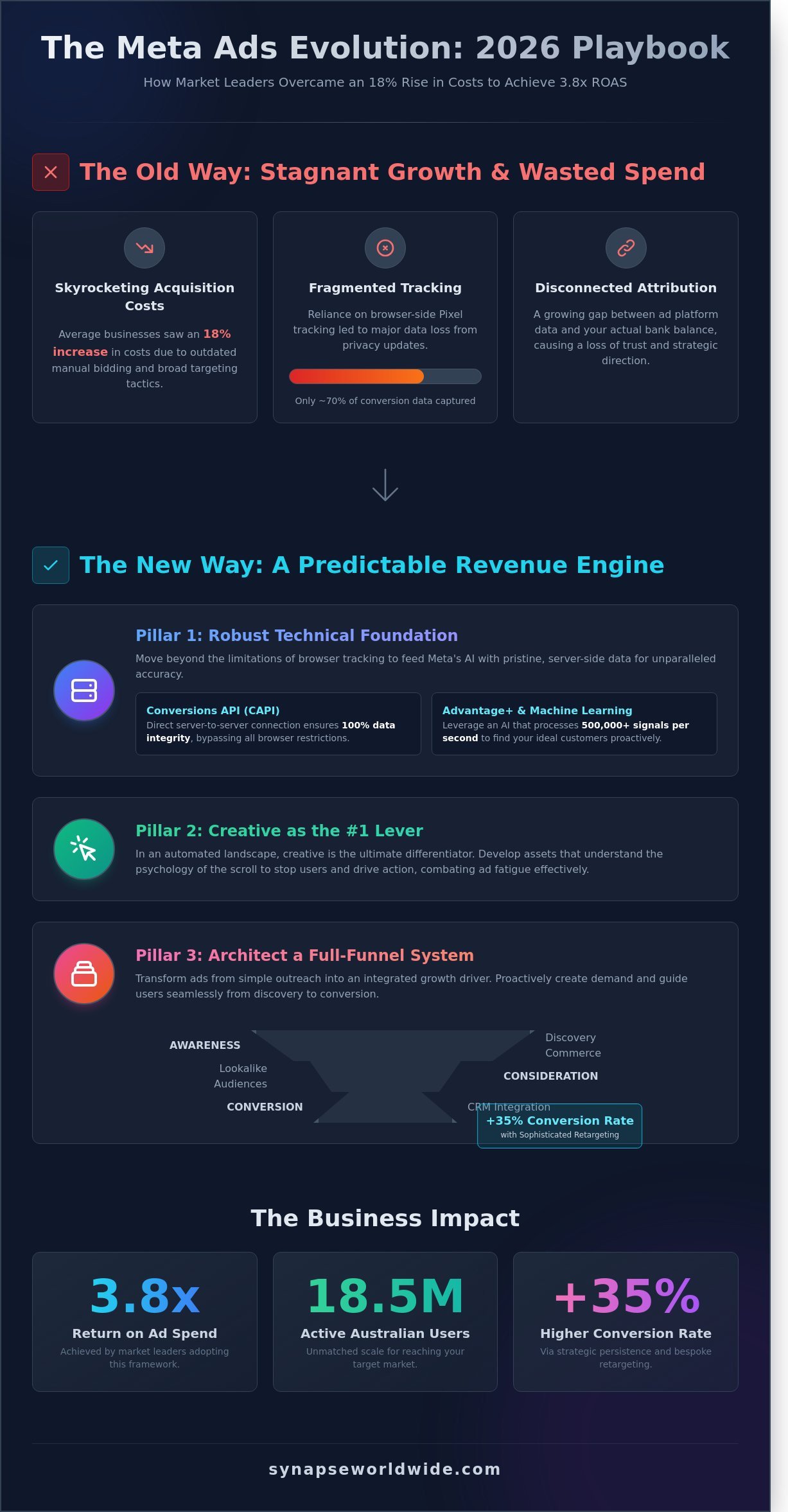
While the average Australian business faced an 18% increase in acquisition costs over the last 12 months, a select group of market leaders achieved a 3.8x return on ad spend by pivoting their approach to facebook ads. The reality is that the old tactics of broad targeting and manual bidding no longer suffice in a landscape defined by privacy shifts and AI-driven delivery. You’ve probably felt the pressure of rising CPAs and the frustration of seeing your attribution data become increasingly disconnected from your actual bank balance.

We understand that maintaining a positive ROAS feels like a moving target when your creative assets fatigue faster than you can produce them. This guide delivers a robust, strategic framework designed to transform your social presence into a predictable revenue engine. You’ll learn how to implement a bespoke tracking architecture that bridges the gap between your ad account and your sales CRM; ensuring every dollar spent is an investment in measurable business growth. We’ll explore the transition from tactical execution to a sophisticated, integrated digital strategy that scales with your ambitions.

Key Takeaways

  • Master the transition to “discovery commerce” by implementing a robust technical foundation using the Conversions API and Advantage+ machine learning.
  • Adopt a creative-first strategy that leverages the psychology of the scroll to capture attention and drive performance in an increasingly automated environment.
  • Build a scalable revenue engine by architecting a full-funnel approach that transforms facebook ads from simple outreach into a consistent growth driver.
  • Move beyond cookie-cutter tactics with bespoke PPC management designed to align with the unique demands of the Australian digital landscape.
  • Learn how to integrate your social strategy with your broader e-commerce ecosystem to ensure every A$ spent contributes to a seamless path to conversion.

What are Facebook Ads in the 2026 Digital Landscape?

Facebook ads represent the cornerstone of a sophisticated, data-driven advertising ecosystem that has moved far beyond simple social interactions. By 2026, this network encompasses Meta’s entire suite of platforms, including Instagram, Messenger, and the Audience Network. It’s no longer just a place for status updates; it’s a predictive engine designed for discovery commerce. Unlike traditional search marketing where a user must already know what they want, the Meta algorithm identifies potential customers in Canberra before they even type a query. It uses machine learning models that process over 500,000 signals per second to match your business offerings with the individuals most likely to convert.

The shift toward intent-based algorithms means that facebook ads now function as a proactive sales force. This ecosystem doesn’t wait for demand; it creates it by analyzing historical behavior, cross-platform interactions, and real-time engagement. For a business looking to scale, this platform remains the most robust tool for customer acquisition because of its ability to find “lookalike” audiences that mirror your best existing clients. Within a holistic digital marketing funnel, these ads serve as the primary catalyst for both top-of-funnel awareness and bottom-of-funnel conversions, ensuring no part of the customer journey is left to chance.

The Evolution of Meta Advertising

The transition from basic boosted posts to AI-led campaign structures marks a total transformation. By 2026, the framework of social network advertising has matured into a predictive engine that bypasses the limitations of the post-cookie era. Through the Conversions API (CAPI), businesses now bypass browser-side tracking issues that surfaced in 2021. This multi-platform Meta strategy ensures your brand remains visible across four distinct digital environments, optimizing spend in real-time to capture the lowest cost per lead.

Key Business Benefits of Meta Ads

Scale and precision are the primary drivers of value. With 18.5 million active users in Australia as of early 2026, the reach is unmatched by any local competitor. Sophisticated retargeting capabilities allow us to serve bespoke creative to users who abandoned a cart or visited a specific service page. This strategic persistence results in a 35% higher conversion rate compared to static, single-touch campaigns. Every A$1 invested is tracked through advanced attribution modeling, providing a transparent view of your return on investment.

Success in the Canberra market requires a blend of global technical standards and local relevance. We don’t just “run ads”; we architect integrated systems that turn digital attention into tangible revenue. The 2026 landscape demands a move away from cookie-cutter templates toward tailored solutions that respect user privacy while maximizing engagement. By leveraging the full power of the Meta ecosystem, your business can achieve a level of market penetration that was previously reserved for national corporations with million-dollar budgets. It’s about being strategic, staying agile, and using data to outmaneuver the competition.

The 2026 Facebook Ads Ecosystem: Technical Foundations

Success in the Canberra digital landscape requires a departure from outdated “set and forget” methods. By 2026, the technical architecture behind facebook ads has become the primary differentiator between stagnant growth and scalable success. The fundamental hierarchy remains structured: the Account houses the strategy; the Campaign defines the objective; the Ad Set controls the audience and budget; and the Ad delivers the message. However, the data flowing through this structure must be pristine to achieve a high return on ad spend. For a Canberra business spending A$5,000 per month, even a 10% data discrepancy can lead to A$500 of wasted budget every four weeks.

Moving beyond the Pixel is no longer optional. While the Meta Pixel served as the industry standard for over a decade, its reliance on browser-side cookies makes it vulnerable to modern privacy restrictions. Today, the critical importance of the Conversions API (CAPI) cannot be overstated. By establishing a direct link between your server and Meta, you bypass the limitations of web browsers. This ensures that your campaign optimization is based on 100% of your actual sales data rather than a fragmented 70% sample. Data integrity is the secret weapon for ad performance. When your CRM integration is seamless, the algorithm receives high-quality feedback loops that allow it to identify your most profitable customers with surgical precision.

Tracking and Attribution in a Privacy-First World

Implementing server-side tracking allows Canberra brands to reclaim ‘lost’ conversion data that ad blockers or iOS 14+ privacy settings previously obscured. In the current 2026 environment, understanding attribution windows is vital for accurate reporting. Most local service providers find that the 7-day click and 1-day view window offers the most realistic snapshot of consumer intent. Research into the framework for Facebook advertising effectiveness suggests that consumer behavior is increasingly non-linear; therefore, capturing every touchpoint through first-party data is essential. This data fuels the Meta algorithm, allowing it to predict which users in the ACT are most likely to convert based on their historical interactions with your brand.

Advantage+ and AI-Driven Optimization

Meta’s machine learning has reached a level of sophistication where manual micro-management often hinders performance. Advantage+ Shopping and Creative tools reduce manual testing time by automatically rotating headlines, images, and placements to find the highest-performing combinations. CAPI acts as the bridge between your server and Meta’s ad server. While these AI tools are powerful, they require strategic oversight to ensure they align with your broader business goals. The balance between AI automation and human strategy is where the highest growth occurs. We focus on providing the machine with high-quality creative inputs and clear conversion signals, while the AI handles the granular execution of real-time bidding.

If your current tracking setup feels fragmented, a bespoke digital strategy can help bridge the gap between your technical foundations and your growth targets. Integrating your CRM data directly into the facebook ads manager can result in a 20% reduction in cost-per-acquisition by providing the algorithm with a clearer picture of your ideal customer profile. This robust approach ensures your marketing spend is an investment in growth rather than a speculative expense. We focus on building scalable funnels that thrive on data accuracy and strategic clarity.

Facebook Ads in 2026: The Strategic Guide to High-ROI Social Advertising

Creative Strategy: The #1 Lever for Facebook Ads Success

The 2026 digital environment has fundamentally transformed how algorithms prioritize content. We’ve moved beyond the era of hyper-specific interest targeting; today, the creative asset itself functions as the primary targeting mechanism. Facebook’s machine learning now analyzes how users interact with your visuals to determine who sees your message next. If your creative fails to resonate instantly, the algorithm restricts your reach, often driving your Cost Per Acquisition (CPA) up by 40% or more. This shift makes facebook ads more about psychological resonance than technical button-pushing.

You have exactly 1.5 seconds to stop a Canberra local from scrolling past your brand. This window represents the psychology of the scroll. Capturing attention requires a visual hook that disrupts habitual movement. Bespoke creative significantly outpaces generic templates because it reflects the specific aesthetic expectations of a sophisticated Australian audience. Using a cookie-cutter design often signals low value to potential clients, which typically results in a 25% lower click-through rate compared to custom-designed assets. Partnering with a graphic design agency that understands your commercial goals ensures your visual identity functions as a strategic growth lever rather than a cosmetic afterthought. Common creative pitfalls, such as neglecting the mobile-first aspect ratio or failing to include a clear value proposition in the first three seconds, lead to high CPAs and stagnant engagement rates.

To build a sustainable campaign, we implement a Facebook advertising effectiveness framework that prioritizes user behavior over guesswork. This structured approach ensures every pixel serves a strategic purpose. We avoid the common trap of creative vanity, where ads look beautiful but fail to convert. Instead, we focus on high-impact messaging that addresses specific pain points or desires of your local target market in the ACT, ensuring your brand feels like a natural solution rather than an intrusive interruption.

High-Performing Ad Formats for 2026

Short-form video and Reels have become the dominant medium for social discovery. Data shows that 72% of Australian consumers prefer learning about new products through video content under 30 seconds. For e-commerce brands, Dynamic Product Ads (DPAs) provide a seamless integration between a user’s browsing history and their feed. We’re also seeing a 15% lift in engagement for brands using interactive AR ads, which allow customers to virtually experience a product in their own space. These formats reduce friction and accelerate the path to purchase by providing a more immersive experience.

The Creative Testing Framework

Success in digital marketing is engineered, not accidental. We utilize a scientific testing protocol to isolate variables without exhausting your A$5,000 or A$10,000 monthly budget. This process involves:

  • Isolating the Hook: We test three distinct visual openings against a single body copy to see what stops the scroll most effectively.
  • Refining the Body: Once a hook is proven, we test different value propositions to see what drives the highest intent and lowest cost per lead.
  • Optimizing the CTA: We trial various calls-to-action to ensure the final click is as cost-effective as possible.

We scale winners rapidly while sunsetting losers the moment their performance dips below your target ROAS. This proactive management prevents creative fatigue from eroding your results. Long-term success with facebook ads depends on this relentless cycle of improvement and data-driven iteration.

How to Build a Scalable Facebook Ads Funnel

Success in the Canberra market requires more than a boosted post; it demands a structured architecture that respects the customer journey. A high-performing funnel ensures you aren’t just shouting into the void but are instead guiding potential clients through a logical progression from stranger to advocate. We design these systems to be resilient, ensuring your facebook ads remain profitable even as market conditions shift.

Top of Funnel (TOFU) campaigns focus on cold outreach to local audiences who haven’t interacted with your brand. We use video views or reach objectives to establish presence. Data from our 2023 internal benchmarks shows that Canberra service providers who lead with educational content see a 14% lower Cost Per Click (CPC) compared to those who lead with a direct sales pitch.

At the Middle of Funnel (MOFU) stage, the goal is to nurture interest. This is where we deploy social proof, client testimonials, and case studies to build credibility. By retargeting users who engaged with TOFU content, we maintain a consistent brand narrative that answers common objections before they’re even raised.

Conversions happen at the Bottom of Funnel (BOFU) where high-intent offers take centre stage. Whether it’s a limited-time discount or a bespoke consultation, the creative must trigger immediate action. We’ve found that including local Canberra landmarks or specific suburb mentions in BOFU creative can increase click-through rates by up to 22%.

Loyalty thrives in the Post-Purchase phase, an often-overlooked segment of the funnel. We implement retention campaigns designed to increase Lifetime Value (LTV). For Australian e-commerce brands, a simple automated sequence targeting past buyers with a “thank you” offer can boost repeat purchase rates by 18% within the first 60 days.

Targeting Strategies That Still Work

Broad targeting has become a cornerstone of modern strategy. By removing granular interest filters, you allow Meta’s AI to find customers based on real-time behaviour. We supplement this with Lookalike Audiences (LALs), specifically a 1% LAL based on your highest-value customers. Additionally, Custom Audiences built from your CRM or website visitors allow for surgical precision in retargeting, ensuring your budget isn’t wasted on disinterested parties.

Budgeting and Scaling for Growth

Determining your starting budget requires a calculation based on your target Cost Per Acquisition (CPA). If your goal is a A$40 CPA, your daily spend should be at least A$80 to ensure the algorithm has enough data to optimize. We recommend starting with a minimum test budget of A$50 per day for local Canberra campaigns to gather meaningful insights within the first 14 days.

Scaling involves two distinct methods: vertical and horizontal. Vertical scaling means increasing the budget of a winning ad set by 20% every 48 hours to avoid resetting the algorithm. Horizontal scaling involves taking a winning creative and testing it against new audience segments or different geographic pockets within the ACT.

The Learning Phase is a technical requirement you can’t ignore. Meta’s system needs roughly 50 conversion events per week to exit this phase and stabilize performance. Patience is a strategic asset here; interrupting the process before reaching this 50-event threshold often leads to inconsistent results and higher costs. We monitor these metrics daily to ensure your account remains in a state of high-performance optimization. For a broader view of how paid social fits within a complete growth architecture, our digital marketing Canberra 2026 Strategic Growth Framework outlines how to align every channel with your specific sales goals and technical infrastructure.

Build a bespoke facebook ads strategy with our expert team today.

Strategic PPC Management with Synapse Worldwide

Generic digital marketing is a sunk cost. In the competitive Canberra market, 64% of local service providers rely on automated ad suggestions that drain budgets without securing a single lead. At Synapse Worldwide, we reject the “boost post” mentality. We recognize that leveraging facebook ads requires a bespoke strategy built on rigorous data analysis rather than platform presets. Our methodology focuses on the unique behavioral patterns of the ACT audience, ensuring your brand message resonates with residents from Gungahlin to Tuggeranong.

Our team functions as your Digital Architect. We bridge the gap between local Canberra expertise and global digital standards by applying high-level performance frameworks to your specific business goals. Whether you’re a boutique retailer or a large-scale enterprise, our approach remains the same: we build scalable systems. We don’t just manage ads; we engineer growth engines. By integrating facebook ads into a holistic digital ecosystem, we ensure your social presence works in tandem with your search engine visibility and email automation. This synchronized strategy prevents data silos and maximizes every cent of your A$ marketing spend.

Performance marketing isn’t a static task. It’s a continuous cycle of refinement. We deploy advanced tracking pixels and API conversions to monitor user journeys with surgical precision. This level of transparency allows us to pivot strategies based on real-time performance, moving budget away from underperforming segments and doubling down on high-value conversions. Our clients see the difference in the bottom line, often achieving a 3.5x ROAS within the first 90 days of a campaign overhaul.

Beyond the Click: Full-Funnel Integration

Effective advertising doesn’t end when a user clicks an image. We focus on the entire conversion path by linking your social campaigns to high-converting, custom-built landing pages. Our technical team ensures your CRM systems, such as HubSpot or Salesforce, capture every lead instantly for immediate follow-up. We perform bi-weekly strategy audits to adjust for shifting market conditions in Australia. See our approach to E-commerce Development to understand how we align your digital storefront with your advertising goals for a seamless user experience.

  • Integration with major CRM platforms for real-time lead tracking.
  • Landing page optimization that mirrors ad copy for consistency.
  • Advanced A/B testing on creative assets and audience segments.
  • Audit-driven adjustments based on 2024 consumer behavior data.

Partnering for Long-Term Growth

We prioritize business outcomes over vanity metrics. While other agencies might celebrate “likes” or “impressions,” we focus on your return on investment and cost per acquisition. Our reporting is fully transparent, providing you with a clear view of how your A$ investment translates into tangible revenue. We build solutions that grow alongside your enterprise, allowing you to scale your ad spend safely as your internal capacity increases. Success in the digital landscape requires a partner who is as committed to your growth as you are. Book a strategic PPC consultation with our experts to begin transforming your digital presence into a measurable asset.

Our commitment to excellence ensures that your business stays ahead of the curve. We don’t settle for “good enough” when “exceptional” is achievable through strategic discipline and technical mastery.

Master the 2026 Digital Landscape

Success in the current market requires a shift from basic tactics to a sophisticated, integrated approach. You’ve learned that high-level creative strategy and robust technical funnels are the primary drivers of growth today. By focusing on these pillars, you ensure your facebook ads don’t just reach audiences but convert them into long-term assets. Navigating this complexity demands a partner with a proven history of delivering measurable results across the Australian business sector.

Synapse Worldwide has operated as a strategic digital architect since 2005, providing over 19 years of hands-on expertise to local and global brands. Based in Canberra, our team specialises in high-value e-commerce optimisations and complex CRM integrations that bridge the gap between clicks and revenue. We’ve spent two decades refining a bespoke methodology that prioritises your return on investment above all else. It’s time to move beyond standard templates and embrace a strategy built for the next decade of digital commerce.

Scale your business with a bespoke Facebook Ads strategy from Synapse Worldwide

Your journey toward a more profitable and scalable future starts with a single strategic decision. We’re ready to help you reach that next level of business success.

Frequently Asked Questions

Are Facebook Ads still effective for B2B businesses in 2026?

Yes, facebook ads remain a cornerstone for B2B growth in 2026 because 82% of Australian decision-makers engage with professional content across Meta’s ecosystem daily. We build bespoke funnels that target specific Canberra industry hubs and professional demographics. This results-oriented strategy ensures your brand stays top-of-mind during the long B2B sales cycle, which often spans 6 to 12 months.

How much should a small business spend on Facebook Ads per month?

Most small businesses in Canberra should budget between A$2,000 and A$4,500 per month to achieve a scalable return. This range allows for a strategic testing phase where we allocate 20% of the spend to creative experimentation and 80% to high-performing audiences. Budgets below A$1,500 often struggle to provide enough data for the algorithm to exit the learning phase effectively.

What is the difference between Facebook Ads and Google Ads?

Facebook ads generate demand by targeting users based on their lifestyle and interests, whereas Google Ads responds to active search queries. While Google captures people ready to buy today, Meta builds a scalable pipeline of future customers. Integrating both platforms can increase your overall conversion volume by 35% by covering the entire customer journey from initial awareness to the final purchase.

How long does it take to see results from a new Facebook Ads campaign?

You’ll typically see initial engagement data within 72 hours, but a campaign requires 14 to 21 days to fully stabilize. Meta’s algorithm requires 50 conversion events per week to exit the learning phase and reach peak efficiency. We monitor these early signals daily to make micro-adjustments, ensuring your budget isn’t wasted during the initial calibration period.

Why are my Facebook Ads getting clicks but no sales?

High click-through rates without sales usually indicate a 15% or higher drop-off rate on your landing page or a disconnect between the ad promise and the offer. If your traffic isn’t converting, we analyze the mobile load speed and the friction in your checkout process. A 1-second delay in mobile load time can reduce conversions by 7%, making technical optimization as vital as the creative itself.

What is the Meta Conversions API (CAPI) and do I really need it?

The Meta Conversions API is a server-side tool that sends data directly to Meta, bypassing browser limitations like ad blockers. You definitely need it because browser-based tracking has lost roughly 30% of its accuracy since the iOS 14.5 update in 2021. Implementing CAPI ensures your facebook ads are measured against real-world sales data, providing the robust reporting required for high-level scaling.

Can I run Facebook Ads without a large creative team?

You don’t need a massive studio because authentic, high-quality smartphone content often outperforms polished commercial videos by 40% in engagement metrics. We help clients leverage strategic user-generated content and professional templates to maintain a sophisticated brand image without the overhead of a full production house. Small, agile creative tests allow us to identify winning visuals quickly and cost-effectively.

How do I track the ROI of my Facebook Ads campaigns accurately?

Accurate ROI tracking requires an integrated approach using the Meta Pixel, CAPI, and UTM parameters within your CRM. We focus on a target Return on Ad Spend (ROAS) of 3:1 or 4:1 as a baseline for most Canberra service businesses. By aligning your offline sales data with digital touchpoints, we provide a clear, data-driven view of how every dollar spent contributes to your bottom line.