Tag Archives: Digital Marketing Strategy


Digital Marketing Strategy for SMBs: The 2026 Strategic Growth Framework

Digital Marketing Strategy for SMBs: The 2026 Strategic Growth Framework

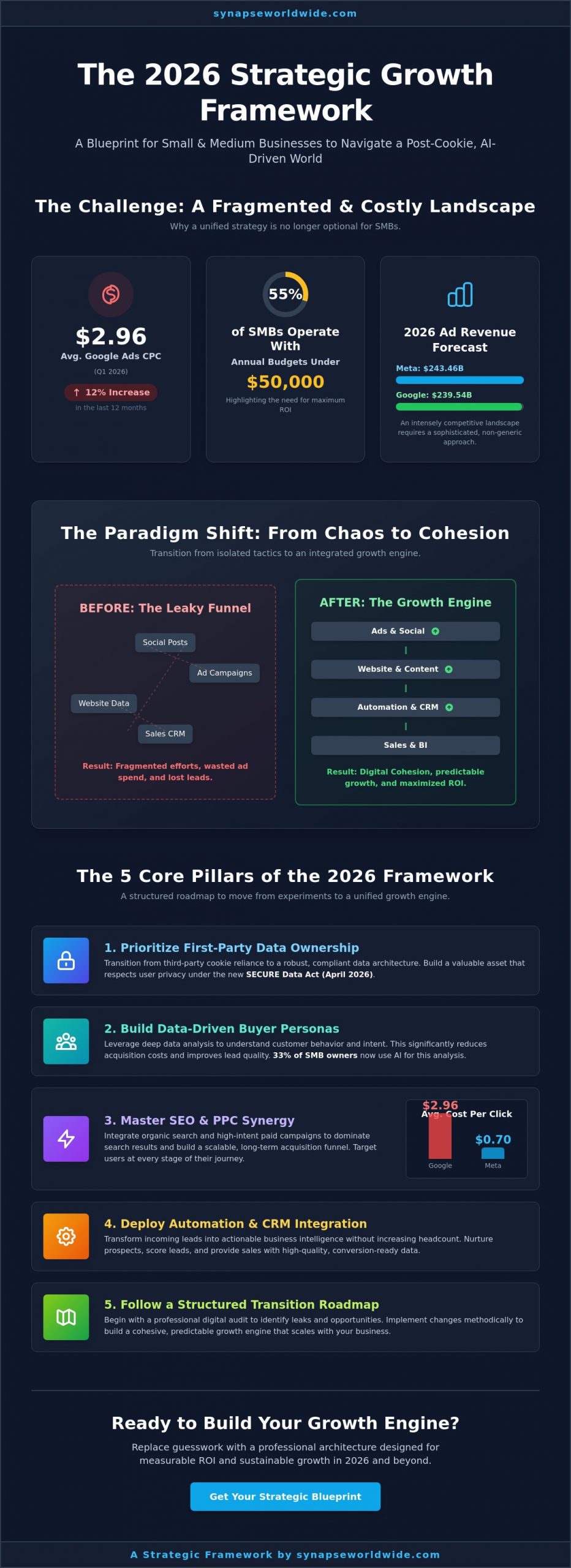
With Google Ads search costs hitting an average of $2.96 per click in the first quarter of 2026, small businesses are paying 12% more for traffic than they did just twelve months ago. It’s a challenging environment where 55% of SMBs are attempting to scale with annual budgets under $50,000. If you feel like your marketing efforts are fragmented and your customer acquisition costs are spiraling, you aren’t alone. Developing a cohesive digital marketing strategy smb isn’t about spending more; it’s about building a professional architecture where your website, ads, and sales data work in total unison.

You deserve a roadmap that replaces guesswork with measurable ROI and sustainable organic growth. This guide provides the 2026 Strategic Growth Framework, a bespoke approach designed to integrate high-level consulting with practical execution. We’ll examine how to navigate the new SECURE Data Act regulations introduced on April 22, 2026, while leveraging the latest GA4 AI tools to ensure your digital presence is both compliant and highly profitable.

Key Takeaways

  • Transition from fragmented tactics to a bespoke blueprint that prioritizes first-party data ownership in the post-cookie landscape of 2026.
  • Leverage data-driven buyer personas and brand alignment to significantly reduce customer acquisition costs and improve lead quality.
  • Master the synergy between organic SEO and high-intent PPC to build a scalable digital marketing strategy smb that dominates search results.
  • Deploy marketing automation and CRM integration to transform incoming leads into actionable business intelligence without increasing your headcount.
  • Follow a structured transition roadmap that begins with a professional digital audit to move from isolated experiments to a unified growth engine.

What is a Digital Marketing Strategy for SMBs in 2026?

A digital marketing strategy smb is no longer a luxury or a side project; it’s the primary architectural blueprint for your revenue generation. In 2026, the distinction between having a website and owning a market has never been sharper. Digital marketing has evolved from simple online visibility into a complex ecosystem where every touchpoint must be intentional. With the introduction of the SECURE Data Act on April 22, 2026, the landscape has shifted permanently toward first-party data ownership. You can’t rely on third-party cookies to track users anymore. Success now requires a transition from fragmented tactical execution to a robust strategic architecture that captures, nurtures, and converts high-value leads with precision.

The core of a modern strategy lies in its ability to turn digital spend into a predictable growth engine. While many businesses still focus on isolated tactics like occasional social posts or disconnected ad campaigns, a professional framework integrates these elements into a single, cohesive unit. This approach ensures that your marketing efforts talk to each other, sharing data to lower your acquisition costs and maximize the value of every visitor.

The Evolution of SMB Marketing: From Presence to Performance

The days of the static brochure website are over. Modern SMBs must view their digital presence as a high-performance engine that operates with a national-scale perspective, even if their service area is local. This shift involves moving beyond mere online presence to a state of constant performance optimization. Digital strategy is the alignment of technology, data, and creative messaging. With the average marketing spend for a small business currently sitting at 8.11% of total revenue, there’s no room for waste. By treating your digital footprint as an integrated asset, you move from passive outreach to sophisticated lead nurturing that respects the 2026 consumer’s demand for privacy and relevance.

Why ‘Cookie-Cutter’ Solutions Fail in a Competitive Landscape

Generic, template-based marketing approaches are facing rapidly diminishing returns. When Meta is forecasted to reach $243.46 billion in ad revenue this year, surpassing Google’s $239.54 billion, the sheer volume of noise makes cookie-cutter solutions invisible. A bespoke digital marketing strategy smb creates a defensive moat around your business by building unique, non-replicable value for your audience. We call this Digital Cohesion. It’s the seamless integration of every channel to ensure that a lead generated on social media is nurtured through automated email sequences and converted by a data-informed sales team. This cohesion ensures that your $2.96 average cost-per-click investment isn’t lost to a leaky funnel, but is instead captured in a CRM system designed for long-term growth.

Building the Foundation: Audience Intelligence and Brand Alignment

Precision is the new currency for small businesses. With Google Search costs rising to $2.96 per click in the first quarter of 2026, you can’t afford to target a broad, undefined audience. High customer acquisition costs often stem from a fundamental lack of brand alignment. When your messaging doesn’t match the specific intent of the user, you’re essentially paying for curiosity rather than conversion. A professional Web Design and Branding Alignment ensures that your identity resonates instantly with high-value prospects. This isn’t just about aesthetics; it’s about building a digital marketing strategy smb that scales by establishing authority before the first sales call occurs.

Effective audience intelligence in 2026 relies on more than just basic demographics. 33% of small business owners now use AI for deep data analysis, allowing them to build personas based on actual behavioral patterns. This intelligence informs a comprehensive digital marketing strategy that prioritizes first-party data. By understanding the specific challenges your customers face, you can position your brand as the bespoke solution they’ve been searching for, effectively creating a defensive moat against lower-cost, cookie-cutter competitors.

Mapping the Modern Customer Journey

The journey from search to sale is no longer linear. A prospect might discover your brand through a Meta ad (where traffic costs average $0.70 per click) but won’t convert until they’ve interacted with your email content or read an authoritative blog post. Omnichannel consistency is vital. You must identify high-intent signals, such as multiple visits to a case study page or engagement with a “Task Assistant” on your site. These signals tell you exactly when to transition from automated awareness to direct sales outreach, ensuring you capture the 53% of SMB customers who prioritize businesses with a seamless digital experience.

The Strategic Intersection of Design and Trust

Trust is a technical requirement in the 2026 digital landscape. A custom web design for small business acts as the anchor for your entire growth framework. Template-based sites often feel fragile or generic, which triggers immediate skepticism in B2B and B2C buyers alike. To audit your current brand-web alignment, consider these critical factors:

  • Visual Cohesion: Does your social media presence mirror the sophisticated UI of your website?
  • Privacy-First UX: Are you meeting the new SECURE Data Act standards for consent and data transparency?
  • Authority Markers: Are your specific business outcomes and data-driven claims integrated directly into the narrative flow?

When these elements align, your website transforms from a static page into a strategic growth engine. If your current digital presence feels fragmented, a bespoke design strategy can help you reclaim your authority and lower your overall marketing spend.

Digital Marketing Strategy for SMBs: The 2026 Strategic Growth Framework

The Core Pillars: Integrating Content, Search, and Paid Channels

Siloed marketing is a legacy of the past. To build a truly scalable digital marketing strategy smb, you must treat your organic, paid, and social channels as a single, integrated ecosystem. Relying on just one pillar is a high-risk gamble. While 53% of small businesses currently utilize SEO, the most successful firms in 2026 are those that use paid data to accelerate their organic growth. This synergy allows you to capture high-intent traffic from Google Ads search campaigns, which currently boast an average conversion rate of 7.04%, while simultaneously building an organic asset that reduces your long-term reliance on rising ad costs.

Relationship-based growth is particularly critical for businesses with longer sales cycles. Implementing a sophisticated b2b social media marketing framework allows you to nurture prospects who aren’t yet ready to buy. With Meta projected to surpass Google in ad revenue for the first time in 2026, reaching $243.46 billion, the platform’s role in the B2B funnel has shifted from mere awareness to a primary lead generation tool. Authoritative content fuels this funnel, ensuring that when a prospect is finally ready to search, your brand is already the trusted authority.

Search Engine Optimization as a Long-Term Asset

Think of SEO as a strategic capital investment rather than a monthly marketing expense. In 2026, site architecture and technical health are the baseline requirements for visibility, not the finish line. We use content clusters to build topical authority, signaling to search engines that your business is a definitive source of truth in your industry. This long game strategy creates a sustainable flow of organic traffic that compounds over time, providing a vital buffer against the 12% year-over-year increase in search CPCs we’ve seen this year.

Precision PPC: Driving Sustainable Traffic

Precision in PPC means moving beyond basic keyword matching to AI-optimized bidding and bespoke landing pages. The automation trends in Google and Meta for 2026 require a higher level of strategic oversight than ever before. You cannot just set and forget your campaigns. By aligning your ad copy with your core brand values and driving traffic to high-performance landing pages, you ensure that every dollar of your digital spend is optimized for conversion. This paid data then flows back into your digital marketing strategy smb, highlighting exactly which topics deserve deep-dive content development based on real-world conversion data.

Operational Excellence: Automation, CRM, and Data Integration

Marketing success is often won or lost in the engine room of your business. While many focus on the top of the funnel, a truly scalable digital marketing strategy smb prioritizes what happens after the click. In 2026, manual lead handling is a liability. With 27% of small business owners planning to adopt AI for campaign management this year, the competitive advantage has shifted to those who can scale their operations without a linear increase in headcount. Operational excellence requires a transition from isolated spreadsheets to a robust, integrated digital architecture where your marketing spend is directly visible within your sales and operational data.

Integrated systems solve the common objection that modern marketing is too complex to manage. By connecting your digital presence to a CRM and ERP, you turn raw data into actionable business intelligence. This level of integration ensures that your marketing team isn’t just chasing traffic, but is instead focused on high-margin opportunities that align with your current inventory and operational capacity. It’s the difference between a fragmented series of ads and a cohesive growth engine that powers your entire enterprise. Exploring the full range of Synapse Worldwide services, from custom web design to CRM integration and precision SEO, reveals how each component works together to eliminate these inefficiencies at scale.

The Power of Integrated Lead Management

The journey from a website inquiry to a CRM record must be instantaneous and invisible. When a lead enters your system, automated follow-up sequences should trigger immediately. Data from 2026 shows that automated emails, such as welcome or nurture sequences, achieve a 31.4% open rate, significantly higher than the 21.33% industry average for general broadcasts. This automation prevents lead leakage and ensures that your $27.66 average cost per lead on Meta platforms isn’t wasted due to slow response times. Closed-loop reporting then allows you to trace every dollar of revenue back to the specific ad or keyword that generated it, providing the clarity needed for true optimization.

Scaling Through Business Process Automation

Common bottlenecks, such as manual data entry or disconnected inventory systems, can be eliminated through business process automation solutions. When your ERP is integrated into your digital framework, you gain a real-time view of marketing profitability. You can see exactly how a spike in search traffic affects your operational load and adjust your strategy accordingly. Automation is the bridge between marketing effort and operational efficiency. It allows your team to focus on high-level strategy and relationship building while the system handles the repetitive tasks of data synchronization and lead routing. To see how these systems can transform your workflow, explore our bespoke automation and CRM integration services.

Implementation and Scaling: Your 2026 Strategic Roadmap

Transitioning from fragmented tactics to a unified digital marketing strategy smb requires a shift in perspective. It’s not about running more ads; it’s about building a professional framework that scales with your ambition. In 2026, where email marketing is expected to generate $17.9 billion in global revenue, your roadmap must prioritize high-value channels while maintaining operational discipline. This transformation begins by moving away from a “test and see” mentality toward a state of data-driven conviction. By positioning yourself as a proactive participant in your digital architecture, you ensure that your marketing spend is an investment in a durable business asset.

Setting scalable KPIs is the next step in this evolution. Move beyond vanity metrics like “likes” or “impressions” and focus on data that reflects real business growth. In 2026, this means tracking the cost per qualified lead and the lifetime value of customers acquired through integrated channels. With the three most used channels being social media, SEO, and email, your metrics must show how these pillars interact to drive revenue. A professional roadmap replaces guesswork with a structured flow that guides your business from initial interest to a state of sustained market leadership.

The Discovery and Audit Phase

Every successful build starts with a discovery phase. A professional digital audit analyzes your existing technical architecture, from your GA4 “Generated insights” setup to your compliance with the SECURE Data Act introduced on April 22, 2026. We identify low-hanging fruit, such as unoptimized Google Business Profiles or broken lead paths, which can provide immediate performance gains. This phase ensures that your digital goals are perfectly aligned with your corporate objectives, creating a stable foundation for the complex technical details that follow. We don’t just look at what’s broken; we look at what’s possible when your technology and strategy are in total unison.

Executing the Bespoke Growth Framework

Executing a bespoke framework is a deliberate, phased process. We start with the core architecture, such as custom web development and CRM integration, before layering on sophisticated automation. This isn’t a one-off transaction but a continuous optimization cycle. We use tools like the GA4 Task Assistant, released on April 29, 2026, to monitor property configuration and refine tactics in real time. This “Monitor, Analyze, Refine” loop ensures your strategy remains robust as market conditions change. Partnering with a Digital Architect provides the visionary oversight and disciplined management needed to turn this framework into a long-term engine for success. For a professional audit of your current digital presence, connect with our strategic consulting team today.

Architecting Your Path to Sustained Digital Growth

The 2026 digital landscape demands a shift from isolated marketing experiments to a unified, professional architecture. By integrating your website, paid channels, and back-end systems, you create a robust ecosystem that reduces acquisition costs and captures high-value leads with precision. Owning your first-party data and leveraging automation aren’t just technical upgrades; they’re essential components of a digital marketing strategy smb that thrives in a privacy-first environment.

Success requires a partner who understands both the high-level strategy and the intricate technical details of execution. Since 2005, Synapse Worldwide has provided over two decades of digital expertise to businesses looking to reach the next level of success. We specialize in custom ERP and CRM integrations that turn fragmented data into seamless operations. Our proven track record of delivering scalable digital infrastructure across diverse industries ensures your business is built on a foundation of reliability and authoritative growth.

Partner with Synapse Worldwide to architect your bespoke digital growth strategy. Your business is ready for its next transformation. Let’s build a presence that doesn’t just participate in the market but leads it.

Frequently Asked Questions

What is the most effective digital marketing strategy for an SMB in 2026?

The most effective approach is an integrated digital marketing strategy smb that prioritizes first-party data and cross-channel synergy. In 2026, relying on a single platform is a high-risk gamble. You must align your organic content with paid search and email automation to ensure every touchpoint captures intent. This multi-channel framework creates a resilient ecosystem that adapts to shifting privacy laws and rising ad costs.

How much should a small business spend on digital marketing strategy?

Small businesses typically allocate an average of 8.11% of their total revenue to marketing efforts. While 55% of SMBs maintain annual budgets under $50,000, those partnering with professional agencies often invest in monthly retainers between $1,000 and $10,000. Your specific investment should reflect your growth targets and the competitive density of your industry. It’s an investment in your business’s scalable infrastructure.

Should I focus on SEO or PPC first for my small business?

You should ideally launch both simultaneously to balance immediate traffic with long-term asset building. PPC provides instant high-intent leads, with Google Ads search campaigns currently averaging a 7.04% conversion rate. This paid data identifies the most profitable keywords, which you can then target through your organic SEO efforts to reduce your future cost-per-acquisition. This integrated method ensures you aren’t waiting months for your first lead.

How long does it take to see results from a digital marketing strategy?

Paid campaigns can deliver results within 24 to 48 hours of launch. In contrast, a robust SEO strategy typically requires 3 to 6 months to demonstrate significant organic ranking improvements. This timeline depends on your site’s technical health and the quality of your content clusters. Consistency is the key to seeing these efforts compound into sustainable market authority and a lower overall cost per lead.

Why do small businesses need a custom website for their marketing strategy?

A custom website provides the technical infrastructure needed for advanced tracking and SECURE Data Act compliance. Template sites often lack the flexibility for deep CRM integration and bespoke user journeys. Since your website is the final destination for all your traffic, a professional UI/UX design is vital to convert visitors into leads at a higher rate than generic, cookie-cutter competitors.

Can marketing automation really help a small business scale?

Automation is the primary driver for scaling operations efficiently without a linear increase in headcount. By deploying automated nurture sequences, which currently see a 31.4% open rate, you can manage thousands of leads with minimal manual intervention. It ensures that no inquiry is ignored and allows your team to focus exclusively on closing high-value deals rather than performing repetitive administrative tasks.

How do I measure the ROI of my digital marketing efforts?

You measure ROI by integrating your website data with a CRM to track the full journey from click to closed sale. Using GA4 “Generated insights,” you can calculate the exact cost-per-lead and customer lifetime value. This closed-loop reporting shows you which channels are driving actual revenue versus those that only generate vanity metrics like impressions or clicks. It turns your digital marketing strategy smb into a predictable growth engine.

Is social media marketing still relevant for B2B SMBs in 2026?

Social media remains highly relevant for B2B SMBs as a tool for authority building and lead nurturing. With Meta ads offering an average CPC of $0.70 for traffic campaigns, it’s a cost-effective way to stay top-of-mind with decision-makers. A strong social presence validates your expertise and shortens the sales cycle by building trust before the initial consultation occurs.


Facebook Ads in 2026: The Strategic Guide to High-ROI Social Advertising

Facebook Ads in 2026: The Strategic Guide to High-ROI Social Advertising

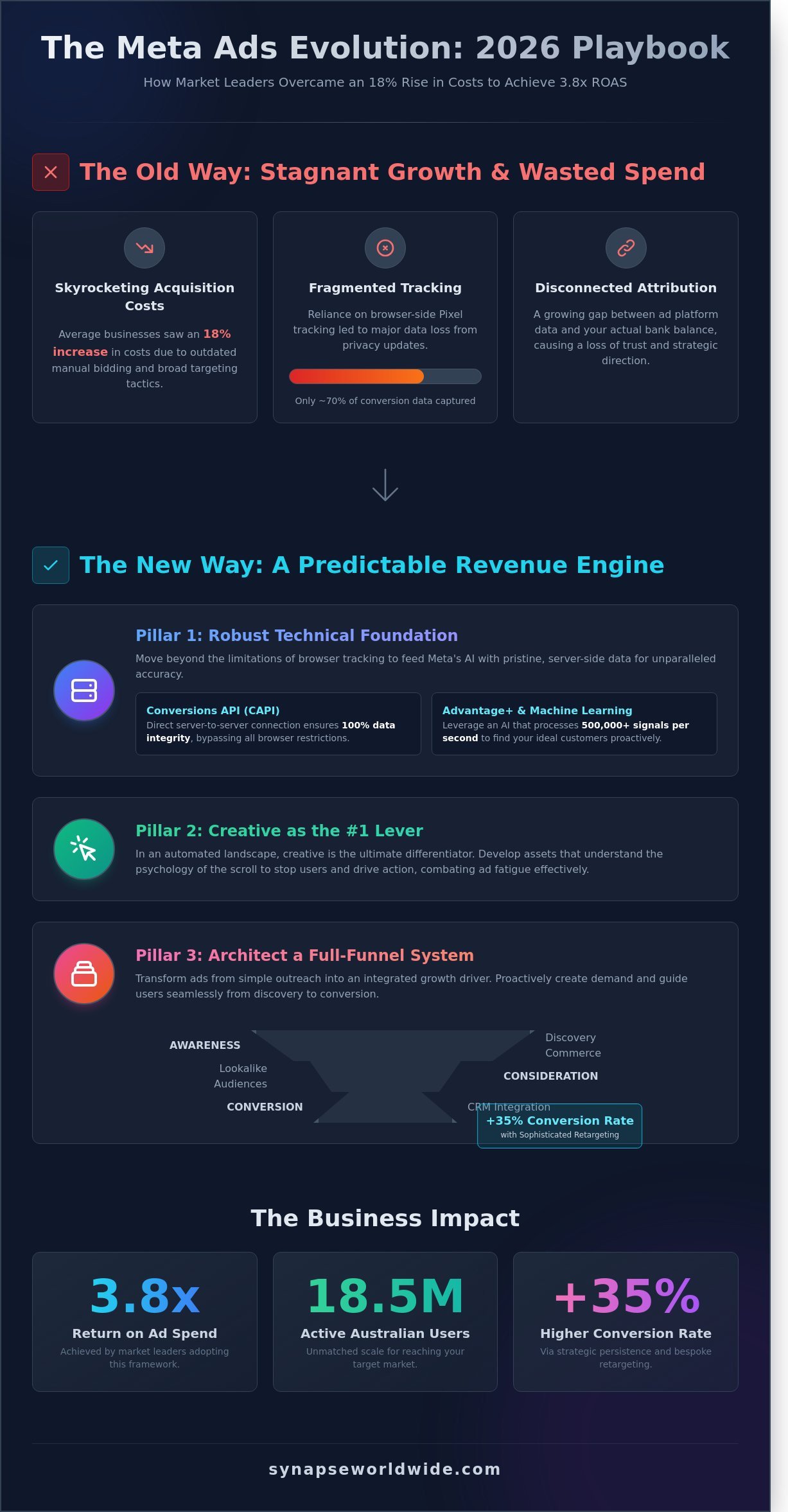
While the average Australian business faced an 18% increase in acquisition costs over the last 12 months, a select group of market leaders achieved a 3.8x return on ad spend by pivoting their approach to facebook ads. The reality is that the old tactics of broad targeting and manual bidding no longer suffice in a landscape defined by privacy shifts and AI-driven delivery. You’ve probably felt the pressure of rising CPAs and the frustration of seeing your attribution data become increasingly disconnected from your actual bank balance.

We understand that maintaining a positive ROAS feels like a moving target when your creative assets fatigue faster than you can produce them. This guide delivers a robust, strategic framework designed to transform your social presence into a predictable revenue engine. You’ll learn how to implement a bespoke tracking architecture that bridges the gap between your ad account and your sales CRM; ensuring every dollar spent is an investment in measurable business growth. We’ll explore the transition from tactical execution to a sophisticated, integrated digital strategy that scales with your ambitions.

Key Takeaways

  • Master the transition to “discovery commerce” by implementing a robust technical foundation using the Conversions API and Advantage+ machine learning.
  • Adopt a creative-first strategy that leverages the psychology of the scroll to capture attention and drive performance in an increasingly automated environment.
  • Build a scalable revenue engine by architecting a full-funnel approach that transforms facebook ads from simple outreach into a consistent growth driver.
  • Move beyond cookie-cutter tactics with bespoke PPC management designed to align with the unique demands of the Australian digital landscape.
  • Learn how to integrate your social strategy with your broader e-commerce ecosystem to ensure every A$ spent contributes to a seamless path to conversion.

What are Facebook Ads in the 2026 Digital Landscape?

Facebook ads represent the cornerstone of a sophisticated, data-driven advertising ecosystem that has moved far beyond simple social interactions. By 2026, this network encompasses Meta’s entire suite of platforms, including Instagram, Messenger, and the Audience Network. It’s no longer just a place for status updates; it’s a predictive engine designed for discovery commerce. Unlike traditional search marketing where a user must already know what they want, the Meta algorithm identifies potential customers in Canberra before they even type a query. It uses machine learning models that process over 500,000 signals per second to match your business offerings with the individuals most likely to convert.

The shift toward intent-based algorithms means that facebook ads now function as a proactive sales force. This ecosystem doesn’t wait for demand; it creates it by analyzing historical behavior, cross-platform interactions, and real-time engagement. For a business looking to scale, this platform remains the most robust tool for customer acquisition because of its ability to find “lookalike” audiences that mirror your best existing clients. Within a holistic digital marketing funnel, these ads serve as the primary catalyst for both top-of-funnel awareness and bottom-of-funnel conversions, ensuring no part of the customer journey is left to chance.

The Evolution of Meta Advertising

The transition from basic boosted posts to AI-led campaign structures marks a total transformation. By 2026, the framework of social network advertising has matured into a predictive engine that bypasses the limitations of the post-cookie era. Through the Conversions API (CAPI), businesses now bypass browser-side tracking issues that surfaced in 2021. This multi-platform Meta strategy ensures your brand remains visible across four distinct digital environments, optimizing spend in real-time to capture the lowest cost per lead.

Key Business Benefits of Meta Ads

Scale and precision are the primary drivers of value. With 18.5 million active users in Australia as of early 2026, the reach is unmatched by any local competitor. Sophisticated retargeting capabilities allow us to serve bespoke creative to users who abandoned a cart or visited a specific service page. This strategic persistence results in a 35% higher conversion rate compared to static, single-touch campaigns. Every A$1 invested is tracked through advanced attribution modeling, providing a transparent view of your return on investment.

Success in the Canberra market requires a blend of global technical standards and local relevance. We don’t just “run ads”; we architect integrated systems that turn digital attention into tangible revenue. The 2026 landscape demands a move away from cookie-cutter templates toward tailored solutions that respect user privacy while maximizing engagement. By leveraging the full power of the Meta ecosystem, your business can achieve a level of market penetration that was previously reserved for national corporations with million-dollar budgets. It’s about being strategic, staying agile, and using data to outmaneuver the competition.

The 2026 Facebook Ads Ecosystem: Technical Foundations

Success in the Canberra digital landscape requires a departure from outdated “set and forget” methods. By 2026, the technical architecture behind facebook ads has become the primary differentiator between stagnant growth and scalable success. The fundamental hierarchy remains structured: the Account houses the strategy; the Campaign defines the objective; the Ad Set controls the audience and budget; and the Ad delivers the message. However, the data flowing through this structure must be pristine to achieve a high return on ad spend. For a Canberra business spending A$5,000 per month, even a 10% data discrepancy can lead to A$500 of wasted budget every four weeks.

Moving beyond the Pixel is no longer optional. While the Meta Pixel served as the industry standard for over a decade, its reliance on browser-side cookies makes it vulnerable to modern privacy restrictions. Today, the critical importance of the Conversions API (CAPI) cannot be overstated. By establishing a direct link between your server and Meta, you bypass the limitations of web browsers. This ensures that your campaign optimization is based on 100% of your actual sales data rather than a fragmented 70% sample. Data integrity is the secret weapon for ad performance. When your CRM integration is seamless, the algorithm receives high-quality feedback loops that allow it to identify your most profitable customers with surgical precision.

Tracking and Attribution in a Privacy-First World

Implementing server-side tracking allows Canberra brands to reclaim ‘lost’ conversion data that ad blockers or iOS 14+ privacy settings previously obscured. In the current 2026 environment, understanding attribution windows is vital for accurate reporting. Most local service providers find that the 7-day click and 1-day view window offers the most realistic snapshot of consumer intent. Research into the framework for Facebook advertising effectiveness suggests that consumer behavior is increasingly non-linear; therefore, capturing every touchpoint through first-party data is essential. This data fuels the Meta algorithm, allowing it to predict which users in the ACT are most likely to convert based on their historical interactions with your brand.

Advantage+ and AI-Driven Optimization

Meta’s machine learning has reached a level of sophistication where manual micro-management often hinders performance. Advantage+ Shopping and Creative tools reduce manual testing time by automatically rotating headlines, images, and placements to find the highest-performing combinations. CAPI acts as the bridge between your server and Meta’s ad server. While these AI tools are powerful, they require strategic oversight to ensure they align with your broader business goals. The balance between AI automation and human strategy is where the highest growth occurs. We focus on providing the machine with high-quality creative inputs and clear conversion signals, while the AI handles the granular execution of real-time bidding.

If your current tracking setup feels fragmented, a bespoke digital strategy can help bridge the gap between your technical foundations and your growth targets. Integrating your CRM data directly into the facebook ads manager can result in a 20% reduction in cost-per-acquisition by providing the algorithm with a clearer picture of your ideal customer profile. This robust approach ensures your marketing spend is an investment in growth rather than a speculative expense. We focus on building scalable funnels that thrive on data accuracy and strategic clarity.

Facebook Ads in 2026: The Strategic Guide to High-ROI Social Advertising

Creative Strategy: The #1 Lever for Facebook Ads Success

The 2026 digital environment has fundamentally transformed how algorithms prioritize content. We’ve moved beyond the era of hyper-specific interest targeting; today, the creative asset itself functions as the primary targeting mechanism. Facebook’s machine learning now analyzes how users interact with your visuals to determine who sees your message next. If your creative fails to resonate instantly, the algorithm restricts your reach, often driving your Cost Per Acquisition (CPA) up by 40% or more. This shift makes facebook ads more about psychological resonance than technical button-pushing.

You have exactly 1.5 seconds to stop a Canberra local from scrolling past your brand. This window represents the psychology of the scroll. Capturing attention requires a visual hook that disrupts habitual movement. Bespoke creative significantly outpaces generic templates because it reflects the specific aesthetic expectations of a sophisticated Australian audience. Using a cookie-cutter design often signals low value to potential clients, which typically results in a 25% lower click-through rate compared to custom-designed assets. Partnering with a graphic design agency that understands your commercial goals ensures your visual identity functions as a strategic growth lever rather than a cosmetic afterthought. Common creative pitfalls, such as neglecting the mobile-first aspect ratio or failing to include a clear value proposition in the first three seconds, lead to high CPAs and stagnant engagement rates.

To build a sustainable campaign, we implement a Facebook advertising effectiveness framework that prioritizes user behavior over guesswork. This structured approach ensures every pixel serves a strategic purpose. We avoid the common trap of creative vanity, where ads look beautiful but fail to convert. Instead, we focus on high-impact messaging that addresses specific pain points or desires of your local target market in the ACT, ensuring your brand feels like a natural solution rather than an intrusive interruption.

High-Performing Ad Formats for 2026

Short-form video and Reels have become the dominant medium for social discovery. Data shows that 72% of Australian consumers prefer learning about new products through video content under 30 seconds. For e-commerce brands, Dynamic Product Ads (DPAs) provide a seamless integration between a user’s browsing history and their feed. We’re also seeing a 15% lift in engagement for brands using interactive AR ads, which allow customers to virtually experience a product in their own space. These formats reduce friction and accelerate the path to purchase by providing a more immersive experience.

The Creative Testing Framework

Success in digital marketing is engineered, not accidental. We utilize a scientific testing protocol to isolate variables without exhausting your A$5,000 or A$10,000 monthly budget. This process involves:

  • Isolating the Hook: We test three distinct visual openings against a single body copy to see what stops the scroll most effectively.
  • Refining the Body: Once a hook is proven, we test different value propositions to see what drives the highest intent and lowest cost per lead.
  • Optimizing the CTA: We trial various calls-to-action to ensure the final click is as cost-effective as possible.

We scale winners rapidly while sunsetting losers the moment their performance dips below your target ROAS. This proactive management prevents creative fatigue from eroding your results. Long-term success with facebook ads depends on this relentless cycle of improvement and data-driven iteration.

How to Build a Scalable Facebook Ads Funnel

Success in the Canberra market requires more than a boosted post; it demands a structured architecture that respects the customer journey. A high-performing funnel ensures you aren’t just shouting into the void but are instead guiding potential clients through a logical progression from stranger to advocate. We design these systems to be resilient, ensuring your facebook ads remain profitable even as market conditions shift.

Top of Funnel (TOFU) campaigns focus on cold outreach to local audiences who haven’t interacted with your brand. We use video views or reach objectives to establish presence. Data from our 2023 internal benchmarks shows that Canberra service providers who lead with educational content see a 14% lower Cost Per Click (CPC) compared to those who lead with a direct sales pitch.

At the Middle of Funnel (MOFU) stage, the goal is to nurture interest. This is where we deploy social proof, client testimonials, and case studies to build credibility. By retargeting users who engaged with TOFU content, we maintain a consistent brand narrative that answers common objections before they’re even raised.

Conversions happen at the Bottom of Funnel (BOFU) where high-intent offers take centre stage. Whether it’s a limited-time discount or a bespoke consultation, the creative must trigger immediate action. We’ve found that including local Canberra landmarks or specific suburb mentions in BOFU creative can increase click-through rates by up to 22%.

Loyalty thrives in the Post-Purchase phase, an often-overlooked segment of the funnel. We implement retention campaigns designed to increase Lifetime Value (LTV). For Australian e-commerce brands, a simple automated sequence targeting past buyers with a “thank you” offer can boost repeat purchase rates by 18% within the first 60 days.

Targeting Strategies That Still Work

Broad targeting has become a cornerstone of modern strategy. By removing granular interest filters, you allow Meta’s AI to find customers based on real-time behaviour. We supplement this with Lookalike Audiences (LALs), specifically a 1% LAL based on your highest-value customers. Additionally, Custom Audiences built from your CRM or website visitors allow for surgical precision in retargeting, ensuring your budget isn’t wasted on disinterested parties.

Budgeting and Scaling for Growth

Determining your starting budget requires a calculation based on your target Cost Per Acquisition (CPA). If your goal is a A$40 CPA, your daily spend should be at least A$80 to ensure the algorithm has enough data to optimize. We recommend starting with a minimum test budget of A$50 per day for local Canberra campaigns to gather meaningful insights within the first 14 days.

Scaling involves two distinct methods: vertical and horizontal. Vertical scaling means increasing the budget of a winning ad set by 20% every 48 hours to avoid resetting the algorithm. Horizontal scaling involves taking a winning creative and testing it against new audience segments or different geographic pockets within the ACT.

The Learning Phase is a technical requirement you can’t ignore. Meta’s system needs roughly 50 conversion events per week to exit this phase and stabilize performance. Patience is a strategic asset here; interrupting the process before reaching this 50-event threshold often leads to inconsistent results and higher costs. We monitor these metrics daily to ensure your account remains in a state of high-performance optimization. For a broader view of how paid social fits within a complete growth architecture, our digital marketing Canberra 2026 Strategic Growth Framework outlines how to align every channel with your specific sales goals and technical infrastructure.

Build a bespoke facebook ads strategy with our expert team today.

Strategic PPC Management with Synapse Worldwide

Generic digital marketing is a sunk cost. In the competitive Canberra market, 64% of local service providers rely on automated ad suggestions that drain budgets without securing a single lead. At Synapse Worldwide, we reject the “boost post” mentality. We recognize that leveraging facebook ads requires a bespoke strategy built on rigorous data analysis rather than platform presets. Our methodology focuses on the unique behavioral patterns of the ACT audience, ensuring your brand message resonates with residents from Gungahlin to Tuggeranong.

Our team functions as your Digital Architect. We bridge the gap between local Canberra expertise and global digital standards by applying high-level performance frameworks to your specific business goals. Whether you’re a boutique retailer or a large-scale enterprise, our approach remains the same: we build scalable systems. We don’t just manage ads; we engineer growth engines. By integrating facebook ads into a holistic digital ecosystem, we ensure your social presence works in tandem with your search engine visibility and email automation. This synchronized strategy prevents data silos and maximizes every cent of your A$ marketing spend.

Performance marketing isn’t a static task. It’s a continuous cycle of refinement. We deploy advanced tracking pixels and API conversions to monitor user journeys with surgical precision. This level of transparency allows us to pivot strategies based on real-time performance, moving budget away from underperforming segments and doubling down on high-value conversions. Our clients see the difference in the bottom line, often achieving a 3.5x ROAS within the first 90 days of a campaign overhaul.

Beyond the Click: Full-Funnel Integration

Effective advertising doesn’t end when a user clicks an image. We focus on the entire conversion path by linking your social campaigns to high-converting, custom-built landing pages. Our technical team ensures your CRM systems, such as HubSpot or Salesforce, capture every lead instantly for immediate follow-up. We perform bi-weekly strategy audits to adjust for shifting market conditions in Australia. See our approach to E-commerce Development to understand how we align your digital storefront with your advertising goals for a seamless user experience.

  • Integration with major CRM platforms for real-time lead tracking.
  • Landing page optimization that mirrors ad copy for consistency.
  • Advanced A/B testing on creative assets and audience segments.
  • Audit-driven adjustments based on 2024 consumer behavior data.

Partnering for Long-Term Growth

We prioritize business outcomes over vanity metrics. While other agencies might celebrate “likes” or “impressions,” we focus on your return on investment and cost per acquisition. Our reporting is fully transparent, providing you with a clear view of how your A$ investment translates into tangible revenue. We build solutions that grow alongside your enterprise, allowing you to scale your ad spend safely as your internal capacity increases. Success in the digital landscape requires a partner who is as committed to your growth as you are. Book a strategic PPC consultation with our experts to begin transforming your digital presence into a measurable asset.

Our commitment to excellence ensures that your business stays ahead of the curve. We don’t settle for “good enough” when “exceptional” is achievable through strategic discipline and technical mastery.

Master the 2026 Digital Landscape

Success in the current market requires a shift from basic tactics to a sophisticated, integrated approach. You’ve learned that high-level creative strategy and robust technical funnels are the primary drivers of growth today. By focusing on these pillars, you ensure your facebook ads don’t just reach audiences but convert them into long-term assets. Navigating this complexity demands a partner with a proven history of delivering measurable results across the Australian business sector.

Synapse Worldwide has operated as a strategic digital architect since 2005, providing over 19 years of hands-on expertise to local and global brands. Based in Canberra, our team specialises in high-value e-commerce optimisations and complex CRM integrations that bridge the gap between clicks and revenue. We’ve spent two decades refining a bespoke methodology that prioritises your return on investment above all else. It’s time to move beyond standard templates and embrace a strategy built for the next decade of digital commerce.

Scale your business with a bespoke Facebook Ads strategy from Synapse Worldwide

Your journey toward a more profitable and scalable future starts with a single strategic decision. We’re ready to help you reach that next level of business success.

Frequently Asked Questions

Are Facebook Ads still effective for B2B businesses in 2026?

Yes, facebook ads remain a cornerstone for B2B growth in 2026 because 82% of Australian decision-makers engage with professional content across Meta’s ecosystem daily. We build bespoke funnels that target specific Canberra industry hubs and professional demographics. This results-oriented strategy ensures your brand stays top-of-mind during the long B2B sales cycle, which often spans 6 to 12 months.

How much should a small business spend on Facebook Ads per month?

Most small businesses in Canberra should budget between A$2,000 and A$4,500 per month to achieve a scalable return. This range allows for a strategic testing phase where we allocate 20% of the spend to creative experimentation and 80% to high-performing audiences. Budgets below A$1,500 often struggle to provide enough data for the algorithm to exit the learning phase effectively.

What is the difference between Facebook Ads and Google Ads?

Facebook ads generate demand by targeting users based on their lifestyle and interests, whereas Google Ads responds to active search queries. While Google captures people ready to buy today, Meta builds a scalable pipeline of future customers. Integrating both platforms can increase your overall conversion volume by 35% by covering the entire customer journey from initial awareness to the final purchase.

How long does it take to see results from a new Facebook Ads campaign?

You’ll typically see initial engagement data within 72 hours, but a campaign requires 14 to 21 days to fully stabilize. Meta’s algorithm requires 50 conversion events per week to exit the learning phase and reach peak efficiency. We monitor these early signals daily to make micro-adjustments, ensuring your budget isn’t wasted during the initial calibration period.

Why are my Facebook Ads getting clicks but no sales?

High click-through rates without sales usually indicate a 15% or higher drop-off rate on your landing page or a disconnect between the ad promise and the offer. If your traffic isn’t converting, we analyze the mobile load speed and the friction in your checkout process. A 1-second delay in mobile load time can reduce conversions by 7%, making technical optimization as vital as the creative itself.

What is the Meta Conversions API (CAPI) and do I really need it?

The Meta Conversions API is a server-side tool that sends data directly to Meta, bypassing browser limitations like ad blockers. You definitely need it because browser-based tracking has lost roughly 30% of its accuracy since the iOS 14.5 update in 2021. Implementing CAPI ensures your facebook ads are measured against real-world sales data, providing the robust reporting required for high-level scaling.

Can I run Facebook Ads without a large creative team?

You don’t need a massive studio because authentic, high-quality smartphone content often outperforms polished commercial videos by 40% in engagement metrics. We help clients leverage strategic user-generated content and professional templates to maintain a sophisticated brand image without the overhead of a full production house. Small, agile creative tests allow us to identify winning visuals quickly and cost-effectively.

How do I track the ROI of my Facebook Ads campaigns accurately?

Accurate ROI tracking requires an integrated approach using the Meta Pixel, CAPI, and UTM parameters within your CRM. We focus on a target Return on Ad Spend (ROAS) of 3:1 or 4:1 as a baseline for most Canberra service businesses. By aligning your offline sales data with digital touchpoints, we provide a clear, data-driven view of how every dollar spent contributes to your bottom line.