

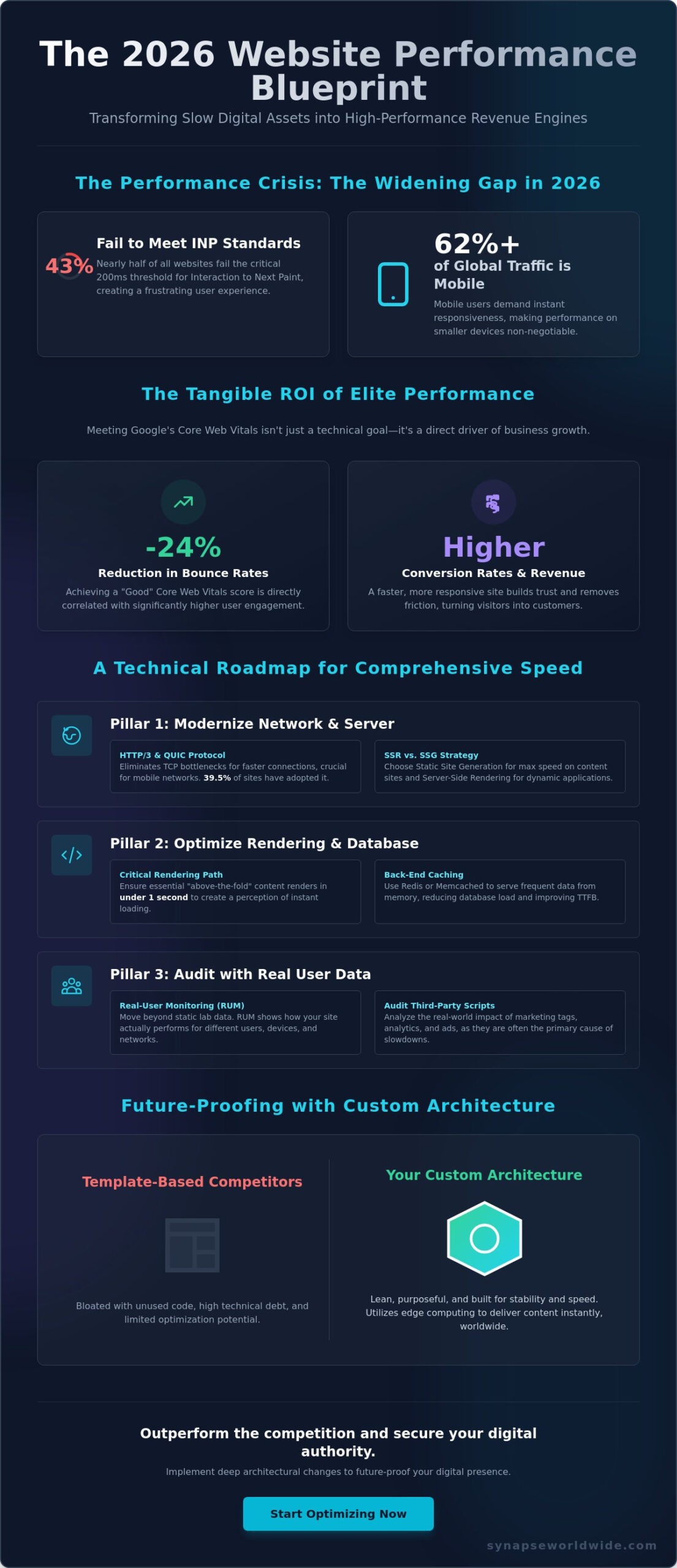
In 2026, 43% of websites still fail to meet the 200ms threshold for Interaction to Next Paint, creating a massive performance gap between market leaders and their competitors. You’ve likely felt the frustration of watching Core Web Vitals degrade while a bloated legacy codebase resists every attempt at a quick fix. It’s a common struggle, as mobile devices now drive over 62% of global traffic and demand near-instant responsiveness. Strategic website performance optimization is no longer a luxury; it’s the foundation of modern digital authority.
You understand that every millisecond of latency directly impacts your conversion rates and search visibility. We’ll show you how to move beyond surface-level patches to implement deep architectural changes that transform slow digital assets into high-performance revenue engines. This guide provides a clear roadmap for reducing technical debt and future-proofing your digital presence. You’ll learn the exact technical workflows required to achieve a 2.5 second Largest Contentful Paint and secure the 24% reduction in bounce rates that comes with passing Google’s latest standards.
Key Takeaways
- Understand how performance acts as a core pillar of your digital infrastructure to drive measurable business growth and conversion rates.
- Explore the technical shift toward HTTP/3 and QUIC to eliminate network bottlenecks and modernize your server-side responsiveness.
- Move beyond static PageSpeed scores by implementing real-user monitoring to audit the actual impact of third-party scripts on your visitors.
- Follow a structured technical roadmap for website performance optimization that prioritizes infrastructure hardening and automated media pipelines.
- Discover why custom digital architecture and edge computing provide the stability and speed required to outperform generic, template-based competitors.
The Strategic ROI of Website Performance Optimization in 2026
Modern digital leadership requires viewing your technical stack as more than just a delivery mechanism. It’s a fundamental pillar of your business infrastructure. In 2026, the definition of “fast” has been radically reshaped by the rise of AI-driven search and a global shift toward mobile-first interactions. For a comprehensive overview of web performance optimization, one must look at how technical efficiency translates directly into market share. Performance isn’t just about code; it’s about revenue protection.
When your Largest Contentful Paint (LCP) exceeds the 2.5-second threshold, you aren’t just losing visitors. You’re experiencing revenue leakage. High-growth enterprises use website performance optimization as a competitive moat to distance themselves from competitors relying on bloated, off-the-shelf templates. Custom architecture ensures that every byte serves a purpose, preventing the technical debt that often leads to high bounce rates and abandoned carts. Speed is the silent engine of growth.
Core Web Vitals and Search Visibility
Google’s 2026 ranking algorithms place unprecedented weight on visual stability and interaction readiness. Metrics like Interaction to Next Paint (INP) now dictate whether your brand appears in top-tier search results or fades into obscurity. Poor performance creates a cascading effect where low engagement signals tell search engines your content is irrelevant. To maintain a dominant position, you must integrate technical speed into your broader digital marketing strategy. This alignment ensures that your paid and organic efforts aren’t undermined by a slow, unresponsive interface. High visibility is impossible without a high-performance foundation.
The Psychology of Speed and User Retention
There’s a critical distinction between objective load times and perceived performance. Users don’t carry stopwatches, but they do have an intuitive sense of brand quality. Micro-delays of even a few hundred milliseconds erode trust, especially in professional sectors where reliability is paramount. Site speed serves as a silent ambassador for your brand’s competence. By optimizing for immediate feedback, you improve customer lifetime value and lower the cost of acquisition. Speed creates a frictionless environment where users feel empowered to convert, turning a technical metric into a powerful tool for business transformation.
Technical Foundations: Addressing Latency and Rendering Bottlenecks
To achieve elite website performance optimization, you must master the interaction between the network, the server, and the browser. As of May 2026, HTTP/3 is used by 39.5% of all websites, marking a significant transition toward the QUIC protocol. This shift reduces connection times by eliminating the traditional TCP handshake, which is vital for users on unstable mobile networks. For those seeking a technical deep-dive into web performance, understanding these foundational protocols is the first step toward reducing Time to First Byte (TTFB). You can’t ignore the browser’s role in this ecosystem; it’s where your code meets the user’s hardware.
Complex enterprise architectures often require a strategic choice between Server-Side Rendering (SSR) and Static Site Generation (SSG). While SSG provides unmatched speed for static content, SSR remains essential for dynamic, data-driven applications that require real-time updates. Managing the Critical Rendering Path ensures that essential content reaches the user in under one second, even on mid-range devices. This level of precision is why custom web design is a superior vehicle for website performance optimization compared to template-based solutions that carry unnecessary code weight. A bespoke approach allows for the pruning of every non-essential line of code.
Back-End Efficiency and Database Optimization
High-performance applications rely on lean database interactions. Optimizing SQL queries and database indexing prevents server-side bottlenecks that often plague off-the-shelf plugins. By utilizing object caching layers like Redis or Memcached, you can serve frequently accessed data directly from memory. This significantly reduces server load and ensures infrastructure stability during traffic spikes. Custom back-ends allow for this level of control, ensuring every query is purposeful and efficient.
Front-End Asset Orchestration
The browser’s ability to render a page quickly depends on how assets are delivered. Modern compression like Brotli offers superior results compared to Gzip, reducing file sizes for faster transfers. Strategic lazy loading ensures only above-the-fold assets are prioritized. This addresses the fact that 43% of websites still fail the 200ms Interaction to Next Paint threshold. By deferring non-essential scripts, you improve the browser’s ability to paint the screen and respond to user interactions.
The Performance Audit: Evaluating Infrastructure Beyond Surface Metrics
A high PageSpeed score is a vanity metric if your actual visitors experience significant lag. For enterprise-level website performance optimization, you must transition from synthetic lab data to Real-User Monitoring (RUM). Lab tests simulate controlled environments, but RUM captures the messy reality of diverse devices and fluctuating network speeds across the country. This distinction is vital because technical debt often hides in the gaps between these two data sets. You need to see exactly how your infrastructure handles the 75th percentile of real-world page loads to make informed architectural decisions.
When performance metrics show consistent degradation despite routine maintenance, it’s often one of the key website redesign signals that suggest your current architecture has reached its limit. You can’t patch your way out of a foundational failure. A strategic audit also serves to improve your search engine optimization (SEO) by ensuring that Google’s crawlers and human users receive the same high-speed experience. Stress testing your infrastructure against national-scale traffic spikes is the only way to guarantee stability during high-stakes marketing campaigns. Effective website performance optimization requires this level of disciplined, evidence-based auditing.
Quantitative vs. Qualitative Auditing
Field data represents the most accurate reflection of user satisfaction because it accounts for the entire interaction lifecycle. Synthetic testing remains useful for simulating specific conditions, such as a user on a low-end mobile device in a remote area with high latency. By overlaying this quantitative data with qualitative heatmaps, you can identify exactly where performance bottlenecks cause UX friction. It’s about seeing the connection between a slow-loading hero image and a sudden drop in scroll depth or conversion intent.
The Third-Party Script Audit
Every additional tracker adds latency that compounds across the user session, turning a simple page into a heavy, unresponsive asset. Marketing tags and social trackers are the primary culprits behind “tag bloat,” where external scripts hijack the browser’s main thread and delay interactivity. Implementing a robust Tag Manager allows you to defer non-essential script execution until the primary content is fully interactive. You should also evaluate how your CRM integrations impact the speed of lead capture pages. While these tools are essential for data flow, their implementation must be carefully orchestrated to avoid penalizing the user’s interaction speed.
A Technical Roadmap for Comprehensive Speed and Responsiveness
Executing a successful website performance optimization strategy requires a disciplined, multi-phase approach that moves from core infrastructure to granular asset delivery. You can’t achieve elite responsiveness by simply installing a few plugins. It’s about a systematic reduction of technical debt. Phase 1 focuses on infrastructure hardening, where you optimize server configurations and network-layer logic to ensure a stable foundation. This stage is critical for handling traffic spikes without compromising the user experience or server response times.
Phase 2 introduces automated media pipelines that handle the heavy lifting of image and video delivery. By Phase 3, the focus shifts to code refactoring, where developers prune legacy bloat and consolidate assets. This ensures that the browser spends less time parsing scripts and more time rendering content. Finally, Phase 4 establishes performance budgets and continuous monitoring. This creates a culture of speed where every new feature is weighed against its impact on load times, preventing the slow creep of performance degradation over time.
Image and Media Optimization Strategies
In 2026, serving modern image formats like WebP and AVIF is the baseline for high-performance assets. You should implement automated pipelines that convert and serve these formats based on browser support. Responsive image syntax is equally vital; it ensures that mobile users don’t waste bandwidth on desktop-sized files. When you’re managing video, consider the trade-offs between self-hosting and third-party players. While third-party embeds are convenient, they often introduce heavy JavaScript that can block the main thread. Self-hosting with a specialized CDN often provides the control needed for a truly seamless interaction.
Code Refactoring and Asset Consolidation
Modern applications require lean JavaScript bundles to maintain high Interaction to Next Paint scores. Techniques like tree-shaking and code-splitting are essential for ensuring that users only download the code they actually need for the current view. You should also audit your CSS to eliminate unused styles from legacy frameworks that add weight to every request. Aligning your code structure with website UX best practices ensures that your technical speed translates into a smooth, high-converting interface. If your current architecture feels too heavy to fix, it’s time to migrate to a custom web design that’s engineered for performance from day one.
Future-Proofing Performance with Custom Digital Architecture
Maintaining a high-speed digital presence requires more than just initial optimization; it demands an architectural philosophy that resists decay. While template-based sites often struggle with “code creep” as new features are added, bespoke builds offer inherently better performance. This is because every element is engineered to serve a specific business function without unnecessary overhead. Strategic website performance optimization in 2026 relies on this level of technical precision. By integrating performance testing directly into your CI/CD deployment pipeline, you ensure that no update ever compromises your speed gains. Speed isn’t a finishing touch. It’s the foundation of a strategic growth engine that powers your entire digital ecosystem.
Modern architecture also leverages Edge Computing to bring data processing closer to your national user base. Instead of relying on a single central server, edge nodes handle requests at the network’s perimeter, significantly reducing latency for users in diverse geographic locations. This decentralized approach ensures that your site remains responsive even during localized traffic surges. When combined with automated deployment workflows, your infrastructure becomes a self-sustaining asset that scales alongside your business ambitions. You aren’t just building a website; you’re developing a high-performance platform designed for long-term stability.
The Advantage of Custom Software for Performance
Generic CMS platforms often suffer from “plugin overhead,” where multiple third-party tools compete for resources and bloat the main thread. Choosing custom software development allows you to eliminate these architectural bottlenecks from the start. You can build lean, purpose-driven APIs that facilitate faster data exchange between your front-end and back-end systems. This level of customization ensures that your digital assets remain agile, secure, and capable of delivering the near-instant interaction speeds that modern users demand. Custom builds provide the clean slate necessary for elite website performance optimization.
Sustaining High Performance in 2026
Sustaining speed requires the implementation of strict “Performance Budgets.” These budgets set non-negotiable limits on asset sizes and script execution times, preventing incremental bloat from eroding your user experience. Regular technical audits and maintenance subscriptions are essential for identifying new optimization opportunities as browser technologies evolve. We’re also seeing a shift toward AI-driven predictive pre-fetching. These systems analyze user behavior to load the next likely page in the background, creating a sensation of near-instant navigation. By combining disciplined maintenance with these emerging technologies, you secure a digital presence that remains at the top of its class for years to come.
Architecting a High-Performance Digital Future
The transition toward a leaner, faster web is no longer a forecast; it’s a present reality that defines market leaders. By moving beyond surface-level patches and embracing custom digital architecture, you secure a foundation that is resilient to the shifting standards of 2026. True website performance optimization requires a disciplined commitment to technical excellence and a rejection of the bloated templates that hinder growth. You’ve seen how strategic auditing and a clear technical roadmap can turn a degrading asset into a reliable revenue engine that drives measurable business success.
Success in this landscape demands a partner who understands the intricate balance between high-level strategy and hands-on execution. Established in 2005, Synapse Worldwide specializes in custom enterprise-level digital solutions that prioritize long-term ROI and architectural stability. We don’t just fix speed issues; we build scalable platforms designed to outperform the competition. Take the next step and audit your digital infrastructure with the architects at Synapse Worldwide to transform your digital presence into a sophisticated growth vehicle. Your journey toward a faster, more profitable future begins with a single strategic decision.
Frequently Asked Questions
What is a good website loading time in 2026?
Aim for a Largest Contentful Paint (LCP) of 2.5 seconds or less to meet current search standards and user expectations. Your Interaction to Next Paint (INP) should remain at 200 milliseconds or less to ensure a responsive experience. Since mobile devices now drive over 62% of global traffic, these thresholds are non-negotiable for maintaining a competitive digital presence.
How does website performance affect my SEO rankings?
Performance is a confirmed ranking factor through Google’s Core Web Vitals, which quantify the quality of a user’s experience. Sites that pass all performance thresholds see an average 24% lower bounce rate, signaling high value to search algorithms. Under mobile-first indexing, a slow mobile version will directly suppress your organic visibility across all devices.
Can a CDN fix all my website speed issues?
No, a Content Delivery Network primarily addresses network latency and cannot resolve deep architectural flaws or inefficient code. While it brings static assets closer to the user, it won’t fix slow database queries or bloated JavaScript that blocks the browser’s main thread. Comprehensive website performance optimization requires a balance of network-layer speed and lean, custom-built software.
What are Core Web Vitals and why should I care?
Core Web Vitals are a set of specific metrics that measure loading speed, interactivity, and visual stability. You should care because they are the industry standard for measuring user experience and directly influence your search engine positioning. Key metrics include Largest Contentful Paint for loading, Interaction to Next Paint for responsiveness, and Cumulative Layout Shift for stability.
Is mobile performance different from desktop performance optimization?
Mobile optimization is distinct because it must account for limited hardware processing power and fluctuating network conditions. While desktop users often have high-speed, stable connections, mobile visitors rely on devices that can easily be overwhelmed by heavy legacy codebases. Professional website performance optimization prioritizes mobile-first architecture to ensure stability for the majority of global internet users.
How do third-party scripts affect my site’s responsiveness?
Third-party scripts often hijack the browser’s main thread, which is the primary cause of poor Interaction to Next Paint scores. Every analytics tag or social tracker adds weight that delays the page’s ability to respond to user inputs like clicks or scrolls. Auditing these scripts and deferring non-essential execution is vital for maintaining a high-performance lead capture or e-commerce environment.
Should I redesign or optimize my existing website for better speed?
A redesign is the better choice if your current site is built on a bloated template or a legacy codebase that no longer responds to simple fixes. If your technical debt is so high that you consistently fail Core Web Vitals, a custom build offers a superior long-term ROI. Building speed into the initial architecture is more effective than trying to patch a fundamentally slow foundation.
What is the difference between TTFB and LCP?
Time to First Byte (TTFB) measures how quickly your server responds to a request, while Largest Contentful Paint (LCP) measures when the main content is actually visible. TTFB is a backend metric that reflects server and database efficiency. LCP is a user-centric frontend metric that depends on server speed, network conditions, and how quickly the browser can render your assets.

