
Tag Archives: technical seo


Full-Service Digital Marketing Agency Australia: The 2026 Strategic Growth Framework

Full-Service Digital Marketing Agency Australia: The 2026 Strategic Growth Framework

In 2026, the traditional divide between your marketing creative and your technical infrastructure has become the single greatest threat to your company’s scalability. You’ve likely felt the friction of disconnected digital tools that refuse to communicate, leaving you with high ad spend and a frustrating lack of transparency regarding your actual ROI. Many agencies handle the aesthetic elements well but fail when it comes to the complex technical backend integration your national growth requires.

Bridging this gap requires a visionary approach to your digital architecture. This article reveals how a premier full-service digital marketing agency australia can align your custom web design, SEO, and CRM integration into a single, accountable growth engine. You’ll discover a strategic framework designed to turn fragmented tactics into a scalable infrastructure that supports your 2026 objectives. We’ll preview how unifying your search visibility with robust business automation creates the measurable results and long-term stability your brand deserves.

Key Takeaways

  • Learn why the 2026 growth model requires a total alignment of digital strategy, technical infrastructure, and marketing execution to avoid fragmented results.
  • Discover how a premier full-service digital marketing agency australia synchronizes custom web design with SEO and PPC to build a high-performance conversion engine.
  • Understand why marketing automation fails without deep CRM and ERP integration to provide a single point of truth for your business data.
  • Master a framework for evaluating potential partners based on their ability to act as strategic architects rather than mere tactical vendors.
  • Identify the core elements of a scalable digital infrastructure that supports national expansion and ensures long-term ROI for Australian business leaders.

What Defines a Full-Service Digital Marketing Agency in Australia for 2026?

By 2026, the definition of a full-service digital marketing agency australia has transitioned from a simple creative shop to a sophisticated technical partner. Success no longer relies solely on catchy copy or high-bid advertising. Instead, it exists at the intersection of high-level strategy, advanced technology, and precision marketing. To grasp the complexity of this shift, one must first understand What is Digital Marketing? in its modern, integrated form; it’s an engineering discipline where data and design are inseparable.

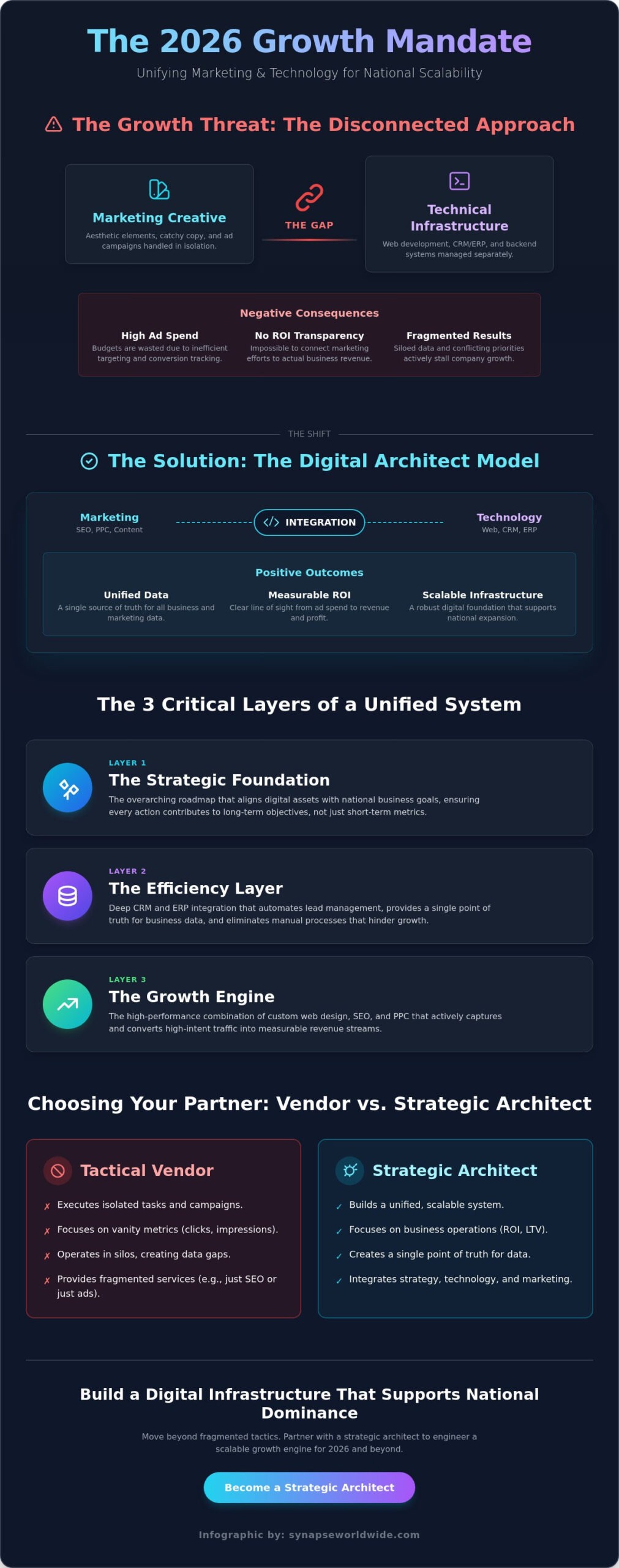
Many Australian firms are abandoning the fragmented model of hiring separate vendors for SEO, web design, and social media. This siloed approach creates data gaps and conflicting priorities that stall growth. A 2026 agency acts as a digital architect, ensuring every component of the ecosystem supports a unified business objective. We define this model through three critical layers:

  • The Strategic Foundation: The overarching roadmap that aligns digital assets with national business goals.
  • The Efficiency Layer: CRM integration and ERP solutions that automate lead management and provide a single point of truth.
  • The Growth Engine: High-performance custom web design, SEO, and PPC management that captures and converts high-intent traffic.

The distinction between a “vendor” and an “architect” is clear. A vendor executes a task; an architect builds a system. This systemic approach is what allows businesses to move beyond simple lead generation toward sustainable, scalable expansion.

The Shift from Tactical to Strategic Partnerships

Agencies in 2026 must understand your balance sheet, not just your click-through rate. A tactical vendor focuses on vanity metrics, but a strategic partner focuses on business operations. This shift is vital for national scaling. When expanding across diverse Australian markets, from Sydney’s competitive finance sector to Perth’s industrial hubs, you need a unified data view. Without this connectivity, your marketing spend remains a gamble rather than a calculated investment. A strategic partner ensures that your digital infrastructure is ready to handle the weight of increased traffic and complex customer journeys.

Core Capabilities: More Than Just Advertising

Modern digital dominance requires a blend of creative excellence and technical consulting. It’s not enough to run ads if your website isn’t optimized for conversion or if your leads vanish into a manual spreadsheet. A premier full-service digital marketing agency australia provides a suite of integrated services including custom web design, e-commerce development, and social media marketing. By linking these with CRM integration and ERP solutions, the agency ensures brand consistency and operational transparency. This holistic view allows for technical backend integration that supports, rather than hinders, your marketing ambitions.

Engineering the Growth Engine: SEO, PPC, and High-Performance Web Design

Your digital presence is only as strong as its weakest connection. For businesses aiming for national dominance, a full-service digital marketing agency australia must treat the website not as a static brochure, but as a high-performance conversion hub. In 2026, the growth engine relies on the seamless integration of custom web design, organic search equity, and precision-targeted paid acquisition. These elements don’t function in isolation; they form a unified system where technical performance directly dictates your marketing efficiency.

Achieving national reach in the Australian market requires a nuanced SEO strategy that recognizes regional search behaviors while maintaining broad authority. Your infrastructure must be mobile-first and exceptionally fast. Google’s Core Web Vitals remain the benchmark for visibility, and even a one-second delay can significantly erode your conversion rates. This technical baseline is non-negotiable for scaling across multiple territories. Additionally, ensuring your promotional tactics align with Australian advertising regulations is essential for maintaining brand integrity and consumer trust as you grow.

Custom Web Design as a Growth Engine

Bespoke development has moved from a luxury to a technical necessity. Standardized templates often carry legacy code that throttles page speed and compromises mobile user experience. A visionary architect understands that custom web design for small business provides the foundational agility needed to outpace competitors. By mapping every design element to specific user journeys, you ensure that traffic from all sources finds a frictionless path to conversion. This tailored approach allows for deeper integration with your backend systems, turning your website into a proactive sales tool rather than a passive asset.

Integrated Search Strategies: SEO and PPC Synergy

Organic and paid search are two sides of the same coin. While seo for small business builds long-term digital equity and reduces your reliance on rented attention, ppc management services provide the immediate visibility required for rapid market testing. A unified agency shares data between these teams. High-converting keywords from your paid campaigns should immediately inform your organic content strategy. Conversely, high organic rankings can lower your paid acquisition costs by improving landing page relevance and quality scores. This synergy is the hallmark of a sophisticated digital strategy that prioritizes total return on investment over individual channel metrics. If you’re ready to unify your search presence, exploring a strategic digital partnership can provide the clarity your brand needs to thrive.
Full-Service Digital Marketing Agency Australia: The 2026 Strategic Growth Framework

The Efficiency Layer: Integrating Marketing with CRM and ERP Infrastructure

The most persistent question business leaders ask is simple: “How do I know my marketing is actually making money?” If your agency only reports on clicks, impressions, or “engagement,” they aren’t providing a complete answer. In 2026, a truly full-service digital marketing agency australia must look beyond the top of the funnel. We believe that marketing success is a data problem as much as a creative one. To prove ROI, your marketing activities must be digitally tethered to your actual sales outcomes through robust CRM and ERP infrastructure.

Technical infrastructure is the secret sauce that separates high-performing enterprises from those stuck in a cycle of speculative spending. Marketing automation might generate thousands of leads, but without a clean CRM integration, those leads often stall in a fragmented sales process. By building a bridge between your digital assets and your operational backend, you create a transparent ecosystem. This connectivity allows you to see exactly which search terms, social ads, or email campaigns resulted in a finalized invoice, transforming marketing from an expense into a predictable investment.

CRM Integration: Closing the Loop on Lead Generation

Closing the loop means ensuring your website and your sales team speak the same language. We focus on automating lead flow directly from your custom web design into your sales pipelines. This eliminates manual data entry, which is often the primary cause of lead leakage and sales team frustration. Beyond simple lead capture, custom CRM hooks allow you to track lifetime customer value (LTV) back to the original acquisition source. When you understand the long-term value of a customer acquired through a specific channel, you can make more aggressive, confident decisions about your scaling strategy. It’s about moving from “guessing” to “knowing” with absolute certainty.

ERP and E-commerce: Scaling Operations Nationally

For Australian enterprises with complex logistics, scaling requires more than just more orders; it requires the ability to fulfill them. This is where ecommerce website development must account for your backend operational reality. Off-the-shelf tools often fail when you need to connect real-time inventory, multi-warehouse logistics, and national shipping providers into a single front-end experience. ERP solutions ensure that your marketing engine doesn’t outpace your fulfillment capacity. By integrating these systems, you provide customers with accurate stock levels and delivery times, which are critical factors for conversion and brand trust. Bespoke software solutions ensure that your growth isn’t limited by the technical constraints of generic platforms.

Evaluating Your Partner: A Framework for Australian Business Leaders

Selecting a partner for your digital transformation is a high-stakes strategic decision. In 2026, the Australian market is crowded with providers claiming comprehensive capabilities, yet only a handful possess the technical sophistication to act as true architects. Identifying a premier full-service digital marketing agency australia requires a fundamental shift in how you evaluate expertise. You aren’t just hiring a team to manage ads; you’re choosing the engineers who will build and maintain your company’s digital nervous system.

A reliable evaluation framework must distinguish between “Strategic Architects” and “Tactical Vendors.” While a vendor might offer lower entry costs, they often lack the technical depth required to integrate your marketing with your business operations. This gap leads to the very pains we’ve discussed: disconnected tools and a lack of conversion transparency. Your partner should be able to demonstrate a clear understanding of national market dynamics and how to navigate the specific regulatory environment in Australia, including the latest consumer protections and data privacy standards.

The “Architect” vs. The “Vendor” Comparison

The primary difference lies in the focus of the engagement. Tactical vendors focus on short-term tasks like monthly blog posts or basic ad management. They often rely on standardized templates that limit your ability to scale. Conversely, strategic architects focus on long-term infrastructure. They prioritize deep technical consulting, ensuring that your custom web design and CRM integration are built to handle future growth. If an agency cannot explain the intricacies of your technical backend or how they will manage complex API integrations, they aren’t equipped to lead a national expansion. Scale requires a partner who understands that every line of code is a business asset.

Transparency, Ownership, and Security

Ownership of your digital assets is a non-negotiable standard. In the 2026 landscape, some vendors still attempt to use “closed” proprietary systems that make it difficult to migrate or update your own site. You must ensure you own the code, the data, and the accounts. Furthermore, your partner must provide clear answers regarding hosting security and uptime. With the increased scrutiny from the ACCC and the strict requirements of the Privacy Act 1988, your agency must be a guardian of your brand’s legal and ethical standing. Ask these critical questions during your vetting process:

  • Data Sovereignty: Where is my customer data stored, and how is it protected under Australian law?
  • Asset Ownership: Do I have full administrative access and legal ownership of all custom code and marketing accounts?
  • Technical Depth: Can the agency manage custom ERP solutions and CRM hooks in-house, or do they outsource technical work?
  • Pricing Alignment: Does the agency offer fixed-price project fees and value-based retainers that align with my ROI goals?

If you’re ready to move beyond tactical tasks and build a scalable digital foundation that drives measurable growth, consult with our strategic architects to begin your 2026 growth journey.

Synapse Worldwide: Your Strategic Architect for National Digital Dominance

The transition from fragmented digital tactics to a unified growth framework requires more than just a vendor; it demands a strategic architect. Synapse Worldwide occupies a unique position as a premier full-service digital marketing agency australia by bridging the gap between high-level business strategy and intricate technical execution. We don’t just manage your digital presence. We engineer it. By aligning your custom web design, search visibility, and backend automation, we transform your digital assets into a single, high-performance engine capable of supporting national expansion.

Our foundation is built on a 20-year legacy of reliability. Established in 2005, Synapse Worldwide has navigated every major shift in the digital landscape, providing our clients with the stability and expertise needed to thrive in a mature market. This longevity is a testament to our results-oriented approach. We’ve spent two decades refining the “secret sauce” of digital growth: the seamless integration of ERP and CRM solutions with award-winning marketing strategies. This allows our clients to move away from the frustration of managing disconnected tools and toward the clarity of executing a cohesive vision.

A Legacy of Custom Excellence

Our history in custom software development is what sets us apart from agencies that only handle “the pretty stuff.” We possess the technical depth to build what other agencies can only buy off the shelf. This capability informs every marketing strategy we deploy. When we design an e-commerce platform or a lead generation site, we do so with a deep understanding of the underlying code and how it interacts with your CRM and ERP systems. This technical precision ensures that your growth engine is robust, secure, and infinitely scalable. We remain committed to fixed-price transparency, ensuring that our partnerships are built on mutual trust and a shared commitment to your long-term ROI. We believe that your digital infrastructure should be an asset, not a bottleneck.

Ready to Scale Nationally?

If you’re ready to stop guessing and start growing, the next step is a comprehensive audit of your digital architecture. Our consulting-first approach is designed to identify the hidden growth opportunities within your current systems and map out a clear path to national dominance. We look beyond surface-level metrics to evaluate how your technical backend supports your marketing ambitions. Whether you need to refine your SEO for small business or implement complex CRM integration, our team provides the discipline and vision required to reach the next level of success. Your journey toward a unified, scalable digital presence begins with a single strategic conversation. Consult with our strategic architects today to secure your brand’s future in the 2026 landscape.

Building Your 2026 Digital Legacy

The Australian market in 2026 demands more than just online visibility; it requires deep synchronization between your business operations and your digital presence. We’ve explored how a premier full-service digital marketing agency australia acts as a strategic architect, bridging the gap between custom web design and complex technical integrations. Success now depends on moving beyond disconnected tools toward a unified ecosystem where every lead is traceable and every asset is fully owned by your brand. Fragments are the enemy of scale.

Since 2005, Synapse Worldwide has specialized in this exact intersection of technology and growth. Our expertise in custom ERP and CRM integrations ensures that your marketing engine doesn’t just generate traffic but drives measurable revenue. We operate with a firm commitment to fixed-price project transparency and a strategic reach that supports your national ambitions. It’s time to stop managing fragmented platforms and start executing a visionary growth strategy that scales with your ambition.

Partner with Australia’s Strategic Digital Architects and secure your path to transformation today. We’re ready to help you reach the next level of business success.

Frequently Asked Questions

What does a full-service digital marketing agency actually do?

A full-service agency unifies strategy, technology, and marketing into a single growth engine. In 2026, this means managing everything from custom web design and SEO to technical CRM integration and PPC management. They act as strategic architects who ensure your digital infrastructure supports your business objectives rather than just running isolated campaigns. This holistic approach provides a single point of accountability for your entire digital presence.

Why is custom web design better than using a template for my business?

Custom web design provides the technical agility and unique architecture required to outperform generic competitors. Templates often include bloated legacy code that slows down page speeds and limits your ability to integrate complex ERP solutions. Bespoke development ensures your site is mobile-first and tailored specifically to your customer’s conversion journey. It creates a foundation for scalable growth that templates simply can’t support.

How long does it take to see results from an integrated SEO and PPC strategy?

You can expect immediate visibility through PPC management while organic search equity typically begins to compound within three to six months. By integrating both, you use paid data to refine your SEO strategy, which helps lower your total acquisition costs over time. This dual approach ensures you capture high-intent traffic today while building long-term digital authority for the future. It’s about balancing immediate wins with sustainable growth.

Do I really need CRM or ERP integration for my marketing to work?

Yes, integration is essential if you want to move beyond vanity metrics and track actual business revenue. Connecting your website to your CRM or ERP systems allows you to automate lead flow and monitor lifetime customer value. Without this connectivity, your marketing remains a speculative expense because you lack a clear view of which campaigns are driving finalized sales. Integration turns your data into a strategic asset.

How do full-service agencies charge for their services in Australia?

Most Australian agencies utilize a combination of fixed-price project fees for initial builds and value-based retainers for ongoing management. These models ensure that the agency’s incentives are aligned with your business outcomes rather than just hourly output. You should check with potential partners to see if they offer transparent, outcome-focused pricing that accounts for both technical maintenance and active marketing execution. This structure supports long-term partnership stability.

Can a full-service digital marketing agency australia help with national business expansion?

A full-service digital marketing agency australia is specifically equipped to manage the complexities of scaling across multiple regional markets. They provide the unified data view and technical infrastructure needed to maintain brand consistency from Sydney to Perth. By leveraging national SEO strategies and scalable e-commerce development, an agency partner ensures your digital presence grows alongside your physical operations. They act as the technical backbone of your expansion.

What is the difference between a digital agency and a traditional marketing agency?

A digital agency focuses on technical infrastructure and online conversion paths, whereas traditional agencies prioritize broad brand awareness through offline channels. In 2026, the distinction lies in a digital partner’s ability to handle custom software, CRM hooks, and data-driven search strategies. Digital agencies act as architects of your online ecosystem, ensuring every click is measurable and every lead is captured. They prioritize technical performance over mere aesthetic appeal.

How do I measure the ROI of a full-service digital partnership?

You measure ROI by tracking the direct correlation between your digital spend and finalized revenue in your CRM or ERP systems. Instead of looking at clicks or likes, you should focus on metrics like Customer Acquisition Cost and Lifetime Value. A strategic partner provides transparent reporting that shows exactly how your search visibility and automation efforts contribute to your company’s bottom line. This transparency ensures your marketing is a predictable investment.
 

SEO for Tech Companies in Australia: The 2026 Strategic Growth Framework

Why are most Australian tech firms still treating organic growth like a bolted-on marketing tactic when it should be the functional architecture of their product-led strategy? You’ve likely felt the frustration of explaining complex SaaS features to a generic agency only to receive surface-level content that fails to convert enterprise decision-makers. With PPC costs reaching unsustainable levels and the Google May 2026 Core Update prioritising deep, first-hand expertise, the traditional playbook for seo for tech companies australia is officially obsolete.

You need a strategy that understands long sales cycles require a sophisticated approach to topical authority rather than a simple “click-to-buy” mentality. This framework promises to help you master the architectural SEO strategies required to dominate the Australian market and capture high-intent enterprise leads. We’ll explore how to align your technical authority with Google’s latest AI-driven search algorithms, leverage Generative Engine Optimisation (GEO), and navigate the 2026 Privacy Act reforms to build a dominant, sustainable market position.

Key Takeaways

  • Learn how to transition from chasing high-volume keywords to capturing high-intent, zero-volume queries that drive enterprise-level conversions.
  • Discover why technical SEO must be treated as a core piece of your digital infrastructure to manage crawl budgets efficiently across complex SaaS platforms.
  • Understand the shift toward product-led content that transforms technical documentation and high-value assets into primary drivers of organic authority.
  • Master the metrics that matter by aligning your strategy for seo for tech companies australia with high-level business outcomes like Customer Acquisition Cost and Lifetime Value.
  • Identify why a custom architectural approach to growth outperforms standardized agency retainers in the increasingly complex Australian technology sector.

The 2026 Landscape of SEO for Tech Companies in Australia

The Australian tech market in 2026 has moved beyond the era of simple keyword rankings. For local SaaS and FinTech innovators, seo for tech companies australia is now a rigorous discipline that merges technical authority with product-led content. You aren’t just competing with local rivals; you’re often up against global giants with massive backlink profiles and established market share. To win, your digital strategy requires the precision of a visionary architect who can map complex product features to the specific pain points of an enterprise buyer. This isn’t about being seen; it’s about being recognized as the definitive solution.

One of the most significant shifts we’re seeing is the transition from high-volume vanity keywords to zero-volume, high-intent queries. These are the highly specific, technical questions that decision-makers ask when they’re deep in the evaluation phase. While a generic agency might chase broad terms with 10,000 monthly searches, an authoritative framework focuses on the queries that indicate a direct readiness to integrate or purchase. This targeted approach ensures that your organic traffic consists of qualified leads rather than casual browsers.

The Long-Cycle Tech Buyer Journey

Enterprise tech procurement isn’t an impulse buy. It’s a deliberate 6 to 18 month process involving a committee of stakeholders, from the technical architect vetting your API to the CFO scrutinising the ROI. Your organic presence must support every stage of this journey. This means providing high-level thought leadership for the awareness phase and granular, technical documentation for the validation phase. When your content answers the specific security and compliance questions of a procurement officer, you’re using SEO to shorten the sales cycle and build trust before the first sales call.

Topical Authority vs. Keyword Density

In 2026, search engines have evolved to prioritise genuine expertise over simple keyword matching. Following foundational search engine optimization (SEO) principles is no longer enough; you must build a semantic web of content. This involves creating a comprehensive ecosystem where every technical whitepaper, case study, and product update reinforces your niche dominance. By treating your documentation as a searchable asset, you signal to both AI-driven agents and human researchers that your platform is the definitive solution in its category. Expertise is your most valuable currency in a competitive digital economy.

Technical SEO Architecture: The Foundation of Digital Infrastructure

Technical excellence isn’t just about passing a standard audit; it’s about building a scalable engine for organic growth. For firms investing in custom software development, SEO must be baked into the source code from day one. According to Technology and innovation statistics, the rapid evolution of the Australian tech sector demands infrastructure that doesn’t just function but actively facilitates search discovery. When you’re managing complex SaaS platforms or extensive technical documentation, standard SEO plugins won’t suffice. You need a custom-engineered solution that handles dynamic content without draining your crawl budget.

Modern search engines are increasingly selective about where they spend their crawling resources. Large-scale tech sites often suffer from “crawl bloat” caused by infinite facets or poorly managed documentation versions. Implementing a headless CMS architecture allows you to decouple your front-end delivery from back-end data, providing the speed and flexibility needed for superior seo for tech companies australia. This separation ensures that search bots encounter clean, pre-rendered HTML, which is vital for indexing complex JavaScript-heavy applications. It’s the difference between a site that is merely “indexed” and one that is fully understood by search algorithms.

Core Web Vitals have transitioned from a ranking factor to a non-negotiable prerequisite for enterprise visibility. Google’s May 2026 update places even greater emphasis on stable, responsive layouts that don’t shift during loading. For a tech company, a sluggish interface signals a lack of technical competence to both users and algorithms. Ensuring your platform meets these benchmarks is essential for maintaining trust in a high-stakes B2B environment.

Scalable Site Architecture for Tech Platforms

Managing deep site hierarchies is a common challenge as product lines expand. You must ensure that link equity flows from your high-authority homepage down to granular feature pages without getting lost in “click depth.” For Australian firms eyeing global markets, international SEO requires a deliberate strategy that respects local user intent while maintaining unified domain authority. Your URL structures should be logical and descriptive, mirroring the user’s journey through your product categories. If you’re ready to build a platform that scales, a bespoke digital growth strategy can align your architecture with your commercial goals.

Security and Performance as Search Signals

Server stability and uptime are direct reflections of your brand’s reliability. Custom-built infrastructures consistently outperform off-the-shelf templates because they eliminate the code bloat that hampers performance and creates security vulnerabilities. In 2026, every millisecond shaved off your load time correlates directly to a measurable increase in enterprise lead generation. High-performing, secure sites aren’t just a technical preference; they are a fundamental search signal that tells Google your platform is safe for enterprise-level traffic.

Product-Led Content: Capturing High-Intent Enterprise Leads

In 2026, the era of “blogging for traffic” is officially over. For sophisticated tech brands, content is no longer a peripheral marketing activity; it’s a core product asset that must demonstrate immediate value to a technical audience. Effective seo for tech companies australia requires a shift from vanity metrics toward high-value technical assets that serve as functional tools for the buyer. Whether it’s an interactive calculator, a detailed API integration guide, or a proprietary industry benchmark report, your content must solve a specific problem before the prospect even signs up for a demo.

This approach aligns with the foundational principles found in the SEO for small business growth framework, which emphasises niche relevance and rapid iteration. However, at the enterprise level, the stakes are higher. The Google May 2026 Core Update has intensified the focus on E-E-A-T, meaning that content authored by “marketing generalists” is being systematically devalued. To rank in 2026, your content must be authored or verified by subject matter experts who possess genuine, first-hand experience in your specific technology vertical.

Mapping Content to Technical Intent

Enterprise buyers move through distinct phases of technical intent. A “problem-aware” searcher might look for ways to solve a latency issue, while a “solution-aware” searcher is actively comparing your platform against a direct rival. You must create dedicated comparison pages and “alternative to” guides that provide objective, data-driven analysis. When these assets are integrated with your CRM, you can track how organic search interactions influence the eventual deal size. This visibility allows you to treat SEO as a predictable lead-generation engine rather than a black box of traffic.

Establishing Industry Thought Leadership

True authority comes from owning the data that your industry relies on. By publishing annual state-of-the-market reports or technical case studies with verified ROI proofs, you create link-worthy assets that global publications will cite. This doesn’t just build backlinks; it builds a reputation for stability and high-level planning. In a crowded market, tech companies must lead the conversation in their niche to ensure they aren’t just participants in the search landscape, but the ones defining its direction. This visionary approach ensures your brand remains the default choice for high-intent enterprise leads.

ROI and Attribution: Measuring SEO Success in Tech

Vanity metrics like total traffic or generic keyword rankings often provide a false sense of security for Australian tech leaders. In the competitive landscape of seo for tech companies australia, the only metrics that truly matter are those that correlate directly with revenue growth and business stability. You shouldn’t be satisfied with a spike in sessions if your Customer Acquisition Cost (CAC) remains stagnant or your lead quality drops. High-level strategic growth requires a deep dive into the Lifetime Value (LTV) of customers sourced through organic channels, ensuring that every dollar spent on search visibility delivers a compounding return.

True success is found in the data that generic agencies often ignore. By prioritising CRM integration, you can bridge the gap between an anonymous search click and a closed enterprise contract. This full-funnel visibility is essential for understanding the multi-touch attribution typical of long B2B sales cycles. It’s about seeing how an initial technical search leads to a whitepaper download, a demo request, and eventually a multi-year partnership. This connectivity allows you to treat your digital presence as a predictable investment rather than a speculative expense.

Attributing Organic Search to Revenue

Tracking the path from a first-touch organic visit to a final enterprise contract is a complex but necessary task. You need to set up custom conversion events that reflect the specific actions of a technical buyer, such as API documentation downloads or sandbox environment sign-ups. These micro-conversions are leading indicators of intent that simple “contact us” forms often fail to capture. When you measure these interactions accurately, you gain a clearer picture of how SEO contributes to shortening the sales cycle and reducing the burden on your outbound sales team.

Integrating SEO with ERP and CRM Systems

Data-driven SEO does more than just drive traffic; it informs your entire product development and sales strategy. When you integrate search intent data with your ERP and CRM systems, you can predict market trends and customer needs with surgical precision. This unified approach allows you to create a dashboard where marketing and business operations are perfectly aligned. If you’re ready to move beyond surface-level reporting, you can optimise your organic attribution with a partner who understands the technical nuances of the tech sector. This level of insight ensures that your digital presence remains a foundational pillar of your business growth.

The Synapse Approach: Custom SEO Architecture for Tech Leaders

Generic SEO retainers are designed for volume, not complexity. For an Australian SaaS founder or a FinTech lead, a “one-size-fits-all” package is a recipe for mediocrity. These standardized models often fail to account for the intricate technical requirements and long-cycle buyer journeys that define the technology sector. At Synapse, we position ourselves as the visionary architect of your digital growth rather than just another service provider. We understand that seo for tech companies australia requires a deep alignment between your product’s code, your commercial goals, and your search visibility.

Our methodology bridges the critical gap between high-performance web design and search engine dominance. We don’t view your website as a static brochure; we treat it as a dynamic engine for lead generation. This means ensuring that every design choice, from your site’s navigation to its mobile responsiveness, supports your broader organic strategy. By treating search performance as a foundational element of your digital infrastructure, we build a presence that is both resilient against algorithm updates and optimized for enterprise-level conversions.

Bespoke Strategies for National Dominance

Success in the Australian market requires more than just following global trends. We customize every campaign to the specific technical stack of our clients, whether you’re running a headless CMS, a React-based application, or a complex legacy system. This advantage comes from our dual understanding of code and commerce. We speak the language of your developers and your stakeholders, ensuring that technical SEO recommendations are both feasible and commercially impactful. In a global tech market, having local Australian expertise ensures your strategy respects domestic regulatory nuances while maintaining the competitive edge required to challenge international incumbents.

Transforming Digital Presence into a Strategic Asset

Most agencies focus on maintenance; we focus on transformation. We move beyond the routine of monthly reporting to turn your digital assets into a strategic engine for sustainable growth. This often begins with fixed-price projects designed to overhaul your foundational SEO infrastructure, ensuring your platform is ready to scale without technical debt. Our commitment is to long-term partnerships built on transparency and a relentless focus on your return on investment. If you’re ready to stop chasing vanity metrics and start building a dominant market position, your next step is to design a custom growth roadmap that aligns with your 2026 business objectives.

Architecting Your Digital Dominance in 2026

Transitioning from basic search visibility to a sophisticated lead-generation engine requires a fundamental shift in perspective. You’ve seen how integrating technical SEO with product-led content creates a foundation that scales with your ambition. By prioritising deep attribution through CRM and ERP systems, you move from speculative spending to predictable, high-value growth. This framework isn’t just about traffic; it’s about building a resilient infrastructure that converts technical intent into enterprise revenue.

Success in seo for tech companies australia isn’t found in a generic checklist; it’s found in a customized strategy that reflects your product’s unique complexity. Since 2005, Synapse has focused on delivering these bespoke digital solutions. We specialise in the CRM and ERP integrations required to unify your marketing efforts and have a proven track record of scaling Australian tech enterprises nationally. We don’t just provide a service; we act as the visionary architects of your digital transformation.

Your digital presence should be your most powerful strategic asset. It’s time to move beyond maintenance and start building for the next level of business success. Partner with the architects of tech growth, Get your custom SEO strategy. Let’s build a partnership that turns your technical expertise into market leadership.

Frequently Asked Questions

Why is SEO different for tech companies compared to other industries?

SEO for tech differs because it must account for highly specialized audiences and non-linear buyer journeys. Unlike retail, tech buyers often require deep technical validation before making a decision. This means your seo for tech companies australia strategy must prioritise topical authority and technical documentation over simple transactional keywords. It’s about building trust with both the end-user and the technical gatekeeper through every stage of search.

How long does it take to see ROI from SEO in the Australian tech market?

You can expect to see early indicators of success within three to six months, though full ROI typically aligns with your 6 to 18 month enterprise sales cycle. Organic growth is a compounding asset that builds momentum over time. While initial results show in improved rankings for high-intent queries, the commercial impact becomes most visible as your organic channel begins to lower your overall customer acquisition costs.

Does my tech company need a technical SEO audit if we have an in-house dev team?

An external technical SEO audit is essential because search architecture requires a different lens than product development. While your in-house developers excel at building functional features, an SEO architect focuses on crawl efficiency, semantic structure, and search signal optimisation. This partnership ensures that your platform is not only built well but is also fully discoverable by complex search algorithms that prioritise infrastructure stability.

What are the most important SEO metrics for a SaaS company in 2026?

The most critical metrics in 2026 are Customer Acquisition Cost (CAC), Lifetime Value (LTV), and organic lead quality. You should move beyond vanity metrics like total impressions to track micro-conversions such as API documentation downloads or sandbox environment sign-ups. These actions provide a much clearer indication of enterprise intent and the direct revenue contribution of your organic search strategy compared to broad traffic numbers.

How does SEO integrate with product-led growth (PLG) strategies?

SEO integrates with product-led growth by transforming your product’s documentation and technical assets into searchable entry points. When you optimise your help centres and feature pages, you capture users who are looking for specific solutions to technical problems. This approach allows your product to lead the sales process, using search visibility to drive self-serve discovery and trial adoption before a sales representative ever engages.

Can SEO help reduce our Customer Acquisition Cost (CAC)?

SEO is one of the most effective ways to reduce your CAC by providing a sustainable alternative to rising PPC costs. Once your organic infrastructure is established, the cost per lead typically decreases as your authority grows. By capturing high-intent enterprise leads through organic search, you build a compounding lead-generation engine that doesn’t require a linear increase in ad spend to scale your national presence.

What is the role of backlinks for tech companies in 2026?

In 2026, the role of backlinks has shifted toward high-quality technical citations and industry authority rather than sheer volume. A single link from a reputable tech publication or a government innovation portal carries more weight than dozens of generic directories. Your focus should be on earning links through proprietary data, technical whitepapers, and deep industry reports that demonstrate your niche dominance and reliability.

How do you handle SEO for companies with highly technical or niche products?

We handle niche products by creating a semantic web of content that maps directly to specific technical intent. This involves collaborating with your subject matter experts to produce content that answers the granular questions of an enterprise architect or CTO. By focusing on zero-volume, high-intent queries, we ensure your brand is present when your most valuable prospects are searching for a highly specialised solution.


Website Performance Optimization: A Strategic Technical Guide for 2026

Website Performance Optimization: A Strategic Technical Guide for 2026

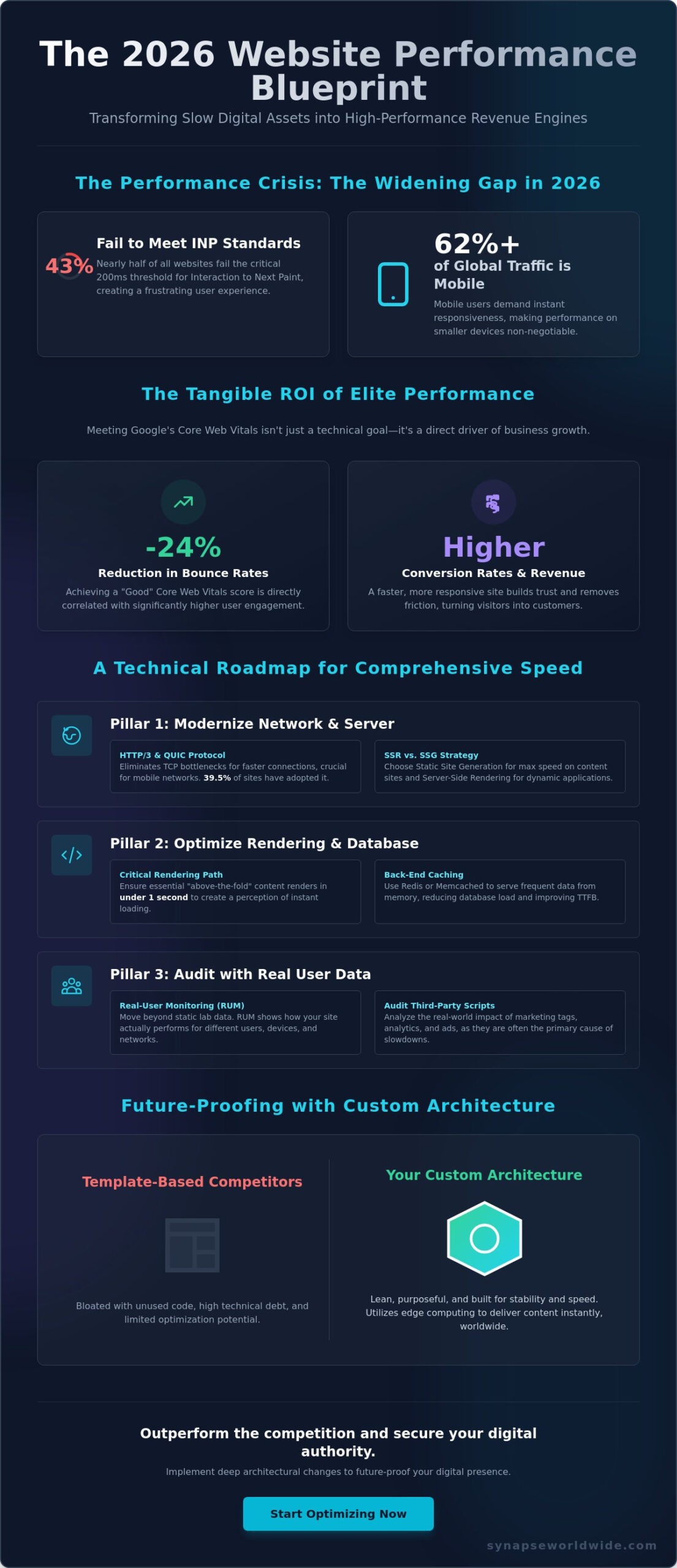
In 2026, 43% of websites still fail to meet the 200ms threshold for Interaction to Next Paint, creating a massive performance gap between market leaders and their competitors. You’ve likely felt the frustration of watching Core Web Vitals degrade while a bloated legacy codebase resists every attempt at a quick fix. It’s a common struggle, as mobile devices now drive over 62% of global traffic and demand near-instant responsiveness. Strategic website performance optimization is no longer a luxury; it’s the foundation of modern digital authority.

You understand that every millisecond of latency directly impacts your conversion rates and search visibility. We’ll show you how to move beyond surface-level patches to implement deep architectural changes that transform slow digital assets into high-performance revenue engines. This guide provides a clear roadmap for reducing technical debt and future-proofing your digital presence. You’ll learn the exact technical workflows required to achieve a 2.5 second Largest Contentful Paint and secure the 24% reduction in bounce rates that comes with passing Google’s latest standards.

Key Takeaways

  • Understand how performance acts as a core pillar of your digital infrastructure to drive measurable business growth and conversion rates.
  • Explore the technical shift toward HTTP/3 and QUIC to eliminate network bottlenecks and modernize your server-side responsiveness.
  • Move beyond static PageSpeed scores by implementing real-user monitoring to audit the actual impact of third-party scripts on your visitors.
  • Follow a structured technical roadmap for website performance optimization that prioritizes infrastructure hardening and automated media pipelines.
  • Discover why custom digital architecture and edge computing provide the stability and speed required to outperform generic, template-based competitors.

The Strategic ROI of Website Performance Optimization in 2026

Modern digital leadership requires viewing your technical stack as more than just a delivery mechanism. It’s a fundamental pillar of your business infrastructure. In 2026, the definition of “fast” has been radically reshaped by the rise of AI-driven search and a global shift toward mobile-first interactions. For a comprehensive overview of web performance optimization, one must look at how technical efficiency translates directly into market share. Performance isn’t just about code; it’s about revenue protection.

When your Largest Contentful Paint (LCP) exceeds the 2.5-second threshold, you aren’t just losing visitors. You’re experiencing revenue leakage. High-growth enterprises use website performance optimization as a competitive moat to distance themselves from competitors relying on bloated, off-the-shelf templates. Custom architecture ensures that every byte serves a purpose, preventing the technical debt that often leads to high bounce rates and abandoned carts. Speed is the silent engine of growth.

Core Web Vitals and Search Visibility

Google’s 2026 ranking algorithms place unprecedented weight on visual stability and interaction readiness. Metrics like Interaction to Next Paint (INP) now dictate whether your brand appears in top-tier search results or fades into obscurity. Poor performance creates a cascading effect where low engagement signals tell search engines your content is irrelevant. To maintain a dominant position, you must integrate technical speed into your broader digital marketing strategy. This alignment ensures that your paid and organic efforts aren’t undermined by a slow, unresponsive interface. High visibility is impossible without a high-performance foundation.

The Psychology of Speed and User Retention

There’s a critical distinction between objective load times and perceived performance. Users don’t carry stopwatches, but they do have an intuitive sense of brand quality. Micro-delays of even a few hundred milliseconds erode trust, especially in professional sectors where reliability is paramount. Site speed serves as a silent ambassador for your brand’s competence. By optimizing for immediate feedback, you improve customer lifetime value and lower the cost of acquisition. Speed creates a frictionless environment where users feel empowered to convert, turning a technical metric into a powerful tool for business transformation.

Technical Foundations: Addressing Latency and Rendering Bottlenecks

To achieve elite website performance optimization, you must master the interaction between the network, the server, and the browser. As of May 2026, HTTP/3 is used by 39.5% of all websites, marking a significant transition toward the QUIC protocol. This shift reduces connection times by eliminating the traditional TCP handshake, which is vital for users on unstable mobile networks. For those seeking a technical deep-dive into web performance, understanding these foundational protocols is the first step toward reducing Time to First Byte (TTFB). You can’t ignore the browser’s role in this ecosystem; it’s where your code meets the user’s hardware.

Complex enterprise architectures often require a strategic choice between Server-Side Rendering (SSR) and Static Site Generation (SSG). While SSG provides unmatched speed for static content, SSR remains essential for dynamic, data-driven applications that require real-time updates. Managing the Critical Rendering Path ensures that essential content reaches the user in under one second, even on mid-range devices. This level of precision is why custom web design is a superior vehicle for website performance optimization compared to template-based solutions that carry unnecessary code weight. A bespoke approach allows for the pruning of every non-essential line of code.

Back-End Efficiency and Database Optimization

High-performance applications rely on lean database interactions. Optimizing SQL queries and database indexing prevents server-side bottlenecks that often plague off-the-shelf plugins. By utilizing object caching layers like Redis or Memcached, you can serve frequently accessed data directly from memory. This significantly reduces server load and ensures infrastructure stability during traffic spikes. Custom back-ends allow for this level of control, ensuring every query is purposeful and efficient.

Front-End Asset Orchestration

The browser’s ability to render a page quickly depends on how assets are delivered. Modern compression like Brotli offers superior results compared to Gzip, reducing file sizes for faster transfers. Strategic lazy loading ensures only above-the-fold assets are prioritized. This addresses the fact that 43% of websites still fail the 200ms Interaction to Next Paint threshold. By deferring non-essential scripts, you improve the browser’s ability to paint the screen and respond to user interactions.

Website Performance Optimization: A Strategic Technical Guide for 2026

The Performance Audit: Evaluating Infrastructure Beyond Surface Metrics

A high PageSpeed score is a vanity metric if your actual visitors experience significant lag. For enterprise-level website performance optimization, you must transition from synthetic lab data to Real-User Monitoring (RUM). Lab tests simulate controlled environments, but RUM captures the messy reality of diverse devices and fluctuating network speeds across the country. This distinction is vital because technical debt often hides in the gaps between these two data sets. You need to see exactly how your infrastructure handles the 75th percentile of real-world page loads to make informed architectural decisions.

When performance metrics show consistent degradation despite routine maintenance, it’s often one of the key website redesign signals that suggest your current architecture has reached its limit. You can’t patch your way out of a foundational failure. A strategic audit also serves to improve your search engine optimization (SEO) by ensuring that Google’s crawlers and human users receive the same high-speed experience. Stress testing your infrastructure against national-scale traffic spikes is the only way to guarantee stability during high-stakes marketing campaigns. Effective website performance optimization requires this level of disciplined, evidence-based auditing.

Quantitative vs. Qualitative Auditing

Field data represents the most accurate reflection of user satisfaction because it accounts for the entire interaction lifecycle. Synthetic testing remains useful for simulating specific conditions, such as a user on a low-end mobile device in a remote area with high latency. By overlaying this quantitative data with qualitative heatmaps, you can identify exactly where performance bottlenecks cause UX friction. It’s about seeing the connection between a slow-loading hero image and a sudden drop in scroll depth or conversion intent.

The Third-Party Script Audit

Every additional tracker adds latency that compounds across the user session, turning a simple page into a heavy, unresponsive asset. Marketing tags and social trackers are the primary culprits behind “tag bloat,” where external scripts hijack the browser’s main thread and delay interactivity. Implementing a robust Tag Manager allows you to defer non-essential script execution until the primary content is fully interactive. You should also evaluate how your CRM integrations impact the speed of lead capture pages. While these tools are essential for data flow, their implementation must be carefully orchestrated to avoid penalizing the user’s interaction speed.

A Technical Roadmap for Comprehensive Speed and Responsiveness

Executing a successful website performance optimization strategy requires a disciplined, multi-phase approach that moves from core infrastructure to granular asset delivery. You can’t achieve elite responsiveness by simply installing a few plugins. It’s about a systematic reduction of technical debt. Phase 1 focuses on infrastructure hardening, where you optimize server configurations and network-layer logic to ensure a stable foundation. This stage is critical for handling traffic spikes without compromising the user experience or server response times.

Phase 2 introduces automated media pipelines that handle the heavy lifting of image and video delivery. By Phase 3, the focus shifts to code refactoring, where developers prune legacy bloat and consolidate assets. This ensures that the browser spends less time parsing scripts and more time rendering content. Finally, Phase 4 establishes performance budgets and continuous monitoring. This creates a culture of speed where every new feature is weighed against its impact on load times, preventing the slow creep of performance degradation over time.

Image and Media Optimization Strategies

In 2026, serving modern image formats like WebP and AVIF is the baseline for high-performance assets. You should implement automated pipelines that convert and serve these formats based on browser support. Responsive image syntax is equally vital; it ensures that mobile users don’t waste bandwidth on desktop-sized files. When you’re managing video, consider the trade-offs between self-hosting and third-party players. While third-party embeds are convenient, they often introduce heavy JavaScript that can block the main thread. Self-hosting with a specialized CDN often provides the control needed for a truly seamless interaction.

Code Refactoring and Asset Consolidation

Modern applications require lean JavaScript bundles to maintain high Interaction to Next Paint scores. Techniques like tree-shaking and code-splitting are essential for ensuring that users only download the code they actually need for the current view. You should also audit your CSS to eliminate unused styles from legacy frameworks that add weight to every request. Aligning your code structure with website UX best practices ensures that your technical speed translates into a smooth, high-converting interface. If your current architecture feels too heavy to fix, it’s time to migrate to a custom web design that’s engineered for performance from day one.

Future-Proofing Performance with Custom Digital Architecture

Maintaining a high-speed digital presence requires more than just initial optimization; it demands an architectural philosophy that resists decay. While template-based sites often struggle with “code creep” as new features are added, bespoke builds offer inherently better performance. This is because every element is engineered to serve a specific business function without unnecessary overhead. Strategic website performance optimization in 2026 relies on this level of technical precision. By integrating performance testing directly into your CI/CD deployment pipeline, you ensure that no update ever compromises your speed gains. Speed isn’t a finishing touch. It’s the foundation of a strategic growth engine that powers your entire digital ecosystem.

Modern architecture also leverages Edge Computing to bring data processing closer to your national user base. Instead of relying on a single central server, edge nodes handle requests at the network’s perimeter, significantly reducing latency for users in diverse geographic locations. This decentralized approach ensures that your site remains responsive even during localized traffic surges. When combined with automated deployment workflows, your infrastructure becomes a self-sustaining asset that scales alongside your business ambitions. You aren’t just building a website; you’re developing a high-performance platform designed for long-term stability.

The Advantage of Custom Software for Performance

Generic CMS platforms often suffer from “plugin overhead,” where multiple third-party tools compete for resources and bloat the main thread. Choosing custom software development allows you to eliminate these architectural bottlenecks from the start. You can build lean, purpose-driven APIs that facilitate faster data exchange between your front-end and back-end systems. This level of customization ensures that your digital assets remain agile, secure, and capable of delivering the near-instant interaction speeds that modern users demand. Custom builds provide the clean slate necessary for elite website performance optimization.

Sustaining High Performance in 2026

Sustaining speed requires the implementation of strict “Performance Budgets.” These budgets set non-negotiable limits on asset sizes and script execution times, preventing incremental bloat from eroding your user experience. Regular technical audits and maintenance subscriptions are essential for identifying new optimization opportunities as browser technologies evolve. We’re also seeing a shift toward AI-driven predictive pre-fetching. These systems analyze user behavior to load the next likely page in the background, creating a sensation of near-instant navigation. By combining disciplined maintenance with these emerging technologies, you secure a digital presence that remains at the top of its class for years to come.

Architecting a High-Performance Digital Future

The transition toward a leaner, faster web is no longer a forecast; it’s a present reality that defines market leaders. By moving beyond surface-level patches and embracing custom digital architecture, you secure a foundation that is resilient to the shifting standards of 2026. True website performance optimization requires a disciplined commitment to technical excellence and a rejection of the bloated templates that hinder growth. You’ve seen how strategic auditing and a clear technical roadmap can turn a degrading asset into a reliable revenue engine that drives measurable business success.

Success in this landscape demands a partner who understands the intricate balance between high-level strategy and hands-on execution. Established in 2005, Synapse Worldwide specializes in custom enterprise-level digital solutions that prioritize long-term ROI and architectural stability. We don’t just fix speed issues; we build scalable platforms designed to outperform the competition. Take the next step and audit your digital infrastructure with the architects at Synapse Worldwide to transform your digital presence into a sophisticated growth vehicle. Your journey toward a faster, more profitable future begins with a single strategic decision.

Frequently Asked Questions

What is a good website loading time in 2026?

Aim for a Largest Contentful Paint (LCP) of 2.5 seconds or less to meet current search standards and user expectations. Your Interaction to Next Paint (INP) should remain at 200 milliseconds or less to ensure a responsive experience. Since mobile devices now drive over 62% of global traffic, these thresholds are non-negotiable for maintaining a competitive digital presence.

How does website performance affect my SEO rankings?

Performance is a confirmed ranking factor through Google’s Core Web Vitals, which quantify the quality of a user’s experience. Sites that pass all performance thresholds see an average 24% lower bounce rate, signaling high value to search algorithms. Under mobile-first indexing, a slow mobile version will directly suppress your organic visibility across all devices.

Can a CDN fix all my website speed issues?

No, a Content Delivery Network primarily addresses network latency and cannot resolve deep architectural flaws or inefficient code. While it brings static assets closer to the user, it won’t fix slow database queries or bloated JavaScript that blocks the browser’s main thread. Comprehensive website performance optimization requires a balance of network-layer speed and lean, custom-built software.

What are Core Web Vitals and why should I care?

Core Web Vitals are a set of specific metrics that measure loading speed, interactivity, and visual stability. You should care because they are the industry standard for measuring user experience and directly influence your search engine positioning. Key metrics include Largest Contentful Paint for loading, Interaction to Next Paint for responsiveness, and Cumulative Layout Shift for stability.

Is mobile performance different from desktop performance optimization?

Mobile optimization is distinct because it must account for limited hardware processing power and fluctuating network conditions. While desktop users often have high-speed, stable connections, mobile visitors rely on devices that can easily be overwhelmed by heavy legacy codebases. Professional website performance optimization prioritizes mobile-first architecture to ensure stability for the majority of global internet users.

How do third-party scripts affect my site’s responsiveness?

Third-party scripts often hijack the browser’s main thread, which is the primary cause of poor Interaction to Next Paint scores. Every analytics tag or social tracker adds weight that delays the page’s ability to respond to user inputs like clicks or scrolls. Auditing these scripts and deferring non-essential execution is vital for maintaining a high-performance lead capture or e-commerce environment.

Should I redesign or optimize my existing website for better speed?

A redesign is the better choice if your current site is built on a bloated template or a legacy codebase that no longer responds to simple fixes. If your technical debt is so high that you consistently fail Core Web Vitals, a custom build offers a superior long-term ROI. Building speed into the initial architecture is more effective than trying to patch a fundamentally slow foundation.

What is the difference between TTFB and LCP?

Time to First Byte (TTFB) measures how quickly your server responds to a request, while Largest Contentful Paint (LCP) measures when the main content is actually visible. TTFB is a backend metric that reflects server and database efficiency. LCP is a user-centric frontend metric that depends on server speed, network conditions, and how quickly the browser can render your assets.


On-Page SEO Checklist: The 2026 Strategic Framework for Digital Growth

On-Page SEO Checklist: The 2026 Strategic Framework for Digital Growth

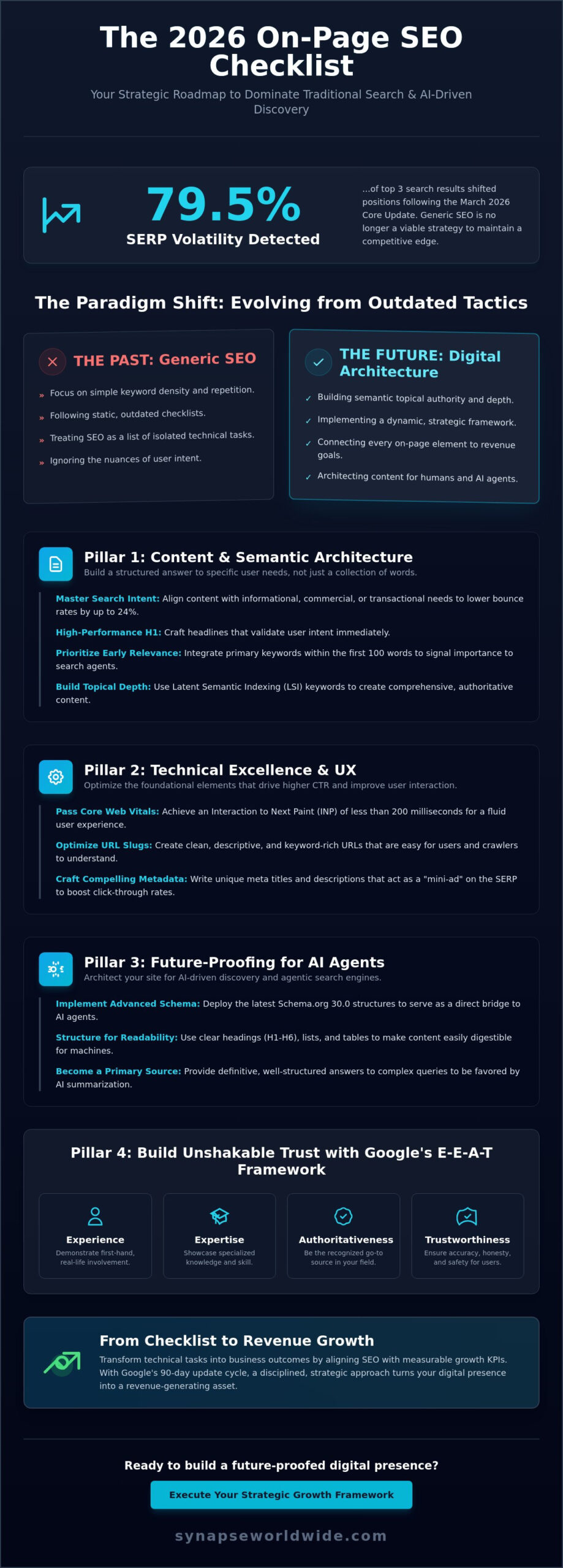
Did you know that 79.5% of top three search results shifted positions following the March 2026 Core Update? This level of volatility confirms that generic optimization is no longer enough to maintain a competitive edge in a landscape that rewards precision. You’re likely feeling the pressure of information overload and the fear of falling behind as AI search agents redefine how users discover your brand. It’s often difficult to connect granular technical tasks to actual revenue growth when the digital environment shifts every 90 days. This definitive on-page seo checklist serves as your strategic roadmap to move beyond basic tactics and into high-level digital architecture.

We’ve designed this framework to help you master the essential elements required to dominate both traditional search and AI-driven discovery in 2026. You’ll learn how to pass the 200-millisecond INP threshold, implement the latest Schema.org 30.0 structures, and build a robust content strategy that satisfies Google’s rigorous E-E-A-T standards. We’re moving past the fluff to provide a clear, professional path toward improved organic visibility and brand authority. By the end of this guide, you’ll have a future-proofed website ready to convert sophisticated searchers into long-term business success.

Key Takeaways

  • Shift from simple keyword density to semantic topical authority to establish a bespoke digital presence that commands attention.
  • Deploy a strategic on-page seo checklist to optimize intent-driven headlines and content structures for maximum performance.
  • Master the technical elements, including URL slugs and meta data, that drive higher click-through rates and improve user interaction.
  • Architect your site for AI-driven discovery by implementing advanced Schema structures that serve as a bridge to agentic search engines.
  • Transform technical tasks into business outcomes by aligning your SEO execution with measurable growth KPIs and recurring strategic reviews.

The Strategic Role of On-Page SEO in the 2026 Digital Landscape

On-page SEO isn’t just a list of technical tasks; it’s the foundation of a bespoke digital presence. While many view it as a chore, we see it as the blueprint for how your brand communicates its value to both humans and machines. This approach aligns perfectly with our SEO for Small Business: The 2026 Strategic Growth Framework, ensuring every element serves a broader commercial objective. We’ve moved beyond the era of simple keyword density. Today, search engines demand semantic topical authority, where your content demonstrates deep, interconnected knowledge rather than just repeating phrases. Agentic Search is the primary driver for 2026 SEO strategy, where autonomous AI agents actively browse, interpret, and summarize web content to fulfill complex user requests without a traditional click.

Why Traditional SEO Checklists are No Longer Sufficient

The shift from matching queries to answering intent is now absolute. Following the March 2026 Core Update, which saw 79.5% of top three results change positions, it’s clear that static lists are obsolete. Google now evaluates the “Digital Architecture” of a page, examining how information flows and how it serves the user’s ultimate goal. This requires a robust commitment to E-E-A-T (Experience, Expertise, Authoritativeness, and Trustworthiness). For a foundational understanding of these dynamics, you can consult a comprehensive guide to SEO. Your on-page seo checklist must evolve to prioritize these qualitative signals, as search agents now disregard content that lacks verified editorial oversight. Before refining your approach, it’s equally important to identify and eliminate the SEO myths 2026 that are actively undermining your strategy and wasting your digital budget.

Aligning On-Page Elements with Business Revenue

Visibility is a vanity metric unless it drives high-value lead generation for Australian enterprises. We treat this on-page seo checklist as a tool for scaling organic traffic sustainably, ensuring that every visitor has a clear path to conversion. A well-optimized, professional web presence isn’t just about ranking; it’s about establishing the authority required to close deals. With Google’s update cadence now occurring every 90 days, maintaining a strategic edge requires constant refinement. This disciplined approach ensures your digital landscape remains a revenue-generating asset rather than a stagnant cost center. By focusing on integrated solutions, you secure a measurable ROI that justifies the technical investment.

Architecting Your Content: Semantic Optimisation & Structure

Content architecture is the bridge between raw data and digital authority. To succeed in 2026, you must begin with a sophisticated keyword research for beginners methodology that identifies high-value semantic clusters. This ensures your content isn’t just a collection of words but a structured answer to specific user needs. Your H1 tag acts as a high-performance headline; it must validate the user’s intent immediately to reduce bounce rates. Integrating your primary on-page seo checklist keywords within the first 100 words signals relevance to search agents before they’ve even finished crawling the page.

Mastering Search Intent and Semantic Clusters

Understanding the nuance between informational, commercial, and transactional intent is vital for conversion. In 2026, Google’s algorithms reward pages that provide immediate clarity. You should utilize Latent Semantic Indexing (LSI) keywords to build topical depth without falling into the trap of outdated keyword stuffing. A comprehensive on-page SEO framework highlights that answering the core question in the introductory paragraphs is essential for capturing featured snippets. This semantic approach prevents the “keyword consistency” errors seen in legacy strategies, favoring a natural, informative flow instead. Websites that successfully align content with intent see a 24% lower bounce rate on average, according to February 2026 data from Digital Applied.

The E-E-A-T Framework for Content Quality

Quality is no longer subjective; it’s measured by your ability to demonstrate Experience, Expertise, Authoritativeness, and Trustworthiness. We recommend integrating bespoke data and unique industry insights that AI cannot replicate. Author bios and credible citations have become critical ranking signals following the February 2026 Discover Core Update, which focused on reducing sensationalism. You should weave social proof and case study data into your narrative to build immediate trust. If you’re looking to scale your authority, a bespoke SEO strategy can help align these technical requirements with your specific business goals.

Logical hierarchy is the final piece of the structural puzzle. Using a clear H2-H3 hierarchy allows both readers and AI agents to scan your content efficiently. This creates a seamless experience that encourages longer dwell times and deeper engagement. When you treat your on-page seo checklist as a structural guide, you transform a simple blog post into a pillar of digital growth. This disciplined approach ensures that your content remains accessible, authoritative, and ready for the next evolution of search.

On-Page SEO Checklist: The 2026 Strategic Framework for Digital Growth

Enhancing the User Experience: Technical On-Page Elements

Technical on-page SEO is where digital architecture meets user behavior. Your meta titles and descriptions must do more than just house keywords; they must act as persuasive calls to action that maximize click-through rates. We recommend keeping titles under 60 characters to avoid truncation in mobile SERPs. Your URL slugs should be equally disciplined. A short, descriptive slug like /on-page-seo-checklist/ provides immediate context to both users and crawlers. This clarity is essential for on-page SEO for agentic search, where machines prioritize easily digestible structures to provide accurate summaries.

Image optimization is no longer optional for high-performance sites. We utilize WebP formatting to ensure rapid load times without sacrificing visual quality. With 43% of websites failing the Interaction to Next Paint (INP) threshold of 200 milliseconds as of February 2026, every kilobyte saved contributes to a more robust user experience. Descriptive alt text is the final touch, serving as a critical accessibility feature while providing search engines with context for image indexing. These technical refinements ensure your site remains agile and responsive across all devices.

Optimising for Visual and Voice Search

Search is becoming increasingly multimodal. To capture voice search snippets, structure your content with short, declarative sentences that answer questions directly. This approach complements the strategic placement of high-quality multimedia, which can increase dwell time and reduce bounce rates by up to 24%. By treating visual elements as integrated components of your narrative, you create a more engaging, multi-sensory brand experience. This level of detail ensures that your on-page seo checklist addresses the diverse ways modern users interact with the web.

Internal Linking as a Growth Engine

A sophisticated internal linking strategy is the circulatory system of your website. It distributes link equity from high-authority pages to newer content, ensuring no “orphan pages” exist to stall your progress. We recommend connecting supporting articles back to your content marketing seo strategy pillar to reinforce topical authority. Use descriptive anchor text that tells the user exactly what to expect. This practice not only improves navigation but also helps you track progress against your seo kpis for small business. Maintaining a robust internal architecture is a fundamental step in any professional digital strategy, turning a collection of pages into a cohesive, scalable growth platform.

Preparing for Agentic Search: Schema and AI Readability

Structuring your digital assets for AI search agents is the next frontier of optimization. In this 2026 framework, Structured Data (Schema) acts as the essential translator between your content and autonomous AI crawlers. The release of Schema.org 30.0 on March 25, 2026, introduced more granular ways to define entity relationships, allowing brands to clarify their expertise with surgical precision. We prioritize Article, FAQ, and LocalBusiness schema to provide comprehensive coverage that search agents can easily ingest. By using JSON-LD, we embed this data directly into your site’s architecture, ensuring that AI tools can identify your core claims without the overhead of heavy scripts. A robust on-page seo checklist must now include these semantic markers to ensure your brand is correctly interpreted by non-human searchers.

AI readability goes beyond code; it requires your content to be logically bulletproof. Every claim should be supported by cited facts or bespoke data that establishes your authority. Since the March 2026 Core Update, Google has significantly increased its reliance on these structured signals to determine which sites are trustworthy enough to be synthesized into AI-generated answers. Ensuring your content is “AI-readable” means removing ambiguity and using a direct, authoritative voice that leaves no room for misinterpretation. This digital architecture turns your website into a reliable data source for the entire web ecosystem.

Winning the Featured Snippet and AI Overview

Structure your content to be easily extracted by AI Overviews and traditional featured snippets. Use “What is” and “How to” blocks that provide immediate, factual answers at the top of your sections. Complex data should be presented in tables or lists to assist in data scraping and display across different search interfaces. Concise, factual definitions are the primary key to winning AI-generated responses in 2026. This method ensures that even if a user doesn’t click through to your site, your brand remains the authoritative source of their information. If you’re ready to modernize your presence, our team can help you implement a bespoke search engine optimization strategy tailored for this new era.

Future-Proofing Content for AI Discovery

Establishing your site as a source of truth requires clear, authoritative language and verified citations. As AI agents like Perplexity and ChatGPT become more prominent, monitoring how they reference your brand is crucial for maintaining your reputation. There’s a direct correlation between technical clarity and AI citation rates; the easier your site is to parse, the more likely it is to be cited as a primary reference. This proactive approach ensures your brand remains visible as the search landscape shifts from traditional links to synthesized, agentic answers. By focusing on these high-level architectural details, you future-proof your growth against the next wave of algorithmic changes.

Executing the Framework: From Checklist to Business Growth

Transforming a static on-page seo checklist into a scalable growth engine requires disciplined, recurring execution. This framework shouldn’t be treated as a one-off project; it’s a fundamental component of a high-performance monthly digital marketing retainer. By embedding these technical and semantic refinements into your operational rhythm, you move beyond simple optimization. You begin the transformation of your digital landscape into a robust, revenue-generating asset. Professional system audits are essential at this stage to uncover deep-seated architectural issues that automated scanners often overlook. These audits ensure your site consistently meets the 75th percentile of real user data required for Core Web Vitals success. We rely on data-driven insights from our seo kpis for small business guide to measure how these on-page adjustments impact your bottom line.

Monitoring and Iterating Your SEO Strategy

On-page SEO is a continuous cycle of refinement, not a final destination. Google’s core algorithm updates now roll out approximately every 90 days, making static content a significant business liability. We utilize Search Console to pinpoint pages where high impressions aren’t translating into clicks, signaling a misalignment with user intent. A/B testing for meta tags and headlines allows us to optimize for click-through rates based on real-time performance data. This iterative process ensures your content remains relevant as search trends evolve and AI agents refine their extraction methods. It’s about maintaining the 24% lower bounce rate observed in sites that pass all three Core Web Vitals thresholds consistently.

Partnering with a Digital Architect

Success in the 2026 search environment demands more than a cookie-cutter approach. Synapse Worldwide serves as your Digital Architect, providing bespoke SEO strategies that align technical precision with ambitious corporate growth goals. We don’t just look at keyword rankings; we integrate CRM and ERP solutions to track exactly how organic visibility converts into high-value leads and sales. This holistic view ensures your digital presence is integrated, scalable, and secure. Our expertise bridges the gap between sophisticated technical implementation and traditional business value propositions. Elevate your digital strategy with Synapse Worldwide’s bespoke SEO services.

Secure Your Competitive Advantage in the 2026 Search Landscape

Dominating the 2026 digital landscape requires a transition from basic optimization to high-level digital architecture. This on-page seo checklist provides the strategic framework needed to satisfy both human intent and the complex requirements of autonomous AI agents. By integrating semantic authority with technical excellence, you position your brand as a primary source of truth in an increasingly agentic world. It’s no longer enough to follow trends; you must architect the environment that search engines and users rely on for clarity.

Realizing this vision requires a partner with deep technical discipline and visionary strategy. Synapse Worldwide was established in 2005; we’ve spent over two decades refining our expertise in enterprise-grade SEO and custom web applications. As strategic consultants, we’re focused on high-value ROI and long-term business transformation for our global clients. Partner with Synapse Worldwide for a Bespoke SEO Strategy to transform your digital presence into a scalable growth engine. Let’s reach the next level of success together.

Frequently Asked Questions

What is the most important on-page SEO factor in 2026?

Semantic topical authority is the primary ranking factor in 2026. Search engines now prioritize how well your content covers a subject rather than just matching a specific phrase. This shift is driven by the rise of Agentic Search, where AI bots categorize your site based on its depth and reliability. Establishing this authority ensures your brand remains visible as a definitive source for both humans and machines.

How often should I update my on-page SEO checklist?

You should review your on-page seo checklist every 90 days. This frequency aligns with Google’s current core update cadence, which transitioned to a quarterly schedule in early 2026. Regular audits allow you to adapt to the high volatility seen in search results, where nearly 80% of top positions can shift after a single update. Consistent iteration is the only way to maintain a stable digital presence.

Can I do on-page SEO without technical coding knowledge?

Content-focused optimization is possible without coding, but technical on-page elements require professional execution. While you can manage headlines and keyword placement, implementing Schema.org 30.0 or optimizing for the 200ms INP threshold involves backend adjustments. Partnering with a Digital Architect ensures these complex architectural details are handled correctly. This balance allows you to focus on business growth while experts manage the technical stability.

How does on-page SEO differ from technical SEO?

On-page SEO manages the content and structure within a specific page. Technical SEO focuses on the site-wide foundation, such as crawlability, security, and server performance. These two disciplines are deeply integrated in a bespoke digital strategy. You can’t have high-performing content on a site that fails core performance assessments, as Google now aggregates these metrics into a composite score.

What is the ideal length for a blog post to rank in 2026?

The ideal length is determined by search intent rather than a specific word count. In 2026, concise pages that answer complex questions immediately often outperform 3,000-word articles that lack focus. Data from Digital Applied indicates that content structured for quick extraction by AI agents sees higher citation rates. Your goal is to provide the most comprehensive answer in the most efficient format possible.

How do I know if my on-page SEO is actually working?

Monitor your organic Click-Through Rate (CTR) and conversion growth to validate your strategy. Successful on-page optimization results in higher engagement and longer dwell times as users find exactly what they need. Use Search Console to identify if your pages are winning featured snippets or AI Overview placements. These metrics provide a clearer picture of ROI than traditional keyword rankings alone.

Is keyword stuffing still relevant for modern SEO?

Keyword stuffing is entirely obsolete and will likely trigger a spam penalty. Modern search engines use semantic understanding to identify the context and expertise of your writing. Instead of repeating terms, focus on building a robust network of related topics and synonyms. This approach satisfies the algorithm’s need for depth while providing a seamless, professional reading experience for your audience.

How does schema markup help my search engine rankings?

Schema markup acts as a translator for AI search agents and traditional crawlers. By providing a structured roadmap of your data, you help search engines understand the specific entities on your page, such as products, events, or local business details. This clarity increases your chances of appearing in rich results and AI-synthesized answers. It’s a critical component for any site aiming for global authority. To ensure your schema implementation isn’t undermined by outdated practices, review the most persistent SEO myths 2026 businesses still rely on that can erode your search visibility.