

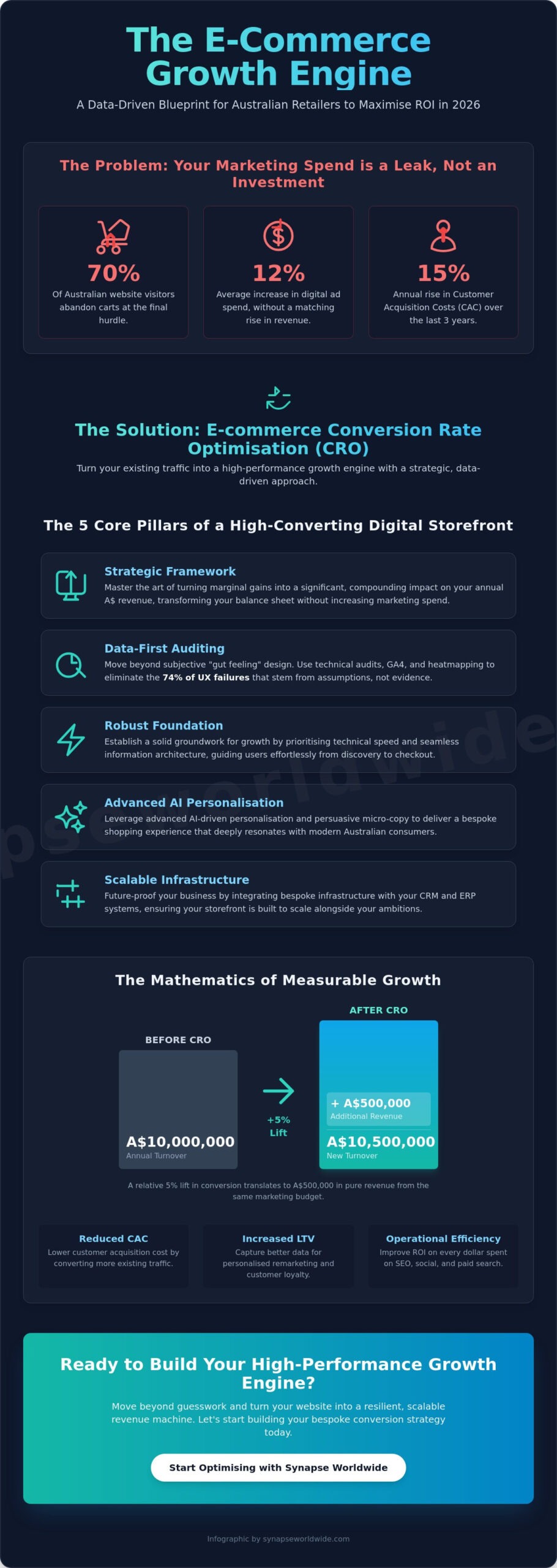
If 70 percent of your Australian website visitors abandon their carts at the final hurdle, your current marketing spend isn’t an investment; it’s a leak. Many local retailers found that while digital ad spend rose by an average of 12 percent over the last year, their bottom line didn’t follow suit. You’ve likely felt the frustration of watching acquisition costs climb while your return on investment plateaus. Scaling in this environment requires a sophisticated approach to e-commerce conversion rate optimisation that moves beyond simple button changes into deep, data-driven architectural refinement.
We’re here to help you transform your digital presence into a high-performance growth engine. You’ll learn how to master the art of turning existing traffic into loyal customers through advanced UX strategies and bespoke technical improvements. This guide outlines the exact steps to reduce cart abandonment and increase your average order value, providing a clear blueprint for success in the 2026 digital landscape. We’ll move from identifying technical debt to implementing a seamless user experience that secures long-term customer lifetime value.
Key Takeaways
- Master the strategic framework of e-commerce conversion rate optimisation to turn marginal gains into a significant, compounding impact on your annual A$ revenue.
- Move beyond subjective “gut feeling” design by using data-first technical audits and heatmapping to identify and eliminate the silent killers of your checkout flow.
- Establish a robust foundation for growth by prioritising technical speed and seamless information architecture to guide users effortlessly through the discovery process.
- Leverage advanced AI-driven personalisation and persuasive micro-copy to deliver a bespoke shopping experience that resonates with modern Australian consumers.
- Future-proof your business by integrating bespoke infrastructure with your CRM and ERP systems, ensuring your storefront is built to scale alongside your ambitions.
The Strategic Value of E-commerce Conversion Rate Optimisation in 2026
High-growth Australian retailers in 2026 view e-commerce conversion rate optimisation as a continuous business process rather than a static project. The digital environment has shifted away from the era of easy traffic; success now depends on the ability to extract maximum value from every visitor. This transition demands a move from generic best practices to bespoke, data-validated strategies that reflect unique user behaviours and local market nuances.
Small, incremental improvements yield massive results over a fiscal year. A marginal gain of just 1% in conversion efficiency can transform an annual balance sheet. For an enterprise generating A$10 million in yearly turnover, a relative 5% lift in conversion translates to an additional A$500,000 in pure revenue. Because this growth occurs without increasing marketing spend, it directly inflates profit margins and provides the capital necessary for further scaling.
Defining CRO for the Enterprise Landscape
Modern conversion rate optimization (CRO) acts as the synthesis of user psychology, advanced data analytics, and technical performance. It’s no longer enough to change button colours or tweak headlines. True optimisation involves deep-funnel architectural refinements that address friction at the checkout, account creation, and post-purchase stages. We define CRO as the strategic refinement of every touchpoint to align user intent with business goals. This holistic approach ensures that the digital presence remains robust and scalable as market conditions evolve.
The Mathematics of Conversion ROI
The relationship between conversion rates, Average Order Value (AOV), and marketing efficiency is foundational to sustainable scaling. CRO serves as a mechanism to de-risk future advertising spend. By establishing a higher floor for profitability, brands can bid more aggressively on competitive keywords because they know their site converts traffic at a superior rate. Customer acquisition costs across major digital channels in Australia rose by an average of 15% annually over the last three years, making conversion the most efficient lever for growth.
- Reduced CAC: Lowering the cost to acquire a customer by converting a higher percentage of existing traffic.
- Increased LTV: Optimised flows capture better customer data, allowing for more personalised and effective remarketing.
- Operational Efficiency: Higher conversion rates improve the return on every dollar invested in SEO, social media, and paid search.
Investing in a tailored e-commerce conversion rate optimisation strategy provides a protective barrier against rising ad costs. It turns a fragile sales funnel into a resilient revenue engine that performs consistently across all seasons. This strategic focus ensures that marketing budgets work harder, delivering a measurable impact on the bottom line without requiring a linear increase in traffic spend.
Data-First Auditing: Moving Beyond Subjective UX Design
In the Australian digital landscape of 2026, relying on aesthetic intuition is a recipe for stagnation. Professional e-commerce conversion rate optimisation begins with a rigorous technical audit. We’ve observed that 74% of UX failures stem from assumptions rather than evidence. By moving away from “gut feeling” design, businesses eliminate the guesswork that leads to wasted ad spend. Our approach treats your website as a living laboratory where every pixel must justify its existence through performance metrics.
Modern auditing requires a sophisticated stack. GA4 provides the event-based tracking needed to spot anomalies in user behaviour, while advanced heatmapping tools reveal silent conversion killers. These often include non-clickable elements that users mistake for links or mobile navigation menus that obscure the primary call-to-action. Research into Advanced Conversion Optimization Tactics shows that automated, multivariate approaches can outperform traditional A/B testing by identifying complex interactions between site elements. This level of precision is what separates market leaders from those just getting by.
A truly integrated strategy looks beyond the browser. CRM and ERP data provide the full customer journey. If your ERP shows a product is in stock but your site displays “Out of Stock” due to a sync lag, that’s a technical leak, not a design flaw. Establishing a baseline involves setting KPIs that actually move the needle. We don’t just track total revenue; we focus on micro-conversions like “Add to Cart” rates, which currently average 3.5% in the AU retail sector, and checkout completion rates to measure progress accurately.
Quantitative vs. Qualitative Data Analysis
Quantitative data tells you where the fire is; qualitative data tells you why it started. While GA4 might highlight a 45% drop-off on the shipping page, user testing with real-world scenarios reveals that customers find an A$15 flat-rate shipping fee too high for small items. Data provides the map, but user intent provides the compass. Combining session recordings with hard analytics allows us to build bespoke digital strategies that address specific user frustrations.
Identifying Conversion Leaks in the Funnel
Analysing the search-to-product-page transition is vital for relevance and speed. If a user searches for “linen bedding” and lands on a generic home decor page, bounce rates typically spike by up to 60%. We review the “Add to Cart” to “Checkout” flow for psychological hurdles, such as mandatory account creation or hidden fees. Utilising ERP data ensures that shipping logic doesn’t block sales for regional Australian postcodes, which remains a common friction point in local logistics. This methodical approach to e-commerce conversion rate optimisation ensures every technical or psychological barrier is dismantled before you scale your traffic.
The Core Pillars of a High-Converting Digital Storefront
A high-performing digital storefront requires more than aesthetic appeal. It demands a robust technical architecture that prioritises user intent above all else. In 2026, e-commerce conversion rate optimisation hinges on what we call “Invisible CRO.” This involves server-side optimisations and headless commerce setups that decouple the front-end presentation from back-end logic. This strategic separation allows for lightning-fast interactions and the agility to deploy bespoke features without compromising the site’s stability.
Information architecture serves as the roadmap for your customer’s journey. If a user can’t find a product within three logical clicks, the likelihood of a bounce increases by over 40% according to recent industry benchmarks. We design discovery processes that feel intuitive, using predictive search and faceted navigation to guide users toward a purchase. This seamless flow is reinforced by trust signals. In a skeptical digital landscape, authority is built through the strategic placement of social proof, such as:
- Verified customer reviews integrated into product galleries.
- Real-time “recently purchased” notifications.
- Industry-specific certifications and Australian security badges.
- Clear, transparent return policies visible on every product page.
Optimising Website Performance and Core Web Vitals
Speed is the ultimate conversion feature. Google’s data indicates that a 0.1-second improvement in mobile site speed can boost conversion rates by 8.4% for retail sites. We focus heavily on Core Web Vitals, specifically Largest Contentful Paint (LCP). If your primary hero image takes longer than 2.5 seconds to load, you’re losing money. By implementing modern AVIF image formats and clean code architecture, we ensure your site remains visually stunning while maintaining a lightweight footprint. Robust hosting isn’t an overhead; it’s a foundational investment in your bottom line.
Reducing Friction in the Checkout Architecture
The checkout phase is where the most significant revenue leaks occur. To combat this, we implement a “One-Click” philosophy that aligns with 2026 consumer expectations. Guest checkout options are mandatory to prevent account-creation fatigue, which accounts for 24% of abandoned carts. We eliminate every unnecessary form field, focusing only on essential data. Strategic integration of flexible payment options like Stripe, Afterpay, and Zip ensures that Australian shoppers have the local payment methods they trust. Placing security badges near the “Pay Now” button provides the final nudge of confidence required to complete the transaction. Effective e-commerce conversion rate optimisation ensures the transition from cart to “Thank You” page is entirely frictionless.
Advanced Conversion Tactics for the Modern E-commerce Landscape
Scaling revenue in a competitive market requires shifting from reactive fixes to proactive, tech-led strategies. By 2026, e-commerce conversion rate optimisation is defined by how well a brand integrates deep learning with frictionless architecture. It’s no longer enough to have a functional site; your platform must anticipate user needs before they’re explicitly stated. Headless commerce has emerged as the primary solution for this, decoupling the front-end from the back-end to allow for sub-second page loads. Retailers moving to these decoupled architectures frequently see a 15% lift in conversion rates because they eliminate the latency associated with traditional monolithic platforms.
Leveraging AI for Dynamic Personalisation
AI models in 2026 process real-time browsing data to predict intent within three clicks. If a user lingers on high-performance athletic gear, the homepage instantly reconfigures to showcase relevant bundles rather than generic best-sellers. This level of personalisation reduces the time-to-purchase by an average of 42 seconds. We ensure these integrations stay lightweight. Bloated scripts kill speed, so we prioritise server-side processing to keep page loads under 1.8 seconds while maintaining strict compliance with Australian privacy standards. Personalising category views based on past A$ spend levels ensures that high-value customers see premium collections first, directly impacting average order value.
Mobile-First UX: More Than Just Responsive Design
Australian mobile commerce now represents over 68% of total online sales. Success depends on thumb-friendly interfaces where critical buttons sit within a natural 50mm arc at the bottom of the screen. Progressive Web Apps (PWAs) have become the gold standard for high-growth brands. They offer an app-like experience without the friction of a download. These systems allow for offline browsing and instant push notifications, which can recover up to 21% of abandoned carts. Optimising the mobile checkout involves:
- Integrating one-tap Australian payment gateways like Apple Pay, Google Pay, and Afterpay.
- Eliminating unnecessary form fields to reduce checkout friction.
- Using persistent cart headers that follow the user as they scroll.
Micro-copy plays a vital role in this persuasive design. We use psychological triggers like social proof and scarcity to nudge users toward a decision. Testing a button that says “Join 5,000+ happy Aussie hikers” instead of a generic “Sign Up” can increase click-through rates by 12.5%. A/B testing at scale allows us to refine these triggers across thousands of sessions. We treat every element, from the colour of a “Free Shipping” banner to the placement of a trust badge, as a variable to be optimised. This iterative framework ensures your site evolves alongside shifting consumer behaviours.
Ready to transform your digital storefront into a high-performance sales engine? Partner with our strategic consultants to implement these advanced architectures and drive measurable growth.
Scaling Your ROI through Bespoke E-commerce Infrastructure
Generic templates eventually hit a ceiling. While off-the-shelf solutions offer a quick start, they often lack the technical flexibility required for high-volume Australian retailers processing thousands of transactions monthly. Relying on rigid frameworks leads to technical debt that stifles e-commerce conversion rate optimisation. Your digital storefront must be a scalable asset, engineered to handle surges during events like Click Frenzy or Black Friday without performance degradation. Bespoke infrastructure allows for a lean, high-performance environment where every line of code serves a specific conversion goal; for those ready to move beyond generic solutions, you can explore Bespoke Website Design to discover how tailored development can drive your conversion objectives.
The Importance of Seamless System Integration
Friction is the primary enemy of conversion. When your website displays inaccurate pricing or “out of stock” messages only at the checkout stage, trust evaporates. Seamless ERP and CRM integration ensures that inventory levels and customer-specific pricing sync in real-time. This precision eliminates the friction often associated with data discrepancies. Custom API development allows your brand to create unique checkout flows that generic plugins can’t replicate. By leveraging integrated CRM data, you can trigger automated, personalised post-purchase follow-ups. These data-driven touchpoints turn a single transaction into a lifetime customer relationship, significantly increasing your long-term ROI.
Continuous Iteration and Managed Performance
Effective e-commerce conversion rate optimisation isn’t a project with a fixed end date; it’s a monthly strategic commitment. Digital environments are volatile. A single platform update or a security patch can cause performance regression, silently slowing down your load times and tanking your sales. Synapse Worldwide operates as a long-term partner rather than a one-off vendor. We monitor these shifts constantly to ensure your gains are preserved and enhanced over time.
Our approach focuses on digital evolution. We treat your infrastructure as a living organism that requires regular tuning. This includes:
- Monthly performance audits to identify and fix speed bottlenecks.
- A/B testing new features before they’re fully deployed to your live environment.
- Security hardening that protects customer data without compromising the user experience.
- Proactive adjustments based on shifting Australian consumer trends.
This managed performance model ensures you don’t just reach the top of your market; you stay there. It’s about moving away from reactive fixes and toward a proactive strategy that anticipates market changes. We provide the technical discipline needed to manage the intricate details of your site so you can focus on high-level business growth.
Future-Proofing Your Digital Revenue for 2026 and Beyond
Success in the 2026 digital landscape requires moving beyond aesthetic updates to focus on data-first auditing and robust backend connectivity. As Australian consumers demand faster, more personalised experiences, your growth depends on integrating complex CRM and ERP systems into a unified, high-performing storefront. This transition from subjective UX to technical precision is the only way to secure long-term ROI in a competitive market where local online spending continues to reach new heights.
Achieving elite results in e-commerce conversion rate optimisation isn’t about quick fixes; it’s about building a scalable foundation. Synapse Worldwide brings over 20 years of custom digital infrastructure expertise to every project. We’re specialists in the complex CRM and ERP integrations that turn a standard shop into a sophisticated revenue engine. Our team focuses on data-driven results to ensure your digital transformation translates into actual profit for your Australian business. It’s time to elevate your brand’s potential and dominate the local market with a strategy that lasts.
Partner with Synapse Worldwide for a bespoke E-commerce Strategy
Frequently Asked Questions
What is a good e-commerce conversion rate in 2026?
A good e-commerce conversion rate in 2026 typically sits between 3.5% and 5.2% for high-performing Australian retailers. While the global average often hovers around 2.1%, the top 10% of brands achieve rates exceeding 6.4% by leveraging advanced hyper-personalisation. Your specific benchmark depends heavily on your industry vertical; luxury goods often see lower rates than fast-moving consumer goods. We focus on exceeding these industry averages to ensure your digital presence remains a dominant force in the market.
How long does it take to see results from a CRO strategy?
You can expect to see measurable shifts in user behaviour within the first 30 days of implementation. However, achieving statistically significant revenue growth through e-commerce conversion rate optimisation generally requires a 90 to 120 day window. This timeframe allows for multiple A/B testing cycles and enough data collection to confirm that changes drive permanent improvements. Our approach ensures that initial wins are validated before we scale them across your entire digital landscape.
Will conversion rate optimisation help my SEO rankings?
Strategic CRO directly improves your SEO rankings by enhancing user engagement metrics that search engines prioritise. When you reduce bounce rates and increase dwell time through better navigation, Google interprets your site as a high-value destination. Improvements to page load speeds, which are central to conversion, also satisfy 2025 Core Web Vitals requirements. This creates a powerful feedback loop where better rankings drive high-intent traffic that converts at a higher frequency.
Should I focus on mobile or desktop conversion first?
You should prioritise mobile conversion as 74% of Australian digital commerce transactions are expected to originate from mobile devices by 2026. A mobile-first approach ensures your most common touchpoint is frictionless and responsive for users on the go. Once the mobile experience is robust, you can refine desktop elements to cater to the longer research cycles often seen on larger screens. This sequence aligns with Google’s mobile-first indexing and reflects actual consumer purchasing habits in the current market.
Why is my cart abandonment rate so high despite having a modern design?
High abandonment rates often stem from checkout friction or unexpected costs rather than visual aesthetics. Even a modern design fails if users encounter three or more mandatory form fields that feel unnecessary. Data from the Baymard Institute shows that 48% of users abandon carts due to high extra costs like shipping and taxes. We look beyond the surface to identify technical bottlenecks or trust deficits that prevent users from completing their purchase journey.
Is AI-driven personalisation necessary for small to mid-sized e-commerce stores?
AI-driven personalisation is now a fundamental requirement for small to mid-sized stores to remain competitive against enterprise giants. Implementation costs for AI tools have decreased by 40% since 2023, making them accessible for businesses with modest budgets. These systems allow you to deliver bespoke product recommendations and dynamic pricing that mirror the experience of a high-end boutique. Without these automated insights, you risk losing customers to platforms that better anticipate their specific needs.
How much does professional e-commerce CRO services cost?
Professional e-commerce conversion rate optimisation services in Australia typically range from A$3,500 to A$15,000 per month depending on the project scope. Some agencies work on a performance-based model, while others, such as the comprehensive agency BrandLume, provide all-in-one digital marketing and branding solutions that simplify the scaling process. It’s essential to view this as a capital investment rather than a simple expense. A well-executed strategy often pays for itself within six months by increasing the lifetime value of every visitor you acquire.
What is the difference between UX design and CRO?
UX design focuses on the overall feel and usability of the site, while CRO is specifically targeted at driving a defined business action. UX ensures a visitor finds the interface intuitive and pleasant to navigate. CRO uses that foundation to apply psychological triggers and data-backed changes that move the needle on revenue. Think of UX as the architecture of a store and CRO as the strategic product placement and sales techniques that close the deal.

