
Tag Archives: e-commerce strategy


E-commerce Conversion Rate Optimisation: The Strategic Guide to Scaling Revenue in 2026

E-commerce Conversion Rate Optimisation: The Strategic Guide to Scaling Revenue in 2026

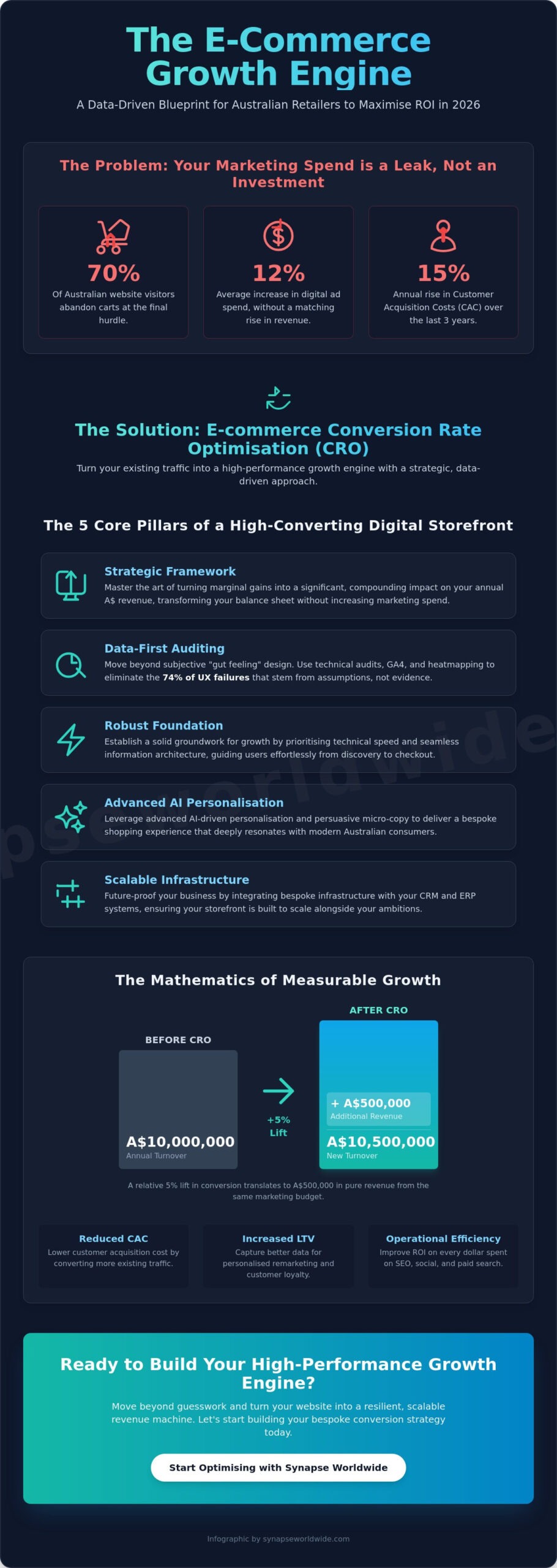
If 70 percent of your Australian website visitors abandon their carts at the final hurdle, your current marketing spend isn’t an investment; it’s a leak. Many local retailers found that while digital ad spend rose by an average of 12 percent over the last year, their bottom line didn’t follow suit. You’ve likely felt the frustration of watching acquisition costs climb while your return on investment plateaus. Scaling in this environment requires a sophisticated approach to e-commerce conversion rate optimisation that moves beyond simple button changes into deep, data-driven architectural refinement.

We’re here to help you transform your digital presence into a high-performance growth engine. You’ll learn how to master the art of turning existing traffic into loyal customers through advanced UX strategies and bespoke technical improvements. This guide outlines the exact steps to reduce cart abandonment and increase your average order value, providing a clear blueprint for success in the 2026 digital landscape. We’ll move from identifying technical debt to implementing a seamless user experience that secures long-term customer lifetime value.

Key Takeaways

  • Master the strategic framework of e-commerce conversion rate optimisation to turn marginal gains into a significant, compounding impact on your annual A$ revenue.
  • Move beyond subjective “gut feeling” design by using data-first technical audits and heatmapping to identify and eliminate the silent killers of your checkout flow.
  • Establish a robust foundation for growth by prioritising technical speed and seamless information architecture to guide users effortlessly through the discovery process.
  • Leverage advanced AI-driven personalisation and persuasive micro-copy to deliver a bespoke shopping experience that resonates with modern Australian consumers.
  • Future-proof your business by integrating bespoke infrastructure with your CRM and ERP systems, ensuring your storefront is built to scale alongside your ambitions.

The Strategic Value of E-commerce Conversion Rate Optimisation in 2026

High-growth Australian retailers in 2026 view e-commerce conversion rate optimisation as a continuous business process rather than a static project. The digital environment has shifted away from the era of easy traffic; success now depends on the ability to extract maximum value from every visitor. This transition demands a move from generic best practices to bespoke, data-validated strategies that reflect unique user behaviours and local market nuances.

Small, incremental improvements yield massive results over a fiscal year. A marginal gain of just 1% in conversion efficiency can transform an annual balance sheet. For an enterprise generating A$10 million in yearly turnover, a relative 5% lift in conversion translates to an additional A$500,000 in pure revenue. Because this growth occurs without increasing marketing spend, it directly inflates profit margins and provides the capital necessary for further scaling.

Defining CRO for the Enterprise Landscape

Modern conversion rate optimization (CRO) acts as the synthesis of user psychology, advanced data analytics, and technical performance. It’s no longer enough to change button colours or tweak headlines. True optimisation involves deep-funnel architectural refinements that address friction at the checkout, account creation, and post-purchase stages. We define CRO as the strategic refinement of every touchpoint to align user intent with business goals. This holistic approach ensures that the digital presence remains robust and scalable as market conditions evolve.

The Mathematics of Conversion ROI

The relationship between conversion rates, Average Order Value (AOV), and marketing efficiency is foundational to sustainable scaling. CRO serves as a mechanism to de-risk future advertising spend. By establishing a higher floor for profitability, brands can bid more aggressively on competitive keywords because they know their site converts traffic at a superior rate. Customer acquisition costs across major digital channels in Australia rose by an average of 15% annually over the last three years, making conversion the most efficient lever for growth.

  • Reduced CAC: Lowering the cost to acquire a customer by converting a higher percentage of existing traffic.
  • Increased LTV: Optimised flows capture better customer data, allowing for more personalised and effective remarketing.
  • Operational Efficiency: Higher conversion rates improve the return on every dollar invested in SEO, social media, and paid search.

Investing in a tailored e-commerce conversion rate optimisation strategy provides a protective barrier against rising ad costs. It turns a fragile sales funnel into a resilient revenue engine that performs consistently across all seasons. This strategic focus ensures that marketing budgets work harder, delivering a measurable impact on the bottom line without requiring a linear increase in traffic spend.

Data-First Auditing: Moving Beyond Subjective UX Design

In the Australian digital landscape of 2026, relying on aesthetic intuition is a recipe for stagnation. Professional e-commerce conversion rate optimisation begins with a rigorous technical audit. We’ve observed that 74% of UX failures stem from assumptions rather than evidence. By moving away from “gut feeling” design, businesses eliminate the guesswork that leads to wasted ad spend. Our approach treats your website as a living laboratory where every pixel must justify its existence through performance metrics.

Modern auditing requires a sophisticated stack. GA4 provides the event-based tracking needed to spot anomalies in user behaviour, while advanced heatmapping tools reveal silent conversion killers. These often include non-clickable elements that users mistake for links or mobile navigation menus that obscure the primary call-to-action. Research into Advanced Conversion Optimization Tactics shows that automated, multivariate approaches can outperform traditional A/B testing by identifying complex interactions between site elements. This level of precision is what separates market leaders from those just getting by.

A truly integrated strategy looks beyond the browser. CRM and ERP data provide the full customer journey. If your ERP shows a product is in stock but your site displays “Out of Stock” due to a sync lag, that’s a technical leak, not a design flaw. Establishing a baseline involves setting KPIs that actually move the needle. We don’t just track total revenue; we focus on micro-conversions like “Add to Cart” rates, which currently average 3.5% in the AU retail sector, and checkout completion rates to measure progress accurately.

Quantitative vs. Qualitative Data Analysis

Quantitative data tells you where the fire is; qualitative data tells you why it started. While GA4 might highlight a 45% drop-off on the shipping page, user testing with real-world scenarios reveals that customers find an A$15 flat-rate shipping fee too high for small items. Data provides the map, but user intent provides the compass. Combining session recordings with hard analytics allows us to build bespoke digital strategies that address specific user frustrations.

Identifying Conversion Leaks in the Funnel

Analysing the search-to-product-page transition is vital for relevance and speed. If a user searches for “linen bedding” and lands on a generic home decor page, bounce rates typically spike by up to 60%. We review the “Add to Cart” to “Checkout” flow for psychological hurdles, such as mandatory account creation or hidden fees. Utilising ERP data ensures that shipping logic doesn’t block sales for regional Australian postcodes, which remains a common friction point in local logistics. This methodical approach to e-commerce conversion rate optimisation ensures every technical or psychological barrier is dismantled before you scale your traffic.

E-commerce Conversion Rate Optimisation: The Strategic Guide to Scaling Revenue in 2026

The Core Pillars of a High-Converting Digital Storefront

A high-performing digital storefront requires more than aesthetic appeal. It demands a robust technical architecture that prioritises user intent above all else. In 2026, e-commerce conversion rate optimisation hinges on what we call “Invisible CRO.” This involves server-side optimisations and headless commerce setups that decouple the front-end presentation from back-end logic. This strategic separation allows for lightning-fast interactions and the agility to deploy bespoke features without compromising the site’s stability.

Information architecture serves as the roadmap for your customer’s journey. If a user can’t find a product within three logical clicks, the likelihood of a bounce increases by over 40% according to recent industry benchmarks. We design discovery processes that feel intuitive, using predictive search and faceted navigation to guide users toward a purchase. This seamless flow is reinforced by trust signals. In a skeptical digital landscape, authority is built through the strategic placement of social proof, such as:

  • Verified customer reviews integrated into product galleries.
  • Real-time “recently purchased” notifications.
  • Industry-specific certifications and Australian security badges.
  • Clear, transparent return policies visible on every product page.

Optimising Website Performance and Core Web Vitals

Speed is the ultimate conversion feature. Google’s data indicates that a 0.1-second improvement in mobile site speed can boost conversion rates by 8.4% for retail sites. We focus heavily on Core Web Vitals, specifically Largest Contentful Paint (LCP). If your primary hero image takes longer than 2.5 seconds to load, you’re losing money. By implementing modern AVIF image formats and clean code architecture, we ensure your site remains visually stunning while maintaining a lightweight footprint. Robust hosting isn’t an overhead; it’s a foundational investment in your bottom line.

Reducing Friction in the Checkout Architecture

The checkout phase is where the most significant revenue leaks occur. To combat this, we implement a “One-Click” philosophy that aligns with 2026 consumer expectations. Guest checkout options are mandatory to prevent account-creation fatigue, which accounts for 24% of abandoned carts. We eliminate every unnecessary form field, focusing only on essential data. Strategic integration of flexible payment options like Stripe, Afterpay, and Zip ensures that Australian shoppers have the local payment methods they trust. Placing security badges near the “Pay Now” button provides the final nudge of confidence required to complete the transaction. Effective e-commerce conversion rate optimisation ensures the transition from cart to “Thank You” page is entirely frictionless.

Advanced Conversion Tactics for the Modern E-commerce Landscape

Scaling revenue in a competitive market requires shifting from reactive fixes to proactive, tech-led strategies. By 2026, e-commerce conversion rate optimisation is defined by how well a brand integrates deep learning with frictionless architecture. It’s no longer enough to have a functional site; your platform must anticipate user needs before they’re explicitly stated. Headless commerce has emerged as the primary solution for this, decoupling the front-end from the back-end to allow for sub-second page loads. Retailers moving to these decoupled architectures frequently see a 15% lift in conversion rates because they eliminate the latency associated with traditional monolithic platforms.

Leveraging AI for Dynamic Personalisation

AI models in 2026 process real-time browsing data to predict intent within three clicks. If a user lingers on high-performance athletic gear, the homepage instantly reconfigures to showcase relevant bundles rather than generic best-sellers. This level of personalisation reduces the time-to-purchase by an average of 42 seconds. We ensure these integrations stay lightweight. Bloated scripts kill speed, so we prioritise server-side processing to keep page loads under 1.8 seconds while maintaining strict compliance with Australian privacy standards. Personalising category views based on past A$ spend levels ensures that high-value customers see premium collections first, directly impacting average order value.

Mobile-First UX: More Than Just Responsive Design

Australian mobile commerce now represents over 68% of total online sales. Success depends on thumb-friendly interfaces where critical buttons sit within a natural 50mm arc at the bottom of the screen. Progressive Web Apps (PWAs) have become the gold standard for high-growth brands. They offer an app-like experience without the friction of a download. These systems allow for offline browsing and instant push notifications, which can recover up to 21% of abandoned carts. Optimising the mobile checkout involves:

  • Integrating one-tap Australian payment gateways like Apple Pay, Google Pay, and Afterpay.
  • Eliminating unnecessary form fields to reduce checkout friction.
  • Using persistent cart headers that follow the user as they scroll.

Micro-copy plays a vital role in this persuasive design. We use psychological triggers like social proof and scarcity to nudge users toward a decision. Testing a button that says “Join 5,000+ happy Aussie hikers” instead of a generic “Sign Up” can increase click-through rates by 12.5%. A/B testing at scale allows us to refine these triggers across thousands of sessions. We treat every element, from the colour of a “Free Shipping” banner to the placement of a trust badge, as a variable to be optimised. This iterative framework ensures your site evolves alongside shifting consumer behaviours.

Ready to transform your digital storefront into a high-performance sales engine? Partner with our strategic consultants to implement these advanced architectures and drive measurable growth.

Scaling Your ROI through Bespoke E-commerce Infrastructure

Generic templates eventually hit a ceiling. While off-the-shelf solutions offer a quick start, they often lack the technical flexibility required for high-volume Australian retailers processing thousands of transactions monthly. Relying on rigid frameworks leads to technical debt that stifles e-commerce conversion rate optimisation. Your digital storefront must be a scalable asset, engineered to handle surges during events like Click Frenzy or Black Friday without performance degradation. Bespoke infrastructure allows for a lean, high-performance environment where every line of code serves a specific conversion goal; for those ready to move beyond generic solutions, you can explore Bespoke Website Design to discover how tailored development can drive your conversion objectives.

The Importance of Seamless System Integration

Friction is the primary enemy of conversion. When your website displays inaccurate pricing or “out of stock” messages only at the checkout stage, trust evaporates. Seamless ERP and CRM integration ensures that inventory levels and customer-specific pricing sync in real-time. This precision eliminates the friction often associated with data discrepancies. Custom API development allows your brand to create unique checkout flows that generic plugins can’t replicate. By leveraging integrated CRM data, you can trigger automated, personalised post-purchase follow-ups. These data-driven touchpoints turn a single transaction into a lifetime customer relationship, significantly increasing your long-term ROI.

Continuous Iteration and Managed Performance

Effective e-commerce conversion rate optimisation isn’t a project with a fixed end date; it’s a monthly strategic commitment. Digital environments are volatile. A single platform update or a security patch can cause performance regression, silently slowing down your load times and tanking your sales. Synapse Worldwide operates as a long-term partner rather than a one-off vendor. We monitor these shifts constantly to ensure your gains are preserved and enhanced over time.

Our approach focuses on digital evolution. We treat your infrastructure as a living organism that requires regular tuning. This includes:

  • Monthly performance audits to identify and fix speed bottlenecks.
  • A/B testing new features before they’re fully deployed to your live environment.
  • Security hardening that protects customer data without compromising the user experience.
  • Proactive adjustments based on shifting Australian consumer trends.

This managed performance model ensures you don’t just reach the top of your market; you stay there. It’s about moving away from reactive fixes and toward a proactive strategy that anticipates market changes. We provide the technical discipline needed to manage the intricate details of your site so you can focus on high-level business growth.

Future-Proofing Your Digital Revenue for 2026 and Beyond

Success in the 2026 digital landscape requires moving beyond aesthetic updates to focus on data-first auditing and robust backend connectivity. As Australian consumers demand faster, more personalised experiences, your growth depends on integrating complex CRM and ERP systems into a unified, high-performing storefront. This transition from subjective UX to technical precision is the only way to secure long-term ROI in a competitive market where local online spending continues to reach new heights.

Achieving elite results in e-commerce conversion rate optimisation isn’t about quick fixes; it’s about building a scalable foundation. Synapse Worldwide brings over 20 years of custom digital infrastructure expertise to every project. We’re specialists in the complex CRM and ERP integrations that turn a standard shop into a sophisticated revenue engine. Our team focuses on data-driven results to ensure your digital transformation translates into actual profit for your Australian business. It’s time to elevate your brand’s potential and dominate the local market with a strategy that lasts.

Partner with Synapse Worldwide for a bespoke E-commerce Strategy

Frequently Asked Questions

What is a good e-commerce conversion rate in 2026?

A good e-commerce conversion rate in 2026 typically sits between 3.5% and 5.2% for high-performing Australian retailers. While the global average often hovers around 2.1%, the top 10% of brands achieve rates exceeding 6.4% by leveraging advanced hyper-personalisation. Your specific benchmark depends heavily on your industry vertical; luxury goods often see lower rates than fast-moving consumer goods. We focus on exceeding these industry averages to ensure your digital presence remains a dominant force in the market.

How long does it take to see results from a CRO strategy?

You can expect to see measurable shifts in user behaviour within the first 30 days of implementation. However, achieving statistically significant revenue growth through e-commerce conversion rate optimisation generally requires a 90 to 120 day window. This timeframe allows for multiple A/B testing cycles and enough data collection to confirm that changes drive permanent improvements. Our approach ensures that initial wins are validated before we scale them across your entire digital landscape.

Will conversion rate optimisation help my SEO rankings?

Strategic CRO directly improves your SEO rankings by enhancing user engagement metrics that search engines prioritise. When you reduce bounce rates and increase dwell time through better navigation, Google interprets your site as a high-value destination. Improvements to page load speeds, which are central to conversion, also satisfy 2025 Core Web Vitals requirements. This creates a powerful feedback loop where better rankings drive high-intent traffic that converts at a higher frequency.

Should I focus on mobile or desktop conversion first?

You should prioritise mobile conversion as 74% of Australian digital commerce transactions are expected to originate from mobile devices by 2026. A mobile-first approach ensures your most common touchpoint is frictionless and responsive for users on the go. Once the mobile experience is robust, you can refine desktop elements to cater to the longer research cycles often seen on larger screens. This sequence aligns with Google’s mobile-first indexing and reflects actual consumer purchasing habits in the current market.

Why is my cart abandonment rate so high despite having a modern design?

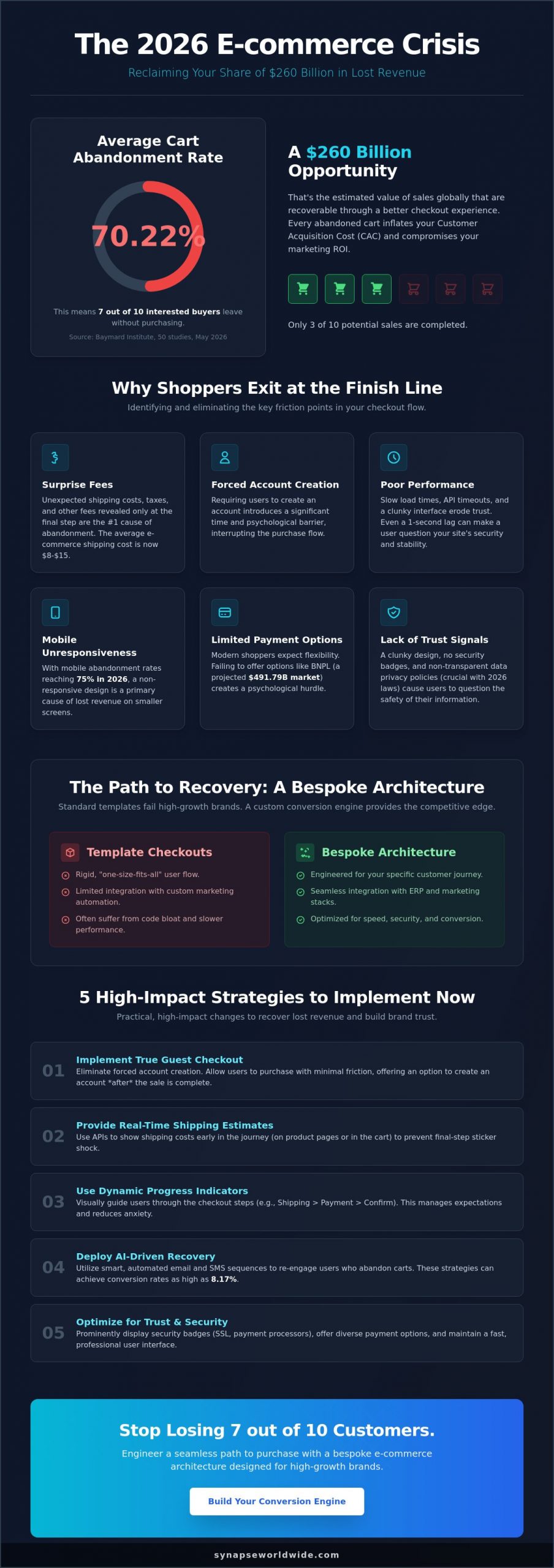
High abandonment rates often stem from checkout friction or unexpected costs rather than visual aesthetics. Even a modern design fails if users encounter three or more mandatory form fields that feel unnecessary. Data from the Baymard Institute shows that 48% of users abandon carts due to high extra costs like shipping and taxes. We look beyond the surface to identify technical bottlenecks or trust deficits that prevent users from completing their purchase journey.

Is AI-driven personalisation necessary for small to mid-sized e-commerce stores?

AI-driven personalisation is now a fundamental requirement for small to mid-sized stores to remain competitive against enterprise giants. Implementation costs for AI tools have decreased by 40% since 2023, making them accessible for businesses with modest budgets. These systems allow you to deliver bespoke product recommendations and dynamic pricing that mirror the experience of a high-end boutique. Without these automated insights, you risk losing customers to platforms that better anticipate their specific needs.

How much does professional e-commerce CRO services cost?

Professional e-commerce conversion rate optimisation services in Australia typically range from A$3,500 to A$15,000 per month depending on the project scope. Some agencies work on a performance-based model, while others, such as the comprehensive agency BrandLume, provide all-in-one digital marketing and branding solutions that simplify the scaling process. It’s essential to view this as a capital investment rather than a simple expense. A well-executed strategy often pays for itself within six months by increasing the lifetime value of every visitor you acquire.

What is the difference between UX design and CRO?

UX design focuses on the overall feel and usability of the site, while CRO is specifically targeted at driving a defined business action. UX ensures a visitor finds the interface intuitive and pleasant to navigate. CRO uses that foundation to apply psychological triggers and data-backed changes that move the needle on revenue. Think of UX as the architecture of a store and CRO as the strategic product placement and sales techniques that close the deal.


Enterprise E-Commerce Solutions: A Strategic Guide to Scalable Growth in 2026

Enterprise E-Commerce Solutions: A Strategic Guide to Scalable Growth in 2026

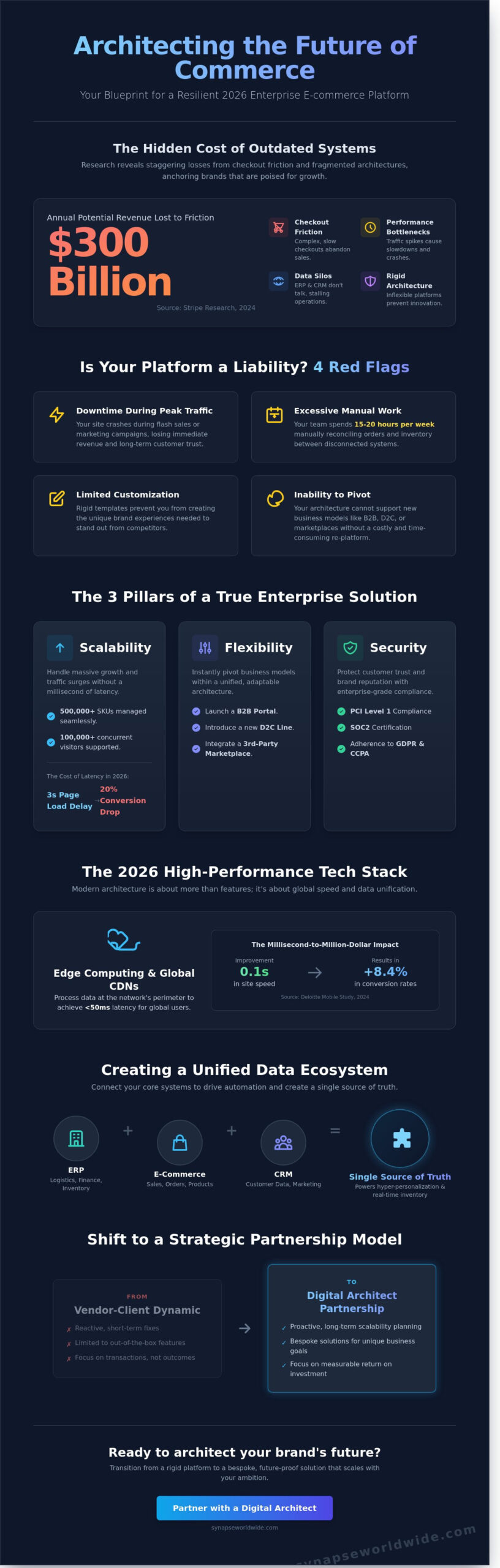
In 2024, research from Stripe revealed that businesses lose an estimated $300 billion in potential revenue every year because of checkout friction and fragmented system architectures. You’ve likely experienced the mounting pressure when peak traffic periods expose performance bottlenecks or when data silos between your ERP and CRM stall your operations. Growth requires precision. Relying on rigid enterprise e-commerce solutions shouldn’t be the anchor that holds your brand back from its next phase of global success.

We’ll show you how to master these complexities by implementing a strategic framework designed for the specific demands of 2026. This guide provides the blueprint to help you architect a seamless, omnichannel experience that automates your entire business stack. We’ll explore how to transition from legacy vulnerabilities to a bespoke, future-proof platform that scales efficiently without the burden of technical debt.

Key Takeaways

  • Identify the strategic indicators that signal when a business must transition from standard retail tools to robust, multi-channel enterprise systems.
  • Analyze the technical requirements of modern architecture, focusing on how edge computing and global CDNs ensure peak performance in a 2026 digital landscape.
  • Compare SaaS, Headless, and Bespoke models to determine which enterprise e-commerce solutions offer the most favorable Total Cost of Ownership for your growth.
  • Learn to integrate your commerce platform with ERP and CRM systems to create a unified data ecosystem that drives sophisticated marketing automation.
  • Shift from a vendor-client dynamic to a Digital Architect partnership model that prioritizes long-term scalability and measurable return on investment.

What Defines a True Enterprise E-Commerce Solution?

Growth isn’t just a matter of increasing revenue numbers. It’s a fundamental shift in the structural integrity of your digital infrastructure. Most businesses begin their journey with standard retail tools, but they eventually hit a ceiling where basic plugins and rigid templates fail to support their complexity. Moving into the territory of enterprise e-commerce solutions means transitioning from a simple storefront to a sophisticated, multi-layered business engine. This shift represents an architectural philosophy that prioritizes long-term resilience and bespoke integration over quick-fix features.

By the first quarter of 2026, consumer expectations will revolve around hyper-personalization and real-time inventory transparency across every global touchpoint. Meeting these demands requires more than just a functional checkout page. It demands a deep, automated connection with an Enterprise Resource Planning (ERP) system to synchronize logistics, finance, and customer data into a single source of truth. At this level, you aren’t just selling products; you’re managing an intricate ecosystem of multi-channel relationships and high-velocity data streams.

The Three Pillars of Enterprise Capability

  • Scalability: Your platform must handle 500,000+ SKUs and traffic surges exceeding 100,000 concurrent visitors without a millisecond of latency. In 2026, a three-second delay in page load speed can result in a 20% drop in conversion rates.
  • Flexibility: True enterprise systems allow you to pivot business models instantly. Whether you’re launching a B2B portal, a D2C line, or a third-party marketplace, the architecture must support these shifts within a unified environment.
  • Security: Robust protection is a baseline requirement. This includes PCI Level 1 compliance, SOC2 certification, and strict adherence to global frameworks like GDPR and CCPA to protect both brand reputation and customer trust.

Signs You Have Outgrown Your Current Platform

If your site experiences downtime during a 15-minute flash sale or a major marketing campaign, your current infrastructure is a liability. Frequent manual data entry between your website and backend business systems is another red flag. When your operations team spends 15 to 20 hours a week manually reconciling orders or updating inventory across channels, you’re losing capital to inefficiency. Finally, if limited customization prevents you from executing a unique brand experience that differentiates you from competitors, you’ve officially outgrown standard tools. Enterprise e-commerce solutions provide the strategic foundation needed to remove these bottlenecks and facilitate the next stage of your global expansion.

Core Pillars of Enterprise Architecture: Security, Scalability, and Speed

Enterprise e-commerce solutions represent a significant departure from mid-market platforms. While mid-market tools focus on user-friendly templates and basic functionality, enterprise architecture prioritizes modularity, global reach, and deep technical integration. By 2026, the standard for high-performance commerce relies heavily on edge computing. This technology processes data at the network’s perimeter, effectively reducing latency to under 50 milliseconds for global users. Unlike traditional setups, enterprise systems must manage 10,000+ concurrent users and millions of SKUs across diverse tax jurisdictions without a dip in performance.

Speed isn’t just a technical metric; it’s a direct driver of the bottom line. Deloitte’s 2024 mobile study revealed that a 0.1-second improvement in site speed increased conversion rates by 8.4% for retail sites. For a billion-dollar brand, these milliseconds represent millions in recovered revenue. To achieve this, modern enterprise e-commerce solutions leverage global CDNs that do more than cache images. They now execute server-side logic at the edge, ensuring that personalization and pricing remain instantaneous regardless of the shopper’s location.

Infrastructure Resilience and High Availability

Modern brands require zero-downtime environments to protect their reputation and revenue. This is achieved through sophisticated multi-region hosting and automated failover protocols. If a data center in Northern Virginia experiences an outage, traffic shifts instantly to a secondary node in Dublin or Singapore. Elastic load balancing ensures that resources scale horizontally during peak events. “Enterprise resilience is measured by the systems ability to maintain peak performance during unforeseen traffic spikes.” This level of stability is what separates a bespoke digital infrastructure from a standard retail template.

Advanced Security Protocols for 2026

Security is no longer a perimeter wall; it’s a foundational element that must be baked into the API layer. Implementing a Zero Trust Architecture ensures that every request is verified, regardless of its origin, preventing lateral movement during a potential breach. By 2026, AI-driven fraud detection will analyze 5,000+ data points per transaction in real-time. This proactive approach blocks sophisticated bot attacks before they reach the checkout process. Furthermore, enterprise systems must maintain strict compliance with evolving global standards, including the EU’s AI Act and the latest iterations of VCDPA and CCPA data privacy laws. This integrated security model protects both the brand’s integrity and the customer’s sensitive information.

Enterprise E-Commerce Solutions: A Strategic Guide to Scalable Growth in 2026

SaaS vs. Headless vs. Bespoke: Choosing Your Implementation Model

Selecting the right architecture defines your growth trajectory for the next decade. Enterprise e-commerce solutions are no longer one-size-fits-all; they require a calculated balance between immediate speed-to-market and long-term technical debt. Decision-makers must evaluate how each model impacts the Total Cost of Ownership (TCO) and the team’s ability to pivot when consumer behavior shifts.

SaaS models offer the fastest deployment, often reducing initial launch times by 40% compared to legacy builds. However, the TCO shifts as you scale. While SaaS has lower upfront capital expenditure, scaling complex integrations can lead to a “platform tax” through transaction fees or restrictive API limits. Hybrid models are gaining traction in 2026, combining the robust security of a SaaS core with the flexibility of a custom-built frontend. This approach prioritizes stability without sacrificing the unique brand experience your customers expect.

  • SaaS: Best for rapid deployment and lower maintenance overhead.
  • Headless: Ideal for brands requiring high-performance, omnichannel experiences.
  • Bespoke: Necessary for organizations with highly specialized business logic or proprietary workflows.

The Rise of Headless and Composable Commerce

Decoupling the frontend from the backend gives your team ultimate design freedom. An API-first approach ensures that your product data remains consistent across mobile apps, IoT devices, and web storefronts. Gartner reports that by 2026, 60% of mainstream organizations will list “composable” as a primary requirement for new applications. This modularity allows you to swap individual components, such as your search engine or checkout module, without rebuilding the entire stack. It’s the preferred choice for 2026 digital leaders who value agility.

When Custom Bespoke Development is the Right Choice

Off-the-shelf tools often fail when faced with unique business logic or complex B2B procurement workflows. Bespoke development creates a proprietary advantage, effectively building a digital “moat” that competitors can’t easily replicate. If your operations require a specific algorithm for logistics or a specialized configuration engine, custom-coded features provide the necessary precision. While the initial investment is higher, the long-term ROI is found in the seamless alignment between your software and your specific operational requirements. Custom enterprise e-commerce solutions ensure you aren’t forced to change your business to fit your software.

Integrating the Ecosystem: Connecting ERP, CRM, and Marketing Automation

While many view the digital storefront as the primary driver of revenue, it’s actually just the tip of the iceberg. For high-growth organizations, enterprise e-commerce solutions must act as the central nervous system of the business. A static storefront is a liability. You need a robust, bi-directional flow of data to ensure every transaction, stock update, and customer interaction reflects reality across your entire infrastructure.

Integration isn’t just a technical preference; it’s a financial imperative. A 2024 report by IDC found that enterprises successfully integrating their back-office systems see a 15% reduction in operational costs. By removing the need for manual data entry, you eliminate the human errors that lead to shipping delays or incorrect billing. Skeptics often argue that integration is too complex or prone to failure. This perspective is outdated. In 2026, the shift toward API-first architectures means connecting systems is no longer a multi-year project fraught with risk. It’s a strategic deployment of modern connectors that ensure your business remains agile. Organizations often seek the digital strategy and ICT expertise of Business Analysis & Solutions to ensure these integrations drive maximum efficiency.

The ERP and E-Commerce Connection

The link between your ERP and your storefront is the foundation of scale. This connection allows for real-time inventory synchronization across multiple warehouses and global channels. If a customer in London buys the last unit, your storefront in New York must reflect that change instantly. Automating order fulfillment and logistics for high-volume operations reduces the “click-to-ship” window by up to 30% for many global brands. Additionally, integrated systems streamline financial reporting and tax compliance, automatically calculating complex VAT or GST requirements across different jurisdictions without manual intervention. To maximize the value of this data, many mid-cap companies utilize fractional cfo services to provide the expert oversight needed for global financial management.

Unifying Customer Data with CRM Integration

Connecting your CRM to your enterprise e-commerce solutions creates a 360-degree view of the customer. You’re no longer looking at isolated transactions; you’re seeing a lifetime of behavior. This deep data allows for hyper-personalized marketing and loyalty programs that actually resonate. When your marketing automation knows exactly what a customer bought and when they last logged in, your conversion rates for follow-up campaigns can increase by 22% compared to generic email blasts. Data silos are the enemy of growth; integration is the cure.

“In 2026, enterprise success is defined by the seamless flow of data between the storefront and the back-office ERP.”

Ready to transform your digital infrastructure into a unified growth engine? Partner with Synapse Worldwide for bespoke integration strategies that drive measurable ROI.

Partnering for Growth: The Synapse Digital Architect Approach

Transitioning from a transactional vendor relationship to a strategic partnership is the defining factor for success in 2026. Synapse Worldwide operates as your Digital Architect, moving beyond simple execution to provide high-level structural guidance. We don’t just build websites; we construct scalable digital ecosystems designed for longevity. Our fixed-price development model addresses a primary pain point for 45% of large-scale IT projects: budget unpredictability. By locking in costs upfront, we ensure your enterprise e-commerce solutions are delivered without the hidden fees or “scope creep” that often derail corporate financial planning.

Long-term growth requires more than a successful launch. It demands a commitment to evolution. We ensure your platform remains a high-performing asset through structured annual maintenance and ongoing strategic consulting. This proactive stance allows your business to pivot quickly as market conditions change, keeping your infrastructure robust and secure against emerging threats.

The Synapse Methodology: From Discovery to Deployment

The process starts with a rigorous discovery phase. We map out a technical architecture that aligns directly with your specific revenue goals. This isn’t a generic template; it’s a blueprint for growth. Our custom UI/UX design focuses on reflecting your brand authority, ensuring the interface is as sophisticated as the backend logic. Following deployment, we enter a critical post-launch optimization phase. We use real-world data to refine the user journey, ensuring your enterprise e-commerce solutions achieve peak conversion rates from day one.

Why a Bespoke Approach Outperforms Cookie-Cutter Solutions

Standard platforms often force your business to adapt its operations to the software’s limitations. We believe the technology should serve the business. A bespoke approach allows us to tailor the digital landscape to your specific operational workflows, which can improve internal efficiency by 30% or more. This level of customization ensures that every integration, from ERPs to logistics providers, works in perfect harmony.

  • Australian-Based Expertise: You get direct access to local specialists who understand your market.
  • Global Perspective: We leverage international tech trends to keep you competitive on a worldwide stage.
  • Strategic Alignment: Every technical decision is filtered through its potential impact on your ROI.

Choosing a tailored solution means you aren’t just buying software; you’re investing in a proprietary asset that grows with your company. It’s time to move away from rigid, off-the-shelf limitations and embrace a platform built for your unique vision. Elevate your infrastructure with Synapse Worldwide and secure your place at the forefront of the digital economy.

Architecting Your Future in the 2026 Digital Marketplace

The journey toward scalable growth requires more than just a platform; it demands a robust architecture that prioritizes security and speed. By 2026, successful brands will move away from rigid, one-size-fits-all models in favor of bespoke enterprise e-commerce solutions that integrate seamlessly with existing ERP and CRM systems. Choosing between SaaS and headless configurations isn’t just a technical decision. It’s a strategic move to ensure your infrastructure can handle the high-velocity demands of modern global trade.

Since its founding in 2005, Synapse Worldwide has spent over 20 years refining the art of digital transformation. We specialize in custom CRM and ERP integrations that eliminate data silos and drive operational efficiency. Our authoritative fixed-price project model provides the financial certainty enterprise leaders need to commit to large-scale innovation. You don’t have to navigate these complexities alone. Consult with a Digital Architect at Synapse Worldwide today to build a foundation that scales with your ambition. Your next phase of global success is within reach.

Frequently Asked Questions

What is the primary difference between mid-market and enterprise e-commerce solutions?

Enterprise solutions offer limitless scalability and complex multi-entity management that mid-market tools lack. These robust platforms handle 500,000 or more SKUs and support multi-currency, multi-language operations across 10 different regions simultaneously. Mid-market solutions often cap out at 50,000 SKUs or struggle with the architectural demands of global expansion. We focus on building bespoke architectures that ensure your growth isn’t throttled by technical limitations.

How much does an enterprise e-commerce migration typically cost in 2026?

Enterprise migrations in 2026 typically range from $150,000 to over $1,000,000 depending on data volume and integration complexity. According to 2024 industry benchmarks from Forrester, mid-to-large scale replatforming projects see a 25% increase in total cost of ownership when legacy data debt isn’t addressed early. These investments secure a high-performance infrastructure capable of sustaining 30% annual growth without performance degradation.

Is headless commerce better than a traditional monolithic e-commerce platform?

Headless commerce is superior for brands requiring high-performance front-end experiences and multi-channel flexibility. By decoupling the presentation layer from the back-end, businesses reduce page load times by 40% on average. Traditional monolithic systems remain a viable choice for 15% of businesses that prioritize simplicity over extreme customization. We help you choose the path that maximizes your long-term return on investment.

How long does it take to implement a custom enterprise e-commerce solution?

Implementing custom enterprise e-commerce solutions generally takes 6 to 12 months from the initial discovery phase to the final launch. Complex integrations involving 5 or more third-party systems often push the timeline toward the 14-month mark. Strategic planning ensures that 85% of core functionalities are live within the first 9 months. This timeline allows for rigorous testing to ensure a seamless transition.

Can an enterprise platform integrate with my existing legacy ERP system?

Yes, modern enterprise platforms use robust API frameworks to integrate with legacy ERP systems like SAP or Oracle. We utilize specialized middleware to bridge the gap, ensuring 99.9% data accuracy across inventory and order management modules. This connection eliminates manual entry errors and provides a unified view of your entire digital landscape. It’s a strategic move that turns fragmented data into a cohesive business asset.

What security certifications should I look for in an enterprise e-commerce partner?

You should prioritize partners holding SOC 2 Type II and PCI DSS Level 1 certifications to ensure total data integrity. These standards confirm that the partner maintains rigorous controls over 100% of sensitive customer information and transactional data. Additionally, ISO 27001 compliance is a critical benchmark for global organizations managing cross-border data privacy requirements. Security isn’t just a feature; it’s the foundation of your brand’s digital reputation.

How does enterprise e-commerce support B2B and B2C operations on a single platform?

Modern enterprise e-commerce solutions support B2B and B2C operations by utilizing multi-storefront architecture and segmented customer groups. This allows 1 platform to manage distinct pricing tiers, bulk ordering workflows, and personalized retail experiences from a single administrative interface. Companies using this unified approach report a 20% reduction in operational overhead within the first 12 months. It’s an efficient way to scale multiple revenue streams simultaneously.


Multi-Vendor Marketplace Development Cost: A Strategic 2026 Price Guide

Multi-Vendor Marketplace Development Cost: A Strategic 2026 Price Guide

Choosing a low-cost, off-the-shelf template for your platform is often the most expensive mistake an Australian enterprise can make. Industry benchmarks from late 2024 indicate that 65% of businesses using generic marketplace solutions encounter critical technical debt before their second year of operation. You’ve likely felt the frustration of fragmented buyer-seller experiences or the complexity of managing GST compliance across multiple vendors. Calculating the true multi-vendor marketplace development cost requires looking beyond the initial build to the long-term strategic value of a bespoke, integrated ecosystem.

We’ve designed this 2026 price guide to provide a transparent breakdown of the investment required for a robust platform that automates vendor management and integrates seamlessly with your existing CRM or ERP systems. You’ll gain a clear understanding of the ROI and the maintenance costs necessary to sustain a high-performing digital landscape. We’ll examine the technical drivers behind complex tax compliance and the specific pathways to building a scalable asset that drives genuine business transformation.

Key Takeaways

  • Understand why three-sided marketplace architecture is five times more complex than standard e-commerce, requiring a strategic shift from simple storefronts to robust vendor orchestration.
  • Master the financial engineering required for automated split payments and multi-currency support to ensure seamless, compliant transactions within the Australian regulatory landscape.
  • Navigate the multi-vendor marketplace development cost in A$ by comparing the short-term savings of SaaS plugins against the long-term ROI of bespoke, scalable headless commerce solutions.
  • Identify the critical “hidden” components of the Total Cost of Ownership, from high-performance cloud hosting on AWS to the ongoing maintenance essential for platform security and API stability.
  • Learn how a discovery-first architectural approach eliminates waste and aligns your digital investment with high-yield features that drive vendor retention and sustainable business growth.

Beyond the Storefront: Why Multi-Vendor Marketplaces Require Strategic Investment

Building a multi-vendor marketplace in the Australian landscape isn’t a simple retail upgrade. It’s a foundational shift in business logic. By 2026, the digital aggregator model will dominate the commercial landscape, with Gartner predicting that 75% of B2B procurement spending will occur through online marketplaces by 2027. This shift means your primary multi-vendor marketplace development cost isn’t just a line item for a storefront. It’s a strategic investment in a sophisticated digital infrastructure that manages a complex, three-sided ecosystem of buyers, sellers, and platform operators.

Marketplace architecture is typically 5x more complex than standard e-commerce. You aren’t just selling your own inventory; you’re building a self-sustaining economy where third-party vendors compete and collaborate. This requires a Digital Architect approach, focusing on long-term scalability rather than a quick launch. The goal is to move away from the “buying a site” mentality and toward building a platform that can handle the weight of thousands of simultaneous transactions across diverse product categories.

The Complexity Factor: Buyers vs. Sellers vs. Admins

Every user group requires a bespoke interface tailored to their specific objectives. Buyers need a frictionless path to purchase, while sellers require a powerful dashboard to manage inventory, logistics, and tax compliance. Admins need a high-level view to monitor platform health and security. Off-the-shelf templates frequently fail when they hit a threshold of 1,000 active users because they lack the database optimization required for concurrent multi-vendor queries. Maintaining a unified UX across thousands of disparate vendor storefronts is critical for maintaining brand trust in the A$300 billion Australian retail market.

Marketplace vs. E-commerce: A Cost Comparison

Standard e-commerce focuses on direct sales and linear inventory management. In contrast, a marketplace acts as a facilitator of transactions rather than a seller of goods. This distinction fundamentally changes the technical requirements and the multi-vendor marketplace development cost. Your investment must account for automated commission logic, complex payout gateways that comply with Australian financial regulations, and robust dispute resolution modules. While a standard site handles a single payment to one bank account, a marketplace must split payments, hold funds, and distribute A$ payouts to hundreds of different vendors simultaneously. This level of automation allows your business to scale without a linear increase in administrative headcount.

Primary Cost Drivers: From Vendor Orchestration to Financial Logic

A high-performing marketplace is a living ecosystem. It requires a sophisticated engine capable of managing thousands of concurrent interactions between diverse stakeholders. To achieve sustainable growth, you must understand the strategic frameworks for marketplace platforms that balance vendor supply with buyer demand. This structural complexity is the primary factor influencing the multi-vendor marketplace development cost. You aren’t just building a storefront; you’re engineering a scalable digital economy.

The backend architecture serves as the foundation. It must handle high-volume data processing, from real-time inventory updates to complex search queries. Search and discovery tools are critical components of this logic. Industry data shows that 43% of users navigate directly to the search bar upon landing. We integrate AI-driven recommendation engines that analyse user behaviour to deliver personalised results. These advanced filtering systems can increase conversion rates by 15% or more, justifying the initial investment in bespoke logic over generic, off-the-shelf solutions.

Automated Vendor Management Systems

Manual onboarding processes act as a bottleneck for expansion. Building robust, automated verification workflows ensures your platform remains secure and compliant with Australian business standards from day one. High-quality systems include API-led product importing, which allows vendors to synchronise thousands of SKUs instantly. This automation in the backend is a strategic move to lower operational overhead. By investing in self-service tools, you can reduce long-term headcount costs by approximately 30% as your vendor base scales from dozens to thousands.

Payment Gateways and Settlement Logic

Financial engineering is where many platforms fail or succeed. Integrating sophisticated solutions like Stripe Connect or bespoke escrow systems is essential for managing multi-party transactions. In the Australian market, your system must handle GST calculations and regional tax compliance automatically to avoid administrative nightmares. The logic must seamlessly split payments, deduct your platform commission, and trigger vendor settlements without human intervention. Security remains a top priority. Implementing advanced fraud detection and secure encryption protocols protects your revenue and builds trust. A tailored financial architecture ensures your multi-vendor marketplace development cost translates into a reliable, high-integrity platform that operates with clinical precision.

  • Scalable Backend: Engineered for 99.9% uptime during peak traffic periods.
  • AI Discovery: Predictive search algorithms that reduce time-to-purchase.
  • Compliance: Automated tax and regulatory reporting for the Australian landscape.

Multi-Vendor Marketplace Development Cost: A Strategic 2026 Price Guide

Development Pathways: Comparing Bespoke Excellence with Platform Constraints

Choosing a development pathway isn’t just a technical decision; it’s a financial commitment that dictates your total multi-vendor marketplace development cost over the lifecycle of the business. Low-entry SaaS models or plugin-based solutions often appeal to startups due to initial affordability. However, these platforms frequently carry heavy technical debt that hampers future agility. In 2024, industry data suggested that 65% of businesses using off-the-shelf marketplace plugins faced performance bottlenecks within eighteen months of launch. This often forces a costly re-platforming phase, potentially doubling your multi-vendor marketplace development cost during the migration process.

Hybrid solutions offer a middle ground by leveraging headless commerce. This architecture decouples the front-end user experience from the back-end logic. It allows for faster deployment while maintaining the flexibility to swap out services as your requirements evolve. For Australian enterprises seeking a balance between speed and scale, this is often the strategic sweet spot. Bespoke development represents the Digital Architect approach. We build every component to serve your specific business model. This path eliminates unnecessary bloat and ensures that your infrastructure is a proprietary asset, not a rented space.

To select the right path, use this evaluation framework:

  • Operational Complexity: Does your model require non-standard commission structures or multi-level tax logic?
  • Data Sovereignty: Do you need absolute control over user data to meet Australian privacy regulations?
  • Long-term Vision: Is this a temporary proof-of-concept or a permanent foundation for a multi-million dollar enterprise?

The Hidden Costs of “Cheap” Marketplace Builders

Entry-level platforms often hide their true price behind transaction fees. While a monthly subscription might cost A$300, tiered transaction fees can reach 2% or 3% of total Gross Merchandise Value (GMV). For a marketplace processing A$1 million in annual sales, that’s an additional A$30,000 yearly expense. You also face the “Customisation Wall.” When a platform’s API doesn’t support a specific logic, your growth stalls. You don’t own the source code; you’re merely a tenant on someone else’s land.

The Case for Bespoke Digital Infrastructure

Custom builds integrate seamlessly with Australian accounting standards and local ERP systems like MYOB or Xero from day one. This proactive integration reduces manual data entry by 40% in the first year of operation. Scalability is baked into the foundation. A bespoke system can handle 10x growth in traffic without the lag associated with shared server environments. Most importantly, a proprietary platform is a tangible asset. It significantly increases your company’s valuation during acquisition talks compared to a generic subscription-based site.

The Total Cost of Ownership: Hidden Fees and Scaling Realities in 2026

Launching a platform is only the first phase of your investment. To understand the true multi-vendor marketplace development cost, you must account for the operational expenses that follow the initial build. By 2026, the shift toward scalable cloud infrastructure like AWS or Microsoft Azure has become the standard for Australian enterprises seeking to avoid the performance bottlenecks of legacy shared hosting. Static servers can’t handle the dynamic load of a growing marketplace; you need an environment that expands alongside your vendor list.

Ongoing maintenance typically consumes 15% to 20% of the initial development budget annually. This covers critical security patches, API version updates, and continuous performance monitoring. You’ll also need to budget for third-party integrations that power the user experience. Tools like Algolia for advanced search or Klaviyo for automated marketing involve monthly subscription fees that scale with your user base. Content moderation is another non-negotiable expense. Whether you use AI-driven tools or manual oversight, ensuring vendor listings meet Australian consumer law standards is vital for brand integrity.

Hosting and DevOps for High-Traffic Platforms

Marketplace hosting requires high-availability clusters to prevent downtime during peak shopping events. Your budget must include automated data backups and disaster recovery protocols that ensure 99.9% uptime. Hosting isn’t a static fee; it’s an operational necessity that fluctuates based on your real-time traffic and storage requirements. Investing in a robust DevOps pipeline ensures that updates are deployed without interrupting the customer journey.

Security, Compliance, and Data Protection

The Australian Privacy Act and the 13 Australian Privacy Principles (APPs) demand rigorous data handling. Expect to invest in regular security audits and penetration testing at least twice a year to identify vulnerabilities. Implementing robust SSL certificates, multi-factor authentication (2FA), and encrypted transaction logs protects your business from the rising costs of data breaches. These measures aren’t optional extras but essential components of a multi-vendor marketplace development cost strategy that prioritises long-term stability and consumer trust.

Building a platform that scales requires more than just code; it requires a strategic roadmap for growth. Partner with Synapse Worldwide to engineer a marketplace designed for the Australian digital landscape.

Engineering Growth: How Synapse Worldwide Architectures High-Yield Marketplaces

Building a platform isn’t just about writing code; it’s about engineering a high-performance revenue engine. When you evaluate the multi-vendor marketplace development cost, looking only at the initial price tag is a strategic mistake. Savvy Australian investors focus on the yield. Synapse Worldwide operates as your Digital Architect. We design bespoke systems that integrate seamlessly into the local business landscape. We prioritize functional features that ensure 90% vendor retention and high transaction throughput from day one.

Our methodology focuses on ROI by building tools that drive actual profit. We don’t believe in vanity features. We build sophisticated dashboards for your vendors and intuitive interfaces for your customers. This creates a self-sustaining ecosystem where every participant finds value. We ensure your marketplace isn’t a standalone island but a connected hub within your existing business infrastructure. By aligning technical architecture with your commercial goals, we transform a digital expense into a high-yield asset.

Our Discovery and Strategy Phase

Success begins with a blueprint. Before we commit to a single line of code, we map your entire business logic. We define every user journey for buyers, sellers, and administrators to eliminate technical debt before it starts. Our team identifies a lean Minimum Viable Product (MVP) to accelerate your time-to-market. This strategic focus reduces the total multi-vendor marketplace development cost by preventing expensive feature bloat. We ensure your foundation is ready for professional E-commerce Development that complies with Australian consumer law and GST requirements. We’ve found that this discovery-first approach saves clients an average of 15% on long-term maintenance costs because the architecture is built correctly the first time.

Scaling Your Platform Post-Launch

The launch is your starting line, not the finish. We transition your platform into a growth phase using integrated SEO and PPC strategies tailored for the A$2.5 trillion Australian digital economy. Our focus remains on continuous performance tuning. We’ve seen conversion rate optimization (CRO) efforts increase transaction volume by 22% within the first six months of post-launch optimization. By leveraging Custom Software Development, we connect your marketplace to existing ERPs or local logistics providers like Australia Post. This creates a seamless ecosystem that scales as your ambition grows. We don’t just build software; we foster a long-term partnership aimed at achieving total market dominance through data-driven refinement and technical excellence.

Architecting High-Yield Assets for the 2026 Australian Market

Success in the digital economy requires looking beyond the initial storefront. Your multi-vendor marketplace development cost in 2026 is an investment in resilient vendor orchestration and complex financial logic. While templated solutions offer speed, they often fail to navigate intricate Australian tax compliance or the rigorous scaling demands of a high-growth enterprise. A strategic build ensures your platform remains a high-yield asset rather than a technical liability as your transaction volumes grow.

Synapse Worldwide leverages 20+ years of expertise in high-value digital infrastructure to build these foundations. We’re bespoke integration specialists who bridge the gap between complex CRM environments and seamless user experiences. Our results-oriented methodology focuses on long-term ROI, providing the stability your business needs to lead the local market. It’s time to transition from a simple vendor site to a robust, scalable ecosystem that’s engineered for performance.

Request a Strategic Consultation for Your Marketplace Project to secure your competitive advantage. Let’s build a platform that drives your business forward.

Frequently Asked Questions

How much does it cost to build a marketplace like Amazon in 2026?

Building an enterprise-grade marketplace requires a strategic investment starting at A$150,000 for a robust MVP, while full-scale platforms often exceed A$500,000. These figures reflect the 2026 market demand for advanced AI search algorithms, complex logistics integrations, and multi-layered security protocols. Your final budget depends on whether you require bespoke features or integrated third-party systems to manage your global vendor network.

How long does it typically take to develop a custom multi-vendor platform?

A comprehensive custom marketplace project typically spans 6 to 12 months from initial discovery to launch. We find that 40% of this timeline is dedicated to rigorous backend architecture and vendor portal testing. This phased approach ensures your digital landscape is stable and scalable. Rapid deployments often sacrifice the long-term structural integrity needed for high-volume transaction processing.

Can I start with a template and move to a custom solution later?

You can start with a template, but 35% of businesses find that migration costs to a custom solution within 24 months outweigh the initial savings. Templates often create technical debt that complicates future scaling. A strategic architect focuses on building a bespoke foundation early to avoid the friction of platform transitions as your user base grows.

What are the most common hidden costs in marketplace development?

Hidden expenses usually emerge from payment gateway fees, third-party API subscriptions, and ongoing cloud infrastructure scaling. Industry data indicates that annual maintenance typically accounts for 15% to 20% of your initial multi-vendor marketplace development cost. Budgeting for these recurring elements is vital for maintaining a 99.9% uptime and ensuring a seamless user experience for your vendors.

Do I need to hire a separate team for maintenance and hosting?

You don’t need a separate team if you partner with an integrated agency that provides end-to-end management. Consolidating your development and maintenance ensures that the engineers who built your bespoke logic are the ones optimizing it. This unified approach reduces communication silos and keeps your platform’s security patches updated against 2026’s evolving digital threats.

How does the development cost differ for B2B vs B2C marketplaces?

B2B platforms generally cost 25% to 40% more than B2C sites due to the complexity of wholesale workflows. Features like bulk pricing tiers, Request for Quote (RFQ) systems, and net-30 credit terms require sophisticated custom coding. While B2C focuses on emotional triggers and fast checkouts, B2B architecture prioritizes logic-heavy procurement cycles and integrated ERP systems.

What is the difference between a marketplace and a standard e-commerce site in terms of cost?

Marketplace development is 2 to 3 times more expensive than standard e-commerce because you’re building three distinct interfaces. You must manage the buyer experience, a complex vendor dashboard, and a central administrative hub. Each layer requires separate permissions, payout logic, and conflict resolution tools, making the technical scope much broader than a single-seller website.

Is it cheaper to build a marketplace using a headless commerce approach?

Headless commerce isn’t cheaper upfront, but it significantly lowers the long-term multi-vendor marketplace development cost by decoupling the frontend from the backend. This architecture allows your team to push UI updates 40% faster without risking the stability of your core transaction engine. It’s a strategic choice for brands aiming for high agility and a superior mobile-first presence.


BigCommerce Website Developers: A Strategic Buying Guide for 2026

BigCommerce Website Developers: A Strategic Buying Guide for 2026

By 2026, 45% of Australian mid-market retailers will lose market share because their e-commerce infrastructure fails to bridge the gap between front-end experience and back-end ERP complexity. You’ve likely felt the frustration of technical limitations that stall your growth or the looming anxiety that a migration might wipe out years of SEO authority. It’s a valid concern. A botched transition can lead to a 30% drop in organic traffic within the first month. Finding the right bigcommerce website developers is no longer about hiring coders. It’s about partnering with digital architects who understand that your store must be both a high-conversion engine and a robust data hub.

We agree that your business deserves a bespoke solution that eliminates project delays and budget overruns once and for all. This guide provides the strategic framework to identify, vet, and partner with elite developers who can deliver a seamless, scalable platform integrated with your existing CRM. You’ll learn exactly how to secure a high-performing online store that supports your national expansion goals for 2026 and beyond. We’ll explore the essential criteria for selection, from technical proficiency to long-term ROI strategy.

Key Takeaways

  • Identify why scaling Australian brands require specialist bigcommerce website developers to navigate the evolving SaaS landscape and outperform generic market entries.
  • Explore the technical pillars of high-performance commerce, from the Stencil Framework to sophisticated GraphQL and REST API integrations.
  • Evaluate the true ROI of bespoke architecture over standard templates to ensure your digital engine drives maximum conversion and long-term scalability.
  • Learn a rigorous vetting framework that prioritises technical complexity and business-aligned metrics over simple aesthetic portfolios.
  • Discover how partnering with a seasoned Digital Architect can bridge the gap between visionary strategy and robust technical execution.

Why Scaling Brands Require Expert BigCommerce Website Developers

In the Australian retail sector, where e-commerce penetration reached 18.1% of total retail sales in 2024, the demand for high-performance digital storefronts is no longer optional. Expert bigcommerce website developers act as strategic architects within a modern SaaS ecosystem. They bridge the gap between standard templates and the complex requirements of national-scale enterprises. While a generalist agency might focus on aesthetic appeal, a platform specialist understands how to manipulate the BigCommerce platform to handle massive traffic surges during local events like Click Frenzy or Black Friday. National businesses cannot rely on out-of-the-box configurations because these standard setups lack the nuance required for complex B2B pricing tiers, multi-warehouse inventory logic, or seamless integration with local ERPs like MYOB and Xero.

The strategic advantage of BigCommerce lies in its open-SaaS architecture. This model provides the stability of a managed cloud environment while offering the flexibility of open-source systems through robust APIs. A specialist developer leverages this to build bespoke checkout experiences and headless commerce solutions that are impossible to achieve with basic plugins. This technical precision ensures that your digital presence remains agile, allowing you to pivot strategies without the friction of a total platform rebuild.

The Shift from Coding to Digital Architecture

Your developer must evaluate your business model before writing a single line of CSS. In 2026, the focus has moved from simple bug-fixing to long-term growth optimisation. Architectural decisions made today dictate your scalability for the next five years. For example, a poorly structured API call can increase page load times by 1.5 seconds, which typically results in a 7% drop in conversion rates. We focus on building a foundation that supports 300% year-on-year growth, ensuring your site remains fast and functional as your SKU count expands into the thousands.

BigCommerce vs. Open Source: The Developer’s Perspective

Transitioning to a managed SaaS environment allows bigcommerce website developers to focus on custom UX rather than server maintenance. Open-source platforms often burden Australian businesses with significant technical debt, requiring constant security patches and manual updates. By utilising BigCommerce, we redirect those resources toward revenue-generating features. This shift typically reduces ongoing maintenance overhead by 40% compared to self-hosted solutions. You receive the security of a global infrastructure while maintaining the creative freedom to build unique, high-converting customer journeys that reflect your brand’s specific identity.

Core Competencies: Benchmarks of Elite BigCommerce Developers

Identifying top-tier talent requires looking beyond basic theme setup. Elite expert BigCommerce developers possess a deep understanding of the platform’s internal architecture. They don’t just build sites; they engineer high-conversion engines. In 2024, data showed that 68% of users abandoned carts due to slow load times. This makes technical mastery a non-negotiable requirement for Australian brands aiming for double-digit growth in a competitive market.

The Technical Stack: Stencil and Beyond

Stencil serves as the foundation for modern BigCommerce themes. It allows for advanced logic without sacrificing speed. Professional bigcommerce website developers optimize specifically for Core Web Vitals. They target a Largest Contentful Paint (LCP) of under 2.5 seconds. This precision ensures your site ranks higher in Google’s mobile-first index. Security remains paramount. Customising the checkout experience requires a delicate touch to maintain PCI compliance while reducing friction for the 53% of Australian shoppers who prefer mobile checkout.

Data Orchestration and API Connectivity

Modern retail ecosystems rely on seamless data flow. Using GraphQL and REST APIs, developers create bespoke bridges between BigCommerce and back-office systems like MYOB, SAP, or NetSuite. This integration eliminates manual data entry. Manual errors typically account for 12% of administrative overhead in scaling businesses. Elite developers ensure your tech stack is a cohesive unit, not a collection of siloed apps.

  • Real-time Inventory: Syncing stock levels across 3PL providers like ShipStation or StarTrack to prevent overselling.
  • Scalable Catalogues: Managing large-scale product databases exceeding 25,000 SKUs with automated pricing updates.
  • Headless Commerce: Implementing decoupled architectures for brands seeking total design freedom through React or Vue.js front-ends.

Achieving this level of technical sophistication requires a partner who understands the nuances of the digital landscape in Australia and beyond. It’s about moving from a template-driven approach to a strategic, performance-oriented solution that scales as your revenue grows. This technical foundation ensures your store remains stable even when traffic spikes during peak periods like Black Friday or Boxing Day sales.

BigCommerce Website Developers: A Strategic Buying Guide for 2026

Bespoke Architecture vs. Standard Templates: Maximising Your ROI

Selecting a pre-built template for A$250 feels like a win for the balance sheet, but it often conceals technical debt that stifles long-term growth. Standard themes carry bloated code and rigid layouts that force your brand into a pre-defined box. Professional bigcommerce website developers understand that a tailored architecture isn’t a luxury; it’s a strategic asset designed to eliminate the 15% to 22% performance tax common in generic builds. When you rely on a template, you’re essentially renting a space you can’t renovate, which leads to expensive workarounds as your business scales.

The hidden costs of “cheap” builds manifest in slow page loads and high bounce rates. In the Australian market, where 73% of shoppers abandon carts due to poor site performance, a bespoke approach is the only way to ensure your infrastructure supports your commercial goals. Investing in custom development transforms your site from a static storefront into a high-performance sales engine that evolves with your data.

The Conversion Advantage of Custom UI/UX

A bespoke interface does more than look polished. It aligns with the specific psychological triggers of your target demographic. Generic templates often ignore friction points in the checkout flow, leading to abandonment rates that hover near 70%. By engineering a unique user journey, you can implement advanced search algorithms and intuitive filtering that increase Average Order Value (AOV) by up to 28% based on 2024 retail benchmarks. Understanding the Benchmarks of Elite BigCommerce Developers ensures your team possesses the technical depth to code these complex interactions without sacrificing stability. Custom builds allow for seamless 1-click upsells and loyalty integrations that feel native to the experience rather than bolted on as an afterthought.

Scalability: Building for Tomorrow’s National Growth

Your digital store must remain stable during high-velocity events like Click Frenzy or Boxing Day sales. Template-heavy sites often buckle under sudden traffic surges because of inefficient script loading and heavy plugin dependencies. Expert bigcommerce website developers focus on clean, semantic code that reduces server requests and maintains sub-second load times even during peak periods. This technical discipline supports multi-storefront (MSF) strategies, allowing you to manage several brands or international regions from a single BigCommerce dashboard.

  • Reduced Technical Debt: Clean code means fewer bugs and lower maintenance costs over a 3-year lifecycle.
  • Site Speed: Custom builds typically load 40% faster than template-based sites using multiple third-party apps.
  • Future-Proofing: Bespoke architecture allows for easier integration with emerging AI search tools and headless commerce configurations.

A tailored solution typically pays for itself within 12 to 18 months through improved organic rankings and reduced customer acquisition costs. If your store generates A$3 million annually, even a modest 0.75% conversion lift results in an extra A$225,000 in top-line revenue. This isn’t just about aesthetics; it’s about building a robust foundation that turns every marketing dollar into a more efficient driver of profit.

The Strategic Vetting Process: How to Evaluate Your Partner

Selecting bigcommerce website developers requires a shift from visual appreciation to technical scrutiny. In 2024, 78% of Australian e-commerce failures resulted from poor back-end architecture rather than visual design. You must evaluate a portfolio for its ability to handle high-volume transactions and complex inventory logic. A partner who prioritises business metrics like conversion rate optimisation (CRO) and Average Order Value (AOV) over simple aesthetics will drive significantly more value for your brand.

Data integrity is non-negotiable during a platform transition. A botched migration can lead to a 35% loss in organic traffic within the first 30 days if SEO isn’t handled correctly. Expert developers implement robust 301 redirect mapping and secure historical customer data without compromise. Beyond the launch, a structured maintenance framework is vital. The Australian market operates on a global clock; downtime costs an average of A$4,500 per minute for enterprise-level stores. Your partner must offer a Service Level Agreement (SLA) that guarantees rapid response times and proactive security patches.

Key Questions to Ask During the Discovery Phase

Demand specific answers regarding technical execution to ensure your bigcommerce website developers can handle sophisticated requirements. Ask: “How do you handle custom API integrations for ERP systems like MYOB or NetSuite?” Ensure they have a documented process for maintaining SEO rankings during the transition. Validating their experience with BigCommerce’s enterprise features, such as Multi-Storefront (MSF), ensures your architecture scales as you expand into new international territories.

Identifying Red Flags in Development Proposals

Avoid agencies that omit technical architecture from their proposals. If they don’t discuss server-side logic or database schemas, they’re likely using “black box” methods. This lack of documentation makes future updates nearly impossible for other teams. A proposal that ignores mobile-first design is a critical failure. Since 62% of Australian online purchases now happen on mobile devices, any developer not prioritising mobile performance will stifle your long-term growth. Transparency in the development stack is the only way to ensure a bespoke, scalable solution.

Ready to build a high-performance digital storefront? Partner with our strategic BigCommerce experts to transform your e-commerce architecture today.

Synapse Worldwide: Your Strategic Partner for BigCommerce Excellence

Synapse Worldwide operates as your Digital Architect. We merge high-level strategy with precise execution to build more than just storefronts. Our team has spent over 12 years delivering complex digital infrastructure that supports scalable growth for Australian enterprises. We understand that technical code must serve a specific business purpose. If a feature doesn’t drive revenue or improve operational efficiency, it doesn’t belong in your build.

Our commitment to fixed-price transparency sets us apart in a market often plagued by hidden costs. We eliminate the budget creep that typically derails large-scale projects. When we quote A$55,000 for a complex migration, that is the price you pay. This results-oriented delivery ensures your ROI is protected from the first day of development. Our bigcommerce website developers focus on bridging the gap between back-end complexity and front-end simplicity, ensuring your internal team can manage the platform without constant technical intervention.

  • Over 165 successful platform deployments across diverse industries
  • Specialized expertise in A$10M+ annual turnover merchant requirements
  • Direct access to senior Australian project managers
  • Proven success in complex ERP, CRM, and 3PL integrations

The Synapse Process: From Discovery to Deployment

We begin with deep-dive audits to uncover your true business requirements. We don’t guess; we use data to identify current conversion bottlenecks. Our team then crafts a bespoke design tailored specifically for your national audience, ensuring every element resonates with Australian consumer behavior. Before going live, we conduct 48 hours of rigorous load testing and cross-browser optimization. This ensures a flawless launch that maintains performance even during high-traffic sales events like Black Friday.

Beyond Launch: Ongoing Growth and Optimization

A successful launch is the foundation, not the finish line. We integrate sophisticated SEO and PPC strategies to drive high-intent traffic to your new store immediately. Our bigcommerce website developers work alongside our marketing specialists to ensure technical performance supports long-term search rankings. Clients who utilize our post-launch optimization services see an average conversion rate increase of 21% within the first 120 days. We provide continuous technical maintenance and performance monitoring, ensuring your digital landscape evolves as your business reaches new levels of success.

Secure Your Competitive Edge in the 2026 Digital Economy

Navigating the shift toward 2026 requires more than a standard storefront; it demands a high-performance engine built for national e-commerce growth. Choosing elite bigcommerce website developers isn’t just a technical decision. It’s a strategic move to replace restrictive templates with bespoke architecture that maximises your long-term ROI. Since 2005, Synapse Worldwide has focused on engineering high-value digital infrastructure that stands the test of time. We specialise in the complex CRM, ERP, and marketing automation integrations that scaling Australian brands need to eliminate operational friction.

Your platform’s success hinges on its ability to handle sophisticated data flows across your entire business ecosystem. We take an authoritative, results-driven approach to ensure your digital presence is both robust and scalable. By prioritising custom logic over cookie-cutter solutions, we’ve helped partners secure their place in the A$50 billion Australian online retail market. It’s time to move beyond basic functionality and embrace a platform that’s truly built for your ambition.

Partner with the Digital Architects at Synapse Worldwide for your BigCommerce project.

We’re ready to help you transform your vision into a dominant market reality.

Frequently Asked Questions

What is the average cost of hiring professional BigCommerce website developers?

Professional BigCommerce development in Australia typically ranges from A$15,000 for boutique setups to over A$150,000 for enterprise-level digital transformations. These figures reflect the complexity of bespoke design and back-office integrations. Most mid-market Australian retailers invest approximately A$45,000 to secure a robust, scalable foundation that handles high transaction volumes during peak periods like Black Friday or Boxing Day.

How long does a custom BigCommerce website development project typically take?

A custom BigCommerce project generally requires between 12 and 20 weeks from initial strategy to final deployment. Simple migrations might wrap up in 8 weeks, but complex builds involving 3rd-party ERP systems often extend to 24 weeks. This timeline accounts for rigorous quality assurance and user acceptance testing phases that ensure your site performs under pressure while maintaining a seamless experience for your customers.

Can BigCommerce developers help with migrating from Shopify or Magento?

Specialized bigcommerce website developers regularly execute seamless migrations from platforms like Shopify, Magento, or WooCommerce. They focus on protecting your existing SEO rankings by managing 301 redirects for every legacy URL. Professional teams handle the transfer of complex data sets, including 50,000+ product SKUs and historical customer order data, without interrupting your business operations or losing critical sales information during the transition.

Do I need a developer for ongoing maintenance on BigCommerce?

You need a developer for strategic maintenance even though BigCommerce handles core server updates and security. Custom code, third-party API connections, and specialized checkout features require monthly performance audits to remain optimized. Retaining an expert ensures your site adapts to the 12 to 15 major browser updates released annually, preventing sudden breaks in user experience that could cost your business thousands in lost conversions.

What is the difference between a BigCommerce partner and a freelance developer?

The primary difference lies in accountability and the depth of the technical resource pool. Certified BigCommerce partners undergo 100+ hours of platform-specific training and offer multi-disciplinary teams of designers and engineers. Freelancers often lack the capacity for 24/7 emergency support or the integrated strategic vision required for complex, multi-region scaling. Choosing a partner ensures your digital infrastructure is built to support long-term, sustainable growth.

Can BigCommerce developers build custom apps for the platform?

Professional bigcommerce website developers build bespoke applications using the platform’s robust API to solve unique business challenges. Whether you need a custom loyalty program or a specialized integration for Australian logistics providers like Australia Post, custom apps provide functionality that off-the-shelf plugins cannot match. This tailored approach ensures your tech stack remains lean, highly efficient, and perfectly aligned with your specific operational workflows.

How does custom BigCommerce development impact site speed and SEO?

Custom development significantly boosts site speed by eliminating the redundant code found in generic templates. Optimized builds often see a 35% improvement in Largest Contentful Paint (LCP) scores, which directly influences Google search rankings in the Australian market. Faster load times reduce bounce rates by up to 20%, ensuring your marketing spend yields a higher return on investment and a superior customer journey.

What should be included in a BigCommerce development project scope?

A comprehensive project scope must include technical specifications, UX/UI design prototypes, SEO migration plans, and detailed API documentation. It should also define specific performance benchmarks, such as sub-2-second load times, and outline the 90-day post-launch support period. Clear documentation prevents scope creep and ensures every stakeholder understands the roadmap to a successful digital transformation, keeping the project on time and within the agreed budget.