

What if the lowest quote for your new online store is actually the most expensive mistake your business will make this year? You likely suspect that the true e-commerce website design cost australia isn’t just a single line item on a quote; it’s a strategic investment into your brand’s long-term growth. It’s frustrating when agencies provide vague estimates that leave you guessing about the final bill. We understand that you need clarity to make informed decisions for the 2026 fiscal year.
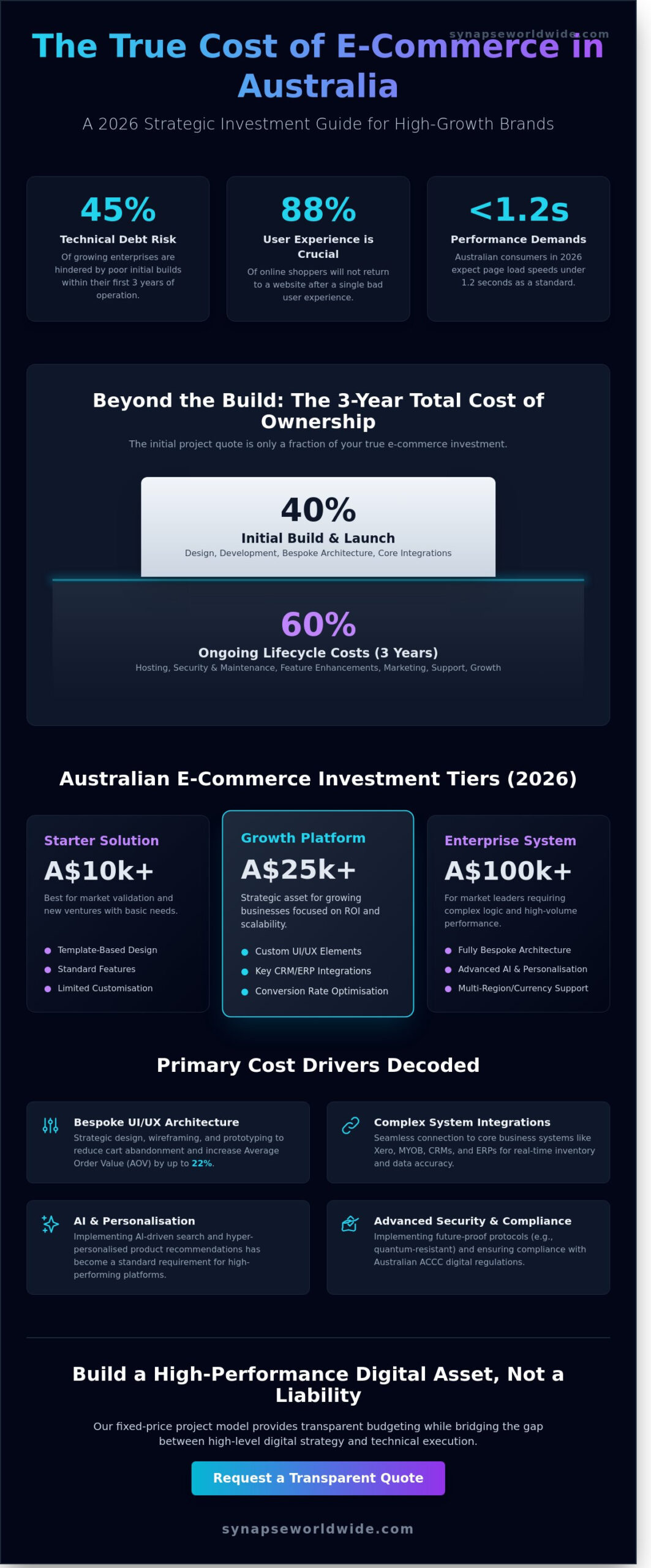
This guide delivers a transparent budget framework designed for the current Australian market. You’ll master the complexities of e-commerce investment, from bespoke interface design to the seamless integration of critical systems like Xero, MYOB, or your preferred CRM. We will explore how to choose between custom builds and templates to maximize your ROI while ensuring your platform remains robust as your transaction volume grows. By the end, you’ll have a clear roadmap to avoid the technical debt that often hinders 45% of growing digital enterprises during their first three years of operation.
Key Takeaways
- Gain insights into how 2026 market dynamics, such as AI integration and advanced security protocols, have established new pricing benchmarks for high-performing digital infrastructure.
- Identify the primary factors influencing e-commerce website design cost australia, including how bespoke UI/UX architecture directly impacts cart abandonment rates and average order value.
- Evaluate the deliverables associated with different investment tiers, ranging from A$10,000 to over A$100,000, to determine the most strategic fit for your business growth trajectory.
- Learn why the initial build represents only 40% of the total e-commerce lifecycle and how to accurately calculate the Total Cost of Ownership (TCO) over a three-year period.
- Discover the benefits of a fixed-price project model that provides transparent budgeting while bridging the gap between high-level digital strategy and technical execution.
Understanding E-commerce Website Design Costs in the 2026 Australian Market
Calculating the e-commerce website design cost australia involves more than just a line item in a marketing budget; it represents a strategic investment in high-performance digital infrastructure. By 2026, the distinction between a simple website and a revenue-generating e-commerce platform has become absolute. While a website displays information, a platform integrates complex inventory logic, AI-driven personalization, and secure payment gateways to drive measurable ROI. To understand these systems, one must first ask What is e-commerce? and how its foundational principles have evolved into the sophisticated ecosystems we deploy today.
The 2026 market dynamics have shifted pricing benchmarks significantly. Australian businesses now face a landscape where AI-integrated search and quantum-resistant security protocols are standard requirements rather than luxury add-ons. These advancements ensure that your digital presence remains resilient against emerging cyber threats while providing the predictive shopping experiences consumers now expect. Bespoke E-commerce Design is a tailored solution for unique business logic, ensuring that every digital touchpoint serves a specific conversion goal rather than following a generic path.
The Shift from Templates to Strategic Platforms
Australian consumers in 2026 demand seamless, high-performance user experiences with page load speeds under 1.2 seconds. Off-the-shelf templates often crumble under these requirements because they carry bloated code that hinders speed and limits scalability. Strategic platforms allow for deep Conversion Rate Optimisation (CRO) by enabling custom checkout flows and integrated loyalty programs. When brands move beyond rigid templates, they gain the agility to implement data-driven changes that can increase average order values by 22% or more within the first six months of deployment.
Market Benchmarks for Australian Digital Projects
Current industry standards for agency-led projects in Australia reflect the high value of local expertise. Investing in “Australian-made” code ensures compliance with the latest ACCC digital regulations and provides the benefit of local support teams who understand the domestic logistics and tax landscape. While initial capital outlay for professional e-commerce website design cost australia typically ranges from A$25,000 for mid-market solutions to over A$150,000 for enterprise-grade systems, the correlation between project complexity and long-term profitability is clear. High-complexity projects often include:
- Seamless ERP and CRM integrations for real-time data accuracy.
- Advanced AI modules for hyper-personalised product recommendations.
- Robust multi-currency and multi-region storefront capabilities for global expansion.
- Custom-built middleware to bridge legacy systems with modern front-end frameworks.
Sophisticated Australian brands recognize that a lower upfront price often masks higher long-term costs in lost conversions and technical debt. By prioritizing a robust initial build, businesses secure a scalable asset that grows alongside their ambitions.
The Primary Cost Drivers: From Bespoke UI/UX to Complex Integrations
Determining the e-commerce website design cost australia requires a shift from viewing a website as a static brochure to seeing it as a high-performance engine. Every feature added to the scope influences the final quote; however, the most significant drivers are the depth of customisation and the complexity of the digital infrastructure. While a standard template might seem cost-effective initially, businesses often find that bespoke solutions yield significantly higher returns. Technical complexity arises when moving beyond standard plugin usage toward custom-coded logic that matches your unique business model.
Custom UI/UX Design and Brand Identity
A sophisticated user interface does more than look professional; it functions as a silent salesperson. The cost of wireframing, prototyping, and user testing phases accounts for a substantial portion of the budget because these steps directly reduce cart abandonment. Research indicates that 88% of online shoppers won’t return to a site after a bad experience. Bespoke design is essential for brand differentiation in a crowded market. Additionally, a mobile-first approach is mandatory for Australian search rankings, as Google primarily uses the mobile version of content for indexing and ranking. Investing in a bespoke digital strategy ensures these technical components align with your growth targets.
Backend Development and System Integrations
Modern e-commerce success relies on how well your website communicates with your existing business tools. Estimating costs for CRM integrations like Salesforce or HubSpot is vital for tracking customer lifecycles and increasing Average Order Value (AOV). The complexity of syncing ERP and inventory management systems, such as Xero, MYOB, or NetSuite, often determines the project’s technical tier. Integrating an ERP system allows Australian enterprises to automate 30% or more of their back-office tasks, effectively synchronizing inventory and financial reporting in real-time. Custom API development provides the bridge for unique business workflows, such as integrating with Pik Pak Logistics for automated fulfillment, that standard plugins cannot accommodate.
Data Security and Compliance Standards
Security is a non-negotiable component of the e-commerce website design cost australia. Implementing robust security protocols and PCI-DSS compliance protects your brand from the financial and reputational damage of data breaches. Australian privacy laws, specifically the Australian Privacy Principles (APP), necessitate high-tier data protection measures that go beyond basic SSL certificates. Budgeting for secure payment gateway integrations like Stripe, Square, or PayPal ensures that transaction data remains encrypted. High-performance businesses treat security as a foundational investment rather than a peripheral expense to maintain consumer trust and legal compliance.
Comparing Investment Levels: Small Business vs. Enterprise E-commerce
Understanding the e-commerce website design cost australia requires a clear assessment of your current business stage. A startup’s requirements differ vastly from an established retailer processing 5,000 transactions daily. Your investment level dictates the platform’s architecture and its capacity for future transformation. Speed-to-market is vital for new ventures, but scalability remains the priority for those seeking a sustainable competitive advantage. Choosing the wrong tier early on often leads to technical debt that stifles growth within 18 months.
Entry-Level and Small Business Solutions
Small ventures often start with a budget between A$5,000 and A$15,000. These projects typically leverage standard Shopify or WooCommerce templates with minimal customisation. While this allows for rapid market entry, it often excludes critical growth components. Basic builds frequently lack advanced SEO architecture and granular conversion tracking. This level serves as a proof of concept. It’s rarely a long-term strategic asset for high-growth firms because it lacks the bespoke functionality needed to differentiate in a crowded digital landscape.
Mid-Market and Growth-Oriented Custom Platforms
The sweet spot for established Australian SMEs seeking aggressive growth lies in the A$30,000 to A$70,000 range. This investment moves beyond simple aesthetics to focus on a bespoke digital landscape. These builds integrate marketing automation and CRM hooks directly into the core structure. You’re building a scalable engine rather than just a storefront. Project timelines typically span 12 to 18 weeks. This phase demands technical expertise to ensure a seamless bridge between your storefront and backend operations. Investing in this scalable architecture early prevents the costly “rip and replace” cycle that 40% of growing businesses face within two years of launch.
Enterprise-Grade Digital Infrastructure
For high-volume environments, the e-commerce website design cost australia often exceeds A$100,000. These systems manage multi-storefront, multi-currency, and complex international logistics. Digital Architects lead these projects to manage the complexity of legacy system bridges and custom software development. Strategic value is found in the 99.9% uptime and the ability to process 10,000+ concurrent users during peak sales events. This infrastructure supports global expansion and high-frequency data synchronisation across ERP systems. Key benefits at this level include:
- Custom Middleware: Tailored code that connects your shop to warehouse management systems.
- Advanced Security: High-level encryption and compliance protocols for sensitive customer data.
- Global Logic: Intelligent routing for shipping and tax calculations across multiple jurisdictions.
- Performance Optimisation: Millisecond-level load times even with massive product catalogues.
Beyond the Build: Factoring in Maintenance and Growth Costs
Launching your store is a significant milestone, but it represents only 40% of the total e-commerce lifecycle cost. Successful Australian retailers view their website as a living asset rather than a one-time expense. To avoid mid-project budget fatigue, you must calculate the Total Cost of Ownership (TCO) over a three-year period. This long-term perspective ensures you have the capital to scale when your traffic begins to surge.
A critical component of your ongoing e-commerce website design cost australia involves securing your digital storefront against evolving threats. Annual hosting and security subscriptions are essential investments that safeguard your customer data and maintain the high-speed performance required for modern conversion rates. Neglecting these recurring costs often leads to technical debt that is far more expensive to resolve than proactive maintenance.
Hosting, Security, and Technical Maintenance
Cheap, shared hosting is a risk most serious businesses can’t afford. High-volume stores require enterprise-grade Australian servers to ensure low latency and 99.9% uptime. You’ll need to budget for regular software updates, security patches, and automated backups to keep the platform stable. While ad-hoc technical support can cost between A$150 and A$300 per hour, a structured maintenance plan provides predictable costs and prevents emergency downtime that erodes consumer trust.
Digital Marketing and SEO Retainers
A beautiful site is a ghost town without a strategic search presence. We integrate SEO foundations directly into the design phase to save you from expensive structural reworks later. Ongoing SEO and PPC campaigns act as the fuel for your platform, driving qualified traffic to your product pages. Monthly retainers allow for continuous performance monitoring and data-driven optimizations. This proactive management ensures your e-commerce website design cost australia delivers a consistent return on investment through every season.
Content Creation and Asset Management
Fresh content is the lifeblood of search relevance and customer engagement. You should allocate funds for professional photography, high-conversion copywriting, and videography to keep your brand competitive. Managing product data and inventory assets at scale requires disciplined asset management. Regular updates to your content library ensure your site remains a dynamic destination that encourages repeat visits and higher average order values.
Want to build a scalable digital asset that grows with your business? Consult with Synapse Worldwide to develop your strategic roadmap.
Strategic Digital Architecture: The Synapse Worldwide Approach
Synapse Worldwide doesn’t just build websites; we engineer high-performance revenue engines. When evaluating the e-commerce website design cost australia, many brands focus solely on the initial invoice. We shift that perspective toward the total cost of ownership and the long-term return on investment. Our methodology bridges the gap between high-level business strategy and technical execution, ensuring that every line of code serves a commercial purpose. We provide fixed-price project fees to eliminate the uncertainty of billable hours, allowing Australian business owners to budget with total transparency and confidence.
We focus on creating scalable, robust, and integrated digital landscapes. A cheap, transactional build often results in technical debt that hampers growth within twelve months. In contrast, our strategic architecture ensures your platform handles increased traffic and complex integrations as your sales volume climbs. We believe a long-term partnership outperforms a one-off build every time. By staying involved post-launch, we help you navigate shifting market conditions and technical updates, keeping your digital asset at peak performance.
Bespoke Solutions for a Global Perspective
Leveraging over 20 years of industry experience, we deliver bespoke digital assets that stand out in a crowded marketplace. We follow a rigorous four-stage methodology: Discovery, UI/UX Design, Development, and Implementation. This structured path ensures that your e-commerce website design cost australia translates into a site that’s uniquely yours rather than a generic template. Our case studies demonstrate that moving from a standard setup to a custom-engineered architecture can increase conversion rates by 25% or more. We combine local Australian market expertise with a global perspective—often drawing inspiration from hubs like web design vancouver—to ensure your brand competes effectively on any stage.
Your Next Steps to E-commerce Excellence
Achieving a high-performing store starts with meticulous preparation. To get an accurate agency quote, you should prepare a detailed brief that outlines your specific user journeys, third-party integrations, and inventory requirements. This clarity prevents scope creep and ensures your investment is allocated efficiently. We also recommend a comprehensive digital audit before starting any new project. This process identifies existing bottlenecks and data gaps, providing a clean slate for your new build. It’s the difference between guessing your requirements and knowing them. When you’re ready to elevate your brand, Consult with our Digital Architects for a tailored e-commerce strategy to begin your transformation.
Future-Proof Your Australian Retail Strategy
Navigating the 2026 digital landscape requires more than a template. Success hinges on a bespoke UI/UX that converts and seamless CRM or ERP integrations that streamline operations. While the e-commerce website design cost australia varies based on complexity, treating your platform as a scalable asset ensures a higher return on investment. You need a partner who values transparency and technical precision over vague estimates.
Synapse Worldwide has been a leader in the Australian digital space since 2005. We eliminate financial uncertainty by offering fixed-price project development fees, ensuring your budget remains controlled while your capabilities expand. As specialists in complex system integrations, we build robust architectures that grow alongside your business ambitions. Don’t settle for a basic storefront when you can deploy a high-performance engine designed for the local market.
Partner with Synapse Worldwide for a high-performance e-commerce platform and turn your digital vision into a measurable commercial reality. It’s time to elevate your brand and lead the market with confidence.
Frequently Asked Questions
How much does a custom e-commerce website cost in Australia in 2026?
According to industry projections for the Australian digital market, a custom e-commerce website in 2026 typically starts at A$15,000 for mid-market solutions and can exceed A$100,000 for enterprise-grade platforms. These figures reflect the rising demand for bespoke integrations and advanced user experience design. Your specific e-commerce website design cost australia depends on the complexity of your product catalog and the level of custom functionality required to achieve a high return on investment.
Is Shopify cheaper than a custom WooCommerce build?
Shopify often presents a lower initial entry cost starting at approximately A$45 per month for basic plans, while a custom WooCommerce build requires a higher upfront investment for bespoke development. However, Shopify’s long-term costs increase through transaction fees and monthly app subscriptions. WooCommerce offers greater flexibility for scaling without recurring platform fees. We find that businesses processing over A$500,000 in annual revenue often achieve better cost efficiency with a tailored WooCommerce architecture.
What are the hidden costs of building an online store?
Hidden costs typically include payment gateway fees, third-party API subscriptions, and ongoing security maintenance which can add 15% to 25% to your annual operating budget. You must also account for professional copywriting and high-quality product photography. Many Australian businesses overlook the cost of SSL certificates and specialized e-commerce hosting. Failing to budget for these essentials can stall your growth and compromise the stability of your digital storefront in a competitive market.
How long does it take to design and develop a professional e-commerce site?
A professional e-commerce site takes between 12 and 24 weeks to design and develop from the initial strategy phase to the final launch. This timeline accounts for 4 weeks of discovery, 8 weeks of bespoke design, and 10 weeks of technical development and testing. Complex projects involving ERP integrations or custom checkout flows may extend this period. We prioritize a structured roadmap to ensure every technical detail aligns with your long-term business objectives.
Do I need a separate budget for SEO and digital marketing?
You should allocate a separate budget for SEO and digital marketing, ideally ranging from 10% to 20% of your projected annual revenue. A high-performing website is only effective if it attracts qualified traffic and converts visitors into loyal customers. Strategic investment in SEO ensures your e-commerce website design cost australia delivers a sustainable competitive advantage. We recommend starting marketing activities at least 3 months before your site launch to build initial authority.
What is the difference between a freelancer and a web design agency price?
Freelancers generally charge between A$50 and A$150 per hour, while professional Australian agencies typically range from A$180 to A$300 per hour. While freelancers offer lower initial rates, agencies provide a multi-disciplinary team of strategists, designers, and developers. This collective expertise ensures your project is scalable and robust. Choosing an agency reduces the risk of project abandonment and provides a more comprehensive approach to your digital transformation and long-term success.
How often should I update or redesign my e-commerce website?
You should perform a major redesign every 3 to 4 years to stay aligned with evolving consumer behaviors and technological advancements. Smaller iterative updates to user experience and security should occur quarterly. According to 2024 industry benchmarks, websites that fail to update their design for over 5 years experience a 30% decline in conversion rates. Regular optimization ensures your platform remains a high-performance asset in a rapidly changing digital landscape and maintains its value.
Can I integrate my existing POS or ERP system with a new website?
Yes, you can integrate existing POS or ERP systems like MYOB, Xero, or NetSuite using custom API connections or dedicated middleware. Integration synchronizes your inventory, sales data, and customer information across all channels in real-time. This eliminates manual data entry and reduces administrative errors by up to 40%. A seamless connection between your physical and digital operations is essential for scaling your business and providing a unified customer experience across the Australian market.


