
Tag Archives: Australia


Best E-commerce Platform for Small Business Australia: 2026 Comparison Guide

Best E-commerce Platform for Small Business Australia: 2026 Comparison Guide

Selecting a platform based on ease of setup alone is often the fastest way to compromise your 2026 profit margins. You likely recognize that high transaction fees and fragmented shipping integrations can quietly erode your bottom line before you have even processed your first hundred orders. According to the 2024 Australia Post eCommerce Industry Report, 8 in 10 Australian households now shop online regularly, yet local retailers frequently lose up to 15% of their potential revenue to inefficient manual workflows and hidden costs.

Our objective is to help you secure a more profitable future. This guide provides the strategic framework to identify the best e-commerce platform for small business australia, ensuring you balance essential local requirements like GST compliance with the power of global scalability. We’ll explore how to build a robust, scalable store that leverages automated tax workflows and seamless payment integration. By the end of this comparison, you’ll have a clear roadmap to transform your digital presence into a high-performing asset that drives consistent growth and long-term transformation.

Key Takeaways

  • Navigate the evolution of the Australian digital retail market by moving beyond basic storefronts toward integrated, high-performance ecosystems.
  • Evaluate the best e-commerce platform for small business australia through a strategic framework that balances immediate deployment with global scalability.
  • Uncover the hidden variables in your Total Cost of Ownership, accounting for payment gateway margins and currency conversions unique to the local landscape.
  • Transition from merely choosing a software tool to architecting a bespoke digital system designed for long-term ROI and operational efficiency.
  • Gain a competitive edge by aligning your platform choice with the sophisticated consumer expectations and technological shifts of the 2026 marketplace.

The Australian E-commerce Landscape in 2026

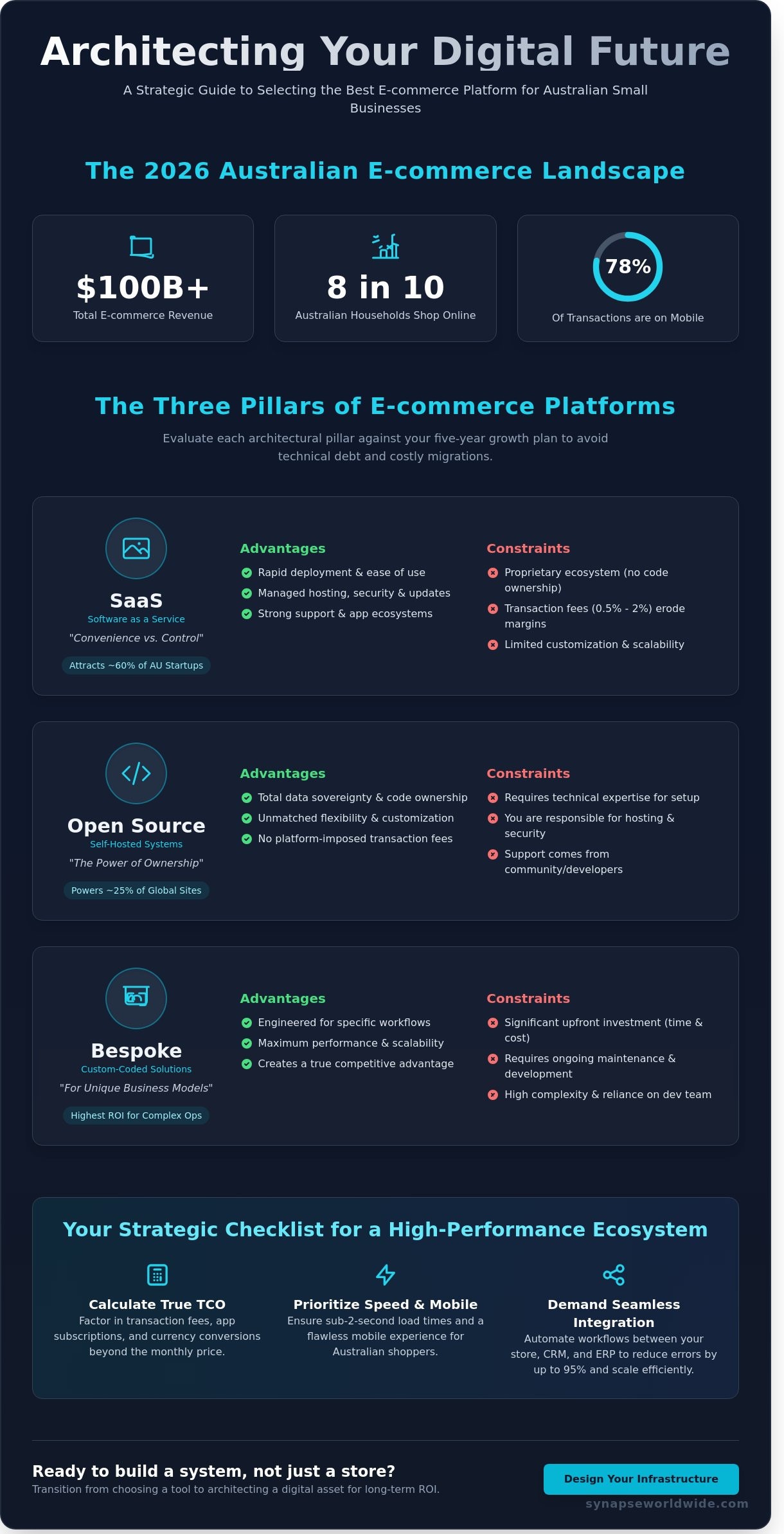
Australia’s digital economy has reached a critical tipping point. Total e-commerce revenue in the country has surpassed $100 billion, driven by a consumer base that demands seamless, high-speed interactions. For local SMEs, the stakes are higher than ever. Strategic growth no longer comes from simply having an online presence; it requires a sophisticated digital architecture. Selecting the best e-commerce platform for small business australia is a decision that dictates your operational capacity for the next five years. You aren’t just buying a website; you’re investing in the central nervous system of your company.

The market has moved away from isolated storefronts. We now see the rise of integrated digital ecosystems where every touchpoint is connected. A “good enough” solution often leads to fragmented data and manual errors, which can cost a business up to 20% in potential annual revenue. To remain competitive, your platform must handle complex tasks like real-time inventory tracking and personalized marketing triggers without human intervention. Understanding E-commerce at this foundational level helps owners transition from being mere vendors to becoming data-driven retailers. It’s about building a bespoke experience that scales with your ambition, whether you are selling physical products or offering professional services like Sit Means Sit Dog Training.

Mobile-First and Speed: The Non-Negotiables

Mobile commerce now dominates the Australian market, accounting for 78% of all online retail transactions in 2026. If your site doesn’t load in under two seconds, you’ve already lost the customer. Data shows a direct correlation here; every 100ms of latency results in a 7% drop in conversion rates. Local server locations in Sydney or Melbourne are essential to maintain the sub-50ms response times that Australian shoppers expect. Speed isn’t just a technical metric; it’s a core component of your user experience and SEO strategy. We prioritize platforms that offer robust global content delivery networks while maintaining a strong local footprint.

Integration as a Growth Lever

The best e-commerce platform for small business australia must serve as more than a checkout page. It needs to bridge the gap between your storefront and your back-office operations. Successful retailers are using automated workflows to connect their CRM and ERP systems directly to their sales channels. This level of synchronization ensures that stock levels are accurate across physical and digital locations, reducing the risk of overselling by 95%. Automated processes allow small teams to handle higher order volumes without increasing their headcount. This creates a scalable path to market dominance by removing the friction of manual data entry and logistics management.

Understanding the Three Pillars of E-commerce Platforms

Choosing the best e-commerce platform for small business australia involves evaluating three distinct architectural pillars against your five-year growth plan. The market is broadly categorized into Software as a Service (SaaS), Open Source, and Bespoke solutions. Each category offers varying degrees of control, scalability, and technical involvement. Understanding these fundamental differences is the first step toward building a robust digital presence that delivers a measurable return on investment.

  • SaaS: Subscription-based models designed for rapid deployment and ease of use.
  • Open Source: Self-hosted systems that offer total data sovereignty and flexibility.
  • Bespoke: Custom-coded solutions built from the ground up for unique business models.

Selecting the wrong pillar can lead to significant technical debt or expensive migration projects within 24 months of launch. A strategic decision today prevents a fragmented customer experience tomorrow.

SaaS Platforms: Convenience vs. Control

SaaS options like Shopify and BigCommerce attract approximately 60% of Australian startups due to their rapid deployment capabilities. These platforms handle hosting, security, and core updates, allowing owners to focus on sales. However, this convenience comes with constraints. You operate within a proprietary ecosystem where you don’t own the underlying code. High-volume merchants often face transaction fees ranging from 0.5% to 2% unless they use specific proprietary payment gateways. This can erode margins as your business scales beyond initial growth targets.

Open Source: The Power of Ownership

WooCommerce remains a dominant force for Australian SMEs, powering approximately 25% of all e-commerce sites globally. The primary benefit is total data sovereignty. You own the hosting environment and every line of code. According to the Australian e-commerce market overview, consumer expectations for personalized experiences are rising, and open-source flexibility allows brands to pivot quickly. While flexibility is high, you’re responsible for maintenance, security patches, and server optimization to maintain a 99.9% uptime.

For businesses with unique operational models or complex logistics, a bespoke solution provides a competitive edge. Custom builds eliminate the bloat of generic platforms, focusing strictly on high-performance needs and specific integrations. If your workflow requires a tailored digital strategy to integrate with complex ERP systems, a custom approach ensures your technology stack evolves with your vision. This level of investment is typically reserved for businesses reaching a specific maturity stage where generic tools no longer suffice. It’s about building a foundation that supports transformation and aggressive growth targets.
Best E-commerce Platform for Small Business Australia: 2026 Comparison Guide

Comparing the Best E-commerce Platforms for Australian Small Business

Selecting the best e-commerce platform for small business australia requires a strategic look at local infrastructure and long-term growth potential. By 2026, the distinction between simple storefronts and integrated digital ecosystems has sharpened. Data from the Australia Post eCommerce Report indicates that online shopping now accounts for a permanent shift in consumer behavior, with 82% of households making regular digital purchases. This reality demands a platform that handles local tax compliance, Australian payment gateways, and rapid SKU expansion without technical friction.

A side-by-side analysis reveals distinct paths for different business models. Shopify and BigCommerce offer managed environments, whereas WooCommerce and Magento provide open-source flexibility. While Magento caters to the enterprise tier with complex multi-store requirements, most Australian small businesses find the resource-heavy maintenance of Magento a barrier to profitability. Instead, the focus has shifted toward platforms that balance SEO performance with operational efficiency. Our evaluation prioritizes platforms that offer seamless integration with the local logistics landscape.

Shopify: The Market Leader for Ease of Use

Shopify remains the dominant choice for merchants prioritizing speed to market and intuitive design. Its out-of-the-box SEO capabilities provide a solid foundation, though rigid URL structures persist as a legacy constraint in 2026. The primary challenge for Australian merchants is the “app tax.” Essential features for local shipping logistics and advanced inventory management often require third-party subscriptions. These can increase monthly operating costs by 30% to 50% compared to the base price. Shopify is best suited for low-complexity retail brands with a heavy focus on social media marketing.

WooCommerce: The Versatile Australian Favourite

WooCommerce leverages the power of WordPress to deliver a content-rich e-commerce strategy. It’s the preferred option for businesses that view their website as a strategic asset rather than just a checkout page. Integration with local gateways like eWAY and CommBank is seamless, providing a localized checkout experience that builds trust. Because you control the hosting environment, you have 100% authority over technical SEO and site speed optimization. It’s the ideal platform for businesses requiring deep customization and a bespoke digital presence that scales without per-transaction platform fees.

BigCommerce: The SaaS Alternative for Scaling

BigCommerce positions itself as the robust alternative for businesses outgrowing basic SaaS limitations. It handles complex product filtering and multi-currency transactions natively, reducing the need for the extensive app libraries found in Shopify. For companies managing over 1,000 SKUs or running a B2B and B2C hybrid model, BigCommerce provides a more stable architecture. Its native SEO features allow for greater flexibility in URL naming and metadata management, ensuring your best e-commerce platform for small business australia remains competitive in search rankings as your product range expands.

Calculating Total Cost of Ownership (TCO) in Australia

Monthly subscription fees typically represent only 20% of your actual investment. The remaining 80% of your digital expenditure resides in transaction fees, app integrations, and the inevitable cost of technical debt. Selecting the best e-commerce platform for small business australia requires a strategic three-year financial forecast rather than a glance at a monthly pricing table. Your digital presence is a long-term asset; treating it as a recurring utility bill often leads to unforeseen fiscal bottlenecks.

Transaction fees and payment gateway margins can silently erode your profitability. While a platform might advertise a low entry price, they often impose a 0.5% to 2% “transaction fee” if you don’t use their proprietary payment processor. When combined with standard credit card fees of 1.75% plus 30 cents per order, your gross margin shrinks before you’ve even accounted for product costs. For businesses scaling past $100,000 in annual revenue, these percentage points represent thousands of dollars that could have been reinvested into customer acquisition.

Technical debt is the most expensive “hidden” cost. A 2024 analysis of small business web projects revealed that firms using low-cost, template-based builds spent 35% more on emergency maintenance and software patches over a 36-month period compared to those who invested in bespoke, robust architectures. Frequent mandatory software updates and security patches are essential for maintaining a secure digital landscape. Ignoring these leads to vulnerabilities that can cost an Australian business an average of $46,000 per cyber incident according to recent ACSC data.

Australian Compliance and Regulatory Costs

Your platform must automate GST compliance and generate tax-compliant invoicing for every sale. Australian Consumer Law (ACL) dictates strict requirements for returns, refunds, and warranties; your system needs the flexibility to handle these workflows without manual intervention. Data sovereignty is also becoming a critical differentiator. Storing customer data on Australian-based servers helps meet local privacy expectations and ensures your business remains resilient against shifting international data regulations.

Shipping and Logistics Integration

Managing logistics across the Australian continent requires integrated precision. The best e-commerce platform for small business australia must provide real-time quoting for Australia Post, StarTrack, and Sendle. Manual label generation is a scalability killer. Automating this process can save a small business up to 15 hours of administrative labor per week. If you operate multi-warehouse inventory, your platform must intelligently route orders to the closest fulfillment center to minimize transit times and shipping costs.

Ready to build a scalable foundation that avoids hidden technical debt? Consult with our strategic architects at Synapse Worldwide to design a high-performance e-commerce solution tailored to your growth goals.

Designing Your Strategic E-commerce Infrastructure

Selecting the best e-commerce platform for small business australia is only the first step in a much larger journey. Many entrepreneurs make the mistake of viewing their online store as a standalone tool rather than a comprehensive business system. This narrow focus often leads to technical debt and missed opportunities for scale. A digital architect approaches your online presence differently. They see a strategic infrastructure designed to capture data, automate workflows, and drive predictable revenue. You don’t just need a place to list products; you need a system that grows with your ambitions.

Bespoke integration outperforms cookie-cutter templates because it removes the friction inherent in generic software. When your store is built as a custom system, every touchpoint is optimized for your specific customer base. This isn’t just about aesthetics; it’s about engineering. A system that integrates natively with your existing supply chain or accounting software can reduce administrative overhead by 30 percent or more. By treating your platform as a revenue engine, you transform it from a monthly expense into a high-yield asset.

Bespoke Development for Competitive Advantage

Standard templates often force your business processes to fit within their rigid limitations. Bespoke development flips this dynamic. By creating unique user journeys, you can guide customers toward higher-value bundles and personalized recommendations. Data from 2024 e-commerce audits suggests that custom-engineered checkout experiences can boost conversion rates by 18 percent compared to stock platform checkouts. Integrating custom CRM and ERP solutions ensures that your inventory, customer data, and financial reporting remain synchronized in real time. This level of technical maturity future-proofs your store against the sudden policy changes or fee hikes that often plague platform-dependent businesses.

The Synapse Worldwide Advantage

Synapse Worldwide doesn’t just build websites; we architect growth engines. We understand that the best e-commerce platform for small business australia must be backed by a strategy that prioritizes long-term ROI. Our fixed-price project development model ensures budget certainty from day one, protecting your capital for marketing and inventory. We leverage deep national expertise in Australian consumer law, tax standards, and localized SEO to give you an immediate edge in the domestic market.

Our ongoing strategic consulting ensures your platform doesn’t just sit idle. We continuously optimize for performance to keep you at the forefront of your industry. If you’re ready to transition from a basic shopfront to a high-performance digital asset, enquire about your bespoke e-commerce project today.

Architect Your Digital Success in 2026

Navigating the Australian digital landscape requires a transition from basic online sales to a fully integrated commerce ecosystem. By 2026, the best e-commerce platform for small business australia must do more than display products; it has to synchronize your entire operation. You’ve identified how the three pillars of e-commerce and a precise calculation of total cost of ownership provide the stability needed for sustainable scaling. A strategic infrastructure isn’t just a technical requirement. It’s a competitive advantage that separates market leaders from those who merely exist online.

Synapse Worldwide has led this space since 2005, bringing over two decades of digital expertise to every partnership. We’re specialists in custom CRM and ERP integrations, ensuring your website communicates perfectly with your backend systems to eliminate data silos. Our commitment to fixed-price project fees provides the transparency you need for a results-oriented development process without the risk of budget creep. We don’t just build websites; we engineer growth engines that endure.

Partner with Synapse Worldwide for a strategic e-commerce solution that drives growth.

Your journey toward a more profitable digital presence starts with a single, decisive step toward a better architectural foundation.

Frequently Asked Questions

Which e-commerce platform has the lowest transaction fees in Australia?

WooCommerce typically offers the lowest transaction fees because it doesn’t charge a platform-specific commission on top of your payment processor costs. While Shopify charges between 0.5% and 2% for third-party gateways, WooCommerce users only pay the base rate of their chosen provider. Stripe Australia currently charges 1.75% plus 30 cents for domestic cards. This makes it a highly cost-effective choice for those seeking the best e-commerce platform for small business australia.

Do I need a local Australian developer to build my online store?

You don’t strictly require a local developer, but hiring an Australian agency ensures compliance with the Australian Consumer Law and local privacy regulations. Local experts understand the nuances of the 2023 Privacy Act amendments and regional shipping logistics. Working with a domestic partner eliminates time zone barriers and ensures your site is optimized for the specific browsing habits of Australian shoppers. This strategic alignment protects your brand from regional compliance risks.

How much should a small business spend on an e-commerce platform?

A small business should allocate between 3% and 5% of their projected annual revenue toward their e-commerce infrastructure. For a startup aiming for $100,000 in first-year sales, a budget of $3,000 to $5,000 covers hosting, premium plugins, and professional design. This investment ensures your platform remains scalable as your transaction volume increases. Avoid underfunding your digital foundation, as technical debt often costs 20% more to fix later.

Can I migrate my existing store from Shopify to WooCommerce easily?

You can migrate your store using automated tools like Cart2Cart or LitExtension, though complex data sets require manual oversight. These services typically move 99% of product data, customer records, and order history without downtime. SEO redirects must be mapped precisely to maintain your search rankings during the transition. A structured migration plan protects your historical data and ensures a seamless experience for your existing customer base.

What is the best platform for SEO in the Australian market?

WooCommerce is widely considered the best e-commerce platform for small business australia due to its deep integration with WordPress and advanced SEO plugins. It provides 100% control over URL structures, meta data, and schema markup. Recent 2025 performance data indicates that self-hosted platforms often achieve 15% faster indexing when optimized correctly. This granular control, often leveraged by digital growth experts like Patio SEO, allows businesses to target localized keywords more effectively than closed-ecosystem competitors.

Do these platforms support Australian payment methods like Afterpay and Zip?

Yes, all major platforms including Shopify, BigCommerce, and WooCommerce support Afterpay and Zip via official API integrations. Afterpay currently serves over 3.5 million active customers in Australia, making it a critical conversion tool for local retailers. You can install these payment gateways in under 10 minutes through the respective app stores. Offering “Buy Now, Pay Later” options has been shown to increase average order values by up to 18%.

How do I handle GST on my e-commerce store automatically?

You handle GST by configuring the tax settings within your platform to apply a 10% rate to all domestic transactions. Platforms like Shopify and BigCommerce use geolocation to identify Australian IP addresses and apply the tax automatically at checkout. For complex requirements, integrating accounting software like Xero or MYOB ensures your tax invoices comply with Australian Taxation Office standards. This automation reduces manual bookkeeping errors by approximately 40%.

Is it better to use a template or a custom e-commerce design?

A bespoke custom design is superior for businesses prioritizing long-term growth and brand authority. While templates offer a faster launch, they often include 30% more bloated code that slows down page load speeds. Custom solutions allow for integrated features tailored to your specific operational workflow. Strategic design choices ensure your store is unique, scalable, and optimized for the highest possible conversion rates in a competitive digital landscape.

 

E-commerce Website Design Cost Australia: The Complete 2026 Pricing Guide

E-commerce Website Design Cost Australia: The Complete 2026 Pricing Guide

What if the lowest quote for your new online store is actually the most expensive mistake your business will make this year? You likely suspect that the true e-commerce website design cost australia isn’t just a single line item on a quote; it’s a strategic investment into your brand’s long-term growth. It’s frustrating when agencies provide vague estimates that leave you guessing about the final bill. We understand that you need clarity to make informed decisions for the 2026 fiscal year.

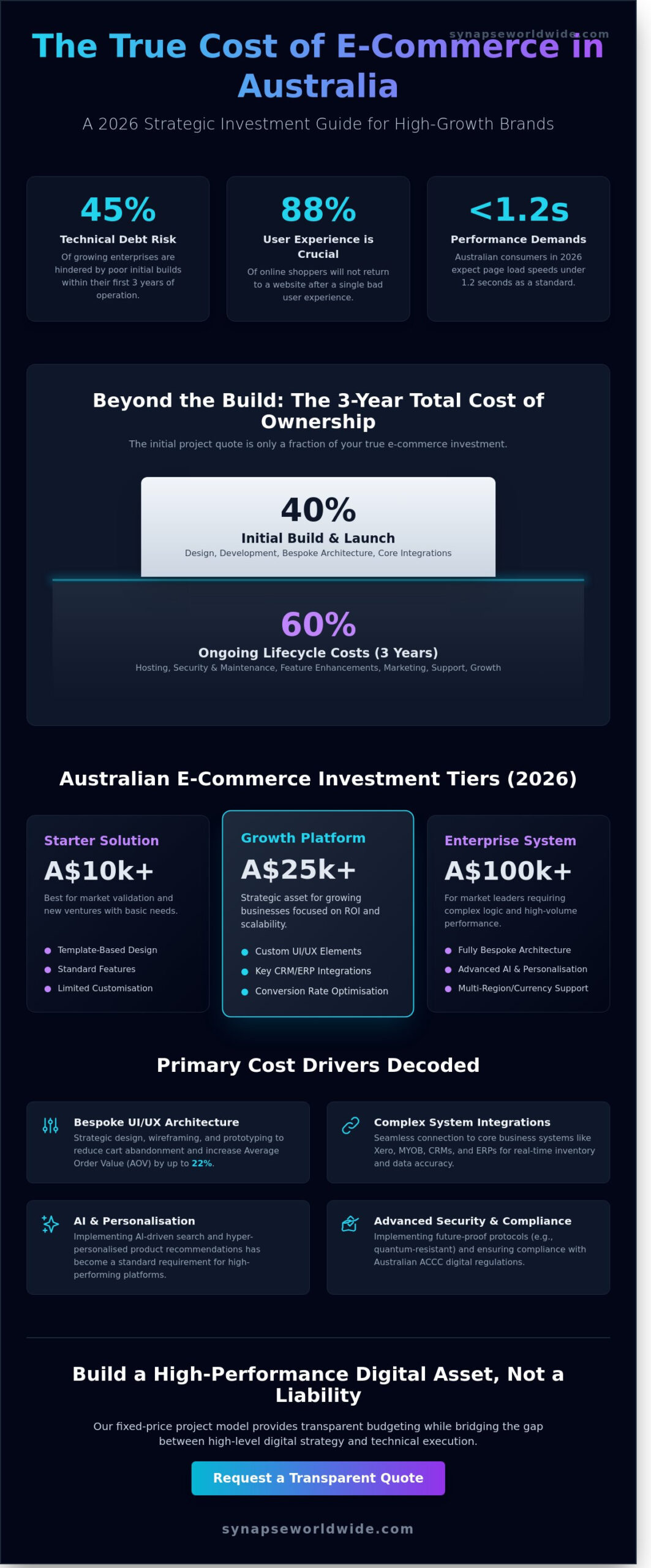
This guide delivers a transparent budget framework designed for the current Australian market. You’ll master the complexities of e-commerce investment, from bespoke interface design to the seamless integration of critical systems like Xero, MYOB, or your preferred CRM. We will explore how to choose between custom builds and templates to maximize your ROI while ensuring your platform remains robust as your transaction volume grows. By the end, you’ll have a clear roadmap to avoid the technical debt that often hinders 45% of growing digital enterprises during their first three years of operation.

Key Takeaways

  • Gain insights into how 2026 market dynamics, such as AI integration and advanced security protocols, have established new pricing benchmarks for high-performing digital infrastructure.
  • Identify the primary factors influencing e-commerce website design cost australia, including how bespoke UI/UX architecture directly impacts cart abandonment rates and average order value.
  • Evaluate the deliverables associated with different investment tiers, ranging from A$10,000 to over A$100,000, to determine the most strategic fit for your business growth trajectory.
  • Learn why the initial build represents only 40% of the total e-commerce lifecycle and how to accurately calculate the Total Cost of Ownership (TCO) over a three-year period.
  • Discover the benefits of a fixed-price project model that provides transparent budgeting while bridging the gap between high-level digital strategy and technical execution.

Understanding E-commerce Website Design Costs in the 2026 Australian Market

Calculating the e-commerce website design cost australia involves more than just a line item in a marketing budget; it represents a strategic investment in high-performance digital infrastructure. By 2026, the distinction between a simple website and a revenue-generating e-commerce platform has become absolute. While a website displays information, a platform integrates complex inventory logic, AI-driven personalization, and secure payment gateways to drive measurable ROI. To understand these systems, one must first ask What is e-commerce? and how its foundational principles have evolved into the sophisticated ecosystems we deploy today.

The 2026 market dynamics have shifted pricing benchmarks significantly. Australian businesses now face a landscape where AI-integrated search and quantum-resistant security protocols are standard requirements rather than luxury add-ons. These advancements ensure that your digital presence remains resilient against emerging cyber threats while providing the predictive shopping experiences consumers now expect. Bespoke E-commerce Design is a tailored solution for unique business logic, ensuring that every digital touchpoint serves a specific conversion goal rather than following a generic path.

The Shift from Templates to Strategic Platforms

Australian consumers in 2026 demand seamless, high-performance user experiences with page load speeds under 1.2 seconds. Off-the-shelf templates often crumble under these requirements because they carry bloated code that hinders speed and limits scalability. Strategic platforms allow for deep Conversion Rate Optimisation (CRO) by enabling custom checkout flows and integrated loyalty programs. When brands move beyond rigid templates, they gain the agility to implement data-driven changes that can increase average order values by 22% or more within the first six months of deployment.

Market Benchmarks for Australian Digital Projects

Current industry standards for agency-led projects in Australia reflect the high value of local expertise. Investing in “Australian-made” code ensures compliance with the latest ACCC digital regulations and provides the benefit of local support teams who understand the domestic logistics and tax landscape. While initial capital outlay for professional e-commerce website design cost australia typically ranges from A$25,000 for mid-market solutions to over A$150,000 for enterprise-grade systems, the correlation between project complexity and long-term profitability is clear. High-complexity projects often include:

  • Seamless ERP and CRM integrations for real-time data accuracy.
  • Advanced AI modules for hyper-personalised product recommendations.
  • Robust multi-currency and multi-region storefront capabilities for global expansion.
  • Custom-built middleware to bridge legacy systems with modern front-end frameworks.

Sophisticated Australian brands recognize that a lower upfront price often masks higher long-term costs in lost conversions and technical debt. By prioritizing a robust initial build, businesses secure a scalable asset that grows alongside their ambitions.

The Primary Cost Drivers: From Bespoke UI/UX to Complex Integrations

Determining the e-commerce website design cost australia requires a shift from viewing a website as a static brochure to seeing it as a high-performance engine. Every feature added to the scope influences the final quote; however, the most significant drivers are the depth of customisation and the complexity of the digital infrastructure. While a standard template might seem cost-effective initially, businesses often find that bespoke solutions yield significantly higher returns. Technical complexity arises when moving beyond standard plugin usage toward custom-coded logic that matches your unique business model.

Custom UI/UX Design and Brand Identity

A sophisticated user interface does more than look professional; it functions as a silent salesperson. The cost of wireframing, prototyping, and user testing phases accounts for a substantial portion of the budget because these steps directly reduce cart abandonment. Research indicates that 88% of online shoppers won’t return to a site after a bad experience. Bespoke design is essential for brand differentiation in a crowded market. Additionally, a mobile-first approach is mandatory for Australian search rankings, as Google primarily uses the mobile version of content for indexing and ranking. Investing in a bespoke digital strategy ensures these technical components align with your growth targets.

Backend Development and System Integrations

Modern e-commerce success relies on how well your website communicates with your existing business tools. Estimating costs for CRM integrations like Salesforce or HubSpot is vital for tracking customer lifecycles and increasing Average Order Value (AOV). The complexity of syncing ERP and inventory management systems, such as Xero, MYOB, or NetSuite, often determines the project’s technical tier. Integrating an ERP system allows Australian enterprises to automate 30% or more of their back-office tasks, effectively synchronizing inventory and financial reporting in real-time. Custom API development provides the bridge for unique business workflows, such as integrating with Pik Pak Logistics for automated fulfillment, that standard plugins cannot accommodate.

Data Security and Compliance Standards

Security is a non-negotiable component of the e-commerce website design cost australia. Implementing robust security protocols and PCI-DSS compliance protects your brand from the financial and reputational damage of data breaches. Australian privacy laws, specifically the Australian Privacy Principles (APP), necessitate high-tier data protection measures that go beyond basic SSL certificates. Budgeting for secure payment gateway integrations like Stripe, Square, or PayPal ensures that transaction data remains encrypted. High-performance businesses treat security as a foundational investment rather than a peripheral expense to maintain consumer trust and legal compliance.

E-commerce Website Design Cost Australia: The Complete 2026 Pricing Guide

Comparing Investment Levels: Small Business vs. Enterprise E-commerce

Understanding the e-commerce website design cost australia requires a clear assessment of your current business stage. A startup’s requirements differ vastly from an established retailer processing 5,000 transactions daily. Your investment level dictates the platform’s architecture and its capacity for future transformation. Speed-to-market is vital for new ventures, but scalability remains the priority for those seeking a sustainable competitive advantage. Choosing the wrong tier early on often leads to technical debt that stifles growth within 18 months.

Entry-Level and Small Business Solutions

Small ventures often start with a budget between A$5,000 and A$15,000. These projects typically leverage standard Shopify or WooCommerce templates with minimal customisation. While this allows for rapid market entry, it often excludes critical growth components. Basic builds frequently lack advanced SEO architecture and granular conversion tracking. This level serves as a proof of concept. It’s rarely a long-term strategic asset for high-growth firms because it lacks the bespoke functionality needed to differentiate in a crowded digital landscape.

Mid-Market and Growth-Oriented Custom Platforms

The sweet spot for established Australian SMEs seeking aggressive growth lies in the A$30,000 to A$70,000 range. This investment moves beyond simple aesthetics to focus on a bespoke digital landscape. These builds integrate marketing automation and CRM hooks directly into the core structure. You’re building a scalable engine rather than just a storefront. Project timelines typically span 12 to 18 weeks. This phase demands technical expertise to ensure a seamless bridge between your storefront and backend operations. Investing in this scalable architecture early prevents the costly “rip and replace” cycle that 40% of growing businesses face within two years of launch.

Enterprise-Grade Digital Infrastructure

For high-volume environments, the e-commerce website design cost australia often exceeds A$100,000. These systems manage multi-storefront, multi-currency, and complex international logistics. Digital Architects lead these projects to manage the complexity of legacy system bridges and custom software development. Strategic value is found in the 99.9% uptime and the ability to process 10,000+ concurrent users during peak sales events. This infrastructure supports global expansion and high-frequency data synchronisation across ERP systems. Key benefits at this level include:

  • Custom Middleware: Tailored code that connects your shop to warehouse management systems.
  • Advanced Security: High-level encryption and compliance protocols for sensitive customer data.
  • Global Logic: Intelligent routing for shipping and tax calculations across multiple jurisdictions.
  • Performance Optimisation: Millisecond-level load times even with massive product catalogues.

Beyond the Build: Factoring in Maintenance and Growth Costs

Launching your store is a significant milestone, but it represents only 40% of the total e-commerce lifecycle cost. Successful Australian retailers view their website as a living asset rather than a one-time expense. To avoid mid-project budget fatigue, you must calculate the Total Cost of Ownership (TCO) over a three-year period. This long-term perspective ensures you have the capital to scale when your traffic begins to surge.

A critical component of your ongoing e-commerce website design cost australia involves securing your digital storefront against evolving threats. Annual hosting and security subscriptions are essential investments that safeguard your customer data and maintain the high-speed performance required for modern conversion rates. Neglecting these recurring costs often leads to technical debt that is far more expensive to resolve than proactive maintenance.

Hosting, Security, and Technical Maintenance

Cheap, shared hosting is a risk most serious businesses can’t afford. High-volume stores require enterprise-grade Australian servers to ensure low latency and 99.9% uptime. You’ll need to budget for regular software updates, security patches, and automated backups to keep the platform stable. While ad-hoc technical support can cost between A$150 and A$300 per hour, a structured maintenance plan provides predictable costs and prevents emergency downtime that erodes consumer trust.

Digital Marketing and SEO Retainers

A beautiful site is a ghost town without a strategic search presence. We integrate SEO foundations directly into the design phase to save you from expensive structural reworks later. Ongoing SEO and PPC campaigns act as the fuel for your platform, driving qualified traffic to your product pages. Monthly retainers allow for continuous performance monitoring and data-driven optimizations. This proactive management ensures your e-commerce website design cost australia delivers a consistent return on investment through every season.

Content Creation and Asset Management

Fresh content is the lifeblood of search relevance and customer engagement. You should allocate funds for professional photography, high-conversion copywriting, and videography to keep your brand competitive. Managing product data and inventory assets at scale requires disciplined asset management. Regular updates to your content library ensure your site remains a dynamic destination that encourages repeat visits and higher average order values.

Want to build a scalable digital asset that grows with your business? Consult with Synapse Worldwide to develop your strategic roadmap.

Strategic Digital Architecture: The Synapse Worldwide Approach

Synapse Worldwide doesn’t just build websites; we engineer high-performance revenue engines. When evaluating the e-commerce website design cost australia, many brands focus solely on the initial invoice. We shift that perspective toward the total cost of ownership and the long-term return on investment. Our methodology bridges the gap between high-level business strategy and technical execution, ensuring that every line of code serves a commercial purpose. We provide fixed-price project fees to eliminate the uncertainty of billable hours, allowing Australian business owners to budget with total transparency and confidence.

We focus on creating scalable, robust, and integrated digital landscapes. A cheap, transactional build often results in technical debt that hampers growth within twelve months. In contrast, our strategic architecture ensures your platform handles increased traffic and complex integrations as your sales volume climbs. We believe a long-term partnership outperforms a one-off build every time. By staying involved post-launch, we help you navigate shifting market conditions and technical updates, keeping your digital asset at peak performance.

Bespoke Solutions for a Global Perspective

Leveraging over 20 years of industry experience, we deliver bespoke digital assets that stand out in a crowded marketplace. We follow a rigorous four-stage methodology: Discovery, UI/UX Design, Development, and Implementation. This structured path ensures that your e-commerce website design cost australia translates into a site that’s uniquely yours rather than a generic template. Our case studies demonstrate that moving from a standard setup to a custom-engineered architecture can increase conversion rates by 25% or more. We combine local Australian market expertise with a global perspective—often drawing inspiration from hubs like web design vancouver—to ensure your brand competes effectively on any stage.

Your Next Steps to E-commerce Excellence

Achieving a high-performing store starts with meticulous preparation. To get an accurate agency quote, you should prepare a detailed brief that outlines your specific user journeys, third-party integrations, and inventory requirements. This clarity prevents scope creep and ensures your investment is allocated efficiently. We also recommend a comprehensive digital audit before starting any new project. This process identifies existing bottlenecks and data gaps, providing a clean slate for your new build. It’s the difference between guessing your requirements and knowing them. When you’re ready to elevate your brand, Consult with our Digital Architects for a tailored e-commerce strategy to begin your transformation.

Future-Proof Your Australian Retail Strategy

Navigating the 2026 digital landscape requires more than a template. Success hinges on a bespoke UI/UX that converts and seamless CRM or ERP integrations that streamline operations. While the e-commerce website design cost australia varies based on complexity, treating your platform as a scalable asset ensures a higher return on investment. You need a partner who values transparency and technical precision over vague estimates.

Synapse Worldwide has been a leader in the Australian digital space since 2005. We eliminate financial uncertainty by offering fixed-price project development fees, ensuring your budget remains controlled while your capabilities expand. As specialists in complex system integrations, we build robust architectures that grow alongside your business ambitions. Don’t settle for a basic storefront when you can deploy a high-performance engine designed for the local market.

Partner with Synapse Worldwide for a high-performance e-commerce platform and turn your digital vision into a measurable commercial reality. It’s time to elevate your brand and lead the market with confidence.

Frequently Asked Questions

How much does a custom e-commerce website cost in Australia in 2026?

According to industry projections for the Australian digital market, a custom e-commerce website in 2026 typically starts at A$15,000 for mid-market solutions and can exceed A$100,000 for enterprise-grade platforms. These figures reflect the rising demand for bespoke integrations and advanced user experience design. Your specific e-commerce website design cost australia depends on the complexity of your product catalog and the level of custom functionality required to achieve a high return on investment.

Is Shopify cheaper than a custom WooCommerce build?

Shopify often presents a lower initial entry cost starting at approximately A$45 per month for basic plans, while a custom WooCommerce build requires a higher upfront investment for bespoke development. However, Shopify’s long-term costs increase through transaction fees and monthly app subscriptions. WooCommerce offers greater flexibility for scaling without recurring platform fees. We find that businesses processing over A$500,000 in annual revenue often achieve better cost efficiency with a tailored WooCommerce architecture.

What are the hidden costs of building an online store?

Hidden costs typically include payment gateway fees, third-party API subscriptions, and ongoing security maintenance which can add 15% to 25% to your annual operating budget. You must also account for professional copywriting and high-quality product photography. Many Australian businesses overlook the cost of SSL certificates and specialized e-commerce hosting. Failing to budget for these essentials can stall your growth and compromise the stability of your digital storefront in a competitive market.

How long does it take to design and develop a professional e-commerce site?

A professional e-commerce site takes between 12 and 24 weeks to design and develop from the initial strategy phase to the final launch. This timeline accounts for 4 weeks of discovery, 8 weeks of bespoke design, and 10 weeks of technical development and testing. Complex projects involving ERP integrations or custom checkout flows may extend this period. We prioritize a structured roadmap to ensure every technical detail aligns with your long-term business objectives.

Do I need a separate budget for SEO and digital marketing?

You should allocate a separate budget for SEO and digital marketing, ideally ranging from 10% to 20% of your projected annual revenue. A high-performing website is only effective if it attracts qualified traffic and converts visitors into loyal customers. Strategic investment in SEO ensures your e-commerce website design cost australia delivers a sustainable competitive advantage. We recommend starting marketing activities at least 3 months before your site launch to build initial authority.

What is the difference between a freelancer and a web design agency price?

Freelancers generally charge between A$50 and A$150 per hour, while professional Australian agencies typically range from A$180 to A$300 per hour. While freelancers offer lower initial rates, agencies provide a multi-disciplinary team of strategists, designers, and developers. This collective expertise ensures your project is scalable and robust. Choosing an agency reduces the risk of project abandonment and provides a more comprehensive approach to your digital transformation and long-term success.

How often should I update or redesign my e-commerce website?

You should perform a major redesign every 3 to 4 years to stay aligned with evolving consumer behaviors and technological advancements. Smaller iterative updates to user experience and security should occur quarterly. According to 2024 industry benchmarks, websites that fail to update their design for over 5 years experience a 30% decline in conversion rates. Regular optimization ensures your platform remains a high-performance asset in a rapidly changing digital landscape and maintains its value.

Can I integrate my existing POS or ERP system with a new website?

Yes, you can integrate existing POS or ERP systems like MYOB, Xero, or NetSuite using custom API connections or dedicated middleware. Integration synchronizes your inventory, sales data, and customer information across all channels in real-time. This eliminates manual data entry and reduces administrative errors by up to 40%. A seamless connection between your physical and digital operations is essential for scaling your business and providing a unified customer experience across the Australian market.


B2B Payment Gateway Solutions Australia: The 2026 Strategic Buying Guide

B2B Payment Gateway Solutions Australia: The 2026 Strategic Buying Guide

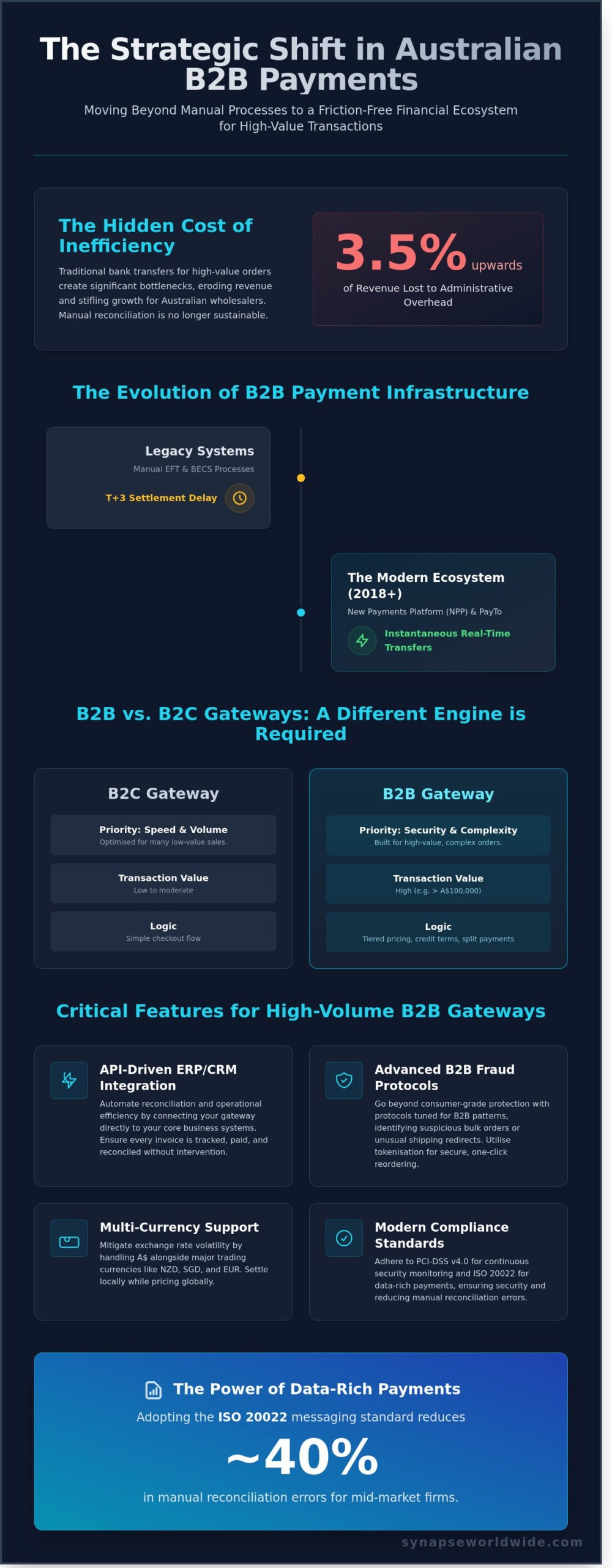
How much of your 2025 revenue was eroded by the hidden cost of manual bank reconciliation and friction in high-value transfers? For many Australian wholesalers, the answer is often upwards of 3.5% in administrative overhead alone. You likely understand that relying on traditional bank transfers for five-figure orders creates a bottleneck that stifles your scale. Finding the right b2b payment gateway solutions australia is no longer just a technical checkbox; it’s a strategic move to reclaim your team’s time and protect your margins.

In this guide, you’ll discover how to select and integrate the most robust B2B payment gateways to streamline high-value transactions and automate your Australian business operations. We’ll examine the specific technologies that bridge the gap between your digital storefront and your ERP system to ensure every invoice is tracked, paid, and reconciled without human intervention. From reducing transaction fees on A$50,000 orders to implementing seamless PayID and automated credit terms, we’re outlining the exact roadmap to a friction-free financial ecosystem for 2026.

Key Takeaways

  • Understand the shift from traditional bank transfers to real-time digital ecosystems designed specifically for the unique complexities of Australian B2B commerce.
  • Identify critical features of b2b payment gateway solutions australia, including multi-currency support and advanced fraud protocols tailored for high-value transactions.
  • Learn how to evaluate fee structures like interchange-plus versus flat-rate to ensure your payment infrastructure remains cost-effective as your volume scales.
  • Discover the strategic advantages of bespoke API-driven integrations that connect your gateway directly to ERP and CRM systems for automated operational efficiency.
  • Explore a proven methodology for designing robust, scalable payment architectures that transform your e-commerce platform into a powerful engine for business growth.

The Evolution of B2B Payment Gateway Solutions in Australia

The Australian B2B ecosystem has undergone a fundamental transformation since the 2018 launch of the New Payments Platform. For decades, local enterprises relied on manual Electronic Funds Transfer (EFT) and Bulk Electronic Clearing System (BECS) processes that often delayed settlement for up to three business days. By 2026, these legacy methods have become a liability. Modern b2b payment gateway solutions australia now provide the real-time infrastructure necessary to maintain liquidity in a high-velocity market. This shift isn’t merely about speed; it’s about the strategic integration of data and finance.

The landscape shifted dramatically following the implementation of The Evolution of B2B Payment Gateway Solutions in Australia, which introduced real-time clearing and settlement capabilities. For a business managing A$500,000 in monthly payables, the move from T+3 settlement to instantaneous transfers represents a significant boost to working capital. A “set and forget” gateway is no longer sufficient for competitive Australian enterprises. You need a proactive system that optimizes every touchpoint of the transaction lifecycle.

B2B vs. B2C: Why Your Gateway Needs a Different Engine

Retail gateways prioritize speed and high-volume, low-value security. Conversely, b2b payment gateway solutions australia must facilitate high-value transaction limits, often exceeding A$100,000 per single payment, without triggering automated fraud blocks that stall operations. The integration of PayTo has revolutionized this space. It allows businesses to automate recurring agreements and real-time authorisations directly from a client’s bank account. This bespoke logic supports complex checkout requirements, such as tiered wholesale volume discounts and split-payment terms, which standard B2C engines simply can’t process.

The Regulatory Landscape for Australian Payments in 2026

Compliance in the current market requires more than a basic SSL certificate. Australian Treasury guidelines now emphasize digital payment safety through rigorous oversight. Businesses must adhere to the updated PCI-DSS v4.0 standards, which demand continuous monitoring rather than annual snapshots. The adoption of ISO 20022 messaging standards is equally critical. This global standard enables data-rich payments, allowing remittance information to travel with the fund transfer. It reduces manual reconciliation errors by approximately 40% for mid-market firms. Staying compliant ensures your enterprise avoids the heavy penalties associated with the Australian Privacy Act and maintains its reputation as a secure, reliable partner.

Critical Features for High-Volume B2B Payment Gateways

High-volume B2B transactions demand a robust infrastructure that mirrors complex corporate logic. For Australian firms scaling internationally, multi-currency support is a non-negotiable requirement. Your gateway must handle A$ alongside major trading currencies like NZD, SGD, and EUR to mitigate exchange rate volatility. This capability allows you to settle in local currency while presenting costs to your global partners in their own denominations.

Security protocols must also evolve beyond standard consumer-grade protection. Advanced fraud protocols specifically tuned for B2B patterns help identify suspicious bulk orders or unusual shipping redirects that standard filters might miss. By implementing tokenisation, you enable secure, one-click reordering for repeat wholesale clients. This technology stores sensitive data in a secure vault, replacing it with a unique identifier. It removes friction from the procurement process and ensures your business remains PCI compliant without storing raw card data on your servers.

Cash flow management remains a primary concern for local enterprises. Standard T+2 settlements don’t always align with complex corporate accounting cycles. When Evaluating the Top B2B Payment Providers in Australia, look for partners that offer flexible settlement windows. Customising when funds are deposited into your accounts helps you maintain liquidity for payroll and inventory replenishment.

Wholesale Pricing and Credit Management

Modern b2b payment gateway solutions australia must integrate real-time credit checks directly into the payment flow. This prevents over-extension to high-risk accounts before the transaction is even processed. Sophisticated systems manage dynamic pricing tiers based on specific customer login history. If a Tier-1 distributor logs in, they see their bespoke rates immediately. You should also consider automating “Buy Now, Pay Later” (BNPL) options tailored for vendors. This allows you to offer net-30 or net-60 terms while the gateway provider assumes the underlying credit risk, ensuring you receive your A$ payment upfront.

Reporting and Reconciliation Automation

Manual reconciliation is a significant drain on administrative resources. Top-tier gateways generate tax-compliant invoices automatically upon successful authorisation, meeting all Australian Taxation Office (ATO) standards. Real-time data feeds provide instant visibility into accounts receivable, which is vital for maintaining an accurate balance sheet. By using custom metadata fields to track project codes or purchase order numbers, your finance team can reconcile thousands of transactions in minutes. This level of bespoke digital integration transforms the payment gateway from a simple utility into a strategic business asset. Every transaction becomes a data point that fuels your broader growth strategy.

B2B Payment Gateway Solutions Australia: The 2026 Strategic Buying Guide

Evaluating the Top B2B Payment Providers in Australia

Selecting the right b2b payment gateway solutions australia requires a shift from retail-centric thinking to a strategic focus on high-value, high-frequency settlement. While Stripe and Eway dominate the general market with their user-friendly interfaces, B2B specialists often provide deeper integration for complex invoice reconciliation. High-volume users should scrutinize fee structures closely. Flat-rate pricing offers simplicity for smaller firms, but interchange-plus models typically provide better cost-efficiency for enterprises processing over A$250,000 monthly. This granular pricing reveals the actual cost of the card network fee plus the provider’s margin, often saving businesses between 0.2% and 0.5% on total transaction costs.

A robust API isn’t just a technical requirement; it’s the bridge that allows your custom e-commerce environment to communicate with your ERP system for seamless reconciliation. Modern B2B systems must leverage the New Payments Platform (NPP) to facilitate real-time, data-rich transfers that traditional credit card rails cannot match. This infrastructure ensures that large-scale B2B transactions settle within seconds rather than days, significantly improving cash flow for the vendor. Technical support also remains a critical pillar. Relying on a global ticket-based system can lead to costly delays during a checkout failure. Local, Australian-based support teams provide the immediate response necessary for mission-critical infrastructure.

Domestic vs. Global Gateways: Which Fits Your Growth Strategy?

Australian-born gateways like Eway provide superior local support and a deep understanding of the local GST environment. Global giants like Adyen or Airwallex excel for cross-border B2B operations, handling over 150 currencies. However, international transactions often carry hidden costs, including currency conversion margins that can reach 3% above the mid-market rate. Choosing a domestic provider often avoids these “cross-border” surcharges for local trade, keeping your margins intact as you scale within the Australian market.

Security and Uptime: The Non-Negotiables

Reliability is the foundation of any digital architecture. Top-tier Australian providers offer Service Level Agreements (SLAs) guaranteeing 99.99% uptime. Many B2B firms now implement secondary “failover” gateways to prevent revenue loss during rare outages. PCI-DSS Level 1 compliance is the gold standard for Australian B2B gateways, ensuring that sensitive financial data remains encrypted and secure against evolving threats. Without this certification, your business assumes immense liability for every b2b payment gateway solutions australia transaction processed.

Strategic Integration: Connecting Gateways to ERP and CRM Systems

Integration isn’t just a technical convenience; it’s a strategic imperative for high-growth firms. Moving beyond simple, off-the-shelf plugins to bespoke API-driven integrations allows your business to function as a single, cohesive unit. In the Australian B2B landscape, 62% of finance leaders cite manual data reconciliation as their primary operational bottleneck. By adopting the “Digital Architect” approach, you build a scalable payment stack where every transaction informs your broader business intelligence. This methodology ensures your b2b payment gateway solutions australia aren’t just processing tools, but active drivers of efficiency.

Eliminating manual data entry through bidirectional ERP synchronisation transforms your finance department. When your gateway communicates directly with systems like NetSuite, Microsoft Dynamics 365, or SAP, data flows both ways. This ensures that an A$20,000 invoice paid online updates your ledger, tax obligations, and cash flow forecasts instantly. It removes the risk of human error that costs Australian businesses an average of 3% in annual revenue leakage. Your payment stack becomes a robust foundation for global expansion, managing complex multi-entity reporting without additional headcount.

Bridging the Gap Between Sales and Finance

Seamless CRM connectivity directly improves customer lifetime value (CLV) by providing sales teams with real-time financial context. When your gateway integrates with Salesforce or HubSpot, “Paid” statuses update automatically, triggering project kick-offs or shipping workflows. This transparency is vital for managing custom projects that require partial payments or deposit structures. It also ensures inventory levels across multiple B2B sales channels remain accurate to the minute, preventing over-selling and maintaining brand reputation. A unified view of the customer journey allows for more strategic account management and proactive retention efforts.

Custom Middleware vs. Native Integrations

Native gateway apps are often sufficient for smaller operations, but they frequently limit growth as business logic becomes more complex. Custom middleware serves as a sophisticated bridge, allowing for bespoke rules that native apps can’t handle. This approach future-proofs your infrastructure for the next decade of digital commerce. If you decide to pivot your ERP or add new payment methods in 2027, the middleware layer protects your core operations from disruption. It provides the stability required to handle high-volume transactions while maintaining the flexibility to adapt to changing Australian market regulations.

Ready to transform your financial infrastructure with a bespoke integration strategy? Consult with our Digital Architects today to build a scalable payment ecosystem.

Optimising Your B2B Infrastructure with Synapse Worldwide

Synapse Worldwide views payment architecture as the critical backbone of B2B scalability. We don’t just implement software; we design bespoke e-commerce environments where the payment gateway functions as a fully integrated engine within your business. Our methodology follows a “Digital Architect” approach. This ensures every transaction aligns with your broader fiscal strategy and technical requirements. We focus on creating a seamless flow between your storefront, your back-office, and your bank.

Integrating complex ERP systems like NetSuite, SAP, or Microsoft Dynamics with b2b payment gateway solutions australia requires a deep understanding of ledger synchronisation. We specialise in eliminating the 15 to 20 hours per week that Australian finance teams often lose to manual reconciliation. By automating the data path from invoice generation to final settlement, we help businesses accelerate cash flow and reduce the average age of the Debtors Ledger by up to 18%. This focus on ROI ensures that your digital transformation pays for itself through reduced administrative friction and improved liquidity.

Bespoke Solutions for Complex B2B Requirements

Since 2004, we’ve navigated the evolving Australian digital landscape to solve unique payment hurdles that off-the-shelf plugins cannot handle. For example, a recent project for a national medical wholesaler involved building a custom portal that managed complex split-payments across multiple cost centres. This bespoke development eliminated a four-day delay in their standard order processing cycle. Our commitment to fixed-price project delivery and transparent timelines removes the financial uncertainty usually associated with high-level technical shifts. You receive a robust, scalable solution delivered on schedule, backed by over two decades of local expertise.

  • Custom API orchestration for legacy ERP systems
  • Automated surcharging and tax calculation for AU compliance
  • Real-time inventory and payment status synchronisation
  • High-security vaulting for recurring wholesale billing

Ready to Transform Your Payment Operations?

The first step toward a more efficient infrastructure is a Synapse Worldwide digital audit. Our strategic consultants perform a deep dive into your current technical stack to identify bottlenecks in your b2b payment gateway solutions australia setup. We look beyond the surface to find opportunities for automation and cost reduction. We aren’t interested in one-off transactions; we aim for long-term partnerships that support your business as it grows and adapts to new market demands in 2026 and beyond.

Our team provides the clarity and technical discipline needed to execute complex digital shifts without disrupting your daily operations. We bridge the gap between high-level strategy and hands-on execution to ensure your business remains competitive. Partner with Synapse Worldwide for your bespoke B2B payment solution and take the next step in your digital evolution.

Future-Proof Your Australian B2B Operations

Navigating the complex landscape of b2b payment gateway solutions australia demands more than just a plug-and-play tool. Success in 2026 hinges on deep ERP and CRM integration to eliminate manual data silos and ensure your high-volume transactions remains secure. You need a system that scales as your enterprise grows, transforming your payment infrastructure from a cost center into a strategic asset. Efficiency isn’t just about speed; it’s about the precision of your digital architecture.

Synapse Worldwide has been at the forefront of this evolution since 2005. With over 20 years of Australian digital expertise, we specialize in building the scalable e-commerce infrastructure that modern enterprises require. We don’t believe in cookie-cutter fixes. Instead, we focus on bespoke integrations that connect your financial data directly to your growth engines. Our proven track record across the Australian market ensures your business is equipped for the next level of digital transformation. It’s time to refine your workflow and secure your competitive edge.

Consult with our Digital Architects for a custom B2B payment strategy

Your journey toward a more profitable, streamlined business starts with the right strategic partner by your side.

Frequently Asked Questions

What is the best B2B payment gateway for Australian small businesses?

Stripe and Airwallex are currently the top-tier choices for Australian small businesses seeking a balance of functionality and ease of use. Stripe offers a robust API that integrates with almost any software stack, while Airwallex provides competitive international FX rates and local AUD global accounts. These platforms allow you to scale your operations without the technical debt associated with legacy banking systems.

How do B2B payment gateways handle high-value transactions?

Leading b2b payment gateway solutions australia utilize advanced risk engine monitoring and 3D Secure 2.0 protocols to manage transactions that often exceed A$10,000. They typically route these through the New Payments Platform (NPP) or direct entry to avoid the high percentage-based fees of traditional credit cards. This strategic approach ensures that high-ticket settlements remain both secure and cost-effective for your enterprise.

Can I integrate my payment gateway with my existing ERP system?

You can achieve seamless synchronization between your gateway and major ERP systems like NetSuite, SAP, or Microsoft Dynamics 365 using bespoke API connectors. This integration automates the flow of financial data, which eliminates manual reconciliation and reduces administrative overhead by up to 40 percent. It’s a critical step for businesses looking to maintain a single source of truth across their digital landscape.

Are there specific B2B payment gateways that support PayTo in Australia?

Modern Australian providers like Monoova, Zepto, and Azupay have fully integrated PayTo to offer real-time, mandate-based payment options. Since its launch by NPP Australia in 2022, PayTo has enabled businesses to gain instant authorization for bank transfers, replacing the slower, traditional direct debit system. It’s an essential feature for managing recurring B2B subscriptions with greater certainty and speed.

What are the typical transaction fees for B2B gateways in Australia?

Domestic credit card fees in Australia generally range from 1.4% to 1.75% plus a fixed fee of A$0.30 per transaction. For high-volume B2B users, direct debit fees are often more economical, frequently capped at a flat rate or a low 1% fee. Many providers will offer tailored enterprise pricing once your monthly processing volume exceeds A$100,000, allowing for significant cost optimization.

How long does it take to settle funds into an Australian business bank account?

Standard settlement cycles in the Australian market typically follow a T+2 timeframe, meaning funds are available two business days after the transaction occurs. However, gateways leveraging the New Payments Platform can provide near-instant settlement, even on weekends and public holidays. Rapid settlement is a vital component for maintaining healthy cash flow and supporting aggressive business growth strategies.

What security certifications should I look for in an Australian B2B gateway?

You must ensure your provider maintains PCI DSS Level 1 compliance, as this is the gold standard for protecting cardholder data. It’s also wise to look for SOC2 Type II and ISO 27001 certifications, which validate the gateway’s internal security controls and data management practices. These certifications prove that the provider can defend your sensitive corporate information against the evolving global threat landscape.

Do I need a separate merchant account to use a B2B payment gateway?

You don’t need a separate merchant account if you partner with a modern payment aggregator like Stripe or Square, as they provide an all-in-one solution. Traditional banking models still require you to apply for a standalone merchant account, which involves more complex underwriting and longer setup times. Opting for an integrated solution simplifies your financial stack and accelerates your speed to market.