
Tag Archives: bespoke development


Multi-Vendor Marketplace Development Cost: A Strategic 2026 Price Guide

Multi-Vendor Marketplace Development Cost: A Strategic 2026 Price Guide

Choosing a low-cost, off-the-shelf template for your platform is often the most expensive mistake an Australian enterprise can make. Industry benchmarks from late 2024 indicate that 65% of businesses using generic marketplace solutions encounter critical technical debt before their second year of operation. You’ve likely felt the frustration of fragmented buyer-seller experiences or the complexity of managing GST compliance across multiple vendors. Calculating the true multi-vendor marketplace development cost requires looking beyond the initial build to the long-term strategic value of a bespoke, integrated ecosystem.

We’ve designed this 2026 price guide to provide a transparent breakdown of the investment required for a robust platform that automates vendor management and integrates seamlessly with your existing CRM or ERP systems. You’ll gain a clear understanding of the ROI and the maintenance costs necessary to sustain a high-performing digital landscape. We’ll examine the technical drivers behind complex tax compliance and the specific pathways to building a scalable asset that drives genuine business transformation.

Key Takeaways

  • Understand why three-sided marketplace architecture is five times more complex than standard e-commerce, requiring a strategic shift from simple storefronts to robust vendor orchestration.
  • Master the financial engineering required for automated split payments and multi-currency support to ensure seamless, compliant transactions within the Australian regulatory landscape.
  • Navigate the multi-vendor marketplace development cost in A$ by comparing the short-term savings of SaaS plugins against the long-term ROI of bespoke, scalable headless commerce solutions.
  • Identify the critical “hidden” components of the Total Cost of Ownership, from high-performance cloud hosting on AWS to the ongoing maintenance essential for platform security and API stability.
  • Learn how a discovery-first architectural approach eliminates waste and aligns your digital investment with high-yield features that drive vendor retention and sustainable business growth.

Beyond the Storefront: Why Multi-Vendor Marketplaces Require Strategic Investment

Building a multi-vendor marketplace in the Australian landscape isn’t a simple retail upgrade. It’s a foundational shift in business logic. By 2026, the digital aggregator model will dominate the commercial landscape, with Gartner predicting that 75% of B2B procurement spending will occur through online marketplaces by 2027. This shift means your primary multi-vendor marketplace development cost isn’t just a line item for a storefront. It’s a strategic investment in a sophisticated digital infrastructure that manages a complex, three-sided ecosystem of buyers, sellers, and platform operators.

Marketplace architecture is typically 5x more complex than standard e-commerce. You aren’t just selling your own inventory; you’re building a self-sustaining economy where third-party vendors compete and collaborate. This requires a Digital Architect approach, focusing on long-term scalability rather than a quick launch. The goal is to move away from the “buying a site” mentality and toward building a platform that can handle the weight of thousands of simultaneous transactions across diverse product categories.

The Complexity Factor: Buyers vs. Sellers vs. Admins

Every user group requires a bespoke interface tailored to their specific objectives. Buyers need a frictionless path to purchase, while sellers require a powerful dashboard to manage inventory, logistics, and tax compliance. Admins need a high-level view to monitor platform health and security. Off-the-shelf templates frequently fail when they hit a threshold of 1,000 active users because they lack the database optimization required for concurrent multi-vendor queries. Maintaining a unified UX across thousands of disparate vendor storefronts is critical for maintaining brand trust in the A$300 billion Australian retail market.

Marketplace vs. E-commerce: A Cost Comparison

Standard e-commerce focuses on direct sales and linear inventory management. In contrast, a marketplace acts as a facilitator of transactions rather than a seller of goods. This distinction fundamentally changes the technical requirements and the multi-vendor marketplace development cost. Your investment must account for automated commission logic, complex payout gateways that comply with Australian financial regulations, and robust dispute resolution modules. While a standard site handles a single payment to one bank account, a marketplace must split payments, hold funds, and distribute A$ payouts to hundreds of different vendors simultaneously. This level of automation allows your business to scale without a linear increase in administrative headcount.

Primary Cost Drivers: From Vendor Orchestration to Financial Logic

A high-performing marketplace is a living ecosystem. It requires a sophisticated engine capable of managing thousands of concurrent interactions between diverse stakeholders. To achieve sustainable growth, you must understand the strategic frameworks for marketplace platforms that balance vendor supply with buyer demand. This structural complexity is the primary factor influencing the multi-vendor marketplace development cost. You aren’t just building a storefront; you’re engineering a scalable digital economy.

The backend architecture serves as the foundation. It must handle high-volume data processing, from real-time inventory updates to complex search queries. Search and discovery tools are critical components of this logic. Industry data shows that 43% of users navigate directly to the search bar upon landing. We integrate AI-driven recommendation engines that analyse user behaviour to deliver personalised results. These advanced filtering systems can increase conversion rates by 15% or more, justifying the initial investment in bespoke logic over generic, off-the-shelf solutions.

Automated Vendor Management Systems

Manual onboarding processes act as a bottleneck for expansion. Building robust, automated verification workflows ensures your platform remains secure and compliant with Australian business standards from day one. High-quality systems include API-led product importing, which allows vendors to synchronise thousands of SKUs instantly. This automation in the backend is a strategic move to lower operational overhead. By investing in self-service tools, you can reduce long-term headcount costs by approximately 30% as your vendor base scales from dozens to thousands.

Payment Gateways and Settlement Logic

Financial engineering is where many platforms fail or succeed. Integrating sophisticated solutions like Stripe Connect or bespoke escrow systems is essential for managing multi-party transactions. In the Australian market, your system must handle GST calculations and regional tax compliance automatically to avoid administrative nightmares. The logic must seamlessly split payments, deduct your platform commission, and trigger vendor settlements without human intervention. Security remains a top priority. Implementing advanced fraud detection and secure encryption protocols protects your revenue and builds trust. A tailored financial architecture ensures your multi-vendor marketplace development cost translates into a reliable, high-integrity platform that operates with clinical precision.

  • Scalable Backend: Engineered for 99.9% uptime during peak traffic periods.
  • AI Discovery: Predictive search algorithms that reduce time-to-purchase.
  • Compliance: Automated tax and regulatory reporting for the Australian landscape.

Multi-Vendor Marketplace Development Cost: A Strategic 2026 Price Guide

Development Pathways: Comparing Bespoke Excellence with Platform Constraints

Choosing a development pathway isn’t just a technical decision; it’s a financial commitment that dictates your total multi-vendor marketplace development cost over the lifecycle of the business. Low-entry SaaS models or plugin-based solutions often appeal to startups due to initial affordability. However, these platforms frequently carry heavy technical debt that hampers future agility. In 2024, industry data suggested that 65% of businesses using off-the-shelf marketplace plugins faced performance bottlenecks within eighteen months of launch. This often forces a costly re-platforming phase, potentially doubling your multi-vendor marketplace development cost during the migration process.

Hybrid solutions offer a middle ground by leveraging headless commerce. This architecture decouples the front-end user experience from the back-end logic. It allows for faster deployment while maintaining the flexibility to swap out services as your requirements evolve. For Australian enterprises seeking a balance between speed and scale, this is often the strategic sweet spot. Bespoke development represents the Digital Architect approach. We build every component to serve your specific business model. This path eliminates unnecessary bloat and ensures that your infrastructure is a proprietary asset, not a rented space.

To select the right path, use this evaluation framework:

  • Operational Complexity: Does your model require non-standard commission structures or multi-level tax logic?
  • Data Sovereignty: Do you need absolute control over user data to meet Australian privacy regulations?
  • Long-term Vision: Is this a temporary proof-of-concept or a permanent foundation for a multi-million dollar enterprise?

The Hidden Costs of “Cheap” Marketplace Builders

Entry-level platforms often hide their true price behind transaction fees. While a monthly subscription might cost A$300, tiered transaction fees can reach 2% or 3% of total Gross Merchandise Value (GMV). For a marketplace processing A$1 million in annual sales, that’s an additional A$30,000 yearly expense. You also face the “Customisation Wall.” When a platform’s API doesn’t support a specific logic, your growth stalls. You don’t own the source code; you’re merely a tenant on someone else’s land.

The Case for Bespoke Digital Infrastructure

Custom builds integrate seamlessly with Australian accounting standards and local ERP systems like MYOB or Xero from day one. This proactive integration reduces manual data entry by 40% in the first year of operation. Scalability is baked into the foundation. A bespoke system can handle 10x growth in traffic without the lag associated with shared server environments. Most importantly, a proprietary platform is a tangible asset. It significantly increases your company’s valuation during acquisition talks compared to a generic subscription-based site.

The Total Cost of Ownership: Hidden Fees and Scaling Realities in 2026

Launching a platform is only the first phase of your investment. To understand the true multi-vendor marketplace development cost, you must account for the operational expenses that follow the initial build. By 2026, the shift toward scalable cloud infrastructure like AWS or Microsoft Azure has become the standard for Australian enterprises seeking to avoid the performance bottlenecks of legacy shared hosting. Static servers can’t handle the dynamic load of a growing marketplace; you need an environment that expands alongside your vendor list.

Ongoing maintenance typically consumes 15% to 20% of the initial development budget annually. This covers critical security patches, API version updates, and continuous performance monitoring. You’ll also need to budget for third-party integrations that power the user experience. Tools like Algolia for advanced search or Klaviyo for automated marketing involve monthly subscription fees that scale with your user base. Content moderation is another non-negotiable expense. Whether you use AI-driven tools or manual oversight, ensuring vendor listings meet Australian consumer law standards is vital for brand integrity.

Hosting and DevOps for High-Traffic Platforms

Marketplace hosting requires high-availability clusters to prevent downtime during peak shopping events. Your budget must include automated data backups and disaster recovery protocols that ensure 99.9% uptime. Hosting isn’t a static fee; it’s an operational necessity that fluctuates based on your real-time traffic and storage requirements. Investing in a robust DevOps pipeline ensures that updates are deployed without interrupting the customer journey.

Security, Compliance, and Data Protection

The Australian Privacy Act and the 13 Australian Privacy Principles (APPs) demand rigorous data handling. Expect to invest in regular security audits and penetration testing at least twice a year to identify vulnerabilities. Implementing robust SSL certificates, multi-factor authentication (2FA), and encrypted transaction logs protects your business from the rising costs of data breaches. These measures aren’t optional extras but essential components of a multi-vendor marketplace development cost strategy that prioritises long-term stability and consumer trust.

Building a platform that scales requires more than just code; it requires a strategic roadmap for growth. Partner with Synapse Worldwide to engineer a marketplace designed for the Australian digital landscape.

Engineering Growth: How Synapse Worldwide Architectures High-Yield Marketplaces

Building a platform isn’t just about writing code; it’s about engineering a high-performance revenue engine. When you evaluate the multi-vendor marketplace development cost, looking only at the initial price tag is a strategic mistake. Savvy Australian investors focus on the yield. Synapse Worldwide operates as your Digital Architect. We design bespoke systems that integrate seamlessly into the local business landscape. We prioritize functional features that ensure 90% vendor retention and high transaction throughput from day one.

Our methodology focuses on ROI by building tools that drive actual profit. We don’t believe in vanity features. We build sophisticated dashboards for your vendors and intuitive interfaces for your customers. This creates a self-sustaining ecosystem where every participant finds value. We ensure your marketplace isn’t a standalone island but a connected hub within your existing business infrastructure. By aligning technical architecture with your commercial goals, we transform a digital expense into a high-yield asset.

Our Discovery and Strategy Phase

Success begins with a blueprint. Before we commit to a single line of code, we map your entire business logic. We define every user journey for buyers, sellers, and administrators to eliminate technical debt before it starts. Our team identifies a lean Minimum Viable Product (MVP) to accelerate your time-to-market. This strategic focus reduces the total multi-vendor marketplace development cost by preventing expensive feature bloat. We ensure your foundation is ready for professional E-commerce Development that complies with Australian consumer law and GST requirements. We’ve found that this discovery-first approach saves clients an average of 15% on long-term maintenance costs because the architecture is built correctly the first time.

Scaling Your Platform Post-Launch

The launch is your starting line, not the finish. We transition your platform into a growth phase using integrated SEO and PPC strategies tailored for the A$2.5 trillion Australian digital economy. Our focus remains on continuous performance tuning. We’ve seen conversion rate optimization (CRO) efforts increase transaction volume by 22% within the first six months of post-launch optimization. By leveraging Custom Software Development, we connect your marketplace to existing ERPs or local logistics providers like Australia Post. This creates a seamless ecosystem that scales as your ambition grows. We don’t just build software; we foster a long-term partnership aimed at achieving total market dominance through data-driven refinement and technical excellence.

Architecting High-Yield Assets for the 2026 Australian Market

Success in the digital economy requires looking beyond the initial storefront. Your multi-vendor marketplace development cost in 2026 is an investment in resilient vendor orchestration and complex financial logic. While templated solutions offer speed, they often fail to navigate intricate Australian tax compliance or the rigorous scaling demands of a high-growth enterprise. A strategic build ensures your platform remains a high-yield asset rather than a technical liability as your transaction volumes grow.

Synapse Worldwide leverages 20+ years of expertise in high-value digital infrastructure to build these foundations. We’re bespoke integration specialists who bridge the gap between complex CRM environments and seamless user experiences. Our results-oriented methodology focuses on long-term ROI, providing the stability your business needs to lead the local market. It’s time to transition from a simple vendor site to a robust, scalable ecosystem that’s engineered for performance.

Request a Strategic Consultation for Your Marketplace Project to secure your competitive advantage. Let’s build a platform that drives your business forward.

Frequently Asked Questions

How much does it cost to build a marketplace like Amazon in 2026?

Building an enterprise-grade marketplace requires a strategic investment starting at A$150,000 for a robust MVP, while full-scale platforms often exceed A$500,000. These figures reflect the 2026 market demand for advanced AI search algorithms, complex logistics integrations, and multi-layered security protocols. Your final budget depends on whether you require bespoke features or integrated third-party systems to manage your global vendor network.

How long does it typically take to develop a custom multi-vendor platform?

A comprehensive custom marketplace project typically spans 6 to 12 months from initial discovery to launch. We find that 40% of this timeline is dedicated to rigorous backend architecture and vendor portal testing. This phased approach ensures your digital landscape is stable and scalable. Rapid deployments often sacrifice the long-term structural integrity needed for high-volume transaction processing.

Can I start with a template and move to a custom solution later?

You can start with a template, but 35% of businesses find that migration costs to a custom solution within 24 months outweigh the initial savings. Templates often create technical debt that complicates future scaling. A strategic architect focuses on building a bespoke foundation early to avoid the friction of platform transitions as your user base grows.

What are the most common hidden costs in marketplace development?

Hidden expenses usually emerge from payment gateway fees, third-party API subscriptions, and ongoing cloud infrastructure scaling. Industry data indicates that annual maintenance typically accounts for 15% to 20% of your initial multi-vendor marketplace development cost. Budgeting for these recurring elements is vital for maintaining a 99.9% uptime and ensuring a seamless user experience for your vendors.

Do I need to hire a separate team for maintenance and hosting?

You don’t need a separate team if you partner with an integrated agency that provides end-to-end management. Consolidating your development and maintenance ensures that the engineers who built your bespoke logic are the ones optimizing it. This unified approach reduces communication silos and keeps your platform’s security patches updated against 2026’s evolving digital threats.

How does the development cost differ for B2B vs B2C marketplaces?

B2B platforms generally cost 25% to 40% more than B2C sites due to the complexity of wholesale workflows. Features like bulk pricing tiers, Request for Quote (RFQ) systems, and net-30 credit terms require sophisticated custom coding. While B2C focuses on emotional triggers and fast checkouts, B2B architecture prioritizes logic-heavy procurement cycles and integrated ERP systems.

What is the difference between a marketplace and a standard e-commerce site in terms of cost?

Marketplace development is 2 to 3 times more expensive than standard e-commerce because you’re building three distinct interfaces. You must manage the buyer experience, a complex vendor dashboard, and a central administrative hub. Each layer requires separate permissions, payout logic, and conflict resolution tools, making the technical scope much broader than a single-seller website.

Is it cheaper to build a marketplace using a headless commerce approach?

Headless commerce isn’t cheaper upfront, but it significantly lowers the long-term multi-vendor marketplace development cost by decoupling the frontend from the backend. This architecture allows your team to push UI updates 40% faster without risking the stability of your core transaction engine. It’s a strategic choice for brands aiming for high agility and a superior mobile-first presence.
 

E-commerce Website Development in Australia: The 2026 Strategic Buying Guide

E-commerce Website Development in Australia: The 2026 Strategic Buying Guide

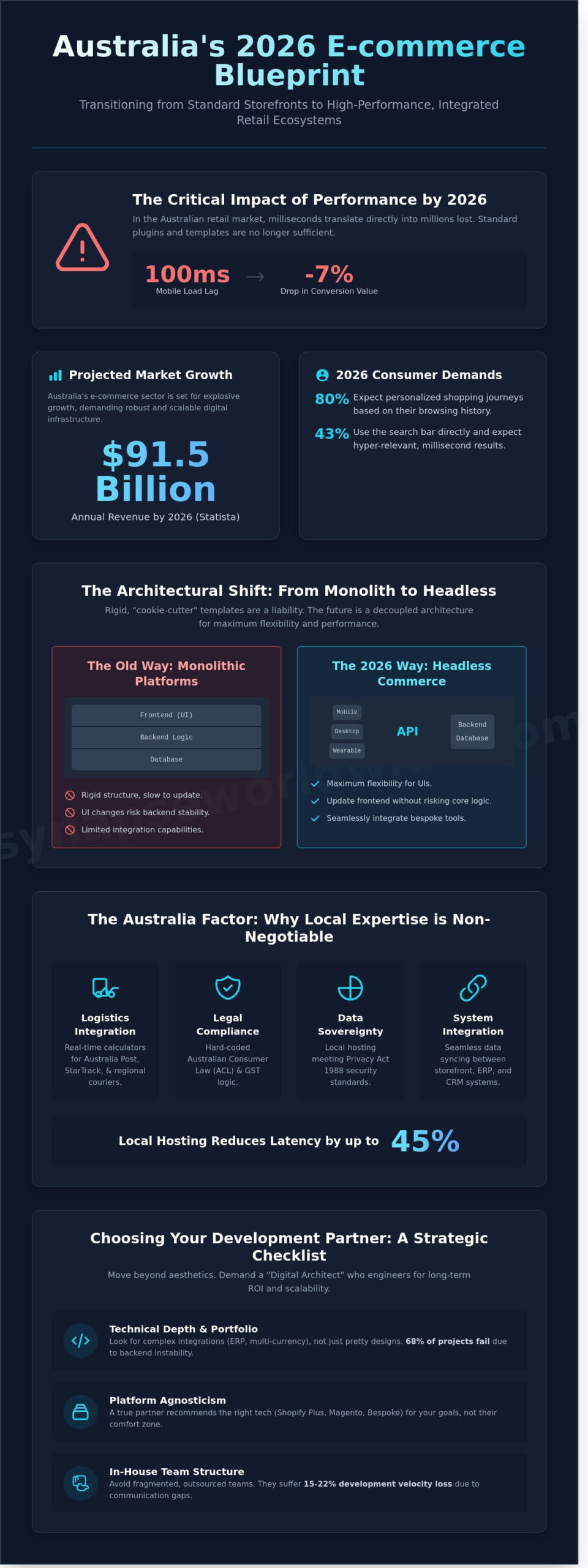
By 2026, a 100-millisecond lag in mobile load times will trigger a 7% drop in total conversion value for Australian retailers. This shift proves that e-commerce website development australia is no longer about just being online; it’s about engineering for elite performance. You’ve likely seen how standard plugins and template-based fixes fail when your SKU count doubles or your traffic spikes during peak seasons. These hidden technical debts don’t just slow your site; they erode your bottom line and frustrate your most loyal customers.

Our strategic guide provides the clarity you need to select a development partner who prioritizes long-term ROI over simple aesthetics. We’ll show you how to demand a bespoke digital architecture that integrates seamlessly with your existing CRM and ERP systems for automated data syncing. You’ll discover the specific benchmarks for a secure, high-converting checkout experience and how to build a scalable foundation that supports your 2026 growth targets. It’s time to move past reactive fixes and invest in a proactive, data-driven retail strategy that transforms your digital presence into a robust engine for success.

Key Takeaways

  • Understand why transitioning from basic storefronts to sophisticated, data-driven retail ecosystems is essential for meeting 2026 consumer expectations.
  • Learn how to evaluate technical depth and platform agnosticism when selecting a partner for e-commerce website development australia.
  • Discover the “Digital Architect” approach to eliminate data silos by seamlessly integrating ERP and CRM systems into your core business operations.
  • Master the lifecycle of high-conversion development, from strategic technical mapping to deploying interfaces that reflect brand authority.
  • Evaluate the long-term financial advantages of bespoke development by comparing total cost of ownership against the hidden limitations of SaaS solutions.

The State of E-commerce Website Development in Australia for 2026

Australia’s digital retail sector has moved past the era of simple online catalogues. By 2026, the e-commerce market in Australia is projected to surpass $91.5 billion in annual revenue according to Statista. Successful brands don’t view their websites as isolated shops; it’s about building integrated retail ecosystems where data flows between inventory, CRM, and the storefront. Relying on generic, “cookie-cutter” templates is a liability in this environment. These rigid structures fail to support the 80% of Australian consumers who now expect personalized shopping journeys based on their browsing history. Professional e-commerce website development australia involves engineering a robust backend that prioritizes speed and scalability over mere visual appeal. Local expertise ensures your platform handles the unique pressures of the domestic market while maintaining a global competitive edge.

Consumer Trends Driving the Need for Custom Solutions

Modern shoppers demand consistent experiences across mobile apps, wearables, and desktops. This shift has made AI-driven search and recommendation engines a baseline requirement, as 43% of users go directly to the search bar and expect hyper-relevant results within milliseconds. Headless commerce is a decoupled architecture that separates the frontend presentation layer from the backend logic to provide maximum flexibility for 2026. This approach allows brands to update their user interface without risking the stability of their core transactional data. By moving away from monolithic platforms, businesses can integrate bespoke tools that drive conversion and customer loyalty.

National Market Dynamics: Why Australia is Unique

Operating in Australia requires deep technical integration with local infrastructure to remain competitive. You need automated workflows for Australia Post, StarTrack, and regional couriers to meet the 2026 standard for transparent, real-time tracking. Compliance isn’t optional; Australian Consumer Law and GST calculations must be hard-coded into your checkout logic to avoid legal friction. Hosting on Australian soil remains critical for both security and performance. It reduces latency by up to 45% compared to overseas servers and ensures customer data stays within the legal protections of the Privacy Act 1988. Strategic e-commerce website development australia focuses on these local nuances to build trust and operational efficiency:

  • Logistics Integration: Real-time shipping calculators for local and interstate zones.
  • Legal Compliance: Built-in tools for GST reporting and consumer rights management.
  • Data Sovereignty: Localised hosting environments that meet strict Australian security standards.
  • Performance Optimization: Reduced load times specifically for users on the National Broadband Network (NBN).

Engaging a partner who understands the intricacies of the Australian digital landscape ensures your site remains fast, compliant, and ready for the next phase of business growth. This requirement for specialized local expertise is a common thread across all high-stakes industries; just as digital success relies on technical depth, patients rely on the advanced surgical solutions provided by Bright Sight Eye Specialists.

Strategic Criteria for Choosing an E-commerce Development Company

Selecting a partner for e-commerce website development australia requires looking past the surface. A polished user interface is now the baseline; 68% of enterprise digital projects fail because of backend instability or poor scalability rather than visual design. You need a partner who functions as a Digital Architect, prioritizing technical logic over simple aesthetics. Portfolio depth should be measured by technical complexity. Ask to see examples of multi-currency checkouts, ERP integrations, or custom middleware. If an agency cannot demonstrate how they solved a specific logistical bottleneck for a client in 2024, they likely lack the depth required for high-stakes builds.

When evaluating potential partners, look for teams like Evolve Media that specialize in professional web design and development, ensuring your platform is built on a foundation of both aesthetic appeal and technical performance.

Platform agnosticism is a non-negotiable trait. Many agencies push a single platform because it’s their only comfort zone. A strategic partner evaluates your specific SKU count, transaction volume, and growth targets before recommending Shopify Plus, Magento, or a bespoke Laravel solution. Accountability hinges on team structure. Fragmented, outsourced teams often suffer from a 15% to 22% loss in development velocity due to time zone friction and communication gaps. Choosing a firm with in-house expertise ensures the person writing the code is the same person attending your strategy sessions.

Post-launch support shouldn’t be an afterthought. With 43% of cyberattacks targeting small to mid-sized e-commerce sites, a robust security and maintenance subscription is essential. This includes real-time monitoring and regular patches rather than just reactive fixes. Your digital presence is a living asset that requires consistent optimization to maintain its competitive edge.

Technical Competence and Platform Expertise

Reliable e-commerce website development australia centers on clean, documented code that allows for future expansion. High-scale platforms like Shopify Plus or custom Laravel builds require specific certification and a history of handling 50,000+ monthly transactions. Security isn’t optional; ensure your developer performs regular penetration testing and adheres to high development standards to protect customer data. A bespoke digital strategy ensures these technical choices align with your 2026 growth targets.

Business Alignment and Strategic Consulting

Your developer must understand your revenue drivers. A discovery phase is the most critical part of the process; data shows that thorough discovery reduces scope creep by 35% and prevents mid-project budget overruns. Look for agencies that discuss conversion rate optimization and SEO architecture during the initial wireframing. If they only talk about hex codes and fonts, they’re decorators, not business partners. They should be able to articulate how the site structure supports long-term digital marketing goals.

E-commerce Website Development in Australia: The 2026 Strategic Buying Guide

Beyond the Storefront: ERP, CRM, and System Integrations

Siloed data is the primary growth killer for Australian e-commerce brands. In 2024, industry data indicated that disconnected systems cost businesses up to 20% of their potential annual revenue through operational friction and missed opportunities. We view e-commerce website development australia through the lens of a Digital Architect. This strategy moves beyond simple aesthetics to build a central hub where every part of your business communicates in a single language.

Streamlining the workflow between sales and fulfillment is vital for scaling. When these systems operate in isolation, manual errors become inevitable; a single inventory discrepancy can lead to a 15% decrease in customer retention rates. We design automated workflows that ensure your storefront, warehouse, and shipping partners update instantly. Synapse Worldwide manages these complex integrations for enterprise clients by building bespoke API bridges that guarantee 99.9% data accuracy across all touchpoints. This level of precision eliminates the “data lag” that often plagues growing retailers.

CRM Integration: Personalizing the Customer Journey

A storefront without a deep memory cannot scale effectively. We sync customer data with Salesforce, HubSpot, or bespoke CRM solutions to create a unified view of every buyer. By 2025, 73% of Australian consumers expect brands to provide hyper-personalized shopping experiences based on their history. Using real-time data to drive automated marketing and loyalty programs can increase your customer lifetime value (LTV) by 25%. We ensure your data informs every marketing decision you make.

ERP and Inventory Management: Eliminating Manual Friction

Connecting your storefront to ERP systems like SAP, Microsoft Dynamics, or NetSuite is the only way to eliminate manual friction. Real-time inventory syncing is a non-negotiable requirement to prevent overselling across multiple channels. Automating the Order-to-Cash cycle reduces administrative processing costs by 30%. This level of integration ensures your e-commerce website development australia project delivers a robust, high-velocity engine capable of handling thousands of transactions without human intervention. Your backend should be as sophisticated as your frontend.

The Lifecycle of E-commerce Development: From Discovery to Deployment

Successful e-commerce website development australia demands a disciplined methodology that prioritizes technical precision over aesthetic guesswork. Our lifecycle approach ensures that your digital storefront is built on a foundation of data-driven strategy and robust engineering. The process begins with mapping complex user journeys and technical requirements, followed by the creation of a UI/UX interface that reflects brand authority and drives conversions. During the development phase, we integrate essential APIs for inventory, logistics, and payment gateways, ensuring the platform functions as a unified ecosystem.

  • Discovery and Strategy: We map every touchpoint to eliminate friction and align technical choices with your business goals.
  • UI/UX Design: Our team builds high-fidelity wireframes that prioritize mobile-first interactions and rapid load times.
  • Development and Integration: This phase involves the actual coding and the seamless connection of third-party tools like CRM and ERP systems.
  • User Acceptance Testing (UAT): We subject the site to rigorous cross-browser and multi-device checks to ensure a bug-free experience.
  • Launch and Optimization: Post-deployment, we monitor live performance metrics to fine-tune the user experience for maximum ROI.

The Importance of the Discovery Phase

The discovery phase identifies architectural roadblocks, such as legacy data migration issues or complex shipping logic, before a single line of code is written. We define precise KPIs, targeting metrics like a 22% improvement in mobile checkout speed or specific revenue goals for the first fiscal quarter. The discovery phase is the most critical stage for budget control because it prevents expensive mid-project pivots and ensures every developer hour aligns with your commercial objectives.

Testing, Security, and Quality Assurance

Reliability is non-negotiable in the Australian digital landscape. We conduct intensive load testing to ensure your infrastructure handles 300% traffic spikes during peak events like Black Friday or Cyber Monday. Security protocols involve multi-layered SSL certifications and strict PCI-DSS compliance to protect sensitive customer data. For long-term stability, we recommend our Annual Web Hosting and Maintenance Subscriptions to provide ongoing security patches and performance tuning. Our QA process involves testing across 40 different browser and device combinations to guarantee a seamless experience for every visitor.

Maximizing ROI: Why Bespoke Development is a Long-Term Asset

ROI isn’t just about the initial invoice. For e-commerce website development australia projects, the Total Cost of Ownership (TCO) reveals a stark contrast between custom builds and SaaS platforms. While a SaaS solution appears affordable at $200 per month, the cumulative weight of 2% transaction fees and $500 monthly app subscriptions often totals over $85,000 over a five-year period. Bespoke development eliminates these recurring taxes on your growth. By owning the IP, you remove the “success tax” where your platform costs rise alongside your revenue.

Cheap solutions carry heavy technical debt. Every third-party plugin added to a template slows page load speeds by an average of 140ms. This bloat directly impacts your bottom line; data shows that a one-second delay in mobile load times can drop conversion rates by up to 20%. A tailored digital landscape ensures every line of code serves a purpose, driving higher organic traffic and lower customer acquisition costs. You aren’t just buying a website; you’re building an optimized sales engine.

Scalability: Growing Without Technical Debt

Investing in a robust foundation from day one prevents the destructive “rebuild cycle.” Roughly 65% of Australian retailers are forced to migrate platforms within three years because their initial “budget” choice couldn’t handle increased SKU counts or complex API integrations. Bespoke code allows for infinite expansion. We provide transparent, fixed-price project fees so you can manage your capital expenditure without the fear of escalating monthly overheads as your traffic spikes.

Choosing Synapse Worldwide as Your Digital Architect

Our team brings a 20 year track record of delivering high-value digital infrastructure across the Australian market. We aren’t just coders; we’re strategic partners who bridge the gap between high-level business goals and deep technical execution. When you choose us for your e-commerce website development australia, you’re investing in a scalable asset designed for 2026 and beyond. We ensure your site remains fast, secure, and ready to dominate your niche.

Ready to build a platform that scales with your ambition? Partner with Synapse Worldwide for your e-commerce development and secure your digital future today.

Future-Proof Your Brand for the 2026 Digital Economy

The 2026 digital landscape demands more than a basic online shop. Success now hinges on deep system architecture, where custom CRM and ERP integrations create a unified operational backbone. Choosing a partner for e-commerce website development australia means looking beyond aesthetics to find technical architects who understand the lifecycle of high-stakes corporate and government projects. Bespoke solutions aren’t just an expense; they’re a long-term asset that drives measurable growth through technical precision and scalability.

Synapse Worldwide has led this space since 2005. With over 20 years of expertise, we’ve refined a process that transforms complex business requirements into seamless digital realities. We don’t just build websites; we engineer integrated systems that empower your team and delight your customers. Your journey toward a dominant market position starts with a partner who values ROI as much as you do.

Start your e-commerce transformation with a strategic consultation

It’s time to build a platform that doesn’t just keep pace but sets the standard for your industry.

Frequently Asked Questions

How much does e-commerce website development cost in Australia in 2026?

Professional e-commerce website development australia typically ranges from $20,000 for mid-market solutions to $250,000 for enterprise-grade platforms. A standard custom build for a growing brand averages $55,000. These figures reflect the increased complexity of headless commerce and AI-driven personalization engines. Investing in a strategic build ensures your infrastructure handles high traffic volumes without performance degradation during peak sales events.

How long does it typically take to build a custom e-commerce site?

A custom e-commerce site takes between 14 and 26 weeks to launch. This timeline includes 4 weeks for strategic discovery, 10 weeks for bespoke design and development, and 4 weeks for rigorous testing. Complex integrations with legacy systems can extend this by 6 weeks. We prioritize a structured roadmap to ensure every technical component aligns with your commercial objectives before the site goes live.

What is the best e-commerce platform for a growing Australian business?

Shopify Plus and Adobe Commerce remain the dominant choices for Australian businesses scaling past $2 million in annual turnover. Recent 2026 market data shows Shopify Plus holds a 35% share of the local mid-market due to its robust API ecosystem. For brands requiring deep customization, Adobe Commerce provides the flexibility needed for complex B2B workflows. We select the platform based on your specific growth trajectory.

Do I need a custom-built site or is a template enough for my needs?

You need a custom-built site if your annual digital revenue exceeds $1.5 million or if you require unique functional workflows. While templates offer a lower entry cost, they often restrict conversion rate optimization and brand identity. Bespoke architecture allows for a 30% improvement in load speeds compared to bloated off-the-shelf themes. This strategic investment provides the scalability necessary for long-term market leadership.

Can you integrate my existing ERP or CRM with a new e-commerce store?

We provide seamless integration for existing ERP and CRM systems including NetSuite, Microsoft Dynamics 365, and Salesforce. Connecting these platforms eliminates manual data entry and reduces order processing errors by 95%. Our team utilizes robust API protocols to ensure real-time synchronization of inventory, customer profiles, and financial data. This integrated approach transforms your store into a centralized hub for all business operations.

What kind of ongoing maintenance does an e-commerce website require?

E-commerce websites require monthly technical maintenance including security patches, server optimization, and third-party API monitoring. We recommend allocating 8 to 12 hours per month for these essential updates to maintain a 99.99% uptime rating. Regular performance tuning ensures your site remains fast and secure against evolving cyber threats. Neglecting this oversight can lead to a 15% drop in conversion rates due to technical debt.

Is SEO included in the e-commerce development process?

Strategic SEO is a fundamental component of our e-commerce website development australia framework. We implement advanced technical SEO, including JSON-LD schema and optimized site architecture, to ensure 100% indexability by search engines. Every site we build targets a minimum PageSpeed Insights score of 92 to satisfy Google’s 2026 ranking signals. This proactive optimization ensures your brand captures high-intent traffic from the moment of launch.

How do you ensure my e-commerce site is secure against cyber threats?

We secure your e-commerce site using ISO 27001 compliant protocols and AES-256 bit encryption. Our security framework includes mandatory Multi-Factor Authentication and real-time threat detection to prevent SQL injections or XSS attacks. In 2026, 85% of Australian consumers prioritize data privacy when choosing a retailer. By implementing these robust safeguards, we protect your brand reputation and ensure your customers’ sensitive financial information remains private.