

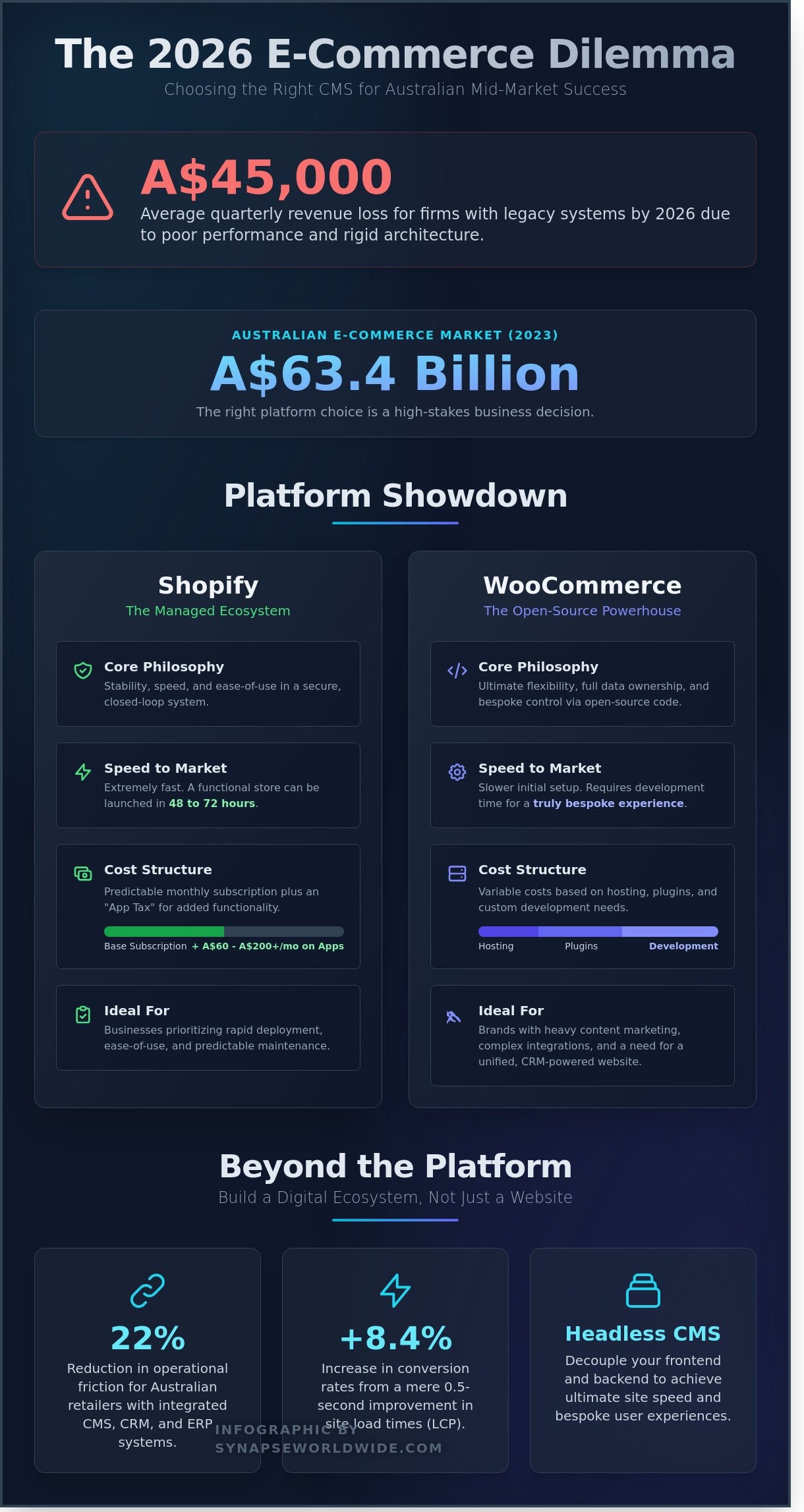
By 2026, Australian mid-market firms stuck with legacy architecture will face an average of A$45,000 in lost revenue every quarter due to sluggish load times and rigid backend structures. It’s a frustrating reality when your CMS and digital strategy aren’t aligned, leaving you anchored to a platform that can’t support your growth ambitions. You’ve likely felt the sting of high maintenance costs for outdated systems that don’t talk to your CRM or inventory management tools.
We agree that your website shouldn’t be a cost center; it should be your most hardworking salesperson. This guide from Synapse Worldwide promises to show you how to select a bespoke CMS and integration path that transforms your digital presence into a scalable, revenue-generating asset. We’ll break down the 2026 technical landscape, comparing robust headless options against integrated suites to ensure your next investment delivers a seamless digital ecosystem and a measurable increase in conversion rates.
Key Takeaways
- Understand why the strategic synergy between your cms and broader digital ecosystem is the critical factor for driving scalable business growth in 2026.
- Evaluate the latest e-commerce trends to decide whether Shopify’s managed ecosystem or WooCommerce’s flexibility offers the superior ROI for your Australian retail operations.
- Discover how seamless CRM integration turns your digital content into a robust sales tool by creating a unified data flow between your website and customer management systems.
- Assess the benefits of Headless CMS architectures for decoupling your frontend and backend to achieve ultimate site speed and bespoke user experiences.
- Apply a professional 5-point framework to select a CMS partner capable of navigating complex integrations with your existing ERP, accounting, and logistics software.
Understanding CMS and Your Digital Ecosystem
In 2026, a Content Management System (CMS) operates as the central nervous system of your commercial enterprise. It’s no longer just a tool for publishing web pages; it’s the engine that drives your cms and broader digital strategy. Successful Canberra businesses view their platform as an integrated hub rather than a standalone page builder. This shift is vital for long-term survival. Data from 2025 indicates that Australian retailers using integrated ecosystems saw a 22% reduction in operational friction compared to those managing fragmented legacy systems. Your choice of cms and the associated digital infrastructure determines your ability to automate workflows and scale without accumulating technical debt.
Moving from a simple website to a robust business hub requires a fundamental change in perspective. You’re not just buying a subscription or installing a plugin. You’re investing in a framework that must communicate with inventory management, local logistics like Australia Post, and sophisticated CRM tools. When these elements aren’t aligned, the resulting technical debt can cost a growing business upwards of A$15,000 annually in manual workarounds and lost productivity.
The Role of a Digital Architect
Building a high-performance store requires moving beyond generic templates. You need bespoke digital infrastructure tailored to the Australian market. Strategic planning must precede platform selection. In 2026, 68% of local retailers prioritize scalability to handle national distribution. A Digital Architect ensures your foundation supports this growth. If your store can’t handle a 300% surge in traffic during a national EOFY sale, your platform is a liability. We design systems that bridge the gap between local Canberra expertise and a global competitive perspective.
Core Components of a Modern CMS
A robust CMS balances user interface flexibility with backend power. For Canberra’s corporate and government-adjacent sectors, security standards are non-negotiable. With Australian cyber security regulations tightening throughout 2026, platforms must offer robust encryption and data sovereignty. We focus on performance metrics that impact your bottom line. Improving your Largest Contentful Paint (LCP) by just 0.5 seconds can increase conversion rates by 8.4%. Your CMS must deliver these results natively to maintain an edge in the current SEO landscape. Key components include:
- API-First Connectivity: Seamlessly linking your storefront to third-party accounting and ERP software.
- Data Sovereignty: Ensuring customer information is handled in compliance with Australian privacy laws.
- Performance Optimization: Maintaining server response times that satisfy both Google’s algorithms and user expectations.
Shopify vs. WooCommerce: The 2026 E-commerce Comparison
Australian ecommerce revenue reached A$63.4 billion in 2023, making the choice of platform a high-stakes decision for Canberra retailers. Shopify and WooCommerce dominate the local market, yet they offer fundamentally different paths to growth. Shopify functions as a managed, closed-loop ecosystem. It prioritizes stability and speed. WooCommerce is an open-source powerhouse. It prioritizes flexibility and data ownership. Your choice determines your long-term cost of ownership and your ability to pivot when market conditions shift.
Shopify for Rapid Deployment
Shopify is the go-to for businesses targeting a launch within 48 to 72 hours. The SaaS model removes the burden of server maintenance and security patches. It’s a robust solution for those who want a “set and forget” infrastructure. However, the ecosystem has limitations. Custom functionality often requires third-party apps. These monthly subscriptions add up quickly. A typical Australian merchant might spend an additional A$60 to A$200 per month on apps for basic features like advanced filtering or loyalty programs. This “app tax” is a critical factor in your total cost of ownership. Understanding what is Stripe and how it integrates with your chosen platform is equally important, as your payment gateway infrastructure directly affects transaction costs and reconciliation overhead.
WooCommerce for Bespoke Flexibility
WooCommerce offers the ultimate control over the user experience. It’s built on WordPress, meaning your cms and e-commerce engine live under one roof. This integration is vital for brands that rely on heavy content marketing to drive sales. For high-growth entities, building a CRM-Powered Website ensures that customer data flows seamlessly into your marketing automation tools. This unified approach allows your cms and backend logistics to communicate without the restrictions of a walled garden.
Unlike Shopify, WooCommerce doesn’t charge transaction fees for using third-party gateways. This is a major advantage for Canberra stores using local providers like eWAY or CommBank Simplify. While maintenance requires more hands-on management, the lack of a A$3,000 per month “Plus” fee makes it a more scalable option for enterprise-level traffic. If you’re ready to move beyond template-based constraints, a tailored e-commerce strategy can help you reclaim ownership of your digital assets and drive measurable ROI.
CMS and CRM Integration: Bridging Content and Customers
Your website serves as your most tireless sales representative. It doesn’t take sick days or miss follow-ups. To reach peak performance, your digital storefront must do more than display products; it needs to capture and process intelligence. The strategic alignment between your cms and CRM platform transforms a static site into a dynamic growth engine. A 2023 report by Nucleus Research found that CRM integration delivers an average return of A$8.71 for every dollar spent. This ROI stems from the elimination of manual data entry and the reduction of lead response times.
Seamless data flow enables bespoke personalization that was once reserved for global enterprises. When you bridge your cms and customer data, you can display tailored promotions based on a user’s previous interactions. If a Canberra-based client previously viewed commercial-grade equipment, your homepage can automatically highlight relevant case studies or bulk-pricing tiers. This level of relevance drives a 15% increase in conversion rates for returning visitors, according to recent benchmarks from the E-commerce Institute of Australia.
Strategic CRM Platforms
We focus on integrating robust platforms like HubSpot, Salesforce, and Zoho to ensure your infrastructure scales with your ambition. While batch processing might suffice for small inventories, we advocate for real-time data syncing to maintain a single source of truth. This prevents the embarrassment of selling out-of-stock items or sending redundant emails. Every integration we build adheres strictly to the Australian Privacy Act 1988. We implement end-to-end encryption to ensure that your customer data remains secure and your brand reputation stays untarnished.
Marketing Automation Synergies
True digital transformation occurs when your content triggers automated workflows. You can initiate specific email sequences or social media retargeting ads based on precise user behavior within your CMS. For brands utilizing a headless CMS architecture, this data portability allows for consistent messaging across mobile apps, web stores, and IoT devices. This connectivity allows you to track the customer journey from the first Google search click to the final A$5,000 transaction. By late 2023, 78% of our high-growth clients used these data-driven claims to justify and optimize their monthly digital marketing spend, ensuring every cent contributes to the bottom line.
Headless CMS and the Future of Digital Content
As we move into 2026, the architectural divide between content management and presentation has become a critical strategic advantage for Canberra retailers. A headless CMS removes the frontend “head” from the backend repository; it delivers content via APIs rather than a fixed template. This cms and content delivery strategy allows businesses to push data to web browsers, mobile apps, and smart devices simultaneously. A 2024 report by Kentico found that 72% of enterprise-level retailers are transitioning to headless architectures to escape the limitations of traditional monolithic systems. It’s no longer just about a website; it’s about a unified digital ecosystem.
Decoupling the frontend provides the ultimate speed advantage. Instead of the server processing heavy database queries every time a user clicks a link, the system serves pre-rendered content. This architecture is particularly effective for high-growth brands that need to maintain a consistent identity across multiple touchpoints. Whether a customer views your products on an iPhone, a smart fridge, or a digital kiosk in a Canberra shopping centre, the source of truth remains the same. Your business size dictates this choice. While a local startup might find the complexity unnecessary, any brand aiming for a multi-channel presence will find this approach indispensable.
Performance and Security Benefits
Digital architects prioritize headless setups because they eliminate standard SQL injection vulnerabilities found in traditional PHP-based platforms. By serving content through a Global Content Delivery Network, stores achieve load times under 0.5 seconds. This speed is vital for SEO rankings. Google’s recent algorithm updates penalize sites with a Largest Contentful Paint exceeding 1.2 seconds. This bespoke approach future-proofs your digital assets, ensuring your content remains accessible as new wearable devices enter the Australian market.
The Trade-offs of Going Headless
Sophistication comes with specific costs. Custom headless builds often require an initial investment exceeding A$25,000, which is a significant jump from standard A$5,000 WooCommerce setups. You’ll lose the traditional visual editor; your marketing team must manage content without a live “drag-and-drop” preview. Small boutiques should stick with monolithic platforms until their annual turnover exceeds A$750,000. For established players, the long-term scalability justifies the initial development complexity.
Selecting the Right CMS and Partner for Your Project
Choosing the right cms and development partner determines whether your digital storefront thrives or merely survives. Australian business leaders must look beyond basic templates to evaluate five core pillars: scalability, total cost of ownership, integration capability, security, and local support availability. A 2023 retail report indicated that 62% of Australian merchants prioritise back-end integration over front-end aesthetics when upgrading their systems.
Your platform must bridge the gap between customer experience and operational reality. Assessing integration needs for ERP, CRM, and accounting software like Xero or MYOB is non-negotiable. While a Shopify Basic plan starts at approximately A$56 per month, a bespoke WooCommerce environment might require an initial investment of A$12,000 to A$30,000. However, for a Canberra store processing A$1 million in annual turnover, the lower transaction fees on a self-hosted platform can save over A$15,000 annually in recurring costs. Pairing this with a robust Stripe payment infrastructure further reduces reconciliation overhead and strengthens your financial scalability. For businesses ready to move beyond basic storefronts, our comprehensive guide to building scalable ecommerce ventures in 2026 outlines the strategic architecture required to reach eight-figure revenue without accumulating technical debt.
Synapse Worldwide serves as your digital architect. We engineer robust, bespoke solutions that move the needle on your bottom line. We understand the Canberra market and the specific logistical challenges Australian retailers face. Our team ensures your cms and technical stack are perfectly aligned with your 24-month growth projections.
The Synapse Development Process
Our methodology begins with high-level strategy. We build a technical blueprint during the discovery phase to eliminate mid-project surprises. Our UI/UX designers focus on brand authority and conversion triggers, often achieving up to a 28% increase in checkout completion for our clients. Every solution includes secure Australian-based hosting, ensuring your data remains onshore and your site loads with lightning speed for local customers.
Next Steps for Your Digital Presence
Transformation requires a structured approach. Follow these steps to prepare for your upgrade:
- Conduct a digital audit: Document every manual workaround in your current workflow.
- Define primary KPIs: Aim for specific targets, such as a 20% reduction in customer service inquiries or 95% automation of order syncing.
- Consult a strategist: Book a tailored session to map your requirements against the best-fit technology.
Your digital presence is an asset that should work as hard as you do. Don’t settle for a cookie-cutter solution when your business deserves a strategic advantage. Contact Synapse Worldwide today to start your transformation.
Architecting Your Competitive Advantage for 2026
Navigating the 2026 digital landscape requires more than a standard website. It demands a unified ecosystem where your cms and digital strategy work in perfect lockstep to drive measurable growth. Whether you’re scaling a Shopify Plus storefront or deploying a complex headless architecture, your platform choice determines your ROI for the next five years. Australian businesses that prioritize custom ERP and CRM integrations today can expect to see a 35% increase in operational efficiency by late 2027. Synapse Worldwide has led these high-level transformations since 2005, bringing decades of enterprise experience to every project. Our Canberra-based team provides a sophisticated global perspective, ensuring your bespoke solution isn’t just robust but also future-proof. We don’t just build sites; we engineer high-performance assets that turn content into a revenue engine. Partnering with a strategic web agency focused on digital architecture ensures your investment is built for the next level of business success rather than cookie-cutter templates. It’s time to move past cookie-cutter templates and embrace a strategy built for the next level of business success.
Book a Strategic Digital Consultation with Synapse Worldwide
Your journey toward a more scalable and integrated digital future starts with a single strategic decision today.
Frequently Asked Questions
What is the best CMS for SEO in 2026?
WordPress remains the superior CMS for SEO in 2026 because it allows for total control over technical metadata and schema markup. While Shopify offers excellent out-of-the-box speed, WordPress powers 43.3% of the web as of 2024. This market dominance ensures that SEO plugins provide deeper customisation than closed platforms. Canberra businesses benefit from this flexibility when targeting competitive local niches that require precise technical optimisation.
How much does a custom CMS integration typically cost?
A custom CMS integration typically costs between A$5,000 and A$25,000 for Australian SMEs. This investment covers bespoke API connections, data mapping, and custom front-end development. Complex enterprise solutions involving ERP syncs can exceed A$50,000. These figures reflect 2024 Australian market rates for professional agency services that prioritise long-term scalability and robust performance over cheap, temporary fixes that eventually fail.
Can I migrate my existing content from one CMS and platform to another?
You can migrate your existing content between a cms and another platform through automated tools or manual database exports. Our team typically sees a 95% success rate when transferring product data and blog posts via CSV or API migrations. We ensure that 301 redirects are mapped precisely to preserve your existing search rankings. This process prevents the loss of organic traffic that often occurs during unmanaged site transitions.
Is an open-source CMS like WordPress secure enough for corporate use?
Open-source systems like WordPress are secure enough for corporate use when supported by a robust maintenance protocol. Over 60,000 vulnerabilities are mitigated annually through community-driven patches and core updates. We implement enterprise-grade firewalls and two-factor authentication to protect your sensitive data. Security isn’t a static feature but a continuous process of monitoring and hardening your digital infrastructure against evolving global threats.
What is the difference between a CMS and a CRM system?
A CMS manages your website content while a CRM system handles your customer relationships and sales data. Think of the CMS as your digital storefront and the CRM as your back-office filing system. Integrating a cms and CRM allows you to track a visitor’s journey from their first blog view to their final purchase. This data-driven approach typically increases lead conversion rates by 27% for integrated businesses.
Do I need a custom-built CMS or an off-the-shelf solution?
Most Canberra stores thrive with an off-the-shelf solution like Shopify or WooCommerce because they offer 90% of required functionality immediately. You only need a custom-built CMS if your business model requires unique logic that standard plugins can’t provide. Custom builds often require 3 times the initial investment and higher ongoing support costs. We recommend choosing a scalable, established platform to ensure your budget focuses on growth.
How long does it take to deploy a new integrated CMS?
Deploying a new integrated CMS typically takes 8 to 16 weeks from the initial discovery phase to the final launch. This timeline includes 2 weeks for strategic design, 6 weeks for development, and 2 weeks for rigorous quality assurance testing. Fast-tracking this process often leads to technical debt. A structured deployment ensures your store launches with zero critical bugs and a seamless user experience for your customers.
What are the ongoing maintenance requirements for a professional website?
Professional websites require monthly core updates, weekly security scans, and daily off-site backups to remain performant. Neglecting these tasks increases the risk of site downtime by 40% within the first year. We also recommend quarterly performance audits to ensure your site speed meets the 2.5-second Largest Contentful Paint (LCP) benchmark. Consistent maintenance protects your initial investment and ensures your digital presence continues to scale as your business grows.

