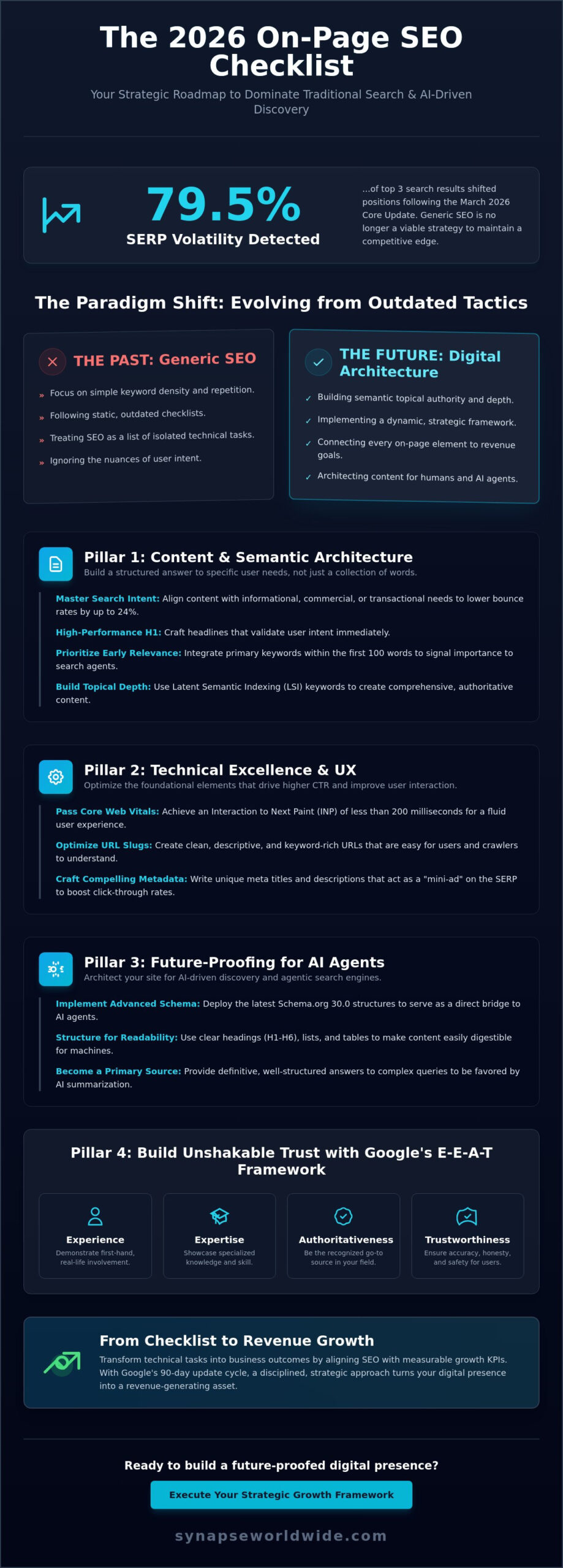
Why are most Australian tech firms still treating organic growth like a bolted-on marketing tactic when it should be the functional architecture of their product-led strategy? You’ve likely felt the frustration of explaining complex SaaS features to a generic agency only to receive surface-level content that fails to convert enterprise decision-makers. With PPC costs reaching unsustainable levels and the Google May 2026 Core Update prioritising deep, first-hand expertise, the traditional playbook for seo for tech companies australia is officially obsolete.
You need a strategy that understands long sales cycles require a sophisticated approach to topical authority rather than a simple “click-to-buy” mentality. This framework promises to help you master the architectural SEO strategies required to dominate the Australian market and capture high-intent enterprise leads. We’ll explore how to align your technical authority with Google’s latest AI-driven search algorithms, leverage Generative Engine Optimisation (GEO), and navigate the 2026 Privacy Act reforms to build a dominant, sustainable market position.
Key Takeaways
- Learn how to transition from chasing high-volume keywords to capturing high-intent, zero-volume queries that drive enterprise-level conversions.
- Discover why technical SEO must be treated as a core piece of your digital infrastructure to manage crawl budgets efficiently across complex SaaS platforms.
- Understand the shift toward product-led content that transforms technical documentation and high-value assets into primary drivers of organic authority.
- Master the metrics that matter by aligning your strategy for seo for tech companies australia with high-level business outcomes like Customer Acquisition Cost and Lifetime Value.
- Identify why a custom architectural approach to growth outperforms standardized agency retainers in the increasingly complex Australian technology sector.
The 2026 Landscape of SEO for Tech Companies in Australia
The Australian tech market in 2026 has moved beyond the era of simple keyword rankings. For local SaaS and FinTech innovators, seo for tech companies australia is now a rigorous discipline that merges technical authority with product-led content. You aren’t just competing with local rivals; you’re often up against global giants with massive backlink profiles and established market share. To win, your digital strategy requires the precision of a visionary architect who can map complex product features to the specific pain points of an enterprise buyer. This isn’t about being seen; it’s about being recognized as the definitive solution.
One of the most significant shifts we’re seeing is the transition from high-volume vanity keywords to zero-volume, high-intent queries. These are the highly specific, technical questions that decision-makers ask when they’re deep in the evaluation phase. While a generic agency might chase broad terms with 10,000 monthly searches, an authoritative framework focuses on the queries that indicate a direct readiness to integrate or purchase. This targeted approach ensures that your organic traffic consists of qualified leads rather than casual browsers.
The Long-Cycle Tech Buyer Journey
Enterprise tech procurement isn’t an impulse buy. It’s a deliberate 6 to 18 month process involving a committee of stakeholders, from the technical architect vetting your API to the CFO scrutinising the ROI. Your organic presence must support every stage of this journey. This means providing high-level thought leadership for the awareness phase and granular, technical documentation for the validation phase. When your content answers the specific security and compliance questions of a procurement officer, you’re using SEO to shorten the sales cycle and build trust before the first sales call.
Topical Authority vs. Keyword Density
In 2026, search engines have evolved to prioritise genuine expertise over simple keyword matching. Following foundational search engine optimization (SEO) principles is no longer enough; you must build a semantic web of content. This involves creating a comprehensive ecosystem where every technical whitepaper, case study, and product update reinforces your niche dominance. By treating your documentation as a searchable asset, you signal to both AI-driven agents and human researchers that your platform is the definitive solution in its category. Expertise is your most valuable currency in a competitive digital economy.
Technical SEO Architecture: The Foundation of Digital Infrastructure
Technical excellence isn’t just about passing a standard audit; it’s about building a scalable engine for organic growth. For firms investing in custom software development, SEO must be baked into the source code from day one. According to Technology and innovation statistics, the rapid evolution of the Australian tech sector demands infrastructure that doesn’t just function but actively facilitates search discovery. When you’re managing complex SaaS platforms or extensive technical documentation, standard SEO plugins won’t suffice. You need a custom-engineered solution that handles dynamic content without draining your crawl budget.
Modern search engines are increasingly selective about where they spend their crawling resources. Large-scale tech sites often suffer from “crawl bloat” caused by infinite facets or poorly managed documentation versions. Implementing a headless CMS architecture allows you to decouple your front-end delivery from back-end data, providing the speed and flexibility needed for superior seo for tech companies australia. This separation ensures that search bots encounter clean, pre-rendered HTML, which is vital for indexing complex JavaScript-heavy applications. It’s the difference between a site that is merely “indexed” and one that is fully understood by search algorithms.
Core Web Vitals have transitioned from a ranking factor to a non-negotiable prerequisite for enterprise visibility. Google’s May 2026 update places even greater emphasis on stable, responsive layouts that don’t shift during loading. For a tech company, a sluggish interface signals a lack of technical competence to both users and algorithms. Ensuring your platform meets these benchmarks is essential for maintaining trust in a high-stakes B2B environment.
Scalable Site Architecture for Tech Platforms
Managing deep site hierarchies is a common challenge as product lines expand. You must ensure that link equity flows from your high-authority homepage down to granular feature pages without getting lost in “click depth.” For Australian firms eyeing global markets, international SEO requires a deliberate strategy that respects local user intent while maintaining unified domain authority. Your URL structures should be logical and descriptive, mirroring the user’s journey through your product categories. If you’re ready to build a platform that scales, a bespoke digital growth strategy can align your architecture with your commercial goals.
Security and Performance as Search Signals
Server stability and uptime are direct reflections of your brand’s reliability. Custom-built infrastructures consistently outperform off-the-shelf templates because they eliminate the code bloat that hampers performance and creates security vulnerabilities. In 2026, every millisecond shaved off your load time correlates directly to a measurable increase in enterprise lead generation. High-performing, secure sites aren’t just a technical preference; they are a fundamental search signal that tells Google your platform is safe for enterprise-level traffic.
Product-Led Content: Capturing High-Intent Enterprise Leads
In 2026, the era of “blogging for traffic” is officially over. For sophisticated tech brands, content is no longer a peripheral marketing activity; it’s a core product asset that must demonstrate immediate value to a technical audience. Effective seo for tech companies australia requires a shift from vanity metrics toward high-value technical assets that serve as functional tools for the buyer. Whether it’s an interactive calculator, a detailed API integration guide, or a proprietary industry benchmark report, your content must solve a specific problem before the prospect even signs up for a demo.
This approach aligns with the foundational principles found in the SEO for small business growth framework, which emphasises niche relevance and rapid iteration. However, at the enterprise level, the stakes are higher. The Google May 2026 Core Update has intensified the focus on E-E-A-T, meaning that content authored by “marketing generalists” is being systematically devalued. To rank in 2026, your content must be authored or verified by subject matter experts who possess genuine, first-hand experience in your specific technology vertical.
Mapping Content to Technical Intent
Enterprise buyers move through distinct phases of technical intent. A “problem-aware” searcher might look for ways to solve a latency issue, while a “solution-aware” searcher is actively comparing your platform against a direct rival. You must create dedicated comparison pages and “alternative to” guides that provide objective, data-driven analysis. When these assets are integrated with your CRM, you can track how organic search interactions influence the eventual deal size. This visibility allows you to treat SEO as a predictable lead-generation engine rather than a black box of traffic.
Establishing Industry Thought Leadership
True authority comes from owning the data that your industry relies on. By publishing annual state-of-the-market reports or technical case studies with verified ROI proofs, you create link-worthy assets that global publications will cite. This doesn’t just build backlinks; it builds a reputation for stability and high-level planning. In a crowded market, tech companies must lead the conversation in their niche to ensure they aren’t just participants in the search landscape, but the ones defining its direction. This visionary approach ensures your brand remains the default choice for high-intent enterprise leads.
ROI and Attribution: Measuring SEO Success in Tech
Vanity metrics like total traffic or generic keyword rankings often provide a false sense of security for Australian tech leaders. In the competitive landscape of seo for tech companies australia, the only metrics that truly matter are those that correlate directly with revenue growth and business stability. You shouldn’t be satisfied with a spike in sessions if your Customer Acquisition Cost (CAC) remains stagnant or your lead quality drops. High-level strategic growth requires a deep dive into the Lifetime Value (LTV) of customers sourced through organic channels, ensuring that every dollar spent on search visibility delivers a compounding return.
True success is found in the data that generic agencies often ignore. By prioritising CRM integration, you can bridge the gap between an anonymous search click and a closed enterprise contract. This full-funnel visibility is essential for understanding the multi-touch attribution typical of long B2B sales cycles. It’s about seeing how an initial technical search leads to a whitepaper download, a demo request, and eventually a multi-year partnership. This connectivity allows you to treat your digital presence as a predictable investment rather than a speculative expense.
Attributing Organic Search to Revenue
Tracking the path from a first-touch organic visit to a final enterprise contract is a complex but necessary task. You need to set up custom conversion events that reflect the specific actions of a technical buyer, such as API documentation downloads or sandbox environment sign-ups. These micro-conversions are leading indicators of intent that simple “contact us” forms often fail to capture. When you measure these interactions accurately, you gain a clearer picture of how SEO contributes to shortening the sales cycle and reducing the burden on your outbound sales team.
Integrating SEO with ERP and CRM Systems
Data-driven SEO does more than just drive traffic; it informs your entire product development and sales strategy. When you integrate search intent data with your ERP and CRM systems, you can predict market trends and customer needs with surgical precision. This unified approach allows you to create a dashboard where marketing and business operations are perfectly aligned. If you’re ready to move beyond surface-level reporting, you can optimise your organic attribution with a partner who understands the technical nuances of the tech sector. This level of insight ensures that your digital presence remains a foundational pillar of your business growth.
The Synapse Approach: Custom SEO Architecture for Tech Leaders
Generic SEO retainers are designed for volume, not complexity. For an Australian SaaS founder or a FinTech lead, a “one-size-fits-all” package is a recipe for mediocrity. These standardized models often fail to account for the intricate technical requirements and long-cycle buyer journeys that define the technology sector. At Synapse, we position ourselves as the visionary architect of your digital growth rather than just another service provider. We understand that seo for tech companies australia requires a deep alignment between your product’s code, your commercial goals, and your search visibility.
Our methodology bridges the critical gap between high-performance web design and search engine dominance. We don’t view your website as a static brochure; we treat it as a dynamic engine for lead generation. This means ensuring that every design choice, from your site’s navigation to its mobile responsiveness, supports your broader organic strategy. By treating search performance as a foundational element of your digital infrastructure, we build a presence that is both resilient against algorithm updates and optimized for enterprise-level conversions.
Bespoke Strategies for National Dominance
Success in the Australian market requires more than just following global trends. We customize every campaign to the specific technical stack of our clients, whether you’re running a headless CMS, a React-based application, or a complex legacy system. This advantage comes from our dual understanding of code and commerce. We speak the language of your developers and your stakeholders, ensuring that technical SEO recommendations are both feasible and commercially impactful. In a global tech market, having local Australian expertise ensures your strategy respects domestic regulatory nuances while maintaining the competitive edge required to challenge international incumbents.
Transforming Digital Presence into a Strategic Asset
Most agencies focus on maintenance; we focus on transformation. We move beyond the routine of monthly reporting to turn your digital assets into a strategic engine for sustainable growth. This often begins with fixed-price projects designed to overhaul your foundational SEO infrastructure, ensuring your platform is ready to scale without technical debt. Our commitment is to long-term partnerships built on transparency and a relentless focus on your return on investment. If you’re ready to stop chasing vanity metrics and start building a dominant market position, your next step is to design a custom growth roadmap that aligns with your 2026 business objectives.
Architecting Your Digital Dominance in 2026
Transitioning from basic search visibility to a sophisticated lead-generation engine requires a fundamental shift in perspective. You’ve seen how integrating technical SEO with product-led content creates a foundation that scales with your ambition. By prioritising deep attribution through CRM and ERP systems, you move from speculative spending to predictable, high-value growth. This framework isn’t just about traffic; it’s about building a resilient infrastructure that converts technical intent into enterprise revenue.
Success in seo for tech companies australia isn’t found in a generic checklist; it’s found in a customized strategy that reflects your product’s unique complexity. Since 2005, Synapse has focused on delivering these bespoke digital solutions. We specialise in the CRM and ERP integrations required to unify your marketing efforts and have a proven track record of scaling Australian tech enterprises nationally. We don’t just provide a service; we act as the visionary architects of your digital transformation.
Your digital presence should be your most powerful strategic asset. It’s time to move beyond maintenance and start building for the next level of business success. Partner with the architects of tech growth, Get your custom SEO strategy. Let’s build a partnership that turns your technical expertise into market leadership.
Frequently Asked Questions
Why is SEO different for tech companies compared to other industries?
SEO for tech differs because it must account for highly specialized audiences and non-linear buyer journeys. Unlike retail, tech buyers often require deep technical validation before making a decision. This means your seo for tech companies australia strategy must prioritise topical authority and technical documentation over simple transactional keywords. It’s about building trust with both the end-user and the technical gatekeeper through every stage of search.
How long does it take to see ROI from SEO in the Australian tech market?
You can expect to see early indicators of success within three to six months, though full ROI typically aligns with your 6 to 18 month enterprise sales cycle. Organic growth is a compounding asset that builds momentum over time. While initial results show in improved rankings for high-intent queries, the commercial impact becomes most visible as your organic channel begins to lower your overall customer acquisition costs.
Does my tech company need a technical SEO audit if we have an in-house dev team?
An external technical SEO audit is essential because search architecture requires a different lens than product development. While your in-house developers excel at building functional features, an SEO architect focuses on crawl efficiency, semantic structure, and search signal optimisation. This partnership ensures that your platform is not only built well but is also fully discoverable by complex search algorithms that prioritise infrastructure stability.
What are the most important SEO metrics for a SaaS company in 2026?
The most critical metrics in 2026 are Customer Acquisition Cost (CAC), Lifetime Value (LTV), and organic lead quality. You should move beyond vanity metrics like total impressions to track micro-conversions such as API documentation downloads or sandbox environment sign-ups. These actions provide a much clearer indication of enterprise intent and the direct revenue contribution of your organic search strategy compared to broad traffic numbers.
How does SEO integrate with product-led growth (PLG) strategies?
SEO integrates with product-led growth by transforming your product’s documentation and technical assets into searchable entry points. When you optimise your help centres and feature pages, you capture users who are looking for specific solutions to technical problems. This approach allows your product to lead the sales process, using search visibility to drive self-serve discovery and trial adoption before a sales representative ever engages.
Can SEO help reduce our Customer Acquisition Cost (CAC)?
SEO is one of the most effective ways to reduce your CAC by providing a sustainable alternative to rising PPC costs. Once your organic infrastructure is established, the cost per lead typically decreases as your authority grows. By capturing high-intent enterprise leads through organic search, you build a compounding lead-generation engine that doesn’t require a linear increase in ad spend to scale your national presence.
What is the role of backlinks for tech companies in 2026?
In 2026, the role of backlinks has shifted toward high-quality technical citations and industry authority rather than sheer volume. A single link from a reputable tech publication or a government innovation portal carries more weight than dozens of generic directories. Your focus should be on earning links through proprietary data, technical whitepapers, and deep industry reports that demonstrate your niche dominance and reliability.
How do you handle SEO for companies with highly technical or niche products?
We handle niche products by creating a semantic web of content that maps directly to specific technical intent. This involves collaborating with your subject matter experts to produce content that answers the granular questions of an enterprise architect or CTO. By focusing on zero-volume, high-intent queries, we ensure your brand is present when your most valuable prospects are searching for a highly specialised solution.