
Tag Archives: Google Core Update


SEO Myths 2026: Debunking Outdated Strategies in the Age of AI Search

SEO Myths 2026: Debunking Outdated Strategies in the Age of AI Search

Did you know that a top-ranking organic position now yields a 58% lower click-through rate than it did just eight months ago? Many business leaders are experiencing a sharp decline in organic traffic despite maintaining a high content output. It’s a common frustration to watch your visibility shrink while legacy providers rely on 2022 tactics that no longer move the needle. Many of the “best practices” still being sold today are actually seo myths 2026 that are actively sabotaging your growth and wasting your digital budget.

We understand the confusion surrounding AI Overviews and the March 2026 Core Update. You need a strategy that prioritizes business outcomes over vanity metrics. This article identifies the legacy tactics you must abandon and introduces the high-performance strategies that drive measurable revenue in the current search environment. We’ll provide a clear roadmap for visibility, validate the metrics that truly impact your ROI, and help you regain strategic confidence in your digital investment through a sophisticated, data-driven approach.

Key Takeaways

  • Understand how search has evolved into a hybrid of traditional indexing and generative AI citations that require a new approach to brand authority.
  • Learn why “Information Gain” is the new standard for content, replacing the outdated focus on sheer volume and repetitive AI-generated text.
  • Discover how to dismantle the seo myths 2026 that are currently draining your marketing budget and stalling your organic growth.
  • Master the technical requirements of Core Web Vitals 4.0 to ensure your site remains the stable, high-performance foundation your brand needs.
  • Transition from reactive tactics to a proactive architecture that aligns your digital presence with the way AI engines actually discover and cite information.

The Evolution of Search: Why 2026 SEO Myths are More Dangerous Than Ever

Search has fundamentally transformed into a sophisticated hybrid system. It no longer relies solely on traditional indexing; instead, it prioritizes generative AI citations and verified domain authority. The March 2026 Core Update solidified this shift by rewarding “information gain” and penalizing sites that merely recycle existing web data. If you’re still following “best practices” from 2024, you’re likely triggering quality penalties that suppress your visibility. Relying on outdated seo myths 2026 can lead to a total decoupling of your content from the results page, making your brand invisible to your target audience.

The primary ranking factor has shifted from keyword density to Information Gain. This means your content must provide unique data, fresh perspectives, or proprietary insights that don’t already exist in the AI’s training set. We recognize the frustration of seeing organic traffic decline despite your team’s hard work. Data from May 2026 shows that AI Overviews have caused a 58% reduction in click-through rates for top-ranking results. This isn’t a failure of effort. It’s a failure of legacy strategy. To succeed, you must architect content that an AI engine views as essential for its own accuracy.

From Keywords to Concepts: The End of String Matching

Modern Large Language Models have moved beyond simple string matching. They understand the underlying intent and the conceptual relationships between topics. Success now requires a transition from traditional keyword lists to a robust “Topic Architecture.” This approach ensures your domain is viewed as a coherent authority on a subject. For those establishing a new presence, our guide on keyword research for beginners provides the strategic foundation needed to build this architecture. At its core, Search engine optimization (SEO) is now about proving to an algorithm that your brand owns a specific concept through deep, expert-led content rather than just matching phrases.

The Rise of Zero-Click Search and AI Overviews

Zero-click searches are the new reality. AI Overviews now appear for 95% of comparison-based queries and 86% of question-based queries. While this reduces traffic for general informational searches, it creates a massive opportunity for commercial intent. Being cited as a source within an AI Overview is the new “Position Zero.” It provides the validation and trust necessary to drive high-value clicks from users who are ready to engage. If your current agency is still obsessing over total traffic numbers without accounting for these shifts, they’re likely chasing seo myths 2026 that won’t lead to revenue. You must pivot your focus to becoming the definitive source that AI engines are forced to cite to remain accurate and helpful.

Myth #1: AI Search Engines Have Made Organic SEO Obsolete

The proclamation that SEO is dead has become a predictable industry tradition, yet it remains one of the most pervasive seo myths 2026. While the layout of the search engine results page has changed, the underlying need for high-quality, indexed information has never been greater. In 2026, AI engines don’t replace the web. They rely on it. Without a constant stream of fresh, expert-led data from independent websites, Large Language Models (LLMs) quickly become outdated and unreliable. High-intent buyers still demand the depth and security that only an authoritative, long-form website can provide.

Search engine layouts now feature prominent AI Overviews, but these summaries are not the end of the journey for commercial users. While a user might accept a quick AI answer for a basic informational query, they won’t rely on a summary when choosing an enterprise ERP solution or a custom web design partner. They want to see the portfolio, read the case studies, and verify the expertise. This is where strategic Search Engine Optimization bridges the gap between initial curiosity and a final transaction. In this environment, your visibility is tied to how effectively you can prove your credibility to both human readers and algorithmic crawlers.

The Symbiosis of AI and SEO

Modern search utilizes Retrieval-Augmented Generation (RAG) to ensure accuracy. This means the search engine’s AI retrieves specific data from your website to augment its generated response. Your site serves as the external knowledge base for the AI. To facilitate this, your technical foundation must be flawless. Adhering to a comprehensive on-page seo checklist ensures that AI crawlers can parse your information without friction. If the AI can’t read your site, it won’t cite your site. This relationship creates a new form of interdependence where the search engine needs your data as much as you need its traffic.

Optimizing for Visibility in Generative Answers

Visibility in 2026 requires a shift toward structured data and explicit relationship mapping. By using Schema.org markup, you provide the context that AI needs to understand your claims as facts. This shift requires a deep understanding of the new rules for keyword optimization, where the focus moves from single phrases to complex, question-based clusters. Generative Engine Optimization (GEO) represents the 2026 evolution of SEO, focusing on optimizing content to be the primary citation source for AI-generated responses. Brands that embrace this architecture gain a significant competitive advantage over those still chasing legacy seo myths 2026.

SEO Myths 2026: Debunking Outdated Strategies in the Age of AI Search

Myth #2: Scaling Content Volume with AI is the Key to Dominance

The “Content Arms Race” has reached a tipping point where sheer volume is no longer a competitive advantage. In fact, flooding your domain with thousands of AI-generated pages often leads to a site-wide suppression of organic traffic. Search algorithms have evolved to detect “synthetic echo chambers” where content merely paraphrases existing web data. This is one of the most dangerous seo myths 2026 because it encourages businesses to invest in quantity over substance, ultimately triggering search quality penalties that are difficult to recover from. High-performance brands recognize that a single, deeply researched asset is worth more than a hundred generic AI-generated posts.

Google’s 2026 “Helpful Content” evolution prioritizes what is known as “Information Gain.” This metric evaluates whether a piece of content adds genuinely new knowledge to the digital ecosystem. If your article provides the same information as the top ten results, it offers zero value to a user or an AI engine. Understanding how AI is changing search reveals that search engines now function as answer engines that reward unique perspectives and proprietary data. Sounding like everyone else is a ranking death sentence in an era where AI can replicate generic voices in seconds.

The Information Gain Score: The New Gold Standard

Re-hashing existing articles results in “Hidden” or de-indexed content because it fails the uniqueness test. To maintain visibility, you must inject proprietary data, first-party case studies, and expert opinions into every asset you publish. This level of depth is central to a high-performance content marketing seo strategy. By focusing on data that doesn’t exist in a Large Language Model’s training set, you ensure your brand remains an essential citation source for generative search results. We help our clients move beyond the noise by architecting content that serves as the definitive authority in their niche.

EEAT in 2026: Experience, Expertise, Authoritativeness, and Trust

The “Experience” component of the EEAT framework is the only element AI cannot fake. It represents first-hand, lived experience that provides a human touch to technical information. You can prove this human authorship by integrating video embeds of your team, detailed author bios, and real-world testing results directly into your content architecture. Search engines increasingly look for signals of “physical world” interaction. Trust is built when users see that your insights come from practical execution rather than just algorithmic synthesis. This commitment to authenticity is what separates market leaders from those still chasing outdated seo myths 2026.

The phrase “Content is King” has become one of the most misleading seo myths 2026. While high-quality information is essential, it cannot perform on a foundation that is structurally unsound. A slow, broken, or poorly architected site will never rank, regardless of how insightful the writing is. In 2026, Google’s Core Web Vitals 4.0 have shifted the focus toward Interaction to Next Paint (INP) and visual stability. These metrics aren’t just technical checkboxes. They are direct indicators of user satisfaction and conversion potential. If your site stutters or delays, users leave, and your search visibility vanishes with them.

Site architecture also dictates how an AI engine perceives your brand as an “Entity.” A logical, streamlined structure allows crawlers to map the relationships between your services and your expertise. This clarity is vital for being cited in generative answers. If your digital infrastructure is cluttered, you’re effectively hiding your value from the very algorithms designed to find it. Success in the current landscape requires a visionary approach where technical precision and creative content work in total alignment.

Infrastructure as SEO: Speed, Security, and UX

Your website’s infrastructure is a primary driver of organic growth. Custom digital solutions consistently outperform rigid, template-based sites because they are built for performance rather than convenience. High bounce rates on slow pages negatively impact your “Trust Score,” a critical internal metric search engines use to gauge reliability. To ensure your technical efforts translate into revenue, it’s vital to monitor the right seo kpis for small business. This strategic oversight allows you to identify bottlenecks before they impact your bottom line. Investing in Custom Web Design ensures your brand sits on a high-performance foundation that is optimized for both humans and AI.

The Death of the Low-Quality Backlink

The era of mass-produced guest posts and link farms is over. AI-driven spam filters now identify and ignore approximately 90% of traditional “guest post” style links. In 2026, the focus has shifted from link quantity to Niche Authority and Digital PR. A single mention from a respected publication within your specific ecosystem carries more weight than a thousand irrelevant backlinks. The strongest signal of authority today is branded search volume. When users actively type your name into a search bar, it tells engines that you are a trusted entity. This organic brand recognition is the ultimate validation of your digital presence and the most effective way to dismantle the seo myths 2026 that prioritize vanity metrics over real-world influence.

Transitioning from debunking seo myths 2026 to implementing a proactive growth framework requires a fundamental shift in perspective. You cannot simply patch a few technical errors and expect a transformation in your organic performance. True search visibility in the age of AI is built on a foundation of custom digital infrastructure integrated with high-level strategy. We call this the “Visionary Architect” approach. It treats content, infrastructure, and strategy as a single, cohesive unit rather than a collection of isolated tasks. To achieve a genuine return on investment, your search efforts must be connected to your CRM Integration and ERP Solutions. This connectivity allows you to track a lead from their initial search query directly through to the final transaction in your sales pipeline.

The days of the “one-off” SEO fix are over. Search engines now prioritize stability and consistent authority over short-term hacks. A long-term partnership with a strategic consultant ensures that your digital presence evolves alongside the algorithms. By aligning your search strategy with your broader business goals, you move away from vanity metrics and toward measurable revenue growth. This holistic view is what separates market leaders from those who are still struggling with declining traffic and outdated tactics.

The Synapse Strategic Framework

Our strategic framework combines Custom Web Design with a deep search architecture designed specifically for the current landscape. We don’t just focus on driving traffic; we identify the “Conversion Leaks” that often cause high-quality visitors to drop off before they reach your sales team. Through rigorous technical consulting, we ensure that your site structure supports a seamless user journey. This comprehensive methodology is detailed in our SEO for Small Business Pillar, which serves as the ultimate roadmap for brands looking to establish a dominant digital footprint.

Future-Proofing Your Digital Investment

Digital success is a continuous process of refinement and adaptation. A stable growth model typically begins with a fixed-price development phase to build a high-performance foundation, followed by a monthly retainer for ongoing strategic optimization. This structure ensures your brand remains resilient against the inevitable algorithm shifts of 2026. Regular maintenance and technical updates are essential to prevent technical debt from eroding your rankings. When you’re ready to move beyond the noise of seo myths 2026 and invest in a strategy that prioritizes your bottom line, partner with Synapse Worldwide for a results-oriented SEO strategy that delivers long-term business transformation.

Mastering the New Era of Digital Authority

The landscape of search has fundamentally shifted toward a hybrid model where brand authority and technical precision are non-negotiable. Success no longer comes from chasing volume or recycling generic data. Instead, it requires architecting unique “Information Gain” and maintaining a flawless digital infrastructure that AI engines can trust and cite. Moving beyond the noise of seo myths 2026 allows you to focus on the high-performance strategies that actually drive revenue and long-term business transformation.

Since 2005, we’ve guided businesses through over two decades of digital evolution. Our expertise in custom high-performance web infrastructure and results-oriented strategic consulting provides the stability your brand needs for national growth. We don’t just provide services; we build long-term partnerships that turn your digital presence into a measurable asset. Your next level of business success is within reach. With the right roadmap and a disciplined execution partner, your brand can thrive in the age of AI search.

Architect your 2026 growth strategy with Synapse Worldwide

Frequently Asked Questions

Is keyword research still necessary in 2026?

Keyword research remains essential but has transitioned into mapping conceptual clusters and topic architecture. You aren’t just targeting phrases; you’re architecting authority over specific subject areas. Modern Large Language Models look for topical coherence rather than simple string matching. This ensures your brand is recognized as an expert entity by both users and AI crawlers.

How does AI search affect my website traffic?

AI search fundamentally changes traffic patterns by answering simple questions directly on the results page. This leads to fewer clicks for top of funnel informational queries. However, it places a premium on high intent commercial traffic. Being a cited source in an AI Overview provides the validation necessary to capture users who are ready to invest.

Can I use AI to write all my SEO content?

Using AI for all your content is one of the most dangerous seo myths 2026. Search engines now prioritize “Information Gain,” which requires unique data and first hand experience that AI cannot replicate. If your content merely recycles existing training data, it won’t provide the value needed to rank or be cited by generative engines.

Are backlinks still important for ranking in 2026?

Backlinks are still vital, but the focus has shifted entirely to niche authority and digital PR. High quality links from within your specific ecosystem serve as proof of trustworthiness. AI driven filters now ignore mass produced guest posts. Branded search volume has become an equally powerful signal of your site’s authority.

What is the most important SEO metric to track now?

The most important metric to track is conversion driven ROI rather than vanity traffic numbers. You should monitor how many leads or sales originate from organic search and your citation frequency in AI Overviews. These numbers reflect the actual business impact of your digital strategy and help you avoid common seo myths 2026 regarding success.

How often should I update my SEO strategy?

Your strategy requires continuous refinement to remain effective. While your core business goals might stay the same, the technical implementation must adapt to monthly algorithm shifts and quarterly performance reviews. This proactive approach ensures your infrastructure remains resilient and your content stays ahead of the competition.

Does website speed affect my AI search visibility?

Website speed is a critical factor for AI search visibility. Core Web Vitals 4.0, specifically Interaction to Next Paint (INP), measures how quickly your site responds to user actions. AI engines prefer to cite and rank sites with stable, high performance infrastructure because they offer a superior user experience.

Is SEO a one-time project or an ongoing service?

SEO is an ongoing service, not a one time project. Maintaining search visibility requires a long term partnership to manage technical debt, update content for accuracy, and respond to new competitive threats. A results oriented strategy involves continuous optimization to ensure your digital investment provides a consistent return.

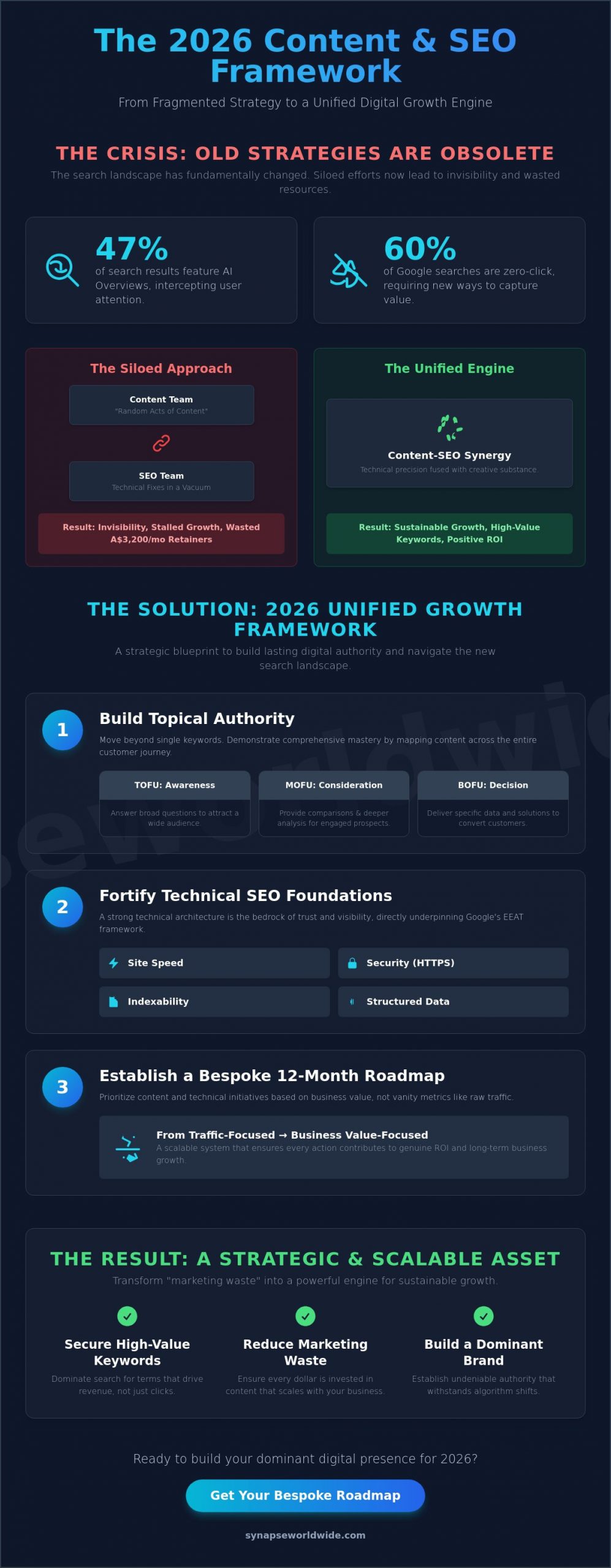
 

The Strategic Integration of Content Marketing and SEO: A 2026 Framework for Growth

The Strategic Integration of Content Marketing and SEO: A 2026 Framework for Growth

With AI Overviews now appearing in 47% of all search results and 60% of Google searches ending without a single click, a fragmented content marketing seo strategy is a recipe for invisibility. You’ve likely felt the frustration of investing in high quality assets that fail to rank, or perhaps you’re watching your organic visibility stall despite a steady publishing schedule. In an Australian market where average agency retainers sit around A$3,200 per month, wasting resources on uncoordinated efforts isn’t just inefficient; it’s a structural barrier to your business transformation.

We promise to provide a clear roadmap to unify your content and technical SEO into a single, high performance digital architecture. This article previews a 2026 framework designed to navigate the March 2026 Core Update, leverage AI powered optimization, and build a trust ecosystem that drives sustainable growth. You’ll discover how to move beyond “random acts of content” to create a scalable system that secures high value keywords and delivers a genuine return on investment. By integrating data driven insights with human expertise, you can ensure your brand remains a dominant force in the evolving digital landscape.

Key Takeaways

  • Understand why siloed marketing departments fail and how to build a unified digital growth engine for the 2026 search environment.
  • Learn to build topical authority by mapping your content marketing seo strategy across the entire customer journey, from awareness to decision.
  • Discover how technical SEO foundations like site speed and security directly underpin the “Trust” element of the 2026 EEAT framework.
  • Establish a bespoke 12-month roadmap that prioritises content based on its actual business value rather than just raw traffic numbers.
  • Reduce marketing waste by treating content as a strategic asset that scales seamlessly with your business growth.

The Convergence of Content Marketing and SEO Strategy in 2026

The landscape of digital growth has shifted. In 2026, a successful content marketing seo strategy is no longer a collection of separate tactics; it’s a unified digital growth engine. For years, businesses treated content and SEO as distinct departments. Writers focused on engagement while technical teams focused on metadata. This fragmented approach fails in the current search environment because Google’s March 2026 Core Update now evaluates holistic performance. If your technical architecture doesn’t support your narrative, or your content doesn’t satisfy technical quality signals, your visibility will suffer.

Traditional “siloed” marketing departments struggle because they lack a cohesive vision. When content teams work in isolation, they often produce assets that search engines can’t index properly or that don’t align with high-value search intent. This leads to a disconnect where high-quality writing fails to reach its intended audience. A unified content marketing seo strategy eliminates this friction, transforming content from a simple expense into a robust strategic asset. This shift from keyword-centric tactics to intent-based strategic planning ensures your brand answers the questions your customers are actually asking. Content-SEO Synergy is the structural fusion of technical precision and creative substance that establishes undeniable digital authority.

The Evolution of Search: Why Content is SEO

Search engines have evolved to prioritise user satisfaction over simple keyword matches. With AI Overviews appearing in 47% of all results, the focus has moved to semantic search. This technology connects disparate content pieces to understand the broader context of a brand’s expertise, meaning your site must demonstrate deep knowledge across entire topics rather than just individual terms. For Australian companies, investing in seo for small business remains a critical long-term play to capture this organic demand. Since organic search accounts for 53.3% of all web traffic, your content must satisfy the specific intent behind every query to remain competitive in a zero-click world.

Moving Beyond “Random Acts of Content”

Many brands still fall into the trap of “random acts of content.” They publish high volumes of blog posts without a technical SEO blueprint, leading to wasted resources and diluted authority. In 2026, volume-based posting is ineffective. Success requires authority-based strategic distribution. Instead of generic articles, you need a bespoke digital architecture tailored to your specific business goals. This ensures every piece of content serves a purpose within a larger, scalable system. With average agency retainers in Australia ranging from A$1,500 to A$5,000 for small businesses, precision is the only way to ensure a positive return on investment. By designing your content with a technical foundation from the outset, you create a robust presence that can withstand frequent algorithm shifts.

Building Topical Authority: Beyond Keyword Stuffing

Topical authority has replaced simple keyword density as the primary driver of organic success. In the 2026 search environment, Google rewards websites that demonstrate comprehensive mastery of a subject. A robust content marketing seo strategy requires you to move beyond individual pages and instead build a network of interconnected knowledge. This involves mapping your content across the entire customer journey. At the Top of Funnel (TOFU), you answer broad questions. At the Middle of Funnel (MOFU), you provide comparisons and deeper analysis. Finally, at the Bottom of Funnel (BOFU), you deliver the specific data needed to close a sale. For those just launching a digital presence, mastering keyword research for beginners is the first step in identifying the high-intent queries that actually drive revenue in the Australian market.

Internal linking serves as the connective tissue of this authority. By strategically linking related articles, you signal to search engines which pages are your primary pillars of expertise. This structure doesn’t just help bots; it guides users through a logical progression of information. If you’re looking to refine your digital architecture, a bespoke SEO audit can reveal the gaps in your current linking strategy. When your internal links are purposeful, you pass authority from high-performing pages to new content, accelerating the ranking process for your entire site.

Creating Content Hubs and Spoke Models

The “Hub and Spoke” model is a proven framework for scaling authority. A central pillar page provides a high-level overview of a broad topic, while multiple spoke articles dive deep into specific long-tail nuances. Technically, these hub pages must be optimized to pass link equity efficiently across the entire cluster. This approach significantly improves user dwell time. When a visitor finds all the answers they need in one ecosystem, they stay longer and bounce less. This signals to Google that your site is the definitive source for that niche, directly impacting your visibility for high-value keywords.

Optimising for AI Search and SGE

With AI Overviews now appearing in 47% of all search results, your content must be structured for machine readability and human authority. Search Generative Experiences (SGE) favour “snippet-ready” definitions and clear, authoritative claims that can be easily parsed. To survive in an era where AI-generated content is abundant, you must provide original insights and first-hand experience. Generic summaries are easily replaced by AI. Bespoke data, unique case studies, and expert opinions are the only way to ensure your brand remains a cited source in AI-generated answers. Before investing further in content production, it’s worth understanding the seo myths 2026 that are still being sold as best practices, as many legacy tactics actively undermine your ability to secure these prominent AI placements. Structure your content with clear headings and concise answers to capture these prominent placements.

The Strategic Integration of Content Marketing and SEO: A 2026 Framework for Growth

The EEAT Framework: Why Authority is the New Currency

In the wake of the March 2026 Core Update, search engines have become significantly more sophisticated in identifying the human element behind the screen. Experience, Expertise, Authoritativeness, and Trustworthiness (EEAT) are no longer just guidelines; they’re the primary filters Google uses to separate high-value insights from the noise of scaled AI content. A sophisticated content marketing seo strategy must account for these signals across every touchpoint. Experience requires proof of first-hand usage. Expertise demands credentials. Authoritativeness comes from third-party validation. Trustworthiness is the foundation that holds the entire structure together. EEAT is not a checklist but a holistic brand signal.

Google now tracks author entities through complex digital footprints. This means the reputation of your individual contributors matters as much as the domain itself. Search engines look for consistent expertise across professional platforms, social proof, and citations from other authoritative sources. When your content is backed by a verifiable expert with a robust history in the industry, your visibility increases. This convergence of personal branding and technical SEO creates a resilient presence that’s difficult for competitors to replicate through automated means alone.

Demonstrating First-Hand Experience

Proving you’ve actually done the work is the most effective way to satisfy the Experience requirement. Use proprietary data and detailed case studies to show real-world applications of your services. For example, our internal data from early 2026 shows that websites using original, first-party imagery see a 30% higher engagement rate than those relying on stock photography. Original video content and links to a professional portfolio further validate your claims. These assets provide the authentic proof that search engines need to rank your content above generic summaries.

The Technical Side of Trust

Trust is fragile. A single security breach or a sluggish interface can dismantle years of authority-building in seconds. Technical SEO directly underpins the “Trust” element of EEAT through Core Web Vitals, specifically the holistic performance scores introduced in 2026. High-performance hosting and secure HTTPS protocols are baseline requirements for any serious growth strategy. When measuring success, your seo kpis for small business should include trust-based metrics like security uptime and interaction speed. If your site feels unstable, users won’t trust your content, and neither will Google. Ensuring a seamless, robust technical foundation is the only way to safeguard your brand’s digital reputation.

Designing a Data-Driven Content Roadmap for Growth

A high-performance content marketing seo strategy requires more than a simple editorial calendar; it demands a 12-month architectural roadmap. While many agencies rely on static search volume, a strategic approach prioritises topics based on their proximity to revenue. This process begins with a comprehensive competitive gap analysis to identify organic opportunities where your competitors are underperforming. By targeting these specific weaknesses, you can secure high-value visibility faster than through broad keyword targeting. Your roadmap must be a scalable system that evolves alongside your business objectives, ensuring that every asset published contributes to long-term digital stability.

Effective planning involves categorising content into tiers based on business value. High-intent topics that solve specific customer problems take precedence over viral, low-conversion trends. This disciplined focus ensures that your marketing budget is allocated toward activities with the highest potential return on investment. In the Australian market, where 61% of B2B marketers report that organic traffic generates more leads than any other channel, a data-driven roadmap is the difference between a growing brand and a stagnant one. We treat your digital presence as a dynamic asset that requires constant refinement based on real-time performance audits.

Integrating CRM and ERP Insights

Your internal data is the most significant competitive advantage you possess. By integrating CRM insights, you can transform common customer pain points into targeted content that addresses the exact barriers to purchase. Similarly, ERP data allows you to identify which products or services offer the highest profit margins. This allows us to focus your organic visibility efforts where they will have the greatest impact on your bottom line. Bespoke marketing automation then tracks these assets from the initial click to the final conversion, providing a clear picture of how your content drives growth. If you’re ready to align your data with your digital presence, book a strategic content consultation to begin building your roadmap.

Measuring What Matters

Success in 2026 is defined by ROI, not vanity metrics like raw page views. We move beyond surface-level data to focus on multi-touch attribution, which recognises the role each content piece plays in the customer journey. A user might discover your brand through a TOFU guide but only convert after reading a technical case study three weeks later. Understanding this path is essential for adjusting your roadmap. Regular performance audits ensure that your strategy remains agile. If a particular topic cluster isn’t delivering the expected lead volume, we pivot resources toward higher-performing categories, ensuring your digital architecture remains robust and results-oriented.

Seamless Integration: Transforming Content into a Strategic Asset

Achieving a seamless integration between technical performance and creative substance transforms your content marketing seo strategy from a series of tasks into a powerful business asset. This unified approach eliminates the waste associated with disconnected marketing efforts. Instead of producing content that fails to rank or technical optimisations that lack a narrative, you build a singular, scalable growth engine. We act as the Digital Architect in this process, ensuring that every element of your digital presence is designed to support a specific business outcome. By treating your website as a high-performance digital architecture, you ensure that every Australian Dollar invested contributes to a robust foundation for future expansion.

Unlike paid advertising, which stops the moment you cease spending, an integrated digital presence offers compounding value that grows over time. Research indicates that organic search accounts for 53.3% of all website traffic, and SEO-driven leads have an average close rate of 14.6%. This is a stark contrast to the 3% close rate typical of paid social media ads. Over a 12 to 18-month period, this infrastructure becomes a self-sustaining source of high-quality leads. It’s not just about visibility; it’s about creating a revenue-driving infrastructure that remains stable even as Google rolls out core updates roughly every three months.

The Role of Bespoke Digital Solutions

Cookie-cutter SEO packages often ignore the unique competitive landscape of your industry and the specific needs of Australian consumers. A bespoke content marketing seo strategy ensures that your technical foundations and creative assets work in perfect harmony. By integrating ERP solutions or CRM systems directly into your digital architecture, you can automate the process of turning organic traffic into actionable business data. This level of technical sophistication ensures that your content isn’t just being read; it’s being used to drive revenue and improve operational efficiency. Strategic integration means your site’s performance is qualified by its ability to generate ROI, not just its appearance. Following a comprehensive on-page seo checklist ensures that every page within your bespoke architecture meets the precise technical and content standards required to compete in the 2026 search environment.

Taking the Next Step Toward Digital Transformation

Reaching the next level of business success requires a shift from tactical fixes to a comprehensive digital strategy. In a competitive national market like Australia, professional execution is the only way to ensure your brand stands out among sophisticated competitors. We provide a clear pathway for businesses ready to move beyond basic visibility toward true digital transformation. This involves a commitment to a robust, revenue-driving infrastructure that is built to last. Your digital presence is in expert hands when you choose a partner that values precision as much as vision. It’s time to stop reacting to the digital landscape and start architecting your own growth.

Mastering Your Digital Architecture for Sustainable Growth

Success in the 2026 search environment depends on your ability to fuse technical precision with strategic substance. As we’ve explored, a fragmented approach no longer secures a place in AI-driven search results. By prioritising topical authority and aligning your content marketing seo strategy with real-world business data, you create a resilient presence that compounds in value over time. This framework isn’t just about ranking; it’s about building a robust, revenue-driving infrastructure that withstands algorithm shifts and market volatility.

Synapse Worldwide has served as a specialist in high-performance bespoke digital infrastructure since 2005. Our team brings a proven track record in national organic growth to every partnership, ensuring your brand reaches its full potential. Partner with the Digital Architects at Synapse Worldwide to build your bespoke growth strategy. The future of your digital presence starts with a commitment to transformation and professional execution. You have the tools to dominate your landscape; it’s time to build something extraordinary.

Frequently Asked Questions

How long does a content marketing SEO strategy take to show results?

It typically takes 6 to 12 months to see measurable traffic gains from a unified strategy, with full ROI realized within 12 to 18 months. This timeline allows search engines to validate your topical authority and index your content clusters. Unlike the temporary spikes of paid ads, these returns compound over time to create a sustainable lead generation engine.

Can I use AI to write all my SEO content in 2026?

No, relying solely on AI is a significant risk because the March 2026 Core Update specifically targets scaled AI-generated content. While AI is projected to automate 80% of SEO tasks, it cannot replicate the first-hand experience and original insights required by the EEAT framework. Successful brands use AI as a tool for optimization while maintaining human-led expertise for all published assets.

What is the difference between a blog post and a strategic SEO pillar page?

A strategic SEO pillar page acts as a comprehensive hub providing a high-level overview of a broad topic, while a blog post serves as a “spoke” that dives into a specific long-tail nuance. Pillar pages are the structural foundation of your site’s architecture. They pass link equity to supporting articles, which helps reduce bounce rates and signals deep expertise to search engines.

How much should a small business invest in an integrated SEO strategy?

Small businesses in Australia typically invest between A$1,500 and A$5,000 per month for a professional, integrated strategy. The average agency retainer in the current market sits at approximately A$3,200. Investing at this level ensures you have the technical precision and content volume necessary to compete for high-value keywords against established national competitors.

Does social media impact my content marketing SEO strategy?

Social media does not directly influence your search rankings, but it plays a vital role in your overall content marketing seo strategy by building trust signals. While SEO drives 1,000% more traffic than organic social media, social platforms help establish the “Experience” and “Authoritativeness” elements of EEAT. It functions as a distribution channel that can lead to third-party citations and brand mentions.

What are the most important SEO metrics for content performance?

You should focus on conversion rates and multi-touch attribution rather than vanity metrics like raw page views. Since 61% of B2B marketers state that organic search generates more leads than any other initiative, tracking the path from initial click to final sale is essential. Metrics such as interaction speed and user dwell time provide a more accurate picture of your digital ROI.

How often should I update my existing content for SEO purposes?

High-value content should be reviewed every three to six months to stay aligned with Google’s core update cadence. Search engines now roll out significant updates roughly every three months, making content freshness a critical ranking factor. Regular audits ensure your data remains accurate and your technical performance continues to meet the holistic Core Web Vitals scoring standards introduced in 2026.

Is a custom website necessary for a successful SEO strategy?

A custom website is essential for any high-performance content marketing seo strategy because it allows for total control over technical architecture. Cookie-cutter templates often suffer from bloated code that slows down interaction speeds and negatively impacts Core Web Vitals. Bespoke designs ensure your site is scalable, secure, and capable of integrating with the CRM or ERP systems needed to track growth.