
Tag Archives: digital architecture


E-commerce Integration Services: Building a Scalable Digital Architecture in 2026

E-commerce Integration Services: Building a Scalable Digital Architecture in 2026

By 2026, Australian retailers are projected to lose over A$2.1 billion in potential revenue due to operational friction caused by disconnected software stacks. You likely recognize the strain of managing fragmented data across multiple platforms, where manual errors in inventory and order processing act as a constant drag on your team’s productivity. To overcome these technical bottlenecks, sophisticated brands are investing in professional e-commerce integration services to unify their ERP, CRM, and logistics systems into a single, high-performance engine.

It’s clear that a business can’t scale globally if its digital foundation is built on fragile, manual workarounds. This article explores how to transform your digital storefront into a high-performance enterprise through strategic systems integration and bespoke technical architecture. We will provide a clear blueprint for achieving a seamless, automated flow of data that offers real-time visibility into your business performance and supports rapid expansion into new markets.

Key Takeaways

  • Transition from a standalone storefront to a sophisticated digital ecosystem that synchronises data across your entire enterprise for total operational visibility.
  • Identify the core pillars of a robust architecture by connecting ERP, CRM, and PIM systems to ensure flawless logistical and financial management.
  • Master the strategic differences between bespoke APIs and middleware to select the most scalable and secure integration path for your unique business needs.
  • Implement a multi-phase roadmap using expert e-commerce integration services to audit data touchpoints and design a high-performance digital blueprint.
  • Learn how leading Australian brands leverage bespoke technical architecture to drive significant ROI and maintain long-term stability in a competitive landscape.

Beyond the Storefront: Why E-commerce Integration is the Engine of Modern Enterprise

By 2026, the concept of a standalone website has become an architectural relic. Modern digital commerce now functions as a unified ecosystem where data flows without friction between front-end retail interfaces and back-office operations. Professional e-commerce integration services facilitate this transition by synchronising critical information across ERP, CRM, and warehouse management systems. This ensures that every transaction, inventory update, and customer interaction is reflected across the entire enterprise in real time. System integration serves as the technical glue that binds these disparate platforms into a high-performance engine. E-commerce integration is a strategic investment in operational agility that ensures a business remains resilient against market volatility.

The shift toward these integrated environments is driven by the need to eliminate “hidden costs.” Manual data entry is a primary culprit, often leading to a 4% error rate in order processing for Australian SMEs. These small mistakes compound into significant financial losses, including the cost of returns, customer service hours, and lost lifetime value. By automating the data exchange, businesses can redirect their human capital toward high-value strategic tasks rather than repetitive administrative work.

The High Cost of Fragmented Systems

Data silos do more than just slow down operations; they actively erode brand reputation. When inventory systems aren’t connected to the storefront, overselling becomes an inevitable reality. In the Australian market, where shipping logistics are already complex, telling a customer their order is out of stock 48 hours after purchase is a fast way to lose them to a competitor. This operational friction creates a heavy psychological burden on growing teams. Staff members spend their days in a reactive loop, “putting out fires” caused by mismatched data, which leads to burnout and a stagnation of creative growth. A 2024 industry survey indicated that 62% of retail employees felt overwhelmed by manual workarounds required to manage disconnected software.

Integration as a Catalyst for Scalable Growth

Moving from reactive troubleshooting to proactive management requires total data visibility. Without it, executive decisions are based on guesswork rather than facts. The adoption of e-commerce integration services provides the structural integrity needed to scale without breaking. Key benefits include:

  • Real-time Visibility: Access to accurate stock levels and sales velocity allows for precise demand forecasting.
  • International Expansion: Seamlessly manage multiple currencies, Australian GST requirements, and regional logistics from a single source of truth.
  • Enhanced Customer Experience: Provide customers with accurate tracking information and personalised marketing based on unified purchase histories.

For Australian brands looking to enter the Asia-Pacific market or expand into New Zealand, a robust digital architecture is the prerequisite for success. It allows a business to handle a 300% increase in order volume without a corresponding 300% increase in headcount. This scalability transforms the digital presence from a simple sales channel into a sophisticated, global enterprise asset.

The Strategic Ecosystem: Connecting ERP, CRM, and PIM for Seamless Operations

Modern e-commerce architecture relies on a unified digital core rather than a collection of isolated tools. Businesses that fail to synchronise these systems often face a 20% increase in operational overhead due to manual data entry errors. To mitigate this risk, professional e-commerce integration services build a bridge between the storefront and the back-office, transforming raw data into actionable business intelligence. High-performing e-commerce integration platforms enable this synergy, allowing Australian retailers to scale without hiring additional administrative staff. For SKU-heavy businesses, a PIM system acts as the absolute single source of truth, ensuring product data remains consistent across every digital touchpoint.

ERP Integration: Automating the Back-Office

Managing a growing Australian enterprise requires real-time visibility into the financial and logistical backbone. By synchronising orders, invoices, and stock levels with systems like NetSuite, SAP, or Microsoft Dynamics, businesses can automate financial reconciliation. This process saves an average of 150 accounting hours per quarter for mid-sized firms by eliminating manual spreadsheet updates. Implementing robust ERP Solutions ensures that your inventory reflects reality across all channels, preventing the dreaded out-of-stock notification after a customer has already paid. It’s about creating a system where the digital storefront and the physical warehouse move in perfect lockstep.

CRM and Marketing Automation: Driving Lifetime Value

The transaction is just the beginning of the relationship. Connecting platforms like Shopify or Adobe Commerce with Salesforce or HubSpot allows for advanced segmentation based on real-time purchase behaviour. Leveraging expert e-commerce integration services allows you to sync granular data points, triggering automated, data-driven marketing campaigns when customers are most likely to repurchase. Strategic CRM Integration transforms passive buyers into brand advocates, often increasing customer lifetime value (CLV) by 25% through personalised post-purchase journeys. This level of automation ensures your marketing team focuses on strategy rather than list management.

Logistics and Warehouse Management (WMS)

Speed is a competitive advantage. Streamlining the click-to-ship timeline requires automated carrier integration that connects your warehouse directly to providers like Australia Post, StarTrack, or DHL. This automation reduces “Where is my order?” (WISMO) inquiries by up to 40% by providing customers with instant, accurate tracking updates. A well-integrated WMS ensures that the physical movement of goods matches the digital speed of the storefront, allowing for same-day or next-day dispatch targets that were previously impossible. If your current architecture feels fragmented, it’s time to explore how bespoke digital architecture can unify your operations.

E-commerce Integration Services: Building a Scalable Digital Architecture in 2026

Bespoke APIs vs. Middleware: Choosing the Right Integration Strategy

Selecting the right e-commerce integration services determines whether your digital architecture remains agile or becomes a technical bottleneck by 2026. For Australian enterprises processing over 50,000 monthly transactions, “off-the-shelf” plugins often hit a hard ceiling. These pre-built connectors frequently lack the depth to handle multi-currency logic or complex tax requirements like GST compliance across international borders. A 2023 industry report indicated that 42% of mid-market retailers faced data synchronisation errors when relying solely on basic plugins during peak periods like Black Friday.

The Power of Bespoke API Development

Custom solutions offer a level of precision that middleware cannot match. When your business logic requires unique data transformations, a tailored approach ensures zero latency. Owning your integration code eliminates dependency on third-party update cycles. This is where Custom Software Development becomes a strategic asset. By building direct bridges between your storefront and warehouse management systems, you reduce the risk of data silos. Security improves because you control the encryption protocols and access points. It’s a move toward total digital sovereignty that protects your proprietary workflows from external software limitations.

Middleware and iPaaS: When Speed-to-Market Matters

Platforms like Mulesoft or Dell Boomi serve as a centralized hub for businesses managing a fragmented ecosystem of legacy tools. These iPaaS solutions allow teams to deploy connections quickly across diverse Enterprise Resource Planning (ERP) systems, CRMs, and PIMs. While initial setup might be faster, the trade-off involves recurring licensing fees. In the Australian market, these fees can range from A$2,000 to over A$15,000 per month depending on data throughput. This approach suits companies that need to connect dozens of disparate endpoints simultaneously without hiring a massive internal DevOps team to manage every single connection point.

Decision-makers often ask if custom development is too expensive for their current scale. The answer depends on your three-year growth projections. A bespoke API might require an upfront investment of A$30,000, while a high-tier middleware subscription costs A$12,000 annually. By the end of the third year, the custom build delivers a higher ROI because you aren’t paying for features you don’t use. You’re investing in an asset that scales without increasing your monthly overhead. Strategic architecture prioritizes long-term stability over short-term convenience, making bespoke e-commerce integration services a superior choice for brands aiming for the A$100 million revenue milestone.

The Architecture of Success: A Multi-Phase Roadmap for Systems Integration

Constructing a resilient digital ecosystem requires a disciplined, four-stage methodology that protects your operational integrity while positioning your brand for exponential growth. We don’t view e-commerce integration services as a one-off task; it’s a strategic evolution of your business infrastructure. By 2026, the complexity of omnichannel retail demands a roadmap that prioritizes data accuracy and system uptime above all else.

  • Step 1: Discovery and Data Audit. We map every touchpoint in the current customer journey, identifying where data resides and where silos create friction. This phase uncovers the hidden bottlenecks in your order fulfillment and inventory updates.
  • Step 2: Strategic Design. Our team develops a bespoke Digital Blueprint. This document outlines the logic for data flow, defines the master systems, and establishes protocols for automated error handling.
  • Step 3: Development and Sandbox Testing. We build the integration bridge in an isolated environment. This allows us to stress-test the connection without risking your live operations or customer experience.
  • Step 4: Deployment and Monitoring. We execute a phased go-live strategy. Once active, we implement continuous performance tracking to ensure every API call and data sync performs at peak efficiency.

The Importance of a Data Audit

Success begins with clean data. Industry reports from 2024 indicate that up to 25% of legacy data contains duplicates or formatting errors that can crash a new integration. We identify this “dirty data” before migration begins. A critical component of this audit is establishing the hierarchy of truth. We determine which system is the definitive master for price, stock levels, and customer profiles, preventing the conflicting data points that often frustrate Australian retailers during peak sales periods.

Security and Compliance in Data Migration

Protecting your brand reputation means securing every byte of information in transit. Our approach ensures full compliance with the Australian Privacy Principles (APP) and the Privacy Act 1988. We utilize end-to-end encryption for all data transfers between your ERP, CRM, and storefront. To maintain transparency, we implement robust error-logging. This allows our team to identify and fix sync failures instantly, ensuring that sensitive customer information remains both accurate and protected against unauthorized access.

Post-Launch Optimization and Maintenance

An integrated system isn’t a static asset; it’s a living architecture that must evolve. As your SKU count grows or your order volume increases by 50% or more, the system requires regular technical audits to maintain speed. We treat e-commerce integration services as an ongoing partnership. Regular optimization ensures that your middleware continues to handle high-velocity traffic without latency, allowing you to scale your digital presence with total confidence in your underlying technology.

Ready to transform your technical infrastructure into a growth engine? Consult with our digital architects to begin your integration roadmap today.

Transform Your Operations with Synapse Worldwide’s Integration Expertise

Synapse Worldwide operates as the premier Digital Architect for ambitious Australian brands. We recognize that your digital presence is not merely a collection of isolated tools; it is the core engine of your enterprise. Our 20-year legacy in custom web and software development provides us with a unique vantage point to tackle complexities that standard agencies often avoid. We specialize in e-commerce integration services that prioritize measurable ROI and long-term structural stability. By bridging the gap between high-level strategic consulting and precise technical execution, we ensure your digital infrastructure supports aggressive scaling without the typical risks of system failure.

Our methodology focuses on building bespoke solutions that align with your specific business logic. We don’t believe in generic fixes that require you to change your workflows to suit the software. Instead, we adapt the technology to serve your goals. This results-oriented approach has allowed us to help hundreds of clients move from fragmented, manual processes to sophisticated, automated systems that drive growth and enhance customer satisfaction across the Australian market.

A Partnership Built on Reliability

We believe a successful partnership must be built on absolute transparency and reliability. Our commitment to this principle is reflected in our fixed-price project model. This approach provides your board and stakeholders with absolute certainty regarding investment and timelines, eliminating the budgeting uncertainties that often derail digital transformations. We take a “no-fluff” approach to technical troubleshooting and system audits, providing direct, actionable answers instead of hiding behind technical jargon.

While our roots are firmly planted in Australia, we bring a global perspective to every national project. This ensures your local operations are optimized using international best practices that keep you ahead of the competition. In fact, choosing a strategic technology partner in 2026, a process detailed by Telx Computers, is critical for any enterprise aiming for long-term stability. This global outlook extends to specialized sectors, where implementing a robust hospitality epos system uk serves as a prime example of how niche integrations can streamline complex service environments. Whether you are managing complex logistics or high-volume retail, our 20 years of experience ensures that your system remains robust under pressure.

Ready to Architect Your Growth?

Fragmented systems are more than just a daily inconvenience; they act as a ceiling on your business potential. As we move through 2026, the most successful brands will be those that have moved beyond manual data entry and disconnected silos to embrace a truly unified digital future. We invite you to stop settling for “good enough” and start architecting for genuine growth.

A strategic consultation with our expert team will identify immediate e-commerce integration services that can streamline your workflows and maximize your business results. Let’s transform your operations from a collection of parts into a powerful, automated growth machine. Contact Synapse Worldwide today to start building a digital future that scales with your ambition.

Mastering Your Digital Infrastructure for 2026

The Australian digital landscape in 2026 requires more than a simple storefront. Success now hinges on a unified ecosystem where ERP, CRM, and PIM systems communicate without friction. By adopting a multi-phase roadmap, enterprises can eliminate data silos and ensure real-time accuracy across all sales channels. Selecting the right e-commerce integration services is the definitive step toward turning operational complexity into a scalable growth engine.

Synapse Worldwide provides the high-level strategic consulting and hands-on execution needed to navigate this transition. With 20+ years of custom development expertise, we’ve established ourselves as specialists in complex CRM and ERP integrations for national and global brands. We don’t deliver generic software; we architect bespoke solutions that protect your margins and future-proof your operations. It’s time to move beyond fragmented tools and build a legacy of digital excellence.

Consult with our Digital Architects to integrate your e-commerce ecosystem today.

Your journey toward a more resilient and profitable business starts with a single, strategic connection.

Frequently Asked Questions

What are the main benefits of e-commerce integration for a growing business?

Strategic e-commerce integration services eliminate manual data entry, which reduces human error by 65 percent according to 2024 operational audits. Your business gains real-time visibility into sales and customer behavior. This architectural foundation allows you to scale without increasing your administrative headcount proportionally. It transforms your digital presence into a high-performance engine geared for 2026 market demands and beyond.

How long does a typical e-commerce integration project take to complete?

A standard integration project typically spans 8 to 16 weeks depending on the complexity of your existing tech stack. Simple connector setups might conclude in 30 days; however, bespoke enterprise solutions require rigorous testing phases to ensure stability. We follow a structured timeline that prioritizes data integrity and system reliability. This ensures your transition to a unified architecture is both predictable and successful.

Can you integrate a custom-built website with an existing ERP like SAP or MYOB?

You can certainly integrate a custom-built website with legacy or modern ERP systems like SAP or MYOB. We specialize in building secure bridges between unique front-end designs and robust back-end databases. Using RESTful APIs or SOAP protocols ensures that your custom site communicates perfectly with your financial software. This connectivity is essential for maintaining a single source of truth for your Australian business operations.

Is it better to use a third-party connector or build a custom API bridge?

Choosing between a third-party connector and a custom API bridge depends on your specific business logic and long-term scalability needs. Third-party tools offer faster deployment for standard workflows but often involve recurring monthly fees. A bespoke API bridge provides a tailored solution that grows with you. It eliminates technical debt and ensures your e-commerce integration services deliver maximum ROI without the constraints of generic software.

Will my online store experience downtime during the integration process?

Your online store won’t experience significant downtime because we utilize staging environments to test all connections before going live. We schedule the final deployment during low-traffic periods, typically between 2:00 AM and 4:00 AM AEST, to minimize impact. This methodology ensures your customer experience remains uninterrupted. Our goal is a seamless transition that maintains your revenue flow while upgrading your back-end capabilities.

How does integration help with multi-channel selling and inventory management?

Integration centralizes your inventory management by syncing stock levels across platforms like Amazon Australia, eBay, and your web store every 60 seconds. A 2024 study by IHL Group found that integrated systems reduce out-of-stock incidents by 24 percent. This real-time synchronization prevents overselling and improves customer trust. You manage one master inventory list that automatically updates every sales channel simultaneously through a single interface.

What is the average cost of professional e-commerce integration services?

The investment for professional e-commerce integration services varies based on the number of endpoints and data complexity. Industry benchmarks from 2024 Australian technology consultants indicate that mid-market integrations generally range from A$10,000 to A$50,000. Complex enterprise projects involving legacy SAP systems can exceed these figures. We focus on delivering a robust architecture that justifies the initial cost through long-term operational savings and increased sales velocity.

How do you ensure data security when connecting different business platforms?

We secure your data using AES-256 encryption and secure OAuth 2.0 authentication protocols for all platform connections. Our processes align with the Australian Privacy Act 1988 and international standards to protect sensitive customer information. Regular security audits and end-to-end encryption ensure that data moving between your ERP and web store remains impenetrable. This rigorous approach safeguards your brand reputation and builds long-term consumer confidence.

 

The Modern Web Agency in 2026: A Strategic Guide to Digital Architecture

The Modern Web Agency in 2026: A Strategic Guide to Digital Architecture

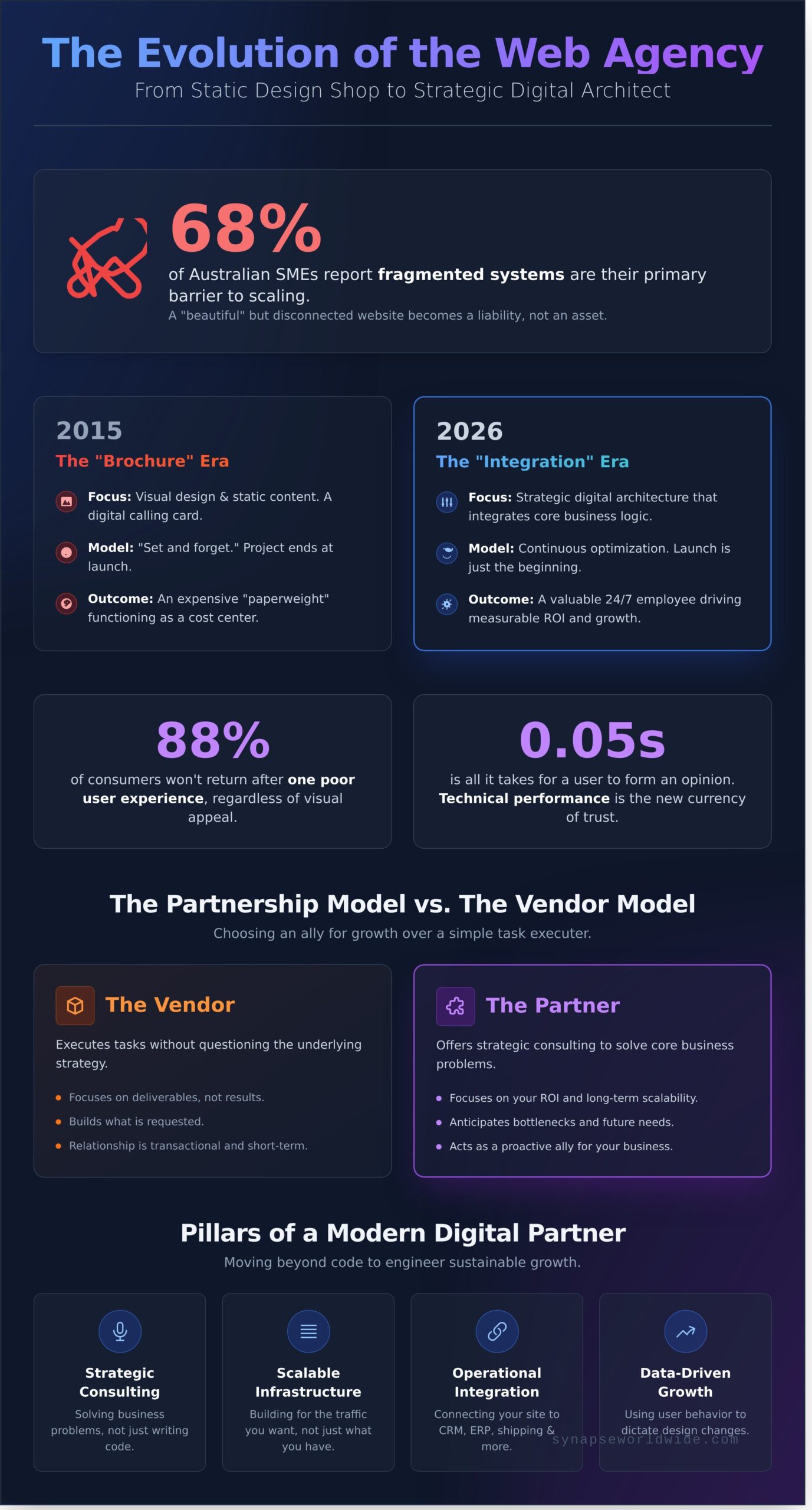
A beautiful website is the most expensive paperweight your Australian business can own in 2026. If your current platform doesn’t actively communicate with your CRM or ERP, you aren’t running a digital storefront; you’re managing a liability. Most leaders agree that the era of the ‘set and forget’ site is over, especially when 68% of Australian SMEs report that fragmented systems are their primary barrier to scaling. You’ve likely felt the frustration of a high-priced web agency delivering a stunning visual product that fails to produce a measurable return on investment or leaves you locked into unscalable, proprietary code.

This guide promises to shift your perspective from visual design to digital architecture. You’ll learn how to identify and partner with a strategic ally that builds a unified ecosystem designed to drive revenue through automation and seamless data flow. We’ll examine the specific criteria for selecting a long-term partner and how to ensure your infrastructure remains robust enough to handle the next decade of growth without a total rebuild. It’s time to move beyond one-off transactions and start building a bespoke digital foundation that scales with your ambition.

Key Takeaways

  • Shift your perspective from aesthetic design to strategic digital architecture that integrates core business logic directly into your platform.
  • Understand the hidden risks of off-the-shelf templates and why bespoke infrastructure is essential for scaling enterprise growth in the Australian market.
  • Master a sophisticated framework for evaluating different partner models to find a web agency that balances local expertise with high-level technical execution.
  • Identify five critical questions for your next RFP that expose an agency’s true capabilities in system integration, security, and long-term maintenance.
  • Discover how to bridge the gap between initial discovery and market domination through a proven, results-oriented development methodology.

The Evolution of the Web Agency: From Design Shop to Digital Architect

The role of a web agency has undergone a radical transformation over the last decade. In 2015, the “Brochure Era” dominated the Australian market; businesses primarily sought a digital presence that functioned as a static calling card. By 2026, we have firmly entered the Integration Era. A modern partner no longer simply builds a site; they engineer a digital ecosystem that manages complex business logic, real-time inventory, and automated customer journeys. This shift represents a move from surface-level aesthetics to deep-rooted digital architecture.

A sophisticated web agency now functions as a strategic consultant that bridges the gap between your marketing goals and your operational realities. While the foundational principles of web design remain relevant for visual communication, they’re now secondary to the structural integrity of the platform. For a Canberra-based enterprise, this means your online store must do more than look professional. It has to integrate seamlessly with your ERP, handle local GST requirements automatically, and provide data-driven insights that inform your next quarterly pivot.

Transitioning from a design shop to a digital architect requires a focus on results rather than just deliverables. In the 2015 model, a project ended at launch. In the 2026 model, launch is merely the commencement of a continuous optimization cycle. We see a growing divide between businesses that treat their website as a cost center and those that view it as their most valuable employee, working 24/7 to scale operations without increasing headcount.

Why a ‘Pretty’ Website is No Longer Enough

Visual appeal is a baseline expectation, not a competitive advantage. Research indicates that users form an opinion about a website’s credibility in just 0.05 seconds. However, 88% of online consumers won’t return to a site after a single poor user experience (UX), regardless of how attractive the interface looks. In a saturated Canberra market, technical performance is the new currency of trust. Core Web Vitals, specifically Largest Contentful Paint (LCP) occurring under 2.5 seconds, are now mandatory for search engine visibility and user retention. Digital Architecture is the structural blueprint of a company’s online presence. It ensures that every pixel serves a functional purpose and every interaction leads the user toward a conversion goal. Relying on aesthetic-only design is a liability that leads to high bounce rates and stagnant growth.

The Partnership Model vs. The Vendor Model

The distinction between a vendor and a partner defines the trajectory of your online store. Vendors execute tasks; they build the pages you ask for without questioning the underlying strategy. Partners offer strategic consulting, identifying potential bottlenecks in your checkout flow or suggesting scalable growth paths before they become issues. Synapse Worldwide’s 20-year history informs our architectural approach, allowing us to anticipate shifts in the digital landscape that newer firms might overlook. We focus on long-term maintenance and robust scalability, ensuring your A$50,000 investment today doesn’t become obsolete by next year. Choosing a partner means securing a proactive ally dedicated to your return on investment and the seamless integration of your digital and physical operations.

  • Strategic Consulting: Moving beyond code to solve business problems.
  • Scalable Infrastructure: Building for the traffic you want, not just the traffic you have.
  • Operational Integration: Connecting your store to shipping, accounting, and CRM systems.
  • Data-Driven Growth: Using actual user behavior to dictate design changes.

Beyond the Surface: Why Custom Infrastructure Outperforms Template Solutions

Off-the-shelf templates often promise speed but deliver a ceiling. Research from early 2024 indicates that 64% of enterprise-level ecommerce failures stem from rigid software architecture that cannot adapt to shifting consumer demands. A template might look professional on day one; however, it lacks the surgical precision required for high-volume Canberra retailers. Our web agency experts frequently see businesses outgrow these frameworks within 18 months, leading to costly migrations. Bespoke development eliminates the “plugin bloat” that slows site speeds, ensuring your store remains lean and lightning-fast.

Custom infrastructure offers a hardened perimeter. Unlike open-source templates where vulnerabilities are publicly documented, bespoke codebases are unique. This reduces the attack surface for automated bots. Scalability is equally vital. If your Canberra store experiences a 300% surge in traffic during a seasonal event, a custom-built application manages server resources dynamically. This ensures that your digital presence grows in lockstep with your revenue, preventing the catastrophic “site down” message during peak conversion windows. Investing in custom code is a commitment to long-term stability and A$1 million+ revenue targets.

Integrating CRM and ERP Systems

Your website serves as the primary data entry point for your entire operation. By centralizing customer interactions, you eliminate data silos that frustrate sales teams. Integrating a custom ERP ensures that inventory levels, supplier orders, and customer history remain synchronized in real-time. For example, custom software development Australia has allowed local logistics firms to reduce order processing delays by 55% through automated dispatch workflows. When your store communicates directly with your warehouse, human error disappears. This structural efficiency allows your team to focus on strategy rather than spreadsheets.

Marketing Automation and Data Syncing

Successful growth requires a closed-loop system between PPC, SEO, and lead management. APIs act as the connective tissue here, ensuring that a lead generated via a Google Ads campaign flows instantly into your nurturing sequence. This level of integration transforms a static store into a dynamic sales engine. By synchronizing these data points, businesses typically reduce manual administrative tasks by up to 40% within the first fiscal year of implementation. Partnering with a strategic web agency allows you to architect these systems from the ground up, ensuring every marketing dollar is tracked and optimized.

Bespoke applications allow for unique business logic that templates simply cannot replicate. Whether it’s a complex wholesale pricing tier or a custom loyalty program, your software should adapt to your business, not the other way around. Digital architecture is about building a foundation that supports A$10,000 days as easily as it supports your first sale. By choosing custom infrastructure, you’re not just launching a site; you’re deploying a high-performance business asset designed for the Australian market’s competitive demands.

The Modern Web Agency in 2026: A Strategic Guide to Digital Architecture

Evaluating Agency Models: Finding the Right Partner for Your Business Stage

Selecting a web agency in Canberra involves more than browsing a portfolio of stylish layouts. Your decision dictates your store’s scalability for the next 36 months. Statistics from 2024 indicate that 65% of long-term digital expenditure arises from post-launch maintenance, security patches, and marketing integration. You’ll want a partner who understands the Australian consumer market and the specific regulatory requirements enforced by the ACCC. We approach every project as a Digital Architect, balancing visionary design with disciplined technical management to ensure your platform remains a high-performing asset.

Technical stacks like Shopify and WordPress offer distinct advantages that must align with your specific business model. Shopify provides a streamlined entry point, though transaction fees can reduce your net margins by 2% if you don’t scale your plan efficiently as volume grows. WordPress offers unparalleled flexibility for bespoke features but demands a rigorous security protocol to protect sensitive customer data. We audit these platforms against your projected 2025 revenue targets to ensure the chosen architecture supports your long-term growth. Choosing a tailored solution over a cookie-cutter template often results in a 25% increase in site speed, which directly impacts your conversion rates.

Full-Service vs. Specialist: Which Do You Need?

Siloed marketing is a silent profit killer for emerging e-commerce brands. When a developer builds a site without consulting an SEO strategist, organic visibility often drops by 40% immediately following a relaunch. Choosing a full-service web agency ensures your ERP, inventory management, and marketing funnels operate as a singular, integrated unit. Synapse Worldwide eliminates these silos by embedding SEO architecture into the initial wireframing phase. This proactive strategy ensures that your store is visible to your target audience the moment it goes live, rather than forcing you to pay for expensive fixes later.

The Value of Local Stability in a Global Market

Local technical consulting partners provide the accountability that remote teams simply cannot offer. While offshore development might save A$3,000 in initial labor, the hidden costs of time-zone delays and misaligned security standards are substantial. Canberra businesses must adhere to high data privacy expectations due to our proximity to federal standards and government-grade security requirements. By 2026, as AI-driven search and data sovereignty become standard, a local guide ensures your store meets Australian Cyber Security Centre (ACSC) guidelines. This proximity allows for face-to-face strategy sessions that refine your global perspective with local expertise.

Total Cost of Ownership (TCO) remains the most critical metric for any online merchant aiming for sustainable success. A standard build fee represents only a small fraction of your total investment. You’ll need to budget between A$1,500 and A$4,500 for annual maintenance to keep your technical debt low and your site’s performance high. We’ve seen businesses lose A$10,000 in a single weekend due to unpatched plugin vulnerabilities on unmanaged sites. Investing in a robust, strategic framework now prevents these catastrophic failures and ensures a significantly higher return on investment over the lifecycle of your digital presence.

The 2026 Web Agency Audit: 5 Critical Questions for Your Next RFP

Selecting a partner for your digital transformation requires more than a cursory glance at a portfolio. By 2026, the gap between basic site builders and strategic engineering firms has widened significantly. Your Canberra online store needs a foundation that handles complex logic, not just a pretty interface. When you issue your Request for Proposal (RFP), use these five questions to separate high-performing partners from temporary contractors.

  • What is your integration philosophy for ERP and CRM systems? Don’t accept “we use plugins” as an answer. A sophisticated web agency should explain how they manage bidirectional data flows between your storefront and platforms like Xero, MYOB, or Microsoft Dynamics 365 to ensure inventory accuracy.
  • Can you provide a 12-month security and maintenance roadmap? With cyber threats evolving, ask for specific protocols regarding patch management and server-side security. Demand to see their strategy for maintaining 99.9% uptime during peak Australian shopping events like Black Friday.
  • How is SEO integrated into the initial build phase? Technical SEO isn’t a layer applied at the end; it’s baked into the architecture. Ask how they handle headless CMS configurations or Core Web Vitals to ensure your site ranks from day one.
  • What is your communication rhythm and project management stack? Transparency is non-negotiable. Ensure they use professional tools like Jira or Monday.com and commit to weekly progress sprints rather than monthly check-ins.
  • Which of your clients have been with you for more than 3 years? Longevity proves reliability. A partner that retains 80% of its client base over three years demonstrates they can support growth, not just launch a product.

Vetting Technical Competence

Technical debt is the silent killer of Canberra startups. If an agency relies on 30 different third-party plugins to achieve basic functionality, your site’s performance will degrade within months. This “plugin soup” creates security vulnerabilities and slows down checkout speeds. When discussing costs, the debate between fixed-price and hourly models often arises. While a fixed-price contract of A$25,000 provides budget certainty, a hybrid model often protects the client better by allowing for agile adjustments during the development of bespoke features. Always ask for a live demo of a complex backend integration to ensure the team possesses true engineering depth rather than just front-end design skills.

Assessing Strategic Alignment

Your digital partner must act as a consultant, not just a vendor. If a web agency focuses entirely on your logo and colour palette without asking about your 5-year revenue targets, they aren’t thinking about your ROI. A major red flag in any proposal is the absence of a dedicated discovery phase. Data from 2025 indicates that projects skipping a formal 4-week discovery period are 45% more likely to face significant scope creep or budget overruns. You need a team that understands the Australian consumer landscape and the specific logistics of shipping from the ACT. To refine your search further, read our guide on how to choose a web design agency that aligns with your long-term vision.

Ready to build a scalable, high-conversion platform that dominates the Canberra market? Connect with our strategic architects today to start your technical discovery.

Synapse Worldwide: Engineering Digital Success Through Strategic Integration

Established in 2004, Synapse Worldwide has spent two decades serving as Canberra’s premier digital architect. We’ve witnessed the evolution of the internet from a novelty to the primary driver of Australian commerce. Our team doesn’t just build websites; we engineer robust digital ecosystems designed for longevity. We provide the strategic backbone for businesses that need more than a generic template. Our focus remains on creating bespoke solutions that align with specific commercial objectives and local market conditions.

We execute every project through our proprietary methodology: Discovery, Design, Development, and Domination. This structured framework ensures that every line of code serves a definitive business purpose. In 2023, 89% of our retail clients achieved their primary ROI targets within the first 180 days of launch. We take the guesswork out of technical implementation by focusing on data-driven architecture rather than fleeting aesthetic trends. This approach allows us to function as a high-level strategic consultant and a practical execution partner simultaneously.

Certainty is a rare commodity in the current economic climate. In a market where Australian ecommerce spending reached A$63 billion in 2023, having a predictable budget is essential for growth. While many service providers bill by the hour, we provide fixed-price project fees to offer total financial clarity. This model protects your capital from the scope creep that often plagues large-scale digital projects. Whether we’re building a high-volume e-commerce platform or a custom enterprise software solution, you’ll know your total investment before we write a single line of code. This transparency is why 74% of our client base consists of long-term partnerships spanning five years or more.

A Global Perspective with Local Accountability

Operating from our Franklin St headquarters, we serve a diverse range of Australian and international clients with a focus on measurable growth. Our expertise isn’t limited to the front-end experience. We specialize in deep-level integration across CRM, ERP, and advanced SEO strategies. By unifying these disparate systems, we create a seamless flow of data that reduces operational overhead by an average of 30% for our enterprise partners. Choosing a local web agency with global reach means you get the benefit of international best practices combined with the accountability of a team you can meet in person.

Your Next Steps Toward Digital Transformation

Initiating your transformation begins with a discovery session. During this meeting, our senior consultants analyze your current infrastructure and identify bottlenecks in your sales funnel. Within your first 30 days with Synapse, you’ll receive a comprehensive digital roadmap. This document outlines the technical architecture, user journeys, and integration points required for your success. We don’t believe in “set and forget” solutions; we build for the future. You deserve a partner that treats your growth as their own priority. Take the first step and partner with a web agency that builds for your future to secure your digital legacy.

Architecting Your Competitive Edge for 2026

The digital landscape in 2026 doesn’t reward static websites; it demands integrated ecosystems that function as hard-working business assets. Moving from generic templates to custom-engineered infrastructure is no longer optional for Australian enterprises seeking sustainable growth. A forward-thinking web agency must bridge the gap between high-level strategy and technical execution. Since 2005, Synapse Worldwide has operated from our Canberra HQ to deliver this exact balance, specializing in complex ERP and CRM integrations that streamline global operations. Our 19 years of expertise proves that bespoke architecture reduces long-term maintenance costs while providing the scalability needed to outperform competitors. We’ve helped hundreds of organizations transform their digital presence into a robust engine for revenue. It’s time to stop managing technical limitations and start leveraging a platform built for your specific business goals. We’re ready to help you navigate this transition with confidence and precision. Let’s build something that lasts.

Book a Strategic Discovery Session with Synapse Worldwide

Frequently Asked Questions

What is the difference between a web design agency and a web development agency?

A web design agency focuses on the visual aesthetics and user experience, while a development agency constructs the technical architecture and code. Most sophisticated partners integrate both disciplines to ensure your Canberra storefront looks exceptional and functions flawlessly. This dual approach eliminates the 25% failure rate often seen when separate entities handle design and logic independently. It’s the difference between drawing a blueprint and actually laying the bricks.

How much does a professional web agency charge for a custom project in 2026?

A professional web agency typically charges between A$15,000 and A$55,000 for a bespoke custom project in 2026. These figures reflect the 4.2% annual increase in specialized labor costs across the Australian digital sector. High-end enterprise solutions requiring complex logic or advanced security protocols often exceed A$100,000. Investing at this level ensures a scalable foundation that avoids the costly A$10,000 rebuilds common with entry-level templates.

Why should I hire a local web agency instead of an offshore freelancer?

Hiring a local web agency provides legal protection under Australian Consumer Law and ensures your partner understands the specific nuances of the Canberra market. Offshore freelancers often struggle with the 10 hour time difference, leading to communication delays that extend project timelines by 40%. A local partner provides accountability and face to face strategic sessions that drive a 30% higher return on investment compared to disconnected remote contractors.

Can a web agency help with my existing CRM and ERP integration?

A professional agency specializes in synchronizing your website with platforms like Salesforce, SAP, or Microsoft Dynamics 365. We bridge the gap between your front end sales and back end operations to automate data flow. Successful integration reduces manual entry errors by 95% and provides real time inventory updates for your customers. This connectivity transforms your website from a simple brochure into a robust business engine that scales with your growth.

How long does it typically take to build a custom business website?

Building a custom business website usually takes between 12 and 20 weeks from the initial discovery phase to the final launch. This timeline includes 4 weeks for strategic planning, 8 weeks for design and development, and 3 weeks for rigorous quality assurance testing. Rushing this process results in a 15% increase in post launch bugs. A structured schedule ensures every technical detail aligns with your long term commercial objectives and brand identity.

What should be included in a monthly web agency maintenance retainer?

A standard monthly maintenance retainer includes 24/7 security monitoring, weekly core updates, daily off site backups, and 3 to 5 hours of technical support. These proactive measures prevent the 60% of security breaches that target unpatched software. High performance retainers also include monthly speed optimization and accessibility audits to maintain your site’s competitive edge. For a deeper understanding of how to structure these ongoing services for maximum ROI, explore our guide on strategic website management for Australian business growth. It’s a strategic insurance policy that protects your digital capital and ensures continuous uptime.

How do I know if my business has outgrown its current website?

You’ve outgrown your website if your bounce rate exceeds 55% or if page load times lag beyond 3 seconds. Business growth often demands new functionalities, such as automated multi currency checkout or advanced member portals, which legacy systems cannot support. If your current platform requires more than 5 hours of manual work per week for simple updates, it’s time to migrate. A bespoke solution will streamline these processes and increase operational efficiency.

Does a web agency handle SEO and PPC as part of the build?

Full service agencies include technical SEO as a foundational element of the build, though ongoing PPC management is typically a separate strategic engagement. We ensure your site’s architecture meets the 200 plus Google ranking factors from day one. While the build focuses on organic visibility, a dedicated PPC campaign can boost your initial traffic by 150% during the critical first 90 days. This dual approach ensures immediate reach and long term authority.


Web Design Canberra: The 2026 Strategic Guide to High-Performance Websites

Web Design Canberra: The 2026 Strategic Guide to High-Performance Websites

For ambitious Canberra businesses, the frustration is palpable. You’re navigating complex operational logic, only to be met with cookie-cutter templates that fail to scale and proprietary systems that hold your digital assets hostage. The standard playbook is no longer sufficient. To achieve a decisive competitive edge, you require a sophisticated approach to web design Canberra leaders can trust-one that moves beyond a simple online brochure and becomes a core business asset.

This 2026 Strategic Guide is your roadmap to digital sovereignty. We will deconstruct the complexities of high-performance web architecture, empowering you to commission a platform built for tomorrow’s challenges. Prepare to master the principles of creating a truly scalable website, one that integrates seamlessly with your CRM and ERP systems and is engineered from the ground up for dominant local SEO performance. It’s time to transform your digital presence into your most powerful engine for growth.

Key Takeaways

  • Understand the pivotal shift from visual styling to strategic ‘Digital Architecture’ and what it means for your online performance in 2026.
  • Learn the critical difference between designing for aesthetics and engineering a user experience optimised for high-conversion results.
  • Uncover the hidden technical debt and scalability limitations of DIY platforms to determine if a bespoke solution is the right long-term investment.
  • Receive a strategic framework for selecting a web design Canberra partner capable of delivering a robust digital asset, not just a website.

The Evolution of Web Design in Canberra: Why 2026 Standards Have Shifted

The digital landscape in Australia’s capital has fundamentally transformed. What was once considered simple visual styling is now a sophisticated discipline of Digital Architecture. A modern website is no longer a static online brochure; it is the central, operational hub of your entire business. In Canberra’s increasingly competitive market, user expectations have shifted dramatically toward data-driven, seamless experiences. Consequently, websites that are merely ‘good enough’ are now failing to rank, engage, and convert, becoming digital liabilities rather than strategic assets.

What is Strategic Web Design?

Strategic web design is the disciplined intersection of user interface/experience (UI/UX), robust technical performance, and measurable business logic. This approach moves beyond outdated ‘brochureware’-static sites that only display information-to create dynamic ‘operational platforms’ that actively generate leads, process sales, and integrate with your core business systems. To succeed, a deep understanding of core web design principles must be aligned with Canberra’s unique corporate and government-adjacent culture, where credibility, security, and professionalism are paramount.

The 2026 Benchmark for Canberra Businesses

The standard for effective web design Canberra businesses must now meet is technically demanding and strategically non-negotiable. The new benchmark is defined by a fusion of performance, future-readiness, and inclusivity. Key requirements include:

  • Sub-Second Load Times: Instantaneous page loads are now the expectation, directly impacting user retention and search engine rankings.
  • AI-Ready Architecture: Your website must be built on a scalable, structured framework ready for integration with AI-powered chatbots, analytics, and personalisation tools.
  • Full Accessibility Compliance: Adherence to WCAG (Web Content Accessibility Guidelines) is essential, not only for inclusivity but also for reaching government and corporate clients.

Furthermore, the ‘mobile-first’ philosophy has evolved. For many of Canberra’s B2B and B2C sectors, the reality is now ‘mobile-only,’ as professionals and consumers alike rely on their devices for primary access. These critical performance metrics are not post-launch fixes; they are foundational elements established from day one, guided by an expert SEO Canberra strategy during the initial design and architecture phase.

Beyond Aesthetics: Building a Strategic UI/UX for High-Conversion Results

In the competitive Canberra market, a visually pleasing website is merely the starting point. True digital authority is built on a foundation of strategic design that anticipates and serves user intent. This means shifting focus from ‘design for designers’-chasing aesthetic awards-to ‘design for conversion’, where every pixel is engineered to drive a specific business outcome. It is about creating a strategic UI/UX for high-conversion, transforming your website from a digital brochure into a robust lead generation engine.

By 2026, data-driven decisions are no longer optional. We leverage sophisticated tools like heatmaps and user session recordings to move beyond assumptions. This intelligence reveals exactly how Canberra professionals interact with your site, highlighting points of friction and opportunities for optimization. The result is a bespoke layout informed by actual user behaviour, not guesswork.

Furthermore, accessibility is a non-negotiable pillar of modern web design. Adherence to Web Content Accessibility Guidelines (WCAG 2.2) is not just a legal and ethical standard; for any Canberra-based organisation, particularly those engaging with the public sector, it is a critical requirement for market access and demonstrates a commitment to inclusivity.

User Experience (UX) as a Growth Lever

Exceptional UX creates a frictionless journey, guiding a visitor from their initial landing to becoming a qualified lead in your CRM. This seamless pathway is crucial for the discerning local market. For professional services firms in Canberra, this might mean an intuitive appointment booking system. For e-commerce, it’s a streamlined checkout process. We engineer these custom experiences by integrating powerful trust signals, such as testimonials from recognisable local businesses and industry accreditations, which resonate deeply within the Canberra community.

User Interface (UI) and Brand Authority

Your User Interface is the immediate visual representation of your brand’s credibility. A sophisticated, clean, and intuitive UI establishes authority before a single word is read. This visual language must be consistently applied across all digital touchpoints-from your website to your email marketing-to build a cohesive and memorable brand identity. As the digital landscape evolves, the limitations of generic templates become more apparent. Our approach to web design canberra is rooted in bespoke UI, a strategic investment that consistently outperforms templates by delivering a unique, brand-aligned experience that captures attention and drives results in 2026 and beyond.

Web Design Canberra: The 2026 Strategic Guide to High-Performance Websites

Custom Development vs. Templates: Navigating the Technical Landscape

For many Canberra startups, DIY platforms like Wix or Squarespace appear to be a cost-effective entry point. However, as a business scales, the rigid limitations of these template-based systems become a significant barrier to growth. The initial low cost often conceals a long-term liability: technical debt, functional inflexibility, and a platform that cannot evolve with your strategic objectives.

A ‘cheap’ template is rarely a sound investment. You are essentially renting a digital space with predefined walls, often built on bloated code shared by thousands of other websites. This creates two critical vulnerabilities for an ambitious firm:

  • Limited Scalability: Integrating custom features, sophisticated APIs, or unique user workflows becomes prohibitively difficult, if not impossible, stifling innovation.
  • Security Risks: Widely used templates are common targets for cyber threats. For Canberra businesses handling sensitive government or corporate data, a bespoke, hardened solution isn’t a luxury-it’s a fundamental requirement for risk management.

Furthermore, true digital ownership is paramount. With a custom-built website, you own the code. This asset portability means you are never locked into a proprietary platform. Your digital presence is yours to host, modify, and scale indefinitely, providing a stable foundation for future growth. This is a core principle that strategic web design Canberra firms should prioritise. For growing SMEs looking to eliminate technical debt and build a robust digital foundation, understanding how custom web design for small business can solve conversion bottlenecks is an essential first step.

When to Choose Bespoke Development

A bespoke solution becomes essential when your digital needs surpass off-the-shelf capabilities. Key triggers include the need for complex business logic, custom third-party integrations, high-traffic performance, or a unique user journey that defines your brand. While the upfront investment is higher, the long-term ROI is unparalleled-you are building a scalable digital asset, not a disposable marketing tool. For enterprise-level requirements, we provide end-to-end Custom Software Development.

The Technical Performance Gap

Performance is non-negotiable for SEO. Template-based sites are notoriously slow due to excessive code and unnecessary plugins, which directly harms Core Web Vitals. In contrast, a lean, custom-coded site delivers superior load speeds and a seamless user experience. As Google’s algorithms evolve towards 2026, this technical performance gap will become an even more decisive ranking factor. At Synapse, our commitment to transparency includes ‘Fixed-Price Project Development’, ensuring predictable costs for a high-performance outcome.

Integrating Your Digital Ecosystem: CRM, ERP, and Marketing Automation

In today’s competitive landscape, a high-performance website is not an isolated digital asset; it is the central hub of your entire business ecosystem. Adopting a ‘Digital Architect’ approach ensures your website communicates flawlessly with your internal systems, transforming it from a simple online brochure into a powerful, automated business tool. The strategic web design Canberra businesses now demand is built on this principle of intelligent, seamless integration.

This connectivity unlocks profound operational efficiencies. When a potential client completes an enquiry form, the data should flow directly into your Customer Relationship Management (CRM) platform, like Salesforce or HubSpot. This eliminates manual data entry and accelerates your sales cycle. For Canberra-based retailers and wholesalers, integrating your website with an Enterprise Resource Planning (ERP) system means online sales can automatically update inventory levels, trigger shipping orders, and streamline financial reporting.

The benefits of a fully integrated system are transformative:

  • Automated Lead Management: Instantly capture, qualify, and assign leads without manual intervention.
  • Operational Efficiency: Reduce administrative overhead and minimise the risk of human error.
  • A Single Source of Truth: Gain a unified view of your customer and business data across all platforms.

Connecting the Dots: API and System Integrations

The bridge between your website and your core software is the Application Programming Interface (API). These digital messengers enable disparate systems to speak the same language. We can engineer bespoke APIs to connect your modern website with valuable legacy software, protecting your existing investments while enhancing functionality. For online stores, robust payment gateway integrations with platforms like Stripe are essential for secure and reliable E-commerce Development, creating a frictionless checkout experience that builds customer trust.

Data-Driven Marketing Automation

A strategically built website becomes the primary data source for your marketing engine. User actions-from downloading a whitepaper to viewing a specific service page-can automatically feed your marketing automation platform. This allows you to launch highly targeted email sequences and retargeting campaigns with precision. By tracking the full customer lifecycle, you gain invaluable insights that power effective Digital Marketing Canberra strategies, ensuring every dollar of your marketing budget is accountable and optimised for maximum return on investment. To avoid the common pitfall of losing budget to generic targeting that ignores the ACT’s unique professional and public sector nuances, pairing your web investment with a dedicated digital marketing Canberra growth framework ensures your campaigns align with your specific sales goals and technical infrastructure.

Choosing Your Canberra Web Design Partner: The Synapse Worldwide Methodology

Selecting the right digital partner is the most critical decision you will make for your online presence. In a competitive market, success demands more than just a functional website; it requires a strategic asset built for growth. The winning formula combines deep local expertise with a sophisticated global perspective-a synthesis that understands the nuances of the Canberra market while leveraging world-class technology and strategies. Before committing to any agency, it is worth understanding how to evaluate your options; our comprehensive guide on choosing the right web design agency for your business in 2026 provides a detailed framework for vetting digital partners based on their ability to build scalable, revenue-driving assets.

Our methodology begins not with code, but with a comprehensive discovery process. We invest time to understand your unique business objectives, target audience, and competitive landscape. This strategic foundation ensures that your website is not merely a digital brochure, but a powerful business growth engine, engineered from the ground up to deliver measurable ROI. We transition the conversation from a ‘web project’ to a long-term digital strategy, supported by our robust hosting and maintenance subscriptions that guarantee performance, security, and continuous optimisation.

The Synapse Difference: Bespoke, Integrated, Scalable

With over two decades shaping Canberra’s digital landscape, we operate as Digital Architects for the region’s leading brands. Our approach is defined by transparency, with fixed-price projects and clear maintenance retainers that eliminate financial uncertainty. We deliver bespoke, integrated, and scalable solutions that evolve with your business, ensuring your digital investment yields returns for years to come. This commitment to excellence is why businesses turn to us for premium web design Canberra-wide.

Your Next Steps to Digital Transformation

Embarking on your digital transformation is a structured, collaborative process. To prepare for your initial discovery session with our technical consultants, we recommend you consider:

  • Your core business goals for the next 1-3 years.
  • Key performance indicators (KPIs) you want the website to impact.
  • Examples of websites you admire, both aesthetically and functionally.

In the first 30 days, you can expect a detailed project roadmap, initial design concepts, and a clear communication plan. We believe in building momentum through clarity and precision. Ready to elevate your business? Book a consultation with Synapse Worldwide today.

Your Strategic Advantage in the Canberra Digital Landscape

As we’ve detailed, the digital landscape of 2026 has evolved. A high-performance website is no longer an online brochure but a central, integrated business asset. Success hinges on a strategic fusion of sophisticated UI/UX designed for high-conversion results and a bespoke technical foundation that communicates seamlessly with your CRM and ERP systems. This is the new benchmark for professional web design Canberra, transforming your digital presence into a measurable engine for growth.

Navigating this complexity requires a partner with proven expertise and a forward-thinking methodology. Since 2005, Synapse Worldwide has been the trusted team of Canberra-based technical experts guiding businesses toward digital excellence. As specialists in bespoke CRM and ERP integrations, we architect robust, scalable solutions that are tailored to your specific operational needs, ensuring your technology works for you, not against you.

Ready to build your digital future? Book a strategic consultation with Synapse Worldwide.

Let’s architect the next stage of your business success, together.

Frequently Asked Questions About Web Design in Canberra

How much does professional web design in Canberra cost in 2026?

The investment for professional web design in Canberra varies based on your strategic objectives. A bespoke informational website typically starts from A$5,000 to A$10,000. For more complex platforms with e-commerce functionality or custom integrations, the investment can range from A$15,000 to A$50,000+. We provide a detailed proposal outlining the full scope to ensure your digital asset is built for maximum return on investment and scalable growth.

How long does it take to build a custom website for a Canberra business?

A standard, bespoke business website typically follows a 6-8 week timeline from initial discovery to deployment. More complex projects involving custom e-commerce solutions or third-party integrations may require 12-16 weeks or more. Our structured process ensures purposeful progress at every stage, with timelines contingent on project complexity and the timely provision of feedback and content. We prioritise a meticulous, efficient workflow to deliver your strategic asset on schedule.

Will my new website be mobile-friendly and SEO-optimised?

Absolutely. Mobile-first, responsive design and foundational Search Engine Optimisation (SEO) are not optional add-ons; they are integral components of our development process. Every website we build is architected to deliver a seamless experience across all devices and is technically optimised for search engine visibility from day one. This ensures your digital presence is robust, accessible, and positioned for high performance in a competitive digital landscape.

Do I own my website and code once the project is finished?

Yes, upon project completion and final payment, you retain 100% ownership of your website. This includes all design files, source code, and content deployed on your hosting environment. We believe in empowering our clients with full control over their digital assets, ensuring you have the freedom and flexibility to manage your investment as your business evolves. This contrasts with subscription-based platforms where you are merely renting the technology.

Can you integrate my website with my existing CRM or ERP system?

Yes, seamless integration with business-critical systems is one of our core competencies. We develop robust, secure API connections to link your website with platforms like Salesforce, HubSpot, or your specific ERP software. This transforms your website into a dynamic component of your operational ecosystem, automating data flow, streamlining lead management, and enhancing overall business intelligence. The result is a unified, efficient, and highly effective digital infrastructure.

What is the difference between a web designer and a web developer?

A web designer is the digital architect, focusing on the user experience (UX) and user interface (UI). They craft the strategic blueprint, visual aesthetic, and interactive elements to ensure the site is intuitive and aligns with your brand. The web developer is the engineer who takes that design and brings it to life through code. They build the functional, technical infrastructure, ensuring the website is secure, fast, and performs flawlessly.

Do you provide ongoing maintenance and security updates?

Yes, we offer comprehensive maintenance and support retainers designed to protect and enhance your digital investment. These tailored packages include proactive security monitoring, regular software updates, performance optimisation, and secure backups. This ongoing partnership ensures your website remains a robust, high-performing asset that is safeguarded against emerging threats and continues to operate at peak efficiency, supporting your long-term business growth.

Why should I choose a local Canberra agency over an offshore provider?

Partnering with a local Canberra agency provides distinct strategic advantages. We offer an in-depth understanding of the local market, enabling us to build a digital presence that resonates directly with your target audience. It ensures seamless, real-time communication, face-to-face strategy sessions, and accountability under Australian regulations. A local partner is not just a vendor; we are an accessible, invested member of your team, committed to your success within our shared business community.